It’s possible that I shall make an ass of myself. But in that case one can always get out of it with a little dialectic. I have, of course, so worded my proposition as to be right either way (K.Marx, Letter to F.Engels on the Indian Mutiny)
Friday, October 10, 2025
Danish wind giant Orsted to cut workforce by a quarter
Offshore wind giant Orsted said its global workforce would fall from 8,000 today to 6,000 by the end of 2027 - Copyright AFP Jean-Christophe VERHAEGEN
Danish offshore wind energy giant Orsted announced Thursday plans to cut 2,000 jobs, or a quarter of its workforce, by 2027 as its business struggles in the United States.
The company said it needed to focus more on its European business and offshore wind, as well as improve its competitiveness.
“We’re committed to maintaining our position as a market leader in offshore wind, and we need to ensure that offshore wind becomes a key element of Europe’s future energy mix and green transition,” chief executive Rasmus Errboe said in a statement.
“Therefore, we also need to reduce our costs for developing, constructing, and operating offshore wind farms to strengthen our competitiveness,” he added.
The company said its global workforce would fall from 8,000 today to 6,000 by the end of 2027 “through natural attrition, a reduction of positions, divestment, outsourcing, and redundancies.”
Orsted said Monday it had raised $9.4 billion in a rights issue aimed at bolstering the struggling company amid US President Donald Trump’s opposition to the wind power sector.
'It's gone': Sheriff 'devastated' as 19 missing in blast at explosives facility
Law enforcement officers guard a gate outside the Accurate Energetic Systems military explosives plant, after an explosion at the facility in Bucksnort, Tennessee on Oct. 10, 2025 in a still image from video. ABC Affiliate WKRN via REUTERS.
A Tennessee sheriff who was asked to describe the scene of the blast at a remote explosives facility on Friday said, "It's gone" as 19 people remain missing.
"There's nothing to describe. It's gone. It's the most devastating scene I've seen in my career," Humphreys County Sheriff Chris Davis said.
Authorities are still reaching out to families of the 19 missing, who are feared dead, The Associated Press reports. The Accurate Energetic Systems (AES) facility in Bucksnort, Tennessee, exploded early Friday. The company produces and stores explosives, including demolition kits and products used by the military and aerospace industry, according to its website.
The cause of the explosion is unknown. The investigation is expected to take several days.
Humphreys County Sheriff Chris Davis waxes emotional as he speaks to media following a large, deadly explosion at an Accurate Energetic Systems bomb factory in Bucksnort, Tennessee on October 10, 2025. (Photo by Brett Carlsen/Getty Images)
19 Workers Missing and Feared Dead After Massive Blast Rocks Tennessee Bomb Factory
It was the third explosion or fire to occur at an Accurate Energetic Systems facility since 2014.
This is a developing story... Please check back for possible updates.
Nineteen people are missing and feared dead after a massive blast tore through a military explosives manufacturing plant in rural Tennessee on Friday morning.
Humphreys County Sheriff Chris Davis told reporters that a “very devastating blast” rocked the Accurate Energetic Systems (AES) facility in Bucksnort, about 60 miles southwest of Nashville, at approximately 7:45 am local time. Davis said the explosion—which rattled homes miles away—destroyed an entire building, and that multiple people died in the blast.
“I thought the house had collapsed with me inside of it,” local resident Gentry Stover told The Associated Press. “I live very close to Accurate and I realized about 30 seconds after I woke up that it had to have been that.”
Hickman County advanced emergency medical technician David Stewart told the AP that emergency responders could not yet go into the building due to continuing secondary explosions.
One AES worker told The Tennessean that the blast occurred in the melt pour building, which the employee said usually has less than 30 people inside during work hours.
As the newspaper reported: The daily process of making bombs involves melting the explosives in large kettles, transferring the melted material into cannisters, packing the cannisters into boxes, stacking the boxes on palettes, and loading the palettes into trucks, the employee said.
AES makes mines for the US Army and demolition charges for the Air Force. In addition to the Department of Defense, AES clients have included the Department of Homeland Security, Department of Justice, and NASA.
This isn’t the first disaster to occur at an AES facility. In 2014, an explosion at the company’s McEwen, Tennessee munitions factory killed one person and injured three others, and in 2020, a fire broke out at the Bucksnort plant.
SPACE/COSMOS
Is Space-Based Solar Power Finally Ready to Shine?
Space-based solar power, a long-envisioned technology, is gaining momentum as a crucial solution to meet growing energy demands and achieve decarbonization targets.
This technology offers significant benefits, including 24/7 high-intensity sunlight collection, potential for substantial reductions in land-based renewable energy and battery storage needs, and lower overall energy system costs.
Despite its promise, space-based solar power faces challenges in financing long-term infrastructure projects, with startups increasingly relying on government contracts to scale the technology.
Scientists have dreamed of putting solar panels in outer space since the late 1960s, and have known that space-based solar power was technologically feasible since the 1970s. But the true race for space-based solar has only just begun, driven by the intensifying need to produce more electricity to meet rapidly growing energy demand. As more of the world becomes electrified, big data and AI become omnipresent, and decarbonization deadlines draw closer, innovative energy solutions are needed more than ever. As a result, space-based solar power is finally ready for its day in the sun.
This nascent technology employs enormous satellites to collect high-intensity sunlight and beam it down to Earth, either through microwaves or lasers. A receptor on Earth receives that energy and converts it into electricity to be fed into the grid. This energy would be dispatchable, as satellites would have gargantuan range and could flexibly beam energy to where the demand is greatest.
The production potential of space-based solar power is enormous. Because the panels are situated beyond clouds and the atmosphere, and are not impacted by the rotation of the earth, they receive high levels of unadulterated sunlight 24 hours a day, 7 days a week. As a result, these systems are capable of producing a potentially game-changing amount of clean energy.
According to calculations by researchers from King’s College London, space-based solar power could reduce Europe’s need for land-based renewable energy by as much as 80 percent, and reduce battery-based energy storage needs by more than two-thirds. The kicker? It would reduce the cost of Europe’s energy system by as much as 15 percent. The researchers found that the associated savings in terms “energy generation, storage and network infrastructure costs” would save an estimated 35.9 billion euros (41.7 U.S. Dollars) per year.
The higher energy density of space-based solar means that energy systems would need far fewer costly resources. Such a system “requires orders of magnitude fewer critical minerals to provide the same continuous power as a terrestrial solution with large-scale energy storage,” reads a recent article from the World Economic Forum. “This offers a more sustainable path, alleviating the strain on resources that the International Energy Agency (IEA) has identified as a key challenge,” the report continues.
Critically, these systems would also require far, far less land than Earthbound solar farms. Not only would we be outsourcing solar panels to outer space, the receptors that receive the solar energy here on Earth would be relatively small and mostly transparent, meaning that they would be well-suited to mixed-use spaces. This would alleviate intensifying issues of land scarcity faced by utility-scale renewable energies.
As the considerable benefits of space-based solar gain more attention, investment in their development has ramped up considerably. Labs in the United States, the United Kingdom, China, Japan, Europe, and other locations around the globe are all accelerating their research programs to advance space-based solar power, and high-profile private investors are now joining the trend as well. Big tech bigwig Baiju Bhatt, a co-founder of Robin Hood, launched the space solar startup called Aetherflux last year.
But space-based solar power still faces some key hurdles before it can be scaled for commercial use. The most significant of these, according to the World Economic Forum, is the way that private finance is structured around early-stage startups and not long-term infrastructure projects. While space-based solar power will be a big money saver in the long term, it will not provide quick or necessarily predictable returns on investment.
For this reason, startups are looking to government contracts to get space-based solar power off the ground. "We think that the military customer is large enough — and for lack of better word, difficult enough — of a customer that if we can serve, we can build a constellation and we can be at scale, Christian Garcia, managing partner at Breakthrough Energy Ventures, one of Aetherflux’s backers, told CNBC. “And at that point, we will have dropped the cost of the technology such that we can expand into other customers."
Karagussova, who has more than 25 years of experience in media, distribution and event management, is the co-founder of Portals, a project combining digital self-regulation tools with science and art.
Kazakhstan is famed for the Baikonur Cosmodrome, from where the first human to reach space, Russian cosmonaut Yuri Gagarin, was launched in 1961.
The reusable New Shepard suborbital rocket system is to take Karagussova – as well as American entrepreneur Jeff Elgin, engineer Clint Kelly III, startup founder Aaron Newman, Ukrainian businessman Vitalii Ostrovsky and one participant who has opted to remain anonymous – on an 11-minute journey. The astronauts, after being launched from West Texas, will soar past the Karman line (100 kilometres/62 miles above mean sea level it is a conventional but not universally accepted definition of the edge of space), and experience several minutes of weightlessness, while witnessing views of Earth.
The vehicle is fully autonomous—there are no pilots.
The NS-36 launch will be Blue Origin’s 15th crewed mission. To date, the company’s spacecraft have carried 75 people.
Blue Origin was created by Amazon founder Jeff Bezos.
The space crew isolation experiment is the first in Kazakhstan to have an all-women "crew" (Credit: gov.kz).
Kazakhstan, meanwhile, has initiated its first long-term crew isolation experiment simulating space flight that involves an all-women “crew”.
Research project SANA-1 was formally launched at the National Space Centre on October 1, The Times of Central Asia has reported.
The initiative is being carried out by the Aerospace Committee of the Ministry of Artificial Intelligence and Digital Development in partnership with Eurasian Space Ventures and several leading national scientific and educational institutions.
The all-female "crew" of four specialists is drawn from organisations under the Aerospace Committee. They are Yuliya Bakirova, who serves as commander, Assem Kuandyk, Daria Komarova and Linara Zhadygerova. The group will spend 10 days inside a spacecraft simulator built by Eurasian Ventures Group, created at the initiative of cosmonaut and Hero of Kazakhstan Aidyn Aimbetov, according to the ministry’s press service.
During the mission, the team will carry out a range of studies on medical and psychological factors, as well as team dynamics, alongside a set of educational experiments. The scientific programme is led by Alina Gutoreva, a PhD in psychology and head of the AI Lab at the Kazakh-British Technical University.
SANA-1 represents Kazakhstan’s first integrated study combining psychological, medical and engineering aspects of human spaceflight. Officials said the project is intended to strengthen the country’s space research capabilities, inspire younger generations to pursue careers in science and technology, and underscore the role of women in research.
The all-female participation is presented as a milestone for gender equality and a step towards preparing Kazakhstan’s own researchers for future space missions.
EU tariffs to hit Serbian steel industry
Serbia's Smederevo steel plant employs around 5,000 people, with 20,000 more indirectly dependent.
Serbia’s President Aleksandar Vucic said on October 9 that European Union steel tariffs will hit the country’s Smederevo ironworks, owned by China’s Hbis Group, and warned that the measures could weaken Serbia’s attractiveness for foreign investment.
In an extraordinary public address, Vucic said the EU’s planned reductions in steel import quotas and higher tariffs would put the steel plant — which employs around 5,000 people, with 20,000 more indirectly dependent — under severe pressure. The European Commission plans to halve quotas for steel imports from outside the EU, with excess imports facing doubled customs duties, from 25% to 50%.
“None of us can withstand that, but neither can European car manufacturers,” Vucic said, referring to opposition from automakers relying on cheaper steel imports. He added that he would appeal to European Commission President Ursula von der Leyen to exempt Serbia, a candidate country for EU membership, from some of the tariffs.
Vucic also linked the EU tariffs to broader challenges for Serbia’s investment climate, citing rising labour costs and the “intentional and calculated destruction of universities and dual education” in the past year, referring to a year of anti-government protests.
Separately, Vucic addressed the start of US sanctions on Serbia’s Oil Industry (NIS), majority-owned by Russia’s Gazprom group. He said the measures would affect citizens but that Serbia has taken steps to ensure energy security. The NIS refinery can operate without oil flows until November 1, he said.
“The sanctions are expected but very bad news for all citizens,” Vucic said, adding that they were aimed at exerting financial pressure on Russia rather than Serbia’s leadership. He confirmed ongoing discussions with Russian and American officials to mitigate impacts.
US sanctions on NIS were first announced in January due to Russian ownership but delayed until October 8. The US embassy in Belgrade said the measures were intended to pressure Russia to end the war in Ukraine and urged Serbia to reduce Russian stakes in its key energy assets.
Dwindling Gas Reserves Threaten Colombia's Economy and Power Grid
Colombia is experiencing a severe energy crisis driven by a significant decline in natural gas production, which has reached its lowest level in over a decade, and rapidly depleting proven natural gas reserves.
The country's reliance on natural gas for electricity generation, coupled with climatic events like the El Niño phenomenon impacting hydroelectric power, has led to increased pressure on the power grid and a surge in liquefied natural gas imports.
President Gustavo Petro's policies, including a ban on new hydrocarbon exploration contracts, are contributing to the worsening shortfall in domestic natural gas supply, making Colombia increasingly dependent on foreign sources.
Strife-torn South American country Colombia is not only suffering from a new wave of violence but is also facing an energy crisis. Dwindling oil and natural gas production is crimping domestic energy supplies and impacting Colombia’s troubled economy. There is a grave threat of a serious natural gas shortage. A lack of exploration drilling, diminishing reserves and plummeting production are weighing on economically crucial natural gas supplies. The shortage of fossil fuel is exacerbated by rising consumption and natural gas’s increasingly vital role in Colombia’s energy mix.
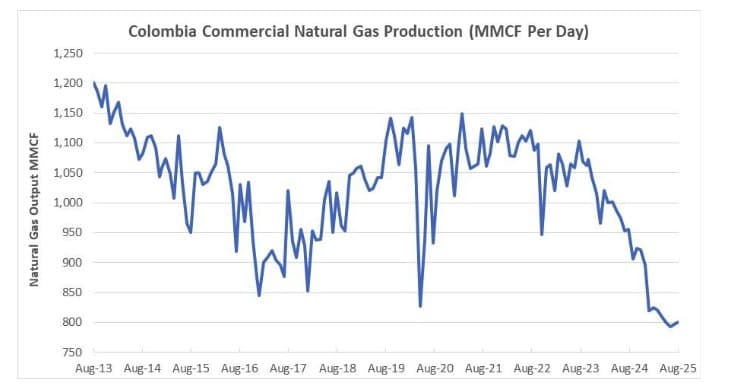
Government data shows Colombia’s natural gas production for August 2025 plunged 16% year over year to 800 million cubic feet per day. The severity of this sharp decline is highlighted by Colombia’s current natural gas production being at its lowest level in over a decade and around 33% less than 2013 natural gas output, as shown below.
Source: Colombia’s National Hydrocarbons Agency (ANH).
Indeed, industry insiders, government officials and economists have long stressed Colombia’s pressing need to produce more natural gas, particularly with consumption soaring higher. Over a decade ago, those pundits opined that production of one billion cubic feet of natural gas per day was the minimum economically viable volume.
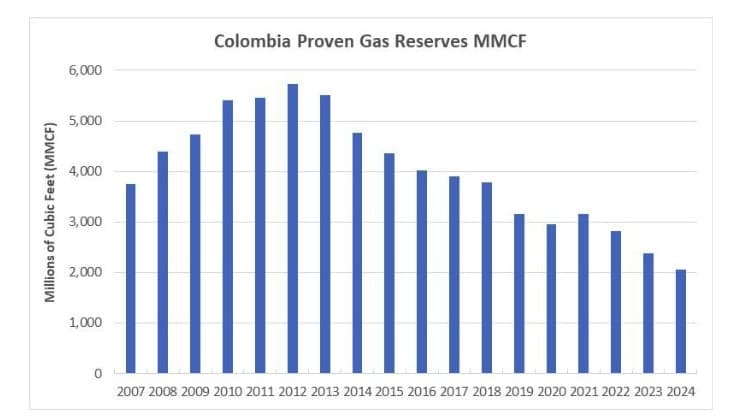
Colombia’s natural gas reserves are also failing to keep pace with domestic demand. Data from the National Hydrocarbons Agency (ANH) shows that at the end of 2024, Colombia’s proven natural gas reserves stood at just under 2.1 billion cubic feet. This represents a whopping 13% decrease compared to a year earlier. It is the lowest level in over a decade, with those reserves forecast to only last another 5.9 years at the current rate of production. ANH data, set out in the graph below, shows natural gas reserves have declined every year, except for 2021, since 2012.
Source: Colombia National Hydrocarbons Agency (ANH).
Colombia’s proven natural gas reserves will continue to decline at an accelerated rate due to rapidly growing consumption and a lack of hydrocarbon exploration and discoveries in the country. In fact, according to El Colombiano, Colombia has consumed 4,628 billion cubic feet of natural gas over the last decade but only replaced 824 billion cubic feet of the natural gas reserves consumed. The reserve replacement ratio will continue to fall due to the lack of exploration drilling and major discoveries.
Most natural gas produced in Colombia is associated gas derived from oil production. Drillers capture this natural gas, which is a byproduct of lifting petroleum, and reinject it into oil wells to boost reservoir pressure, thereby enhancing recovery. This is an increasingly important oil extraction technique in Colombia because of the rising number of mature oilfields where production has peaked and entered a steady decline. The number of mature wells and decline rates will only increase because President Gustavo Petro has decidedto ban exploration drilling by not awarding new contracts.
Those developments underscore the urgency with which Bogota needs to implement initiatives to boost hydrocarbon exploration, expand proven reserves and increase production. Yet, Colombia’s leftwing President Petro, after taking office in August 2022, not only ceased to award new oil contracts but also implemented various policies designed to reduce the country’s dependence on fossil fuels and extractive industries. President Petro made this decision despite natural gas being recognized globally as the fossil fuel of choice due to its low carbon emissions, in order to support the clean energy transition.
Sharp declines in natural gas reserves and production pose a significant threat to Colombia’s power grid. The Andean country, while generating 58% of its electricity from hydroelectric plants, is highly reliant upon natural gas-fired power stations. Regular fluctuations in water levels, caused by climatic events and consequently affecting electricity production, place considerable pressure on an electricity grid already stretched beyond capacity. Indeed, brownouts and blackouts are commonplace across many parts of Colombia’s stretched electric grid, particularly during periods of limited rainfall.
Until early 2025, a severe two-year-long drought, caused by the El Niño climate phenomenon, led to a sharp reduction in electricity production due to plummeting water flows at Colombia's hydro plants. This drought was so severe that the Mayor of Bogota, Carlos Galán, was forced to introduce water rationing. This pushed the national government to seek other sources of natural gas, as local production was incapable of meeting the additional demand.
The sharp decline in natural gas production is so severe that after decades of self-sufficiency, Colombia no longer extracts enough of the fossil fuel to meet its needs. By 2016, Bogota was forced to start importing liquified natural gas (LNG). Cargoes of the fuel that year, according to the IEA, totaled 429 million cubic feet. LNG imports continue to soar higher, with data from S&P Global showing cargoes hit a record high of 94 billion cubic feet in 2024, almost triple the 36 billion cubic feet imported a year earlier. That means the imported fossil fuel now accounts for around a fifth of all natural gas consumed in Colombia.
It was Colombia’s harsh two-year drought, from 2023 to early 2025, that drove the massive increase in LNG imports during 2024. This severe weather event, triggered by the El Niño climate phenomenon, caused water levels at Colombia’s hydro-plants to plummet sharply, impacting electricity supply. That forced the government to increase the importation of LNG to fuel three gas-fired power plants in Colombia’s north, boosting electricity generation at a crucial moment as hydro power fell significantly.
While the drought ended some months ago, the main industry trade body, The Colombian Natural Gas Association (Naturgas), believes LNG imports will keep climbing. The industry association projects that by 2029, Colombia will be forced to import 56% of all natural gas consumed domestically. According to Naturgas, it is plummeting supply and not rising demand, which is responsible for the widening shortfall. This is due to a lack of exploration drilling to identify new reservoirs, which, along with falling investment, will prevent the development of the new natural gas fields required to boost production.
Spanish energy company Repsol announced it has achieved industrial-scale production of gasoline derived from 100% renewable sources at its complex in Tarragona, Spain, according to a company press release.
The new fuel, branded Nexa 95 Gasoline of 100% renewable origin, is compatible with existing gasoline vehicles without engine modifications and reportedly reduces net carbon dioxide (CO2?) emissions by more than 70% compared to conventional gasoline.
The fuel is currently available at 20 service stations in Spain, primarily in the Madrid and Catalonia regions. Repsol expects to expand availability to 30 stations by the end of the year, including locations in Tarragona, Valencia, Zaragoza, and Bilbao. The company is adding the renewable gasoline to its existing lineup of renewable fuels, which includes a 100% renewable diesel product.
The development marks a step in the ongoing efforts by refiners to decarbonize the transportation sector using existing vehicle infrastructure. Repsol highlighted the significance of renewable liquid fuels, noting that combustion engine vehicles—gasoline, diesel, and hybrid—represent 97% of the Spanish and European vehicle fleets.
The company also used the announcement to address the proposed European Union (EU) regulation on CO2? emission standards, which includes a potential ban on the sale of new combustion engines by 2035. Repsol suggested that the role of 100% renewable fuels should be re-evaluated within the EU's climate targets.
The press release SUGGESTS that the uncertainty created by the potential ban has contributed to the aging of Spain's vehicle fleet, which has an average age of 14.5 years. Repsol stressed the need for long-term targets and a favorable tax framework for renewable fuels to drive investment, similar to policies already in place for the aviation and maritime sectors.
Repsol’s industrial process in Tarragona, which resulted from over 20 years of research, was developed in collaboration with Honeywell. The company's strategy for decarbonizing mobility involves a combination of solutions, including electrification, renewable hydrogen, and renewable fuels.
Repsol is already operating a large-scale plant in Cartagena, Spain, focused exclusively on producing sustainable aviation fuel (SAF) and renewable diesel. A second plant is scheduled to open at its Puertollano complex in 2026 with an annual capacity of approximately 200,000 tons of renewable fuel for road and maritime transport.
Repsol has established supply agreements for renewable fuels with several heavy-duty transport, passenger transport, and maritime operators across Spain and Portugal, including Scania, Alsa, and Royal Caribbean, in addition to agreements with commercial airlines such as Iberia and Ryanair for sustainable aviation fuel.