Sunday, September 07, 2025

WATER WAR 

Ethiopia set to inaugurate $4bn mega-dam as Egypt, Sudan renew strong objections

Ethiopia set to inaugurate $4bn mega-dam as Egypt, Sudan renew strong objections
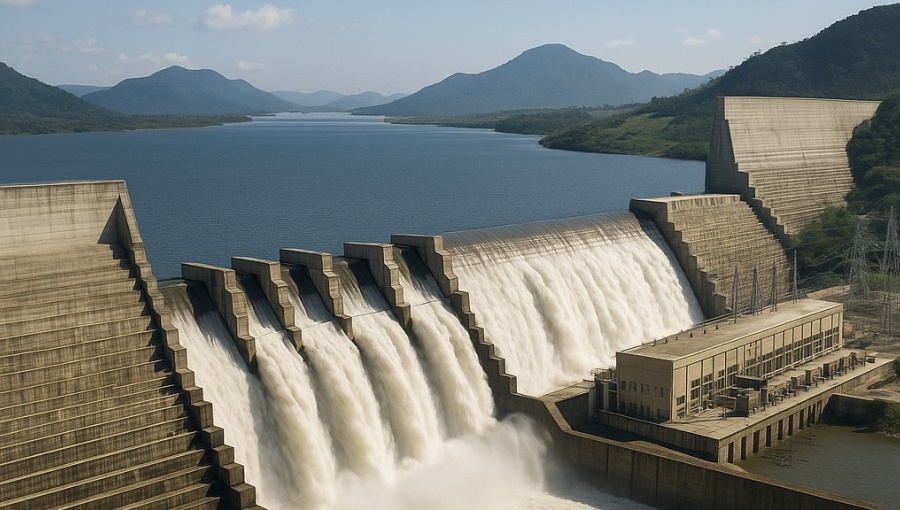
Heavily dependent on the Nile for agriculture and drinking water, Egypt fears the GERD undermines its historic share of the mighty river / bne IntelliNews
By Brian Kenety September 7, 2025

Ethiopia is preparing for a true "watershed moment", with plans to officially inaugurate its $4bn Grand Ethiopian Renaissance Dam (GERD) on September 9, just ahead of the start of the Ethiopian New Year and the end of the rainy season in the landlocked East African country.

Prime Minister Abiy Ahmed in early July declared construction finished on Africa’s largest hydroelectric project – nearly 15 years in the making – hailing it as the "crowning achievement of a generation", and extending invitations to Egypt and Sudan to attend the ceremony.

Hours later on that same July day, Egypt’s Minister of Irrigation reaffirmed Cairo’s categorical rejection of Ethiopia’s continued unilateral actions concerning the Nile River.

Ahead of this week’s ribbon-cutting ceremony on the GERD, Ethiopia’s two downstream neighbours raised fresh objections to the project, calling the mega-dam a “threat” to water security and regional stability erected in “violation of international law”.

Addis Ababa roundly rejects these claims, insisting that regulated releases from the GERD – built on the Blue Nile River in the Benishangul-Gumuz region, about 30km from the Sudanese border – mean it will not substantially reduce the flow of water.

Work on the dam began in 2011, and it has been generating electricity since 2022 through phased commissioning. Once fully operational, it is expected to reach an installed capacity of around 5,150 megawatts (MW), based on its 13 turbines (2 × 375 MW and 11 × 400 MW), roughly doubling current capacity and creating scope for regional power exports to neighbouring countries such as Kenya and Djibouti.

Prime Minister Abiy Ahmed described the GERD as “a symbol of Ethiopia’s resilience and capacity,” according to BBC News. State media referred to the mega-dam as “a monument of Africa’s renaissance,” underscoring its political significance at home, where it is a source of national pride.

According to Capital Ethiopia, about 91% of the project’s financing – which some news outlets estimate cost $5bn or more – came from the state-owned Commercial Bank of Ethiopia (CBE), with the remainder covered by domestic contributions and bond sales. Ethiopian businesses, citizens, and its diaspora, all rallied to fund its construction over the past decade.

Chinese lenders, including the Export-Import Bank of China, contributed targeted financing for turbine and electrical system costs. Ethiopian officials said the bulk was funded domestically as part of a deliberate strategy to limit external debt exposure.

From the start, Ethiopia’s downstream neighbour Egypt was opposed to the GERD being built, citing fears the project threatens its historic and vital share of Nile waters, which underpin agriculture and livelihoods for over 100mn people who live near its shores.

Cairo, which relies on the Nile for 97% of its water needs, argues that Addis Ababa acted unilaterally in constructing and filling the dam, bypassing long-standing treaties (which Egypt considers binding but Ethiopia does not recognise) and ignoring calls for a binding legal framework on water releases, drought management, and reservoir operations.

Egyptian officials say the lack of safeguards creates an existential risk to its water security and undermines the historic order of Nile governance, not least its share of Nile waters set under colonial-era treaties. Sudan, another downstream neighbour, has taken a more ambivalent stance over the years, but often publicly sided with Egypt.

“The Ethiopian dam, in violation of international law, entails serious consequences for the two downstream states and represents a continuous threat to stability in the Eastern Nile Basin,” reads a joint statement from Egypt and Sudan, issued on September 3, during the second round of their 2+2 Consultative Mechanism in Cairo, as quoted by The Reporter (Ethiopia).

Ethiopia secured the support of upstream nations, including Uganda, after the Cooperative Framework Agreement (CFA) on the equitable use of Nile Basin waters entered into force in October 2024. The accord was ratified by six members of the 10-country Nile Basin Initiative — Ethiopia, Rwanda, Tanzania, Uganda, Burundi and South Sudan.

The CFA, first signed in 2010, provides a legal basis for upstream states to pursue water projects without Egypt’s prior approval. Cairo and Khartoum refused to ratify the deal, warning it undermines their historic rights to Nile flows guaranteed under colonial-era treaties.

Diplomatic negotiations, supported at times by the African Union and the United States, have yet to produce a lasting water-sharing deal. Cairo continues to press for a treaty-based arrangement rooted in the 1929 Anglo-Egyptian Treaty and the 1959 Nile Waters Agreement, which Ethiopia does not recognise.

Africa holds some of the world’s richest hydropower resources, yet its vast potential remains largely untapped. According to the International Hydropower Association’s (IHA) 2025 World Hydropower Outlook, the continent has only harnessed about 11% of its technical potential, despite hydropower already contributing around 20% of Africa’s total electricity generation.

GERD at a glance

  • Full name: Grand Ethiopian Renaissance Dam (GERD)
  • Location: Blue Nile, Benishangul-Gumuz region, ~30km from Sudan border
  • Project cost: ≈ $4bn (some estimates $5bn+)
  • Funding: 91% by Commercial Bank of Ethiopia; balance from domestic bonds and contributions; partial turbine/electrical finance from China Exim Bank
  • Construction start: 2011
  • Declared completion: July 2025 (civil works finished; commissioning ongoing)
  • Inauguration: September 9 (ahead of Ethiopian New Year)
  • Capacity: 5,150 MW (phased commissioning since 2022)
  • Significance: Africa’s largest hydroelectric project
  • Regional context: Ethiopia aims to become an energy exporter; Egypt and Sudan warn of risks to Nile water security


WWIII

China accused of escalating Taiwan tensions with oil drilling in disputed waters

China accused of escalating Taiwan tensions with oil drilling in disputed waters
/ FUJIDUDEZ - Unsplash
By bno - Taipei Office September 8, 2025

China has been accused of intensifying its pressure campaign on Taiwan after installing drilling platforms and energy vessels inside the island’s exclusive economic zone (EEZ) Oilprice.com reports. The move, linked to the state-owned China National Offshore Oil Corporation (CNOOC), is being interpreted by analysts both inside and outside the region as a major escalation of Beijing’s “grey-zone” strategy – tactics designed to test Taiwan’s resilience without crossing into outright warfare.

Taiwan already sees daily moves by China to intimidate with flights into Taiwanese airspace and Chinese naval vessels circumnavigating the main island of Taiwan.

In recent weeks, Taiwanese military surveillance has detected at least a dozen CNOOC vessels and fixed structures operating within Taiwan’s EEZ, according to reports cited by The Guardian. Among them is a drilling platform just 50km from waters surrounding the Pratas Islands, which are controlled by Taiwan. Steel “jackets” which serve as the foundations of offshore oil rigs have also been spotted the report adds.

This latest step in an ongoing campaign against Taiwan by Beijing now indicates a shift towards embedding permanent infrastructure in disputed areas, effectively normalising China’s presence in Taiwan’s waters and in turn allowing China to ‘steal’ Chinese energy sources.

The Global Taiwan Institute argues that these “grey-zone” tactics are designed to probe Taipei and its allies, stretching their ability to respond while avoiding a conventional confrontation. The approach also helps Beijing incrementally expand its reach under the cover of ambiguity.

Taiwan’s energy dependence at present leaves it acutely exposed to Chinese coercion. Domestic production of gas and oil is negligible and imports supply virtually all the island’s oil, gas and coal. This vulnerability was only added to in May when the ruling Democratic Progressive Party in Taipei shut down its last nuclear power plant, fulfilling a campaign pledge made after Japan’s 2011 Fukushima disaster.

As such, Beijing now appears to be exploiting this reliance. Taiwan’s EEZ offers some potential hydrocarbon resources, but China’s activity risks blocking Taipei from accessing them.

A think tank in Washington earlier in the year modelled the potential consequences of a blockade. A series of 26 wargames conducted by the Center for Strategic and International Studies (CSIS) concluded that Taiwan’s natural gas reserves would be exhausted within 10 days of maritime disruption the Oilprice.com report adds. Coal stocks would run dry in just seven weeks, and oil supplies in roughly 20 weeks. In short, Taiwan would be crippled by any form of Chinese blockade. It is not an issue on the minds of many in Taiwan however, and rarely features in news or public opinion debates.

But the implications for the island’s grid would be severe, with electricity output potentially dropping to one-fifth of normal levels. To this end, China’s attempted installation of oil and gas rigs so close to Taiwanese territory is seen not only as a challenge to sovereignty but also as a calculated reminder of Taiwan’s energy fragility.

And by placing energy platforms in contested waters, China is signalling both defiance of international rulings and a willingness to tighten the squeeze on Taiwan.

The installation of CNOOC platforms may appear technical – for now - but for Taiwan the strategic risks are stark.


Black youth, especially Black girls, use mental health services less than their White peers


Canadian Medical Association Journal


Black adolescents with mental distress are less likely to use mental health services than their White peers, and Black girls are the least likely to access care, according to new research published in CMAJ (Canadian Medical Association Journalhttps://www.cmaj.ca/lookup/doi/10.1503/cmaj.241733.

“Adolescence is a crucial developmental stage and a critical period for onset of mental health problems,” writes Mercedes Sobers, a PhD candidate in epidemiology at the Dalla Lana School of Public Health, University of Toronto and research coordinator at the Centre for Addiction and Mental Health (CAMH), Toronto, Ontario, with coauthors. “In Canada, Black adolescents disproportionately access services through crisis situations, such as justice system interactions or when intensive care is required, suggesting they are less likely to access mental health care until intense intervention is needed.”

There is a lack of data on mental health services usage in Canada for Black youth and other racialized populations.

The study, which included data on 12 368 middle- and high-school students (grades 7–12) who identified as Black or White from the 2015, 2017, and 2019 Ontario Student Drug Use and Health Survey, encompassed schools from as many as 52 school boards in Ontario. It included students from English and French schools in both the public and Catholic systems from the Greater Toronto Region, Northern, Western and Eastern Ontario.

The researchers found distinct trends for Black males and females. Black females consistently used mental health services less than their White peers, with the gap widening as their distress increased. Although Black males with low distress were more likely to use services than their White counterparts, once their distress increased to moderate levels, their odds of service use dropped significantly. In general, Black youth (both male and female) who were more distressed were less likely to report using services than their White peers.

“Black adolescent mental health must be discussed with consideration of the interaction between being Black, sex, and mental distress,” write the authors.

Many barriers may reduce access to care, such as a lack of culturally competent care, inaccessible services, racism, and cultural stigma that can contribute to misunderstandings, misdiagnoses, and misconceptions that foster mistrust in the system. The shortage of mental health professionals who understand the unique perspectives and challenges of Black adolescents can hinder diagnosis and treatment.

“Black boys are more likely to be perceived as older, less innocent, and more threatening than White peers. When Black males exhibit signs of psychological distress, they are more likely to be met with disciplinary or punitive responses, sometimes with fatal consequences, rather than mental health support. This may also explain why, once they overcome access barriers, their care frequency matches that of White peers,” write the authors.

They call for specific policy and practice changes to help equalize mental health service use.

“Intersectional strategies that tackle racism and the specific mental health challenges faced by Black students are needed. Enhancing mental health service utilization for Black adolescents demands culturally responsive and sex-specific adaptations to care.”


Canada must protect youth from sports betting advertising


Canadian Medical Association Journal


Canada must enact strong, effective legislation to protect youth from gambling advertising. Minors are suffering harms from problem gambling despite age restrictions, argue authors in an editorial in CMAJ (Canadian Medical Association Journalhttps://www.cmaj.ca/lookup/doi/10.1503/cmaj.251227 .

Since 2021, ads for sports betting have saturated sports broadcasts, constantly viewed by children. Gambling is normalized as a natural part of spectatorship at a young age. Even before single-game sports betting was legalized, a 2019 survey of Canadian students in grades 7–12 found about 4% of students expressed the urge to gamble despite their own negative consequences, and 2% had symptoms of gambling addiction.

Smartphones only make the problem worse.

“The legalization of online gambling (iGaming) in Ontario in 2022 turned any smartphone into a betting platform, compounding existing epidemics of technology and social media use addiction,” writes Dr. Shannon Charlebois, medical editor, CMAJ, with Dr. Shawn Kelly, a pediatrician and addictions medicine specialist, CHEO and the University of Ottawa, Ottawa, Ontario.

Problem gambling in minors is linked to an increased risk of suicide, substance use disorder, theft, weapons use, and assault. Most alarming is the increased risk of suicide, with a UK study showing a ninefold risk in males and almost fivefold in females with problem gambling. A study of Norwegians from 2008 to 2021 found that suicide was the number one cause of death in people with problem gambling.

“Allowing glaring and ubiquitous promotion of sports betting is a willful mortgage of Canada’s future to the interests of private profit and tax revenue. Canadian jurisdictions should act to eliminate all commercials that promote sports betting during broadcasts where minors are likely to see them.”

The authors call for the federal government to begin by expediting Bill S-211 which will allow development of a national framework to regulate sports betting advertising and national standards to protect people who can be negatively affected.


White House's review of Smithsonian content could reach into classrooms nationwide

MAKIYA SEMINERA
Sun, September 7, 2025


In this Sept. 3, 2025 photo, Samuel J. Redman, Ph.D., Professor of History and Director of the Public History Program at the University of Massachusetts, sits in front of content he uses from the Smithsonian on campus in Amherst, Mass. (AP Photo/Jessica Hill)More

High school history teacher Katharina Matro often pulls materials from the Smithsonian Institution website as she assembles her lessons. She trusts its materials, which don't require the same level of vetting as other online resources. She uses documents and other primary sources it curates for discussions of topics like genocide and slavery.

As the White House presses for changes at the Smithsonian, she's worried she may not be able to rely on it in the same way.

“We don’t want a partisan history," said Matro, a teacher in Bethesda, Maryland. "We want the history that’s produced by real historians.”

Far beyond museums in Washington, President Donald Trump's review at the Smithsonian could influence how history is taught in classrooms around the country. The institution is a leading provider of curriculum and other educational materials, which are subject to the sweeping new assessment of all its public-facing content.

Trump is moving to bring the Smithsonian into alignment with his vision of American history. In a letter last month to the Smithsonian Institution, the White House said its review is meant to “assess tone, historical framing, and alignment with American ideals.” It’s part of Trump’s agenda to “celebrate American exceptionalism” by removing “divisive or partisan narratives,” it said.

Those opposed to the changes fear they will promote a more sanitized version of American history.

In celebration of the country’s 250th anniversary next year, the Education Department recently launched the White House's Founders Museum in partnership with PragerU, a conservative nonprofit that produces videos on politics and history. Visitors to the museum in the Eisenhower Executive Office Building, as well as the White House website, can read biographies on the signers of the Declaration of Independence and watch videos that depict them speaking.

“Real patriotic education means that just as our founders loved and honored America, so we should honor them,” Education Secretary Linda McMahon said in a PragerU video introducing the project.

The project mentions some signers favoring abolition and includes Phillis Wheatley, an enslaved woman who became the first published Black female poet in the U.S. But critics say it brushes over some of the nation’s darker past.

“Those are the kinds of things that teachers are really leery of because they don't see partisanship in the sources that we're using as being good educational practice,” said Tina Ellsworth, president of the National Council for the Social Studies.

History teachers use supplemental resources over textbooks

Like many other history teachers, Matro said she turns to materials from the Smithsonian because she doesn't have the time to create lessons from scratch or the budget to buy the latest books. She favors the museum's digitized collections to guide her classes.

“I don’t have to figure out ‘is this real? Is this not real?’ I can trust the descriptions of the artifact,” she said.

More than 80% of history teachers report using free resources from federal museums, archives and institutions including the Smithsonian, according to an American Historical Association survey last year.

The federal institutions' materials have been widely trusted partly because they are thoroughly examined by professionals, said Brendan Gillis, the historical association's director of teaching and learning. Some teachers have out-of-date history textbooks, and online resources from institutions like the Smithsonian can fill the gaps, he said.

“That’s been one of the most influential and profoundly important ways that the federal government has invested in social studies education over the last couple of decades,” Gillis said.

While education always has been part of the Smithsonian's mission, developing materials specifically for classrooms became more prevalent after World War II, said William Walker, a State University of New York, Oneonta, professor who has researched the Smithsonian’s history. The museum organizes professional development workshops for teachers and offers materials ranging from worksheets to videos.

Russell Jeung, an Asian-American studies professor at San Francisco State University and co-founder of Stop AAPI Hate, took part in a Smithsonian video series in 2020 meant to educate high schoolers and adults on racism and discrimination against Asians during the COVID-19 pandemic and other points in American history.

Jeung said he expects the project will be shelved by the White House review.

“I think the story will be told,” Jeung said. “But the tragedy again and the loss is that we won’t get the national recognition that we deserve.”

In recent years, many states have passed laws adopting guidelines on how schools can address topics including racism, sexism and other topics. And professional groups say teachers will continue to adapt and find resources to put historical events in due context, regardless of what happens at the Smithsonian.

“Education is always political, so we know that as social studies teachers, it’s our job to navigate that terrain, which we do and we do well,” Ellsworth said.

Educators worry students will be turned off on history

Michael Heiman, a longtime social studies teacher in Juneau, Alaska, said he typically had his students do a scavenger hunt of artifacts in a virtual Smithsonian tour.

He said the exhibits always have been culturally inclusive and if that changes, he worries it would affect students of color he's taught, including Native American children. It could discourage them from pursuing careers in museum sciences or engaging with history at all, he said.

“We are further quieting voices that are important to our country,” Heiman said. “We are also restricting certain kids in those underrepresented populations to really understand more about their past.”

About a decade ago, graduate students of history professor Sam Redman at the University of Massachusetts, Amherst, had the opportunity to collaborate with the Smithsonian National Museum of American History for a blog series commemorating the Americans with Disabilities Act. The exercise connected objects in the Smithsonian collection to the civil rights law. The experience for his students was “really incredible,” he said.

Each year, he’s heard students say they want to get a job in the federal government or work at the Smithsonian after graduation. But not this year. Redman said he hasn’t heard a single student express interest.

“This is a pressing concern, no doubt about it,” he said.

——

The Associated Press’ education coverage receives financial support from multiple private foundations. AP is solely responsible for all content. Find AP’s standards for working with philanthropies, a list of supporters and funded coverage areas at AP.org.


What to know about the National Museum of American History amid Trump review

BrieAnna J. Frank, USA TODAY
Sat, September 6, 2025 


The National Museum of American History plays a key role in President Donald Trump’s battle with the Smithsonian Institution over its perceived “wokeness.”

The White House mentioned the museum several times in its list of Smithsonian objections it published in August. Its items and exhibits will be reviewed as part of Trump's effort to get the Smithsonian to "celebrate American exceptionalism, remove divisive or partisan narratives and restore confidence in our shared cultural institutions."

USA TODAY visited the museum, along with four others, to assess the administration’s concerns and get visitors’ perspectives.

In depth: Trump says the Smithsonian is too woke. We visited five of its museums to find out

Here’s what to know about the National Museum of American History:
The museum's origins

The museum opened to the public in 1964 as the National Museum of History and Technology, adopting its current name in 1980. It was the sixth Smithsonian building on the National Mall, according to the museum.

The building, which spans nearly 800,000 square feet, is a national historic landmark. It's one of the most visited Smithsonian museums, with 2.1 million visits in 2024.
What we found

The White House’s list of objections includes numerous complaints about the museum, including a sculpture based on the Statue of Liberty that depicts her holding tomatoes instead of a torch and tablet, and a Title IX exhibit that references ongoing civil rights battles as “transgender, nonbinary and cisgender female athletes demand equality.”


Immokalee Statue of Liberty by Kat Rodriguez is seen on display at the National Museum of American History.

Some of the items on the White House list, however, aren’t part of the museum’s current collections. Its “Upending 1620” exhibit, which the White House said portrays pilgrims as colonizers, was closed in September 2022.


The National Museum of the American Latino hasn’t yet been built, and a Latino history exhibit with several items Trump objected to closed in July.

The White House also said a section about demonstrations in the museum’s "American Democracy” exhibit “includes only leftist causes.”

While the majority of signs at the display may be considered progressive by some conservatives, the display also featured signs saying “Stop Abortion Now” and "Secure Our Borders Now.”

A looped History Channel segment on a TV situated among the signs also showed Second Amendment and tea party marches, as well as those supporting issues such as gun control and marriage equality.


As the museum’s offerings show, politics reach all corners of American life.

The “Entertainment Nation” exhibit, for example, features a “Los Suns” jersey that the Phoenix Suns wore to protest a controversial Arizona immigration law in 2010. The “Food: Transforming the American Table” exhibit notes that supermarkets “became symbols of the superior living standards made possible by the American capitalist system” during the Cold War.
What visitors said

Sammy Houdaigui, 22, said it's hard to leave the museum and “not feel pretty patriotic.”

He finds the museum to have a “pretty generous portrayal” of the country.

“It's kooky to me when I hear people say like, ‘oh, this museum is woke,’” he said. “It’s most certainly not.”

Trump’s effort to influence how the Smithsonian portrays American history is a far cry from how other countries handle their histories, said 78-year-old Lorraine Miles.

She was born in Germany, where she said Holocaust history is “crammed down their throats” to prevent the horrors of history from repeating.

She was joined by 72-year-old Robin Bowles and said both are “concerned” by the prospect of Trump reshaping the museum in light of his belief that “everything discussed is how horrible our country is.”

“That’s the funny thing,” Bowles said. “I don’t see it as being negative. I see it as being honest.”

But David Layman, who said he’s around 70 years old and lives in Charlotte, North Carolina, said the museum “could go more positive.”

That said, he didn’t take issue with how Trump’s impeachments were presented in “The American Presidency: A Glorious Burden” despite his feeling that they were politically motivated and “absolute nonsense.”

“I think there are a lot of legitimate complaints that he has,” Layman said. “I don’t know that that’s one of them.”

Kurt Kennedy, 74, said the museum provides a “different perspective” than the ones he was exposed to as a child. His childhood history lessons were “very biased toward the White perspective" and “glossed over” certain topics.

At the same time, he thinks it’s “fair to reevaluate ... how things are presented.”

“Problem is, the pendulum swings too far in each direction,” he said.

BrieAnna Frank is a First Amendment reporter at USA TODAY.

USA TODAY's coverage of First Amendment issues is funded through a collaboration between the Freedom Forum and Journalism Funding Partners. Funders do not provide editorial input.

This article originally appeared on USA TODAY: National Museum of American History amid Trump feud: What to know


What to know about the Smithsonian's National Portrait Gallery with Trump review underway

BrieAnna J. Frank and Chris Quintana, USA TODAY
Sat, September 6, 2025 

The National Portrait Gallery is among the first Smithsonian museums President Donald Trump’s administration is reviewing as part of an effort to eliminate “wokeness” in the country’s cultural institutions.

The White House mentioned the museum several times in its list of Smithsonian objections it published in August. Its items and exhibits will be reviewed so that they "celebrate American exceptionalism, remove divisive or partisan narratives and restore confidence in our shared cultural institutions."

USA TODAY visited the museum, along with four others, to assess the administration’s concerns and get visitors’ perspectives.

Here’s what to know about the National Portrait Gallery:

The museum's origins

Congress passed legislation to establish the National Portrait Gallery as part of the Smithsonian Institution in 1962.

The law calls for it to “function as a free public museum for the exhibition and study of portraiture and statuary depicting men and women who have made significant contributions to the history, development, and culture of the people of the United States and of the artists who created such portraiture and statuary.”

It houses a complete collection of presidential portraits – the only one in the country outside the White House, according to the museum. It started commissioning such portraits in the 1990s, starting with former President George H.W. Bush.

The building, which it also shares with the Smithsonian American Art Museum, is a national historic landmark that dates back to 1836, when it was built for the U.S. Patent Office.


What we found visiting

The White House's list condemned a performance art series that took place in 2015 and 2016, an oil painting showing refugees crossing the U.S. border into Texas that hasn’t been displayed since 2023, an animation of Dr. Anthony Fauci not currently on display and a since-scrapped exhibit that was set to open in September and include a “painting depicting a transgender Statue of Liberty.”

The White House objected to the National Museum of American History’s portrayal of Benjamin Franklin, which it said "focuses almost solely on slavery,” though the National Portrait Gallery’s Franklin painting has no such references. It describes his “lifetime of achievement” and says he “remains highly visible today.”

The portrait museum has a dizzying array of galleries depicting everything from Old Hollywood to 17th-century Indigenous Americans. Its stated mission is to “tell the story of America by portraying the people who shape the nation’s history, development and culture.”

Indeed, among the museum's collection are portraits of the most iconic figures in American history – the unfinished portrait of George Washington that served as the foundation for the image now seen on the $1 bill and the “cracked plate” portrait of Abraham Lincoln that the museum describes as “one of the most important and evocative photographs in American history.”

“The Shape of Power: Stories of Race and American Sculpture,” an exhibit that opened in November 2024 and is set to end in September, says visitors will “find different ways that artists use sculpture to tell fuller stories about how race and racism shape the ways we understand ourselves, our communities and the United States.”

One of its sculptures, Nari Ward’s “Swing,” shows a car tire with embedded shoes hanging from a noose. Its description says the piece references the “brutal history of lynching in the United States” and that the shoes represent “the countless lives lost to racial violence, in the past and in our present day.”


“Swing” by Nari Ward at the National Portrait Gallery.

The exhibit also says “American sculpture became a medium for expressing racist hierarchies” and that its pieces highlight sculpture’s “deep connections to notions of white supremacy and idealized white female virtue.”

In the “America’s Presidents” exhibit, the museum notes that neither Trump’s nor former President Joe Biden’s commissioned portraits have been unveiled.

Currently, a 2017 photograph by Matt McClain shows Trump, hands folded and wearing a red tie, looking directly at the visitor. At certain angles, the photo’s dark backdrop allows viewers to see the reflection of former President Barack Obama’s portrait that depicts him surrounded by greenery and flowers representing Chicago and Hawaii.

Biden is represented by a 2023 photograph taken at the Asia-Pacific Economic Cooperation summit in San Francisco that shows him looking away from the camera as he stands behind a microphone.

A portrait of President Trump by Matt McClain is seen at the National Portrait Gallery as a portrait of former President Barack Obama by Kehinde Wiley is reflected in the glass.
What visitors said

Museum visitors said they did not feel like the museum was politically biased.

Ian Jayne, 29, said he appreciated the museum and didn’t think any of the exhibits were “woke.”

Jayne, a former Georgetown student now visiting from Oklahoma, said he hoped the Smithsonian would fight to maintain control over its exhibits.

“So much of American culture is about open expression,” he said.

Maya Ribault, 50, works near the National Portrait Gallery. She is a frequent guest and considers herself a bit of a superfan.

She said the museums do a great job of representing the nuance and diversity of America.

“If I could see the curators,” she said, “I’d give them a big hug.”

BrieAnna Frank is a First Amendment reporter at USA TODAY.

USA TODAY's coverage of First Amendment issues is funded through a collaboration between the Freedom Forum and Journalism Funding Partners. Funders do not provide editorial input.

This article originally appeared on USA TODAY: National Portrait Gallery: What to know amid Trump review


What to know about the National Museum of African American History and Culture

Christopher Cann, USA TODAY
Sat, September 6, 2025

WASHINGTON – The National Museum of African American History and Culture – which President Donald Trump once said made him “deeply proud” – has become a flashpoint in the White House's targeting of the Smithsonian Institution.

The museum was among a group of Smithsonian facilities named in Trump's executive order "restoring truth and sanity to American history." It was also one of several museums that is having its exhibits and programming examined as part of a White House review ahead of the nation's 250th anniversary next year.

Since its come under pressure from the Trump administration, the African American history museum's director has stepped down and its grounds have been the site of several large rallies, with hundreds of demonstrators demanding that the adminitration leave the museum alone.

In August, Trump said on social media that the Smithsonian focuses too much on “how bad slavery was” and not enough on “success.” As an example, the White House cited a controversial graphic released online by the African American history museum in 2020.

The graphic, which was part of the museum’s “Talking About Race” portal, described what it called “aspects and assumptions about white culture.” Following intense backlash from conservatives, the graphic was removed, and the museum issued an apology.

The White House’s recent characterizations of the museum stand in stark contrast to Trump's comments after he toured the facility in 2017 and hailed it as “a beautiful tribute to so many American heroes."

“This tour was a meaningful reminder of why we have to fight bigotry, intolerance and hatred in all of its very ugly forms,” he said at the time.

USA TODAY visited the museum, along with four others, to assess the administration’s concerns and get visitors’ perspectives.

Here's what to know:

When did the museum open?

The National Museum of African American History and Culture opened on Sept. 24, 2016, to much fanfare.


The opening ceremony was full of pomp and circumstance, with reflective speeches and a slate of presidents, actors and celebrities in attendance.

President Barack Obama closed out the event and, speaking to a large crowd gathered outside the three-tiered building, said the museum reaffirms that "African American history ... is central to the American story."


U.S. President Donald Trump looks at an exhibit on slavery during the American revolution while visiting the National Museum of African American History and Culture in Washington, U.S., Feb. 21, 2017.

A museum a long time in the making


Congress and President George W. Bush authoritzed the contruction of the museum in 2003, following decades of requests and lobbying from advocates who wanted to see a museum in the nation's capital dedicated to the experience and history of African Americans.

Unusually, the museum had to build its collection from scratch. To do so, a Smithsonian team traveled across the country and held events in which thousands of ordinary people brought in antiques and heirlooms to donate. Many of the items that are highlighted in the museum's galleries – including Harriet Tubman's shawl and Nat Turner's Bible – were acquired this way.

Built on five acres of land a short walk from the Washington Monument, the facility is among the newest Smithsonian museums. It's a sprawling 10-story building holding about 105,000 square feet of exhibition space. In 2024, it hosted 1.6 million visitors.


A guard tower from Angola Prison stand in the background at the National Museum of African American History and Culture. The prison, which was referred to as the “the bloodiest prison in the South,” originated on a plantation and cells were located on old slave quarters.


What's inside the National Museum of African American History?


The museum’s permanent galleries trace through six centuries of history in the Americas, from the arrival of the first enslaved Africans in the early 1500s to the election of President Barack Obama and beyond.

On the bottom floor, where the historical galleries begin, the mood is somber as visitors navigate dimly lit corridors, viewing renderings of Africans packed into slave ships and descriptions of the horrid conditions they faced in colonial North America.

The museum notes how African slaves worked alongside indentured servants from Europe before laws in the mid-1700s cemented a system of slavery based on African descent. These new laws, a video in the museum says, “created whiteness” and separated indentured Europeans from enslaved Africans.


A statue of Thomas Jefferson stands in front of a wall emblazoned with the slaves he owned. The museum notes that Jefferson owned 609 slaves, including his own children.

At the beginning of a section on the Declaration of Independence stands a statue of Thomas Jefferson flanked by stacks of bricks, each emblazoned with the names of the slaves he owned.

“The tension between slavery and freedom – who belongs and who is excluded – resonates through the nation’s history and spurs the American people to wrestle constantly with building a ‘perfect union,’” text on a nearby wall reads. “This paradox was embedded in national institutions that are still vital today.”

As visitors ascend through decades of history, they can enter a segregation-era railway car, sit at a lunch counter protest and read about Civil Rights figures such as Rosa Parks, the Rev. Dr. Martin Luther King Jr. and Malcom X. One room contains the casket of 14-year-old Emmett Till, the boy who was kidnapped and lynched in Mississippi in 1955 after he was accused of whistling at a White woman.


Facing the rising sun, the National Museum of African American History and Culture on Jan. 13, 2017.

At the end of the historic galleries, where light begins pouring into the building, visitors move above ground and pass by a quote from poet and Civil Rights activist Langston Hughes

“I, too, am American,” it reads.

The top floors of the museum are dedicated to African American culture and the pivotal role Black Americans have played in everything from music and literature to technological advancements and the military.

Beaming with sunlight, these galleries feature shimmering pieces of memorabilia: Muhammad Ali’s headgear, Jackie Robinson’s jersey, one of Dinah Washington’s dresses and Chuck Berry's cherry red Cadillac Eldorado – a stark difference in tone from the exhibits below ground.


A red Cadillac Eldorado owned by Chuck Berry is seen on display at the National Museum of African American History and Culture.


Visitors describe museum as 'truthful' and 'all-encompassing'

Over a dozen people who visited the museum told USA TODAY it presents a clear-eyed telling of history that doesn’t sugar-coat the atrocities of slavery and segregation, but also provides plenty of examples of success, hope and prosperity.

“I think it’s very honest and truthful,” said Chris Bradshaw, 40, who visited the museum for the first time with his mother.

He took issue with Trump saying the Smithsonian focused too much on slavery. “It is literally the foundation of this country, and it’s the foundation of this museum,” Bradshaw said. “The prosperity is there – it’s just at the top.”

Eugene Lucas, 61, spent a few hours in the museum while on a family trip to attend an honoring ceremony for his cousin – a member of the rap trio Jungle Brothers – hosted by the National Hip-Hop Museum.

“It was all-encompassing,” he said of the galleries, including a section on the Harlem Hellfighters, a regiment of Black Army infantrymen in which his great-grandfather served.

“Changing any of this now would just be going back in time.”