Saturday, September 20, 2025

The Political Economy Of One China Policy In Conundrum: Philippines’ Stake In Taiwan-China Geopolitical Controversy – Analysis


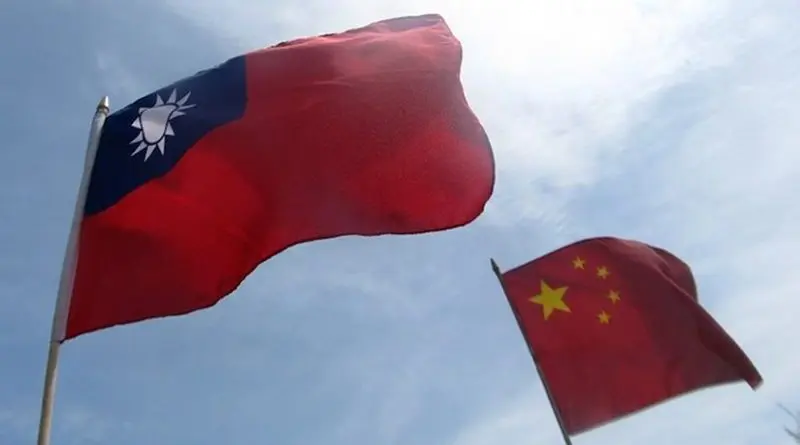
Flags of the Republic of China (Taiwan) and the People's Republic of China. CC BY-SA 4.0

September 21, 2025 

By Jumel Gabilan Estrañero, Latrell Andre C. Manguera, Chelsy Dianne Giban, Fordy Tic-ing Ancajas and Keith Justine Michael G. Banda


On August 29, 2025, the Department of Foreign Affairs (DFA)[1] released its independent yet quite intriguing stance on the geopolitical controversy of Taiwan and China. Accordingly, the DFA emphasized that the 1975 Joint Communiqué between the Republic of the Philippines and the People’s Republic of China remains a cornerstone of our longstanding bilateral relationship.

Added to that, “in line with the One China Policy, which the Philippines has consistently upheld, the Government of the Philippines does not recognize Taiwan as a sovereign state. This policy is clear and unwavering.

At the same time, the Philippines maintains economic and people-to-people engagements with Taiwan, particularly in the areas of trade, investment, and tourism. These interactions are conducted within the bounds of our One China Policy.

Consistent with the Philippines’ One China Policy, no official from Taiwan is recognized as a member of the business delegation that recently visited the Philippines.

Given our geographical proximity and the presence of approximately 200,000 Filipinos working and residing in Taiwan, the Philippines has a direct interest in peace and stability in the region. We therefore continue to call for restraint and dialogue. We leave it to the Chinese people to resolve Cross-Strait matters.”

A day before DFA released the diplomatic communique, a Senate hearing[2] was conducted. Presided Sen. Imee Marcos, she then asked officials of the Department of Foreign Affairs (DFA)[3] to clarify the Philippines’ position on the One China policy during a public hearing. Sen. Marcos noted that a lot of people are confused on the issue. “As they say… we all know that if there is a confrontation over Taiwan between China and the United States, there is no way that the Philippines can stay out of it simply because of our physical geographical situation. If there is an all-out war, we will be drawn to it. The situation is confusing and above all, its scary. Just to put it on record, as far as the committee is concerned, the Philippines and the U.S. both still recognize the One-China policy, is that correct?” Marcos inquired.

In retort, Foreign Affairs Sec. Ma. Theresa Lazaro said that based on the 1087 Joint Communique of the Philippines and China, the Philippines does not recognize Taiwan as a sovereign state. “We leave it to the Chinese people to resolve cross-strait matters. Conflict will have an impact on geographically proximate territories and the President did not deviate from our principle of non-interference in each other’s internal affairs, a principle of the joint communique,” Lazaro clarified. The One China policy is the acknowledgment by a country that there is only one sovereign state under the name China, with the People’s Republic of China (PRC) on the mainland being its sole legitimate government, and that Taiwan is a part of China.

In a political economy analysis by Mr. Manguerra, he laid down the foundation of China’s claim. The fall of the Qing Empire in 1912–which ended imperial China–paved the way for the establishment of the Republic of China (ROC). This era saw the Chinese Civil War between the Nationalists and the Communists, which led to the later division of China. Following this are as follows:

• Partition of China. After the civil war, Mao Zedong’s People’s Republic of China (PRC) took over the Chinese mainland, while Chiang Kai-Shek’s ROC retreated to Taiwan, creating competing claims of legitimate sovereignty internationally.1

• Prologue & Formalization of Relations. Diplomatic engagement between the Philippines and the PRC began in 1974, which resulted in the signing of the PRC-Philippines joint communiqué in 1975, which officially recognized the PRC under the One China Principle.

• Pragmatic Balance of Ties. Since 1975, the Philippines has walked a pragmatic fine line. The Philippines has vibrant economic relations with the PRC, while keeping the boiling tensions at bay in the West Philippine Sea. At the same time, Manila has informal relations with Taipei in the areas of culture, labor, trade, and technology.

• Political Economy in the 21st Century. The “One China Principle” remains a core component of the diplomatic relations of the Philippines. China is among the top trading partners of the Philippines while there is continuous interaction not only in the unofficial economic and cultural sectors but also in the people-to-people contacts with Taiwan. When a diplomat from the ROC visited Manila in 2025, it incited anger from Beijing which prompted the Philippines’ Department of Foreign Affairs to reaffirm that it does not recognize the sovereignty of Taiwan.

The relationship between the Philippines and China can be traced back through its historical and economic roots. On June 9, 1975, a diplomatic relationship between China and the Philippines was formally established, and nearly 100 bilateral agreements that cover different political aspects: trade, infrastructure, etc, were created. However, tension arises between them, particularly the territorial dispute over the West Philippine Sea, also known as the South China Sea. And with recent remarks of President Bongbong Marcos Jr. regarding the China and Taiwan dispute, stressing “There is no way that the Philippines can stay out of it simply because of our geographic location“, and if there will be one, he would ally with the United States to defend Taiwan from China. In which the Chinese foreign ministry responds that it is contradictory to the 1975 agreement between Philippines and China to respect one’s sovereignty, which includes the “One China” Policy.

Meanwhile in most recent assertion, the People’s Republic of China (PRC)[4] has been strong on pushing for the narrative since last year that Taiwan has been Chinese territory since ancient times. They claim that from 1895 to 1945, Taiwan had been occupied and colonized by Japan. In 1945, the Chinese people won the great victory of the War of Resistance Against Japanese Aggression, ending Taiwan’s half-century of humiliation under Japanese slavery.

To beef up its claim, China is legally cited the Cairo Declaration issued by China, the United States and the United Kingdom in December 1943; stating that it was the purpose of the three allies that all the territories Japan had stolen from China, such as Northeast China, Taiwan and the Penghu Islands, should be restored to China (an expressed claim by PRC). Another pre-owned basis is culled from the Potsdam Proclamation, signed by China, the United States and the United Kingdom in July 1945 and subsequently recognized by the Soviet Union, reiterates, “The terms of the Cairo Declaration shall be carried out.” On October 25, 1945 the Chinese government announced that it was resuming the exercise of sovereignty over Taiwan, and the ceremony to accept Japan’s surrender in Taiwan Province of the China war theater of the Allied powers was held in Taipei. The return of Taiwan to China constitutes an important component of the post-World War II international order.

What is interesting is that China also used Philippines for its narrative when it cited Pres. Marcos’ statement. It said that in January 2024, President Ferdinand R. Marcos Jr. publicly reiterated that the Philippines adheres to the one-China policy, and that the Taiwan is a province of China but the manner in which they will be brought together again is an internal matter.

Analysis


1. The US and China contestation


Internal calls for debates have emerged regarding this underlying issue with some even leveraging the Mutual Defense Treaty with the United States to strengthen strategic ties.

At the backdrop of this, the U.S. establishment of the “One China” policy is an act to maintain a balance in relations with both China and Taiwan. One of the aims of this policy is to maintain peace in the Taiwan Straits to insist on a peaceful resolution being done by both countries without interference from any third parties. However, looking at a different lens, although not specifically mentioned, the policy also functions as an instrument for political economy, ensuring continued access to markets, resources, and investments. This allowed the U.S. to open trade and invest with China, while still maintaining unofficial economic ties with Taiwan. This is the same as the Philippines, with economic and diplomatic relations with China, as well as unofficially with Taiwan. The Philippines benefits from stability, trade, and investment under this policy, but places itself in the middle, especially with the tensions arising in the West Philippine Sea.

If we consider the broader context, we can observe that the United States’ interpretation of the “One-China Policy” afforded them a strategic position to balance their relationship with China while simultaneouslyexerting influence over Taiwan. Given the ambiguity and open-ended nature of the “One-China Policy,” the United States can maintain economic relations with Taiwan while simultaneously acknowledging China’sjurisdiction over Taiwan. This is because the United States has its own business and interests in Taiwan,just as China does. Both nations recognize Taiwan’s geographical and economic potential to contribute to theUnited States’ economic agenda. Consequently, they have chosen to ignore the disputed status of thecountry. Both China and the United States are engaged in a global competition for hegemony, which has ledthem to become the “Modern Colonialists”, they do not engage in physical war but an economic wat. Their objective is to seize control of any potential resources or territories they perceive as advantageous throughassertive dominance or strategic economic maneuvers.

2. Precarious Exchange: Philippines in the Middle of Modern Cold War

Even with increased regional tensions, the Philippines continue economic exchanges with Taiwan but strictly within the framework of One China Policy.

Meanwhile, keeping the One China Policy avoids the Philippines from being antagonistic towards the PRC, an emerging regional hegemon, and maintains Philippine access to trade, investment, and strategic leverage. While informal ties with Taiwan permit Philippines to hedge strategically, it also indicates to China that Philippines has room for flexibility with diplomatic relations and has an independent diplomatic cerebrum. This strategic yet pragmatic actions allow the Philippines to extract benefits and engage selectively with both sides – all with the Philippine national interest in mind.

Perhaps the better question to ask here is “Given that China already possesses everything it needs, whatdoes China want from Taiwan?” and “What Taiwanese possession or ownership does the Chinesegovernment seek to assert its dominance over?” The answer lies within the landscape of Taiwan — they are the largest global manufacturer of chips or semi-conductors, has become a dominant force in the technological market, captivating the attention of the “power-hungry” Chinese government. They aim to seize control of the global chip market due to the increasing demands of globalization. China could have just abandoned Taiwan and allows to exercise their own sovereignty a long time ago, but they could not, given the fact that they see the potential in Taiwan to be their economic resource and to further boost their end goal by take over the global market free from the West.

3. Assertive Response yet Calculated

Evidently, the Philippines strengthened ties with countries such as Australia and Canada through joint drills to counteract China’s ever-growing presence, marking a show of force by rising middle-power countries.

Incidentally and strategically, President Marcos Jr. has acknowledged that the Philippines cannot avoid the conflict between Taiwan and China due to its geographic proximity and the presence of over 200,000 OFWs in Taiwan. This vulnerability is heightened by China’s assertiveness in the South China Sea and its warnings over Philippine engagement with Taiwan, underscoring how the issues are interconnected.

From a political economy perspective, the Philippines is caught in a “tug-of-war,” as any escalation regarding Taiwan could draw it into regional conflict while threatening economic stability. The Department of Foreign Affairs’ affirmation of the “One China” Policy reflects the country’s attempt to balance security commitments with the U.S. and economic ties with China and Taiwan.

Furthermore, when it comes to the Philippines and the “One-China Policy,” the government’s stance isa smart move, but it is also risky. Throughout history, the Philippines has been caught between the two hegemons: China and the U.S., and it has been playing tug-of-war with them. It is better to choose one or the other than to be a puppet on their strings. The stance of the administration is understandable as it gears towards preserving the territory of the Philippines and its right to self-determination. But then again, Filipinos must be vigilant of the ongoing tension between the two superpowers.


4. Balancing Development and Defense


Economic revitalization is something the Philippines need. Engaging with the PRC establishes essential investments, trade, and infrastructure flows that could result in domestic growth, industrialization, and job creation. Informal ties with Taiwan also supplement economic and technological growth, while OFWs in China and Taiwan send remittances and establish human capital that support the overall national development. If Manila were to spur Chinese anger by overexposing itself to Taiwan, bilateral economic coercion, trade gap measures, or capital flight could threaten Philippine growth.


Financial software

The boiling tensions between the PRC and Taiwan (ROC for China mainland’s self-assertion) is not a foreign reality for the Philippines. Like Taiwan, the Philippines is also experiencing Chinese bullying in the West Philippine Sea. In the Cross-Strait context, Pres. Marcos Jr. is realistically correct that if a war breaks out in the Taiwan Strait, the Philippines would be drawn inevitably because of its association with the U.S. through the Mutual Defense Treaty, as the U.S. commits to defend ROC. This challenging reality explains why retaining the One China Policy is primordial, because it allows the country to respond to regional pressures in a pragmatic way that protects the nation’s economic and security interests.

Implications and Some Recommendations

1. We recommend maintaining the adherence of the Philippines to the “One China” Policy to maintain a peaceful and stable relationship with China.[5] Any diplomatic fallout would backfire on the Philippines, as the reality is that the country is weak in terms of military and economic aspects, still depending on outside nations. Adding to this is the ongoing tension regarding the West Philippine Sea. The Philippines’ adherence to the “One China” policy is, therefore, a necessary form of strategic. By maintaining this policy, the Philippines will avoid being directly involved in the cross-strait politicaldispute[6]. And if the latter happens in the future, the Philippines will act as a neutral party. Focused its resources on protecting its people and securing its territory.

2. To mitigate any significant risks of a potential conflict between China and Taiwan. First, deepened the ties with Taiwan. Although acting as a de facto, the key role that Taiwanese companies hold in the manufacturing of electronics and technology should continue to benefit the Philippines in both ways. Also, it is recommended to diversifying economically and strengthening further trade partnerships to reduce dependence on China. One way is to deepen the connection to intra-ASEAN trade to leverage regional supply chains. Relevant today is to explore new market trends, especially those that are known for their renewed technology (Japan) and financing.

3. It is recommended to take an active neutral stance and strengthen thesecurity of these forces under the defense and security department: Armed Forces of the Philippines (AFP), the Office of Civil Defense (OCD), the Philippine Veterans Affairs Office (PVAO), the National Defense College of thePhilippines (NDCP), the Government Arsenal (GA), and Veterans Memorial Medical Center (VMMC) with supports from National Security Council (NSC), DTI, and the DEPDEV (formerly NEDA). The Philippines must innovate and invest in new and effective dynamics that will safeguard the Philippines from any threats (whether internal or external actors).

To wit, the Philippine Government strikes a balance between economic and political interactions with conflicted countries like Taiwan, China, and the United States. By establishing a balanced economic partnership with these nations, we can minimize the risk of potential conflicts. Additionally, we should strengthen our connections with our allies within the Association of Southeast Asian Nations (ASEAN), as they are crucial in enhancing our economic security reducing the reliance on the two hegemons.

Conclusion and Way Ahead

In a nutshell, the Philippines’ commitment to the One-China Policy is evident in its long-standing diplomatic stance, as demonstrated since 1975. Indeed, the ‘August 2025 communique’ recognized the People’s Republic of China as the sole legal government of China and acknowledged Taiwan as an integral part of Chinese territory but in a calculated move from Philippine’s fence.

Successive Philippine administrations have consistently upheld this stance, emphasizing respect for China’s sovereignty and territorial integrity. The Executive Department also supports the peaceful resolution of Cross-Strait matters, believing that the Chinese people themselves should resolve them and to avoid escalated and unintended spillovers in Southeast Asian conundrum, yet the Philippines[7] must be prepared in any probable war beyond peacetime. Preparation has always been a key in any grey zone tactics of China.

Despite the recent official diplomatic position, the Philippines maintains robust economic tie-up and people-to-people engagements with Taiwan, particularly in areas such as trade, investment, and tourism. These interactions are carefully conducted within the established bounds of the One-China Policy, reflecting a complex balancing act on its foreign policy. Given its geographical proximity to Taiwan and the significant presence of approximately 200,000 Filipino workers there, the Philippines has indeed a direct interest in regional peace and stability. Consequently, it frequently urges restraint and dialogue in the Taiwan Strait yet here we are, in strategic zen mode of political economy while maintaining peace and security at larger extent in global context.

*Ideas and/or views expressed here are entirely independent and not in any form represent author’s organization and affiliation.

About the authors:
Jumel G. Estrañero is a defense, security, & political analyst and a university lecturer in the Philippines. He worked in the Armed Forces of the Philippines, Office of Civil Defense, National Security Council-Office of the President, and currently in the Department of the National Defense. He is currently teaching in De La Salle University Philippines while in the government and formerly taught at Lyceum of the Philippines as part-time lecturer. He is the co-author of the books titled: Disruptive Innovations, Transnational Organized Crime and Terrorism: A Philippine Terrorism Handbook, and Global Security Studies Journal (Springer Link, United States). He is an alumnus of National Defense College of the Philippines (NDCP), ASEAN Law Academy Advanced Program in Center for International Law, National University Singapore and Geneva Centre for Security Policy, Switzerland. He is also a Juris Doctor student and specializing in geopolitics, SCS/WPS disputes, international law, strategic intelligence, public policy, and AI impacts.
Latrell Andre C. Manguera is an International Development Studies major in De La Salle University, and forerunner of organizational plans & programs in the IDS Council and Christian church (Christ Commission Fellowship / CCF). He is specializing in international relations, sustainable development, and pragmatism in contemporary politics.
Chelsy Dianne Giban is a Political Science major in in De La Salle University, University Student Government Asst. Secretary (Internal), and specializing in cyber-politics, gender and development, public policy, and the emerging sports politics.
Fordy Tic-ing Ancajas is Political Science major in De La Salle University, Deputy Executive Secretary in University Student Government (7th Congress), international law debater, and specializing in Southeast Asian politics, indigenous people’s rights, and human rights.
Keith Justine Michael G. Banda is Political Science major in in De La Salle University specializing in political dynamics and American & European political economy.

[1]DFA Statement on One China Policy, DFA, https://dfa.gov.ph/dfa-news/statements-and-advisoriesupdate/37090-dfa-statement-on-one-china-policy

[2]Senate Public Relations and Information Bureau, https://web.senate.gov.ph/photo_release/2025/0828_01.asp

[3] Department of Foreign Affairs (DFA) Secretary Ma. Theresa Lazaro said they have several mechanisms to address the harassment such as the bilateral consultative mechanism, but Committee Chairman Senator Imee Marcos pointed out that the protests do not seem to work. (ABS-CBN, August 28, 2025)

[4] The one-China principle is clear cut. There is but one China in the world. Taiwan is part of China. The Government of the People’s Republic of China is the sole legal government representing the whole of China. UNGA Resolution 2758 fully reflects and reaffirms the one-China principle. On October 25, 1971, the 26th session of the UN General Assembly adopted Resolution 2758 with an overwhelming majority. It states in black and white that the General Assembly “decides to restore all its rights to the People’s Republic of China and to recognize the representatives of its Government as the only legitimate representatives of China to the United Nations, and to expel forthwith the representatives of Chiang Kai-shek from the place which they unlawfully occupy at the United Nations and in all the organizations related to it.” (Embassy of the Republic of China in the Philippines, October 8, 2024)

[5] In other words, a good and sedate relationship with China. This is because our stance on “One-China Policy” can be a tool to navigate the dynamics about the ongoing territorial dispute over the West Philippine Sea. Though recently, the Marcos Administration’s actions leaned towards the west, it is still critical to maintain a good relationship with our neighboring country.

This might be a hard pill to swallow that the Philippines is weaker in terms of economy and military compared to what China has, and any misunderstanding of China could lead to unpleasant outcomes as far as the Philippines is concerned. Therefore, the adherence of the Philippines to “One-China Policy” is pivotal in achieving its national interest which is to protect and preserve our territory free from international violence.

[6] For example, Philippines to keep the people-to-people exchanges between China and Taiwan going. Even though the government-to-government relations are on hold, we should still encourage cultural, educational, and tourist exchanges whenever we can. These interactions help us get to know each other better and build a solid foundation of understanding. That could be helpful if we ever need to talk about anything important in the future.

[7] That is why there is big deal on the enhancement of maritime, aerial, and surveillance assets so that the country can effectively deter threats in the West Philippine Sea. The country must use its alliances with like-minded partners responsibly while maintaining a diplomatic equilibrium with China, to keep national security in focus as it tactically seek other ways to deter strategic threats.

[8] He has participated in various NADI Track II dialogues. His articles have appeared in Global Security Review, Geopolitical Monitor, Global Village Space, Philippine Daily Inquirer, Philippine Star, Manila Times, Malaya Business Insights, Asia Maritime Review, The Nation (Thailand), Southeast Asian Times, Global Politics and Social Science Research Network.



Jumel Gabilan Estrañero is a defense, security, & political analyst and a university lecturer in the Philippines. He has completed the Executive Course in National Security at the National Defense College of the Philippines and has participated in NADI Track II discussions in Singapore (an ASEAN-led security forum on terrorism). His articles have appeared in Global Security Review, Geopolitical Monitor, Global Village Space, Philippine Daily Inquirer, Philippine Star, Manila Times, Malaya Business Insights, Asia Maritime Review, The Nation (Thailand), Southeast Asian Times, and Global Politics and Social Science Research Network. He worked in the Armed Forces of the Philippines, Office of Civil Defense, National Security Council-Office of the President, and currently in the Department of the National Defense. He is currently teaching lectures in De La Salle University Philippines while in the government and formerly taught at Lyceum of the Philippines as part-time lecturer. He is the co-author of the books titled: Disruptive Innovations, Transnational Organized Crime and Terrorism: A Philippine Terrorism Handbook, and Global Security Studies Journal (Springer Link, United States). He is an alumnus of ASEAN Law Academy Advanced Program in Center for International Law, National University Singapore and Geneva Centre for Security Policy, Switzerland. He is also a Juris Doctor student.

Azerbaijan: State Restricts Who Can Worship And Where – Analysis

Baku, Azerbaijan. Source: Wikipedia Commons.

September 21, 2025 
By F18News
By Felix Corley

Peace Church, a Protestant church in Sumgait north of Baku, lodged a registration application in April to the State Committee for Work with Religious Organisations. Five months on, the church complains that the State Committee is refusing to give a response to its registration application. State Committee officials have not pointed to any problems or shortcomings in the church’s registration application. “They simply told us that you cannot hold any more meetings, that it is forbidden to hold any religious ceremony without registration. ‘If you do not heed this warning and hold a religious ceremony, you will be punished,’ he said.”

]Officials warned the pastor: “You are holding secret meetings and gathering people.” The pastor rejected this. “Our meetings were always held openly and transparently,” he told them (see below).

“We are being restricted from exercising our constitutional right to worship peacefully and to practise our faith,” the church notes. “The lack of clarity and the indefinite waiting period put excessive pressure on our church and potentially violate our rights” (see below).

Officials at the branch of the State Committee in Sumgait did not answer the phone each time Forum 18 called (see below).

The Sumgait Church notes that the State Committee no longer registers any churches. “There are churches that have been waiting for registration in the State Committee for years. Most likely, what happened to us will happen to them too.” The Church is among at least five Protestant churches known to have lodged registration applications to the State Committee, lawyer and human rights defender Murad Aliyev told Forum 18. “Some of them have been waiting for more than two years” (see below).


The State Committee usually leaves applications from communities it does not like with no formal response, neither accepting nor rejecting applications. “This makes it difficult for such communities to challenge this in court, as they have no response to challenge,” lawyer Aliyev told Forum 18 (see below).

Forum 18 asked the State Committee in Baku:
– why it fails to accept or reject registration applications, particularly from non-Muslim organisations;
– and why, out of the many non-Muslim communities that have applied for state registration, only one has been accepted since 2020.
Forum 18 received no response (see below).

The State Committee also did not respond on why Jehovah’s Witnesses cannot register a national organisation to be able to function legally throughout the whole country, and why the Georgian Orthodox community cannot regularly use its historical Church of St George in Kurmukhi in Qakh region (see below).

When the Muslim holy month of Muharram began on 26 June, the Interior Ministry and the State Committee issued a public instruction with a reminder that, under the Religion Law, “religious ceremonies are to be held only in mosques and shrines”. It also banned parents from bringing children. Lawyer Khalid Bagirov believes that such general prohibitions create legal uncertainty and pose a risk of abuse. “If a Shia parent wants to bring their child to the Ashura ceremony, that is their right,” he said (see below).

Arzu Abdullah Gul Zaman, a journalist, visited Ajdarbay mosque in Baku on 6 July, the day she believed Ashura should be commemorated. A female mosque attendant told her: “The government did Ashura yesterday, today Ashura is forbidden.” The mosque attendant directed her to the “supervisors”. Gul Zaman maintained that they were plain-clothed police officers, though they denied this (see below).

Mamed Abdullayev, a Russia-based blogger, complains about the lack of provision for Sunni Muslims to pray in his home city of Ganca. “I don’t know why, but in the whole city we don’t have a single mosque where we can pray.” He said that “at least a thousand Sunnis” live in Ganca “and want to go to the mosque” (see below).

In his online video, Abdullayev showed the cramped rooms in the back of the city’s Shia-dominated Juma Mosque. This is the only place where up to 30 Sunni Muslims can hold prayers. “They use literally every centimetre. Everyone is literally standing on top of each other, bowing, to put it mildly, to each other’s backs,” he complained (see below).

“The situation regarding religious freedom in Azerbaijan has deteriorated significantly in recent years,” a leader of a non-Muslim community told Forum 18. “A country that officially promotes multicultural and tolerant values has recently taken actions that contradict these values.”
Compulsory state permission to exist

Under the Religion Law, backed by Administrative Code Article 515 (“Violation of the procedure for creating or running religious organisations”), all exercise of freedom of religion and belief by a group of people is illegal unless it has obtained state registration, and so permission to exist.

To apply for permission to exist, a group must have at least 50 adult founding members. All the founders have to go to a Notary Office at the same time and the process of verifying each founder’s identity can take several hours in total. Notary Offices can be very small.

The requirement to have 50 adult members bans all small religious communities. Many people are afraid to sign such registration applications, for fear of harassment and reprisals by the regime.

Muslim communities must belong to the state-controlled Caucasian Muslim Board.

Without state registration religious communities – and even informal groups of people meeting together – cannot legally exist or exercise freedom of religion and belief. Police and the State Security Service (SSS) secret police have raided many religious communities that have chosen not to register, or have tried to register but have been refused. Requiring state permission to exercise freedom of religion and belief and other human rights is against Azerbaijan’s legally binding international human rights obligations.

Forum 18 asked the State Committee in writing on 17 September:
– why religious communities must have state registration before they can meet for worship;
– and why mosques that are independent of the Caucasian Muslim Board cannot function and gain state registration.
Forum 18 had received no response by the afternoon of the working day in Baku of 19 September.
“Officials know where they meet”

Whenever a religious community starts meetings for worship, “the police always come”, one Protestant told Forum 18. “Officials know where they meet. If people come together anywhere for any reason, people call the police – even if you have ten guests in your home.”

On 19 June, Nakhichevan City Court fined three Protestants from Baku and two local people 1,500 Manats each under Administrative Code Article 515.0.2 (“Violating legislation on holding religious meetings, marches, and other religious ceremonies”) for holding “illegal” religious meetings in a home. This represents about three months’ average wage for residents of Nakhichevan and two months’ average wage for residents of Baku.
Sumgait church’s stalled registration application

Peace Church, a Protestant church in Sumgait north of Baku, lodged a registration application in April to the State Committee for Work with Religious Organisations. Five months on, the church complains that the State Committee is refusing to give a response to its registration application.

In April, “approximately 50 members of our church community came together to prepare and submit all the necessary documents required for official recognition and permission to assemble,” the church’s leader, Pastor Shahin, told Forum 18. “We ensured that all the paperwork was complete and submitted it to the State Committee without delay.”

The State Committee’s regional office in Sumgait invited Pastor Shahin to a meeting at its office on 7 July. During this meeting, officials told him that gathering as a religious community without official permission is not allowed.

“When officials asked him about the number of members of the church, and the pastor said that there were 70-80 members in the church, they became very angry with him,” individuals familiar with the situation told Forum 18. Officials told the pastor: “You are holding secret meetings and gathering people.” The pastor rejected this. “Our meetings were always held openly and transparently,” he told them.

Pastor Shahin pointed out that the State Committee repeatedly invited him to various events. “When foreign guests came, you asked me to wear the medals I received for participating in the first Karabakh war and attend the event. You gathered us, that is, the Azerbaijani pastors, and took us to an event in Karabakh, in Shusha. And now you are telling me that I held secret meetings?!”

State Committee officials did not point to any problems or shortcomings in the church’s registration application. “They simply told us that you cannot hold any more meetings, that it is forbidden to hold any religious ceremony without registration. ‘If you do not heed this warning and hold a religious ceremony, you will be punished,’ one official said.”

The church does not know if the State Committee found any legal or procedural flaws in the application. “So we do not know whether our documents are in order. It seems that the State Committee has not even checked our documents.”

“We are being restricted from exercising our constitutional right to worship peacefully and to practise our faith. The lack of clarity and the indefinite waiting period put excessive pressure on our church and potentially violate our rights.”

Officials at the branch of the State Committee in Sumgait did not answer the phone each time Forum 18 called on 18 September 2025.
“Churches have been waiting for registration in the State Committee for years”

The Sumgait church notes that the State Committee no longer registers any churches. “There are churches that have been waiting for registration in the State Committee for years. Most likely, what happened to us will happen to them too.”

Sumgait’s Peace Church is among at least five Protestant churches known to have lodged registration applications to the State Committee, lawyer and human rights defender Murad Aliyev told Forum 18. “Some of them have been waiting for more than two years.”

One of the churches applied for registration in 2023. State Committee officials made positive comments to it in 2024 and it therefore expected to get registration. But no registration followed and “they say nothing”, a community member told Forum 18. “It is so sad.” The community member insisted that getting registration is important for the church.

The State Committee usually leaves applications from communities it does not like with no formal response, neither accepting nor rejecting applications. “This makes it difficult for such communities to challenge this in court, as they have no response to challenge,” lawyer Aliyev told Forum 18.

Forum 18 asked the State Committee in Baku in writing on 17 September:
– why it fails to accept or reject registration applications, particularly from non-Muslim organisations;
– and why, out of the many non-Muslim communities that have applied for state registration, only one has been accepted since 2020.
Forum 18 had received no response by the afternoon of the working day in Baku of 19 September.
Only one non-Muslim registration since 2020

The State Committee has registered only one non-Muslim community since December 2020. The last such community it granted registration to was the Baku community of the Church of Jesus Christ of Latter-day Saints (commonly known as Mormons) on 10 July 2024, according to the State Committee website.

A large Azerbaijani delegation visited the Church headquarters in Salt Lake City in the United States in March 2023. Among delegation members were Sahib Nagiyev, Deputy Chair of the State Committee, and Sheikh ul-Islam Allahshukur Pashazade, the head of the state-controlled Caucasian Muslim Board. Two elders of the Church from the United States met President Heydar Aliyev in Baku on 30 April 2024.

The Baku branch of the Church began the registration process “in the second half of 2023”, a 26 July 2024 statement from the Church internationally noted. “The Church currently has a small group of members meeting regularly in the city [Baku].” The community’s services are in English.
No registration for Jehovah’s Witnesses outside Baku

The State Committee finally registered the Baku Jehovah’s Witness community in 2018. However, it has consistently refused applications by local communities, including in Ganca and Qakh.

Jehovah’s Witnesses then tried to register a national organisation. This would allow them to function anywhere in the country. The Religion Law currently allows a local community to operate only at its registered legal address. However, the State Committee has consistently rejected the Jehovah’s Witness application to register a national organisation.

The State Committee told Jehovah’s Witnesses that if they inform it of the location of religious meetings outside Baku, it would ensure that the meetings could take place without disturbance. “The State Committee has adhered to this commitment,” Jehovah’s Witnesses told Forum 18. “But we’re still nervous about the lack of national registration.”

For a quarter of a century, officials repeatedly rejected registration applications from the Baptist community in the northern town of Aliabad, which police repeatedly raided and two of whose pastors were jailed. The State Committee in Baku gave limited approval for the church to meet for worship from January 2020. It said it had “no objection” to the church holding worship meetings for two hours each Saturday morning.

Forum 18 asked the State Committee in Baku in writing on 17 September why Jehovah’s Witnesses cannot register a national organisation to be able to function legally throughout the whole country. Forum 18 had received no response by the afternoon of the working day in Baku of 19 September.
Important for Georgian Orthodox churches and monasteries “to restore their original purpose”

Georgia’s Orthodox Patriarchate in Tbilisi has repeatedly expressed concern over Azerbaijani officials’ refusal to hand back confiscated places of worship. These are mostly in Qakh Region of north-western Azerbaijan near the border with Georgia.

The State Committee has registered only two Georgian Orthodox churches, St George’s in Qakhingloy and St Nino’s in Alibeyli, both in March 2010.

Orthodox Christians are allowed to hold services at the Church of St George in Kurmukhi only twice a year, on 6 May and 23 November (both St George’s day, the church’s patronal festival).

Another nearby parish – Holy Trinity Church in the village of Kotuklu – prepared a registration application in 2009 signed by 20 parishioners. But the State Committee has never registered the community.

A 1 August 2024 Georgian Orthodox Patriarchate statement spoke of how “important it is for Georgian churches and monasteries on the territory of Azerbaijan to restore their original purpose”.

The Patriarchate in particular called on Azerbaijani officials “to make the Church of St George in Kurmukhi a functioning church and to grant the Georgian Patriarchate the right to regularly hold religious services there”.

The official who answered the phone at the regional branch of the State Committee in Zaqatala refused to answer any of Forum 18’s questions on 18 September 2025.

Forum 18 asked the State Committee in Baku in writing on 17 September why the Georgian Orthodox church cannot use St George’s Church in Kurmukhi for worship whenever it wants to, rather than only twice a year. Forum 18 had received no response by the afternoon of the working day in Baku of 19 September.

On 27 January 2025, the Azerbaijani authorities allowed the arrival in the region of a delegation from the Georgian Orthodox Church from Georgia, led by Metropolitan Teodor (Chuadze). He ordained to the priesthood the 40-year-old Tariel Poladashvili in St Nino’s Church in Alibeyli. This was the first ordination in that church for more than a century. Fr Tariel was born in Qakh Region and is an Azerbaijani citizen.

The regime prevented several Georgian Orthodox priests in succession from continuing their ministry, claiming that they had to have Azerbaijani citizenship to be able to serve the parishes in the country. Georgian citizen Fr Demetre Tetruashvili was barred from re-entry to Azerbaijan in June 2015. This was apparently to prevent the implementation of a Georgian Orthodox Synod decision of 2014 to create the Diocese of Qakh and Kurmukh to look after the parishes in Azerbaijan. Fr Demetre was the bishop-designate.
Muharram ceremonies only in mosques – and without children

The Muslim holy month of Muharram began this year on 26 June. The Interior Ministry and the State Committee issued a public instruction the following day with a reminder that, under the Religion Law, “religious ceremonies are to be held only in mosques and shrines”.

Muharram often features street processions, especially around the commemoration of Ashura, the 10th day of the month (marked this year on 6 July, though the state-controlled Caucasian Muslim Board set the date as 5 July). Shia Muslims (the largest religious community in Azerbaijan) observe Ashura as a day of mourning.

“We would like to especially note that there are cases of some parents taking minor children to religious ceremonies, including mourning meetings,” the Interior Ministry and State Committee warned. “In this case, both the physical and psychological safety of children should be taken into account. We ask parents to consider that it is inappropriate for minor children to participate in such mass ceremonies and to be particularly sensitive to preventing situations that contradict legislation.”

Lawyer Khalid Bagirov believes that such general prohibitions create legal uncertainty and pose a risk of abuse. “If a Shia parent wants to bring their child to the Ashura ceremony, that is their right,” he told JAMnews for a 27 June article. “The state must clearly explain what exactly is prohibited: mourning rites, self-flagellation, beating the chest? Or simply attendance? Such ambiguity is legally unacceptable.”

Bagirov also pointed to the United Nations Convention on the Rights of the Child, noting that raising children in accordance with their parents’ religious beliefs is their fundamental right.

Bagirov describes the regime’s approach as “part of a systemic policy of restricting the rights of the Shia community”. He noted Ashura processions in the southern region of Lankaran, which have worried the authorities. However, he argues, these concerns stem from freedom of peaceful assembly. “The state is attempting to restrict freedom of assembly and processions under the pretext of religious rituals.”

Bagirov warned that such vague and restrictive approaches are likely to lead to increased police surveillance at mosques and a ban on minors entering without parental supervision.
Ashura restrictions

As the state-controlled Caucasian Muslim Board had set the date for the Ashura commemoration as 5 July, mosques – with the backing of police – practically banned Shia Muslims from commemorations on 6 July.

Arzu Abdullah Gul Zaman, a journalist, visited Ajdarbay mosque in Baku on 6 July. “For more than 30 years since I came to Baku, I have always been to the Ajdarbay mosque in Ashura, but I have never been shaken as today,” she wrote on Facebook the same day. “In past years, it was not possible to enter the courtyard of Ajdarbay Mosque at Ashura. There used to be a really big crowd. And today, only police officers were roaming in and around the mosque.”

Gul Zaman asked a female mosque attendant to read the commemoration prayers. “Shh! Go and sit down, they will come and take me too,” she responded. “They will gather all of us and hand us over to the administration. They strongly instructed that there is to be no crying, no bleeding here. The government did Ashura yesterday, today Ashura is forbidden.” She approached the prayer leader but he too refused to read the commemoration prayer and directed her to talk to the “supervisors”.

Gul Zaman maintained that the “supervisors” were plain-clothed police officers, though they denied this.

“Go and cry, but cry slowly, cry so that the government does not hear,” older people told her. “The government does not allow you to cry loudly.” After again asking the female mosque attendant to read the prayer, she reported Gul Zaman to the police. The police officer refused to allow her to commemorate Ashura, insisting that this had been done the previous day. He accused her of following Iran, where Ashura was being commemorated that day.

Muslims who are not part of the state-controlled Caucasian Muslim Board, particularly Sunnis, have long objected to the state-imposed calendar which dictates when they are allowed to pray and celebrate Muslim festivals. “This is a serious issue for us,” one Sunni Muslim from the Baku area told Forum 18 in May 2016. “If we pray according to the calendar we believe is correct, they’ll arrest us.” The Muslim noted that the state does not impose compulsory calendars on Christians, Jews or members of other faiths.
Where can Sunni Muslims pray?

The regime has closed many specifically Sunni Muslim mosques in recent years. The ban on any mosques that function outside the state-controlled Caucasian Muslim Board (which is Shia-dominated) leaves Sunni Muslims who want to practise their faith in line with their interpretation few places to worship.

Mamed Abdullayev, an Azerbaijani-born and Russia-based blogger, posted an online video on 13 October 2024 complaining of the lack of a Sunni mosque in his home city of Ganca. He called for new mosques to be opened, as well as public prayer rooms.

“I don’t know why, but in the whole city we don’t have a single mosque where we can pray.” Abdullayev said that “at least a thousand Sunnis” live in Ganca “and want to go to the mosque”. He also spoke of foreign visitors “who come to us from all sorts of countries to relax, work and get to know our culture, and they are actually amazed that stupidly there is nowhere to pray in the city”.

Abdullayev showed the cramped conditions for Sunni Muslim worshippers in rooms at the back of Ganca’s Juma Mosque, where the main prayer hall is used by Shia Muslims. He said the rooms at the back can hold at most 30 worshippers and each worshipper had only about 40 cm (16 inches). “They use literally every centimetre. Everyone is literally standing on top of each other, bowing, to put it mildly, to each other’s backs,” he complained. “If someone can’t fit into this small room, they simply go home because you’re not allowed to pray outside.”

Abdullayev added: “And that’s not even the worst of it. Even this small side room only opens on Fridays. The rest of the time, it’s closed, so there’s nowhere to pray at all.”

Abdullayev concluded: “Unfortunately, this problem is long-standing and has not yet been resolved. I hope this video will reach the right people. And soon I will film a video review of the new, luxurious, large mosque where Sunni believers, both local and visiting our city, can come and worship Allah.”

Comments under the video from people who say they are Sunnis from Ganca echo Abdullayev’s remarks. “It’s high time to build a mosque for Sunnis in Ganca,” a respondent from the city wrote. “That there are no Sunni mosques there is greatly offensive for Muslims,” another wrote. “May Allah help build there a beautiful Sunni mosque!!!”
State Committee manipulation?

Members of Baku’s state-registered Hare Krishna community are divided over allegations that some of their leaders have engaged in corruption.

Among those leading the complaints is Rashid Huseynov (religious name Ramakanta das). He complains that the State Committee continues to allow the community to be headed by 12 official founders, as the community was registered before the 2009 Religion Law, which increased the minimum number of founders to 50.

The Hare Krishna community is among state-registered religious communities that receive an annual state subsidy.

“The State Committee can lean on the founders and gives them subsidies,” Huseynov told Forum 18 from Baku on 18 September. “That’s why they’ve left this number.” He says when two of the 12 were removed at the community’s request in 2024 after corruption allegations, the State Committee quietly approved two replacements to be added. “The Committee agreed to add the two new founders in February 2025 after six months, despite my complaints.”

Huseynov said he and others would like to increase the number of founders to 50. “This would make it more difficult for the State Committee to pressure them.” He says adding further founders should not require full re-registration of the Hare Krishna community.

Huseynov said that in spring 2025 he twice met the Chair of the State Committee, Ramin Mammadov. He gave Mammadov a list of 38 devotees who were prepared to be added to the list of founders. However, Mammadov refused to add them. He said the community should decide.

Huseynov and another community member appealed to President Ilham Aliyev on 8 September. They called for the State Committee’s inaction over the demand to increase the number of founders from 12 to 50. They also called for the alleged corruption in the community leadership to be investigated. Huseynov has received no response to the appeal, he told Forum 18.
Another European Court finding against Azerbaijan

On 8 July, the European Court of Human Rights (ECtHR) in Strasbourg found that Azerbaijan had violated the rights of Vuqar Rafiyev under three provisions of the Convention:
– Article 5, Paragraph 1 (unlawful arrest and detention);
– Article 6, Paragraph 1 (lack of reasoning in the domestic courts’ decisions);
– and Article 9 (violation of the right to freedom of religion).

Rafiyev is a Muslim from Sumgait who reads the works of the late Turkish Muslim theologian Said Nursi. In March 2017, police raided a home in Quba where Muslims who study Said Nursi’s works were meeting and seized religious literature. Almost all of those present were fined in March 2017, including Vuqar Rafiyev. He lodged his case to the ECtHR in November 2017 (Application No. 81028/17).

In its 8 July 2025 decision, the ECtHR noted that “even assuming that the private residence where the applicant assembled with others was used as a place of religious worship as argued by the Government, the Court finds it necessary to reiterate that, while States can put in place a requirement that religious denominations be registered in a manner compatible with Articles 9 and 11 of the Convention, it does not follow that sanctioning an individual member of an unregistered religious organisation for praying or otherwise manifesting his or her religious belief is compatible with the Convention..”

The decision added: “To accept the contrary would amount to the exclusion of minority religious beliefs which are not formally registered with the State, and consequently would amount to admitting that a State can dictate what a person can or cannot believe..”

The ECtHR ordered that Azerbaijan pay Rafiyev the equivalent of 3,000 Euros in compensation, plus 1,000 Euros in costs.

“This is a positive decision,” a fellow Muslim Nursi reader told Forum 18 on 19 August 2025.

The regime is due to pay compensation to Rafiyev within three months of the decision becoming final on 8 October 2025. However, it remains unclear if the regime will pay. President Aliyev was angered by the Council of Europe Parliamentary Assembly’s decision in January 2024 to suspend the Azerbaijani delegation for 12 months for the country’s persistent violations of Council of Europe standards. Azerbaijan did not contribute to nominating judges to the ECtHR.

Aliyev declared on 9 April 2025 that “none of the decisions of the European Court are valid for us because we were deprived of our voting rights. We did not vote for those judges. We don’t know who these judges are.”

Asabali Mustafayev, one of the lawyers for Rafiyev, told Forum 18 on 18 September that the regime has not paid compensation decreed by the ECtHR for more than a year.

The ECtHR has repeatedly found that Azerbaijan has violated human rights by its restrictions on the exercise of freedom of religion or belief.
Complaint to UN Human Rights Committee

In 2024, a religious community lodged a complaint against Azerbaijan to the United Nations Human Rights Committee (4706/2024) about “Restriction to the right to religious gathering”. The complainants argue that the restrictions violated their rights under Article 18 of the International Covenant on Civil and Political Rights (ICCPR). The Human Rights Committee has not yet made a decision in the case.

ICCPR Article 18 includes the right to manifest a religion “in worship, observance, practice and teaching” either individually “or in community with others and in public or private”.


F18News
Forum 18 believes that religious freedom is a fundamental human right, which is essential for the dignity of humanity and for true freedom.


Could Chinese AI threaten Western submarines?
DW
September 18, 2025

A new Chinese AI system is said to detect even the most modern submarines. Is it a real threat to maritime security or just a bluff?


Nuclear-powered submarines equipped with ballistic missiles such as the USS Ohio 
are crucial for deterrence
Image: Juan Antoine King/ABACA/picture alliance


Psychological warfare has often involved touting technological superiority while suggesting that opponents are powerless against it. Which might be the right context in which to view a new study about an advanced artificial intelligence-driven anti-submarine warfare (ASW) system out of China that can reportedly detect 95% of even the stealthiest submarines.

Last week, the Hong Kong-based South China Morning Post outlined the study, published in August by the trade journal Electronics Optics & Control. It announced that the China Helicopter Research and Development Institute had created an AI system that can simultaneously evaluate measurement data from various sources. From sonar buoys and underwater microphones to water temperature and salinity, it creates a dynamic map of the underwater environment in real time.

The game-changing technology developed under chief engineer Meng Hao can also respond flexibly to countermeasures such as zigzag maneuvers and the deployment of decoys or drones. In computer simulations, the system was able to successfully locate the target in about 95% of cases, thus jeopardizing proven methods of submarine camouflage and defense.

Another important advance is that the AI translates this complex data into simple action points for military personnel, helping them to make the right decisions quickly, even in stressful situations.


In future versions, the team of developers hopes to have the AI system work closely with drone swarms, surface ships, and autonomous underwater robots. The aim is to create a three-dimensional, self-learning detection network that adapts to increasingly sophisticated evasion strategies and "scans" the ocean in real time.

A strategic dilemma for world powers

Existing defense strategies would be seriously undermined if the team successfully reaches their goals. The three pillars of nuclear deterrence, known as the "nuclear triad,” consist of land-based intercontinental ballistic missiles, strategic bombers and submarine-launched ballistic missiles.

These delivery systems are designed to deter a potential attacker from launching a nuclear first strike because they ensure reliable retaliation. Entire naval fleets, which have so far relied on the strategic hide-and-seek tactics of nuclear-powered submarines, would face uncertainty if their submarine capabilities were threatened.


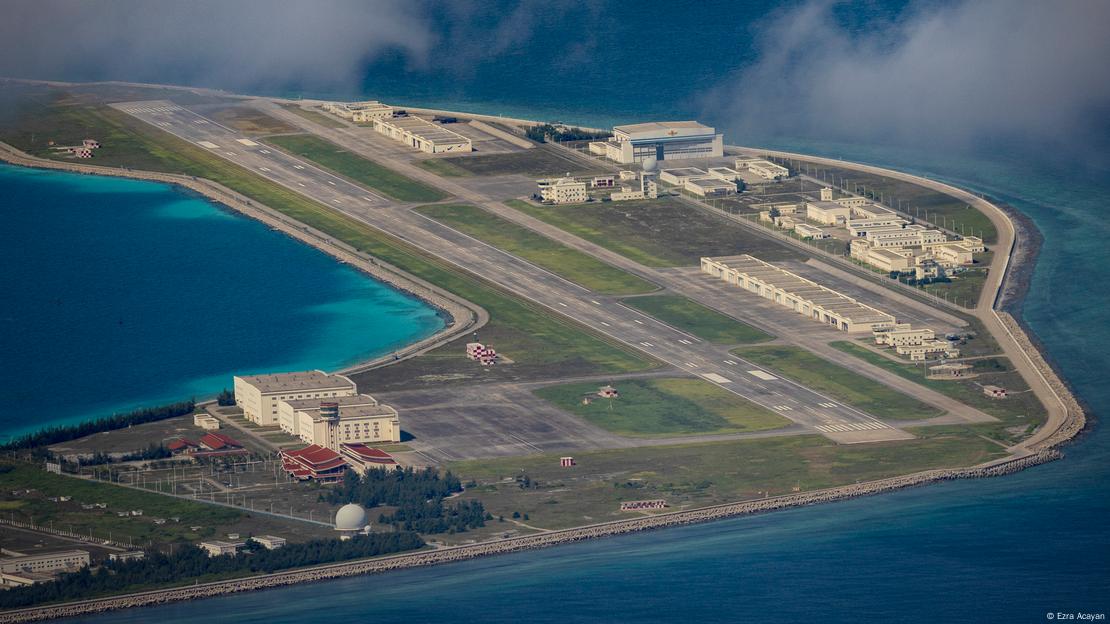
China is transforming artificial islands like Mischief Reef here in the South China Sea into unsinkable aircraft carriers
Image: Ezra Acayan


Psychological warfare?

An important caveat, however, is that military tactics involve not only deterrence, but also psychological warfare. News about things such as the new study are intended to anchor China's strategic superiority in the public perception. Simultaneously, China has been demonstrating its presence in strategically important waters such as the Taiwan Strait and the South and East China Seas.

Gaining control of Taiwan would be particularly significant to the Chinese submarine fleet because they have so far had to launch mainly from shallow waters near the Yulin and Yalong bases on Hainan Island. There, they are easily located by enemy sensors and reconnaissance systems.

Taiwan in the crosshairs

If China could control access to the Pacific Ocean via Taiwan and the surrounding island groups, its submarines would gain direct access to deep water to be deployed more credibly as nuclear second-strike options.

This is why China has been heavily upgrading its naval forces in recent years, equipping strategically important sea areas with radar, sonar, and buoy chains, in addition to intimidating its neighbors with large-scale naval maneuvers.

Playing cat and mouse

While China is making remarkable progress with AI, Western military experts doubt that the new submarine detection system poses an immediate threat to global defense strategies.

Professor Paul S. Schmitt, a US expert on strategic and operational naval warfare, told DW that AI has the potential to make submarine hunting more successful by evaluating large amounts of data from different sensors and supporting human decision makers, but implementation remains difficult because the underwater environment is extremely complex.

The idea of a fully networked and integrated AI-controlled solution is an interesting goal for the future, but currently seems optimistic due to the constant arms race between submarine technology and the means to detect it, he said. Schmitt is affiliated with the Naval War College, but noted that his comments do not necessarily represent those of the Department of War, the Navy, or the Naval War College.

German security experts also say that maritime armament dynamics are constantly locked in a game of cat and mouse with an uncertain outcome. This is precisely why maritime attack and defense techniques must also be developed dynamically.


The global balance of underwater power

China currently has 105 submarines, the largest fleet worldwide, followed by North Korea (90), the United States (74), and Russia (62). However, modern, nuclear-powered submarines equipped with ballistic missiles (SSBNs) are particularly crucial to strategic competition, and the US has the largest and most advanced fleet, with around 14 Ohio-class SSBNs and more than 50 modern attack submarines. Russia follows with around 16 strategic submarines and numerous other nuclear attack and cruise missile submarines.

Meanwhile, China is rapidly expanding its fleet with at least six Jin-class and one Xia-class SSBNs, as well as several other new types. The United Kingdom and France each ensure their strategic security with four SSBNs (Vanguard and Triomphant classes, respectively) and additional nuclear-powered attack submarines.

Germany relies on modern diesel-electric submarines and plays a leading role in conventional technology, but does not have nuclear capabilities. Other relevant NATO countries with submarines include Italy, Spain, Norway, Sweden, the Netherlands, Canada, and Turkey, which rely on proven conventional technology.

Outside NATO, India's Arihant class and Israel's Dolphin submarines have special underwater capabilities.


This article was originally written in German.

Alexander Freund Science editor with a focus on archaeology, history and health

D.E.I.
Deutsche Bahn to get first female CEO — reports


Saim Dušan Inayatullah 
DW with Reuters and German media
September 19, 2025

Evelyn Palla is reportedly set to take the helm at Germany's Deutsche Bahn railway operator. She will be tasked with overhauling a firm that has been dogged by delays and cancellations.

DB Regio subsidiary chief Evelyn Palla is set to take the helm at its parent company
Image: Annette Riedl/dpa/picture alliance


Evelyn Palla is to become the first female CEO of Germany's Deutsche Bahn national rail operator, German media reported on Saturday.

The Bild tabloid reported that Transport Minister Patrick Schneider would announce the appointment on Monday.

According to the paper, Schneider will also present his overall plans for the company.

There was no immediate comment from the ministry or from Deutsche Bahn.
Who is Evelyn Palla?

The 52-year-old hails from the South Tyrol region of northern Italy.

She joined the company in 2019 and had previously worked for chipmaker Infineon, energy firm E.ON and the Austrian railway operator ÖBB.

Palla is set to replace Richard Lutz, who had served as Deutsche Bahn's CEO since 2017 and was dismissed last month.

She had previously run the regional subsidiary of the company, DB Regio, where she delegated more powers to regional management teams, according to the Süddeutsche Zeitung daily.

Deutsche Bahn has made substantial payouts to passengers over delays and cancelationsImage: Ina Fassbender/AFP/Getty Images

Why is Germany restructuring Deutsche Bahn?

The railway operator has been dogged by widespread delays and cancellations, which the company has blamed on old and overloaded infrastructure.

Deutsche Bahn was forced to pay €197 million ($231 million) in compensation in 2024 due to late and canceled trains.

Chancellor Friedrich Merz promised to restructure Deutsche Bahn's management and modernize Germany's transport infrastructure when he came to power in May.

The firm is a a joint-stock company owned 100% by the German state.

Edited by: Roshni Majumdar
Bella Ciao: Protest song in focus after Charlie Kirk killing

DW
September 18, 2025

A look at the evolution of the Italian protest 
ANTI-FASCIST anthem, from its opaque origins
to TikTok remixes and feminist marches.


A participant of Italy's 80th anniversary of Liberation Day on April 25, 2025, paid tribute to the son
g
Image: Alessandro Bremec/NurPhoto/picture alliance

It wasn't penned as a romantic farewell, but "Bella Ciao" — meaning "goodbye beautiful" in Italian — is a song that has come to symbolize a parting with oppression.

When the phrase was discovered etched on an unspent bullet casing linked to the man accused of killing conservative US activist Charlie Kirk, it wasn't just some cryptic clue.

It was a refrain bearing history, drawn from a century-old Italian protest song, which has long been a global tune of resistance.

While its connection to Kirk's death remains moot, this find has cast fresh light on a melody that has evolved from partisan movements to pop culture playlists.


The song 'Bella Ciao' has been used as an anthem by groups of all stripes
Image: Brancolini/Fotogramma/ROPI/picture alliance

Divergent origin stories

Widely labelled an anti-fascist anthem, "Bella Ciao" is sung annually on April 25 during Italy's Liberation Day to mark the end of Benito Mussolini's fascist dictatorship and the Nazi occupation in Italy. Its most widespread version tells the story of a partisan with unspecified political leanings, who dies for freedom, asking to be buried "under the shade of a beautiful flower."

But the song's origins are anything but clear. Some historians have traced its melody (without lyrics) to a 1919 recording by Odesa-born klezmer accordionist, Mishka Ziganoff.


Others point to a separate folk song sung by "mondine" — female rice paddy weeders in Northern Italy — protesting against harsh labor conditions. That version, also titled "Bella Ciao," shares little with the partisan anthem beyond its title.

The partisan version known today was solidified in the early 1960s, notably through a rendition by Italian-born French actor Yves Montand. As Utrecht University researchers Daniele Salerno and Marit van de Warenburg noted in their 2023 study of the song, its power lies not in its fixed origin but in its adaptability.

They described "Bella Ciao" as a "portable monument" — a cultural artifact that carries memory across time and space.

"Bella Ciao is continuously rewritten, reused, and relocated in different and new contexts and media, and for a range of causes," they wrote.

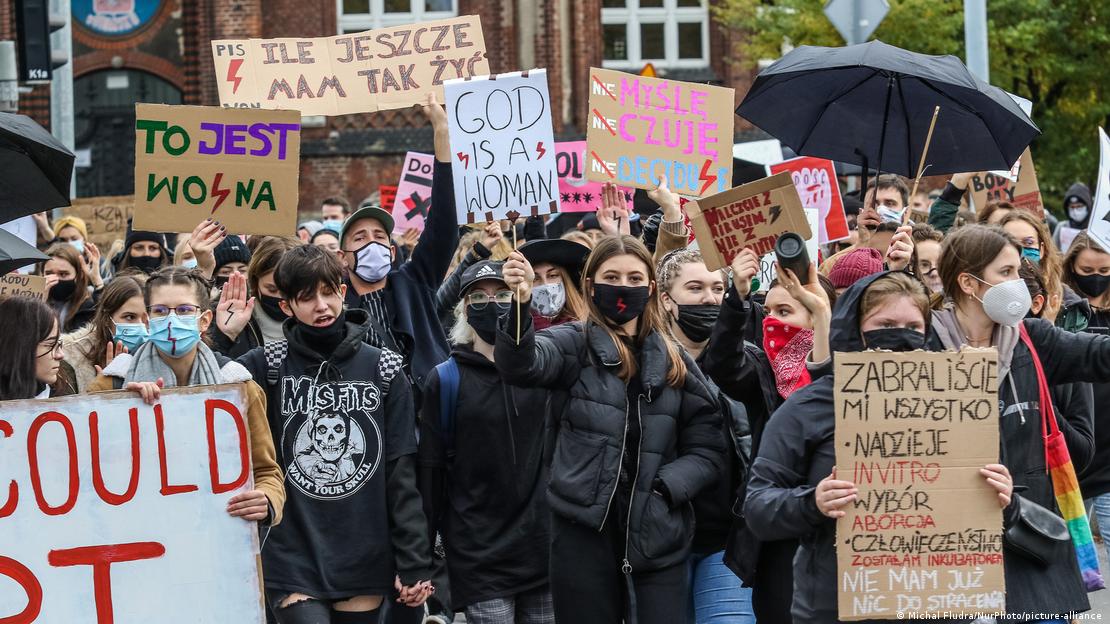
Pro-choice protesters in Poland repurposed 'Bella Ciao' in 2020Image: Michal Fludra/NurPhoto/picture-alliance


From resistance to remixes

Though not widely sung during World War II itself, "Bella Ciao" defined how Italians stood up to fascism after the war. Over the decades, it has been adopted by leftist movements across Europe and beyond.

In January this year, left-wing activists in Germany sang the song at a protest against the far-right party AfD.

In 2024, left-leaning members of the European Parliament sang it to protest Hungarian Prime Minister Viktor Orban's policies — prompting Parliament President Roberta Metsola to then quip, "This is not Eurovision."

In 2021, demonstrators in Jerusalem, opposed to Prime Minister Benjamin Netanyahu's hold on power despite an indictment and corruption allegations, sang "Bibi Ciao" at the prospect of his departure back then — "Bibi" being Netanyahu's nickname.

Carlo Pestelli, who authored the book "Bella Ciao: The Song of Freedom," told AFP in 2022 that the song's appeal lies in its adaptability and melodic simplicity.

"It wasn't a communist song but a manifesto for freedom… it represents apolitical values that everyone can understand and share," Pestelli said. "It is also an easy song to sing, with a catchy chorus that even non-Italian speakers can pick up."

Feminist protests and balcony choruses


Feminist activists have also repurposed the catchy ditty to fight their causes. Pro-choice activists in both Argentina and Poland repurposed the song in 2018 and 2020 respectively, calling out their governments for legislating unfavorably against women's reproductive rights.

On September 16, 2022 — the day 22-year-old Jina Mahsa Amini died following her arrest by Iran's morality police for wearing an improper hijab — sisters Samin and Behin Bolouri sang a Persian version of "Bella Ciao" in a social media post that went viral.


These localized adaptations reflect what Salerno and van de Warenburg call "transnational activism," where the song — also used by both the Occupy Wall Street and Fridays for Future movements — becomes a vessel for new struggles without losing its historical weight.

Its reach however, has extended far beyond politics. It was belted from balconies in Italy during COVID-19 lockdowns and has even been reworked by soccer fans in support of their clubs.


Digital reworking

"Bella Ciao" owes much of its recent popularity to Netflix's Spanish crime drama "La Casa de Papel" (or "Money Heist" in English), which introduced the song to a global audience.

The series' version, remixed by electronic dance music producers El Profesor and Hugel, has to date garnered more than 200 million views on YouTube. Dozens of versions, including indie interpretations, can also be heard on Spotify.

It has also surfaced in gaming culture, featured in "Far Cry 6" and used on TikTok to score highlights from "Call of Duty: Warzone."

A legacy transcending ideologies

"Bella Ciao" has been used by movements across continents and ideologies — from anti-fascist and feminist activists to climate protesters and pop culture creators.

Its adaptability has made it a fixture in moments of dissent, solidarity and remembrance.

Whether sung in protest, remixed online or referenced cryptically on a bullet casing, "Bella Ciao" continues to serve as a signal — not of any particular ideology, but perhaps of resistance itself.

Edited by: Elizabeth Grenier


India sees drop in CO2 emissions as renewables accelerate

India sees drop in CO2 emissions as renewables accelerate
/ Valeriy Kryukov- Unsplash
By bno - Taipei Office September 19, 2025

India’s power sector has recorded an unusual dip in carbon dioxide output, with emissions falling by 1% in the first half of 2025 compared with a year earlier. It is only the second time in nearly fifty years that such a decline has been observed Carbon Brief reported on September 18. Over the past twelve months, emissions were down by 0.2%, according to the analysis Carbon Brief published.

This shift has taken place against the backdrop of record growth in renewable energy across India as the nation pushed ahead on installing renewables at a pace seen in few other places around the world. In the first six months of the year the report says, India added 25.1 GW of clean-energy capacity — a 69% rise on the same period in 2024.

That expansion, the report says, is expected to produce roughly 50 terawatt hours of electricity annually, enough to match the average increase in nationwide demand. It is an expansion being helped in part by India putting in place its own solar production infrastructure to help avoid importing hardware from China and elsewhere.

Research by the Centre for Research on Energy and Clean Air (CREA) cited, also highlights several factors behind the drop Carbon Brief says. Oil use has flattened after years of steady growth, while gas consumption has fallen by 7%.

Cooler weather in some parts of India as well as heavier rainfall during the monsoon has also reduced electricity demand. In contrast, oil-product demand showed no growth at all it was stated - a stark departure from the 6% and 4% annual increases registered over the last two years.

The picture, however, is mixed Carbon Brief claims. Heavy industry in India continues to drive emissions upwards. Steel production rose by 7% to support this, as did cement output by 10% in the first half of the year, fuelled in large part by government infrastructure spending.

Indeed, as Carbon Brief indicates but as is already widely known, coal still dominates India’s energy mix and will do for some time to come. At present coal accounts for more than half of the sector’s emissions. Yet the new figures suggest the country could reach a peak in power-sector emissions before 2030, provided the expansion of renewables stays on track. India has set a widely-publicised target of 500 GW of non-fossil capacity by that date, with 243GW already installed by mid-2025.

On the global stage, India remains a decisive force. Since 2019 it has been responsible for nearly 40% of the increase in energy-sector emissions, reflecting the pace of its industrialisation and rising energy needs as millions move into the middle classes. For now though, although emissions per person remain well below the world average, India still accounts for 8% of global energy-sector CO2 in 2024, and that number is likely to rise as tastes change and India becomes more developed.

In sync, whether the present slowdown signals what Carbon Brief suggests as being a lasting shift or a temporary pause, will depend entirely on how quickly renewables continue to expand VS how fast industrial demand evolves, and whether oil consumption remains subdued.