Sunday, September 14, 2025


Why It Matters That Male and Female Economists See the Economy Differently

In a significant new study published by the Institute for New Economic Thinking, Canadian economist Mohsen Javdani reveals that gender shapes views on power, equality, and inclusion in ways politics alone can’t explain.


A close-up shows a woman shopping at a convenience store and checking her receipt while exiting.
(Photo by Getty Images)


Lynn Parramore
Sep 14, 2025
Common Dreams

Men and women might check the same box on election day, but they see the economy through different lenses. Just ask professional economists.

That’s the striking implication of a new study by Mohsen Javdani, associate professor of economics at Simon Fraser University, who surveyed over 2,400 economists across 19 countries. His research reveals that gender shapes how they understand economic issues in ways politics alone can’t explain—and warrants attention from policymakers and campaigns alike.


Javdani wasn’t just chasing numbers; he was looking for patterns in what economists believe and focus on. What he found: Women in the field (still underrepresented) are more likely to challenge traditional theories, promote equality and social justice, and push for a more inclusive economics. They tend to lean further left than their male colleagues, who are more often centrists or right leaning.

Probably no surprise there.

But here’s the twist: Even when the men and women shared the same political beliefs, they still interpreted economics differently. Right-leaning female economists, for example, were more likely than their male peers to question orthodox ideas and emphasize equality and inclusion. Javdani’s data suggests that as economists shift right politically, men abandon progressive views more quickly than women do.

Simply put, political labels often try to explain it all, but they miss a big piece: Gender is at work behind the scenes.

If right-leaning women are more receptive to progressive economic ideas than their male counterparts, then campaigns that speak directly to these women could unlock a powerful, untapped base for fairness and inclusion.

So, just pack the room with more women and expect the conversation to shift? Not so fast.

Javdani points to earlier research by Giulia Zacchia and others, showing that numbers alone don’t cut it, especially if the loudest voices still echo the same old male-dominated, market-centered dogma. Without structural changes and real efforts to open the field to new ideas, the issues women tend to bring to the table, like labor protections, inequality, and a more hands-on role for government, keep getting sidelined. New faces, same soundtrack. Female economists are out there pushing for redistribution, calling out bias, and demanding better, but if no one’s listening, the system stays stuck.

This isn’t just academic—what’s at stake is a real understanding of how the economy hits women, what they contribute, and why their labor keeps getting undervalued.

Javdani’s study breaks new ground by showing how politics can blur—but never erase—the gender gap in economic thinking. As he writes:
While moving rightward on the political spectrum is consistently associated with weaker support for progressive and equity-oriented positions, the decline is less steep among women. In several cases—particularly among right- and far-right-leaning economists—women remained more supportive of positions emphasizing inequality, structural disadvantage, and concern about corporate power.

For anyone trying to grasp how voters think about the economy, this research is very suggestive.

Javdani study samples only economists, but it is difficult to believe that the differences he documents do not extend far more broadly, and that if we want to understand economic opinions at the ballot box, we have to look beyond party lines and pay attention to gender.

A recent NBC News poll, for example, shows a wide gap between conservative young male voters and their liberal female counterparts on issues like financial independence, debt, and home ownership. And a new Gallup survey reveals meaningful differences in how male and female respondents view capitalism and socialism—with men viewing capitalism more positively than women, and the reverse for socialism.

But significantly, there are also large gaps among men and women in the same political categories. A March 2025 Pew analysis found Republican women were more than twice as likely as Republican men to see employer bias as a major cause of the gender wage gap (43% vs. 18%). Meanwhile, polling by Navigator Research shows American women are consistently more pessimistic about the economy than men, across race, income, and party lines. This stems from how women experience the economy day-to-day—focusing on costs like groceries, rent, and healthcare rather than abstract numbers like GDP or the stock market.

As a result, women tend to strongly support policies that directly ease these burdens, from paid family leave and the Child Tax Credit to cracking down on corporate price gouging.

Yet much economic messaging still treats the economy as gender-neutral—a costly oversight for anyone hoping to connect with voters. Javdani’s research points to a missed opportunity: If right-leaning women are more receptive to progressive economic ideas than their male counterparts, then campaigns that speak directly to these women could unlock a powerful, untapped base for fairness and inclusion.

Talking about economics like gender doesn’t matter is like playing checkers in a chess game. When you meet people where they actually are, not where your ideological playbook says they should be, you stop talking past each other, and start building something real, like an economy that works for everybody.


Don’t Let Wall Street Gamble With Your Golden Years

September 12, 2025

Photo by Aditya Vyas

Your retirement savings are supposed to be the safest money you’ll ever have — not a roll of the dice. The whole point of a 401(k) and other retirement plans is to let you gradually build wealth that brings economic security in your golden years.

But private equity firms are itching to lure retirement savers into Wall Street’s casino. Anyone who wants a secure retirement should recall what Las Vegas tourists inevitably learn: the house always wins.

Private equity is a business model built on raising money from big, sophisticated institutional investors like pension funds, endowments, and insurance companies — then buying companies to flip them for profit.

It works out well for Wall Street executives who pocket enormous fees, but it often leaves companies and workers in ruins.

Toys “R” Us was driven into bankruptcy after being loaded with debt by its private equity owners. So were hospital chains Steward Healthcare and Prospect Medical Holdings, craft powerhouse Joann Fabrics, the TGI Fridays restaurant chainPayless ShoeSource, and Sears. These companies were all gutted by private equity deals that prioritized quick payouts over long-term stability.

But now, the big investors these Wall Street firms once relied on — like Yale University, which oversees a staggering $41.4 billion endowment — are walking away after years of high fees, murky accounting, and disappointing results.

If the pros are stepping away, who’s left? Ordinary savers, who hold $12.4 trillion in retirement accounts. Private equity firms want to bring the workers holding this cash to the table, where the game is stacked against them.

And the Trump administration is helping them, pressuring the Department of Labor and the Securities and Exchange Commission, the very agencies meant to safeguard retirement savers, to open the door for private equity firms to enter 401(k) plans.

Private equity firms see you as easy prey. Your retirement account is a steady pot of money, and they’d love to siphon off fat fees while locking you into risky, opaque investments you can’t escape. They get rich whether you win or lose — and you get stuck with the bill.

While a standard index fund charges less than half a percent in annual fees, private equity takes 2 percent off the top every year plus 20 percent of whatever gains the investments make. There are “transaction fees,” “monitoring fees,” and other made-up charges that guarantee the casino wins — and your golden years pay for someone else’s yacht.

If you invest your money in the stock market, you can see what’s going on: up or down, it’s very transparent. Private equity funds set their own valuations, meaning your account balance could look fine on paper even as long-term losses pile up. Plus, your money could be tied up for five or ten years. Need cash for an emergency? Too bad.

No one saving for retirement ever asked, “Can you make my 401(k) riskier, less transparent and more expensive?” Instead, this push is coming straight from Wall Street, which has spent years buying political influence in Washington.

The Trump administration welcomed private equity executives into its ranks and has been eager to deliver on their agenda, weakening the rules that kept retirement funds safe for decades and clearing the way for Wall Street to raid ordinary people’s savings.

Retirement saving should be boring. Boring means low fees, broad diversification, steady growth, and money that will be there when you need it. But in the private equity casino, Wall Street never risks its own chips. They rake in the pot while you’re left holding the losses.

The lure of gambling is insidious. Wall Street will play on that as it pushes the Trump administration for finance-friendly changes. If private equity is allowed into 401(k)s, the only ones guaranteed to come out ahead are the billionaires.

And your golden years? You’ll be cleaned out.


Targeting Venezuela, Trump Escalates US Campaign of Aggression in Latin America

The US and Latin American right have long mobilized to remove challenges to their traditional privileges and control.

By Jonathan Ng ,
September 13, 2025


An activist holds a poster depicting U.S. President Donald Trump bearing devil horns during a protest in defense of national sovereignty following the U.S. government trade taxes and sanctions on Brazil, near the U.S. consulate, in Sao Paulo, Brazil, on August 1, 2025.NELSON ALMEIDA / AFP via Getty Images

Earlier this month, the Trump administration bombed a civilian boat in the Caribbean, after sending warships to the region. “Instead of interdicting” the vessel, Secretary of State Marco Rubio emphasized, “we blew it up.” The attack drew harsh criticism from legal experts such as former Human Rights Watch Director Kenneth Roth, who called it “a summary execution – the crime of murder.”

U.S. officials frame the operation as a dissuasive strike against drug traffickers. Yet many experts agree that the crude display of force and ongoing naval expedition form part of an offensive against President Nicolás Maduro of Venezuela. The White House claims without evidence that the socialist statesman and U.S. critic is a drug cartel leader. Secretary of War Pete Hegseth stresses that policy makers are ready to leverage “every asset that the American military has” toward regime change.

The drive to overthrow Maduro illuminates an established but often unrecognized pattern of imperialism in Latin America. U.S. officials and regional conservatives have long targeted leftist leaders, attacking political threats to their influence and investments. In recent decades, opposition to “Pink Tide” governments has fostered new forms of interventionism, disinformation, and legal manipulation. Trump’s naval expedition highlights this trend, which now threatens self-determination and democracy across much of Latin America.

Turning the Tide

The current cycle of conflict began in the early 2000s, as “Pink Tide” governments took power challenging Washington’s leadership and neoliberal capitalism. Leftists such as Evo Morales, the first Indigenous president of Bolivia, prioritized social programs, while promoting regional integration to counterbalance U.S. influence. In response, President George W. Bush tried to create a political terrainhostile to reform. Repeatedly, his administration strengthened the local opposition in strategic sectors — especially the judiciary and legislature — to foster political gridlock.

Morales’s election in 2005 unnerved U.S. diplomats in particular. They portrayed his progressive agenda as a reckless assault on foreign investment. In one racist description, officials labeled the Indigenous president a “[r]adical cocalero union leader” with “strong anti-democratic tendencies,” willing to “physically intimidate anyone” standing in his way.

During their first meeting, Ambassador David Greenlee bullied Morales by outlining the United States’s suffocating influence over the Bolivian financial system. “When you think of the IDB [Inter-American Development Bank], you should think of the U.S.,” Greenlee underscored. “This is not blackmail, it is simple reality.”

The U.S. embassy recommended the “careful application of carrots and sticks” to expose Morales’s vulnerability. Officials brainstormed “the freezing of certain programs,” blocking international loans, and other “shots over the bow” to signal “it will not be business as usual.” Meanwhile, the U.S. government poured money into strengthening opposition forces. Between 2005 and 2006, USAID heavily redirected funding in Bolivia toward conservative civic groups and politicians, continuing a long-time agency tradition of operating as a screen for foreign intervention.

The embassy became a hotbed of political intrigue, as a revolving cast of right-wing leaders and activists lobbied for U.S. assistance. Privately, former President Jorge Quiroga urged Ambassador Greenlee to “block further debt relief for Bolivia.” Another U.S. ambassador himself hosted meetings and a cocktail party for opposition members.

Tensions peaked in 2008 when conservative activists in the Media Luna region organized an illegal referendum seeking political autonomy. The embassy reported coup rumblings, noting that “opposition-aligned” forces were “contacting Bolivian military general officers regularly” for support. “If called upon to put down ‘insurrection,’ they claim they would side with the Media Luna.”

So would the United States. USAID programs aimed to “strengthen regional governments as a counter-balance to the central government.” The opposition mobilized the Media Luna region, but failed to topple Morales. In response, his administration ousted the U.S. ambassador and DEA officials for helping instigate the unrest.

Morales proved fortunate. In 2012, USAID-backed forces ousted the progressive President Fernando Lugo in Paraguay, who had sided in agrarian conflicts with displaced peasants and sought land reform. Across Latin America, Washington supported opposition-dominated civic and state institutions in order to tip the balance of forces against the left. Wielding “carrots and sticks,” they aimed to reassert a political order that preserved U.S. investment and influence, while locking the left out of power.
Waging Lawfare

Above all, the United States deepened cooperation with foreign judges, prosecutors, and other law enforcement officials. In multiple countries, conservatives substituted legal combat and disinformation for open warfare against the left. They waged “lawfare” in the courts and press, immobilizing progressive leaders through judicial harassment and character assassination. Lawfare operations were slow-motion coups with a legal façade: court disputes and impeachment procedures that made military force unnecessary.

They gained notoriety in Brazil, where the United States played a major role in Operation Car Wash, a politically motivated anti-corruption probe that ran from 2014 and 2022, which investigators pursued to undercut the Workers’ Party. Brazilian prosecutors held secret meetings with U.S. officials investigating bribery without informing their own Ministry of Justice. “[The] Americans don’t want us to divulge things,” one confided. Notably, a veteran of several U.S. legal exchange programs, Judge Sergio Moro, presided over the operation. A Supreme Court minister observed that officials were “participating in a gold rush” to enrich their own agencies and advance their personal careers: Eventually, the state oil company, Petrobras, alone paid over $853 million in penalties.

In 2016, the opposition exploited the probe to oust President Dilma Rousseff in a parliamentary coup, enabling Michel Temer — a former U.S. informant — to assume office. Legislators impeached Rousseff after accusing her of manipulating state finances. Yet auditors found no evidence of wrongdoing. Afterward, Judge Moro sentenced former President Luiz Inácio Lula da Silva for false corruption charges. Although the Supreme Court eventually ordered Lula’s release and annulled his convictions, the initial ruling undermined the left’s electoral prospects, allowing the arch-reactionary Jair Bolsonaro to win the presidency in 2018. Later, Bolsonaro rewarded Moro by appointing him minister of justice.

President Lenín Moreno of Ecuador also waged lawfare against the left after assuming office in 2017. His predecessor Rafael Correa and the Citizen Revolution Movement (RC) slashed poverty by 38 percent, while building robust social programs. But Moreno betrayed Correa and his former colleagues by persecuting them, purging the judiciary, and imposing austerity measures. As poverty and protests spread, he thanked a forum of bankers for opposing his election, since he now attracted “hatred instead from those who voted” for him.


Lawfare operations were slow-motion coups with a legal façade: court disputes and impeachment procedures that made military force unnecessary.

RC leaders faced death threats, police surveillance, and imprisonment, forcing many into exile. Authorities sentenced Correa in absentia for “psychic influence” over government officials. Interpol recognized that the case was outrageous and refused to extradite him from Belgium. Back in Ecuador, authorities arrested and allegedly tortured former Vice President Jorge Glas.

As in Brazil, the U.S. government backed the campaign of persecution. The National Endowment for Democracy (NED) funded Mil Hojas, a journalism collective that smeared the RC with corruption allegations. A NED newsletter, Democracy Digest, explained that Correa governed “when left-wing leaders were ascendent in Latin America,” before approvingly noting the “left-wing wave has since subsided.” Attorney General Diana Salazar later received a Wilson Center award for spearheading the repression. Privately, she admitted that U.S. officials “want [the] RC’s head.”

Lawfare became an essential strategy of the right in Latin America, triggering a domino effect of coups against progressive governments. Brazil and Ecuador became models for local oligarchies and U.S. officials attempting to drain the “Pink Tide.” The field of struggle shifted from the ballot box to the courtroom, as the right took back the power it had lost in elections.
Courtroom Drama

Most notably, Brazil and Ecuador offered a script for conservatives in Argentina, which became the epicenter of lawfare. In 2015, the wealthy conservative Mauricio Macri became president, before revamping law enforcement cooperation with the United States — securing DEA assistance, training for judges, and enhanced intelligence coordination. The infusion of U.S. aid helped Macri clobber former President Cristina Fernández de Kirchner (“CFK”) and the Peronist left.

Between 2003 and 2015, CFK and her husband steered Argentina out of a financial crisis and alleviated poverty, while refusing to impose IMF-prescribed austerity measures. Macri and U.S. officials vigorously opposed their bold progressive agenda, prompting Secretary of State Hillary Clinton to ask about the president’s “nerves and anxiety” — as if leftist policies were a sign of mental illness.

The backlash was swift. By 2022, CFK was the target of over 650 legal complaints. One Macri ally alone initiated 74 against her.

A group of leading international jurists including Baltasar Garzón concluded that CFK was the victimof “judicial persecution.” Garzón emphasized that it was “not [even] possible for a person to have committed as many illicit acts as she has been accused of.”

Former Supreme Court Justice Eugenio Raúl Zaffaroni observed that his Argentine colleagues exploited “the technique of lawfare,” pursuing CFK and other Peronistas without evidence. Zaffaroni noted that officials organized “mafia-style meetings” to coordinate their campaign against the left. Notoriously, the minister of labor for Buenos Aires, Marcelo Villegas, a close Macri ally, plotted with businessmen to destroy the labor movement. “Believe me, if I had a Gestapo… a shock force to finish off all the trade unions, I would go ahead,” Villegas confided.

The collusion between the judiciary and conservatives was ongoing. At least five judges and two prosecutors involved in a public works (“Vialidad”) corruption case against CFK privately consulted right-wing leaders and Macri — whose very administration opened the proceedings. Senior judges and prosecutors even played soccer and tennis at the president’s residence.

Major news outlets legitimated the repression by joining what CFK dubbed “a media-judicial firing squad.” The leading newspaper, Clarín, published sensational coverage echoing claims of corruption. One editor admitted that his team waged “war journalism” against CFK. Ultimately, lawfare mobilized not only judges but journalists, cementing the impression of guilt in the public imagination because the courts lacked the evidence to do so.

Eventually, Macri allies led a secret retreat in Lago Escondido for judges, government lawyers, and Clarín representatives. The group included Judge Julián Ercolini, who oversaw the “Vialidad” case against CFK. After news of the retreat leaked, officials discussed potential cover stories to avoid leaving “loose ends.” They struggled to concoct a convincing lie. “We can’t say that we went fishing,” one member lamented, because “it’s not fishing season.”

The Lago Escondido scandal exposed the fusion of the judiciary and media that made lawfare possible. Latin American conservatives claimed that a separation of powers existed. But the manipulation of justice and information revealed the oligarchy’s vice-like grip over strategic sectors of society. The campaign against CFK was a sign of this deeper reality, as supposedly impartial institutions repeatedly asserted their class bias.
Gavels or Guns

By 2017, the right-wing resurgence and Donald Trump’s presidency was emboldening regional conservatives, who openly adopted more aggressive methods of regime change. Critical observers portrayed lawfare as a fundamental break from the military coups of the Cold War past. Yet U.S.-backed security forces remained the last resort and irreducible bedrock of the oligarchy’s class power.

This became clear in Venezuela, where Trump revamped efforts to strangle the Bolivarian Revolution: a self-proclaimed socialist experiment that rejected U.S. hegemony. Grasping for pretexts, officials exploited an Obama-era executive order that labeled the country an “unusual and extraordinary threat” as precedent, while blocking access to U.S. financial and energy markets. Previous measures targeted individual Venezuelans leaders. But the latest raft of sanctions were indiscriminate and agonizing, fomenting a humanitarian crisis and offering a pretext for military intervention. Economists concluded that U.S. pressure caused “tens of thousands of deaths” by depriving Venezuelans of medicine and food, while propelling “the largest economic collapse, outside of wartime, since 1950.”

Exploiting the chaos, the opposition legislator Juan Guaidó spearheaded a coup in January 2019 with Trump’s encouragement. Later, National Security Advisor John Bolton explained that they supported Guaidó to secure control of Venezuela’s energy wealth, including the largest known oil reserves in the world. But privately, Trump ridiculed the coup leader. “This kid – nobody’s ever heard of him,” he guffawed. As the coup fizzled, Trump unsuccessfully attempted to incite military intervention by demanding that Venezuelan officers oust President Nicolás Maduro or “lose everything.”


Far from passé, military intervention remained an alluring option in the regime change playbook, while U.S. and local officials isolated bastions of the left, mobilizing judges when possible and soldiers, if necessary.

That same year, however, Trump’s regime change strategy succeeded in Bolivia, after Morales secured reelection in October. The U.S.-dominated Organization of American States published inaccurate statements challenging the results, which fueled an exhibition of unrestrained racism and class resentment. Middle-class motorcycle gangs wove through city corridors hunting Indigenous socialists, and pro-coup security forces massacred dozens of civilians.

As Morales’s government imploded, the opposition senator Jeanine Áñez declared herself president. Reenacting the Spanish conquest, Áñez entered office with an oversized Bible and conquistador cross, after having asserted that Indigenous culture was “satanic.”

U.S. fingerprints were all over the coup. The Washington-aligned OAS played an essential role in escalating the crisis. The U.S.-trained Bolivian general, Williams Kaliman, pressured Morales to resign. And the Trump administration immediately backed Áñez, arguing that “Morales’s departure preserves democracy.” Tesla founder Elon Musk appeared belligerent when observers accused the United States of orchestrating the coup to secure lithium for his company. “We will coup whoever we want,” Musk announced. “Deal with it!”

Under President Joe Biden, U.S. officials both maintained crushing sanctions against Venezuela and continued to back Áñez in Bolivia, even after local authorities arrested her for illegally seizing power. The violence of the 2019 coups exposed an underlying pattern. Far from passé, military intervention remained an alluring option in the regime change playbook, while U.S. and local officials isolated bastions of the left, mobilizing judges when possible and soldiers, if necessary.
Solidarity Coups

Recently, the Trump administration has reinvigorated ties with local reactionaries in the region and openly targeted progressives. The MAGA movement promotes regime change in Latin America, while offering a dangerous model for regional conservatives.

In January 2023, President Bolsonaro attempted a coup in Brazil that closely mirrored Trump’s failed 2021 insurrection. Audio recordings capture him rehearsing claims about electoral fraud before polls opened, as well as allied officers conspiring to ignite a “civil war.” Before finishing his term, Bolsonaro moved to Florida near Mar-a-Lago, where his family allegedly liaised with Trump, consolidating a truly global right-wing international.

This April, President Daniel Noboa of Ecuador also used strong-arm tactics to secure reelection. Noboa ran without taking the required leave of absence and illegally tapped public funds for his campaign. After underperforming in the first round, Noboa visited Trump to enhance his image among voters seeking aggressive leadership amid spiraling crime rates and economic uncertainty. He then declared a state of emergency in pro-RC areas before the runoff election, allowing the police to impose curfews and prohibit public gatherings. Noboa’ is an implacable enemy of the left — at one point, security forces invaded the Mexican embassy to arrest a dissident.

Across the region, conservative populists maintain an open alliance against progressive movements. More than anyone, President Javier Milei of Argentina personifies the right’s reactionary fury and ties to Washington. Milei not only gifted Elon Musk a chainsaw at the 2025 Conservative Political Action Committee (CPAC) conference in Maryland. He also headlined Brazil’s CPAC, where he denounced the left after binge drinking with Bolsonaro.

Ultimately, the alignment between the U.S. and Latin America’s oligarchies is toppling more than progressive governments. Right-wing backlash to social democracy has eroded the rule of law, reimposed poverty, and fostered political despair.

This summer, CFK began six years of house arrest for the “Vialidad” case, after the US government itself sanctioned the leftist leader. Prominent Argentine journalists welcomed her arrest by applauding themselves for making “this day possible.” Her detention continues as leaked audio files suggest that Milei’s sister has embezzled funds for citizens with disabilities, and an allied judge is prohibiting the publication of potential evidence, curbing freedom of speech and exacerbating a national scandal.

Recently, Brazil’s Supreme Court convicted Bolsonaro for organizing the failed 2023 coup, citing “overwhelming evidence” that he plotted to assassinate Lula and a senior judge. Prior to Bolsonaro’s sentencing, the White House had leveraged tariffs to punish Brazilian authorities who are attempting to hold the former president accountable, and had threatened to apply “military might” in his defense.

The naval expedition against President Maduro of Venezuela fits into this broader context. Taking lawfare to its extreme, U.S. leaders now advocate regime change by claiming that Maduro is a drug trafficker. Yet the evidence is flimsy, and Secretary of State Rubio exploded when confronted with opposing conclusions. “I don’t care what the UN says,” he retorted. From the sidelines, Venezuelan conservatives have echoed drug trafficking claims and encouraged officials to ramp up economic pressure.

In short, Trump’s bare-fisted offensive against Venezuela is nothing new. For two decades, the United States and Latin American right have mobilized to eradicate challenges to their traditional privileges and control. Lawfare against the left has cleared the way for dangerous reactionaries, while reinforcing inequality and inflicting lasting damage to government institutions. Rather than social progress, the right is pursuing solidarity coups across borders: substituting oligarchical rule for democracy and, once more, turning Latin America into a central battleground in the global struggle against U.S. imperialism.

The author would like to thank Sarah Priscilla Lee of the Learning Sciences Program at Northwestern University for reviewing this article.

This article is licensed under Creative Commons (CC BY-NC-ND 4.0), and you are free to share and republish under the terms of the license.

Jonathan Ng is a postdoctoral fellow at the John Sloan Dickey Center for International Understanding at Dartmouth College.
Venezuela says US marines raided a fishermen's boat in the Caribbean as tensions rise\\

Associated Press
Sat, September 13, 2025 


Members of the Bolivarian Militia listen to a recorded speech by President Nicolás Maduro at a military garrison in Caracas, Venezuela, Friday, Sept. 5, 2025. (AP Photo/Cristrian Hernandez)


CARACAS, Venezuela (AP) — Personnel from a U.S. warship boarded a Venezuelan tuna boat with nine fishermen while it was sailing in Venezuelan waters, Venezuela’s foreign minister said on Saturday, underlining strained relations with the United States.

The White House did not immediately respond to a request for comment.

Tensions between the two nations escalated after U.S. President Donald Trump in August ordered the deployment of warships in the Caribbean, off the coast of the South American country, citing the fight against Latin American drug cartels.

While reading a statement on Saturday, Foreign Minister Yván Gil told journalists the Venezuelan tuna boat was “illegally and hostilely boarded by a United States Navy destroyer” and 18 armed personnel who remained on the vessel for eight hours, preventing communication and the fishermen’s normal activities. They were then released under escort by the Venezuelan navy.

The fishing boat had authorization from the Ministry of Fisheries to carry out its work, Gil said at a press conference, during which he presented photos of the incident.

Along with the statement, Venezuela’s foreign affairs ministry distributed a short video, taken, according to the ministry, by the Venezuelan fishermen. In the video, it is alleged that part of the fishing boat, U.S. Navy personnel and the U.S. warship can be seen.

“Those who give the order to carry out such provocations are seeking an incident that would justify a military escalation in the Caribbean,” Gil said, adding that the objective is to “persist in their failed policy” of regime change in Venezuela.

Gil said the incident was “illegal” and “illegitimate” and warned that Venezuela will defend its sovereignty against any “provocation.”

The Venezuelan foreign minister’s complaint comes days after Trump said that his country had attacked a drug-laden vessel and killed 11 people on board. Trump said the vessel had departed from Venezuela and was carrying members of the Tren de Aragua gang, but his administration has not presented any evidence to support that claim.

Venezuela accused the United States of committing extrajudicial killings. The South American country’s interior minister, Diosdado Cabello, said Washington’s version is “a tremendous lie” and suggested that, according to Venezuelan government investigations, the incident could be linked to the disappearance of some individuals in a coastal region of the country who had no ties to drug trafficking.

The Trump administration has accused Venezuelan President Nicolás Maduro of leading a cartel to flood the U.S. with drugs, and doubled the reward for his capture from $25 million to $50 million.

The U.S. government has given no indication that it plans to carry out a ground incursion with the more than 4,000 troops being deployed in the area.

But the Venezuelan government has nonetheless called on its citizens to enlist in the militias - armed volunteers - in support of its security forces in the event of a potential incursion. On Saturday, it urged them to go to military barracks for training sessions.

The Passivity or Complicity of BRICS+ With Imperialist Wars


 September 12, 2025

Has Egypt, a member of BRICS+, increased its trade with Israel despite the genocide?

Certainly, for example, Egypt is supplying increasing quantities of cement that enable Israel to develop its illegal settlements in occupied territories while systematically and massively destroying homes and infrastructure in Gaza and the West Bank. According to the website enterprise.news: “Egyptian cement exports to Israel skyrocketed by more than 16 times in 2024, reaching USD 66.2 million from just USD 3.8 million in 2023, according to the Export Council for Building Materials.”

Israel rose from 35th place among importers Egyptian cement in 2022 to 4th place in 2024, coinciding with Turkey’s decision in April-May 2024 to suspend its cement exports to Israel, [1] making Egypt its main alternative supplier. Egypt is complicit in genocide by helping Israel cope with sanctions imposed by Turkey.

Furthermore, Egypt imports gas sold by Israel. In June 2025, its government cracked down on protesters who had come from all over the world to try to reach the border with Israel to demand an end to the genocide and allow humanitarian aid in the Gaza Strip.

It should also be noted that Egypt, as indicated in part 1 of this series, which receives $1.3 billion in military aid from Washington each year, cooperates militarily with Israel, particularly in the destruction of communication tunnels between its territory and Gaza.

Let us now turn to the role of the United Arab Emirates (UAE), a full member of BRICS+, and Saudi Arabia, which has been asked to join.

Apart from the Emirati military intervention in the Socotra archipelago off the coast of Aden discussed in the first part, what other direct or indirect military interventions has the UAE carried out in the Arabian Peninsula?

In the Arabian Peninsula, for most of the 2010s, the United Arab Emirates (which is a full member of BRICS+) and Saudi Arabia (which has been invited by BRICS to join) remained close counter-revolutionary allies in their opposition to the popular movements of the “Arab Spring”. Together with Saudi Arabia, the UAE intervened militarily in the Kingdom of Bahrain to put an end to the strong popular protests in 2011 [2].

In Yemen, the UAE collaborated with Saudi Arabia from 2015 onwards to reinstate the regime that had been overthrown the previous year by a popular uprising. Gradually, the UAE pursued its own agenda separately from Saudi Arabia by attempting to establish control over part of Yemen’s coastline.

Are there any direct or indirect interventions by the UAE in armed conflicts in Africa?

In Libya, in 2019 and 2020, the UAE actively supported General Khalifa Haftar, a Libyan warlord, financially and with arms shipments after he launched an attack on Tripoli to overthrow the UN-backed government.

In Sudan, referring to Husam Mahjoub’s analysis cited above (see part 1 of this series), it can be argued that the UAE’s involvement over the past decade reflects its growing sub-imperialist tendencies, particularly in terms of regional dominance, economic exploitation and military intervention. Together with Saudi Arabia, they have recruited Sudanese soldiers from the Sudanese Armed Forces (SAF) and Rapid Support Forces (RSF) to fight in the war in Yemen. The UAE provided financial support to Omar al-Bashir’s dictatorial regime in Khartoum until his ouster in April 2019 following mass protests that began in December 2018 (December Revolution).

After Omar al-Bashir’s fall, the UAE and Saudi Arabia, along with Egypt, encouraged a process that led to the formation of a transitional government, which failed to meet the aspirations of the Sudanese people. The three countries then undermined the civilian wing of the government, supporting military leaders with financial aid, military supplies and lobbying efforts to consolidate their power. The United Arab Emirates also pushed Sudan to normalise relations with Israel through the Abraham Accords [3], thereby aligning Sudan with the regional strategies pursued by the United Arab Emirates.

In October 2021, the three countries supported a military coup that further strengthened military rule in Sudan. As tensions escalated, the United Arab Emirates’ support shifted decisively towards the Rapid Support Forces (RSF), contributing to the outbreak of war on 15 April 2023, which has since developed into one of the world’s worst humanitarian crises. The UAE has been a hub for RSF’s financing, logistics, media, public relations and political activities.

In Somalia, the UAE has funded, trained and equipped rebel forces for several years. Relations deteriorated in 2018 when Mogadishu seized Emirati funds, but the UAE subsequently restored its support, particularly to Puntland. See, for example: Washington Institute, “More Emirati Military Involvement in Somalia Could Help Curb al-Shabab,” published 27 June 2023. Read also: Husam Mahjoub, “The emerging sub-imperial role of the United Arab Emirates in Africa”, TNI, 4 February 2025.

In Eritrea, the UAE leased the port and airbase at Assab, transforming it into an important logistics hub for its military operations in Yemen (2015-2019). This initiative strengthened its presence in the Red Sea.

In Ethiopia, the UAE provided drones and support to Abiy Ahmed during the Tigray war (2020-2022), thereby contributing, according to some sources, to changing the dynamics of the battlefield against the Tigray People’s Liberation Front (TPLF).

The UAE has evolved from being a commercial and financial hub in the Gulf to an active participant in African conflicts. From Libya and Sudan to Somalia, Eritrea, Ethiopia and the Sahel, it uses a combination of weapons, drones, financial resources and mercenaries to influence outcomes. Their actions often exacerbate conflicts, strengthen authoritarian regimes, and undermine peace processes while presenting themselves on the international stage as a “guarantor of stability”.

How can we summarise the UAE’s intervention in the Arab region?

The United Arab Emirates has played a central role in suppressing democratic movements in the Arab world. It has opposed popular movements calling for greater social justice and supported authoritarian regimes. At the same time, they have pursued military and economic expansion, intervening in Yemen and Libya, establishing strategic bases and using their wealth to consolidate their regional influence. They have also supported forces opposed to the revolutions and collaborated with other counter-revolutionary powers (Israel, Saudi Arabia) to block any democratic transition and limit the rights of peoples to decide their own future.

The Emirates are a pillar of the counter-revolution in the region. While adopting a policy that corresponds to their interests as a rising regional power, they have prioritised despotic stability in the region and respect for the interests of US imperialism and Israel at the expense of democratic change and popular aspirations.

What is the United Arab Emirates doing among the BRICS+?

The United Arab Emirates (UAE) officially joined the BRICS in January 2024, alongside four other countries (Indonesia, Iran, Egypt and Ethiopia), as part of a historic expansion of the group.

The United Arab Emirates joined BRICS to increase its global influence. It remains an ally of the United States and Israel, and by joining BRICS, it gains importance on the international stage. For the UAE, joining BRICS expands investment and trade opportunities, particularly with China.

What is Donald Trump’s reaction to the UAE’s accession to BRICS?

We wait to see what pressure Donald Trump will apply to the UAE regarding its participation in BRICS. To date, there has been no direct public statement or testimony from Donald Trump specifically denouncing the United Arab Emirates’ (UAE) membership of BRICS. While he has repeatedly made virulent comments against BRICS, no article, post or official speech mentions Trump specifically targeting the UAE’s membership (see the box on Trump’s statements about BRICS).

Why did the founding members of BRICS invite the UAE to join them?

To broaden their influence, the leaders of the BRICS founding countries considered it useful to include an oil and financial power that is also a traditional ally of the United States. For the same reason, they wanted Saudi Arabia to join.

What about Saudi Arabia, which was invited to join as a full member, and Turkey, which was invited as a partner?

It is justified to take into account the role of Saudi Arabia and Turkey, as both countries are sub-imperial powers in the region that have not yet decided whether to join the BRICS while maintaining close relations with them by participating in their summits. Turkish President Recep Tayyip Erdoğan attended the Kazan summit in October 2024, and Saudi Arabia was represented by its foreign minister at both the Kazan 2024 and Rio 2025 summits.

Saudi Arabia, ultimately did not confirm its membership after being invited to join the BRICS as a full member. It is likely that Saudi Arabia is increasing its leverage with Washington, which aims to prevent this significant oil reserve and financial power from also joining the heterogeneous coalition that Washington has designated as an enemy. Saudi Arabia has every interest in maintaining an ambiguous position and not joining BRICS+.

Turkey, which has also been invited by the BRICS to join without becoming a member, is also demonstrating its ability to play both sides. It occupies a geostrategic position in NATO and pursues a policy that is relatively autonomous from that of Washington, Moscow and the capitals of Western Europe. It defends its own interests in the region, but it knows that if it officially joined the BRICS+, this would greatly increase tensions with Washington. To demonstrate its autonomy and regain legitimacy among the Muslim population, Turkey is one of the few countries that has actually reduced its trade relations with Israel, while the BRICS+ countries, with the exception of Iran, are strengthening their trade with Israel.

What is the reaction of the BRICS+ to the unilateral acts of war by the United States and Israel against Iran?

In the final declaration of the Rio summit on 6 July 2025, the BRICS criticise the attacks against Iran in point 21 but do not name the United States and Israel as responsible for them. [4] While Iran, a member of BRICS+, is under military attack, the BRICS+ coalition is not taking any concrete measures to defend it, which indicates that they are on the defensive against the military offensive by Washington and Israel and are unable to adopt a strong common stance on the issue.

To clarify this situation, it is important to consider the pressure exerted by the UAE, which, while part of BRICS+, opposes Iran and supports its weakening, as well as regime change in Tehran. The UAE has every interest in ensuring that the BRICS countries do not take any initiative to defend Iran. Moreover, the United Arab Emirates and Saudi Arabia have at various times helped Israel and the United States to prevent Iranian missiles from reaching their targets in Israel. For more information, see The Times of Israel, “Report: Gulf states, including Saudi Arabia, provided intelligence on Iran attack”, published on 15 April 2024.

What is the BRICS+ reaction to the destruction of infrastructure and loss of life inflicted on the Houthis by the United States and Israel?

In the final declaration, the BRICS+ countries do not mention the attacks by the United States and Israel against the Houthis because, with the exception of Iran, they oppose Houthis’ actions that are taken in solidarity with the Palestinian people’s struggle. Indeed, these actions, which mainly target Israel and US interests, hamper BRICS trade with Israel and force them to divert a significant number of ships to avoid the region. The Houthis have attacked several ships carrying goods to or from Russia, India, and even China since early 2024. Read a fairly comprehensive study on the subject: Michael Knights, “A Draw Is a Win: The Houthis After One Year of War,” CTC Sentinel, October 2024, Volume 17, Issue 9.
Read about a Houthi action concerning Chinese interests, the attack on 19 July 2024 against the Pumba, a ship returning from Turkey and heading back to China.

The final declaration of the Rio Summit contains no criticism or mention of the military attacks carried out by the United States and Israel on Yemeni territory controlled by the Houthis. Yet these attacks have caused the deaths of many civilians.

It should be noted that, in the Kazan Declaration of October 2024, the BRICS leaders condemned, without naming them, the actions of the Houthis who attack ships tradingwith Israel. The BRICS stated:

“it is important to guarantee the rights and freedoms of navigation of all states’ ships in the Red Sea and the Bab Al-Mandab Strait”.
For more information on the Houthis’ actions, read Gilbert Achcar’s opinion piece published in March 2025: “Yemen on the brink”, https://www.cetri.be/Yemen-on-the-brink and https://gilbert-achcar.net/yemen-on-the-brink

What is the BRICS+ position on Syria?

Regarding Syria, the final declaration of the BRICS+ summit, in point 29, welcomes the lifting of sanctions against the country. While the regime in Damascus, which was allied with Moscow and Tehran, was overthrown in December 2024 and Bashar al-Assad subsequently found refuge in Russia, the BRICS+ welcome the lifting of sanctions. The BRICS+ call on Israel to leave the Syrian territory it occupies, namely the Golan Heights. The statement makes no mention of the hundreds of air strikes carried out by Israel since December 2024. This statement also shows that BRICS+ does not wish to take a hard line against the neo-fascist regime in Israel. Without sanctions against Israel, how can Netanyahu’s government be forced to comply?What is the position of BRICS+ regarding Lebanon?

While Israel has systematically carried out deadly attacks in Lebanon and occupies part of the country’s territory, the BRICS+, in point 28, call on the Zionist state to respect the agreements made with the Lebanese government and ask it to withdraw its occupying troops. However, it’s important to note that the BRICS+ countries have not announced any concrete measures to try to force Israel to heed their call. It should be noted that the Lebanese government denounces the Israeli occupation.

What is the BRICS position on Russia’s invasion of Ukraine?

Only points 22 and 35 address the war in Ukraine, and there is no condemnation of Russia’s invasion of Ukraine. Furthermore, there is no mention or condemnation of NATO. The Ukrainian army’s attacks on civilians in Russian territory (point 35) are condemned, but Russian attacks on Ukrainian civilians are not. Yet this war has caused hundreds of thousands of deaths among Ukrainians and Russians.

Nor is there any announcement of a BRICS+ initiative to end the conflict, which allows Trump to present himself as the sole arbiter, the one who can bring about a ceasefire or lasting peace.

He is applying the same approach to the outcome of the negotiations between Armenia and Azerbaijan, which were announced by Trump during a White House meeting in early August 2025 in the presence of leaders from both belligerent countries.

What is the BRICS+ position on NATO?

As mentioned above, the 2025 Rio final declaration makes no mention of or criticism of NATO. The same was true of the final declaration of the Kazan summit in October 2024.

What is the BRICS+ position on the armed conflict in Sudan?

The BRICS+ countries are calling for a ceasefire, but, as mentioned above, the United Arab Emirates supports the Rapid Support Forces (RSF), which are playing a major role in the ongoing war and are responsible for large-scale crimes against humanity, as are the government forces they are fighting against5 .

Does the final declaration of July 2025 adopted by BRICS+ address other conflict regions?

The situation in the eastern Democratic Republic of Congo (DRC) and the Great Lakes region is not addressed, as it is only briefly mentioned among other conflicts in point 31 of the declaration, alongside the conflicts in the Horn of Africa and Sudan (in which the UAE is involved).

The final declaration makes no mention whatsoever of the conflict between Pakistan and India (a prominent member of BRICS) over Kashmir, which reached a critical point in May 2025. This also allows Trump to claim to be the arbiter who put an end to the escalation of the conflict (a version contradicted by N. Modi). This is particularly noteworthy given that the Pakistani authorities are proposing him for the Nobel Peace Prize.

Neither is there any mention of the ongoing conflict in Myanmar between the military dictatorship (which has good relations with Beijing and Moscow) and the resistance, nor of the tensions in the South China Sea and over Taiwan.

A specific point in the declaration is devoted to the situation in Haiti, stating that “The current crisis requires a solution led by Haitians, which encompasses national dialogue and the search for consensus among local political forces, institutions and society.” This is not a bad thing.

What is the position of the BRICS+, on the Sahel Alliance (AES), which includes Burkina Faso, Mali and Niger?

There is no reference to the AES in the final declaration. There were no official representatives of the AES (which has existed since 2024) or its member countries among the official guests.

Conclusions

BRICS+ is a heterogeneous and contradictory coalition: while claiming to embody an alternative to the camp led by US imperialism and its domination over the peoples of the South, it maintains close relations with Israel and reactionary regimes. Egypt and the United Arab Emirates, allies of Washington and Tel Aviv, play a central role in this compromise. Faced with the genocide in Gaza and the wars (Yemen, Iran, Ukraine, Syria, Lebanon, Sudan, Eastern Congo, etc.), the final declaration of the 2025 summit is limited to general appeals, without sanctions against Israel or any strong initiatives.

The agreement reveals the BRICS+ coalition’s unwillingness to take clear and decisive measures to weaken Netanyahu’s neo-fascist government, to end the genocide in Gaza and to put an end to the ongoing wars, even though several of them are actively involved in these wars, such as Russia and the UAE, which are carrying out attacks against their neighbours.

In practice, the BRICS+ coalition is largely allowing Trump to take the lead, as he presents himself as a peacemaker in conflicts such as India/Pakistan, DRC/Rwanda, Ukraine/Russia, and Armenia/Azerbaijan. Meanwhile, he aggressively pursues various offensive actions—including military operations and customs measures—and does not hesitate to use force while supporting Israel in its crimes.

Faced with this situation, priority must be given to independent action by the peoples and to the strongest and most massive mobilisations possible against the ongoing genocide of the Palestinian people and in solidarity with all victims of conflicts wherever they occur on the planet. It is also a question of mobilising internationally and locally against the rise of extreme right-wing and neo-fascist forces. The construction of an anti-imperialist, feminist, internationalist, ecologist and socialist alternative remains more necessary than ever.

In the following parts of the series, the author will discuss the position of the BRICS+ countries in relation to the IMF, the World Bank, the WTO, ‘free’ trade, ‘free’ competition, etc. He will analyse the tools that the BRICS countries have equipped themselves with, such as the New Development Bank. He will discuss the position of the BRICS+ countries on the pound sterling and their position on environmental challenges.

The author would like to thank Omar Aziki, Patrick Bond, Sushovan Dhar, Jawad Moustakbal and Maxime Perriot for their proofreading and advice. The author is solely responsible for the opinions expressed in this text and any errors it may contain.

Footnotes

[1Despite this suspension, data from the Turkish Statistical Institute (TurkStat) shows that in April 2024, exports of products including cement, iron, steel and other construction materials continued, totalling several million dollars. For example, exports to Israel included approximately USD 6.6 million worth of “plaster, lime and cement”, as well as other materials such as iron and steel.

[2for most of the 2010s, the United Arab Emirates (which is a full member of BRICS+) and Saudi Arabia (which has been invited by BRICS to join) remained close counter-revolutionary allies in their opposition to the popular movements of the “Arab Spring”. Together with Saudi Arabia, the UAE intervened militarily in the Kingdom of Bahrain to put an end to the strong popular protests in 2011

[3The Abraham Accords are two peace treaties: one between Israel and the United Arab Emirates, and the other between Israel and Bahrain. The first, between Israel and the United Arab Emirates, was announced on 13 August 2020 by US President Donald Trump. They were signed on 15 September 2020 at the White House in Washington, accompanied by a tripartite declaration also signed by the US President as a witness. These agreements were extended by those with Sudan and Morocco. Source: https://en.wikipedia.org/wiki/Abraham_Accords

[4It should be added that in the communiqué issued by the BRICS countries on 24 June 2025, two days after the US bombing of Iranian nuclear facilities, there was no mention of the United States or Israel. Read: https://brics.br/en/news/brics-joint-statement-on-the-escalation-of-the-security-situation-in-the-middle-east-following-the-military-strikes-on-the-territory-of-the-islamic-republic-of-iran

The BRICS, the dollar and SWIFT: A review of evolving interests and monetary reform momentum

Pages 243-266 | Received 22 Feb 2025Accepted 18 Jun 2025Published online: 10 Jul 2025

ABSTRACT

A collective of emerging markets known as the BRICS (Brazil, Russia, India, China and South Africa, plus five new members as of 2025) is pushing for reform of 20th century global economic currency and international payment norms. Change in the distribution of global economic activity, technological progress, the challenge of updating the system, including institutions such as the World Bank and International Monetary Fund, and recent geoeconomic tensions drive their campaign. This article elucidates that multi-faceted history, its challenges and changes over time, and details of BRICS’ intensifying efforts to reform the international payments-related system, including the use of the SWIFT international payments system, and why. The article points to opportunities to improve the global economic governance status quo, toward which suggestions are offered.

Full article: The BRICS, the dollar and SWIFT: A review of evolving interests and monetary reform momentum


How Would a New BRICS Currency Affect the US Dollar?

Sep. 10, 2025

The BRICS nations are interested in creating a new currency to compete with the US dollar, and recently announced plans for a blockchain-based payment system. Learn about the developments thus far and how investors can prepare for the possibility.
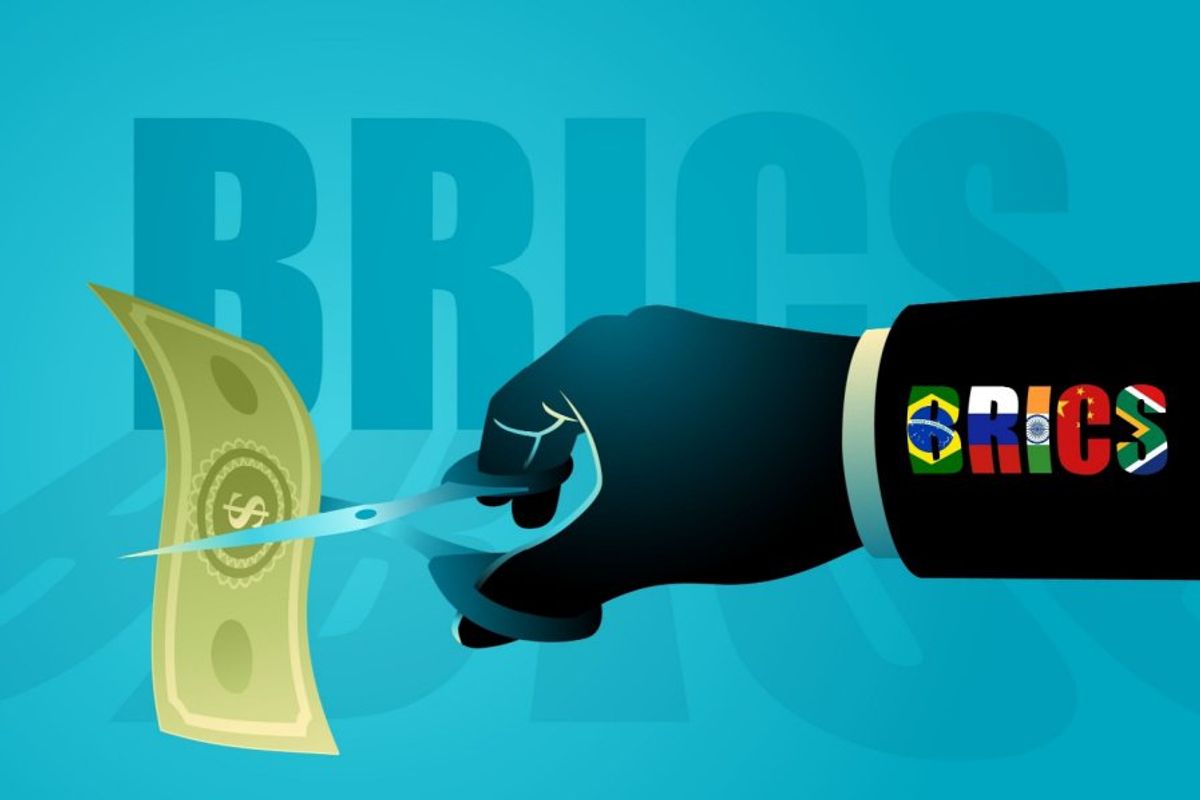
Hand labeled "BRICS" cutting paper money with scissors.
rudall30 / Shutterstock

The BRICS nations, originally composed of Brazil, Russia, India, China and South Africa, have had many discussions about establishing a new reserve currency backed by a basket of their respective currencies.

The topic was key at the 2024 BRICS Summit, which took place from October 22 to 24 in Kazan, Russia.

The BRICS nations continued discussions on creating a potentially gold-backed currency, known as the "Unit," as a US dollar alternative. Also at the summit, Russian President Vladimir Putin appeared on stage holding what appeared as a prototype of a possible BRICS banknote. However, he seemed to back away from previous aggressive calls for de-dollarization, stating the goal of the BRICS member nations is not to move away from the US dollar-dominated SWIFT platform, but rather to deter the "weaponization" of the US dollar by developing alternative systems for using local currencies in financial transactions between BRICS countries and with trading partners"We are not refusing, not fighting the dollar, but if they don't let us work with it, what can we do? We then have to look for other alternatives, which is happening," Putin told listeners.

A potential BRICS currency would allow these nations to assert their economic independence while competing with the existing international financial system. The current system is dominated by the US dollar, which accounts for about 90 percent of all currency trading. Until recently, nearly 100 percent of oil trading was conducted in US dollars; however, in 2023, one-fifth of oil trades were reportedly made using non-US dollar currencies.

Central to this situation is the US trade war with China, as well as US sanctions on China and Russia. Should the BRICS establish a new reserve currency, it would likely significantly impact the US dollar, potentially leading to a decline in demand, or what's known as de-dollarization. In turn, this would have implications for the US and global economies.?

Another factor is Donald Trump's return for a second term US presidential term. His America-first policies are expected to drive up the value of the dollar compared to its global counterparts, as was already on display the day following his election win on November 5 as China's yuanRussia's rubleBrazil's realIndia's rupee and South Africa's rand all fell. This could in turn push these BRICS member nations to look for new paths to move away from the US dollar.

If BRICS watchers were hoping for more fireworks at the 2025 BRICS meeting held in Brazil this July, they were sorely disappointed. Putin and Chinese President Xi Jinping were not in attendance, and talk of a BRICS currency was much more muted. On top of this, according to Modern Diplomacy, that topic may be even less of a concern at next year's BRICS meeting; it will be held in India, which has sought to distance itself from a move away from the US dollar.

It's still too hard to predict if and when a BRICS currency will be released, but it's a good time to look at the potential for a BRICS currency and its possible implications for investors.

Why do the BRICS nations want to create a new currency?

The BRICS nations have a slew of reasons for wanting to set up a new currency, including recent global financial challenges and aggressive US foreign policies. They want to better serve their own economic interests while reducing global dependence on the US dollar and the euro.

In recent years, the US has placed numerous sanctions on Russia and Iran. The two countries are working together to bring about a BRICS currency that would negate the economic impacts of such restrictions, as per Iranian Ambassador to Russia Kazem Jalal, speaking at a press conference during the Russia-Islamic World: KazanForum in May 2024.

Some experts believe that a BRICS currency is a flawed idea, as it would unite countries with very different economies. There are also concerns that non-Chinese members might increase their dependence on China's yuan instead. That said, when Russia demanded in October 2023 that India pay for oil in yuan as Russia is struggling to use its excess supply of rupees, India refused to use anything other than the US dollar or rupees to pay.

When will a BRICS currency be released?

There's no definitive launch date as of yet, but the countries' leaders have discussed the possibility at length.

During the 14th BRICS Summit, held in mid-2022, Russian President Vladimir Putin said the BRICS countries plan to issue a "new global reserve currency," and are ready to work openly with all fair trade partners.

In April 2023, Brazilian President Luiz Inacio Lula da Silva showed support for a BRICS currency, commenting, “Why can’t an institution like the BRICS bank have a currency to finance trade relations between Brazil and China, between Brazil and all the other BRICS countries? Who decided that the dollar was the (trade) currency after the end of gold parity?”

In the lead up to the 2023 BRICS Summit, there was speculation that an announcement of such a currency could be on the table. This proved to be wishful thinking, however. "The development of anything alternative is more a medium to long term ambition. There is no suggestion right now to creates a BRICS currency," Leslie Maasdorp, CFO of the New Development Bank, told Bloomberg at the time. The bank represents the BRICS bloc.

Government officials in Brazil, which took the rotating presidency of the BRICS group for 2025, have said there are no plans to take any significant steps toward a BRICS currency.

However, measures to reduce the reliance on the US dollar are very much on the table with cross-border payment systems, including exploring blockchain technology, a major theme at the 2025 BRICS summit, reported Reuters.

As mentioned, in 2026, the BRICS Summit will be held in India, which earlier this year distanced itself from the idea of a move away from the US dollar. Speaking at an event in London in March 2025, India's External Affairs Minister S. Jaishankar stated, "I don't think there's any policy on our part to replace the dollar. The dollar as the reserve currency is the source of global economic stability, and right now what we want in the world is more economic stability, not less. I don't think there's a unified BRICS position on this. I think BRICS members, and now that we have more members, have very diverse positions on this matter."

Which nations are members of BRICS?

As of 2025, there are 10 BRICS member nations: Brazil, Russia, India, China, South Africa, Egypt, Ethiopia, Indonesia, Iran and the United Arab Emirates (UAE). The group was originally composed of the four nations Brazil, Russia, India and China and named BRIC, which it changed to BRICS when South Africa joined in 2010.

At the 2023 BRICS Summit, six countries were invited to become BRICS members: Argentina, Egypt, Ethiopia, Iran, Saudi Arabia and the UAE. All but Argentina and Saudi Arabia officially joined the alliance in January 2024, and in 2025, Indonesia became the 10th full member of BRICS.

Additionally, at the 2024 BRICS Summit, 13 nations signed on as BRICS partner countries, although they are not yet full-fledged members: Algeria, Belarus, Bolivia, Cuba, Kazakhstan, Malaysia, Nigeria, Thailand, Turkey, Uganda, Vietnam and Uzbekistan. The expanded group of 10 full member countries is sometimes referred to as BRICS+.

What would the advantages of a BRICS currency be?

A new currency could have several benefits for the BRICS countries, including more efficient cross-border transactions and increased financial inclusion. By leveraging blockchain technology, digital currencies and smart contracts, the currency could revolutionize the global financial system. Thanks to seamless cross-border payments, it could also promote trade and economic integration among the BRICS nations and beyond.

A new BRICS currency would also:

  • Strengthen economic integration within the BRICS countries
  • Reduce the influence of the US on the global stage
  • Weaken the standing of the US dollar as a global reserve currency
  • Encourage other countries to form alliances to develop regional currencies
  • Mitigate risks associated with global volatility due to unilateral measures and the diminution of dollar dependence

What is Donald Trump's stance on a BRICS currency?

Trump has not been shy about upping the ante on American protectionism with tariffs. During the first US presidential debate between him and Vice President Kamala Harris on September 10 last year, Trump doubled down on his pledge to punish BRICS nations with strict tariffs if they seek to move away from the US dollar as the global currency.

He originally took a particularly strong stance against China, threatening to implement 60 percent to 100 percent tariffs on Chinese imports, although these hefty tariffs would be paid by American companies and consumers purchasing Chinese products, not by China itself.

In early December, Trump posted an even more direct threat to BRICS nations on Truth Social:

“We require a commitment from these countries that they will neither create a new Brics currency nor back any other currency to replace the mighty US dollar or they will face 100% tariffs and should expect to say goodbye to selling into the wonderful US economy."

In response to Trump demanding a "commitment" from BRICS nations not to challenge the supremacy of the US dollar, Kremlin spokesperson Dmitry Peskov sounded less than threatened.

"More and more countries are switching to the use of national currencies in their trade and foreign economic activities," Peskov said, per Reuters. "If the U.S. uses force, as they say economic force, to compel countries to use the dollar it will further strengthen the trend of switching to national currencies (in international trade)."

How will Trump's tariffs affect BRICS nations?

If US President Donald Trump were to come through on his promise to enact 100 percent tariffs on BRICS nations the outcome could prove costly for all parties involved.

“The action would result in slower growth and higher inflation than otherwise in the US and most of the targeted economies,” according to analysis by the Peterson Institute for International Economics.

China would likely experience the worst slowing of its GDP growth as the US is its largest trading partner. One silver lining for China is that its disciplined central bank will help to save it from accelerated inflation. Trump’s 50 percent tariffs on steel and aluminum imports, set on June 3, 2025, will impact Brazil and China, as well as the UAE. Brazil is a top three source for US steel imports, while China and the UAE are significant sources of US aluminum imports.

In late July, Brazil was also saddled with a 50 percent tariff on a broader range of goods, which US President Donald Trump inflicted on the nation in response to the trial of former President Jair Bolsonaro for his alleged coup attempt.

Trump’s tariffs could have a significant impact on Brazil’s economy, which is the largest in Latin America. However, most of the key trading sectors between the two nations are exempt from the tariff, including “civil aircraft, pig iron, precious metals, wood pulp, energy and fertilizers,” states Reuters.

India is another BRICS nation facing 50 percent tariffs. The sectors targeted span from textiles, garments and footwear to food, leather goods, gems and automobiles. Key industries such as pharmaceuticals and computer chips.

One of the major sticking points for the Trump administration is India continuing to purchase Russian oil. India and China are the two largest buyers of Russian oil, but the US has yet to punish China for purchasing oil from Russia.

Although China is the US' biggest economic rival on the global stage, Trump hit the pause button on the escalating tariff war between the two nations until November 10, 2025.

In the meantime, the US' 30 percent tariff on Chinese goods remains in place. Negotiations are underway, including on a proposed 245 percent tariff on Chinese electric vehicle imports.

In July, the Trump Administration imposed 30 percent tariffs on South Africa, the US’ second biggest trading partner. The African nation's agriculture, mining and manufacturing sector are at significant risk from the tariffs, but there are exceptions in place for “copper, pharmaceuticals, semiconductors, some critical minerals, stainless steel scrap and energy products,” reports the BBC.

How are BRICS nations responding to US tariffs?

Brazilian President Luiz Inacio Lula da Silva convened an online BRICS summit on September 8, 2025, to address the threat of US trade policies and tariffs to member nations.

“Tariff blackmail is being normalized as an instrument to seize markets and interfere in domestic affairs,” stated Lula, according to a prepared statement from the Brazilian government.

“Our countries have become victims of unjustified and illegal trade practices.”

Both Lula and Jinping called upon their BRICS peers to stand together and push back against unfair trade practices, and strengthen trade and cooperation between member nations.

However, the South China Morning Post reports that summit attendees fell short of directly criticizing US President Donald Trump in a bid not to further stoke his ire. That may also be why most BRICS members are trying to negotiate with the US rather than fight back with retaliatory tariffs.

Critics have suggested Trump’s tariffs are having the undesirable effect of driving major trading partners like Brazil, India and South Africa further into the arms of US rivals China and Russia.

While currently only 9 percent of China’s exports are to other BRICS members, according to Reuters, trade between China and Russia reached a record US$244.8 billion in 2024.

In addition, China is Brazil’s largest trading partner, importing 70 percent of its soybeans from the Latin American country. In fact, 28 percent of Brazil’s total exports go to China and 24 percent of its imports are from China.

BRICS trade relations may strengthen as the bloc seeks to mitigate the economic impact of US tariffs.

How would a new BRICS currency affect the US dollar?

RomanR / Shutterstock

For decades, the US dollar has enjoyed unparalleled dominance as the world's leading reserve currency. According to the US Federal Reserve, between 1999 and 2019, the dollar was used in 96 percent of international trade invoicing in the Americas, 74 percent in the Asia-Pacific region and 79 percent in the rest of the world.

According to the Atlantic Council, the US dollar is used in approximately 88 percent of currency exchanges, and 59 percent of all foreign currency reserves held by central banks. Due to its status as the most widely used currency for conversion and its use as a benchmark in the forex market, almost all central banks worldwide hold dollars.

Additionally, the dollar is used for the vast majority of oil trades.

Although the dollar's reserve currency share has decreased as the euro and yen have gained popularity, the dollar is still the most widely used reserve currency, followed by the euro, the yen, the pound and the yuan.

The potential impact of a new BRICS currency on the US dollar remains uncertain, with experts debating its potential to challenge the dollar's dominance. However, if a new BRICS currency was to stabilize against the dollar, it could weaken the power of US sanctions, leading to a further decline in the dollar's value. It could also cause an economic crisis affecting American households. Aside from that, this new currency could accelerate the trend toward de-dollarization.

Nations worldwide are seeking alternatives to the US dollar, with examples being China and Russia trading in their own currencies, and countries like India, Kenya and Malaysia advocating for de-dollarization or signing agreements with other nations to trade in local currencies or alternative benchmarks.

While it is unclear whether a new BRICS currency would inspire the creation of other US dollar alternatives, the possibility of challenging the dollar's dominance as a reserve currency remains.

And, as countries continue to diversify their reserve holdings, the US dollar could face increasing competition from emerging currencies, potentially altering the balance of power in global markets.

However, a study by the Atlantic Council's GeoEconomics Center released in June 2024 shows that the US dollar is far from being dethroned as the world's primary reserve currency. "The group's 'Dollar Dominance Monitor' said the dollar continued to dominate foreign reserve holdings, trade invoicing, and currency transactions globally and its role as the primary global reserve currency was secure in the near and medium term," Reuters reported.

Warwick J. McKibbin and Marcus Noland of the Peterson Institute for International Economics agree with this sentiment, writing in their analysis of the impacts of US tariffs on BRICS nations that "the BRICS pose no serious threat to the dollar’s dominance."

Ultimately, the impact of a new BRICS currency on the US dollar will depend on its adoption, its perceived stability and the extent to which it can offer a viable alternative to the dollar's longstanding hegemony.

Will the BRICS have a digital currency?

BRICS nations do not as of yet have their own specific digital currency, but a BRICS blockchain-based payment system is in the works, according to Kremlin aide Yury Ushakov in March 2024.

Known as the BRICS Bridge multi-sided payment platform, it would connect member states' financial systems using payment gateways for settlements in central bank digital currencies. The planned system would serve as an alternative to the current international cross-border payment platform, the SWIFT system, which is dominated by US dollars.

“We believe that creating an independent BRICS payment system is an important goal for the future, which would be based on state-of-the-art tools such as digital technologies and blockchain," Ushakov said in an interview with Russian news agency TASS, emphasizing that it should be convenient, as well as cost effective and free of politics.

Another dollar-alternative digital currency cross-border payment system in the works is Project mBridge, under development via a collaboration between the Hong Kong Monetary Authority, the Bank of Thailand, the Digital Currency Institute of the People's Bank of China and the Central Bank of the UAE.

Saudi Arabia has also recently decided to join the project. The central bank digital currencies traded on the platform would be backed by gold and local currencies minted in member nations.

In June 2024, Forbes reported that the mBridge platform had reached a significant milestone by completing its minimal viable product stage (MVP). The MVP platform can undertake real-value transactions (subject to jurisdictional preparedness) and is compatible with the Ethereum Virtual Machine (EVM), a decentralized virtual environment that executes code consistently and securely across all Ethereum nodes," stated the publication. "MVP thus is suitable as a testbed for new use cases and interoperability with other platforms."

In a recent interview with the Investing News Network, Andy Schectman, president of Miles Franklin, explained how Project mBridge relates to the BRICS Unit.

Watch the full interview with Schectman.

"(New Development Bank President Dilma Rousseff) came out and publicly said that there has been an agreement in principle to use a new settlement currency called the Unit, which will be backed 40 percent by gold and 60 percent by the local currencies in the BRICS union — the BRICS+ countries. That gold will be in the form of kilo bars and will be deliverable or redeemable for those entities," Schectman said.

"The basket of gold and the basket of currencies will be minted in the member countries ... it will be put into an escrow account, taken off the ledger so to speak — off of their balance sheet and put onto the mBridge ledger, and held in an escrow account in their own borders. It doesn't need to be sent to a central authority."

How would a BRICS currency impact the economy?

A potential shift toward a new BRICS currency could have significant implications for the North American economy and investors operating within it. Some of the most affected sectors and industries would include:

  • Oil and gas
  • Banking and finance
  • Commodities
  • International trade
  • Technology
  • Tourism and travel
  • The foreign exchange market

A new BRICS currency would also introduce new trading pairs, alter currency correlations and increase market volatility, requiring investors to adapt their strategies accordingly.

How can investors prepare for a new BRICS currency?

Adjusting a portfolio in response to emerging BRICS currency trends may be a challenge for investors. While it does not currently seem like a BRICS currency is on the immediate horizon, Trump's aggressive trade tactics have pushed allies away from the US, making diversification important.

Several strategies can be adopted to capitalize on these trends and diversify your portfolio:

  • Diversify currency exposure by investing in assets such as bonds, mutual funds exchange-traded funds (ETFs) that are denominated in currencies other than the US dollar.
  • Gain exposure to BRICS equity markets through stocks and ETFs that track BRICS market indexes.
  • Invest a portion of your portfolio in precious metals gold and silver as a hedge against currency risk.
  • Consider alternative investments such as real estate or private equity in the BRICS countries.

Prudent investors will also weigh these strategies against their exposure to market, political and currency fluctuations.

In terms of investment vehicles, investors could consider ETFs such as the iShares MSCI BIC ETF (ARCA:BKF) or the Pacer Emerging Markets Cash COW 100 ETF (NASDAQ:ECOW). They could also invest in mutual funds such as the T. Rowe Price Emerging Markets Equity Fund, or in individual companies within the BRICS countries.

Simply put, preparing for a new BRICS currency or potential de-dollarization requires careful research and due diligence by investors. Diversifying currency exposure, and investing in commodities, equity markets or alternative investments are possible options to consider while being mindful of the associated risks.

Investor takeaway

While it is not certain whether the creation of a BRICS reserve currency will come to pass, its emergence would pose significant implications for the global economy and potentially challenge the US dollar's dominance as the primary reserve currency. This development would present unique investment opportunities, while introducing risks to existing investments as the shifting landscape alters monetary policy and exacerbates geopolitical tensions.

For those reasons, investors should closely monitor the progress of a possible BRICS currency. And, if the bloc does eventually create one, it will be important watch the currency's impact on BRICS member economies and the broader global market. Staying vigilant will help investors to capitalize on growth prospects and hedge against potential risks.

FAQs for a new BRICS currency

Is a BRICS currency possible?

Some financial analysts point to the creation of the euro in 1999 as proof that a BRICS currency may be possible. However, this would require years of preparation, the establishment of a new central bank and an agreement between the five nations to phase out their own sovereign currencies; it would most likely also need the support of the International Monetary Fund to be successful internationally.

The impact of its war on Ukraine will continue to weaken Russia's economy and the value of the ruble, and China is intent on raising the power of the yuan internationally. There is also a wide chasm of economic disparity between China and other BRICS nations. These are no small obstacles to overcome.

Would a new BRICS currency be backed by gold?

While Putin has suggested hard assets such as gold or oil, a new BRICS currency would likely be backed by a basket of the bloc's currencies. However, this basket could contain gold as well, as Andy Schectman explained to INN.

Additionally, speaking at the New Orleans Investment Conference, well-known author Jim Rickards gave a detailed talk on how a gold-backed BRICS currency could work. He suggested that if a BRICS currency unit is worth 1 ounce of gold and the gold price goes to US$3,000 per ounce, the BRICS currency unit would be worth US$3,000, while the dollar would lose value compared to the BRICS currency as measured by the weight of gold.

Importantly though, he doesn't see this as a new gold standard, or the end of the US dollar or the euro.

“(With) a real gold standard, you can take the currency and go to any one of the central banks and get some gold,” Rickards said at the event. “With BRICS they don’t have to own any gold, they don’t have to buy any gold, they don’t have to prop up the price. They can just rise on the dollar gold market."

How much gold do the BRICS nations have?

The combined central bank gold holdings of the original BRICS nations plus Egypt (the only nation of the five new additions to have central bank gold reserves) accounts for more than 20 percent of all the gold held in the world's central banks. Russia, India and China rank in the top 10 for central bank gold holdings.

Russia controls 2,335.85 metric tons (MT) of the yellow metal, making it the fifth largest for central bank gold reserves. China follows in the sixth spot with 2,298.53 MT of gold and India places eighth with 879.98 MT. Brazil and South Africa's central bank gold holdings are much smaller, coming in at 129.65 MT and 125.47 MT, respectively. New BRICS member Egypt's gold holdings are equally small, at 128.54 MT.

This is an updated version of an article originally published by the Investing News Network in 2023.

Don't forget to follow us @INN_Resource for real-time news updates!

Securities Disclosure: I, Melissa Pistilli, hold no direct investment interest in any company mentioned in this article.

Editorial Disclosure: The Investing News Network does not guarantee the accuracy or thoroughness of the information reported in the interviews it conducts. The opinions expressed in these interviews do not reflect the opinions of the Investing News Network and do not constitute investment advice. All readers are encouraged to perform their own due diligence.