It’s possible that I shall make an ass of myself. But in that case one can always get out of it with a little dialectic. I have, of course, so worded my proposition as to be right either way (K.Marx, Letter to F.Engels on the Indian Mutiny)
Monday, August 11, 2025
U.S. Bureau of Labor Statistics (BLS)
Trump Nominates Outspoken BLS Critic EJ Antoni to Run Agency
President Donald Trump has nominated economist EJ Antoni, a prominent figure at the conservative Heritage Foundation, to serve as commissioner of the U.S. Bureau of Labor Statistics (BLS). The move comes just ten days after Trump abruptly dismissed former commissioner Erika McEntarfer, accusing her of manipulating employment data for political purposes.
Announcing the pick on Truth Social, Trump wrote, “Our Economy is booming, and E.J. will ensure that the Numbers released are HONEST and ACCURATE. I know E.J. Antoni will do an incredible job in this new role.”
The nomination sets up a potential Senate confirmation battle and will reignite debate over the independence of the agency that produces some of the most closely watched economic statistics in the world.
Antoni, who holds a doctorate in economics, is currently chief economist at the Heritage Foundation and previously worked at the Texas Public Policy Foundation. He has taught courses in labor economics, money, and banking, and was a contributor to “Project 2025,” a controversial conservative blueprint for restructuring the federal government.
Over the past several years, Antoni has been openly critical of BLS data, especially under the Biden administration. He has described some Consumer Price Index (CPI) readings as “phoney baloney” and, during the Biden administration, claimed the Labor Department existed in "the land of make-believe”.
The BLS, a division of the Labor Department, produces key data such as the monthly nonfarm payrolls report and the CPI. These figures influence everything from Federal Reserve interest rate decisions to Social Security cost-of-living adjustments and are closely monitored by global investors.
McEntarfer’s firing followed a July jobs report that showed weaker-than-expected growth and included historically large downward revisions to previous months’ figures. Trump claimed the report was “rigged” to benefit Democrats, though economists widely reject the notion of political bias in BLS methodology.
Large revisions are common because the payrolls report is released only days after a month ends, leaving limited time for data collection. These numbers are revised twice in the following months as more employer surveys are received, and undergo an annual benchmark revision.
Given the BLS’s role in shaping market expectations, the leadership shake-up has rattled some economists and investors, raising concerns about the potential politicization of the data.
Antoni will also inherit significant logistical challenges, including declining survey response rates and the need to maintain quality in inflation and labor market data despite resource constraints. In some regions, funding shortfalls have forced the BLS to impute—rather than collect—up to 35% of prices in the CPI basket.
If confirmed, Antoni will lead a workforce of roughly 2,000 employees tasked with producing the statistics that underpin much of U.S. economic policymaking.
By Charles Kennedy for Oilprice.com
Chevron Brings Thai Partner Onboard for Key Offshore Energy Project
Chevron Offshore (Thailand) Limited (COTL), a subsidiary of U.S. energy major Chevron, has partnered with BCPR, an affiliate of Thailand’s Bangchak Group, to advance petroleum exploration and development in the Gulf of Thailand. The two companies will jointly work on Block G2/65 under a production sharing contract (PSC), aiming to bolster Thailand’s energy security.
The partnership was formally launched at a ceremony presided over by Dr. Prasert Sinsukprasert, Permanent Secretary of the Ministry of Energy, following the issuance of a supplementary PSC by the Minister of Energy. Dr. Prasert hailed the deal as a milestone, noting that it brings a new Thai investor into the petroleum sector while offering BCPR staff hands-on experience in developing fields with complex geology. The collaboration, he said, would help prepare BCPR to become a future operator in Thailand’s upstream industry.
Chevron’s President for Thailand Exploration and Production, Chatit Huayhongtong, described the deal as a fusion of Chevron’s global exploration expertise with Bangchak’s leadership in Thailand’s midstream and downstream sectors. “This partnership will advance Block G2/65 while facilitating knowledge transfer and developing human resources to strengthen long-term energy security,” he said.
Under the agreement, Chevron—operator of Block G2/65 since securing the PSC in 2023—has transferred 30% of its rights and obligations to BCPR. The block remains in the exploration phase.
Bangchak’s Group CEO, Chaiwat Kovavisarach, said the venture reflects a shared vision to enhance Thailand’s energy resilience and builds on BCPR’s international experience, including its investment in Norwegian oil and gas player OKEA.
Senior officials from the Department of Mineral Fuels, Chevron, and Bangchak attended the signing, underscoring strong institutional backing for the project. The partnership is also framed as part of Thailand’s broader strategy to expand domestic exploration to meet rising energy demand while reducing reliance on imports.
Chevron’s move in Thailand comes just weeks after receiving approval to acquire Hess Corporation, a merger expected to create significant synergies in four core regions. The Gulf of Thailand partnership with BCPR signals that Chevron is also keeping its Southeast Asian upstream portfolio firmly in focus.
Norway Plans Biggest Frontier Oil and Gas Licensing Round in Years
Norway is initiating its 26th oil and gas licensing round in unexplored frontier areas to increase exploration and resources, aiming to counter an anticipated decline in production from the early 2030s.
Energy Minister Terje Aasland stated that Norway intends to be a long-term supplier of oil and gas to Europe and needs more discoveries, especially in frontier regions, to maintain value and jobs.
Despite its ambitious transition to electric cars, Norway acknowledges its continued reliance on oil and gas, having become Europe's largest pipeline natural gas supplier and boasting the world's biggest sovereign wealth fund from energy revenues.
Norway has started to plan its 26th oil and gas licensing round in little explored frontier areas as it looks to boost exploration and resources to stem an expected decline in production from the early 2030s.
Norway’s Energy Ministry has launched work on announcing the new licensing round for the unexplored areas soon, Energy Minister Terje Aasland has said.
“Norway wants to be a long-term supplier of oil and gas to Europe, while the Norwegian continental shelf will continue to create value and jobs for our country,” Aasland said.
If Norway is to deliver on this commitment, companies must make more oil and gas discoveries and boost exploration, including in frontier regions, the minister added.
Norway, unlike the UK, strongly supports oil and gas development and exploration for undiscovered resources on its shelf.
In recent years, oil and gas operators on the Norwegian shelf have advanced infrastructure-led exploration which allows them to fast-track the development of newly-discovered resources via tie-ins to nearby infrastructure.
However, further exploration efforts and new discoveries would be crucial to slowing the expected decline in Norway’s oil and gas production in the 2030s, the Norwegian authorities have said.
Frontier areas could be the answer to adding more resources as companies continue to search for the next elephant field in Norwegian waters.
Norway expects its oil liquids production to rise by 5.2% in 2025 from 2024, also thanks to the start-up of the Johan Castberg oilfield in the Barents Sea in the Arctic earlier this year.
Norway has become the largest supplier of pipeline natural gas to Europe, replacing Russia in 2022, and boasts the biggest sovereign wealth fund in the world thanks to revenues from oil and gas.
Norway also has the highest per-capita ownership of electric cars and a most ambitious transition state. Even so, Norway has acknowledged it cannot give up oil and gas anytime soon.
Tesla is seeking to expand its UK footprint beyond electric vehicles by entering the retail energy market. The company has applied to Ofgem, the UK’s energy regulator, for a licence to supply electricity to homes and businesses across England, Scotland and Wales. If approved, Tesla could start offering power as early as next year, competing directly with Britain’s largest energy providers.
Best known for its electric cars, Tesla also operates a growing solar energy and battery storage business. In the UK, the company has sold more than 250,000 EVs and tens of thousands of Powerwall home batteries—giving it an established base of potential electricity customers.
Tesla already runs an energy supply business in Texas, where its Tesla Electric program offers EV owners cheaper charging rates and pays them for returning excess electricity to the grid. A similar model could be introduced in the UK, potentially linking EV charging, home solar generation and battery storage into one integrated service.
The application, signed by Andrew Payne, head of Tesla’s European energy operations, was submitted late last month. Ofgem typically takes up to nine months to process such requests
The move into energy supply comes as Tesla faces headwinds in its core EV business. July sales fell sharply across Europe, with UK registrations dropping nearly 60% and German sales down more than 55%. Across 10 major European markets, deliveries slumped by 45% in the month. Rising competition—particularly from Chinese automaker BYD—has intensified pressure on Tesla’s market share.
The company has also faced political controversy. CEO Elon Musk’s high-profile clashes and shifting alliances with political leaders, including a public falling out with U.S. President Donald Trump, as well as involvement in right-wing politics in Europe, have drawn criticism from some customers.
For Tesla, securing a UK energy supply licence could open a new revenue stream, leverage its existing battery and solar products, and deepen customer loyalty by creating an end-to-end clean energy ecosystem—just as its EV sales growth shows signs of slowing.
Ford to Invest $5 Billion in EV Production Despite Subsidy Rollback
Ford will invest $5 billion in the production of a new line of EVs and batteries, despite the Trump administration’s removal of EV subsidies.
The carmaker said the investment, in its Louisville assembly plant and the BlueOval battery park in Michigan, will “create or secure” as many as 4,000 jobs for the production of the EV line that will start with a pickup that will have a price tag of just $30,000, and the manufacturing of advanced LFP batteries for electric vehicles.
The pickup and future models from the new family will be produced with Ford’s new Universal EV Platform that promises to make the cars both affordable and high-quality. The first car to get off the assembly line is scheduled for 2027, Ford also said.
“We took a radical approach to a very hard challenge: Create affordable vehicles that delight customers in every way that matters – design, innovation, flexibility, space, driving pleasure, and cost of ownership – and do it with American workers,” Ford president and chief executive Jim Farley said.
Ford, like the other big carmakers in the U.S., has been losing billions from its EV adventure, despite subsidies, tax incentives, and a massive campaign promoting EVs as a better alternative to internal combustion vehicles. Over the last two and a half years, Ford has accumulated EV losses of $12 billion, according to The New York Times. Of that, $2.2 billion was lost in the first half of this year alone. Sales of EVs during this time have been slowing down, with the first-half total down 12% on the year.
In this context, it is a little surprising that Ford is doubling down on EVs, especially under the Trump administration, which clearly has no love for battery-powered vehicles. Perhaps the size of the investment in local manufacturing capacity may soften hearts in Washington.
By Irina Slav for Oilprice.com
Ørsted Blames Trump’s Pressure on Offshore Wind as it Seeks Capital
Ørsted needs to raise capital to fund the construction of Sunrise Wind (Ørsted file photo)
Ørsted, one of the leading developers of renewable energy including offshore wind projects, is turning to its shareholders to raise additional capital, citing the pressure on the industry from the Trump administration. The company surprised investors by announcing it will sell rights to raise $9.4 billion, nearly half the company’s current market valuation, causing its stock price to collapse nearly 30 percent on Monday, August 11.
The company cited a “material adverse development” in the U.S. market for offshore wind development. Ørsted had bet heavily on the U.S. market, paying high valuations to win leases before the Trump administration launched its crackdown on the industry and costs began to soar across the global supply chain. Several years ago, the company walked away from two large wind farms planned for New Jersey, and this year said it would not proceed with the UK’s largest wind farm project, Hornsea 4, due to rising costs.
Major wind developers have followed a business model of taking the risk to win the leases and investing the time to gain permit approvals before starting the development of the wind farms. With strong investment interest, they were selling portions of the projects, often to private equity or investment managers raising the capital to fund future projects.
Ørsted reports that after the Trump administration suspended permitting for Equinor’s New York offshore wind farm earlier this year, investors have soured on the U.S. market. They view the risk as too high based on the continuing opposition from the Trump administration.
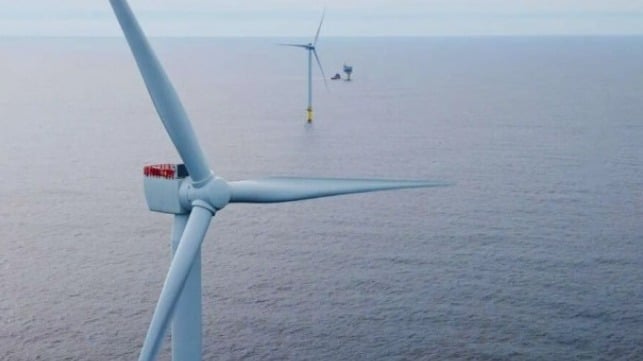
Ørsted was in discussions with an investor to purchase a portion of its Sunrise Wind project, a 924 MW offshore wind farm located roughly 30 miles off the coast of New York's Montauk Point. Work is underway both onshore and off for the project, with the first foundations having recently gone in. However, the board reports it has decided to end discussions on a possible sale of a portion of Sunrise Wind, meaning it will also not benefit from expected project financing and resulting in an incremental cost of approximately $6.2 million.
The company is calling the rights offering the best solution, while some analysts said it was the only option left for Ørsted. The Danish Government, which owns half of Ørsted, has indicated it will participate in the rights offering. The company says two-thirds of the proceeds will be required to fund the construction of Sunrise Wind, and the remainder will be used to develop future projects.
The company highlights that it currently has 8.1 GW of offshore wind projects under construction by 2027. It reports continued “good progress” across its entire construction portfolio according to plan, with almost 70 percent of the offshore wind turbines installed at Revolution Wind, its other U.S. project, which is due to be completed in 2026 and supply power to Connecticut and Rhode Island.
Operationally, it said the business is recovering and lowering costs. It cited strong earnings of DKK 13.9 billion ($2.2 billion), supporting its full-year EBITDA guidance of DKK 25-28 billion. The rights issue announced today, management said, would strengthen Ørsted’s capital structure and provide financial robustness in the years 2025 through 2027.
Solar Stocks Outshine Oil and Gas Benchmarks AfterDESPITE Trump Climate Credit Cuts
Despite the Trump administration’s rollback of many clean energy credits under the “One Big Beautiful Bill Act” (OBBBA), solar stocks have outperformed oil and gas benchmarks in 2025.
First Solar, SolarEdge, and Sunrun all reported strong Q2 results, with boosts from domestic manufacturing incentives, cost efficiencies, and record storage installations.
While OBBBA phases out key residential solar tax credits after 2025, potentially slowing growth, leading players are leveraging manufacturing expansion.
Last month, U.S. President Donald Trump signed into law ‘One Big Beautiful Bill Act’, rolling back many clean energy credits enacted by former President Joe Biden under the Inflation Reduction Act (IRA) of 2022. As widely expected, OBBBA is far from beautiful for various industries within the solar and wind energy sectors. However, the solar sector has continued to defy bearish expectations one month after OBBBA was passed, thanks in large part to robust U.S. and global solar demand as well as specific provisions within the OBBBA that favor solar manufacturing in the United States. The solar sector’s favorite benchmark, Invesco Solar ETF (NYSEARCA:TAN), has outperformed its oil and gas peers, returning 10.9% in the year-to-date compared by -0.7% return by the oil and gas benchmark, the Energy Select Sector SPDR Fund (NYSEARCA:XLE), and 8.6% gain by the S&P 500.
OBBBA favors solar manufacturing through provisions that incentivize domestic production and streamline the tax credit process, while also setting deadlines for construction and placement in service of solar projects. Specifically, it maintains and clarifies the tax credits for solar projects under Sections 48E and 45Y, while also phasing them out for wind and solar projects placed in service after December 31, 2027, unless construction began within 12 months of the Act's enactment.
First Solar (NASDAQ:FSLR) is one of the companies heavily favored by OBBBA. UBS recently reiterated its Buy rating and hiked its price target on FSLR to $275 from $255, good for nearly 50% upside, saying the company will receive a significant boost to the bottomline from OBBBA credits. According to UBS, the present value of 45X tax credits for the company is worth $75 per share, while the company is expected to grow net cash to $25 per share by the second quarter of 2026. UBS says its PT is conservative, pointing out that it did not factor in extra earnings when First Solar’s finishing factory comes online. First Solar's 3.5 GW per year manufacturing facility in Louisiana is expected to be commissioned in the second half of 2025. This facility is part of First Solar's broader strategy to scale its American manufacturing footprint to over 10 gigawatts (GW) by 2025,according to Made in Alabama. The Louisiana factory, along with a new facility in Alabama, are key components of this expansion.
FSLR shares have been on a tear over the past week after the company postedQ2 earnings that exceeded Wall Street estimates, driven by surging solar module sales to third parties. According to First Solar’s CEO Mark Widmar, the company is more favored by OBBBA than it was by Biden’s IRA credits.
Israel-based SolarEdge (NASDAQ:SEDG) beat top- and bottom-line estimates on Thursday, with revenue of $289.4M (+9.0% Y/Y) beating by $14.91M while non-GAAP EPS of -$0.81 beat by $0.03. The company shipped 247 MWh of batteries for solar applications and 1,194 MW of inverters during the quarter. SolarEdge issued upbeat guidance, saying it expects revenues in the range of $315 million to $355 million, well above the Wall Street consensus at$304.33M; Non-GAAP gross margin of 15% to 19%, including ~2% in tariff impact while Non-GAAP operating expenses are expected to come in at $85 million to $90 million. Regarding regulatory changes under OBBBA, SolarEdge CEO Shuki Nir said the company’s multi-year strategy of onshoring manufacturing to the U.S. will help it preserve 45X advanced manufacturing credits over the next 7 years.
Meanwhile, some residential solar companies are also defying bearish projections. California-based residential solar company Sunrun (NASDAQ:RUN) surged nearly 30% on Thursday after posting strong second quarter earnings driven by robust cost efficiencies as well as a record 70% storage attachment rate. Sunrun installed a record 392 MWh of storage capacity during the quarter, good for a 48% Y/Y increase while solar capacity installations clocked in at 227 MW, up 18% Y/Y. Meanwhile, subscriber additions grew 15%, bringing the company’s total subscribers to 941,701 as of June 30.
For the full year, Sunrun has projected aggregate subscriber value growth of 14% to $5.7B-$6 and upped its guidance for contracted net value creation to $1B-$1.3B from $650M-$850M.
"Our actions to drive cost efficiencies and value optimization resulted in the strongest Upfront Net Subscriber Value the company has ever reported, expanding our margins by seventeen percentage points compared to the prior year," CFO Danny Abajian said.
Susquehanna maintained its Positive rating on RUN and raised its price target to $13 from $12, noting that the company is well positioned to capitalize on the ongoing shift towards third-party ownership offerings, a market where it commands a 33% share. The Wall Street analysts expect Sunrun to grow installation volumes despite the looming phase out of residential clean energy tax credits. Residential solar companies are expected to be negatively impacted by the One Big Beautiful Bill Act (OBBBA). Specifically, the elimination of the Section 25D tax credit for residential solar systems after 2025 will significantly reduce the affordability of solar for homeowners, potentially leading to a slowdown in near-term growth. By Alex Kimani for Oilprice.com
Minister confirms environmental authorisation for South African new build
South Africa's Minister of Forestry, Fisheries and the Environment has upheld a 2017 decision to grant Eskom environmental authorisation to construct and operate a new nuclear power station in Duynefontein, in the Western Cape.
(TheDigitalArtist/Pixabay)
The authorisation for Eskom's Final Environmental Impact Report for a new nuclear power plant at Duynefontein was originally granted by South Africa's Department of Environmental Affairs, but had been the subject of challenges from various environmental organisations. Those appeals have now been dismissed.
Minister of Forestry, Fisheries and the Environment Dion George announced his decision to uphold the 2017 decision on 8 August.
"In considering these appeals, I have carefully reviewed the Environmental Impact Assessment Report (EIAr), as well as the independent peer review conducted in respect of the project," George said.
"In the end, my decision was made in respect of the principles of the National Environmental Management Act, 1998 (Act No. 107 of 1998), and with full appreciation of the environmental, social and economic considerations involved."
The granting of an Environmental Authorisation "does not exempt an applicant from complying with any other applicable legal requirements or obtaining permits from other competent authorities," George said.
Eskom would still be required to obtain additional statutory authorisations before proceeding with the project, including a nuclear installation licence from the National Nuclear Regulator (NNR); approval from the National Energy Regulator of South Africa; water use licences from the Department of Water and Sanitation; and other approvals.
Duynefontain is next to Eskom's existing Koeberg nuclear power plant. In March 2016, the state-owned utility submitted site licence applications to the NNR for Duynefontein and another site, Thyspunt, to construct and operate "multiple nuclear installations (power reactors) and associated auxiliary nuclear installations." The Department of Environmental Affairs in 2017 authorised 4000 MWe nuclear capacity to be built at either site.
Loyiso Tyabashe, Group Chief Executive Officer of the Nuclear Energy Corporation of South Africa Ltd (Necsa), today welcomed the ministerial decision.
"This approval marks an important milestone for the nuclear industry and South Africa’s journey towards implementing a balanced energy mix that enables socio-economic development and is climate friendly. The Minister’s decision shows rigour of the process that was followed to choose appropriate site for nuclear new build and reflects confidence in nuclear technology as a safe, clean, and reliable energy solution. Necsa continues to work with the Department of Electricity and Energy as well as Eskom as a partner and commits to contribute its technical expertise to maximise the benefits of nuclear energy, " he said.
In January 2024 the South African government published plans to procure 2.5 GWe of new nuclear capacity. However in August 2024 the government paused the procurement process to allow for further public consultation.
Radiant signs deal to supply microreactor for US military base
California-based Radiant said an agreement it has signed with the Defense Innovation Unit and the Department of the Air Force is the first-ever deal designed to deliver a mass-manufactured nuclear microreactor to a US military base.
A rendering of Radiant's transportable micoreactor being deployed at a military base (Image: Radiant)
The company is developing the 1 MWe Kaleidos high-temperature gas-cooled portable microreactor, which will use a graphite core and TRISO (tri-structural isotropic) fuel. Earlier this year, it was one of eight technology developers selected as potential microreactors suppliers made eligible to receive funding under the Advanced Nuclear Power for Installations programme: an initiative launched in 2024 by the Defense Innovation Unit in collaboration with the Department of the Army and the Department of the Air Force, with the goal of "working to design, license, build, and operate one or more microreactor nuclear power plants on military installations".
"We're proud to be the first agreement designed to deliver mass-manufactured nuclear microreactors for a US military base," said Radiant CEO and Founder Doug Bernauer. "In 36 months, Kaleidos reactors will arrive via truck and within 48 hours plug in, power on, and provide resilient, cyber-secure power to our nation's Air Force for years without refueling."
Radiant says it plans to test its first reactor in 2026, with initial customer deployments beginning in 2028.
In July, Radiant was one of the two companies selected by the US Department of Energy to perform the first tests in the National Reactor Innovation Center's Demonstration of Microreactor Experiments test bed at the Idaho National Laboratory.
Detailed site survey begins at Dukovany
A ceremony has been held at the Dukovany nuclear power plant in the Czech Republic to mark the start of a detailed site survey in preparation for the construction of two Korean-supplied APR1000s there.
(Image: KHNP)
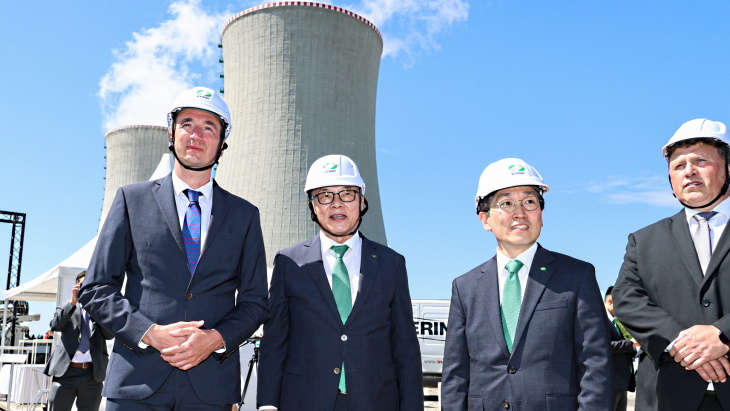
The ceremony was attended by Korea Hydro & Nuclear Power (KHNP) President Hwang Joo-ho, project development company Elektrárna Dukovany II (EDU II) President Zavodski, Czech Minister of Industry Lukáš Vlček, South Korean Ambassador to the Czech Republic Hong Young-ki, and executives from local survey company CEZ EP.
KHNP said the detailed site survey will be conducted over about the next 12 months. It said, as the first step in the nuclear power plant project, the characteristics of the proposed construction site will be investigated and used as basic data for the design.
(Image: KHNP)
"The detailed site survey is the first on-site process for the Dukovany nuclear power plant project and the practical starting point for the APR1000 design," Hwang Joo-ho said. "This is a crucial task for the timely execution of the contract, and we will conduct the survey thoroughly and systematically according to plan."
The Czech government selected KHNP as its preferred bidder in July 2024 for two APR1000 units near the current Dukovany plant, about 200 kilometres southeast of Prague. Two more units at the Temelin nuclear power plant are also being considered and, according to KHNP "if the Czech government decides within the next three years to proceed with Temelin units 3 and 4, KHNP will be eligible to sign additional contracts with EDU II after further negotiations".
The contract with KHNP for new nuclear capacity at the Dukovany site was signed on 4 June. The aim is to start construction in 2029.
The Czech Republic currently gets about one-third of its electricity from the four VVER-440 units at Dukovany, which began operating between 1985 and 1987, and the two VVER-1000 units in operation at Temelín, which came into operation in 2000 and 2002.
Construction gets under way of first unit at Jinqimen plant
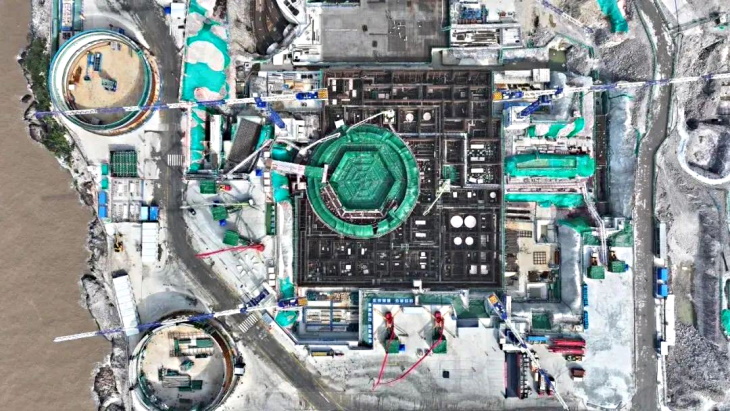
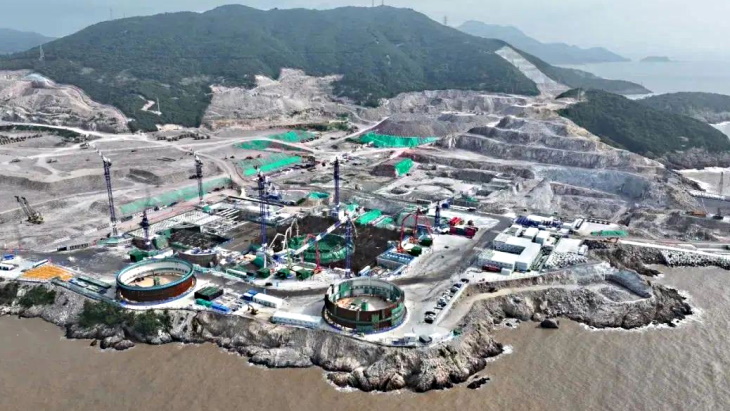
The first safety-related concrete has been poured for the nuclear island of unit 1 at the Jinqimen nuclear power plant in Ningbo, Zhejiang province, China National Nuclear Corporation announced. It is the first of six Hualong One units planned for the plant.
(Image: CNNC)
A ceremony was held at the plant site on 10 August to mark the pouring of first concrete for unit 1, a milestone that means the unit has officially entered the construction phase, China National Nuclear Corporation (CNNC) said.
The construction of two 1200 MWe Hualong One reactors as Phase I of the Jinqimen plant was approved by China's State Council at a meeting on 29 December 2023. A ground-breaking ceremony was held in February 2024 to mark the start of work on the units.
(Image: CNNC)
China's National Nuclear Safety Administration issued a construction licence on 5 August for units 1 and 2 at the Jinqimen plant, clearing the way for first concrete to be poured for the foundation of the reactor building of the first unit.
CNNC subsidiary CNNC Zhejiang Energy Co Ltd is responsible for project investment, construction and operations management of the new plant, which will eventually house six Hualong One units. Another CNNC subsidiary, China Nuclear Engineering & Construction Corporation, is responsible for the construction of the nuclear island, conventional island, and key facilities of the Jinqimen nuclear power project.
(Image: CNNC)
Once all six units have been completed, the total installed capacity of the Jinqimen plant will be about 7.2 GWe, and the annual grid-connected electricity will be some 55 TWh, which according to CNNC is equivalent to half of Ningbo's total electricity consumption in 2024. The plant, it said, will reduce carbon dioxide emissions by about 45 million tonnes.
Following the pouring of first concrete for Jinqimen unit 1, the number of nuclear power units under construction controlled by CNNC has reached 13, with an installed capacity of 15.138 GWe. The Jinqimen plant becomes the company's third nuclear power base in Zhejiang Province.


_16342.jpg)
_51865.jpg)
_20523.jpg)
_50257.jpg)