Sunday, July 13, 2025

New York Times rejects Netanyahu’s denial over report he sought to prolong Gaza war for political gain

‘Our role as independent journalists is to report and disclose information vital to public interest, and to hold leaders to account regardless of party,’ NYT spokesperson says

Asiye Latife Yilmaz |13.07.2025 -  TRT/ AA


ISTANBUL

The New York Times on Sunday rejected Israeli Prime Minister Benjamin Netanyahu’s denial of its report alleging he prolonged the war in Gaza to stay in power, saying his office “does not refute the facts” of the investigation.

The report, published Friday, was based on more than 110 interviews and internal documents. It alleged that Netanyahu delayed a ceasefire and blocked a normalization deal with Saudi Arabia to maintain the support of his far-right coalition partners and protect his political position.

In a statement, the Israeli Prime Minister’s Office dismissed the story, calling it a “rehash of long discredited claims of Prime Minister Netanyahu's political opponents.”

“It defames Israel, its brave people and soldiers, and its Prime Minister,” the statement said, praising Netanyahu’s role in military operations targeting Hamas, Hezbollah, and Iran’s nuclear infrastructure.

In response, a spokesperson for the New York Times said: “The statement from the Prime Minister’s office does not refute the facts of that reporting.”

“Our role as independent journalists is to report and disclose information vital to the public interest, and to hold leaders to account regardless of party,” the spokesperson said. “What our investigation shows in detail is how prolonging the Gaza war helped Mr. Netanyahu to stay in power.”

Since late October 2023, Israel has waged a full-scale assault on the Gaza Strip following Hamas’ cross-border attacks. More than 58,000 Palestinians, most of them women and children, have been killed, according to health authorities in the enclave. Large parts of Gaza have been reduced to rubble, with mass displacement, famine conditions, and disease outbreaks reported.

In November, the International Criminal Court issued arrest warrants for Netanyahu and former Defense Minister Yoav Gallant for war crimes and crimes against humanity in Gaza.

Israel also faces a genocide case at the International Court of Justice for its ongoing military campaign in the besieged territory.
US pop singer Olivia Rodrigo calls situation in Gaza ‘unacceptable’

American pop star says she made donation to UNICEF to support civilians affected by conflict


Asiye Latife Yilmaz |13.07.2025 - TRT/AA


ISTANBUL

American pop singer Olivia Rodrigo addressed the situation in Gaza on Saturday, calling it “horrific and completely unacceptable.”

In an Instagram story, Rodrigo said she was heartbroken by the suffering of innocent people in Palestine.

Highlighting the dire conditions faced by people in Gaza, Rodrigo said: “Mothers, fathers, and children in Gaza are starving, dehydrated, and being denied access to basic medical care and humanitarian aid.”

“There is no child in Israel, Palestine, or anywhere in the world who deserves to suffer through what we’re seeing these children have to endure. It is horrific and completely unacceptable. To give up on them is to give up on our shared humanity,” she added.

Rodrigo added that she made donations to UNICEF “to help support the victims of this horrifying situation and encourage you to do the same if you have the means.”

Rejecting international calls for a ceasefire, the Israeli army has pursued a brutal offensive on the Gaza Strip since Oct. 7, 2023, killing over 58,000 Palestinians so far, most of them women and children. The relentless bombardment has destroyed the enclave and led to food shortages and a spread of disease.

Last November, the International Criminal Court issued arrest warrants for Israeli Prime Minister Benjamin Netanyahu and his former Defense Minister Yoav Gallant for war crimes and crimes against humanity in Gaza.

Israel also faces a genocide case at the International Court of Justice for its war on the enclave.

New Gaza-bound aid boat leaves Italy


Last updated: July 14, 2025 | AFP


Yazan Eissa gestures aboard the Freedom Flotilla ship 'Handala' at a port in Syracuse, Sicily. Agence France-Presse

A Gaza-bound boat carrying pro-Palestinian activists and humanitarian aid left Sicily on Sunday, over a month after Israel detained and deported people aboard a previous vessel.

The Handala, operated by the Freedom Flotilla Coalition, left the port of Syracuse shortly after 12:00 pm (1000 GMT), an AFP journalist saw, carrying about fifteen activists.

Several dozen people, some holding Palestinian flags and others wearing keffiyeh scarves, gathered at the port to cheer the boat’s departure with cries of “Free Palestine”.

The former Norwegian trawler -- loaded with medical supplies, food, children’s equipment and medicine -- will sail for about a week in the Mediterranean, covering roughly 1,800 kilometres (1,120 miles), in the hope of reaching Gaza’s coast.

In early March, Israel imposed a total aid blockade on Gaza amid an impasse in truce negotiations, only partially easing restrictions in late May.

The boat will make a stop at Gallipoli, in southeastern Italy, where two members of the hard-left France Unbowed party (LFI) are expected to join.

The initiative comes six weeks after the departure of the Madleen, another ship that left Italy for Gaza transporting aid and activists, including Greta Thunberg.

Israel authorities intercepted the Madleen about 185 kilometres west of Gaza’s coast.

“This is a mission for the children in Gaza, to break the humanitarian blockade and to break the summer silence on the genocide,” said Gabrielle Cathala, one of the two France Unbowed party members set to board the boat on July 18.

“I hope we will reach Gaza but if not, it will be yet another violation of international law” by Israel, she added.

The war was sparked by Hamas’s October 7, 2023 attack on Israel that led to 1,219 deaths, most of them civilians, according to an AFP tally based on official figures.

Out of 251 people taken hostage that day, 49 are still held in Gaza, including 27 that the Israeli military says are dead.

Hamas-run Gaza’s health ministry says that at least 58,000 Palestinians, most of them civilians, have been killed in Israel’s military reprisals. The UN considers the figures reliable.

Israeli airstrikes killed at least 28 Palestinians including four children in the Gaza Strip, while 24 others were fatally shot on their way to an aid distribution site, Palestinian hospital officials and witnesses said Saturday.

Agence France-Presse
Bernie Sanders openly attacks AIPAC, calls for boycott from Democrats

Senator Sanders asked all Democrats to stop their relationship with AIPAC, calling them "the organization that helped deliver the presidency to Donald Trump."

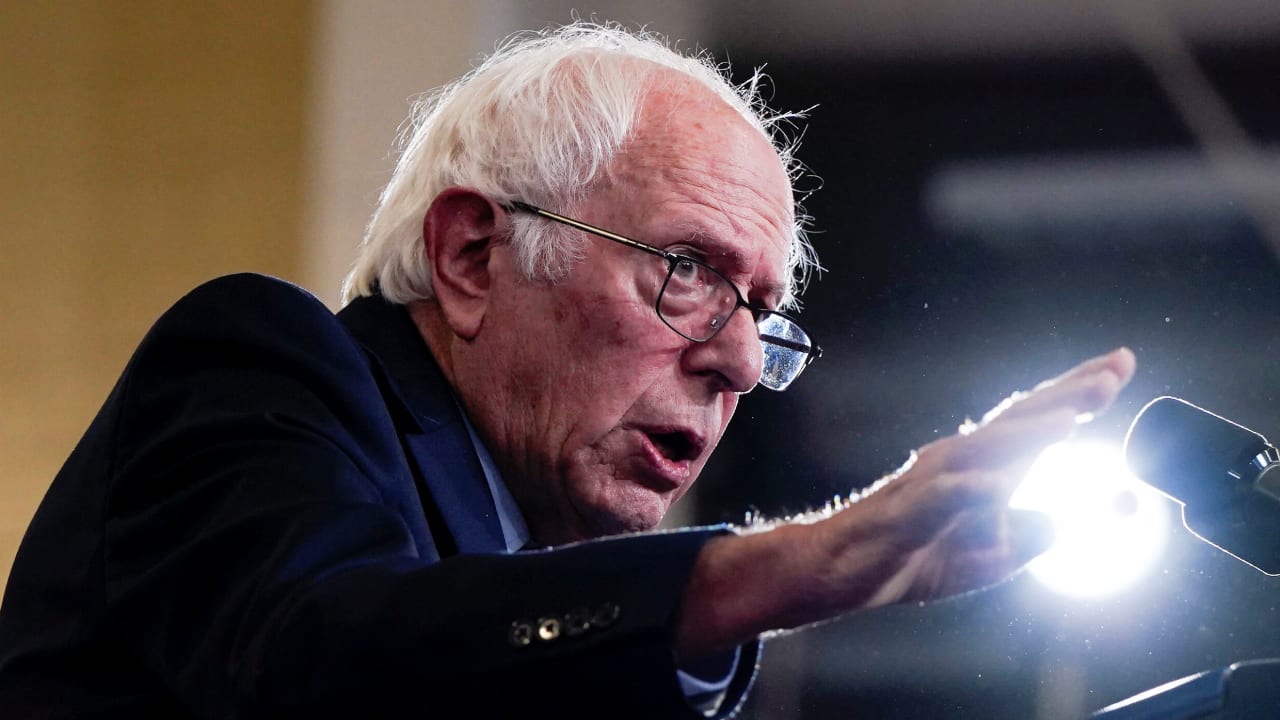
Bernie Sanders speaks during an event at NHTI Concord Community College in Concord, New Hampshire, US. October 22, 2024.(photo credit: REUTERS/ELIZABETH FRANTZ)

JULY 14, 2025

Democrat Senator Bernie Sanders publicly attacked AIPAC and called for all Democrats to cease relations with the organization.

“No Democrat should accept money from AIPAC,” he wrote on X/Twitter on Saturday.

“Given the illegal and immoral war being waged against the Palestinian people by Netanyahu, NO Democrat should accept money from AIPAC -- an organization that also helped deliver the presidency to Donald Trump,” the Senator posted.


In his post, he included a video featuring former President Barack Obama's advisor, Ben Rhodes, who states that “AIPAC is part of the constellation of forces that have delivered this country into the hands of Donald Trump.”

“These are the wrong people to have under your tent,” he continues and then adds: “The kind of people that they are supporting, Bibi Netanyahu and [US President] Donald Trump, I don’t want my leaders and my political party coasing up to these people.”

US Senator Bernie Sanders (I-VT) speaks at a Senate Health, Education, Labor and Pensions Committee hearing on Capitol Hill in Washington, US, May 10, 2023. (credit: REUTERS/LEAH MILLIS/FILE PHOTO)


It is important to note that Sanders is one of the most far-Left politicians in the “Progressive Left” of the United States, with the Senator being very critical both of the current administration and the Israeli Government during the Gaza War.

For example, in November of 2024, Sanders pushed for a resolution in the American Congress to ban the sale of certain weapons to Israel, citing the humanitarian crisis in Gaza as a reason for this measure.

Sanders’ conflict with Israel is nothing new

The resolution in question included four Democrat Senators. It argued that “Israel has the right to self-defense after the October 7 massacre, but the US is complicit in the all-out war that Prime Minister Benjamin Netanyahu has waged on the Palestinian people.”

The resolutions called for the blocking of 32,739 120-mm. tank cartridges, consisting of 120 mm. M1147 High Explosive Multi-Purpose with Tracer (HEMP–T) cartridges and/or 120-mm. M830A1 High Explosive Multi-Purpose Anti-Tank with Tracer (MPAT) cartridges.

Also included were various 120-mm. tank munitions, 120-mm. munition canisters, transportation costs, publications, and technical documentation, US government and contractor engineering, and technical and logistics support services, according to the resolutions.

US Senators strongly condemn efforts by Israeli Knesset to expel Arab lawmaker

'The current expulsion effort is a direct response to MK (Ayman) Odeh's outspoken and brave calls,' says joint statement

Yasin Gungor
 |14.07.2025
 -  TRT/ AA

ISTANBUL

Three US senators issued a joint statement Sunday strongly condemning efforts by Israel’s Knesset to expel Arab lawmaker Ayman Odeh, calling it an assault on democratic principles.

Senators Bernie Sanders, Peter Welch and Chris Van Hollen defended Odeh, the chairman of the Arab-majority Hadash-Ta'al party, after Israeli lawmakers voted to advance his impeachment.

"We strongly condemn the effort to expel MK Ayman Odeh from the Israeli Knesset," the senators said. "If Israel is going to call itself a democracy, it must tolerate peaceful dissent."

The senators linked the expulsion effort to Odeh's calls for an immediate ceasefire in Gaza, an end to Israeli occupation of Palestinian territories, and a political solution between Israelis and Palestinians.

"For over a decade, MK Odeh has been a leading advocate for peace, justice, and Jewish-Arab partnership," they said. "The current expulsion effort is a direct response to MK Odeh's outspoken and brave calls."

The lawmakers described the move as sending "a chilling message to millions of Palestinian citizens of Israel: that their representation is conditional and their rights revocable."

“We stand in solidarity with MK Odeh and with the right of all lawmakers, Arab and Jewish, to speak freely and without fear of political retribution,” they said.

A parliamentary committee voted on June 30 to advance Odeh's impeachment over his welcome of Palestinian detainee releases.

The Knesset is scheduled to vote Monday on whether to eject Odeh. The motion requires a supermajority of 90 out of 120 members to pass.

Even if his impeachment is approved, Odeh will still be able to file a petition against the decision with the Israeli Supreme Court.

Palestinians account for 21% of Israel's population of nearly 10 million.
Nearly 70% of atomic bomb survivors in Japan fear nuclear weapons could be used again: Survey

Some 45.7% of respondents say they 'cannot forgive' US for bombings

Anadolu staff |14.07.2025 - 


ANKARA

Nearly 70% of atomic bomb survivors in Japan believe nuclear weapons could be used again, citing growing global tensions, including Russia’s war in Ukraine and North Korea’s weapons development, a survey by Kyodo News Agency revealed Sunday, ahead of the 80th anniversary of the US atomic bombings.

Around 1,500 survivors took part in the survey, with 68.6% saying the risk of nuclear weapons being used again is increasing.

Some 45.7% of respondents said they “cannot forgive” the US for the bombings, while 24.3% said they have "no special feelings" and 16.9% said they "did not know."

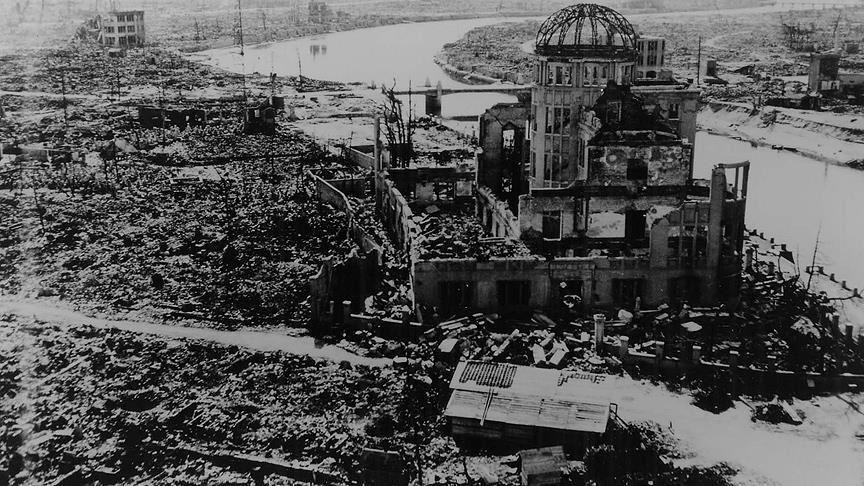
This year marks 80 years since the US dropped atomic bombs on Hiroshima and Nagasaki in western Japan near the end of World War II.

On Aug. 6, 1945, the US dropped an atomic bomb on Hiroshima, killing an estimated 140,000 people.

A second bomb was dropped on Nagasaki three days later, resulting in about 70,000 additional deaths.

Japan surrendered on Aug. 15, 1945, officially marking the end of World War II.


Israel's war on Iran broke the nuclear non-proliferation treaty

Washington must kick diplomacy into overdrive to save the NPT and avert another endless conflict


Tytti Erästö
Jul 14, 2025
RESPONSIBLE STATECRAFT

Rather than helping to prevent the spread of nuclear weapons, the Israeli-initiated 12-day war on Iran damaged the Nuclear Non-Proliferation Treaty.

In response to the attacks on its nuclear facilities, on July 2, Iran suspended cooperation with the International Atomic Energy Agency, whose responsibilities include verifying NPT state parties’ compliance with their nonproliferation commitments. At the same time, these illegal attacks, which the U.S. joined, have created the conditions for the kind of endless war that President Trump allegedly wants to avoid. While the prospects for Iranian-U.S. diplomacy in this context look bleak, there might still be a way out through regional non-proliferation cooperation.

The end of nuclear transparency in Iran

Iran’s suspension of cooperation with the IAEA marks the end of nuclear transparency provided by agency inspections in the country since 1974. Thanks to this transparency, we knew, prior to June 13, the exact amount and locations of Iran’s fissile material stockpiles — which could not have been diverted to military uses without being noticed by the IAEA. Now, due the Israeli and U.S. attacks, this knowledge has been lost.

Israel — whose goal appears to be to weaken and remove the Iranian government, rather than just its nuclear program — is likely to push for additional military actions. That Iran’s nuclear capabilities were, predictably, not all destroyed by the military strikes, makes it difficult for Washington to restrain Israel even if it wishes to do so. This points to the open-ended aggression that experts have long warned would result from attacks against Iran’s nuclear facilities.

Apart from its perception that the IAEA is politically biased in favor of Israel and Western countries, Iran’s decision to suspend cooperation with the agency arguably reflects a concern that nuclear transparency might undermine its interests. By indicating the location of nuclear materials and facilities that survived the war, IAEA findings could be used to facilitate future Israeli and U.S. military targeting.

Demonstrating the flawed logic of aggressive counterproliferation, the war on Iran could be seen as a perfect argument for Tehran to leave the NPT and develop a nuclear deterrent. After all, the use of force against its territorial integrity can constitute a circumstance in which “extraordinary events have jeopardized [its] supreme interests,” the legal basis for withdrawal under the NPT’s Article X.

Prospects for bilateral Iranian-US nuclear diplomacy

Yet, Iran has neither withdrawn from the NPT nor closed the door to diplomacy. Iran is currently reviewing a U.S. proposal for resuming bilateral talks. As Iran’s foreign minister Abbas Araghchi said, "Iran needs guarantees it won’t be attacked again if the talks don’t succeed."

The trust required for bilateral diplomacy, let alone for credible security guarantees, has been severely undermined by the war — which took place while the last round of Oman-mediated Iranian-U.S. talks was still ongoing. According to Araghchi, this constituted a ”betrayal of diplomacy.”

A nuclear deal would also require a compromise on the key issue of uranium enrichment. A compromise was already reached in the 2015 Joint Comprehensive Plan of Action when Iran agreed to verifiably limit enrichment activities in exchange for sanctions relief. The obstacle here has been President Trump’s self-inflicted difficulty in accepting anything resembling the JCPOA — from which he withdrew in 2018, thus renewing a nuclear crisis with Iran.

President Trump has insisted that Iran should not be allowed to enrich any uranium, assuming that the country can be coerced to accept his terms through maximum pressure. But Iran has consistently rejected this demand. If his approach now rests on the assumption that Iran will finally give in as a result of the war, efforts at bilateral diplomacy are likely doomed.

On the other hand, the Trump administration has demonstrated ambiguity on the enrichment issue. Together with the president’s aversion to endless wars, this might still allow for a compromise solution.

Possibilities for diplomacy

One of the most promising avenues in the Iranian-U.S. talks since April was a regional nuclear consortium involving Iran and other Gulf states. The main sticking point seemed to be the location of joint uranium enrichment facilities: while Iran viewed the enhanced nuclear transparency provided by the consortium as a way to build international confidence in its enrichment activities, Washington saw it a means to end enrichment on Iranian soil.

This plan could still be feasible if the U.S. were to accept limited enrichment on Iranian soil as part of the consortium. This would serve the objective of nonproliferation and still might look different enough from the JCPOA for President Trump to claim victory.

The previous idea of U.S. investment in the consortium nevertheless seems unlikely after Washington’s involvement in Israel’s military operation that also included the assassinations of Iranian nuclear scientists. However, other extra-regional powers such as China or Russia could be invited to join the venture, thus enabling a de facto security guarantee to Iran. Notably, the Bushehr nuclear power plant was Iran’s only nuclear facility that was spared in the June attacks — partly due to the presence of Russian staff there.

As an alternative to a nuclear consortium, Gulf states could jointly agree to cap uranium enrichment levels and fissile material stockpiles in the region. While such restrictions would initially mainly affect Iran’s program, over time they would also build confidence in Saudi Arabia’s nuclear ambitions, which also include plans for uranium enrichment.

To verify these restrictions, the Gulf states states could establish a regional nuclear verification mechanism modeled on the Brazilian–Argentine Agency for Accounting and Control of Nuclear Materials (ABACC). This could complement IAEA safeguards and, in the case of Iran, substitute for them as long as the country’s cooperation with the agency remains suspended.

Although Iran cannot be expected to implement restrictions on its nuclear activities without sanctions relief by the U.S., it could nevertheless commit to doing so pending such relief. This could allow an informal Iranian-U.S. compromise even without a bilateral nuclear agreement.

At minimum, a conditional agreement on regional nuclear restraint would increase political pressure on Washington to lift sanctions on Iran, while a regional verification mechanism would provide an argument against further military action.

By way of comparison, the additional confidence created by ABACC apparently explains why Brazil is allowed to enrich uranium without international objection — despite the lack of public reporting on related details and the country’s refusal to sign the Additional Protocol with the IAEA.

Choice between diplomacy and endless war

The 12-day war represented the culmination of the disastrous U.S. maximum pressure policy, which since 2018 has undermined nonproliferation for the sake of scoring domestic political points and fostering Washington’s special relationship with Israel. Continuing on this path now risks leading to an endless war in the Middle East.

A diplomatic off-ramp still exists but it would require a U.S. policy shift from coercion to compromise. The political costs of such a shift for President Trump could be reduced through linking the compromise to a regional nuclear arrangement. While extending the non-proliferation benefits beyond Iran, the involvement of multiple stakeholders committed to its success could also make such an arrangement more sustainable than the JCPOA.


Tytti Erästö is a Senior Researcher in the SIPRI Weapons of Mass Destruction Programme, focusing on nuclear disarmament and non-proliferation issues. She holds a PhD in International Relations from the University of Tampere, Finland.


Federal Agents Spray Tear Gas at Protesters, Children During ICE Raids at California Farms


"ICE was conducting a raid using disproportionate displays of force against local farmworkers and our agricultural community," said U.S. Rep. Salud Carbajal, who was denied entry to one farm where he was attempting to provide oversight.


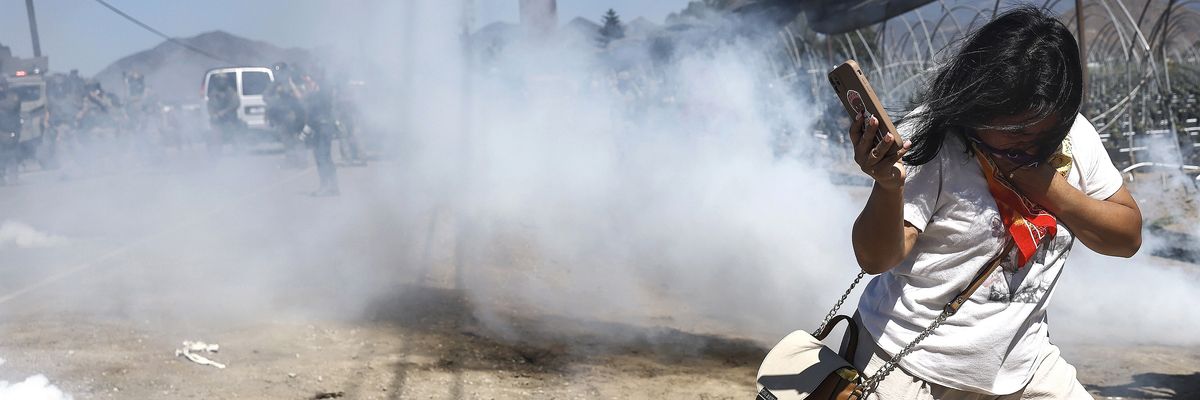
A person reacts to a smoke canister deployed by federal agents blocking protestors during an immigration raid at a nearby cannabis farm on July 10, 2025 near Camarillo, California.
(Photo: Mario Tama/Getty Images)

Julia Conley
Jul 11, 2025
COMMON DREAMS

Federal immigration agents were met with a strong show of resistance Thursday when they raided two farms in Southern California—with hundreds of community members protesting the arrests of migrants at the facilities growing cannabis and vegetables.

Los Angeles-based independent journalist Mel Buer reported that hundreds of community members gathered to protest the raid by Immigration and Customs Enforcement (ICE) at Glass House Farms' facility in Camarillo, Ventura County, and supporters dropped "hundreds of pounds of water, food, and masks."

Local news outlet KTLA reported that "dozens of farmworkers were detained" in the raids at Glass House Farms' properties in Camarillo and Carpinteria.

Federal law enforcement first arrived in Camarillo at about 11:00 am, and the situation escalated as a crowd of community members gathered.

The federal agents first deployed tear gas into the crowd early Thursday afternoon.

Ventura County District 5 Supervisor Vianey Lopez told KTLA that as the federal agents used force on the protesters, she saw two government vans, each carrying about 15 people, leaving the farm.

"It is an ongoing situation that is very concerning for the safety of those showing up with anger and disappointment at what is happening to hardworking people in our community," Lopez said.

The immigration enforcement agents were joined by National Guard troops in military vehicles later that afternoon in Camarillo, according to The Guardian, as other federal agents carried out a simultaneous raid in Carpinteria, about 50 miles northwest in Santa Barbara County.

Carpinteria City Council members Julia Mayer and Mónica Solórzano were among a large crowd of community members who gathered to protest the raid, and they told the Santa Barbara Independent that federal officers "pushed us as a group into the ground" and threw at least one smoke grenade, causing Solórzano to injure her arm.


U.S. Rep. Salud Carbajal (D-Calif.), who represents Santa Barbara County and part of Ventura County, released a statement condemning the ICE raid and saying he had been "denied entry and not allowed to pass" when he attempted to "conduct oversight" over the raid targeting his constituents in Carpinteria.

"ICE was conducting a raid using disproportionate displays of force against local farmworkers and our agricultural community," said Carbajal. "There's been a troubling lack of transparency from ICE since the Trump administration started, and I won't stop asking questions on behalf of my constituents."

Carbajal is now one of several Democratic elected officials who have been denied the ability to oversee ICE operations. Rep. LaMonica McIver (D-N.J.) pleaded not guilty last month to forcibly interfering with federal officers—charges that stemmed from her attempt to conduct congressional oversight at an ICE detention center in Newark, New Jersey.

"These militarized ICE raids are not how you keep our communities safe. This kind of chaos only traumatizes families and tears communities apart. They are also a gross misuse of limited resources and a betrayal of the values that define us as Americans," said Carbajal, who noted that the identities of those detained in the raids had not been made clear.

In Camarillo, a resident named Judith Ramos told The Guardian that she had learned from her father, who worked in Glass House Farms' tomato fields, that "immigration was outside his job" on Thursday morning.

Ramos, a 22-year-old certified nurse assistant with two younger siblings, said her father told her "to take care of everything" if he was detained by ICE.

She was sprayed with a chemical substance when she arrived at the farm and joined the crowd of protesters, and told The Guardian that she did not know where her father was.

Gov. Gavin Newsom, a Democrat who has clashed with President Donald Trump and filed a lawsuit against the administration last month over its federalization of the California National Guard to respond to protests against immigration raids in Los Angeles, posted a video showing children running from the federal agents.

"Trump calls me 'Newscum,'" said the governor, "but he's the real scum."


Farmworker Dies After Fall From Greenhouse During California ICE Raid


Sanders Says Billionaire Effort to Crush Mamdani Rooted in Fears of Nationwide Progressive Wave

"They are worried that his campaign is an example of what can happen all over the country."


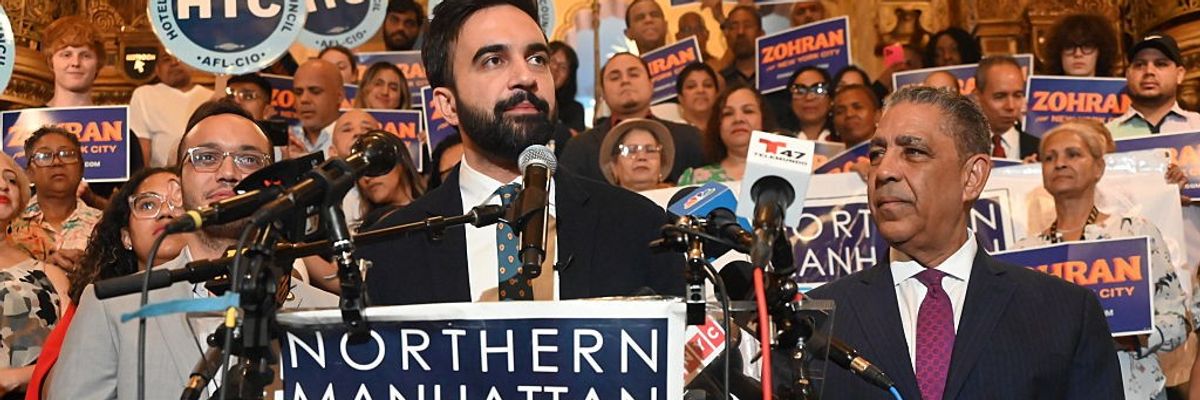
Zohran Mamdani, the Democratic nominee for New York City mayor, participate in an endorsement event with Congressman Adriano Espaillat (D-N.Y.) at the United Palace Theater in New York City on July 10, 2025.
(Photo: Kyle Mazza/Anadolu via Getty Images)

Brett Wilkin
Jul 11, 2025
COMMON DREAMS

Independent U.S. Sen. Bernie Sanders on Thursday reaffirmed his support for Democratic New York City mayoral nominee Zohran Mamdani, a fellow democratic socialist facing fierce opposition from deep-pocketed establishment figures who fear the broad nationwide appeal of his people-over-profit agenda.

Faced with the growing possibility that Mamdani would win the June 24 primary, Wall Street bankers, corporate executives, real estate developers, mega-landlords, and others rushed to dump money into disgraced former Gov. Andrew Cuomo's campaign coffers. Now that Mamdani is the Democratic nominee, they're pouring tens of millions of dollars into an anti-Mamdani war chest, despite not even agreeing on which candidate to back in November's mayoral election.

In a Thursday interview with CNN's Christiane Amanpour—who noted that Sanders' Fighting Oligarchy tour "has been drawing record crowds"—the Vermont senator said that policies like "giving massive tax breaks to billionaires and cutting healthcare and education and nutrition from working-class families [are] not popular."

While acknowledging that "mainstream Democrats" have been unable to galvanize opposition to Republicans' pro-billionaire, anti-working class agenda, Amanpour pressed Sanders about what he would tell New Yorkers who say that Mamdani "has never run anything, and he says, free buses, and... is he antisemitic or not?'"

Watch Sanders' response:


"First of all, understand, he's going to have the entire establishment, the oligarchy, the billionaires coming down on his head, not only because he's demanding that the wealthy and large corporations in New York City start paying their fair share of taxes, they are worried that his campaign is an example of what can happen all over the country when you bring people together to demand the government that works for all of us and not just a few," the senator said. "So, they really want to crush this guy."

"You have billionaires saying quite openly, 'We are going to spend as much as it takes to defeat this guy.' You have Democratic leadership not refusing to jump on board a campaign where this guy is the Democratic nominee," Sanders added. "So, most importantly, I'm going to do everything I can to see that Zohran becomes the next mayor of New York."

Some Democrats have done more than refuse to support their own party's nominee. Sen. Kirsten Gillibrand (D-N.Y.) falsely claimed last month that Mamdani had made references to "global jihad" and speciously argued that "globalize the intifada"—a call for Palestinian liberation and battling injustice—is a call to "kill all the Jews."

Freshman Congresswoman Laura Gillen (D-N.Y.) also falsely accused Mamdani of "a deeply disturbing pattern of unacceptable antisemitic comments."

Congressional progressives including Reps. Rashida Tlaib (D-Mich.), Ilhan Omar (D-Minn.), André Carson (D-Ind.), and Lateefah Simon (D-Calif.)—the four practicing Muslims in the House of Representatives—last month condemned what they called the "vile, anti-Muslim, and racist smears from our colleagues on both sides of the aisle."

Despite the attacks against him, Mamdani is leading Cuomo—who is now running as an Independent—by 10 points in a Slingshot Strategies poll of more than 1,000 registered voters published earlier this week. Mamdani also leads Republican nominee Curtis Sliwa by 21 points and scandal-ridden incumbent Mayor Eric Adams by 24 points.

Observers note that establishment Democrats' reservations about backing Mamdani seem to be fading amid the strength of his campaign. As Democrats including Senate Minority Leader Chuck Schumer (D-N.Y.) and House Minority Leader Hakeem Jeffries (D-N.Y.) hold out on endorsing their own party's nominee, critics argue it's time to follow other lawmakers like Reps. Alexandria Ocasio-Cortez, Jerrold Nadler, Adriano Espaillat, and Nydia Velázquez—all New York Democrats—and endorse Mamdani.

"Mamdani won a record-setting primary victory, and unions, grassroots Democratic groups, and savvy elected officials are rushing to back him," The Nation's national affairs correspondent, John Nichols, wrote Friday. "Now it's the establishment's turn."


Coast Guard Aircrew Receives Flight Medals for Texas Flood Response

Rescue swimmer PO2 Scott Ruskan and flight mechanic PO3 Seth Reeves receive medals for their service during the response (USCG)

Published Jul 13, 2025 6:43 PM by The Maritime Executive


On Friday, the Department of Homeland Security awarded its highest honor to a rescue swimmer who made a heroic effort to save lives after the disastrous Guadeloupe River flood. 

During the response, Petty Officer 2nd Class Scott Ruskan, 26, set an all-time Coast Guard record for most rescues on a single mission. Hundreds of campers at Camp Mystic, a summer retreat for girls outside of Hunt, Texas were caught unprepared, and multiple cabins were flooded by fast-flowing, debris-laden water. The survivors were stranded and needed evacuation. 

The Coast Guard received a request for assistance, and dispatched a helicopter aircrew out of Air Station Corpus Christi, located about 160 miles to the southeast of the camp. The same heavy weather that had caused the flash floods also made flying difficult, and the helicopter was forced to land for safety multiple times. It took six hours for the aircrew to reach the scene. 

When Ruskan's MH-65 aircrew arrived at the camp, he volunteered to stay behind so that the small helicopter could carry two more campers per trip. Ruskan helped reassure the young campers, who had been through a traumatic experience, and organized the loading to speed up the evacuation process. In all, he helped 169 people get away from the scene in one day. For his efforts, the Coast Guard awarded him the Distinguished Flying Cross. 

"Petty Officer Ruskan launched on the first Coast Guard aircraft, making three perilous attempts to reach survivors. Facing rising floodwaters and unstable terrain, he volunteered to remain on the ground at a critical moment in the rescue operation, putting his own safety at great risk," the Coast Guard said in a statement. "As the sole first responder at the chaotic Camp Mystic evacuation landing zone, Petty Officer Ruskan overcame crippled communications and dangerous conditions to triage survivors."

Pilot Lieutenant Ian Hopper also received the Distinguished Flying Cross for carrying out a "harrowing instrument flight" and "narrowly avoiding disaster" on the below-the-clouds trip in near-zero visibility. Lt. Blair O. Ogujiofor, the co-pilot, received the Air Medal for leading the two-helicopter mission, carrying out obstacle avoidance, coordinating comms and deconflicting the flight paths of 12 other helicopters to evacuate survivors. Flight mechanic Petty Officer 3rd Class Seth N. Reeves received the Air Medal for detecting a mechanical fault early in the mission and helping the pilots navigate beneath the cloud layer using road maps. 

The awards were a bright spot for the Department of Homeland Security after a difficult news cycle. On Saturday, the New York Times reported that thousands of people affected by Texas flooding had not been able to reach the Federal Emergency Management Agency (FEMA) because the department had dismissed hundreds of contractors who worked at its call centers, effective July 5 - the day after the flood. The contracts were not renewed until July 10. The current Secretary of Homeland Security, Kristi Noem, requires all contracts over $100,000 to be held until after she personally reviews and signs off on them.

Four FEMA officials also told CNN that Noem's new requirement for personal review and signature on large contracts delayed the  initial federal response to the flooding, reducing the availability of skilled search and rescue personnel on scene. While awaiting Noem's signature, FEMA officials did not have the funding to move and preposition urban search and rescue teams near the flood zone. Noem did not sign off on FEMA's search and rescue deployments until three days after the flood, multiple sources told CNN.

The current death toll from the flood stands at 129, and about half a dozen people remain missing. Search efforts continue, and Gov. Greg Abbott has pledged a thorough attempt to locate all remains.  

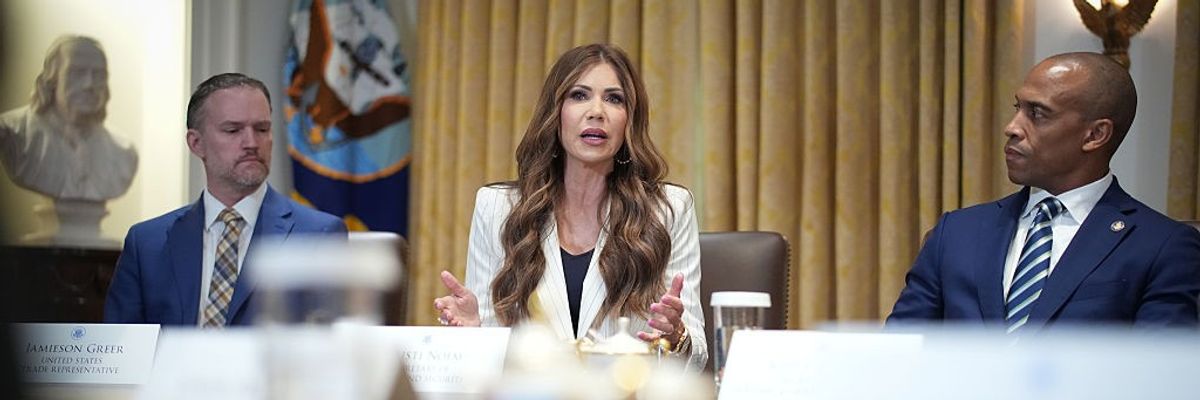
After Delaying FEMA Response for Three Days, Noem Calls to 'Eliminate' Agency Due to Slow Texas Response

Congressional Democrats want investigations "at every level of government of what went wrong" and to "stop the dismantling of federal agencies."


Department of Homeland Security Secretary Kristi Noem (C) discusses the flash flooding tragedy in Texas during a Cabinet neeting with U.S. President Donald Trump at the White House on July 8, 2025.
(Photo: Andrew Harnik/Getty Images)

Stephen Prager
Jul 11, 2025
COMMON  DREAMS

U.S. Secretary of Homeland Security Kristi Noem renewed her call Wednesday to "eliminate" the Federal Emergency Management Agency, calling it "slow to respond" to the deadly floods that have killed more than 120 people in Texas over the past week.

But that "slow" response was the direct result of a policy put in place by Noem herself, according to four FEMA officials who spoke to CNN.

Last month, the network reported on a new policy introduced by Noem that required any contract or grant above $100,000 to cross her desk for approval.

The administration billed the move as a way of "rooting out waste, fraud, [and] abuse." But multiple anonymous officials, including ones from FEMA, warned at the time that it could cause "massive delays" in cases of emergency, especially as hurricane season began to ramp up.

That appears to be what happened in Texas. According to the four officials who spoke to CNN, "FEMA ran into bureaucratic obstacles" as a result of this requirement. Compared to the billions that are typically required to respond to disasters, officials said $100,000 is essentially "pennies."

FEMA officials said they were left to ask for Noem's direct approval on virtually every action they took in response to the catastrophic flood, which created massive delays in deploying Urban Search and Rescue Teams.

The sources told CNN that "in the past, FEMA would have swiftly staged these teams, which are specifically trained for situations including catastrophic floods, closer to a disaster zone in anticipation of urgent requests."

Multiple sources said Noem waited until Monday to authorize the deployment of these search and rescue teams, more than 72 hours after the flooding began. Aerial imagery to aid in the search was also delayed waiting for Noem's approval.

On Wednesday, Noem used these very delays to justify her calls to disband FEMA entirely.

"Federal emergency management should be state and locally led, rather than how it has operated for decades," she said. "It has been slow to respond at the federal level. It's even been slower to get the resources to Americans in crisis, and that is why this entire agency needs to be eliminated as it exists today, and remade into a responsive agency."

President Donald Trump said last month he is in the process of beginning to "phase out" FEMA and that it would begin to "give out less money" to states and be directed out of the White House.

He first took a hatchet to FEMA back in February using the Department of Government Efficiency (DOGE), which eliminated 2,000 permanent employees, one-third of its total staff.

Noem has also boasted about using FEMA funds to carry out Trump's mass deportation crusade, including allocating hundreds of millions from the agency to build the so-called "Alligator Alcatraz" immigrant internment camp in Florida, as well as other detention facilities.

Before a House panel last month, former FEMA Administrator Deanne Criswell noted that the administration's cuts have made it harder for FEMA to respond in disaster areas.

"It just slows down the entire response and delays the recovery process from starting," Criswell said. "If the state director asks for a resource, then FEMA needs to be able to quickly respond and mobilize that resource to come support whatever that is. They still need the staff that are going in there. And so when you have less people, you're going to have less ability to actually fill those senior roles."

The revelation that Noem's policy may have contributed to the slowdown has only amplified calls by congressional Democrats to investigate how Trump administration cuts to FEMA and other services like the National Weather Service may have contributed to the devastation.

"During disasters, every second matters," said Rep. Joaquin Castro (D-Texas). "Noem must answer for this delay."

Congressman Greg Casar (D-Texas) said this disaster in his home state highlighted the need for federal agencies like FEMA.

"Year after year, Texans face deadlier fires, freezes, and floods." Casar said. "As we continue to support first responders and grieving families after the terrible flooding, we will need investigations at every level of government of what went wrong and what could save lives in future."

"We must stop the dismantling of federal agencies that are supposed to keep us safe from the next disaster," he added.


'These Deaths Are on Trump's Hands': Texas Flooding Spotlights Assault on Climate Science

"The Trump regime is gutting scientific research into climate and atmospheric science for political reasons, at the very time we need a much better understanding of it," said one environmentalist. "This is so reckless and dangerous."


Kerrville residents document the aftermath of deadly flooding at Louise Hays Park near the Guadalupe River in Kerrville, Texas on July 6, 2025.
(Photo: Jorge Salgado/Anadolu via Getty Images)


Jake Johnson
Jul 07, 2025
COMMON DREAMS

Deadly flooding caused by torrential rain in central Texas late last week called attention to U.S. President Donald Trump's full-scale assault on the climate research and monitoring agencies tasked with studying and predicting such weather catastrophes, as well as his ongoing attacks on disaster preparedness and relief.

Though local National Weather Service (NWS) forecasters did issue warnings in the lead-up to Friday's flooding—which killed at least 82 people, including dozens of children—key roles were reportedly vacant ahead of the downpour, prompting scrutiny of the Trump administration's mass firings and budget cuts, in addition to years of neglect and failures by Republicans at the state level.

Asked whether he believes the federal government should hire back terminated meteorologists in the wake of the Texas flooding, Trump responded in the negative and falsely claimed that "very talented people" at NWS "didn't see" the disaster coming.

"This is an absolute lie," replied meteorologist and climate journalist Eric Holthaus. "Worse, this is the person responsible for making those kids less safe and he's trying to deny the damage he caused."

Holthaus wrote Sunday that Trump's staffing cuts "have particularly hit the National Oceanic and Atmospheric Administration's Environmental Modeling Center, which aims to improve the skill of these types of difficult forecasts."

"Though it's unclear to what extent staffing shortages across the NWS complicated the advance notice that local officials had of an impending flooding disaster," he added, "it's clear that this was a complex, compound tragedy of a type that climate warming is making more frequent."

"Republicans have fired meteorologists, cut emergency disaster aid, and given an extra $18 billion to the fossil fuel corporations causing this crisis."

Under the guise of "government efficiency," the Trump administration has taken an axe to staff at federal climate agencies and is trying to go even further with its budget for the coming fiscal year. The Washington Post noted Sunday that "a budget document the Trump administration recently submitted to Congress calls for zeroing out climate research funding for 2026, something officials had hinted at in previous proposals but is now in lawmakers' hands."

"But even just the specter of President Donald Trump's budget proposals has prompted scientists to limit research activities in advance of further cuts," the Post noted. "Trump's efforts to freeze climate research spending and slash the government's scientific workforce have for months prompted warnings of rippling consequences in years ahead. For many climate scientists, the consequences are already here."

Since the start of his second term, Trump has dismissed the hundreds of scientists and experts who were working on the National Climate Assessment, moved to slash NOAA's workforce, and announced a halt to climate disaster tracking, among other changes—all while working to accelerate fossil fuel extraction and use that is supercharging extreme weather events. One NOAA veteran warned that Trump's cuts could drag the agency back to "the technical and proficiency levels we had in the 1950s."

"The Trump regime is gutting scientific research into climate and atmospheric science for political reasons, at the very time we need a much better understanding of it," environmentalist Stephen Barlow wrote on social media on Sunday. "This is so reckless and dangerous, which is why I suggest we call these tragedies Trump events."

Aru Shiney-Ajay, executive director of the Sunrise Movement, said over the weekend that "Republicans have fired meteorologists, cut emergency disaster aid, and given an extra $18 billion to the fossil fuel corporations causing this crisis."

"These deaths are on Trump's hands," she added.


As Flood Deaths Rise, Texas Officials Blast Faulty Forecast by DOGE-Gutted National Weather Service

"Experts warned for months that drastic and sudden cuts at the National Weather Service by Trump could impair their forecasting ability and endanger lives during the storm season," said one critic.


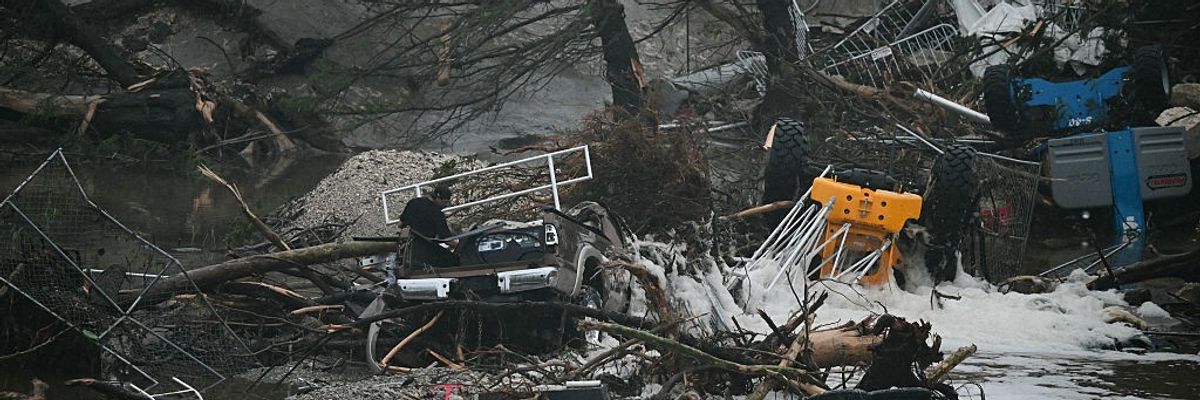
A photo shows overturned vehicles and broken trees after flooding caused by a flash flood at the Guadalupe River in Kerrville, Texas, on July 5, 2025.
(Photo: Ronaldo Schemidt/AFP via Getty Images)

Brett Wilkins
Jul 05, 2025
COMMON DREAMS

As catastrophic flooding left scores of people dead and missing in Texas Hill Country and President Donald Trump celebrated signing legislation that will eviscerate every aspect of federal efforts to address the climate emergency, officials in the Lone Star State blasted the National Weather Service—one of many agencies gutted by the Department of Government Efficiency—for issuing what they said were faulty forecasts that some observers blamed for the flood's high death toll.

The Associated Press reported Saturday that flooding caused by a powerful storm killed at least 27 people, with dozens more—including as many as 25 girls from a summer camp along the Guadalupe River in Kerr County—missing after fast-moving floodwaters rose 26 feet (8 meters) in less than an hour before dawn on Friday, sweeping away people and pets along with homes, vehicles, farm and wild animals, and property.

"Everybody got the forecast from the National Weather Service... It did not predict the amount of rain that we saw."

"The camp was completely destroyed," Elinor Lester, 13, one of hundreds of campers at Camp Mystic, told the AP. "A helicopter landed and started taking people away. It was really scary."

Kerr County Sheriff Larry Leitha said during a press conference in Kerrville late Friday that 24 people were confirmed dead, including children. Other officials said that 240 people had been rescued.

Although the National Weather Service on Thursday issued a broad flood watch for the area, Texas Division of Emergency Management Chief Nim Kidd—noting that the NWS predicted 3-6 inches of rain for the Concho Valley and 4-8 inches for the Hill Country—told reporters during a press conference earlier Friday that "the amount of rain that fell in this specific location was never in any of those forecasts."


"Listen, everybody got the forecast from the National Weather Service," Kidd reiterated. "You all got it; you're all in media. You got that forecast. It did not predict the amount of rain that we saw."

Kerrville City Manager Dalton Rice also said during the press conference that the storm "dumped more rain than what was forecasted" into two forks of the Guadalupe River.

Kerr County judge Rob Kelly told CBS News: "We had no reason to believe that this was gonna be anything like what's happened here. None whatsoever."

Since January, the NWS—a branch of the National Oceanic and Atmospheric Administration (NOAA)—has reduced its workforce by nearly 600 people as a direct result of staffing cuts ordered by the Department of Government Efficiency, or DOGE, as part of Trump's mission to eviscerate numerous federal agencies.

This policy is in line with Project 2025, the Heritage Foundation-led blueprint for a far-right overhaul of the federal government that calls for "dismantling" NOAA. Trump has also called for the elimination of the Federal Emergency Management Agency, arguing that states should shoulder most of the burden of extreme weather preparation and response. Shutting down FEMA would require an act of Congress.

Many of the fired NWS staffers were specialized climate scientists and weather forecasters. At the time of the firings, Rep. Jared Huffman (D-Calif.), the ranking member of the House Natural Resources Committee, was among those who warned of the cuts' deadly consequences.

"People nationwide depend on NOAA for free, accurate forecasts, severe weather alerts, and emergency information," Huffman said. "Purging the government of scientists, experts, and career civil servants and slashing fundamental programs will cost lives."

Writing for the Texas Observer, Henry D. Jacoby—co-director of the Massachusetts Institute of Technology Joint Program on the Science and Policy of Global Change—warned that "crucial data gathering systems are at risk."

"Federal ability to warn the public is being degraded," he added, "and it is a public service no state can replace."

On Friday, Trump put presidential pen to congressional Republicans' so-called One Big Beautiful Bill Act, a $4 trillion tax and spending package that effectively erases the landmark climate and clean energy provisions in the Inflation Reduction Act signed by then-President Joe Biden in 2022.

As Inside Climate News noted of the new law:

It stomps out incentives for purchasing electric vehicles and efficient appliances. It phases out tax credits for wind and solar energy. It opens up federal land and water for oil and gas drilling and increases its profitability, while creating new federal support for coal. It ends the historic investment in poor and minority communities that bear a disproportionate pollution burden—money that the Trump administration was already refusing to spend. It wipes out any spending on greening the federal government.

Furthermore, as MeidasNews editor-in-chief Ron Filipkowski noted Saturday, "rural areas hit hardest by catastrophic storms are the same areas now in danger of losing their hospitals after Trump's Medicaid cuts just passed" as part of the budget reconciliation package.

At least one congressional Republican is ready to take action in the face of increasing extreme weather events. Rep. Marjorie Taylor Greene (R-Ga.)—who once attributed California wildfires to Jewish-controlled space lasers—announced Saturday that she is "introducing a bill that prohibits the injection, release, or dispersion of chemicals or substances into the atmosphere for the express purpose of altering weather, temperature, climate, or sunlight intensity."

"It will be a felony offense," she explained. "We must end the dangerous and deadly practice of weather modification and geoengineering."
While Congress Abandons Climate Safety, Cities and States Must Lead

The One Big Beautiful Bill Act may be putting profits ahead of people and the planet, but real climate leadership remains possible—and urgently needed—at the local level.


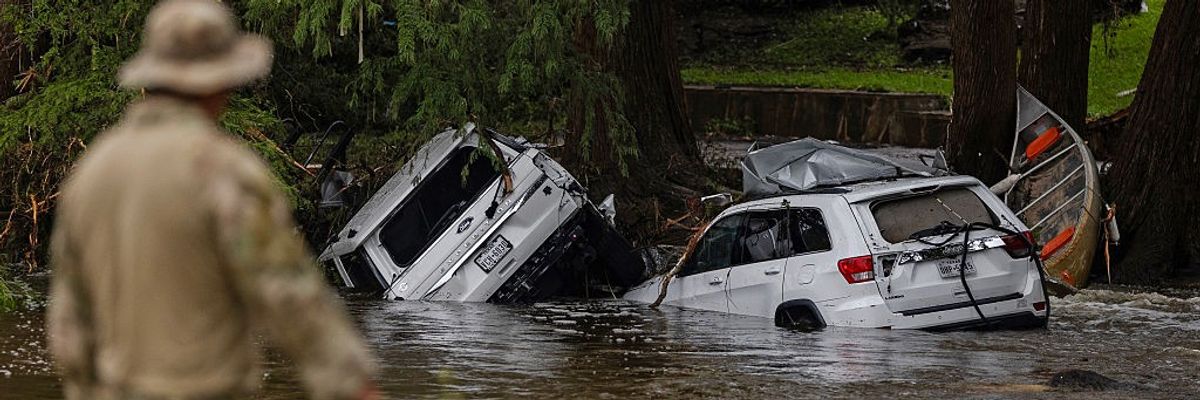
Vehicles sit submerged as a search and rescue worker looks through debris for any survivors or remains of people swept up in the flash flooding on July 6, 2025 in Hunt, Texas.
(Photo: Jim Vondruska/Getty Images)


Anne Jellema
Jul 11, 2025
Common Dreams

On July 4, as rescue teams searched for children swept away by flash floods in central Texas, U.S. President Donald Trump signed the One Big Beautiful Bill Act into law—a legislative package that represents a catastrophic retreat from climate safety precisely when Americans need protection most.

The cruel irony was impossible to ignore: As the floodwaters rose in San Antonio, the federal government was rewarding fossil fuel companies driving the climate crisis while pulling protection away from those in its path.

The OBBBA delivers a devastating one-two punch to American families. First, it guts the very programs designed to keep us safe from extreme weather. The Federal Emergency Management Agency's disaster prevention funding faces a 40% cut. The National Weather Service—already dangerously understaffed—will see deeper cuts to the National Oceanic and Atmospheric Administration that cost lives. Texas' recent floods tragically illustrated how staffing gaps in weather offices directly translate to preventable deaths.

Wildfire prevention efforts have already been halted by White House funding freezes ahead of peak fire season, and the OBBBA eliminates another $100 million in firefighting capacity. Meanwhile, toxic waste cleanups face defunding, exponentially increasing health risks for the 1 in 5 Americans living within three miles of contaminated sites.

By supercharging this growing insurability crisis, the act risks unleashing a climate-fueled version of the 2008 financial meltdown—but this time driven by underinsured climate risk, not subprime mortgages.

The social safety net that helps the most vulnerable disaster victims avoid permanent destitution is being shredded too. The act slashes federal assistance with energy bills by 34%, strips an estimated 6.2 million people of Medicaid, and denies over 3 million people food assistance—the largest Supplemental Nutrition Assistance Program cuts in program history.

Adding fuel to the fire, 350.org's analysis shows that oil, gas, and coal companies are set to receive over $200 billion in OBBBA handouts over the next decade. This includes bargain-basement royalty rates for extraction on public lands and the restoration of controversial tax loopholes. At the same time, OBBBA kneecaps renewable energy competition, forcing families to rely on expensive fossil fuels and pushing up annual utility bills by hundreds of dollars.

The math is simple: We need to halve fossil fuel emissions by 2030 to keep America livable. Instead, U.S. emissions will spike by 8-12%, making it less likely that other countries will agree to reduce their own oil and gas consumption, and driving more extreme weather.

Main Street and family farms will pay the price. Insurance companies rely on predictive weather data and disaster prevention programs that the OBBBA undermines. Premiums have already surged over 35% nationwide since 2020, with the steepest hikes in the places most exposed to extreme weather. State Farm and Allstate have withdrawn completely from fire- and flood-prone regions of California, Florida, and Louisiana.

By supercharging this growing insurability crisis, the act risks unleashing a climate-fueled version of the 2008 financial meltdown—but this time driven by underinsured climate risk, not subprime mortgages.


Fortunately, cities and states still hold powerful tools to fight back and build clean and safe futures for their residents.Vermont and New York have passed Climate Superfund Acts requiring fossil fuel companies to pay for climate damages. Honolulu, Baltimore, New York City, and dozens more are suing polluters to recover costs. Other states and cities should follow.
Local leaders can reform utilities to prioritize affordability and clean energy, ban utility shutoffs during extreme weather, promote public or cooperative models, and remove barriers to community solar.
Michigan's climate law, mandating 100% clean electricity by 2040, is already driving billions in private investment and creating jobs while lowering utility bills.

Steps like these will help to protect communities from the worst of the climate chaos that OBBBA unleashes. They can also build national momentum that political parties will not be able to ignore come 2026 and 2028.

The OBBBA prioritizes fossil fuel profits over public safety and future generations' survival. But this story isn't over. While Congress may be putting profits ahead of people and the planet, real climate leadership remains possible—and urgently needed—at the local level.

Cities and states must lead now. Our lives depend on it.


Our work is licensed under Creative Commons (CC BY-NC-ND 3.0). Feel free to republish and share widely.


Anne Jellema is the executive director of 350.org.

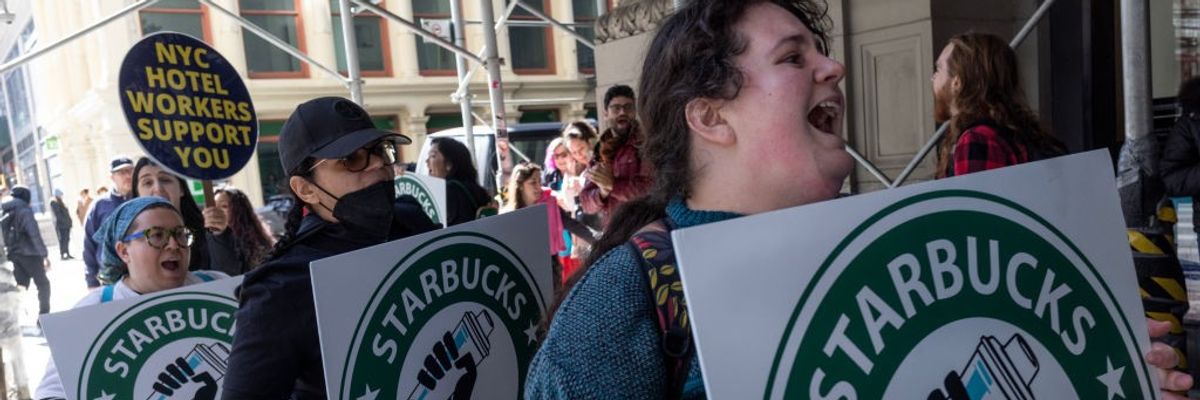
At Home and Abroad, Starbucks is Failing the People it Calls 'Partners'

Despite our different languages and cultures, Starbucks workers around the world are saying the same thing: We want to be treated with respect and dignity.


Starbucks union members and their supporters, including baristas who have just walked off the job, effectively closing a local branch, picket in front of the store, on February 28, 2025 in New York City.
(Photo: Andrew Lichtenstein/Corbis via Getty Images)


Dachi Spoltore
Jul 11, 2025
Common Dreams

For five years, I've been brewing coffee and serving customers at Starbucks. I love connecting with people, crafting creative drinks, and learning about coffee. But what I've witnessed behind the green apron tells a different story than the one Starbucks executives want you to hear.

At the Workers United convention in Ohio earlier this year, I had the privilege of meeting Starbucks workers and the unions that represent them from Brazil, Chile, and the United Kingdom. Despite our different languages and cultures, Starbucks workers around the world are saying the same thing: We want to be treated with respect and dignity. We all shared stories of a company that talks about caring for its partners while systematically failing to support the people who make their business possible in the first place.

The barista from Chile I spoke with described conditions that were heartbreaking. They said they are required to work in extreme heat with no support to address the dangerous working conditions. When they went to bargain for better pay, they told me what Starbucks offered wouldn't even cover basic bills and food. The pay increase they were fighting for—literally less than a dollar—put into perspective just how little this multibillion dollar company values its workers.

Starbucks' issues in Latin America extend beyond how it treats its workers in the stores and into its supply chains, as it is now the target of allegations in a new lawsuit claiming their Brazilian coffee is made under slavery-like conditions. And the pressure campaign has grown as local unions and human rights groups recently demanded the Brazilian retail brand FARM Rio end its partnership with the coffee giant. These aren't just abstract allegations—the allegations involve real workers, real families, and real human suffering in the coffee giant's supply chain.

Starbucks executives can improve operations and public perception right now by listening to union baristas who are committed to building a better company.

This international scrutiny isn't limited to Latin America. In the U.K., workers described navigating complex bureaucratic channels just to organize. Everywhere I looked, I saw the same pattern: Starbucks partners demanding respect, safety, and fair treatment, while the company prioritizes all the wrong things.

Here in the United States, we're experiencing our own version of this neglect. Customers wait 30 minutes for lattes while we're understaffed, underpaid, and undersupported. Mobile orders pour in while only two people work an entire shift. We're forced to enforce policies that put us in danger—like denying the bathroom or water to people seeking shelter—while fearing for our jobs if we speak up. Meanwhile, Starbucks executives are focusing on what color T-shirts we wear instead of bargaining in good faith with the union and addressing real operational problems. The contradiction is stark: a company that claims to care about its partners while baristas rely on Medicaid because we can't get guaranteed hours to qualify for health insurance.

I can't imagine how many more stories there are just like mine that go unheard. Starbucks is under fire around the globe due to allegations of forced Uyghur labor in their Chinese supply chains, exploitation in Mexico, and its use of a Swiss subsidiary to avoid taxes. Yet, CEO Brian Niccol—who made $96 million in just four months last year and commutes to work in a private jet—has failed to address these serious issues abroad, all while the company has committed hundreds of unfair labor practices in the U.S. and he's ignoring union baristas' demand for fair contracts at home.

Starbucks won't turn this business around by allegedly violating labor law internationally and domestically, and failing to finalize fair union contracts. Fighting with baristas—whether in Seattle or São Paulo—is bad for business. We're the ones who open stores every morning, greet customers, make the coffee, and remember favorite orders. We're central to their turnaround strategy, and I have yet to see them address our concerns. We've been bargaining since April 2024 for a fair contract, but Starbucks continues to drag its feet.

But workers aren't staying silent. Just this month, we won our 600th union election in the U.S.. We're growing stronger, and we're building solidarity with Starbucks workers and customers across borders.

Starbucks executives can improve operations and public perception right now by listening to union baristas who are committed to building a better company. We've been ready to consider proposals that include actual improvements in staffing, guaranteed hours, and take-home pay.

The choice is yours, Starbucks. You can continue fighting the people you call "partners" while facing mounting international scrutiny, or you can finally live up to your claims about being the best place to work. The world is watching, and we're organizing.


Our work is licensed under Creative Commons (CC BY-NC-ND 3.0). Feel free to republish and share widely.


Dachi Spoltore is a five-year Starbucks barista and member of Starbucks Workers United.
Full Bio >