It’s possible that I shall make an ass of myself. But in that case one can always get out of it with a little dialectic. I have, of course, so worded my proposition as to be right either way (K.Marx, Letter to F.Engels on the Indian Mutiny)
Wednesday, August 27, 2025
Höegh Autoliners Orders 1st Ammonia Engines for Pure Car & Truck Carriers
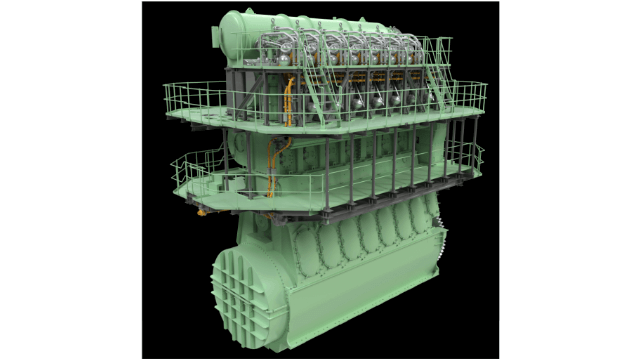
In a major leap for maritime decarbonisation, Höegh Autoliners has placed a landmark order for ammonia-burning Everllence B&W ME-LGIA engines. Accordingly, 4 × 7S60ME-LGIA (Liquid Gas Injection Ammonia) dual-fuel engines will be delivered to an undisclosed Asian shipyard in connection with the construction of 4 × 9,100 CEU (Car Equivalent Unit) ‘Aurora’-class Pure Car/Truck Carriers (PCTCs).
Everllence views the order as signalling a new era for clean propulsion within global shipping. The newbuildings are bound for Höegh Autoliners, the major PCTC operator and part of the Leif Höegh & Co. shipping company. HD Hyundai Heavy Industries Co. Ltd. will build the engines in South Korea.
Sebjørn Dahl, Chief Operations Officer, Höegh Autoliners, said: "The engines are the beating heart of our vessels, and we take it as a clear mark of confidence that Everllence has chosen us to install some of the world’s first two-stroke ammonia engines on our final four Aurora Class vessels. With nearly 100 years of industry experience, Höegh Autoliners is proud to be among the first companies selected to pioneer this important transition together with Everllence. This collaboration underscores their trust in us as a reliable frontrunner in the shift to zero-emission shipping. Reaching zero is a shared ambition, and Everllence plays a vital role in helping us realize our goal of operating our large PCTC vessels on zero-carbon fuels from 2027."
Bjarne Foldager – Head of Two-Stroke Business – Everllence, said: “This order – one of several ammonia pilot-projects we have in China, Japan and South Korea – gives us encouragement that we are on the right path, as does the widespread industry interest in our progress. We have adopted a responsible, safety-first approach to developing this engine on account of ammonia’s particular risk-profile, and are confident that ammonia will ultimately become one of three major, alternative fuels in the market along with methanol and methane.”
Christian Ludwig – Head of Two-Stroke Sales and Promotion – Everllence, said: “We have now been running our two-stroke ammonia test engine since 2023 and can confirm that the ME-LGIA’s combustion is right where we want it. Using the Diesel principle, the ME-LGIA engine concept has many of the same merits as our existing dual-fuel engines that already entered operation over a decade ago. Inspired by these engines, we are – among other innovations – using the same sealing-oil design for the fuel-booster injection valves as this has proven to be particularly important and efficient. By end-2026, we tentatively expect to have a small number of demonstration projects on the water to enable a commercial market introduction of the G50-, S60-, G60-, G70- and G80-bore ME-LGIA engines based on positive service experience.”
Aurora class Höegh’s Aurora Class will be the largest and most environmentally friendly PCTC ever built, further accelerating Höegh Autoliners’ decarbonisation efforts and setting a new standard for more sustainable deep-sea transportation. Being the first in the PCTC segment to receive DNV’s ammonia-ready and methanol-ready notations, the Auroras will also be the first to be ready to operate zero-carbon ammonia propulsion with the main engine designed by Everllence.
The products and services herein described in this press release are not endorsed by The Maritime Executive.
Shearwater to Undertake Ghana’s First Deepwater Ocean Bottom Survey
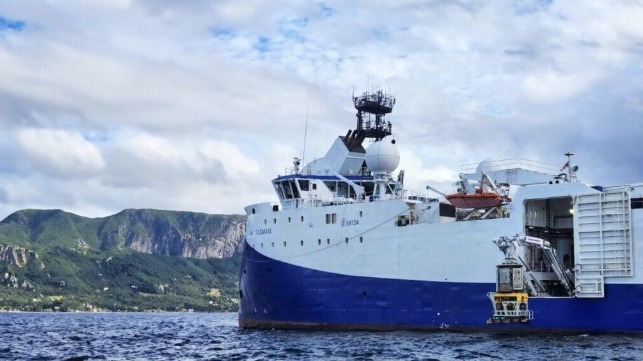
Shearwater Geoservices AS (“Shearwater”) has been awarded a deepwater Ocean Bottom Node (OBN) seismic survey in Ghana’s Jubilee and TEN fields, operated by Tullow and its partners. It will be the first deepwater OBN project offshore Ghana, following Shearwater’s successful recent deployment of the SWTasman vessel and Pearl node OBN platform in Côte d’Ivoire and Angola. The two-month survey is scheduled to begin in the last quarter of 2025.
The SWTasman and Pearlnodeplatformhave been continuously deployed offshore West Africa since late 2024, first executing the inaugural OBN survey offshore Côte d’Ivoire before mobilising to consecutive surveys offshore Angola.
“These projects demonstrate Shearwater’s role in pioneering new technology in new regions, delivering operational excellence and industry-leading survey efficiency and data quality. By delivering the first OBN project in Ghana and other surveys across this part of Africa, we are opening new geophysical frontiers – combining precision, innovation and commitment to responsible resource exploration,” said Irene Waage Basili, the CEO of Shearwater.
The Jubilee and TEN fields have been central to Tullow’s operations for nearly two decades. This first OBN survey is expected to further enhance reservoir imaging, helping unlock deeper insights to inform field development and production strategies. It follows a streamer survey executed by Shearwater over the Jubilee and TEN fields in early 2025.
The products and services herein described in this press release are not endorsed by The Maritime Executive.
Corvus Energy Battery System Powers Latin America’s First Electric Tugboat
The first electric tugboat in Latin America, the result of a collaboration between the largest towage services operator in the Americas, SAAM, and Chilean national oil company, Enap, is powered by a lithium-ion marine battery system from Corvus Energy.
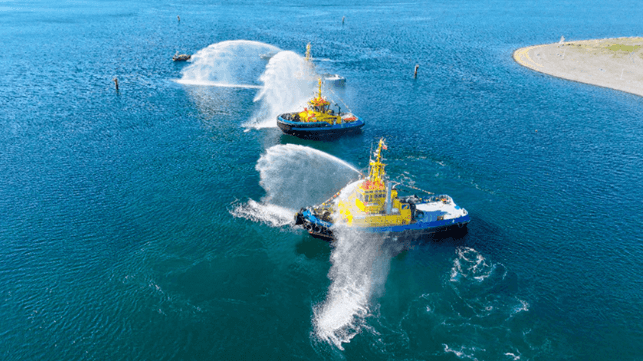
Based on an exclusive design from naval architects Robert Allan Ltd (RAL) and built by SANMAR Shipyards for SAAM, the battery-electric tug supports ship berthing and deberthing maneuvers in one of the southernmost terminals in the world—Puerto Chacabuco in the Aysén Region of Chile in South America.
About the electric tugboat The battery-powered vessel, named “Trapananda” in honor of the Chilean Patagonia region where the tug operates, measures 25 meters in length, 13 meters in beam and boasts 70 tons of bollard pull capacity, enabling it to assist large vessels under challenging harbor conditions.
Third electric tug in the SAAM fleet SAAM, including its division SAAM Towage, operates more than 200 tugboats around the Americas. Notably, the Trapananda is the third battery-electric tug to join the SAAM fleet. In May 2024, SAAM launched two electric tugboats in the Port of Vancouver in Canada, making SAAM among the first zero-emission tug operators in North America. All three tugs are RAL-designed, SANMAR Shipyards-built and equipped with a Corvus Energy battery system.
Environmental and operational benefits According to SAAM, battery-powered tugboats are an important part of the Company’s 2030 Sustainability Strategy, which includes a goal to neutralize 65% of greenhouse gas emissions from the operation of their fleet through reduction and offsetting initiatives. (Source).
Fully battery-powered operations produce zero emissions and are almost completely silent. This results in significant environmental benefits, including reduced carbon footprint and less noise pollution, both in port and underwater, protecting coastal communities and marine life alike. Compared to diesel-powered tugs, electric tugboats also offer operational advantages including reduced fuel and maintenance costs.
After its first year operating electric tugs in Canada, SAAM reported its “carbon intensity index [had] fallen 72% compared to diesel-powered units with similar features, and a further 90% reduction is projected for the second year of operation. In addition, the electric tugs’ operating costs were reported to be 70% lower than its diesel-powered peers.” (Source).
Corvus Energy involvement The Trapananda is equipped with a Corvus Orca ESS, the most installed marine energy storage system, used onboard over 700 maritime vessels worldwide. Like the SAAM electric-powered tugs operating in Vancouver, the Trapananda is outfitted with a 3,616-kWh capacity battery system.
“We are proud to support SAAM, RAL and SANMAR by supplying the battery system for the first electric tugboat to operate in Latin America, as well as for the Vancouver-based tugs,” said Tor-Gunnar Hovig, Head of Region Americas at Corvus Energy. He adds, “SAAM is leading the way towards more sustainable port operations in the Americas and beyond with these RAL-designed, SANMAR-built tugs.”
"The arrival of the Trapananda is a turning point for our industry. It signals our decisive move toward cleaner, more efficient, and environmentally friendly operations. This project represents our vision for the future: we're developing solutions that not only assist and tow ships but also help mobilize a shift toward a truly sustainable logistics chain. We consider Corvus a strategic partner in this journey,” said Pablo Cáceres, Sustainability and Development Director of SAAM Towage.
The products and services herein described in this press release are not endorsed by The Maritime Executive.
Owners of Ex-Bouchard ATB Fleet Tussle in Court, Sidelining Vessels
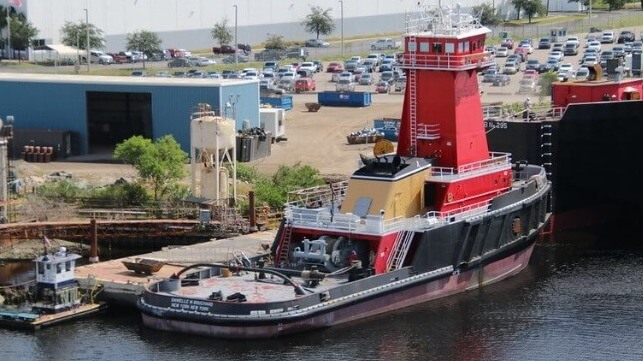
The giant ATB tug Danielle M. Bouchard, since renamed Rebekah Rose under Pennantia's ownership, 2017 (Corey Seeman / CC BY NC SA 2.0)
Pennantia, the JV company that acquired eight ATBs out of the former Bouchard fleet, has paused its operations amidst a legal fight between its majority owner and its operator. One of the vessels has been arrested in Panama on a lien filed by the operator, and another of the idled ATBs may have attracted Coast Guard attention over manning levels, according to court filings.
The shipowning JV, Pennantia, is majority-owned by Contrarian Capital, with minority owner Rose Cay handling maritime operations under contract (the Rose Cay name is the fleet's operating brand). Rose Cay alleges that Pennantia - controlled by Contrarian Capital - has stopped paying in full for operating expenses, and it has suspended shipmanagement services while demanding repayment. In response, Pennantia sued Rose Cay and accused it of trying to shut down operations on a false pretext in order to scuttle the pending sale of the ATB fleet. Both parties deny each others' allegations.
The fallout is a new speed bump for the remnants of the Bouchard empire. The Pennantia partnership bought eight ATBs from the former Bouchard Transportation fleet when Bouchard was dissolved and its assets split up in 2021. Pennantia's acquisition includes younger Jones Act vessels, ranging from 4,000-horsepower tugs up to the tanker-sized ex-Kim M. Bouchard / RCM 270.
After purchase, the fleet was initially operated by Foss under contract, but Rose Cay took over management in 2022. At that time, it took crewing and operations under its own umbrella and subcontracted these tasks to a new subsidiary, named Dove Cay LLC. In December 2024, Rose Cay claimed that Pennantia owed about $9.5 million in unpaid expenses and interest to Dove Cay, and in February it escalated with a declaration that Pennantia was in default. (Pennantia denies these claims.)
Dove Cay then filed liens against the entire Pennantia fleet totaling about $29 million, including $13 million for repayment of a loan. In response, Pennantia called Rose Cay's claims "fabricated" and last month it filed for a court injunction to prevent Rose Cay and Dove Cay from idling the fleet or pursuing their maritime liens.
In an order signed on August 18, Judge Sidney H. Stein denied Pennantia's motion for an injunction in the case, allowing Dove Cay to pursue its liens against the vessels while litigation continues. The judge also allowed Rose Cay to terminate its shipmanagement contract with Pennantia, on the understanding that minimum safety and manning requirements would continue to be met.
The two parties are in mediation and have discussed possible terms for a settlement; in the meantime, AIS data shows that the firm's active tugs are all at berth or at anchor in New York, Panama and Port Arthur.
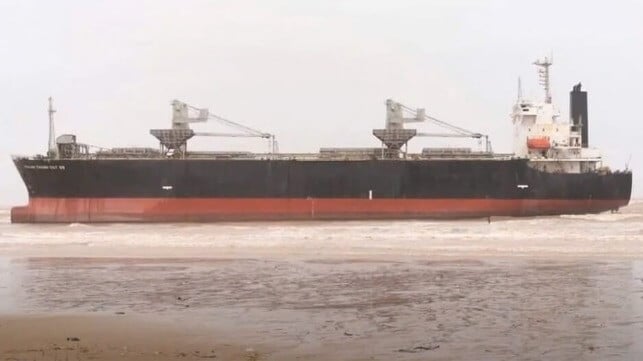
Vietnamese officials are reporting widespread damage as the 14th named storm of the 2025 season, Typhoon Kajiki, slammed ashore Monday night into Tuesday morning, August 25-26. A large cargo ship was driven onto the shore, and at least four people have died from injuries and flooding during the powerful storm.
The storm was traveling west across the Pacific, encountering the Philippines as a tropical depression and dropping large amounts of rain on portions of China. By the time it reached Vietnam, it had strengthened with maximum sustained winds of 100 mph, according to NASA. Other parts of Vietnam were reporting sustained winds of 82 mph.
Vietnam had been preparing for the storm. At least half a million people had been evacuated before Kajiki reached the coastline.
The wood chip carrier Thanh Thanh Dat 99 (22,300 dwt) had been anchored at the northern port of Ninh Binh, but on the evening of August 25, during a lull ahead of the storm attempted to sail south toward Nghi Son port. The ship, which is 495 feet (151 meters) in length, was traveling only with ballast as it was due to load in Nghi Son.
The captain reported that by the time they reached the anchorage, the winds and waves were too strong to drop anchor. They were attempting to hold the ship in position as the storm approached. At 11:30 p.m. local time on August 25, they notified the authorities that the vessel was drifting from a position approximately two nautical miles offshore. Two hours later, they reported that the ship was dangerously close to shore.
The cargo ship came to rest approximately 70 to 100 meters (230 to 325 feet) from shore. The authorities reported the ship was stable and that the crew was uninjured. They will explore refloating the ship after the storm has passed.
The country is continuing to deal with widespread flooding and damage to structures. At least 13 people were reported injured in addition to the four confirmed deaths. The storm continued west, weakening with winds of 38 mph as it reached the border with Laos.
Saildrone Secures Class Certification for its Largest Unmanned Vessel
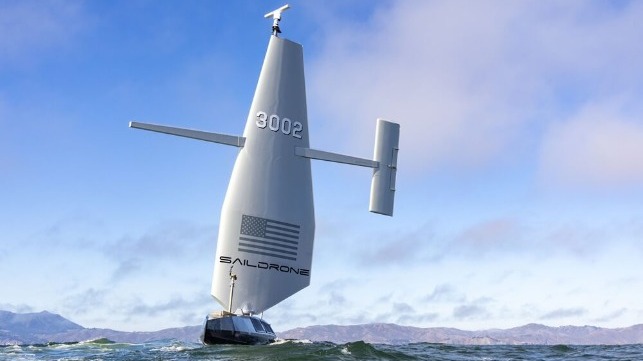
Saildrone, the California-based manufacturer of long-endurance ISR and survey drone boats, now operates the world's largest fully-classed unmanned surface vessel. In partnership with ABS, the company has obtained classification for its 20-meter Saildrone Surveyor after a rigorous review process. Among other benefits, the achievement allows the unmanned boats to operate in the waters of nations that require vessels to maintain a class certificate.
"The ABS class certification is . . . a signal to governments and the maritime industry that Saildrone USVs are mature, safe, tested, and ready for scale," said Richard Jenkins, Saildrone's founder and CEO. "It’s been a very large investment and a multi-year process to achieve ABS class certification, but we are proud to be the first company in the world to do so."
ABS said in a statement that it has made a concerted effort to support unmanned vessel technology development.
"ABS and Saildrone are pioneering new frontiers, setting the pace for innovation. This step forward is a result of our investments in ABS’ technical capability and helping to ensure our Rules are able to support innovation with an unwavering focus on safety," said Patrick Ryan, ABS Senior Vice President and Chief Technology Officer.
The two partners have been working together on certification for years. In 2023, ABS provided interim classification for Saildrone's 10-meter Voyager design, a popular choice for research and government customers like NOAA and the U.S. Navy. Saildrones have deployed everywhere from the Persian Gulf to the Arctic to the center of an Atlantic hurricane, collecting data for months at a time without human intervention - a key challenge for unmanned surface vessels. The company markets its vessels on a charter basis, and claims that its service model radically reduces carbon emissions compared to conventional vessels.
Surveyor takes payload capabilities up a notch compared to previous models, and can support more technically demanding missions like subsea survey, acoustic doppler current profiler (ADCP) water column analysis and geotechnical data collection. It has been used commercially to map subsea cables for Meta, but it is built around the needs of the U.S. Navy: the large drone is built to ABS Light Warship standards, and is equipped with the kind of capability that the Navy needs to support persistent MDA and undersea warfare data collection.
ABS Issues Certificate for World’s Largest Classed Unmanned Surface Vehicle
ABS awarded Classification to the Saildrone Surveyor, a fully autonomous deepwater unmanned surface vehicle (USV).
At 20 meters long and capable of unmanned operations across all of the world’s oceans, the Surveyor breaks new ground. The Surveyor is the largest class of USVs from Saildrone, a provider of maritime security, ocean mapping, and meteorological and oceanographic data using unmanned autonomous assets.
“ABS and Saildrone are pioneering new frontiers, setting the pace for innovation. This step forward is a result of our investments in ABS’ technical capability and helping to ensure our Rules are able to support innovation with an unwavering focus on safety,” said Patrick Ryan, ABS Senior Vice President and Chief Technology Officer.
“The ABS class certification is more than a certificate—it’s a signal to governments and the maritime industry that Saildrone USVs are mature, safe, tested, and ready for scale,” said Richard Jenkins, Saildrone founder and CEO. “It’s been a very large investment and a multi-year process to achieve ABS Class Certification, but we are proud to be the first company in the world to do so and proud that our systems have reached the highest standards as required by the ABS Class certificate.”
The 20-meter Surveyor is capable of long-endurance missions in the open ocean, collecting deep-ocean bathymetry and performing a wide range of maritime domain awareness tasks. This milestone follows the smaller 10-meter Voyager, which achieved ABS Class in 2023 and is designed for persistent surveillance in coastal and near-shore environments. Saildrone USVs are capable of fully autonomous operations with no human onboard and are remotely monitored 24 hours a day, seven days a week by the company’s global Mission Management team.
ABS is collaborating with industry, government regulators and stakeholders in the design and implementation of the world’s most advanced remote-control and autonomous technology. Learn more here.
The products and services herein described in this press release are not endorsed by The Maritime Executive.
Oceanbird Wing Sail Reaches for the Sky in Demonstration
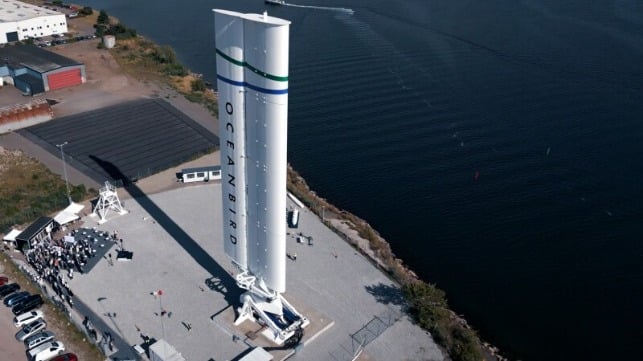
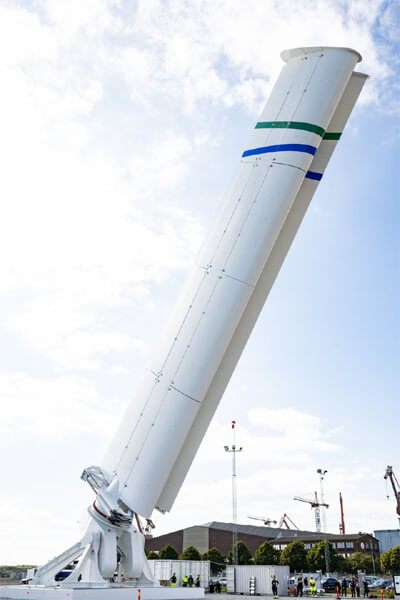
Prototype installed in Sweden for demonstrations and crew training (Oceanbird)
After more than three years of planning and research, Oceanbird unveiled its first prototype wing sail as the latest entry into the wind-assisted propulsion market. At an event in Sweden on August 25, the company said it is entering a new phase as it moves to commercial application, which will see the first sail installed aboard a vessel I 2026.
Oceanbird, the company, was launched in 2021 as a partnership between Sweden’s Wallenius Lines and Alfa Laval with the mission of developing the concept for commercial application. Wallenius first previewed its concept of a sail-powered car carrier in 2020. A Swedish R&D project team, consisting of Wallenius Marine, KTH Royal Institute of Technology, and SSPA/RISE, and supported by Swedish Transport Administration, spent over three years refining the design, while the company also worked on the business concepts.
“We believe that wind propulsion can grow into a significant new industry for Sweden — one that brings together engineering, sustainability, and maritime leadership,” said Magnus MackAldener, interim CEO & Head of R&D at Oceanbird, who moderated the inauguration. With the sail cutting the ribbon as it rose, MackAldener said they were ready to show it to the world and take orders.
The prototype is installed at the Orsesund DryDocks in Landskrona, Sweden. It stands 40 meters (131 feet) and is 14 meters (46 feet) wide. It rose from the lowered position, unfolded its two segments, and demonstrated a full rotation. Oceanbird has installed a full control room at the yard for demonstrations and crew training.
The sail has a high-strength steel core. The aerodynamic surface is a composite of glass fiber, and it is made from 370,000 recycled plastic bottles. They are calling it Wing 560.
“We need pioneers who are willing to take risks, to innovate, and to lead the way into the green industrial transformation, and this is a great example of leadership. Oceanbird stands as proof of this success,” said Andreas Carlson, Sweden's Minister of Infrastructure and Housing at the inauguration.
During the event, the sail was raised and unfurled and demonstrated its rotation (Oceanbird)
The company highlights that it has undertaken extensive data simulations as well as physical tests. It conducted wind tunnel and model tests in open water and water tanks. It has also undertaken Lidar measurements. They report that a single wing can reduce fuel consumption and emissions by 10 percent, and with the full installation, it will be possible to achieve up to a 90 percent reduction in emissions if all the factors are aligned.
The next step is the assembly of a second, identical wing sail, which will be completed this fall at the yard. It will be installed on the Wallenius Wilhelmsen vessel Tirranna at the beginning of 2026. Built in 2009, the 30,000 dwt vessel with a capacity of 7,620 cars was fitted in July 2024 with the foundation for the wing sail. Preparations have been completed, and they will begin tests aboard the operational vessel.
The tests come as wind-assisted propulsion continues to generate interest in the industry. Several concepts of rigid sails and wind rotors are being installed in an increasing number of commercial vessels. Operations have confirmed the expected fuel savings on vessels ranging from tankers to bulkers and RoRos.
Japan Proposes Changes in Wind Energy Terms as Mitsubishi Withdraws
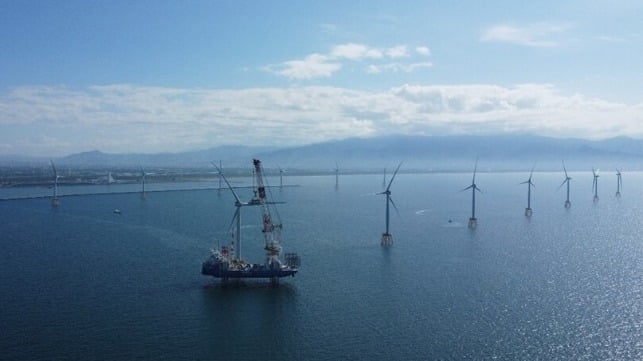
Japan has so far developed coastal offshore wind as it seeks to move to deep ocean floating wind farms (JERA)
The Japanese government is looking for means to revitalize its lagging efforts to develop offshore wind energy. The move comes as Mitsubishi, which in a consortium had won the first large auction, confirmed it has decided not to proceed with three wind farms.
Japan’s offshore wind energy sector has been slow to start and faces significant challenges due to the offshore topography. There are limited near-shore positions for fixed-bottom wind turbines. To achieve the government’s goals of 45 GW by 2040, the industry will have to develop floating wind technology. To date, Japan has developed only a few small near-shore wind farms with a total installed capacity of approximately 300 MW.
The consortium with Mitsubishi won in December the first large-scale auctions that consisted of three offshore sites near Akita on the northwest of Honshu in the Sea of Japan and Chiba, which is approximately 25 miles from Tokyo. The two sites on the Sea of Japan called for 819 MW and 478.8 MW, while the site near Tokyo would have been 390 MW, and all were fixed-bottom projects. Work was expected to start this year and next, and collectively they called for nearly 1.7 GW.
Mitsubishi announced a review of the projects in February, citing increasing costs and changed economics, while reporting it would record a $354 million charge. The company, however, initially denied media reports earlier this week that indicated that the projects were being canceled. However, in a statement issued on August 27, Mitsubishi confirmed it has decided not to proceed with the development of the projects.
The company said that the business environment for offshore wind power has changed worldwide due to factors such as tight supply, inflation, exchange rates, and rising interest rates, since the pandemic and the Ukraine crisis. It called the changes unexpected and said that while it continues to recognize the role of renewable energy, it would not be proceeding with the three projects. The group was involved in the manufacture of wind turbine generators since 1982, but sold its joint venture to Vestas in 2020.
“To adapt to these unexpected changes, we have been pursuing various options, including reassessment of costs, project schedule, and revenue. However, after discussions among the partners, we have determined that establishing a viable business plan is not feasible given the current conditions,” the company said in its statement.
Japan’s Minister of Economy, Trade, and Industry, Yoji Muto, called the decision “deeply regrettable.” He said it would undermine trust in the industry.
The Ministry, along with the Ministry of Land, Infrastructure, Transport and Tourism, had just completed an expert panel review of the industry. It submitted a proposal to the government calling for revising the terms of the leases, adding a provision so that companies could apply for an additional 10 years. The leases in the first three rounds of auctions in Japan provided a 30-year total term and required removal and rebidding at the end of the term. Experts point out that companies would have approximately 20 years of operation after the time required for permitting and construction.
The panel said adding 10 years would give companies more time to improve cash flow, increase electricity sales, and provide for earlier capital recovery. They believe this will also attract a broader range of investors. They proposed changing the terms for future auctions, but did not address making the provision for the 10-year extension available for the existing leases.
The ministry said it plans to restage the auctions for the leases that Mitsubishi is not proceeding with.
In Europe, they have also begun to extend wind leases. Denmark in June issued the first extension for an offshore wind lease. It followed with two more agreements later that same month, also highlighting that the extended term would improve the economics of some of its oldest operating wind farms while also maintaining the flow of renewable energy.
Hanwha Shipping Details Largest U.S. Commercial Vessel Order in 20 Years
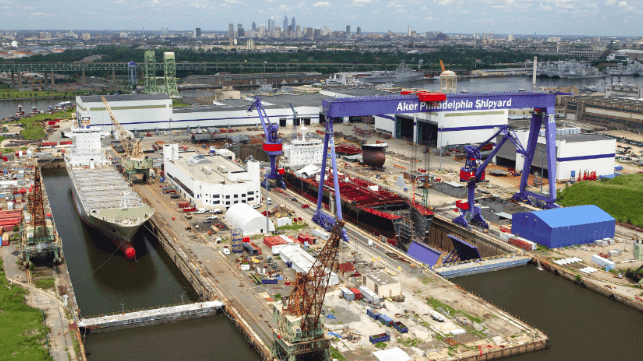
Hanwha looks to take the shipyard back to its heyday when it built 24 MR tankers in the early 2000s (Philly Shipyard)
Hanwha Shipping, the newly-launched U.S. shipping subsidiary of South Korea’s Hanwha Ocean, provided additional details on its shipbuilding plans, which it is calling the largest U.S. commercial vessel order in more than 20 years. The company looks to build out the U.S. Jones Act tanker fleet and launch the first modern U.S. LNG carriers for the international export market.
“We are able to order these U.S.-made MR tankers because of Hanwha’s investment in building a world-class shipyard in Philadelphia,” said Ryan Lynch, President & CEO of Houston-based Hanwha Shipping. “Hanwha has made a long-term commitment to bringing cutting-edge technology from Korea to the Hanwha Philly Shipyard that will create thousands of good, advanced manufacturing jobs in the United States and spearhead the revitalization of America’s maritime industrial base.”
The hallmark of the initiative is an order for 10 medium-range (MR) oil and chemical tankers to be built in Philadelphia. The first tanker is expected to be delivered by early 2029, in what Hanwha Shipping terms “the highest-value commercial order seen at U.S. shipyards.”
The MR vessels will be fitted to transport crude oil, refined petroleum, and chemical products, and will significantly expand the U.S. Jones Act fleet of U.S.-built, U.S.-owned, and U.S.-crewed vessels operating between U.S. ports.
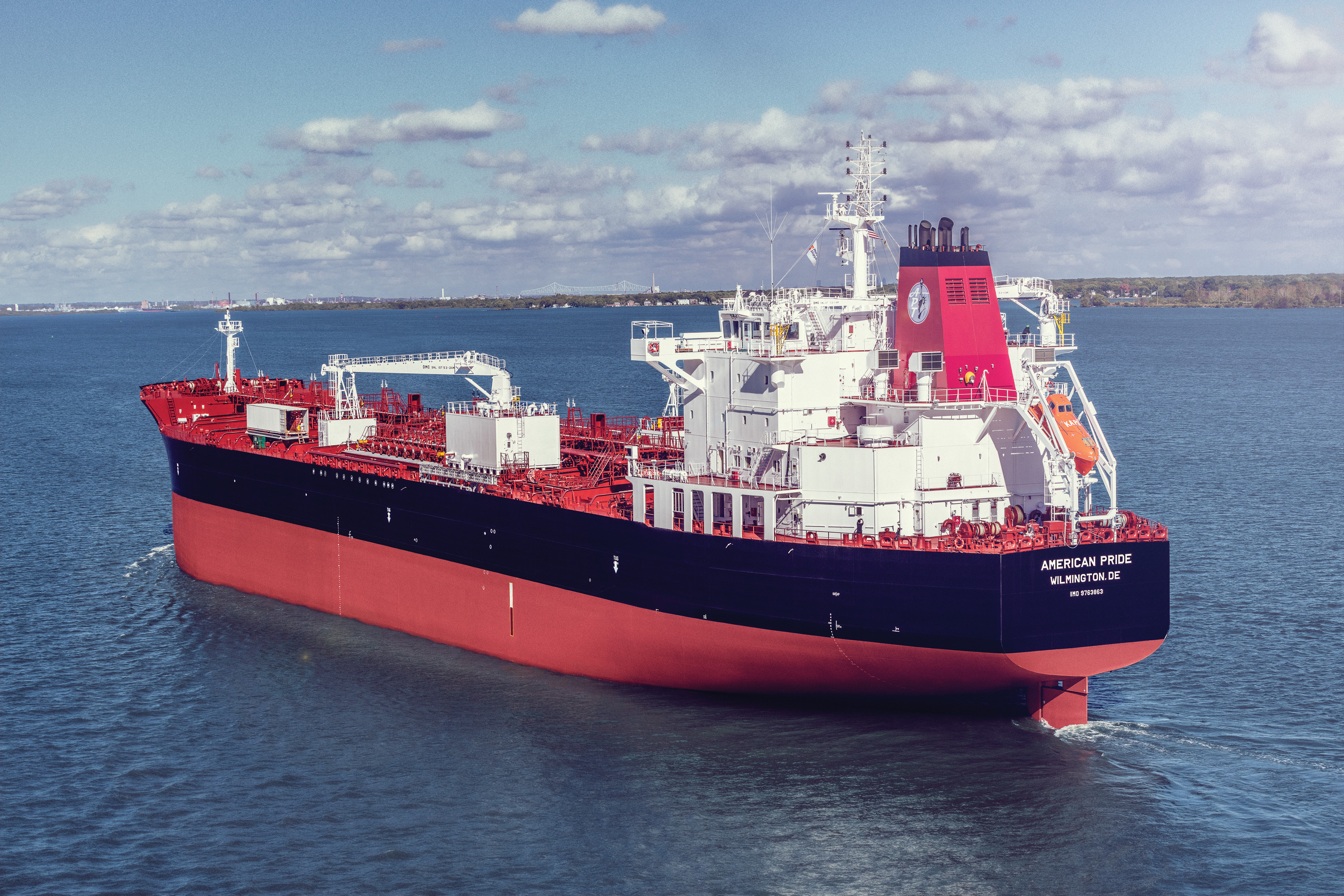
Delivered in 2017, American Pride was the 28th ship built by the yard since it started commercial operations in 2000 (Philly Shipyard)
The ships return the yard now known as Hanwha Philly Shipyard to its roots. Started in 2000 at the site of the former Philadelphia Navy Yard, the company, known as Aker Philadelphia Shipyard, started with contracts to build 46,000 to 50,000 dwt tankers. This included a dozen 600-foot MT46 Veteran-class tankers for Overseas Shipping Group and concluded in 2017 when it delivered American Pride, the fourth 50,000 dwt product tanker built for American Petroleum Tankers (APT), a subsidiary of Kinder Morgan. The yard delivered 24 tankers in addition to its six containership builds for Matson.
As the only company in the world with significant shipbuilding operations in both Korea and the U.S., Hanwha reports it plans to build new MR tankers in the U.S. by transferring its advanced shipbuilding technologies, processes, and supply chains to Hanwha Philly Shipyard.
At the same time, Hanwha Shipping also exercised an option to order a second liquefied natural gas (LNG) carrier, following its first order announced a month ago. They will be the first U.S.-ordered LNG carriers for the export market in almost 50 years and respond to the Trump plan that calls for requiring a portion of U.S. LNG exports to be transported on U.S. ships. The ships will be built via a joint construction model between Hanwha Ocean and Hanwha Philly Shipyard as part of the U.S.-Korea partnership.
The orders are an element of a $5 billion infrastructure plan announced yesterday for Hanwha Philly Shipyard as part of South Korea’s commitment to supporting the growth of U.S. shipbuilding. After acquiring the shipyard at the end of 2024, the company plans to install two additional docks and three quays to increase annual capacity from less than two vessels to up to 20. Hanwha is also reviewing the build-out of a new block assembly facility as it targets work for LNG carriers, naval modules and blocks, and, in the long-term, naval vessels built at the U.S. shipyard.
The Hanwha group quietly launched Hanwha Shipping, based in Texas, in April 2024. According to the company, it aims to take a leading position in the American shipping ecosystem by deploying next-generation digital technologies and advancing the resilience and robustness of America’s energy security and maritime industrial base.
HD Hyundai to Merge Ulsan Shipyards to Expand Defense and Commercial Work
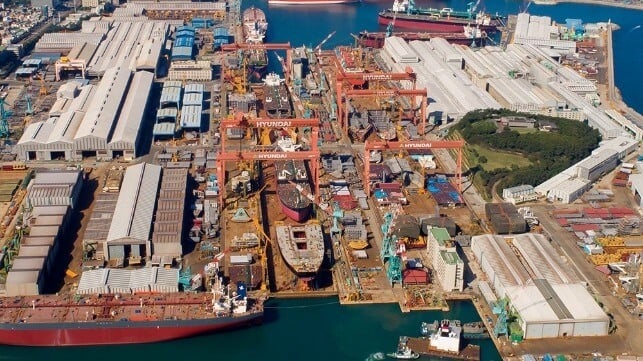
HD Hyundai will consolidate the ownership and management of its shipbuilding operations in Ulsan, South Korea (HD Hyundai file photo)
HD Hyundai, which is already South Korea’s largest shipbuilder, announced plans to reorganize by merging its shipbuilding operations in Ulsan to realize opportunities both in naval shipbuilding and repair, and the South Korean MASGA (Make America Shipbuilding Great Again) initiative.
The company said that it looks to take a leadership role in the South Korean program following the meeting earlier this week between the country’s president, Lee Jae Myung, and Donald Trump, in which South Korea committed to investing at least $150 billion into U.S. shipbuilding and other key industries. As part of the agreement, the company announced a new partnership with U.S. private equity giant Cerberus Capital Management and the Korea Development Bank to pursue a maritime investment strategy.
Under the terms of the proposed merger, HD Hyundai Heavy Industries will acquire the mid-sized operation HD Hyundai Mipo with HHI as the surviving company. HD Hyundai’s shipbuilding holding company, HD Korea Shipbuilding & Offshore Engineering, owns 74 percent of HHI and 42 percent of Mipo, and after the merger will have a 69 percent position in the combined company.
HHI says the merger is an effective response to future changes in the shipbuilding industry and points to the opportunities to reduce unnecessary costs and structure by integrating its systems. Media reports are highlighting that China recently consolidated its two large shipbuilding companies and that Japan’s two largest shipbuilders have also reorganized.
In the first seven months of 2025, HD KSOE reported that it booked orders for a total of 82 ships worth $11.22 billion. It has achieved 62 percent of the annual order target of $18.05 billion for 2025. HHI specializes in larger vessels, including LNG carriers and containerships, while Mipo is considered a medium-sized operation building containerships, chemical tankers, and vehicle carriers.
One of the key markets the combined company will be targeting is defense shipbuilding, which HD Hyundai highlighted to investors as a rapidly growing segment as countries expand their investments. HHI reports it has built 106 naval vessels, more than any other domestic shipbuilder. It has experience with destroyers, frigates, submarines, and patrol boats, and looks to expand both internationally and specifically with the United States as part of the MASGA program.
“We will increase our competitiveness in the K shipbuilding and defense sectors by reorganizing the shipbuilding business,” the company told investors. It said the target is to grow defense revenues to $7.2 billion annually by 2035.
It also looks to expand its entry into the repair business. The company recently won its first MRO contract from the U.S. for the overhaul of a U.S. Military Sealift vessel, USNS Alan Shepard, a 41,000-ton displacement Lewis and Clark class dry cargo and ammunition vessel. As part of MASGA, they believe this business segment will grow rapidly.
They also look to expand their expertise in specialty ships, pointing to the opportunity for icebreakers due to the rise in Arctic development. South Korea previously announced that it plans to launch an Arctic shipping initiative and recently ordered a new Arctic research vessel.
The combined company will also accelerate its focus on green shipping. They will consolidate the R&D and design capabilities of the two shipbuilders. Mipo will also provide additional capacity to the combined company, as reports are that it is currently operating at a rate of 45 ships but has a capacity to reach 70 ships annually.
The combined company plans to launch by December a new overseas investment holding company to be based in Singapore. It will manage the operations of the shipyards in Vietnam and the newly launching yard in the Philippines, as well a the recently acquired tank and crane manufacturer in Vietnam that it has agreed to acquire from Doosan. HD Hyundai has also been exploring additional overseas operations, including possibly a shipyard in Morocco and Egypt, and has formed new relationships in the United States.
U.S. officials are reporting yet another case in which a MARPOL violation was discovered after a crewmember turned over evidence to the U.S. Coast Guard. The Department of Justice reported on August 25 that V.Ships Norway pleaded guilty to the violation and was sentenced to pay a $2 million fine.
“Dumping oil-contaminated waste into the waters around our ports and coasts violates the law and poses an unnecessary health and environmental hazard,” said Acting Assistant Attorney General Adam Gustafson of the Justice Department’s Environment and Natural Resources Division (ENRD). “The crew took pains to hide their illegal activity by knowingly keeping inaccurate records. We will not turn a blind eye to this kind of irresponsible and fraudulent activity.”
DOJ reports that between February 2022 and August 2022, a hose was connected between the incinerator waste oil tank and the sewage holding tank on the product tanker Swift Winchester(46,000 dwt). The vessel was at the time operating under the Marshall Islands flag and owned by Winchester Shipping and managed by V. Ships. The hose was a type of “magic pipe” that allowed oily waste to transfer into the sewage holding tank and then to be discharged directly into the sea, bypassing required pollution prevention equipment.
A low-ranking engine crewmember reported this to a superintendent at V.Ships. The superintendent investigated the matter and discovered what appeared to be oil in the sewage tank. DOJ acknowledges that V.Ships dismissed the Chief Engineer.
In August 2022, the new Chief Engineer ordered the engine crew to clean the Oil Water Separator (OWS) filter. The engine crew took the filter onto the deck and hosed it down with a degreaser, and the oily waste washed directly overboard through a scupper.
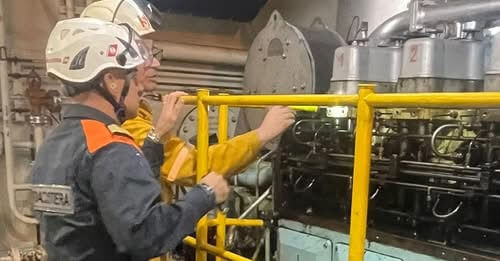
Coast Guard members from the U.S. Coast Guard Marine Safety Unit Port Arthur conducted an examination of the vessel. While they were in the engine room, a crewmember disclosed the discharges and provided photographic and video evidence documenting the illegal discharges.
Guardia Costeria is reporting that it has detained a smaller containership after it was unable to determine that the vessel was in compliance with emissions regulations. The Mediterranean became an Emission Control Area (ECA) this year, while the Italian authority reports that it has detained ten ships this year for failing to comply with international regulations.
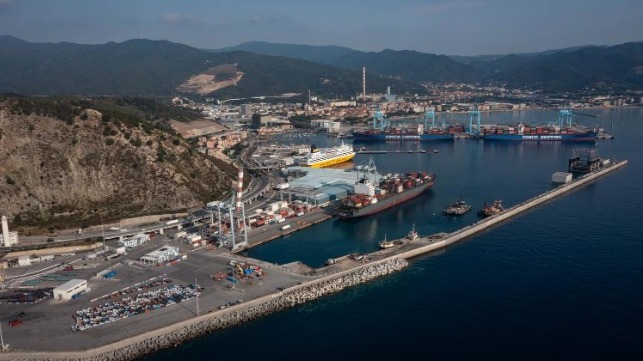
The new situation arose in Genoa on August 21 when the Hansa Horneburg (23,644 dwt) arrived from the Italian port of Vado Ligure. The vessel, which is registered in Liberia and managed by Leonhardt & Blumberg of Germany, was built in China in 2007. It has a capacity for 1,732 TEU,
The Italian authority reports that it conducted an inspection of the vessel, and although it is equipped with valid certifications, it could not determine full compliance with the regulation relating to the containment of nitrogen oxide (NOx). The authority says that components of the electric generators did not display compliance identification, and it was unable to determine if they complied with the NOx technical code.
Guardia Costiera was unable to determine compliance with the emissions regulation (Guardia Costiera)
Guardia Costeria reports it undertook a comprehensive inspection from the bridge to the engine room as well as crew areas. It also conducted a safety drill aboard the vessel. The Italians said that since compliance could not be ensured, the vessel was being detained. This year and last, the vessel underwent inspections in the United States and Peru without incident.
The increased diligence comes as the Mediterranean ECA became official on May 1, 2025, the fifth ECA zone under the IMO’s regulations. The IMO highlighted that ships operating in the new ECA would be subject to strict mandatory measures to prevent, reduce, and control air pollution. The focus is on sulfur emissions and particulate matter. Ships operating in the Mediterranean must comply with stricter content limits than those set by the global standard (0.10 percent mass by mass (m/m) for sulfur, compared with 0.50 percent m/m allowed outside SOx ECAs).
AIS signals show that the Hansa Horneburg remains in Genoa as of August 27. The Italian authority says it will be detained until the deficiencies are addressed under the supervision of the flag administration and the class society. It will also be required to pass a follow-up Port State Control Inspection.