
Sunday, October 26, 2025


Russia test fires its Burevestnik nuclear-powered cruise missile

Russia test fires its Burevestnik nuclear-powered cruise missile
Russia has developed a new nuclear-powered cruise missile, the Burevestnik, that President Vladimir Putin says has no analogues in the Western world / bne IntelliNews
By bne IntelliNews October 26, 2025

Russia’s Burevestnik nuclear-powered cruise missile has no analogues in the world, Russian President Vladimir Putin said on October 26, as the Kremlin escalates the unfolding missile arms race with Ukraine another notch.

Wearing military fatigues, Putin made the comments during a visit to one of the Russian command posts of the joint group of forces and held a meeting with Chief of the General Staff Valery Gerasimov and commanders of the battlegroups involved in the war in Ukraine.

"I have a report from the industrial bodies, and in general I am familiar with the estimates of provided by the defence ministry. It's a unique product that no one else in the world possesses," the Russian president said.

"I remember quite well when we announced that we were in the development stage of such weapons and even high-level experts told me that it worthy objective indeed, but in the historical short term was unrealisable. I reiterate that this opinion was voiced by high-class experts," Putin added.

Russia successfully tested the nuclear-powered and nuclear-capable Burevestnik cruise missile, which Putin says can pierce any defence shield, and will now deploy the weapon.

The test was part of a nuclear drill last week and is designed to send a message to Washington that is toying with the idea of supplying Ukraine with equally powerful Tomahawk cruise missiles. In his remarks in a televised meeting, Putin said that Russia will “never bow to pressure” from the West over the war in Ukraine as US President Donald Trump hardened his line against Russia again last week, imposing the first sanctions on Russia since he took office in January with oil sanctions on Russia’s two biggest oil companies.  

Gerasimov, a close Putin ally, told Putin that the 9M730 Burevestnik (Storm Petrel) - dubbed the SSC-X-9 Skyfall by Nato - flew 14,000 km and was in the air for about 15 hours during a test on October 21. Putin called it "invincible" against current and future missile defences, with an almost unlimited range and unpredictable flight path.

The Burevestnik was first mentioned in 2018, according to Reuters, when it was cast in response to moves by the United States to build a missile defence shield after Washington in 2001 unilaterally withdrew from the 1972 Anti-Ballistic Missile Treaty, and to enlarge the Nato military alliance.

Ukraine's missiles

Ukraine has been throwing its efforts into developing missiles to counter Russia’s overwhelming advantage in long-range cruise and ballistic missile production. It has already developed the Neptune sea-launched, which was used early in the war to sink Russia’s Black Sea flagship, the Moskva in April 2022. Since then the missile has been adapted for land use.

Ukraine also developed the Palyanytsia cruise missile, but it has limited range and has since been superseded by the powerful and long-range Flamingo cruise missile which has a 1,200kg payload and range of more than 3,000km that can threaten strategic targets deep inside Russia as well Moscow itself.

Ukraine developed the missile, which uses generic engines produced by local aviation plant Motor Sich, in only nine months. As a result, the cost of the missile is a very affordable $400,000 each and the factory is already producing seven a day with the hope of rapidly increasing the output.

For comparison, Russia produced 1,200 missiles of various sophistication last year, but with heavy investment, the Kremlin says that will increase to 2,500 this year.

While the Flamingo is a welcome addition to Ukraine’s arsenal, and goes someway to compensating for the US decision to provide Kyiv with its powerful Tomahawk missiles. Ukraine’s Western allies remain reluctant to send Ukraine really powerful missiles that can fly deep into Russian territory as part of its “some, but not enough” escalation containment strategy of support. Likewise, German Chancellor Friedrich Merz has refused to supply Ukraine with its powerful Taurus cruise missile. France and the US have sent their Storm Shadow missiles to Ukraine, but as those went out of production 15 years ago, the stockpile has almost been depleted.

Russia ahead in missile development

For its part, Russia remains well ahead in missile development in the unfolding missile war it launched this summer. In addition to the Burevestnik, it has also developed the Oreshnik cruise missile that can hit any city in Western Europe as well as a family of new hypersonic missiles which Putin showcased in his 2018 state of the nation speech, which he claims the West has no defences against.

At the other end of the spectrum, Russia has upgraded its FAB glide bombs – WWII vintage heavy gravity bombs that can carry a devastating payload of up to 3,000kg of explosives. More recently, the Armed Forces of Russia (AFR) have put an improved FAB 500 glide bomb into service that is jet propelled, which has significantly increased its range.

Military analysts say the shortcomings of the Flamingo include the lack of satellite navigation system, which makes targeting inaccurate, and sophisticated defence capabilities. According to reports, the AFU has fired several Flamingos at Russia, but several were shot down by Russian surface-to-air defence systems.

And Ukraine has little in the way of air defences to protect itself against Russian-made missiles, almost entirely reliant on US-made Patriot missiles, where after months of exchanges, ammo supplies are running low. In recent months, the AFR has changed tactics and is flying waves of drones against key military and energy assets to deplete air defence measures before firing a salvo of missiles at the target, which has caused significant damage.

As bne IntelliNews reported, both sides have been targeting energy assets this summer with the AFU targeting Russian oil refineries, but the jury remains out on who is doing the most damage as winter looms. Ukraine is facing a dark and cold winter, but Russia’s size is its Achilles’ heel as it is simply too big to be able to protect important assets spread across its vast territory and most of its best air defence systems are deployed in Ukraine.


Putin Touts Successful Tests Of Nuclear-Powered Burevestnik Missile
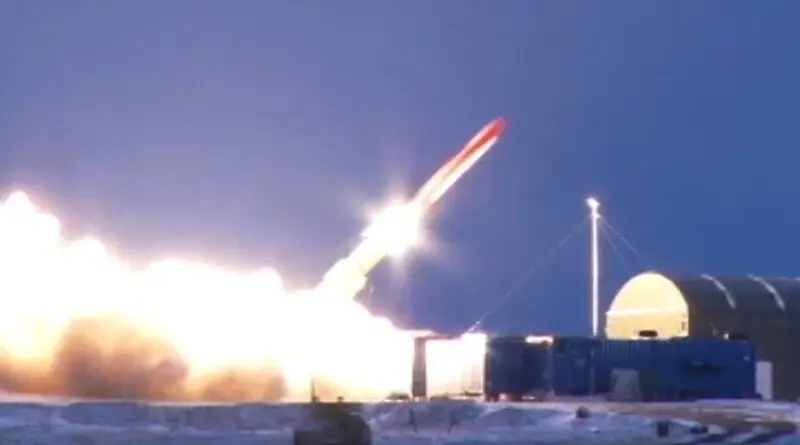
File photo of a previous test launch of Russia's Burevestnik missile. Photo Credit: Mil.ru, Wikipedia Commons

By 

President Vladimir Putin said Russia has successfully tested the nuclear-powered, nuclear-weapon capable Burevestnik cruise missile and is seeking ways to deploy it at a time when the Kremlin’s war in Ukraine drags on.

The Kremlin published a video on October 26 of a meeting between Putin and Chief of the General Staff, General Valery Gerasimov, which reportedly took place at a command post of the joint group of forces.

Gerasimov said the test occurred five days earlier, when the missile, which Moscow claims cannot be detected by any defense system, traveled 14,000 kilometers (8,700 miles) and was in the air for about 15 hours.

The missile, dubbed Skyfall by NATO, has been under development for more than a decade. It’s one of several new systems Russian designers have focused on as the Kremlin pours money into weapons development as part of a not fully recognized arms race — mainly against the United States.

“The decisive tests are now complete,” Putin said in the video, adding he has ordered the preparation of “infrastructure to put this weapon into service in the Russian armed forces.”

The advancement of the project comes after Putin’s war on Ukraine entered its 45th month with Russian troops grinding out incremental gains.

Kyiv has been pushing the United States and its Western allies to provide longer-range weapons such at Tomahawk missiles to allow Ukraine to strike deeper into Russia as it tries to gain an upper hand in the war and strengthen its position in any peace talks, which currently appear to be stalled.

The Burevestnik is powered essentially by a small nuclear reactor built into the engine, theoretically enabling it to stay aloft for days. The United States researched the possibility of such a weapon in the 1960s, but abandoned it as dangerous and unfeasible. 

The missile has drawn particular attention from arms control and intelligence experts, partly because of the technology but also its past failures.

botched bid to recover a sunken missile — thought to be a Burevestnik — caused a radiation blast in the White Sea in 2019, killing five people, documents, photographs, satellite imagery, and other open-source materials reviewed by RFE/RL showed. 

Russia’s state nuclear agency, Rosneft, later said five technicians had been killed in the incident. And US officials confirmed the radiation plume was caused during the recovery of a nuclear-powered missile.

Putin’s announcement comes as the New START treaty, which limits US and Russian nuclear forces to 1,550 strategic warheads and 700 strategic launchers deployed on each side, is set to expire early next year.

The Russian leader recently offered to voluntarily respect the treaty’s limits for one year, a proposal US President Donald Trump said “sounds like a good idea to me.”



 

Paris Court Dismisses Most Greenwashing Claims Against TotalEnergies

TotalEnergies SE (NYSE: TTE) said Friday that the Paris Judicial Court dismissed the majority of claims brought against it in a high-profile greenwashing case, rejecting accusations that the company’s corporate and institutional communications misled consumers about its environmental commitments.

The ruling, which focused on TotalEnergies’ statements about its carbon neutrality ambitions, ordered the company’s French affiliate to remove three paragraphs from its customer-facing website. The court found that the removed content failed to reference the internal energy transition scenario underpinning TotalEnergies’ multi-energy strategy.

However, the court rejected key allegations concerning TotalEnergies’ 2021 rebranding campaign and broader communications about the role of natural gas and biofuels in the energy transition—both central themes in the company’s strategy. No advertising by TotalEnergies or its affiliates was condemned, contrary to some earlier media reports.

TotalEnergies said it will not appeal the ruling, adding that it plans to replace the removed paragraphs with factual updates highlighting its progress in implementing its multi-energy strategy. The company reiterated its view that the decision confirms the overall integrity of its public communications.

The French energy major also used the occasion to spotlight its domestic and global investments in low-carbon energy. Since 2020, TotalEnergies has invested more than €20 billion worldwide—including €4 billion in France—across renewables, biofuels, electricity, and EV charging. It now operates 32 GW of gross installed renewable capacity and produces 50 TWh of electricity annually, equivalent to about fifteen nuclear reactors.

In France, the company has built a 2 GW renewables portfolio spanning 430 wind and solar projects, serves 4.2 million electricity and gas customers, and leads the motorway EV charging market with nearly 1,900 fast chargers. It has also invested close to €1 billion in two biorefineries producing biofuels and sustainable aviation fuel, while developing 117 agrivoltaic projects totaling almost 2 GW.

Globally, TotalEnergies said it has reduced greenhouse gas emissions from its operated oil and gas facilities by 36% since 2015 and cut methane emissions by 55% since 2020.

The court’s decision comes amid mounting scrutiny of oil and gas companies’ climate claims in Europe, where regulators and environmental groups have targeted corporate “greenwashing” in advertising and investor communications. In recent years, TotalEnergies and its peers have faced lawsuits seeking to challenge the credibility of their net-zero and transition strategies.

Despite ongoing criticism, TotalEnergies defended its record, emphasizing that it continues to balance energy security, affordability, and decarbonization goals. “Regardless of those who accuse us of greenwashing, we are proud to make every effort to serve our customers every day and to help build the energy system of tomorrow,” the company stated.

By Charles Kennedy for Oilprice.com


Can California Still Lead the Charge on Electric Trucks?

  • California aimed for a 100% zero-emission medium- and heavy-duty vehicle fleet by 2045, but lost EPA support under the Trump administration.

  • The California Air Resources Board repealed key zero-emission purchasing rules after failing to secure a federal waiver.

  • Despite setbacks, demand for electric trucks remains strong, driven by limited incentives and private-sector optimism.

In recent years, California has pursued an accelerated shift to green by encouraging consumers to make the switch from internal combustion engine (ICE) vehicles to electric vehicles. The government of California hopes to eventually decarbonise its medium-duty and heavy-duty vehicles to improve the state’s air quality and help tackle the effects of climate change. However, following significant opposition from the truck industry and the federal government, achieving this aim now appears increasingly unlikely. 

California’s medium- and heavy-duty vehicles make up just 6 percent of the vehicles registered with the state’s DMV; however, they contribute more than 20 percent of the greenhouse gas (GHG) emissions. Therefore, decarbonising the fleet would help improve air pollution as well as decrease the negative effects of this form of pollution on environmental and human health. 

The government of California introduced a comprehensive statewide strategy to reduce transportation emissions, which included the aim of achieving carbon neutrality by 2045. Governor Gavin Newsom’s Executive Order N-79-20 states the target of transitioning to a 100 percent zero-emissions drayage truck and off-road equipment population by 2035 and a 100 percent zero-emission medium- and heavy-duty vehicle fleet by 2045, where feasible. The targets align with the air quality standard objectives stated in the 2022 State Implementation Plan Strategy. 

While the cost of electric trucks is higher than that of equivalent ICE vehicles, the government expects the price of these vehicles to fall as uptake increases and production costs decrease. In addition, the State of California has introduced a range of incentives for purchasing zero-emission vehicles in recent years to encourage uptake. For example, the California Energy Commission launched a $50 million multi-year EnergIIZE programme, which provides incentive funds for the infrastructure needs of the companies and public agencies that plan to use zero-emission vehicles.

Several state agencies have introduced ambitious transport decarbonisation aims in recent years, which have made a transition to electric seem increasingly more achievable. The California Air Resources Board (CARB) has established several zero-emission regulatory requirements and incentive programmes, such as the Innovative Clean Transit regulation, which requires a phase-in of zero-emission bus purchases to achieve 100 percent zero-emission fleets by all public transit agencies by 2040.

However, California’s electrification aims have often been at odds with those of the federal government, which has not generally supported the state’s decarbonisation efforts for the transport sector. In addition, the truck industry has been staunchly opposed to the transition, and, under the President Trump administration, achieving its clean transport targets has become even more difficult. 

At the beginning of the year, California hoped to receive a waiver from the Environmental Protection Agency (EPA) to enforce its new Advanced Clean Fleets regulation, but the change in administration meant this was not achieved. Although CARB introduced new rules on zero-emission trucks at the end of last year, it needed a waiver to enforce these new rules. The board eventually decided to withdraw its request for a waiver after Trump came into power in January, effectively putting a stop to the new regulation. This decision responded to Trump’s electoral pledge to reverse vehicle emission regulations enacted during Biden’s presidency.

Then, in September, CARB voted to repeal its zero-emission purchasing rule for private fleets, thereby halting its mandate for the accelerated electrification of the state’s trucking sector. This decision came just shortly after State Governor Newsom discussed California’s great potential as an EV power during Climate Week. CARB was unable to secure the waiver it needed before President Biden left office, and it became increasingly clear in the following months that it would not receive such a waiver under the Trump administration. Strong lobbying efforts by both republicans and the trucking sector eventually upended California’s strategy.

Some suggest that improved incentives could encourage truck companies to make the switch, even without the new regulations in place. Matt LeDucq, the CEO of Forum Mobility, which is developing heavy-duty charging stations near West Coast ports, said, “It’s up to us to show that electrification is going to be a great thing… [that it’s] not something you have to do, but something that you want to do.” 

Meanwhile, Nick Chiappe, the California Trucking Association’s director of government and regulatory affairs, said, “Incentives are a powerful tool to encourage and advance the adoption of ZEVs for use cases where it is feasible.” Chiappe said that trucking companies and other transit companies rapidly took up the $200 million in incentives for electric trucks and buses after they were launched in September. “The demand for this equipment is there, with or without mandates,” said Chiappe. However, due to the ongoing budget deficits, the introduction of more far-reaching incentives may not be possible. 

By Felicity Bradstock for Oilprice.com


Shale Giants Slash Thousands of Jobs as Lower Prices Bite

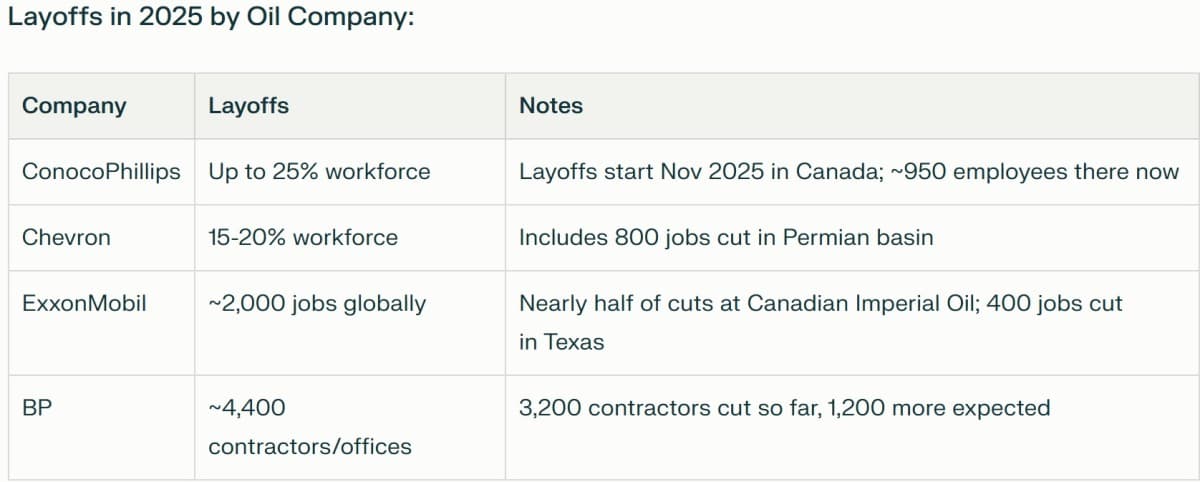
  • U.S. oil majors, including ConocoPhillips, Chevron, and ExxonMobil, are cutting jobs substantially in 2025 to reduce costs amid lower oil prices.

  • ConocoPhillips is planning to cut up to 25% of its workforce globally, including layoffs starting in November 2025 in its Canadian operations.

  • Chevron aims to cut 15-20% of its global workforce by the end of 2026, including 800 jobs in the Permian basin.

U.S. oil and gas producers seek efficiencies and cost reductions amid lower oil prices this year compared to 2024 levels.

Fresh off multi-billion-dollar mergers and acquisitions in the 2023-2024 period, many major producers in the U.S. shale patch are restructuring businesses and operations.

The result so far has been a series of announcements and reports of workforce reductions across geographies and basins.

The latest such report came this week, by Reuters, which reported a memo it had seen regarding layoffs at the Canadian business of U.S. oil and gas giant ConocoPhillips.

The U.S. firm, one of the world’s largest independent exploration and production companies based on production and proven reserves, has its Canadian headquarters in Calgary, Alberta.

ConocoPhillips Canada develops the Surmont oil sands project in the Athabasca region of northeastern Alberta and opportunities in the unconventional liquids-rich Montney play in northeastern British Columbia. 

According to the memo on workforce reductions, ConocoPhillips’ employees in Calgary will be notified virtually on November 5, and those in Surmont and Montney will be told in person on the following day, sources told Reuters.

Related: Saudi Arabia’s Spending Spree Meets Oil Price Reality

“We will not be sharing area-specific workforce numbers for current or impacted employees and contractors,” ConocoPhillips spokesperson Dennis Nuss told Reuters via email.

At present, the company employs about 950 people in Canada.

The number will shrink later this year and next year as ConocoPhillips and other large oil and gas producers look to streamline structures, eliminate duplicate roles or inefficiencies, and save costs.

ConocoPhillips already has plans to slash workforce numbers by up to 25% across functions and geographies to simplify the organization and cut costs.

Last year, ConocoPhillips completed its acquisition of Marathon Oil Corporation, in an all-stock deal with an enterprise value of $22.5 billion, including debt.

The Marathon Oil transaction was viewed by analysts as ConocoPhillips pursuing scale and size and diversified exposure in several U.S. shale basins.

Months before the announcement of the deal, ConocoPhillips CEO Ryan Lance told CNBC in an interview in March 2024, “We have said our industry needs to consolidate.”

“There are too many players. Scale matters, diversity matters, and we are going through a natural cycle of that in the business,” Lance added.

“It’s healthy for our business. It’s the right thing to be doing for our business,” according to ConocoPhillips’ top executive.

The consolidation wave is now receding, and the wave of streamlining and cost-cutting is underway among the major U.S. and European oil firms.

The U.S. shale patch is seeing the deepest jobs cuts in three years as producers respond to lower oil prices with slowing drilling activity and greater efficiencies through consolidation and cost cuts.

The biggest producers are cutting headcount, in the thousands, following blockbuster acquisitions in recent months.

Chevron, which bought Hess Corporation for $53 billion, has said it would reduce its workforce by 20% by the end of 2026 as part of wide cost cuts. This includes 800 jobs in the Permian.

ExxonMobil will slash 2,000 jobs worldwide, with nearly half of these cuts at its Canadian business, Imperial Oil.

Exxon has already eliminated about 400 jobs in Texas since it acquired Pioneer Natural Resources in a $60-billion deal finalized in May 2024.

UK-based BP, which is under intense shareholder pressure to slash costs and reduce debt, said in August that it was accelerating the reduction of contractor numbers and office-based workforce.

“Across the supply chain, we’ve delivered around $900 million of savings. Over a third of our supply chain spend reductions seen so far reflect a reduction in contractors, significantly enabled by technology,” BP’s chief financial officer Kate Thomson said on the Q2 earnings call.

BP has already reduced contractor numbers by 3,200, and expects a further 1,200 contractors to exit by the end of 2025.

“Beyond that, we will continue to rigorously review the remaining contractor activity across our businesses and functions,” Thomson added.

An executive at an oilfield services firm said in comments to the latest Dallas Fed Energy Survey last month, “Operators are less prone to utilize outside services and continue to reduce their own workforces.”

By Irina Slav for Oilprice.com


The big winners from the Australia-US critical minerals deal


Cue region in Western Australia. (Image: Austockphoto.)

The Australian mining sector was buzzing this week off the back of the critical minerals deal announced by US President Donald Trump and Australian Prime Minister Anthony Albanese in Washington DC on Monday.

News of the deal filtered through on Tuesday morning local time, just hours ahead of the opening of Australia’s largest mining event, the International Mining and Resources Convention (IMARC) in Sydney, and it dominated discussions during the conference.

Association of Mining and Exploration Companies CEO Warren Pearce told the conference the deal was much better than expected.

“We’d hoped for a high-level agreement which would enable negotiations and hopefully lead to commercial contracts between American companies and Australian producers,” he said. “What we got was that, plus commitments of investment.”

Two big winners

While the deal boosted sentiment in the Australian critical minerals space, there were two big winners in Albanese’s announcement, Arafura Rare Earths (ASX: ARU) and a joint venture between Alcoa (NYSE: AA) and Sojitz Corp (TYO: 2768).

It was a double win for Gina Rinehart-backed Arafura, which also received a letter of interest (LoI) from the Export-Import Bank of the United States (EXIM) for up to $300 million of funding for its $1.2 billion Nolans project in the Northern Territory.

“I’ve never seen this level of cooperation between the tops of two governments working together in terms of matching supply and funding. It’s actually quite historic,” Arafura managing director Darryl Cuzzubbo told MINING.com from New York, where he had just completed 12 consecutive hours of investor meetings.

“Essentially, through the agreement, Australia is giving somewhat preferential treatment to its critical minerals, to the US, and in return, the US is giving somewhat preferential treatment to funding and price mechanisms, particularly funding, both on the debt and the equity side.

“And then secondly, the agreement spells out how the process can be sped up, which will allow projects to move into construction quicker than they otherwise would,” Cuzzubbo said.

EXIM issued LoIs worth up to $2.2 billion to another six projects: Graphinex’s Esmeralda graphite project in Queensland, Northern Minerals’ (ASX: NTU) Browns Range rare earths project in Western Australia, La Trobe Magnesium’s (ASX: LMG) plant in Victoria, VHM’s (ASX: VHM) Goschen mineral sands and rare earths project in Victoria, RZ Resources’ Copi rare earths project in New South Wales and Sunrise Energy Metals’ (ASX: SRL) Syerston scandium project in NSW.

Ready to build

The Australian government announced a $100 million equity investment in Arafura’s Nolans project through Export Finance Australia.

Arafura has already invested A$60 million ($39 million) in early works at Nolans.

“We’re expecting to finalize our cornerstone equity by the end of this year, and that allows us to then finalize the rest of the funding early next year and then move into construction early next year,” Cuzzubbo said.

Nolans has a three-year construction period and a two-year ramp-up phase. Once in full production, it will produce 4,440 tonnes per annum (tpa) of neodymium-praseodymium, 573tpa of mixed middle-heavy rare earths oxide and 5144,393tpa of phosphoric acid.

“You’ve got Korea, the US and Germany trying to diversify away from China. At the same time, demand is doubling,” Cuzzubbo said.

“Then you look at the rare earths supply pipeline, the number of projects that can move into construction, there’s not too many projects that are going to move into production in the next five to 10 years.”

Gallium hopes boosted In August, Alcoa revealed it had signed a deal with Sojitz and the Japanese government to investigate the production of gallium as a by-product of alumina from its Wagerup refinery in WA.

The Australian government announced up to $200 million in concessional equity finance for the project, which includes a right of offtake for the Australian government.

The US government is also making an equity investment, though the amount is yet to be disclosed, with a right of offtake.

Speaking on a conference call this week, Alcoa CEO William Oplinger said the Japanese would own 50% of the project, with the combination of the US, Australia and Alcoa to own the other half.

Oplinger said negotiations were ongoing but conceded Alcoa may only end up with 5% ownership of the project.

“The real strategic advantage of this deal is that it provides a supply chain outside of China for gallium that is around 10% of the world’s gallium market,” he said.

“We are pushing to have first metal by 2026. We think we will be first to market outside of China on an aggressive schedule. The next step is that we need to get final documents signed, but we’re pushing to be able to extract gallium by 2026.”

South32 (ASX: S32) has its own bauxite and alumina facilities near Alcoa’s in WA and is also considering gallium production.

CEO Graham Kerr told the company’s annual general meeting in Perth on Thursday it had been more focused on working with the US government on its Hermosa project in Arizona and Ambler project in Alaska.

“We do obviously have a list of different priorities and we’re ticking through those,” he said. “Gallium, we’ll continue to look at and study, but Alcoa are probably one step ahead of us on that.”