Monday, November 03, 2025

Longer distances to family physician has negative effect on access to health care


Canadian Medical Association Journal


Living farther than 30 km from a family physician can negatively affect access to health care, found a new Ontario study published in CMAJ (Canadian Medical Association Journalhttps://www.cmaj.ca/lookup/doi/10.1503/cmaj.250265.

Over the last 10 years, access to primary care has declined in Canada, and this decline accelerated with the COVID-19 pandemic. Even after moving, many patients reported continuing with their family physicians, despite travelling longer distances to reach them.

“Distance to health care services is an important determinant of health and can be classified as a factor of health care utilization, with increased distance a potential barrier to receiving care,” writes Dr. Archna Gupta, a scientist at Upstream Lab and a family physician at St. Michael’s Hospital, Unity Health Toronto, Toronto, Ontario, with coauthors.

To understand the impact of distance between family physicians and their patients on health care usage and quality of care, researchers undertook a large study based on data as of Mar. 31, 2023. The study of almost 10 million patients in Ontario, Canada’s largest province, found that 13% of patients lived more than 30 km from their family physician. These patients were more likely to visit the emergency department for nonurgent reasons and had fewer visits with a family physician in the previous two years. They were also more likely to be male, to be under 65 years of age, to live in a low-income neighbourhood, and to be newcomers to Ontario.

“Our research shows that people use the emergency room not just because they don’t have a family doctor or can’t get an appointment. It’s also because their family doctor might be too far away to reach easily. The distance makes it harder for many Ontarians to get the care they need when they need it most,” says Dr. Archna Gupta.

Patients who lived more than 150 km from their family physician had the highest odds of an emergency department visit for nonurgent reasons and were less likely to visit their physician. As well, the farther patients lived from their primary care physician, the less likely they were to undergo preventive screening for colorectal, breast, or cervical cancer.

The authors hope this study will aid policy-makers with health care planning.

“Incorporating distance to a family physician can provide policy-makers with a more nuanced understanding of unmet primary care demand. Our findings suggest that reforms should prioritize offering primary care a minimum of 30 km from a patient’s home,” conclude the authors.

For-Profit Healthcare Makes Us Sick!

The harmful behaviors of profit-driven healthcare companies—from tax dodging to insurance denials to carelessness with patient safety—stem from the same illness: a disregard for the community they serve.


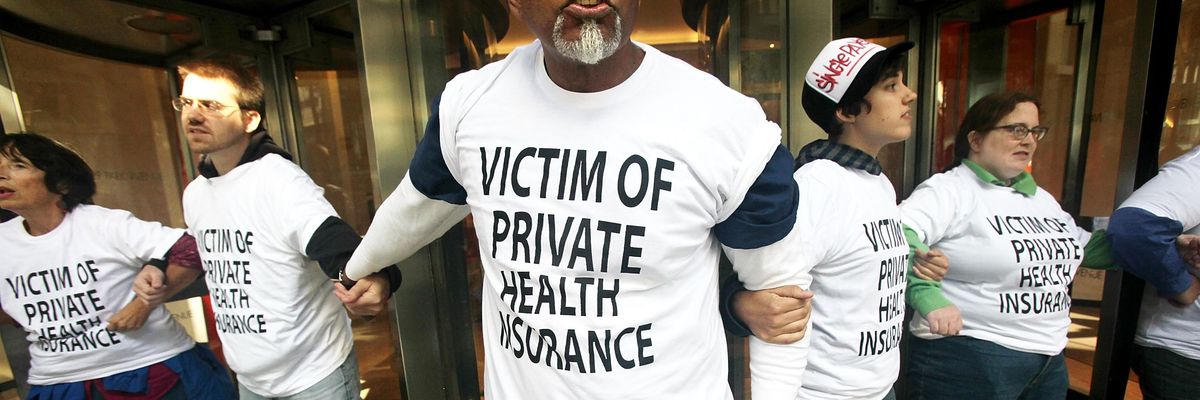
Healthcare reform supporters participate in a sit-in inside the lobby of a building where Aetna insurance offices are located September 29, 2009 in New York City.
(Photo by Mario Tama/Getty Images)

William Rice
Miriam Straus
Nov 02, 2025
Inequality.org


Even though most of us think of healthcare as a human right, the reality is that in the United States the provision of healthcare is big business. It places profits over people, demonstrating that priority through tax dodging, price gouging, insurance denials, and unsafe conditions for patients, as documented in a recent joint report from our two organizations, Americans for Tax Fairness and Community Catalyst.

The report, “Sick Profits,” highlights how seven healthcare corporations have together saved over $34 billion in federal taxes thanks to the 2017 Trump-GOP tax law recently extended by the current Trump administration and Republican Congress. They paid for those corporate tax breaks in part by cutting Medicaid and jeopardizing health coverage for 15 million people, and failing to preserve the enhanced premium tax credits for people buying health insurance through the Affordable Care Act (ACA) Marketplaces.


RECOMMENDED...


75% of US Voters Are Concerned About Surging Healthcare Premiums


‘No Question’ More People Will End Up With Fake Insurance If ACA Subsidies Expire: Expert

We currently have public policy that cuts taxes on corporations while ignoring nearly two-thirds of people who believe that big companies are not paying enough. Instead, healthcare corporations have each enjoyed hundreds of millions—in most cases, billions—of dollars in tax savings thanks to the Republican tax law, the most expensive part of which was a two-fifths cut in the corporate tax rate. They have also saved taxes by exploiting loopholes that the law (and its extension) failed to close, including in the accounting for stock options and the treatment of profits shifted offshore.

Not surprisingly, the companies examined in the report did not use their tax savings to lower prices, hire more providers, or improve patient care. No, the money went instead to higher executive compensation and increased payouts to shareholders through dividends and stock buybacks.

We must demand more transparency, fairer tax policy, and better oversight of these institutions.

Additionally, companies are maximizing their profits by simply not paying for care. By demanding “preauthorization” for a dizzying number of procedures then routinely denying approval, insurers can save billions at the expense of their policyholders. High percentages of initial denials are overturned on appeal, showing that “no” is simply the initial default position, taken in the hopes that patients and doctors won’t push the issue. Claim denials often result in medical debt and can also disrupt treatment for chronic medical conditions, delay or deny access to lifesaving care, and lead to avoidable complications—or even death.

Claim denials affect the health and well-being of people every day. They are people like Little John Cupp, who began feeling short of breath and experienced swelling in his feet and ankles. His doctor recommended a catheter exam to determine whether the arteries in his heart were blocked. However, the medical benefits management company EviCore (owned by Cigna) twice denied the catheter exam while eventually approving a much lower-cost stress test. The delay in diagnosis proved catastrophic. Less than two days after Mr. Cupp received the stress test, he died of cardiac arrest.

The tragedy of the end of Mr. Cupp’s life demonstrates the incredibly real risks that the first obstacle to getting care creates. Unfortunately, clearing that hurdle and receiving approval for care does not ensure quality. You could find yourself getting treatment at a facility saving money for shareholders by reducing staff and failing to maintain safe and hygienic conditions. NBC News aired a six-part investigation of hospital-operator HCA Holdings that uncovered, in the words of our report, “roaches in the operating room, leaking ceilings, essentially unmonitored vital signs, overworked nurses, overcrowded emergency rooms, closed departments, and other threats to patient health and safety.”

Or you may receive care at a facility owned or controlled by private equity interests. One cautionary tale is Prospect Medical Holdings, which operated hospitals and other health facilities in multiple states and was driven into bankruptcy after it was acquired by a private equity firm that extracted over $650 million in debt-financed dividends from the targeted company. While the private equity partners enjoyed lucrative payouts, patients suffered from unsanitary conditions, supply shortages, insufficient staffing, and shuttered departments.

Our diagnosis is simple but serious. The harmful behaviors of profit-driven healthcare companies—from tax dodging to insurance denials to carelessness with patient safety—stem from the same illness: a disregard for the community they serve. We must demand more transparency, fairer tax policy, and better oversight of these institutions. That means closing tax loopholes, raising the corporate tax rate, curbing the routine denials of coverage, and strengthening regulatory oversight of health facilities. That’s the only way to ensure that people’s needs are prioritized over corporate profits.

Remote patient monitoring boosts primary care revenue and care capacity


Columbia University's Mailman School of Public Health


Remote physiologic monitoring (RPM)—digital tools that track patients’ health data between visits—shows promise for improving chronic disease management and reshaping primary care delivery, according to a new study at Columbia University Mailman School of Public Health. While prior studies have examined how RPM affects patients who use the technology, this is the first study to quantify the impact of RPM on practices, including its effects on practice revenue, care delivery, and resource allocation across patients. The findings are published online in the journal Health Affairs.

“RPM services are often touted as a way for practices to both improve patient care and increase revenue, but it’s not a given that this will happen.” said study author Mitchell Tang, PhD, assistant professor of Health Policy and Management at Columbia Mailman School of Public Health.

Using national Medicare data, the researchers identified 754 primary care practices that began billing for RPM between 2019 and 2021. The researchers found that primary care practices adopting RPM saw a 20 percent increase in Medicare revenue in the next two years compared with similar practices that did not adopt RPM. Most of the increase stemmed from RPM billing, although roughly one-quarter came from added care management and outpatient visits.

Most surprisingly, according to Tang and his co-authors, adopting practices did not reduce access for patients not receiving RPM. “There was concern that the added time and resources to provide RPM to some patients would come at a cost – other patients in the practice might struggle to get care,” said Tang. On the contrary, practices saw more patients overall, with much of the added activity focused on individuals with higher disease burdens—many of whom were non-White or dually eligible for Medicare and Medicaid.

“In a time when many call for a strengthening of primary care, our study offers cautious optimism that technologies like RPM can make primary care more accessible, proactive, and patient-centered,” said co-author Ariel D. Stern, PhD, professor of Digital Health, Economics and Policy at the Hasso Plattner Institute, University of Potsdam. However, the authors caution that unchecked widespread adoption could substantially increase Medicare spending. “Thoughtful reimbursement policies, such as evidence-based limits on monitoring duration and patient eligibility, are key to incentivize high value RPM services and ensure sustainability of RPM moving forward.”

Other co-authors are Felippe Marcondes, Massachusetts General Hospital; and Ateev Mehrotra, Brown University.

The study was supported by the Commonwealth Fund.

Columbia University Mailman School of Public Health

Founded in 1922, the Columbia University Mailman School of Public Health pursues an agenda of research, education, and service to address the critical and complex public health issues affecting New Yorkers, the nation and the world. The Columbia Mailman School is the third largest recipient of NIH grants among schools of public health. Its nearly 300 multi-disciplinary faculty members work in more than 100 countries around the world, addressing such issues as preventing infectious and chronic diseases, environmental health, maternal and child health, health policy, climate change and health, and public health preparedness. It is a leader in public health education with more than 1,300 graduate students from 55 nations pursuing a variety of master’s and doctoral degree programs. The Columbia Mailman School is also home to numerous world-renowned research centers, including ICAP and the Center for Infection and Immunity. For more information, please visit www.mailman.columbia.edu.


Mayor Zohran Mamdani and the Dignity of Working People

The election of Mamdani in New York City would indeed send a message across the country and the world

.
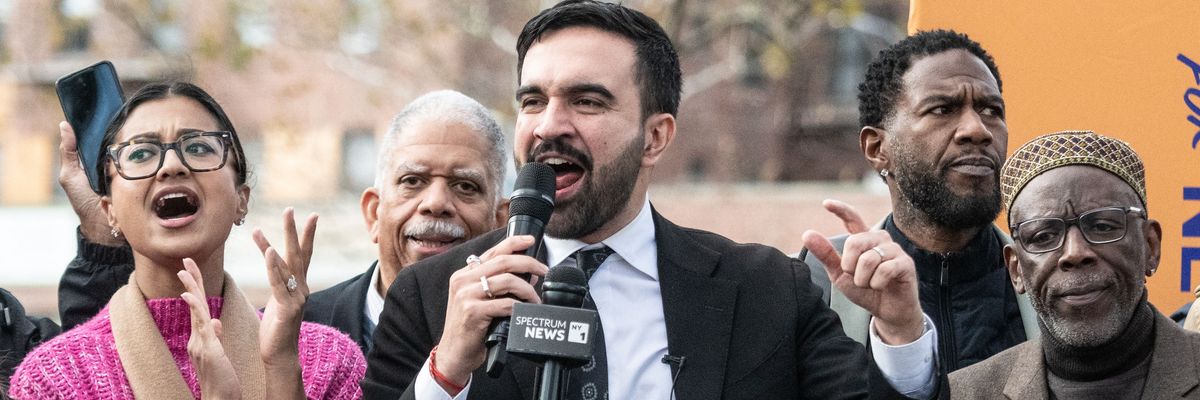
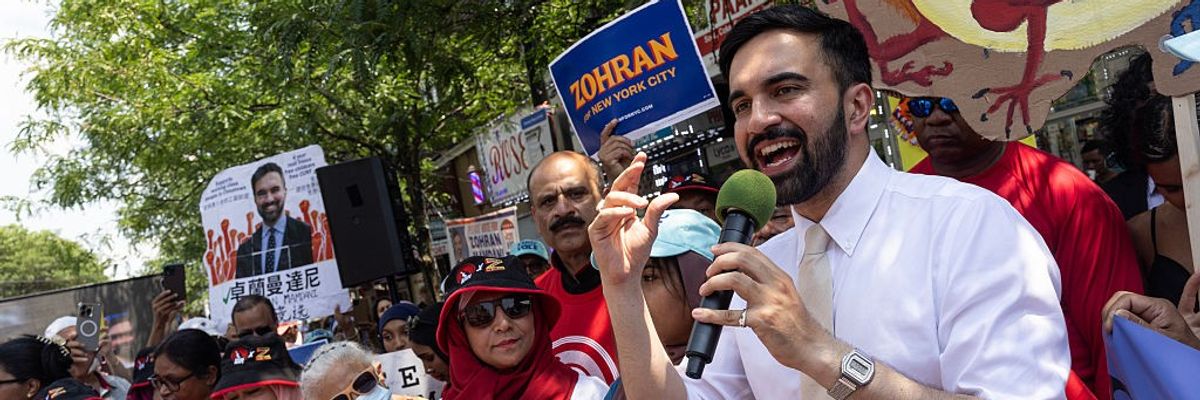
Democratic New York City mayoral candidate Zohran Mamdani speaks during a campaign event with New York City elected officials on November 1, 2025 in the Queens borough of New York City.
(Photo by Stephanie Keith/Getty Images)

Douglas H. White
Nov 03, 2025
COMMON DREAMS


On Tuesday, New York, the largest city in America, has an opportunity to elect Zohran Mamdani, a young man, a democratic socialist, an immigrant (at age seven), a Muslim, a progressive, and someone hated by Donald Trump. And no wonder, since he’s the antithesis of Trump. No wonder he brings fear to the reactionary forces largely represented by the president and his supporters.

Zohran Mamdani is one of nearly 3.1 million immigrants now living in New York City, close to one-third of its total population. Its inhabitants are 30.9% White, 28.7% Hispanic or Latino, 20.2% Black or African American, and 15% Asian. There are also 800 languages spoken in New York City, and nearly four million residents speak a language other than English. That fact does anything but warm the hearts of reactionary folks, since many of them worry about what’s known as “replacement theory,” an idea created by White nationalist Republican strategists to scare the hell out of their base.


RECOMMENDED...


After Fake Mamdani Hit Piece, the Real Bill DeBlasio Says Zohran’s ‘Vision Is Both Necessary and Achievable’


Raucous Mamdani Rally Reveals Political Battle Stretches Beyond New York City

Mamdani is running a very New York-focused election campaign, but one that also speaks to low-income and moderate-income voters across this nation. So many in Donald Trump’s America are now facing the possibility of either losing their healthcare or having healthcare that’s simply far too expensive and doesn’t cover what they need. All too many confront rising housing costs or their inability to purchase a home. All too many are seeing the cost of college reach a level that makes it unaffordable for their children and are now experiencing significant healthcare expenses, whether for young children or elderly sick parents, that have become suffocating.

Here in New York City, poverty is already double the national average. One quarter of New Yorkers don’t have enough money for housing, food, or medical care. Twenty-six percent of children (that’s 420,000 of them!) live in poverty. Of the 900,000 children in the city’s public school system, 154,000 are homeless. (And sadly, each of these sentences should probably have an exclamation point after it!) In the face of such grim realities, Mamdani, among other policies, is calling for a freeze on rents in rent-stabilized apartment buildings in the city; making buses free; offering free childcare for those under the age of five; building significant amounts of new affordable housing; improving protections for tenants; providing price-controlled, city-owned grocery stores as an option; and raising the minimum wage.

At its most basic, the Mamdani campaign is about affordability and the dignity of working people.

Make no mistake: Zohran Mamdani distinctly represents the “other” in Donald Trump’s universe. In that world, he’s viewed as not White, which is in itself a crime for so many of the president’s supporters. Trump has always been a divider. As the Guardian reported in 2020 in a piece headlined, “The politics of racial division: Trump borrows Nixon’s southern strategy,” the president warned that, if Joe Biden were to replace him as president, the suburbs would be flooded with low-income housing.

He’s backed supporters who have sometimes violently clashed with Black Lives Matter (BLM) protesters across the country. He even refrained from directly condemning the actions of a teenager charged with killing two protesters in Kenosha, Wisconsin, suggesting that he might have been killed if he hadn’t done what he did. He’s also called the BLM movement a “symbol of Hate.”

With such rhetoric, the president is indeed taking a page or two out of the 1960s “southern strategy,” the playbook Republican politicians like President Richard Nixon and Senator Barry Goldwater once used to rally political support among White voters across the South by leveraging racism and White fear of “people of color.” Much of what drives Republican strategists today is figuring out what can be done to slow and mute the browning of America. It’s always important to remember that race is almost invariably a critical issue in the American election process.

The election of Mamdani in New York City would indeed send a message across the country and the world that this — my own city — is a place where immigrants can achieve political office and thrive. It would send a message that an agenda focused on low-income people — promising to provide them with opportunity, access to needed resources, and assistance — is a winning approach. In truth, Mamdani’s platform and agenda could undoubtedly be used to attract large groups of Americans who might indeed upend the political situation in many conservative districts across America. In other words, it — and Mamdani — are a threat.

As an observer of the Mamdani campaign, I can’t help reflecting on the civil rights struggle I was engaged in during the 1960s in the South. The challenges were enormous and the dangers great, but we made lasting change possible.

I hear a lot about the number and intensity of the workers in the Mamdani campaign. From my own past experience, I believe that the intensity of those involved in his campaign, the fact that many of them are workers, and their focus on affordability add up to a distinctly winning combination.

Let me now break down the future Mamdani experience as mayor of New York into four categories:

Vision

Zohran Mamdani has what it takes to be a great mayor because he has a vision that speaks to so many sectors of New York’s population, emphasizing as he does the dignity of working people and hope as an active force to put in place meaningful programs for a better future. He articulates a future for this city that is more equitable and will make it so much more livable for so many. As a politician, he’s both an optimist and unafraid to propose big solutions.

Dignity

At its most basic, the Mamdani campaign is about affordability and the dignity of working people. I’ve lived in this city for nearly 60 years and raised my family here. My wife was born here and has lived here her entire life. She was raised by a single father who worked for a fabric company. We managed to build a middle-class life, but right now such a future is anything but a given for so many in a city that has become all too difficult for working people to remain in and create a life worth living.

Make no mistake: Zohran Mamdani distinctly represents the “other” in Donald Trump’s universe.

It’s no small thing that, at this moment in the city’s history, Mamdani has made affordability the central issue of his campaign and suggested that a more affordable New York can be created based on a tax increase on those earning more than a million dollars annually. His focus on the dignity of working people and their families allows his message to have a deep resonance among the population and reach the young, the middle-aged, and the old. His focus is on how New York City can restructure its operations so that it serves us all, not just the well-off and the rich.

Hope

I suspect Zohran Mamdani recognizes that his focus on dignity is also connected to “hope,” and that such hope would be an active force in achieving change. His version of hope isn’t about mere optimism. It’s much broader than that. I was a member of the last generation born into segregation and a Jim Crow system in the American South. During my college days, the most powerful voice for dignity and hope in America was Martin Luther King Jr. He was just 26 years old when he was asked to lead the fight for civil rights and against segregation and Jim Crow in Montgomery, Alabama. Though that fight, in which I was a participant, did indeed seek to end segregation, it was equally about securing a sustainable economic life for Blacks. Indeed, Martin Luther King lost his life fighting for a decent wage for sanitation workers in Memphis, Tennessee.

Zohran Mamdani has been influenced by Dr. King when it comes to his focus on the issues of Dignity and Hope (which should indeed be capitalized in Donald Trump’s America). In a recent interview in the Nation Magazine, responding to a question about how he defines himself, and if he considers himself a democratic socialist, he said, “I think of it often in terms that Dr. King shared decades ago: ‘Call it democracy or call it democratic socialism. But there must be a better distribution of wealth within this country for all God’s Children.'” King believed that hope was not a passive but an active force. As he once said, “We must accept finite disappointment, but never lose infinite hope.”

Inclusiveness and Outreach

I spent 36 years working in the New York City and New York state government, much of that time as the leader or commissioner of agencies impacting the daily lives of citizens. I served under mayors Ed Koch, Mario Cuomo, David Dinkins, Michael Bloomberg, and Bill de Blasio. I was City Personnel Director, Commissioner of Human Rights for the State of New York, and Director of the Bureau of Labor Services. I finished my government service with a 16-year stint as Deputy Fire Commissioner for the Fire Department of New York City. And I know one thing: it’s critical to have vision and purpose if you plan to lead such a city successfully. In addition, a mayor can only put in place big ideas and see them to fruition if he’s connected to all the diverse constituencies and array of institutions that also work daily to reach citizens. In terms of outreach, Governor Mario Cuomo, the father of Andrew Cuomo, once told me that he judged a commissioner by how much time he spent in the community talking and listening to people as opposed to sitting in the office.

New York City has a population of 8.5 million people, which swells each day to more than 15 million, if you include all the commuters and visitors who must be served. With an annual budget of nearly $116 billion, it would be difficult for any mayor to manage. No one can truly be prepared for it, so it’s critical that the mayor selects a group of managers who have the experience and moxie to achieve his or her goals. I’m not concerned about Mamdani’s youth because no one becomes mayor with the singular management skills to confront such a giant budget and the diverse, powerful interest groups within the metropolis. None of those who preceded him, not Koch, Dinkins, Giuliani, Bloomberg, de Blasio, or Adams, could have led the city without the help of a cadre of able managers. Some chose well. Some chose poorly.

It’s critical, though, that if he wins on November 4th, a future Mamdani administration be composed of astute, experienced managers, from first deputy mayor to all the agency heads. And it’s not merely the agency heads who must be capable and well-focused, but all the other managers and deputies within those agencies, too. After all, in New York City, from fiscal crises to snowstorms, sanitation issues to policing, violence in the streets to ethnic tensions, education to housing, union negotiations to potential conflicts with New York State and the federal government, crises erupt on a remarkably regular basis. And don’t forget the more than 210,000 migrants who have arrived in the city since the spring of 2022 in search of an opportunity for a better life. All of that can overwhelm any mayor.

As a result, assuming he wins, Mamdani’s Transition Committee must cast a wide net for the best managers the city has to offer. On the whole, they should be young, yet seasoned. They should be diverse and represent an array of sectors. What he needs are not “yes” personnel but leaders who are themselves astute, critical, and committed to government service. His outreach should be to all races, religions, business areas, and nonprofit groups. As it happens, I’m encouraged by reports in the press of the way he’s already reaching out and I hope he does so in all the years of his mayoralty.

If Mamdani merges a focus on leadership and management with his already clear commitment to expanding affordability, dignity, hope, and opportunity for ever more New Yorkers, then he’ll cement his place in the city’s history and possibly—as Donald Trump grows ever less popular in a distinctly disturbed country—in American history, too.


Douglas H. White
Douglas H. White is a civil rights activist, lawyer, and government official whose career has centered on human and civil rights and labor law. He was Human Rights Commissioner for the State of New York, City Personnel Director/Commissioner of the City of New York, and Deputy Fire Commissioner for New York City. He recently completed a memoir entitled Unbroken: The Last Generation of Black Americans Under Jim Crow and the Culture of Racism in America. The memoir is represented by Marie Brown Associates.
Full Bio >

Beware Zohran Mamdani Critics With False Accusations

There is an inherent danger in conflating Israel with the religion of Judaism and, by extension, conflating criticism of Israel or Political Zionism with antisemitism.


New York City mayoral election, candidate Zohran Mamdani attends a campaign rally, calling for the full enforcement of the city’s Sanctuary City laws, June 21, 2025, in Diversity Square in the Jackson Heights neighborhood of the borough of Queens, New York City.
(Photo by Andrew Lichtenstein/Corbis via Getty Images)

James Zogby
Nov 03, 2025
Common Dreams


In the days before the election for mayor of New York City, a group of rabbis issued a “A Call to Action” attacking public figures like Democratic candidate Zohran Mamdani whom they say “refuse to condemn violent slogans, deny Israel’s legitimacy, and accuse the Jewish state of genocide.” The rabbis’ letter then leaps to the unfounded conclusion that Mamdani’s support for Palestinian human rights and his critique of Israeli behavior is acting to “delegitimize the Jewish community and encouraging and exacerbating hostility toward Judaism and Jews.”

In addition to this logical fallacy, there is an inherent danger in conflating Israel with the religion of Judaism and, by extension, conflating criticism of Israel or Political Zionism with antisemitism. This matter has long been a subject of debate, in particular, within the Jewish community.

During the late 19th and early 20th centuries, as the idea of Zionism was being debated by European Jews, there were competing currents of thought, even amongst those who agreed that the Jewish people had a connection with the biblical land of Israel. Some saw the connection as spiritual; others had a more secular cultural bond. While some in these two camps sought a partnership with the Arabs who inhabited the land, the view that came to dominate the new movement advocated, instead, for an exclusive Jewish state in Palestine. It was called Political Zionism and, tying itself to British colonial ambitions in the Middle East, this movement described the Arabs of Palestine in the same way the British defined those whom they subjugated in other lands—objects of contempt who were undeserving of rights.

In the early 1920s, a British journalist reported witnessing a group of European Jews carrying flags bearing the Star of David marching through the streets of Jerusalem chanting “Jerusalem is ours,” and “We want a Jewish State.” The journalist observed that Jerusalem’s inhabitants—Christians, Muslims, and Jews—were mostly befuddled. The flag with the star was foreign to them, as were the slogans. Arabs who objected to the march were accused of attacking Judaism because the flags included a Star of David. They were not. They were objecting to the European Jews’ claim that Jerusalem was theirs, as well as the marchers’ stated goal of ignoring Arab rights and supplanting them with a colonialist-supported foreign state.

As the British designs on Palestine and their pledge to the Political Zionist movement became known, the Arabs of Palestine came to understand the portent of that early Jerusalem march. During the next three decades, a bloody conflict unfolded.

While American Jews had some sympathy for their co-religionists in Palestine, the majority did not embrace Zionism or Israel as their self-identity. This was true even after the 1948 War and Israel’s Declaration of Independence.

In the 1960s, several factors combined to make a change in American Jewish attitudes toward Israel: the US was in the midst of the Cold War; the McCarthyite anti-communist surge that was tinged with antisemitism; and the anti-Vietnam war and the civil rights movements that combined to challenge the American identity. In this context, the successful 1960s hasbara film, “The Exodus” and Israel’s victory in the 1967 war played significant roles in moving American Jews to demonstrate greater affinity with Israel.

But affinity and financial support were not enough for Political Zionists. They continued to push the notion that Zionism and Judaism were the same. In the 1970s, leaders of the Anti-Defamation League (ADL), a group that had long been in the vanguard of defending Jews against bigotry, co-authored a book entitled, “The New Anti-Semitism,” advancing the case that because, in their view, Israel was so central to Judaism and Jewish identity, being against Israel was the newest form of hatred against Jews.

It was decades before this dangerous conflation took hold. Efforts by the powerful pro-Israel lobby to pass legislation in Congress equating criticism of Israel with antisemitism were repeatedly stymied by both Republicans and Democrats. When the arena shifted to the states, the pro-Israel forces were more successful. To date, more than three dozen states have passed such controversial bills, threatening protected speech.

In the wake of the public outrage that followed Hamas’s October 7th, 2023 attack, the ADL and its allies in government and media saw the opportunity to press hard make the case that the student protests against Israel’s war on Gaza were threatening to the identity of Jewish Americans.

It didn’t matter to them the protests were against Israeli actions not Jews, nor that polls were showing that Jewish Americans were deeply divided over Israeli policies. Instead, they supported efforts by Republicans to have the protests banned and pushed universities to punish students who engaged in criticism of Israel. Thousands of students were arrested, and many were suspended from their universities and had their degrees withheld. Faculty who supported the students were silenced or terminated, and some foreign students were held for deportation because they had been critical of Israel.

Despite the fact that attacks against both Arab American and Jewish American students increased, the ADL and Republicans in Congress deployed a weaponized definition of antisemitism that slighted Arab concerns or judged them as extremism worthy of criminalization. Meanwhile Jewish concerns were prioritized as legitimate and worthy of full-throated support and action.

One such scene stands out:

During the early campus protests against Israel’s war on Gaza, US television captured a scene which was deeply troubling in its implications. A young Jewish woman with a large Israeli flag draped around her neck like a cape was shown walking right into the middle of a pro-Palestinian demonstration. She was followed by a reporter and camera. Despite her deliberate provocation and the fact that she was ignored by the pro-Palestinian protesters, the woman could be heard saying to the reporter, “I just want to feel safe.”

Enter Zohran Mamdani. He is an elected member of the New York State legislature whose entry into the mayoral contest electrified voters. His charisma and agenda to make New York more affordable has won support from young voters, the city’s working class, recent immigrants, and liberals. After decisively winning the Democratic primary, New York’s financial elites and political establishment mobilized to defeat Mamdani in the general election. While polls are showing him still holding a substantial lead over his main opponent, billionaire donors have poured tens of millions into ads that ironically have used anti-Muslim tropes to defame and smear the candidate and his community.

While there are many issues at play in this contest, the dominant media narrative has been that Mamdani’s criticism of Israel is making the city unsafe for Jews. This is easily disproven by the most recent poll of Jewish voters showing Mamdani tied with his nearest competitor—and leading by two to one among Jews between the ages of 18 to 45.

Mamdani’s support of Palestinians and his agreement with almost all US and international human right groups (including Israeli organizations) that Israel is committing genocide is not antisemitic. This shouldn’t threaten Jews. In fact, the threat to Jews comes from those, like the ADL, who falsely equate all Jews with Israel’s deplorable behaviors. Or the rabbis who use false charges to incite against a candidate whose one crime has been to tell the truth.

Our work is licensed under Creative Commons (CC BY-NC-ND 3.0). Feel free to republish and share widely.


James Zogby
Dr. James J. Zogby is the author of Arab Voices (2010) and the founder and president of the Arab American Institute (AAI), a Washington, D.C.-based organization which serves as the political and policy research arm of the Arab American community. Since 1985, Dr. Zogby and AAI have led Arab American efforts to secure political empowerment in the U.S. Through voter registration, education and mobilization, AAI has moved Arab Americans into the political mainstream. Dr. Zogby has also been personally active in U.S. politics for many years; in 1984 and 1988 he served as Deputy Campaign manager and Senior Advisor to the Jesse Jackson Presidential campaign. In 1988, he led the first ever debate on Palestinian statehood at that year's Democratic convention in Atlanta, GA. In 2000, 2008, and 2016 he served as an advisor to the Gore, Obama, and Sanders presidential campaigns.
Full Bio >


Can Mamdani and Friends Revive Socialism in America? Our Future Depends on It

To build a society that actually serves its people, it is necessary to recover a long-marginalized tradition that understands democracy not simply as the holding of elections but as a genuine way of life focused on fighting for the many rather than the privileged few.


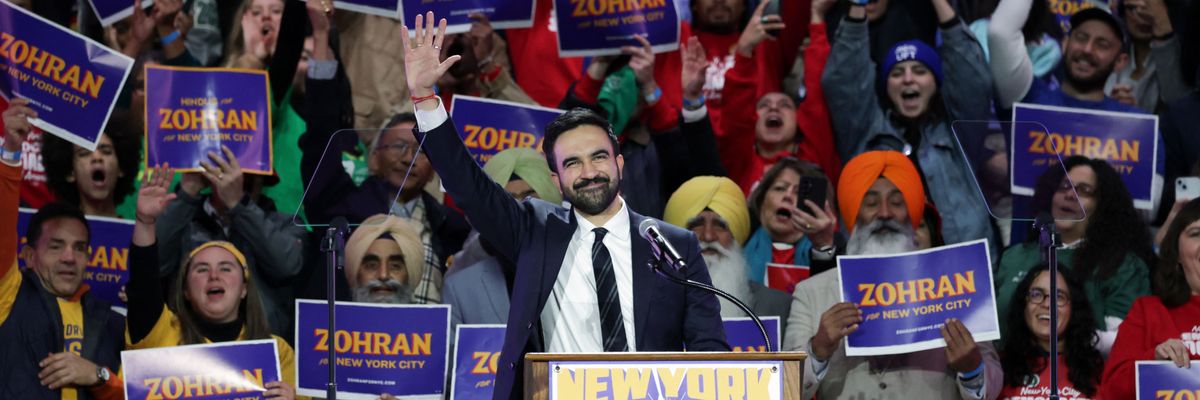
New York City mayoral candidate Zohran Mamdani waves during a campaign rally at Forest Hills Stadium in the Queens borough of New York City on October 26, 2025.
(Photo by Angela Weiss /AFP via Getty Images)

Eric Ross
Nov 02, 2025
TomDispatch

More than a century ago, from a Berlin prison cell where she was confined for her uncompromising opposition to the slaughter of the First World War, Rosa Luxemburg warned, “Bourgeois society stands at the crossroads, either transition to socialism or regression into barbarism.” Her diagnosis remains no less salient today.


In the United States, we long ago chose the path of barbarism. President Donald Trump and his enablers have proven major catalysts in hastening our descent, but they are symptoms as well as causes. The more thacompounding crises of our time, from ecological collapse to immense inequality to endless war, were hardly unforeseeable aberrations. They are the logical outgrowths of a capitalist system built on violent exploitation and rooted in the relentless pursuit of profits over people.

The unsustainable economic order that has defined our national life has corroded our democracy, eroded our shared sense of humanity, and propelled our institutions and our planet toward collapse. Today, we find ourselves perilously far down the highway leading to collective suicide. What the final autopsy will include—be it nuclear annihilation, climate catastrophe, AI-driven apocalypse, or all of the above—no one can yet be certain.

Yet fatalism is not a viable option. A different direction for the country and world remains possible, and Americans still can meet this moment and avert catastrophe. If we are to do so, Luxemburg’s prescription, socialism, remains our last, best hope.

Whether Mamdani wins or loses in November (and count on him winning), he has sparked the reawakening of a long-dormant American tradition of leftist politics.

That conviction animates the democratic socialist campaign of Zohran Mamdani for mayor of New York City. In a bleak political climate, he offers a rare spark of genuine hope. Yet his mass appeal has provoked a remarkable, if predictable, elite backlash. He’s faced Islamophobic smearsoligarch money, and backroom deals (efforts that, Mamdani observed, cost far more than the taxes he plans to impose to improve life in New York). Trump has unsurprisingly joined these efforts wholeheartedly, while the Democratic establishment has chosen the path of cowardice and silence, or at least equivocation.

The outrage over Mamdani is not only about the label “socialist.” Every American has heard the refrain: Socialism looks good on paper but doesn’t work in practice. The subtext, of course, is that capitalism does. And in a sense, it has. It has worked exactly as designed by concentrating obscene levels of wealth in the hands of a ruling class that deploys its fortune to further entrench its power. Especially since the Supreme Court’s 2010 Citizens United decision, private capital has wielded untold influence over elections, drowning out ordinary voices in a flood of corporate money.

What makes Mamdani’s campaign so unsettling to those (all too literally) invested in this status quo is not merely his critique of capitalism but his insistence on genuine democracy. His platform rests on the simple assertion that, in the wealthiest city in the wealthiest country in the world (as should be true everywhere across this nation), every person deserves basic dignity. And what undoubtedly unnerves the political establishment isn’t so much his “radical” agenda but the notion that politics should serve the many, not the privileged few, and that the promise of democracy could be transformed from mere rhetoric to reality.

Whether Mamdani wins or loses in November (and count on him winning), he has sparked the reawakening of a long-dormant American tradition of leftist politics. Reviving socialism in this country also requires reviving its history, recovering it from the hysteria of the Red Scare and the Cold War mentality of “better dead than red.” Socialism has long been a part of our national experience and democratic experiment. And if democracy is to survive in the 21st century, democratic socialism must be part of its future.
The Roots of American Socialism

In the late 19th and early 20th centuries, a wave of immigration brought millions of workers to the United States, many carrying the radical ideas then germinating in Europe. Yet such beliefs were hardly alien to this country.

The growth of labor unions and the rise of leftist politics were not foreign imports but emerged as a byproduct of the dire material circumstances of life under industrial capitalism in America.

By 1900, the US had become the world’s leading industrial power, surpassing its European rivals in manufacturing and, by 1913, producing nearly one-third of global industrial output, more than Britain, France, and Germany combined. That share would climb to nearly half of the global gross domestic product by the end of World War II. However, the immense accumulation of wealth was not shared with those whose labor made it possible. American workers endured intense poverty and precarity, while being subjected to grueling hours for meager pay. They saw few meaningful protections, and suffered the highest rate of industrial accidents in the world.

When workers rose in collective opposition to those conditions, they faced not only the monopolistic corporations of the Gilded Age, but an entire political economy structured to preserve that system of inequality. Anti-competitive practices concentrated wealth to an extraordinary degree. The richest 10% of Americans then owned some 90% percent of national assets, with such wealth used to buy power through the co-optation of a state apparatus whose monopoly on violence was wielded against labor and in defense of capital. As Populist leader Mary Elizabeth Lease described the situation in 1900: “Wall Street owns the country. It is no longer a government of the people, by the people, and for the people, but a government of Wall Street, by Wall Street, and for Wall Street.”

That was evident as early as 1877, when railroad workers launched a nationwide strike and federal troops spent weeks brutally suppressing it, killing more than 100 workers. Such violence ignited a surge of labor organizing, thanks particularly to the radically egalitarian Knights of Labor. Yet the Haymarket Affair of 1886—when a bomb set off at a May Day rally in Chicago provided a pretext for a bloody government crackdown—enabled the state to deepen its repression and stigmatize the labor movement by associating it with anarchism and extremism.

Still, the socialist left was able to reconstitute itself in the decades that followed under the leadership of Eugene V. Debs. He was drawn to socialism not through abstract theory but lived experience in the American Railway Union. There, as he recalled: “in the gleam of every bayonet and the flash of every rifle the class struggle was revealed. This was my first practical lesson in socialism, though wholly unaware that it was called by that name.”

In 1901, Debs helped found the Socialist Party of America. Over the next two decades, socialist candidates became mayors and congressional representatives, winning elections to local offices across the country. At its peak in 1912, Debs captured nearly a million votes, some 6% of the national total, while running as a third-party candidate for president (and again from prison in 1920). For a time, socialism became a visible, established part of American democracy.
“This War Is Not Our War”

Yet socialism faced its most formidable test during the First World War. Across Europe and the United States, many socialists opposed the conflict, arguing that it was a “rich man’s war and a poor man’s fight,” a framing that resonated with broad segments of the American public.

The socialist critique went deeper than class resentment. For decades, socialists were drawing a direct connection between capitalism’s parasitic exploitation of labor at home and its predatory expansion abroad. Writing during the late 19th-century era of high imperialism, as European powers carved up the globe in the name of national glory while showing brutal disregard for the lives of those they subjugated, progressive and socialist thinkers contended that imperialism was anything but a betrayal of capitalism’s logic.

Russian communist and revolutionary Vladimir Lenin called that moment “the monopoly stage of capitalism.” (Capitalists labeled it the cause of “civilization.”) While British economist John Hobson similarly maintained that empire served not the interests of the nation but of its elites who used the power of the state to secure the raw materials and new markets they needed for further economic expansion. “The governing purpose of modern imperialism,” he explained, “is not the diffusion of civilization, but the subjugation of peoples for the material gain of dominant interests.” That was “the economic taproot of imperialism.”

The centuries of imperialism that are returning home in the form of fascism can’t be dismantled without confronting the capitalism that has sustained it, and capitalism itself can’t be transformed without democratizing the economy it commands.

Similarly in the United States, W.E.B. Du Bois, a leading civil rights advocate, situated the war in the longer history of racial and colonial domination. He traced its origins to the “sinister traffic” in human beings that had left whole continents in a “state of helplessness which invites aggression and exploitation,” making the “rape of Africa” imaginable and therefore possible. War, he argued, was the continuation of empire by other means. “What do nations care about the cost of war,” he wrote, “if by spending a few hundred millions in steel and gunpowder they can gain a thousand millions in diamonds and cocoa?”

Others, like disability activist and socialist Helen Keller, a founding member of the American Civil Liberties Union, echoed such critiques. In 1916, she wrote: “Every modern war has had its root in exploitation. The Civil War was fought to decide whether the slaveholders of the South or the capitalists of the North should exploit the West. The Spanish-American War decided that the United States should exploit Cuba and the Philippines.” Of the First World War, she concluded, “the workers are not interested in the spoils; they will not get any of them anyway.”

Once Washington entered the war, it criminalized dissent through the Espionage and Sedition Acts, the same “emergency measure” that would be used, during future wars, to charge whistleblowers like Daniel EllsbergEdward Snowden, and Daniel Hale. Socialists were among its first targets.

After a 1918 speech condemning the war, Debs himself would be imprisoned. “Let the wealth of a nation belong to all the people, and not just the millionaires,” he declared. “The ruling class has always taught and trained you to believe it to be your patriotic duty to go to war and have yourself slaughtered at their command. But in all the history of the world, you, the people, have never had a voice in declaring war.” The call for a world “in which we produce for all and not for the profit of the few” remains as relevant as ever.
Socialism After the Scare

The Red Scare of 1919, followed by McCarthyism in the 1950s and the broader Cold War climate of hysteria and repression, effectively criminalized socialism, transforming it into a political taboo in the United States and driving it from mainstream American discourse. Yet, despite the ferocity of the anticommunist crusade, a number of prominent voices continued to defend socialism.

In 1949, reflecting on a war that had claimed more than 60 million lives and brought us Auschwitz and Hiroshima, Albert Einstein argued that “the real source of evil” was capitalism itself. Humanity, he insisted, “is not condemned, because of its biological constitution, to annihilate each other or to be at the mercy of a cruel, self-inflicted fate.” The alternative, he wrote, lay in “the establishment of a socialist economy,” with an education system meant to cultivate “a sense of responsibility for one’s fellow men in place of the glorification of power and success.”

Martin Luther King Jr. carried that struggle against capitalism, racism, and war forward. Building on the legacy of the Double-V campaign, he called for confronting the evils of white supremacy at home and imperialism abroad. In grappling with those intertwined injustices, he increasingly adopted a socialist analysis, even if he didn’t publicly claim the label. For King, there could be no half freedom or partial liberation: Political rights were hollow without economic justice and racial equality was impossible without class equality.

As he put it, you can “call it democracy, or call it democratic socialism, but there must be a better distribution of wealth within this country for all of God’s children.” Rejecting the pernicious myth of capitalist self-reliance with biting clarity, he pointed out that “it’s all right to tell a man to lift himself by his own bootstraps, but it is a cruel jest to say to a bootless man that he ought to lift himself by his own bootstraps.”

In his 1967 Riverside Church speech denouncing the American war in Vietnam, King made the connection clear. “A nation that continues year after year to spend more money on military defense than on programs of social uplift,” he warned, “is approaching spiritual death.” America, he added, needed a revolution of values, a shift from a “thing-oriented” society to a “person-oriented” one. As long as “machines and computers, profit motives and property rights [are] considered more important than people,” he concluded, “the giant triplets of racism, materialism, and militarism are incapable of being conquered.”
A Better Country and World is Possible

The effort to discredit Zohran Mamdani and other Democratic Socialists like Bernie SandersAlexandria Ocasio-Cortez, and Rashida Tlaib, who challenge entrenched power, is, of course, anything but new. It reflects an ongoing struggle over the meaning of democracy. To build a society that actually serves its people, it is necessary to recover a long-marginalized tradition that understands democracy not simply as the holding of elections but as a genuine way of life focused on fighting for the many rather than the privileged few. Mamdani and crew can’t be exceptions to the rule, if such a vision is ever to take root in this country.

In Donald Trump’s grim vision for and version of America, democratic institutions are decaying at a rapid pace, the military is being used to occupy cities with Democratic mayors, and tyranny is replacing the rule of law. Fascism has never triumphed without the assent of elites who fear the rise of the left more than dictatorship. Mussolini and Hitler did not take power in a vacuum; they were elevated by an elite democratic establishment that preferred an authoritarian order to the uncertainties of popular democracy.

The choice remains what it was a century ago: some version of socialism as the foundation for a renewed democracy or continued barbarism as the price of refusing it.

Meeting today’s crises requires more than piecemeal reform. It demands a reimagining of political life. The centuries of imperialism that are returning home in the form of fascism can’t be dismantled without confronting the capitalism that has sustained it, and capitalism itself can’t be transformed without democratizing the economy it commands.

This country once again stands at a crossroads. Capitalism has brought us to the edge of ecological, economic, and moral catastrophe. Today, the top 1% control more wealth than the bottom 93% of Americans combined, a trajectory that is simply unsustainable. The choice remains what it was a century ago: some version of socialism as the foundation for a renewed democracy or continued barbarism as the price of refusing it. The question is no longer whether socialism can work in America, but whether American democracy can survive without it.

© 2023 TomDispatch.com


Eric Ross
Eric Ross is an organizer, educator, researcher, and PhD Candidate in the History Department at the University of Massachusetts Amherst.
Full Bio >


Opinion

How Zohran Mamdani's campaign will change perceptions of Muslims

(RNS) — Mamdani’s election may be a turning point not only for Muslims but for the promise of a new kind of Democratic Party.


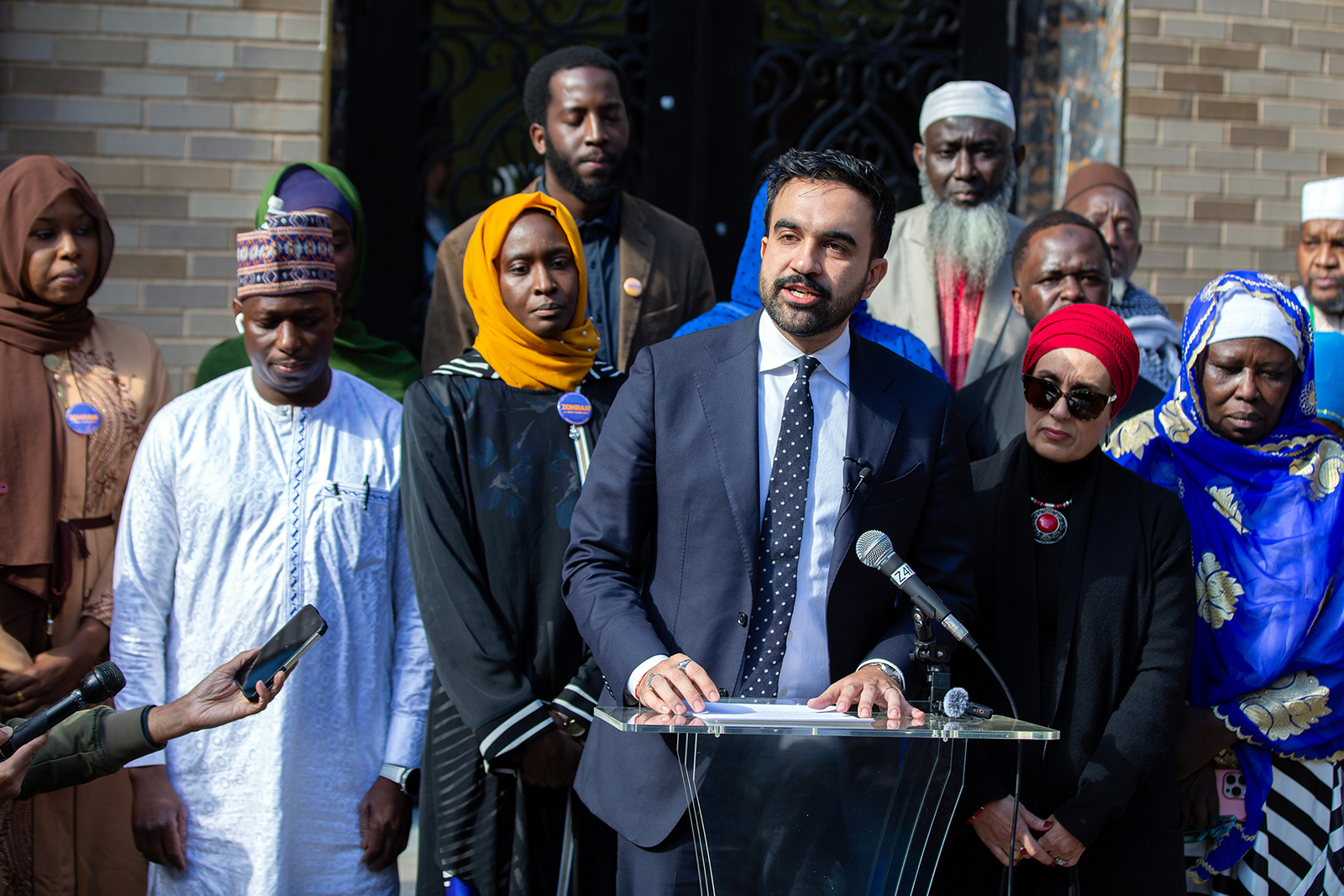
New York City Democratic mayoral candidate Zohran Mamdani speaks at the Islamic Cultural Center of the Bronx mosque in New York on Oct. 24, 2025. 
(AP Photo/Ted Shaffrey)


Dilshad Ali
October 31, 2025

(RNS) — Coming out of the subway near New York University on a brisk Friday last week, I spotted women wearing hijabs and men in kufis filing into a nondescript brick and glass building. My plan had been to attend Jummah (Friday) prayers at NYU’s campus Islamic center. Instead I followed the evidently Muslim crowd into the Islamic Center of New York City, a still-developing “independent epicenter for Muslim spiritual, intellectual, professional, and social life in Manhattan,” according to its website.

Shortly afterward, I realized I had stumbled onto a powerful khutba (sermon) given by Imam Khalid Latif, a campus chaplain at NYU and Princeton University and to the New York Police Department.
RELATED: Meet the New York rabbis planning to vote for Mamdani

The next day was the start of early voting in New York, beginning a historic election that would determine whether frontrunner Zohran Mamdani will become the city’s first Muslim mayor, and Latif’s sermon masterfully turned from the power of prayer, to the importance of being unapologetically Muslim, to a plug for voter registration. The imam also called on those gathered to learn from Mamdani’s campaign, which had withstood vitriolic and vile Islamophobic attacks from his opponent former Gov. Andrew Cuomo, Republican U.S. Rep. Elise Stefanik and others in recent weeks.

When Cuomo says anti-Muslim hate rhetoric, it is not just for his voters. It doesn’t embolden them. It is for us as Muslims, to “mess with our psyche,” Latif said.

The same day, outside the Islamic Cultural Center in the Bronx, Mamdani would give an emotional and pivotal speech in which he leaned into his Muslim identity in ways he had avoided doing throughout a campaign focused on economic issues. He gave voice to the difficult experiences of racism, targeted attacks and amplified hate so many Muslim New Yorkers and American Muslims in general have endured for years.

In doing so, he took an extraordinary step in being unapologetically Muslim. “I will be a Muslim man in New York City,” Mamdani said. “I will not change who I am, I will not change how I eat, I will not change the faith that I am proud to belong to. But there is one thing I will change: I will no longer look for myself in the shadows. I will find myself in the light.”

His words come as an open letter, now signed by more than 1,000 rabbis and cantors, called out the “political normalization” of anti-Zionism by political candidates. It comes as numerous articles have explored the complex and challenging struggles Jewish New Yorkers have faced in this election cycle as they grapple with the possibility of their next mayor being a Muslim with particular views on Palestinian rights, genocide and the state of Israel.

RELATED: For New York’s Muslims, Zohran Mamdani’s candidacy is a reckoning on 9/11 backlash

What is often overlooked in this anti-Muslim narrative is that, while New York is home to the largest Jewish population outside of Israel, it is also home to the largest Muslim population in the United States. Mamdani’s joy-filled campaign should not be seen as a negation of another group’s place in city politics, but an inflection point for those often-unseen Muslim New Yorkers.

I caught up with Fahd Ahmed, executive director of DRUM Beats, a sibling of the South Asian American political organizing group Desis Rising Up & Moving. Ahmed said that something had changed, as Islamophobic attacks on him escalated.

“We can’t just sidestep (these attacks) and just focus on the broader message. In that moment of Zohran asserting his own Muslim identity and experiences, but again linking it to the experiences of so many Muslim New Yorkers over the last two-and-a-half decades, even now I feel emotional,” said Ahmed.

Even in talking about his Muslim identity, Ahmed pointed out, Mamdani stuck to his message of getting by in New York. “He came back and grounded it into the material experiences of being profiled, of being dismissed, of being disregarded, of being viewed suspiciously. It felt very validating,” Ahmed said.

In acknowledging the hate and racism faced by Muslim New Yorkers and many Muslim Americans — the burden of being asked to prove their Americanness time and time again, in hiding parts of themselves to fit into society, in having their experiences relegated to the background of life — Mamdani made clear that he was looking to the future of the city, its children.

“This isn’t about me,” Mamdani said. “It’s about whether Muslim kids growing up in this city can believe they belong here.”

In mid-October, the Institute for Social Policy and Understanding released its 2025 American Muslim Poll, which measures Islamophobia using the National American Islamophobia Index. The poll disclosed that 63% of Muslims reported facing religious discrimination in the past year, which makes it “more likely than 50 percent of Jews and 22-27 percent of other religious groups” facing similar bias. Forty-seven percent of Muslim families with school-age children reported having a child who faced bullying for their faith in the past year.

Mamdani’s story in New York echoes Virginia legislator Ghazala Hashmi’s historic run for lieutenant governor and Minnesota legislator Omar Fateh’s mayoral race in Minneapolis. In a recent conversation with Hashmi, who is a friend, she asked, “Can you imagine that of all states, Virginia could have a female Muslim lieutenant governor?”

In a time of dismantling of government institutions, non-stop ICE raids, fear and worrying, local leaders are unapologetically being themselves in pursuit of serving their communities. Hashmi ran her first state senatorial campaign in 2019 with the tagline: “Ghazala Hashmi is an American name.” This time around, Virginians no longer need to be told.

Ahmed cautiously views Mamdani’s election and these other campaigns around the country as an inflection point, not only for Muslims but for the promise of a new kind of Democratic Party. He feels hopeful that they will change not only perceptions but policy.


RELATED: Mamdani’s win unleashed a surge of Islamophobia — and showed how to beat it

“Having a prominent figure who is willing to speak and act — we see that already with (U.S. Reps.) Rashida Tlaib and Ilhan Omar,” Ahmed said, adding that Mamdani and the others have invested by design in coalition-building. “That is where Zohran and the relationships and coalitions that have been built in (New York) have been more instructive for larger communities,” he said.

As this tumultuous campaign season full of ugly accusations ends, the hope is that one, two or more victories will be an acknowledgment that while one’s identity shouldn’t be the totality of a candidate’s politicking, neither does it need to be hidden to succeed.

(Dilshad D. Ali is a freelance journalist. The views expressed in this commentary do not necessarily reflect those of RNS.)


Meet the New York rabbis planning to vote for Mamdani

(RNS) – Mamdani’s defense of Palestinian liberation has alarmed many New York Jews. But some rabbis are enthusiastically embracing, and even campaigning for, the Muslim mayoral candidate.


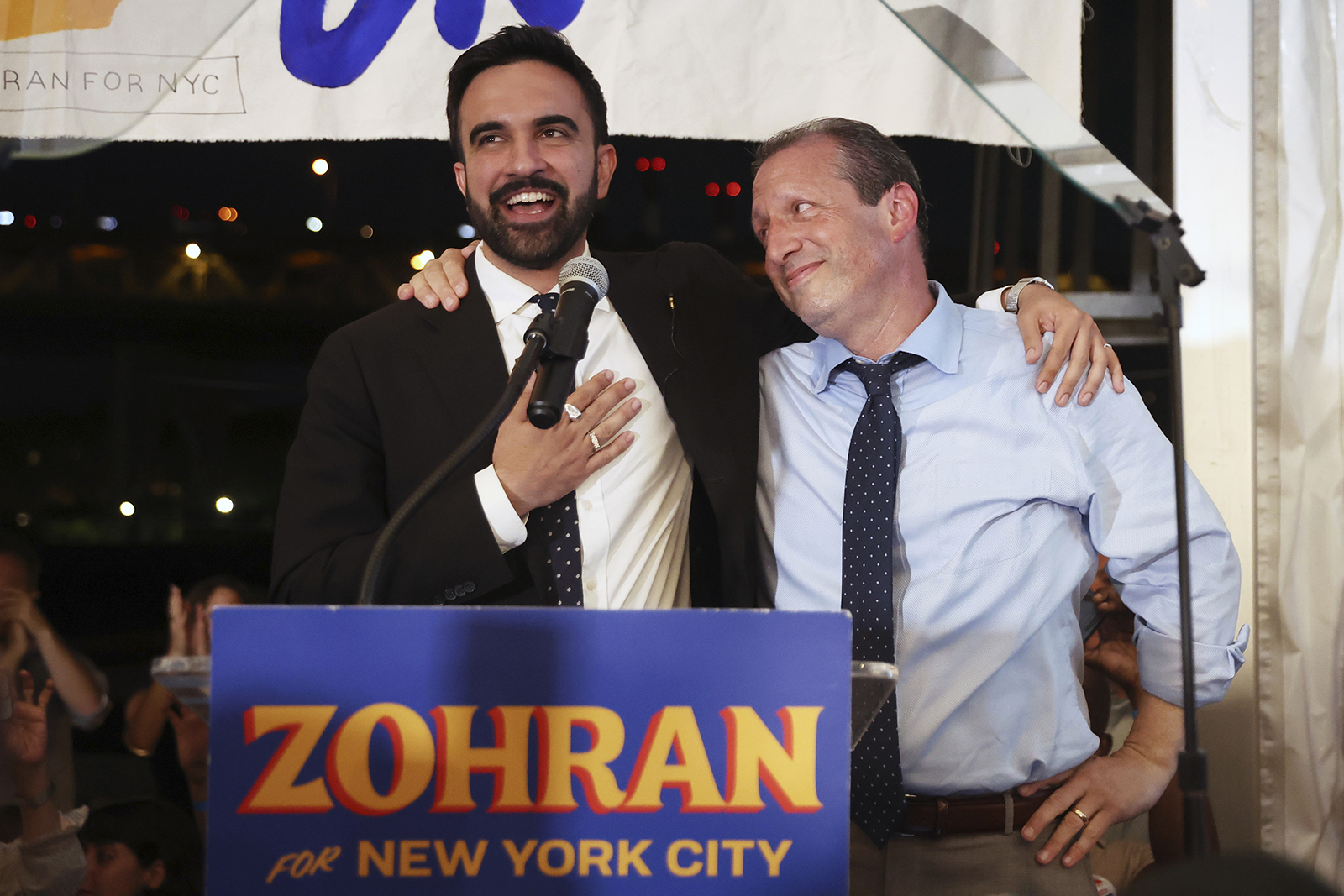
FILE - Democratic mayoral candidate Zohran Mamdani, left, speaks on stage with fellow candidate Comptroller Brad Lander at his primary election party, Wednesday, June 25, 2025, in New York. (AP Photo/Heather Khalifa)

Yonat Shimron
October 30, 2025
RNS

(RNS) — At the World Zionist Congress in Jerusalem this week, Rabbi Margo Hughes-Robinson was one of some 2,500 Jewish activists, organization leaders and government officials from around the world who gathered to decide how to spend more than $1 billion in annual funding for Zionist institutions around the world.

But Hughes-Robinson plans to be back home in New York in time to cast her vote for mayoral candidate Zohran Mamdani, a Muslim who does not believe Israel should exist as a state that privileges Jewish rights above all others.

“I’ve been active in city politics for quite a while, and I’m not afraid of being in coalition with people with whom I disagree on foreign policy points,” said Hughes-Robinson, an educator and translator of Jewish texts, in a phone interview. “Mamdani has talked quite a bit about his plan to reduce hate and violence in a city that’s seeing a spike in antisemitic violence and Islamophobia. I want a New York City that is safe for all of us. And I think Mamdani actually has a really good, effective plan.”

Hughes-Robinson will not be the only New York rabbi to cast her vote for Mamdani. Despite widespread opposition to his candidacy among many voters whose core concern is Israel, Jewish leaders are hardly monolithic in their views of Mamdani. More than a third, according to a recent poll, intend to vote for the 34-year-old Democratic socialist candidate.


Rabbi Margo Hughes-Robinson. (Courtesy photo)

Mamdani, who campaigned mostly on a promise to make the city more affordable, has been steadfast in his defense of Palestinian liberation, alarming many New York Jews. He has accused Israel of committing genocide against Palestinians in Gaza and has vowed to arrest Israeli Prime Minister Benjamin Netanyahu should he visit New York.

In recent days, some 1,150 rabbis and cantors from across the United States signed a letter opposing Mamdani and the “political normalization” of his anti-Zionism. It followed a Shabbat sermon by the prominent Rabbi Elliot Cosgrove of Park Avenue Synagogue, who said Mamdani “poses a danger to the security of the New York Jewish community.”

But Mamdani continues to show surprising strength among New York’s 1 million Jewish residents, especially with the anti-Zionist Jewish Voice for Peace and the progressive New York-based Jews for Racial and Economic Justice. The two organizations launched a joint campaign, “Jews for Zohran,” that has fielded thousands of volunteers to knock on doors and make phone calls on behalf of Mamdani.

“What we’re trying to make clear as ‘Jews for Zohran’ is that Jews thrive in a multiracial democracy where all voices are heard and celebrated and uplifted,” said Beth Miller, JVP Action’s political director.

Bend the Arc, Jewish Action, another progressive Jewish organization that does not take a position on Israel, also made support for Mamdani a central campaign.

Among progressive Zionists, the most prominent rabbi to support Mamdani is Rabbi Sharon Kleinbaum, co-founder of the nonprofit New York Jewish Agenda and the rabbi emerita of Congregation Beit Simchat Torah in Manhattan. The 66-year-old rabbi appeared at a rally for Mamdani on Sunday (Oct. 26) in Queens’ Forest Hills Stadium, where she said she believed in his vision of a shared future for all New Yorkers — a city, she said, “where Jews and Muslims respect and care for each other.”

Other rabbis are joining in. A new letter, titled “Jews for a Shared Future” and drafted by mainstream rabbis, cantors and rabbinical students, already has hundreds of signatures. The letter does not endorse Mamdani but pushes back forcefully against the idea that Jewish safety will be compromised if he is elected.

“In response to Jewish concerns about the New York mayoral race, we recognize that candidate Zohran Mamdani’s support for Palestinian self-determination stems not from hate, but from his deep moral convictions,” the letter says. “Even though there are areas where we may disagree, we affirm that only genuine solidarity and relationship-building can create lasting security.”

Mamdami has visited synagogues and met with Jews throughout his campaign, and especially in the past month, as Jews marked the High Holy Days. While he has focused on liberal synagogues such as Congregation Beth Elohim and Congregation Kolot Chayeinu, he has also met with several Hasidic Orthodox leaders, sitting down at their sukkahs, or huts, during the holiday of Sukkot and donning a black yarmulke.

On the eve of Yom Kippur, Mamdani attended Lab/Shul, a liberal nondenominational synagogue in Manhattan, where he received a standing ovation. Rabbi Amichai Lau-Lavie made it clear there would not be an endorsement, but the event nevertheless caused a backlash with some members furious that he was invited to speak.

“I understand and I respect the hurt of people I love who feel that he’s a legitimate threat to Jewish well-being and safety and the future,” Lau-Lavie said. “My question is: Are we approaching decisions from fear? Is it trauma that’s going to motivate how I go about the world, or is it the attempt to lean into love and to trust more?”

Several rabbis said they were initially drawn to Brad Lander, the city comptroller who also ran on the Democratic ticket for mayor and is Jewish. When Lander and Mamdani cross-endorsed each other in the city’s ranked-choice voting system, many Jewish leaders saw it as a signal that they could trust Mamdani.

“When Brad and Zohran co-endorsed each other in the primary, I felt like any reservations that I may have had about Zohran were really addressed, because I trust Brad, and I trusted that Brad would not co-endorse somebody he felt he had any reason to be concerned about, vis-à-vis the Jewish community,” said Rabbi Emily Cohen, who recently appeared in a video spot of four “proud New York rabbis for Mamdani” sponsored by Jews for Racial and Economic Justice.


New York City Democratic mayoral candidate Zohran Mamdani speaks during a press conference outside the Jacob K. Javits federal building Aug. 7, 2025, in New York. (AP Photo/Yuki Iwamura)

These rabbis said they were also impressed with Mamdani’s ability to listen carefully to their concerns and to modulate and change his message in response. For example, in July, Mamdani reconsidered his use of the phrase “globalize the intifada” and said he would discourage others from doing so.

What most excites these rabbis about Mamdani is the new possibility of Muslim-Jewish cooperation in politics — especially after the two-year example of deadly conflict in Israel and Gaza.

Ellen Lippmann, the founding rabbi of Congregation Kolot Chayeinu, a nondenominational Brooklyn synagogue, said it was the promise that Mamdani brings that’s most inspiring to her. “A colleague of mine said, ‘He gives me hope.’ And I thought that was a great answer. It feels exciting. It feels hopeful.”