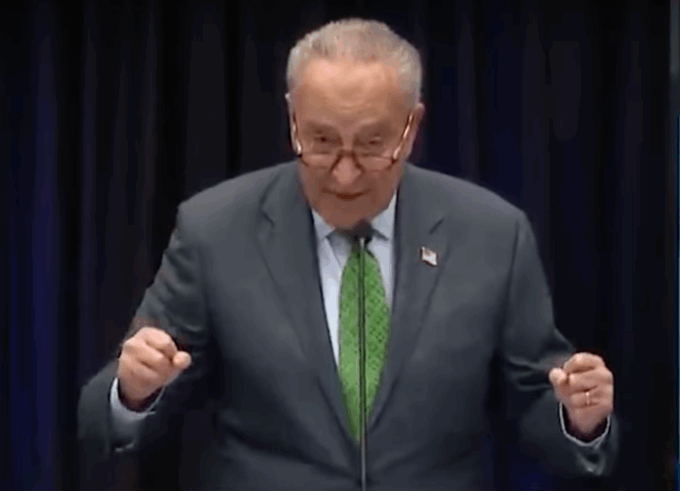
Chuck Schumer at NanoTech, Albany, New York. Still from video posted to X.
Offering feeble excuses for why their top-down selected Presidential candidate in 2024 lost badly to an individual they held in the deepest contempt and why in 2025 the party-anointed candidate lost – again badly – to a left wing, Muslim neophyte in the New York City mayoral primary, the Democrats are struggling to find the right formula for political success. A Democratic Party that can successfully compete with the Trump machine is nowhere in sight. That is largely because they think it is a formula they need for victory.
I worked in the last decades of the previous century on the staff of four Members of the US Senate (both parties), and I believe the systemic deterioration there from then to now illuminates the problem. The Senate is now a mostly empty hall with literally nothing going on, interrupted infrequently with someone reading from a script, culminating in a vote the outcome of which is pre-ordained. There are some exceptions when a handful, or less, dissent from their party’s directives, threatening an unsanctioned outcome. Not to worry; it virtually always turns out that enough miscreants fall away – having been bought off or cowed into submission – to permit the commanded outcome. It is exactly this Kabuki dance that just played itself out in the Senate’s consideration of the Trump machine’s biggest – so far – legislative initiative, the “One Big Beautiful Bill Act” [sic.].
Importantly, note that whatever transient drama occurred on that bill was only in the Republican caucus, with the last-minute folding of Lisa Murkowski (R.-AK) allowing a tie, broken by Vice President Vance casting the Constitutionally allowed deciding vote. Where was the Democratic opposition? Truthfully, there was none; none that that amounted to anything. But there were rituals. The official record shows about 30 technical motions and at least 10 amendments offered by Democrats; all failed; almost nowhere did any Republicans cross over. In addition, at the start of the proceedings, Minority Leader Charles Schumer (D-NY) exercised a Senator’s right to have the entire 900+ page bill read out loud by staff, delaying things about a day.
None of this Democratic palaver was anything that Majority Leader Thune (R. SD) had to worry about. It was the form of opposition without the substance: with their motions and amendments the Democrats were doing nothing more than “positioning” to provide fodder for political ads and fundraising. Nothing of significance in the Republican-desired version of the Senate bill was changed. Of course, the Republicans have a 53-47 majority in the Senate, people argue; that makes a voting Democratic majority in the Senate impossible. Right?
Not so fast. When the Senate was a functioning legislative body, argumentation back and forth were routine, and outcomes were anything but predetermined. A Senator going to the floor with a staff prepared speech to articulate a position would win smirks of derision from the professional staff lining the back and side walls: no command of the facts without a staff-written crutch; clueless; needs to be spoon fed. As the back-and-forth debate unfolded, the majority and minority leaders would have to make continuous headcounts on important measures to see not if votes were changing but how many and in which direction. Neither party was in lockstep with itself; the Republicans had a significant liberal faction (the “Wednesday Group”); the liberal Democrats struggled to overcome their conservative old bulls. If a caucus leader were to discipline a Member not conforming to party dogma (if there were one), there were going to be consequences in the future – for the leader. It was not how the game was played.
What about the filibuster? Didn’t that make almost anything impossible, except for a very small number of truly must-do bills? In fact, when debates were real, filibusters were almost non-existent. After the Dark Ages when Southern Democratic racists used the filibuster to oppose civil rights, the device was a non-occurrence for daily business. They were so rare that junior staff would pile into the public gallery to watch the talk-a-thon. Now, the minority party (whichever that happens to be) considers the modern filibuster, which requires no long-term speechifying, on almost any bill or amendment to be both a tradition (which it is not) and an automatic right. When the majority switches, they also switch the speeches, and each side opines what they previously derided.
Also, they pretend the 60-vote requirement encourages bipartisanship; that is a luminous lie. Instead, it is a device for the Majority and Minority Leaders to keep caucus members in line. Without the 60-vote threshold only three or four votes, or less, (not the unachievable ten or so) might be needed to comprise a working majority on any real controversy. The temptation to step out of line would be irresistible for those who harbored real dissent – or just wanted a moment in the spotlight. It would make the central control of the two caucus leaders infinitely more difficult.
The Democrats betray their allegiance to this broken system by refusing to seek genuine bipartisanship with Republicans. There are less than a handful of exceptions, such as ultra-liberal Elizabeth Warren (D-MA) who has co-authored a few important bills with knuckle-dragger Chuck Grassley (R-IO), but one or both of them routinely wash their hands after a quick joint press conference with the other and escapes to another venue where rancor against the other side makes it plain the exercise was just that, and no one need fear they have a habitual miscreant in their midst.
There have been some who did habitually object to Democratic homogeneity. They get primaried and thrown out of office, if they don’t resign first. Ask former Senators Joe Manchin (D-WV) or Krysten Sinema (D-AZ) want they think of the Democratic caucus’ unwritten club rules. The Democratic caucus would rather risk shrinking its number than tolerate recurring dissent.
To survive in the mainstream Democratic Party is to say, think and act in narrow, allowed confines; some safe divergences are allowed (even encouraged to ape independence), but being habitual about it or getting too far beyond the outer edge of allowed dogma on major issues will cut off large chucks of under- and over the table campaign contributions and earn you nervous looks in the elevators in the Capitol from fellow Democrats who might think it could be catching.
The result is the absence of meaningful policy alternatives that threaten to catch a majority in the Senate. When the One Big Beautiful Bill Act started to take shape, where was the comprehensive Democratic alternative? By that I mean not a bill that cobbled together all the favorite Democratic budget-related hobby horses, but one that effected a real appeal to the few existing moderate and loose cannon Republicans to realistically address the deficit problem that all economists (except the MAGA ones) warn the OBBBA miscreation profoundly exacerbates. That, of course, would have required some heavy intellectual and political lifting – as it did when President Clinton and the Republicans virtually eliminated deficits in 1997. By the way, the two sides did so then with as much personal and political animosity as we see today.
Instead, we see the Democrats throwing up fluff in the form of motions and amendments that are wholly meaningless, except for their political campaign and fundraising potential. We also saw the same behavior when Democrats used various devices to “get” Trump in his first term: the embarrassingly hollow Mueller inquiry, the attempt to impeach and convict Trump for a relatively minor and routinely corrupt effort to expose Hunter Biden’s corrupt enrichment of himself, the double standard exercised in prosecuting Biden and Trump’s illegal retention of classified documents and so much more.
The Democrats do not attempt to defeat Trump with the majority of votes in Congress or in elections; instead, they attempt to “get” him with various legal, legislative, and political stratagems. Their track record is awful; they have lost at every turn, even when he attempted a violent coup.
And what of the Republicans? They are beneath contempt. There is no longer a Republican Party. Instead, we have a feudal hierarchy with one lord at the top, insisting that his every whim is genius policy and any in the realm who cannot offer abject prostration are to be – quite literally – banished, past sycophancy notwithstanding. They, except for the banished, can be dismissed as useless fluff seeking to survive, even grope to the top, through abject groveling – repeated on demand.
Recent polling shows that the Democrats in general are even less popular than during the Kamala Harris/House/Senate fiasco in 2024. The current party plan appears to bank on economic stagnation plus inflation thanks to Trump’s tariff and legislative shenanigans, leading to a Democratic comeback in the midterms in the House and/or Senate. But what if the economy turns out not so bad as some middle of the road economists opine? If Trump breaks the mold and survives the midterms in OK shape, what is to prevent him from using the loophole in the 22nd Amendment to allow himself a third term by running as Vice President with a willing non-entity as the titular Presidential candidate? Straight lining the current Democratic mind-set guarantees him a good chance.
At this point, there is nothing to stand in Trump’s way.