It’s possible that I shall make an ass of myself. But in that case one can always get out of it with a little dialectic. I have, of course, so worded my proposition as to be right either way (K.Marx, Letter to F.Engels on the Indian Mutiny)
Monday, October 27, 2025
Amazon targets as many as 30,000 corporate job cuts, sources tells Reuters
Amazon is planning to cut as many as 30,000 corporate jobs beginning on Tuesday, as the company works to pare expenses and compensate for overhiring during the peak demand of the COVID-19 pandemic, according to three people familiar with the matter.
The figure represents a small percentage of Amazon’s 1.55 million total employees, but nearly 10 per cent of the company’s roughly 350,000 corporate employees. This would represent the largest job cut at Amazon since around 27,000 jobs were eliminated starting in late 2022.
An Amazon spokesperson declined to comment.
Amazon has been trimming smaller numbers of jobs over the past two years across multiple divisions, including devices, communications, podcasting and others. The cuts beginning this week may impact a variety of divisions within Amazon, including human resources, known as People Experience and Technology, devices and services and operations, among others, the people said.
Managers of impacted teams were asked to undergo training on Monday for how to communicate with staff following email notifications that will start going out on Tuesday morning, the people said.
Amazon CEO Andy Jassy is undertaking an initiative to reduce what he has described as an excess of bureaucracy at the company, including by reducing the number of managers. He installed an anonymous complaint line for identifying inefficiencies that has elicited some 1,500 responses and over 450 process changes, he said earlier this year.
Andy Jassy, Amazon president and CEO, attends the premiere of "The Lord of the Rings: The Rings of Power" at The Culver Studios on Monday, Aug. 15, 2022, in Culver City, Calif. (Photo by Jordan Strauss/Invision/AP, File)
Jassy said in June that the increased use of artificial intelligence tools would likely lead to further job cuts, particularly through automating repetitive and routine tasks.
“This latest move signals that Amazon is likely realizing enough AI-driven productivity gains within corporate teams to support a substantial reduction in force,” said Sky Canaves, an eMarketer analyst. “Amazon has also been under pressure in the short-term to offset the long-term investments in building out its AI infrastructure.”
The full scope of this round of job cuts was not immediately clear. The people familiar with the matter said the number could change over time, as Amazon’s financial priorities shift. Fortune earlier reported that the human resources division could be targeted with a cut of roughly 15 per cent.
Layoffs.fyi, a website tracking tech job cuts, estimated that about 98,000 jobs have been lost so far this year among 216 companies. For all of 2024, the figure was 153,000.
Amazon’s largest profit center, cloud computing unit Amazon Web Services, reported sales in the second quarter of US$30.9 billion, a 17.5 per cent increase that was well below the sales gains for Microsoft’s Azure and Google Cloud, which gained 39 per cent and 32 per cent, respectively. Google Cloud is owned by Alphabet.
Estimates indicate that AWS will have boosted third-quarter sales by about 18 per cent to $32 billion, a slight slowdown from last year’s 19 per cent increase. AWS is still reeling from a roughly 15-hour internet outage last week that felled many of the most popular online services, like Snapchat and Venmo.
Indications are that Amazon is expecting another big holiday selling season. The company said it plans to offer 250,000 seasonal jobs to help staff warehouses, among other needs, the same as in the prior two years.
Amazon shares were up 1.3 per cent at $227.11 near the close of trading on Monday. The company plans to report third-quarter earnings on Thursday.
Greg Bensinger, Reuters
Canada’s exports drop as tariffs weigh heavy on economy: Statistics Canada
Statistics Canada released employment figures for September. Workers inspect sheets of stainless steel after being pressed from coils, at Magna Stainless and Aluminum in Montreal on Thursday, Sept. 18, 2025. THE CANADIAN PRESS/Christopher Katsarov
U.S. tariffs on key Canadian goods and weakening global demand triggered a sharp pullback in exports in the second quarter of 2025, according to new data released by Statistics Canada.
Exports dropped 7.5 per cent in Q2 after the U.S. implemented tariffs on key Canadian goods like steel, aluminum, automobiles and other goods not compliant with the Canada-United States-Mexico Agreement.
“This was the largest quarterly decline since 2009, excluding the COVID-19 pandemic period,” according to the report released Monday.
The slump extended to manufacturing, wholesaling and employment, all of which posted declines or stalled growth.
“Prices for various consumer goods have been directly or indirectly affected by U.S. tariffs and Canada’s tariff countermeasures, including new cars, clothing and footwear, certain household appliances, a range of grocery items, and travel services,” according to the report.
Manufacturing and employment decline
The report states businesses which engage in cross-border trade with the U.S. are looking for mitigation strategies to deal with the tariff caused disruptions.
Fifty four per cent of manufacturers and 44 per cent of wholesalers say they have been impacted by tariffs in May.
The report also states there was no net employment growth from February to August this year.
Employment growth in the public sector has slowed this year. The pace of growth in the private sector slowed before trade tensions began and has been below two per cent for the last 17 months.
A third of businesses reported passing cost increases caused by tariffs to the customer in the last six months while two fifth of businesses say they are likely to follow suit within the next year,
A cyclist rides past the Bank of Canada in Ottawa, Wednesday, Sept. 17, 2025.
THE CANADIAN PRESS/Adrian Wyld
OTTAWA — Most economists expect the Bank of Canada will look past strong jobs data and signs of stubbornness on the inflation front to deliver a second consecutive interest rate cut this week.
BMO chief economist Doug Porter is among those expecting a second straight cut on Wednesday, but he admits recent economic data hasn’t perfectly lined up with that call.
“The two major economic reports we’ve had since the Bank of Canada last decided on interest rates were a strong jobs report and a bit higher than expected inflation report,” he said in an interview.
“Taken in isolation, you would think there’s no reason for the bank to be cutting interest rates.”
The Bank of Canada lowered its benchmark interest rate by a quarter point to 2.5 per cent in late September, snapping a streak of three consecutive rate holds since March.
As of Friday, LSEG Data & Analytics put financial market odds at more than 80 per cent in favour of a second quarter-point cut at the central bank’s decision on Wednesday.
Earlier this month, Statistics Canada reported a surprise gain of roughly 60,000 jobs in September. Inflation data for that month also accelerated to 2.4 per cent, up half a percentage point from August, with the Bank of Canada’s preferred measures of core inflation holding above three per cent.
The central bank uses various definitions of “core” inflation to strip out volatile influences on the consumer price index and get a better sense of where inflation is headed.
Porter said the firm September inflation report “did make it a little tougher to cut rates.”
He said the Bank of Canada could still surprise with a hold this week, but he’s putting more stock in the broader economic context to inform BMO’s rate call for a cut.
Despite the surprise employment gain in September, the labour market has barely posted any job growth since January as U.S. trade uncertainty restrains businesses’ hiring appetites.
Porter argued that Canada’s jobs market needs relief from lower rates with the unemployment rate still elevated at 7.1 per cent.
The Bank of Canada has also cast some doubt on the reliability of its own core inflation metrics, instead telling Canadians that monetary policymakers see inflation around 2.5 per cent right now. Porter said some other core inflation measures from September are in line with that reading.
“We think they should proceed carefully here, but ultimately they should proceed with lower rates,” he said.
Economists at RBC also believe the Bank of Canada has a tough call to make this week.
Economists Nathan Janzen and Claire Fan said in a note to clients that signs of weakness in the labour market and lower inflation expectations in the central bank’s business outlook survey published last week should give monetary policymakers confidence that inflation will cool further going forward.
“This essentially means more room and flexibility for the central bank to have looser monetary policy,” they wrote.
But to see further cuts past this, the economy would need to deteriorate more sharply than RBC is currently forecasting. Fan and Janzen argue fiscal policy from the federal government is best suited to address ongoing sectoral pain from U.S. tariffs.
The Bank of Canada will have to make its rate decision before getting a sense of the federal government’s spending plans coming in the fall budget on Nov. 4.
BMO sees the Bank of Canada continuing to cut interest rates to a low of two per cent before finishing the current easing cycle -- among the lowest terminal rates currently expected by major forecasters.
Outside of the hard numbers, Porter said recent announcements that automakers Stellantis and GM are either pausing some Canadian production or moving it south of the border show what an “exceptionally challenging” time it is for the economy.
While he also expects stimulative government spending to come from the federal budget next month, he said Canada is grappling with “once in a lifetime uncertainty on the trade front,” warranting a strong response from both monetary and fiscal policy.
The Bank of Canada doesn’t know yet where government spending plans will end up — and how much the budget could fuel inflation — but Porter said it’s nonetheless appropriate for both monetary and fiscal policy to be rowing in the same direction.
“You don’t want to see those two policies working against each other usually. And I think that’s what we have here,” he said.
“A bit of support from the the fiscal oar and a little bit of support from lower interest rates, the monetary oar.”
The Bank of Canada has also signalled it will return to publishing a single, central forecast for the economy. In an updated monetary policy report accompanying the rate decision on Wednesday. The central bank had published illustrative scenarios for the past two quarters based on how U.S. tariff policy might evolve.
This report by The Canadian Press was first published Oct. 27, 2025. Craig Lord, The Canadian Press
WTF?!
Cyberattack: Contractors working for Nova Scotia Power haven’t been paid in months
Nova Scotia Power's headquarters is seen in Halifax
CANADIAN PRESS/Andrew Vaughan
Halifax — Nova Scotia’s largest electric utility says it has fallen months behind in paying contractors and suppliers because of a cyberattack in March that saw hackers trying to steal personal information from more than 200,000 ratepayers.
Nova Scotia Power spokeswoman Jacqueline Foster apologized on behalf of the utility on Monday, saying invoices are being paid, but progress has been slow.
“We are extremely sorry for the delays in payments,” Foster said in an emailed statement. “Invoices are being paid but we know it (is) causing real issues for our partners.”
Foster said dozens of additional staff have been brought in to speed up the payment process, which has required extensive manual work to get the job done.
“Our IT and finance teams have been working around the clock to restore our systems safely and securely following the impacts of the cyber incident,” Foster’s statement said.
All of the invoices should be paid before the end of the year, but Foster did not say how much money is owed.
CBC News has reported that some contractors are owed hundreds of thousands of dollars.
Tim Houtsma, CEO of Marid Industries, said his steel fabrication company is owed between $60,000 and $70,000.
“It stretches your finances where they really shouldn’t be stretched,” he said in an interview Monday.
Houtsma said the payment delays have highlighted the fact that the Nova Scotia government has yet to enact “prompt payment” legislation that would apply to construction contracts.
“(The government) started a consultation period maybe two or three years ago, and the file has gone completely silent,” said Houtsma, whose company in Windsor Junction, N.S., custom manufactures about 6,000 tons of structural steel every year.
Meanwhile, Nova Scotia Power has said the ransomware attack resulted in some personal information being posted on the dark web, a part of the internet that can be accessed through special software.
In May, the utility said about half of its customers -- about 277,000 ratepayers -- may have had personal information stolen. Four months later, a report from the Nova Scotia Energy Board said all of the utility’s customers may be affected in some way.
The independent board said its investigation has been complex, “given the severe nature of the cyberattack.”
The stolen data includes names, birth dates, email addresses, home addresses, customer account information, driver’s licence numbers and, in some cases, bank account numbers and social insurance numbers.
The board’s report also said the utility has no way of telling individual customers what specific information has been stolen due to “the nature of the breach and the complexity of the systems involved.”
On another front, the board confirmed the cyberattack compromised the company’s ability to retrieve electricity usage readings from customers’ smart meters. In June, the utility started issuing estimated bills based on an average of previous usage. This prompted some customers to complain they had received inflated bills.
The report, however, said the incident had not caused any disruption to electricity generation, transmission or distribution.
On May 14, the utility -- a subsidiary of Halifax-based Emera Inc. -- said the consumer reporting agency TransUnion would provide affected customers with two years of credit monitoring at no cost. That offer was extended to five years for all customers on June 25. By Michael MacDonald This report by The Canadian Press was first published Oct. 27, 2025.
Doug Ford defends anti-tariff ad that infuriated Trump, says trade talks have done nothing to protect auto workers
Ont. Premier Ford says the anti-tariff ad was a ‘mission accomplished’ and says he will ‘never apologize for fighting for the hardworking people.’
Ontario Premier Doug Ford is defending a multi-million-dollar anti-tariff ad featuring Ronald Reagan that was blasted at U.S. audiences and which incurred the wrath of President Donald Trump, who cited it when he threatened to impose higher tariffs on Canada over the weekend.
“The message was clear: don’t forget our auto sector,” Ford told reporters Monday when asked about the ad.
The ad, which featured an old clip of Ronald Reagan talking about the negative effects of tariffs, ran on major U.S. networks last week and prompted Trump to break off trade talks with Canada.
But during an exchange with Liberal MPP John Fraser in the legislature earlier Monday, Ford called the ad “the most successful ad in the history of North America.”
He said he’s heard from people around the world about the ad and that the message received between $300 million and $400 million in earned media — a measure of free media exposure through news coverage and social media impressions.
His office later clarified that while they originally expected to garner one billion impressions through a $75 million campaign, they have reached an estimated 11.4 billion impressions over the past seven days through earned media and social impressions.
Ontario Premier Doug Ford speaks in the Ontario legislature Monday October 27, 2025.
Fraser shot back at Ford that “Ontarians are paying with their jobs for what you just did,” a reference to Trump’s threat on Saturday to add an additional 10 per cent tariff on Canadian goods because the ads were only paused on Monday so that they could run during the World Series.
Prime Minister Mark Carney said Monday that trade talks had been proceeding well until they were halted because of the tariffs.
However Ford said he’s been waiting months for a trade deal that would protect Ontario’s economy — particularly in the auto sector, where some companies have recently announced they are slimming down on their production in Ontario — and none has yet materialized.
“We’ve been waiting for this deal month after month after month after month,” Ford said. “But this deal has nothing to do with protecting auto workers. We’re here to protect the auto workers, and I don’t think a fair deal is the Americans charge us a 50 per cent tariff on steel, we charge them a 25 per cent tariff on steel. My job is to protect the people of Ontario. That’s exactly what I’m going to do.”
Ford has been saying for months that he thinks Canada should be levying dollar-for-dollar tariffs against the U.S. and that it should not “roll over” for Trump.
Prime Minister Mark Carney, Ontario Premier Doug Ford and U.S. President Donald Trump are shown in this combination photo. (THE CANADIAN PRESS/Sammy Kogan / Sean Kilpatrick/AP Photo/Evan Vucci)
Ford told reporters that while he doesn’t have the numbers in hand just yet, the ad campaign will not cost as much as $75 million, as he previously said it would. It was scheduled to run through February, but only ran for around a week.
Speaking with ABC News during a slew of U.S. media appearances Monday, Ford said he has no regrets about running the ad.
“I don’t regret it at all. My intention was to make sure the American people were informed and have a conversation and it really started a conversation,” Ford said.
Trump claimed last week that the ad was “fake” and that Ronald Reagan loved tariffs. However, a comparison of the audio with the full radio address shows that while the clip was edited, the meaning and sentiment of the message in both were the same.
Ford said Trump is simply upset because the ad was effective.
“It’s working,” Ford said, adding that the campaign has generated a conversation, especially among Republicans. He said he doesn’t believe Trump will follow through in his threat to raise tariffs on Canada because of the ad.
He also said Carney and his chief of staff saw the ad before it ran, and the incident has not strained their relationship.
Ontario Finance Minister Peter Bethlenfalvy also weighed in on the ad Monday, saying it helped the province achieve its objective.
“I think it was money extremely well spent,” Bethlenfalvy told reporters at an unrelated news conference.
“It achieved its objective of increasing the narrative and the awareness that a trade war hurts both countries, that it’s in the interests of both countries to get a deal, to get a good deal that’s sustainable, that supports workers. We’re always going to support workers and our businesses here in Ontario, we’re stronger together. And I think the ads achieve that objective.” Joshua Freeman
Journalist, CP24.com
‘Canada burned the bridges’: U.S. ambassador doubts tariff deal feasible before new year
The U.S. Ambassador to Canada Pete Hoekstra speaks during an event at the Halifax Chamber of Commerce in Halifax on Thursday, Sept. 18, 2025. THE CANADIAN PRESS/Darren Calabrese (Darren Calabrese/The Canadian Press)
The U.S. ambassador to Canada doesn’t foresee a new security and economic deal between Canada and the United States — which could see the reduction or full removal of tariffs amid an ongoing trade dispute — before the new year.
“We have stopped negotiations with Canada,” Pete Hoekstra said in a keynote address to the Coalition of Concerned Manufacturers and Business Canada on Monday. “I don’t see any way that there will be an agreement before American Thanksgiving.”
“I’m not sure what it’s going to take to get people back to the table in a constructive and positive mode,” he added.
Hoekstra’s comments come just days after U.S. President Donald Trump said he is terminating trade talks with Canada and increasing levies on Canadian goods by 10 per cent in response to an anti-tariff ad by the government of Ontario which featured the voice of former Republican U.S. president Ronald Reagan.
Ontario has since pulled the ads, effective Monday.
Government sources had told CTV News that Canadian officials were hopeful there could be movement on a steel and aluminum deal by this week’s APEC Summit in South Korea.
And, speaking to reporters on the sidelines of the ASEAN summit in Malaysia on Monday, Prime Minister Mark Carney said talks “had been making progress” on affected sectors like steel and aluminum until the Ontario anti-tariff ad created waves.
Hoekstra said while he is not part of the negotiating team, he is in frequent contact with U.S. officials who are. He said if not by this week, he’d heard indications a deal could be reached by American Thanksgiving at the end of November.
“They were confident it would happen before Thanksgiving, that we would have a deal on steel, aluminum, energy, which would include both oil and uranium,” he said. “So, that’s where we were on Thursday.”
“The answer was, ‘oh, yeah, absolutely, we’ve ironed out most of the major issues, most of the major hurdles,’” he also said.
Now, with very little time between American Thanksgiving and the Christmas holidays, Hoekstra said, it’s unlikely a trade deal with Canada will take any priority until the new year. ‘Canada burned the bridges’: Hoekstra
Asked by event attendees whether he sees any way to get negotiations back on track, such as an apology for the ad, Hoekstra said: “No.”
Speaking more broadly about the state of negotiations, Hoekstra laid the blame at Canada’s feet for the soured relationship.
Hoekstra has previous expressed his distaste for what he’s called “anti-American” sentiment in Canada, and on Monday pointed to some provinces removing U.S. liquor from store shelves and Canadians being discouraged from travelling south of the border as examples.
He also said the ad amounts to foreign interference, with the U.S. Supreme Court set to start hearing arguments on the legality of Trump’s tariffs on Nov. 5, as well as some gubernatorial and state legislative elections happening next week.
“Canada burnt the bridges with America,” he said. “Donald Trump did not slam the door.”
“Donald Trump could do the only thing that a leader of a sovereign nation could do when a neighbour, another sovereign nation, decided to interject itself into American politics,” he added. “Canada slammed that door shut all by itself.” ‘Mission accomplished’: Ford
Speaking to reporters at Queen’s Park on Monday, Ontario Premier Doug Ford said both Carney and his chief of staff, Marc-André Blanchard, saw the ad prior to it airing.
Ford also said the ad accomplished what he’d hoped, surpassing a billion impressions and reaching American voters.
“Mission accomplished, it was done,” he said. “They’re talking about it in the U.S., and they weren’t talking about it before I put the ad on.”
“We achieved our goal, and our goal is to make sure that we get a fair deal, not a one-sided Donald Trump deal, but a fair deal for the people of Ontario and Canada,” he also said.
Ford said the intention was never to “poke the president in the eye,” but rather to “inform the American people.”
Asked whether he believes he owes an apology for derailing negotiations, Ford said his job is to fight for workers in at-risk sectors in Ontario, and he believes that despite word of an imminent deal, some sectors — namely autos — have “slipped to the side.”
“If it wasn’t the ad, he’d look out the door or the window, President Trump say, ‘Oh, the leaves have turned colour, let’s stop,’” Ford said. “Believe me, President Trump is not putting a deal together to benefit Canada. It’s our job. It’s the prime minister’s job to get a deal that benefits all of Canada.”
“It’s not about the ad, it’s about finding every excuse in the world not to get a deal,” he also said. With files from CTV News’ Stephanie Ha Spencer Van Dyk Writer & Producer, Ottawa News Bureau, CTV News
Google and NextEra to Restart Iowa’s Duane Arnold Nuclear Plant to Power AI Era
NextEra Energy, Inc. (NYSE: NEE) and Google have announced a landmark agreement to restart the Duane Arnold Energy Center in Iowa—the state’s only nuclear facility—to help meet soaring U.S. electricity demand driven by artificial intelligence (AI) and data center growth. The 615-MW plant, located near Cedar Rapids, is scheduled to return to full operation by the first quarter of 2029, pending regulatory approval.
Under the 25-year agreement, Google will purchase a significant portion of the plant’s output as a 24/7 carbon-free energy source to power its cloud and AI infrastructure. The remaining capacity will be bought by Central Iowa Power Cooperative (CIPCO) on equivalent terms. NextEra Energy will assume full ownership of the facility after acquiring CIPCO and Corn Belt Power Cooperative’s combined 30% stake.
The Duane Arnold restart—shut down in 2020 after nearly five decades of service—marks a major return of nuclear generation to Iowa and underscores the growing convergence between Big Tech and clean baseload power. NextEra said the project will create around 400 permanent jobs and generate more than $9 billion in total economic benefits for Iowa, including $3 million annually in new tax revenue.
“This partnership with Google not only brings nuclear energy back to Iowa—it accelerates the development of next-generation nuclear technology,” said NextEra CEO John Ketchum, highlighting the collaboration’s role in strengthening U.S. grid reliability and advancing national energy independence.
Google, which has invested more than $7 billion in Iowa since 2007, framed the deal as essential to its AI-driven growth strategy. “Reopening Duane Arnold delivers reliable, clean power and hundreds of new jobs in the Hawkeye State,” said Ruth Porat, president and CFO of Alphabet and Google, calling it a model for similar clean energy investments across the country.
The companies also announced a strategic agreement to explore new nuclear generation projects nationwide, positioning nuclear power as a cornerstone of the AI and data economy. This comes amid growing concern that U.S. electricity demand—expected to rise sharply through 2035 due to AI, electrification, and manufacturing—will outpace renewable and grid expansion without firm, low-carbon generation sources.
Iowa officials hailed the move as a major milestone in the state’s energy evolution. Governor Kim Reynolds praised the project as “a fusion of nuclear and AI innovation that will drive economic growth, strengthen communities, and keep America competitive.”
Economic studies suggest that the restart will add over 1,600 jobs during construction, with $340 million in annual output statewide once operational. In Linn County, where the plant is located, the project is expected to sustain 400 high-paying, full-time positions and generate $127 million in long-term local earnings.
The Duane Arnold revival follows comprehensive engineering evaluations and coordination with the Nuclear Regulatory Commission (NRC). NextEra Energy emphasized that the restart will not raise costs for Iowa ratepayers, as Google’s long-term power purchase agreement (PPA) covers all production expenses.
The announcement further deepens NextEra and Google’s long-standing energy partnership, which already spans nearly 3 GW of clean energy projects across the U.S., including wind, solar, and battery assets.
The deal also signals a broader renaissance for U.S. nuclear power, as utilities and tech giants alike revisit the technology’s potential to provide round-the-clock carbon-free power amid tightening climate goals and unprecedented data center growth.
By Charles Kennedy for Oilprice.com
Joint venture selected to deliver Cascade SMR facility
Energy Northwest has selected a joint venture of Aecon, Kiewit Nuclear Solutions Co and Black & Veatch to design and build the first phase of the Cascade Advanced Energy Facility near Richland, Washington.
??Representatives from Energy Northwest, X-energy, Cascade Nuclear Partners, Amazon and AtkinsRéalis have signed a charter affirming their joint commitment to delivering the Cascade Advanced Energy Facility (Image: Energy Northwest))
The public power agency said it is in negotiations with the Cascade Nuclear Partners joint venture to collaboratively complete the planning, design, and construction of the first four out of 12 Xe-100 advanced small modular reactors (SMRs) under a progressive design-build (PDB) model. This development phase will help define the project's scope, schedule, and cost parameters before advancing to full execution, it said.
It was just a year ago - in October 2024 - that Energy Northwest announced a multi-year agreement with Amazon focused on comprehensive environmental, safety, permitting, licensing and risk analyses for the SMR project, with Amazon to fund the initial feasibility phase for a plant to be sited near Energy Northwest's Columbia Generating Station nuclear energy facility in Richland after which it expects to submit a construction permit application to the US Nuclear Regulatory Commission. Construction is anticipated to begin by the end of the decade, with operations targeted for the 2030s.
Earlier this month, the name of the new facility was announced and Amazon released a series of images of how its planned X-energy small modular reactor plant is expected to look. It will feature X-energy's Xe-100, a Generation IV advanced high temperature gas-cooled reactor design using tri-structural isotropic - or TRISO - particle fuel.
Energy Northwest CEO Bob Schuetz said the selection of Cascade Nuclear Partners is a "strategic milestone" which reflects the continued momentum for the project. "Their specialised knowledge in nuclear construction, collaborative approach, and strong alignment with Energy Northwest's values gives us confidence in their ability to help deliver this critical project successfully," he said.
Santee Cooper selects Brookfield to take on VC Summer
Eight years after construction of two AP1000 reactors at the VC Summer site in South Carolina was abandoned, Santee Cooper has announced it is in negotiations with Brookfield Asset Management about the potential completion of the units.
The VC Summer construction project was abandoned in 2017 (Image: Santee Cooper)
"Final, exclusive negotiations" concerning the two partially built units are being guided by a Letter of Intent between the two companies, with a six-week initial project feasibility period during which the parties will jointly select a project manager and evaluate construction providers that would be used in resuming construction of the two nuclear units. The six weeks would also allow for advanced discussions with entities interested in buying nuclear power generated by the units and facilitate additional due diligence, leading to execution of a Memorandum of Understanding, Santee Cooper said.
Construction of two AP1000 units began at VC Summer in 2013. However, the owners of the Summer project - Scana subsidiary South Carolina Electric & Gas Company (SCE&G) and Santee Cooper - decided in August 2017 to abandon construction of the units following reactor vendor Westinghouse's filing for bankruptcy in March that year. Majority owner SCE&G (now Dominion Energy South Carolina) transferred its interest in the assets to Santee Cooper in 2018.
Earlier this year, Santee Cooper launched a competitive bidding process for the potential sale of the VC Summer assets to a third party who would complete the unfinished nuclear units. Initial expressions of interest were received from over 70 potential bidders, with 15 formal proposals submitted.
"Our goals include completing these reactors with private money and no ratepayer or taxpayer expense, delivering financial relief to our customers and gaining significant additional power capacity for South Carolina," Santee Cooper Board Chairman Peter McCoy said. "Brookfield’s proposal would do just that, and the company has the financial capability to stand behind its proposal."
"As we move closer to a final deal, our goal remains the same: to enable completion of these two units and thus provide 2,200 MW of carbon-free, reliable nuclear power that delivers energy security for South Carolina and specific benefits to Santee Cooper customers who are paying our initial investment," Santee Cooper President and CEO Jimmy Staton said, thanking Governor of South Carolina Henry McMaster and the South Carolina General Assembly members, who he said had been instrumental in encouraging Santee Cooper to conduct the bidding process.
The two-unit Vogtle plant in Georgia was at a similar stage of construction to Summer at the time the South Carolina project was abandoned. Vogtle's owners - Southern Company's Georgia Power, Oglethorpe Power, MEAG Power and Dalton Utilities - opted to continue with the project which saw Vogtle 3 and 4 become the first new nuclear units to be constructed in the USA in more than 30 years, with unit 3 entering commercial operation in 2023 and unit 4 in 2024.
A strategic decision to maintain the equipment after the project was abandoned now meant for a less costly path to completion, Staton said: "The state of the units, and the fact that they use the same Westinghouse AP1000 technology that is now operating in Georgia and overseas, make these assets very attractive to the nuclear power industry," he said. Brookfield is 51%-owner of Westinghouse, a fact which "added to Brookfield's proposal," he said.
According to Santee Cooper, completion of the two VC Summer units could generate thousands of temporary construction jobs and hundreds of highly skilled, permanent operational jobs, as well as strengthening and diversifying South Carolina’s energy portfolio, enhancing grid reliability, and helping attract new industries, bringing more jobs and other economic benefits.
The US Nuclear Regulatory Commission approved SCE&G's request to terminate the combined construction and operating licences for the units in 2019.
Singapore 'seriously' considering nuclear energy
Singapore is "seriously studying the potential deployment of nuclear energy, especially newer technologies such as small modular reactors," Minister-in-charge of Energy and Science and Technology Tan See Leng said at the opening of Singapore International Energy Week.
(Image: World Nuclear Association)
"Rising geopolitical uncertainties have led to countries reassessing their climate ambitions, placing renewed emphasis on economic resilience and self-sufficiency, at the expense of decarbonisation efforts," Tan said. "Yet, nature will wait for no man. Climate change continues to accelerate, and its impact will profoundly affect how we live, work, and thrive. For Singapore - a small low-lying island and an alternative-energy disadvantaged city-state - these challenges are far more acute. To secure a low-carbon energy future for generations to come, we must plan smarter and work harder."
He said Singapore "must pursue a diversified portfolio of sustainable energy pathways to build the future we envision. It is unlikely that any single solution will suffice, just as there is no one-size-fits-all solution to decarbonisation."
Tan said nuclear energy has the potential to be "a safe, reliable, and cost-competitive option for Singapore". He noted that Prime Minister Lawrence Wong announced earlier this year that the government would reorganise itself to place greater emphasis on capability building.
"We have since formed dedicated nuclear energy teams within key agencies to lead these efforts - namely, the Nuclear Energy Office within the Energy Market Authority (EMA) and the Nuclear Safety Division within the National Environment Agency (NEA). These teams will focus solely on nuclear energy issues, and I hear they are hiring actively." Tan said Singapore is "also actively collaborating with international partners".
"We understand that the public has many queries about our plans," he said. "We will engage the public regularly as we progress on this journey together. For a start, we are releasing a Background Paper on Building Singapore's Capabilities to Assess Nuclear Energy today to provide an overview of our interests, and the government's work on capability building thus far."
The 16-page background paper outlines Singapore's approach to studying the potential for domestic nuclear energy deployment. It explains the factors to consider in this endeavour, including the safety, reliability, affordability, and environmental sustainability of nuclear technology in Singapore's context. The paper has been produced by the Ministry of Trade and Industry, the Ministry of Sustainability and the Environment, EMA and NEA.
The paper stresses that Singapore has not made any decision on the deployment of nuclear energy. "We will continue our efforts to build up domestic capabilities, supported by international partners. We will engage the public regularly on the latest developments in nuclear energy, to build an informed understanding of the benefits and risks surrounding nuclear energy," it says.
In 2012, the Singapore government conducted a pre-feasibility study on nuclear energy. While the study concluded that nuclear power plants of the time were not suited for a small and densely populated city-state, it recommended that Singapore continue to monitor the progress of new nuclear energy technologies.
In March 2022, EMA released a report that concluded nuclear energy could supply around 10% of Singapore's energy needs, helping its power sector achieve net-zero carbon emissions by 2050.
In October 2024, EMA signed a memorandum of understanding with the UAE's Emirates Nuclear Energy Company to develop capabilities in nuclear energy. Through the MoU, both parties will work together to strengthen capabilities in nuclear science and technology, and identify activities of mutual interest in areas such as the assessment of emerging nuclear technologies and human resource development. The parties will facilitate information sharing through workshops, technical exchanges, and/or staff attachments.
Delivering his Budget 2025 speech in February this year, Wong - who is also Finance Minister - said the government will study the potential deployment of nuclear power in Singapore and take further steps to systematically build up capabilities in this area. "We will need new capabilities to evaluate options, and to consider if there is a solution that Singapore can deploy in a safe and cost-effective way," he said.
In September, the Energy Market Authority appointed UK-headquartered engineering firm Mott MacDonald to conduct a study on the safety and technical feasibility of advanced nuclear energy technologies. The study will evaluate the safety performance and technical feasibility of advanced nuclear energy technologies, such as small modular reactors, based on their safety features, technology maturity, and commercial readiness.
Cooling towers brought down at German plant
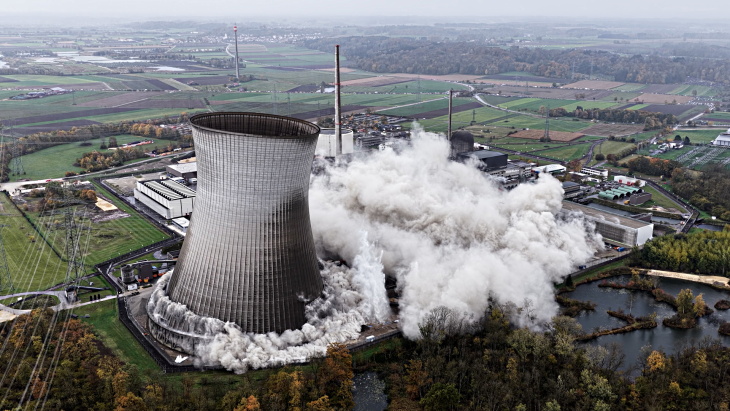
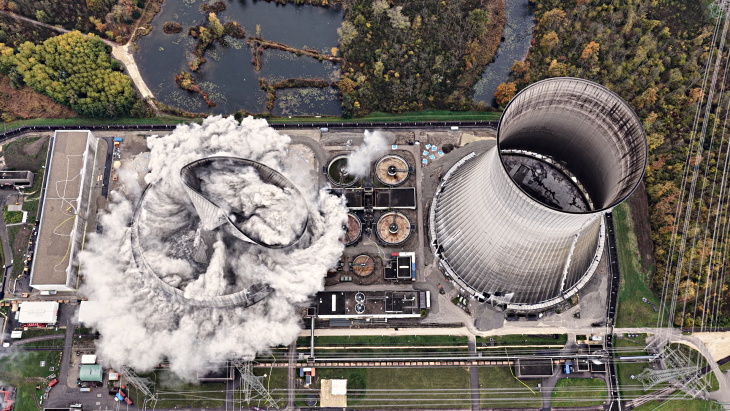
The two 160-metre-high cooling towers of the shut down Gundremmingen nuclear power plant in Germany have been demolished as part of the plant's decommissioning, utility RWE announced.
(Image: RWE)
On 25 October, the towers were inspected by specialists from a renowned German blasting company and successfully demolished one after the other. In the weeks prior to the demolition, so-called drop and vertical slots had already been inserted into the cooling tower shell. During operation, the cooling towers ensured that the Danube River was not exposed to excessive waste heat.
About 600 kilograms of explosives in a total of 1,800 boreholes were required to demolish the two cooling towers. The approximately 56,000 tonnes of material will be processed into recycled gravel, a sought-after construction material.
(Image: RWE)
Around 30,000 spectators watched the demolition from a safe distance. At 1.24 pm, the demolition was officially declared complete, allowing authorities to lift the previously established exclusion zone. Surrounding buildings of the dismantling facility, as well as the interim storage facility and neighbouring high-voltage lines, were not affected.
"We have been intensively preparing for the demolition of the cooling towers for many months in close coordination with the Günzburg district and the municipality of Gundremmingen, thus reaching an important milestone for the site," said Gundremmingen Plant Manager Heiko Ringel. "My special thanks go to the representatives of the district and municipality for their trusting and constructive cooperation over the past few weeks. The successful outcome underscores that the dismantling is proceeding safely and responsibly."
The 1284 MWe Gundremmingen B boiling water reactor (BWR) in Bavaria, southern Germany was disconnected from the grid on 31 December 2017 after 33 years of operation. Gundremmingen C - a 1288 MWe BWR - permanently shut down on 31 December 2021. The licence for dismantling unit B according to the Atomic Energy Act was granted by the Bavarian State Ministry of the Environment and Consumer Protection in March 2019; the licence for dismantling unit C in May 2021.
In December 2021, RWE awarded a contract to Westinghouse to dismantle the two reactors at the Gundremmingen plant. Under the contract, Westinghouse will dismantle and pack the reactor pressure vessels, including the associated internals, the fuel element storage racks and adjacent concrete shielding structures in units B and C of the Gundremmingen plant. The work is expected to be completed in 2030.
"We have been fulfilling our legal mandate to rapidly dismantle the Gundremmingen plant since January 2018 in Block B and since January 2022 in Block C," said Steffen Kanitz, member of the Executive Board of RWE Power AG responsible for the Nuclear Energy division. "The successful demolition of the two cooling towers is now also visible to the outside world that we are consistently implementing the politically agreed nuclear phase-out."
After years of restructuring and cost-cutting efforts, UK-listed oilfield services group Petrofac on Monday filed for administration, following the termination of its biggest contract.
Petrofac’s directors have applied to the High Court of England and Wales to appoint administrators to Petrofac, said the company, which provides infrastructure and engineering services to the oil and gas, renewables, and power supply industries.
When appointed, administrators will work alongside Executive Management to preserve value, operational capability and ongoing delivery across the Group’s operating and trading entities, Petrofac said today.
The collapse was triggered by last week’s announcement of Dutch electricity grid operator TenneT that it had exercised its right to partial termination of a major contract related to the Petrofac scope.
TenneT signed in March 2023 a framework cooperation agreement with a consortium consisting of Hitachi Energy and Petrofac for six 2 gigawatt (GW) projects out of the total of fourteen 2-GW grid connection systems that TenneT will realize via the 2GW Program.
However, Petrofac, which has been undergoing a financial restructuring since 2024, has not been able to meet its contractual obligations, leading to TenneT terminating the Petrofac scope.
“At the same time, a solution has been put in place involving a consortium of Hitachi Energy and a replacement contract,” TenneT said last week.
Today, Petrofac noted that “Having carefully assessed its options, and the impact of TenneT’s decision to terminate Petrofac’s scope of work on the 2GW programme in the Netherlands, the Directors of Petrofac Limited (the Group’s ultimate holding company) have applied to the High Court of England and Wales to appoint administrators to Petrofac Limited.”
More than 2,000 job are at risk in Scotland because of Petrofac’s collapse, Sky News reported on Monday.
Yet, sources close to Petrofac told Sky News that they hope Petrofac’s North Sea operations could soon find a buyer.
Petrofac’s collapse and potential job losses come as the UK government is being urged to avoid accelerating the decline of North Sea oil and gas production through policies, especially the windfall tax on operators.
China has increased its underground gas storage capacity by the most of any country since 2022, the International Gas Union (IGU) said in a new report on Monday.
As of 2025, there are 699 underground natural gas storage facilities in operation worldwide, with a total working gas volume of 424 billion cubic metres (bcm), the IGU report found. That’s an increase of 10 bcm compared to 2022.
“Of note is the fact that China added 6 bcm to its storage capacity, now ranking 6th globally,” the IGU said.
The top five countries with the largest available gas storage capacity are the United States, Russia, Ukraine, Canada, and Germany.
China has now moved up to sixth, thanks to the jump in its available gas storage capacity in recent years.
Unlike the surge in China, underground gas storage (UGS) in developed markets “appears to be stagnating or experiencing only modest growth,” the IGU report said.
But China, the world’s second-largest economy and major gas consumer, continues to expand underground gas storage. Additional capacity could help the country reduce its exposure to the volatile spot LNG market as higher storage capacity could diminish the need for LNG cargo imports.
By snapping up CNPC’s Xinjiang, Xiangguosi, and Liaohe gas storage sites, PetroChina bulked up capacity and tightened control of the full gas chain at a moment when Beijing is leaning hard into the fuel as both a security hedge and a lower-emission bridge. Natural gas use has been stable even as EVs chew away at road fuel sales, and CNPC expects demand to accelerate through the second half of the decade.
Last month, China said its first underground salt cavern gas storage facility became operational after a major expansion. This is significantly boosting China’s ability to manage peak demand and ensure energy security, state media reported.
By Charles Kennedy for Oilprice.com
Russia Moves to Establish State Insurance Firm for Arctic Oil Shipments
Russia is preparing to launch a state-backed insurance company to cover oil and commodity exports along the Northern Sea Route, as Western sanctions continue to isolate its shipping and reinsurance sectors. The initiative, confirmed by several Russian media outlets including Izvestia and Neftegaz, is being developed with support from the Ministry of Finance and the Bank of Russia.
According to Energy Intelligence, the planned insurer would underwrite vessels transporting crude, LNG and other raw materials through the Arctic corridor to Asia, providing coverage where international reinsurers have withdrawn.
The firm would likely operate alongside the Russian National Reinsurance Company, which has handled sanction-exposed risks since 2016 but faces limits on capital and international recognition.
Officials familiar with the discussions said the new entity would centralize underwriting for Arctic shipping, including tankers serving Novatek’s LNG terminals and Rosneft’s northern oil projects. The move aligns with Moscow’s goal to expand the Northern Sea Route’s freight capacity to more than 200 million tonnes by 2030 and to make it a year-round export channel.
The route’s current throughput remains modest compared to its ambitions. Russia itself reports about 37.9 million tonnes shipped in 2024 via the Northern Sea Route. Yet government and industry plans project cargo flows in a wide range, from roughly 224 million tonnes in a baseline case to as much as 270 million tonnes by 2030-2035.
Russian business outlets suggest the proposal emerged after several Asian insurers declined to renew policies on tankers linked to sanctioned operators, forcing Moscow to seek a domestic safety net. The policy structure remains under review but would effectively replace Western reinsurance layers for Arctic shipments.
The plan follows years of heavy reliance on older, opaque vessels now known as Russia’s “shadow fleet,” which continue to carry sanctioned crude with limited transparency. Russian media report the insurance framework could be formalized before the end of this year in order to coincide with the next phase of Arctic tanker fleet expansion.


_12363.jpg)
_83725.jpg)
_57354.jpg)