Friday, August 15, 2025

CRIMINAL CAPITALI$M

Ex-Pemex CEO Arrested in U.S., Faces Corruption Trial in Mexico

Mexican President Claudia Sheinbaum announced Thursday that former Pemex chief executive Carlos Treviño has been detained in the United States and will be deported to face corruption charges in Mexico.

Treviño led the state-owned oil company from 2017 until 2018, leaving the role when former President Andrés Manuel López Obrador assumed office.

Sheinbaum told reporters at her daily press briefing that prosecutors intend to bring Treviño to trial over alleged corruption committed during his time at the helm of Pemex.

On Monday, the U.S. Department of Justice announced that two Mexican businessmen, Roma Energy CEO Ramón Alexandro Rovirosa Martínez and former gubernatorial candidate Mario Alberto Ávila Lizárraga, were indicted in the U.S. for allegedly bribing Pemex officials to obtain and retain contracts with the state-owned oil company. 

On July 29, Pemex reported its first quarterly profit in more than a year, crediting a stronger peso for the improvement, posting $3.16 billion in net income for the second quarter, following heavy losses in 2024, including just over $9 billion in the fourth quarter. Crude and condensate production in 2024 averaged 1.65 million barrels per day, underscoring ongoing output challenges despite the quarterly gain.

Earlier in July, Mexico’s Finance Ministry announced a plan to support Pemex through the issuance of pre-capitalized notes aimed at bolstering its balance sheet without a direct sovereign guarantee. 

A day after its earnings report release, the government issued $12 billion in new dollar-denominated notes maturing in 2030, exceeding initial expectations of up to $10 billion. The debt sale formed part of the same strategy to stabilize Pemex’s finances. Analysts noted that the second-quarter profit was largely driven by currency effects, while sales and revenues continued to be pressured by lower oil prices.

By Charles Kennedy for Oilprice.com


Exxon Will Benefit Most from South America’s Newest Petrostate

  • Guyana has emerged as a significant oil-producing nation due to major discoveries by ExxonMobil in the offshore Stabroek Block, positioning it to become a top global oil producer.

  • ExxonMobil, with a 45% stake and operator status in the Stabroek Block, benefits from highly favorable production sharing agreement terms, including a low royalty rate and substantial cost recovery.

  • Ongoing and planned projects in the Stabroek Block are set to significantly increase Guyana's oil output, further cementing its role as a leading petrostate and boosting ExxonMobil's profitability.


The South American country of Guyana has recently emerged as a world-recognized oil-producing nation. This occurred due to ExxonMobil’s string of world-class discoveries in offshore Guyana, starting with the 2015 Liza-1 wildcat well, drilled 118 miles northeast of the capital, Georgetown, in the 6.6 million-acre Stabroek Block. Big Oil is pouring billions of dollars into Guyana, an impoverished country of less than one million, now among the world’s top offshore drilling locations. Ongoing exploration and development will further boost production, enabling the former British colony to pump over two million barrels per day by 2030. This will make Guyana South America’s second-largest oil producer and a leading petroleum exporter.

U.S. energy supermajor Exxon is ideally placed to benefit from Guyana’s mega oil boom, having secured extremely favorable terms for its holding in the prolific Stabroek Block. The supermajor was an early mover in Guyana, which saw i,t along with partners Hess and CNOOC acquire extremely favorable terms for the exploration and development of the Stabroek Block. Exxon, which controls 45% of the Stabroek Block, is the operator while Hess and CNOOC hold working interests of 30% and 25% respectively. Since July 2025, another U.S. supermajor, Chevron, has entered the Stabroek Block, acquiring Hess’s 30% working interest in a controversial $53 billion all-stock deal. This acquisition followed two years of arbitration initiated by Exxon.

Chevron’s desire to acquire a substantial stake in the 6.6 million-acre Stabroek Block is easily understandable. Since 2015, Exxon has made over thirty major oil discoveries, leading to estimates that the petroleum acreage is believed to contain nearly 12 billion barrels of crude oil, placing the Stabroek Block among South America's most prolific and promising offshore acreage. Not only are recoverable oil resources growing at a solid rate, but production is also soaring to record highs. Since the first floating Production Storage and Offloading (FPSO) vessel, Liza Destiny, commenced operations, petroleum output has roared ever-higher to a notable 677,000 barrels per day, according to official government data. This makes Guyana South America’s fifth-largest oil producer.

The oil being lifted from the Stabroek Block is particularly attractive to foreign energy investors because it is light and sweet with a low carbon footprint. Exxon’s petroleum assay shows Liza crude oil is light with an API gravity of 32 degrees and sulfur content of 0.58%. This makes it lighter than the Brent international benchmark, which has an API gravity of 38 degrees, although Liza crude is slightly more sour. High-quality light sweet crude oil is easier, cheaper and more profitable to refine into the premium low-emission fuels demanded in a world where greenhouse gas emissions are top of mind and governments are focused on reducing the carbon footprint.

The greenhouse gas emissions associated with oil extraction in Guyana are lower than the global average and among the lowest in South America, which is a particularly appealing attribute in the current operating environment. Indeed, there is considerable pressure on Big Oil to make its operations carbon-neutral. In 2022, Exxon introduced a plan to achieve net-zero greenhouse gas emissions for operated assets by 2050. At the same time, Chevron is focused on reducing its operational carbon footprint by securing assets with low greenhouse gas emissions. This is another reason for Chevron’s decision to acquire Hess, which enabled the supermajor to secure a 30% stake in the Stabroek Block, one of the world's most promising offshore petroleum assets

Oil production in offshore Guyana remains lucrative, even as the world moves away from consuming fossil fuels. The former British colony is estimated to have an average break-even cost of $36 per barrel, making it one of the lower-cost jurisdictions in South America and globally. Indeed, even in the current low-price environment, with Brent trading at around $66.80 per barrel, the oil being lifted in Guyana is highly profitable to extract. This is particularly true in the Exxon-controlled Stabroek Block, where the breakeven cost is estimated to be as low as $30 per barrel or even lower.

Finally, the Exxon-led consortium, as early movers in Guyana, was able to secure extraordinarily favorable terms for the production sharing agreement (PSA) established for the Stabroek Block. Key among those terms is an industry-low royalty rate of just 2%, compared to 8% or more in other South American jurisdictions, along with the ability to deduct 75% of oil produced for cost recovery purposes and no corporate taxes. It is those contractual advantages that endow the 6.6 million-acre Stabroek Block with such a low breakeven price, making the oil acreage one of the jewels in Exxon’s crown and a highly lucrative oil asset to own. Exxon, as the dominant partner in the consortium and the block’s operator, benefits most from these characteristics.

There is tremendous upside ahead for the Houston-based supermajor. Production is poised to significantly grow once again with the fourth project in the Stabroek Block, the Yellowtail facility, coming online earlier this month. The ONE GUYANA FPSO will initially pump 250,000 barrels of crude oil per day, lifting Guayana’s total production to around 900,000 barrels per day. This will see the tiny South American nation, with a population of less than one million, become the continent’s second-largest oil producer, after Brazil, and rank among the world’s top 20 petroleum-producing countries. Notably, Yellowtail came online four months ahead of schedule, underscoring the significant resources Exxon is investing in developing the Stabroek Block, which is now a key growth driver for the supermajor.

There are three additional projects under development in the Stabroek Block. These are expected to become operational before the end of the decade. The fifth facility under construction is the $12.7 billion, 250,000-barrel-per-day Uaru project, which is expected to begin production in 2026 from an oilfield believed to contain over 800 million barrels of crude oil. Then there is the Whiptail development, also costing $12.7 billion, which is expected to commence operations in 2027, adding a further 250,000 barrels daily to Guyana’s oil output. The seventh is the Hammerhead project, which is scheduled to start lifting crude oil in 2029. This project will be smaller than previous ones, with production expected to range from 120,000 to 180,000 barrels per day from 30 wells. Exxon estimates that Guyana’s petroleum output will reach 1.4 million barrels per day.

The completion of those projects will solidify Guyana’s position as the world's newest petrostate, making it the seventeenth-largest producer globally, ahead of OPEC member Algeria and behind Nigeria. It will also confirm the country’s position as South America’s second-largest oil producer while boosting Exxon’s petroleum output, revenue and profitability. Even after the completion of seven facilities, there is considerable upside ahead in the Stabroek Block. Data indicates that more significant oil discoveries will be made. The most recent being the Bluefin discovery announced in March 2024, where the well was drilled to a depth of 197 feet (60 meters) to the southeast of the Sailfin-1 discovery. Exxon’s 2025 drilling campaign involves drilling two exploration wells, Hamlet-1 and Lukanani-2, along with 30 development wells to support the Uaru and Whiptail projects.

Significant volumes of capital are flowing into offshore Guyana as Exxon and its partners develop the Stabroek Block. The impoverished South American country’s oil resources, production, and ultimately, oil revenues will continue to grow as Guyana’s oil boom remains in its early stages, illustrating the considerable opportunities that still exist for Exxon to build low-cost petroleum reserves and production. This delivers a significant financial benefit for Exxon. The supermajor’s non-U.S. upstream income for the first half of 2025 grew nearly 2% year over year because of rising production from Guyana, although softer oil prices weighed heavily on Exxon’s bottom line.

By Matthew Smith for Oilprice.com


National Oil Companies Lead Aggressive Refining Growth

  • Global refining capacity has increased over the past two decades despite a decline in the absolute number of refineries, driven by the expansion of large, integrated mega-refineries primarily in the Middle East and Asia.

  • The growth in refining capacity in Asia and the Middle East is fueled by rising domestic demand and strategic investments, while Europe and North America are seeing closures of older, less efficient plants.

  • While overall emissions intensity in the refining sector has held steady, absolute emissions have surged in Asia and the Middle East due to rapid capacity growth, contrasting with stable or declining emissions in North America and Europe.

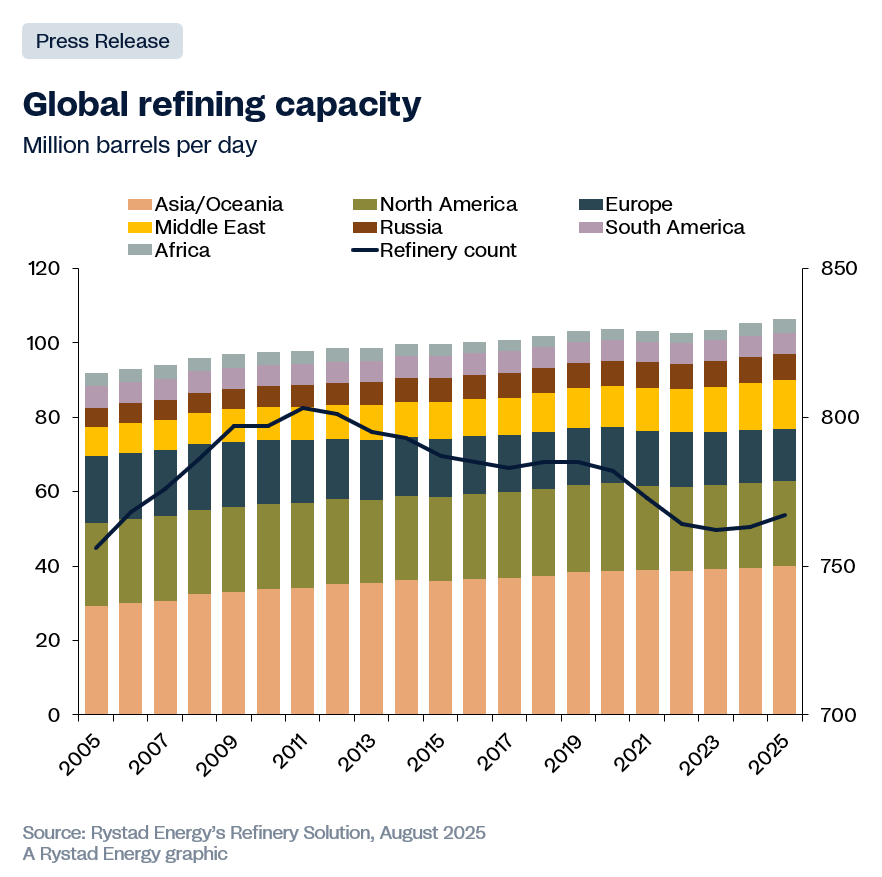
Global refining is at a crossroads, as shifting regional demand, mounting sustainability pressures and heightened energy security concerns reshape the industry. Rystad Energy’s research shows that even though there are fewer refineries today, overall refining capacity has grown to keep up with the rising volume of oil that needs processing. In the last two decades, global primary refining capacity has increased by about 13.5 million barrels per day (bpd), or roughly 15%. In contrast, the absolute number of refineries peaked in 2011 and has been in steady decline since, driven by aging infrastructure, shrinking profit margins and weakening fuel demand as electrification advances.

Today, the Middle East and China, alongside India, are fueling the growth in global refining capacity, with the latter two serving as key drivers for Asia. China has nearly doubled its refining capacity over the past two decades, increasing from 10.6 million bpd in 2005 to 18.8 million bpd in 2025. This expansion reflects long-term efforts to meet rising domestic demand and improve energy security, while also positioning the country as a key exporter of refined products. India’s refining capacity has also grown steadily, from 2.9 million bpd in 2005 to approximately 5.2 million bpd this year, supported by similar drivers, including strong domestic consumption and strategic investments in refining infrastructure.

Middle Eastern refiners have also expanded their refining capacity in the last 20 years from nearly 8 million bpd to roughly 13 million bpd, with major additions concentrated in Saudi Arabia and the UAE. This push reflects a strategic shift to move beyond crude exports by capturing more value through downstream integration. This includes the development of complex, large-scale refineries designed not only to serve growing domestic demand but also to supply refined products to key export markets across the globe.

The Middle East and Asia are driving global refining growth by focusing on large, integrated mega-refineries that secure energy supplies and meet rapidly rising demand. In contrast, Europe and the US are retreating, with older, less efficient plants closing due to high costs and uncertainty over future fuel needs. This shift has sparked a wave of rationalization, where smaller, less flexible refineries are being shut down while bigger, more adaptable facilities gain ground through economies of scale. Today, nearly all new projects are larger and more economically viable, so even though the total number of refineries worldwide has declined, overall refining capacity continues to grow significantly,

Arne Skjaeveland, Vice President, Oil & Gas Research, Rystad Energy

Download our whitepaper to access more insights: The Future of Refining: Global Shifts and Strategic Outlook Toward 2030.

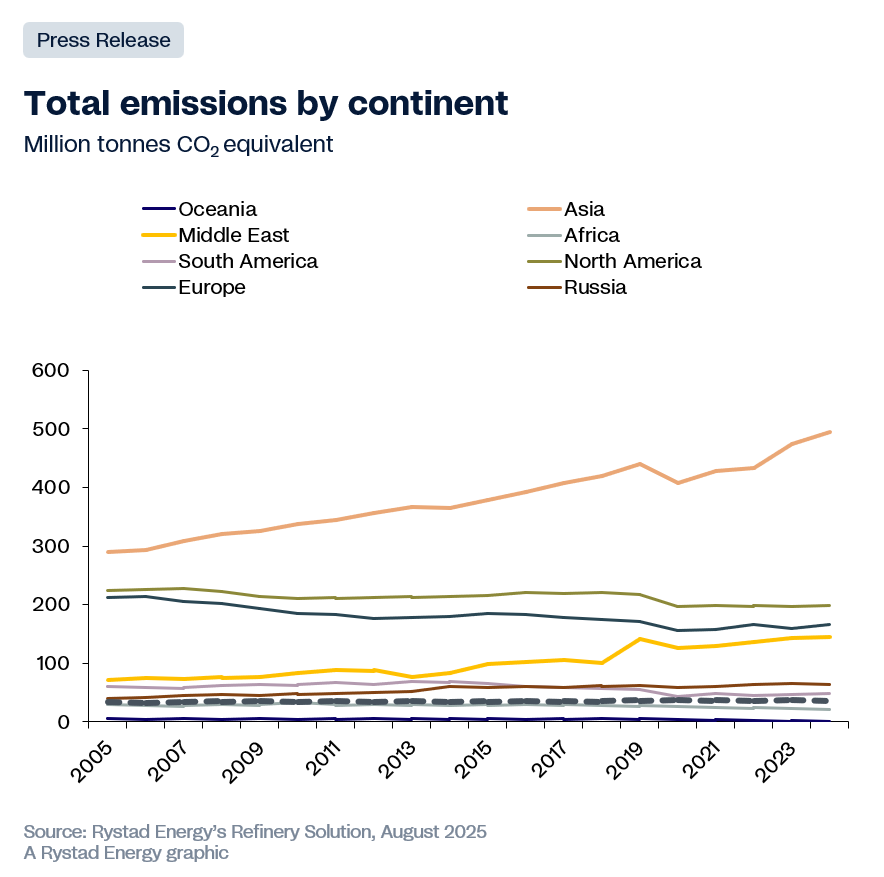
With today’s refineries increasingly designed to secure greater value chain control and meet rapidly rising energy demand, emissions trends tell a divided story. Emissions intensity across the sector has held relatively steady, but absolute emissions reveal a sharper regional split. Asia, followed by the Middle East, has seen total refinery emissions surge, driven by rapid growth in capacity and throughput. The newer, highly complex refineries in Asia and the Middle East tend to consume more energy by design but often achieve greater carbon efficiency per barrel thanks to modern technologies and tighter integration.

While emissions in North America and Europe have remained flat or declined, this is largely influenced by retrofits and refinery closures as opposed to the substantial gains in carbon efficiency seen in Asia and the Middle East. As climate policies tighten and low-carbon expectations rise, the gap between leading and lagging refineries is poised to widen, reshaping competitiveness and steering future investment decisions across the sector.

For companies owning and operating major refineries globally, a clear divide emerges between strategies in Europe and North America and those in Asia and the Middle East, particularly in how emissions are managed. Chevron and TotalEnergies have focused on consolidation and modernization rather than adding new capacity, adapting to stricter regulations and shifting fuel demand. Chevron invests about $1.5 billion annually in upgrades at its legacy sites like Pascagoula and Pasadena, keeping utilization high at 86% despite the age of its assets. On the other hand, TotalEnergies is positioning for a lower-carbon future, taking the lead in integrating advanced biofuel technologies into its refining portfolio.

National oil companies are pursuing a different path, expanding aggressively for better downstream integration. Saudi Aramco has expanded its refining footprint through multibillion-dollar annual investments, developing advanced complexes such as Jazan and forming joint ventures including YASREF and SATORP. While these projects boost capacity and complexity, they also carry higher emissions intensity, averaging around 41 kilograms of carbon dioxide equivalent (CO?e) per barrel, reflecting the processing of heavier crudes and the energy demands of large, sophisticated systems.

By Rystad Energy

World Nuclear News


Legislative changes proposed to remove Swiss new reactor ban


Switzerland's Federal Council has presented draft legislation that would remove the country's ban on the construction of new nuclear power, which has been in place since 1 January 2018.
(Image: GDJ / Pixabay)

A new Swiss energy policy was sought in response to the March 2011 accident at the Fukushima Daiichi plant in Japan. Two months later, both the Swiss parliament and government decided to exit nuclear power production. The Energy Strategy 2050 initiative drawn up by the Federal Council came into force in 2018 and calls for a gradual withdrawal from nuclear energy. It also foresees expanded use of renewables and hydro power but anticipates increased reliance on fossil fuels and electricity imports as an interim measure.

Switzerland currently has four nuclear reactors generating about one-third of its electricity. They all have an unlimited operating licence and can be operated as long as they are safe.

In March 2024, the federal popular initiative Electricity For Everyone At All Times (Stop Blackouts) was passed. The federal constitution now stipulates that the electricity supply must be guaranteed at all times and that the federal government should determine the necessary responsibilities for this. Furthermore, electricity production should be environmentally and climate-friendly and all climate-friendly types of electricity generation should be permitted. Acceptance of the initiative would mean a new division of tasks between the federal government and the cantons and the lifting of the ban on the construction of new nuclear power plants.

The Federal Council has now adopted the text on an indirect counter-proposal to the Stop the Blackout initiative. It said it rejects the initiative, but intends to use the counter-proposal to amend the Nuclear Energy Act so that new nuclear power plants can once again be licensed in Switzerland.

The Department of the Environment, Transport, Energy and Communication (DETEC) said the Stop the Blackout initiative "aims to introduce a provision into the Federal Constitution requiring that the electricity supply be guaranteed at all times and that the Confederation allocate responsibilities for this. However, this objective would represent a fundamental departure from the current division of tasks and responsibilities for energy supply between municipalities, cantons, and the Confederation. The Federal Council rejects this initiative."

It said the initiative also requires that all forms of "climate-friendly electricity generation be permitted. It therefore implicitly calls for the ban on the construction of new nuclear power plants to be lifted. The Federal Council supports this fundamental point in order to maintain a certain degree of flexibility regarding options for energy supply in the future. However, this does not require a constitutional amendment; it is sufficient to amend the Nuclear Energy Act. Therefore, the Federal Council is proposing an indirect counter-proposal, which has been put out for consultation from December 2024 to April 2025."

DETEC said the counter-proposal will repeal two provisions prohibiting the granting of general permits for new nuclear power plants and for modifications to existing nuclear power plants. "This means that general permits may in principle be granted again for nuclear power plants in the future," it noted. However, it said: "The counter-proposal does not consist of a decision to build new nuclear power plants, since there are currently no concrete construction plans."

The Swiss Nuclear Forum welcomed the indirect counterproposal. The organisation's President Hans-Ulrich Bigler commented: "Electricity demand will increase to over 90 TWh by 2050 - just think of electrification, digitalisation, and artificial intelligence. Given climate targets and the geopolitical situation, gas-fired power plants are not a sustainable option, and the expansion of renewables is stalling. It is high time for technology-neutral planning."

Modi highlights India's nuclear plans on Independence Day


Prime Minister Narendra Modi highlighted India's plans for reforms in the nuclear energy sector in his Independence Day address from the Red Fort in Delhi.
 

Modi arrives at the Red Fort on Independence Day (Image: Press Trust of India)

India celebrates its independence on 15 August. Modi's address on the 79th Independence Day lasted 103 minutes - his longest yet. It focused on self-reliance, innovation, and citizen empowerment, and the roadmap to Viksit Bharat: the government's strategy to make India into a completely developed nation by 2047.

It is "essential" for India to become self-reliant in energy, Modi said: in the last 11 years, solar energy has seen a thirtyfold increase; new hydropower dams are being built; and India is investing "thousands of crores of rupees" in green hydrogen initiatives, he said.

"Keeping in mind the future of energy, Bharat is also undertaking major initiatives in nuclear energy," Modi said. "In the field of nuclear energy, 10 new reactors are progressing rapidly. By 2047, when the nation will complete 100 years of independence - the year we have set as the target for achieving the goal of a 'Viksit Bharat' - we are moving forward with the resolve to increase our nuclear energy capacity more than tenfold."

India plans to achieve this by a two-pronged approach, with the deployment of large-capacity reactors as well as small modular reactors (SMRs). Earlier this month, Minister of State Jitendra Singh outlined to the Parliament the three types of SMR that are being designed and developed by the Bhabha Atomic Research Centre for demonstration: the 200 MWe Bharat Small Modular Reactor (sometimes referred to as BSMR-200); a 55 MWe small modular reactor (SMR); and a 5 MWt high temperature gas cooled reactor for hydrogen production by coupling with suitable thermochemical process for hydrogen production.

India has introduced "major reforms" in the field of nuclear energy, Modi said: "We have now opened the doors of nuclear energy to the private sector as well; we want to combine our strengths."

The Atomic Energy Act of 1962 prohibits private control of nuclear power generation in India: only two government-owned enterprises - Nuclear Power Corporation of India Ltd (NPCIL) and Bharatiya Nabhikiya Vidyut Nigam Limited (BHAVINI, set up to build and operate fast reactors) - are legally allowed to own and operate nuclear power plants in India. Amendments to the act made in 2016 allow public sector joint ventures, but private sector companies and foreign investments are not allowed to invest directly in nuclear power in India.

However, the government has begun the process to amend the Amending the Atomic Energy Act and the Civil Liability for Nuclear Damage Act of 2010, to enable broader participation by private and state sectors.

According to World Nuclear Association information, India currently has 24 operable nuclear reactors totalling 7,943 MW of capacity, with six reactors - 4,768 MW - under construction. (The Indian government often classes two units at Gorakhpur where site works have begun as being under construction, although the first concrete for the reactor buildings has not yet been poured.) A further 10 units - some 7 GW of capacity - are in pre-project stages.

UK MoD: Nuclear Safety Incidents at Sub Base Posed No Risk to Public

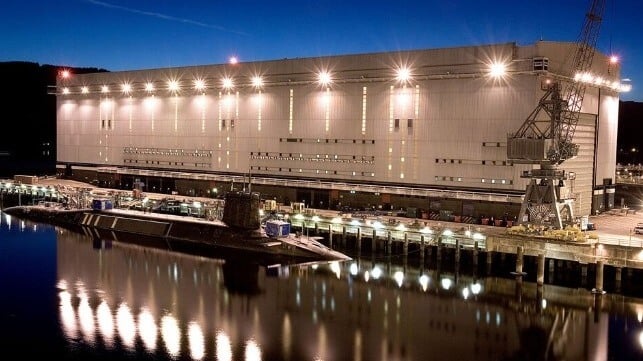
A sub alongside at a berth at Faslane (UK MoD)
A nuclear sub alongside at a berth at Faslane (UK MoD)

Published Aug 14, 2025 2:12 PM by The Maritime Executive


Following a report of a minor leak of radioactive tritium at the Royal Navy's Faslane / Coulport nuclear ballistic missile submarine complex, UK politicians have begun asking questions about the frequency of reportable HSE incidents at the facilities. This week, the UK's defense minister confirmed that a serious "category A" safety incident occurred as recently as this spring - though the UK MoD maintains that the public and environment were never in danger. 

The series of revelations began five days ago, when the Guardian and The Ferret published a long-awaited story on radioactive pollution from the Coulport nuclear warhead storage depot on Loch Long, part of HMNB Clyde. Since 2019, the outlets had been trying to publish regulatory documents about leaks at the depot, and this month they finally obtained clearance from the relevant classification authorities. The documents from Scotland's environmental regulator show that aging water pipes burst three times at Coulport in the 2010s, and one event resulted in a "significant" flooding incident in a nuclear weapons processing area at the depot in 2019. The water was contaminated with low levels of tritium, and it spilled out a drain and into the sea. 

The Scottish Environment Protection Agency (SEPA) reviewed the incident and wrote up an (initially classified) report on it, finding that the pollution level was very low and unlikely to endanger the public. However, it determined that the incident demonstrated asset management shortcomings at the base, resulting in the unexpected piping failure. 

The MoD pledged improvements after the report, but there were two more pipe bursts in 2021, including a second flooding incident in an area with radioactive materials. In 2022, SEPA concluded that MoD had moved too slowly in making safety management improvements.

Since 2023, there have been 12 additional "category A" nuclear safety incidents at the Faslane sub base, according to The Ferret. One occurred between January 1 and April 22, 2025, confirmed defense minister Maria Eagle this week. 

"None of the events caused harm to the health of any member of staff or to any member of the public and none have resulted in any radiological impact to the environment," Minister Eagle assured in a written response.

The MoD has pushed back on perceptions of risk, and it suggested this week that it is "factually incorrect to suggest" that there was any danger to the public or any radiological impact. It has presented the existence of safety incident reports as a positive, a demonstration of "robust safety culture and commitment to learn from experience."  

The news of Faslane's reportable safety incidents prompted protests from Scottish politicians. "With repeated reports of serious incidents at Faslane and now confirmed radioactive contamination in Loch Long, it's clear these weapons are not only poorly maintained but are a direct threat to our environment, our communities, and our safety," said MSP Keith Brown in a statement.

US startup makes thorium breakthrough at Department of Energy’s Idaho National Lab


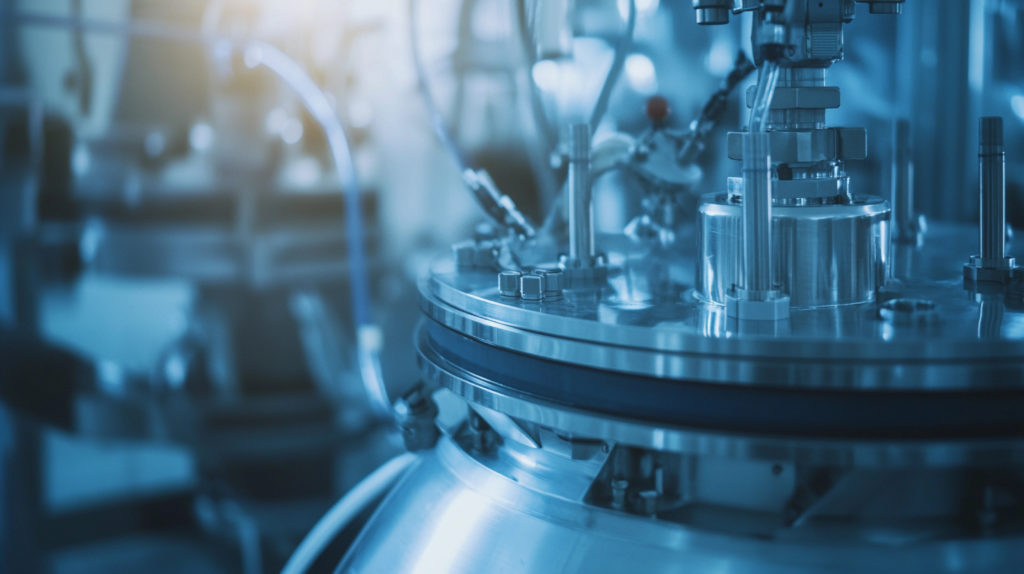
Thorium nuclear reactor design. AI-generated stock image.

Clean Core Thorium Energy (CCTE) a Chicago-based company developing thorium-based nuclear fuel, announced a milestone for its patented Advanced Nuclear Energy for Enriched Life (ANEEL) fuel, which it said has now reached a burnup level of over 45 gigawatt-days per metric ton in the advanced test reactor  at the US Department of Energy’s Idaho National Laboratory (INL).

This level, CCTE said, outpaces the capabilities of conventional nuclear fuels used in pressurized heavy water reactors (PHWRs) and CANDU reactors – Canadian pressurized heavy-water reactor design used to generate electric power.

In February, the privately- held company raised a $15.5M Series Seed round of financing to advance the ANEEL fuel – a patented blend of thorium and high-assay low-enriched uranium (HALEU) designed to be seamlessly deployed into existing reactors. 

The fuel, the company said, uniquely combines thorium with HALEU to offer a safer, more efficient, and proliferation-resistant alternative for existing and future PHWR and other CANDU reactor fleets worldwide. 

Thorium, weakly radioactive, silvery-white metal, has been hailed as a safer and cheaper alternative to uranium in nuclear reactors. According to the International Atomic Energy Agency (IAEA), thorium is three times more abundant in nature than uranium, but historically has found little use in power generation due to the significant economic and technical hurdles. 

Compared to uranium, thorium can generate a significantly higher amount of energy via nuclear fission, reports have shown. 

Over a year of testing

In May 2024, twelve ANEEL fuel rodlets were loaded into the ATR for irradiation to achieve three burnup level targets. The first successful irradiation of four rodlets surpassed 20 GWd/MTU last year, the company said, adding that the second set of four rodlets have exceeded 45 GWd/MTU—six to seven times the average discharge burnup for PHWR/CANDU reactors that are designed to use natural uranium fuel. 

The newly irradiated rodlets are currently cooling in the ATR water pool and will soon be transferred to INL’s materials and fuels complex for detailed post-irradiation examination. The final four rodlets will remain in the ATR for continued irradiation, with expected burnup levels exceeding 60 GWd/MTU, CCTE said. 

“This second burnup milestone is a transformative moment for CCTE and for the future of nuclear energy,” CCTE Thorium Energy CEO Mehul Shah said in a news release.  

“ANEEL fuel is not just demonstrating superior technical performance—it’s proving that thorium-based solutions can meaningfully address global 

challenges of energy security, nuclear waste, and proliferation,” Shah said. “Our partnership with INL is helping unlock a new era for advanced nuclear fuels.” 

The company said these results reflect ANEEL fuel’s potential to redefine performance and sustainability standards in the nuclear industry. 

“ANEEL’s performance in the ATR is a strong indicator of the promise thorium-based fuels hold in supporting future energy goals and diversifying the nuclear fuel landscape,”  Dr. Michael Worrall, Technical Lead for the CCTE ATR Irradiation at INL, added.

US lab begins post-irradiation studies on high-burnup fuel


Researchers at the US Department of Energy’s Pacific Northwest National Laboratory have begun post-irradiation studies on GE Vernova's high burnup fuel after it has spent six years in a commercial reactor.
 

The lid of the shipping container is opened inside a shielded hot cell at PNNL (Image: PNNL)

The lab is examining a shipment of fuel rods, manufactured by Global Nuclear Fuel - a GE Vernova-led joint venture with Hitachi, Ltd - from assemblies that were initially loaded into a US nuclear power plant for two 24-month cycles of operation. The assemblies were then relicensed to allow them to be reloaded for an additional cycle to increase their exposure, operating in the reactor beyond current US Nuclear Regulatory Commission licensing limits.

High burnup fuels use more of the fissile material in nuclear fuel, allowing longer operational cycles. The need for fewer fuel bundles, over time, is expected to enhance nuclear safety and reduce the amount of used fuel that needs to be managed. High-burnup fuels could also support power uprates at existing nuclear power plants. The Department of Energy (DOE) is supporting the development of such fuels through its Accident Tolerant Fuels Program.

 The shipment of GNF2 Fuel rods arrive at PNNL (Image: PNNL)

The assemblies shipped to Pacific Northwest National Laboratory (PNNL) include full length and partial length rods - a feature that is unique to boiling water reactor fuels - with fuel pellets that contain gadolinium, which absorbs neutrons to improve the use of the fuel's fissile content throughout the operating cycle, DOE said. They were removed from the reactor in 2023, and will be analysed by PNNL over the next few years to determine the impact of the additional cycles on the fuel and cladding performance.

The studies support GNF’s development, engineering and licensing efforts to ensure the continued safe and reliable performance of fuel under expanded operating conditions, GE Vernova said.

Similar studies began on irradiated GNF2 fuel rods at Oak Ridge National Laboratory last year. The rods that have been shipped to PNNL were selected to compliment the work being done at Oak Ridge, GE Vernova told World Nuclear News: "As part of this initiative, it is important to collect irradiated performance data from different operating conditions and water chemistry variations for licensing approvals and to support the success of a fleet-wide deployment."

The fuel is the same design that will be used in the initial core designs of the GVH BWRX-300 small modular reactor, and the data obtained through this programme will be used to support future potential economic improvements in BWRX-300 fuel cycle designs, including extending fuel cycle lengths to 36 to 48 months.

A fuel rod to release Radioactive gases for analysis (Image: PNNL)

"The examination of these rods is the next step in our continuous drive to develop higher efficiency fuels that are safer and more reliable," said Craig Ranson, Installed Base CEO at GE Vernova Hitachi Nuclear Energy. "We are proud to be part of this collaboration with the US Department of Energy, PNNL and our utility partners to benefit the entire industry."

Frank Goldner, the Accident Tolerant Fuel federal programme manager in the DOE Office of Nuclear Energy, said the start of the studies at PNNL is significant milestone for the programme. "The development of this fuel could further support the Trump Administration's executive order to facilitate five gigawatts of power uprates at existing power plants by 2030 and high burnup fuels could be a big part of that," he said.

The DOE programme is supporting GE Vernova, Framatome, and Westinghouse who are all testing fuel concepts in commercial US reactors with the goal of widespread adoption by 2030.

Equinix signs further agreements with SMR developers


In a move to diversify its power supplies, data centre developer and operator Equinix has signed a preorder agreement for the purchase of 20 of Radiant's Kaleidos microreactors and intends to sign a power purchase agreement with Dutch nuclear energy development company ULC-Energy.


A rendering of Radiant's Kaleidos microreactor (Image: Radiant)

"Equinix is taking a diversified portfolio approach to the global energy challenge by tapping into innovative power technologies and working directly with utilities to strengthen the grid," the California-headquartered company said. "Looking ahead, the company is supporting the development of advanced nuclear technologies that can deliver reliable, clean power in the future.

"Next generation nuclear technologies can offer a pathway to faster nuclear deployments due to their simplified design and robust safety features. Equinix sees safe, efficient and reliable nuclear energy as a promising solution to help power both data centres and the broader grid."

California-headquartered Equinix has now announced a preorder agreement with Radiant for the purchase of twenty 1 MWe Kaleidos high-temperature gas-cooled portable microreactors. The Kaleidos will use a graphite core and TRISO (tri-structural isotropic) fuel.

Radiant was one of eight technology developers selected earlier this year as potential microreactor suppliers made eligible to receive funding under the Advanced Nuclear Power for Installations programme: an initiative launched in 2024 by the Defense Innovation Unit in collaboration with the Department of the Army and the Department of the Air Force, with the goal of "working to design, license, build, and operate one or more microreactor nuclear power plants on military installations".

Earlier this week, Radiant was among 11 advanced reactor projects that the US Department of Energy announced as its initial selection for the Nuclear Reactor Pilot Program, which aims to see at least three of them achieve criticality in less than one year from now.

"Kaleidos offers a reliable, long-lasting energy source that can be transported anywhere it's needed, installed in days, and deployed safely alongside existing equipment and integrated with on-site transmission infrastructure," Equinix said.

In a post on X (formerly Twitter), Radiant said: "We're proud to share that Equinix, the world leader in digital infrastructure, has signed a deal and submitted deposits for the purchase of 20 Kaleidos microreactors. This is not only the largest deal to date for us, it's the largest deal to date for any mass-manufactured reactor."

Dutch power purchase agreement

Equinix also announced the signing of a Letter of Intent with ULC-Energy for a power purchase agreement up to 250 MWe to power data centres in the Netherlands.

In August 2022, Rolls-Royce SMR of the UK signed an exclusive agreement with ULC-Energy to collaborate on the deployment of Rolls-Royce SMR power plants in the Netherlands. ULC-Energy - established in 2021 and based in Amsterdam - aims to accelerate decarbonisation in the Netherlands by developing nuclear energy projects that efficiently integrate with residential and industrial energy networks in the country.


(Image: ULC-Energy)

"Our partnership with ULC-Energy marks an important milestone in Equinix's mission to support sustainable growth in the Netherlands," said Michiel Eielts, Managing Director for Equinix in the Netherlands. "By securing Rolls-Royce SMR capacity, we're not only ensuring reliable and clean energy for our data centres but also contributing to a resilient energy future that benefits local communities, supports economic development, and helps reduce the environmental impact of digital infrastructure."

ULC-Energy CEO Dirk Rabelink said: "Small modular reactors (SMRs) are ideally suited to power increasing demand for data centres. They can deliver clean baseload electricity safely, reliably, and affordably. ULC-Energy has developed a deployment model that leverages the SMR's capability to address data centre energy requirements whilst also providing a realistic and affordable solution to support the increasing regional grid and energy challenges. The SMR-powered data centre will enable a clean digital solution and will be a strategic regional energy asset benefitting many local stakeholders."

Equinix has previously signed agreements with other SMR developers. In April 2024, it signed an agreement to procure 500 MW of energy from US company Oklo's next-generation fission Aurora powerhouses. It has also signed a pre-order power agreement for 500 MWe with French molten salt reactor developer Stellaria to power its European data centres.

"The potential challenges to powering reliable and sustainable digital infrastructure are considerable," said Ali Ruckteschler, Senior Vice President and Chief Procurement Officer at Equinix. "However, Equinix has always been at the forefront of energy innovation, signing the data centre industry's first agreement with a SMR provider and pioneering the use of fuel cells a decade ago. Powering AI infrastructure responsibly is a global priority. With Equinix's operational expertise, trusted supply chain, and close partnerships with the US and global governments and utilities, we are poised to deliver safe, secure and reliable AI solutions for our customers and the communities we serve."

NANO Nuclear Advances KRONOS Microreactor and Reports Strong Cash Reserve

NANO Nuclear Energy Inc. (NASDAQ: NNE) announced its third fiscal quarter results, revealing significant milestones in the development of its KRONOS Micro Modular Reactor (MMR). The company advanced U.S. Nuclear Regulatory Commission (NRC) licensing efforts, initiated preparatory work for deployment at the University of Illinois Urbana-Champaign (UIUC), and resumed Canadian licensing activities, positioning KRONOS as a leading contender in the North American microreactor race.

Financial Highlights

  • Cash Position: $210.2 million as of June 30, 2025, up from $28.5 million on September 30, 2024, following a series of equity raises.

  • Operating Cash Use: $14.7 million in the first nine months of FY2025, driven by KRONOS R&D and operations.

  • Investing Activities: $12.9 million, including $9.1 million for KRONOS MMR acquisition and $3.8 million for a demonstration facility in New York.

  • Financing Activities: $209.3 million net cash inflows.

  • Filed first universal shelf registration statement to support long-term growth.

Strategic and Technological Progress

  • Licensing: Progressed NRC construction permit application preparations for UIUC site; resumed Canadian licensing, building on KRONOS’ prior Phase 1 CNSC review.

  • Partnerships: Signed collaboration agreements with UIUC and AECOM for engineering and environmental studies.

  • Innovation: Advanced proprietary Annular Linear Induction Pump (ALIP) technology under SBIR Phase III, targeting potential commercial sales in 2025–2026.

  • Vertical Integration: Signed MOU with UrAmerica to secure nuclear fuel supply chain resilience.

Operational Expansion and Leadership Strengthening

  • Recruited over a dozen engineers in the Midwest to accelerate KRONOS development.

  • Acquired a 2.75-acre engineering and manufacturing facility in Oak Brook, Illinois.

  • High-profile appointments include former U.S. Energy Secretary Rick Perry, Vice Admiral Charles J. Leidig Jr., and Intel’s Seth Berl, bolstering technical and policy expertise.

Market Recognition

Added to the Solactive Global Uranium & Nuclear Components Total Return Index in August 2025, qualifying NNE for inclusion in the $4 billion Global X Uranium ETF (URA).

  • This inclusion provides broader institutional investor exposure and market liquidity.

Industry Context

NANO Nuclear’s progress comes amid a global nuclear resurgence driven by AI data center growth, industrial reshoring, electrification, and bipartisan policy support in the U.S. Nuclear microreactors are increasingly seen as vital for clean, reliable, zero-emission power in both centralized and remote settings.

Outlook

The company targets submitting a U.S. NRC construction permit application by late 2025 or early 2026 and aims to be the first to license a commercial microreactor in Canada. Management also plans to pursue commercial agreements with AI data center operators and remote communities, alongside potential vertical integration opportunities through M&A.

CEO James Walker emphasized that KRONOS’ proven reactor design, substantial prior R&D investment, and integrated supply chain strategy give NANO Nuclear a competitive edge in the rapidly growing advanced reactor market.