Thursday, June 12, 2025

US Supreme Court may be death row inmate’s last chance to avoid execution
GOOD LUCK WITH THAT


Mina Corpuz,
 Mississippi Today
June 12, 2025 

FILE PHOTO: A view of the U.S. Supreme Court in Washington, U.S., July 1, 2024. REUTERS/Kevin Mohatt/File Photo

Less than two weeks from the scheduled execution of Richard Jordan, the Mississippi Supreme Court said it will not reconsider the death row inmate’s appeal, but the federal high court is expected to discuss his case next week.

Jordan, at 79, the state’s oldest and longest-serving death row inmate, was first convicted in 1976 for kidnapping and killing Edwina Marter in Harrison County. He had four trials until a death sentence was handed down in 1998.

On Thursday, eight of the nine justices of the Mississippi Supreme Court declined to rehear an order to set Jordan’s execution date. Justice Leslie King was the lone person who wanted to grant a rehearing.

This decision comes about a week after Jordan’s attorney, Krissy Nobile of the Office of Capital Post-Conviction Counsel, wrote to the court to emphasize that her client has not yet exhausted federal remedies and an execution could not be set.

The U.S. Supreme Court distributed Jordan’s petition for a writ of certiorari at a May 29 conference and is expected to discuss it again at a June 18 conference – a week before the execution.

Meanwhile, Jordan’s attorneys filed an emergency application for a stay of execution with Justice Samuel Alito Jr. pending the court’s disposition on the case.


They argue there is a reasonable prospect that the court will grant certiorari and reverse the Mississippi Supreme Court’s decision, and that Jordan will suffer irreparable harm if a stay is not ordered.

In its response, the state argues Jordan has been trying to avoid his death sentence for almost 50 years and that he is repeating baseless arguments in his pending petition for certiorari.

His attorneys argue Jordan’s death sentence is not valid because in 1976, when the murder was committed and Jordan was sentenced, Mississippi and all other states had ceased executions based on a 1972 U.S. Supreme Court decision in Furman v. Georgia that capital punishment was unconstitutional.


This article first appeared on Mississippi Today and is republished here under a Creative Commons Attribution-NoDerivatives 4.0 International License.






You can be a junkie and a deadbeat dad. MAGA doesn't care — if you're white

John Stoehr
June 10, 2025 
ALTERNET


U.S. President Donald Trump holds a MAGA (Make America Great Again) cap as he arrives at Philadelphia International Airport in Philadelphia, Pennsylvania, U.S., March 22, 2025. REUTERS/Nathan Howard

The current president has decided it’s a good idea for his regime to investigate criminally the previous president’s “cognitive decline.”

In political terms, this is ploy. Donald Trump wants to create conditions in which to invalidate legislation Joe Biden signed into law. He will say that Biden was too enfeebled to know what he was doing.

Biden is out of power. He’s a pariah among some in his own party. And now he has cancer of the prostate.

Yet Trump seems to believe Biden can’t die fast enough. He’s now going to spend his precious time kicking him until he does.

That’s not the worst part. The worst part is that Trump will never pay a price for being a jerk, just as he’s never paid a price for being a lying, thieving, philandering sadist. Indeed, he will be rewarded. His people will cheer him on, encouraging him to be an even greater jerk.

Character and morality matter to the GOP, but only if you’re Black or a Muslim or some kind of liberal. Otherwise, as can be seen in the case of billionaire Elon Musk, you can be as terrible as you want to be.


You can be a junkie.

A deadbeat dad.

A literal Nazi.

None of that matters, not when you’re rich and powerful.

Sure, Musk now appears to be “going to war” with Trump over his budget bill. Musk called it a “disgusting abomination” and has encouraged his followers on X to tell their congresspeople to kill it.

But that’s not because the legislation rolls back electric vehicle subsidies. It’s not because of anything to do with self-interest.


It’s because Musk is a jerk, too.

Or as USA Today columnist Rex Huppke put it, more politely than I would: “pairing two high-profile narcissists was bound to not end well.”

Rex added: “It's possible one or both will be able to temper their delicate emotions, but I doubt it. Musk is a sensitive fellow, and Trump takes criticism as well as a cat takes a bath. … Both men will continue to be miserable, because I don't think either is capable of feeling joy.”


I spoke to Rex.

JS: What's wrong with Elon Musk? Something is wrong with him.

RH: He certainly seems wildly not OK. I'm not going to try to diagnose whatever's going on in his noggin, but you'd be hard-pressed to find a reasonable person who would say his behavior seems fine.


He's erratic. He spews random vitriol and conspiratorial babble on X, the platform he turned into his personal rightwing-weirdo playground. And of course there's the New York Times' solid reporting on his alleged drug use.

If nothing else, the guy thinks he's the smartest person in any room and strikes me as a narcissist of the highest order. Plus he just wreaked havoc on our government and cut spending in ways that are believed to be costing tens of thousands of people their lives.

JS: If he were not the richest man in the world, the Times piece would have cemented the idea that he's a junkie and a deadbeat dad. He will never been known as such, which means wealth and power can paper over any number of sins that would never be papered over if the junkie and deadbeat dad in question were, say, Black.


RH: I certainly agree with that. We're witnessing with Trump and Musk the ultimate examples of what wealthy white men can get away with in public. In fact, I'd even narrow it down to "what wealthy, white conservative men" can get away with in public, since I don't think any Democrat or liberal American would survive the near-daily scandals that Trump and Musk manage to pull off largely without consequence.

JS: You wrote recently about Joe Biden's decency. Thank you for that. However, it's a reminder that being an honorable man, or just trying to be an honorable man, often fails in America. The social and economic incentives for being terrible are just too great these days.

RH: Exactly. When Barack Obama left office, I wrote about how he was a good and decent man, despite years of the right trying to paint him as a monster. Then the same thing happened with Biden. The Republican Party's entire playbook is to simply demonize any Democratic president, and they have the rightwing media apparatus to drive whatever loony messaging they come up with right into the brains of millions of Americans. Absolute nonsense becomes gospel to people.

After that piece on Biden's decency ran, I got a slew of emails from people 100 percent convinced that Biden was an evil criminal mastermind who damn-near destroyed America. It's just nuts, and it's clear most mainstream news outlets are unable or unwilling to do enough to knock down the lies and fabrications that bubble-up from the right. Of course, it's much harder to do when a huge swath of the population only gets its news from rightwing sources.


JS: The conventional wisdom among Democratic leaders is that people who get their information from rightwing sources can be reasoned with by appeals to their pocketbook. Do that make sense to you?

RH: Not really. My belief is that the MAGA faithful are unreachable. They're lost, and any attempt to cater to them or "reach them" is a waste of time and resources. The people who remain reachable, and the ones who I think swung the election to Trump, are the people who are less engaged, the ones who don't consume all that much news.

They care about pocketbook issues, and they tend to sway in the direction of whoever is not in charge when prices are high or things are impacting them negatively. That's who the Democrats need to be reaching out to, and I think they can do that by aggressively getting themselves out into communities, whether that's in person or via big advertising blitzes or via social media or non-mainstream platforms.


The Democratic Party should be blasting out the truth about what Trump and his cronies are doing to hurt Americans, and they should be doing that 24-7 in every nook and cranny of the country. With a few notable exceptions, I'd say they're largely dropping the ball right now. People are about to start really feeling the pain of Trump's tariffs and other nonsense. Democrats need to be loud and in front of it all.

JS: Circling back to Musk, he is now calling Trump's budget bill, the “big beautiful” one, a "disgusting abomination." This is triggering some speculation of a "civil war" between Trump and Musk and within MAGA, generally. I'm skeptical, but what do I know? Thoughts?

RH: Pairing two high-profile narcissists was bound to not end well.

As you noted in your earlier question, Musk doesn't seem right, and Trump, well, we know he's not right. So the chances of the two erupting into an absolutely bonkers online slap-fight seem solid.

It's possible one or both will be able to temper their delicate emotions, but I doubt it. Musk is a sensitive fellow, and Trump takes criticism as well as a cat takes a bath. Musk's businesses and reputation are in the toilet. Trump's ratings are low and his agenda keeps getting jammed up by judges and, you know, the law. All of this creates a volatile stew, and I don't know that these two nutters will be able to refrain from finger pointing or lashing out at the other as a way to distract from their assorted problems. If it happens, I expect MAGA will stick with Trump, because they always do. And both men will continue to be miserable, because I don't think either is capable of feeling joy.
'Embarrassing': Trump's Treasury secretary gets brutal math lesson at hearing

Matthew Chapman
June 11, 2025 

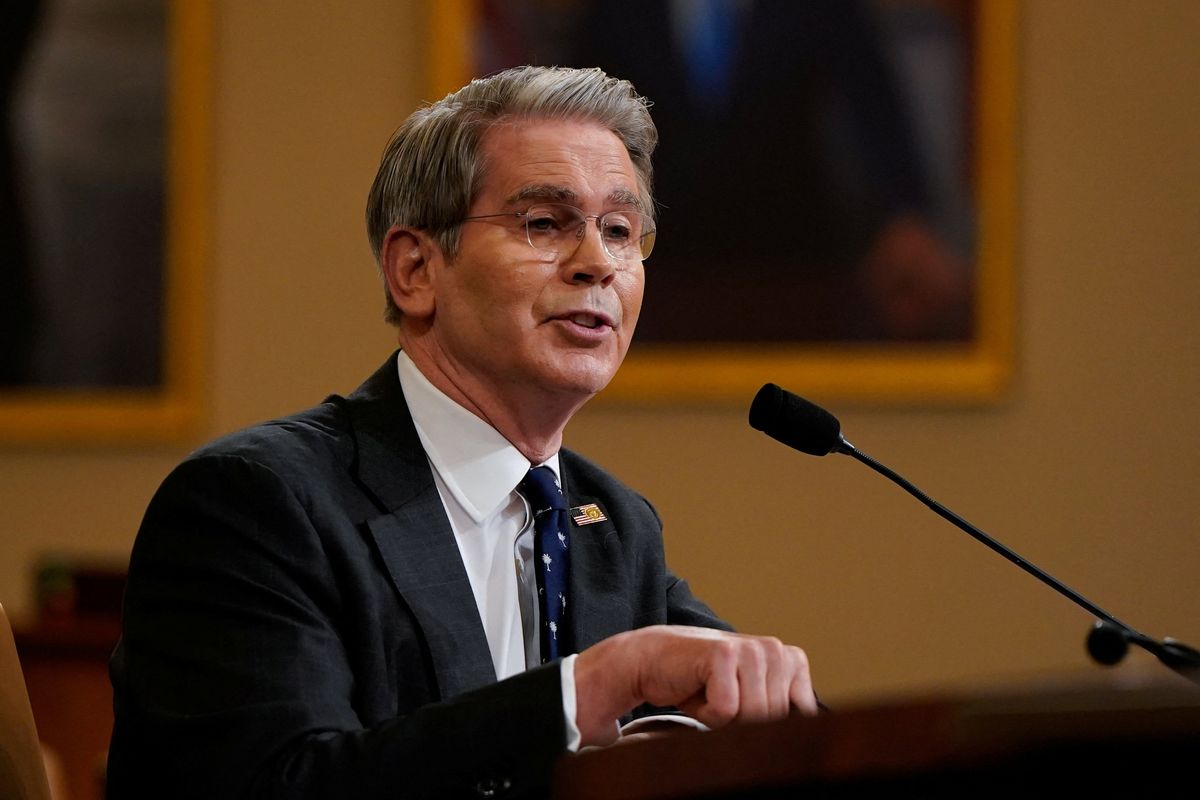
U.S. Treasury Secretary Scott Bessent testifies before a House Ways and Means Committee hearing on Capitol Hill in Washington, D.C., U.S., June 11, 2025. REUTERS/Elizabeth Frantz

President Donald Trump's Treasury secretary, Scott Bessent, had to get corrected multiple times on his fuzzy math about the economy during a heated hearing before the House Ways and Means Committee on Wednesday.

The hearing was at many points a mess, with Bessent, a former hedge fund manager, admitting Trump would "likely" cave on tariff deadlines yet again, and having to be told to stop interrupting lawmakers.

One of the most remarkable moments came when Rep. Don Beyer (D-VA) held him to account for how sluggish the economy has been since Trump's tariffs took effect, and Bessent unsuccessfully tried to deny this was the case.

Beyer noted that all the biggest periods of market strength during the Trump administration have always come when "the administration is in retreat from key policy areas ... is this embarrassing?"

"It isn't embarrassing," said Bessent. "I'm sorry, Congressman, but you seem not to have seen the economic data. The GDP growth has been quite substantial, job growth is solid—"

"GDP growth is half what it was last year, sir," Beyer interjected.


"The job growth is solid, and private sector job growth especially," Bessent repeated.

"Job growth is a third what it was all last year, sir," said Beyer.

"And if you'd like to talk about inflation, would you?" said Bessent.


Beyer said that inflation numbers look decent "so far," but that all economic reports he is reading indicate "the impact of the tariffs" is not yet fully baked into prices.

Bessent has previously faced an avalanche of criticism for claiming that the federal workers the Trump administration is firing can just go find work in factories producing American-made goods. 


Entire Fulbright board quits in mass revolt over Trump assault

Adam Nichols
June 11, 2025 
RAW STORY


New York Archbishop Cardinal Timothy M. Dolan, Republican presidential nominee and former U.S. President Donald Trump and Melania Trump attend the 79th annual Alfred E. Smith Memorial Foundation Dinner in New York City, U.S. October 17, 2024. REUTERS/Brendan McDermid

In a stunning institutional revolt against Donald Trump, the entire 12-member board overseeing America's most prestigious international scholarship program resigned en masse Wednesday, blasting the administration for what they called blatantly illegal political interference.

The dramatic walkout of the Fulbright Foreign Scholarship Board represents an unprecedented rebuke to Trump's destruction of academic independence, with board members—including New Hampshire Democratic Senator Jeanne Shaheen—accusing Marco Rubio's State Department of trampling decades of bipartisan tradition, the Daily Beast reported.

The Fulbright program, a crown jewel of American soft power established by Congress in 1946, has become another casualty in Trump's broader war against higher education and international cooperation. The program typically supports 8,000 scholars, students, and artists in cultural exchanges—exactly the kind of diplomatic bridge-building Trump consistently attacks.

Board members didn't mince words in their scathing resignation statement, accusing Trump appointees of taking "unprecedented actions that we believe are impermissible under the law, compromise U.S. national interests and integrity, and undermine the mission and mandates Congress established for the Fulbright program nearly 80 years ago."

Trump's administration has already begun systematically destroying the program, canceling approximately 200 scholarships awarded to American researchers for international projects. According to sources, most cancellations were based purely on the administration's ideological objections to research topics.

The purge extends beyond American scholars. A staggering 1,200 scholarships awarded to foreign nationals for U.S. research are under review, sending shockwaves through the international academic community and damaging America's reputation as a destination for world-class research.

Secretary of State Marco Rubio has reportedly submitted a budget proposal that would essentially destroy the program entirely, slashing funding for the Bureau of Educational and Cultural Affairs from $691 million to $50 million.

Trump has installed Darren Beattie to oversee the State Department office housing Fulbright. Beattie was previously fired from Trump's first administration after speaking at a white nationalist conference.

The Fulbright controversy represents just the latest front in Trump's attack American higher education. The administration has systematically attacked universities as "too liberal" while demanding ideological submission.

Trump's highest-profile target remains Harvard University, where he's frozen billions in federal funding while issuing demands. When Trump tried blocking Harvard from enrolling international students entirely, a federal judge stopped him.

Meanwhile, Rubio has ordered U.S. embassies worldwide to halt new student visa applications while implementing invasive social media screening—another barrier to international educational exchange.

 Labourstart


Lululemon: Stop union busting!

The workers at Metro Wear 2 in the Philippines that produce clothing for Lululemon, a Canadian-American athletic apparel retailer, need our help today. 

Their union won their certification election over a year ago, but the company has employed delaying tactics and has refused to begin collective bargaining. The company just announced that they plan to shut down the factory for three months without a clear and convincing reason. Nearly 1,800 workers will lose their means of living for that time. Furthermore, the company has fired five union officers since February, in a move clearly intended to undermine the union. This is union busting and we've been asked by the workers to send messages of protest to the company.  Please take a minute to send yours today:

Click here


Launch of the International Strike Report

Research groups from eleven countries have come together to publish the latest version of the International Strike Report. This collaborative effort, including interviews with strikers, examines trends across all those countries, aiming to increase visibility and provide critical insights into global workers' movements.  Read the report here.

Join us for a special online event on Saturday, 14 June where contributors to the report will share key findings through short presentations, followed by an open discussion on the report's implications.  This will take place at 14:00 UTC -- that's 07:00 in Vancouver, 10:00 in Toronto, 15:00 in London, 16:00 in Berlin, and 17:00 in Istanbul. Use this link to figure out the time where you are. 

Login to the Zoom call here. If prompted for a password, use 'solidarity'


Canada: Interview with Gil McGowan, President of the Alberta Federation of Labour

The Alberta Federation of Labour and some 25 Alberta unions, representing more than 300,000 workers, recently unveiled the Solidarity Pact, a commitment to collective defence against any attack on workers by public- or private-sector employers. The Solidarity Pact is intended to remain in force indefinitely. In the latest LabourStart podcast, we talk to McGowan about the Solidarity Pact, and labour relations in the province with a "Maple MAGA" premier, who's now advocating for a separation referendum. Listen to it here.


Dan Gallin (1931-2025)

Dan Gallin, former general secretary of the IUF, passed away on 31 May in his home in Geneva.  For many of us, Dan was a mentor, comrade and friend.  One of the best obituaries of Dan appeared in the Global Labour Column this week, written by Peter Rossman.  It's well worth a read - click here

To learn more about Dan's life and work, we recommend these two books by him, which LabourStart had the honour to publish:

Thank you.


Eric Lee

UK

Youth Demand promises a 'revolution'

New protest group picks up Just Stop Oil's mantle and vows to 'build a movement that is going to take control of the British state'


Like Just Stop Oil, Youth Demand has positioned itself as a 'non-violent civil-resistance group'
(Image credit: Martin Pope / SOPA Images / LightRocket via Getty Images)


By Elliott Goat, The Week 
UK

"The government is engaging in absolute evil. They are enabling genocide in Palestine by sending money and arms to Israel. They are contributing to the murder of billions to keep the fossil fuel profits flowing."


That is the founding claim of Youth Demand, the UK's latest activist movement "taking up the mantle of public disruption" from Extinction Rebellion, Insulate Britain and, most recently, Just Stop Oil, said The Times.
Who are they and what do they want?

The group emerged last year out of the youth wing of Just Stop Oil, which recently announced it would end its programme of civil disobedience having achieved its goals after the government pledged to stop issuing new licences for oil and gas exploration and production.

Made up predominantly of students and young people in their 20s, Youth Demand has two main aims: to end all trade with Israel and "make the rich pay". It says the latter must be achieved by raising £1 trillion by 2030 from the "fossil fuel elite to pay damages to countries harmed by fossil fuel burning".

"Until these demands are met," the group said, "we will be in nonviolent resistance against this rigged political system and the people with blood on their hands."
What tactics do they use?

The group first hit the headlines last spring after spray-painting the Labour Party's HQ and Ministry of Defence buildings. In protest over Gaza, it has laid child-sized body bags outside the home of Foreign Secretary David Lammy, and hung a banner covered with red hand prints reading "Starmer stop the killing" outside the home of the PM.

Like Just Stop Oil, it has positioned itself as a "non-violent civil-resistance group" that aims to cause maximum disruption and provoke a reaction from the authorities. Dozens of members were arrested in April after they attempted to "shut London down" with more than 70 roadblocks.

This is an example of the group's signature "swarm" protest, said The Times. This involves "blocking busy roads with a line of people holding banners, flares and flags for about 10 minutes, disrupting traffic and attracting attention, then dispersing before police arrive and repeating the process in another location".

Its activists also target high-profile sporting and cultural events. At the London Marathon they threw red powder paint in front of the men's race, while two members attempted to get on stage during Israel’s performance at this year's Eurovision Song Contest in Basel.
What does the future hold?

The group – which says it has 25,000 people on its mailing list – is planning to "ramp up their activities over the summer" to create a "sustained wave of resistance" in support of the Palestinian people, said The i Paper.

Yet its ambitions extend beyond what William Sitwell in The Telegraph called the "two couture lines of protest: pro-Palestine and anti-fossil fuel".

Youth Demand is just one of four sub-groups in the 'Umbrella' coalition. It also includes Just Stop Oil, Assemble, which aims to create a House of the People representative of the UK public through a lottery to discuss fixing the "broken system", and Robin Hood, which will engage in "civil resistance" in relation to socioeconomic challenges such as food poverty and housing.

"We are going to build a movement that is going to take control of the British state," said co-founder Sam Holland.

This proposition may be "easily dismissed as the delusions of a fringe group," said The i Paper, but Youth Demand is "convinced that 'a revolution' to dismantle centuries of political institutions is just around the corner, and they are the ones who are going to tip it over the edge".
Fishing cat: Pakistan’s Indus delta losing its lone surviving predator

Pakistan’s endangered Indus fishing cat faces an alarming decline due to a lethal mix of environmental and human-induced factors


Aamir Latif
Update : 12.06.2025
TRT/ AA


- Estimates suggest the fishing cat population in Pakistan has halved over the past 20 years, while its global number dropped by around 30% since 2010

- With Pakistan facing growing ecological pressures, conservationists are hopeful that ongoing efforts, community involvement, and increased awareness will help protect this crucial yet vulnerable species

KARACHI, Pakistan

Pakistan has long been struggling with the gradual disappearance of its rare wildlife species due to a lethal mix of environmental and human-induced factors, including habitat destruction, dwindling water resources, pollution, and poaching.

Among these vanishing species is the endangered Indus fishing cat, found mostly in the Indus River Delta and surrounding buffer areas, where its numbers have dropped dramatically over recent decades.

Habitat loss, food scarcity, hunting, and growing human populations have significantly impacted this rare feline, which plays a vital role in maintaining the balance of aquatic ecosystems, according to experts.

“The past two decades have appeared to be disastrous for this environment-friendly animal, mainly because of the destruction of wetlands and killings by local people,” Saeed-ul-Islam, a senior Pakistani wildlife expert, told Anadolu.

Although official surveys have yet to determine precise figures, Islam explained that conservative estimates suggest the cat’s population in Pakistan has declined by more than 50% in the last two decades alone.

Globally, the fishing cat population has declined approximately 30% since 2010, and the animal has been listed as vulnerable on the International Union for Conservation of Nature (IUCN)’s Red List since 2016.

In addition to decreasing water levels, deteriorating water quality has exacerbated the plight of these animals.

“Deterioration of water quality due to untreated water flowing directly into water bodies, and the use of pesticides and chemical fertilizers, are also taking a toll on conservation efforts,” Islam noted.

Region’s last surviving predator

Wildlife specialists consider the fishing cat the last surviving major predator of the Indus flood plains following the near extinction of others such as gharials, tigers, and leopards from the region.

“We have this last predator in the Indus flood plains that greatly contributes to keeping aquatic animal populations healthy,” said Zafeer Ahmed Shaikh, head of the Indus Fishing Cat Project (IFCP).

The IFCP, launched in 2021, forms part of the global Fishing Cat Conservation Alliance initiative, which seeks to protect and preserve this rare species. The project engages local communities, governmental authorities, and wildlife organizations to support conservation efforts.

Before 2020, the status of the Indus fishing cat on Pakistan’s IUCN country list remained uncertain, suggesting the species was nearing extinction, according to Shaikh.

“It was us (IFCP) who told the world that this animal not only still exists in Pakistan but that its distribution range has extended to the riverine areas of Sindh and Balochistan provinces through the canal network,” Shaikh asserted.

In addition to the Indus delta, recent sightings have occurred in Jaffarabad and Jhal Magsi districts in the southwestern Balochistan province.

Challenges in determining exact numbers

Shaikh acknowledged the difficulty in determining the exact population numbers due to a lack of comprehensive surveys by either government agencies or wildlife groups.

“We cannot give any specific number about its population in Pakistan. But one thing is sure – its number has reduced due to shrinking wetlands and water bodies,” he said.

“That’s why it is hard to fix its current status, but it can safely be described as ‘almost endangered,’ considering the given circumstances.”

Shaikh acknowledged that, although the IFCP has made “a little difference” in increasing the fishing cat’s numbers, “it’s a long way to go.”

Kamal Palari, a community worker involved with IFCP conservation efforts in Sindh’s Thatta district, noted a significant reduction in hunting incidents involving the fishing cat in recent years.

“Locals, especially farmers, would kill them because they falsely believed this cat was a threat to their livestock and crops,” Palari told Anadolu.

However, he said awareness campaigns launched by IFCP and increased community involvement have led to a noticeable decrease in such cases.

Shaikh also clarified that the fishing cat “very rarely” attacks goats and has no capacity to threaten livestock herds significantly.

Balancing aquatic ecosystems

Mumtaz Soomro, a deputy director at the Sindh Wildlife Department, believes that strict wildlife protection laws enacted in 2020 – imposing heavy fines and sentences for hunting rare species – have further helped reduce killings of fishing cats.

Soomro said the department has worked with local communities and wildlife groups on awareness campaigns to protect the cat, which he emphasized is “very important for keeping marine life healthy.”

“We have already almost lost leopards, tigers, and other predators because of human-induced factors. We cannot afford to lose this last predator,” he said.

In addition to shrinking wetlands, Islam cited overfishing by local communities as another critical reason for food shortages affecting the fishing cat.

He also stressed the fishing cat’s vital role in maintaining the ecological balance within the Indus delta.

“The fishing cat is a species of low-lying wetlands and can survive not only on fish but also on supplementary foods like crabs, rodents, and birds. The cat catches only lazy animals and fish, helping maintain the health of the remaining aquatic life,” Islam explained.

Shaikh echoed these views, underscoring the fishing cat’s role in protecting crops by controlling populations of rodents and turtles.

“They control the population of small animals, so the ecosystem remains in balance,” he concluded.
‘Breaks your dignity’: India’s farm credit lifeline turns into debt trap

A credit policy for farmers is being misused, often twisted to serve dowry demands and other non-agricultural ends, leading to financial ruin.

Mohsin (right) and his father in their home near Meerut, India, ponder over how they will repay a loan they took out on a credit scheme for farmers. Their loan was to pay off a dowry for Mohsin's sister [Ismat Ara/Al Jazeera]

By Ismat Ara
10 Jun 2025
 Al Jazeera

Meerut, India – The last of the paint had begun to peel off Mohammad Mohsin’s house two years ago. The faded green, white and yellow paints on the walls still bore stains from last year’s monsoons.

A narrow, 3-foot-tall (0.9 metres) passage only possible to enter by crouching, led from the kitchen into a courtyard lined with buffalo dung, a rusting scooter, and a creaking cot in northern India’s Meerut district, about 100km (62 miles) from New Delhi.

“We will get the house painted when it’s finally wedding time,” Mohsin had said, leaning on an iron shovel, when Al Jazeera visited him in February earlier this year, referring to his sister Aman’s wedding plans.

But the date for the wedding came and went – without it being solemnised.

In 2023, Mohsin had borrowed roughly $1,440 under the Indian government’s Kisan Credit Card (KCC) scheme. “Kisan” means “farmer” in Hindi.

Launched in 1998, the KCC initiative is intended to modernise rural credit by providing accessible, short-term, low-interest credit to farmers for agricultural expenses, thereby replacing exploitative private moneylenders.

Issued against land holdings, the KCC operates like a revolving credit line, allowing farmers to borrow at the start of a crop cycle and repay after the harvest. With a modest interest rate of 4 percent annually, the scheme is among the most accessible financial instruments for millions of farmers.

But for years now, the KCC scheme has deviated from its original purpose. Farmers in rural India, where agriculture barely sustains families and where dowry in marriages is the norm, have used KCC loans as a convenient but dangerous alternative to family income.

The KCC money Mohsin borrowed in 2023 from a state-run bank’s local branch was not meant to sow sugarcane or buy fertiliser. He always meant to use it for his sister’s dowry: Aman’s prospective in-laws had demanded a Maruti Wagon-R car, a larger Mahindra Scorpio SUV, and hundreds of thousands of rupees in cash, when the marriage was planned.

KCC looks and can be used like a regular credit card, including for cash withdrawals. Clutching the family’s KCC card issued in his father Mohammad Kamil’s name, Mohsin withdrew the money from an ATM and went straight to a car dealer in Meerut to make the down payment for a Wagon R car.

In February 2025, Aman’s proposed marriage collapsed under a new set of dowry demands. By now, Mohsin was already in significant debt and had no money to sow crops, or invest in seeds or farm machinery.

He was also saddled with the car he had bought for the groom. He missed paying the monthly instalments a few times. When farmers fail to repay during a crop cycle, the interest rate jumps from 4 percent to 7 percent, which is what happened with Mohsin.

He now repays the loan in small instalments, but knows that he will be playing catchup for years. And the longer he delays his payments, the higher the risk that the loan could be classified as a non-performing asset (NPA), damaging his credit rating and future borrowing capacity.

Meanwhile, 22-year-old Aman finished Fazilat, a seven-year course in Islamic theology offered by Darul Uloom, a prominent Muslim seminary in Deoband, about 80km (50 miles) from Meerut. The course is considered the equivalent of a bachelor’s degree from a regular college.

Aman’s family has also resumed its search for another groom. “I will get married when the right family agrees,” Aman told Al Jazeera.

But families do not just agree. They negotiate – and dowry is the currency. Tens of thousands of Indian women have been killed by their in-laws over dowry demands. In 2024 alone, India saw a dowry-related death every 30 hours, according to data from the National Crime Records Bureau.

“In our part of the world, no dowry means no groom,” Aman’s 60-year-old mother, Amina Begum, told Al Jazeera, sitting in one of the corners of their sparse home.

Once a groom is finalised and the new dowry demands are negotiated, Mohsin will need cash again. And he may have to rely on the KCC scheme, again.

But a new KCC loan cannot be sanctioned until the previous one is fully repaid. The only way around this involves local middlemen who help farmers repay the interest on existing KCC loans, and get the principal renewed in the bank as a fresh loan. In exchange, these middlemen charge an interest rate as high as between 2 and 5 percent per day.

The result: If Mohsin gets another KCC loan sanctioned, he will need to use that to also repay the middlemen who helped him get it – perpetuating the cycle of indebtedness he is trapped in.

Mohsin at his home near Meerut in India [Ismat Ara/Al Jazeera]

‘System breaks your dignity’

India’s farmers receive limited state support for unexpected or heavy personal expenses, such as hospital bills, children’s education, social obligations, or even weddings – often forcing them to rely on informal credit or agricultural loans meant for farming needs.

For instance, India’s public healthcare spending is among the lowest globally, consistently under 2.5 percent of the gross domestic product (GDP). The limited resources put a significant strain on poor families in cases of medical emergencies.

As a result, across India’s agrarian belt, mainly in the north, the KCC scheme is being drained to plug life’s emergencies, exposing a deep rural distress.

A farmers’ union leader and a politburo member of the Communist Party of India, Vijoo Krishnan, says that in addition to weddings, farmers are increasingly using KCC loans for healthcare and education. This diversion of money leads to what Krishnan calls a “development debt trap”, where farmers are forced to take on loans just to meet basic survival needs, rather than to invest in productivity or growth.

A 2024 study published in The Pharma Innovation Journal, an Indian interdisciplinary publication that also features research in agriculture and rural development, found that only a fraction of KCC loans go towards agriculture. About 28 percent of the KCC-holding farmers who were respondents in the study said they used the fund for household needs, 22 percent for medical expenses, 14 percent for children’s education, and nearly 10 percent for marriage-related expenses.

“Farming barely pays enough to sustain a family,” said Mohammad Mehraj, the former head of Mohsin’s Muslim-majority village of Kaili Kapsadh. “If there’s a medical emergency or a wedding, the pressure is too much.”

The fear of repayment haunts farmers, rooted in the deep shame that failure brings. Everyone has heard the stories. “In a nearby village, a man in his forties was declared a defaulter. His name was read out in the village square. The shame was so unbearable that his wife moved back to her parents’ home,” Mohsin recalled. The man in question, he says, has not been seen since. No one knows if he fled, or if he is even alive.

Mohsin lives with the same fear. “The system doesn’t break down your door, it breaks your dignity,” he said. In small villages with close-knit communities, a bank official’s visit to the house to seek repayment of loans is seen as an embarrassment to be avoided at all costs.

“I’d rather starve than have a bank man knock on our door,” said Mohsin’s father, Kamil, who is in his 70s, his voice barely above a whisper. Around him, others nodded in agreement.

To escape shame, farmers like Mohsin rely on the middlemen who charge a steep interest rate to help them renew KCC loans without settling the principal.

Thomas Franco, a former general secretary of the All India Bank Officers’ Federation, said that while schemes like KCC have expanded credit access for farmers, they have also created a debt trap.

“At the harvest time, many farmers, already burdened with earlier debts, are forced to take additional loans. Loans intended for productivity often get diverted to meet immediate social obligations,” he told Al Jazeera.

By 2024, the Indian government’s official data shows that the KCC scheme had disbursed more than $120bn to farmers, a sharp rise from $51bn in 2014.

But those numbers mask a more complex reality in which banks become a part of the serial indebtedness crisis, while showcasing high numbers of loan disbursals, Franco said.

“The loans get renewed every year without actual repayment, and in the bank’s books, it shows as a fresh disbursal, even though the farmer does not get the actual funds. This exaggerates the success numbers,” he said.

Meanwhile, as India’s farmers find themselves buried in mountains of debt, many are taking their own lives.

In 2023, Maharashtra, India’s richest state, contributing about 13 percent to the country’s GDP, reported the highest number of farmer suicides – at 2,851. This year, Maharashtra’s Marathwada region is one of the worst hit. In the first three months of 2025 alone, the region recorded 269 suicides, marking a 32 percent increase from the same period in 2024.

In neighbouring Karnataka, between April 2023 and July 2024, 1,182 farmers died by suicide, primarily due to severe drought, crop loss and overwhelming debt. In the northern state of Uttar Pradesh, farmer suicides rose by 42 percent in 2022, compared with the previous year. Similarly, Haryana, also in the north, reported 266 farm suicides in 2022, up 18 percent from 225 in 2021.

Critics argue that without deep structural reforms aimed at providing better public welfare systems for farmers and their families, such as affordable healthcare, quality education, and reforms to make farming profitable, schemes like the KCC will remain short-term solutions.

Jayati Ghosh, a leading development economist and professor at the University of Massachusetts Amherst, said that India’s agricultural credit system is fundamentally out of sync with how farming works.

“Crop loans are typically structured for a single season, but farmers often need to borrow well before sowing, and can only repay after harvesting and selling. Forcing repayment within that narrow window is unrealistic and harmful, especially when farmers lack the support to store crops and wait for better prices,” she said.

Ghosh, who co-authored a 2021 policy report for the Andhra Pradesh government and has studied agrarian distress for more than three decades, told Al Jazeera that key Indian financial institutions – the Reserve Bank of India (RBI), the central bank and NABARD, the apex rural development bank – were to blame for treating agriculture like any other commercial enterprise.

“The failure lies with NABARD, the RBI and successive governments. Agricultural lending needs to be subsidised, decentralised and designed around real conditions in the field,” she said.

Schemes like the KCC, she said, are built on the flawed belief that cash alone can solve rural distress.

“We’ve built a credit system assuming farmers just need money. But without investment in irrigation, land security, local crop research, storage and market access, loans won’t solve the crisis,” she said.

Mohsin (left) and a cousin survey their fields while wondering whether farming has any future at all in India [Ismat Ara/ Al Jazeera]

‘I wonder if farming even has a future’

The KCC scheme has also been riddled with controversies, with multiple loan scams surfacing across India in recent years.

In Kaithal, a town in northern Haryana state, six farmers used forged documents to secure nearly $88,000 in loans, which ballooned to $110,000 before detection, due to accrued interest over time after the farmers failed to repay them.

In the Himalayan state of Uttarakhand, agricultural dealer Mohammad Furkan, in collusion with a bank manager, created fake bills and ghost loans worth $1.2m in 2014, earning him a three-year sentence in March 2023.

In Lucknow, the capital of Uttar Pradesh state where Meerut is located, three State Bank of India managers sanctioned about $792,000 in fraudulent KCC loans between 2014 and 2017, using forged land records and fake documents. The federal Central Bureau of Investigations (CBI) booked them in January 2020 after an internal bank inquiry. The matter is still being probed.

Yet, bank officials say that despite years of scams and red flags, the KCC scheme continues to suffer from weak oversight.

“There’s no systemic check in place,” said a loan disbursal agent affiliated with the National Bank for Agriculture and Rural Development (NABARD), who has been processing KCC applications in rural Uttar Pradesh for more than a decade. He spoke to Al Jazeera on condition of anonymity, as he is not authorised to speak to the media.

But even if the KCC was cleaned up and all scammers punished, it would not solve the problem, say some farmer leaders.

“This is not about debt. It’s about dignity,” said Dharmendra Malik, the national spokesperson of the Indian Farmers’ Union, a prominent group. “You can’t solve agrarian distress with easy loans. You need investment in irrigation, storage, education and guaranteed prices for the crops.”

Back in Kaili Kapsadh, Mohsin’s buffalo stood tethered in the courtyard, swatting flies with its tail. It is worth $960 and, in this village, that is a status symbol, akin to owning a vintage car in a wealthy urban suburb.

But prestige does not pay back loans. Mohsin has not been able to renew his family’s KCC loan, worth about $1,500, for more than two years. He is still repaying the last one.

Each harvest yields the same bitter crop for him: more bills and losses. Looking at his sugarcane fields, already browning under a harsh sun, he said: “Sometimes I wonder if farming even has a future.”

If you or someone you know is at risk of suicide, these organisations may be able to help.

Source: Al Jazeera


Canada’s anti-Islamophobia adviser calls for end to 'stigmatization of Canadian Muslims and Palestinians'

Amira Elghawaby denounces recent vandalism of Canadian Institute of Islamic Civilization-MAC center in downtown Montreal

Merve Aydogan |12.06.2025 -  TRT/AA


HAMILTON, Canada

Canada's Special Representative on Combatting Islamophobia denounced the recent vandalizing of the Canadian Institute of Islamic Civilization-MAC center in downtown Montreal.

"Vandalism fueled by hate targeting community centres, public spaces and places of worship sends a frightening message that threatens our collective safety and well-being," Amira Elghawaby said Wednesday on X.

Saying that the vandalism in Montreal reflects "the intersection of anti-Palestinian racism and Islamophobia," she said it "reminds us why it has been critical to name APR (Anti-Palestinian Racism) and combat it."

"And how all Canadians of conscience can stand together in solidarity—because our rights and freedoms are at stake," Elghawaby said, stressing that "the ongoing stigmatization of Canadian Muslims and Palestinians must stop."

Meanwhile, the National Council of Canadian Muslims (NCCM) also reported a "spike" in anti-Palestinian racism incidents across Canada.

"Needless to say, it is deeply disheartening and disappointing to witness yet another Muslim centre be attacked," the group said on X, noting that "it is time for real change."


UK must not protect friends at expense of international humanitarian law, MPs argue in report

12 June 2025

Report publication: Humanitarian access and adherence to international humanitarian law

The UK Government must ensure that it does not protect its allies at the expense of unconditional support for international humanitarian law (IHL), MPs argue in a new report. 

Today the cross-party International Development Committee publishes its report on humanitarian access and adherence to international humanitarian law (IHL) which examines how the UK can support access to aid globally, amid an increasingly hostile climate. 

Protecting allies at the expense of unconditional support for IHL is “unacceptable”, the Committee says, and such actions set a poor example to other states and risk undermining the universality of IHL. “The Government must be ready to call out actions not only when a blatant breach of IHL has been ruled on by a court, but when the spirit of IHL is being eroded,” it recommends. 

The Committee adds: “This condemnation needs to extend to where an overly permissive interpretation of IHL has been taken and must happen in equal measure regardless of the offending party’s diplomatic relationship to the UK. Failure to do so undermines a system designed to keep all civilians safe and to impose limits on the horrors of war.”

In the report, the Committee responds to critics of IHL by saying that this area of law is “clear and comprehensive” and “robust and universal in its coverage”. It says the UK has a “strong and proud history” of upholding IHL, protecting aid workers, and ensuring that others do so too through fora like the United Nations Security Council. 

But the Government could and should go much further, it says. It should aspire to establish itself as the primary champion of IHL on the international stage, and the convener of likeminded states.

It is “unacceptable”, the Committee says, that the Government has failed to issue a formal response to the International Court Justice’s advisory opinion on Israel’s actions in the Occupied Palestinian Territories nearly a year after that ruling emerged. It recommends the Government issue a formal response to the ICJ’s opinion, setting out how it is complying with the obligations on the UK as a third party.

The report comes at one of the most dangerous times in history for humanitarian and aid workers. The Aid Worker Security Database reports 402 major attacks on aid workers in 2024, the highest number recorded since it began collecting data in 1997. In April this year, the UN’s Assistant Secretary-General for Humanitarian Affairs, Joyce Msuya, told the United Nations Security Council that humanitarian workers “are being killed in unprecedented numbers”. 

The Committee echoes these findings in the report. “We see growing examples of where IHL is ignored, or used to justify restrictions to aid delivery,” MPs say. “This has to stop.”

The Committee’s inquiry heard evidence of many barriers to delivering aid, including violence and intimidation but also administrative and bureaucratic barriers. These could include excessive delays or outright denials of permissions such as travel permits, delays or refusals to import key goods such as medicines into a country, and disruption to power, telecoms or internet services. 

Faced with these barriers, the Committee finds that the success of traditional forms of public diplomacy are “patchy at best” and states that “a radically new approach is needed”. The Committee recommends the UK explore creative forms of diplomacy with likeminded states, to bring maximum pressure and combined diplomatic capability to solving specific access issues. 

The Committee’s report also supports the role of the International Criminal Court (ICC) in holding states and individuals accountable for breaches of IHL. The Committee says that although it has heard evidence on complications regarding the ICC’s jurisdiction, the court still has considerable agreement internationally. 

“At a time when the legitimacy and impartiality of international courts is being questioned by some,” the Committee says, “the UK must stand firm in support of these important mechanisms for accountability to prevent impunity for serious violations of IHL.”

Chair comment

Sarah Champion, Chair of the International Development Committee, said:

“Our report makes clear that adherence to international humanitarian law is non-negotiable. It is never acceptable for aid workers to face intimidation, deliberate bureaucratic obstacles and even lethal violence simply for delivering aid to those in need. Civilians are not legitimate targets, and all practicable measures should be made to protect them in conflicts. 

The internationally agreed conventions on conflict are falling apart before our eyes. We must act now before it is too late to retrieve the protections IHL provide to us all. 

Though the erosion of international humanitarian law is happening all over the world, the conflict in Gaza is one of the most potent examples. The UK must strain every sinew of its diplomatic muscle to ensure aid can be delivered to the people of Gaza. No option must be left untried.

The Government may say it is pressing Israel for a ceasefire and to allow aid in, but I am not reassured that this is the case. Ministers can, and must, go much further, making the UK a passionate global leader for the cause of international humanitarian law.”

Critical minerals: The one issue COP has forgotten about


Published: 09 June 2025
Global Witness 
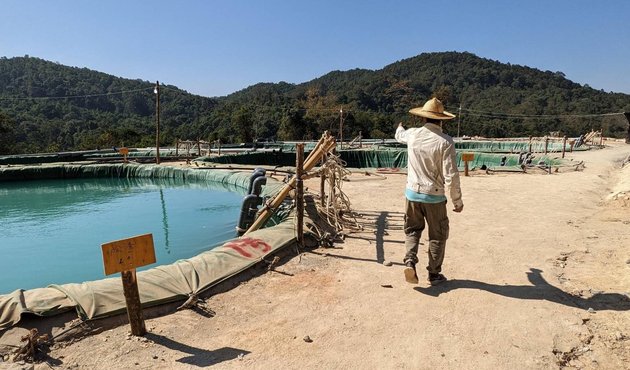
A mine worker walks near the leaching pools near Pangwa (the Kachin Special Region 1), in Northern Myanmar, near the Chinese border in early 2024.
 Supplied by a Global Witness partner

Content type
Opinion

Campaigns

Transition Minerals

Topics
COPHuman rightsMiningMinerals


To reverse the climate crisis, COP30 must address the unforeseen consequences of the critical mineral boom, which is adding more deforestation and CO2 emissions

Next week, scientists, negotiators and government attaches gather in Bonn for the halfway point to COP30 – a critical moment to decide the agenda for the Brazil conference. One issue in particular has been neglected for far too long by previous COPs, and must not be left off the table: the climate consequences of mineral mining.

Global Witness, alongside a growing coalition of over 65 civil society groups, academics and industry voices, is calling for COP30 to deliver an agreement that puts climate, environment and human rights protections at the heart of mineral extraction for the energy transition.

Our call is simple: the minerals powering clean energy must not exacerbate climate change and human rights abuses.
The climate cost of the clean energy boom

Since the adoption of the Paris Agreement in 2015, the push for a low-carbon economy has ignited an unprecedented demand for so-called “transition minerals” – the copper, cobalt, lithium and rare earths used in wind turbines, solar panels, electric vehicles and battery storage. This demand is expected to quadruple in coming years.

But there is a dangerous irony. In the rush to decarbonise, the very process of extracting and processing these minerals is producing serious climate harmsdeforestation in carbon-rich rainforests, emissions-intensive refining processes, and destruction of wetlands and peatlands that are vital carbon sinks.

In some places, mining expansion is undermining the climate resilience of entire ecosystems and putting Indigenous territories and livelihoods at direct risk.

This should become a central climate issue. If left unchecked, mineral extraction could erode the very carbon sequestration potential we need to achieve net zero. According to the International Resource Panel, unchecked resource extraction is already the primary driver of the triple planetary crisis: climate change, biodiversity loss and pollution.

A COP blind spot – until now

So far, these impacts have not been addressed by the UNFCCC – the body tasked with stopping climate change. But the UN Secretary-General’s own 2024 Panel on Critical Energy Transition Minerals has now made it clear that mineral governance is an urgent issue, and we need multilateral coordination to get it right.

Brazil is a top mineral producer and home to the Amazon rainforest, so COP30 is an opportune moment to finally align mineral extraction with climate goals. The Paris Agreement focused rightly on decarbonisation. COP30 must now tackle the material conditions under which that decarbonisation happens.
The building blocks for a climate-safe mineral future

Our coalition is calling for COP30 to support a text that anchors mineral extraction within the UNFCCC’s climate governance framework. Among the priorities, we are asking the COP parties to:Protect no-go zones: Mining should be strictly off-limits in ecosystems vital for carbon storage – old-growth forests, wetlands, peatlands and high-altitude grasslands. These are not just environmental treasures. They are fundamental climate infrastructure.
Respect Indigenous rights: More than half of transition mineral reserves lie on or near Indigenous lands. Any extraction must be subject to Free, Prior and Informed Consent (FPIC). Indigenous Peoples are guardians of some of the most climate-critical ecosystems on Earth. Their rights must not be sacrificed in the name of green industry growth.

Enable equitable transitions: Mineral-rich countries must have the right to use their resources to power their own transitions, not just export them for the benefit of industrialised nations. This includes support for onshoring value-add processing and enabling community-led benefit sharing arrangements.

A mandate for action

COP30 must do more than acknowledge these problems. We need action. That’s why we’re calling for the UNFCCC to formally endorse and expand the work of the High-Level Expert Advisory Group (HLEAG) proposed by the UN Secretary-General’s Panel. This group should:Include equal representation for Indigenous peoples, affected communities, governments, business and civil society
Develop binding international guidelines for responsible mineral sourcing, aligned with the goals of the Paris Agreement
Promote circular economy approaches and mineral demand reduction strategies in end-use sectors
Create climate-specific guidelines to mitigate mining-driven deforestation, especially in primary forests and high-carbon stock landscapes
Align minerals with climate integrity

At its core, the UNFCCC exists to prevent dangerous climate change and promote sustainable development. That mission is incompatible with unchecked mineral extraction that destroys forests, pollutes ecosystems and sidelines Indigenous rights in pursuit of short-term energy gains.

As we accelerate the clean energy transition, we must not repeat the extractive injustices of the fossil fuel era. COP30 is our chance to correct course and ensure that we do not trade one model of extractivism for another.

The world needs action on minerals. Not just for the communities on the frontlines but for the future of our planet.
Authors


Emily Iona Stewart

Head of Policy and EU Relations, Transition Minerals


estewart@globalwitness.org


FAUX AND FRIENDS

Vance made a brief trip to Montana to speak to Rupert and Lachlan Murdoch, AP sources say

Vice President JD Vance has made a brief trip to Montana to meet with media mogul Rupert Murdoch, his son Lachlan and a group of other Fox News executives

Michelle L. Price
Thursday 12 June 2025
The Independent


Vice President JD Vance on Tuesday made a brief trip to Montana, where he spoke to media mogul Rupert Murdoch; his son Lachlan Murdoch, the head of Fox News and News Corp.; and a group of other Fox News executives, according to two people familiar with the trip.

Vance met with the group at the Murdoch family ranch in southwest Montana near Dillon, according to the people. They confirmed the visit to The Associated Press on condition of anonymity because they were not authorized to speak publicly about it.

It’s not clear why the vice president addressed the group or what they spoke about.

A spokesperson for Fox News Channel did not respond to a message seeking comment.

The vice president's office does not release a schedule for Vance and did not offer advance notice of the trip, so the surprise arrival of Air Force Two in Butte, Montana, set off local speculation as his motorcade was seen driving away.

The Murdoch ranch near Dillon is roughly 70 miles (110 kilometers) south of Butte. The ranch, which Murdoch purchased in 2021, is spread across two valleys and a mountain range and has some 12,000 cattle. It sits near Yellowstone National Park along the Montana-Idaho border.

According to flight restrictions issued by the Federal Aviation Administration, the vice presidential aircraft was only on the ground for a matter of hours.

Vance was scheduled to have lunch with President Donald Trump on Wednesday, according to the president's publicly released schedule, meaning the vice president presumably returned to Washington shortly after meeting the Murdochs 2,200 miles (3,500 kilometers) away on Tuesday night.

Rupert Murdoch and his media organization have long been friendly with Republicans and have, for the most part, had a friendly relationship with Trump. He appeared at Trump's inauguration and was spotted earlier this year in the Oval Office.

Rupert Murdoch, 94, stepped down as the head of Fox News and News Corp. in 2023 and handed control over to son Lachlan.

Montana state Auditor James Brown told the Montana Talks radio show that he helped Vance’s staff arrange the trip.

Brown, who did not respond to a message Wednesday from the AP, said he met the vice president when Vance landed at the airport and then helped escort Vance’s entourage on an hourlong drive by driving second lady Usha Vance’s staff.

___

Associated Press writers Zeke Miller in Washington and Matthew Brown in Billings, Montana, contributed to this report.


A Belgrade landmark bombed by Nato could get Trump makeover

Guy Delauney
BBC Balkans correspondent
Reporting fromBelgrade
Getty Images
The bomb-damaged Ministry of Defence building could be replaced with apartments and a luxury hotel

One of the first sights that greets arrivals to the centre of Serbia's capital Belgrade are government buildings in an advance state of collapse. Nato planes bombed them back in 1999 – and they remain in much the same condition.

The message they deliver to visitors could be "welcome to Serbia, our recent history has been tumultuous and complicated – and we still haven't quite finished processing it".

Like a smile with a row of broken teeth, the Defence Ministry buildings are still standing. But they clearly took a serious hit when Nato intervened to stop Serbia's then military campaign in Kosovo.

As a member of the Western military alliance, the US was implicated in the bombing.

Given that history, last year it came as something of a jolt for Serbians when the government struck a deal with a company called Affinity Global to redevelop the site into a $500m (£370m) luxury hotel and apartment tower complex.

Not just because the business concerned is American, but due to the fact its founder is Jared Kushner, best-known as Donald Trump's son-in-law. And because the planned development is due to be called Trump Tower Belgrade.

While these has now been a major twist in the tale that puts the scheme in some doubt, the Serbian government's decision to strike the deal wasn't too surprising.

Before he became US president in 2016, Donald Trump himself expressed interest in building a hotel on the site.

The move also fits a government pattern - as alleged by the Serbian opposition - of allowing foreign investors to profit from public property.

They cite, as a prime example, the Belgrade Waterfront residential and retail project, constructed by Emirati developers on land owned by Serbia's railways.

Where there used to be rusting rolling stock and derelict sidings, there is now a swish shopping centre, smart restaurants and the oddly bulbous, 42-storey Belgrade Tower. It is not to everyone's taste.

Getty Images
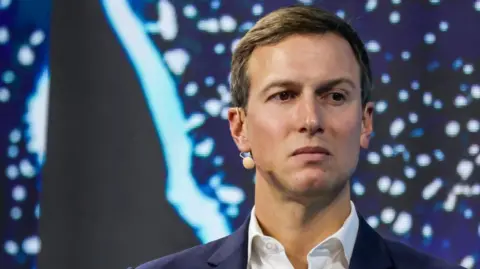
The development project is being led by Jared Kushner

That, however, was a brownfield site, rather than a city centre landmark. The Defence Ministry complex is an entirely different proposition – not least because it acts as a memorial to the casualties of the 1999 bombing campaign.

It is also a highly visual reminder of why the vast majority of Serbians remain opposed to Nato, and feel sympathetic towards Russia.

In that context, granting a US developer a 99-year lease on the site, reportedly for no upfront cost, is a bold move.

But Serbia's president, Aleksandar Vucic, is unapologetic. "It's important to overcome the burden from 1999," he tells the BBC.

"We are ready to build better relations with the US – I think that is terribly important for this country."


Getty Images
Serbia's president Aleksandar Vucic says that the sale of the site is completely above board

That view garners a degree of sympathy from Belgrade's international business community.

Foreign direct investment inflows have more than tripled over the past decade. But GDP per capita remains low compared to EU member states. It stands at just one third of the bloc's average.

To keep those figures moving in the right direction, attracting new investors is vital. And while the financial details of the Ministry of Defence development have not been revealed, the New York Times has reported that the Serbian government will get 22% of future profits.

"For a small and specific market – ex-Yugoslavia, outside the EU – all publicity is good publicity," says James Thornley, a former senior partner at KPMG Serbia, who is now a partner at financial consultants KP Advisory in Belgrade.

"If you have major international players coming in, it's a pull, it's a draw. You're getting the name and opportunity out there."

Mr Thornley has lived in Serbia for 25 years and is fully aware of the sensitivities surrounding the Defence Ministry complex. But he believes that views would change once people saw the benefits of the development.

"That site is an eyesore and should be resolved," he says. "Nothing's happened for 26 years, let's get it sorted out."

But not everyone involved with international investment in Serbia is so enthusiastic.

Andrew Peirson was the managing director of global real estate giant CBRE in Southeast Europe, and now holds the same role at iO Partners, which focuses entirely on the region.

He admits that the shattered state of the Defence Ministry complex is "not good for the city's image", and that the deal to develop the site is "probably good news, because it shows the country can attract big investments".

But he has serious qualms about how the government struck the deal with Affinity Global. Mr Peirson says that there was no open tendering process that would have allowed other firms to bid for the site.

"With state-owned land, you should be able to prove you're getting market value for the site. The way you usually do that is to run a proper tender process," says Mr Peirson.

"If it had been in UK, Germany, Hungary or even Romania or Bulgaria, there would have been a process; it would have gone through the open market. Developers that were looking to enter Serbia, or already active, would have been given the chance to buy it themselves."

Back in 2023 Vucic said he met with Kushner and had an "excellent conversation" with Jared Kushner regarding the "potential for large and long-term investments."

And Donald Trump Jr has since made follow up visits to Belgrade after Affinity Global announced that a Trump International Hotel would form part of the development. The role of Trump Jr and the family business is thought to be limited to the hotel.

Questions have been raised about the Trumps making commercial deals while Donald Trump is in the White House but his press secretary has rejected any suggestion he is profiting from the presidency.

Mr Peirson is concerned that the nature of the Ministry of Defence building deal may irk businesses which have already committed to Serbia.

"If I'm an investor already putting tens or hundreds of millions into the country, I would feel sad that I hadn't been given the chance," he says.

Both Affinity Global and the Serbian government did not respond to requests for comments about how the deal over the site was agreed, and whether or not there was an open tendering process.

Then there is the question of whether a commercial development should be taking place at all. The site, even in its current state, remains architecturally and historically significant.

The buildings were originally constructed to welcome visitors to the capital of Tito's Socialist Federal Republic of Yugoslavia. Architect Nikola Dobrovic created two structures on either side of Nemanjina Street which, viewed together, took the form of a gate.

The design also echoes the contours of Sutjeska Gorge, the site of the Yugoslav Partisans' pivotal victory over Nazi forces in 1943. And in 2005, it was granted protected status under Serbia's cultural heritage laws.

"No serious city builds a modern future by demolishing its historical centres and cultural monuments," says Estela Radonjic Zivkov, the former deputy director of Serbia's Republic Institute for the Protection of Monuments.

"For Serbia to progress, it must first respect its own laws and cultural heritage," she insists. "According to Serbian law, it is not possible to revoke the protection of this site."

Getty Images
Belgrade was bombed by Nato in response to Serbia's actions in Kosovo


But just when it seemed the site's fate was sealed, Serbian organised crime prosecutors delivered a twist worthy of a Hollywood thriller.

On 14 May, police arrested the official who had given the green light for the lifting of the Defence Ministry complex's protected status.

Prosecutors said Goran Vasic, the acting director of the Republic Institute for the Protection of Cultural Monuments, had admitted to fabricating an expert opinion which had been used to justify the change of status. He faces charges of abuse of office and forgery of official documents.

This admission has been seized on by those opposed to the project as evidence Kushner got preferential treatment. The Serbian government denies this.

Where this leaves the Affinity Global project – Trump International Hotel and all – is not entirely clear.

Repeated efforts to arrange an interview with the company have been unsuccessful, though it did issue a statement insisting that Mr Vasic had "no connection to our firm", adding that it would "review this matter and determine next steps".

Vucic, meanwhile, denies there is any problem with the development. During a meeting of European leaders in Tirana, he said "there was not any kind of forgery".

Still, it seems the Defence Ministry's shattered visage will remain unchanged for a while at least. And thanks to the Trump connection, it will offer even more of a talking point for first-time visitors to Belgrade.