Sunday, June 08, 2025

AMERIKA

Stephen Miller brutally ridiculed by observers for 'crying' about 'insurrection'

David McAfee
June 7, 2025 
RAW STORY
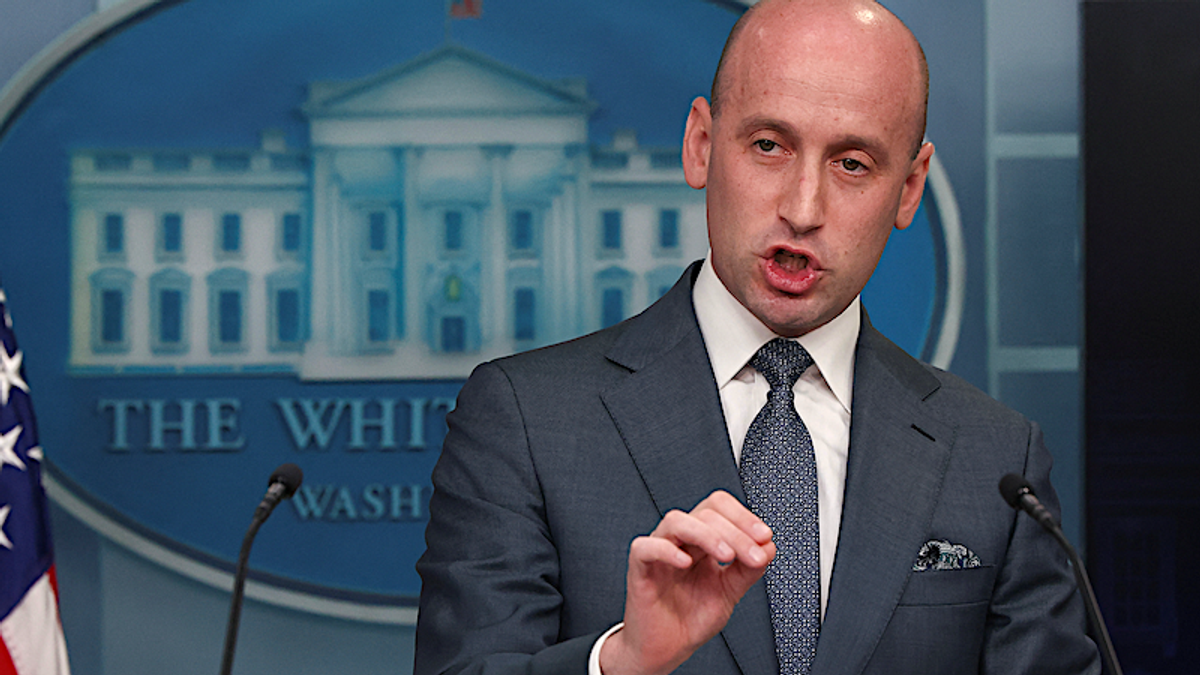

U.S. White House Deputy Chief of Staff Stephen Miller speaks to reporters during a press briefing at the White House in Washington, D.C., U.S., May 1, 2025. REUTERS/Evelyn Hockstein

U.S. White House Deputy Chief of Staff Stephen Miller is under fire this weekend after proclaiming that there is an "insurrection" occurring with California protests.

After it was reported on social media that, "Protesters have surrounded the federal detention center in Los Angeles. California isn’t backing down, this is a full-blown standoff with the feds," Miller sought to define what is happening.

"An insurrection against the laws and sovereignty of the United States," Miller wrote.

Podcaster Brian Allen responded, saying, "Stephen Miller is now calling the anti-ICE uprising in Los Angeles 'an insurrection against U.S. sovereignty.' Let’s be clear: over 800 protesters cornered federal agents in a garage, breached a government building, and caused widespread damage."

"This isn’t just chaos, it’s a full-blown standoff. Miller is demanding National Guard deployment and federal arrests. The stakes just got raised," Allen added. "Stephen Miller; the guy who architected family separation, is now crying 'insurrection' because Californians dared to protest ICE raids. You don’t get to weaponize the government, then act shocked when the people fight back. California isn’t backing down."

Internet personality Leah McElrath also chimed in:

"To give people an idea of where the Trump administration is wanting to take things, White House Deputy Chief of Staff Stephen Miller is calling the anti-ICE protests in large cities in blue states 'an insurrection against the laws and sovereignty of the United States.'"


Self-described "political junkie" Richard Angwin told his hundreds of thousands of followers:

"Calling peaceful protest an 'insurrection' disrespects our democracy. Protesting unjust policies is a constitutional right, not sedition. Miller's rhetoric endangers civil liberties and distorts the meaning of real threats."

U.S. Customs and Border Patrol echoed Miller's language, resulting in similar feedback.


"Let this be clear: Anyone who assaults or impedes a federal law enforcement officer or agent in the performance of their duties will be arrested and swiftly prosecuted to the fullest extent of the law. Attack a cop, and life long consequences will follow!" CBP wrote.

To that, speech writer Mark Salter replied, "Unless you’re breaking into the Capitol and trying to hang the VP."

Oops: Kevin Hassett says 'of course' Medicare cuts are on the table

David Edwards
June 8, 2025 
RAW STORY


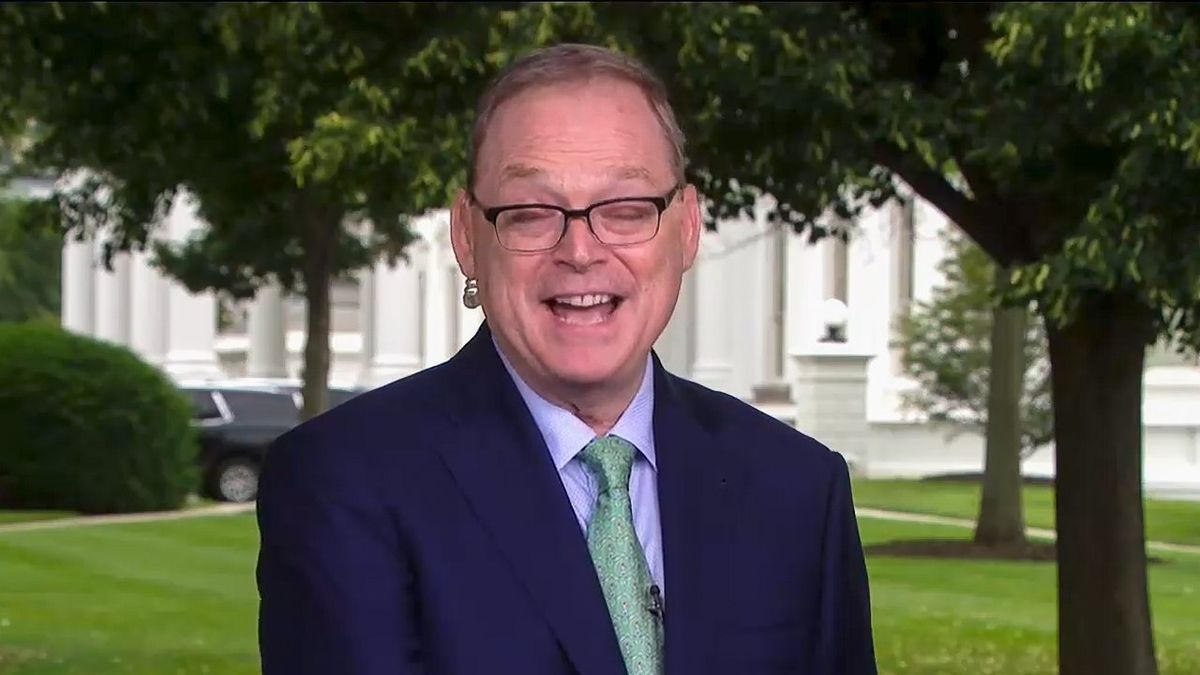
CBS/screen grab


White House economic adviser Kevin Hassett insisted that the Trump administration would consider cutting Medicare even though the president has said the program would not be touched.

During a Sunday interview on CBS, host Margaret Brennan noted that Senate Majority Leader John Thune (R-SD) had acknowledged a discussion around Medicare cuts.

"Is the White House open to any discussion around Medicare?" she asked Hassett.

"Well, first of all, what's happening is that the senators, respecting the legislative process, are discussing what they think that they can put on the table," President Donald Trump's economic adviser replied. "If the Senate comes up with other things they'd like us to look at, I guess we would have a look at them. But there have been a lot of false stories about Medicare being on the table, and it's totally not on the table."

"You are taking Medicare off the table?" Brennan clarified. "The White House says don't do it?"

"No," Hassett laughed, "I've seen a massive amount of waste, fraud, abuse in Medicaid, and I've not been briefed on Medicare waste, fraud, and abuse. But if they find something that, of course, we would look at it."

"You would look at it?" Brennan asked.


"Of course," Hassett said.

Watch the video below from CBS or at the link..


Why MAGA Christianity should fear the new pope

(RNS) — Pope Leo’s election also offers hope, because he reminds the world that religious conviction need not serve nationalist power.


Newly elected Pope Leo XIV concelebrates Mass with the College of Cardinals inside the Sistine Chapel at the Vatican the day after his election as 267th pontiff of the Roman Catholic Church, Friday, May 9, 2025. (Vatican Media)

Jennifer Butler
June 6, 2025


(RNS) — The election of Pope Leo XIV has felt like a balm, as the Chicago native who spent decades in Peru has revealed himself as a leader with a modern globalist perspective, rooted in dignity, solidarity and mercy. The warm reception he’s received from Catholics and non-Catholics alike shows how much his outlook is needed.

There is one group that’s not so enthusiastic. “This is all a very calculated move,” warned Sean Feucht, a Christian nationalist influencer in the Trump orbit. “They chose a globalist and woke Pope from the West ON PURPOSE to stand up and criticize the leaders of the Free World.”
RELATED: Inauguration week was a collision of two Christianities

Fringe-right commentator Laura Loomer, who has advised President Trump on national security appointments, called Leo a “WOKE MARXIST POPE” and “a Marxist puppet in the Vatican.”

Why such fury? It’s not because Leo espouses liberal theological views — he doesn’t. He holds traditional Catholic positions on sexuality and abortion and prefers the liturgical formalism many conservatives favor. Leo has become a MAGA flashpoint not due to any dramatic break from Catholic doctrine, but because his worldview directly threatens the Christian nationalist engine behind the rising authoritarianism of our time. He threatens to become a transnational counterweight to a rapidly expanding authoritarian religious network.

Before the conclave, as Cardinal Robert Prevost, Leo retweeted a post criticizing U.S. President Trump and El Salvadoran President Nayib Bukele for mocking immigrants being deported from the U.S. to Bukele’s jails. The future pope also challenged Vice President JD Vance’s “ordo amoris” argument that Christians should prioritize their own nation over global needs. “Jesus doesn’t ask us to rank our love for others,” the cardinal tweeted.

This was no minor theological dustup over the proper “order of love” Christians should obey. It was a direct rebuttal to the ideological foundation of Christian nationalism: that faith should serve state nativist power and preserve national sovereignty at the expense of human rights.

Christian nationalism is not a uniquely American phenomenon. Russia’s Vladimir Putin has used the Orthodox Church to launder the legacy of Soviet authoritarianism and sanctify nationalist aggression. Hungary’s Viktor Orbán has refined the Christian nationalist playbook, conflating immigration with national collapse and portraying European Union officials as threats to Hungary’s Christian identity.

In Uganda, President Yoweri Museveni, influenced by American conservative Christians, criminalized LGBTQ+ communities, setting them up for harassment, imprisonment and potentially the death penalty. In Brazil, Jair Bolsonaro used similar tactics to rally evangelical Christians, claiming his opponent in recent elections would close churches. After losing that election, he incited an insurrection reminiscent of Jan. 6, where mobs waving Christian banners attacked government buildings.

The American Christian Right has played a central role in the creation of this transnational movement merging religious identity with authoritarian rule. Its leaders increasingly collaborate across borders — culturally, politically and financially — to impose a rigid moral order, polarize the public and erode democratic institutions.

Funded by fossil-fuel billionaires and with strategic support from far-right operatives such as Steve Bannon, Christian nationalists have established international networks to roll back gender rights, embolden strongmen and promote anti-democratic messaging. They’ve built alliances with sympathetic governments, particularly in Eastern Europe, Latin America and Africa. This month, U.S.-based Christian right leaders are hosting a continental summit in Africa aimed at seeding Christian nationalist power in national governments.

The connective tissue? A shared strategy of using religion to justify authoritarian consolidation and frame dissent as sacrilege.

The election of Leo XIV signals that not all global religious institutions are capitulating.

Commentators expect Leo to continue to align the papacy with marginalized communities targeted by the global right, in the spirit of Pope Francis, who invited 40 migrants, transgender individuals and those experiencing homelessness to personally receive his coffin as it entered the Basilica of St. Mary Major.

The implications go beyond such symbolism. The Catholic Church, the world’s largest religious institution, plays a complex role in global affairs, often shaping public sentiment and influencing political alliances. Leo has already shown that he rejects the premises of the Christian nationalist movement, which thrives on polarization and convincing believers that compassion for outsiders is weakness. His tweets to Vance pushed back on the idea that national sovereignty trumps human rights and that political violence is a legitimate defense of “faith.”

MAGA influencers understand that when Leo speaks, people listen — not just Catholics, but others looking for spiritual leadership grounded in clarity. His critics know how powerful that can be.
RELATED: Catholics see a familiar political divide in Pope Leo XIV and his eldest brother

That’s why Pope Leo’s election also offers hope, because he reminds the world that religious conviction need not serve nationalist power. It can, instead, call us to global responsibility — to protect the vulnerable, honor the dignity of every person and resist tyranny in all its forms.


The Rev. Jennifer Butler. (Photo by David F. Choy)

In a moment when the line between spiritual leadership and political manipulation is dangerously thin, that reminder couldn’t be more timely.

(The Rev. Jennifer Butler, the founder of Faith in Democracy and Faith in Public Life, chaired President Obama’s third Advisory Council on Faith-Based and Neighborhood Partnerships. )

MAGARTS&CRAFTS

Kennedy Center's free show sponsored by pest control company flopped big: report


David McAfee
June 8, 2025 
RAW STORY


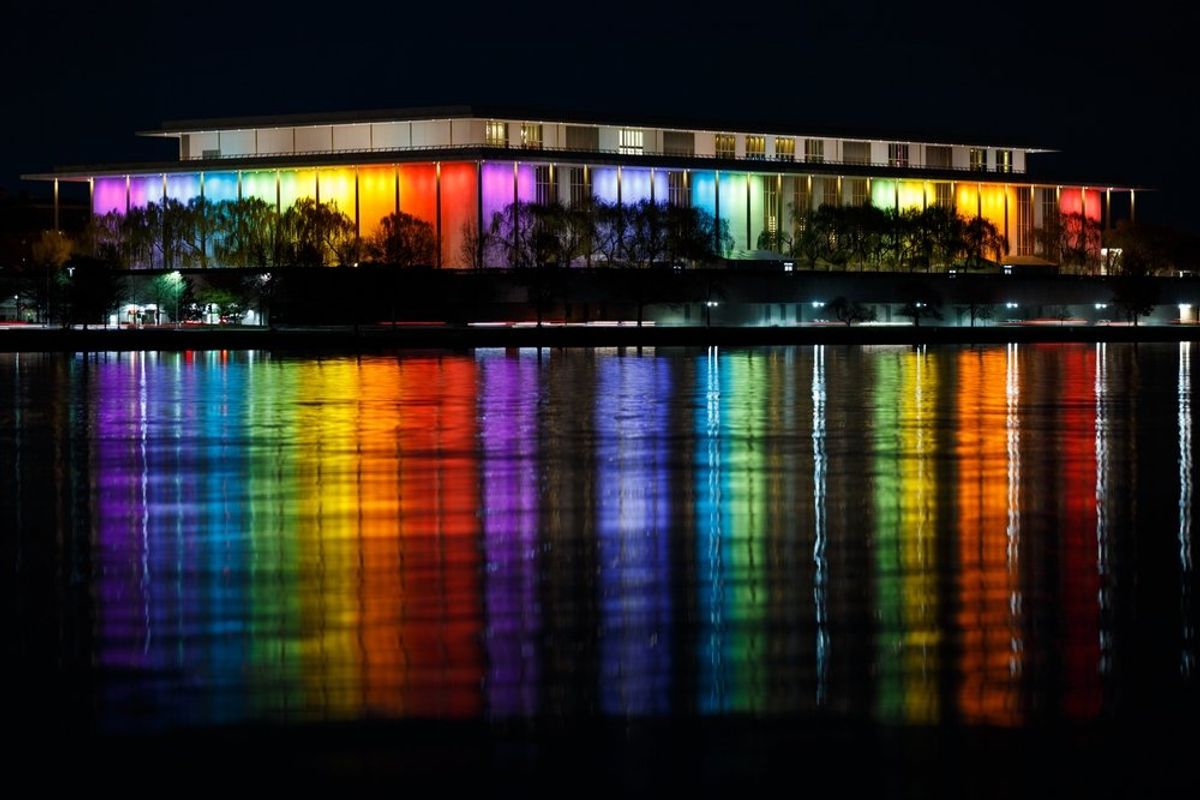
The Kennedy Center in Washington DC.
 (Photo credit: Matthew Hodgkins / Shutterstock)

The MAGAfied Kennedy Center hosted a free animated film about Jesus, but only a little more than half of the seats were filled, according to a new report.

Trump avoided the Kennedy Center in his first term, but has since vowed to remake it in MAGA's image.

Already, reports have abounded about canceled bookings, a dropoff in donations, and stars like legendary cellist Yo-Yo Ma dropping out of performances ever since Trump promised to rebuild the Kennedy Center into a MAGA bastion.

Raw Story reported over the weekend on how Kennedy Center officials have purportedly discussed speaking to Qatar about funding a VIP renovation project.

The same Wall Street Journal report that revealed the potential Qatari funding had an anecdote about a recent film flop.

"Richard Grenell, the White House special envoy who was named executive director of the Kennedy Center in February, said the president has taken a direct interest in the center and agreed it needed additional funding for upkeep and repairs after a recent visit," the report states before quoting Grenell.

"The back of the house and the front of the house have been left in an embarrassing state. I am proud to be a small part of a team where the boss eschews partisan politics in favor of putting American culture, heritage, and excellence first,” Grenell reportedly said.

The report states, "Grenell requested a June 1 public screening of 'The King of Kings,' an animated feature film about the story of Jesus, as told by the character of Charles Dickens. Grenell ordered that the free event take place in the center’s biggest venue, a 2,500-seat concert hall, at a projected cost of $29,000 for staffing, gratis popcorn and other expenses."

"The event featured a prayer wall where visitors could post their written prayers for the nation, and was sponsored by the Museum of the Bible and Moxie Pest Control, whose founder made an unsuccessful run at a Republican U.S. Senate seat in Utah last year," The report continues. "When advance sign-ups for tickets indicated a full house, Kennedy Center leaders added a second screening, increasing the total cost of the event."

But things didn't go as planned, according to the WSJ.

"Employees, who said there is typical attrition for free events, said the actual turnout left the hall 55% full for the first screening and 58% full for the second," the report states. "The Kennedy Center spokesperson said the free screenings were sold out."

Kennedy Center official's new request led to 'audible gasp' from staff: report


The Kennedy Center has undergone a slew of changes since Donald Trump's election to his second term in office, but one request made staff release "an audible gasp," according to a report.

Trump avoided the Kennedy Center in his first term, but has since vowed to remake it in MAGA's image.

Already, reports have abounded about canceled bookings, a dropoff in donations, and stars like legendary cellist Yo-Yo Ma dropping out of performances ever since Trump promised to rebuild the Kennedy Center into a MAGA bastion.

Raw Story reported over the weekend on how Kennedy Center officials have purportedly discussed speaking to Qatar about funding a VIP renovation project, as well as on an anecdote about a recent film flop.

But one request made the staff gasp, according to the Wall Street Journal's weekend report.

Noting that the center recently filled a position for a director of faith-based programming, the outlet reported, "The religious orientation has at times extended to the institution’s staff."

"The Kennedy Center’s new head of development, Lisa Dale, invited her staff to pray during a May meeting, a request that prompted an audible gasp from some staff members, according to a person familiar with the matter," it stated. "Dale dropped the idea at the time. In the same meeting, she mentioned that insubordination would be grounds for dismissal, the person said."

Dale didn't reply to requests for comment from the WSJ, the report states.


Qatar may fund Kennedy Center renovation project as part of 'MAGA makeover'


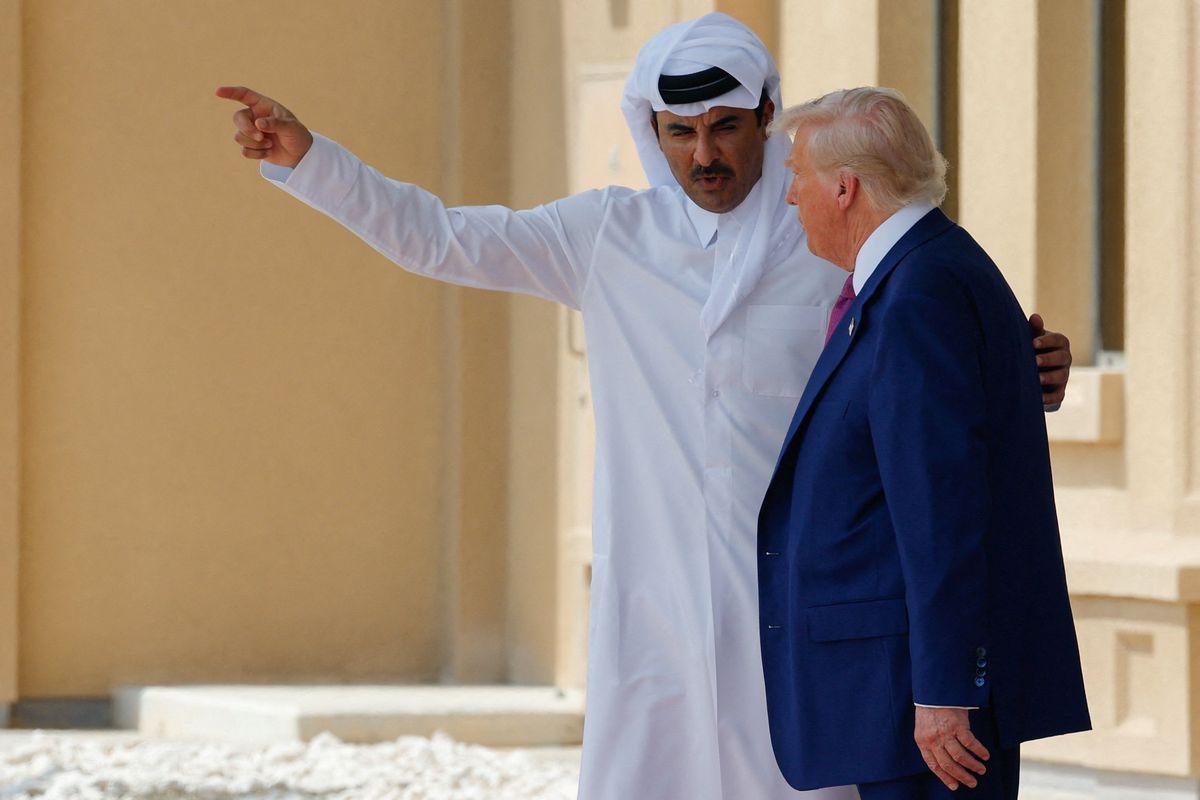
U.S. President Donald Trump talks with Qatar's Emir Tamim bin Hamad Al Thani, before being seen off to Air Force One at Al Udeid Air Base, en-route to Abu Dhabi, United Arab Emirates, in Doha, Qatar, May 15, 2025. REUTERS/Brian Snyder

Fresh off the scandal involving Donald Trump's administration accepting a Qatari jet to be used as Air Force One, Wall Street Journal broke some news about potential Qatari involvement in the famous Kennedy Center.

Trump avoided the Kennedy Center in his first term, but has since vowed to remake it in MAGA's image.

Already, reports have abounded about canceled bookings, a dropoff in donations, and stars like legendary cellist Yo-Yo Ma dropping out of performances ever since Trump promised to rebuild the Kennedy Center into a MAGA bastion.

Now, the WSJ has a new report with additional details on the struggles the center is having.

As part of that report, the outlet included this nugget of reporting:

"A Trump appointee on the Kennedy Center board has suggested building a marina next to it on the Potomac River, so that visitors can pull up their boats and listen to music," it states, adding, "Kennedy Center officials have discussed speaking to Mideast countries such as Qatar about funding the renovation of one of its VIP lounges, people familiar with the matter said."

The article is called, "It’s Opening Night for the MAGA Makeover of the Kennedy Center."

Read the full report here.
SUB REQUIRED

David McAfee
June 8, 2025 


MEN IN BLACK (MIB)


Satellite tracking reveals ocean giants are in trouble


ByDr. Tim Sandle
DIGITAL JOURNAL
June 8, 2025


Sperm whales are the largest toothed predators on the planet, living in matrilineal societies with distinct cultures and dialects - Copyright AFP/File AHMAD GHARABLI, SEYLLOU

A global collaboration, led by the Australian National University with the United Nations, and between many scientists has tracked over 12,000 marine animals from whales to turtles to create one of the most detailed movement maps of ocean giants ever assembled.

The project, MegaMove, highlights how animal migrations intersect with fishing, shipping, and pollution, revealing alarming gaps in current ocean protections. Even if 30% of the oceans were protected, most critical habitats would still be exposed to threats.

The research also links to UN Sustainable Development Goals Goal 14 on water, and specifically, to Goal A of the Kunming-Montreal Global Biodiversity Framework to halt human-induced extinction of threatened species. The study’s lead author was the Research Director and Founder of MegaMove, Associate Professor Ana Sequeira of the Australian National University.

How marine megafauna move globally


The scientists tracked more than 100 species and identified ocean hotspots critical for protecting threatened marine megafauna that fall beyond current conservation zones.

The study reveals how marine megafauna move globally and where their migratory, feeding, and breeding behaviors intersect with human threats such as fishing, shipping, and pollution.

According to one contributor, Francesco Ferretti, a marine ecologist at Virginia Tech: “This is one of the largest marine tracking data sets ever assembled…It’s not just about drawing lines on a map. We need to understand animal behavior and overlap that with human activity to find the best solutions.”

U.S. example


Taking just one of the insights, relating U.S. coastal waters, the scientists revealed that past collapses of shellfish fisheries in North Carolina and impacts on seagrasses meadows, important for fisheries, carbon sequestration, and to prevent coastal erosion, show how predator loss can shift entire ecosystems.

Troubling findings


MegaMove was established to inform the United Nations’ 30×30 target: a global goal to protect 30 percent of the world’s oceans by 2030. The team used optimization algorithms to propose which areas should be prioritized for protection based on how marine species use the space.

But the findings show that even if all 30 percent of protected areas were perfectly placed, it would not be enough. This is partly because sixty percent of the tracked animals’ critical habitats would fall outside of these zones.

Current marine protection areas include only 8 per cent of the world’s total oceans, which the UN High Seas Treaty seeks to expand to 30 per cent.

The research appears in the journal Science, titled “Global tracking of marine megafauna space use reveals how to achieve conservation targets.”


Outdated phones can power smart cities and save the seas


By Dr. Tim Sandle
June 8, 2025
DIGITAL JOURNAL


Smartphone makers are racing to develop more potent batteries that can charge faster and last longer - Copyright AFP Nelson ALMEIDA

Researchers at the University of Tartu Institute of Computer Science have introduced a novel approach for reducing electronic waste and advancing sustainable data processing: turning old smartphones into tiny data centres. This low-cost innovation (just 8 euros per phone) offers practical applications from tracking bus passengers to monitoring marine life without needing new tech.

A modern problem


Each year, more than 1.2 billion smartphones are produced globally. The production of electronic devices is not only energy-intensive but also consumes valuable natural resources. Additionally, the manufacturing and delivery processes release a significant amount of carbon dioxide into the atmosphere.

Meanwhile, devices are ageing faster than ever — users replace their still-functional phones on average every 2 to 3 years. At best, old devices are recycled; at worst, they end up in landfills.

Novel solution

Researchers Huber Flores, Ulrich Norbisrath, and Zhigang Yin from the University of Tartu’s Institute of Computer Science, along with Perseverance Ngoy from the Institute of Technology and their international colleagues developed the alternative use for superseded mobile devices.

“Innovation often begins not with something new, but with a new way of thinking about the old, re-imagining its role in shaping the future,” explains Huber Flores, Associate Professor of Pervasive Computing in a research note.

Yesterday’s devices become tomorrow’s opportunities

The scientists demonstrated that old smartphones can be successfully repurposed into tiny data centers capable of efficiently processing and storing data. They also found that building such a data center is remarkably inexpensive.

These tiny data centers have a wide range of applications. For example, they could be used in urban environments like bus stops to collect real-time data on the number of passengers, which could then be used to optimize public transportation networks.

Practical demonstration


In the project’s first stage, the researchers removed the phones’ batteries and replaced them with external power sources to reduce the risk of chemical leakage into the environment. Then, four phones were connected together, fitted with 3D-printed casings and holders, and turned into a working prototype ready to be re-used, fostering sustainable practices for old electronics.

The prototype was successfully tested underwater, where it participated in marine life monitoring by helping to count different sea species. Typically, these kinds of tasks require a scuba diver to record video and bring it to the surface for analysis. However, with the prototype, the whole process was done automatically underwater.

This demonstrates that even with minimal resources, smartphone devices can be given a new purpose, contributing to the development of more environmentally friendly and sustainable digital solutions.

The research appears in the journal IEEE Pervasive Computing, titled “Supporting Sustainable Computing by Repurposing E-Waste Smartphones as Tiny Data Centers.”

Scientists, activists call for ban on bottom trawling ahead of UN ocean summit

Issued on: 08/06/2025 - 

Scientists and environmental activists are calling for a ban on bottom trawling, a damaging fishing practice, ahead of a high-level UN summit in France aimed at protecting the world’s oceans.

Video by: FRANCE 24


Money, mining and marine parks: The big issues at UN ocean summit


By AFP
June 8, 2025


France is hosting the third edition of the UN Ocean Conference in the Riviera city of Nice - Copyright AFP Frederic DIDES

Nick Perry

France is hosting world leaders this week to confront what the United Nations calls a global “emergency” in the oceans — but what is expected, and can the summit make a difference?

There is pressure on the UN Ocean Conference starting Monday in Nice to show that countries can unite and deliver more than just talk for the world’s ailing and neglected seas.

– Plundered parks –

Several countries are expected to announce the creation of new marine conservation zones within their national waters, though how protected they really are will come under scrutiny.

Some countries impose next to no rules on what is forbidden or permitted in marine zones. France and other EU states, for example, allow bottom trawling, a damaging fishing practice, in protected waters.

This means just three percent of oceans are considered truly safe from exploitation, far short of a global target to place 30 percent under conservation by 2030.

– High seas –

Key to achieving this goal is enacting the high seas treaty, a landmark global pact signed in 2023 to protect marine life in the vast open waters beyond national control.

France had pinned success at Nice on delivering the 60 ratifications necessary to bring the treaty into force, saying the conference would be a failure without it.

But it could not get the required number, drumming up roughly half ahead of the summit. Those outstanding will be pushed to explain when they intend to do so.

– Uncharted waters –

France will be leading diplomatic efforts in Nice to rope more countries into supporting a moratorium on deep-sea mining, a contentious practice opposed by 33 nations so far.

Bolstering those numbers would send a rebuke to US President Donald Trump, who wants to allow seabed mining in international waters despite concerns over how little is understood about life at these depths.

But it would also carry weight ahead of a closely watched meeting in July of the International Seabed Authority, which is haggling over global rules to govern the nascent deep-sea mining sector.

– Actions not words –

At the summit’s close, nations will adopt a pre-agreed political statement that recognises the crisis facing oceans, and the global need to better protect them.

Critics slammed the language in the eight-page document as weak or — in the case of fossil fuels — missing altogether, but others cautioned against reading into it too much.

“The end declaration from here isn’t really the only output. It’s much more important, actually, what governments commit to, and what they come here to say on an individual basis,” said Peter Haugan, policy director at the Institute of Marine Research in Norway.

– Money matters –

The conference is not a COP summit or a UN treaty negotiation, and any decisions made between June 9 and 13 in Nice are voluntary and not legally binding.

But countries will still be expected to put money on the table in Nice to plug a massive shortfall in funding for ocean conservation, said Pauli Merriman at WWF International.

“What we lack — what we still lack — is the ambition, the financing and the delivery needed to close the gap,” she told reporters.

“It’s not enough for governments to show up to Nice with good intentions.”


What is the UNOC? World leaders gather in Nice to confront ocean emergency


Copyright AP Photo/Annika Hammerschlag

By Rosie Frost
Published on 08/06/2025 

More than 10,000 people will gather in France for largest ocean conference ever.


World leaders are gathering in the French city of Nice tomorrow for the United Nations Oceans Conference.

As the world’s oceans face increasing threats from climate change, overuse of marine resources and pollution, leading marine experts are calling on governments to use this opportunity to protect fragile underwater ecosystems.

Taking place from 9 to 13 June, it is the largest ocean summit ever organised and could provide a vital chance for key agreements to be finalised, promises to be delivered upon, and new pledges to be made.

What is the United Nations Ocean Conference?

Co-chaired by France and Costa Rica, the conference aims to confront the deepening global ocean emergency. Scientists warn that climate change, plastic pollution, the loss of ecosystems and the overuse of marine resources are all pushing our oceans to the point of no return.

In an effort to spark collaboration and subsequent solutions to some of these problems, UNOC is bringing together world leaders, scientists, activists and businesses.

Specifically, it focuses on the implementation of UN Sustainable Development Goal 14: Life Below Water. The overarching theme of this particular conference is “accelerating action and mobilising all actors to conserve and sustainably use the ocean”.

This is the third UN Oceans conference, and over 10,000 people will be in attendance. It is set to welcome leaders like Brazil’s Luiz Inácio Lula and France’s President Emmanuel Macron will be in the spotlight.
Will UNOC result in a new agreement for oceans?

The week-long talks will end with the adoption of a political declaration. While this won’t be legally binding, it sets the tone for future global ambition, serving as a signal to governments, investors and civil society and hopefully motivating support for new initiatives.


Related


UNOC identifies three key priorities for the declaration: defending ocean ecosystems, sustainable ocean economies and accelerating actions.

A successful conference would result in a final and signed political declaration which would be called the Nice Ocean Action Plan.

More ratifications of the landmark UN High Seas Treaty are also expected as efforts intensify to ensure its implementation.

A strong outcome could also help lay the groundwork for more biodiversity and climate wins at COP30 in Brazil later this year.

What can we expect from President Macron?


France is co-hosting the conference with Costa Rica, and it is being held in Nice on the country’s Mediterranean coast.

Ahead of the summit, President Macron and the French government have been encouraging countries to improve ocean protection.

“We've…had the leadership from the French government engaging with countries to increase the ratification for the BBNJ (UN High Seas Treaty),” says Rita El Zaghloul, director of the High Ambition Coalition for Nature and People.

In late May, the European Union and six of its member states formally ratified the High Seas Treaty after France and Spain did so earlier this year. It is hoped that this international agreement will garner enough ratifications before the end of the summit to enter into force as international law.

Brazil's President Luiz Inacio Lula da Silva, left, and French President Emmanuel Macron leave after visiting an exhibition in Paris. AP Photo/Michel Euler, Pool

France has been actively leading efforts to engage with countries on ocean protection, El Zaghloul adds, to ensure that the conference ends with some concrete results.

Earlier this year, Chile and France announced the ‘100 per cent Alliance’, urging coastal and ocean states to commit to 100 per cent sustainable management of their national ocean areas.

But Enric Sala, National Geographic explorer in residence and founder of Pristine Seas, emphasises that France has to be a “leader in actions, not just words”.

Related


“France is the co-chair of the High Ambition Coalition for Nature and People, committing to at least 30 per cent of the ocean protected by 2030,” he explains, “and in France…there are all these protected areas, but most of these protected areas are open to commercial fishing, including bottom trawling.”

Sala says just 1 per cent of French waters are no-take areas that actually allow marine life to recover. These areas also bring huge benefits for tourism, jobs and local, small-scale fishermen.

“Everybody expects President Macron to make some announcements of designation of new marine protected areas that are truly protected. Also, there is a great expectation for President Macron to make some commitment about phasing out bottom trawling in marine protected areas.”

Funding for marine protection is billions short

The pledges made both at the conference and before will mean nothing, however, without the funds to back them up. And global marine protection efforts are already critically underfunded.

In 2022, nearly 200 countries agreed to designate 30 per cent of the world’s oceans as protected areas by 2030.

As of 2024, just 8.4 per cent were covered, and only 2.7 per cent have been assessed to be effectively protected - meaning there are regulations and active management in place to ensure minimal or no damaging activities. That latter figure has dropped earlier this year as a result of the Trump Administration’s rollback of the Pacific Islands Heritage Marine National Monument.

Just two countries - Palau and the United Kingdom - have effectively protected more than 30 per cent of their waters, although effectively protected areas in UK waters are overwhelmingly located in remote, overseas territories.

Around $15.8 billion (€13.8 billion) a year is needed to achieve the 30 per cent by 2030 target, but a new report by a global coalition of nature NGOs and funders has found that just $1.2 billion (€1.05 billion) is currently being spent.

That is a massive funding gap of $14.6 billion (€12.7 billion) - a figure the environmental groups point out is just 0.5 per cent of annual global defence budgets.

Brian O’Donnell, director of Campaign for Nature, which led on the finance gap analysis, says protecting the ocean is “no longer just an ecological imperative - it's an economic one.”

“For just $15.8 billion (€13.8 billion) a year, we can protect one of our planet’s most valuable assets while avoiding costs and unlocking long-term returns in the tens of billions.”

The report’s authors say it sends a clear message ahead of UNOC: governments can’t afford to underinvest in ocean protection. And the conference is a critical opportunity to build momentum, ratify key international agreements and recognise the value of the ocean
As Arctic ice vanishes, maritime traffic boom fuels the climate crisis


The Arctic is warming four times faster than any other place on the planet. As sea ice melts, new shipping routes between continents are opening up, and the yearly window for navigating through these freezing waters is expanding. But there is a heavy toll that comes with increased traffic in the Arctic, a fragile environment that is rapidly collapsing.


Issued on: 08/06/2025 -
FRANCE24
By: Lara BULLENS

File photo of a ship navigating between icebergs near Greenland in the Arctic taken August 15, 2023. © Olivier Morin, AFP

When a Russian gas tanker sliced through the icy waters of the Arctic in the middle of winter four years ago, it became clear global shipping routes would be forever changed.

The Christophe de Margerie vessel, named after the former CEO of French oil company Total, made its way from eastern China through the Bering Sea, eventually docking at a remote Arctic port in Siberia in February 2021.

For the first time in history, global warming caused by humans allowed a ship to navigate through Arctic winter ice.

The Arctic has been warming four times faster than anywhere else on the planet since 1979, according to multiple scientific studies. Melting sea ice is opening up paths for increased shipping and other vessel traffic in the region, especially along the Northern Sea Route, the Arctic shortcut between Europe and Asia that stretches more than 9,000 kilometres.

Shipping seasons are also being prolonged as a result of the warming climate.

But with more traffic comes more environmental degradation. The consequences are dire, particularly for climate heating, loss of biodiversity and pollution. And since the Arctic is a key regulator of the Earth's climate, what happens in this region can be felt thousands of kilometres away.
A vicious cycle

It's a vicious cycle. As sea ice melts and opens new routes for maritime traffic in the Arctic, the environmental fallout caused by vessels burning fossil fuels adds to global warming, which in turn melts more sea ice.

A perfect example of this is black carbon. It's a sooty material emitted from gas and diesel engines that aren't completely combusted. Not only does black carbon pollute the air with particulate matter, but because of its ability to absorb light as heat, it contributes to climate change by warming the air.

When black carbon is deposited on ice in the Arctic, it takes away its ability to reflect heat.

“The black colour deposited on the white ice means the ice then absorbs more sunlight, leading to more melting,” explained Sammie Buzzard, a polar scientist at the Centre for Polar Observation and Modelling at Northumbria University.


The use of heavy fuel oil, leftovers from the bottom of the barrel that lead to high black carbon emissions, grew by 75 percent in the Arctic in just four years, between 2015 and 2019. On the opposite end of the planet, in Antarctica, its use has been banned since 2011.

Black carbon is one of the most significant contributors to climate change, after CO2.

“Lots of Arctic ice gets covered, and anything that changes the colour of the ice or causes it to melt also removes a key part of the ecosystem,” Buzzard said.

Busy routes

Almost all types of maritime traffic are on the rise in the Arctic, whether for tourism or transportation. Fishing boats are by far the most common type on ship in the Arctic, followed by cargo ships and bulk carriers. Between 2013 and 2023, every type of ship aside from oil tankers and research vessels took to the Arctic in higher numbers.

Not only are there an increasing number of ships in the Arctic Ocean, but they are also navigating over greater distances. In the span of a decade, the total distance vessels covered more than doubled, with an increase of 111 percent.

The area for ships to move safely in open waters of the Arctic route during a 90-day safety window expanded by 35 percent from 1979 to 2018. Every year, the area keeps growing. It’s estimated that five percent of global shipping traffic will be diverted to the Arctic route as a result.

Usually, navigating the frozen waters of the Arctic requires an escort well-versed in icebreaking. A boat designed to break open large chunks of ice glides alongside vessels that need to make it through one of the three main shipping routes: the Transpolar Sea Route, the Northwest Passage or the Northern Sea Route.

But according to climate projections, unescorted navigation could be possible as early as 2030 in the summer months.

Arctic shipping routes. © FRANCE 24's graphic design studio

In the Canadian Arctic, where the Northwest Passage is located, the number of vessels has quadrupled since 1990.

But the exact number of weeks ships can navigate safely through the route is dwindling. Research has found that melting sea ice doesn't necessarily make all Arctic sea routes more accessible. Thin sea ice does indeed melt under global warming, but centuries-old floes break off and are released into the Arctic Ocean, moving southwards and creating choke points, which makes some key points in the Northwest Passage more dangerous and unpredictable.

Still, the overall trend is alarming. Melting sea ice brought on by global warming allowed shipping traffic to increase by 25 percent between 2013 and 2019.

The butterfly effect of the Arctic

The Arctic helps keep the planet's climate in balance. As sea ice perishes and maritime traffic increases, further accelerating global warming, environmental consequences become ever more far-reaching.

“The polar regions act to help cool the rest of the planet through the white ice reflecting energy from the sun back to space,” Buzzard explained. “They act a bit like a giant freezer for the rest of the planet.”

This has an effect on global temperature. “Sea ice regulates heat exchange between the atmosphere and ocean, impacting the global circulation of heat,” said Buzzard. “[So] anything that reduces the amount of ice, or darkens it, can mean less energy is reflected, which means extra warming, which then has consequences for the entire planet.”

Some changes are being implemented to slow down this worrying feedback loop. A ban on heavy fuel oil, which releases black carbon, was introduced in July 2024, though some vessels can continue to use it until July 2029.

The UN agency responsible for regulating maritime transport, the International Maritime Organization (IMO), also pledged to reduce emissions by at least 20 percent in the next five years.

But the Clean Arctic Alliance, a group of 21 NGOs who advocate for government action to protect the Arctic's wildlife and its people, insists there is not enough being done to curb the rise of black carbon and methane pollution from shipping in the Arctic. Its lead advisor, Sian Prior, said that “in recent years, black carbon emissions from Arctic shipping have more than doubled,” in a statement published on 14 May. 

For Buzzard, the economic interests of using Arctic shipping routes may be beneficial. But increased traffic must be coupled with strict environmental regulations.

“While there can be a saving both in terms of carbon and time for ships to travel across the Arctic, this is a very fragile ecosystem that is already struggling to cope with changes from human-created climate change,” she said.

“Sea ice not only acts to help cool the planet, it is a habitat for creatures like polar bears that use the ice for hunting,” Buzzard noted. The polar bear, now a mascot for environmental issues in the Arctic, relies on sea ice to hunt and move around to find crucial denning areas. It accounts for over 96 percent of the animal's critical habitat.

Increased traffic also brings noise pollution, which disturbs mammals who travel through these frozen waters, like whales. Pods use sound to find their food, mates, avoid predators and migrate. A recent study found that underwater noise in some places in the Arctic Ocean has doubled in just six years because of increased shipping.

The list of environmental consequences of the maritime traffic boom in the Arctic goes on. Vessels navigating through the Arctic also release air pollutants, flush out sulphur oxide into the ocean through scrubbers that remove the substance from a ship's exhaust, and can leave behind litter.

“There is also the increased risk of pollution from oil spills,” added Buzzard.

As countries such as Russia and China eye the prospect of new exploitation that comes with melting sea ice, and US President Donald Trump covets the resource-rich island of Greenland, time is running out for this fragile environment.

“There needs to be careful regulation to minimise the [environmental] impacts to the area,” stressed Buzzard. “The consequences won't just stay in the Arctic.”
Environmental DNA, a ‘revolutionary’ key to unlocking the secrets of our oceans

Sequencing environmental DNA found in soil, seawater, snow or even air samples has made it possible to detect and identify organisms, allowing researchers to build exhaustive biodiversity inventories. And when it comes to our oceans, environmental DNA may be a revolutionary tool for better understanding and protecting them.

Issued on: 06/06/2025 - 
FRANCE24
By: Cyrielle CABOT

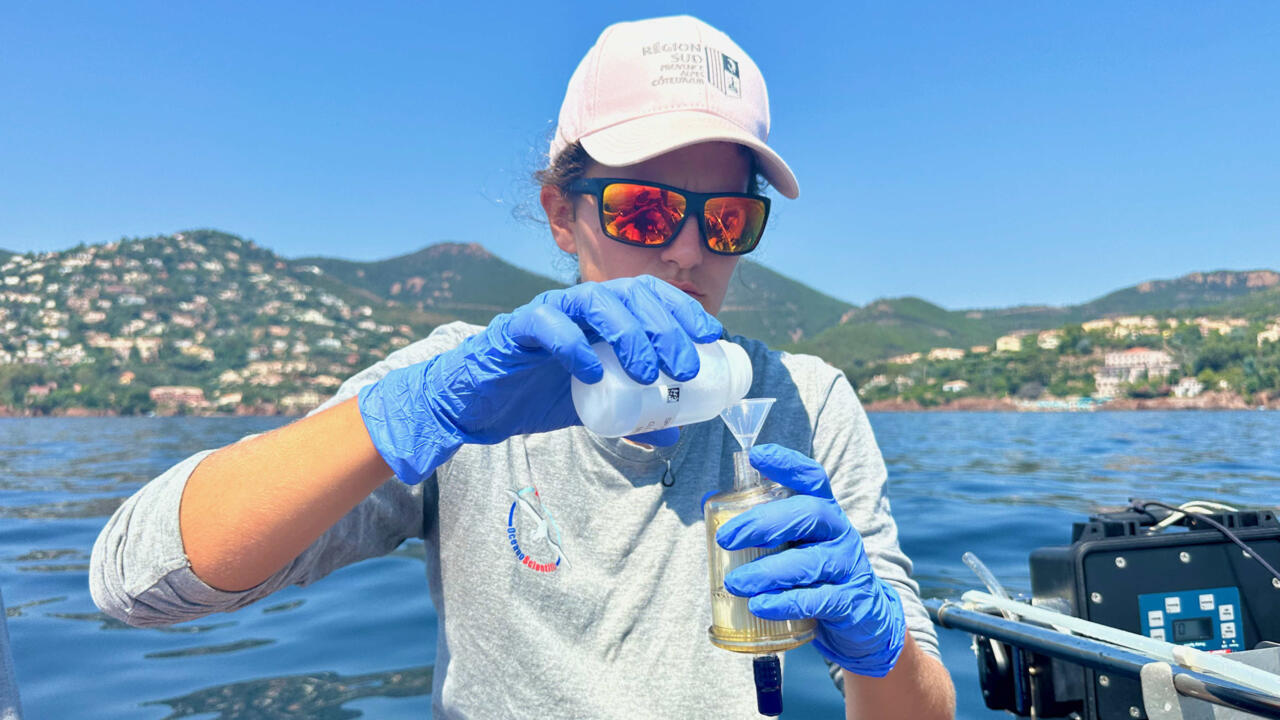
A volunteer from NGO Oceano Scientific takes a DNA sample in the Mediterranean in June 2024. © Oceano Scientific


Pierre Jorcin slides on a pair of gloves, attaches a plastic tube to a filter, plunges it into the water, presses the start button on a small pump and then slowly begins walking through the river stream. Thirty minutes later, he has gathered three litres of water and filtered thousands of particles. The entire procedure seems simple, banal even. But Jorcin’s gesture is part of a microscopic revolution. In the process, the scientist has collected fragments of environmental DNA, also known as eDNA.

“Every living organism leaves traces of DNA behind, whether in water, soil or in the air. And those traces hold out for some time before eventually degrading,” Jorcin explains. “By collecting them, we can identify and catalogue the organisms we find like bacteria, mammals, amphibians, fish, etc.”

Pierre Jorcin, project manager at Spygen, takes environmental DNA samples at from a lake in Savoie on June 2, 2024. © Cyrielle Cabot, FRANCE 24

An environmental DNA kit that is sold by Spygen. © Cyrielle Cabot, FRANCE 24

The samples Jorcin collects are then transported a few kilometres away to the University of Savoie Mont Blanc in Chambéry, an Alpine town in southeast France. That is where the offices of Spygen are based, a French pioneer in environmental DNA and the only company in the country that markets eDNA kits. Spygen sells the kits to NGOs, universities and private stakeholders, and then collects the samples to decode them.

Dozens and dozens of samples are processed in the small premises of the company, which analyses the trapped eDNA to try and identify what species it belongs to. “We extract the DNA from the filters and then run it through the sequencing machines,” says Jorcin, who is a project manager at the company. After sequencing, a long succession of four letters emerges – A, T, C, G – representing the genetic code of all species. “Then it’s up to us to find which species the code belongs to by looking through reference databases,” he explains.

A burgeoning practice

Spygen didn’t end up at the foot of the Alps by accident. While the practice of sampling and sequencing eDNA was first tested by a US microbiologist in the 90s, this small revolution truly began about 60 kilometres south of Chambéry. Researchers from the Alpine ecology lab in Grenoble in 2008 found that the method could be used to detect bullfrogs, an invasive species, in places it had not yet been seen.

A year later, scientist and Spygen co-founder Alice Valentini came up with the idea of using eDNA in her study on Himalayan brown bears, an endangered species. “To get a better understanding of the bear’s low reproductive capacity, Valentini tested the eDNA of food in its feces, which allowed her to get a precise rundown of its diet. It was a completely new method," says Benjamin Allegrini, president of the company. "That’s when we understood the full scope of eDNA. Not only can we detect what organisms or species exist in different environments, but we can also understand how they interact with one another,” he says, beaming.

A passionate birdwatcher since he was a child, Allegrini kicked off his career, binoculars in hand, as an ornithologist and went on to study bats. “Then I discovered how much we could learn from DNA," he recounts. Once he had earned a degree in molecular biology, he decided to devote himself entirely to Spygen from 2018 onwards.

Benjamin Allegrini in the eDNA sequencing lab in Chambéry on June 2, 2025. © Cyrielle Cabot, FRANCE 24

“The more we know about our environment, the more we’ll be able to protect it,” says Allegrini, who recently published a book on eDNA. “That’s why it’s important to develop new technologies like eDNA, which can revolutionise how we see the world.”

The number of scientific papers on environmental DNA has skyrocketed since Spygen was founded in 2011, with each publication confirming the effectiveness of the method a little more.

It is now a widely used approach, and is even part of France’s new national strategy to protect biodiversity, which was published late last year. The country plans to “regularly and extensively” document its national biodiversity with a census creating during a “large-scale campaign to collect and analyse environmental DNA”.
An ambitious inventory for underwater species

And if there is one habitat where environmental DNA is especially useful, it’s in our seas and oceans. Much of the life that exists in the vastness of these underwater worlds is invisible. “In just one litre of seawater, there are 28 million DNA sequences. But only 14 percent of those sequences are identifiable. That means there are millions and millions of genetic sequences we know nothing about,” Allegrini explains.

“Until now, traditional methods used to document marine biodiversity yielded fragmented results,” says Yvan Griboval, a sailor who is also the head of the French NGO OceanoScientific, which works to collect scientific data from our oceans. “Environmental DNA opens up a new range of possibilities by offering a tool that is no longer based on estimates or observations, but on factual data.”

Read moreThe Saya de Malha Bank, a 'forgotten ecosystem' in need of protection

Scientists traditionally rely on fishing returns, diving expeditions, underwater cameras or acoustic surveys to observe life underwater. Collecting eDNA is a less invasive procedure, with no bait or electric fishing needed to gather data.

“Above all, it allows us to detect species that are invisible to the naked eye, especially those that are rare and difficult to find, or those that only come out at night or live in habitats that are hard for humans to reach,” Allegrini adds.

“It’s also much faster and cheaper than traditional methods. A diver can only make four trips 50 metres underwater per day, and their visibility is limited to two metres… Imagine if they had to cover the entire Mediterranean basin. How many species would they miss?” the head of Spygen insists.

Two years ago, Spygen and OceanoScientific banded together with six other partners to take on a wild dream. Between May and July, the group decided they would make an inventory of every species of fish, crustacean and marine mammal found along the Mediterranean coast. Over the course of four months, they gathered more than 700 eDNA samples. The project was called BioDivMed.

A DNA collection kit is attached to an OceanoScientific boat in the Mediterranean in June 2024. © Oceano Scientific

“When we started out, we didn’t really know what the outcome would be. No one had ever tried to get that broad of an inventory of Mediterranean species,” Griboval recalls. “And the results were good news. The biodiversity of the area was much richer than we had expected it to be.”

“We often talk about the Mediterranean as a dying sea, but this project showed that the coastline is healthier than we thought,” Griboval says.

A total of 267 fish species were identified. “It was a phenomenal result. Unprecedented,” adds David Mouillot, a professor at the University of Montpellier who took part in the project.

Watch moreHatching of baby turtles in south of France puzzles scientists

And there were other surprises. Off the coast of Corsica, eDNA identified the presence of several angel sharks, a critically endangered species that was already thought to have disappeared from the area. “We were able to find the animal’s last refuge,” Mouillot says. “We also found DNA traces of sunfish, which we also thought had disappeared from our waters.”

For Mouillot, the discoveries were not only symbolic but vital for conservation efforts of the Mediterranean’s biodiversity. “Detecting rare species has a tendency to get things moving, especially when it comes to protecting a specific area or ecosystem. No one wants to destroy the habitat of the last living specimen of an endangered species,” he says.
Better protections, better catch

At a time when France, like several other countries, has promised to transform 30 percent of its land and marine ecosystems into protected areas – compiling inventories of living organisms could help identify and monitor priority zones.

One hundred sites in the Mediterranean were identified thanks to the BioDivMed project from 2023. Surveys are conducted annually to observe how many species are left in each delineated zone. And every three or four years, a more complete inventory is taken to allow for long-term monitoring.

“That’s another advantage of eDNA,” says Mouillot. “There is a standard protocol that is easy to replicate, so we can conduct serious species monitoring. It allows us to determine whether the protection of a given area is actually working, whether a species has moved somewhere else, or if there is a proliferation of an invasive species that could pose a threat.”

“Inventories based on eDNA also help us inform fishers about available resources,” says Griboval. “We know when we need to reduce fishing when it puts too much pressure on a given area, and we can help by directing fishers to other locations or even diversify their catch.”

Exploring the deep sea


Allegrini and his team are now setting their sights on new horizons – the deep sea. While some have their sights set on exploiting the resources that can be found, eDNA could help bolster research on this ecosystem we still know very little about.

For some time now, Spygen has been developing an underwater drone that could collect data from these unexplored depths.

But there is a limit to their ambitions. Organisms can only be identified if their genetic sequencing has already been catalogued in the past. In other words, unknown species would not be able to be identified – there would be no match in existing databases.

“So we have a parallel challenge of enriching the existing databases,” says Mouillot. “The good news is that the DNA we collect can be saved, even if it’s unknown for now. We can always identify it later when our inventories grow.”

Another major challenge is "developing our identification process”, says Allegrini. “We can find out what species an organism is thanks to a fragment of its DNA. But we need to be able to identify what family or even what individual it belongs to.”

“It would be a revolution for species monitoring, especially for those at risk of becoming extinct. We could track them with precision, understand their behaviour, their movements…” Allegrini adds.

For now, however, Allegrini admits that these ambitions feel a little more like science fiction than reality. But the president of Spygen has a tendency to think big, especially when it comes to observing something small.

This article was translated from the original in French by Lara Bullens.
Jewish groups in US line up to oppose Trump anti-Semitism strategy


ByAFP
June 7, 2025


US Jewish groups are unified over the need to fight mounting anti-Semitic incidents across the country, but many are bitterly opposed to how President Donald Trump is seeking to counter the scourge.

A string of incidents has targeted Jews in the United States in recent weeks. Two Israeli embassy workers were murdered in Washington, Molotov cocktails were thrown at an event in Colorado, and tensions persist on university campuses.

The conservative Heritage Foundation think-tank, behind the “Project 2025” roadmap for radically overhauling and shrinking the government, published in October “Project Esther” — a blueprint on combatting anti-Semitism.

The project seeks to “dismantle” so-called “anti-Israel,” “anti-Zionist,” or “pro-Palestinian” organizations allegedly part of a “Hamas support network” that has “infiltrated” universities including Columbia and Harvard.

The text advocates the dismissal of professors, barring some foreign students from campuses, expelling others outright, and withholding public funding from universities.

Robert Greenway, a Project Esther co-author, recently told The New York Times it was “no coincidence that we called for a series of actions to take place privately and publicly, and they are now happening.”

The Heritage Foundation refused an interview request.

Stefanie Fox, director of Jewish Voice for Peace (JVP), said “Project Esther sets out a blueprint for the Trump administration to sharpen the legal regimes that will best advance (his) ‘Make America Great Again’ goals.”

The JVP, a Jewish organization that leads demonstrations against “genocide” in Gaza, is named in Project Esther as a member of the so-called Hamas support network.

“These assumptions are baseless, paranoid, laughable,” said Fox, whose group is on the left.

– ‘Weaponizing’ anti-Semitism? –


Although 89 percent of the 7.2 million US Jews say they are concerned about anti-Semitism, 64 percent disapprove of Trump’s efforts to combat it, according to a recent Jewish Voters Resource Center poll.

“There is anti-Semitism on those campuses… But to give the broad claim that the thrust to fight anti-Semitism is to go after higher education is just absolutely ridiculous,” said Kevin Rachlin.

He is a prominent figure in the Nexus Project formed in opposition to Project Esther that seeks to counter anti-Semitism without impairing freedom of speech.

Trump’s strategy “doesn’t keep Jews safe.” Rather, it seeks to separate the Jewish minority from others in the country and ignores right-wing anti-Semitism, Rachlin argues.

“We as Jews are safer when we’re in coalition with other groups and other minorities,” he said, adding that combatting anti-Semitism through education was more viable than targeting universities.

Traditional Jewish groups have aligned more with Trump’s Republicans and Israeli Prime Minister Benjamin Netanyahu, unlike the “majority” of American Jews, claims author Eric Alterman.

“What’s happened in Gaza has been very hard for most American Jews — particularly young American Jews — to stomach. Young American Jews are now roughly evenly divided between supporting Israel and supporting the Palestinians,” he told AFP.

Alterman added most US Jews are not anti-Zionist — but don’t like the war in Gaza or Israel’s West Bank strategy.

“They’re kind of caught in the middle.”

Some Jewish groups warn that when Trump targets higher education purportedly combatting anti-Semitism, he is actually “weaponizing” the sensitive issue to stifle freedom of expression.

In recent weeks, ten major Jewish organizations criticized the Trump administration in a letter, saying they reject the “false choice” between “Jewish safety” and “democracy.”

“There should be no doubt that anti-Semitism is rising” but access to “higher education, and strong democratic norms… have allowed American Jewry to thrive for hundreds of years,” the letter states.

One of the signatories, rabbi and former ambassador for religious freedom David Saperstein, said there was “appreciation” for Trump prioritizing anti-Semitic violence and rhetoric — but opposed the clampdown on universities, media and judges.

He added: “Ironically, they are targeting democratic institutions that have given the Jewry in America more rights, more freedom, more opportunities than we have ever known in our 2,600 years of diasporic history.”
France’s Macron to visit Greenland

By AFP
June 7, 2025


Trump has repeatedly threatened to take over Greenland
 - Copyright AFP/File Juliette PAVY

French President Emmanuel Macron is to visit Greenland, his office said Saturday, the first foreign head of state to do so since US President Donald Trump’s repeated threats to seize the autonomous Danish territory.

Macron’s office said he had been invited to visit on June 15 by the territory’s prime minister Jens-Frederik Nielsen and Danish leader Mette Frederiksen.

The three will hold talks focused on North Atlantic and Arctic security, climate change, the energy transition and the supply of critical minerals, the French presidency said.

The visit will contribute to fostering “European sovereignty” and was aiming at “strengthening cooperation” with Greenland, it added.

Frederiksen called the visit “a concrete testimony of European unity” in a statement.

“It has been uplifting to see the strong international support for Greenland and the Kingdom in the difficult foreign policy situation in recent months,” she said.

Danish and Greenlandic leaders have insisted that the autonomous territory, where a majority are in favour of independence in the long term, must decide its own future, and have repeatedly said Washington “will never get Greenland”.

Macron will travel on to Canada after the Greenland visit to participate in a G7 summit.

THE ARCTIC CIRCLE - DON'T SEE FRANCE ANYWHERE


Italy holds referendum on citizenship, workers’ rights


By AFP
June 7, 2025


The referendum seeks to ease citizenship rules, with non-EU adult residents able to apply for citizenship after living in Italy for five years if approved - Copyright AFP Filippo MONTEFORTE

Piera ROCCO DI TORREPADULA, Alice RITCHIE

Italians vote on Sunday and Monday in a referendum on easing citizenship rules and strengthening labour laws, with Giorgia Meloni’s government opposing both changes and urging people to abstain.

A non-EU adult resident without marriage or blood ties to Italy must currently live in the country for 10 years before they can apply for citizenship — a process which can then take years.

The referendum proposal, triggered by a grassroots campaign led by NGOs, would cut this to five years, putting Italy in line with Germany and France.

Campaigners say around 2.5 million people could benefit from the reform, which is being backed by the centre-left Democratic Party.

Meloni, whose far-right Brothers of Italy party has prioritised cutting illegal immigration even while increasing the number of legal work visas for migrants, is strongly against it.

She said Thursday that the current system “is an excellent law, among the most open, in the sense that we have for years been among the European nations that grant the highest number of citizenships each year”.

More than 213,500 people acquired Italian citizenship in 2023, double the number in 2020 and one fifth of the European Union total, according to EU statistics.

More than 90 percent were from outside the bloc, mostly from Albania and Morocco, as well as Argentina and Brazil — two countries with large Italian immigrant communities.

Ministers agreed in March to restrict the rights to citizenship of those with blood ties to Italy from four to two generations.

Meloni and her coalition partners have encouraged voters to boycott the referendum, which will only be valid if 50 percent of eligible voters plus one participate.

Even if it passes, the reform will not affect the migration law many consider the most unfair, that children born in Italy to foreign parents cannot request nationality until they reach 18.

Prominent rapper Ghali, who was born in Milan to Tunisian parents, has been an outspoken advocate changing the law for children, but nevertheless urged fans to back Sunday’s vote as a step in the right direction.

“With a ‘Yes’ we ask that five years of life here are enough, not 10, to be part of this country,” he wrote on Instagram.


– Interests of workers –


Under Italy’s constitution, a referendum can be triggered by a petition signed by at least 500,000 voters.

This week’s ballot includes one question on citizenship and four others on increasing protections for workers who are dismissed, in precarious situations or involved in workplace accidents.

The changes are being pushed by the left-wing CGIL trade union.


“We want to reverse a culture that has prioritised the interests of business over those of workers,” CGIL general secretary Maurizio Landini told AFP.

The Democratic Party is also backing the proposals — even if it introduced some of the laws the CGIL wants to repeal while in office in the past.

The proposals are notably aimed at measures of the so-called Jobs Act, passed a decade ago by the government of the Democratic Party prime minister, Matteo Renzi, in order to liberalise the labour market.

Supporters say the act boosted employment but detractors say it made work more precarious.

Under new leadership, the Democratic Party — which is polling at around 23 percent, behind Meloni’s Brothers of Italy at about 30 percent, according to an SWG survey this week — is seeking to woo working-class voters by backing the referendum reform.
Powerful 6.3 magnitude quake shakes central Colombia, damaging buildings


ByAFP
June 8, 2025


The United States Geological Survey said the quake struck at a depth of nine kilometers - Copyright AFP Frederic J. Brown

Andrew BEATTY

Buildings swayed, sirens blared and panicked Colombians raced onto the streets Sunday after a shallow 6.3 magnitude earthquake rattled the center of the country.

The quake struck at 8:08 am about 170 kilometers (105 miles) east of the capital Bogota and was felt across much of the country.

In the town of Paratebueno, not far from the epicenter, AFP reporters saw several partially collapsed buildings, including a whitewashed church with one wall seriously damaged.

Nearby residents picked through the debris of several collapsed zinc-roofed structures.

There were no reports of serious injuries, but authorities were investigating minor damage in several other villages.

In Bogota — a city nestled in the high Andes and home to eight million people — the lengthy jolt prompted sirens to go off and sparked widespread alarm.

Tall buildings visibly moved from side to side, creaking and groaning for almost a minute, while furniture and fittings shook violently.

Thousands of Bogotanos raced downstairs and out of buildings still wearing their pajamas and sought refuge in parks and other open spaces.

Parents tried to calm terrified children, couples hugged and others looked for pets that had run away.

Many were afraid to go back inside as several aftershocks were detected.

“It was a big scare,” said 54-year-old Carlos Alberto Ruiz, who left his apartment with his wife, son and dog.

“It’s been a while since we felt it this strong here in Bogota,” said Francisco Gonzalez, a lawyer who also fled his home.

The United States Geological Survey said the quake struck at a depth of nine kilometers (5.5 miles) near Paratebueno.

The impact was felt as far away as Medellin and Cali — close to the Pacific coast.

Bogota’s security department said on X that emergency workers were conducting a sweep of the city to look for damage and provide assistance.

Bogota’s mayor, Carlos Fernando Galan, said all disaster agencies had been activated.

Central Colombia is in a zone of high seismic activity. A 6.2 magnitude quake there in 1999 claimed nearly 1,200 lives.

The country is on the Pacific “Ring of Fire,” an arc of intense seismic activity where tectonic plates collide that stretches from Japan through Southeast Asia and across the Pacific basin to South America.

Powerful 6.3 magnitude quake shakes Bogota


By AFP
June 8, 2025


People, some still in their pyjamas, rushed into the streets as a powerful earthquake shook the Colombian capital of Bogota on June 8, 2025 - Copyright AFP Luis ACOSTA

A powerful, shallow 6.3-magnitude earthquake shook the Colombian capital of Bogota early Saturday, according to AFP reporters on the ground and the United States Geological Survey.

The shallow quake struck at 9:08 local time near the city of Paratebueno in central Colombia, some 170 kilometers (105 miles) east of Bogota, the USGS said.

Buildings shook, sirens blared around the capital and people rushed out into the streets, while social media users posted videos of swinging lights and furniture, though the images could not be immediately verified by AFP.

Scores of people gathered in parks and outside buildings in their pajamas, with parents trying to calm frightened kids and others looking for pets that had run away.

“This was very strong,” said an elderly lady in Bogota trying to make her way down several flights of steps.

Central Colombia is in a zone of high seismic activity. A 6.2 magnitude quake there in 1999, not far from Ansermanuevo, claimed nearly 1,200 lives.