Friday, September 05, 2025


Ukraine Drones Hit One of Russia’s Biggest Refineries

Ukraine attacked with drones Rosneft’s Ryazan refinery in Russia, again, the commander of Ukraine’s drone forces, Robert Brovdi, said on Friday, as eyewitnesses reported explosions, a fire, and thick smoke near the refinery in the region southeast of Moscow. 

The Ryazan refinery operated by oil giant Rosneft is one of the biggest crude processing plants in Russia with a capacity to process more than 260,000 barrels per day (bpd) of crude—or 5% of Russia’s refining capacity. 

Ukraine also attacked early on Friday an oil depot in the Luhansk region, which is occupied by Russia, the Ukrainian army said. 

The hit on the Ryazan refinery is one of several Rosneft has sustained at its facility this year, including a drone hit in August, when Ukraine intensified attacks against key energy infrastructure in Russia. 

Several refineries in Russia sustained damages during Ukrainian drone strikes last month.  

Ukraine also targeted in August Rosneft’s Saratov Refinery in the Volga region with the capacity to process 140,000 bpd of crude. The facility had to temporarily suspend intake of crude and processing operations. 

A Lukoil refinery in the Russian city of Volgograd caught fire after being hit by Ukrainian drones in the middle of August. The Volgograd refinery is Lukoil’s second-biggest crude processing facility in Russia and a key fuel supplier to the southern federal district in the country.

Over the past four weeks, Ukrainian drones have caused various degrees of damage at at least half a dozen refineries in Russia and at the fuel loading and gas processing complex at the Ust-Luga port on the Russian Baltic Sea. Repairs at the most seriously damaged unit at Ust-Luga could take up to six months, according to reports. 

Due to crippled domestic operating refining capacity, Russia is expected to sharply increase crude oil exports in the coming weeks.    

By Charles Kennedy for Oilprice.com


Ørsted Secures $9.4 Billion to Navigate U.S. Offshore Wind Crisis

Danish offshore wind developer Ørsted won shareholder approval Friday for a $9.4-billion emergency rights issue, shoring up its balance sheet as U.S. projects face mounting political and operational setbacks. The move follows weeks of uncertainty triggered by President Donald Trump’s directive halting work on Equinor’s Empire Wind 2 project, a decision that also rippled into Ørsted’s nearby Sunrise Wind venture, according to Reuters.

Two-thirds of the capital raised will be directed toward Sunrise Wind, where financing gaps emerged after co-investors withdrew. At the same time, Ørsted is fighting a stop-work order on the nearly completed Revolution Wind project. Court filings show the company and partners are already carrying costs of roughly 100 million Danish crowns ($15.7 million) per week on Revolution Wind, plus an additional 60–70 million crowns weekly on Sunrise Wind linked to vessel utilization.

Ørsted and partner Skyborn have filed suit in U.S. federal court challenging the administration’s halt to the 704-megawatt Revolution Wind project, arguing the stop-work order unlawfully disrupts an almost completed facility and threatens billions in sunk investment. The companies are seeking an injunction to resume construction, warning that prolonged suspension will inflate costs and breach offtake contracts, and further strain their already weakened balance sheets.

The rights issue and lawsuit come against a backdrop of weakening earnings expectations. Earlier this week, Ørsted cut its 2025 core profit outlook to between 24–27 billion crowns, down from 25–28 billion, citing poor summer wind speeds in Europe and commissioning delays at the Greater Changhua 2b project in Taiwan.

Credit pressures have been intensifying. S&P Global last month downgraded Ørsted to BBB-, its lowest investment-grade rating, warning that persistent delays could erode the benefits of any equity injection within months. That warning helped set the stage for Friday’s decisive shareholder vote, which passed with broad support.

Among the largest backers of the capital raise is Equinor, which holds a 10% stake in Ørsted and pledged to subscribe for up to 6 billion crowns (about $941 million) in new shares, as confirmed by The Wall Street Journal.

By Michael Kern for Oilprice.com


Prometheus and Conduit Partner on Hybrid Power for Texas Hyperscale Data Centers

Prometheus Hyperscale has partnered with Conduit Power to deliver hybrid bridge and backup power solutions for next-generation data centers co-located at ENGIE’s carbon-free facilities in Texas.

The collaboration aims to support the rapid buildout of AI-ready hyperscale infrastructure by combining Conduit’s hybrid natural gas-plus-battery systems—developed with Gruppo AB—with Prometheus’ liquid-cooled, sustainable data center designs. The model prioritizes reliability, low-carbon power, and speed-to-market, addressing one of the sector’s biggest challenges: securing clean and resilient energy at scale.

The first two Texas projects will each support up to 300 MW of computing capacity, with the initial facility slated to come online in 2026 and further sites planned for 2027 and beyond.

“This partnership reflects our commitment to building the infrastructure AI needs—fast, clean, and at scale,” said Prometheus CEO Trenton Thornock. Conduit CEO Matt Herpich emphasized that extending proven low-carbon power systems into data centers would allow operators to grow “with speed, confidence, and sustainability.”

The deal highlights the growing convergence between the energy and digital infrastructure sectors. Hyperscale data centers—particularly those serving AI workloads—require enormous amounts of reliable electricity. By leveraging hybrid power systems and co-location with ENGIE’s renewable assets, Prometheus and Conduit aim to reduce both carbon intensity and project execution risks.

Conduit, backed by Grey Rock Investment Partners, specializes in distributed natural gas and battery generation. Prometheus, meanwhile, is developing liquid-cooled data centers using proprietary geothermal technology designed to eliminate water use, setting new sustainability benchmarks for the sector.

The Texas builds underscore the state’s emergence as a hotspot for both renewable energy and hyperscale development, as operators seek to align AI-driven demand with secure, low-carbon power sources.

Petronas-Operated Tartaruga Verde Draws Interest from Brazilian Offshore Players


PRIO, Brava Energia, and BW Energy are weighing bids for Petronas' 50% stake in Brazil’s Tartaruga Verde oil field, according to people familiar with the process. The trio has signed non-disclosure agreements and is reviewing data, but talks remain preliminary and may not result in a deal, the people said.

Petronas is working with Bank of America to run the sale and is seeking around $1 billion for its half of the asset, Oilprice.com previously reported. Petrobras operates Tartaruga Verde with the remaining 50% and would retain operatorship under most scenarios.

Located in deepwater Campos Basin, off Rio de Janeiro state, Tartaruga Verde produced about 35,000 barrels per day in July, per Brazil’s regulator ANP. For mid-cap offshore players like PRIO, Brava, and BW Energy—each already active in Brazilian waters after acquiring packages from Petrobras—the field offers immediate, material volumes and brownfield upside in Latin America’s largest oil producer.

Petronas acquired its stake in 2019 as part of a broader transaction with Petrobras. A sale now would mark another step in portfolio high-grading by international players in Brazil, while continuing the second-wave privatization that has opened mature and mid-life assets to independent operators. For prospective buyers, Tartaruga Verde’s established production profile, Petrobras operatorship, and Campos Basin infrastructure could support near-term cash flow and targeted infill or debottlenecking investments.

Whether the process advances will hinge on price, tax, and decommissioning assumptions, and alignment with Petrobras on future work programs. With multiple qualified bidders in the data room and a relatively clean structure, the asset is likely to draw competitive offers—though market volatility and financing costs could still sway timing and outcome.


Canada to unveil promised aid for aluminum soon

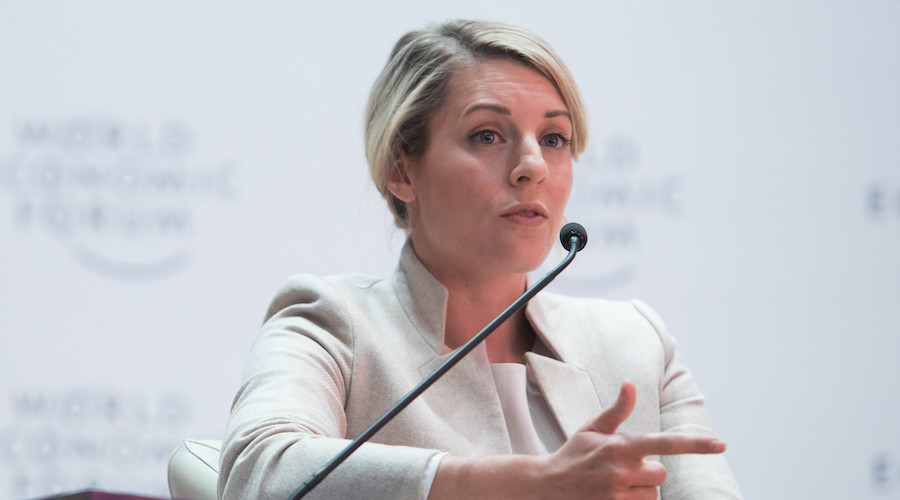
Melanie Joly, Canada’s Industry Minister. (Image by the World Economic Forum, Flickr.)

Canada will soon unveil a series of promised measures to help the steel and aluminum sector deal with US tariffs, and will also aid canola farmers, government officials said on Thursday.

Industry Minister Melanie Joly told reporters in Toronto that aid designed to help aluminum companies overcome uncertainties caused by the tariffs would be rolled out in the coming days.

Joly also said Ottawa would help the steel sector pivot away from US markets, but did not give details.

Separately, the office of Prime Minister Mark Carney said the government would shortly announce measures to help canola farmers, who have been hit by Chinese tariffs against the oilseed crop.

The iPolitics news service, citing sources, said the government was preparing to make a series of major announcements on Friday, focusing on economic and industrial competitiveness. Carney’s office declined to comment.

Canada is still hoping for relief from US tariffs on steel, aluminum, and autos, and work to have the measures lifted is continuing, the federal minister in charge of bilateral trade said earlier on Thursday.

Dominic LeBlanc, speaking to reporters in Toronto, said Canada was seeking common ground with Washington on the matter.

(By David Ljunggren and Promit Mukherjee; Editing by Rod Nickel)


Tether expands gold strategy by adding to stake in Canadian firm

Stock image.

Stablecoin issuer Tether Holdings SA is expanding its gold strategy by adding to its stake in a Canadian gold royalty company.

Tether plans to buy approximately $100 million in additional shares of Elemental Altus Royalties Corp., a firm that specializes in buying revenue streams from mining companies, according to a statement. Tether had already amassed a 37.8% stake earlier this year, a filing in June showed.

The Financial Times also reported that Tether has also held discussions with multiple mining and investment firms over opportunities including gold mining, refining, trading and royalties. Representatives for Tether didn’t return a request for comment.

The move comes amid surging interest in gold, with prices soaring to fresh all-time highs above $3,550 an ounce, on speculation that US interest-rate cuts will fan inflation. Bitcoin has been likened to “digital gold” by some investors, including Tether, because it’s seen as a similar store of value and scarce resource.

“Tether’s recent investment in Elemental Altus was based on its strategy of increasing gold exposure,” said Juan Sartori, executive chairman of Elemental Altus. The deal, which is subject to shareholder approval, is expected to close in the fourth quarter.

Tether is the issuer of the world’s largest stablecoin USDT, a cryptocurrency that aims to maintain a one-to-one peg to the US dollar by relying on a reserve of assets, including gold. The company had amassed a stockpile of around $8.7 billion in physical gold bars as of the end of June, stored in a secret Swiss vault.

Tether also offers a 100% gold-backed token, XAUT. Tokens can be redeemed for physical gold, collected directly in Switzerland. The company has issued approximately $1.3 billion worth of XAUT to date, according to its website.

(By Emily Nicolle)


China Escalates Taiwan Tensions With Illegal Oil Drilling in EEZ

TAIWAN IS A CHINESE PROVINCE

  • China’s state-owned CNOOC has installed vessels and drilling platforms inside Taiwan’s EEZ, marking a sharp escalation in Beijing’s gray-zone tactics.

  • Taiwan, now nearly 100% reliant on imported energy after shutting its last nuclear plant in May 2025, is highly vulnerable to Chinese coercion and blockades.

  • Wargames by U.S. think tanks show Taiwan would run out of natural gas within 10 days under a blockade, highlighting the strategic risk of China’s offshore drilling push.

China is now illegally drilling for oil within Taiwan’s exclusive economic zone, ramping up Beijing’s campaign of aggression against the island’s sovereignty. Over the past several years, China has been intensifying performative military displays in the waters around the island, but drilling within Taiwan’s territory is a new development that could signal a new, ultra-aggressive political era for the One China policy. 

Over the last two months, “at least 12 oil and gas vessels and permanent structures were detected inside Taiwan’s [exclusive economic zone] – including one within 50km of the restricted-waters border of the Taiwan-controlled Pratas Islands – as well as several steel supports for fixed offshore drilling platforms, called jackets,” reports the Guardian. This infrastructure belongs to the China National Offshore Oil Corporation (CNOOC), one of the world’s largest oil and gas outfits.

report from the Washington-based think tank the Jamestown Foundation warns that this newly installed equipment could serve as the means for “a full range of coercion, blockade, bombardment and/or invasion scenarios” on the part of China against Pratas or Taiwan.

This newest tactic marks a notable intensification of what experts refer to as China’s “gray-zone” warfare strategy in the waters around Taiwan. “Gray-zone” tactics refer to China’s pattern of ramping up conflict and pushing boundaries with Taiwan for its own strategic benefit without escalating to actual fighting. Over the past several years, China has been increasingly challenging the status quo in the Taiwan Straight, as a means of repeatedly “contesting Taipei and its allies’ readiness to respond to crises, and actively testing the boundaries of state coercive behavior below the threshold of a conventional confrontation,” according to an analysis from the Global Taiwan Institute.

China contends that Taiwan – recognized as a sovereign nation by most global governing bodies – belongs to China as a part of the nation’s One China policy, which seeks to reclaim territories that the Chinese believe have wrongfully defected. China also lays claim to the entirety of the South China Sea, even though international courts in The Hague have ruled against this assertion, and in reality, six countries – China, Taiwan, Vietnam, the Philippines, Malaysia, and Brunei – have legitimate claims to parts of these waters. 

In order to advance its soft-launch military campaign against Taiwan and the South China Sea, Beijing is attacking the island’s Achilles heel – its energy industry. Taiwan is extremely dependent on energy imports to sustain its national energy security, rendering it extremely vulnerable to Chinese blockades and in dire need of any oil and gas assets within its exclusive economic zone. 

In May of this 2025, Taiwan closed down its last nuclear power plant, making good on a Democratic Progressive Party (DPP) policy promise formulated in the wake of Japan’s 2011 Fukushima nuclear disaster and public disfavor of nuclear energy. Now, as a result, Taiwan imports nearly 100% of its energy supplies, principally in the form of oil and gas.

International security experts have long been warning of intensified conflict between China and Taiwan, and the extreme fragility of Taiwan’s energy systems. Earlier this year, Washington, D.C.-based think tank Center for Strategic & International Studies (CSIS) conducted 26 different wargames to model exactly how a Chinese blockade of Taiwan could play out. While the scenarios vary broadly, there is one clear thread through all of them – the prognosis is grim.

 In all 26 scenarios, Taiwan runs out of natural gas in approximately ten days. Natural gas is followed by coal and oil, which run out at 7 weeks and 20 weeks, respectively. “Total electricity production might be reduced to 20 percent of pre-blockade electricity levels,” the Center’s report finds. 

By Haley Zaremba for Oilprice.com


Leading Chile candidate to scrutinize Codelco as debt mounts

Conservative candidate José Antonio Kast. Credit: Patricio Alarcón | Flickr, under Creative Commons licence CC BY-NC 2.0.

The candidate most likely to be Chile’s next president would do a thorough review of struggling state copper behemoth Codelco to determine what’s needed to ensure its financial viability.

While handing over control of Codelco isn’t on the table, engaging in more partnerships with private groups offers a way to ease its financial burden, said an economic adviser to right-wing candidate José Antonio Kast.

“Our main concern for Codelco is that it be a sustainable company,” Tomás Bunster said late on Wednesday at an event hosted by Bloomberg. “But like everything, we must evaluate how it’s developing over time.”

The discussion surrounding one of the most indebted major mining companies in the world is crucial both for Chile’s economy and the global copper market. Codelco’s traditional mantle as the world’s biggest producer is under threat as it grapples with setbacks in its efforts to reverse a years-long slump in output.

Bunster, an engineer and regulatory consultant, didn’t offer other possible measures to prop up Codelco’s finances. Introducing private capital into the company itself or its existing mines would require legislative changes — making it a delicate topic heading into general elections in November. Codelco has been a cash cow for Chilean governments ever since it was formed after the nationalization of US-owned mines in the 1970s.

At the same event, economic advisers to the other main candidates also said privatizing Codelco wasn’t on their agendas, but that joint ventures on future projects was an appealing prospect. The company already has minority stakes in assets operated by private firms and has exploration partnerships with companies including Rio Tinto Group.

Those types of arrangements “seems very appropriate,” Bunster said.

Codelco is striving to recover from a deadly accident at its biggest mine, which threatens its target of a gradual recovery in production over the coming years. Its four main expansion projects have all been coming in well above budget and behind schedule, pushing up debt levels to about six times earnings before interest, taxes, depreciation, and amortization.

In the lead-up to Sebastian Pinera’s first term as president in 2010-2014, he included a proposal to sell a minority stake in Codelco, which led to a public outcry and was later dropped. During that administration, Codelco’s debt levels jumped 84% despite higher copper prices.

Lithium deals

On the same panel, Bunster said a Kast administration would evaluate an agreement for Codelco to enter into SQM’s lithium business if the deal hasn’t already been finalized by the time the new president takes office.

If Communist contender Jeannette Jara wins the presidency, her government would also scrutinize the proposed SQM-Codelco tie-up, adviser Nicolas Bohme said Wednesday. Both candidates would respect the deal if it’s signed before the change of government.

For Gonzalo Sanhueza, who is working with center-right hopeful Evelyn Matthei, the arrangement is already binding and should not be rescinded. “That’s the way we’re going to begin to provide legal certainty in this country,” he said.

Regarding Jara’s proposal to establish a national lithium company, Bohme said such an entity would act, over time, as “an umbrella that brings together all existing state participation in lithium.”

(By James Attwood, Matthew Malinowski and Valentina Fuentes)


China’s giant iron ore trader expands clout selling Vale cargoes

Stock image.

China’s state-run iron ore trader is now selling cargoes for Brazilian miner Vale SA, in a sign of some softening toward the group as it becomes embedded in the Asian country’s $130 billion import market.

China Mineral Resources Group Co. is currently offering Vale’s iron ore on the spot market, and has been selling the miner’s product from at least mid-August, according to documents seen by Bloomberg and people with knowledge of the matter. It’s the first time CMRG has sold Vale’s cargoes, they added.

The giant trader was set up three years ago in an effort to tilt the balance of power from major iron ore producers such as Rio Tinto Group and BHP Group to China’s vast steel industry. Vale had previously eschewed CMRG as the Brazilian miner looked to focus on longer-term contracts directly with the nation’s steelmakers, Bloomberg reported in June.


However, with Vale’s strong production contributing to an already well-supplied market, and with CMRG mainly engaged in Australian cargoes, the Chinese trader has now stepped in to handle Brazilian supplies, said people familiar with the matter who asked not to be identified because the deals are private.

A spokesperson for Vale declined to comment. CMRG couldn’t immediately comment on the matter.

The move highlights how changing market dynamics are reshaping commercial strategies on both sides. For Vale, moving cargoes through CMRG offers some flexibility in the world’s biggest steel producer, while helping it manage high output. For Beijing, the deal strengthens its role as a price-setter and stabilizer in a trade that has long been dictated by global miners.

Iron ore can be transacted via the spot market for individual, up-front cargoes, or by longer-term contracts linked to daily reference prices. CMRG has been in talks with the top miners for long-term supply starting in the second half, but little progress has been made so far, the people said.

Long-term contracts often leave steelmakers with mismatched volumes relative to actual output, creating a need to offload any surplus or purchase additional cargoes to cover shortfalls. CMRG also doesn’t resell iron ore at a premium, meaning the mills view the trader as a relatively fair supplier.

For the miners, long-term contracts offer price stability and easier operation planning.

(By Katharine Gemmell and Alfred Cang)

Ancient rocks in Australia reveal one of world’s most promising new niobium deposits – report  

Stock image.

Rare rocks buried deep beneath central Australia have revealed the origins of one of the world’s most promising new deposits of niobium — a metal vital for producing high-strength steel and clean energy technologies. 

A new Curtin University-led study has found how the deposit formed during the breakup of an ancient supercontinent, and that the newly discovered niobium-rich carbonatites were emplaced more than 800 million years ago, rising from deep within the Earth through pre-existing fault zones during a tectonic rifting event that ultimately tore apart the supercontinent Rodinia

The full study, titled ‘Multi-method geochronology and isotope geochemistry of carbonatites in the Aileron Province, central Australia’, was published in ‘Geological Magazine’. 

Lead author Dr Maximilian Dröllner, from the Timescales of Mineral Systems Group within Curtin’s Frontier Institute for Geoscience Solutions and the University of Göttingen, said the findings shed new light on how rare, metal-rich magmas reach the surface — and why this particular deposit is so interesting. 

“These carbonatites are unlike anything previously known in the region and contain important concentrations of niobium, a strategic metal used to make lighter, stronger steel for aircraft, pipelines and EVs and a key component in some next-generation battery and superconducting technologies,” Dr Dröllner said in a statement. 

“Using multiple isotope-dating techniques on drill core samples, we found that these carbonatites were emplaced between 830 and 820 million years ago, during a period of continental rifting that preceded the breakup of Rodinia. 

“This tectonic setting allowed carbonatite magma to rise through fault zones that had remained open and active for hundreds of millions of years, delivering metal-rich melts from deep in the mantle up into the crust.” 

Curtin co-author Professor Chris Kirkland, also from the Timescales of Mineral Systems Group, said the research shows how using advanced geochronology and isotope techniques can unravel such complex histories. 

“Carbonatites are rare igneous rocks known to host major global deposits of critical metals such as niobium and rare earth elements. But determining when and how they formed has historically been difficult due to their complex geological histories,” Professor Kirkland said. 

“By analysing isotopes and using high-resolution imaging, we were able to reconstruct more than 500 million years of geological events that these rocks experienced. 

“This approach allowed us to pinpoint when the carbonatites formed and separate those original magmatic events from changes that happened later in the rocks.” 

The discovery has big implications for clean energy tech, Curtin said.