Wednesday, July 16, 2025

Communist Party triumph and opportunity in an adverse electoral scenario in Chile

Tuesday 15 July 2025, by Javiera Manzi, Karina Nohales


Jeannette Jara swept the country, displacing the former Concertación and Frente Amplio [1] (Broad Front or FA) parties. If she were to win the November 16, 2025 presidential elections, it would be a milestone that would run counter to the current political climate in Latin America.
Karina Nohales and Javiera Manzi / Activists of the 8M Feminist Coordination of Chile

On Sunday, June 29, the primaries for the presidential election to be held in November of this year were held in Chile. It was a primary for the governing coalition, with only the ruling parties participating, given that the right-wing parties failed to reach an agreement to run jointly or to register as a pact. This is a crucial development: it is the first time that a single political bloc has participated in the presidential primaries since the primary election system was established in 2012.

Jeannette Jara Román, the Communist Party candidate and former Minister of Labour in the Boric administration, won with 60% of the vote—about 825,000—winning in every region of the country. Jara’s overwhelming percentage contrasts with the meager 28% (385,379 votes) obtained by Carolina Tohá—former Minister of the Interior and Public Security of the current government—and candidate of the Socialismo Democrático (Democratic Socialism or SD) alliance made up of the Party for Democracy and the Socialist Party. [2] The defeat of Tohá, who, according to polls, started the race as the favourite, confirms the already established path of electoral decline for the so-called political centre, embodied by the parties of the former Concertación.

For his part, Gonzalo Winter, a congressman and member of the Broad Front—President Boric’s party—received just 9% of the vote. The ruling party entered the primaries without a candidate of its own, having relied until the last minute on the possible nomination of Michelle Bachelet (PS), an option that the former president ultimately ruled out. After a succession of declines by other figures in the Broad Front, the group ultimately encouraged Representative Winter—who had also initially declined to be a candidate—to take on the task. With more than 60,000 members, the presidential party’s candidacy garnered just 123,829 votes in this primary, a clear defeat for that sector of the ruling party. Finally, Jaime Mulet, a deputy from the Green Social Regionalist Federation and former Christian Democrat member, obtained a predictable fourth and last place with 2.7% of the votes (37,659).

With this unprecedented result, the Chilean Communist Party—virtually absent from the political system until just over ten years ago—takes the lead in the center-left coalition, displacing both the parties that traditionally held that leadership and those who have led it recently.

This is the third Communist Party presidential candidate to appear on the ballot. The first was Pablo Neruda in 1969. The second was Gladys Marín in 1999, forty years later. Although Chile has had numerous governments where the Communist Party has been part of the ruling coalition (including the Unidad Popular, Popular Unity or UP), it has not, until now, had its own presidency.

Data kills the story: (not so) low overall turnout and expanding support for the Communist Party

A first analysis of the election results immediately leads us to the low turnout in the primaries.

Unlike in 2021, when voting was voluntary in both the primary and the first round, this year the primary remains voluntary, while the first round will be mandatory. This means that the primary votes will be diluted across a much broader electorate, significantly reducing their relative weight.

This Sunday, the voting percentage reached 9.1% (1,420,435) of the total voter register (15,499,071), which represents a considerable decrease from the percentage of participation in the previous primaries, where 21.4% of the electoral register voted in the sum of the votes for the left and right pacts.

If the comparison is narrowed down and only the turnout in the last primaries of the left- and center-left blocs (2021) is considered, the decline is less steep: 11.9% of the registered voters (1,752,922 people) voted then. Despite this, most local media outlets and analysts insist on highlighting the low turnout as the most significant political statistic of these elections.

In the 2021 presidential primaries of the Apruebo Dignidad coalition, Gabriel Boric (FA) competed against the then mayor of Recoleta, Daniel Jadue (PC), winning with more than 60% of the votes. In the right-wing primaries, the winner was Sebastián Sichel, the former Christian Democrat and Piñera candidate, who later finished only fifth in the first round of the presidential election. In that same election, far-right candidate José Antonio Kast emerged as the frontrunner.

This background explains the reluctance of the Republican Party (Kast) and the National Libertarian Party (Kaiser) to participate in primaries with candidate Evelyn Matthei, a representative of a traditional right whose electoral collapse has only worsened.

Despite a campaign marked by persistent references to the Cold War, Jeannette Jara’s sweeping victory over Carolina Tohá in every region of the country demonstrates the at least partial failure of this narrative of fear.

In the Metropolitan Region, where 40% of the electoral roll is concentrated, the preference for Jara was especially clear in the working-class communities. The results stand out in Lo Espejo (74%), Conchalí (72%), La Pintana (71%), Puente Alto (69%), San Ramón (69%) and Pudahuel (68%) where she had the explicit support of left-wing and independent mayors. Among them, Matías Toledo, a left-wing independent and current mayor of Puente Alto, is highlighted. Following his resounding victory in the recent municipal elections, he has established himself as a leader in the sector. Toledo expressed his support for Jara, stating: "Our heart and our political positions are with her."

In contrast, and contrary to the predictions at the start of the campaign that announced a comfortable majority for her, Tohá’s candidacy only managed to win in the five wealthiest communes of Santiago (Vitacura, Las Condes, Providencia, La Reina, and Lo Barnechea).

"From Conchalí to the Presidential Palace of La Moneda" What did Jeannette Jara Román do to win?

Friendly, smiling, and clear-eyed, Jeannette Jara’s campaign was sustained primarily by the support and enthusiasm that her image and career aroused, with a marked emphasis on her personal story as a working-class woman born in the historic town of El Cortijo de Conchalí, which contrasted significantly with the profiles of the other candidates.

But it wasn’t just about her origins. Her extensive political career—which began in the 1990s as a student leader in the Student Federation of the University of Santiago—also includes work as a union leader, Undersecretary of Social Security during Michelle Bachelet’s second term, and Minister of Labour in Gabriel Boric’s administration.

The sustained deployment of activists and volunteers throughout the country took a qualitative leap forward thanks to the momentum generated by its social media campaign, especially aimed at competing for youth votes against Gonzalo Winter. With references to Japanese kawaii or “cute” culture, [3] TikTok trends, a television segment marked by simple messages, and the absence of major figures, her campaign projected the image of a candidate distinct from the traditional tenets of the Chilean left.

The viralisation of its content was not merely symbolic; it demonstrated its real reach in recent weeks, with long lines of students at public events convened with barely a day’s notice at universities such as the Catholic University and Alberto Hurtado University. An unprecedented enthusiasm that incorporated an emotional component, consistent with the demeanor and tone of a candidate who at all times avoided falling into disqualifications, controversy, or hostile responses, even in the face of constant questioning from other candidates about her suitability to confront the far right due to her membership in the Communist Party.

In her role as Minister of Labour, Jara epitomised effective government management. In a context of a parliamentary minority, she successfully implemented two of the government’s main programmatic commitments: reducing the work week to 40 hours and reforming the pension system. During the campaign, her constant refrain was to highlight precisely this management capacity, particularly her ability to engage with the business community and the opposition, key players in the negotiation of both reforms.

However, these achievements came at a cost that has been widely criticised by unions and by social sectors. In the case of the working day, the agreement involved the incorporation of mechanisms of flexibility promoted by the business community. In the case of the pension reform, the promise to improve retirement payouts stems not only from maintaining the current private pension system, but also from increasing the capitalisation of insurance companies by almost 50%, which the government’s programme and that of the Communist Party itself promised to eliminate.

This helps to explain, in part, the tensions Jara’s candidacy has faced within her own party. Far from the favouritism of the PC’s historical leadership—openly inclined to support the leadership of a judicially challenged Daniel Jadue [4] —this distance has ended up strengthening rather than weakening the reach of her campaign, expanding her margins of support beyond the party’s organisational structure.

Jara has capitalised on this position. When faced with controversial issues, such as the persistent questions from the mainstream press about the human rights situation in Cuba and Venezuela, she has not hesitated to emphasise that, regardless of the positions of the Communist Party, she—as the eventual head of state—will be the one to set the course for Chile’s foreign policy. In her victory speech, she declared: "I do not want Chile to be subordinated to foreign governments or external models. That is why I will maintain an international policy based on independence and multilateralism, defending human rights wherever they are violated in the world."

Regarding her programme, the main proposed measures include initiatives aimed at strengthening the welfare state, redistribution, and social rights. In economic terms, she proposes boosting domestic demand by raising the minimum wage, creating jobs, and strengthening collective bargaining.

In terms of public safety, she proposes strengthening existing police forces (Carabineros and Investigative Police), pursuing drug trafficking money routes, and lifting bank secrecy to facilitate this task. In health, she advocates strengthening the public system, emphasising the reduction of waiting times and clarifying that the goal is not to replace the private sector, but rather to strengthen state services. In pensions, she proposes ending the AFP (Association of Pension Funds) and consolidating a public, solidarity-based Social Security system.

In terms of gender, her programme includes guaranteed access to sexual and reproductive health care—including abortion on request—the implementation of Comprehensive Sexual Education (CSE), and parity at all levels of representation. In terms of redistribution, she posits the creation of a tax on the super-rich, remuneration for reproductive and care work, and state regulation of basic services to guarantee fair rates, differentiated subsidies for the most vulnerable sectors, and the evaluation of the creation or strengthening of public companies in strategic areas.

Fragmented majority of the right

Jara will be the one to face the right in the first round of the presidential elections in November. According to polls, the majority of voters in Chile are currently behind the three main right-wing candidates: a true triumvirate of "German patriots" made up of Evelyn Matthei, José Antonio Kast, and Johannes Kaiser.

Evelyn Matthei, a member of the Unión Demócrata Independiente (Independent Democratic Union or UDI)—a party descended from the Chicago Boys’ doctrine—and a candidate for former President Piñera’s Chile Vamos coalition, has served as a deputy, senator, minister, mayor, and presidential candidate. The daughter of Air Force General Fernando Matthei, a member of the military junta that ruled Chile during the Pinochet dictatorship, she embodies the so-called "traditional right." In the current electoral climate, she began by leading in the polls, but her candidacy has suffered a progressive and sustained decline.

For his part, José Antonio Kast, standard-bearer of the far-right Partido Republicano (Republican Party or PR), has steadily increased his support and is currently leading the polls as the favourite to advance to the second round. The so-called "Nazi of Paine"—a reference to the rural area where his family of German origin settled, and a civilian accomplice to the dictatorship’s crimes against peasants—was the most voted candidate in the first round in 2021, winning by a majority in 11 of the country’s 16 regions. However, the mobilisation of the popular vote in the second round managed to reverse the result in favour of current President Gabriel Boric.

A third candidate, also from the far right, is MP Johannes Kaiser, from a family of German settlers. After breaking with Kast’s party, he founded his own political party, the Partido Nacional Libertario (National Libertarian Party or PNL). In a style openly aligned with figures like Trump and Milei—he has questioned women’s right to vote and suggested awarding honours to men who rape "ugly" women—Kaiser seeks to embody the phenomenon of breaking into the establishment with a radical and provocative discourse. Kaiser’s polling performance has been unstable: after a significant surge some time ago, his support appears to be trending downward. His main political effect, however, has been to dislodge Kast from the extreme position he held during the last presidential election, giving him an appearance of moderation.

The ongoing dispute over right-wing hegemony prevented this sector from reaching an agreement to participate in the official primaries. Everything indicates that the first round of presidential elections will act as a de facto primary to decide their leadership. While possible variables cannot be ruled out in advance, if everything goes according to today’s picture, that leader should be José Antonio Kast.

From primary to government: Jara’s long march

The challenge for Jeannette Jara’s candidacy is enormous on several levels. The first and most significant is transforming the 825,835 primary votes into the 7 million needed to win the presidential runoff, which for the first time since 2012 will be held with compulsory voting, a system that, by all accounts, has favoured the right. According to the latest CADEM poll, in a potential runoff election between Jara and Kast, the Republican candidate would obtain 50% of the vote, while the Communist candidate would achieve 30%. Twenty percent of those surveyed stated they had no clear preference.

To achieve this, the second major challenge will be to rally the broad social and popular movement that made Boric’s victory possible. The scenario, however, seems more difficult today than it was then. In the 2021 presidential election, voting was voluntary, the first constitutional process was still ongoing, and a significant portion of the electorate that voted in the second round did so with the expectation of ensuring its success. The defeat of this process had a demoralising effect on the organised social movement, compounded by a rapid conservative shift by the government, which strengthened its alliance with the traditional parties of "neoliberal progressivism" and deepened the programmatic disengagement of the Broad Front. As a result, this sector ended up pushing for profound compromises on key and sensitive issues, such as pensions, healthcare, education, and the environment. All of this contributed to further disenchantment among the same sectors that defined the last runoff election and that, today, must be called upon once again to mobilise their votes around Jara’s candidacy.

Likewise, it remains to be seen how cohesive the current governing parties will be around the communist leadership. During the primary campaign, defeated candidate Tohá (of the PPD and the PS) placed her central emphasis on the so-called "useful vote," claiming that voting for Jara would be tantamount to handing the victory to Kast.

In this regard, candidate Kaiser has clearly foreshadowed the anti-communist content of his campaign. In his first post-primary speech, he attributed the more than "100 million murders" of Stalinism to the Chilean Communist Party and affirmed that the victory of the Communist Party poses a danger to institutions, that democracy is at stake in this election, and that the Communist Party is entering the state through elections, never to leave again. He said all this while accompanied by former agents of the dictatorship, including one convicted by the Chilean justice system for the crime of torture.

In a more subdued tone, Kast stated that it was bad news for the country that someone from the radical left was leading the ruling coalition, that the current government was a failure, and he emphasised that the strategy deployed by his candidacy was being seen as the correct one.

For her part, Matthei stated that Chileans don’t want ideological fights and, distancing herself from Kaiser’s narrative, focused on her own programmatic measures.

For their part, the mainstream media supports the narrative that it would be not only undesirable—because of the danger to democracy—but also impossible for a member of a Communist Party to become president of a country through elections.

Without a doubt, achieving this would in itself create an unprecedented scenario. Achieving this in the current international and local context, marked by the social and electoral advance of the far right, would be a feat that would transcend Chile’s borders. In a country that pioneered the so-called "peaceful path to socialism," the possibility of a new historic milestone cannot be ruled out in advance. The only force that can make it possible, once again and as always, is the people.

What will their terms and conditions be? What is the openness of the ruling parties? May deliberation from below take over the coming days.

1 July 2025

Translated and annotated by David Fagan for International Viewpoint from Jacobin America Latina.


Attached documentscommunist-party-triumph-and-opportunity-in-an-adverse_a9085.pdf (PDF - 933.2 KiB)
Extraction PDF [->article9085]

Footnotes


[1] The Concertación or Coalition formed in 1988 was an alliance of centrist parties. In 2013 it was replaced by the Nueva Mayoría or New Majority coalition until 2018. The Frente Amplio formed in 2017 and led by current Chilean President, Gabriel Boric was composed of centre and left wing parties and movements which in July 2024 merged into the Frente Amplio party.


[2] The DS coalition was formed in 2021 by the Partido Socialista (Socialist Party or PS), Partido por la Democracia (Party for Democracy or PPD) Partido Radical (Radical Party or PR), Partido Liberal de Chile (Liberal Party or PL) and Nuevo Trato or New Deal.


[3] Think “Hello Kitty” and Pikachu, a character from Pokémon, for example.


[4] Daniel Jadue, Mayor of Recoleta from 2012 until 2024 is, like Jara, a member of the Communist Party.


Karina Nohales
Karina Nohales is a lawyer, member of the Chilean Committee of Women Workers and Trade Unionists and the Internationalist Committee/March 8 Feminist Collective. She is in the editorial collective of Jacobin América Latina

Javiera Manzi
Javiera Manzi is an activist of the 8M Feminist Coordination of Chile.

International Viewpoint is published under the responsibility of the Bureau of the Fourth International. Signed articles do not necessarily reflect editorial policy. Articles can be reprinted with acknowledgement, and a live link if possible.
Iran

Islamic Republic and state racism: we must put an end to this regime!

Monday 14 July 2025, by Babak Kia

Since 1 June 2025, nearly 450,000 Afghans have left Iranian territory. This estimate, provided by the International Organisation for Migration (IOM), is staggering. For the whole of 2025, the number rises to 906,326 according to the UN agency.

At the end of May, the Islamic Republic gave ‘until 6 July’ to ‘four million illegal Afghans’ to leave Iran. It should be noted that the vast majority of Afghan refugees living in Iran do not have valid identity documents, but contrary to the authorities’ claims, the deportations do not only concern so-called ‘illegal’ migrants.

Hatred as policy

Afghan refugees are being pushed out by the Islamic Republic, which is waging a hate campaign against them.

Numerous reports indicate that among those deported were people with valid passports or residence permits. Many of them were even born in Iran and have only Afghan parents. They are stripped of their belongings before being deported. According to videos released, regime agents arrest Afghans and demand bribes before forcibly sending them to camps for deportation. If a migrant has no money, they are violently forced onto trucks and sent to the camp.

The regime’s security forces have announced that renting any property to Afghan migrants is now prohibited. In the event of a violation, the contracts concerned will be invalidated and the property sealed and confiscated.

For others, the Tehran regime has decided to block their credit cards in order to speed up ‘remigration’.

Afghans, scapegoats

Since the advent of the Islamic Republic, Afghans have always been scapegoats. The Tehran regime has always used racism as a weapon to mask its own responsibilities for the disastrous situation in Iran. Today, these measures are part of the Islamic Republic’s deliberate strategy to divert attention from domestic crises, including corruption, hyperinflation, unemployment and economic collapse.

The Islamic Republic is using state media and social media to intensify its anti-Afghan policy. If a rape or murder occurs, the media attributes it to Afghans without any investigation. State media link water and electricity shortages, as well as high bread prices, to the presence of Afghan refugees.

The Islamic Republic is using state media and social networks to intensify its anti-Afghan policy.

But the reality is quite different. The incompetence and corruption of the Islamic Republic’s leaders are reflected in the government’s inability to provide water, electricity and basic services to the population.

A diversionary measure by the regime

In the aftermath of the Israeli-US attack, the Islamic Republic intensified the deportations of Afghans.

The humiliating failure of the Tehran regime in terms of intelligence and security against the CIA and Mossad during the Israeli-US attack has become a new pretext to justify the repression against Afghan immigrants. Seeking to cover up their intelligence failure, the Islamic Republic’s security and law enforcement agencies have pursued two policies simultaneously.

First, they have intensified repression against political, civil, trade union, cultural and social activists accused of being ‘Mossad spies’. Second, they have intensified pressure on Afghan immigrants and refugees and carried out mass deportations, also accusing them of ‘collaboration with Israel’.

Afghanistan, a collapsed country


The living conditions of Afghans in Iran are dire. Afghan workers are among the most exploited in Iran. They have always been persecuted, deprived and humiliated. Deprivation of social security and social services, deprivation of housing in many provinces, arbitrary detention and violent expulsion after arrest, summary trials and summary executions are only a small part of the suffering inflicted on Afghan refugees.

Afghan refugees in Iran fled a country that has been at war since the Soviet invasion of 1979. A country devastated by US imperialist intervention, Pakistani and Saudi interference, the religious obscurantism of the Taliban, segregation of women, poverty and misery.

Many of the young Afghans in Iran have never known Afghanistan. Afghan girls educated in Iran are now being expelled en masse and sent back to the Taliban regime. Like their parents, who have been working in Iran for decades, they should all be considered Iranian and enjoy equal rights.

Trade union response to injustice

In this context, the Free Union of Iranian Workers and the Vahed union (Tehran and suburban public transport workers) have issued two statements against the racist policies of the Islamic Republic. These statements by respected activist networks are important. They come a few days after a public letter signed by more than 1,300 activists, artists and journalists condemned the treatment of Afghan migrants. In their letter, the signatories stress that silence in the face of the actions of those in power risks turning ordinary citizens into accomplices of injustice.

A public letter signed by more than 1,300 activists, artists and journalists condemned the treatment of Afghan migrants

The Islamic Republic is not only a reactionary capitalist dictatorship, it is also a structurally racist and misogynistic state. It is urgent to amplify the voices of those fighting in Iran for social justice, equality and democracy.

14 July 2025

Translated by International Viewpoint from l’Anticapitaliste.


Attached documentsislamic-republic-and-state-racism-we-must-put-an-end-to_a9084.pdf (PDF - 909.3 KiB)
Extraction PDF [->article9084]

Iran
A Terrifying Abyss for the Iranian People and the Region
Faced with the Iran-Israel war, a third way is possible!
The United States at War in the Middle East —Again
Opposing War and Warmongering Policies
On the illegal Israeli aggression against Iran


Babak Kia is an activist in “Solidarité Socialiste avec les Travailleurs en Iran” and member of the Fourth International.

International Viewpoint is published under the responsibility of the Bureau of the Fourth International. Signed articles do not necessarily reflect editorial policy. Articles can be reprinted with acknowledgement, and a live link if possible.

We need a totally different Europe

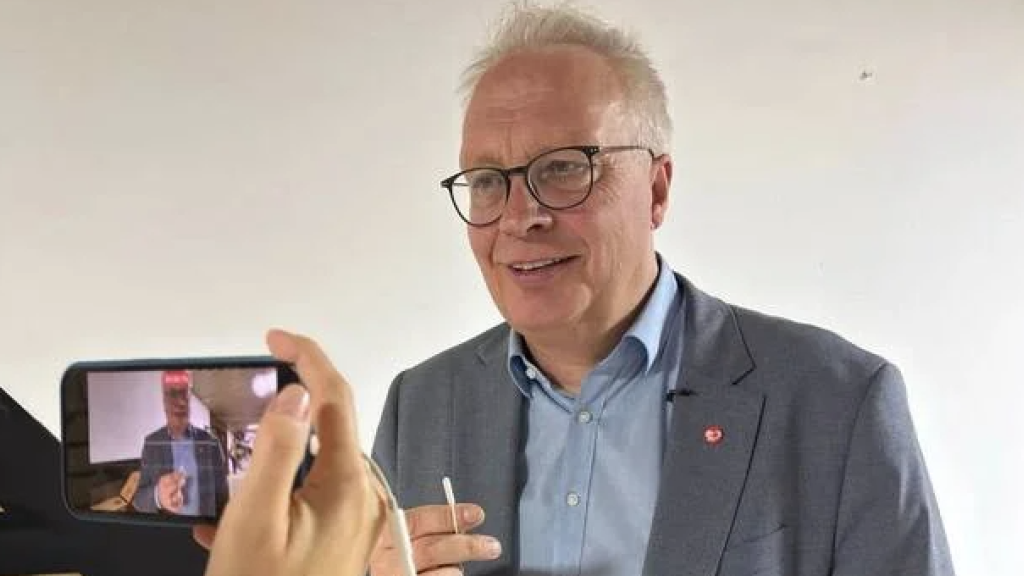
Peter Mertens during an interview in Cuba, January 2025

First published at Rosa-Luxemburg-Stiftung.

“The fear of war has really been gaining ground among young people.” Onno, vice president of the Workers’ Party of Belgium (PVDA/PTB) youth movement, is worried. “TikTok is overflowing with videos about preparing for war. ‘War is coming’, ‘we’re already at war’, ‘get ready for war’. It provokes a lot of anxiety.”

Lise feels the same. She’s a doctor at Medicine for the People in Antwerp’s Hoboken district. She confides: “People who work in home help tell me that all of their patients are stockpiling food and drink, in case war breaks out.”

Camille is a union secretary. Recently, she networked with other trade unionists in Berlin at a conference organized by the Rosa Luxemburg Foundation. “I heard people saying that they’re worried because of rumours that the unemployed are going to be forced to join the army, ads for the military are turning up on the bread bags, soldiers are visiting schools, companies are being restructured to produce defence materiel. Things in Germany are changing fast”, she says.

One thing is for sure — in Europe, the wholesale fearmongers are zealously jostling for position. They can be seen on television every day. Fear sells, and there is nothing quite like it for stimulating the weapons industry. Fear of war is being used to push through colossal military budgets, while social security, health care, and pensions get dismantled.

Young people don’t want war; neither do the nurses or the workers. But today, all we get is the rhetoric of characters like Mark Rutte, the NATO Secretary General, constantly telling us that war might be inevitable, and that we had best be ready for it. Yet there is nothing inevitable about war. More than that: we have to do everything we can to preserve peace, rather than pouring petrol onto a fire that’s obviously already burning very hot.

A world in the balance

Everyone could see who was sitting in the front row at Donald Trump’s inauguration. A gang of billionaires. An oligarchy. These people just bought a government, and they are proud of it. They portray themselves as the embodiment of history itself. “God saved me so I could make America great again”, Trump boasted. Elon Musk reckons he is going to save humankind with a mission to Mars.

On Earth, it’s mainly the billionaires who can count on being saved. Nine of them got a post in the Trump administration. Nine billionaires. One of these men — they are almost all men — is the new Secretary of the Treasury: Scott Bessent, a hedge-fund CEO. He says it straight out: he’s going to continue the policy of tax giveaways for millionaires. This first came in in December 2017, during Trump’s first term, and was due to expire this year. Bessent is treating himself and his billionaire friends to a giant present. Without the least scruple. Naked vulture capitalism.

The same mentality is driving the Trump administration when it comes to foreign policy. Some of them see the world as a stockpile of raw materials that ultimately belongs to the US. By virtue of some sort of divine mandate, “manifest destiny”.

“Panama belongs to us”, “Canada belongs to us”, “the Gulf of Mexico belongs to us”, “Venezuela belongs to us”, “Cuba belongs to us”, “Greenland belongs to us” — it’s cowboy rhetoric. It is unscrupulous imperialism and neo-colonialism.

We say: hands off Panama, Mexico, Venezuela, Canada, Greenland, Cuba! Trump is nothing but a spasm of the past, a symptom of a superpower that is not ready to let go of its hegemony.

Because what exactly is happening? After 500 years of Western domination, based on pillage and slavery, the world’s economic centre of gravity is shifting to Asia. This is what is happening — in fits and starts. The tectonic plates are shifting, as it were, and the shocks are bigger than anything we have experienced in the last three decades. “How our world is tilting” is the subtitle of my book, Mutiny. The process is underway.

In their recent history as a world superpower, the US has never had a bigger “rival” than today’s China. Technologically and economically, China is now far stronger than the Soviet Union ever was — which is rather impressive, considering in how little time this result was reached.

Needless to say, the US continues to be the world’s leading military and financial power and, depending on how you figure it, the largest or second-largest economy on the planet. Washington is now fighting with every available means and in every possible way to maintain its position, and wants to pull the whole world into a Cold War logic against Beijing and any country that tries to pursue its own path autonomously.

Against this backdrop, the European Union is struggling to survive in economic, democratic, and political terms. The shift to a war economy is exacerbating all of the tensions pervading the old continent. Tensions between the member states, and internally within those same states, whose citizens can no longer stomach the high cost of living, nor the absence of democracy or viable outlook for the future.

The EU was never a force for peace

Since it was founded, the EU has been trying to pass itself off as a force for peace, but the suit doesn’t fit. Until the fifteenth century, Europe was just another a province of the world, no more developmentally advanced than the other continents. The situation would only change once the European powers began building their colonial world empire, based on the trade in slaves and the pillaging of other continents. The primitive accumulation that European capital needed in order to establish capitalism across the entirety of the planet came out of a bloodbath inflicted on the rest of the world.

Up until the end of the nineteenth century, the British were the biggest imperial power. Other imperialist powers like France, Germany, Japan, Belgium, the Netherlands, and Portugal clashed regularly but finally decided to divvy up Africa between them at the Berlin Colonial Conference (1884–1886). As if the continent were a pie, that it was their prerogative to cut up into portions.

At the beginning of the twentieth century, Germany slowly but surely began to assert itself as a world power. But unlike its rivals, it had practically no colonies. This was a significant handicap for the German elite, who wanted colonies as a market for German manufacturing on the one hand, and for the supply cheap raw materials on the other. The redistribution of the world and the race for colonies furnished the economic basis of World War I.

After that war, the notion of a larger inner-European market began catching on, especially in Germany. Count Coudenhove-Kalergi was the first to propose the transformation of Germany into a Greater German Europe. He launched his “pan-European concept” in 1923. This was not a peace project, but an imperialist scheme tailor-made for Berlin, with an expanded Europe that would stretch from Petsamo, in the north of Finland, to Katanga, in southern Congo. Coudenhove-Kalergi viewed Africa as a source of European wealth, which ought to be exploited and become part of Europe (or Paneurope) — a vast, German Europe, endowed with an immense colonial empire. The Count was unable to fulfil his scheme, and soon Hitler attempted to conquer the European continent through violence and barbarity in order to materialize his own version of a “new Europe”. After claiming some 60 million lives, the fascist project would crumble in turn.

The European nations, having just escaped from the prisons of Nazism, had no intention of immediately giving up their independence again for the sake of a fresh pan-European adventure. The decisive impulse for European unification came from elsewhere — Washington. With the Bretton Woods conference, the major economic event of the twentieth century, the United States decided that global commerce would henceforth take place in dollars. The Americans wanted a totally open European market, for their goods and investment. “Long live Europe!”, cried Washington. Through the Marshall Plan, the US solved its own export crisis, and tied Europe to American capital.

It was also Washington that would impose the conditions for Germany’s return to the world economic stage. Germany ought not to be too weak, the US reckoned, otherwise, it might fall into the hands of the Communists. Germany ought to be able to start exporting coal and steel from the Ruhr region again. The European Coal and Steel Community (ECSC) was created to this end in 1951.

The integration of the European states was never meant to prevent war. It was a project under the aegis of the Pentagon, within the context of a military strategy directed against the Soviet Union. The Americans wanted to bring the German military back into working order, but with US materiel and within the framework of NATO. In the long run, they were aiming to reconquer the Soviet sphere of influence.

For the French, the British, the Dutch, and the Belgians, seeing Washington put the Germans back in uniform was a hard pill to swallow. But the European states were forced to resign themselves to playing the role of “junior” partner to the United States. At Bretton Woods (1944), the dollar became the world’s currency, French colonialism suffered a heavy defeat in Indochina (1954), and the British and French were humiliated during the Suez crisis (1956).

From the beginning, the idea of a unified Europe was a colonial one. Four of the six founding member states of the European Economic Community (EEC), including France and Belgium, still held colonial dependencies at the time, and the 1957 Treaty of Rome contains no mention of decolonization. On the contrary, according to the map of the EEC at the time, the majority of European territory could be found… in Africa.

Ghanaian President Kwame Nkrumah quite rightly declared: “French neo-colonialism is merging into the collective neo-colonialism of the European Common Market”.

The colonial or neo-colonial ambitions of the European powers are now being presented as “civilizing missions”, “civilian missions”, or “geopolitical missions”, but at bottom nothing has changed: these are still the old imperialist states looking for a new way to preserve their bygone glory. From 1957 to the present day, the “Europe of peace” has continued to wage war, from Lumumba’s Congo to the genocide in Rwanda, from Libya to its numerous interventions in sub-Saharan Africa, from Iraq and Afghanistan to the former Yugoslavia. No, the European Union has never been a force for peace.

Geostrategy and the war economy

Ursula von der Leyen, President of the European Commission, declared that the EU ought to become a major “geopolitical actor”. According to her, the chaos and the crises the Union is traversing require that “we learn to speak the language of power”.

“Learn to speak the language of power”? — as if this were something with which the European powers were unfamiliar! Von der Leyen made this statement during the plenary session of the European Parliament in November 2019, more than two years before Russia’s invasion of Ukraine.

Since the war in Ukraine, “geopolitics” has been the EU watchword, with “war economy” the slogan of the day.

European President Charles Michel wasn’t lying when he addressed the annual conference of the European Defence Agency (EDA) in November 2023. “We have broken countless taboos since Russia invaded Ukraine. We have done what would have been unthinkable only a few weeks before: jointly procuring military equipment, using the EU budget to support the increase in our military production, and funding joint research and development in defence.” His Union used the dust of war in Ukraine to break all the taboos.

EU member states currently spend 326 billion euro on armaments. This amounts to around 1.9% of gross domestic product. Ten years ago, this figure came to 147 billion. It has doubled in ten years. And according to the first-ever European Commissioner for Defence, former Lithuanian Prime Minister Andrius Kubilius, this is not good enough. He wants to expand the defence industry using low-cost loans from the European Central Bank (ECB) and public funds. There is no lack of creativity when it comes to financing the war machine.

Why don’t hospitals in Europe receive low-cost loans from the ECB? Why don’t European schools have access to support from extra-budgetary instruments such as the European Peace Facility? Josep Borrell, former European Minister of Foreign Affairs, has this answer: “Everyone, including myself, always prefers butter to cannon, but without adequate cannons, we may soon find ourselves without butter as well.”

More weapons: this is what the European Union’s revamped “geostrategy” amounts to. “Geostrategy” means “the primacy of foreign and security policy”. From now on, all other policy areas will be subservient.

Germany’s Defence Minister, Boris Pistorius of the Social Democratic Party (SPD), speaks bluntly of the need to make Germany “ready for war” again, to offset the “generations spoiled by peace”. As if growing up and growing old without the terror of bombardment and the fear of war were a privilege… Society as a whole has become militarized at breakneck speed, from Rheinmetall ads on bus stops and in soccer stadiums, to messages from the Bundeswehr printed on pizza boxes. In some of Germany’s federal states, the law stipulates that soldiers must be allowed to teach in the classroom, and that schools cannot forbid this. In Germany, 15 June has been designated as the annual national veterans’ day. This is supposed to better anchor militarism in everyday life.

There are also more practical preparations for war. During NATO’s last training exercise in 2024, “Steadfast Defender”, 90,000 soldiers from 32 countries were deployed “to demonstrate that NATO is capable of conducting and sustaining complex multi-domain operations for several months, over thousands of kilometres and in all conditions, from the far north to Central and Eastern Europe”.

“As tragic as the war in Ukraine may be,” writes the German business newspaper Handelsblatt, “it has been a boon for armaments corporation Rheinmetall and its CEO, Armin Papperger.” Papperger is presented like a front-page star, under the heading “The Tank Man”. It is not just the Russian menace that is helping to sell defence materiel, but the fear provoked by Donald Trump. “The best thing that could have happened to Europe was the election of Trump,” explains the CEO of Belgian defence contractor Syensqo. While governments terrify their populations with advice on how to put together a survival kit, the arms manufacturers count their profits.

War on the working class

“In general, spending more on defence means spending less on other priorities”, Mark Rutte explained to the members of the European Parliament. The same man who left the Netherlands in political chaos and at the mercy of the whims of Geert Wilders, that far-right clown, is now Secretary General of NATO. And he is on a mission: he wants all NATO member states to devote 3.5 percent of their total wealth to the organization.

Rutte also knows where to find this money: “On average, European countries easily spend up to a quarter of their national income on pensions, health, and social security systems. We need a small fraction of that money to make our defences much stronger, and to preserve our way of life.”

So, this is how it happens. The NATO head comes into the parliament and tells everyone that the money for pensions, the money for health care, and the money for social security ought to be spent on war. “To make things a little bit more tangible, what we are talking about is a reduction of around 20 percent to all pensions”, an economist explained on Belgian public television.

It’s not just pensions, social security, and health care that are set to be cut. Everything, really everything, is to be sacrificed for the sake of this military turn. The EU has buried its “Green Deal”. The 10 billion euro earmarked for the Sovereignty Fund, Europe’s answer to the US Inflation Reduction Act (IRA), has been reduced to a paltry 1.5 billion.

Germany, they are saying in Washington, has to become the linchpin of the war in the East, the country through which troops and equipment pass. Today, the warmongers are proposing to limit, if necessary, the right to strike on the railroads, and to abolish fixed working hours for train drivers, health care workers, and any other public services that are at all likely to be connected with future military efforts.

Freedom of expression is also under attack. The warmongers are passing themselves off as pacifists. They accuse peace activists of being a kind of fifth column for “the enemy”. Today, this approach is already being used in a range of countries to target anyone who raises their voice to protest the genocide in Gaza and the criminal complicity of the states that are supplying Israel with arms.

Even the domestic economy is to be sacrificed on the altar of war. One of the greatest acts of self-destruction to occur in the last three decades, perhaps the greatest, has been the disconnection of German and European industry from Russian gas. This was a victory for Washington; Europe is now hooked up to extremely expensive and polluting shale gas supplies from the US. A self-imposed defeat for European member states, where gas and energy prices remain four times higher than on the other side of the Atlantic. Furthermore, the major food, distribution, and transport monopolies took advantage of the fog of war to raise their prices, in search of maximum profit margins. Astronomical prices for food and energy have been the result.

While European governments announce austerity plan after austerity plan, their military spending knows no bounds. The 32 NATO countries already spend eight times more on defence than Russia does, but their military shopping lists seem endless — and incredibly expensive. The purchase of F-35 fighter jets from America, for example, which will tie Belgium to the US military-industrial complex for years to come. A single tank costs millions and millions of euro. One shot with the new MELLS missile system comes with a 100,000-euro price tag.

A system that spends billions to satisfy the hunger of the armaments industry, while millions of people queue up at food banks while they work two or even three jobs, and still can’t afford health care for their parents or children — this is a system that is rotten to the core.

With each new phase, the Union slides a little further into the mire

There was a time when it was assumed that a unified Europe might emerge in the same way that Germany, for example, became a nation state: first as a customs union, then slowly, over the course of conflicts and diverging interests, towards a political union. But the European nation-states have never managed to overcome their internal oppositions. The phases of integration are always subject to outside pressure; in the meantime, chaos reigns.

Six years ago, in 2019, the ruling class still displayed a certain optimism as regards the possibilities offered by the EU and by programmes like the Green Deal. Today, the President of the European Commission, Ursula von der Leyen, is trying to stave off collective depression with encouraging speeches and a comprehensive agreement on defence. The Eastern axis — Germany–Poland–the Baltic States — is totally aligned with the United States, and wants the EU to be subservient to Washington.

There is hardly a single economy in the Eurozone with economic growth of more than 1 percent per year. The average just reaches 0.2 percent. And if Trump raises tariffs again, Europe will also be impacted. “The European Union is very, very bad to us”, Trump declared shortly after his inauguration. “So they’re going to be in for tariffs.”

The biggest European economy, Germany, has been in recession for two years, and dragged itself into elections in the hope that someone would breathe new life into German industry. The second-largest economy, France, is in a total political impasse. Macron, with a minority government, has put himself at the mercy of Le Pen. The Dutch government is lumbered with a country at the mercy of Geert Wilders. Europe’s third largest economy, Italy, is led by Meloni, who wants to become very good friends with Donald Trump. In Austria too, the road seems open for the extreme-right Freedom Party.

Europe is increasingly shackling itself to NATO and Washington. The more it does so, the less European leaders there seem to be. Where are they? Where are the European statespeople? Nowhere. Europe won’t be seeing a new de Gaulle any time soon.

France still considers itself a P5 state, a permanent member of the UN Security Council armed with its own nuclear weapons. But French imperialism has eaten the dust of the Sahel Desert and Paris faces popular outrage from Martinique to Mayotte. The French were also beaten to the punch in the Aukus affair, with Australia’s submarine contracts ultimately being awarded to the UK. All that the “Hexagon” has left are its pretensions to leadership in European Union defence policy.

Rheinmetall and the German establishment also aspire to leadership of the new European “geopolitical power”. This is why the contradictions between Germany and France remain important, with respect both to energy policy and to military expansion. Without a renewed and more concerted effort at integration, the Union will continue to weaken or even fall apart. But with each step towards greater integration, profound divergences emerge: over questions like whether the EU should have its own resources, whether to create Eurobonds to distribute debt, tariffs on Chinese products, European defence independence, and so on. Trump will miss no opportunity to drive the EU member states further apart, and Elon Musk has already set about the task.

The EU is battling against its very demise, but with each new phase, it slides a little further into the mire. This “Union” of crisis and war cannot be reformed; we need a totally different Europe.

Mobilizing against militarism and chauvinism

Let’s step back into the past for a moment. In late July of 1914, the leaders of Belgium’s then-powerful socialist cooperative movement met in the Vooruit festival hall in Ghent, which had just opened. Socialist leader Louis Bertrand interrupted the discussions at the cooperative congress to announce that war had broken out. He proposed that the congress adopt a motion asking “that the peoples strive to avert a looming war that would spell destruction for co-operative efforts”. The motion was adopted, and the congress resumed its agenda: rebates from the cooperatives, syrup, and vinegar. Not a word about the catastrophe of the war, which would hit Belgium a few days later.

The anecdote is revealing. The Belgian Labour Party (POB), Belgium’s social-democratic party at the time, had established itself as a strong party of the working class, with considerable trade union strength, and the experience of three major general strikes under its belt, which were without doubt the first general strikes in the world. The POB had gained a foothold among the young working class thanks in particular to the socialist cooperative Vooruit. The centre of the latter was its bakery, where people could buy cheap, good-quality bread.

In the end, preserving the co-operatives had become the alpha and omega of the POB. Even the outbreak of war was seen in the same light: it didn’t matter what happened, so long as the cooperatives weren’t destroyed. But it wasn’t the cooperatives that would be destroyed, but the lives of countless sons of workers and peasants, crushed in the great slaughter. The war was the final destination for millions of young people who had their whole lives ahead of them.

During the major general strike of March 1913, when more than 400,000 strikers took to the streets, almost nothing was said about chauvinism, war credits, or the imminent threat of war.

Still, the question had been on the agenda of almost every congress of the Second International, to which the POB sent representatives. It had been decided to mobilize the population against militarism, chauvinism, and war. The coming world war was going to be an imperialist war, the Second International delegates had affirmed. It would be a war over the carving up of the planet, a war of conquest and colonization. Workers and peasants would inevitably pay the cost. But meanwhile, the POB’s leadership had so identified itself with the Belgian state that they voted unreservedly in favour of war credits.

What good is it having the best policies on cooperative rebates, syrup, and vinegar, if everything gets swept away in the devastating tides of war?

The question contains the answer: the good. A party of the working class should be the best fighter for the good of the working class, and the working class should be able to see that it is pursuing that task. Whether that comes down to pensions or salaries, working conditions, living conditions, housing or energy prices, kindergartens or aged care, the party of the working class should concentrate on class politics.

Which means: doing surveys, listening, gathering proposals, taking action, changing things, with people. And continuing to do that work year after year, through thick and thin. The work is essential and indispensable. We can’t be satisfied with “declarations” about the working class, or “resolutions” here and there. The work has to be done. It is the foundation. But it’s not the whole story, either.

Socialism over war

The working class, both in Europe and the US, is furious, enraged. People are angry, they feel they are not being listened to, they feel invisible, they feel unrepresented. And rightly so. There is no need to be afraid of the dust that is being kicked up, or the whirlwinds of opinion blowing in all directions because people lack a framework for analysis.

Marxists should not fear the troubled times ahead. They must recognize the desire for radical change, and seize the opportunity. The forces that are best prepared for the shocks will be the ones best able to steer them. This is what Naomi Klein teaches us in her book The Shock Doctrine, and she is right.

We are not spectators to what’s going on, we are living through a piece of history and need to be a driving force to tilt the shocks in the right direction.

We ought to be building a project with a long-term vision, not just looking months ahead, or into the next year. A project that aims to promote workers’ parties, in order to fight for socialism; a project built on self-confidence. Building a party takes time, effort, discipline, and the art of strategy and tactics. But it is possible, if we are patient, if we know how to give confidence to party workers, if we work on education and unification, and if we dare to express ourselves with the strength of our conviction.

Waging the socio-economic struggle is one thing. But it is not enough. We also need to politicize this struggle, and make people aware of the situation in which we live. The opposition between labour and capital is a systemic opposition, a contradiction internal to capitalism itself. In its thirst for maximum profit, capitalism leads to conflict, crisis, and war.

Our planet is being shaken by the degradation of the climate, a food crisis, a debt crisis, wars both economic and military, by exploitation and global disequilibrium. Capitalism is unable to propose a solution to the enormous challenges we face. Only socialism is up to the task.

People want to be part of this historical wave. Even more: they want to, and can, make these waves themselves. Not to change the position of a comma in a text, but to change the world. To do this, we need to shine. The Left has to want to fight to win, and really want to win. Nobody sides with losers.

The Trumpist social project, the project of the Bolsonaroists, the adherents of Vox, the partisans of the Alternative für Deutschland — this project has nothing to offer the working class. They just want to sow division, the better to rule; theirs is a hateful, racist project, of militarization and authoritarianism, made to measure for the benefit of the ruling class. Why would we ever abandon the working class to the siren song of the far right? The working class is our class; it is where we belong, where we must work and organize, raise awareness and mobilize, fall and rise again. Our model of society is the emancipation of work. This is the only positive response that can give constructive direction to the anger of the working class.

Everything depends on us. On our capacity to grasp the new opportunities. On our faith in the capacity of people to mobilize themselves, organize themselves, and to find a socialist perspective.

Peter Mertens is General Secretary of the Workers’ Party of Belgium and a member of the Belgian Chamber of Representatives. His most recent book is Mutiny: How Our World Is Tilting. This article is based on a speech given by Mertens at the Sixth International Conference for World Balance in Cuba. Translated by Samuel Langer for Gegensatz Translation Collective. 

AMERIKAN PLAGUE; 2ND AMENDMENT & MISOGYNY

Suspected Kentucky church shooter had a domestic violence hearing the next day

The suspected shooter went to Richmond Road Baptist Church seeking the mother of his children but his domestic violence hearing did not involve her, the Lexington Herald-Leader reported.


Bruce Schreiner
July 16, 2025

The man accused of killing two women in a shooting rampage at a Kentucky church after wounding a state trooper had been expected in court for a domestic violence hearing on Monday, a local official said.

In a chilling account of Sunday’s attack, Star Rutherford, a relative of the two slain women, said Guy House went to the Lexington-area church looking for one of her sisters but was told she wasn’t there.

He declared: “Well I guess someone’s going to have to die then,” and shot her mother, 72-year-old Beverly Gumm, in the chest. Rutherford spoke to the Lexington-based broadcaster WKYT-TV. House later killed Christina Combs, who media reports said was another of Rutherford’s sisters. Two men were also critically wounded, police said Monday.

House went to Richmond Road Baptist Church seeking the mother of his children but his domestic violence hearing did not involve her, the Lexington Herald-Leader reported, citing Rachael Barnes. She identified Gumm and Combs, 34, as her mother and sister.

Matt Ball, a deputy clerk for family court in Fayette County, confirmed to The Associated Press that House had been scheduled for the domestic violence hearing on Monday.

Authorities have offered no motive and the investigation was ongoing.

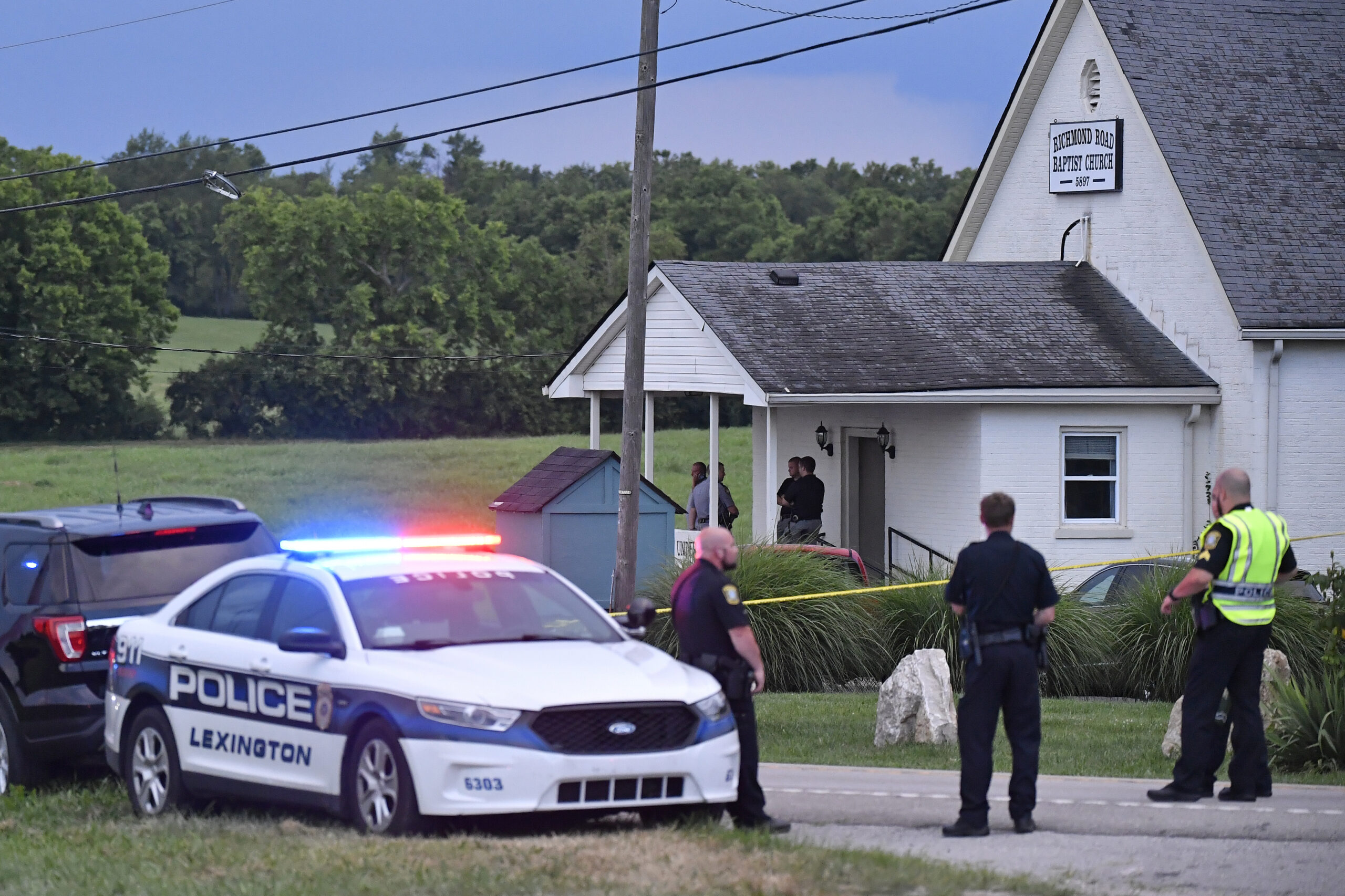
Officers confronted House, 47, in a rear parking lot after the shootings at the close-knit rural church where many members are related or close friends. At least three Lexington police officers fired, striking House and resulting in his death, authorities said.

The trooper is in stable condition, and authorities have not identified the wounded.

Sunday’s violence began when House shot the trooper during a traffic stop near Lexington’s airport, police said. House then fled, forcibly stole a vehicle and opened fire at the church about an hour later, police said.

The trooper stopped House after receiving a “license plate reader alert,” police said. House had active arrest warrants and he shot the trooper as the officer interacted with people in the vehicle, Kentucky State Police Sgt. Matt Sudduth said Monday. The others in the vehicle were not involved in the shooting, did not flee and have cooperated with investigators, he said.

A woman who witnessed that shooting said it initially appeared to be a routine traffic stop, with the trooper talking through an open window.

“And as we were driving by, I heard, ‘pop, pop’ and I knew it was gunshots,” Larissa McLaughlin told WLEX-TV in Lexington.

Police credited several people for coming to the trooper’s aid immediately.

“Without the assistance of several Good Samaritans, this likely could have been a very life-threatening injury,” Sudduth said. He didn’t offer details on what aid was provided and said police were working to identify them.

Officers tracked the stolen vehicle to the church about 16 miles (26 kilometers) from where the trooper was shot, police said.

“Please pray for everyone affected by these senseless acts of violence,” Gov. Andy Beshear said Sunday, “and let’s give thanks for the swift response by the Lexington Police Department and Kentucky State Police.”

State Attorney General Russell Coleman said Sunday that detectives with his office were ready to support local and state agencies, saying, “Today, violence invaded the Lord’s House.”


A fight to save a Hindu temple for the 'unheard and unseen'

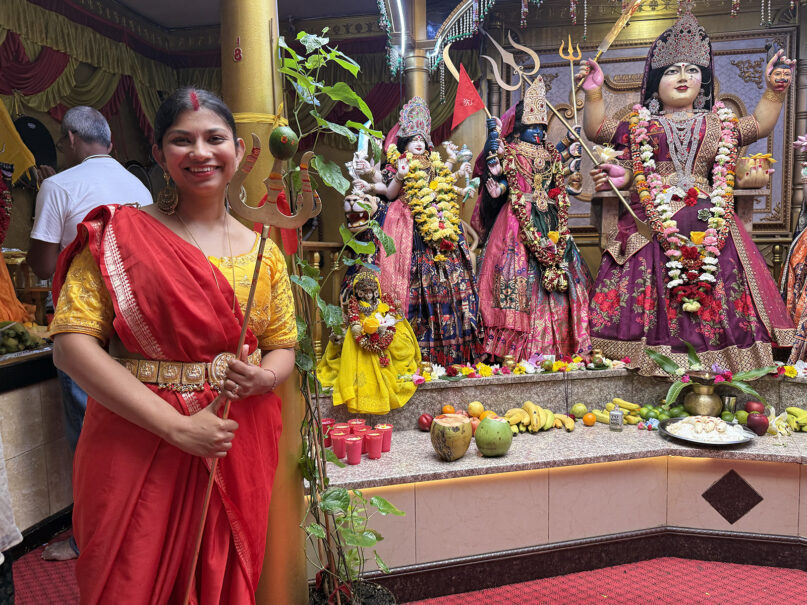
NEW YORK (RNS) — Since 2008, Shri Shakti Mariammaa has been a safe haven for women and members of the LGBTQ community. But the temple risks closure if it cannot make costly improvements.


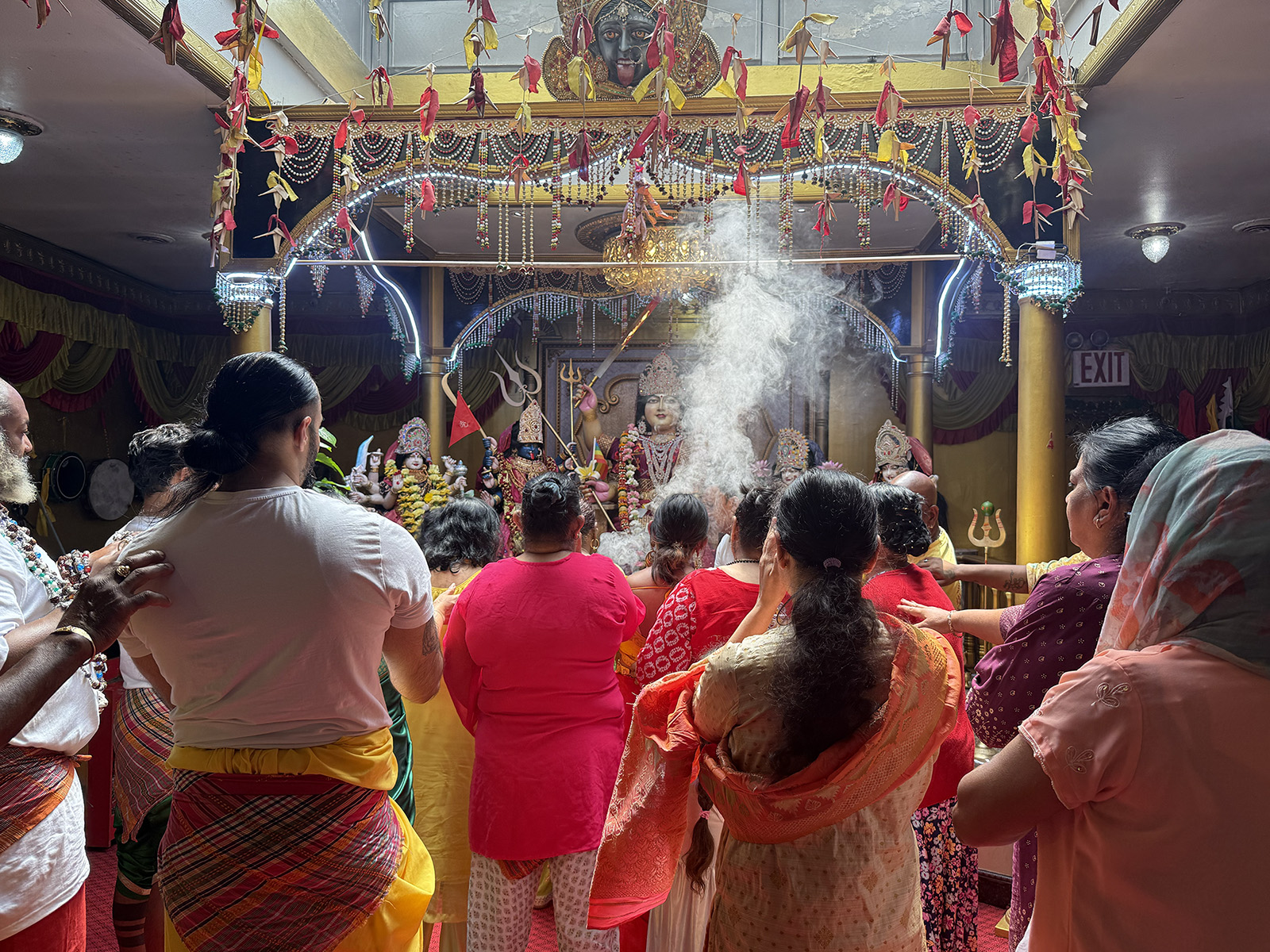
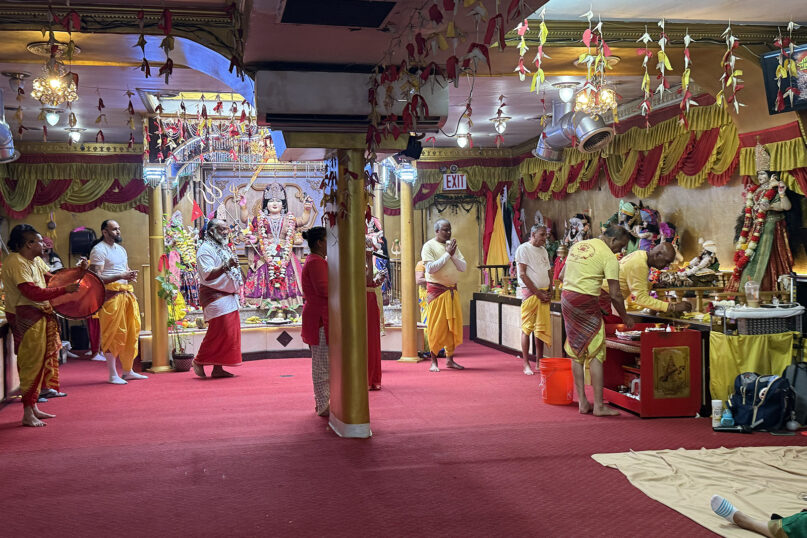
Congregants perform a devotional ritual to Mariamman, represented by the idol at center, passing the Divine energy through one another, during a worship service at the Shri Shakti Mariammaa temple, July 13, 2025, in the Queens borough of New York. (RNS photo/Richa Karmarkar)

Richa Karmarkar
July 16, 2025


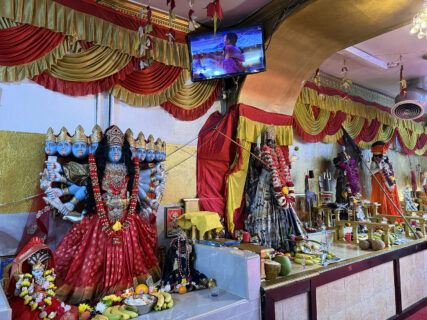
NEW YORK (RNS) — Illuminated by a skylight at the center of a small factory-turned-Hindu temple in Queens sits a murti of the Divine Mother — a 1-ton, 6-foot-tall icon of the South Indian village goddess Mariamman, an incarnation of Kali, the deity of time and death. Smoke from cigarettes and incense fills the room, and bottles of rum sit next to fruit at the altar.

“Our religion is very rural, very villagelike,” said Chandni Kalu, 31, a priestess at the Richmond Hill temple. “It’s very raw.”

Even other Hindus might find Sunday worship services at the Shri Shakti Mariammaa temple unfamiliar. The mostly Indo-Caribbean congregants worship goddess Kali, who also represents transcendental knowledge that can manifest within, or spiritually possess, her followers. At a recent service, a young male pujari, or lay priest, shook and danced vigorously through the crowd, entranced with Shakti, the feminine energy that inhabits someone possessed by Kali.


“We are a healing temple,” said Sharda Ramsami, one of the original members of the temple when it was founded in 2008. “Whether it’s something physical or something spiritual, we are always the last resort, and when people come here, they’re desperate for help. I think that’s what’s most powerful: that desperation, and then here’s the answer that no one else could provide for them. Mother knows.”

But the temple is also known as one that is open to all. Its clergy have married same-sex couples after they were shunned or rejected from other Hindu temples in the area, and, uniquely, those clergy, the temple staff and congregants are mostly women. Women come to seek refuge at the temple, Ramsami explained, sometimes to escape dire situations. They have been quietly offered money from temple staff or even given the keys to the building to stay there.

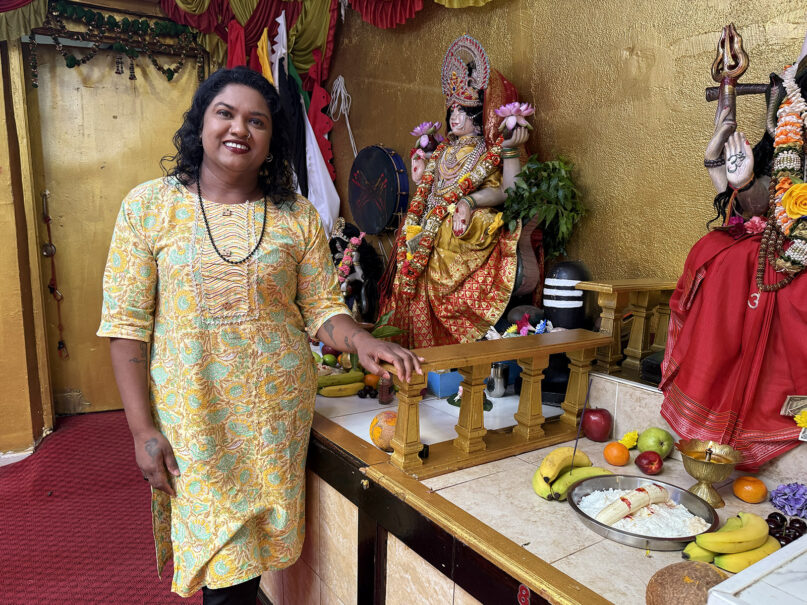
Sharda Ramsami at the Shri Shakti Mariammaa temple, July 13, 2025, in New York’s Queens borough. (RNS photo/Richa Karmarkar)

Other temples, Ramsami said, would throw women out for menstruating or not allow women to approach the altar. “That’s just not something we believe in,” she said. “We worship a woman.”

“Even in mainstream Hinduism,” Kalu said, “there’s so much patriarchy. Women aren’t really given roles, and whenever they are, it’s just mediocre roles in the kitchen making prasadam (offerings). I was really given a platform here to become a priestess.”

Now, the temple is in danger of closing. Without more than $150,000 in necessary upgrades to the space, the landlord and the city will move to push the temple out.

“I think Mother had a plan for us all to be here, because our lives changed so much and in so many ways,” said Hilda Thamen, Ramsami’s aunt and another founder of the temple. “She did so much for us. So now what’s going on here is really sad. It’s really hurting us.”

Back in 2018, a noise complaint from a neighbor led to intervention from the city’s Department of Buildings, resulting in a small fine. In 2024, after another noise complaint by the same neighbor, the city determined the temple needed to legally register as a community space. To do so, said Ramsami, the building needs several costly improvements to electricity, plumbing, fire safety and accessibility.

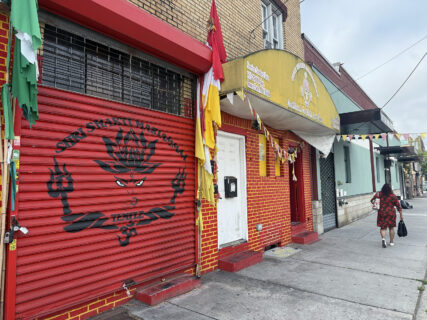
The Shri Shakti Mariammaa temple in Queens, N.Y. (RNS photo/Richa Karmarkar)

But it is unclear whether these changes are viable in a building intended for manufacturing, not worship. Though renting another location for more money may eventually be possible, “if we move somewhere further, we lose some of our congregants,” said Ramsami. “A lot of older folks come here, and the bus stop is right down the block, so it’s just easy for them to walk here.”

The neighbor, who lives in a single-family home behind the temple, heard the loud bhajans, or devotional songs, and drums nine nights in a row during the holiday of Navratri, an homage to the goddess Durga. At the time, he told congregants he would “rather there be a bar” than a temple so close to his windows. The neighbor has denied the temple’s request to build an exit in the back, and has constructed a 12-foot fence in between them.

“He came once and he saw our logo painted on the gate and he said, ‘Oh, Diablo, Diablo meaning the devil,'” said Ramsami. “So it definitely stems from fear.”
RELATED: For New York’s Indo-Caribbean Hindus, Diwali is a fusion of East and West

Most Kali temples in the area are tucked away in basements or backyards. “If you look at the murti or an image of Ma Kali, she’s so different from other mothers,” said Kalu. “She’s dark, she’s disheveled, she’s naked. She has blood dripping from her tongue. And I think all of that makes people uncomfortable. Blood is kind of deemed inauspicious, and I think from fear it became so taboo.”

Even in Guyana, said Thamen, “you were afraid to say you go to a Kali temple, because people look at you different.”


Chandni Kalu is a priestess at the Shri Shakti Mariammaa temple in Queens, N.Y. (RNS photo/Richa Karmarkar)

In the 19th century, the British brought scores of indentured Indians to Trinidad, Guyana and Suriname in the Caribbean. Many came from southern India and brought their animistic and folk religions with them. Caribbean Shaktism was thus born, with rituals passed down in a “broken” version of Tamil by word of mouth to the mostly English-speaking Indo-Caribbean population, with no Scriptures to consult and no book of mantras.

Yet the tradition still thrives thanks to the Queens temple’s founders, some of whose parents were priests in Shakti temples back in Guyana. A small group of second-generation New Yorkers gutted out the factory, built a kitchen and redid the roof, all while holding day jobs in commercial and residential cleaning, catering and nutrition school.

The mission of Shri Shakti Mariammaa was clear, said Dave Kutaiyah, the temple’s chairman. “This is not only a place for religion or a place where you come to pray on Sunday,” he said. “This is a place where you come and you see people who look like you, people who are familiar to you.

“That’s one of the things we instill in our temple: Treat everyone the same, whether you work for city government and you’re the right-hand person to the mayor, or you’re working at Dunkin’ Donuts on the 12 a.m. shift. People need to be loved and respected, and that’s what we try to bring here.”


The temple has survived through individual donations from families wanting a particular puja, or ritual, to be performed. But Kutaiyah and his team, even during the current financial struggle, have never asked for money from the congregation, or passed out a tithing plate.

“We believe worship should be free, health should be free, and we shouldn’t gain financially from that,” said Ramsami.


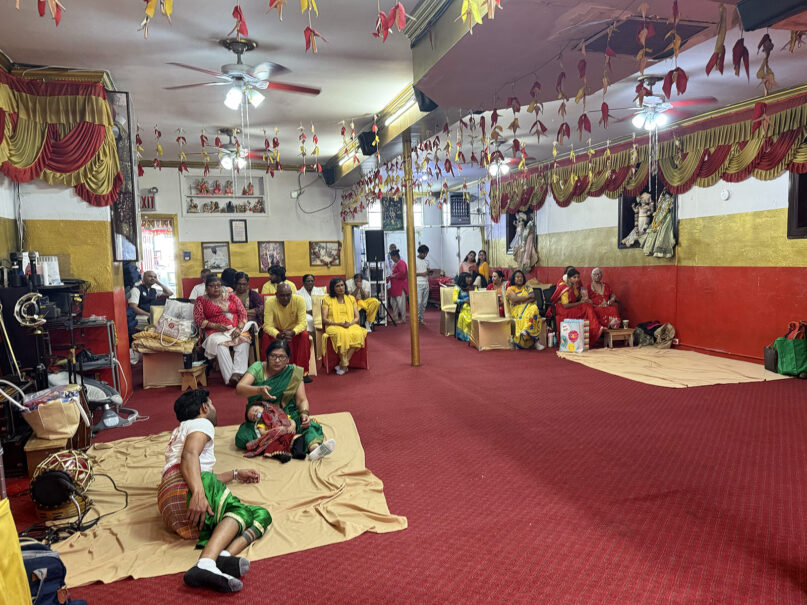
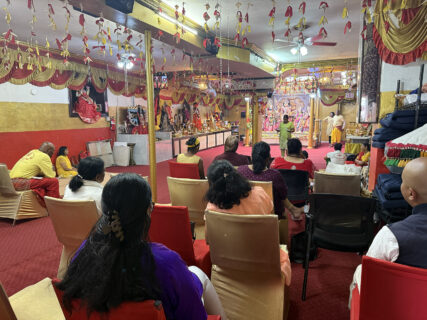
Congregants attend a worship service at the Shri Shakti Mariammaa temple, July 13, 2025, in Queens, N.Y. (RNS photo/Richa Karmarkar)

“I think 90% of people who attend here will tell you they work in a department store, factory or at JFK (International Airport), so we don’t have a lot of white-collar professionals that have a lot of disposable income to donate,” added Kutaiyah, who works in human resources. “I always tell people, use your pension money to pay your bills first, and then think about God. God will not be upset with you if you can’t give anything.”

A GoFundMe campaign, co-signed by a number of organizations that have used the temple’s space for meetings, such as Jahajee: Indo-Caribbeans for Gender Justice and the Caribbean Equality Project, has been circulating since June. In November, at a court date to pay an outstanding fine, the temple will ask the city for an extension to figure out its next steps.

Rohan Narine, NYC organizer with the national organization Hindus for Human Rights, one of the supporters of the GoFundMe campaign, has a personal stake in the temple’s success. A Queens native, Narine has been hosting Om Night open mics at the temple for years.


Congregants attend a worship service at the Shri Shakti Mariammaa temple, July 13, 2025, in Queens, N.Y. (RNS photo/Richa Karmarkar)

Icons of different incarnations of the Divine Mother at the Shri Shakti Mariammaa temple, July 13, 2025, in Queens, N.Y. (RNS photo/Richa Karmarkar)

Narine considers himself an “orthodox Hindu” and was surprised on his first visit to see worshippers throwing menthol cubes of fire into their mouths and dousing themselves in rose water. But despite theological differences, “I felt that beauty and that raw spiritual energy that you don’t feel in other temples,” he said. “It’s not like sitting down at an ashram, offering prasad, do a little aarti (lamp ritual) and you eat and go home. Here, it’s very involved. It’s almost like being part of a live interactive performance.”

In Indo-Caribbean spaces in Queens, according to Narine, the temple’s style of worship is becoming more mainstream. More people are coming to the temple not just for curiosity’s sake, but to worship alongside the Shakti community.

“I think the entire expanse of Hinduism should be represented,” said Narine. “All of the Hindu pantheon should have the ability to practice their faith freely. We as Hindus, and especially Indo-Caribbean in America, are very comfortable with the more simplistic way of worship, and Shakti worship might be more complex. But we can’t shy away from that. I think we should be more open to that.”


Congregants perform devotional rituals during a worship service at the Shri Shakti Mariammaa temple, July 13, 2025, in the Queens borough of New York. (RNS photo/Richa Karmarkar)


Inside Colorado’s psychedelic church: ‘What makes this place magical is not the mushrooms’

(RNS and NPR) — As psychedelics are decriminalized in Colorado, one unconventional church is building community in the basement of a suburban home.


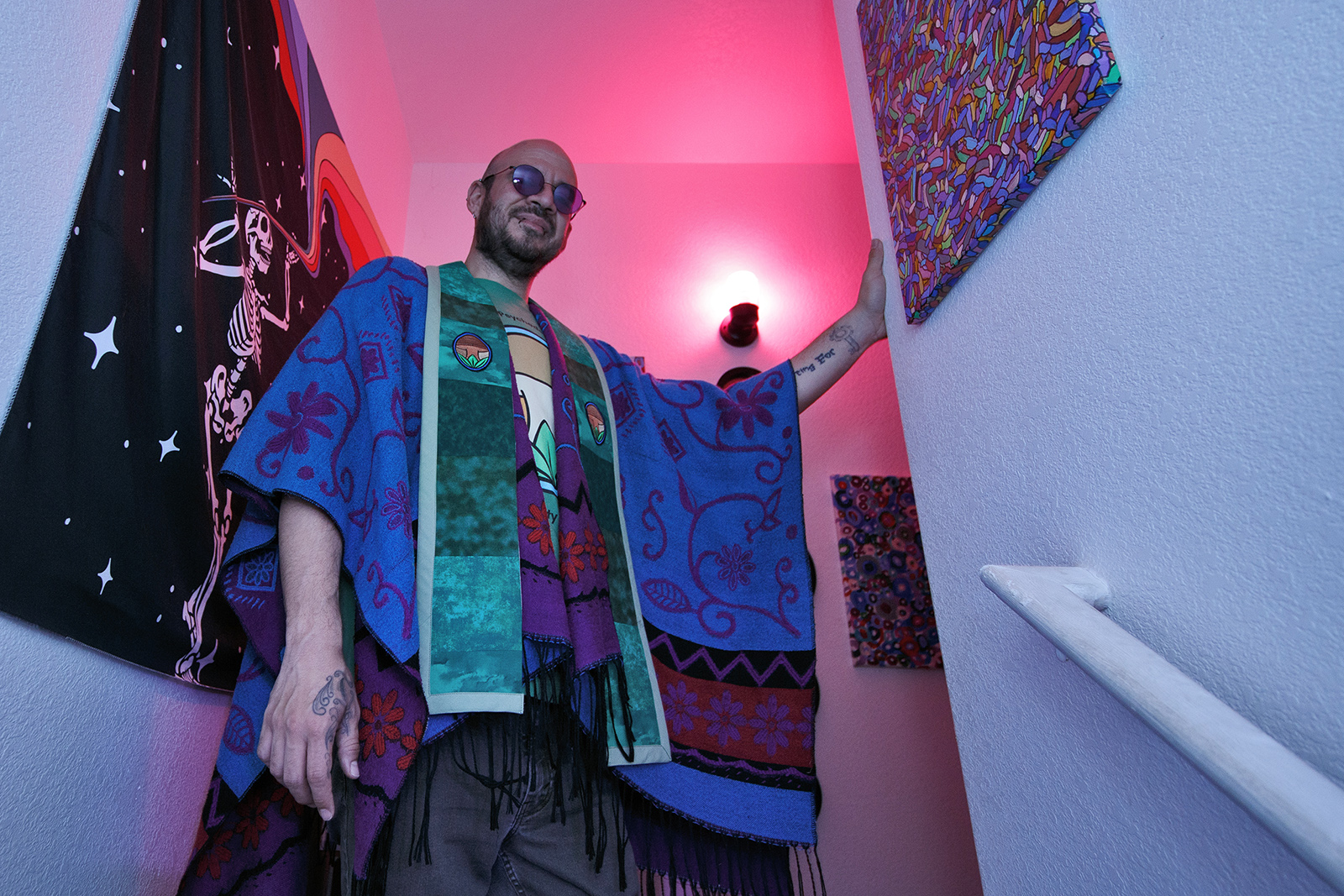
Benji Dezaval poses for a portrait, Friday May 30, 2025, in Colorado Springs, Colo. 
(Photo by Jeremy Sparig, for CPR News)


Hayley Sanchez
July 7, 2025

COLORADO SPRINGS (RNS and NPR) — The door to the Colorado Psychedelic Church doesn’t look like much — a walkout basement to a home in an eastern Colorado Springs neighborhood.

Faux foliage dangles from the walls, a tabletop fountain trickles nearby, and on a recent Tuesday in May, about 20 people were seated on couches under dim green lighting, while soft meditative music filled the air.

At the front of the room sat Benji “Dez” Dezaval the church’s founder.

“Hey y’all,” said Dezaval, welcoming people inside with a big laugh, purple-tinted glasses and a shawl draped around his shoulders. “I’m glad we waited.”

This weekly guidance — one of many community events the church hosts in a given week — is not unlike a regular book club or Bible study. The evening’s conversation centers on this month’s theme: what it means to be maternal, timed to Mother’s Day.

A typical Tuesday meetup like this one might begin with some socializing over shared snacks brought by a congregant. Then the group settles in for a sermon, or lecture, followed by a conversation with reflections on the day’s topic. The meeting closes with an optional offering of psychedelics.


Multiple strains of psilocybin spores sit ready for cultivation at the Colorado Psychedelic Church, Friday May 30, 2025, in Colorado Springs, Colo. (Photo by Jeremy Sparig, for CPR News)

On this particular Tuesday, it was one puff of DMT, or dimethyltryptamine, a compound found naturally in some plants and animals, known for its short-yet-intense effects.

About a quarter of the group raised their hands, some regulars and others first-timers. Once everyone’s church membership card was checked — issued after completing a safety screening — a facilitator pulled out a small device resembling a vape pen.

The facilitator explained the instructions and said smoking DMT was different from cannabis. He held the pen to each person’s mouth to take a puff, pausing and counting to four before they exhaled, wiping the mouthpiece off with a cloth in between each congregant.

After everyone had received their gift, the facilitator thanked the group for sharing the time together. And for the next few minutes, in the quiet pattering of the rain outside, participants seemed to go inward, not speaking, some closing their eyes, while the congregants who chose not to participate chatted quietly with each other.

Lee Mead, 43, attends the church events regularly. He works in a nonprofit and moved to Colorado Springs from Houston last August, not knowing anyone. And within a week, he discovered the Psychedelic Church on the app Meetup and decided to show up

“It’s not just a bunch of people doing drugs in some guy’s dingy basement,” said Mead. “It is nice down here. And it is more about the community than the substances.”


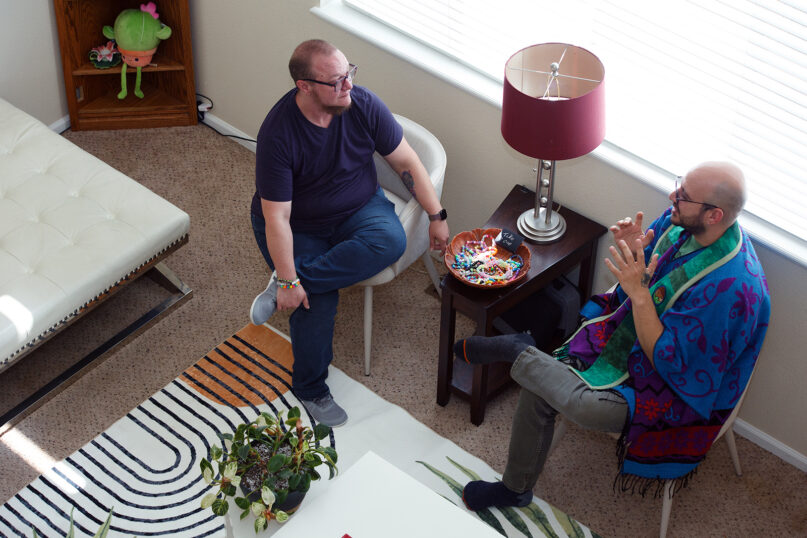
Lee Mead, left, and Benji Dezaval talk at the Colorado Psychedelic Church, Friday, May 30, 2025, in Colorado Springs, Colo. (Photo by Jeremy Sparig, for CPR News)

One night after taking psilocybin, the drug found in magic mushrooms, during what congregants call “revelry” — or an altered state of consciousness — Mead had a panic attack as he was coming back to reality. The stress of his job and a deeper unhappiness came rushing to the surface, he said.

And that’s when strangers stepped in and stayed with him.

“People that had just seen me maybe three times here at the church carried me through that,” Mead said. “Which of course made it even worse because I was receiving love that I didn’t feel I was worthy of.”


Mead didn’t touch psychedelics for months after that experience, but he never stopped showing up to the church gatherings.

“I hadn’t felt that level of care and level of love for a long time,” Mead said.

The Colorado Psychedelic Church, founded in 2024, describes itself as a spiritual community that uses psychedelics in communal settings. The church offers a range of gatherings throughout the week, including one for women, for men and for queer folks, plus a weekly lounge night for all in the community. The church also hosts classes and occasional themed gatherings. People gather in Dezaval’s basement, and they can choose whether to partake in the psychedelics. They see these substances not as recreational drugs but as a form of medicine that provides spiritual or emotional healing.


The Colorado Psychedelic Church, Friday May 30, 2025 in Colorado Springs, Colo. (Photo by Jeremy Sparig, for CPR News)

“There’s revere the self, and that’s the first universal truth. And we do that primarily through self care, making sure we’re actually actively maintaining ourselves. The use of natural medicine is a large part of that,” Dezaval said, explaining one of the church’s values.

“The second one is to embrace the communal experience to come together,” Dezaval said. “And the last, that the universe provides.”

Counseling is provided before, during and after revelry by Dezaval and other facilitators to help individuals make sense of their experience. Some facilitators and congregants also have medical training, according to Dezaval.

Before taking a dose at the church, people go through a safety screening, Dezaval added, ensuring they are over 21 and don’t take any medications that could interact dangerously with psychedelics, like some antidepressants. They also are required to complete training that explains the effects of the psychedelics and how to navigate the experience.


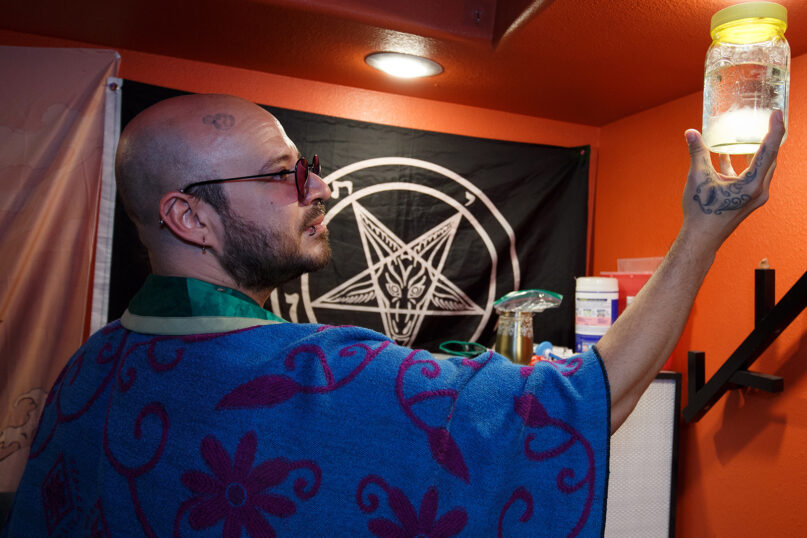
Benji Dezaval examines psilocybin spores at the Colorado Psychedelic Church, Friday, May 30, 2025, in Colorado Springs, Colo. (Photo by Jeremy Sparig, for CPR News)

Although DMT is illegal under federal law, Colorado decriminalized certain psychedelics in 2022. Since then, therapy clinics have popped up across the state.

The state’s regulated program requires licensed facilitators in a therapeutic setting, for instance, to oversee preparation, facilitation and integration after. But informal settings, like the psychedelic church, are not regulated.

Under Colorado’s Proposition 122, adults 21 and over may legally grow, possess, consume and gift naturally occurring psychedelics for personal use without requiring a license so long as no money is exchanged.

The congregation is funded through donations, according to Dezaval.

Don Lattin, a veteran reporter and author of “God on Psychedelics,” told RNS that federal scrutiny often focuses on whether a group has ongoing membership, screens out recreational users and upholds spiritual practices.

“The laws on this are vague and subject to the whims of the DEA,” Lattin said via email, but regulators have historically been more accepting of churches that “attempt to select only those who are serious” and “turn away would-be recreational users or thrill seekers.”


Pslocybin mushroom cultivation kits are stored at the Colorado Psychedelic Church, Friday May 30, 2025 in Colorado Springs. (Photo by Jeremy Sparig, for CPR News)

One way to distinguish a legitimate psychedelic church from a dispensary, Lattin said, is by looking at intention, structure and consistency.

“One of them, Sacred Garden Church, appeared to me after months of participatory reporting to be a sincere attempt to explore the spiritual dimensions of the psychedelic experience in a responsible group setting,” Lattin said. “The more notorious Zide Door Church of Entheogenic Plants seemed like a thinly veiled mushroom dispensary.”

Dezaval, the Colorado Springs church leader, maintains that his goal is to help people through the healing power of psychedelics. “If I was doing anything illegal, if this was all about the drugs and this is all about the money, why would I have any of these conversations?

“I understand the skepticism and I invite people in, so I can say like, ‘Let me show you every nook and cranny so you can see there is no secret,’” Dezaval said.

Congregants must partake of the DMT onsite, but they can take psilocybin home with them, and Dezaval acknowledges they may end up sharing the substance with friends who are not part of the community and have not gone through the training or safety screening.

“That’s gonna happen,” he said, adding that he tells congregants, “Don’t give them this without the information to make it safe.”

“Because without safety information, these tools are weapons and that weapon can only hurt somebody,” he said. “It’s not, ‘I gave you this — godspeed.’ No. I gave you this, I gave you the tools to do it right. So I want to make sure that you can heal, not get hurt.”

Nearly 700 people have attended at least one gathering of the church, Dezaval said, adding that they plan to expand into a second home in the neighborhood.

“There (are) a lot of people … who are looking so hard to find a place to belong,” Dezaval said

That held for congregant Sara Snapp, a stay-at-home mom with a background in religious studies. She grew up Catholic but said she spent much of her life feeling alone. She said she had lived with depression for most of her life but wasn’t diagnosed until after the birth of her daughter.

Last year, she tried psilocybin in a therapeutic setting, and something shifted. And then, Snapp said, things continued improving after she joined the church.


Sara Snapp listens at the Colorado Psychedelic Church, Friday, May 30, 2025, in Colorado Springs, Colo. (Photo by Jeremy Sparig, for CPR News)

“I found exactly what I needed here,” Snapp said. “I found the community that I was searching for. I found people who wanted to know the real me.”

For congregants like Snapp and Mead, Colorado Psychedelic Church doesn’t fit neatly into a box; it’s part support group, part spiritual sanctuary, part experiment.

“What makes this place magical is not the mushrooms,” Snapp said. “It’s that when you walk in that door, your armor falls off. And it’s in that softness and vulnerability that we … build these relationships.”

As one more weekly guidance session comes to a close, the sound of laughter and chatter fill the room.

“This is my family here,” said Mead, the Colorado transplant. “This is truly my third place.”

This story was produced through a collaboration between NPR and RNS. Listen to the radio version of the story.