Sunday, September 28, 2025


Keir Starmer urges Labour Party unity to fend off Nigel Farage's Reform UK threat
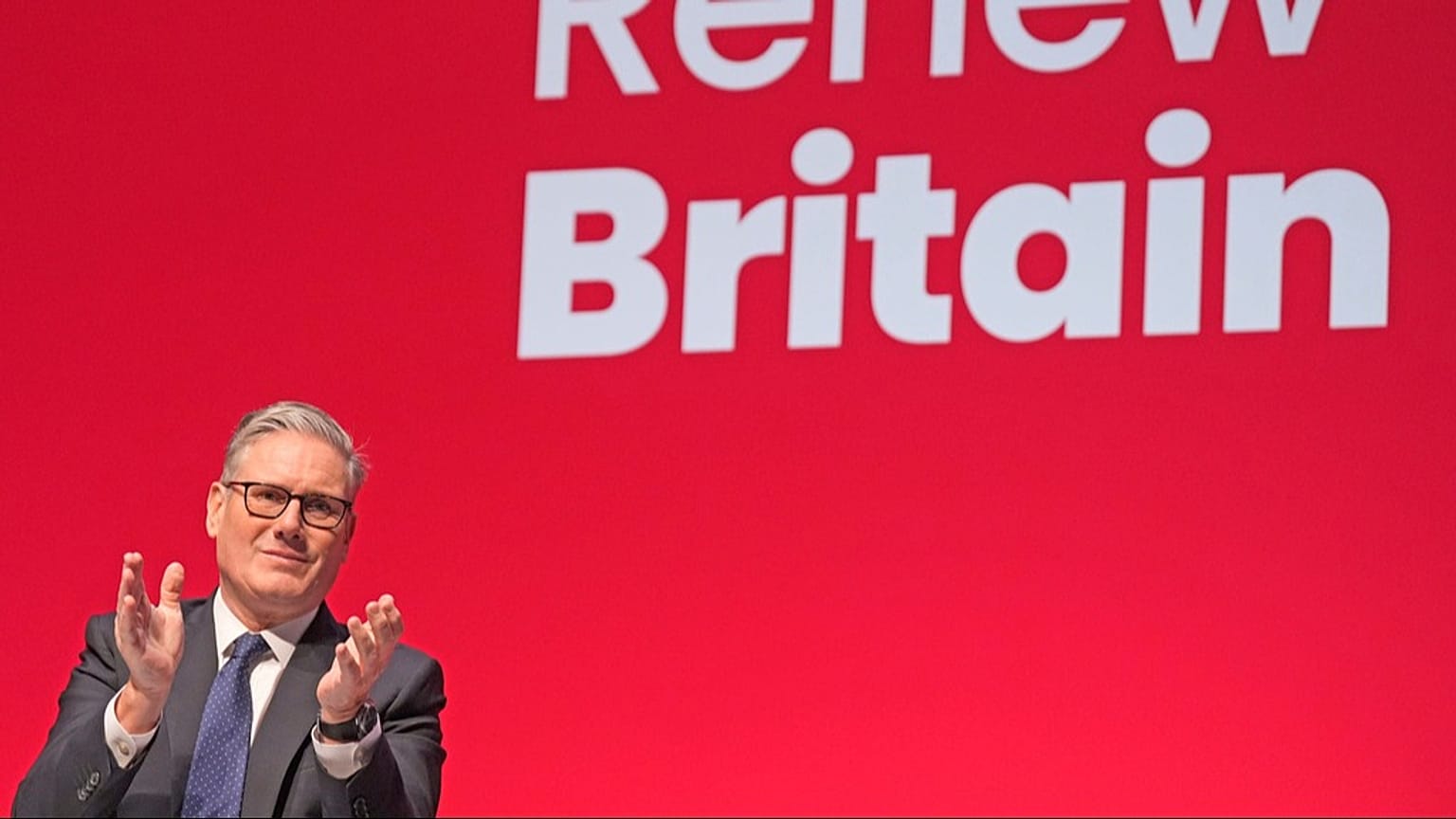
Copyright Danny Lawson/APBy  Malek FoudaPublished on 28/09/2025 - EURONEWS

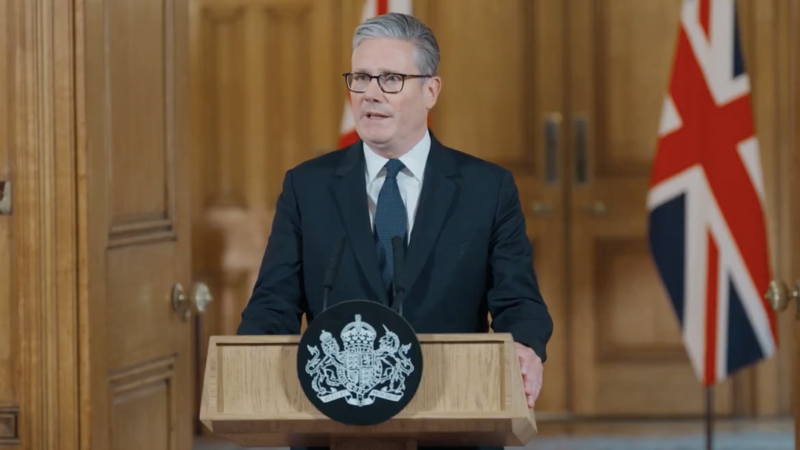
Starmer appealed to his Labour Party colleagues to have more trust in the government and display a united house, warning them to prepare for the “fight of our lives” amid Nigel Farage’s poll-topping Reform UK party threat.

UK Prime Minister Keir Starmer urged his Labour Party to stop “navel gazing” and display unity amid threats from Nigel Farage’s Reform UK party, which has been consistently topping British polls for weeks.

The British premier told his party members as they gathered for their annual conference in Liverpool to unite for the “fight of our lives” and stand for British values amid Reform’s threat, which he said is guided by a “racist policy”.

His government has struggled to ease growing divisions over immigration, fuelled in part by the arrival of thousands of migrants in small boats across the English Channel.

More than 30,000 people have made the dangerous crossing from France so far this year despite efforts by authorities in the UK, France and other countries to crack down on people-smuggling gangs.
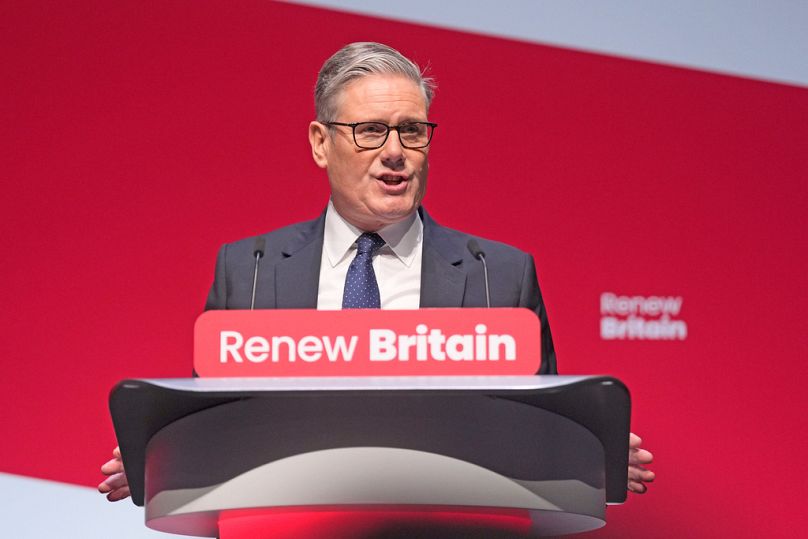
Britain's Prime Minister Keir Starmer speaks during the Labour Party Conference in Liverpool, England, Sunday Sept. 28, 2025 Danny Lawson/AP

Starmer’s government has only been in office for little more than a year, and in recent weeks, has faced many turbulences, leading public opinion of him, and support from within his own party to wane.

The next election is as much as four years away, but as thousands of Labour Party members gathered beside the river Mersey, lawmakers are growing anxious. A potential leadership rival has emerged in Andy Burnham, the ambitious mayor of Manchester.

“Business as usual … ain’t gonna do it. The plan has to change quite radically,” Burnham said. He added that “it’s the plan that matters most, rather than me,” but acknowledged some lawmakers had approached him about a potential leadership bid.

Speaking to UK media, Starmer downplayed the discontent, saying “in politics, there are always going to be comments about leaders and leadership” and insisting the government had “achieved great things in the first year.”
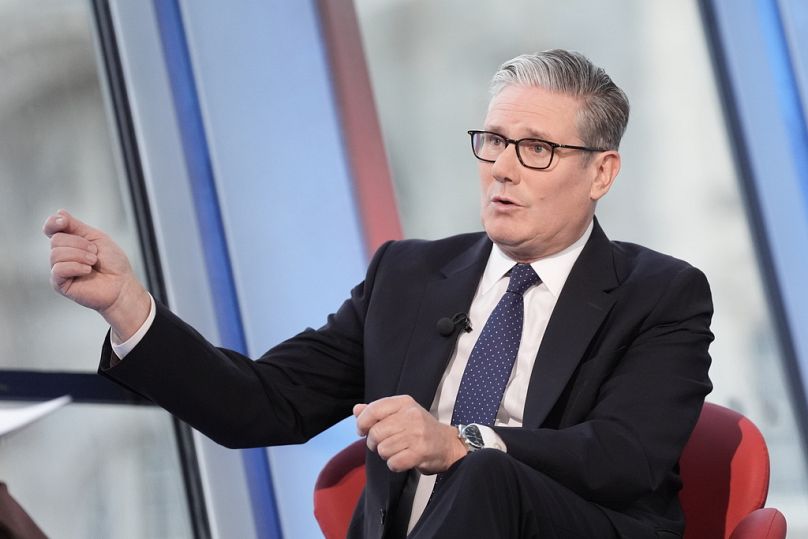
British Prime Minister Keir Starmer speaks on the BBC 1 current affairs programme, Sunday, Sept. 28, 2025, with Laura Kuenssberg in Liverpool Stefan Rousseau/The Press Association

Burnham replacing Starmer could be some way off though as the former shadow home secretary turned big city mayor is not currently a member of British Parliament.

The PM appealed to his colleagues to maintain trust in him and allow his government to weather the storm.

“I just need the space to get on and do what we need to do,” said Starmer.

Since ending 14 years of Conservative rule with his July 2024 election victory, the Labour party leader has struggled to deliver the economic growth he promised.

Inflation remains stubbornly high and the economic outlook subdued, disrupting efforts to repair inefficient public services and ease the burden of a worsening cost of living crisis.

In recent weeks Starmer has lost his deputy prime minister, Angela Rayner, who resigned over a tax error on a home purchase, and fired the Washington Ambassador Peter Mandelson, after news surfaced about his past friendship with convicted sex offender Jeffrey Epstein.
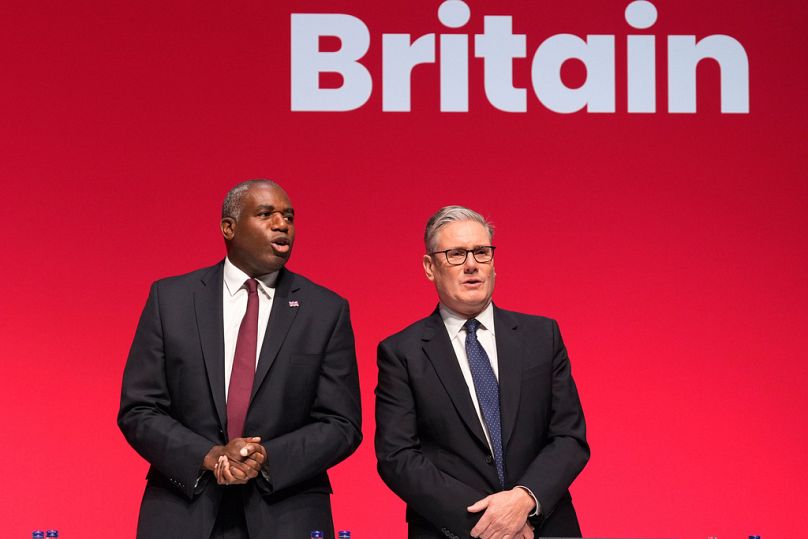
UK Prime Minister Keir Starmer and Deputy Prime Minister and Justice Secretary David Lammy attend the Labour Party Conference in Liverpool, England, Sunday Sept. 28, 2025 Danny Lawson/AP

There have also been several exits from his backroom team, adding to a sense of disarray and creating an environment of uncertainty over the future of this government.

And though the UK managed to secure a trade deal with the US easing import duties on some goods, the autumn budget statement in November looks set to be a grim choice between tax increases and spending cuts — or maybe both.

“They’ve only been in government a year and they’ve got a big majority, but most voters seem to be quite disappointed and disillusioned with the government," said Tim Bale, professor of politics at Queen Mary University of London.

Bale added that even though the public’s opinion of Keir Starmer is currently “very low”, he believes that the premier’s best move, for now, is to “keep calm and carry on”.

The government does not have to call an election until 2029, but pressure will mount on Starmer if, as many predict, Labour does badly in local and regional elections in May.


Billy Bragg mocks Nigel Farage’s hopes of


being PM on BBC Question Time


26 September, 2025 
Left Foot Forward

'To demonise, particularly the Muslims, this is the sort of thing why we worry about Reform.'
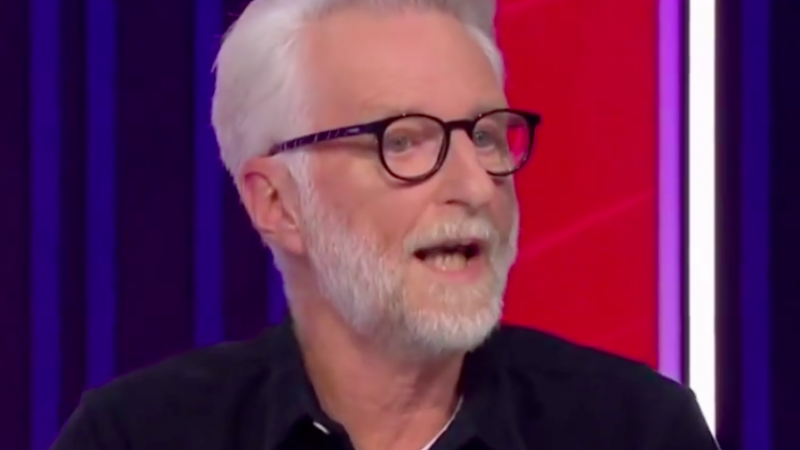


Reform UK leader Nigel Farage was brutally mocked on BBC Question Time over his hopes of becoming Prime Minister by musician and activist Billy Bragg.

Farage has continued to make the headlines this week, seeking to whip up a moral panic over migrants and Muslims, without providing proof for any of his ludicrous claims.

Appearing on LBC earlier this week, he refused to condemn President Trump’s claims linking the use of paracetamol to autism.

There is no evidence of a link between pregnant mothers taking paracetamol and the birth of a child with autism or other neurodevelopmental disorders such as ADHD.

Rather than speak the truth, Farage went on to defend the President’s previous claim that illegal immigrants from Haiti were eating domestic cats and dogs in Ohio. Farage is a Trump supporter and the President was also condemned this week for his false and Islamophobic claims about the Mayor of London Sadiq Khan, where he told the UN that Khan was a ‘terrible Mayor’ and that he wanted to bring Sharia law into London.

During the LBC interview, Farage said he believed Sharia Law was being introduced to the UK because he had been told so by a taxi driver.

Bragg told the Question Time audience: “After giving the impression he doesn’t trust scientists, he later said in the interview when he was asked by Nick Ferrari, why he believed that Sharia Law was coming to Britain, he said he’d been told by a taxi driver.

“So he was willing to believe a Muslim taxi driver in Buckinghamshire rather than believe the scientific establishment. This guy wants to be prime minister? You must be joking”, leading to much applause.

Reform deputy leader Richard Tice interrupted, and told him: “Billy, there are over 80 Sharia courts in the United Kingdom. Are you aware of that?”

The singer hit back: “Yeah I am, but there are also Jewish courts and that is part of their religion and we, as a tolerant nation, accept that.

“To demonise, particularly the Muslims, this is the sort of thing why we worry about Reform.”

Keir Starmer says Donald Trump’s claim Sadiq Khan wants to bring in Sharia Law is ‘nonsense’

26 September, 2025 
Left Foot Forward


Prime Minister Keir Starmer has defended the Mayor of London Sadiq Khan against Trump’s attacks, calling his claim that Khan wanted to bring in Sharia law ‘nonsense’.

Trump took aim at Khan during a speech at the UN, where he falsely claimed that London wanted to “go to sharia law” under its “terrible mayor”.

In a rambling speech at the UN, the President launched a scathing attack on the global body, where he called for countries to close their borders and expel foreigners as well as calling climate change a ‘con job’.

He then took aim at London’s Muslim mayor, saying: “I look at London, where you have a terrible mayor, terrible, terrible mayor, and it’s been changed, it’s been so changed. Now they want to go to sharia law. But you are in a different country, you can’t do that.”

His comments were condemned by a number of Labour MPs, with Khan himself calling Trump ‘racist, sexist and Islamophobic’.

The Prime Minister has called Trump’s comments ‘nonsense’.

Sir Keir said: “I’m not going to get drawn into a war of words, but what I will say is this, because it is important.

“You saw from the state visit last week that there are plenty of things on which the president and I agree, and we are working together.

“There are some issues on which we disagree, and what the president said about the mayor, who’s doing a really good job, in fact driving down serious crime, what he said about the introduction of Sharia law was ridiculous nonsense.

“I support our mayor, I’m really proud of the fact we have a Muslim mayor of a very diverse city.

“We do work with the Americans on a huge number of issues. On this issue I disagree, and I stand with our mayor.”


Sadiq Khan rips into Trump after President’s Islamophobic comments: ‘He Is Racist, Sexist and Islamophobic’


24 September, 2025 
Left Foot Forward

Speaking to Sky News, Khan said he appeared to be living rent free in Trump’s head.
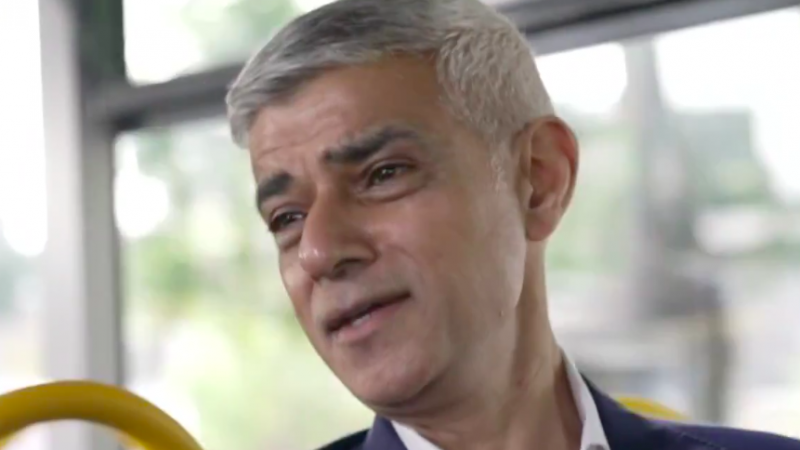


The Mayor of London Sadiq Khan has hit out at Donald Trump after the U.S. President once more targeted him with false claims, in what is his strongest rebuke yet of the Republican.

Trump took aim at Khan during a speech at the UN, where he falsely claimed that London wanted to “go to sharia law” under its “terrible mayor”.

In a rambling speech at the UN, the President launched a scathing attack on the global body, where he called for countries to close their borders and expel foreigners as well as calling climate change a ‘con job’.

He then took aim at London’s Muslim mayor, saying: “I look at London, where you have a terrible mayor, terrible, terrible mayor, and it’s been changed, it’s been so changed. Now they want to go to sharia law. But you are in a different country, you can’t do that.”

His comments were condemned by a number of Labour MPs and now Khan has responded himself calling Trump ‘racist, sexist and Islamophobic’.

Speaking to Sky News, Khan said he appeared to be living rent free in Trump’s head.

He said: “People are wondering what it is about this Muslim mayor who leads a liberal, multicultural, progressive, successful city that means I appear to be living rent free inside Donald Trump’s head.”

Asked if he thought the comments were Islamophobic, Khan replied: “I think President Trump has shown he is racist, he is sexist, he is misogynistic and he is Islamophobic”.

On Trump’s accusations that he is a “terrible mayor”, Khan just said he was “thankful” there were rising numbers of Americans relocating to London.

Basit Mahmood is editor of Left Foot Forward
UK

If the government wants economic growth it must bring essential industries into public ownership

26 September, 2025


Successive governments clobber households and small busi
nesses by hiking interest rates to manage inflation, but don’t inconvenience corporations.


The latest economic forecast for the UK by the Organization for Economic Co-operation and Development (OECD) makes uncomfortable reading. The UK is expected to have inflation rate of 3.5% across 2025, the highest amongst G7 countries. Economic growth, a key plank of the government’s policy, is expected to ease from 1.4% in 2025 to 1% in 2026.

Such problems are caused by obsession with neoliberal policies. The rate of inflation can’t be blamed on excessive cash sloshing around in low/middle income households. The average real wage of employees has hardly moved since 2008. The median pre-tax employee wage of £30,816 means that around 50% of workers are struggling to survive. A single person needs to earn £30,500 a year to reach a minimum acceptable standard of living. A couple with 2 children needs to earn £74,000 a year between them. Even with both parents working and earning a median wage, a typical family is unlikely to attain a minimal standard of living. Around 16m people in the UK are living in families in poverty. Millions rely upon food banks and charity.

The main cause of inflation is profiteering. The cost of energy, water, rent, food and transport continues to exceed the rate of inflation. Household energy debt has hit record £4.43bn. Some 128,000 people a year die in fuel poverty, but no government or major political party has shown any inclination to curb profiteering.

A report by Unite noted that since the pandemic, corporate profit margins have jumped by an average of over 30%. Electricity generation companies almost trebled their margins, up by 198%. Electricity and Gas supply companies increased their profit margins by 363%. Shipping companies’ profit margins have soared to 650-times their pre-pandemic levels. Companies engaged in health and social work increased their margins by 118%. Wholesale and retail trade increased its profit margins by 36%. Profiteering is a key driver of inflation and has resulted in real transfer of wealth from households to companies and their shareholders. This inevitably leaves people with less to spend on goods and services and limits their ability to stimulate the economy.

Successive governments clobber households and small businesses by hiking interest rates to manage inflation, but don’t inconvenience corporations. They seem to think that somehow markets will take corrective action even though too many sectors are dominated by monopolies and oligopolies.

For example, there is no competition in the water industry and none is possible. There is hardly any competition in the energy industry. Sectors such as mobile phones, internet, banking, housebuilding, supermarkets are controlled by a handful of companies. In recent months a cartel of pharmaceutical companies has ganged up on the UK government, demanding higher drugs prices to boost their profits. They have not been shy of fleecing the public purse which results in higher costs for the National Health Service and higher taxes. For example, cancer drug lenalidomide had a profit mark-up of 23,000%. Suppliers of hydrocortisone tablets increased prices by over 10,000% and the price of phenytoin sodium increased by 2,300% to 2,600%. Governments can break-up monopolies and empower people to check profiteering, but they don’t. Regulators are now expected to promote growth of industries, which will make them even ore toothless.

The government wants economic growth but it can’t be delivered as millions do not have the required purchasing power. The economic growth model chosen by successive governments is also problematical. Governments have deregulated, weakened consumer and employment rights, and cut real wages in the hope of attracting foreign direct investment (FDI) to provide jobs and new investment, but that hasn’t always delivered. The value of inward FDI in 2023 was £1.3bn, down from £22.9bn in 2022. The exclusion of a large proportion of population from consumption combined with the effects of Brexit and uncertainties of Trump tariffs does not make the UK an attractive FDI destination.

There are two kinds of investment flows. Firstly, there is investment in productive assets which increase the stock of productive capital. The UK invests around 18.2% of GDP in productive assets, compared to 23% average for OECD countries. Secondly, there is ‘fictitious capital’ which does not increase the productive capacity. Everyday billions of Pounds are spent on buying/selling previously issued shares i.e. A buys shares from B. None of the money goes directly into productive assets. Increasingly, stock market functions as a cash extraction machine rather than a provider of new capital. Last year, companies listed on the London Stock Exchange (not all are UK-based) raised £25.3bn in new shares; paid out £92.1bn in dividends and another £57.1bn in share buybacks.

The FDI may provide jobs and investment, but it also brings problems of cash extraction, and investor returns which escape UK taxation. Since the 1980s, governments have privatised swathes of industries in the hope of securing private sector investment. That hasn’t always been the case. The privatised water sector has been starved of investment and companies dump raw sewage into rivers; lakes and seas. Since privatisation, companies chose to pay £88.4bn in dividends. The returns extracted by shareholders have had a detrimental effect on the UK economy.

Since privatisation, shareholders of water, rail, bus, energy and mail services have received around £200bn in dividends. Total extraction is probably significantly higher as companies engage in share buybacks and shift profits through spurious intragroup transactions, loans, interest payments, royalty and management fees. Large parts of the returns have gone abroad and have not lubricated the UK economy. No UK tax is paid on dividends paid to foreign investors.

Around 90% of England’s water companies are owned by foreign investors and states, including entities controlled from Australia, Bermuda, Canada, Cayman Islands, China, Hong Kong, Qatar, Singapore and the US. Since privatisation around £88.4bn has been paid in dividends, and a vast amount of cash went abroad.

A large part of the energy infrastructure and supply is owned by investors and state entities located in France, Germany and Spain. Around 40% of North Sea oil and gas licences are owned by investors from Canada, France, Israel, Italy, Korea, Norway, Spain, the United Arab Emirates and the US. 82.2% of offshore wind capacity is foreign-owned. Since 2020 alone, top 20 energy companies have made operating profits of £514bn.

Though train passenger services are currently being brought into public ownership again, at the height of privatisation over 61% of rail journeys were completed on franchises operated by foreign companies. These include entities controlled by the governments of France, Germany, Hong Kong, Italy, Japan and the Netherlands. Between 1996 and 2019, train operating companies and rolling stock companies paid over £8.3bn in dividends. Another report noted that £2bn was paid out between 2015 and 2023.

The government is not nationalising rail rolling stock companies (ROSCOs) It will operate passenger services by leasing carriages from ROSCOs. Around 87% of the rolling stock is controlled by three companies registered in Luxembourg, with an average profit margin of 41.6%. ROSCOs paid £409m dividends in 2021/22, £542m in 2022/23 and £331m in 2023/24, mostly to foreign investors.

It isn’t just privatised companies, a large part of the UK infrastructure is owned from abroad. For example, London Heathrow airport is owned by private and state investors from Australia, China, France, Qatar, Saudi Arabia, Singapore and Spain. Similar patterns apply steel, auto, ports, shipbuilding, banking, insurance, care homes, hospitals, GP surgeries, veterinary services and other industries. The temptation is to sweat assets and maximise cash extraction.

Successive governments have used blunt tools for managing inflation. Instead of selective taxes on the rich to withdraw surplus cash from the economy, governments have used austerity, real wage and benefit cuts, and higher interest rates. Profiteering must be curbed but political parties funded by corporations are unwilling or unable to do so. This exacerbates poverty and economic exclusion and in turn is a barrier to investment in productive economy.

The UK is a major financial centre, but the finance industry has been unwilling to finance productive investment as the City of London has little appetite for long-term investment and risks. Swathes of essential industries are owned from abroad, resulting in huge cash extractions which do not lubricate the UK economy and are not taxed in the UK. To control inflation and stimulate growth the government must acquire more economic policy options by bringing essential industries into public ownership but are hampered by self-imposed arbitrary fiscal rules. The government could also levy a withholding tax on dividends, interest and other payments to foreign investors but has chosen not to. Without major policy changes, the UK is unlikely to turn a new leaf on its economic problems.


Prem Sikka is an Emeritus Professor of Accounting at the University of Essex and the University of Sheffield, a Labour member of the House of Lords, and Contributing Editor at Left Foot Forward.

UK

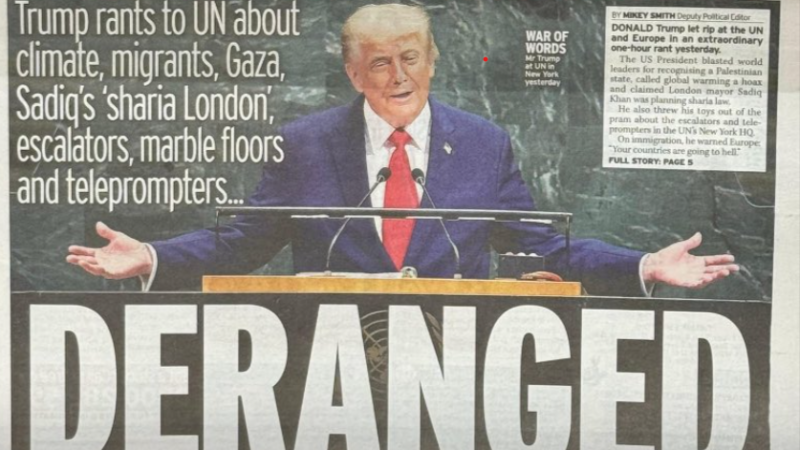
“Nailed it!”: Mirror praised for ‘Trump deranged’ front page


Gabrielle Pickard-Whitehead 
Yesterday
Left Foot Forward


Only the Mirror gave the speech the front-page treatment it deserved.


Despite being one of the most unhinged and nonsensical rants in recent political history, riddled with falsehoods, juvenile digs, and inflammatory vitriol, most newspapers played it safe in their coverage of Donald Trump’s cringe-inducing address to the United Nations General Assembly on September 22.

The Times, Daily Mail, Daily Express, and the Sun all omitted the speech from their front pages the next day.

The Daily Telegraph focused on Trump’s claim that the West is “going to hell over migration,” while the Financial Times referred to a “Trump tirade” and noted his accusation that the UN is “funding an assault on the West.” The Guardian highlighted his remark: “Your countries are going to hell.”

Only the Mirror gave the speech the front-page treatment it deserved.

“World’s most powerful man-baby – DARANGED,” splashed the headline, mocking Trump’s rambling UN address, which covered everything from climate change and migrants to escalators, marble floors, Sadiq Khan’s “sharia London,” and even his distaste for teleprompters.

The Mirror’s truthful cover was widely praised on social media.

“Well done Daily Mirror,” read one comment on X.

“The Mirror nailed it: ‘World’s most powerful man-baby,’” wrote another.

Another said: “Don’t it make ya feel proud.”

It wasn’t the first time the Mirror had skewered the President. During his recent state visit to the UK, their front page headline read: “The Ego Has Landed,” referencing the wave of protests that greeted his arrival.

But this week was especially unhinged, even by Trump’s standards.

His nearly hour-long speech at the UN drew audible gasps from diplomats and attendees. He claimed to have ended “seven wars,” without the UN’s help, saying the only thing they’d ever given him was “a broken escalator.”

Among the most jaw-dropping moments was his declaration that climate change is “the greatest con job ever perpetrated on the world.”

The climate crisis was a frequent target of his ire. Trump derided renewable energy, attacked wind farms and solar panels, and once again falsely claimed that coal is “clean and beautiful,” repeating thoroughly debunked talking points.

Trump even used his tirade against green energy to big up his own merchandise. “If you don’t get away from this green scam, your country is going to fail. And I’m really good at predicting things, you know?” he said. “They actually said during the campaign, they had a hat: the best-selling hat, ‘Trump was right about everything.’ And I don’t say that in a braggadocious way, but it’s true. I’ve been right about everything.”

“When are the men in the white coats coming for him?” one X user asked.


Deepening Revolutionary Theory in a Time of Genocidal War and the Threat of Fascism


Now Online: Recording of talks at the online IMHO mini-conference on Saturday, September 13, 2025


Panel 1

Watch recording hereOn the 100th Anniversary of Frantz Fanon’s Birth: Why His New Humanism Matters Now More Than Ever - YouTube (60 minutes)

Speakers:

  • Ndindi Kitonga, Kenyan-American revolutionary educator and activist in Los Angeles
  • Peter Hudis, Oakton College, author of Frantz Fanon: Philosopher of the Barricades
  • Alex Adamson, organizer in the Greater Boston area, writes on queer, trans, and feminist decolonial philosophy and Marxism
  • Annie Olaloku-Teriba, is a columnist, podcast host and independent scholar of ‘Race’ and Imperialism


Panel 2

Watch Recording here: The Late Marx: Gender, Colonialism, Indigeneity - YouTube (46 minutes)

Speakers:

  • Kevin B. Anderson, UC-Santa Barbara, author of The Late Marx’s Revolutionary Roads
  • Melda Yaman, Istanbul University, feminist philosopher, author of Pathways from the Grundrisse to Capital
  • Wayne Wapeemukwa, University of British Columbia, writer on non-Western/Indigenous philosophy and Marxism


Panel 3

Watch recording hereMarx’s "Critique of the Gotha Program" 150 Years Later, and Today’s Organizational Challenges - YouTube (30 minutes)

Speakers:

  • Heather A. Brown, Westfield State University, author of Marx on Gender and the Family
  • Tomas MacAilpein, Scottish libertarian communist


*****

Sponsored by the:
International Marxist-Humanist Organization

More information:
arise@imhojournal.org  https://www.facebook.com/groups/imhorg/

Consider a donation to the IMHO to support our work:
bit.ly/IMHO-DONATE

Indigenous knowledge steers new protections for the high seas

For centuries prior to modern conservation efforts, indigenous communities cared for the oceans with a fundamentally different philosophy – treating marine environments as family rather than a commodity. With the UN High Seas Treaty set to come into force in January, their knowledge is being formally recognised in the governance of international waters for the first time.


Issued on: 28/09/2025 - RFI

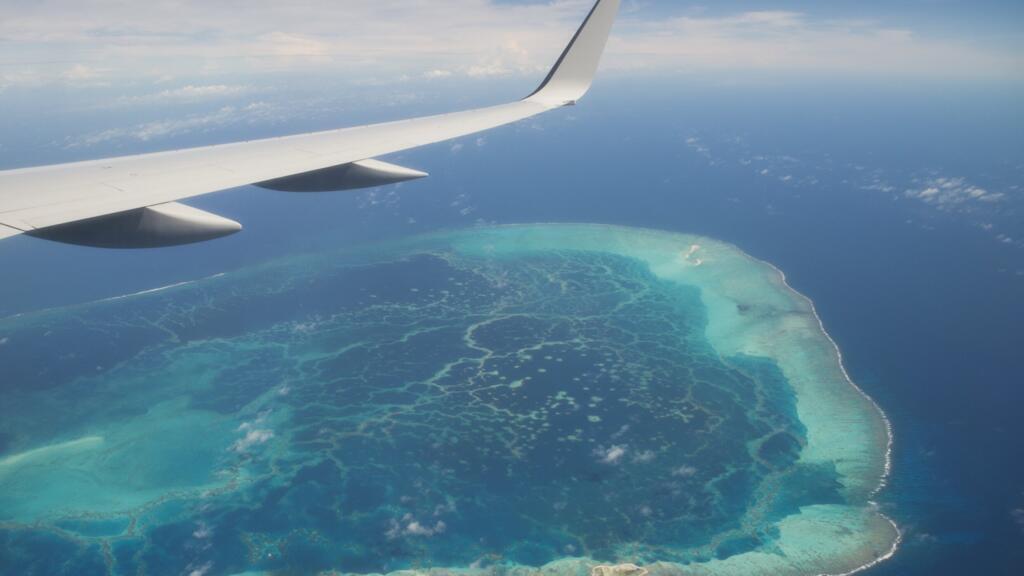
The view from Air Force One, with Barack Obama on board, as it approaches Midway Atoll in the Papahanaumokuakea Marine National Monument in the Pacific Ocean, September 2016. AFP - SAUL LOEB

By:Amanda Morrow

Sixty ratifications pushed the treaty over the line, with Morocco’s kick-starting the 120-day countdown to 17 January.

The treaty offers a tool for nations to create marine protected areas (MPAs) – central to the goal of safeguarding 30 percent of the ocean by 2030.

It also recognises indigenous knowledge, and requires "free, prior and informed consent" – in other words, clear permission in advance – for the use of marine resources linked to that knowledge.

From the sacred waters of Papahanaumokuakea in Hawaii to the hand-built islands of the Solomons, indigenous communities say culture and conservation work hand in hand.

Culture steers conservation

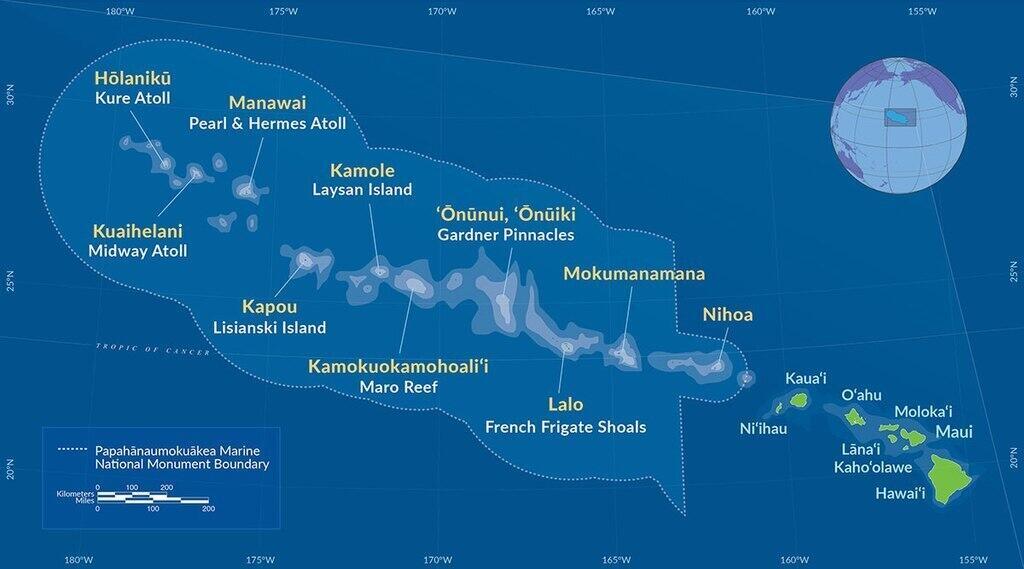
Stretching northwest from Kauai across roughly 1,500 kilometres of ocean – about the same distance from Paris to Rome – Papahanaumokuakea is one of the world’s largest fully protected MPAs.

It covers around 1.51 million square kilometres, larger than all the national parks in the United States combined, and shelters more than 7,000 marine species, many found nowhere else on earth.

The area is vital for endangered Hawaiian monk seals, green turtles and millions of seabirds.

For native Hawaiians it is also a sacred realm – a place tied to creation stories and ancestral routes at sea.


A map of the Papahanaumokuākea Marine National Monument. 
© Wikimedia Commons / NOAA

“I've been involved for more than half my life in protecting a place that we now call Papahanaumokuakea,” Aulani Wilhelm, a native Hawaiian conservationist who played a central role in creating the marine monument, told RFI.

“It was a movement started by native Hawaiian fishermen who partnered with conservationists to protect the coral reefs and endangered species.”

Wilhelm, who also heads the non-profit organisation Nia Tero, said elders had pushed for a refuge rooted in local principles and direct community engagement.

In her words, “not just another model of Western conservation” – but instead protection anchored in values and participation.

Stewardship, not ownership

Papahanaumokuakea is co-managed by four entities: native Hawaiian leaders, the US Federal Government, the state of Hawaii and the Office of Hawaiian Affairs.

Joint decisions cover both nature and culture, and include protecting reefs and endangered species, safeguarding creation stories and traditional navigation routes, and setting rules for access and research.

Instead of talking about “managing” a resource, Wilhelm describes a relationship of care.

“People used to call me the manager of Papahanaumokuakea,” she said. “And I said, I don’t manage anything. You don’t manage your grandmother. You don’t manage your elder cousins. This is a relationship. You ‘care for’ instead.”

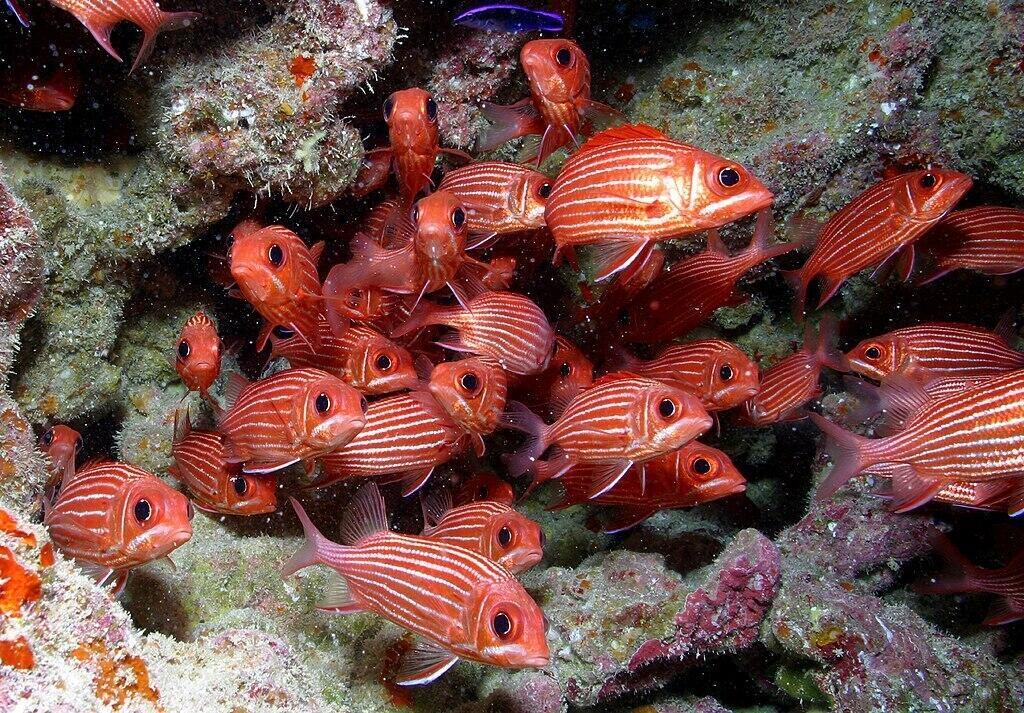
A school of Hawaiian squirrelfish at French Frigate Shoals in the Papahanaumokuakea Marine National Monument. © Wikimedia Commons / James Watt


From sanctuary to survival

Indigenous people manage around a quarter of the world’s land and many of those places hold rich biodiversity. Advocates say the lesson is simple – when communities have a say, nature often fares better.

In the Solomon Islands the stakes are high. In lagoons such as Langa Langa and Lau, some families still live on artificial islands first built centuries ago. They now face rising seas, chaotic weather and stronger storm surges that push water into their homes.

Lysa Wini, a researcher from the Solomon Islands who works with Nia Tero, told RFI that communities are using what they know and are asking for resources so that guardianship can continue.

“That would be not just merely putting indigenous knowledge or wisdom into text, but actually into practice," she said.


Next steps


Once the treaty takes effect – and once the first Conference of the Parties (Cop) is held – countries can file formal proposals for MPAs under the new global system. The first Cop must meet within one year of the treaty coming into force.

States will agree basic rules, set up a secretariat, create a science panel and open an information hub to share data. Decisions are taken by consensus where possible, or by a three-quarters majority.

Each proposal must say where the area is, why it should be protected, which measures will apply, how long they will last and how progress will be checked.

Wilhelm told RFI the planet will need 53 more protected areas the size of Papahanaumokuakea in order to meet global targets.
Memory and mourning as Guinea marks 2009 Conakry stadium massacre

On the anniversary of Guinea’s 2009 stadium massacre, the quest for justice and accountability continues amid the daily realities of military rule and fresh tensions over a controversial referendum.


Issued on: 28/09/2025 - RFI
A protester is arrested at Conakry’s main stadium on 28 September 2009, when security forces crushed an opposition rally. A UN inquiry later found at least 156 people were killed and more than 100 women raped. © AFP/Seyllou
By:RFIFollow
Advertising


Sixteen years after the Conakry stadium massacre, Guineans are reminded of one of the darkest chapters in their recent history.

On 28 September 2009, security forces stormed a peaceful opposition rally at the capital’s main stadium.

By the time the violence subsided, at least 156 people had been killed and more than a hundred women had been subjected to brutal sexual violence, according to a UN investigation.

For the survivors, the long road to justice has finally begun to show some results.

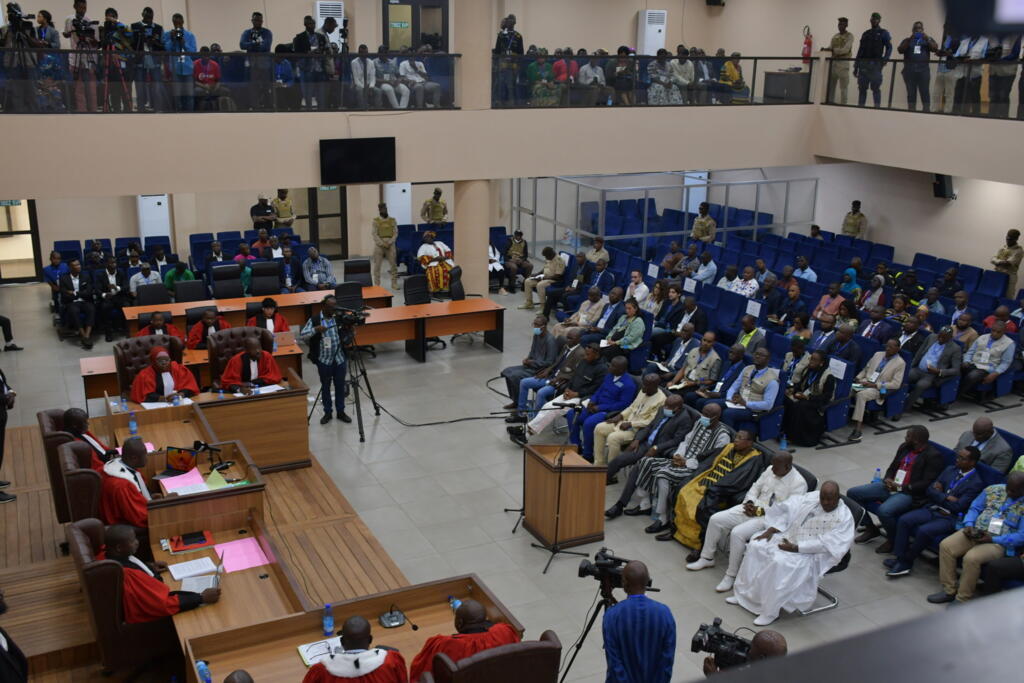
10 defendants stand before magistrates during the reading of the trial verdict on the 2009 Conakry stadium massacre, on 31 July 2024 in Dixinn, Guinea. © Matthias Raynal/RFI


Reparation for survivors


This year’s anniversary comes just months after the Guinean government opened the first phase of reparations for victims.

At a ceremony in May inside the Court of Appeal in Conakry – where the long-awaited trial unfolded – survivors wept as they were handed cheques in compensation from the state.

“We are gathered to put into execution the content of this decree and give the victims cheques corresponding to the amount fixed by the judicial decision,” said Justice Minister Yaya Kairaba Kaba.

For Asmaou Diallo, president of the Avipa victims association, the moment marked a rare glimpse of closure after years of waiting.

“Today, I can breathe a sigh of relief,” she told RFI, recalling the years of doubt over whether the state would ever pay up.

Since the ruling, more than 300 victims are to receive reparations, with funds drawn directly from the national budget after the convicted perpetrators were deemed unable to cover the damages themselves.


Camara's release condemned

Former junta leader Moussa Dadis Camara – who ruled the country between 2008 and 2009 – was sentenced in July 2024 to 20 years in prison for crimes against humanity.

Judges found him guilty on the basis of command responsibility and for his intention to repress the rally.

But in March this year, Colonel Mamadi Doumbouya – the current head of Guinea’s transitional military government – announced Camara’s release, citing “health reasons”.

The pardon stunned victims’ families and drew sharp criticism from international observers.

On Thursday, UN human rights chief Volker Türk explicitly warned that international law forbids pardons for crimes as grave as those committed on 28 September.

He also called on Conakry’s rulers to free political detainees, end arbitrary arrests and lift restrictions on opposition parties and the press. “The Guinean authorities must, above all, lift the unacceptable bans targeting political parties and the media,” Türk insisted.

Residents watch television as the General Directorate of Elections (DGE) Director Djenabou Toure announces provisional official referendum results in Conakry, 23 September 2025. © Patrick Meinhardt / AFP

That appeal resonates strongly in the current climate. This week, Guinea’s opposition denounced as a “masquerade” the 21 September referendum that paved the way for Colonel Doumbouya’s potential candidacy in upcoming presidential elections.

While the transitional government has hailed the vote as a step towards restoring constitutional order, civil society groups warn that freedoms remain tightly curtailed, with journalists and activists facing harassment or even disappearance.
Guinea voters back new constitution clearing path for junta leader

Four years after the military seized power, voters in a Guinea referendum have resoundingly chosen to implement a new constitution, with 89 percent supporting the charter. This paves the way for elections in the West African country, but also permits General Mamady Doumbouya, its junta leader, to run for president.


Issued on: 25/09/2025 - RFI

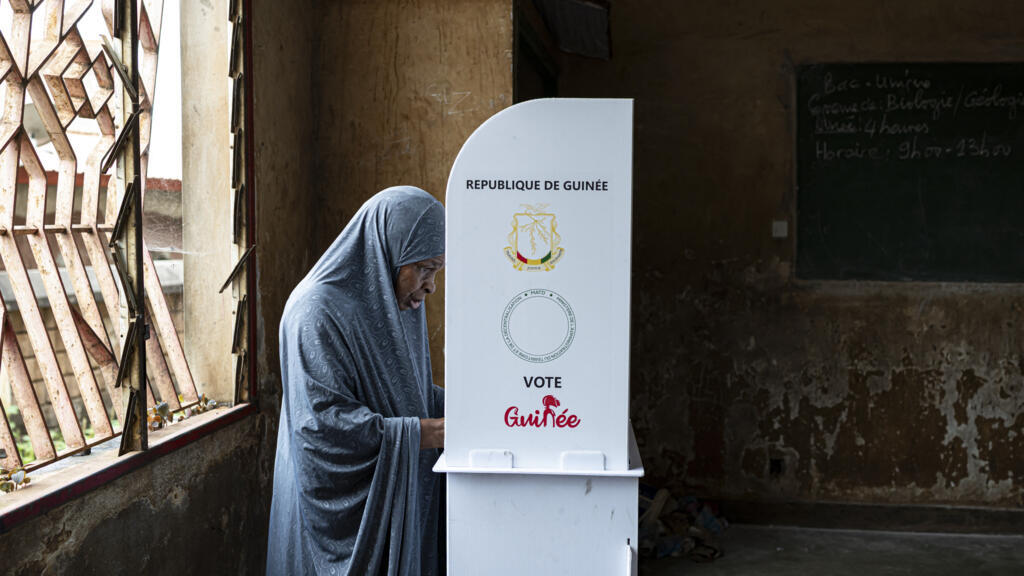
A voter marks her ballot behind a voting booth at Hamdallaye Primary School polling station in Conakry on 21 September, 2025 as Guinea votes in the constitutional referendum. AFP - PATRICK MEINHARDT

The "yes" vote won with 89.4 percent of ballots, according to the official provisional results announced by Ibrahima Kalil Conde, minister of territorial administration and decentralisation.

According to Conde, total election turnout stood at 86.4 percent. Final results will be announced by the Supreme Court at an unspecified date.

The opposition, many of whose leaders are based abroad, had called for a boycott, describing the vote as a power grab with predetermined results.

Despite their plea, Guineans flooded to the polls, with the majority interviewed by French news agency AFP stating they had voted to move forward with a new constitution.


Some 6.7 million Guineans out of a population of approximately 14.5 million people were eligible to cast a ballot.

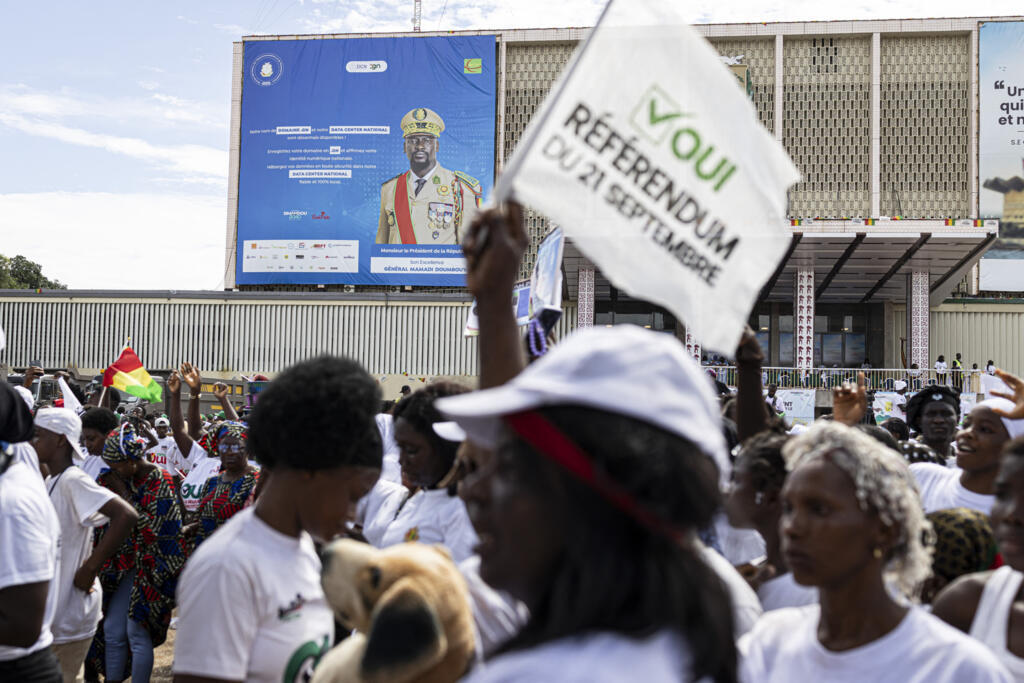
Campaigning had been strong in the referendum's "yes" camp: rallies, marching bands and posters depicting 40-year-old Doumbouya were prevalent throughout the country.

Doumbouya, at the head of a military junta ousted long-serving president Alpha Condé in September 2021 and dissolved the government and constitution.

The "no" campaign was virtually non-existent, mainly carried out on social media and often led by the junta's critics in exile.

Exiled former prime minister and fierce junta critic Cellou Dalein Diallo on Tuesday called the vote a "masquerade" that was aimed at "whitewashing" the 2021 coup that brought the junta to power.

Diallo and other members of the opposition had called for a boycott of the vote.

Authorities deployed 45,000 members of the security forces across the country Sunday for the vote, along with 1,000 light and armoured vehicles and combat helicopters, the National Gendarmerie said.

The military had initially pledged to return power to civilians before the end of 2024.


Crackdown on media

Although its authorities are now promising presidential and legislative elections before the end of the year, the junta has not yet set a date.

The new constitution will replace the country's "transitional charter", introduced by the military government, that had prohibited any junta member from running for election.

There is no such restriction in the new constitution, however, paving the way for Doumbouya's candidacy.

This photograph taken on September 18, 2025, shows a general view of a billboard depicting Guinea President Mamady Doumbouya during an event in favor of the "yes" vote at the Palais du Peuple in Conakry, ahead of the constitutional referendum on 21 September, 2025. AFP - PATRICK MEINHARDT

Guineans AFP spoke with were divided between hoping for the return of civilian rule under a new constitution and supporting the junta leader and his potential candidacy in a future presidential election.

Since 2022, the junta has banned demonstrations and has arrested, prosecuted or pushed into exile several opposition leaders, some of whom were victims of forced disappearances.

On 23 August, the junta suspended two of the country's main opposition parties for three months.

Several media outlets have also been suspended and journalists arrested.

Interviewed by AFP on Sunday, the secretary-general of the presidency, General Amara Camara, stated that "this constitution is the profound expression of the aspirations of the people of Guinea".

"Many had expressed doubts about the organisation of this vote, and we have allayed them; we hope that we will also be able to organise the legislative and presidential elections" when the time comes, he said.

(with AFP)

'Predators': how reality TV explains Epstein obsession

Los Angeles (United States) (AFP) – As demands to release the so-called Epstein files rage on, a new documentary asks why America is so fascinated with child sex abusers by reflecting on the salacious 2000s reality TV series "To Catch A Predator."


Issued on: 29/09/2025 -FRANCE24

David Osit's documentary 'Predators' makes extensive use of unaired, behind-the-scenes footage from 'To Catch A Predator' © Maya Dehlin Spach / GETTY IMAGES NORTH AMERICA/AFP/File

The infamous NBC show lured pedophiles to homes equipped with hidden cameras, where they expected to have sex with minors but were instead confronted by the program's host -- and then arrested by cops.

"It was this incredible mix of schadenfreude and horror. No one had ever seen anything like it before," film director David Osit told AFP.

Framed as investigative journalism but presented as darkly humorous entertainment, "To Catch A Predator" ran for just 20 episodes. It was cancelled in 2008, soon after one target killed himself as police and cameras entered his home.

Few criminal charges ever resulted, due to the legally dubious entrapment involved.

But its enduring popularity on online forums -- and the YouTube industry of copycat "predator hunters" it spawned -- led Osit to ponder why the heinous crime of child sex abuse is so readily and widely consumed as entertainment.
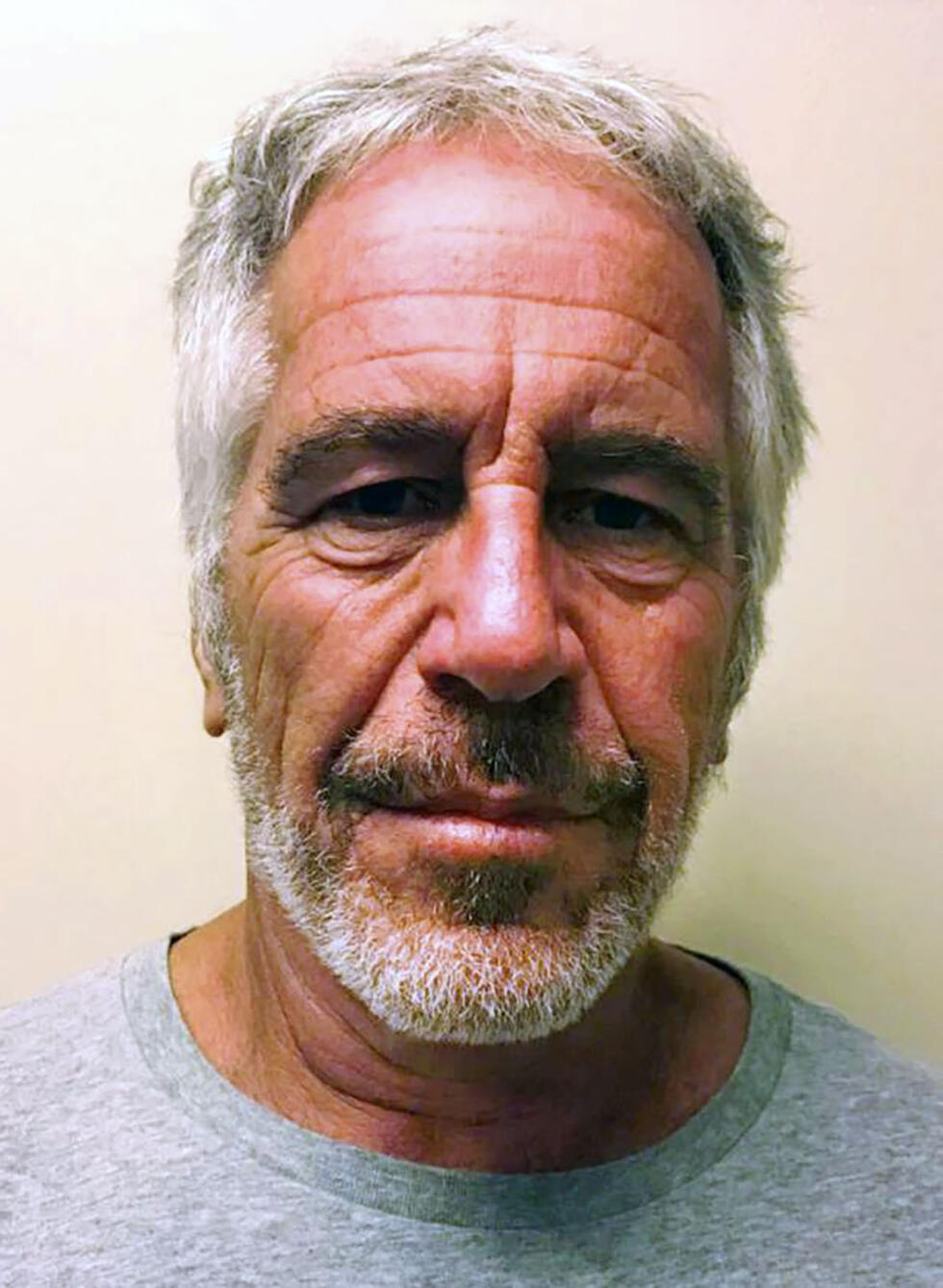
Disgraced financier Jeffrey Epstein was convicted of sex offenses and found dead in his jail cell while awaiting trial for sex trafficking of underage girls © HO / New York State Sex Offender Registry/AFP/File


Osit's film "Predators" is released in US theaters Friday. The movie makes extensive use of unaired, behind-the-scenes footage from "To Catch A Predator," including from police interrogation rooms.

While the broadcast episodes were "cut like a dark comedy," with the raw footage "you're watching 70, 80 minutes of someone's life fall apart in slow motion," said Osit.

"I would find myself watching and feeling this emotional ping-pong of feeling devastated for them, and then disgusted at them, and then really questioning my own feelings of whether what I was looking at was right or wrong," said the director.

He set out to make a film about "how the show made us feel."
'Pornographic'

It is a question that is timelier than ever, given pedophilia's centrality to the Jeffrey Epstein controversy, as well as many pervasive conspiracy theories like the QAnon movement
.
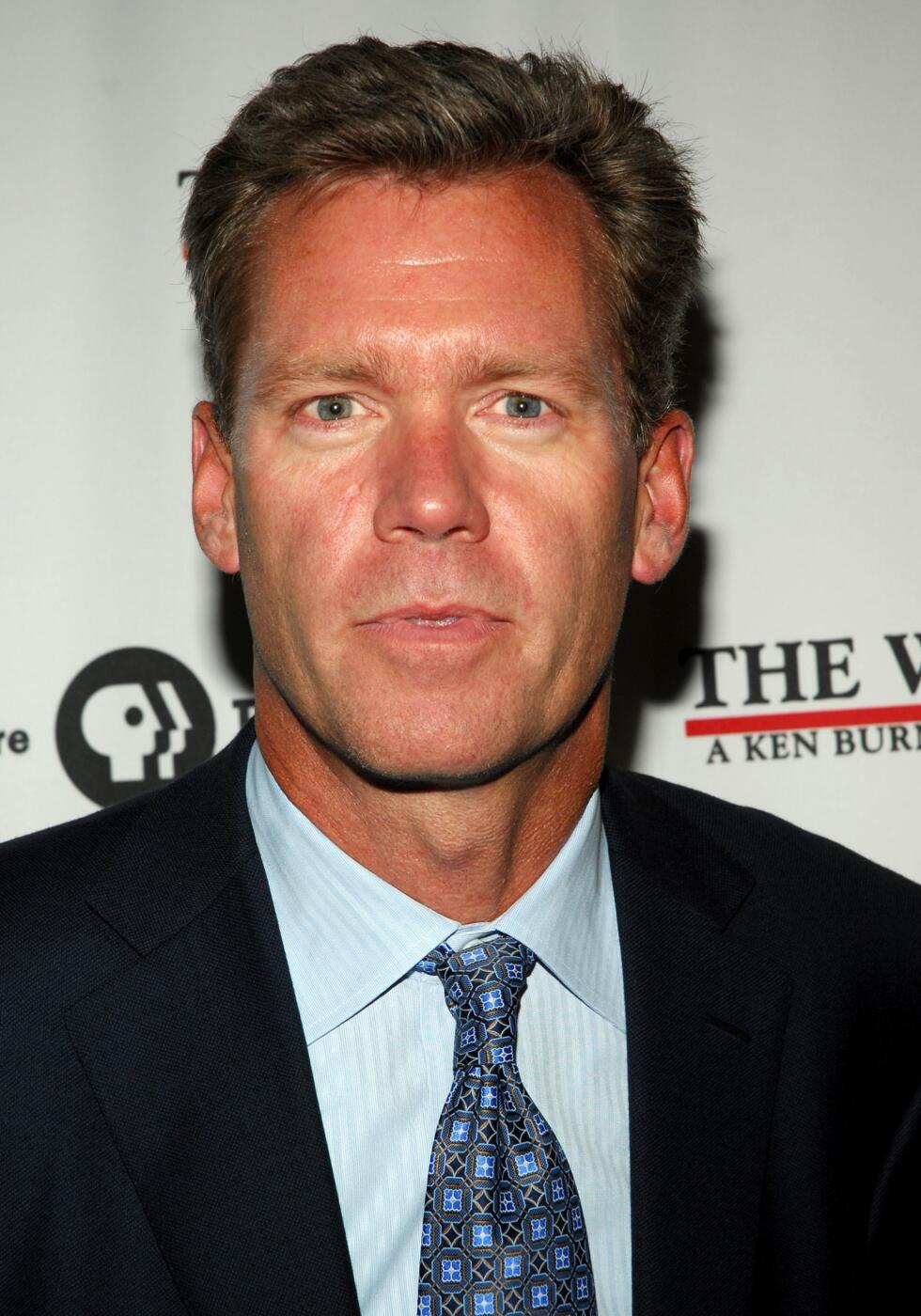
Chris Hansen presented 'To Catch A Predator,' which ran for just 20 episodes
 © Rob Loud / Getty Images North America/Getty Images/AFP/File


Disgraced financier Epstein was convicted of sex offenses and found dead in his jail cell while awaiting trial on allegations of sex trafficking underage girls. Much of the criminal investigation into Epstein has not been made public.

US President Donald Trump, once a friend of Epstein, has tried to quell the calls to release the Epstein files -- despite attacking opponents with them in the past.

The national obsession has not abated, even among Trump's supporters and some Republican legislators.

According to Osit, there can be "almost a pornographic element" to poring over the details of these crimes from afar -- which also explains the huge popularity of "true crime" podcasts.

"If you want to identify with the more salacious elements, you can do it in the privacy of your own home, and no-one has to know what you're taking pleasure in," he said.

US President Donald Trump, once a friend of Jeffrey Epstein, has tried to quell the same calls to 'release the Epstein Files' that he himself previously stirred up to attack his opponents © - / Everone Hates Elon/AFP/File

The "fantasy of justice" also appeals to fans of "predator hunting" shows, particularly those who have been abuse victims themselves, Osit added.

Yet the biggest root of our obsession may be the seemingly clear-cut morality these shows serve up.

"In a world of people being told they're good or evil, or right and wrong, for certain people it's quite appealing to stand on the side of good unequivocally against the idea of child predation... the ultimate evil," said Osit.

"It is an excellent wedge to say that there's an 'us' and there's a 'them', and there's the people who would do that and the people who wouldn't."

© 2025 AFP
Oregon sues Trump administration over deployment of US military to Portland

Oregon sued on Sunday to block President Donald Trump’s order to deploy US troops to Portland, a day after the directive was issued. The move mirrors earlier deployments to Los Angeles and Washington, DC, opposed by local Democratic leaders, highlighting tensions over federal intervention in cities.


Issued on: 29/09/2025 - 
By: FRANCE 24

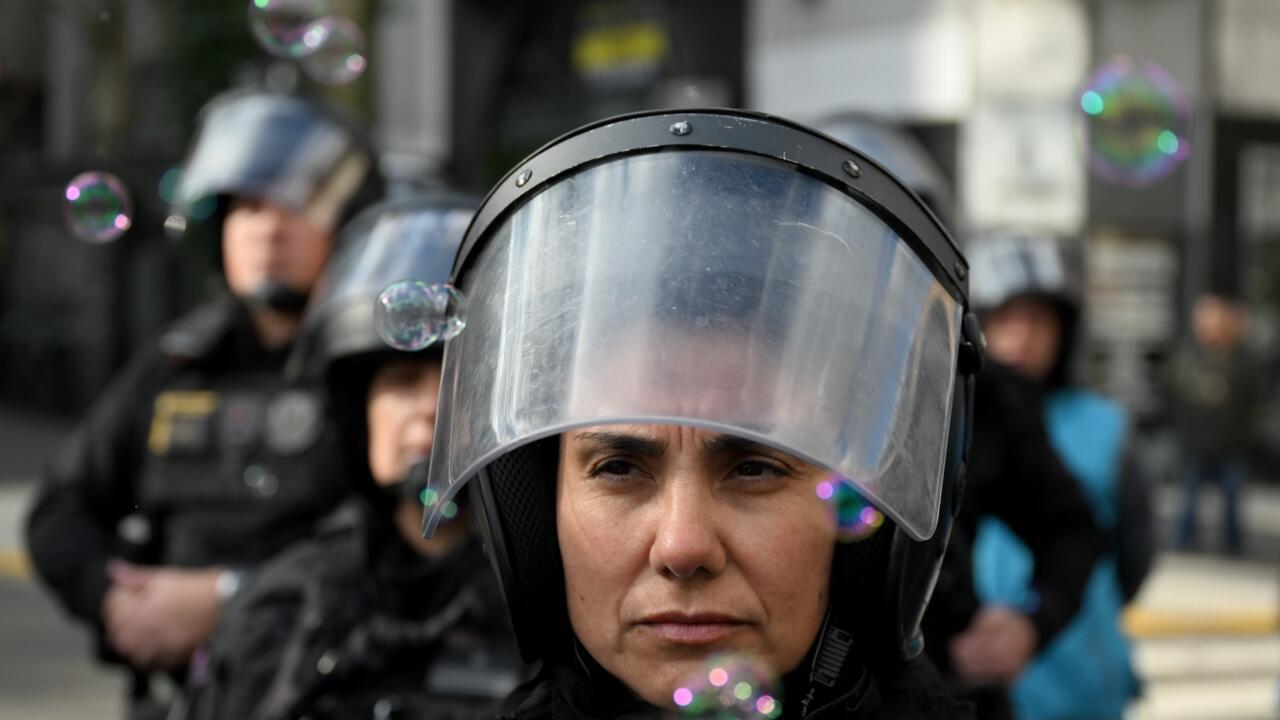
A police officer stands guard as protesters gather

State authorities in Oregon on Sunday sued to halt the deployment of US troops to the northwestern city of Portland, a day after President Donald Trump ordered the move.

The deployment would follow similar moves by the Republican president to mobilise troops against the wishes of local Democratic leadership in Los Angeles and Washington DC.

Trump says the deployments are necessary to crack down on crime and protests against his contentious and wideranging mass deportation drive.

The suit filed by Oregon and Portland authorities on Sunday accused Trump of overreach, saying the move "was motivated by his desire to normalise the use of military troops for ordinary domestic law enforcement activity," particularly in jurisdictions run by his political opponents.

Since returning to power in January, Trump has delivered on campaign promises to go after undocumented migrants in a drive that lawyers and NGOs say has led to frequent violations of people's rights.

In recent weeks, the Republican has also vowed to take on violence he alleges is being carried out by an alleged left-wing "domestic terrorist" network -- moves his critics say are designed to silence dissent.

In its suit, Oregon authorities said there was no need for a National Guard deployment to Portland as -- contrary to Trump's claims -- the protests there against Immigration and Customs Enforcement (ICE) have been small-scale and peaceful.

The suit said the protests typically involve less than 30 people and have not required arrests since mid-June.

"But (Trump's) heavyhanded deployment of troops threatens to escalate tensions and stokes new unrest," the suit said.

Protesters in Portland and other cities have intermittently blocked entrances to ICE facilities in recent weeks, prompting some clashes as agents try to clear the area.

Earlier, responding to Trump's Saturday announcement, Oregon Governor Tina Kotek said she had been given no details or timeframe regarding the troop deployment.

"There is no insurrection, there is no threat to national security, and there is no need for military troops in our own major city," she told reporters.

Portland Mayor Keith Wilson called the deployment "unwanted, unneeded and un-American."

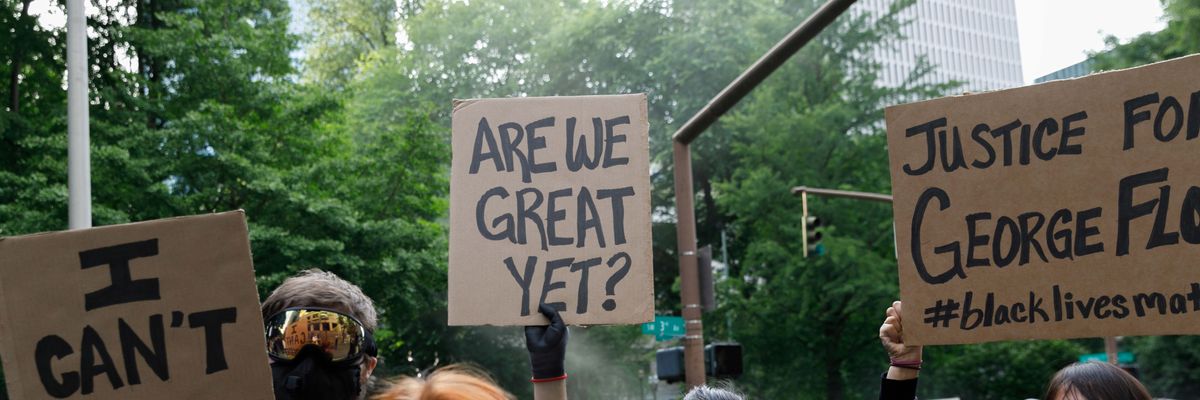
Officials in Portland are wary of a repeat of summer 2020, during Trump's first term, when the city saw a surge of violent clashes amid racial justice protests following the police killing of unarmed Black man George Floyd.

Trump first deployed troops in Los Angeles in June, overriding the state's Democratic governor and prompting an ongoing legal dispute over the limits of presidential authority.

That was followed by a surge of troops and federal agents to the US capital, and threats to go into other major cities, including Chicago.

(FRANCE 24 with AFP)

‘An Egregious Abuse of Power’: Trump Orders Troops to Portland, Ore; OKs ‘Full Force’

“This unilateral action represents an abuse of executive authority, seeks to incite violence, and undermines the constitutional balance of power between the federal government and states,” Oregon lawmakers wrote.


People carrying banners march to protest over the death of George Floyd, an unarmed black man who died after being pinned down by a white police officer, on May 31, 2020 in Portland, Oregon.
(Photo by John Rudoff/Anadolu Agency via Getty Images)

Olivia Rosane
Sep 27, 2025
COMMON DREAMS

In his latest attempt to turn the US military on an American city, President Donald Trump said on Saturday that he was sending troops to Portland, Oregon and had authorized them to use “Full Force, if necessary.”

“At the request of Secretary of Homeland Security, Kristi Noem, I am directing Secretary of War, Pete Hegseth, to provide all necessary Troops to protect War ravaged Portland, and any of our ICE Facilities under siege from attack by Antifa, and other domestic terrorists,” Trump wrote on Truth Social.

RECOMMENDED...


‘No Trump! No Troops!’ Thousands March in Chicago as President Threatens ‘War’


DC Sues Over Trump Troop Deployment as National Guard Members Say They’re Being Used as ‘Toy Soldiers’

Trump’s announcement follows his deployment of the National Guard in Los Angeles and Washington, DC, as well as his threats to send the military to Chicago and Memphis. These deployments have been widely condemned and legally challenged as a massive overreach of executive authority.

Portland and Oregon leaders were no less vehement in their opposition to Trump’s order for their city.

“Trump is plunging further into authoritarianism every single day.”

“President Trump has directed ‘all necessary Troops’ to Portland, Oregon. The number of necessary troops is zero, in Portland and any other American city,” Portland Mayor Keith Wilson said in a statement on Saturday. “Our nation has a long memory for acts of oppression, and the president will not find lawlessness or violence here unless he plans to perpetrate it.”

Democratic Oregon Gov. Tina Kotek said that she had not been informed ahead of time of any reason for the deployment of federal troops.

“In my conversations directly with President Trump and Secretary Noem, I have been abundantly clear that Portland and the State of Oregon believe in the rule of law and can manage our own local public safety needs,” she wrote on social media. “There is no insurrection. There is no threat to national security.”

Rep. Maxine Dexter (D-Ore.) said in a statement: “The President of the United States is directing his self-proclaimed ‘Secretary of War’ to unleash militarized federal forces in an American city he disagrees with. This is an egregious abuse of power and a betrayal of our most basic American values.”

“Authoritarians rely on fear to divide us,” she continued. “Portland will not give them that. We will not be intimidated. We have prepared for this moment since Trump first took office, and we will meet it with every tool available to us: litigation, legislation, and the power of peaceful public pressure.”

Dexter also posted a photograph of a tranquil park on social media, mocking the idea that Portland was a war zone.

Sen. Ron Wyden (D-Ore.) adopted a similar strategy, posting videos of downtown Portland and of an Immigration and Customs Enforcement (ICE) facility that has been the site of protests Trump has characterized as out-of-control.

Dexter and Wyden were among the seven members of Oregon’s congressional delegation who sent a letter to Trump, Noem, and Hegseth on Saturday urging them to reconsider.

“Portland is a vibrant and peaceful city, and does not require any deployment of federal troops or additional federal agents to keep our community safe,” the lawmakers wrote. “This unilateral action represents an abuse of executive authority, seeks to incite violence, and undermines the constitutional balance of power between the federal government and states. We urge you to rescind this decision, and withdraw any military personnel and federal agents you have recently sought to deploy.”

As of Saturday, Oregon National Guard spokesperson Lt. Col. Stephen Bomar told The Associated Press in an email that “no official requests have been received at this time.” However, Oregon officials noted an uptick in the presence of federal agents and armored vehicles in Portland on Friday.

In a press conference Friday evening, Mayor Wilson suggested that the deployment was a “distraction” from the looming GOP-driven government shutdown.

“Imagine if the federal government sent instead 100 teachers or 100 engineers or 100 addiction specialists,” Wilson said.

Earlier in the week, Trump also smeered Portland protesters as “professional agitators and anarchists,” according to the Portland Tribune.

“We’re going to get out there and we’re going to do a pretty big number on those people in Portland,” Trump said.

The federal deployment threatens to reopen wounds from 2020, when Portland was the site of massive protests sparked by the police killing of George Floyd and the first Trump administration sent federal and border agents to the city.

As the Oregon lawmakers wrote:
Portland residents experienced the consequences of an unnecessary and outrageous federal deployment five years ago. In summer of 2020, the White House unleashed federal agents on Portland like an occupying army, complete with military-grade equipment and violent tactics that were utterly unacceptable on American soil. A federal agent shot a peaceful protester in the head with a crowd-control munition, sending the man to the hospital with a fractured skull. Federal agents were captured on video jumping out of unmarked vans and grabbing people off the streets without explanation. A county commissioner was tear gassed along with other non-violent protestors. A Navy veteran was filmed being beaten by federal agents after he questioned them about their actions. These examples, and many more that occurred in Portland, demonstrate that the federal agents who were parachuted into Portland incited violence and trampled over the constitutional rights of Americans. There is no question that another deployment by your administration will result in similar abuses.

However, the risks of abuses are perhaps even higher as the second Trump administration has designated “antifa,” which is not an actual, coherent group, as a domestic terrorist organization, a dubious legal move that experts warn is an attempt to restrict the First Amendment rights of leftists and others critical of the administration.

“If ever there was a time not to normalize Trump’s authoritarian fever dreams, this is it,” said journalist Mehdi Hasan on social media. “This should be impeachable. ‘War ravaged’ Portland? He’s insane—& insanely power hungry. The script is set—call an imaginary group a terror group and then send in the troops.”

Sen. Jeff Merkley (D-Ore.) urged his constituents not to give Trump the confrontation he is clearly seeking.

“Trump is sending troops to Portland with the goal of ‘doing a number’ on the city. We know what this means. He wants to stoke fear and chaos and trigger violent interactions and riots to justify expanded authoritarian control,” he said in a video posted on social media. “Let’s not take the bait! Portland is peaceful and strong and we will take care of each other.”

Other advocates and lawmakers also took issue with Trump’s characterization of Portland.

Human Rights lawyer Qasim Rashid pointed out that Portland had actually experienced the most dramatic drop in homicides among all US cities during the first half of 2025.


Sen. Elizabeth Warren (D-Mass.) said the description of Portland as “war ravaged” was “delusional and dangerous.”

“Sending troops into American cities doesn’t make our communities safer—it just stokes fear and stirs up chaos,” she wrote on social media. “Trump is plunging further into authoritarianism every single day.”

Civil rights lawyer and author Alec Karakatsanis said that the mainstream media needed to reflect on how its reporting had enabled Trump’s false narrative about Portland.

“This kind of outrageous misinformation would not be possible without the culture of fear spread for years by the mainstream media,” Karakatsanis wrote on social media. “He is playing on the prodigious ignorance and irrational fear cultivated by the way the news media distorts our sense of safety.”

“Portland, needless to say, is nothing remotely like what Trump describes,” he continued. “But the mass media has created an entirely delusional public perception of what threats we face and from whom.”


Trump to deploy troops to Portland, Oregon in crackdown on immigration protests

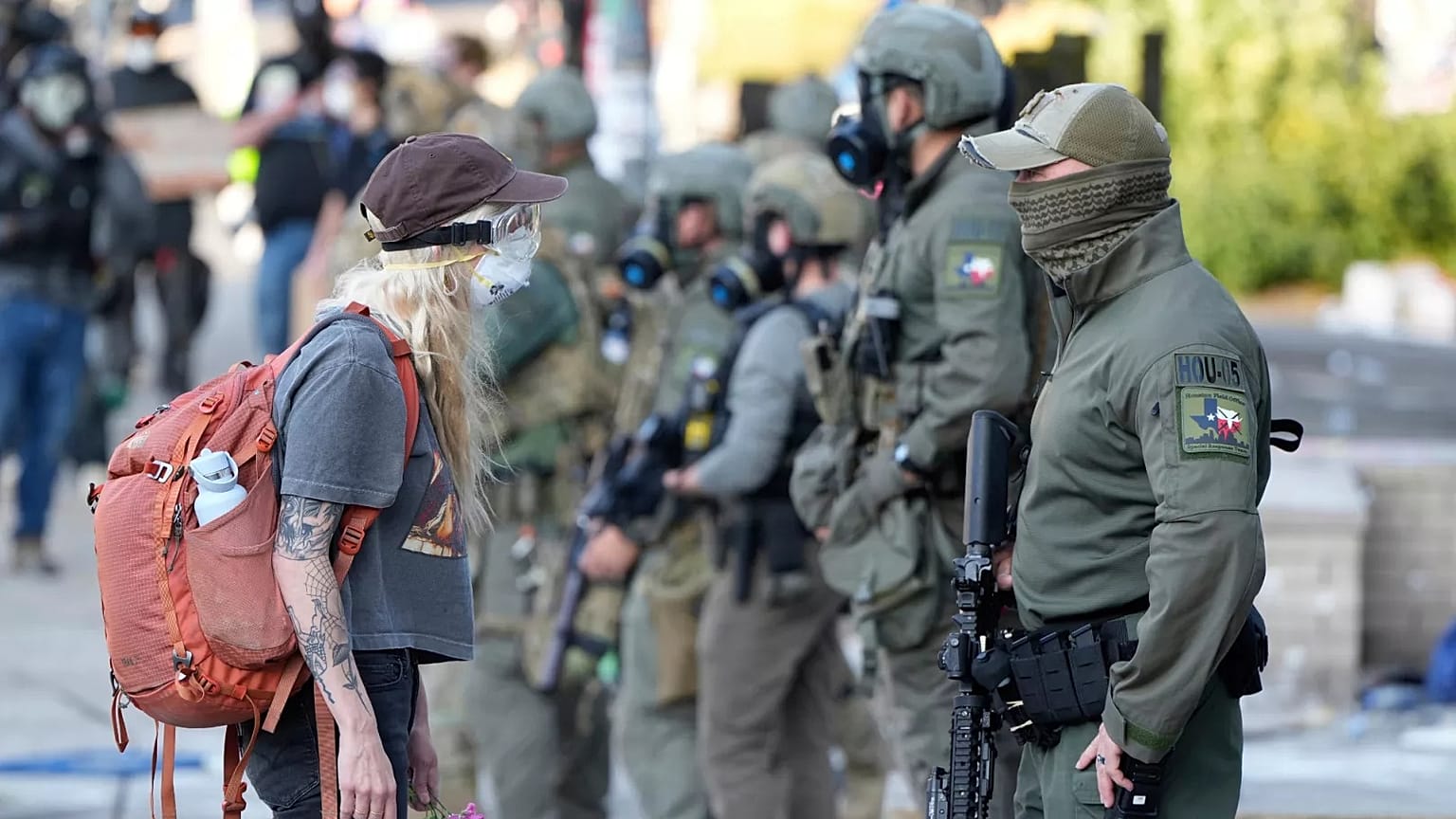
FILE - A woman stands off with a law enforcement officer wearing a Houston Field Office Special Response Team patch outside the U.S. Immigration and Customs (ICE) building dur
Copyright Copyright 2025 The Associated Press. All rights reserved.

By Jerry Fisayo-Bambi with AP
Published on 

The decision, according to Trump, was necessary to protect US Immigration and Customs Enforcement facilities, which he described as “under siege from attack by Antifa, and other domestic terrorists.”

US President Donald Trump said Saturday he will send troops to Portland, Oregon, "authorising Full Force, if necessary” to handle “domestic terrorists” as he expands his controversial deployments to more American cities. 

Trump announced this on social media, writing that he was directing the Department of Defence to “provide all necessary troops to protect war-ravaged Portland.”

The decision, according to Trump, was necessary to protect US Immigration and Customs Enforcement facilities, which he described as “under siege from attack by Antifa, and other domestic terrorists.” 

Details on the timeline for the deployment in Portland, or what troops would be involved, have yet to be given, and the White House has not issued any statement regarding this.

Since conservative activist Charlie Kirk was killed, Trump has stepped up efforts to target the so-called "radical left," which he claims is to blame for the nation's political violence issues.

He deployed the National Guard and active-duty Marines to Los Angeles over the summer, as part of his law enforcement takeover in the District of Columbia. 

Portland protesters target ICE facilities

The ICE facility in Portland has been the target of frequent demonstrations, sometimes leading to violent clashes. Some federal agents have been injured, and several protesters have been charged with assault.

Earlier this month, when protesters erected a guillotine, the Department of Homeland Security described it as “unhinged behaviour.”

Speaking at the Oval Office on Thursday, Trump suggested some kind of operation was in the works. “We’re going to get out there, and we’re going to do a pretty big number on those people in Portland,” he said, describing them as “professional agitators and anarchists.”

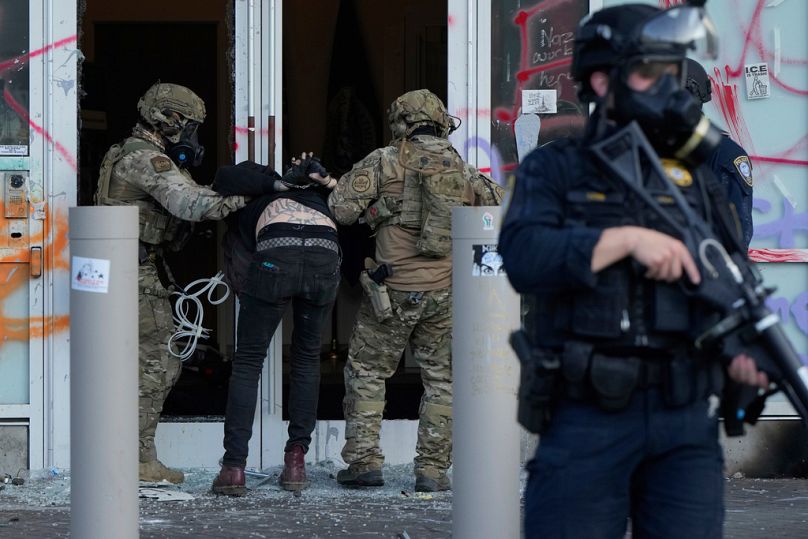
U.S. Customs and Border Protection agents detain a man outside the U.S. Immigration and Customs building during a protest in Portland, Ore., June 14, 2025. (AP Photo/Je Jenny Kane/Copyright 2025 The AP. All rights reserved.

He once described living in Portland “like living in hell” and said he was considering sending in federal troops, as he has recently threatened to do to combat crime in other cities, including Chicago and Baltimore. 

Reacting to Trump's threat, Portland's mayor, Keith Wilson, said in a statement. “Like other mayors across the country, I have not asked for—and do not need—federal intervention.”

Wilson said his city had protected freedom of expression while “addressing occasional violence and property destruction."

In Tennessee, Memphis has been bracing for an influx of some 150 National Guard troops, and on Friday, Republican Gov. Bill Lee said they will be part of a surge of resources to fight crime in the city. 

Trump previously threatened to send the National Guard into Chicago without following through.