It’s possible that I shall make an ass of myself. But in that case one can always get out of it with a little dialectic. I have, of course, so worded my proposition as to be right either way (K.Marx, Letter to F.Engels on the Indian Mutiny)
Saturday, November 29, 2025
Trump exposed for 'funneling' donor money into his bank account: report
November 29, 2025 (REUTERS)
Newsbreak reports that millionaire President Donald Trump is diverting donor money straight into his pocket.
“Even as he leverages his presidency to make himself millions, perhaps even billions of dollars, Donald Trump is also funneling Republican donor money into his own cash registers through the political committees he controls,” said Newsbreak writer S.V. Date.
In the 10 months since he retook office, the Republican National Committee has spent at least $796,513 at Trump’s hotels and country clubs, while MAGA Inc., Trump’s super PAC, has spent $60,733, according to a Federal Election Commission data analysis.
The figures are based on most recent filings, with some committees providing updates only twice a year, so that number will likely grow. The total number for 2025 will not be disclosed until the end of January 2026.
But that combined $857,246 represents just under four-fifths of the $1.1 million that the Republican candidate and committees spent at Trump’s properties, reports Date.
“The RNC, for example, spent $193,145.70 on March 5 to hold an event at Mar-a-Lago, Trump’s country club and residence in Palm Beach, Florida. Two months later, on May 2, the committee spent $307,202.49 for an event at his golf resort in Doral, near Miami’s airport. Three weeks later, on May 30, MAGA Inc. spent $20,711.84 at Trump’s golf course in Sterling, Virginia,” Datre said.
In all, 73 different GOP candidates and committees “sent money Trump’s way,” said Date. “Directing committees that he controlled, and encouraging Republican candidates he did not, to spend at his properties — thereby putting all profits into his own pockets — was a strategy [Trump] also used in his first term in office.”
“When Trump rakes in tens of millions of dollars from crypto deals, it’s easy to miss when he grifts hundreds of thousands of dollars from his political apparatus, but those numbers add up. Ask an average American if they think pocketing $800,000 is a big deal or chump change,” said Jordan Libowitz, head of communications for the watchdog group Citizens for Responsibility and Ethics in Washington.”
Libowitz added that what makes it worse is that this money was originally donated “with the intention of helping elect candidates and push a political agenda,” jnot further enrich a millionaire president.
“More to the point, if there’s no limit to which he’s willing to use the presidency to profit himself, then there’s no limit to the ways America could be up for sale,” Libowitz said. Read the Newsbreak post at this link.
FILE PHOTO: Federal agents gather outside 26 Federal Plaza (Jacob K. Javits Federal Building), where migrants who were detained during a raid in Lower Manhattan by U.S. Immigration and Customs Enforcement (ICE) were brought in, in Manhattan, New York, U.S., October 21, 2025. REUTERS/Eduardo Munoz/File Photo
Although MS NOW host, Never Trump conservative and ex-GOP Congressman Joe Scarborough often says that the United States' immigration laws must be obeyed and enforced, he is vehemently critical of the way in which President Donald Trump's United States Immigration and Customs Enforcement (ICE) raids are being carried out. Scarborough considers the raids reckless and blatantly cruel.
"Companies that have collaborated with immigration enforcement agencies in various ways to aid Trump's mass deportation initiative — whether through allowing ICE to raid their parking lots, taking on contracts with DHS, or a variety of other actions — are starting to feel the rumblings of a consumer revolt," Carrasquillo reports. "Home Depot is possibly the most visible case after the company’s parking lots became a familiar setting for shocking viral clips and local news segments depicting federal agents' aggressive attempts to apprehend unsuspecting day laborers. The home-improvement chain now faces the prospect of a national boycott."
Carrasquillo adds, "But that's not the end of their troubles: Bold and unpredictable protests are beginning to disrupt retail operations across the country…. For months now, Home Depot has been singled out for its role as a staging ground in the Trump deportation regime."
Another possible target for boycotts, according to Carrasquillo, is AT&T.
Carrasquillo reports, "There's also speculation that AT&T data could have been used by DHS to target people during the shocking raid at the 7500 South Shore Drive residential building raid in Chicago."
Chris Newman, general counsel for the National Day Laborer Organizing Network (NDLON), doesn't see these boycotts letting up anytime soon.
Newman told The Bulwark, "People are becoming more emboldened to cross Trump as his power wanes. The shared goal of the corporate overlords and ICE is to make people feel powerless, and these actions are a way of resisting that sense of powerlessness."
Adrian Carrasquillo's full article for The Bulwark is available at this link.
Trump's plan made these troops sitting ducks
Lakanwal wasn’t granted asylum by Biden. He was granted asylum, this year, by the Trump administration.
National Guard members stand behind yellow tape after two were shot. REUTERS/Nathan Howard
Back in August, a publication written by and for US military members groused about the danger of National Guard troops performing lawn care in the nation’s capital.
Credibly ranked as having no political bias, The Military Times observed that the real threat to 2,300 troops deployed to D.C. wasn’t Trump’s imaginary “magnitude of violent crime” in war-torn domestic environs, but domestic assignments that rendered them sitting ducks.
Trump’s use of the military as Made-for-Fox Newsvideo props alarmed critics and supporters alike. Aside from sending troops into cities where they are not wanted, Trump’s politicization and purging of the military prompted a rare rebuke from former defense secretaries including Lloyd Austin and Trump’s own first defense secretary, Jim Mattis, who submitted a joint letter to Congress warning about Trump’s recklessness. Military is legally and functionally different from law enforcement
For more than 150 years, for reasons easily traced back to the founding era, using military troops for domestic law enforcement has been illegal under the Posse Comitatus Act. Unless there’s an insurrection or rebellion, two specific words denoting specific conditions on the ground, a president cannot deploy the US military to enforce federal, state, or local law. The Insurrection Act, widely understood to be an exception to the Posse Comitatus Act, also requires specific conditions on the ground such as rebellion or an extreme level of violence necessitating military assistance.
Despite the clarity of federal law, Trump has sent military troops to US cities in the absence of rebellion, insurrection, or widespread rioting, using a revolving door of justifications from “quelling violence in Democratic-controlled cities” and “cracking down on crime” to “supporting deportation initiatives,” meaning, to help ICE, which is another form of domestic law enforcement.
Whatever excuse he trots out, Trump appears to be doing his level best to cause violent rioting in the streets so that there will be insurrection or rebellion. He’s counting on it, even though most Americans do not want cities occupied by troops.
The US military is not allowed to be used for law enforcement, because service members are trained to kill. The military’s primary mission is to defend the nation against foreign threats. Combat-ready military forces are trained to defeat adversaries through readiness and weapons training on lethality, resilience, and mission readiness in hostile environments, prioritizing skills like weapons proficiency, combat tactics, and survival. In obvious distinction, law enforcement officers exist and are trained to enforce domestic laws and protect civilian populations, which is best accomplished through de-escalation, proportionality, and the preservation of life.
Simply put, domestic law enforcement and the US military differ in terms of purpose, training, mission and goals, and it’s both disrespectful and dangerous to confuse them. Attacking the truth
After one of the service members died, instead of offering introspection or comfort, Trump lashed out, doubled down, and blamed Joe Biden. Referring to the suspect's origins in Afghanistan, Trump told the press: “There was no vetting or anything. They came in unvetted. And we have a lot of others in this country, we’re going to get 'em out.”
A reporter then pointed out that Trump’s own DOJ Inspector General confirmed the vetting, so why, exactly, was Trump was still blaming Biden? Trump exploded: “Because they let them in. Are you stupid? Are you a stupid person? Because they came in on a plane along with thousands of other people who shouldn’t be here, and you’re just asking questions because you’re a stupid person.”
Trump attacked the question because it didn’t fit his narrative: The shooter, Rahmanullah Lakanwal, was thoroughly vetted by both the CIA and the FBI because he previously worked with the CIA in Afghanistan, assisting in US combat missions. Doubling down on lies won’t make us safe
Military advisers have long warned that putting American military members on city streets put them in increased danger. After the D.C. shooting, a member of the California National Guard texted the New York Times that he “knew that this would happen.” Having served six years in the Guard, the soldier said he and his commanders worried that the assignment “increased our risk of us shooting civilians or civilians taking shots at us.”
Instead of rethinking the obvious danger of putting military troops on US street corners, Trump has decided to double down by deploying 500 more troops to D.C., and stopping immigration entirely from poor nations. DHS announced further that, “The Trump administration is also reviewing all asylum cases approved under the Biden administration.”
Subsidies and Contracts for Difference (CfD) that the UK government has promised to the two projects for new nuclear power stations are expected to add $1.32 billion (£1 billion) annually to the UK power bills from around 2030, The Telegraph reports, citing documents by the Treasury and the Office for Budget Responsibility (OBR).
The Hinkley Point C nuclear power station, developed by EDF, is expected to begin generating electricity in 2030-31, after years of delays and cost overruns.
That year, CfD is expected to generate $6.1 billion (£4.6 billion) in receipts, including £1.0 billion to fund subsidy payments to the Hinkley Point C nuclear power plant for its first year of expected generation, OBR said in its economic and fiscal outlook released after the UK’s latest budget announcement.
The UK government earlier this year also took the final investment decision to build the $51-billion Sizewell C nuclear power plant on the Suffolk Coast in eastern England, which was the first British-owned nuclear power station to be announced in over three decades.
Sizewell C will be the first nuclear power station in the UK financed using a regulated asset base (RAB) model that levies an additional charge on consumer energy bills, which contributes to the financing costs of the plant, OBR noted. This levy is also expected to increase energy bills as early as January.
UK households will pay slightly higher energy bills in the first quarter of 2026 after energy market regulator Ofgem last week raised the Energy Price Cap by 0.2%, against expectations of a 1% drop.
The slight increase in the price cap is driven by government policy costs and operating costs. This includes funding the government’s Sizewell C nuclear project, which will bring more clean power, Ofgem noted.
Opponents of new conventional nuclear plants in Britain argue that consumers will be burdened with a “nuclear tax” for the expensive projects in their energy bills.
“The Government has a misguided belief that nuclear will be a cheap, ‘green’ solution to our energy needs, but the evidence shows the opposite – that costs of delivery and of dealing with nuclear waste – will continue to rise,” Alison Downes, of Stop Sizewell C, told The Telegraph.
“We remain opposed to the imposition of a nuclear tax on households, given the acknowledged uncertainty about the projected costs of constructing Sizewell C.”
Restart of two Taiwanese plants feasible, ministry says
Taiwan's Ministry of Economic Affairs has approved Taipower's report on the current condition of its decommissioned nuclear power plants, which concludes that the Kuosheng and Maanshan plants are "feasible for reoperation". The utility is expected to submit plans next year for their restarts.
The Maanshan plant (Image: Taipower)
Taiwan Power Company (Taipower) conducted the current status assessment of the Chinshan, Kuosheng and Maanshan nuclear power plants in accordance with the newly revised Nuclear Regulation Act and its regulations, conducting an inventory and analysis of seven major aspects, including unit equipment, manpower allocation, dry fuel storage, service life extension of similar units, geological seismic resistance, current status of safety inspections and preparations, and power supply efficiency.
The assessment determined that the two-unit Chinshan plant - Taiwan's oldest plant - is not feasible for reoperation. The two 604 MWe boiling water reactors (BWRs) were shut down in December 2018 and July 2019, respectively, following the expiration of their operating licences after 40 years of operation.
"Most of the important power generation equipment has been dismantled, and many instrumentation components need to be replaced and upgraded," the Ministry of Economic Affairs (MOEA) said. "Furthermore, these units are of the same type as those involved in the March 2011 Fukushima nuclear disaster in Japan, and similar units in Japan have also been decommissioned. Therefore, the Chinshan plant is not feasible for restarting."
However, the assessment concluded that it was feasible to restart both the Kuosheng and Maanshan plants. The Kuosheng plant comprises two 985 MWe BWRs that shut down in July 2021 and March 2023, respectively, while Maanshan's two 936 MWe pressurised water reactors were taken offline in July 2024 and in May this year, respectively.
The ministry said "independent safety inspections and reoperation plans will be initiated simultaneously". These inspections will include aging and seismic resistance assessments. The reoperation plans for both plants are expected to be submitted to the Nuclear Safety Council in March next year. It noted the independent safety inspection for the Maanshan plant requires peer review and assistance from the original plant supplier, and is expected to take about 1.5-2 years. The process will be longer than for the Kuosheng plant because the used fuel in the reactors of the plant still needs to be removed.
"The safety and support systems at the Kuosheng plant are still undergoing regular overhauls and maintenance as during operation," MOEA noted. "However, the power generation system has been shut down for over two years, requiring a long-term overhaul and implementation of a recovery control plan. Its functionality needs to be reconfirmed, but it is initially assessed that it is still capable of restarting.
"The equipment at the Maanshan plant has not yet been dismantled and is undergoing regular overhauls and maintenance according to the standards during operation. The reactor has been emptied, and there is still space in the fuel pool. It is also initially assessed that it is capable of restarting."
MOEA said Taipower has initiated its own safety inspection to assess the lifespan of various facilities and equipment at the nuclear power plants and to determine necessary modernisation. The Maanshan plant is expected to complete this within 1.5 to 2 years. However, the Kuosheng plant's inspection process will be longer than that of Maanshan due to the nearly 10-year delay in its dry storage facilities. Used nuclear fuel in the reactors can only be removed after the on-site dry storage facilities are operational, and the reactor core must be emptied before reactor-related safety inspections can be conducted.
The ministry stated that the restart procedure for nuclear power plants must adhere to "two musts", and regarding nuclear energy issues, "three principles" must be met. "Taipower will be required to conduct related work with the utmost rigour to ensure nuclear safety meets international standards," it said. "Subsequent reviews by international professional technical institutions and peers will be required, and the process will proceed according to the Nuclear Safety Council's review results. Further social consensus is also necessary."
Taiwan's nuclear energy policy
Taiwan's Democratic Progressive Party (DPP) was elected to government in January 2016 with a policy of creating a "nuclear-free" Taiwan by 2025. Under this policy, Taiwan's six operable power reactors would be decommissioned as their 40-year operating licences expire. Shortly after taking office, the DPP government passed an amendment to the Electricity Act, passing its phase-out policy into law. The government aims for an energy mix of 20% from renewable sources, 50% from liquefied natural gas and 30% from coal.
However, in a referendum held in November 2018, voters chose to abolish that amendment. The Ministry of Economic Affairs said the amendment was officially removed from the Electricity Industry Act on 2 December.
Nevertheless, then Minister of Economic Affairs Shen Jong-chin said in January 2019 "there would be no extension or restarts of nuclear power plants in Taiwan due to subjective and objective conditions, as well as strong public objection".
But in May this year, Taiwan's Legislative Yuan passed an amendment to the Nuclear Reactor Facilities Regulation Act that allows nuclear power plant operators to apply for a 20-year licence renewal beyond the existing 40-year limit, potentially extending a plant's operating lifespan to 60 years.
India moving towards opening nuclear sector to private players, says PM
Opening India's nuclear sector to private companies will create opportunities as well as strengthening energy security, Prime Minister Narendra Modi said ahead of the start of the session that will see the Indian parliament consider new atomic energy legislation.
Press "play": Modi inaugurtes Skyroot's new campus by video link (Image: Prime Minister of India)
Speaking at the inauguration of private Indian space company Skyroot's new campus in Hyderabad - which also saw the unveiling of Skyroot's first orbital rocket, Vikram-I - the prime minister said opening India's space sector to private innovation has seen it transform into an "open, cooperative, and innovation-driven ecosystem". India now wants to repeat that in nuclear sector.
"Just as we opened space innovation to the private sector, we are now taking steps in another very important sector. We are moving toward opening the nuclear sector as well. We are laying the foundation for a strong role for the private sector in this field too. This will create opportunities in small modular reactors, advanced reactors, and nuclear innovation. This reform will give new strength to our energy security and technological leadership," he said.
According to World Nuclear Association information, India currently has 24 operable nuclear reactors totalling 7,943 MW of capacity, with six reactors - 4,768 MW - under construction. (The Indian government often classes two units at Gorakhpur where site works have begun as being under construction, although the first concrete for the reactor buildings has not yet been poured.) A further 10 units - some 7 GW of capacity - are in pre-project stages. But India's Atomic Energy Act of 1962 prohibits private control of nuclear power generation: only government-owned enterprises Nuclear Power Corporation of India Ltd (NPCIL) and BHAVINI are legally allowed to own and operate nuclear power plants in India, and private sector companies and foreign investors are not allowed to invest directly in nuclear power.
However, the government is targeting 100 GW of nuclear power by 2047 under its Viksit Bharat development strategy, and has begun the process to amend the Atomic Energy Act as well as the Civil Liability for Nuclear Damage Act of 2010, to enable broader participation by private and state sectors. Earlier this year, Minister of State Jitendra Singh confirmed that the committees had been set up by the Department of Atomic Energy to discuss and propose the amendments to the two acts.
The Atomic Energy Bill, 2025, has been listed for introduction to the Winter Session of the Indian parliament, which begins on 1 December.
Rolls-Royce SMR and ÚJV Řež deepen collaboration
The Czech Republic's ÚJV Řež has signed a memorandum of understanding with UK-based Rolls-Royce SMR "aimed at deepening further cooperation in the implementation of small modular reactor technology in the Czech Republic and abroad".
Martin Rušcák, left, Ruth Todd, centre, and Blanka Cupáková, SMR Supply Chain Expert, CEZ (Image: ÚJV Rež)
The MoU will see the companies "explore opportunities across a range of technical and regulatory areas, including nuclear safety analysis, design and engineering services, evaluation and testing, technical support to operations, licensing and regulatory requirements specific to the Czech Republic".
Rolls-Royce SMR's technology has been selected by the Czech Republic to provide up to 3 GW of capacity in the country with nuclear power plant operator ČEZ, which has also taken a 20% stake in Rolls-Royce SMR.
As well as signing the MoU, Rolls-Royce SMR hosted a technical conference for suppliers in Prague, with ČEZ saying Czech companies "have a unique opportunity to be at its birth and participate in the construction of small modular reactors both in the Czech Republic and in other world markets".
ÚJV Řež, which is 80% owned by ČEZ, has an existing contract with Rolls-Royce SMR for the analysis, testing and evaluation of critical components and Director General Martin Ruščák said: "Deepening our relationship with Rolls-Royce SMR is a valuable opportunity to leverage decades of nuclear expertise at ÚJV Řež."
"By combining our experience with Rolls-Royce SMR’s pioneering technology, we can help position the Czech industry at the forefront of the global SMR market and significantly contribute to our secure energy future," he added.
Rolls-Royce SMR Technical Director David Dodd, said: "ÚJV Řež is a globally recognised provider of technical and scientific services with over 60 years of experience supporting the European nuclear industry. Strengthening this partnership not only solidifies our own engineering capabilities, but also ensures that we are working with the best in the world in developing the Rolls-Royce SMR deployment."
The Rolls-Royce SMR is a 470 MWe design based on a small pressurised water reactor. It will provide consistent baseload generation for at least 60 years. Ninety percent of the SMR - measuring about 16 metres by 4 metres - will be built in factory conditions, limiting activity on-site primarily to assembly of pre-fabricated, pre-tested, modules which significantly reduces project risk and has the potential to drastically shorten build schedules.
It has been selected by both the Czech Republic and by the UK government for their respective proposed SMR programmes.
Germany Seeks Looser EU Rules of Gasoline Cars Phase-out by 2035
Germany will plead with the EU to allow plug-in hybrids and highly efficient conventional cars to be sold in the bloc even after the effective ban on gasoline and diesel passenger cars in 2035, Chancellor Friedrich Merz said on Friday as the government looks to prop up its massive but currently ailing auto manufacturing industry.
The ruling coalition in Germany has decided to seek some exemptions from the hard deadline of 2035, the chancellor of Europe’s biggest economy said on Friday.
In 2023, the EU member states approved an emissions regulation under which the bloc will end sales of new carbon dioxide-emitting cars and vans in 2035.
Merz said he would send a letter today to European Commission President Ursula von der Leyen seeking reprieve for some technologies as the ruling coalition understands “how precarious the situation in the automotive industry is.
The auto industry in Germany, Europe’s largest and most important, has suffered in recent months from the U.S. tariffs, the Chinese curbs on rare earth exports, falling EU demand, and competition from the cheaper vehicles made in China.
The German government wants to maintain “the competitiveness of the automotive industry without compromising climate targets,” Merz said today, as carried by Bloomberg.
“Our common goal should be to achieve innovation-friendly and technology-neutral regulations that reconcile climate protection and industrial competition,” the German chancellor said.
As early as last year, Germany’s car manufacturing giant BMW warned that the EU ban on the sale of gasoline and diesel cars from 2035 is “no longer realistic” amid slow EV sales, as the European auto industry will see a “massive shrinking” with such a ban.
In June this year, Germany’s key car industry association VDA called on Germany and the EU “to enable the flexibility and technological openness required to achieve climate targets” to ensure the industry’s competitiveness.
“Brussels must respond to the changing global situation. Achieving the ambitious climate targets must be strategically linked to maintaining competitiveness,” VDA said.
By Tsvetana Paraskova for Oilprice.com
America’s Fragile Grid Faces a Perfect Storm Ahead of Winter
Years of underinvestment, fragmented oversight, and poor coordination have weakened U.S. energy infrastructure, leaving states vulnerable during severe weather.
Explosive growth in data centers—especially in Texas—is sharply increasing baseline electricity demand, adding new winter reliability risks.
Regulators warn that extreme cold could create a double crisis of reduced power supply and rising demand, underscoring the need for stronger grid planning before approving new mega-projects
The energy infrastructure in the United States has failed repeatedly in instances of severe weather, due to years of underinvestment and the failure of utilities to work together to strengthen larger networks. During winter storms and wildfires, a wide range of energy infrastructure has been known to fail due to the lack of preparedness by utilities and state governments. Going into the winter months, there are fears over more potential network failures across various parts of the U.S.
Texas, California, and several other states face annual power outages due to severe weather events, from winter storms to heatwaves. In February 2021, Storm Uri brought plunging temperatures to the state of Texas and left millions of people without electricity, heat, or running water, as much of the infrastructure froze. These outages turned off electricity in various parts of Texas, including parts of the natural gas network that are electrically operated, such as pumps and antifreeze injection systems. This led to the shutdown of several power plants.
During the storm, as demand increased for heating, Texas grid operator ERCOT ordered 20 GW of rolling blackouts to prevent a total system collapse, according to the Federal Energy Regulatory Commission (FERC). It was the “largest manually controlled load shedding event in U.S. history,” with 4.5 million people losing power for several days, stated a FERC report.
The U.S. energy network is highly fragmented, with different state governments each managing parts of the grid, and a multitude of utilities responsible for different infrastructure. The fractured nature of the system makes it extremely hard to fix. For example, investment made in the transmission lines of one state may not be replicated by the neighbouring state, meaning that the network in part of a region may be more resilient than another.
In 2021, the Biden administration introduced the $2 trillion Bipartisan Infrastructure Law, aimed at upgrading U.S. infrastructure. The plan earmarked $100 billion in financing to update and modernise the electric grid to make it more reliable and resilient. However, due to a multitude of challenges standing in the way of a complete overhaul, U.S. energy infrastructure remains highly unprepared for severe weather events.
Now, another threat is adding to fears of winter blackouts – data centres. There has been a rapid rollout of data centres across the U.S. in recent years, as tech companies invest heavily in the infrastructure needed to power advanced technologies, such as artificial intelligence. This has driven up energy demand in several states, particularly in Texas. The concern now is that this will increase the risk of energy shortages, which could result in power cuts during freezing temperatures.
Requests for new data centres are on the rise in Texas, thanks to its growing renewable energy capacity and natural gas resources. In recent years, Houston has become known by many as the Silicon Valley of energy, for its strong reputation for energy production, growing cleantech sector, and welcoming business environment. This has helped attract significant investment to the state from tech companies looking to expand operations.
The North American Electric Reliability Corporation (NERC) warned in November that the 24/7 energy demand of data centres will make it increasingly difficult to maintain sufficient electricity supply during times of high demand, such as if the temperature drops to an extreme low.
During a severe winter storm, Texas’ power demand could rise to as much as 85.3 GW. While the state’s 92.6 GW electricity capacity would normally be enough to power this demand, the available power could decrease to roughly 69.7 GW during a severe weather event, meaning a deficit of over 15 GW.
In a recent analysis, NERC stated, “Strong load growth from new data centres and other large industrial end users is driving higher winter electricity demand forecasts and contributing to continued risk of supply shortfalls.” It went on to say that while Texas will experience elevated risk during extreme winter weather, but the grid will remain stable during normal peak demand.
Over 120 GW of projects have requested to be connected to the Texas grid, marking a 170 percent increase since January requests. Approximately 73 percent of these projects are data centres, according to ERCOT. If all these data centres are built, it would equate to the average annual power consumption of almost 154 million homes. However, experts believe that it is unlikely for the massive project pipeline to be developed in its entirety, as there is simply not enough power to serve it.
Years of underinvestment in the U.S. grid, a lack of preparedness from utilities, and the rise in demand for data centres could lead to a power deficit if Texas, or another state, is hit by severe weather this winter. This demonstrates just how dramatically the tech sector is changing the landscape of power demand through data centre development. It also implies the need for stronger regulations to ensure that the electricity supply is sufficient and stable enough to meet demand before approving new projects.
By Felicity Bradstock for Oilprice.com
UK Court Lets North Sea Drilling Hopes Live Another Day
A London judge has knocked back a lawsuit aimed at stopping 28 offshore oil and gas exploration licences, giving the government a win it probably didn’t expect this week. Oceana UK had claimed officials treated the licences like a rubber-stamp exercise, ignoring climate impacts and the state of protected marine zones. The court didn’t buy it. It basically said: these aren’t drilling permits, they’re early scoping permissions, and fuller environmental checks can come later, if companies ever get that far.
The ruling drops into a UK energy sector already stuck between political messaging and geological reality. Labour keeps insisting it won’t issue new exploration licences and is pushing ahead with a permanent fracking ban, but it also knows the North Sea isn’t quite dead yet. Ministers have been signalling that tiebacks to existing platforms are still fair game, mostly because they’re cheaper, cleaner, and require far less political courage than opening new acreage.
Producers aren’t buying the balancing act. Taxes remain punishing, rules shift every few months, and companies now need to account for downstream emissions before anything gets a green light. Several big projects — Shell’s Jackdaw and Equinor’s Rosebank among them — have already been shoved back into the paperwork grinder. Meanwhile, output keeps sliding and the UK grows more dependent on imports, even though millions of barrels remain stranded near aging hubs that won’t survive much longer without capital.
Zoom out, and the picture gets tougher. Global markets are bracing for oversupply next year. U.S. shale is easing off the throttle. OPEC+ can’t decide whether to defend prices or volumes. Against that backdrop, the UK’s stop–start approach makes it look like a place where investment goes to lie down for a bit.
So the ruling doesn’t suddenly revive the North Sea or flip the politics. It mainly stops everything from getting even more tangled. At this point, simply keeping old licences out of the shredder is about as much progress as anyone in the UK upstream business expects in 2025.
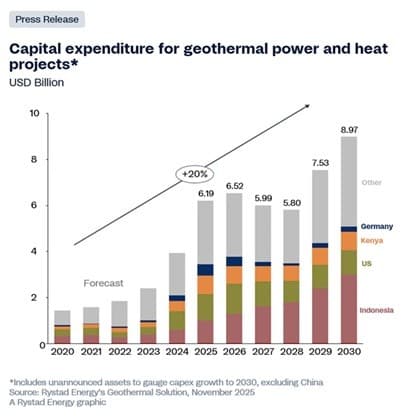
Global geothermal spending is rising sharply, with capex expected to grow 20% annually through 2030 and consistent cost structures across regions.
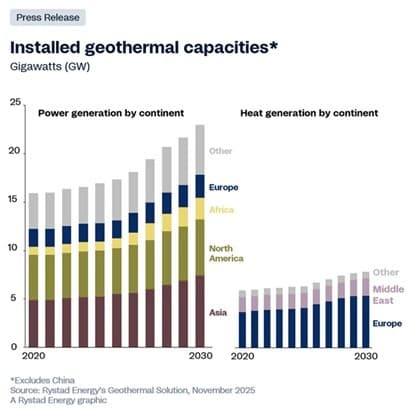
Different markets emphasize different uses: Europe focuses on district heating, while Asia and North America prioritize power generation and emerging enhanced geothermal systems.
Costs for heating projects are roughly half those of geothermal power due to simpler surface infrastructure, guiding investment and policy decisions.
Global geothermal investment is entering a period of accelerated growth, with capital expenditure (capex) expected to climb about 20% annually through 2030, according to Rystad Energy’s latest geothermal economics model. This momentum comes as geothermal energy, produced by tapping heat from deep within the earth, is no longer defined only by mature hubs in Southeast Asia and the US. Interest in regions such as Africa and Europe has been building at a measured pace, contributing to a steady broadening of activity worldwide. Meanwhile, the distribution of spending remains relatively stable across development categories due to consistent cost structures in drilling, surface facilities and steamfield infrastructure.
Currently, just over half of total spending goes toward surface facilities, while an estimated 47% is directed to subsurface work and about 2% is allocated to pre-final investment decision (FID) activities. This distribution is broadly consistent across most markets, making this cost structure a defining aspect of geothermal development. Even the relatively small share devoted to pre-FID work can represent a significant risk, as early exploration determines whether a project advances or is halted altogether. The distribution of costs helps explain why project timelines and financing needs remain relatively uniform across regions, even as overall activity grows.
Global investment in geothermal energy is gaining momentum as more projects move toward FID. Our research shows that geothermal energy is increasingly being tailored to regional needs, reflecting its dual role as a source of clean, reliable power and a provider of heat. In the US, growth is being driven by the expansion of enhanced geothermal systems (EGS) and rising demand for baseload power from data centers. Europe, on the other hand, is focusing on decarbonizing heat, while Southeast Asia is turning to geothermal to meet growing electricity demand. The sector’s longer-term potential in cooling applications is growing as well, a market set to expand alongside global data center activity that’s less considered,
Alexandra Gerken, Vice President, New Energies Analysis, Rystad Energy
When comparing geothermal deployment across continents, Europe stands out as a market dominated by district heating, driven by ambitious decarbonization targets and extensive municipal heating networks. In contrast, Asia, particularly Indonesia, and North America focus primarily on electricity-generating geothermal projects, reflecting strong baseload power needs and abundant geological resources. This divergence shapes both installed capacity and investment patterns. Europe relies more on subsurface development for heating despite lower surface infrastructure costs, while Asia and North America exhibit a more balanced demand between drilling and surface power facilities.
Beyond regional deployment differences, geothermal energy’s role as a clean, reliable source of baseload power is gaining importance. EGS reduces site dependence by requiring only hot rock rather than aquifers, unlocking additional clean power potential and providing stable baseload heat. The technology also shows long-term promise in cooling applications. Pilot projects in the Middle East are exploring its use for data centers, including the UAE’s first geothermal cooling plant, the G2COOL project.
Further research from Rystad Energy, using a bottom-up approach, examines each geothermal asset and its individual cost components, including drilling operations, equipment, and surface infrastructure, rather than focusing solely on total project costs or subsurface development. Geothermal projects are primarily used for district heating systems or power generation, and the resource stands out as one of the few energy sources capable of providing clean baseload power, meaning it can deliver a steady and reliable energy supply.
Costs are often expressed in “dollars per watt,” which indicates the investment required to produce one watt of energy. On this basis, district heating projects generally require about half the investment of geothermal power plants. This difference arises because heating systems do not require expensive turbine sets or complex surface infrastructure, which are essential for electricity generation. In contrast, geothermal power projects involve more extensive facilities and intricate designs, resulting in roughly $6 per watt for power versus around $3 per watt for district heating.
These cost differences are important for policymakers, investors, and developers when assessing project feasibility, choosing technologies, and planning long-term geothermal development. Understanding these relative costs helps guide decisions on which projects to prioritize and how to maximize the value of geothermal resources.
.jpg)




_16403_79272.jpg)
_44651.jpg)