Tuesday, July 01, 2025


New evidence suggests Russian forces shot down Azerbaijan Airlines Flight 8243

Copyright AP PhotoBy Euronews
Published on 01/07/2025

An Azerbaijani news outlet released evidence Tuesday suggesting the Russian military ordered the 2024 missile strike on Flight 8243, causing a crash in which 38 passengers died and another 29 were injured.

Russian military forces were involved in the missile strike on Azerbaijan Airlines Flight 8243 which crashed on 25 December 2024, a new audio recording and a letter published by an Azerbaijani news website on Tuesday purport to prove.

Azerbaijani news outlet Minval claims it received an “anonymous letter ... containing testimonies, audio clips, and technical details” pointing to “technical deficiencies in the communications equipment used at the time.

Minval claims the letter includes a written statement “allegedly signed by Captain Dmitry Sergeyevich Paladichuk, a Russian air defence officer (who) was acting under direct orders from Russia’s Ministry of Defence when he authorised the missile strike.”

Euronews cannot independently verify the authenticity of the claims in the Azerbaijani news outlet’s report.

Minval’s news report on Tuesday quoted the letter claiming that “Captain Paladichuk was stationed near Grozny on duty from 24 to 25 December. At 05:40 on the day of the incident, his unit was ordered to enter full combat readiness."

"Due to poor mobile reception and a lack of functional wired communication, coordination relied heavily on unstable mobile connections," the letter added.

"A potential target was detected at 08:11 and tracked using radar. Two missiles were reportedly fired at the object after Paladichuk was instructed via phone to destroy it — despite heavy fog obscuring optical confirmation.”

According to the letter, “the coordinates, speeds, and directions of the target at the time of both missile launches were provided in detail in the written explanation. The first missile is said to have missed, while the second one allegedly detonated close enough for shrapnel to strike the aircraft.”

Minval also claimed that it reviewed "three voice messages" believed to support the claims made in the letter. The voices reportedly confirm that operational orders were given, two missiles were fired, and shrapnel from the explosion struck the aircraft, according to the outlet.

The outlet has released one audio recording purporting to depict the sequence in which a voice in Russian gives military directions, orders a missile to be fired, followed by the sound of what appears to be a firing sequence, the same voice saying “target missed”, and allegedly ordering another missile to be fired.

On the day of the tragedy, Azerbaijani government sources told Euronews that a Russian surface-to-air missile was fired at Flight 8243 during drone air activity above Grozny, the flight’s destination. The same sources said that the shrapnel hit the passengers and cabin crew as the missile exploded next to the aircraft mid-flight, disabling it.

The damaged aircraft was not allowed to land at any Russian airports despite the pilots’ requests for an emergency landing, the same sources said, and it was ordered to fly across the Caspian Sea towards Aktau in Kazakhstan, where it crashed while attempting an emergency landing, killing 38 and injuring 29.

Subsequent reports after the tragedy claimed that Flight 8243 was downed by a missile from a Russian Pantsir-S1 system.

Putin calls crash 'tragic incident', stops short of apology

Three days after the crash, in an address to the nation, Azerbaijani President Ilham Aliyev said, "we can say with complete clarity that the plane was shot down by Russia (...) We are not saying that it was done intentionally, but it was done.”

At that time, on 29 December, Aliyev stated that Baku had made three demands to Russia in connection with the crash.

“First, the Russian side must apologise to Azerbaijan. Second, it must admit its guilt. Third, punish the guilty, bring them to criminal responsibility and pay compensation to the Azerbaijani state, the injured passengers and crew members,” Aliyev outlined.

Aliyev noted that the first demand was “already fulfilled” when Russian President Vladimir Putin apologised to him on 28 December. Putin called the crash a “tragic incident," though he stopped short of acknowledging Moscow’s responsibility.

The Kremlin said at the time that air defence systems were firing near Grozny, where the plane attempted to land, to deflect Ukrainian drone strikes.

In the days following the tragedy, Russian military bloggers claimed that the said explosion happened over the Naursky District of Chechnya, where several Russian military units were posted at the time, including those with air defence systems, basing their conclusions on open-source data.

The new claims linking the Russian military to the Azerbaijan Airlines Flight 8243 tragedy appear at a time of a fast-moving escalation of judicial measures between Russia and Azerbaijan, as relations between the two countries reach a new low.


Azerbaijan jails Sputnik executives amid escalating tensions with Russia
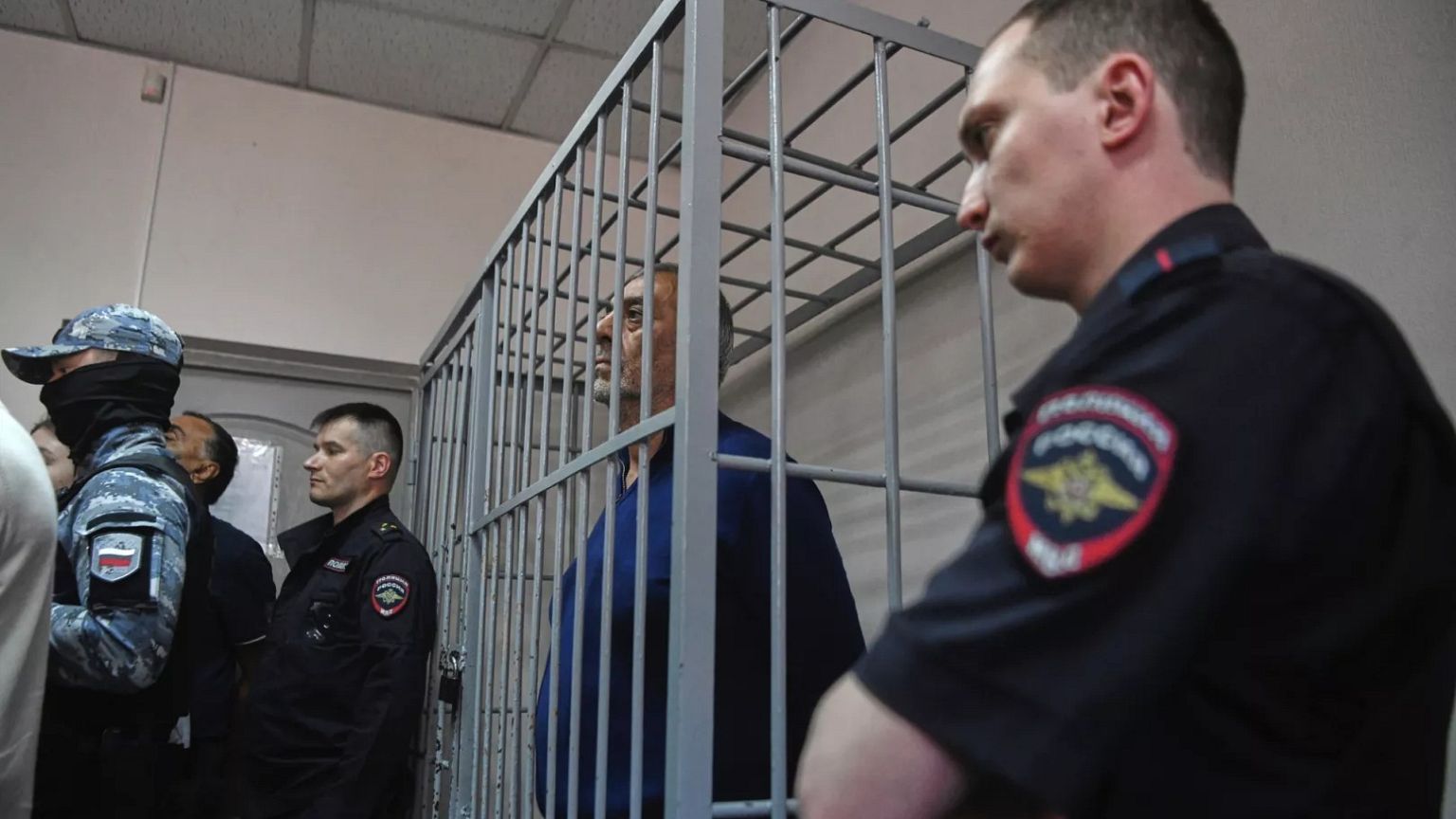
Bakir Safarov, Azerbaijani citizen who faces murder charges as part of a Russian probe into murders that caused outrage in Azerbaijan, attends a hearing in Yekaterinburg
Copyright AP Photo

By Sasha Vakulina
Published on 

Azerbaijan and Russia have engaged in a rare escalation of judicial measures against each other over the last days, as relations between the two countries reach a new low.

The executive director and editor-in-chief of Russia's state-run news agency Sputnik in Azerbaijan have been sentenced to four months in prison on Tuesday, following a Baku police raid of the Russian state media affiliate the day before, in what appears to be a fast-moving escalation between the two countries.

According to Azerbaijan’s authorities, they have been found guilty of fraud, illegal entrepreneurship and legalisation of property obtained by criminal means, Baku-based international news channel AnewZ reported.

Azeri APA agency reported earlier that two employees of the Russian Federal Security Service (FSB) were among seven people detained after the raid on the offices of Sputnik Azerbaijan, owned by Rossiya Segodnya, which is in turn owned and operated by the Russian government.

Another Russian state-run media outlet, Ruptly, later reported that one of its editors had been detained after attempting to film the police action at the Sputnik offices in Baku.

Azerbaijan's Interior Ministry published a video showing officers leading two men to police vans in handcuffs.

The tensions between Azerbaijan and Russia escalated over the past few days following the detention of over 50 Azerbaijanis in Yekaterinburg in raids by the Russian Federal Security Service (FSB) last Friday.

Two people — brothers Huseyn and Ziyaddin Safarov — died during the raids, and three others were seriously injured. Russia claimed that the arrests were part of a murder investigation from the early 2000s.  

Azerbaijan-based broadcaster AnewZ said the news of deadly raids sparked outrage and calls for justice amid what Azerbaijanis allege as abuse and ethnic profiling.

Some detainees have alleged that confessions were obtained through force, threats, and coercion, including pressure on family members.

Forensic experts have revealed that the Azerbaijani citizens killed during the Russian raids in Yekaterinburg died from blunt force trauma, not gunshot wounds, raising additional questions about the circumstances of the deaths.

Azerbaijan’s Foreign Ministry condemned the operation as “brutal and unjustified” and called on the Russian authorities to “conduct an urgent investigation into the matter and bring the perpetrators of this unacceptable violence to justice as soon as possible,” according to AnewZ.

In addition, Azerbaijan summoned Russia’s envoy to Baku to protest against the deadly raids and also cancelled all cultural events planned by the Russian state and private institutions in protest against the raid on Russia’s state-run Sputnik agency offices. 

"In response to targeted and extrajudicial killings and acts of violence against Azerbaijanis based on their ethnicity, dem onstratively perpetrated by Russian law enforcement agencies in the Yekaterinburg region of the Russian Federation – and considering the systematic nature of such incidents in recent times – all cultural events planned in Azerbaijan involving Russian state and private entities have been cancelled," Azerbaijan’s ministry of Culture said in a statement.

Russia’s state-run agency in Azerbaijan

In February, the Azerbaijani government shut down Russia's state-funded news agency, Sputnik, but it has continued to operate, albeit with reduced staff.

Although the agency’s accreditation was officially revoked in February, the Azerbaijan Interior Ministry stated that its data indicated Sputnik Azerbaijan allegedly continued its activities using illegal funding sources.

The director of Sputnik's parent company Rossiya Segodnya, Dmitry Kiselev — one of the most prominent Russian propagandists, who regularly makes open calls to destroy Ukraine and attack Europe with Russian missiles — said Sputnik and Azerbaijani officials had been trying to find a temporary agreement allowing it to keep working in Baku.

Sputnik, Ruptly, and other affiliates of Rossiya Segodnya are widely regarded as tools for spreading the Kremlin's propaganda outside of Russia. 

Kiselev expressed his disconnect over the Monday arrests on Telegram, calling it a “deliberate step aimed at worsening relations between the countries”.

Azerbaijan's parliament has pulled out of planned bilateral talks in Moscow amid the recent escalation and cancelled a visit by a Russian deputy prime minister.

Russian authorities denounced the state-run Sputnik office raid and detention as "unfriendly acts by Baku and the illegal arrest of Russian journalists." 

In additional developments on Tuesday, Azerbaijan's Interior Ministry announced that it dismantled two criminal groups in Baku, detaining Russian nationals suspected of trafficking drugs from Iran and conducting cyber fraud operations.

Relations between Moscow and Baku cooled after an Azerbaijani airliner crashed in Kazakhstan in December, killing 38 of 67 people aboard. 

As exclusively reported by Euronews, investigations into the incident revealed that the Azerbaijan Airlines Flight 8243 was shot at by Russian air defence over Russia's Grozny and rendered uncontrollable by electronic warfare. 

Azerbaijan’s President Ilham Aliyev accused Russia of trying to "hush up" the incident for several days. Russian President Vladimir Putin apologised to Aliyev for what he called a "tragic incident" but stopped short of acknowledging responsibility.

In May, Aliyev decided not to attend Russia’s 80th Victory Day celebrations.

Indian lawmakers to review aviation safety weeks after Air India crash

Reuters
Published July 1, 2025

A panel of Indian lawmakers will review safety in the country’s civil aviation sector and has invited several industry and government officials to answer questions on July 9, with topics set to include Air India’s recent plane crash.

The upper house of India’s parliament has asked airport operators, air traffic controllers and airlines including Air India and IndiGo INGL.NS to take part in a comprehensive review of passenger safety, according to a memo drafted for the meeting and seen by Reuters.

The gathering comes after the June 12 Air India disaster that killed 260 people, including 241 on board, when a Boeing BA.N 787-8 jet crashed within a minute of take-off from India’s Ahmedabad. Investigators are still probing what caused the world’s worst aviation accident in a decade.

Though the memo did not mention the crash, R K Chaudhary, a lawmaker on the panel, told Reuters that it planned to discuss the matter internally and during the meeting.

“If we will not raise questions on it, they (airlines) will not become vigilant about these issues,” he said.

The Indian government has said data from the front recorder of the crashed plane was accessed by a team led by India’s Aircraft Accident Investigation Bureau, with the US National Transportation Safety Board.

Air India has been getting warning notices for compliance lapses in recent days.

India’s aviation watchdog last month warned the airline over “repeated and serious violations” related to pilot duty scheduling. It has also warned Air India for breaching safety rules after three of its Airbus AIR.PA planes flew despite being overdue checks on escape slides.
‘We are a distraction’: Bob Vylan responds to Glastonbury backlash

The band issued a fiery statement insisting they are being scapegoated for highlighting Israel’s genocide of Palestinians.


Images Staff
Updated 01 Jul, 2025
DAWN

British punk duo Bob Vylan has hit back at critics after their Glastonbury performance sparked fierce backlash — and a criminal investigation — over pro-Palestine chants, including a crowd-led call of “Death to the IDF.”

Following statements from UK Prime Minister Keir Starmer and a Metropolitan Police probe, the band issued a fiery statement online addressing the controversy, insisting they are being scapegoated for highlighting Israel’s genocide of Palestinians in Gaza.

“Not the first. Not the last,” the band began. “Today, a good many people would have you believe a punk band is the number one threat to world peace. Last week, it was a Palestine pressure group. The week before that, another band.”


The group denied inciting hate against any community, saying they are “not for the death of Jews, Arabs, or any other race or group of people,” but rather for “the dismantling of a violent military machine.”

Their statement comes days after footage of their Glastonbury set showed frontman Bobby Vylan encouraging chants of “Free Palestine” and criticising the Israeli military. The chant that has drawn the most criticism — “Death to the IDF” — was echoed by members of the audience.

The band’s comments have been labelled “deeply disturbing” by British politicians and pro-Israel advocacy groups.

“We, like those in the spotlight before us, are not the story. We are a distraction from the story,” Bob Vylan wrote. “And whatever sanctions we receive will be a distraction.”

“The government doesn’t want us to ask why they remain silent in the face of this atrocity. To ask why they aren’t doing more to stop the killing? To feed the starving?”

The duo also called on others to join them in speaking out. “We are being targeted for speaking up. We are not the first. We will not be the last. And if you care for the sanctity of human life and freedom of speech, we urge you to speak up too. Free Palestine.”

UK police launch criminal probe into Bob Vylan’s Glastonbury set over ‘Death to IDF’ chants


Irish rap group Kneecap is also under investigation after it led crowds in chants against the UK PM Kier Starmer.


AFP | Images Staff
01 Jul, 2025
DAWN

UK police on Monday launched a criminal investigation into remarks made by rap groups Kneecap and Bob Vylan during the Glastonbury festival, as the US revoked visas for the latter after its frontman led an anti-Israel chant.

Bob Vylan, a London-based duo which often tackles racism in its tracks, was slammed by international and British politicians after the group led the crowds in chants of “Death to the IDF” — the Israeli military.

Prime Minister Keir Starmer said after the show that there was “no excuse for this kind of appalling hate speech”.

Avon and Somerset Police in southwest England said a “criminal investigation is now being undertaken” after reviewing “video footage and audio” of both Kneecap and Bob Vylan.

“The investigation will be evidence-led and will closely consider all appropriate legislation, including relating to hate crimes,” police said in a statement.

The BBC apologised for not pulling the live stream of Bob Vylan’s performance at the festival over the weekend.

“With hindsight, we should have pulled the stream during the performance. We regret this did not happen,” the broadcaster said. It added that the “antisemitic sentiments expressed by Bob Vylan were utterly unacceptable and have no place on our airwaves”.

Media watchdog Ofcom said it was “very concerned” and the BBC had questions to answer. “We have been speaking to the BBC over the weekend and we are obtaining further information as a matter of urgency,” it added.

Israel’s Deputy Foreign Minister Sharren Haskel called for the public broadcaster to be investigated over the time it took for the video to be removed from the BBC’s online streaming platform.

“I think that the latest (BBC) statement is absolutely pathetic,” Haskel told Times Radio.
‘Not welcome visitors’

Controversy descended on this year’s festival before it even began over the inclusion of Kneecap, one of whose members was recently charged under terror legislation.

During their show on Saturday, one Kneecap member also wore a T-shirt dedicated to the Palestine Action Group, which is about to be banned under UK terror laws.

The chants about Israel’s military were led by Bob Vylan’s frontman who goes by the stage name Bobby Vylan, and were broadcast live on the BBC.

Bob Vylan also chanted “free, free Palestine” and “from the river to the sea, Palestine will be free.”

The United States on Monday said it would revoke visas for Bob Vylan’s members, ahead of its American tour dates scheduled later this year.

“Foreigners who glorify violence and hatred are not welcome visitors to our country,” Deputy Secretary of State Christopher Landau posted on X.
‘Crossed a line’

Causing a possible political headache for the UK, the Israel embassy issued a statement saying it was “deeply disturbed by the inflammatory and hateful rhetoric expressed on stage at the Glastonbury Festival”.

US ambassador to the UK Warren Stephens slammed the chants as “anti-Semitic” and a “disgrace”. Glastonbury’s organisers said the the comments had “very much crossed a line.”

“We are urgently reminding everyone involved in the production of the festival that there is no place at Glastonbury for antisemitism, hate speech or incitement to violence,” the festival said in a statement.

Kneecap, which has made headlines in recent months with its pro-Palestinian and anti-Israel stance, also led crowds in chants against UK Prime Minister Starmer.

One of the trio, Mo Chara, is on bail, charged with a terrorism offence after allegedly displaying a flag representing Hezbollah at a gig in November last year.

“Glastonbury, I’m a free man!” yelled Mo Chara during the band’s Glastonbury set on Saturday, inspiring a mass chant of “Free Mo Chara” that turned into several rounds of “Free, free Palestine!” reported The Telegraph.

Rapper Móglaí Bap called for fans to gather at the next court hearing and stage a riot. He then corrected, “No riots, just love and support, and more support for Palestine.” This led to the first of several loud chants of “F*** Kier Starmer!” which proved an even more popular chant amongst the young audience than “Free Palestine”.

Starmer and other politicians had said the band should not perform after its Mo Chara was charged with a terror offence. He appeared in court this month, accused of having displayed a Hezbollah flag while saying “Up Hamas, Up Hezbollah” at a London concert last year.

It is an offence to express support for Hezbollah or Hamas in the UK.
Meet Zohran Kwame Mamdani

Jawed Naqvi 
Published July 1, 2025


The writer is Dawn’s correspondent in Delhi.

HIS rise has been swift and vertical. Donald Trump, among others, is struggling to figure out who exactly Zohran Kwame Mamdani is. They know that the newly elected Democratic mayoral candidate for New York in the Nov 4 elections stands for the liberation of Palestine.

They probably also know that he accuses Narendra Modi of mass murder in Gujarat, even if India’s supreme court has given him the proverbial clean chit for the 2002 carnage of Muslims.

In a pre-election interview, mayoral candidates were asked if they would help the Indian prime minister hold another rally in the city. All said no, but Mamdani went on to emphasise that he would never wish to meet Modi if elected mayor of New York.

Zohran should not perhaps worry about that possibility if reports are true about the possible resignation of Modi in September, when he attains the retirement age of 75 that he set for all BJP office bearers.


But Mamdani’s critics (and many supporters) don’t quite seem to know how or why he succeeded in toppling the Democratic Party’s applecart by upstaging its poster boy Andrew Cuomo in the race. Cuomo’s elitist supporters include Zionist Jews from Brooklyn, who reportedly helped mobilise a whopping $25 million to defeat Mamdani.

They are naturally worried by the turn of events. Mamdani’s reply to them was reassuring, even disarming. Hate crimes trouble him equally, including the current antisemitic uptick across the US. His pledge to them was his proposal for an 800 per cent increase in the city’s mayoral budget to arrest hate-crimes.

Trump, nevertheless, has called him a communist lunatic, and reports are coming in of assassination threats to the 33-year-old Ugandan migrant with a winsome smile.

To appreciate Zohran’s secular and progressive Hindu and Muslim lineage, it might help to look for a clue in his middle name, Kwame. The one Kwame his parents possibly named him after, and who best fits the sketchy political profile we have of the Mamdanis, is Kwame Nkrumah.

The radical left politician led Ghana to independence from Britain but was overthrown after a short tenure as president by a Western-backed military coup while he was visiting China in 1966. Nkrumah, together with Patrice Lumumba, Kenneth Kaunda and Julius Nyerere, was an idol for post-colonial masses in Africa and beyond. South Asians saw him as a genuine friend, and Jawaharlal Nehru courted him as a comrade. Some say he was the inspiration for Martin Luther King’s doctrine of peaceful resistance.

To appreciate Zohran’s secular and progressive Hindu and Muslim lineage, it might help to look for a clue in his middle name.

We also know that Zohran was born in Kampala, where his father of Gujarati Shia Muslim origins, began his journey as a scholar with a focus on colonialism, ethnic strife and migration. Mahmood Mamdani has written outstanding books on colonialism and society, a more widely lauded being Good Muslim, Bad Muslim. To get a handle on the phenomenon, his son is, we may benefit from discussing his father’s scholarly quest.

In Good Muslim, Bad Muslim, Mamdani discusses the rise of political Islam, and answers questions that Americans have struggled with since Osama bin Laden, the former American protégé, staged a spectacular attack on the US. Mamdani dispels the easy description of ‘good’ Muslims being secular or Westernised and the ‘bad’ being slotted as pre-modern and fanatical. In his view, political Islam emerged from a modern encounter with the West. The terrorist movement at the centre of political Islam is an even more recent phenomenon, one “that followed America’s embrace of proxy war after its defeat in Vietnam”.

The book seems relevant to today’s perceptions of the Israel-Iran contest. Amid the megaphoned Western vilification of ‘mullahs’ ruling Iran, a 5,000-year-old civilisation is condemned by its parvenue rivals who were largely created from the British-French division of spoils following Turkey’s defeat in 1919. Look carefully, and all the post-Cold War Western targets were utterly secular states — from Iraq to Libya, from Algeria to Syria, and from Lebanon to Yemen. Damned if you are secular, damned if you are not.

Mamdani’s other acclaimed works include a signal point of departure in analysing the ethnic violence in Rwanda. Another work, Neither Settler nor Native: The Making and Unmaking of Permanent Minorities posits that the modern state didn’t begin with the 1648 Treaty of Westphalia, but sprang into being in 1492: the year of the expulsion of Jews and Muslims from Spain following the ‘Reconquista’, which coincided with the European colonisation of the Americas.

Zohran’s mother, Mira Nair, is a progressive filmmaker. Some of her acclaimed movies are seen in their approach as a facet of parallel cinema. Monsoon Wedding, Mississippi Masala, The Namesake are more widely applauded, though her cinematic work on life in the slums of Uganda is a class apart.

Nair’s films are known for their vibrant storytelling, rich cultural textures and exploration of identity, displacement and human connections. The parents’ imprint is palpable in the son’s politics.

What makes his win even more remarkable is that Zohran “has refused to back down from his vocal support for Palestinian liberation, a position that has long been a death knell for candidates within a party whose establishment is unabashedly pro-Israel,” said The Guardian.

There are other compelling factors driving Mamdani’s success. His approach to New York differs from Frank Sinatra’s individualistic quest to arrive at “the top of the heap”. Zohran takes a leaf, instead, from Sahir Ludhianvi’s angst for Bombay. “Cheen o Arab hamara, Hindosta’n hamara/ Rehne ko ghar nahi hai, saara jahaa’n hamara.” (The far corners of the world belong to me, and I am its homeless citizen.)

Like Sahir, Mamdani identifies with “those who toil in the nights, so they can enjoy the fruits of their labour in the day. Where eight hours on the factory floor or behind the wheels of a cab is enough to pay the mortgage, enough to keep the lights on, enough to send your kids to school”.

jawednaqvi@gmail.com

Published in Dawn, July 1st, 2025


Comment


Zohran Mamdani getting hate for eating rice with his bare hands is exposing people’s ‘colonial mindset’


Congressperson Brandon Gill told the New York City mayoral candidate that 'civilised people in America don't eat like this.'


Images Staff
Updated 01 Jul, 2025
DAWN


Afiery debate sparked online after a video of Zohran Mamdani — poised to win New York City’s Democratic mayoral primary — eating rice with his hands, went viral, to which Republican Congressperson Brandon Gill said, “Civilised people in America don’t eat like this.”

Gill, in his rampant racism, added, “If you refuse to adopt Western customs, go back to the third world.”


For context, during an interview with Uncivilized Media, Mamdani was asked a question about the “third holy grail of taboos in American politics: socialism, Islam and Palestine,” and that he was “going for the trifecta.” Instead of focusing on Mamdani’s answer about his politics being impacted by Palestine because of his upbringing in the third world, the internet chose to single out the fact that while responding, he was eating rice with his hands — a common occurrence in the East, but for some reason, the internet could not handle it.

End Wokness, a right-wing X (formerly Twitter) account with over 3.7 million followers, shared the video and wrote, “Zohran says his worldview is inspired by the 3rd world while eating rice with his hands.”

After Gill reshared the video, with his rather insensitive opinion, journalist Mehdi Hasan highlighted that Gill’s father-in-law was born and raised in India and “has definitely eaten with his hands.” Hasan questioned if the congressperson would ask his father-in-law to leave the US, too.


Gill’s wife, Danielle D’Souza Gill, was quick to respond and said, “I did not grow up eating rice with my hands and have always used a fork. I was born in America. I’m a Christian MAGA patriot. My father’s extended family lives in India, and they are also Christian, and they use forks too. Thank you for your attention to this matter.”


Another X user, however, shared a picture of Danielle’s father eating naan with his hands and asked, “Should we send him back?”


The blatant racism

The Mamdani hate brigade trudged on, flashing their racism and questioning the hygiene of eating with one’s hands. An X user asked why someone would eat rice with their hands if spoons existed.


Another person wrote, “If I ever saw a grown man eating like this, everything that comes out of their mouth imma discredit as bull c**p until they can figure out how to eat like a civilised person. What the hell is wrong with some people, man?”


One person believed it was okay to eat certain foods with their hands, but rice called for an “immediate deport.”

To this we ask, who’s drawing this distinction, because don’t all food items end up in the same place (your stomach) after you eat them, be it rice or burgers? Aren’t you using the same hands to eat with?


Others resorted to bigotry and called Mamdani a “monkey.”


Yes, it isn’t part of Western culture to use hands to eat food items, especially things like rice, but that doesn’t mean it’s wrong, or because Mamdani is an American, he needs to forgo his roots.

The implication that eating rice with his hands is ‘uncivilised’ is blatant racism. For centuries, people — not just South Asians, but other cultures — have used their hands to eat their food.

In many Asian, African and Middle Eastern cultures, eating with your hands is the traditional and normal way to eat. To imply that the Western way to eat is more civilised or correct is to imply that other cultures are inferior to the West, an idea rooted in colonialism.

An X user summed it up brilliantly: “The idea that there’s one ‘civilised’ way to eat or live, tied to Western customs, is rooted in a colonial mindset that dismissed the richness of global cultures.

“Mamdani’s work champions inclusivity and justice, celebrating the diversity of communities in America. Food, traditions, and ways of life aren’t ranked by ‘first’ or ‘third’ world — they’re expressions of humanity. Telling people to ‘go back’ for being themselves is the opposite of what makes America vibrant.”


Mamdani’s defence

Many jumped to the mayoral candidate’s defence, with one social media user stating, “Tell me you have had zero exposure to people from other cultures whatsoever without telling me. I firmly believe that one of our country’s greatest issues is a massive unwillingness and negligence toward meeting and understanding people and cultures dissimilar to one’s own.”


Another maintained that “the quote and replies show the ignorance and arrogance of many Westerners who think their practices are always the only right practices.”


An individual highlighted that it was “heavenly” eating with one’s hands, adding that all the attacks on Mamdani from the right seemed to have the opposite attack.

“Mate, you should try eating rice with your hands sometime. You can achieve an unparalleled level of understanding of the food: texture, mixing of flavours.”


One person believed that none of the rhetoric against Mamdani worked; therefore, people were talking about him eating with his hands.


“People who think it’s dirty must do something dirty with their hands and not wash their hands before eat[ing],” another person wrote, while someone else urged people to wash their hands before and after eating if they were concerned about germs.

As anyone who’s enjoyed a hot plate of biryani using their hands will tell you, their hands are generally thoroughly washed before and after.


An X user, who claimed to be quoting the Ottoman counterargument, said, “How would I know if this spoon is washed properly? I know for sure my hands are.”


An individual who said they grew up in Texas wrote that they ate with their hands when dining with other cultural groups and that it seemed that “the ‘hand-eating’ guests are much more serious about sanitation than the ‘non’.”


“The hate is so forced, man, y’all have nothing to complain anymore, give it up, you will live. Indonesians eat with their bare hands, too. Y’all don’t know how amazing botram is,” one person wrote, referencing a Sudanese term that denotes a feast.


Meanwhile, a social media user failed to understand the point of the criticism. “He’s a politician and connecting with his constituents. Maybe more politicians should try it. I’m no fan of this guy, but come on. There are better ways to ‘attack’ a political opponent.”


You and your faves do it too

Many people emphasised that several foods regularly consumed in the West were eaten with their hands. Pizza, burgers, fries, ribs, anyone? One user maintained that only when it came to rice did allegations of “third world country habits” burst forth.


“Tell me you are a racist piece of s* * t without telling people you are a racist piece of s**. Eating pizza, ribeyes, seafood with bare hands [is] okay. But when an Asian / POC (person of colour), suddenly it’s not okay? The hypocrite, the racism,” an individual wrote.


Another user aptly highlighted that America was the country that created KFC’s “finger-licking good” chicken, “but apparently, it’s not American to eat with your fingers.”


Other netizens shared pictures of US President Donald Trump and incumbent New York City mayor Eric Adams using their hands to eat food.

“I can’t believe he’s eating with his hands. Disgusting third worlder. He’ll never be civilised,” someone wrote alongside a picture of Trump digging through a box of McDonald’s French fries with — surprise, surprise — his hands.


Another X user put it aptly: “Is this what people call a negative quality? I don’t see it.” Perhaps there are better metrics for judging a politician than the way they consume food, especially when it’s intrinsically linked to their culture and the culture of billions.


Let’s not forget, finger food exists in the West as a whole subculture of eating, and it is considered normal for one to use their hands to eat certain things, as The Guardian reports. It’s 2025, the time is past to judge people and pass racist comments about how billions eat.


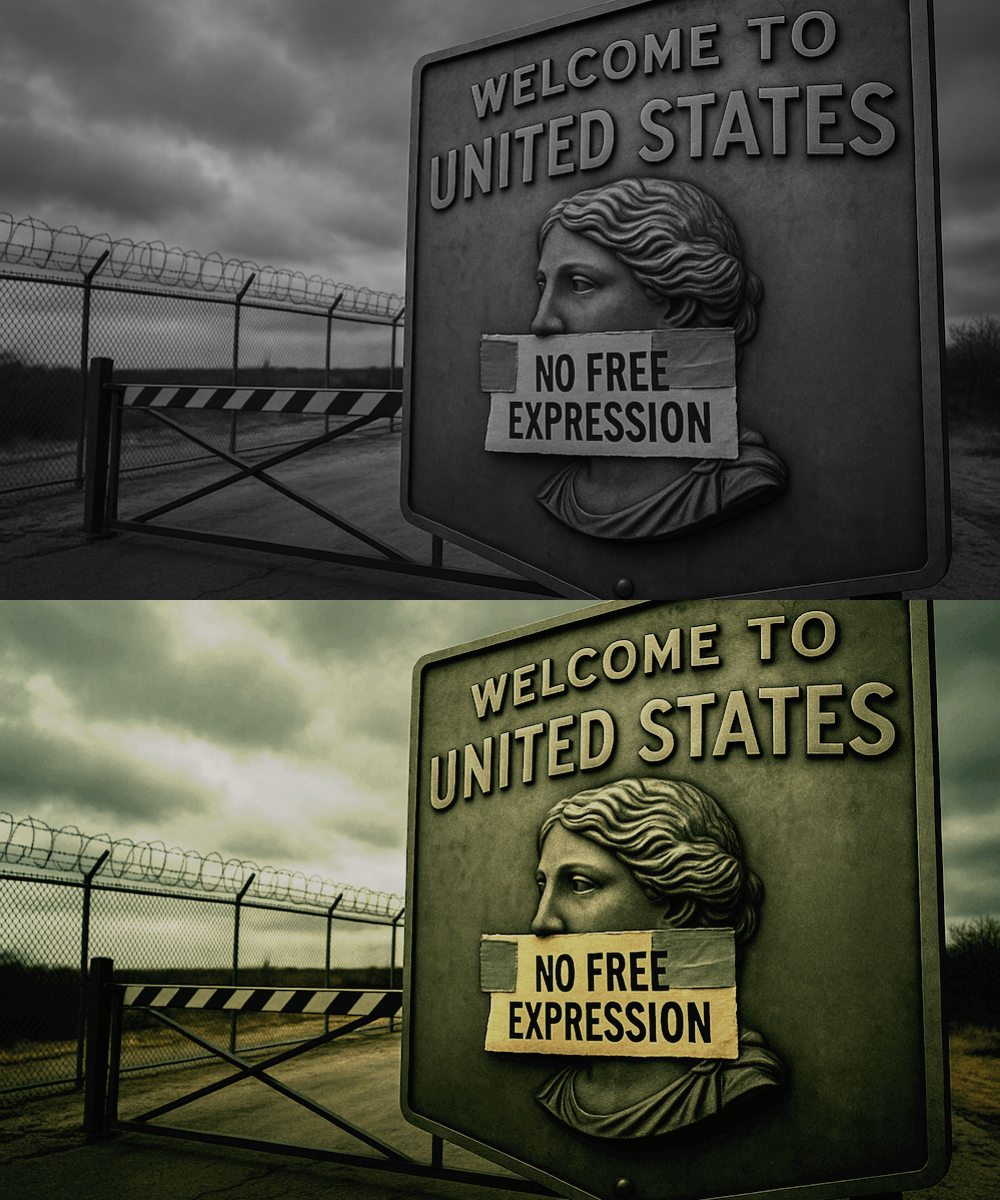
You are welcome to the land of the free … only if you are willing to give up your freedom of speech


The social media vetting rule isn’t just a draconian border policy but a slow, deliberate erosion of the right to dissent and the right to be human online.
Published July 1, 2025   
PRISM/DAWN

Kamran Arif, a name instantly recognisable to anyone in Pakistan’s human rights circles, was more than a colleague; he was a friend, a mentor, and a quiet force of clarity.

At his home, tucked between wall-sized shelves stacked with everything from constitutional theory to crime thrillers, sat a book I once borrowed, and then shamelessly failed to return. ‘May It Please the Court: The First Amendment’ is a collector’s gem, a gripping compilation of real Supreme Court cases and the arguments that once gave weight to America’s promise of free speech. It captures a time when the First Amendment still held meaning in the so-called land of the free, before it was gradually emptied by national security paranoia and rebranded as a talking point to defend corporate power and demagogic bluster.

The book revisits the fierce courtroom battles fought to defend free expression, and upholding the First Amendment, the constitutional safeguard that promises freedom of speech, press, religion, assembly, and the right to dissent without fear or favour — the very foundations of the ‘American dream’.

Down the slippery slope


I was reading the book again recently, and it felt grimly ironic to recall those legal battles now, at a time when the US — once the loudest champion of free speech — is sliding into a state of quiet authoritarianism. Students are arrested for protesting, ICE stalks immigrants through digital footprints, and speech that challenges power is flagged, monitored, and punished. The very rights once argued for so passionately before the Supreme Court are now, seemingly, selectively applied, if not openly discarded.

In yet another chapter of the post-Trump erosion of civil liberties, the US government has formalised what many feared would become the global template for ideological policing: social media vetting as a precondition for entry.

All F, M, and J visa applicants from Karachi and Lahore, including students, researchers, and exchange scholars, are now required to surrender every social media handle used over the past five years and strip away any privacy settings.

The US Consulates in Karachi and Lahore issued a special advisory for F, M, and J applicants, emphasising that mandatory disclosure of social media identifiers is now part of the core screening process. An Instagram post by the consulates reads: “Effective immediately, all individuals applying for an F, M, or J nonimmigrant visa are requested to adjust the privacy settings on all of their social media accounts to ‘public’ to facilitate vetting necessary to establish their identity and admissibility to the United States.

“Omitting social media information on your application could lead to visa denial and ineligibility for future US visas,” they warned.


View this post on Instagram


In this latest avatar of surveillance rationalised as policy, online posts are treated like ideological contraband, combed through by consular officials for memes, captions, and hashtags that hint at dissent. It’s a quiet but chilling escalation, where political expression becomes a liability measured not by law, but by algorithms, suspicion, and the shifting whims of empire.
Tightening the screws

In the courtroom transcripts Kamran so cherished, lawyers once stood before the highest court defending the right to burn flags, mock presidents, and speak without fear. Today, those same freedoms, especially when exercised by immigrants or folks of colour, are surveilled, catalogued, and punished in silence. The First Amendment, once a shield against state overreach, now hangs limp in the theatre of selective liberties.

I feel this isn’t just a draconian border policy but a slow, deliberate erosion of the right to dissent and the right to be human online. The First Amendment, long considered the North Star of American civil liberties, seems to have been effectively shelved.

There is little ambiguity about where this began. The Trump administration’s obsession with digital spaces as ideological battlegrounds first gave rise to the idea that visa applicants should be screened for their online views. This idea, originally floated in 2017 as part of Trump’s larger anti-immigration fervour, was then institutionalised under the cloak of counterterrorism. In 2019, the State Department expanded the policy to cover over 15 million people annually. In 2025, the screws are being tightened. What was once a soft screening has now become an explicit demand: unlock your digital self or be denied entry.

According to a Reuters report citing an internal cable, US consular officers have been instructed to carry out “comprehensive and thorough vetting” of all student and exchange visitor applicants, with a specific mandate to identify individuals who “bear hostile attitudes toward our citizens, culture, government, institutions, or founding principles.” The cable, dated June 18, was circulated to US missions worldwide just days before the policy was set to take effect.
The message is clear

Who defines hostility? What is considered a threat? Can criticism of American foreign policy constitute subversion? Could satire be seen as offensive, extremist material?

The American Civil Liberties Union (ACLU) had documented multiple cases during the previous Trump era in which Iranian students, despite holding valid US visas, were detained at airports and summarily deported under vague “national security” justifications, without explanation, legal recourse, or due process. Many had already cleared extensive vetting, only to be flagged at the last mile. This was also the period when visa forms were updated to demand applicants’ social media handles, turning online expression into a minefield of suspicion.

Recently, a Norwegian tourist was denied entry into the US after officials found a meme of Vice President JD Vance on his phone and questioned him about past drug use. Homeland Security cited his admission as grounds, though the incident raises concerns about digital content being used to screen travelers.

But let’s be honest, when even Elon Musk had to scrub his timeline and issue half-hearted apologies to keep the leader of the ‘free’ world calm, what chance does a 22-year-old student from Karachi stand? The message is clear: your digital footprint can follow you across borders, and in the land of filtered freedoms, speech is free only when it flatters power.

This policy fits squarely into the blueprint of what I have previously termed ‘The Outrage Machine’, a political-industrial complex where demagogues are at the helm and social media platforms function as their whips. In this architecture, disagreement is not dialogue; it is treason. If you question, mock, or contradict the orthodoxy online, you are no longer a user. You are the enemy.

This is textbook authoritarian logic, draped in the language of administrative procedure. And it is not being driven by data. A 2021 study by the Brennan Center for Justice found no credible evidence that social media screening has ever prevented a terror attack. On the contrary, it found significant racial and religious bias in how online content was interpreted and weaponised against applicants. The policy punishes not intent, but perception. And perception is deeply racialised.

Nowhere is this felt more acutely than in Pakistan. For young scholars and aspiring students, the US remains a coveted destination. But in 2025, that aspiration comes with a caveat: surrender your digital privacy.

And therein lies the quiet tragedy. The US, long a self-appointed champion of free speech and open society, is now importing the logic of surveillance states. It is hard to distinguish this from the digital authoritarianism practised in authoritarian societies where social media is routinely monitored for dissent. The difference is that the US does it while preaching democratic values.
Only the beginning

There is a strategic hypocrisy at play. The same government that warns against TikTok as a Chinese surveillance tool now demands access to the Instagram, Twitter and Facebook accounts of Pakistani students. The same administration that rails against digital censorship abroad is building a system to algorithmically screen beliefs at home.

Make no mistake: this policy will not remain confined to visa applicants. Surveillance logic never retreats. It expands. Already, we see private companies using AI to analyse employee social media. Governments across the West may be watching closely. What begins in Washington rarely stays there. What the US is doing in a bid to secure borders might just become a template for digital control.

Digital rights advocates have warned that policies like these do not merely violate privacy; they dismantle the foundation of the open internet. The right to express oneself without fear of retribution, to organise, to criticise power, all these freedoms are under siege when surveillance becomes a condition for movement. The right to privacy is not a luxury. It is a prerequisite for liberty.

Universities in the US must not remain silent. If academic freedom is to mean anything, it must include the right of students to think, speak, and post without being labelled a threat. If US campuses become ideological checkpoints, then the moral foundation of their global prestige collapses. This is not a war on terror, but a war on the unfiltered self. The kind of policy that makes students choose between their voice and their future. It is morally indefensible.

To conclude, I can say with near certainty that after authoring this, my future US visa applications are headed straight for the shredder. Tragic, I know. But thankfully, I’m not the sort who lets bureaucratic paranoia ruin my day. That said, if you’re feeling bold enough to share this article on your timeline, just a heads-up, your dreams of sipping overpriced coffee in Brooklyn and posting a selfie from Times Square might suffer a similar fate.

Choose rebellion wisely.

Header image created with generative AI

The writer is a journalist, techie, media strategist, and the founder of media development and watchdog organisation Media Matters for Democracy. He tweets @asadbeyg


Racial inequities and access to COVID-19 treatment


JAMA Network Open


About The Study: 

This cross-sectional study found that racial and ethnic disparities in COVID-19 treatment are substantial and partially explainable by encounter-level factors, particularly differences in diagnostic test type, virtual care access, and site of care. These findings suggest that targeted interventions, including expanding rapid test access and virtual care, may improve equity in outpatient COVID-19 treatment. 


Corresponding Author: To contact the corresponding author, Rebecca Bromley-Dulfano, MS, email rbromleydulfano@g.harvard.edu.

To access the embargoed study: Visit our For The Media website at this link https://media.jamanetwork.com/

(doi:10.1001/jamanetworkopen.2025.18459)

Editor’s Note: Please see the article for additional information, including other authors, author contributions and affiliations, conflict of interest and financial disclosures, and funding and support.

#  #  #

Embed this link to provide your readers free access to the full-text article 

http://jamanetwork.com/journals/jamanetworkopen/fullarticle/10.1001/jamanetworkopen.2025.18459?utm_source=For_The_Media&utm_medium=referral&utm_campaign=ftm_links&utm_term=070125

About JAMA Network Open: JAMA Network Open is an online-only open access general medical journal from the JAMA Network. On weekdays, the journal publishes peer-reviewed clinical research and commentary in more than 40 medical and health subject areas. Every article is free online from the day of publication. 


Scientists target ‘molecular machine’ in the war against antimicrobial resistance


Scientists have studied a new target for antibiotics in the greatest detail yet – in the fight against antibiotic resistance


.


King's College London

Molecular structure of the bacterial flagellum – a new target in the war against antimicrobial resistance 

image: 

Molecular structure of the bacterial flagellum – a new target in the war against antimicrobial resistance

view more 

Credit: Dr Julien Bergeron - King's College London


Scientists have studied a new target for antibiotics in the greatest detail yet – in the fight against antibiotic resistance.

The ‘molecular machine’ flagellum is essential for bacteria to cause infection, allowing bacteria to ‘swim’ around the bloodstream until finding something to infect. But it could also be a target for antibiotics.

Impairing the flagellum would deliver a critical, but not fatal, blow to bacteria. This is a new approach and contrasts to traditional antibiotics, which are designed to kill all bacteria in their path.

Keeping bacteria alive could help to tackle, or at least significantly slow down the rate of antibiotic resistance. This is because there is less pressure for the bacteria to adapt and develop resistance to survive.

To develop this new approach, scientists first need to understand the enemy. Answering the call, researchers at King’s College London, have now studied the flagellum in its greatest detail to date.

The new study, published in Nature Microbiology today, addresses one of the most significant challenges to modern healthcare, antibiotic resistance. Drug-resistant infections are expected to claim more than 39 million lives between now and 2050 without further policy action, according to the Global Research on Antimicrobial Resistance Project.

Lead author Dr Julien Bergeron, King’s College London, said: “The flagellum is perhaps the most studied cellular machine, acting as a propeller, through the rotation of a long filament. It is also a major reason why bacteria cause disease; flagella give bacteria a competitive edge at causing disease and the presence of this molecule alone contributes to more than 100,000s deaths annually.

“We knew how important it was to study this ‘molecular machine’, as we investigate it as a potential target in our quest to neutralise the threat of bacteria.

“The bacterial flagellum has long fascinated scientists and the wider public alike. Yet, despite being extensively studied for over 70 years, the molecular details of its architecture have so far eluded researchers. This is because we simply haven’t had the tools.”

Dr Bergeron and his team used a state-of-the-art type of technique called cryo-electron microscopy – which reveals images of cells at an atomic level in impressive molecular detail. This enabled the team to understand how the flagellum forms, identifying areas to target with drugs. They had access to one of the most powerful electron microscopes, based at the Francis Crick Institute, available for scientists tackling some of the biggest challenges in healthcare – from antibiotic resistance to cancer.

Dr Bergeron explained: “In this study, we have used the world’s most advanced electron microscope to reveal the complete architecture of the bacterial flagellum, down to atomic levels of details. This unearthed unexpected intricacies in its structure. Critically, we were able to visualise the individual steps involved in the assembly of the flagellum, a process that until now had largely remained unexplained.”

Co-author Professor Marc Erhardt, from the Max Planck Unit for the Science of Pathogens and the Humboldt-Universität zu Berlin, Germany, also developed a vital ‘genetic trick’, enabling scientists to study a very short section of flagella in great detail. He said: “It was an extraordinary experience to capture snapshots of the flagellum forming that had previously remained hidden. Observing how individual flagellin molecules are folded and inserted into the growing filament was like decoding a molecular ballet.”

Further research is needed to fully understand how the flagellum forms, for example what triggers the initial process of its development. Scientists believe, however, it could be a key target to stop infections without driving resistance.

Dr Bergeron added: “This study will undoubtedly open new avenues towards the development of new treatments for bacterial infections. With the right funding and support this could become reality within a couple of years. However, realistically I think it would be more like a decade and we would need support from industry to help us in this fight against antimicrobial resistance.”

Read the study: https://www.biorxiv.org/content/10.1101/2024.09.25.614892v1

Notes to editors

This study was funded by BBSRC and the European Research Council, with support from EMBO and the Chinese Science Council for studentships

Images – credit Dr Julien Bergeron, King’s College London


Aston University research: Parents should encourage structure and independence around food to support children’s healthy eating


Aston University


  • Dr Katie Edwards studied the feeding practices of parents of children with ‘avid’ eating traits, which can lead to obesity
  • Focusing on health or deciding when it is time for a meal or snack helps parents to use supportive feeding practices.
  • Supportive feeding practices could include involving children in decisions about food, or sitting together for mealtimes

New research from Aston University has shone a light on the best ways for parents to encourage healthy eating in their children.

The team of academics from Aston University’s School of Psychology, led by Professor Jacqueline Blissett, with Dr Katie Edwards as the lead researcher, looked at the meal- and snack-time practices of parents of children with ‘avid’ eating behaviours. ‘Avid’ eaters, who make up around 20% of children, particularly love food, are often hungry and will eat in response to food cues in the environment and their emotions, not just when they are hungry. They are the most susceptible to obesity and therefore encouraging a healthy, balanced diet is vital.

Feeding children with avid eating behaviours can be challenging and the researchers wanted to understand how factors in everyday life, such as parent mood or eating situations, influence the feeding practices that parents use. Understanding this can help to create better support for families around meal and snack times and reduce the risk of children developing obesity.

Dr Edwards says that the research shows that when parents prioritise children’s health or decide when it is time for a meal or snack, parents are more likely to use supportive feeding practices which create structure around meal or snack times or encourage children to be independent with their food choices. For example, parents could sit and eat with their children, choose what food is available for their children, or involve children in decisions about what food to eat.

She adds that there are three main things that parents can do to help encourage healthy eating behaviour. The first is to focus on health, by providing nutritious and balanced meals. The second is to ensure a calm and positive atmosphere during eating occasions. The final recommendation is that parents should take the lead on setting meal- and snack-times, with a good structure being three meals and two snacks a day. These recommendations are linked to parents’ use of supportive feeding practices which are known to encourage children’s healthy eating.

To carry out the research, the team recruited parents of children aged 3-5 with avid eating behaviour and asked them to download an app to their smartphones. The app sent four semi-random reminders per day for a 10-day period, asking them to complete a survey with information about mood and stress levels. Every time a child had a meal or a snack, or asked for food, parents completed another survey to give information about feeding practices (including those which give children structure, or independence, around food), mealtime goals (such as prioritising healthy eating), and information about the mealtime setting (such as the atmosphere).

Previous research from this team at Aston University identified four main eating traits in children. As well as ‘avid’, the other traits, not studied here, are ‘typical’ eaters, who have no extreme behaviours, ‘avoidant’ eaters, who are extremely fussy, and ‘emotional’ eaters, who eat in response to emotions but do not necessarily enjoy food in the way that avid eaters do.

Dr Edwards was also involved in the team’s research at Aston University that showed that parents’ eating behaviour influences that of their children.

Dr Edwards said:

“Given the challenges that parents may face and the risk of childhood obesity, we will use these findings to develop feeding support for families. Encouraging parents to use feeding practices which provide structure around meal and snack times, or promote children’s independence with food, could be helpful for supporting children’s healthy eating.

Read the full paper in the International Journal of Behavioral Nutrition and Physical Activity at https://doi.org/10.1186/s12966-025-01768-x.