It’s possible that I shall make an ass of myself. But in that case one can always get out of it with a little dialectic. I have, of course, so worded my proposition as to be right either way (K.Marx, Letter to F.Engels on the Indian Mutiny)
Sunday, May 25, 2025
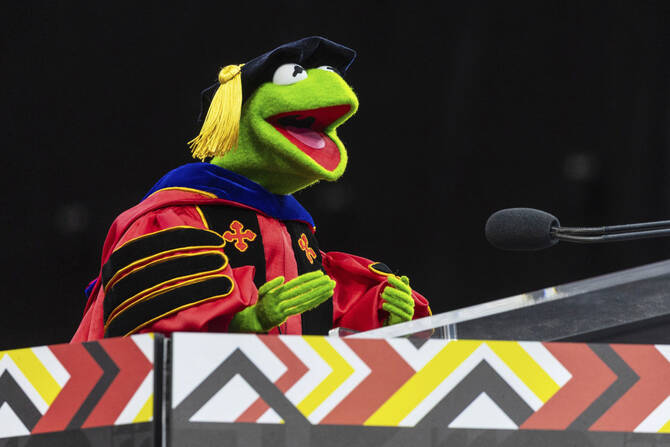
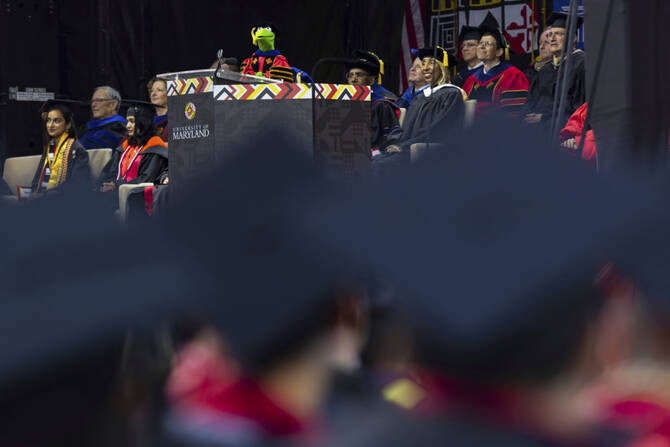
‘Leap together,’ Kermit the Frog says in commencement address at University of Maryland graduation
Kermit the Frog speaks during University of Maryland's commencement ceremony on May 22, 2025, in College Park, Maryland. (Riley Sims/University of Maryland via AP) Kermit the Frog speaks during University of Maryland's commencement ceremony on May 22, 2025, in College Park, Maryland. (Stephanie S. Cordle/University of Maryland via AP) Kermit the Frog speaks during University of Maryland's commencement ceremony on May 22, 2025, in College Park, Maryland. (Riley Sims/University of Maryland via AP)Next
AP May 23, 2025
Kermit, who was created in 1955 and became the centerpiece of the Muppets franchise, is no stranger to the school
Muppets creator Jim Henson graduated from Maryland in 1960 with home economics as his major
COLLEGE PARK, Maryland: Kermit the Frog knows it’s not easy being green — or graduating from college and entering the real world, especially during a time of economic uncertainty and political turmoil.
Members of the University of Maryland’s class of 2025 received their diplomas Thursday evening with sage advice from the amphibious Muppet ringing in their ears.
“As you prepare to take this big leap into real life, here’s a little advice — if you’re willing to listen to a frog,” the beloved Muppet said. “Rather than jumping over someone to get what you want, consider reaching out your hand and taking the leap side by side, because life is better when we leap together.”
The university announced in March that Kermit, who was created in 1955 and became the centerpiece of the Muppets franchise, would be this year’s commencement speaker. He is also no stranger to the school.
Muppets creator Jim Henson graduated from Maryland in 1960. A home economics major, he fashioned the original frog puppet from one of his mother’s coats and a Ping-Pong ball cut in half, according to a statement from the university. Henson died in 1990. A bronze statue of Henson and Kermit sitting on a bench is a well-known feature of the College Park campus.
In a video announcing the speaker pick, Kermit is described as an environmental advocate, a bestselling author, an international superstar and a champion of creativity, kindness and believing in the impossible.
His speaker bio calls him “a star of stage, screen and swamp” whose simple mission is to “sing and dance and make people happy.”
“I am thrilled that our graduates and their families will experience the optimism and insight of the world-renowned Kermit the Frog at such a meaningful time in their lives,” university President Darryll J. Pines said in a statement.
Beyond ceasefire, India and Pakistan battle on in digital trenches
A man reads news on his mobile phone after the ceasefire announcement between India and Pakistan, in Srinagar, Indian-administered Kashmir. (REUTERS/File)
Both states continue to push competing narratives after the four-day military standoff, which ended on May 10 with a US-brokered truce
Digital rights experts note how it is often laced with hate, targeting vulnerable communities like Muslims in India and Hindus in Pakistan
ISLAMABAD: As Indian and Pakistani guns fell silent after trading fire for days this month, the war over facts and fiction is far from over and fierce battle rages on social media as to who won, who distorted the truth, and which version of events should be trusted.
As both states continue to push competing narratives, experts warn that misinformation, censorship and AI-generated propaganda have turned digital platforms into battlegrounds, with real-world consequences for peace, truth and regional stability.
The four-day military standoff, which ended on May 10 with a US-brokered ceasefire, resulted from an attack in Indian-administered Kashmir that killed 26 people last month. India accused Pakistan of backing the assault, a charge Islamabad has consistently denied.
While the truce between the nuclear-armed archfoes has since held, digital rights experts have sounded alarm over the parallel information war, which continues based on disinformation, censorship and propaganda on both sides, threatening the ceasefire between both nations.
Asad Baig, who heads the Media Matters for Democracy not-for-profit that works on media literacy and digital democracy, noted that broadcast media played a central role in spreading falsehoods during the India-Pakistan standoff to cater to an online audience hungry for “sensational content.”
“Disinformation was overwhelmingly spread from the Indian side,” Baig told Arab News. “Media was playing to a polarized, online audience. Conflict became content, and content became currency in the monetization game.”
A man clicks a picture of a billboard featuring Pakistan's Army Chief General Syed Asim Munir (C), Naval Chief Admiral Naveed Ashraf (R), and Air Chief Marshal Zaheer Ahmed Babar Sidhu, along a road in Peshawar. (AFP/File)
Several mainstream media outlets, mostly in India, flooded the public with fake news, doctored visuals and sensationalist coverage, fueling mass anxiety and misinformation, according to fact-checkers and experts, who say the role of media at this critical geopolitical juncture undermined journalistic integrity and misled citizens.
“I think this is a perfect example of the media becoming a tool of propaganda in the hands of a state,” said prominent digital rights activist Usama Khilji, calling on those at the helm of television and digital media outlets to independently verify state claims using tools like satellite imagery or on-ground sources.
In Pakistan, X, previously known as Twitter, had been banned since February 2024, with digital rights groups and global organizations calling the blockade a “blatant violation” of civic liberties and a threat to democratic freedoms.
But on May 7, as Pakistan’s responded to India’s missile strikes on its territory that began the conflict, the platform was suddenly restored, allowing users to access it without a VPN that allows them to bypass such restrictions by masking their location. The platform has remained accessible since.
“We were [previously] told that X is banned because of national security threats,” Khilji told Arab News, praising the government’s “strategic move” to let the world hear Pakistan’s side of the story during this month’s conflict.
“But when we actually got a major national security threat in terms of literal war, X was unblocked.”
Indian authorities meanwhile blocked more than 8,000 X, YouTube and Instagram accounts belonging to news outlets as well as Pakistani celebrities, journalists and influencers.
“When only one narrative is allowed to dominate, it creates echo chambers that breed confusion, fuel conflict, and dangerously suppress the truth,” Khilji explained.
VIRTUAL WAR
Minutes after India attacked Pakistan with missiles on May 7, Pakistan released a video to journalists via WhatsApp that showed multiple blasts hitting an unknown location purportedly in Pakistan. However, the video later turned out to be of Israeli bombardment of Gaza and was retracted.
A woman wearing a T-shirt featuring ‘OPERATION SINDOOR’ checks her mobile phone near a market area in Ludhiana. (AFP/File)
On May 8, Indian news outlets played a video in which a Pakistani military spokesperson admitted to the downing of two of their Chinese-made JF-17 fighter jets. X users later pointed out that the video was AI-generated.
Throughout the standoff both mainstream and digital media outlets found themselves in the eye of the storm, with many official and verified accounts sharing and then retracting false information. The use of AI-generated videos and even video game simulations misrepresented battlefield scenarios in real time and amplified confusion at a critical moment.
Insights from experts paint a disturbing picture of how information warfare is becoming inseparable from conventional conflict. From deliberate state narratives to irresponsible media and rampant misinformation on social platforms, the truth itself is becoming a casualty of war.
AFP Digital Verification Correspondent Rimal Farrukh describes how false information was often laced with hate speech, targeting vulnerable communities like Muslims in India and Hindus in Pakistan.
“We saw dehumanizing language, misleading visuals, and recycled war footage, often from unrelated conflicts like Russia-Ukraine or Israel-Gaza, used to stoke fear and deepen biases,” she told Arab News.
Turkey and the PKK: A historic new phase, but questions abound
The PKK's shift in strategy is a historic opportunity to address one of the region's longest-running conflicts, but the path ahead is uncertain
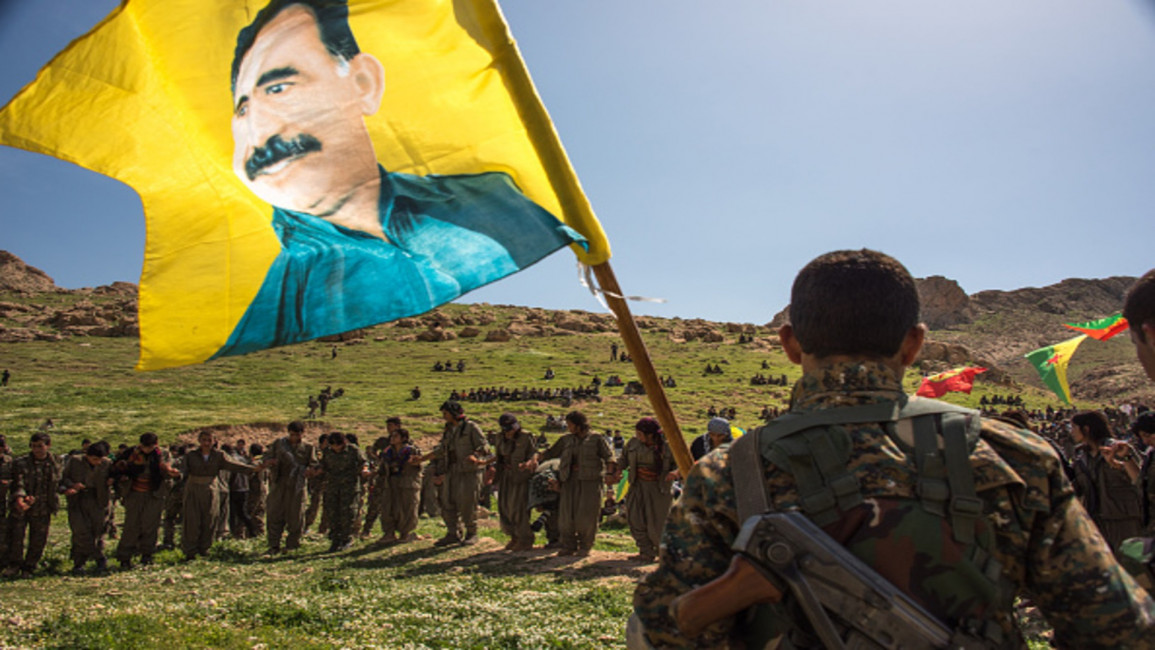
The Kurdistan Workers’ Party (PKK) announced on 12 May that it has officially ended its campaign of armed struggle and disbanded after four decades.
The move came in direct response to a call by the group’s imprisoned founder, Abdullah Ocalan, on 27 February.
This historic shift represents an opportunity to address the root causes of one of the longest-running conflicts in the Middle East and answer Kurdish political and cultural demands.
Yet, there are many questions about how this decision was reached and why the PKK decided to act now.
Following a congress held on 5-7 May in two locations inside Iraq’s Kurdistan Region, the PKK announced that it would “dissolve the PKK’s organisational structure and end the armed struggle”. It declared that the struggle for Kurdish rights in Turkey will now be carried out through other means.
The group argued that the “end [of] the method of armed struggle offers a strong basis for lasting peace and a democratic solution” and called on the Turkish government and all sections of civil society to “join the peace and democratic society process”.
Dr Dastan Jasim, as associate fellow at the German Institute for Global and Area Studies (GIGA), told The New Arab that “there are a lot of different dynamics that are influencing” the PKK’s decision to disband. Moreover, there are numerous practical considerations as well.
Turkey’s Kurds will wonder whether the Turkish state will loosen rules on Kurdish language use, allow Kurdish civil society and political parties to operate freely, and release imprisoned leaders, including Ocalan and former Peoples' Democratic Party (HDP) co-leader Selahattin Demirtaş.
Meanwhile, President Recep Tayyip Erdogan’s government will watch carefully to see whether the PKK actually disbands, and whether it gives up its weapons.
“This is not a transparent process,” Jasim said, explaining that the substantive talks are primarily taking place between Ocalan, a small group of people in the PKK leadership, and the Turkish intelligence and security services.
This means that the process is subject to a trade-off where decisions are protected from the spoiler influences of Turkish and Kurdish public opinion, but are not guided by them in a democratic way either. This makes it difficult to predict a trajectory.
Some people “want this peace process to be part of a legal framework that sets up certain stages for this process, [but] none of that has happened,” Jasim added.
Turkey's Kurds will wonder whether the Turkish state will loosen rules on Kurdish language use, allow Kurdish civil society and political parties to operate freely, and release imprisoned leaders [Getty]
Regardless of how the coming months play out, it is clear that the PKK has changed regional politics over the past four decades. While violence is a fundamental part of its legacy, the group also put Kurds and their political demands on the domestic and geopolitical map in a profound way.
“In the late 1970s and early 1980s, when the PKK was founded, Kurdishness was, in many senses, dying out” because of assimilation, political and cultural repression, and population movement, Jasim said. However, the PKK changed this by increasing the political consciousness of the Kurdish population in southeastern Turkey and across the Middle East, which in turn forced governments to take Kurdish demands seriously.
“Whole state systems were built on the denial of Kurds as a nation overall. And those days are long over,” she said.
In his February statement, Ocalan argued that the PKK armed struggle “was primarily inspired by the fact that the channels of democratic politics were closed”. However, this was no longer the case, and now “there is no alternative to democracy in the pursuit and realisation of a political system. Democratic consensus is the fundamental way”.
This sentiment was endorsed by the PKK in its congress.
There is understandable scepticism about whether the Turkish state will respond by relaxing restrictions on Kurdish free expression and political action. Recent crackdowns on non-Kurdish groups like the Republican People's Party (CHP) add to that sense.
Yet it is also clear that the Turkish authorities are invested and involved in the process. Its seriousness was signalled by the involvement of Turkish nationalist hardliner Devlet Bahceli of the Nationalist Movement Party (MHP), who publicly endorsed talks with Ocalan in October 2024. This openness to dialogue was key in enabling the PKK to take the steps that it later undertook.
For President Recep Tayyip Erdogan, resolving the PKK issue addresses several domestic and geopolitical problems. As it exposes itself to increased political risk in Syria, the Turkish government wanted to lower the temperature in Kurdistan, which has been referred to as Turkey’s strategic “soft underbelly”.
In particular, developments in neighbouring Syria changed Turkey’s strategic calculus. Ankara has long opposed the Kurdish-led administration in northeastern Syria and accused its main party of links with the PKK. Turkey’s main proxy, the Syrian National Army (SNA), often clashes with the Kurdish-led military forces, known as the Syrian Democratic Forces (SDF).
However, the collapse of the Assad regime and engagement between the transitional government in Damascus and the Kurdish-led administration changed the equation. Lowering the temperature on the Kurdish issue inside Turkey allows both Ankara and Kurdish groups to focus on the delicate situation in Syria.
Domestically, Erdogan’s term expires in 2028, and he hopes to change the Turkish constitution to allow him to stay in power longer. Addressing Kurdish cultural demands and loosening restrictions on their political activities may provide crucial votes for those changes.
However, there may be more personal reasons on both sides as well. Jasim argued that PKK and Turkish leaders are also looking to their legacies, calling it “the elephant in the room”. Ocalan is 74 years old and has been in prison since 1999, while Erdogan is 71 years old and has been in frontline politics since 1994 when he was elected as mayor of Istanbul.
In different ways, securing the end of the conflict between the PKK and the Turkish state - if that is what comes to pass - will be significant to how history regards them.
For now, however, it is unclear how the process of the PKK’s disbandment will play out and how much the Turkish state will change to allow more democratic rights for Kurds. If the moment is seized, it will bring significant changes inside Turkey and across the region.
“It is a generational switch that’s happening,” Jasim said. Kurds in Turkey, Syria, and Iraq are now all negotiating with the governments of those states. However, only time will tell whether these burgeoning relationships will bear fruit.
“Every [Kurdish] side does have these links and wants to leverage them, but at the same time, does not know how much it is going to help them…or how much they are actually going to be used,” she said.
Winthrop Rodgers is a journalist and analyst based in Sulaymaniyah in Iraq's Kurdistan Region. He focuses on politics, human rights, and political economy.
BBC Gaza documentary delay prompts withdrawal threats from doctors, whistleblowers
The BBC, however, has not indicated when the review is expected to be completed. (Supplied)
Arab News
BBC faces mounting pressure over decision to shelve film despite legal clearance and widespread support
LONDON: Doctors and whistleblowers who featured in a BBC documentary on Gaza have threatened to withdraw their consent after the broadcaster delayed airing the film, citing an internal review.
The documentary, “Gaza: Medics Under Fire,” was scheduled to be broadcast in February but remains on hold as the BBC investigates a separate program, “Gaza: How to Survive a Warzone,” which was earlier pulled from the BBC’s iPlayer after revelations that its young narrator was the son of a Hamas official.
According to a report by The Guardian, although “Gaza: Medics Under Fire” was cleared for broadcast and approved by the BBC’s legal and editorial compliance teams, the broadcaster has reportedly requested further changes and stated the film will not be aired until the ongoing internal review concludes.
The BBC, however, has not indicated when the review is expected to be completed.
While other broadcasters have expressed interest in airing the film, the BBC has so far blocked those efforts, according to the production company.
The delay has sparked backlash from cultural figures including Susan Sarandon, Gary Lineker, Harriet Walter and Miriam Margolyes, who signed an open letter to BBC Director-General Tim Davie, accusing the corporation of “political suppression.”
“This is not editorial caution. It’s political suppression,” the letter stated. “No news organisation should quietly decide behind closed doors whose stories are worth telling. This important film should be seen by the public, and its contributors’ bravery honoured.”
More than 600 people endorsed the letter, including prominent UK actors Maxine Peake and Juliet Stevenson.
Meanwhile, Basement Films, which produced the documentary, has released additional footage from other doctors in Gaza through its social media channels.
“We have many offers from broadcasters and platforms across the world so that the searing testimonies of Gazan medics and of surviving family members can be heard, in some cases eight months after we spoke to them … We are still urging BBC News to do the right thing,” the company said in a statement.
The situation has also stirred internal concern at the BBC, particularly after the corporation’s chair, Samir Shah, described the editorial failings of “Gaza: How to Survive a Warzone” as a “dagger to the heart” of the BBC’s reputation for trust and impartiality.
A BBC spokesperson told The Guardian: “We understand the importance of telling these stories and know that the current process is difficult for those involved.”
Why fury over Israeli actions in Gaza and West Bank may lead to EU sanctions
Special
1 / 4
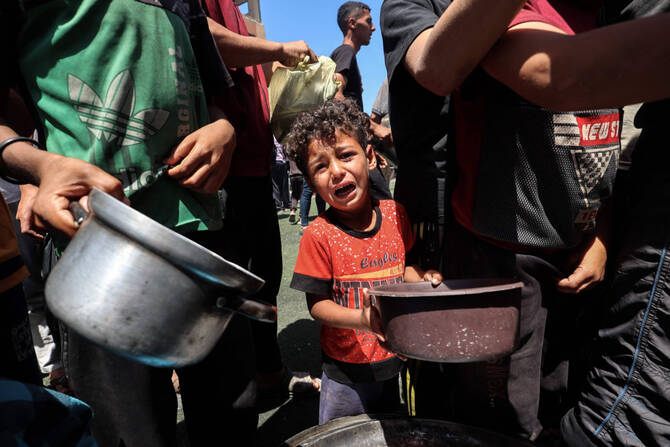
A child cries as Palestinians gather to receive a hot meal at a food distribution point in the Nuseirat camp for refugees in the central Gaza Strip on May 24, 2025. (AFP)
Special
2 / 4
Special
3 / 4
European Union diplomats leave in a rush after shots were fired by the Israeli military as they visited a refugee camp in Jenin in the occupied West Bank on May 21, 2025. (AFP)
Special
4 / 4
Palestinian boys fill their containers with water in the Nuseirat camp for refugees in the central Gaza Strip on May 24, 2025. (AFP)
Updated 9 sec ago
Jonathan Gornall
Calls rise for arms embargo, ICC referrals and greater aid access after Israeli military fire in Jenin forces foreign ministers to scatter
Trade deal with Israel under review amid alarm over Gaza famine warnings, West Bank settler violence, international law violations
LONDON: Watching the widely circulated footage of Israeli soldiers firing “warning shots” in the direction of a delegation of foreign diplomats visiting a refugee camp in the Palestinian city of Jenin on Wednesday, it was hard to resist the conclusion that the Israeli military had lost its collective mind.
Luckily, no one was injured in the incident. But in a manner of speaking, Israel shot itself in the foot.
The extraordinary provocation took place as Israel was already facing a rising wave of condemnation — internally and externally — and the threat of international sanctions for its actions in Gaza and the West Bank.
International support for Israel, so unified in the immediate aftermath of the Oct. 7, 2023, attack by Palestinian militant groups, in which 1,200 Israelis and others were killed and 251 more were taken hostage, has steadily crumbled in the face of outrage after outrage, which collectively have left more than 50,000 Palestinians dead and much of Gaza reduced to uninhabitable rubble.
Last Tuesday, the day before the shooting incident in Jenin, the European Union announced that it was reviewing its political and economic relations with Israel – no hollow threat from a bloc that is Israel’s biggest trading partner.
“The situation in Gaza is catastrophic,” Kaja Kallas, high representative of the EU for foreign affairs and security policy and vice-president of the European Commission, said on Tuesday.
Earlier that same day, the UN had raised the specter of thousands of babies dying of starvation “in the next 48 hours” if Israel did not allow aid trucks to enter the territory immediately.
Israeli soldiers fired ‘warning shots’ in the direction of European diplomats visiting a Palestinian refugee camp in Jenin, in the West Bank, on May 21, forcing them to scatter and sparking diplomatic outrage. (AFP)
Israel, while rejecting the suggestion that mass starvation was imminent, responded by allowing what critics condemned as a wholly insufficient token amount of aid into Gaza.
“The aid that Israel has allowed in is of course welcomed, but it’s a drop in the ocean,” said Kallas. “Aid must flow immediately without obstruction and at scale.”
She had, she added, "made these points also with my talks with Israelis … and regional leaders as well. Pressure is necessary to change the situation.”
And pressure is building up. In an unprecedented move, the EU is now reviewing the EU-Israel Association Agreement, the legal basis for its trade relations with Israel, which entered into force in June 2000.
Illustration posted on the website of the European Coordination Committees and Associations for Palestine, along with a report saying 63 MEPs calling on EU foreign policy chief Federica Mogherini to suspend the EU-Israel Association Agreement.
Pressure for this review has been mounting since May 7, when Dutch Foreign Minister Caspar Veldkamp urged the EU to act, saying “the situation in Gaza compels us to take this step.”
Disturbed by the nightmarish scenes in Gaza and reports of increasing settler violence in the West Bank, his government, he said, “will draw a line in the sand.”
Losing European trade would be a massive blow to Israel’s economy. The EU is Israel’s biggest trading partner – in 2024 34.2 percent of Israel’s imports came from the EU while 28.8 percent of Israel’s exports went to the EU. The total value of the trade in goods between the two in 2024 was o 42.6 billion euros.
“The review will specifically assess Israel’s adherence to the human rights provisions within the deal,” said Caroline Rose, a director at the New Lines Institute focused on defense, security and geopolitical landscapes.
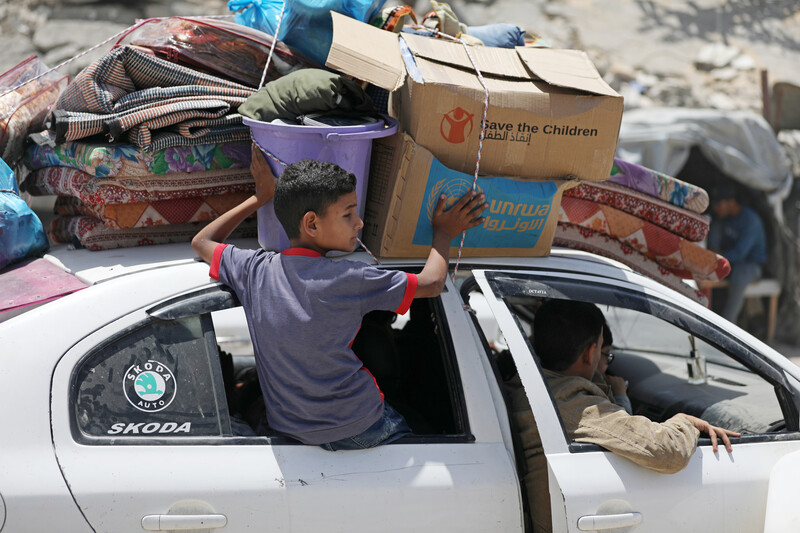
Palestinians transport their belongings as they flee the northern Gaza Strip toward the south, along the coastal al-Rashid road on May 25, 2025. (AFP)
The clause in the agreement that is now under legal scrutiny is Article 2. This states that “Relations between the Parties, as well as all the provisions of the Agreement itself, shall be based on respect for human rights and democratic principles, which guides their internal and international policy and constitutes an essential element of this Agreement.”
Other international measures are under consideration, said Rose, including “imposing a full arms embargo, referring Israel to the International Criminal Court (ICC), as advocated by Pakistan, enforcing a ceasefire and humanitarian aid access, sanctioning Israeli officials, supporting recognition of a Palestinian state, dismantling illegal settlements, reforming the UN Security Council veto system, and coordinating global reconstruction aid.”
Rose cautions that “internal divisions within the bloc could stall progress. While 17 member states support the review, countries such as Germany, Hungary, Austria and Italy reportedly oppose it. Germany and Austria, in particular, have resisted punitive measures despite issuing public condemnations.”
People move past destroyed buildings as smoke billows following an Israeli strike in Jabalia, in the northern Gaza Strip on May 25, 2025. (AFP)
Germany, bearing the moral weight of the Holocaust, has been a staunch supporter of Israel since its creation in 1948. But now, under new conservative chancellor Friedrich Merz, even Berlin is wavering.
Last week, out of concern for the situation in Gaza and the West Bank, Merz despatched his foreign minister, Johann Wadephul, on a fact-finding mission. Wadephul was among the diplomats scattered by the warning shots fired by the Israeli military on Wednesday, as were senior delegates from countries including France, Belgium, the UK, Italy, Canada, Russia and China.
All the countries involved have lodged complaints with Israel about the episode, which the Palestinian Authority condemned as a “heinous crime” a “deliberate and unlawful act” which “constitutes a blatant and grave breach of international law.”
Israeli soldiers fired ‘warning shots’ in the direction of European diplomats visiting a Palestinian refugee camp in Jenin, in the West Bank, on May 21, forcing them to scatter and sparking diplomatic outrage. (AFP)
The day after the shooting in Jenin, during a visit to Lithuania the German chancellor said “we are very concerned about the situation in the Gaza Strip and also about the intensification of the Israeli army’s military operations there.
“We are urging, above all, that humanitarian aid finally reaches the Gaza Strip without delay, and also reaches the people there, because, as we hear from the United Nations, there is now a real threat of famine.”
On May 13 a study by the Bertelsmann Foundation found that over the past four years Germans had developed an increasingly negative view of Israel. In 2021 46 percent of Germans had a positive view of the country, compared with only 36 percent today, with 38 percent now viewing it negatively. Germany has seen many mass protests since the start of Israel’s war in Gaza, which a majority of Germans oppose.
IN NUMBERS:
• 38% Germans who now view Israel negatively.
• 10% Drop in number of Germans who view Israel positively.
Source: Bertelsmann Foundation study
On May 19, two days before the Israeli military’s live-fire intimidation of international diplomats, the UK, France and Canada issued a joint statement condemning the situations in Gaza and the West Bank and strongly opposing the expansion of Israeli military operations in Gaza.
While also calling on Hamas to immediately release the remaining hostages, the statement denounced “the level of human suffering in Gaza” as “intolerable.”
The three nations added: “Yesterday’s announcement that Israel will allow a basic quantity of food into Gaza is wholly inadequate. We call on the Israeli Government to stop its military operations in Gaza and immediately allow humanitarian aid to enter Gaza.”
Palestinians wait to receive aid, in Gaza City, on May 25, 2025. (REUTERS)
Israel, warned the statement, “risks breaching international humanitarian law,” adding: “We condemn the abhorrent language used recently by members of the Israeli Government, threatening that, in their despair at the destruction of Gaza, civilians will start to relocate. Permanent forced displacement is a breach of international humanitarian law.”
Israel had a right to defend Israelis against terrorism, “but this escalation is wholly disproportionate.”
As a result, “We will not stand by while the Netanyahu government pursues these egregious actions. If Israel does not cease the renewed military offensive and lift its restrictions on humanitarian aid, we will take further concrete actions in response.”
A fire blazes in an olive grove in the village of Salem, east of Nablus in the occupied West Bank on May 25, 2025, after Israeli settlers reportedly started a fire near the road to the Israeli settlement of Alon Moreh, according to eyewitnesses and the local village council. (AFP)
In the West Bank, Israel must also “halt settlements which are illegal and undermine the viability of a Palestinian state and the security of both Israelis and Palestinians.
“We will not hesitate to take further action, including targeted sanctions.”
On May 20, as the death toll from Israeli air strikes over the previous week reached 500, the UK summoned Israel’s ambassador to London, paused talks on a new free-trade agreement, and announced further sanctions against West Bank settlers.
Israel’s operation in Gaza was "incompatible with the principles that underpin our bilateral relationship,” David Lammy, the UK foreign minister, told parliament.
“It is extremism. It is dangerous. It is repellent. It is monstrous, and I condemn it in the strongest possible terms.”
Britain's Foreign Secretary David Lammy speaking to MPs during a statement on Israel and the war in Gaza in the House of Commons, in London, on May 20, 2025. (AFP)
All these moves “clearly reflect growing discomfort with Israeli military actions in Gaza but also in the West Bank,” Sir John Jenkins, who served as British ambassador to Saudi Arabia, Iraq and Syria and as consul-general in Jerusalem, told Arab News.
“This has been crystallized by the issue of humanitarian aid. The UN has not handled this well itself. But it’s a real political problem for Western governments, with significant domestic implications, which is why the UK has also paused trade talks.”
However, he added, “none of this will affect the Israeli decision-making process in the short term, and Western governments will be very reluctant to do anything that helps Hamas.
“But they will be increasingly keen to see a proper plan for the endgame. The question is: How much does the Trump administration support them? The news last week of the shooting of the two Israeli diplomats in Washington will only complicate this calculation.”
Israel, increasingly isolated, nevertheless remains defiant. “The British Mandate ended exactly 77 years ago,” a spokesperson for its foreign ministry said in response to last week’s criticism from the UK. “External pressure will not divert Israel from its path in defending its existence and security against enemies who seek its destruction.”
Yet in Europe that external pressure is mounting. So much so that, after 20 years of campaigning virtually in the wilderness for “freedom, justice and equality” for Palestinians, the Boycott, Divestment, Sanctions (BDS) movement finally finds its much-criticised methods on the cusp of becoming mainstream.
Founded in 2005, for two decades the Palestinian-led BDS and those who support it have endured international censure, based on an unquestioning acceptance of Israel’s accusation that the organization’s aims are merely a manifestation of antisemitism.
Now, however, as governments in Europe, shocked by Israel’s latest actions and the seemingly deliberate starvation of two million people in Gaza, begin to adopt stances for which BDS has been calling for 20 years, as it marks its 20th anniversary the organisation and its work is being vindicated.
“For the first time ever, even the world’s most complicit governments are being forced – due to people power and moral outrage – to publicly consider accountability measures against Israel,” the BDS said in a statement.
Mourners react next to the body of a Palestinian killed in Israeli strikes, during a funeral at Nasser hospital, in Khan Younis, in the southern Gaza Strip, May 23, 2025. (REUTERS)
This was “another clear sign that our collective popular BDS pressure is working. The taboo is broken – sanctions are the way forward to end Israel’s atrocious crimes.”
Nevertheless, the organization continues to be critical of the UK, France and Canada, countries which had spent 19 months “enabling Israel’s genocide with intelligence gathering and other military means.” The statements by the three “are far too late and fall dangerously short of meeting these States’ legal obligations under international law, including the Genocide Convention and the Apartheid Convention.”
BDS says it is now stepping up its campaign to “transform tokenism and empty threats into tangible and effective accountability measures, starting with a two-way military embargo and full-scale trade and diplomatic sanctions.”
Prime Minister Benjamin Netanyahu, keenly aware as ever of his dependence upon the support of the right-wing extremists in his cabinet, went on the offensive last week.
UK Prime Minister Keir Starmer, French President Emmanuel Macron and Canadian Prime Minister Mark Carney, he said, were siding with “mass murderers, rapists, baby killers and kidnappers.” Astonishingly, he added, Starmer, Macron and Carney were “on the wrong side of humanity and … the wrong side of history.”
In fact, in the wake of the Hamas-led attack of Oct. 7, 2023, all three countries came out in unequivocal support of Israel, and its right to defend itself.
What Netanyahu is refusing to acknowledge is that in the eyes of the world, the events of that day do not give Israel a carte blanche.
His apparent determination to continue the war seemingly in order to keep himself in power, and to support the Zionist extremists in his cabinet who want to see Palestine ethnically cleansed, is facing growing criticism within Israel itself.
One of the staunchest critics is Ehud Olmert, Israel’s prime minister from 2006 to 2009, who recently told the BBC that what Israel was doing in Gaza was “close to a war crime.”
Former Palestinian foreign minister Nasser Al-Kidwa appears on a screen as former Israeli prime minister Ehud Olmert holds a microphone on stage, during the It's Time People’s Peace Summit at the International Convention Center in Jerusalem on May 9, 2025. (AFP)
That earned him a rebuke from a current Israeli minister, but on Friday Olmert intensified his criticism. “A group of thugs … are running the state of Israel these days and the head of the gang is Netanyahu,” he told the BBC World Service.
He added: “Of course they are criticizing me, they are defaming me, I accept it, and it will not stop me from criticizing and opposing these atrocious policies.”
Speaking to Arab News, Ahron Bregman, a former Israeli soldier and a senior teaching fellow in King’s College London’s Institute of Middle Eastern Studies, said: “You don’t have to be an expert on international humanitarian law to conclude that what the Israelis are doing in the Gaza Strip is carrying out terrible war crimes.
“European governments can’t ignore this any longer, as their publics are furious, and, at last, they have started to react.”
Ideally, he said, “it would be the UN Security Council that instructs Israel to stop the industrial killing in Gaza and the starving of the Gazans, but the Israelis seem confident that US President Donald Trump will not let such a resolution pass.
“But who knows? Sometimes, in war, there are moments which are turning points, moments that push nations of the world over the edge and make them take action to stop wars.”
Bregman believes only two courses of action “would make the Israeli government rethink and change its criminal behaviour in Gaza.”
The first is that European countries should block trade relations with Israel — a step now being seriously considered in the European Union — and impose sanctions on the state.
“You don’t have to be an expert on international humanitarian law to conclude that what the Israelis are doing in the Gaza Strip is carrying out terrible war crimes.
Ahron Bregman, a former Israeli soldier and a senior teaching fellow in King’s College London’s Institute of Middle Eastern Studies
But his second suggestion, coming as it does from a man who served in the Israeli army for six years and took part in the 1982 Lebanon War, shows just how far the actions of the current Israeli government have strayed from what mainstream public opinion in the country now regards as acceptable.
“Young Israelis who fought in Gaza should be stopped when trying to cross into Europe,” he said.
“They should be investigated for their actions in Gaza and arrested if there’s any suspicion of war crimes.”
And, he added, “pilots, who caused most of the damage in Gaza, should be sent automatically for trial at the International Criminal Court in The Hague.”
A Palestinian family that fled north Gaza arrives in Gaza City on 16 May. Yousef ZaanounActiveStills
Israel’s brutal violence against Palestinians is often defended indirectly in public debate by suggesting it represents a short-term breach of international law – a regrettable exception to the rules, a momentary lapse in global justice.
But what if this isn’t about failure at all?
What if international law is doing exactly what it was built to do? What if its double standards are not bugs in the system, but deeply rooted features designed to support geopolitical, economic and racial power structures that benefit Israel and its Western allies?
Israel doesn’t operate outside the law; it moves within a legal framework that quietly permits its actions. The ongoing violence is not happening in defiance of international law, but thanks to it. The impunity Israel enjoys, the unwavering backing of the United States and European Union, and the language of diplomacy that avoids calling genocide by its name – these aren’t signs of the law being ignored. They’re signs it’s working as intended.
Taking cues from the philosopher Giorgio Agamben, we might say what looks like an exception is actually the rule. For colonized and marginalized people, what we see in Palestine is not a legal anomaly. It’s where the Western colonial legal machine shows its true face.
This calls for a deep rethinking of international law. We can no longer pretend it’s a space of justice for all. It’s a tool designed to uphold power imbalances. The genocide of Palestinians, aided by liberal democracies either willfully ignoring or helping directly, is not indicative of the system’s failure. It is its blueprint. That system needs to be dismantled.
To stop saying international law is “failing” is to take a political stance. It means admitting the law is part of the problem. Any true anti-colonial or liberation movement must challenge the very structure of the legal order, and start building new forms of justice based on solidarity, resistance and the power of communities on the ground. Colonialism wrapped in liberalism
The core principle of international law – state sovereignty – has always worked two ways. It protected European states while denying that same sovereignty to regions labeled “uncivilized.” It created a line between those who get rights (European states) and those who get ruled over, displaced, or even eliminated.
The idea of “civilization” has long been the moral shield of international law. Colonial wars were sold as efforts to bring order and progress. Today, that same logic continues: humanitarian wars, foreign interventions and selective human rights campaigns all follow this pattern. Western power is presented as legitimate, while resistance is dismissed as terror or extremism.
The post-World War II era, with the birth of the United Nations and the Universal Declaration of Human Rights, seemed like a turning point. But in reality, it was a makeover. The old colonial system was wrapped in the new language of liberalism. International law still works selectively.
In this setup, Israel isn’t breaking the mold. It’s continuing the colonial project. Israel is the modern entity that most clearly exposes how colonial law lives on. Political Zionism shares roots with European imperialism: a chosen land to reclaim, a barren space to develop and native people to remove, confine or erase.
Postcolonial theorytells us that international law rarely protects those outside its moral circle. That’s why we must stop framing the Palestinian tragedy as a legal failure. It isn’t. It’s the law doing what it’s made to do. Palestinians are treated as outside the community of those whose lives matter. Their deaths are “collateral.” Their resistance is criminalized.
So, Palestine is not an exception. It’s where the exception becomes normal. A permanent state where legal rules are swept aside so a sovereign power can unleash unchecked violence. Israel acts in a legal gray zone that’s been made permanent, where law and crime, war and peace, occupation and security blur into one. Here, legal tools are used to make injustice seem legitimate.
From Gaza to the West Bank, refugee camps, military checkpoints, home demolitions, mass arrests and targeted killings – every part of the system adds to a space where law allows the unthinkable. As Achille Mbembe puts it, this is “necropolitics”: the power to decide who gets to live and who must die.
Even in this climate of death, law isn’t missing. It’s still present as a symbolic shield. It’s pulled out when needed, to justify or delay criticism. War crimes are denied, watered down or buried in endless diplomatic channels. UN resolutions are ignored. Legal proceedings are blocked by powerful states. This selective weakness doesn’t show law failing; it shows law maintaining the current world order. Some states face justice. Others don’t.
Israel fits into this system perfectly. It uses international law to its advantage, backed by Western powers. The colonial mindset – where non-Western bodies and lands are disposable – is alive and well. Western leaders know what’s happening but use watered-down terms. Not “genocide,” but “conflict.” Not “illegal occupation,” but “self-defense.” Not “apartheid,” but “ethnic tension.” The exception becomes a permanent legal structure.
People often respond to Israel’s impunity by pointing to ignored laws: Geneva Conventions, UN resolutions, the Rome Statute of the International Criminal Court. But even with the best intentions, this view keeps alive a myth: that international law is fair and neutral but just not being used properly. Maybe it’s that very idea that’s the problem. Power and domination
International law was never just about justice. It’s always been about managing global power. Its rules, exceptions and institutions are built around the interests of dominant states. There’s no law separate from politics, only laws that serve certain political agendas.
Israel’s impunity isn’t a gap in the legal system. It’s part of the system’s design. The very idea of “crime” becomes flexible, delayed, displaced. Legal statements without enforcement, trials that never come, diplomatic talks that go nowhere – these all pretend to hold power accountable while doing the opposite. Impunity isn’t a glitch; it’s the main feature.
With Israel’s strategic importance, US protection and ideological alignment with Europe, legal consequences are off of the table. The West claims to uphold international law while breaking or ignoring it when it suits its allies. It becomes the exception that writes the rules. What we need isn’t a better version of this system. We need a complete break from it.
This starts with disillusionment. Justice won’t come from courts or resolutions. Law isn’t neutral, and it can’t lead to liberation unless we rethink it completely from the ground up, from the perspective of those who have been silenced. We don’t need to abandon law, but we do need to stop worshipping it. To be a tool for freedom, law must be torn down and rebuilt.
That doesn’t mean giving up on legality. It means taking it back. Turning it from a gatekeeper into a tool for justice. A law that demands action, not recognition. Justice that acts, not begs. In this view, international law isn’t where Palestinian freedom will be granted, it’s one of the places where the fight is happening. The genocide of Palestinians doesn’t show us where law fails. It shows us what law truly is. And it challenges us not to fix it, but to transform it.
A version of this op-ed was originally published in Italian by L’Antidiplomatico.
Pasquale Liguori is an independent writer, urban photographer and pharmacologist.