Friday, June 13, 2025

CAPPLETALI$M

Foxconn sends 97% of India iPhone exports to U.S. as Apple tackles Trump’s tariffs

By Reuters
June 13, 2025 

An Apple iPhone XR is held at the Steve Jobs Theater after an event to announce new products, in Cupertino, Calif. (AP Photo/Marcio Jose Sanchez, File)

NEW DELHI — Nearly all the iPhones exported by Foxconn from India went to the United States between March and May, customs data showed, far above the 2024 average of 50 per cent and a clear sign of Apple’s efforts to bypass high U.S. tariffs imposed on China.

The numbers, being reported by Reuters for the first time, show Apple has realigned its India exports to almost exclusively serve the U.S. market, when previously the devices were more widely distributed to countries including the Netherlands, the Czech Republic and Britain.

During March-May, Foxconn exported iPhones worth US$3.2 billion from India, with an average 97 per cent shipped to the United States, compared to a 2024 average of 50.3 per cent, according to commercially available customs data seen by Reuters.Latest news & updates on tariffs and the trade war here


India iPhone shipments by Foxconn to the United States in May 2025 were worth nearly US$1 billion, the second-highest ever after the record US$1.3 billion worth of devices shipped in March, the data showed.

Apple declined to comment, while Foxconn did not respond to a Reuters request for comment.

U.S. President Donald Trump on Wednesday said China will face 55 per cent tariffs after the two countries agreed on a plan, subject to both leaders’ approval, to ease levies that had reached triple digits.

India is subject, like most U.S trading partners, to a baseline 10 per cent tariff and is trying to negotiate an agreement to avert a 26 per cent “reciprocal” levy that Trump announced and then paused in April.

Apple’s increased production in India drew a strong rebuke from Trump in May. “We are not interested in you building in India, India can take care of themselves, they are doing very well, we want you to build here,” Trump recalled telling CEO Tim Cook.

In the first five months of this year, Foxconn has already sent iPhones worth US$4.4 billion to the U.S. from India, compared to US$3.7 billion in the whole of 2024.

Apple has been taking steps to speed up production from India to bypass tariffs, which would make phones shipped from China to the U.S. much more expensive. In March, it chartered planes to transport iPhone 13, 14, 16 and 16e models worth roughly US$2 billion to the United States.

Apple has also lobbied Indian airport authorities to cut the time needed to clear customs at Chennai airport in the southern state of Tamil Nadu from 30 hours to six hours, Reuters has reported. The airport is a key hub for iPhone exports.

“We expect made-in-India iPhones to account for 25 per cent to 30 per cent of global iPhone shipments in 2025, as compared to 18 per cent in 2024,” said Prachir Singh, senior analyst at Counterpoint Research.

Tata Electronics, the other smaller Apple iPhone supplier in India, on average shipped nearly 86 per cent of its iPhone production to the U.S. during March and April, customs data showed. Its May data was not available.Latest updates on investing here

The company, part of India’s Tata Group, started exporting iPhones only in July 2024, and only 52 per cent of its shipments went to U.S. during 2024, the data showed.


Tata declined to comment on the numbers.

Indian Prime Minister Narendra Modi has in recent years promoted India as a smartphone manufacturing hub, but high duties on importing mobile phone components compared to many other countries means it is still expensive to produce the devices in India.

Apple has historically sold more than 60 million iPhones in the U.S. each year, with roughly 80 per cent made in China.

---

Reporting by Aditya Kalra and Munsif Vengattil; Editing by Kate Mayberry and Rachna Uppal.
Crypto

Russia recruited a Canadian teenage spy. His arrest led to a crypto money trail

By Reuters
June 12, 2025 


LONG READ

(John Petalcurin / Pexels.com)

WARSAW - The Canadian teenager was getting anxious. It was May 2024, and he was in Copenhagen, running out of money after leaving Moscow a week earlier. He’d booked the cheapest room he could find in the Danish capital, but the hostel was still more expensive than he’d expected.

The teen, Laken Pavan, opened Telegram to type out a message to his handler in Russia’s Federal Security Service, which runs the country’s spy operations and is known by its acronym FSB.

“Are you able to send BTC today?” Pavan wrote to the man, using the shorthand for bitcoin. Pavan knew the man only as “Slon,” or elephant in Russian. The man had been assigned to the 17-year-old by FSB officers who had recruited the teen just weeks prior in Russian-occupied Donetsk, according to court documents reviewed by Reuters.

“I have a big problem there are no Bitcoin ATMs in Denmark,” Pavan explained in English. He’d checked around and it would be simpler in Poland, Pavan told his handler. Things were cheaper and he could more easily turn cryptocurrency into cash there.

“Check, I’ve sent you the first batch of money,” Slon replied. A minute earlier, Pavan’s bitcoin wallet showed it had received about $130 worth of the cryptocurrency.


Pavan soon responded with a photo of his boarding pass for a flight to Warsaw.

A couple days later, intoxicated and suddenly fearful, Pavan asked the receptionist of his budget hotel in Warsaw to call the police. Once officers arrived, he confessed to working with the FSB and planning to pass information about the Polish military to his Russian handler, the court documents show.

The Canadian pleaded guilty to charges of helping Russian intelligence and was sentenced in December 2024. Pavan, who turned 18 a few weeks after his arrest, is now serving a 20-month sentence in a Polish prison on the outskirts of Radom, a city 100 kilometers south of the capital.

There is no indication from the court documents that he ever obtained or passed along any sensitive information to the Russians. The term he received is even less than the usual 5-year minimum because of his age and because he admitted guilt and cooperated with the investigation, prosecutors said in a post-sentencing statement.

At a time when Europe is in a heightened state of alarm over what security agencies across the continent call Russia’s “hybrid war” of sabotage and espionage, Reuters found an emerging trend: Moscow is increasingly recruiting teenagers and complete novices.

The hybrid campaign comes as Ukraine and Russia try to strengthen negotiating positions in sporadic peace talks, which have so far produced no breakthroughs. Russian bombing attacks on Ukraine have intensified. So has pressure from Ukraine, including a surprise attack on Russian bombers after what Ukraine’s president said was months of work by intelligence operatives working inside Russia.

Since the full-scale invasion in 2022, dozens of teenagers in Ukraine and at least 12 teens elsewhere in Europe – in Germany, Poland, Britain and Lithuania – have been arrested in Russia-linked cases of sabotage and spying. Pavan’s case, reported in detail for the first time, sheds light on these covert Russian operations and their cryptocurrency trail.

The answer to why Moscow has resorted to using untrained agents lies in the mass expulsion of Russian diplomats and operatives from Europe after the start of Russia’s full-scale invasion of Ukraine in 2022. To plug the hole in their operations, Russian intelligence services have shifted to recruiting common criminals or individuals with little spycraft experience, said a senior NATO official. His statement echoed comments last year from Germany’s domestic security service. Two European security experts said teenagers are recruited because they’re vulnerable, low-cost, and often in need of money.

“These are, in many cases, not trained intelligence professionals,” the NATO official said on condition of anonymity to describe the clandestine operations.

The official expects more Russian hybrid warfare, which combines physical warfare with non-military tactics used to undermine an adversary’s security and sow distrust and confusion. “One of the main objectives of the Russian hybrid campaign is to undercut support for Ukraine, and that is both politically, in terms of creating disquiet amongst the population, but also very practically, in terms of the actual concrete support going to Ukraine,” he said.

Reuters reviewed more than 1,400 pages of Polish court documents in Pavan’s case, which includes all of the messages between the Canadian teen and his FSB handler – more than 300 in total. The messages, as well as Pavan’s testimony to prosecutors, provide a rare, unfiltered view of the sometimes-haphazard nature of such operations, where the FSB is using a mixture of threats and lukewarm incentives.


Neither the Kremlin nor the FSB responded to requests for comment from Reuters about Pavan’s case, Russia’s recruiting tactics of young people or its use of bitcoin to fund operations. Polish prosecutors in Pavan’s case also declined to answer questions about the case. Requests to the Polish detention center in Radom to speak with Pavan went unanswered.

The bitcoin transactions in the court documents allowed Reuters, with the help of blockchain analysts, to trace the payments, revealing transfers across several wallets. The analysis identified one large cryptocurrency wallet that financed the two wallets which paid bitcoin directly to Pavan. That big wallet has processed over $600 million since its creation in June 2022, four months after the start of the war in Ukraine, the analysis found. Reuters could not ascertain who operates the large upstream wallet.

European officials have pointed to Russia for sabotage including cyberattacks and arson, attempted assassinations , as well as espionage in countries allied with Ukraine. Moscow denies involvement and has called such allegations “empty” and unproven. Russia’s Foreign Intelligence Service, known as the SVR, did not comment directly on Pavan’s case and accused Europe of blindly supporting “the Kyiv regime’s terrorist methods.”

Ukraine has similarly recruited youths in Russia for sabotage there, primarily arson , according to Russia’s FSB and the Russian Investigative Committee, the federation’s main investigative authority. There is no indication those operations have targeted Russian allies, and Ukraine did not respond to requests for comment on the allegations .
A difficult life in Canada

As a child in Parksville on Canada’s western coast, Pavan was a quiet boy obsessed with the Canadian military, said his mother, Andelaine Nelson. He idolized his father, who served in Afghanistan and later worked as a combat engineer. She remembers her son researching his ancestry for hints of military service.

“He’s been lining up marbles and doing little combat things since he could sit in a highchair,” she said. As a child, he frequently accompanied his father to military events around Canada and abroad, she said.

Nelson and Pavan’s father split when he was a toddler, and her contact with her son was sporadic for most of his childhood as his father had custody . Their separation, among other family issues, had made her son increasingly angry, Nelson said. Contacted through his lawyer, Pavan’s father in Canada declined to comment about his son’s case.

At the 75th anniversary celebration of D-Day on France’s Juno Beach in 2019, Pavan, who was then turning 13, can be seen grinning next to former Canadian prime minister Justin Trudeau in a photo posted by a local news site at the time.

Pavan told prosecutors he joined the Canadian reserves in 2022, when he was 16. Nelson said her son’s dream was to work as a combat engineer like his father. Canada’s military confirmed that Pavan was a reservist from July 2022 to October 2024.

When the war started in Ukraine in 2022, Pavan at first expressed no interest, Nelson said. The court records don’t indicate why he came to embrace Russia’s cause.

Pavan and his mother fully reconnected in 2023. By the end of the year, he was debating strangers online, where he was increasingly supportive of Russia, court records show.

In dozens of public Telegram exchanges in pro-Moscow groups from December 2023 through spring 2024 seen by Reuters, Pavan voiced disappointment about his experience as a reservist in the Canadian army and said he believed Russia’s war was “justified.” By March 2024, he mentioned he had a visa for Russia, and suggested another user join the Russian military for citizenship.

According to chat logs recovered by Polish prosecutors, Pavan was also messaging moderators of Russian propaganda channels and English-speakers in Russia about fighting for Russian forces in occupied Donetsk.

Pavan’s mother said she knew nothing about his plans to travel to Russia.

“I had no idea he was even gone,” she told Reuters, only later hearing from her son that he was traveling around Europe with friends.

John Kingman Phillips, a lawyer for Pavan’s family, said Canadian authorities should have been aware of his plans to travel to Russia and Donetsk and stopped the minor from traveling. Canada’s Border Services Agency said citizens have the right to leave the country, although high-risk people could be flagged. Canada’s Global Affairs Department said it was aware of the arrest and sentencing of a citizen in Poland but declined to comment on the specifics of Pavan’s case.
Meeting ‘elephant’

On April 16, 2024, Pavan flew from Vancouver to Moscow via Istanbul and hired a driver to take him to occupied Donetsk. There, he crashed in the basement headquarters of the Interbrigades, a volunteer group, which according to the organization’s social media account was set up in 2014 to gather mercenaries to fight for Russia in Donetsk and the neighboring Ukrainian region of Luhansk and to organize humanitarian projects for civilians. The group’s name refers to the Spanish Civil War, when leftists from many countries arrived in Spain to fight for the International Brigades against Francisco Franco’s rebels.

Pavan was two months shy of 18, fair-haired and lanky. He had inquired about enlisting but was told he had to first turn 18 under Russian law, according to a message he sent a foreign fighter from Spain. For about a week, he volunteered around Donetsk with the Interbrigades and helped rebuild a school.

Wilmer Puello-Mota, an American former airman who fled to Russia after being charged with possession of child sexual abuse material, told Reuters he encountered Pavan in Donetsk, where the Canadian tried unsuccessfully to join the Russian army.

Puello-Mota, who described the U.S. allegations against him as unfair, is now serving in Russia’s military.

“Everybody he talked to down there, we told him, go home,” said Puello-Mota, whose contacts with Pavan appear in the court documents. He said Pavan did nothing more than volunteer for the Interbrigades for a day or two , as the court documents also indicated. Puello-Mota said the espionage allegations made by Poland against the teen made no sense.

In late April, Pavan was out drinking in Donetsk when he was arrested. He told Polish prosecutors he was questioned about his family and friends at the police station by men who said they were from the FSB. The men put a bag over his head and drove him to a second location, where they interrogated him again, asking also about his travel plans around Europe. None of them gave Pavan their names.

Eventually, he told prosecutors, he was taken to the Central hotel in Donetsk, a tall building with a glass facade in the heart of the occupied city. There he was grilled repeatedly by a group of at least six FSB officers and one man who said he was from Russia’s Foreign Intelligence Service. After several days, they gave him instructions.

After returning to Europe, Pavan was to lose his passport to conceal his trip to Russia and begin working for Russia’s security services.

“This work was to consist of traveling around Europe and taking photos. In Ukraine, on the other hand, I was to enlist in the Ukrainian army; I was to receive detailed instructions for this later, after arriving in Ukraine,” Pavan told Polish prosecutors, according to a copy of his testimony seen by Reuters. The teen did not speak Russian, Ukrainian or Polish.

The Russian men used a combination of threats and inducements to get him to agree, Pavan told Polish authorities. In exchange for his work, he’d get Russian citizenship and an apartment in any Russian city of his choosing. If he didn’t comply, he would be killed, he told prosecutors.

They then introduced Pavan to Slon, his FSB handler. Slon, who appeared to be in his 30s, never gave Pavan his real name. Slon did not respond to calls or to messages sent by Reuters via Telegram. Reuters was unable to contact him on his fake Instagram account.

Pavan began messaging Slon on Telegram as he prepared to leave Donetsk. At first, their messages focused mainly on food. Slon’s were sometimes in stilted English, as if he were using a translation app.

May 7

C: how are you doing with food? Is there any food left? (2:15 PM)

LP: Yes, I still have noodles left (2:16 PM)

May 8

C: Hi (9:51 AM)

LP: hey (10:11 AM)

C: Buddy, let’s meet closer to 6 pm today. Let’s go have coffee and eat pizza. (10:14 AM)

LP: ok sounds good! (10:14 AM)

C: How are you doing in general? (10:14 AM)

You’re not bored there alone (10:15 AM)

? (10:15 AM)

LP: no its fine, I just watch movies on my phone or something. (10:15 AM)

C: Well, that’s it, we’ll meet in the evening, walk around the city, take a walk, talk about our common business (10:16 AM )

LP: (10:16 AM)

Later, Pavan shared a link to a website about how the British military was no longer accepting soldiers from Commonwealth countries like Canada. It is not clear why he shared the link.

May 11

LP: I feel bad for asking, but there is no food and I ate all my noodles. Do you think we can go get Pizza quickly 3:05 PM

C: I live in another city and am already at home.

Now I’ll try to come up with something (5:05 PM)

The same day in May, Slon sent Pavan details of his flight from Moscow to Istanbul. According to the messages, Slon drove with Pavan to the bus terminal in Donetsk, where Pavan boarded a bus to Moscow. Pavan later told Polish police he was given $2,000 in cash before leaving Donetsk.

C: Good luck to you my friend, be careful, I will wait for your return with impatience here I keep my fists for you and we believe in you (9:25 AM)

LP: ok sounds good! 9:26 AM
Bitcoin payments

On May 14, Pavan arrived in Copenhagen via Istanbul. It’s not clear why the Danish capital was chosen as his destination.

Slon and Pavan messaged daily, with the FSB handler encouraging the teenager to apply for a new Canadian passport, buy a new phone, and set up a fake Instagram account for photos of his travels.

Slon also created a fake profile for himself, picking the username “@Astridjenson.dnk , ” and uploaded a photo of a blonde woman as his profile picture. Reuters identified the woman as a 20-year-old Donetsk teacher named Anastasia Protsenko, who told Reuters she was unaware her image was being used for the account and knew no one named Slon.

May 14

LP: I have two important things I need to tell to you, is it ok to sent it here? (7:34 PM)

C: a little did not understand the translation Well, tell me what things you have that you should tell me (7:35 PM)

LP: I will go to phone store, but this city is very expensive. Would it be better just to erase my current phone and change sim card? And I think I should go embassy on thursday once I get a new phone. 7:40 PM

C: my friend I said that in any case I expect improvisation on your part So look, tomorrow, don’t be lazy, walk Look at how much new phones cost, take pictures if we don’t fit into the budget What Yes, of course, we won’t have a phone about going to the embassies on Thursday, I agree with you, until now you must fully familiarize yourself with the city, at least see its surroundings, sights, take a few photos that you are in this city Was (7:42 PM) Unfortunately, I’m not there, I can’t help you there in any particular way, so you tell me what nuances accompany you in this matter, and I’ll prompt you from here (7:42 PM)

LP: Ok I will do that (7:44 PM)

C: The most important thing is that you have already done, you have arrived, so today rest, go to bed, Tomorrow we will decide on your next actions (7:44 PM)

LP: Alright (7:45 PM)

C: ️ (7:46 PM)

In Copenhagen, Pavan messaged Slon about the people he encountered. Slon seemed particularly interested in Pavan’s new friend, an American defense contractor who was traveling through Copenhagen. He encouraged Pavan to continue talking to the American without making him suspicious.

But Pavan’s money was running out fast in Denmark. He messaged his mother in Canada for funds.

“He told me he had no money, that he hadn’t been paid,” Nelson said. Until then, she thought Pavan was travelling with friends.

“I said, who’s paying for this trip because I wanted to know what was going on.”

She said her son never answered her question. After days of Pavan’s pestering, Slon finally transferred bitcoins to him on May 20. The next day, he sent more.

C: Okay, let’s act as you just said, Look, I have another $120 in my bitcoin wallet, I can send it to you in case of anything, but not today, not tomorrow, it takes time (12:00 PM)

C: then I will slowly mine money into a wallet in Bitcoin, something that will help you in the future, but it’s not fat, so on Fast Money Don’t count on, I need time for this (12:00 PM)

LP (12:02 PM)

Pavan’s bitcoin wallet shows he received bitcoin worth more than $500 from two wallets on May 20 and 21 last year. In testimony, he confirmed these payments came from Slon’s bitcoin wallets. Each time, Pav a n said, Slon told the teen his own account needed replenishing first.

At the request of Reuters, Global Ledger and Recoveris, both firms with expertise in tracing crypto movements, tracked the two bitcoin payments Pavan received using the wallet addresses listed in Polish court documents. Reuters confirmed the path of the payments.

Global Ledger said the payments to Pavan’s wallet were made after the two wallets Pavan identified as Slon’s in court documents received a similar amount of bitcoins from two intermediaries. Those, in turn, received bitcoins worth hundreds of thousands of dollars from a large wallet set up in June 2022, Global Ledger said. Recoveris also traced the payments back to the large wallet.

Recoveris also noted that outgoing transfers from the “cluster” of wallets identified through Pavan’s case took place during Moscow business hours.

In three years, the large wallet has processed bitcoins equivalent to US$600 million. Global Ledger said during that period, the wallet has transferred bitcoins to a crypto exchange called Garantex, which has been sanctioned by the European Union and the United States for its close association with sanctioned Russian banks. In March, the United States, Germany and Finland took down the online infrastructure used by Garantex.

The wallet was active as of June. Reuters could not determine the ownership of the large wallet or the two intermediary wallets that paid into wallets Pavan identified as Slon’s, or whether any were used in other sabotage or espionage cases. Global Ledger said the large wallet appeared to be funded by a major mining pool and a custodial service.

“Transactions from wallets linked to the FSB followed a structured laundering pattern, involving fund splitting, mixing with larger sums, and routing through unconnected deposit wallets,” Global Ledger wrote in its report for Reuters, noting methods commonly used to obfuscate the source and use of funds.

Ago Ambur, who until January this year served as the head of Estonia’s Cybercrime Bureau and now works as chief operating officer at the cyberintelligence firm Glazer Technologies, said the wallets and transaction patterns alone were not enough to indicate that Russia’s special services were behind them.

“Attributing a crypto activity to an adversary can be similar to finding a knife at a crime scene. It might match the type the adversary uses, but without fingerprints, DNA or surveillance footage, it remains just a clue,” he told Reuters.
Life after prison

Pavan and Slon’s last contact was on May 22, 2024, a day after the teen’s arrival in Warsaw. In their final exchange, Slon reminded Pavan to apply for a new Canadian passport, and suggested he reach out to his father and his old military commander. The messages did not explain why.

Twelve hours later, Pavan was in Polish police custody.

Phillips, the lawyer for Pavan’s family, said their aim is now to get the teen home to Canada to serve out his sentence. Pavan’s family are “devastated,” Phillips said. If Pavan is not granted early release, he is expected to complete his sentence in January 2026.

Recently, Nelson looked online and saw thousands of horrific messages under Reddit and other social media posts about her son’s case, calling him an idiot or worse. These people don’t know anything about her son, Nelson says, and have no idea how he was detained and threatened by Russian agents.

She has tried raising money so Pavan can get on his feet when he returns. The campaign she started has only raised $200.

By Mari Saito, Anna Koper, Anton Zverev, Filipp Lebedev, Polina Nikolskaya, Reuters

Additional reporting by Tom Wilson, Anastasiia Malenko and Andrius Sytas. Edited by Lori Hinnant.
WORKERS CAPITAL

PSP Investments earns 12.6 per cent return, tops reference portfolio

The Public Sector Pension Investment Board

By The Canadian Press
June 13, 2025 

The Canada flag flies atop the Peace Tower on Parliament Hill in Ottawa on Friday, May 5, 2023. THE CANADIAN PRESS/Sean Kilpatrick

MONTREAL — The Public Sector Pension Investment Board says it earned a return of 12.6 per cent for its latest financial year ended March 31.

The results topped the investment fund’s reference portfolio, which showed a one-year return of 11.1 per cent.

PSP Investments says the results came from strength in its infrastructure, private equity, public market equities and credit investments portfolios.

Net assets under management totalled $299.7 billion on March 31.

PSP Investments chief executive Deborah Orida says the fund delivered strong returns and showed resilience in uncertain times.

PSP Investments manages investments for the pension plans of the federal public service, the Canadian Forces, the RCMP and the Reserve Force.


This report by The Canadian Press was first published June 13, 2025.

The Canadian Press
AstraZeneca signs US$5 billion research deal with China’s CSPC

By Reuters
 June 13, 2025 

A general view of AstraZeneca offices and the corporate logo in Cambridge, England
 (AP Photo/Alastair Grant)

AstraZeneca has signed a research agreement worth more than US$5 billion with Chinese drugmaker CSPC Pharmaceutical Group, the Anglo-Swedish drugmaker said on Friday.

The deal marks the latest effort by AstraZeneca to revive its business in China, where it has faced several challenges including the arrest of its China president last year and potential fines related to imports.

Under the agreement, the two companies will collaborate to discover and develop pre-clinical candidates for potential treatments targeting chronic diseases, with CSPC conducting AI-driven research in Shijiazhuang City.

Cambridge, U.K.-based AstraZeneca will pay CSPC an upfront fee of $110 million. The Hong Kong-listed firm is also eligible to receive up to $1.62 billion in development milestones and $3.6 billion in sales-related milestones, AstraZeneca said.

In March, AstraZeneca announced plans to invest $2.5 billion in a research and development hub in Beijing, as it works to rebuild trust in its second-largest market.


Reporting by Pushkala Aripaka in Bengaluru; Editing by Tasim Zahid, Reuters

Nippon Steel exec says firm needs freedom to manage U.S. Steel, newspaper says

By Reuters
Updated: June 13, 2025

President Donald Trump walks with workers as he tours U.S. Steel Corporation's Mon Valley Works-Irvin plant, Friday, May 30, 2025, in West Mifflin, Pa. (AP Photo/Julia Demaree Nikhinson)

Shares of U.S. Steel dipped after a Nippon Steel executive told the Japanese Nikkei newspaper that its planned takeover of the company required “a degree of management freedom” to go ahead, even as sources told Reuters a deal with the U.S. government to greenlight the tie-up was effectively done.

“Without a degree of management freedom, it may not be possible to reach an agreement with the U.S. government,” the executive said, according to the newspaper, sending shares of the iconic U.S. steelmaker down 4 per cent.

The comments appeared to take aim at remarks made by President Donald Trump, who said on Thursday that he had control over U.S. Steel via a “golden share” that gave the American people a 51 per cent stake in the company.Latest news & updates on tariffs and the trade war here

But two of the three people said the deal could be finalized as soon as Friday.

Nippon Steel, U.S. Steel and the White House did not immediately respond to requests for comment.

The US$14.9 billion bid, first announced by Nippon Steel in December 2023, has faced opposition from the start. Both former President Joe Biden and Trump asserted last year that U.S. Steel should remain U.S.-owned, as they sought to woo voters ahead of the presidential election in Pennsylvania, where the company is headquartered.

Biden blocked the deal in January on national security grounds, prompting lawsuits by the companies, which argued the national security review they received was biased. The Biden White House disputed the charge.

The steel companies saw a new opportunity in the Trump administration, which began on January 20 and opened a fresh 45-day national security review into the proposed merger in April.

But Trump’s public comments, ranging from welcoming a simple “investment” in U.S. Steel by the Japanese firm to floating a minority stake for Nippon Steel, spurred confusion.Latest updates on commodities here

At a rally in Pennsylvania on May 30, Trump lauded an agreement between the companies and said Nippon Steel would make a “great partner” for U.S. Steel. But he later told reporters the deal still lacked his final approval, leaving unresolved whether he would allow Nippon Steel to take ownership.

Nippon Steel and the Trump administration asked a U.S. appeals court on June 5 for an eight-day extension of a pause in litigation to give them more time to reach a deal for the Japanese firm. The pause expires Friday, but could be extended.

June 18 is the expiration date of the current acquisition contract between Nippon Steel and U.S. Steel, but the firms could agree to postpone that date.

---

Reporting by Alexandra Alper in Washington, David Gaffen in New York, and Nathan Gomes in Bengaluru; Editing by Anil D’Silva


 Nova Scotia’s offshore wind transmission line could cost $10 billion: premier


By The Canadian Press
June 13, 2025 


A Block Island Wind Farm turbine operates, Dec. 7, 2023, off the coast of Block Island, Rhode Island. THE CANADIAN PRESS/AP-Julia Nikhinson

HALIFAX — It could cost between $5 billion and $10 billion to build a transmission line that would connect Nova Scotia’s proposed offshore wind farms with the rest of the country, Premier Tim Houston says.

The rough estimate follows his announcement last week that Nova Scotia wants to license enough offshore turbines over the next 10 years to produce 40 gigawatts of electricity — eight times more than what was originally planned.

“It’s a concept,” Houston said after a cabinet meeting Thursday, referring to the Wind West project. “It’s a very powerful concept .... My objective, initially, was to capture the imagination of Nova Scotians.”

For context on the size of Houston’s ambitions, Nova Scotia, with just over one million people, requires 2.4 GW at peak demand. The Brussels-based Global Wind Energy Council issued a 2025 report saying China’s offshore wind turbines were producing just under 42 GW as of last year. The council says the global offshore wind energy industry added 11 GW in 2023 and 8 GW in 2024.

Houston went on to say the project would require “hundreds” of wind turbines to be built in water about 100 metres deep, about 25 kilometres offshore.

A renewable energy expert, however, said it will take far more turbines to generate 40 GW of reliable electricity, assuming that a peak capacity of 66 GW would be required. Sven Scholtysik, a research director at Net Zero Atlantic, said that based on the current industry standard of using 15 megawatt turbines, Wind West would require construction of more than 4,000 offshore turbines.

Despite that big number, Scholtysik said there would be ample room for them amid the 19,500 square kilometres within the five “wind energy areas” selected in January by an independent committee appointed by the federal and Nova Scotia governments.

When asked how long it would take to build such an ambitious project, Scholtysik said it would be difficult to come up with an accurate timeline.

“When we look at how long it takes to build an offshore wind park, that 10-year number is about right,” said Scholtysik, who’s research focuses on electricity, clean fuels and modelling. ”But that ambition to install 66 GW is likely going to require multiple projects, not one single project.”

Tina Northrup, a lawyer with the East Coast Environmental Law Association, said Houston’s 10-year time frame does not seem feasible, given the need for consultations and environmental studies.

“It would be unrealistic to have that much offshore wind infrastructure out into the water in a short period of time,” she said. “We understand this to be a vision that might be realized decades into the future. It wouldn’t be an all-at-once kind of thing.”

As for Houston, he has said he floated the idea on June 2 to get the attention of Prime Minister Mark Carney, who has asked provincial and territorial leaders to submit bids for infrastructure projects to help Canada withstand the trade turmoil caused by U.S. President Donald Trump.

“I think Nova Scotians are pretty inspired by what’s possible,” Houston said. “This would change Nova Scotia and Atlantic Canada and provide green, renewable energy that the world is looking for.”

The Progressive Conservative premier has said he wants Ottawa to help cover the costs of Wind West, saying the excess electricity could supply 27 per cent of Canada’s total demand.

If his plan is successful, Nova Scotia would become an “energy superpower” that no longer requires federal equalization payments, he said.

“We could get off of that transfer system over the next 20 years if we pursued the opportunities that are available to us.”


Houston went on to say Nova Scotia’s offshore is blessed with strong, remarkably steady winds.

Scholtysik, whose research group gets most of its funding from provincial and federal governments, confirmed that the wind energy industry is well aware that Nova Scotia’s offshore winds are among the strongest and most consistent in the world.

A study from the wind energy research firm Aegir Insights, based in Denmark, found that Nova Scotia’s offshore has a “world-class wind resource,” with almost all areas recording consistent wind speeds between 9 and 11 metres per second.

“The consistent availability of good wind resources across the entire offshore territory means that wind speed will likely not be a restricting factor when it comes to siting offshore wind farms,” the 2020 study says.

This report by The Canadian Press was first published June 13, 2025


Why Wind Farm Developers Are Pulling Out At The Last Minute

offshore wind farm

Published Jun 13, 2025 5:49 PM by The Conversation


[By Thomas York]

The UK government’s strategy for tackling climate change received a major blow in May when Danish developer Ørsted announced that adverse economic developments had halted its 2.4 gigawatt (GW) Hornsea 4 wind farm in the North Sea.

The government aims to generate at least 43GW of offshore wind power (current capacity is 14.7GW) and 95% of all energy from renewable sources by 2030.

These targets are now in jeopardy. The cancellation of Hornsea 4 follows a similar decision by Swedish developer Vattenfall, which stopped work on its 1.4GW Norfolk Boreas wind farm in 2023.

What is forcing renewable energy developers to pull out when they are due to make their final investment decision?

The offshore wind industry is exposed to fluctuations in the prices of raw materials necessary to meet rising global demand for renewable energy. This vital part of the energy transition, alongside the phaseout of fossil fuels, has been impeded by inflation caused by the pandemic and the war in Ukraine.

Building a wind turbine requires significant amounts of steel, copper and aluminium, all of which doubled or tripled in price between 2020 and 2023. Turbine manufacturers have raised prices in an effort to recover recent losses. This affects the profitability forecasts of wind energy developers like Ørsted and the viability of each of their projects.

Impending national and international net zero targets also mean that developers globally are having to make earlier investments in transmission infrastructure. An exponential increase in demand for scarce high-voltage cabling has already led to high-profile cancellations of offshore wind farms in the US.

Rising demand for rare earth metals used to make magnets in turbine generators has also been snared by geopolitical issues. The mining, processing and refining of these metals is dominated by China, which manufactures over 90% of these magnets.

A shortage of boats

Developers need boats to build offshore wind farms. Here lies another strain on the timescales of developers.

Ørsted ceased work on its 2.2GW Ocean Wind development zone off the coast of New Jersey in 2023, citing a vessel delay in its decision to cancel the project.

According to the advocacy group WindEurope, demand for vessels capable of installing foundations and turbines and laying cables will outstrip availability within the next five years. The gap between the two is forecast to skyrocket between 2028 and 2030. This will make it harder to commission the wind farms that the UK government is relying on to reach its 43GW target by the end of the decade.

Delays caused by these issues can result in a problem known as “contract erosion”. In their contracts, developers have a commissioning window within which turbines have to start generating. If they are not operational within this time, they lose their subsidies on a day-by-day basis.

Rising costs mean that even one of the world’s biggest wind farms, Dogger Bank in the North Sea, will not be profitable for its developer, Equinor. As a prospect for generating financial returns, renewable energy still cannot compete with oil and gas.

This is the key argument of economic geographer Brett Christophers in his recent book The Price is Wrong. Christophers argues that, if national governments continue to rely so heavily on private sector investment to build renewable energy, decarbonisation is unlikely to proceed as fast as it needs to. It is simply not profitable enough.

Misguided planning reform

How might the UK defy difficult global conditions and meet its 43GW target by 2030? So far, the government’s main proposal has been to relax timelines for the planning process of wind farms.

Earlier in 2025 it opened a consultation on reforms to the contracts for difference process, which is how developers bid for long-term energy generation contracts, prior to an auction round in summer 2025.

The main proposed change was to allow developers of fixed-bottom offshore wind projects to bid in the auction before receiving a development consent order, or a DCO. A DCO defines the approved scope of a development, taking into account environmental surveys, land rights and developer proposals.

It can take more than two years for a DCO to be awarded. The government hopes that fast-tracking fixed-bottom developments will result in more contracts being awarded in the latest auction, but will this work?

The government is aware of the risks. Planning permission could be refused after a contract has been awarded, and projects without consent face even greater uncertainty over costs than developments that already have a DCO.

The government might be able to get more projects into the pipeline, but the supply chain is already stretched to its limits. Through the state-owned investment body GB Energy, the government has pledged £300 million to bolster the domestic supply chain for components required for offshore wind, like platforms and cabling.

However, this investment largely focuses on new technologies for floating offshore wind, leaving fixed-bottom projects like Hornsea 4 at the mercy of vessel delays and raw material price rises. If something does not change to mitigate costs and increase returns for developers, the government’s 2030 target is in doubt.


Thomas York is a Postgraduate Researcher in Human Geography, University of Leicester

This article appears courtesy of The Conversation and may be found in its original form here.
 

The opinions expressed herein are the author's and not necessarily those of The Maritime Executive.

Canadian Manufacturing sales in April see biggest monthly drop since 2023 amid U.S. tariffs

By The Canadian Press
 June 13, 2025 
Honda employees work along the vehicle assembly line in Alliston, Ont., on Thursday, April 25, 2024. THE CANADIAN PRESS/Nathan Denette

OTTAWA — Statistics Canada said Friday that manufacturing sales fell 2.8 per cent in April, the largest monthly drop since October 2023, as the tariff dispute with the United States hit the industry.

StatCan said manufacturing sales stood at $69.6 billion in April, their lowest level since January 2022 after a third straight monthly decrease.

Drops in sales of petroleum and coal products (down 10.9 per cent), motor vehicles (down 8.3 per cent) and primary metals (down 4.4 per cent) drove the decline.

Growing global trade tensions in April were a major factor driving down prices and volumes in the petroleum and coal products industry, StatCan said.

While the trade war kicked off in March, April marked the first full month of tariffs from the United States in many sectors — particularly targetting Canada’s steel, aluminum and automotive industries.

The U.S. administration has since offered some carveouts from the tariffs for CUSMA-compliant goods, and Canada has also offered relief on its own counter-tariffs for businesses in some critical manufacturing sectors.

Eight provinces saw manufacturing sales drop in April, but StatCan said Ontario saw the biggest tariff-related decline. Several auto assembly plants in the province partially shut down operations amid the tariff uncertainty in the month.

Roughly half of manufacturers surveyed by StatCan say they were being affected by tariffs in some form in April, as did 43 per cent of wholesalers.

A separate release from StatCan said wholesale sales fell 2.3 per cent in April with the motor vehicles, parts and accessories subsector leading the drop.

The agency’s surveys of manufacturers and wholesalers said price increases, changes in demand for products and higher expenses for raw materials, shipping and labour were the most common impact from tariffs.

StatCan reported last week that Canada posted its largest merchandise trade deficit on record in April at $7.1 billion as exports fell sharply in the face of tariffs.

CIBC senior economist Andrew Grantham said in a note to clients on Friday that both manufacturing and wholesale sales were weaker than expected for April.

That suggests that StatCan’s flash estimate calling for a 0.1 per cent rise in real gross domestic product for the month could be an overshoot — the economy might’ve started the second quarter with flat or slightly negative growth, he said.

Signs of lower inventories in the manufacturing data also bode poorly for April’s GDP figures, Grantham said.

StatCan will issue its formal real GDP estimates for April on June 27.

This report by The Canadian Press was first published June 13, 2025.
Search for gold to offset cost of disaster at Yukon mine, government says


By The Canadian Press
 June 13, 2025 


Victoria Gold's Eagle gold mine site north of Mayo, Y.T., is shown in this handout aerial photo taken Wednesday, July 3, 2024. THE CANADIAN PRESS/HO — Yukon Government

WHITEHORSE — A court-appointed receiver plans to start sifting for gold in cyanide-laced water stored at the Eagle Gold Mine in Yukon.

The Yukon government says proceeds will be used to help pay for some of the cleanup after a disaster at the mine a year ago.

The failure of the mine’s heap-leach facility, which contained millions of tonnes of cyanide-laced ore and water, set off the disaster and subsequent takeover by the receiver.

A statement from the territory says the gold being recovered is found within cyanide water stored in ponds at the mine site and the process will also destroy some cyanide, helping treat the contaminated water.

It says work continues at the gold mine to manage a large amount of additional water from the spring snowmelt, and contaminated water is being treated and discharged.

The government says it’s too early to say what the value of the gold being recovered might be but the receiver will report those results in further reports to the court.

This report by The Canadian Press was first published June 13, 2025.

WWIII

IAEA's Grossi 'deeply concerned' after Israel attack on Iran nuclear facilities


Friday, 13 June 2025

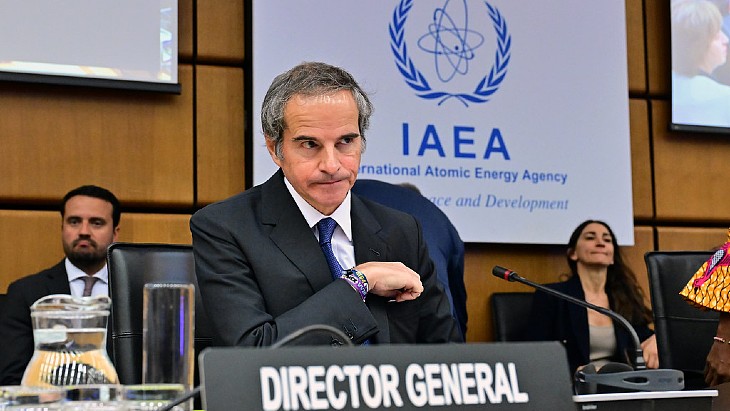
The International Atomic Energy Agency Director General Rafael Mariano Grossi has told the agency's board of governors "nuclear facilities must never be attacked, regardless of the context or circumstances, as it could harm both people and the environment".

IAEA's Grossi 'deeply concerned' after Israel attack on Iran nuclear facilities
(Image: Dean Calma / IAEA)

In a statement on Friday he said: "We are currently in contact with the Iranian nuclear safety authorities to ascertain the status of relevant nuclear facilities and to assess any wider impacts on nuclear safety and security. At present, the competent Iranian authorities have confirmed that the Natanz enrichment site has been impacted and that there are no elevated radiation levels. They have also reported that at present the Esfahan and Fordow sites have not been impacted.

"This development is deeply concerning ... such attacks have serious implications for nuclear safety, security and safeguards, as well as regional and international peace and security."

He noted previous IAEA general conference resolutions on the topic of avoiding military attacks on nuclear facilities and said: "As Director General of the International Atomic Energy Agency, and consistent with the objectives of the IAEA under the IAEA Statute, I call on all parties to exercise maximum restraint to avoid further escalation. I reiterate that any military action that jeopardises the safety and security of nuclear facilities risks grave consequences for the people of Iran, the region, and beyond."

Grossi added: "Yesterday, the Board of Governors adopted an important resolution on Iran’s safeguards obligations. In addition to this, the Board resolution stressed its support for a diplomatic solution to the problems posed by the Iranian nuclear programme. The IAEA continues to monitor the situation closely, stands ready to provide technical assistance, and remains committed to its nuclear safety, security and safeguards mandate in all circumstances ... in accordance with its Statute and longstanding mandate, the IAEA provides the framework and natural platform where facts prevail over rhetoric and where engagement can replace escalation."

According to Iran's official Islamic Republic News Agency (IRNA) at least five nuclear scientists were known to be among those killed in the strikes, including Fereydoun Abbasi-Davani - who headed the Atomic Energy Organisation of Iran from 2011 to 2013 - and Mohammad Mehdi Tehranchi, president of Azad University. Israel said that its actions had been a pre-emptive move targeting what it called Iran's programme to develop nuclear weapons and to "neutralise an immediate and existential threat to our people". 

Iran says that its nuclear programme is peaceful and condemned what it called the IAEA board's "anti-Iran resolution". According to an IRNA report a joint statement by the Ministry of Foreign Affairs and the Atomic Energy Organization of Iran on Thursday said that in response to the resolution, a new uranium enrichment facility had been ordered in a "secure location" and "first-generation centrifuges at the Fordow enrichment site would be replaced with sixth-generation machines".

According to World Nuclear Association's Information Paper on Iran, the country has one nuclear power reactor operating, with construction of a second Russian-designed unit at the Bushehr site taking place. According to a presentation at the IAEA general conference last September, first concrete was expected on a third unit by the end of 2024, with another unspecified unit under construction, and further power units planned.

The nuclear power plants have not been listed among the targets of the attacks, which instead included the uranium enrichment centres at Natanz. 

Iran's enrichment facilities

Unenriched, or natural, uranium contains about 0.7% of the fissile uranium-235 (U-235) isotope. ("Fissile" means it's capable of undergoing the fission process by which energy is produced in a nuclear reactor). The rest is the non-fissile uranium-238 isotope. Most nuclear reactors need fuel containing between 3.5% and 5% U-235 - known as low-enriched uranium, or LEU. Advanced reactor designs that are now being developed - and many small modular reactors - and research reactors, which are often used to produce medical radioisotopes, amongst other things - will require higher enrichments still - typically up to 20%.

Enrichment increases the concentration of the fissile isotope by passing the gaseous uranium hexafluoride (UF6) through so-called cascades of gas centrifuges, in which a fast spinning rotor inside a vacuum casing makes use of the very slight difference in mass between the fissile and non-fissile isotopes to separate them.

But the same technology that is needed to enrich uranium for use in nuclear power or research reactors could also be used to enrich uranium to the much higher levels (90% U-235 and above) that could be used in nuclear weapons. This means that uranium enrichment is strategically sensitive from a non-proliferation standpoint, so there are strict international controls to ensure that civilian enrichment plants are not used in this way.

Iran is known to operate enrichment plants at Natanz, about 80km southeast of Qom, and Fordow, 20km north of Qom. Iranian authorities have confirmed to the IAEA that the Natanz enrichment site has been impacted but "at present" Fordow, and a site at Esfahan, where there is a uranium conversion facility, have not been impacted.

According to World Nuclear Association, there are two enrichment plants at Natanz: the Pilot Fuel Enrichment Plant, with two cascades designated for production of uranium enriched up to 20% U-235, ostensibly for the Teheran Research Reactor, and R&D purposes; and the Fuel Enrichment Plant, which is built underground.

In a quarterly report, published on 31 May, the IAEA verified that cascades at the Fuel Enrichment Plant were being fed with natural UF6 to produce material enriched up to 5% U-235. It verified that Iran was testing some centrifuges and feeding both natural and depleted UF6 into others in the various R&D production lines at the Pilot Fuel Enrichment Plant.

According to the IAEA's quarterly report, as of 27 May some 82 cascades were operational at the Fuel Enrichment Plant, with seven operational cascades at the Pilot Fuel Enrichment Plant. The Fuel Enrichment Plant had produced an estimated 2671.3 kg of UF6 enriched up to 5% since its previous report. The pilot plant had produced 19.2 kg of uranium enriched up to 60%, about 243 kg with up to 5% enrichment and 453 kg with enrichment up to 2% U-235.

The Fordow Fuel Enrichment Plant has 13 operating cascades, according to the IAEA, where over 166 kg of UF6 enriched up to 60% U-235 were produced since the agency's previous quarterly report, as well as 67 kg of material enriched up to 20%, 724.5 kg enriched up to 5%, and nearly 369 kg of up to 2% enrichment.

The agency said that Iran's total inventory of enriched uranium as of 27 May stood at 2221.4 kgU of material with an enrichment of up to 2%; 5508.8 kgU up to 5%, 274.5 kgU up to 20% and 408.6 kgU with up to 60% enrichment.

The UF6 feedstocks - natural and depleted UF6 - have low levels of radioactivity, but significant chemical toxicity, so have to be handled appropriately, as does the enriched uranium product. The materials themselves are stored in purpose-built cylinders to provide the necessary physical protection.

The IAEA has continued to underline that "armed attacks on nuclear facilities could result in radioactive releases with grave consequences within and beyond the boundaries of the State which has been attacked". As Grossi highlighted in his speech to the IAEA Board, as of Friday morning Vienna time, the IAEA had been told there had been no increase in radiation levels at Natanz following the attacks.

Israel Shuts Leviathan Gas Field Amid Iran Conflict, Choking Supply to Egypt

  • Israel’s Energy Ministry ordered Chevron to shut down the Leviathan gas field amid heightened regional threats following strikes on Iran.

  • Egypt, reliant on Israeli gas during peak demand, now faces a supply crunch and may turn to costly emergency LNG imports.

  • The disruption has raised global alarm, sending European gas prices higher and highlighting vulnerabilities in East Med energy corridors.


Israel has ordered the shutdown of its massive Leviathan gas field, cutting off a critical supply line to Egypt just as regional tensions with Iran erupt into open conflict.

Chevron, the operator of Leviathan, confirmed the halt on Friday after Israel’s Energy Ministry issued the order, citing escalating security threats. Energean Plc also suspended output from its Israeli assets. The Leviathan shutdown is already impacting gas flows to Egypt, according to Bloomberg sources close to the pipeline network.

Egypt, facing peak summer demand and a widening domestic gas shortfall, now faces the prospect of emergency LNG purchases ahead of schedule—tightening an already brittle global gas market. European gas prices spiked as much as 6.6% Friday on the news.

The Leviathan field, located in the Levant Basin, is Israel’s largest energy asset with 22.9 trillion cubic feet of recoverable gas and had been exporting record volumes to Egypt—981 million cubic feet per day in 2024, an 18% year-over-year surge. Egypt, with declining domestic production and LNG export ambitions, had increasingly leaned on Israeli imports to fill the gap.

Chevron’s Tamar field remains operational, and Energean’s Karish field continues to serve domestic Israeli demand. But if shutdowns persist, Egypt’s LNG export capacity—and its own power grid—could be strained, and Jordan’s access to gas also stands at risk.

The timing is striking. Just months ago, Leviathan’s operators announced plans to expand capacity from 12 to 21 billion cubic meters, with eyes on Europe as a key customer. Now, the field is offline as Israel braces for retaliation after launching strikes on Iranian nuclear infrastructure.

For Egypt, the implications are immediate. For global gas traders, the situation underscores the fragility of East Med supply routes in a geopolitical flashpoint.

Chevron stated its personnel and infrastructure remain safe. But the gas isn't flowing—and the regional energy balance just shifted overnight.

By Julianne Geiger for Oilprice.com

UK Firm Energean Halts Offshore Israel Production After Strikes on Iran

UK-based oil and gas producer Energean plc has suspended production from its offshore platform in Israel following the escalation of tensions in the Middle East.

Energean on Friday confirmed it received notice from the Ministry of Energy and Infrastructure on June 13, 2025, ordering the temporary suspension of production and activities of the Energean Power FPSO, following the recent geopolitical escalation in the region.

“All production activities have now been temporarily suspended and notices have been issued to Energean’s customers and other stakeholders,” Energean said in a statement.

The company maintains a close dialogue with the Israeli Ministry of Energy and Infrastructure and other relevant stakeholders “to facilitate the safe resumption of production as soon as possible.”

The suspension of activities comes after Israel launched a series of coordinated airstrikes on Iran, targeting nuclear facilities in what it describes as a decisive move to prevent the Islamic Republic from becoming a nuclear power.

Iran has vowed to retaliate, and Israel is preparing for that retaliation.

Offshore Israel, the UK’s Energean is also developing the Katlan gas field, which the company said last month is progressing on schedule, with first gas on track for the first half of 2027.

Israel’s offshore area has several large natural gas fields, which were shut during similar Israel-Iran escalations in recent years.

The Leviathan and Tamar fields, operated by U.S. supermajor Chevron, have briefly halted operations following similar events.

Last October, Chevron briefly suspended natural gas production and supply from two platforms offshore Israel as a precaution following an Iranian missile attack on Israel.

By Tsvetana Paraskova for Oilprice.com

Shipping Not Immediately Impacted as World Watches Israel-Iran Conflict

Strait of Hormuz
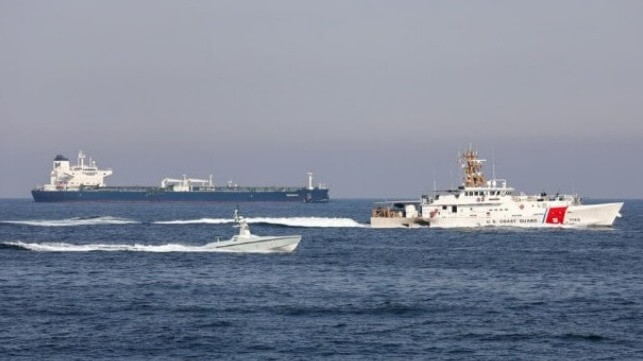
USCG transiting the Strait of Hormuz in 2023 (US Navy photo)

Published Jun 13, 2025 11:10 AM by The Maritime Executive


The global shipping industry is holding its breath anxiously watching the emerging conflict between Israel and Iran as is the world. Analysts are scrambling to predict the potential impact on shipping while security services are issuing cautions and some nations are already issuing advice to shipping.

As would be expected, the price of oil jumped dramatically on world markets after the news that Israel had struck and killed leadership within Iran’s military and nuclear program, bombed nuclear sites, and defense installations. At midday, the global price of oil was up around seven percent on a barrel after news that Iran’s first response was limited to about 100 drones launched at Israel. The Israel Defense Force is saying the drones were intercepted and caused no damage.

“The Strait of Hormuz remains open and commercial traffic continues to flow uninterrupted,” reported the Joint Maritime Information Center while also saying “JMIC has no indications of an increased threat to the maritime environment.” 

JMIC however immediately raised the “likelihood of regional conflict” to “significant.” It said the effect on the maritime environment is not predictable. It is advising increased security measures and monitoring the situation.

The UK Maritime Trade Operations had issued its first warning of “increased tension” on June 11. The UK today, June 13, according to a report from Reuters, advised merchant ships to avoid sailing through the southern Red Sea and the Gulf of Aden.

Greece’s Ministry of Shipping reports Reuters also issued a warning to commercial shipping. The Ministry is asking Greek ship owners and operators to send details of their planned transits through the Strait of Hormuz. Greece is especially sensitive due to its entanglements with Iran which has seized and held Greek-owned tankers in the past.

One company, the UK’s gas producer Energean has already reported it was temporarily suspending production on its FPSO located off the northern coast of Israel. The company said it had been ordered to suspend activities by Israel’s Ministry of Energy and Infrastructure.

Iran has not indicated its strategy other than announcing that “a bitter and painful fate awaits Israel.” It has however also said it believes the United States supported the efforts although the Trump administration has been quick to disavow any involvement in the attacks. It however announced that its oil infrastructure was functioning normally and not part of the overnight attacks.

Well-known shipping industry analysts Peter Sand, Chief Analyst at Xeneta, and Lars Jensen, CEO of Vespucci Maritime, both speculated on the potential of a “de facto closure” of the Strait of Hormuz similar to what the Houthis achieved with the Red Sea in 2024. 

“Any closure of the Strait of Hormuz would see services re-routed, with increased reliance on India West Coast ports for connecting the Far East to Indian sub-continent,” commented Peter Sand on the potential impact to the container shipping segment in particular.  “The inevitable disruption and port congestion, as well as the potential for higher oil prices, would cause a spike in ocean freight container shipping rates, with carriers likely also pushing for a ‘security surcharge’ on these trades in the coming days.”

Jensen highlighted three major risks with the first of course being oil prices. In addition to the impact on oil from the closing of the Strait of Hormuz, he highlights the impact on imports and exports from Saudi Arabia, the UAE, Qatar, Bahrain, Kuwait, and Iraq. A disruption at Saudi Arabia’s main ports, Jebel Ali and Khalifa, Jansen points out could spill over to regional congestion in Asia. 

Iran, he notes in the past has shown it is “not adverse” to interfering with commercial shipping. It has held the MSC Aries containership for over a year as well as having a history of seizing crude oil tankers. The Houthis released the crew but still hold the vehicle carrier Galaxy Leader which they seized in November 2023. 


How Will the Israel-Iran Conflict Unfold?

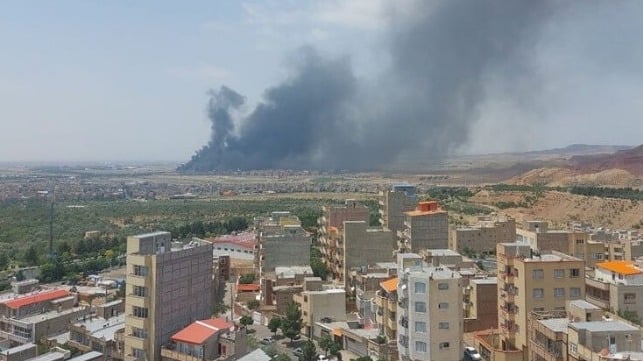
Israel's attack on one of Iran's outposts (Tasmin News Agency - CC BY 4.0)

Published Jun 13, 2025 3:46 PM by The Maritime Executive


Israel has declared that its attacks on Iran early on the morning of June 13 are only the beginning of what could be an initial three-week campaign. As yet the 100 drones Iran announced had been launched at Israel in a counter-attack do not appear to have arrived. Both sides have a range of options that they could pursue as the conflict pans out, although, at this early juncture, the Israeli attacks on the Iranian command and control system appear to have stymied a massive True Promise-3 response which Iran had threatened would be the result of any attack on Iran.

As reported earlier, as yet there does not appear to be any immediate disruption to shipping in the Gulf, and remarkably, Gulf airlines - whilst avoiding Iranian airspace and destinations - appear to be maintaining much of their schedules, albeit with delays due to diversions through safer airspace. Reports from ship monitoring companies carried in the Wall Street Journal suggest that a larger number than normal of vessels are in anchorages off Iran’s ports awaiting docking, but such numbers would have built up prior to the Israeli attack, possibly caused by the after-effects of the explosion at the Bandar Abbas commercial port. A pattern of activity is not yet apparent in satellite imagery of the Bandar Abbas roads, save that a lot of ships are under way.


Bandar Abbas Anchorage, June 13 (Sentinel-2)


Any Iranian attempt to close the Straits of Hormuz would be a very risky endeavor. Firstly, it would curtail Iran’s own oil exports, which are its primary source of finance. A blockade would quickly degenerate into open warfare. Whilst the IRGC Navy (Nedsa) can make a nuisance of itself in times of peace, Iranian maritime capability, both that belonging to Nedsa and the antiquated regular navy (Nedaja), would rapidly take up positions on the seabed if they tangled with US or allied navies in open conflict. Moreover, a closure of the Straits of Hormuz would severely impact GCC states - and Iran at this juncture would not wish to make enemies of these countries, who at the moment are professing outrage about the Israeli attacks.

Likewise, attacks on infrastructure in GCC countries, or on US assets based in these countries, would force GCC countries into alignment with the United States, which in reality is the inclination of their leaders, but unspoken because of popular support in these GCC countries for the Palestinian cause.

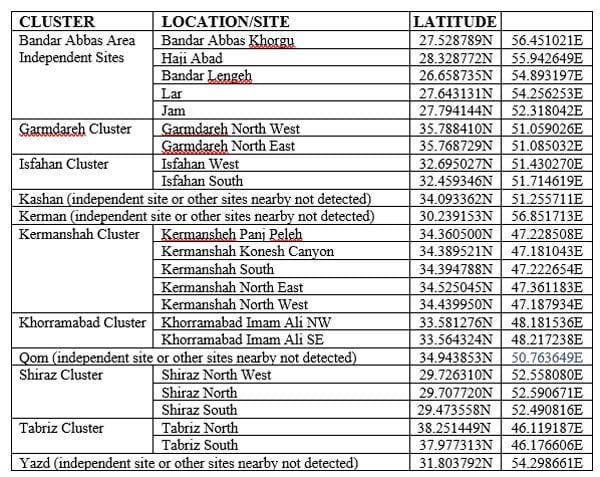
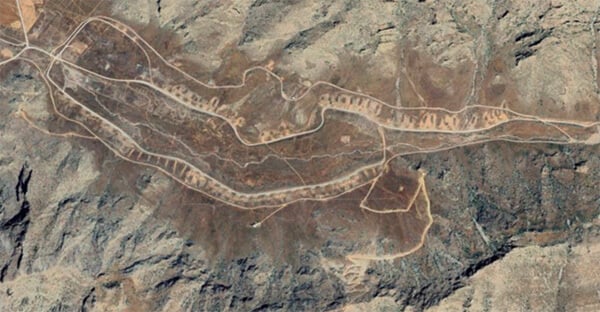
Israel will undoubtedly aim further attacks at the IRGC’s 24 identified missile sites in the western half of the country, spread from north to south. All feature underground storage bunkers, from which both drone and missile mobile launchers can be driven out, ready to go into action within minutes. The site at Kermanshah Konesh Canyon has at least 60 such tunnel bunkers and appears to have been an early Israeli target, with secondary explosions visible in the Israeli attack video released.


More than 50 underground bunkers visible in the Kermanshah Konesh Canyon missile complex (Google Earth, June 6, 2024)


Each site has multiple tunnel entrances, from which a further multiple of missiles or drones can be launched. Some sites also feature hardened silos, with automated revolver carousels enabling the rapid reloading of ballistic missiles; the site at Haji Abad for example has at least seven silos, aligned for targets along the Bahrain-Riyadh axis. There are also a number of coastal tunnel complexes, housing Nedsa missile boats.

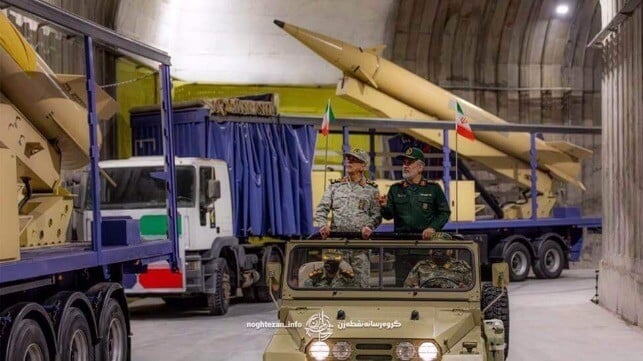
For Israel to be safe from Iranian counter-attacks, all the sites listed below will need to be neutralized or destroyed. Those sites armed with the latest Haj Qassem medium-range solid fuel missile will be a particular priority, as these missiles have a separating warhead which appears to be independently maneuverable and equipped with a passive targeting system.


The late Maj Gen Mohammad Bagheri and Brigadier Amir Ali Hajizadeh tour a ‘missile megacity’, March 25 (Press TV)


Israel has couched its attack as a last-minute unavoidable step needed to prevent Iran from acquiring nuclear weapons. But also important to Israel will be curbing this enduring Iranian ballistic missile threat, as well as ending Iran’s strategy of regional expansionism which has plagued the region for decades. Israel’s aims in this regard are shared with the United States. Attacking the Iranian leadership will help attain this objective, as well as paralyzing Iranian counter-attack planning, weakening the hardliners who dominate the IRGC. Israel may also choose to hold back attacks on the regular armed forces, which are more closely aligned with the reformist cause headed up by President Masoud Pezeshkian. The retention of most of the Nedaja fleet dockside in Bandar Abbas Naval Harbor in recent weeks could be interpreted as a desire not to present a provocation; by not attacking the regular armed forces, Israel would leave them with the strength to take on the hardliners in a post-attack struggle for power.


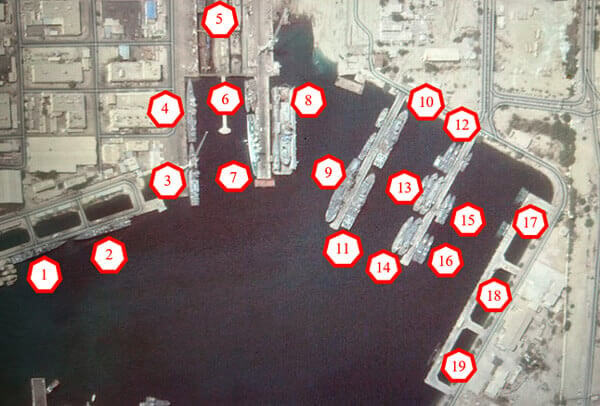
Bandar Abbas Naval Base June 2 ((Sentinel-2/CJRC, subject to imagery resolution limitations)
1. Moudge Class frigate
2. Alvand Class frigate
3. Moudge Class frigate
4. Alvand Class frigate
5. Kilo Class submarine in dry dock, with probable second Kilo under cover in dry dock alongside
6. 2 x Sina or Kaman Class fast attack craft
7. Intelligence collector IRINS Zagros (H313)
8. Hengam Class landing ship IRINS Larak (L512) in floating dry dock
9. Bandar Abbas Class logistics vessel IRINS Bushehr (K442)
10 and 11. Hengam Class landing ships IRINS Tonb (L513) and Lavan (L514)
12. 2 x Hendijan Class auxiliaries
13 and 14. Total of 4 x Delvar Class auxiliaries
15. 2 x Kaman or Sina Class fast attack craft
16. Probably 2 x Hendijan Class auxiliaries
17. Ghadir and Nahang Class midget submarines
18. Kilo Class submarine missing from its normal berth
19. Probable Fateh Class medium submarine
Bandar Abbas Naval Base outer harbor: Forward base ship IRINS Makran (K441)

The opinions expressed herein are the author's and not necessarily those of The Maritime Executive.