Saturday, July 26, 2025

Yellowstone has been a ‘sacred wonderland’ of spiritual power and religious activity for centuries – and for different faith groups

(The Conversation) — Native American groups were aware of the region’s dramatic features. Since the national park’s creation, other faiths have also been inspired by its beauty, from Christians to New Age groups.


Beehive Geyser, in the Upper Geyser Basin of Yellowstone National Park. 

Thomas S. Bremer
July 25, 2025
The Conversation

 Nearly 5 million travelers come to Wyoming to visit Yellowstone National Park each year, most in the summer months. They come for the geysers, wildlife, scenery and recreational activities such as hiking, fishing and photography.

However, few realize that religion has been part of Yellowstone’s appeal throughout the park’s history. My 2025 book “Sacred Wonderland” documents how people have long found holiness in Yellowstone: how a landscape once sacred to Native Americans later inspired Christians and New Age communities alike.

Native reverence – and removal

Long before European Americans “discovered” the Yellowstone region in the 19th century, numerous Indigenous peoples were aware of its unique landscape – particularly geysers, hot springs and other hydrothermal wonders. Several tribal groups engaged in devotional practices long before it became a park. These included the Tukudika, or Sheep Eaters, a band of mountain Shoshone. They lived year-round within the boundaries of what would become the national park.

Anthropologists know relatively little about the specific beliefs that Native Americans held about Yellowstone during this era. However, it’s clear most of the Indigenous groups who frequented Yellowstone considered it, as historian Paul Schullery concludes, “a place of spiritual power, of communion with natural forces, a place that inspired reverence.”


Lower Falls of the Yellowstone River, Yellowstone National Park.
Thomas S. Bremer

After the Civil War, more Euro-Americans entered the region. In 1872, the U.S. government created Yellowstone as the first national park, setting a precedent for others in the United States and around the world.

Yellowstone and other U.S. national parks established in the 19th century were products of manifest destiny: the Christian idea that Americans had a divinely ordained right to expand their country across the continent. The nation’s westward expansion included turning supposedly wild, “uncivilized” areas into parks.

The park system’s creation, though, came at the cost of Indigenous communities. In Yellowstone, the Tukudika were forcibly removed in the 1870s to two reservations in Idaho and Wyoming, as anthropologists Peter Nabokov and Lawrence Loendorf discuss in their book “Restoring a Presence.”

Christian ministry

In addition to the concept of manifest destiny, Christians brought their own religious practices to Yellowstone National Park.

The U.S. Army was responsible for protecting and managing the park from 1886 to 1918. It operated from Fort Yellowstone at Mammoth Hot Springs in the northern part of the park. The last building it erected at the fort was a chapel, which has been in continuous use as a worship space – mostly for Christian groups – since its completion in 1913.


The Yellowstone National Park Chapel at Mammoth Hot Springs, finished in 1913, was the last building constructed by the U.S. Army at Fort Yellowstone.
Thomas S. Bremer

One group that has used the chapel consistently since the 1950s is ACMNP, A Christian Ministry in the National Parks, an evangelical Protestant parachurch ministry founded in Yellowstone. Its volunteers conduct worship services and proselytize among employees and visitors.

ACMNP began as the brainchild of Presbyterian minister Warren Ost, who had worked as a bellhop at the Old Faithful Inn during summer breaks in seminary. Upon graduation, he formed the ministry, hoping to capitalize on the awe people experience in the parks to affirm believers’ faith and bring new souls to Christ.

ACMNP’s mission involves placing seminarians and other students in national parks as “worker-witnesses.” They work as paid employees in secular jobs and conduct religious activities after their regular working hours. Additionally, they are encouraged to talk about religion with their fellow workers on the job.

ACMNP experienced rapid growth in the 1950s and 1960s, boosted by support from National Park Service leadership. Cooperation included reduced-cost housing for their volunteers, and in some parks the superintendents or other high-level officials served on local ACMNP committees.

At its peak in the 1970s, ACMNP had nearly 300 volunteers working in over 50 locations. However, a federal lawsuit in the 1990s challenged its relationship with the government on the grounds of church-state separation and ended some of the privileges ACMNP had enjoyed. Not long after the legal action, Ost announced his retirement.

Although the organization has scaled back operations, the ministry in Yellowstone has experienced few changes. ACMNP volunteers continue to offer religious services to park employees and visitors throughout the summer.

Spiritual fortress

Another religious group has a very different interpretation of Yellowstone. The Church Universal and Triumphant, which had several thousand members at its height, was founded by Elizabeth Clare Prophet in the 1970s, based on the teachings of her late husband, Mark Prophet.

The Church Universal and Triumphant is an heir to the “I AM” movement, which flourished in the U.S. during the 1930s. Most prominent among I AM’s influences were theosophy, which promotes esoteric knowledge gleaned from Asian religious traditions as a universal wisdom underlying all religions; new thought, which advocates a mind-over-matter spirituality; and spiritualism, which involves communicating with spirits.

In the 1980s, Prophet’s followers relocated from California to Montana, where they purchased a large ranch adjacent to Yellowstone National Park’s northwest boundary. With them, they brought an eclectic New Age theology that combines elements of Christianity, Buddhism and Hinduism with belief in “ascended masters,” spiritual beings who guide the church. The group’s tradition teaches that beneath Yellowstone are two underground caverns, hidden from human view, that contain a cache of sacred stones with spiritual powers.

The Church Universal and Triumphant gained attention in the ‘90s when its believers in Montana built underground bunkers. Members believed that their ascended masters had predicted a nuclear war and had instructed the community to prepare to survive underground. When the prophecy of a nuclear attack did not materialize, many members became disillusioned.

The group struggled to rebuild its reputation and establish goodwill with Montana neighbors, including the National Park Service. Elizabeth Clare Prophet retired in 1999, and since then the church has concentrated more on its publishing and educational enterprises. However, a core community of the faithful still live and worship on their Royal Teton Ranch adjacent to Yellowstone
.


The main church sanctuary at Church Universal and Triumphant headquarters, just outside Yellowstone National Park.
Thomas S. Bremer

Although the community teaches that its Montana ranch is a sacred location of the ascended masters, followers’ holiest place in the Western Hemisphere is roughly 35 miles south of Yellowstone, in Grand Teton National Park. They believe humanity began at Grand Teton Mountain and that the faithful will find their destiny there.

Accordingly, members believe that Yellowstone and Grand Teton national parks are brimming with spiritual powers, sacred sources of light and energy for the entire world.

In my conversations with people in the park, I found that very few knew anything about Yellowstone’s religious history at all – especially Native American practices. The ongoing practices of religious communities in the park remain invisible to nearly all visitors. Still, many vacationers interpret Yellowstone’s wonders as evidence of God’s handiwork.

(Thomas S. Bremer, Professor Emeritus of Religious Studies, Rhodes College. The views expressed in this commentary do not necessarily reflect those of Religion News Service.)


The Conversation religion coverage receives support through the AP’s collaboration with The Conversation US, with funding from Lilly Endowment Inc. The Conversation is solely responsible for this content.

LA pastor on hunger strike to protest ICE’s detainment of Iranian Christians

WASHINGTON (RNS) — Pastor Ara Torosian’s congregants fled Iran to escape persecution due to their Christian faith. Now, they are being held in immigration detention.


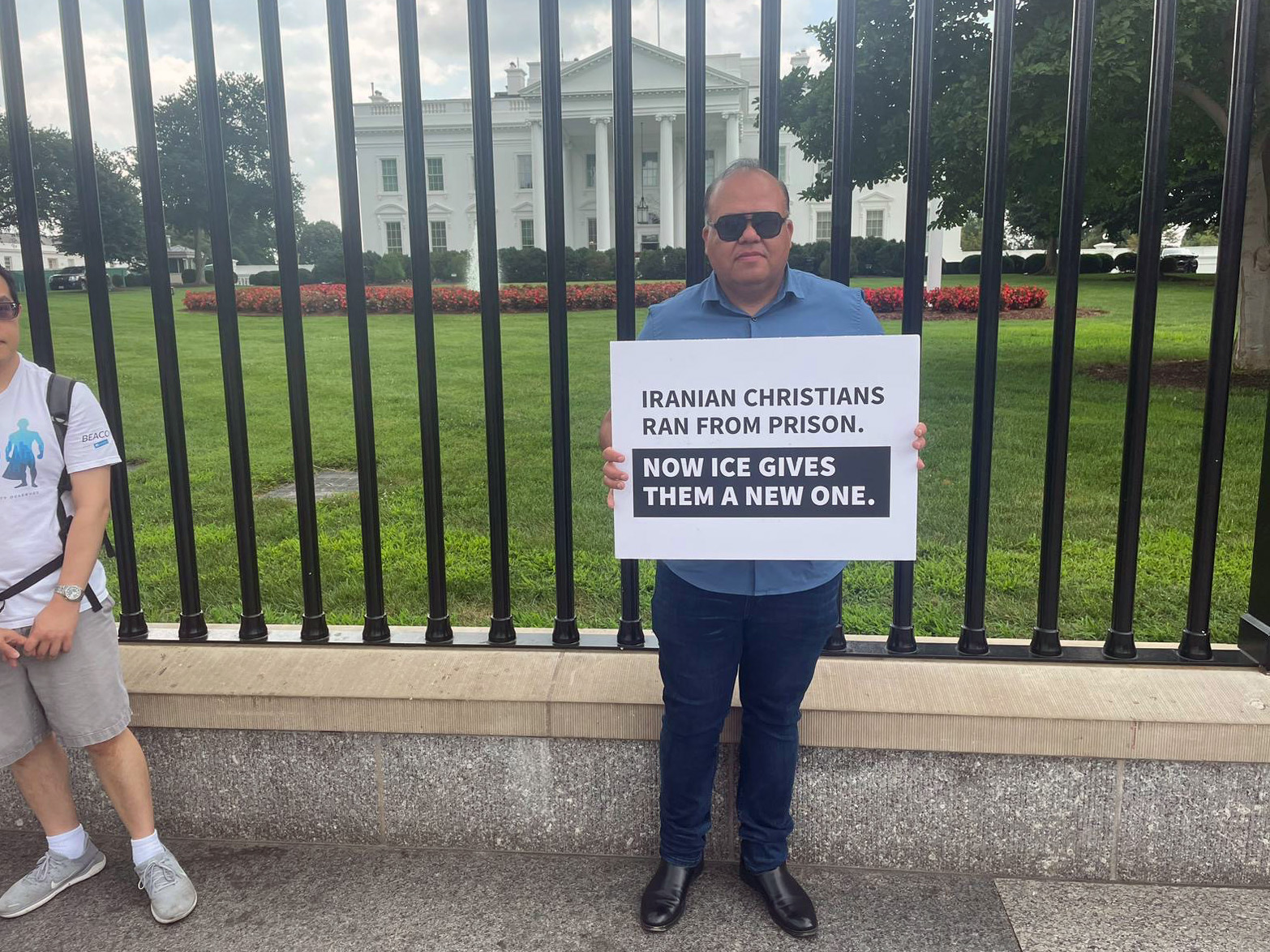
Pastor Ara Torosian draws attention to detained Iranian Christians while on a hunger strike in front of the White House, July 23, 2025, in Washington. (Photo by David Ian Klein)

David I. Klein
July 23, 2025
RNS

WASHINGTON (RNS) — About a month ago, Pastor Ara Torosian received a frantic call from one of his congregants in Los Angeles. Armed authorities were at her door and trying to arrest her and her husband. He quickly rushed over to a scene that he described as akin to incidents in his native Iran.

The armed police were not the Islamic Revolutionary Guard Corps but United States Border Patrol federal agents. The congregants had fled Iran for the U.S., escaping persecution due to their Christian faith.

Now, the pastor of Cornerstone Church West LA — a multiethnic Protestant church that holds services in English, Spanish and Farsi — is protesting outside the White House, advocating not just for the five members of his own congregation who are still detained, but an estimated 200 Iranian Christians he said are currently in U.S. custody, according to his firsthand reports from detained immigrants. For three days, Torosian is refraining from eating solid food, drinking only water to draw attention to the issue.

“I decided last week to come and to be a voice for voiceless people,” Torosian told RNS on Wednesday (July 23), adding he’s met with lawmakers and policy leaders during his visit. “There are lots of Iranian Christian people detained and they are in danger of deportation back to Iran. I came here to be their voice in front of the White House. … I just want people to hear what is in my heart, what’s happened to us and tell them to see it.”

Torosian’s congregants were detained in a wave of U.S. Immigration and Customs Enforcement arrests that targeted Iranian immigrants shortly after a ceasefire was declared between Israel and Iran after a 12-day war in June. The same week as Torosian’s congregants were taken by Border Patrol, at least 11 other Iranians were arrested across the country, according to a DHS statement.

RELATED: Pastor films as masked federal agents arrest Iranian Christian asylum-seekers in LA

Torosian said his congregants came as asylum-seekers under a Biden administration policy, followed all legal protocols and received work permits. One family, a couple and their 3-year-old daughter, was arrested during a scheduled immigration court appearance, while the couple he captured on video was at their home.


U.S. Border Patrol agents detain two Iranian Christian individuals, June 24, 2025, in Los Angeles. (Video screen grabs via Ara Torosian)

In the video Torosian recorded of the arrests, police can be heard saying CBP One, the mobile app the family used to legally come to the U.S. under the Biden administration, “is no longer valid anymore.” During the incident, the woman had a panic attack and was wrestled to the ground by police, which was captured on video.

“When I saw that scene, it triggered something inside of me, and I thought, ‘Where am I? Am I in LA or in the streets of Tehran?’” Torosian said.

The wife was later taken to the hospital, where Torosian said he was blocked by federal agents from praying with her, and then to an ICE detention center.

A spokesperson for U.S. Customs and Border Protection, which includes Border Patrol, said the couple were considered “subjects of national security interest” and were “unlawfully present” in the U.S., RNS previously reported.

Iran has so far refused to take deportees from the U.S.; however, last month the Supreme Court allowed the administration to deport migrants to countries that are not their homelands.

Were they to be deported back to Iran, they could face religious persecution. Open Doors International, an evangelical organization covering Christian persecution, in a January report listed Iran in the top 10 countries known for government oppression and persecution of Christians.

Despite being less than 1% of the population, Christians make up the largest non-Muslim religious minority in the Islamic Republic of Iran, according to Open Doors. Iranian state recognition has largely been restricted to historic ethnic churches such as the Armenian Apostolic Church, Assyrian Church of the East and Chaldean and Aramean churches. Christian worship in Farsi has been outlawed, and churches that cater to the historically Muslim, ethnically Persian majority are suppressed. Proselytizing and conversion are punishable by fines, corporal punishment, jail time and potentially the death penalty under Iranian law.

After facing threats, Torosian fled Iran in 2010 and is now an American citizen.

“I was caught smuggling Bibles in Iran, and (the police) said, ‘You are a spy of Israel, you’re a spy of America,’” Torosian recalled. “There’s long-term prison sentences, they kill our pastors and even in America, I got threatened by (the Iranian government) many times.”

He said that since the video of his congregants’ arrests went viral, their family members in Iran have been questioned by national security services. Since the ceasefire with Israel, Iran has expanded its arrests of dissidents — disproportionately those from religious minorities — under the claim of rooting out Israeli spies.

RELATED: Jewish, Baha’i leaders detained amid Iranian crackdown on spying

In a statement to RNS last month, White House spokesperson Abigail Jackson said, “Any foreign citizen who fears persecution — including Iranians — are able to request asylum and have their claims adjudicated.”


Signs that pastor Ara Torosian displays in front of the White House, July 23, 2025, in Washington. (Photo by David Ian Klein)

The persecution of Christian communities in the Muslim world was a significant talking point for Donald Trump’s presidential campaign and among Republican leaders. As Torosian’s congregants sit in detention, GOP lawmakers are pushing a resolution in the Senate to denounce the treatment of Christians in Muslim-majority countries.

“Our country was founded on religious liberty,” Republican Sen. Josh Hawley of Missouri, who introduced the resolution, said in a statement Monday. “We cannot sit on the sidelines as Christians around the world are being persecuted for declaring Jesus Christ as their Lord and Savior. We must condemn these heinous crimes.”

The disconnect between such public claims and the actual treatment of Iranian Christian refugees has been deeply disappointing to Torosian and his community, he said.

“We feel trapped as Iranian refugee Christians,” Torosian said, holding a sign reading, “Mr. President: Iranian Christians believed you would protect them,” and “President Trump: Keep your promise to persecuted Christians.”

While Christian humanitarian organizations such as World Relief, which works with refugees worldwide, have supported Torosian and his community, other evangelical leaders have backed the Trump administration’s immigration policy.

“I have received big support from some Christian organizations, and other people, they don’t like me,” he said. “They believe that our people are illegal here. Some Christians have told me that I need to ‘go back to my country.’ I am a U.S. citizen. My children were born here.

“When you are calling yourself an evangelical church and Christian, you need to follow God’s word,” Torosian added. “I usually say to them, ‘Go read your Bible.’ … Jesus sat down with everybody — vulnerable people who were never loved by their community, prostitutes and other hated people. Jesus himself was a refugee.”


'Shiny Happy People' returns to examine the Christian culture war pioneer Teen Mania

(RNS) — The three-part docuseries explores the birth and sudden demise of Teen Mania, plus the gnarly underbelly of a ministry some former members consider abusive.


Promotional art for “Shiny Happy People: A Teenage Holy War.” (Courtesy of Prime Video)
Kathryn Post
July 24, 2025

(RNS) — In 1999, a man in his 30s, dressed in a red button-down shirt, stood in front of some 73,000 Christian teens and invited them into battle. “Do we have any fighting men and women in here ready for a fight for some souls?” Ron Luce, founder of Teen Mania, demanded of the crowd crammed into Michigan’s Pontiac Silverdome, to roars.

At that moment, Teen Mania was perhaps the most consequential Christian teen ministry in the world. Millions of earnest evangelical Christian youths had shown themselves ready over the previous 13 years to inscribe their hearts and not a few checks to change the world. Luce enticed them with a combative “us vs. them” approach to mainstream American culture. In the Silverdome, those militaristic undertones were made explicit, supercharging the youth movement for a new century.

What that century brought, in the now familiar story of many a supercharged ministry, were accusations of abuse from former members and outlandish fear tactics employed to mold the ministry’s teen interns, a gnarly underbelly that is the subject of the second season of Prime Video’s “Shiny Happy People: A Teenage Holy War.” The three-part docuseries, following the success of “Shiny Happy” season one’s 2023 examination of the prolifically pro-natalist Duggar family, rides the fascination with Christian subculture in exploring Teen Mania’s birth and seemingly inevitable demise.

What makes the Teen Mania story more than a rehash of evangelical overreach is watching how, as revealed at “Day One” at the Silverdome, Luce stoked the flames of the culture war still playing out on a national stage today.

When Luce and his wife, Katie, founded Teen Mania in 1986, it was envisioned as an international missionary movement. Global Expeditions, its first major initiative, would transport a group of teens and their leaders abroad for a few weeks, where they would win as many souls for Jesus as possible.

The group’s primary tactic involved Jesus skits, a youth group staple. Often accompanied by music, but no words, the teen missionaries typically acted out variations on the dangers of the temptations of youth — lust, greed, drugs, etc. — that most often end with a confrontation between Jesus and Satan, with Jesus emerging the victor.

But in the 1990s, the organization’s own events back home became emotive, high-energy spectacles in churches and arenas. Called Acquire the Fire, the events employed pyrotechnics, evocative music, intense lighting and stirring altar calls to convey the gospel message.


Carrie Saum in “Shiny Happy People: A Teenage Holy War.” (Courtesy of Prime Video)

“They weren’t appealing to our intellect. They weren’t appealing to our common sense. Looking back at it now, they weren’t even really appealing to our spirits,” Carrie Saum, a Teen Mania alumna featured in the docuseries, told Religion News Service. “They were appealing to our emotions. And that was a really powerful drug.”

April Ajoy, an influencer and author of “Star-Spangled Jesus: Leaving Christian Nationalism and Finding A True Faith,” remembers attending Acquire the Fire events as a kid. Luce’s rhetoric, which she describes as very “black and white,” had a lasting impact.

“You leave so fired up, and you have this deep sense of purpose that there’s no higher calling than for you to give up your entire life to spread the gospel, to save souls,” Ajoy said in an interview. “Because you literally believe that if people do not have your beliefs, that they do not believe in Jesus the way you do, that they will die and go to hell.”

Liz Boltz Ranfeld, the daughter of former Christian musician Ray Boltz who appears in “Shiny Happy People” with her brother Phil, said, “There was the pressure of, I have to get this right, because I have to get these people saved.” But she and her brother don’t discount the intense messaging as a motivator for their evangelism.


Siblings Liz Boltz Ranfeld and Phil Boltz in “Shiny Happy People: A Teenage Holy War.” (Courtesy of Prime Video)

Acquire the Fire events were also used to enlist interns enrolled in the Honor Academy, an intense, on-site gap-year program that included everything from janitorial work and groundskeeping to promoting Teen Mania events. Rather than being paid for these duties, the interns were charged hundreds of dollars a month for the experience, which included early wake-ups, mandatory physical training and adherence to strict rules. No dating or secular music was allowed. Violations, former interns recall, could result in immediate ejection from the program.

Some of the most troubling elements of the program, such as ESOAL — Emotionally Stretching Opportunity of a Lifetime — were designed to push teens to their limits. A boot camp-like experience involved sleep deprivation, mud crawls, wearing military-style fatigues and, some recall for the camera, rolling down vomit-strewn hills.

According to its alums who talked to “Shiny, Happy People,” the manipulation and unpaid labor directly contributed to Honor Academy’s booming success.

In 2005, Teen Mania doubled down, launching the Battle Cry Campaign. Backed by conservative Christian icons such as Chuck Colson, Pat Robertson and Joyce Meyer, it put Luce on a national tour where he deployed war metaphors to urge Christian kids to stand against pornography, gay marriage and materialism.

“It was always, we have a fight. There’s a fight for your young people’s souls, and we’re casting out the devil,” Saum said.

About that time Teen Mania joined the Arlington Group, a coalition of Christian right conservative groups that included the American Family Association, Center for Moral Clarity, Family Research Council and Focus on the Family. By 2014, it had been endorsed by evangelist Billy Graham, former President George W. Bush and Bishop T.D. Jakes, among other influential leaders.

But a year later, Teen Mania Ministries abruptly announced it would shut down. An RNS report from the time cites financial trouble, but also the stories of mistreatment and spiritual abuse being told by watchdog groups and on alumni blogs. As the criticism became public, the Honor Academy struggled to recruit interns. Soon, Teen Mania’s headquarters in Garden Valley, Texas, was in foreclosure.


April Ajoy in “Shiny Happy People: A Teenage Holy War.” (Courtesy of Prime Video)

But the end of Teen Mania didn’t mean the end of its influence, according to the documentary. “The army Ron trained is still out there,” Mica Ringo, creator of the “Recovering Alumni” blog for former Teen Mania interns, tells the filmmakers. Ajoy told RNS that she hears echoes of Teen Mania in the rhetoric of today’s Christian nationalists, who, she said, try to convince Americans, “If you can keep people from sinning through policy and laws, then they have a better chance of going to heaven.”

Ajoy said the importance of “Shiny Happy People: A Teenage Holy War” highlights how extreme, warlike, pro-Christian rhetoric has entered mainstream American discourse, particularly in the evangelical world

“Most people who espouse Christian nationalism in some way don’t think that they are Christian nationalists,” Ajoy told RNS. “They think they’re just being good Christians. They love God. They love people. They vote Republican, because that’s part of it too. But they genuinely believe … that turning America Christian is a call from God.”

Ten years after Pope Francis' Laudato Si', Catholic ecologists assess its impact on Africa

(RNS) — Participants from the US and Africa urged scientific and economic thinkers on climate to consider spiritual concepts raised in Laudato Si'.


People attend the Laudato Si’ Africa Conference 2025 near Kampala, Uganda. 
(Photo courtesy Bethany Land Institute)

Fredrick Nzwili
July 25, 2025
RNS

(RNS) — Meeting near the Ugandan capital of Kampala, Catholic environmentalists in Africa marked the 10th anniversary this week (July 23-25) of the publication of Laudato Si’, Pope Francis’ encyclical on care of the environment, with a conference that asked how Africa has responded to the pontiff’s call for action.

Vatican officials and Catholic climate thinkers from the United States and around Africa joined other environmental activists, researchers and policy makers at Bethany Land Institute, a nonprofit ecological education center north of Kampala, for the three-day program.
RELATED: 10 years later, Pope Francis’ Laudato si’ is more relevant than ever

Organized by the institute with the University of Notre Dame and Taproot Earth, a pro-democracy nonprofit based in Louisiana, the conference, titled “Laudato Si’: Where Is Africa?,” also honored the legacy of the late pontiff, who made climate and ecology one of the main concerns of his papacy.

“Ten years ago, Pope Francis made a bold call to care for our common home,” said the Rev. Emmanuel Katongole, a Catholic priest and Notre Dame professor of theology and peace studies who co-founded the institute, in his opening remarks. “Across Africa, communities rose to the call, building hope from the soil and the spirit of science. Now in Uganda, we gather to reflect, to renew, and to ask, what next?”

Katongole said he had been inspired to found the institute by Francis and his encyclical to combat environmental degradation, food insecurity and poverty on the African continent. “He died as we were preparing for this conference,” said Katongole. “We want to honor his leadership and his legacy and thank him for providing us with that urgent call to care for our common home.”

The participants at the conference considered a wide range of topics, from environmental degradation to sustainable agriculture and food security and energy. Several presenters and panelists talked about how scientific and economic approaches to these concerns could be influenced by spiritual concepts raised in Laudato Si’.

Sister Damien Marie Savino, a visiting professor in Notre Dame’s department of civil and environmental engineering and Earth sciences, described “an ecology of hospitality” based on the teachings of St. Francis, the late pontiff’s namesake. Pointing out that “nature’s ecological efficiency is only 40%,” she urged engineers and economists, who seek to design systems with 90% efficiency, to instead “hear the language of creation.”

Augustine Bahemaku, a policy adviser with the Africa Europe Faith and Justice Network, presented the idea of “integral ecology,” Francis’ term for the view that all of nature is interrelated, in terms of “African traditional systems.” That tradition, said Bahemaku, sees in the world a descending order from gods to ancestors to humans and to the natural world, a “mystical relationship” that puts humans at its center but nonetheless “doesn’t give permission or leeway to use nature as they want.”

Bahemaku went on to identify parallels between Laudato Si’s emphasis on the common good, community and sustainability and African traditions such as the transmigration of souls and totems. Respecting the community, he said, could be as simple as the principle that, on encountering a tree full of mangoes, “you don’t beat every mango out of the tree. Leave some mangoes for the people after you.”

Cardinal Peter Kodwo Appiah Turkson, who heads the Vatican’s Pontifical Academy of Sciences, similarly noted in his keynote address that adopting a new awareness of the need to care for the earth entails conversion to new lifestyles. Humans must “change the way we do and then become a little bit more brotherly or a little bit more sisterly towards creation as Pope Francis would have us think and do.

“So to encourage us to do this change and all that is there, he is inviting us to ecological citizenship. Francis wants us to recognize that we are ecological citizens and, in a sense, ecological citizenship, to learn and to feel with the earth. So hearing the cry of the earth and the cry of the poor requires a sense of ecological citizenship,” he said.
Cardinal Peter Turkson addresses the Laudato Si’ Africa Conference 2025 near Kampala, Uganda. (Photo courtesy Bethany Land Institute)

Several speakers cautioned that a decade after the release of the encyclical, Africa remains both ecologically vulnerable and on the frontline of the climate crisis.

“Cyclones, droughts and other extreme weather events across the continent have ravaged communities and ecosystems. The international community is yet to get its house in order about a comprehensive and just plan of action to address the crisis we face,” Allen Ottaro, founder and executive director of the Catholic Youth Network for Environmental Sustainability, told the Catholic Church in Africa in an interview.

RELATED: Pope Leo XIV approves new Mass centered on care for the environment

Steven Kezamutima, African programs coordinator for the Laudato Si Movement in Nairobi, said the conference demonstrated, however, the importance of Francis’ encyclical in inspiring churches, and especially Catholics, to take action on climate change and its fallout.

“In different parts of Africa, preaching moved to action. Where there was a lack of civic space for climate activism or advocacy, Laudato Si’ has been the best tool,” he said. “Climate issues were in the Catholic social teachings, but for the first time, the church opened the door for climate conversation.”
What makes for charisma? 
Religion historian tries to understand the mysterious force.

(RNS) — In her recent book, 'Spellbound,' Molly Worthen posits that charismatic people tell a compelling story about human identity and purpose that others gravitate to because it helps explain their own role in the grand scheme of life.


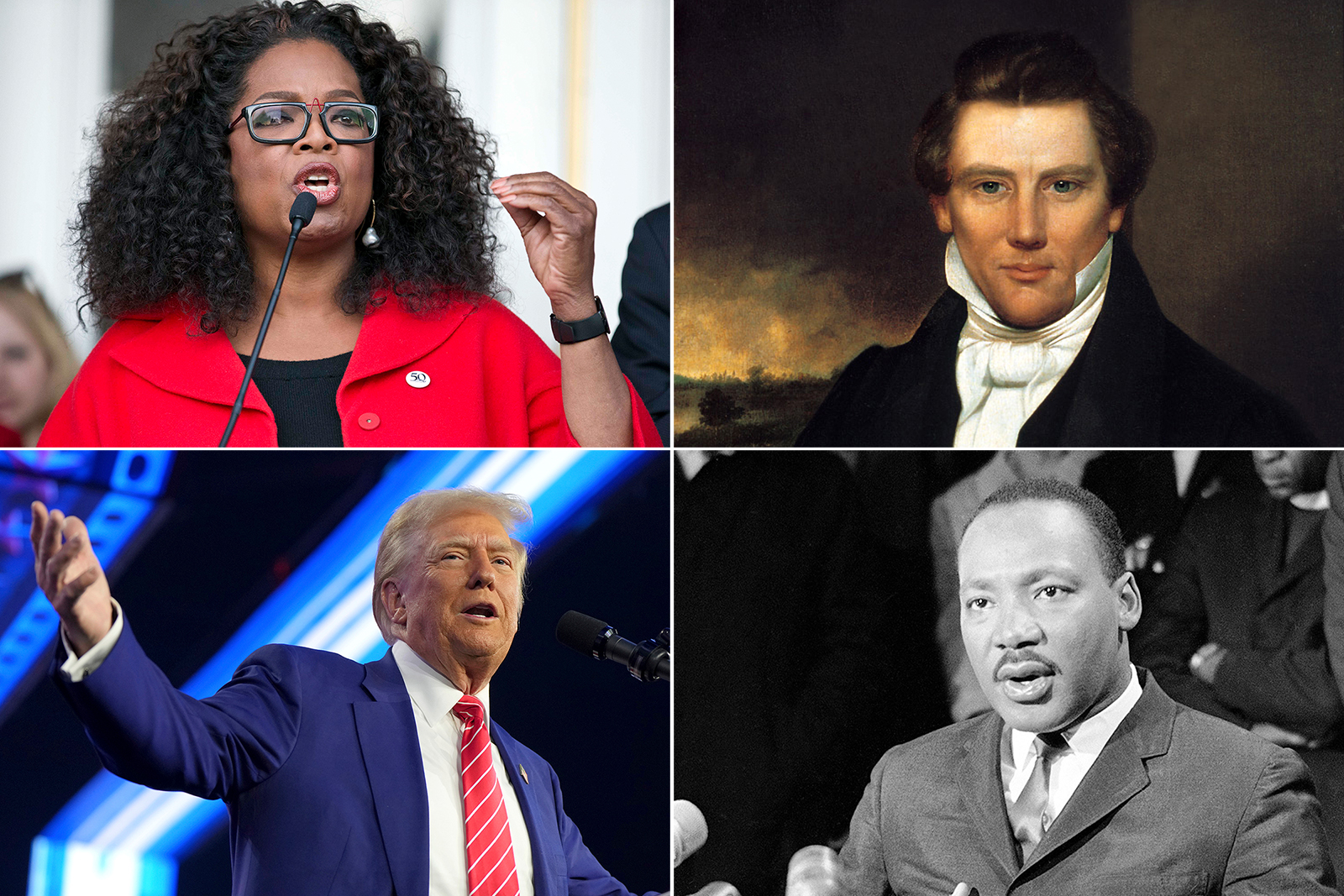
Leaders including Oprah Winfrey, clockwise from top left, Joseph Smith, the Rev. Martin Luther King Jr., and President Donald Trump are highlighted in “Spellbound: How Charisma Shaped American History from the Puritans to Donald Trump.” (AP and RNS file photos)


Yonat Shimron
July 25, 2025
RNS


(RNS) — What drives people to follow a leader and place their faith in that person’s story? That question is at the heart of religion historian and journalist Molly Worthen’s latest book, “Spellbound: How Charisma Shaped American History from the Puritans to Donald Trump.”

Worthen, a history professor at the University of North Carolina at Chapel Hill, describes being fascinated by the qualities that help explain charismatic leadership. In her book, released in May, she posits that charismatic people tell a compelling story about human identity and purpose that others gravitate toward because it helps explain their own role in the grand scheme of life.

Understanding charisma is therefore, a way to understand the religious quest.

In her book, Worthen writes about leaders across 400 years of United States history who served as magnets for multitudes. Among the dozens portrayed are Shaker leader Mother Ann Lee, Native American Shawnee Chief Tecumseh, Mormon founder Joseph Smith, President Andrew Jackson, civil rights leader the Rev. Martin Luther King Jr., Indian-American guru Maharaj Ji, media mogul Oprah Winfrey, and yes, Donald Trump. Some are what she calls apocalyptic destroyers, others are institution builders. Some are beautiful, others are physically repulsive, yet all are alluring because they invite followers into a story that offers them meaning, a glimpse into a hidden reality, and a sense of security and assurance.

Even as Americans’ trust in religious and governmental institutions has collapsed over the past few decades, their religious impulses and their search for ultimate meaning are alive and kicking. As Worthen posits, we may even be at the start of an old-fashioned religious revival.

RNS talked with Worthen about her book and the mysterious quality of charisma that bewitches people who gravitate toward certain leaders. The interview was edited for length and clarity.


“Spellbound: How Charisma Shaped American History from the Puritans to Donald Trump” and author Molly Worthen. (Courtesy images)

You’re both a scholar and journalist who writes frequently about religion. Who did you intend this book for?

I intended it for people who are interested in American history and, like me, scratching their heads about the current political scene. The genesis of the project was about nine or 10 years ago when I was trying to make sense of the rise of Donald Trump and to think through how one individual could provoke such diametrically opposed reactions from different swaths of the country. How could one guy totally repel so many people, but also be so magnetic for other people?

I was also thinking about the way we use the word charisma. People punt to the word charisma when they are observing a phenomenon and they’re not really sure what’s going on — they can’t really account for the appeal of this person by ordinary policy proposals. I think it’s a set of questions that have pretty broad application beyond the academic study of history, which is why I wrote it for a trade press and tried to do it in a character-focused narrative style.

Is the core of your argument that the theory of growing secularization is wrong?

It’s contested. I always try to get my students to understand that secularization is the story of the decline of Western individuals’ relationships with institutions in general, including religious institutions. I absolutely think that secularization describes a real phenomenon. I’m not persuaded that it describes a radical change in what I see to be pretty essential desires and anxieties that humans have had across the centuries. I’m pushing back against the sense that religion is declining in some grand sense and we’re all becoming more rational and see the world purely through a material lens.


Your book offers a panoramic look at 400 years of history. How did you decide which charismatic figures to write about?

It was really hard. Every time I would tell someone about the project, they would say, ‘Oh, are you including X, Y and Z person?’ There’s an almost endless list. I tried to identify particular patterns in history, individuals whose stories would help bring forward those patterns, as well as try to offer the reader a mix of characters. I felt I had to have a certain number of people who are markers in the American historical narrative, combined with less expected figures who show the interweaving of religion and politics. It’s an art and not a science. I’m sure I could have written other versions of the book with wholly different characters.

I did make the decision to focus on religion and politics, not because I think that charisma doesn’t show up in other forums, but because I’m telling a story about the way a particular kind of storytelling yields a kind of power over people that is easiest to see in the spheres of religion and politics. One of my arguments is that we confuse charisma with charm and celebrity. I think it’s important to distinguish them. Much of what people use charisma to describe in these other spheres is better captured in discussions about celebrity.


It seems like all the different types of charismatic leaders you portray converge in Trump. Do you see that?

I struggled with the role of Trump in the story because on the one hand, the project began as an effort to try to explain him, but I don’t see him as the culmination of four centuries of American history. Rather, I think understanding the patterns that stretch across four centuries of history helps us contextualize Trump. There are certain ways in which he is sui generis. At the same time, Trump’s success as a political leader is in continuity with earlier episodes in American history and with this destructive impulse that we see in some leaders to tear down established traditions and institutions. In our own moment, institutions are weaker than they have ever been, and Americans are more atomized and isolated than ever, disconnected from various communities that used to anchor us. And so, I think that there is scope for a charismatic leader who has a gift for offering a counter narrative that further erodes institutional authority to really gain more power than perhaps was possible in the past.

I think, too, that Trump has a real gift for telling a story about himself that then gets woven into a story about the country. He’s always talking about how people are constantly trying to screw him over and everything is a scam; the whole system is rigged. It flows so cleanly into the story he begins telling about how America is getting screwed over. So it’s kind of easy for him to become the avatar for people who increasingly feel excluded from the kind of economic gains of globalization.

I also think he is in no way an orthodox Christian. He grew up going to Norman Vincent Peale’s church in New York City. His native spiritual tradition, which I think is very sincerely ingrained in him, is the power of positive thinking. You could argue it’s one of the dominant spiritual traditions within Christianity in America — this sense that we can manifest the future that we want to see. That’s very much Trump’s spiritual formation. His connections with some conservative Christian representatives of that, like Paula White-Cain, long predate his formal interest in politics.

Many of these strands do come together in Trump, but I guess I want to resist aggrandizing him too much. But I do think his charismatic storytelling ability, his gift for convincing followers that he will pull back the veil on a picture of the world that the elites have been keeping you from seeing all this time, I think that is really appealing and helps us explain the support of his base.


You spent a bit of time on some leaders of the New Apostolic Reformation. Do you think there is a kind of apocalyptic revival happening today and do you see them as leading that?

It is interesting how Trump has awakened outside observers to the presence of these independent charismatic churches. They’ve always been really big, but now we’re finally paying attention. The more I learn about the NAR, the more I’m struck by its internal diversity. I do think there’s been a problem in the reductionist account of the NAR as this sort of unified army of foot soldiers. There are some leaders and congregations in this subculture that are very politically activated, Others are focused on missions and quite politically mixed. It’s such a slippery phenomenon because they’re not denominations with a normal hierarchy. They’re networks. They’re global. The average secular person expects to find white supremacists. It’s not what you see at all in many of these churches.

I think that there are real hazards though. These very independent churches are averse to the traditional hierarchies, averse to having pastors with degrees from traditional seminaries, skeptical of institutions, which has been a feature of modern Pentecostalism and charismatic churches since they began as a real movement more than 100 years ago. There’s a way in which that belief that you are receiving a message directly from God, unencumbered by checks and balances from a sober institution can empower radical activity. That’s a powerful, activated frame of mind, that when allied with the incredible strategic savvy of the second Trump administration can yield very serious political consequences.

You talk in the book about two kinds of charismatic figures: the apocalyptic destroyers and the institution builders. I guess it’s possible an institution builder could emerge again in the future, right?

I think that charisma by itself is morally neutral. It doesn’t carry with it inherently a moral valence, so I think the lens of charisma helps us understand Martin Luther King, and it helps us understand Hitler. The difference is whether the story that the charismatic leader is telling is anchored in empirical fact. So you can tell a true story, or you can tell one that is full of lies and manipulations. That’s an important distinction.

I also think charismatic leaders who ultimately serve moral progress have healthy relationships to institutions and checks and balances and structures of accountability. There’s a limit on the authority they accrue to themselves as individuals. The American left is struggling with the grand narrative problem that can truly be a counterweight to the MAGA story, but that isn’t to say that it can’t happen. I do think that maybe these little signs of heightened interest in the stability of institutions and the connections they offer to the deep past may indeed indicate a hunger for a leader who tends in that direction. I hope.


Conference explores spiritual care as resistance to US political situation

CHICAGO (RNS) — While IASC has an international focus, many references were made throughout the annual conference to the current political moment in the United States.


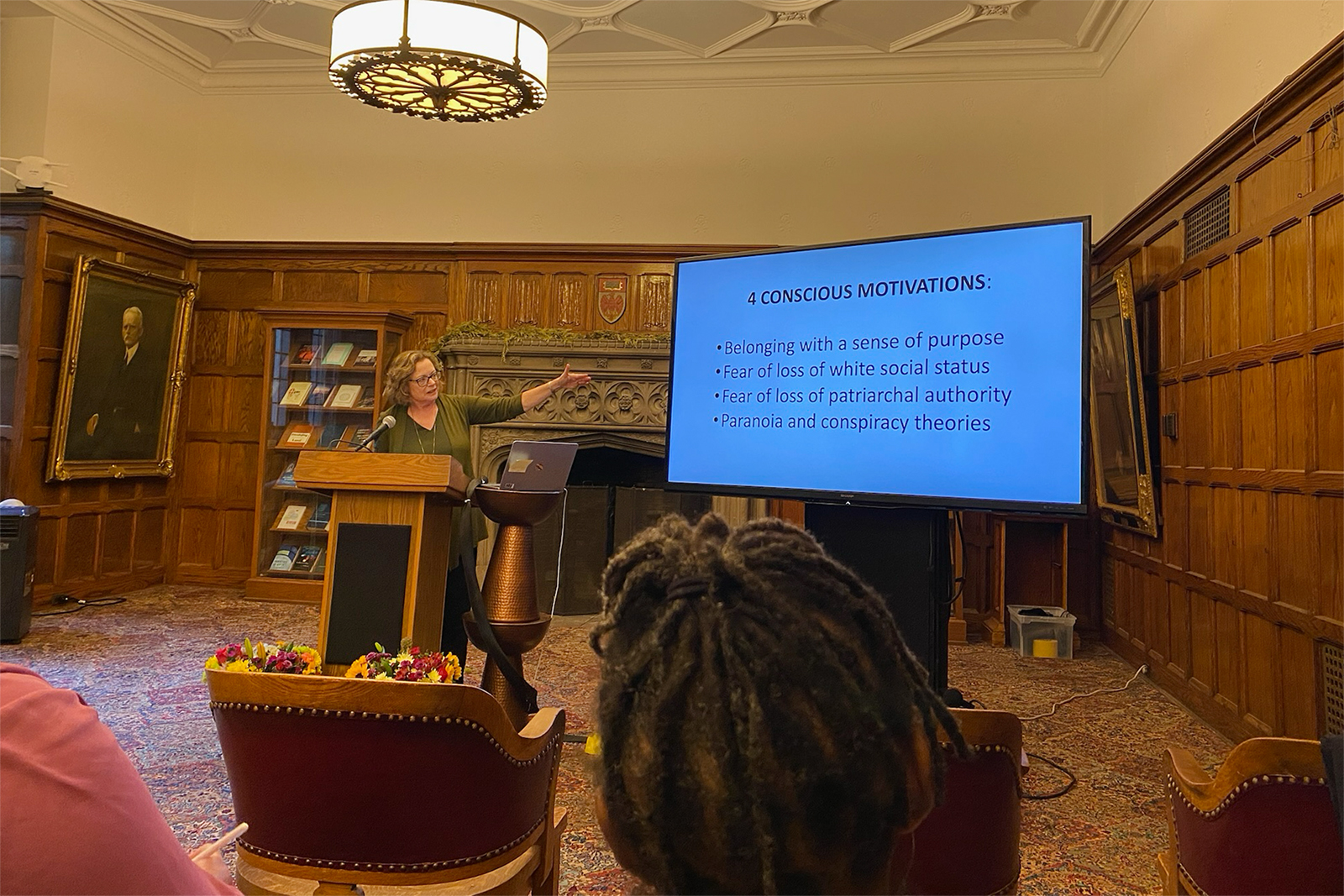
The Rev. Pamela Cooper-White presents a lecture titled “Spiritual Care as Resistance: Christian Nationalism, White Supremacy, and the Rise of Authoritarianism," Sunday, July 20, 2025, during the International Association for Spiritual Care annual meeting in Chicago. (Photo by Rachel Berkebile)


Rachel Berkebile
July 25, 2025

CHICAGO (RNS) — The International Association for Spiritual Care met in Chicago for its annual conference from July 20-22, under the theme “spiritual care as resistance,” which focused on how to address the current political moment through the field’s expertise.

About 50 people attended the conference, both in person and online, including pastoral care scholars, hospital chaplains and clergy. The attendees from at least four continents represented a variety of faith traditions, including Christianity, Judaism, Islam, Buddhism, paganism and those of no religion.

In contemplating spiritual care as resistance, speakers covered topics from religious trauma and how to heal it, to how spiritual care can be used for groups rather than just individuals, to how to embody one’s values of care and justice when they go against a larger system. While IASC has an international focus, many panelists referenced the current political moment in the United States throughout the conference.

The Rev. Pamela Cooper-White, IASC founding member and former president, set the tone with her public lecture on Sunday evening titled, “Spiritual Care as Resistance: Christian Nationalism, White Supremacy, and the Rise of Authoritarianism.”

“This is probably the angriest talk I’ve ever given,” she said. “U.S. President Donald Trump and his loyalists have taken a wrecking ball to virtually everything touching on racial, gender and climate justice that most, if not all, of us here have worked on for decades. And the consequences are dire and potentially long-lasting.”

Cooper-White’s 2022 book, “The Psychology of Christian Nationalism: Why People Are Drawn In and How to Talk Across the Divide” was featured heavily in her lecture as she unpacked how she sees Christian nationalism affecting the American political landscape. She concluded with a call to action.

“The current escalating racist attacks on immigrants and people of color, LGBTQ persons, and the blatant reversal of environmental protections, call us to consider spiritual care as resistance,” she said. “We have engaged personally in practices of resistance in our own communities, but we perhaps need more collective, political and policy-oriented action. … As an international and explicitly interreligious organization, we as members of IASC have the knowledge and the power collectively to make a more public witness against all that we see is eroding the cultural and religious values that undergird our work of care.”

Spiritual care, sometimes referred to as pastoral care, has many overlaps with therapy or counseling, both taking place in a one-on-one setting between a care seeker and provider. However, instead of caring for one’s mind like in therapy, spiritual care focuses on one’s soul, centering the care seeker’s personal lived theology. Historically, most think of chaplains or those who commonly work in hospitals, prisons and with the military as performing this work. But spiritual care is also central to the work of spiritual directors and most clergy.

IASC, which was founded in 2015 in Bern, Switzerland, aims to enhance the capacities of spiritual care scholars and practitioners in acquiring, disseminating and applying knowledge of theory and practice of the field, and emphasizes interdisciplinary, interreligious and intercultural scholarly investigation, according to its mission statement.

The group began as a nonprofit, but in 2023, the board decided to drop its nonprofit status. Since then, it has operated as a volunteer-only organization. The board members at the time of the switch realized that what the association was best at was putting on the annual conference and creating books from the content, Cooper-White said. They wanted to make the annual conferences their focus, rather than collecting members and dues.

One of IASC’s books is “What Is Spiritual Care?” in which contributors in various caregiving professions, religious traditions and cultural contexts offered their answer to the question. “The cumulative impact of this work emphasizes that spiritual care is inseparable from larger efforts towards justice and peacemaking,” IASC said of the book on its website.


The Rev. Cynthia Linder, from left, leads a panel discussion on the book, “What Is Spiritual Care?” with Rabbi Mychal Springer, the Rev. Pamela Cooper-White, Daniel Schipani, president of IASC, and Mahmoud Abdallah, Tuesday, July 22, 2025, in Chicago. (Photo by Rachel Berkebile)

Members of the IASC board, including its president, Daniel Schipani, and contributors to the book spoke about the question on a panel, discussing the importance of and challenges around their attempts to maintain a broad, international and interfaith definition of spiritual care.

Each speaker on the panel offered their definition of spiritual care. Rabbi Mychal Springer, who founded the Center for Pastoral Education at Jewish Theological Seminary in New York City, said spiritual care is the “work of sustaining people in the spirit.”

Schipani’s definition included spiritual care as “a compassionate response to human suffering.” While Mahmoud Abdallah, an academic staff member at the Center for Islamic Theology at the University of Tübingen in Germany, said the field of spiritual care “is still open to design.” The panelists seemed to agree on the importance of community in doing the work of pastoral care and that it is not work that can be done alone.

Palestinians Fight for Survival is at the

Forefront of a Worldwide Struggle against

Global Fascism


An interview with Prof. David Klein


Q: How long did you teach mathematics at Cal State University, Northridge?

David Klein:  I was there for a little more than three decades. Before that, I taught at UCLA and USC, and before that at Louisiana State University in Baton Rouge. There, I got into some trouble. I was arrested for taking over a U.S. Senator’s office along with half a dozen Quakers in protest of weapons to the Nicaraguan Contras. I also had a little run-in with the Ku Klux Klan and was sued by right-wing Central American students for bringing in speakers they didn’t like. They sued me for “mental anguish”. Of course, the suit was thrown out of court, but it was a distraction. So, when I got the position at CSUN, I was very happy to get a permanent position there.

Q:  So “mental anguish” …. that’s a recurring theme of the critics.

DK:  Yes, it’s one of their tools. Claiming to feel bad about what we talk about.

Q:  How did you become interested in Israel-Palestine?

DK:  Well, it was kind of gradual. When I was a kid, I was very pro-Israel. And then in college, I started to have doubts and talked to more people. And the more I learned, the more obvious it was that this was a settler colonial state that was engaged in pretty much what the United States did to the Native Americans. And then there was a real spike in my understanding and activity with the 2009  “Cast Lead” assault on Gaza by Israel. That really increased my activism. It was just a new level of outrage that I and many people felt.

Q:  I understand you didn’t talk about politics in your mathematics classes, but that you were otherwise active. What did you do, and what attacks or censorship did you experience?

DK: That’s right. I was careful not to bring it up in my classes since it didn’t really have direct relevance. But I was the faculty advisor for Students for Justice in Palestine and for the Student Green Party and a few other student groups. So, I created a webpage, a BDS resource webpage on the university server from my faculty webpage. Then, I wrote an open letter that was signed by many CSU faculty, administrators, and students to the chancellor of the entire CSU system, demanding that CSU end the study abroad program in Israel for a variety of reasons.

That got some news coverage and brought a lot of attention to my website. So, that was the start of a lot of attacks.

There were hundreds of calls to my university president that I be fired. There were some threats, some kind of death threats. There were some threats to the administration to withhold financial contributions. There was just lots of slander. Some of it came from the campus itself, but it was mostly outside from the Zionist Organization of America, a group called AMCHA, and other groups. And then there were some politicians who joined in the attacks. The local congressman, Brad Sherman, and a California assembly member, Bob Blumenfield, who later became a city council member.

An Israeli-supported law firm pressured then Attorney General Kamala Harris to prosecute me. And they separately asked the Los Angeles City attorney to do that. But those requests came to nothing. Still, I was required to produce massive amounts of emails, anything regarding Israel-Palestine, and regarding logistical planning to bring in guest speakers Ilan Pappe and Norman Finkelstein. These threats and demands went on and on for a long time. And on my website, I  posted a page of the threats, the nasty comments, and the calls for my removal. They were signed by doctors and other professionals, but used really low-level language.  The ugliness that it brought out was amazing.

Q: So you were part of organizing and hosting famous academics such as Norman Finkelstein and Ilan Pappe. How did those visits go, and what were the results?

DK: The Norman Finkelstein visit lasted a week. He gave three lectures, and there was a group of us who wanted to hire him at CSUN after he lost tenure at DePaul University. And so that included 30 faculty members from various departments, including the science departments and social studies, social science departments, and a wide range. And it was going well. We got the approval of a department that wanted to hire him, the journalism department, and it went up to the top, and we were all set to go. And then, at the last minute, it was vetoed by the campus president. Norman asked me to write an article about the whole thing, which I did.

The visit of Ilan Pappe came later in 2012.  We had to have campus police escorts because of the threats. But he was very persuasive and compelling. Both of these guests were. The students were very engaged and it went well.

Q:  I know that there was a big campaign to prevent the tour by Ilan Pappe, but ultimately, the presidents of several CSU universities defended his right to speak. Is that correct?

DK: Three of the campus presidents wrote a letter defending academic freedom. It was an open letter, but it went to the chancellor of the entire CSU system. The visits went smoothly logistically because of that. And it was pretty rare that campus presidents would stand up for academic freedom and freedom of speech for speakers like Ilan Pappe, who very strongly promotes Palestinian human rights.

Q: You’ve been an active supporter of the cultural and academic boycott of Israel. Why do you think this is important?

DK: It’s an important part of the general Boycott, Divestment, and Sanctions movement. Academics and culture are very important within Israel. And so this particular aspect of BDS lends what we think is special leverage to isolate the Zionist state because of its actions. Israeli universities are deeply complicit in the persecution and genocide of Palestinians. Maya Wind’s new book, “Towers of Ivory and Steel”, documents that very clearly. Focusing on academics is very pertinent to what’s going on. And the cultural boycott has a very large impact. Everybody recognizes when a famous artist, a singer, or a musician refuses to go to Israel and states the reasons.

Q: But critics of Israel and supporters of BDS are under attack. Do you think the censorship and attacks are the same as in the past? Or is it getting worse?

DK:  It’s getting much worse. The accusation of anti-semitism has been weaponized. Students, teachers, and professors are facing frivolous lawsuits. Students are facing expulsions. Faculty are facing job loss. Both are facing arrests and deportations for opposing genocide because it might hurt the feelings of the killers. Zionist students and outside advocates of genocide claim to feel unsafe because of demonstrations against Israel’s genocide. And they call human rights activists “anti-semitic”.  Even the Jewish activists. And so it’s much more intense now than in the past. They were just sort of getting warmed up on people like me, and now they’ve really sharpened their knives.

Q:  Do you have any strategy suggestions for campus activists who oppose the genocide happening in Gaza?

DK: Yes. I think we would do well to be less defensive and go on the offense. Pleading academic freedom and denying that we’re anti-semites is not really going very far. I think we need to move in the direction of accusing the accusers. Israeli soldiers are intentionally killing babies and children, shooting boys in their testicles, torturing doctors to death, and more broadly, carrying out the extermination of the entire Palestinian people. These are the worst of the worst. And we need to point to them, not just defend ourselves from their empty accusations.

By defining opposition to genocide as antisemitic, they’ve turned antisemitism into a virtue. Hitler could have only dreamed of this kind of linguistic transformation. And in this sense, the Zionists are the biggest antisemites on the planet. They’re the worst of humanity. So I think that the least vulnerable among us should take the lead, especially US-born tenured professors.

And we should focus on where the real power is.  For K-12 schools, it is the school boards. But for almost all colleges and universities in the United States, whether they’re public or private, the board of trustees is the institution’s highest decision-making or governance body.

Members of the board are typically very rich. They have a lot of political power within the country, not just in universities. To give one example, Miriam Adelson is on the USC Board of Trustees. Miriam Adelson was married to the late Sheldon Adelson. He was a very rich billionaire. Both of them are rich billionaires. And Miriam Adelson’s Foundation contributes $200 million each year to Israel. And she was one of the biggest Trump donors as well. So, there are a lot of university trustees like that. They come from weapons manufacturers, the oil and gas industry, and other major corporations. And they’re overwhelmingly Zionist.

University presidents, who appear to be in charge of their campuses, serve at the pleasure of the boards and can be hired and fired at the whim of these boards of trustees. So the boards of trustees are the real power at universities. They are behind the persecution of opponents of genocide. The college presidents who do cave in to the Zionist censors should face no-confidence votes from their faculty senate on campus. But, there really hasn’t been enough focus on the boards of trustees. And I think that’s the next step. There are a number of people who are coming to the same conclusion on campuses and universities.

A lot of research would be involved to find out who these people are, what their background is, expose them to the public, and show what they’re doing, and try to get them kicked out. Replace them with decent human beings. It’s like you’re either for genocide or against it. If you don’t care, that doesn’t say much good about you. So being anti genocide is the minimal criterion for human decency. After all, if they’re going after and attacking people who are trying to stop a genocide, that makes them horrible human beings, and they shouldn’t be in charge of anything.

Q: Do you have any final comments?

DK: I think the importance of the Palestinians’ fight for survival can hardly be overstated. Their struggle is not only for themselves, but it’s at the forefront of a worldwide struggle against global fascism. And that includes the climate catastrophe, because global fascism can only accelerate planetary suicide.

David Klein is Professor Emeritus of Mathematics at California State University, Northridge (CSUN). 

Rick Sterling is an investigative journalist in the SF Bay Area. He can be reached at rsterling1@protonmail.comRead other articles by Rick.