It’s possible that I shall make an ass of myself. But in that case one can always get out of it with a little dialectic. I have, of course, so worded my proposition as to be right either way (K.Marx, Letter to F.Engels on the Indian Mutiny)
Monday, August 18, 2025
EPSTEIN'S OTHER BUDDY
An ‘Entitled’ scandal: Here are the key takeaways from the scathing new Prince Andrew biography
“Entitled: The Rise and Fall of the House of York”, by Andrew Lownie, “traces the life of the late Queen’s second son.” It hits the shelves today. Here are some of the key takeaways from a scathing exposé.
Short-tempered, vain, arrogant, sex obsessed... Prince Andrew, Duke of York and the younger brother of King Charles III, does not come off well in Andrew Lownie’s new book, “Entitled: The Rise And Fall Of The House Of York.”
To say the very least.
The new biography, which tells the story of "a spoilt prince unable to connect and a duchess pushed by her insecurities into a desperate need to maintain the attention her ‘royal’ status brought," is based on court papers, freedom of information disclosures, interviews with ex-staffers and correspondence.
The 450 pages reportedly took Lownie four years to complete, and he paints an unflattering portrait of the Duke of York – from shady financial deals to sex scandals and close ties with convicted sex offender Jeffrey Epstein.
Extracts from the book were serialised in the Daily Mail newspaper, and the biography hits shelves today.
It comes as a YouGov poll suggests that not only is Prince Andrew is the most unpopular royal in the country, but also that two thirds of Britons would support stripping him of his remaining royal titles - Queen Elizabeth II having stripped her son of his military titles and patronages in 2022.
“Entitled: The Rise And Fall Of The House Of York” will do nothing to lower his polling numbers.
Here are five of the key takeaways from this damning new book.
"Entitled: The Rise and Fall of the House of York" by Andrew Lownie Harper Collins
Andrew and Epstein’s relationship
“Entitled: The Rise And Fall Of The House Of York” dwells on the relationship between Andrew and convicted sex offender Jeffrey Epstein, saying that their bond was much closer than the prince has admitted
Lownie claims that Andrew “was easy prey for a rattlesnake like Epstein,” adding: “Epstein played Andrew. The prince was a useful idiot who gave him respectability, access to political leaders and business opportunities. He found him easy to exploit.”
Lownie reports that Ivan Novikov, Epstein’s personal driver, claims he remembers driving the prince around with “two young girls around eighteen to the Gansevoort Hotel in the Meatpacking District. Both girls were doing lines of cocaine.”
Lownie also alleges that Epstein sold Andrew’s “most intimate secrets” to foreign intelligence agencies around the world, including to Israel’s Mossad and the Saudi Arabian authorities.
Andrew claims to have met Epstein in 1999 – something the book refutes, as the pair allegedly already knew each other “almost a decade earlier”.
The book claims that Andrew once called a royal staff member a “f*cking imbecile” for failing to give the Queen Mother her full title.
“He could be unbelievably cruel,” Lownie writes of Andrew’s behaviour towards royal employees.
Other cases of inappropriate and childish behaviour include firing an employee because he wore a nylon tie, dismissing another member of staff because he had a mole on his face, and asking his security guards to retrieve his golf balls.
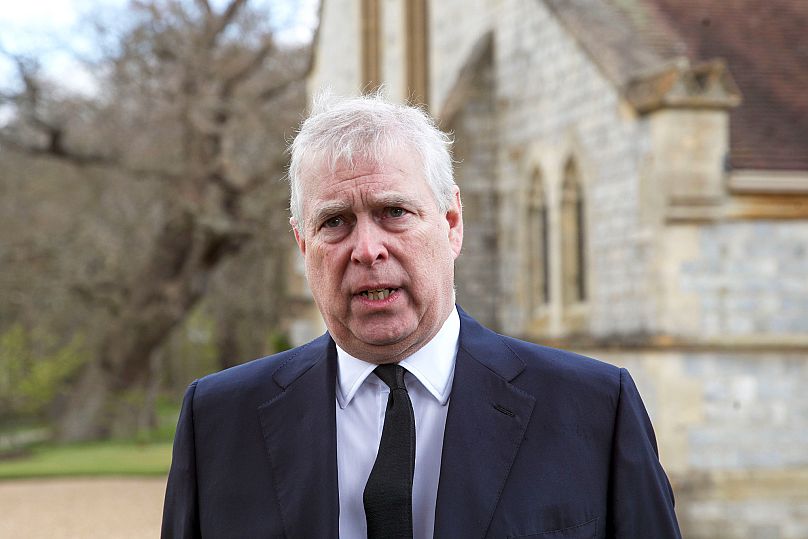
Prince Andrew AP Photo
A tussle with Harry
Lownie alleges that Prince Harry gave his uncle Andrew a bloody nose during a “heated argument” at a 2013 family gathering in which “punches were thrown”.
The book claims that Harry “got the better of Andrew” after the latter said that his marriage to “opportunist” Meghan Markle would not last more than a month.
Lownie also claims: “Buckingham Palace braced itself for historic complaints about Prince Andrew’s bullying, profanities and impossible demands. Some say a report on bullying accusations against Meghan Markle has never been released because it would also raise questions about the behaviour of the queen’s second son.” This refers to the accusations of bullying levelled against Markle in 2021 – accusations which she has denied.
Prince Andrew and Prince Harry AP Photo
The philandering prince
Lownie alleges that Andrew, a “sex addict,” had relations with anywhere from “one thousand” to “three thousand” women, including dozens he met through Epstein.
Regarding his marriage with Sarah Ferguson, the book details how Andrew was in the Royal Navy when he and Ferguson wed in 1986, and most of his time was spent at sea.
“Sarah discovered Andrew wasn’t coming home on some of his leave. He was going elsewhere - and this just drove her crazy,” shares the Duke of York’s former driver in Lownie’s book. The former employee also reveals that “Randy Andy” slept with “more than a dozen women” before Andrew and Ferguson’s first anniversary.
Other claims about Andrew’s sex life include that he lost his virginity at 11 years old, that he “realised he was obsessed with women”, and that dozens of women were brought to his hotel room during a stay in Bangkok.
“Hotel staff were used to foreigners bringing in girls, but amazed that more than 10 a day were going to Andrew’s room,” Lownie writes.
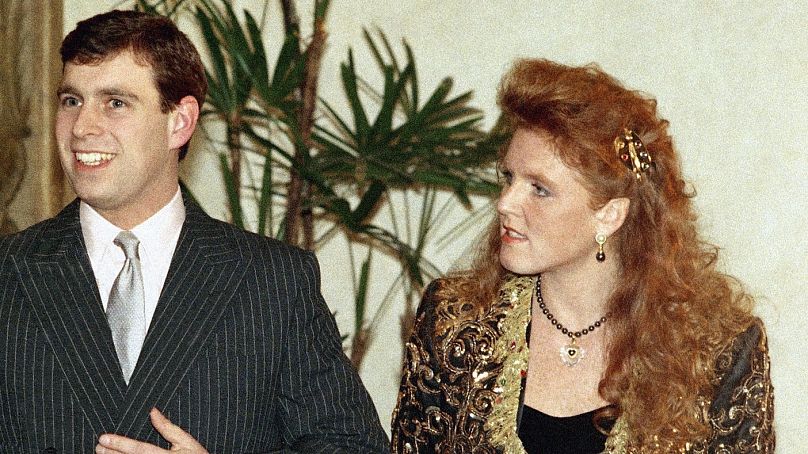
Prince Andrew and Sarah Ferguson AP Photo
Andrew and Sarah’s schemes
The book details Ferguson’s money schemes, as well as how she met with an editor at Hello! magazine to discuss how she could fill the gap left by Princess Diana, following her death in 1997.
She agreed “to give Hello! everything about her for a monthly retainer,” a source told Lownie. “The deal was thought to be worth $134,000 a month.” However, the spotlight is more on Andrew’s grifting.
From 2001 to 2011, he worked as the UK’s Special Representative for International Trade and Investment and met leaders from Azerbaijan, Libya and Tunisia. He was reportedly not shy about asking for gifts and once allegedly demanded he be offered a Faberge egg.
Lownie claims the late Queen Elizabeth II was well aware of Andrew’s shady deals and the handouts, but that she was “not going to do anything” as “it seemed to be that if he wasn’t caught and could get away with it,” then the palace would turn a blind eye.
Throughout the book, Lownie doesn’t just chronicle the downfall of a entitled and petty man, who hasn’t been a "working royal" since 2019, but paints the portrait of the rot at the heart of Britain’s royal family and how “The Firm” favours a misguided sense of loyality over any accountability.
"Entitled: The Rise and Fall of the House of York" by Andrew Lownie, published by Harper Collins, is released on 14 August.
Hamas on Monday informed mediators that it had accepted a ceasefire deal proposal submitted to it the day before, according to international and Israeli outlets.
Hamas on Monday told mediators that it approves of the latest Gaza ceasefire proposal, according to international and Israeli outlets, citing Hamas officials.
The officials did not provide further details at this time.
Israeli media report that the latest proposal was presented to the militant group the day before and was a revised version of Hamas’ latest response, which involved a framework agreement for a 60-day ceasefire and a two-step release of Hamas-held hostages.
Egyptian and Qatari mediators were holding talks with Hamas in their latest effort to broker a ceasefire with Israel in the Gaza Strip.
Israeli Defence Minister Israel Katz reacted to the news on Monday by saying Hamas was open to discussing the deal to release the remaining hostages "only because of its fear that we seriously intend to conquer Gaza City.”
Speaking to senior IDF officers on Monday, Katz said taking control of Gaza City “will lead to the defeat of Hamas," Israeli media reported.
"The leadership is there, and there remain the central infrastructures of the military wing. Hamas also knows that this is now the core of its rule,” Katz added.
Israel announced plans to take complete control of Gaza City after ceasefire talks appeared to break down. The move raised further international concerns amid fears of a worsening humanitarian catastrophe in Gaza, which experts say is sliding into famine.
US President Donald Trump appeared to cast doubt on these talks, posting on social media: “We will only see the return of the remaining hostages when Hamas is confronted and destroyed."
"The sooner this takes place, the better the chances of success will be," Trump emphasised.
Verifying claims Spain sent humanitarian supplies in bad condition to Gaza
A viral video claims to show a bag of humanitarian supplies air-dropped into the Gaza Strip by Spain and other governments containing mouldy contents. Euroverify investigates.
Copyright Abdel Kareem Hana/Copyright 2025 The AP. All rights reserved.
A video spreading virally online shows a young Palestinian opening a bag of aid allegedly air-dropped into the Gaza Strip.
It contains sachets of supplies covered in mould.
The Palestinian in the video says that the bag was parachuted into the Khan Younis and Deir Al-Balah areas, and was being sold "in the markets" for the equivalent of $100 (around €85).
"Can you see? There is mould," he explains, showing sachets covered in a dark substance. "Look how aid with mould is reaching us."
The packet carries the branding of JOMIPSA, an Alicante-based company that provides food rations and humanitarian aid kits to customers including European governments and the NATO alliance.
Photographs of food packs on the JOMIPSA website match those seen in the viral video, which Euroverify detected on X, Instagram, TikTok and Telegram.
The video was first published on 2 August, a day after Spain, along with France, Germany, the UAE and Jordan, air-dropped humanitarian supplies into Gaza in response to the humanitarian crisis gripping the enclave.
Spain provided 12 tonnes of aid, dropped using 24 parachutes. This included 5,500 food rations designed to feed 11,000 people.
Online users have assumed that the bag in question was air-dropped as part of the aid rations donated by the Spanish government.
Euroverify put the claims made by the Palestinian in the video to the Spanish foreign affairs ministry. It firmly rejected what it described as "false information”.
"We categorically deny that, under any circumstances, content was sent in a bad condition," the ministry said in a statement.
The ministry adds that it's impossible to verify the origin of a package without the batch number, but that the Spanish company in question, JOMIPSA, had also sold supplies to other donor countries. Palestinians say aid is being sold at markets
Several Spanish media, including news agency EFE, have also received pictures from Palestinians on the ground in Gaza claiming to show the aid packets being sold at markets.
They say the bags were being sold for 350 shekels (around €90) on the markets.
Testimonies shared with EFE match the Palestinian's account in the video, both in terms of the contents of the bags, namely 24 sachets of foodstuff including biscuits and coffee, as well as the location where the parachutes fell.
Images obtained by Catalan newspaper Diari ARA show bags matching those in the video being sold at a Gaza market.
The director of the UN agency for Palestinian refugees (UNRWA), Philippe Lazzarini, said in a statement after the parachutes were dropped that such methods are "at least 100 times more costly than trucks”.
"If there is political will to allow airdrops - which are highly costly, insufficient and Inefficient, there should be similar political will to open the road crossings," he added.
Spain's foreign minister José Manuel Albares described the aid parachuted into the Strip as a "drop in the ocean" and called for aid to be allowed to enter in a "regular, sufficient and safe way”. Madrid rejects allegations that pork product was included in food aid
Other online users have claimed that the aid bags dropped into Gaza, whose population is predominantly Muslim, contained pork.
Some users have shared a screenshot from JOMIPSA's website in which the contents of one of the available aid packs is listed as including "pork meatballs”.
But there is no evidence that these food rations were included in the packs sent to Gaza, and the Spanish foreign ministry has firmly denied the allegations, saying all meals sent to civilians in Gaza were halal.
1.4 million Canadians missed a credit payment in the second quarter, report says
A consumer pays with a credit card at a store in Montreal . THE CANADIAN PRESS/Ryan Remiorz
TORONTO — There’s a deepening divide among consumers, even as the rate of missed credit payments dipped, a new Equifax Canada report shows.
It shows 1.4 million Canadians missed a credit payment in the second quarter. While that’s up by 118,000 compared with the same time last year, it’s down slightly from the first quarter.
Rebecca Oakes, vice-president of advanced analytics at Equifax Canada, said it’s “a bit of good news” to see the delinquency rate levelling off.
“We’re starting to finally see that stabilize a little bit,” she said in an interview.
“The less good news, though, is that below that high level number, we’re still seeing this financial gap widening for some groups of consumers,” she added, particularly between homeowners and non-homeowners.
About one in 19 Canadians without a mortgage missed at least one credit payment, compared with one in 37 homeowners, the report said.
Total consumer debt rose 3.1 per cent year-over-year to $2.58 trillion, Equifax said, while average non-mortgage debt per consumer increased to $22,147.
Oakes said various factors, including high unemployment and economic uncertainty — amplified by trade disruptions — have made it harder for many Canadians to keep up with day-to-day expenses.
Consumers under the age of 36 are being hit the hardest, the report suggests.
Millennials and gen Z saw their average non-mortgage debt rise two per cent to $14,304 from a year ago. The group’s 90-plus days non-mortgage balance delinquency rate also rose to 2.35 per cent — a 19.7 per cent jump year-over-year.
“The affordability crisis seems to be hitting younger consumers the hardest,” Oakes said. “Between rising costs, employment uncertainty, and limited access to affordable credit, many are struggling just to stay afloat.”
Also, many homeowners who locked in lower mortgage rates during the height of the pandemic could see their payments rise upon renewal.
“Payment levels are going up for many consumers when they’re renewing their mortgage and when that is a little bit too much, the first place you tend to see that is (missed payments) on things like credit cards,” she said.
Ontario remained the hot spot for financial distress in the second quarter. The 90-plus day delinquency rate was 1.75 per cent, which is 15.2 basis points higher than the national average, the report said.
The rates of missed payments were even higher in the city of Toronto and the surrounding area, which are exposed to the tariff-hit auto and steel sectors.
However, Oakes said the financial gap between homeowners versus non-homeowners in Ontario peaked last year and has started to come down. Another credit-tracking agency, TransUnion, released its second-quarter consumer credit report last week.
It said consumer debt reached $2.52 trillion in the second quarter, up 4.4 per cent year-over-year.
“Subprime consumers are more likely to feel the impact of higher costs of living and may choose to take on additional debt, such as credit card balances, to help cover the costs of goods and services,” Matthew Fabian, director of financial services research and consulting at TransUnion Canada, said in a statement.
“For other risk tiers of borrowers, their card balance growth has been less than the rate of inflation, indicating that these consumers are less reliant on credit cards to maintain purchasing power,” he said.
This report by The Canadian Press was first published Aug. 18, 2025.
Ritika Dubey, The Canadian Press
Alberta planning to power some of its jails with solar energy
Alberta's infrastructure ministry says it plans to build solar installations at five correctional facilities in Edmonton and Calgary.
EDMONTON — Alberta’s government is looking to power some of its jails with solar energy.
The province says it’s planning to build solar installations at five of its 10 correctional facilities, with early energy cost savings estimated at $1 million per year.
“The solar installations are expected to offset approximately 80 per cent of the energy used at each site,” Michael Kwas, press secretary for Infrastructure Minister Martin Long, said in an email.
He said the estimated savings will likely change as the installations are further designed.
A procurement document published by the province, which lists future projects with approved construction funding, says the government’s budget for the solar proposal is anywhere from $10 million to $50 million.
Like the savings, the budget figure is also preliminary, Kwas said. A more exact estimate would be determined later as planning progresses.
While the ministry didn’t say which jails have been chosen, Kwas said two are in the Edmonton area and three are around Calgary.
“The significant amount of non-agricultural land, underutilized land on these sites presents an ideal opportunity for ground mounted solar installations,” Kwas said.
There are three provincial jails in the capital region: the Edmonton Remand Centre, which houses those awaiting trial; the Edmonton Young Offender Centre, directly beside the remand centre; and the Fort Saskatchewan Correctional Centre, northeast of Edmonton.
Calgary has a remand centre, a young offender centre and a correctional centre, all of which are built beside each other. There are also correctional facilities in Lethbridge, Medicine Hat, Peace River and Red Deer.
Some other government-owned buildings are already equipped with alternative energy generation systems, Kwas said, but didn’t provide examples.
“None of the (existing) installations are as large as those planned for the correctional centres.”
Kwas added the Edmonton facilities use about 11,500 megawatt hours of energy annually. Calgary’s total is roughly 6,300 megawatt hours per year.
Alberta-based utility supplier ATCO says the average home in the province uses roughly seven megawatt hours annually.
The procurement document says the province plans to start accepting bids to build the solar arrays later this year or in early 2026. Stephen Legault, an Alberta-based senior manager with advocacy group Environmental Defence, said he doesn’t know if other jails in Canada are solar powered, but he’d be thrilled if Alberta were breaking new ground.
“When little announcements like this come out that suggests somebody is thinking rationally within the government about our energy future, it makes me pretty happy,” Legault said.
“It’s a great idea.”
The office of federal Public Safety Minister Gary Anandasangaree said no prisons currently run on solar power. “We wish the Alberta government well in their pursuit of renewable energy solutions to power their correctional facilities,” a spokesperson says in an email.
While it seems to be a unique proposal in Canada, using solar energy to power jails and prisons is almost common south of the border.
Ned Lamont, governor of Connecticut, announced earlier this year seven state-run correctional facilities were being powered in part by new solar arrays expected to save the government USD$11 million over the lifespan of the panels.
“Installing solar energy systems at correctional facilities is a way that we can deliver cost savings in the operations of state government while also reducing our carbon footprint,” Lamont said in an April news release.
There are also examples in Colorado and California.
The Santa Rita Jail, near Dublin, Calif., had the largest rooftop solar installation in the entire United States when nearly 10,000 panels were installed between 2001 and 2002.
Legault said he was somewhat surprised by Alberta’s plan.
The province put a seven-month moratorium on project approvals for solar and wind energy in 2023, along with “draconian” rules on new projects that restrict where new solar and wind farms can be built.
Kwas said the infrastructure ministry is always looking for ways to improve efficiency and reduce costs, “including innovative energy solutions that minimize environmental impact.”
Legault said Alberta shouldn’t stop at jails when it comes to putting up new solar arrays on or around provincially owned buildings.
“The only barrier is ingenuity, creativity and cash. And the third one is something that I will admit is always difficult,” Legault said.
“My hope would be that it would lead this provincial government to realize that renewable energy isn’t necessarily the boogeyman.”
This report by The Canadian Press was first published Aug. 18, 2025.
Jack Farrell, The Canadian Press
Poilievre should ‘put partisan stripes aside’ and work with Carney amid Trump threat: Ford
Premier Doug Ford spoke on Donald Trump’s tariff wars, the Air Canada flight attendant strike, and more after meeting with Prime Minister Mark Carney.
Ontario Premier Doug Ford is encouraging federal Conservative Leader Pierre Poilievre to “put partisan stripes aside” if he wins back a seat in the House of Commons, amid an ongoing trade war with the United States.
“Work with the prime minister,” Ford said, when asked by reporters on Parliament Hill Monday if he has any advice to offer Poilievre.
“Let’s put our political stripes aside and start working together collectively on large infrastructure projects, on other areas that he can cooperate with the government,” he added, on his way out of a meeting with Prime Minister Mark Carney.
Ford is in Ottawa to attend the Association of Municipalities of Ontario conference, but he sat down first with Carney to discuss trade and Canada-U.S. relations.
Voters in the rural Alberta riding of Battle River—Crowfoot, meanwhile, are casting their ballots Monday, in a byelection where Poilievre hopes to win back a seat in Parliament. He lost the Ottawa-area riding he’d held for more than 20 years during the April general election, to Liberal political rookie Bruce Fanjoy.
“All I want to do is move forward collectively as a government,” Ford said, when asked whether he plans to meet with Poilievre if the latter wins the byelection. “I don’t care about political stripes.”
“The person I’m working with right now is the prime minister of the day, and as far as I’m concerned, he’s doing a really, really good job, considering the position he’s been put in,” Ford added. “I challenge anyone try to deal with (U.S. President) Donald Trump, myself included. He’s a different type of cat.”
Both during and in the aftermath of the federal election campaign in April, there were reports of a rift between Ford’s Progressive Conservatives in Ontario and the federal Conservative party.
Leading Conservative campaign strategist and Ford campaign manager Kory Teneycke took aim at Poilievre and his team, accusing them of squandering a 20-point lead in the polls, and calling it “campaign malpractice at the highest level” on the Curse of Politics podcast.
Ford later defended Teneycke, and said he wouldn’t interfere in the federal election, but also pointed out Poilievre never campaigned or contributed during the provincial election that had taken place just two months prior. Carney ‘doing an incredible job’ amid trade war
Canada has been in a protracted trade war with the U.S. since February, when Trump imposed sweeping tariffs on Canadian goods that he said were related to border security. In the months since, the U.S. president has stacked additional sectoral tariffs, including on steel and aluminum, copper, and autos.
Canadian countermeasures also remain in place.
Carney, meanwhile, was unable to secure a deal with Trump ahead of a much-anticipated Aug. 1 deadline, at which point the U.S. tariffs on Canadian goods that are not compliant with the countries’ trade deal went up to 35 per cent.
“He’s doing an incredible job,” Ford said, when asked whether he believes Carney has been too elbows down on Trump. “He’s working collaboratively with 12 other premiers, myself and working as Team Canada.”
“And he’s doing a very, very good job, in my opinion, put in this position dealing with Donald Trump,” Ford added. “Let’s not worry about Donald Trump. We’ll start focusing Ontario and Canada and all the other provinces and territories.”
The Ontario premier — who’s repeatedly said he’s in favour of taking a hard line on Trump — said his focus is on encouraging investment in Canada to reduce the country’s reliance on the U.S., and pointed to measures like tax cuts and reducing “regulatory burdens.”
“You know, I always said that we can never predict what Donald Trump is going to do, but we can create the environment and conditions for companies to come here and invest and direct foreign investment,” he said.
“I won’t speak for the prime minister, (but) what I what I can tell you, we’re united on the message of, ‘let’s start worrying about how we can be competitive here,’” Ford also said of the ongoing trade dispute. “Donald Trump is so unpredictable I don’t even know what he, if he knows what he’s doing tomorrow morning, so let’s start focusing on creating that environment to attract investment.”
On his way out of the meeting with Ford, Carney described it as “very good,” but did not otherwise take questions from reporters.
Ontario Premier Doug Ford says he had a ‘great discussion’ with Prime Minister Carney on combating tariffs and improving the economy.
Rolled coils of steel sit in the yard at Algoma Steel Inc., the second largest steel producer in Canada, along the St. Marys River in Sault Ste. Marie, Ont., Thursday, July 24, 2025. THE CANADIAN PRESS/Nick Iwanyshyn
OTTAWA — China is taking its dispute with Canada over steel tariffs to the World Trade Organization.
Beijing filed a complaint Friday with the WTO in response to Canadian restrictions on imports that contain steel melted or poured in China.
Prime Minister Mark Carney announced last month that he was imposing the 25 per cent surtax on products containing Chinese steel to protect the domestic industry in the face of steep U.S. tariffs.Latest updates on commodities here
But China said those duties are “discriminatory,” according to a translation of a statement issued by the Chinese commerce ministry.
“This is a prototypical measure reflecting unilateralism and protectionism, which damages China’s legal rights and disrupts the global stability of steel product supply chains,” the translated statement said.
China said it is disappointed by the move to impose tariffs and urged Canada “to correct its erroneous actions.” The statement also made reference to protecting the multilateral rules-based system of trade and improving Canada-China trade relations.
The Canadian Press reached out to Global Affairs Canada for comment on Friday but has yet to receive a response.
Carney said at his announcement of new steel industry protections in July that some foreign competition “unfairly benefits” from non-market policies.
This can include companies exporting products at a lower price than they charge domestically - a practice known as dumping.
Canada’s trade dispute with China ramped up this week after Beijing imposed a tariff of nearly 76 per cent on Canadian canola seed starting Thursday - an apparent response to Canada’s ongoing tariffs of 100 per cent on Chinese-made electric vehicles.
China imposed the duties after what it said was an anti-dumping investigation into Canadian canola. Ottawa has denied that Canada is dumping canola.
Lawrence Herman, a Toronto-based international trade lawyer, said in an email to The Canadian Press on Friday that the WTO complaint is a “cynical ploy.”
China often offends “the very basis of the WTO agreement” with its use of state capitalism and aggressive takeovers of foreign markets through subsidized exports, Herman said.Trade War coverage on BNNBloomberg.ca
China exploits and disregards the WTO’s own trade rules by “preventing foreign companies from fair and open access to its own market and, in one way or another, acquires western technology though various devious mechanisms,” he argued.
Herman said Canada can defend itself at the WTO by pointing out China’s own “egregious actions.”
Herman said that even if China’s case were to be proven, he questions the ability of the WTO dispute settlement process to produce a substantive penalty.
The organization authorizes members to impose sanctions based on a consensus finding of wrongdoing, but cannot hand out penalties unilaterally.
“The result is that while Canada will contest the Chinese claim, at the end of the day the dispute process can’t lead to any meaningful legal result,” Herman said.
---
Craig Lord, The Canadian Press
This report by The Canadian Press was first published Aug. 15, 2025.
Global Nuclear Power Hits Record High as Asia Surges Ahead
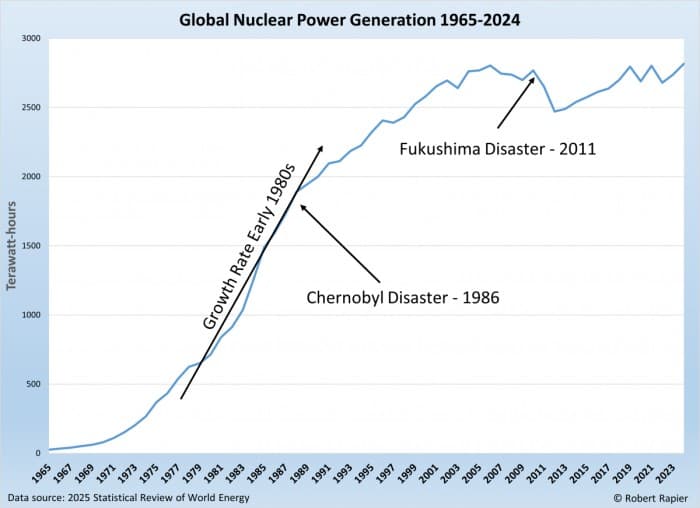
Global nuclear generation reached 2,817 TWh in 2024, surpassing the previous record from 2021, with most growth coming from non-OECD countries.
Asia Pacific, led by China’s 13% annual growth rate, now accounts for over 28% of global nuclear output, marking a major geopolitical and energy shift.
While Eastern Europe, the UAE, and select other nations expand nuclear capacity, Western Europe and North America face stagnation, retirements, or policy-driven phaseouts.
Nuclear power has always been a paradox. It can produce massive amounts of low-carbon electricity, yet it must constantly battle the headwinds of politics and public perception.
The latest Statistical Review of World Energy shows that while nuclear generation is growing globally—setting a new record high in 2024—the trend is anything but uniform. Some countries are charging ahead, while others are stepping back.
Global Output: Modest Growth, Unevenly Shared
In 2024, global nuclear generation reached 2,817 terawatt-hours, a modest uptick from 2023, but surpassing the previous all-time high set in 2021.
Over the past decade, output has grown at a 2.6% annual rate—slow, but a clear recovery from the post-Fukushima slump. That growth is heavily skewed toward non-OECD countries, which are building new capacity at a faster pace (3.0% annual growth) than the flat-to-declining trend in OECD nations (2.5%).
Asia Pacific: The New Center of Gravity
The most dramatic shift is happening in Asia Pacific, now responsible for over 28% of global nuclear output—over double its share from a decade ago:
As with renewables, China is in a league of its own, with output soaring from 213 TWh in 2014 to more than 450 TWh in 2024—an annual growth rate near 13%.
India and South Korea also posted steady gains, though on a smaller scale.
This marks a clear geopolitical shift. Nuclear power is no longer dominated by Western democracies, but by countries with state-driven, long-term infrastructure agendas.
North America: Stable, but Aging
The United States still leads the world in nuclear output at roughly 850 TWh annually (29.2% of the world’s total nuclear output), but beneath the stability is a slow attrition of older plants and a lack of new construction.
But the U.S. had its biggest nuclear milestone in decades in 2023 and 2024 with the startup of Vogtle Unit 3, followed by Unit 4. Located in Georgia, Vogtle is the first newly built nuclear power plant in the United States in more than 30 years, and its completion marks the end of a long, costly construction saga plagued by delays and budget overruns. Together, the two new reactors added more than 2,200 megawatts of capacity—enough to power over a million homes—and provide a rare example of nuclear expansion in a country where most growth has come from extending the lives of existing plants.
Canada’s output has slipped from 106 TWh in 2016 to 85 TWh in 2024, reflecting plant refurbishments and changing policies. Mexico, a small player, has seen big year-to-year swings, which may indicate operational challenges
Europe: A Story of Contrasts
Western Europe is drifting away from nuclear:
France, long the gold standard for nuclear reliability, has seen output fall from 442 TWh in 2016 to just 338 TWh last year, hampered by maintenance issues and political uncertainty.
Germany is now at zero after completing its nuclear phase-out.
Belgium, Switzerland, and Sweden are split between retirements and life extensions.
In Eastern Europe, the picture is brighter. The Czech Republic, Hungary, and Slovakia are increasing output, while Ukraine has managed to maintain over 50 TWh annually despite wartime disruptions.
Emerging Regions: Small Shares, Big Moves
In Latin America, Brazil and Argentina are holding steady around 15–25 TWh, with Brazil inching higher. Africa’s only nuclear producer, South Africa, remains flat at about 13 TWh. The Middle East has a new entrant in the UAE, which ramped from zero in 2019 to over 40 TWh in 2024 thanks to the Barakah plant—an impressive buildout in such a short time.
The Outliers
Japan has restarted some reactors, but its output remains far below pre-Fukushima levels—84 TWh last year versus more than 300 TWh in 2010.
Taiwan is phasing out nuclear, with production falling from 42 TWh in 2016 to just 12 TWh in 2024.
Pakistan and Iran continue steady, if modest, growth.
Final Thoughts
The global nuclear landscape is diverging. Some countries are doubling down, driven by the twin imperatives of energy security and climate action, while others are walking away. The center of gravity is moving away from traditional Western producers toward nations prepared to back nuclear with long-term capital and policy support.
For investors, the next wave of growth is likely to come from Asia and the Middle East, not the historical powerhouses of Europe and North America. That shift carries environmental upside as well—especially in China, the world’s largest carbon emitter. Every gigawatt China moves from coal to nuclear represents a major win in the fight to reduce carbon emissions
The newly announced collaboration includes a first-of-a-kind power purchase agreement between Kairos Power and the Tennessee Valley Authority that will see Kairos Power's Hermes 2 reactor deliver power to the grid for Google's data centres, with plans to increase the demonstration unit's output.
The power purchase agreement between the Tennessee Valley Authority (TVA) and Kairos Power will deliver up to 50 MW of "reliable, 24/7 energy" to the TVA grid that powers Google data centres in Tennessee and Alabama, the companies said. This is the first such agreement signed by a US utility to buy electricity from an advanced, Gen IV reactor, as well as being the first deployment under the 2024 deal between Kairos Power and Google to enable 500 MW of new, advanced nuclear capacity to come online by 2035 in support of Google’s load growth.
Hermes 2 will be a power-producing demonstration reactor built alongside the Hermes Low-Power Demonstration Reactor which is currently under construction at Oak Ridge, Tennessee. The US Nuclear Regulatory Commission issued construction permits for Hermes 2, two 35 MWt molten salt-cooled reactors with a shared power generation system, in November 2024.
To accelerate the delivery of clean energy to Google, Kairos Power said it now intends to increase Hermes 2's output from 28 MWe to 50 MWe "generated by a single reactor," with operations scheduled to begin in 2030.
The agreement will see Google receive the clean energy attributes from the plant through the TVA system to further decarbonise its data centre operations in Montgomery County, Tennessee, and Jackson County, Alabama, and support future growth in the region. The collaboration demonstrates TVA's commitment to integrating innovative, firm energy sources to proactively support the development of new clean generation within its service territory, the companies said.
"To power the future, we need to grow the availability of smart, firm energy sources," said Google’s Global Head of Data Center Energy Amanda Peterson Corio. "This collaboration with TVA, Kairos Power, and the Oak Ridge community will accelerate the deployment of innovative nuclear technologies and help support the needs of our growing digital economy while also bringing firm carbon-free energy to the electricity system. Lessons from the development and operation of the Hermes 2 plant will help drive down the cost of future reactors, improving the economics of clean firm power generation in the TVA region and beyond."
Kairos Power CEO and co-founder Mike Laufer said the collaboration is an "important enabler" to making advanced nuclear energy commercially competitive. "The re-envisioned Hermes 2 gets us closer to the commercial fleet sooner and could only be made possible by close collaboration with TVA and Google, and a supportive local community," he said.
"Energy security is national security, and electricity is the strategic commodity that is the building block for AI and our nation’s economic prosperity," TVA President and CEO Don Moul said, adding that the first-of-a-kind agreement "is the start of an innovative way of doing business. By developing a technology, a supply chain, and a delivery model that can build an industry to unleash American energy, we can attract and support companies like Google and help America win the AI race."
"The deployment of advanced nuclear reactors is essential to US AI dominance and energy leadership," US Energy Secretary Chris Wright said. "The Department of Energy has assisted Kairos Power with overcoming technical, operational, and regulatory challenges as a participant in the Advanced Reactor Demonstration Program, and DOE will continue to help accelerate the next American nuclear renaissance."
Western Uranium focuses on Colorado mill
Western Uranium & Vanadium Corp confirmed it has begun delivering ore from its Sunday Mine Complex in Colorado for processing at Energy Fuels' White Mesa mill, but sees the development of its own Mustang processing facility as critical to its plans for in-house yellowcake production.
Underground at the Sunday Mine Complex (Image: Western Uranium & Vanadium)
Deliveries of ore to White Mesa - currently the only operating conventional uranium mill in the USA - began in June, Western said in its mid-year update. The company began mining and stockpiling ore at the past-producing Sunday Mine Complex in 2023, and finalised an ore purchase agreement with EnergyFuels for the delivery of up to 25,000 short tons of uranium-bearing ore over a one-year period. About 792 tons of material was delivered to the Utah mill in June and July, mostly from stockpiled material.
The company intends to bring yellowcake production in-house, and is prioritising the development of the former Pinon Ridge Mill site in Colorado, which it purchased in 2024. It began baseline data collection for the project - renamed as the Mustang Mineral Processing Plant - in January, and expects to begin preparing a radioactive materials licence application in the first quarter of 2026. The development of the Mustang plant is being prioritised over plans for a new mill - the Maverick Minerals Processing Plant - in Utah due to Mustang's close proximity to the Sunday complex and lower hauling costs in comparison to Maverick, the company said.
Western said it intends to continue to rehabilitate additional areas in the Sunday Mine Complex, which could further expand capacity. It is also considering "less capital intensive" opportunities to increase production capacity, including re-permitting the Topaz Mine, rehabilitating the Sage Mine, reassessing the Van 4 Mine for decline/portal access rather than utilising the previously reclaimed shaft, and additional development of the mines that are part of its joint venture with privately owned company Rimrock Exploration and Development Inc. A project to advance permitting of the San Rafael Project is also under way with the next step being the installation of monitor wells, the company said, adding "Progress has been made on each of these initiatives. Opportunities to acquire additional uranium properties are also being considered."
Western Uranium & Vanadium is headquartered in Nucla, Colorado, and is listed in Canada and the USA. Its uranium and vanadium mineral assets are located across western Utah and eastern Colorado.
X-energy, U.S. military to advance microreactor technology
X-energy Reactor Company has signed an agreement with the Defense Innovation Unit and the Department of the Air Force to advance the development of its commercial microreactor ahead of its deployment at Department of Defense installations to support US national security.
The XENITH microreactor (Image: X-energy)
The company - a subsidiary of X-energy LLC - said the agreement supports continued design and development for the X-energy XENITH microreactor under the Advanced Nuclear Power for Installations (ANPI) programme, an initiative led by the Defense Innovation Unit (DIU) in partnership with the Department of the Air Force.
The programme, launched last year, is designed to accelerate the deployment of next-generation microreactor technologies to provide resilient, secure power at military installations, and enables governmental sponsors like the Department of the Air Force to engage with X-energy under a flexible contracting mechanism that allows for faster development and deployment of commercial nuclear systems.
X-energy said the agreement aligns with President Donald Trump's Executive Order on Deploying Advanced Nuclear Reactor Technologies for National Security, issued in May this year, which directs the Department of Defense (DOD) to deploy an advanced reactor at a military installation before the end of the decade. As part of this effort, X-energy was selected to demonstrate commercial microreactors that can deliver resilient and secure energy to power critical defense infrastructure and remote microgrids.
X-energy's XENITH is a 3-10 MWe high-temperature gas-cooled microreactor first developed for DOD's Project Pele, a mobile microreactor initiative led by the Strategic Capabilities Office. The design was selected to continue into an enhanced engineering phase, focused on achieving preliminary design maturity and initiating pre-licensing engagement with the US Nuclear Regulatory Commission for both military and commercial applications.
Steam generator installation begins at Haiyang 4
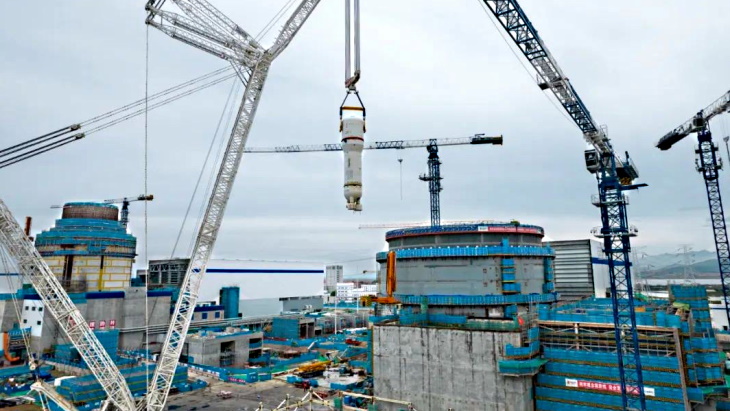
The first of two steam generators has been hoisted into place at unit 4 of the Haiyang nuclear power plant in China's Shandong province.
(Image: SPIC)
Steam generators are heat exchangers which convert heat generated by the reactor core into steam, which is transported to the conventional island via the main steam pipeline. The steam generator drives the steam turbine, which then drives the generator to generate electricity.
The first of the two steam generators for Haiyang 4 - each with a diameter of nearly 6 metres, a length of about 24 metres, and a net weight of over 630 tonnes - was hoisted into place within the reactor building on 13 August in an operation lasting 3 hours and 22 minutes.
(Image: CNNC)
State Power Investment Corporation (SPIC) said the installation of the first steam generator - the heaviest and largest components of the nuclear island reactor's primary circuit - has "laid a solid foundation for the connection of the main circuit of the nuclear island reactor and the capping of the reactor building".
SPIC noted that, based on the construction experience of Haiyang unit 3, workers "formulated improvement measures, established a daily meeting system to sort out various prerequisites, used mature and reliable laser 3D measurement and modeling technology to carry out installation simulation, carried out special prerequisite supervision and inspection, and strictly controlled on-site safety and quality during the hoisting process to ensure the precise positioning of the steam generator."
(Image: CNNC)
The construction of two CAP1000 reactors - the Chinese version of the Westinghouse AP1000 - as units 3 and 4 of the Haiyang plant was approved by the country's State Council on 20 April 2022.
The first safety-related concrete was poured for the nuclear island of Haiyang unit 3 in July 2022, with that for unit 4 being poured in April 2023. The two units are scheduled to be fully operational in 2027.
"XENITH delivers reliable, clean power anywhere it's needed, from remote communities to critical military installations, with the simplicity of factory-built deployment and the reliability of 20-year uninterrupted operation," according to X-energy. "Deployed in months, not years, XENITH provides energy independence where traditional power infrastructure falls short."
In addition to XENITH, X-energy is advancing the deployment of its Xe-100 high-temperature gas-cooled reactor as a grid-scale energy solution for utilities, industrial customers, and hyperscalers. The company is also constructing a first-in-the-nation advanced nuclear fuel fabrication facility to manufacture its proprietary TRISO-X fuel.
X-energy was among eight potential microreactor suppliers selected by DOD in April this year as eligible to seek funding as part of the ANPI programme.
Earlier this month, California-based Radiant - one of the other companies selected - said an agreement it has signed with the DIU and the Department of the Air Force was the first-ever deal designed to deliver a mass-manufactured nuclear microreactor to a US military base. The company is developing the 1 MWe Kaleidos high-temperature gas-cooled portable microreactor. Radiant says it plans to test its first reactor in 2026, with initial customer deployments beginning in 2028.
Equinix signs further agreements with SMR developers
In a move to diversify its power supplies, data centre developer and operator Equinix has signed a preorder agreement for the purchase of 20 of Radiant's Kaleidos microreactors and intends to sign a power purchase agreement with Dutch nuclear energy development company ULC-Energy.
A rendering of Radiant's Kaleidos microreactor (Image: Radiant)
"Equinix is taking a diversified portfolio approach to the global energy challenge by tapping into innovative power technologies and working directly with utilities to strengthen the grid," the California-headquartered company said. "Looking ahead, the company is supporting the development of advanced nuclear technologies that can deliver reliable, clean power in the future.
"Next generation nuclear technologies can offer a pathway to faster nuclear deployments due to their simplified design and robust safety features. Equinix sees safe, efficient and reliable nuclear energy as a promising solution to help power both data centres and the broader grid."
California-headquartered Equinix has now announced a preorder agreement with Radiant for the purchase of twenty 1 MWe Kaleidos high-temperature gas-cooled portable microreactors. The Kaleidos will use a graphite core and TRISO (tri-structural isotropic) fuel.
Radiant was one of eight technology developers selected earlier this year as potential microreactor suppliers made eligible to receive funding under the Advanced Nuclear Power for Installations programme: an initiative launched in 2024 by the Defense Innovation Unit in collaboration with the Department of the Army and the Department of the Air Force, with the goal of "working to design, license, build, and operate one or more microreactor nuclear power plants on military installations".
Earlier this week, Radiant was among 11 advanced reactor projects that the US Department of Energy announced as its initial selection for the Nuclear Reactor Pilot Program, which aims to see at least three of them achieve criticality in less than one year from now.
"Kaleidos offers a reliable, long-lasting energy source that can be transported anywhere it's needed, installed in days, and deployed safely alongside existing equipment and integrated with on-site transmission infrastructure," Equinix said.
In a post on X (formerly Twitter), Radiant said: "We're proud to share that Equinix, the world leader in digital infrastructure, has signed a deal and submitted deposits for the purchase of 20 Kaleidos microreactors. This is not only the largest deal to date for us, it's the largest deal to date for any mass-manufactured reactor."
Dutch power purchase agreement
Equinix also announced the signing of a Letter of Intent with ULC-Energy for a power purchase agreement up to 250 MWe to power data centres in the Netherlands.
In August 2022, Rolls-Royce SMR of the UK signed an exclusive agreement with ULC-Energy to collaborate on the deployment of Rolls-Royce SMR power plants in the Netherlands. ULC-Energy - established in 2021 and based in Amsterdam - aims to accelerate decarbonisation in the Netherlands by developing nuclear energy projects that efficiently integrate with residential and industrial energy networks in the country.
(Image: ULC-Energy)
"Our partnership with ULC-Energy marks an important milestone in Equinix's mission to support sustainable growth in the Netherlands," said Michiel Eielts, Managing Director for Equinix in the Netherlands. "By securing Rolls-Royce SMR capacity, we're not only ensuring reliable and clean energy for our data centres but also contributing to a resilient energy future that benefits local communities, supports economic development, and helps reduce the environmental impact of digital infrastructure."
ULC-Energy CEO Dirk Rabelink said: "Small modular reactors (SMRs) are ideally suited to power increasing demand for data centres. They can deliver clean baseload electricity safely, reliably, and affordably. ULC-Energy has developed a deployment model that leverages the SMR's capability to address data centre energy requirements whilst also providing a realistic and affordable solution to support the increasing regional grid and energy challenges. The SMR-powered data centre will enable a clean digital solution and will be a strategic regional energy asset benefitting many local stakeholders."
Equinix has previously signed agreements with other SMR developers. In April 2024, it signed an agreement to procure 500 MW of energy from US company Oklo's next-generation fission Aurora powerhouses. It has also signed a pre-order power agreement for 500 MWe with French molten salt reactor developer Stellaria to power its European data centres.
"The potential challenges to powering reliable and sustainable digital infrastructure are considerable," said Ali Ruckteschler, Senior Vice President and Chief Procurement Officer at Equinix. "However, Equinix has always been at the forefront of energy innovation, signing the data centre industry's first agreement with a SMR provider and pioneering the use of fuel cells a decade ago. Powering AI infrastructure responsibly is a global priority. With Equinix's operational expertise, trusted supply chain, and close partnerships with the US and global governments and utilities, we are poised to deliver safe, secure and reliable AI solutions for our customers and the communities we serve."







_99967.jpg)
_81216.jpg)
_43077.jpg)
_53678.jpg)

_96509.jpg)