Thursday, April 16, 2020

Senator Warren takes Treasury, Fed to task over 'little oversight' of stimulus programs

Pete Schroeder

WASHINGTON (Reuters) - U.S. Senator Elizabeth Warren chastised the Federal Reserve and Treasury Department on Thursday over their rollout of massive stimulus programs designed to help businesses weather the global coronavirus pandemic, saying they were failing to protect workers.

Warren, a former Democratic presidential candidate, raised her criticism in a pair of letters sent to Fed Chairman Jerome Powell and Treasury Secretary Steven Mnuchin.

“The Federal Reserve is handing out billions of dollars with little oversight and failing to require basic protections that companies retain workers and maintain payroll, failing to include protections against outsourcing, and failing to retain basic protections for union workers,” she wrote in one letter. “Absent these protections, it is not clear how these bailouts will help American families and workers.”


Warren, who is expected to have a major voice in Washington, particularly if Democrats retake the White House, said the government should require any companies relying on those relief programs to take certain steps to protect workers and taxpayers, such as prohibiting layoffs and outsourcing, curbing executive pay, and prohibiting stock buybacks.

Earlier this month, the Fed announced a broad $2.3 trillion effort to bolster local governments and small and mid-size businesses, which built on previous Fed programs launched since the outbreak aimed at soothing financial markets and ensuring capital can continue to flow.

Before becoming a senator, Warren was a fierce watchdog on a government panel created to oversee the last significant bailout in response to the 2007-2009 financial crisis.


One of Warren’s former top aides, Bharat Ramamurti, is now serving as the only named member of a new congressional oversight panel of pandemic relief programs. Earlier Thursday, he wrote in a essay published in the New York Times that the programs raised similar concerns of being too generous to executives without protecting rank-and-file employees.

A Fed spokesperson said the central bank has received the letter and will respond. A Treasury spokesperson did not respond to a request for comment.
THIRD WORLD USA 
Court blocks Trump administration push to make school meals saltier and less healthy

American school meals have been allowed to roll-back standards since 2018, but now a Maryland court says changes ‘not logical’


Gino Spocchia, THE INDEPENDENT APRIL 15, 2020


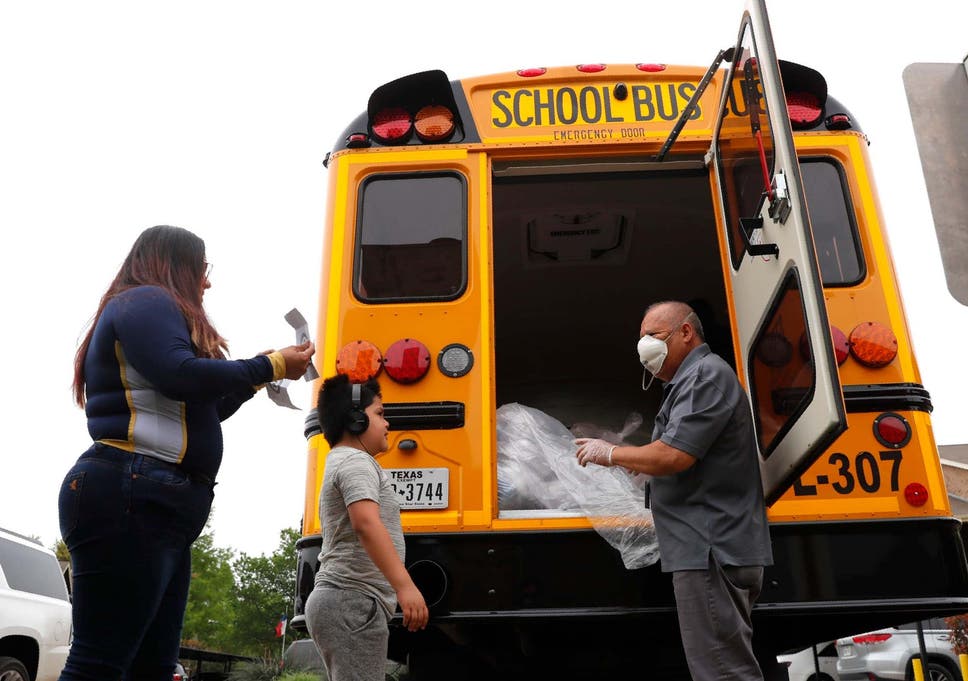
Some US schools have have been distributing food to families during the pandemic ( AP )

A federal district judge has blocked the Trump administration’s proposals on lowering American school food standards after a decision was made against the US Department for Agriculture (USDA).

The Trump administration rolled-back National School Lunch Program nutrition guidelines in 2018, which reduced whole-grain requirements and sodium level restrictions on all school meals.

The District Court of Maryland ruled on Tuesday that the standards reductions were in violation of the Administrative Procedure Act (APA), which regulates how federal agencies develop and issue regulations.

According to the court, the agriculture secretary Sonny Perdue’s school meal regulation changes came without adequate public warning before it came into effect this school year.

“There is a fundamental difference between delaying compliance standards — which indicates that school meals will still eventually meet those standards — and eliminating those standards altogether,” it said.

The legal nonprofit, Democracy Forward, brought the case against the USDA on behalf of the Center for Science in the Public Interest (CSPI) and Healthy School Food Maryland.

In a statement, Democracy Forward’s executive director Anne Harkavy said in a statement that the court’s ruling was a victory for families. “The Trump administration’s unlawful rollback of important school meal nutrition standards jeopardised children’s access to the nutritious foods they need to stay healthy,” she added.

The court added that the USDA decision was “not a logical outgrowth”, but schools that are currently distributing meals during the pandemic are permitted to continue using the Trump administration guidelines until schools reopen.

“None of this applies under the current situation. This is for when we resume post-pandemic school operations,” said Laura MacCleery, senior policy director for CSPI.

The Maryland ruling is the latest change in US school meal standards, since Michelle Obama championed the gradual introduction of whole-grains and sodium reductions in 2012.

The USDA announced in late 2018 that schools would have more flexibility with the rollback in standards and elimination of a final sodium reduction target

However many US schools were reported to have stood-by the healthier measures amid the changes, whilst others did lower nutrition levels.

A USDA spokesperson told The Independent that they do not comment on ongoing litigation.

The Independent has asked the White House for comment.


Federal court strikes down Trump's school nutrition rollbacks

April 14 (UPI) -- A federal judge in Maryland on Tuesday ruled against the Trump administration's plans to roll back regulations on school lunch standards, citing a procedural error.

District Judge George Hazel said Agriculture Secretary Sonny Perdue violated the Administrative Procedure Act when the administration moved to weaken federal nutritional standards for breakfasts and lunches served to schoolchildren in 2018.


The rule change rolled back sodium limits and whole grain requirements.

The court said the rule ultimately ended up being different from the 2017 interim rule.

RELATED Fish, vegetables, whole grains in diet can reduce dementia risk by 45%

"The court concludes that the rule is not inconsistent with federal law, does not reflect unexplained and arbitrary decision making, it does not represent an unacknowledged and unexplained change in position, and the USDA appropriately responded to public comments. The court does find, however, that the final rule is not a logical outgrowth of the interim final rule, so it must be vacated and remanded to the administrative agency for further proceedings," the court wrote.

Democracy Forward, which filed the 2019 lawsuit against the Trump administration on behalf of the Center for Science in the Public Interest and Health School Food Maryland, hailed the ruling.

"This decision is a victory for children and families, for policymaking based on sound science, and for the rule of law. The Trump administration's unlawful rollback of important school meal nutrition standards jeopardized children's access to the nutritious foods they need to stay healthy," said Democracy Forward Executive Director Anne Harkavy.

RELATED Nutrition experts fear 'dirty dozen' produce list will put off consumers

"This victory shows, once again, that the Trump administration's pattern of unlawfully shutting the public out of policy changes that impact their health can't -- and won't -- stand."

The Trump administration proposed further rollbacks in January, giving schools a larger variety of vegetables to serve and making it easier for schools to serve entrees a la carte. The schools would also be allowed greater control in customizing meal patterns and meals. It also implements a performance-based review process to cut down on time spent on paperwork.

The Center for Science in the Public Interest said the new proposed rule changes will lead to more children choosing to foods higher in calories, such as pizza, hamburgers and french fries


New Zealand activist flies flag of environmental revolution with election run


AUCKLAND (Reuters) - The growing green concerns that will be in the spotlight on Earth Day next week are mirrored in a call for an “environmental revolution” by an 18-year-old New Zealand activist looking to take on Prime Minister Jacinda Ardern in an election this year.

Climate change is shaping up as a major issue in the general election after New Zealanders were shocked in recent months by ash from bushfires in neighbouring Australia that turned their skies red and glaciers brown.

The youthful challenger, climate activist Luke Wijohn of New Zealand’s Green Party, stands to become the country’s youngest lawmaker should he pull off an admittedly unlikely win to take Auckland’s Mount Albert seat from Ardern in the Sept. 19 poll.

Wijohn aims for “environmental revolution”, he told Reuters, as he prepared to host his first Green Party political meeting at his parents’ home in Auckland by painting signs with fellow party members.

“I’m going to run my campaign similar to a climate strike, similar to any grassroots protest, where it is about reaching the people,” added Wijohn, who gained prominence for organising last year’s “School Strike 4 Climate” marches in New Zealand.

“Especially in this modern era, when there’s lies online, we need to be able to fight that with real conversations about our values.”


Wijohn said he saw Ardern, herself the youngest elected head of government when she won office in 2017, as being in a “compromised position”.

“That is why we need the Green Party to be strong enough to pull them to go further and faster,” he said.

Now 39, Ardern is seen as a liberal, progressive and environment-friendly leader whose coalition, which includes the Green Party, has acted on issues of climate change, social justice, and equality.

But the Greens want more, Wijohn said.

“Our rules, our laws are so far behind what they could be,” he said.

“We can actually make laws that are further forward than the culture is ready for,” he added, saying a push for better culture and laws would provide a foundation for change.


“We can just build it up to get, the environmental revolution, basically.”

Earth Day is on April 22.


Australia High Court: Federal police unlawfully raided reporter's home

April 15 (UPI) -- Australia's Federal Police used an unlawful warrant to search a journalist's home last year, the country's high court unanimously ruled Wednesday.

Police raided the home of reporter Annika Smethurst last June trying to identify sources of a story in April 2018 that said the Australian government had plans to expand its spying powers on citizens.


The court said the police warrant "misstated" relevant criminal laws and was not specific enough about the offenses. Smethurst's attorneys wanted the police to destroy data they seized but the court declined.

The information taken, for now, remains in police hands but could face legal challenges if used since the court said it was obtained illegally.

Authorities have been trying to build a case against former intelligence employee Cameron Gill, who they believe was the source of the report.

Federal Police Commissioner Reece Kershaw said his office has taken steps to improve the warrant process, but said the court was not clear on whether information obtained can be used in future cases.
Exclusive: The Military Knew Years Ago That a Coronavirus Was Coming
The Pentagon warned the White House about a shortage of ventilators, face masks, and hospital beds in 2017—but the Trump administration did nothing.

By Ken Klippenstein,APRIL 1, 2020

 is The Nation’s DC Correspondent

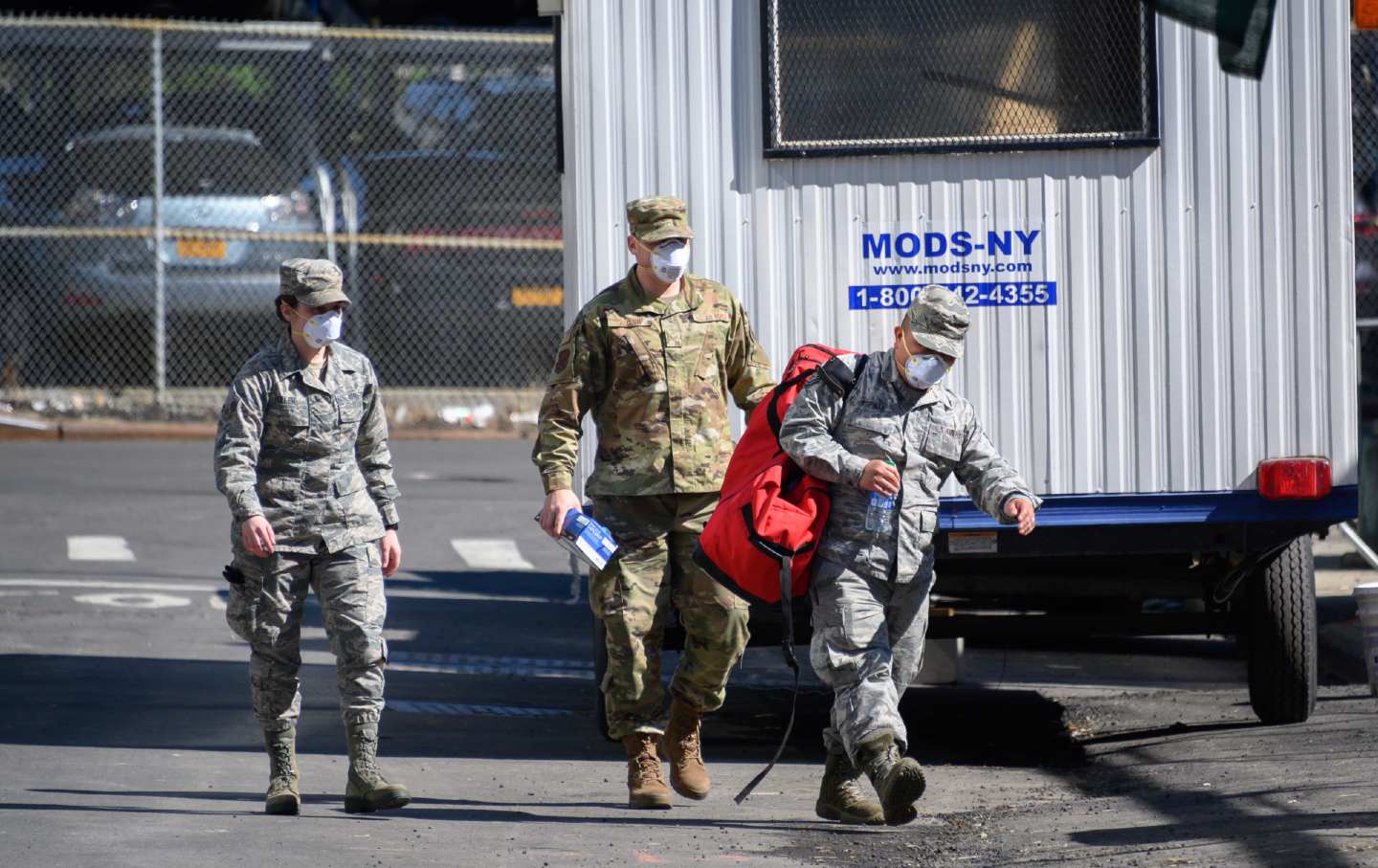
US Air Force troops help build a makeshift morgue in New York City on

 March 27. (Noam Galai / Getty Images)

Despite President Trump’s repeated assertions that the Covid-19 epidemic was “unforeseen” and “came out of nowhere,” the Pentagon was not just well aware of the threat of a novel influenza but even anticipated the consequent scarcity of ventilators, face masks, and hospital beds, according to a 2017 Pentagon plan obtained by The Nation.

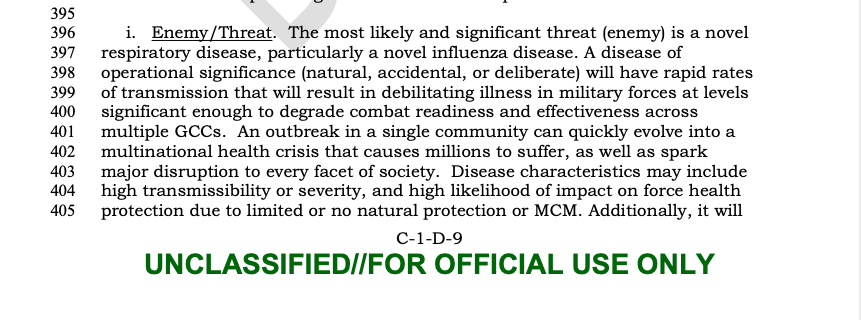
“The most likely and significant threat is a novel respiratory disease, particularly a novel influenza disease,” the military plan states. Covid-19 is a respiratory disease caused by the novel (meaning new to humans) coronavirus. The document specifically refers to coronaviruses on several occasions, in one instance saying, “Coronavirus infections [are] common around the world.”

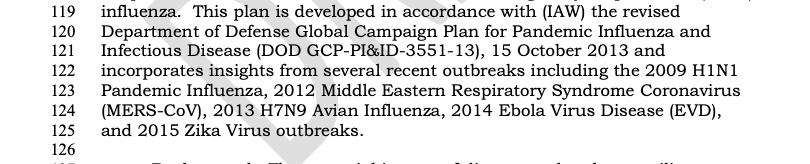
The plan updates an earlier Department of Defense pandemic influenza response plan, noting that it “incorporates insights from several recent outbreaks including…2012 Middle Eastern Respiratory Syndrome Coronavirus.”


Titled “USNORTHCOM Branch Plan 3560: Pandemic Influenza and Infectious Disease Response,” the draft plan is marked for official use only and dated January 6, 2017. The plan was provided to The Nation by a Pentagon official who requested anonymity to avoid professional reprisal.

RELATED ARTICLE

THE CORONAVIRUS IS TRUMP’S LATEST EXCUSE TO MILITARIZE THE BORDER

Ken Klippenstein

Denis Kaufman, who served as head of the Infectious Diseases and Countermeasures Division at the Defense Intelligence Agency from 2014 to 2017, stressed that US intelligence had been well aware of the dangers of coronaviruses for years. (He retired from his decades-long career in the military in December 2017.)

“The intelligence community has warned about the threat from highly pathogenic influenza viruses for two decades, at least. They have warned about coronaviruses for at least five years,” Kaufman said in an interview.

“There have been recent pronouncements that the coronavirus pandemic represents an intelligence failure…. It’s letting people who ignored intelligence warnings off the hook.”

In addition to anticipating the coronavirus pandemic, the military plan predicted with uncanny accuracy many of the medical supply shortages that will now apparently soon cause untold deaths.

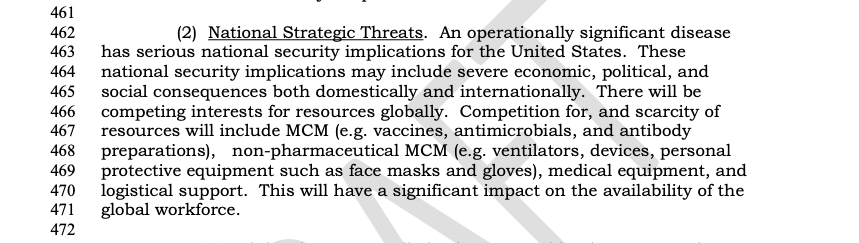
The plan states, “Competition for, and scarcity of resources will include…non-pharmaceutical MCM [medical countermeasures] (e.g., ventilators, devices, personal protective equipment such as face masks and gloves), medical equipment, and logistical support. This will have a significant impact on the availability of the global workforce.”


The 103-page response plan provides an overview of what might cause a pandemic, likely complications, and how the military might respond. The plan outlines conditions under which an infectious disease can become a pandemic, several of which were at play with Covid-19: crowded workplaces, proximity to international airports, unsanitary living conditions. It also contains references to classified annexes that go into further detail. (The Nation is not in possession of these annexes.)

Last week, Trump lashed out at General Motors and Ford on Twitter, demanding that they manufacture ventilators, a life-or-death appliance for many people with acute Covid-19 symptoms.

General Motors MUST immediately open their stupidly abandoned Lordstown plant in Ohio, or some other plant, and START MAKING VENTILATORS, NOW!!!!!! FORD, GET GOING ON VENTILATORS, FAST!!!!!! @GeneralMotors @Ford
—Donald J. Trump (@realDonaldTrump) March 27, 2020

The plan’s warning about face masks and ventilators was prescient: The US Strategic National Stockpile of medical equipment—including respirators, gloves, face masks, and gowns—is reportedly nearly depleted.

The military plan also correctly anticipates “insufficient hospital beds.” Indeed, hospitals are in critically short supply in Italy and are rapidly filling up across New York.


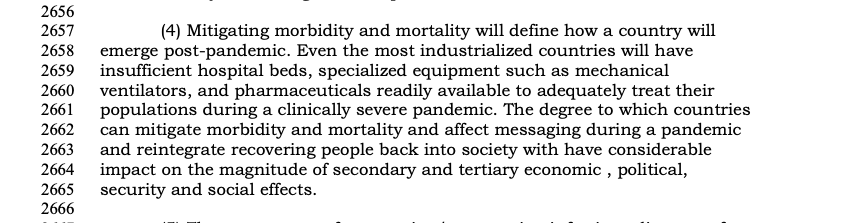
“Even the most industrialized countries will have insufficient hospital beds, specialized equipment such as mechanical ventilators, and pharmaceuticals readily available to adequately treat their populations during clinically severe pandemic,” the report goes on.

Another prediction in the report anticipates worldwide competition for and scarcity of Covid-19 vaccines. Trump has already reportedly offered German scientists large sums of money for exclusive rights to a vaccine, and efforts to develop drugs are underway in several countries.

The Pentagon did not immediately respond to a request for comment.
You can read the Pentagon’s full draft pandemic plan here

'The sun will shine again,' Captain Tom, 99, raises millions and the spirits of a nation

Paul Sandle

LONDON (Reuters) - Captain Tom Moore, 99, a British war veteran, completed the last of 100 laps of his garden on Thursday, raising more than 15.4 million pounds ($19 million) for the health service in a feat that has spread joy across the country amid the coronavirus gloom.
“For all those people who are finding it difficult at the moment: the sun will shine on you again and the clouds will go away,” said Moore, dressed in a blazer and tie and displaying his war medals, after completing his walk.

The retired army captain, who has used a walking frame with wheels since breaking his hip, set himself the target of walking the 25 metres around his garden 100 times before his 100th birthday on April 30.

He completed his challenge to praise from around the country and beyond - and a salute from soldiers in the regiment which replaced his own. “I feel fine,” he said.

Raised in Yorkshire, northern England, Moore served in India, Burma and Sumatra during World War Two.

He said the walk was inspired by the care he received from Britain’s state-run National Health Service when he broke his hip and when he was treated for cancer.

His original target was 1,000 pounds.

But that modest aim was blown away as media attention from around the globe zoomed in on his garden in Bedfordshire, central England.


Veteran Capt Tom Moore talks to soldiers from 1st Battalion The Yorkshire Regiment who formed a Guard of Honour for the veteran as he completed his fundraising walk for the health services, in Bedfordshire, Britain, April 16, 2020. Ministry of Defence/Crown Copyright 2020/Handout via REUTERS

The story lifted the hearts of a nation in lockdown, weary of relentless waves of grim news.

It has also embodied an outpouring of gratitude for Britain’s doctors, nurses and other healthcare workers on the front line in the fight against the pandemic.

So far, nearly 13,000 people with COVID-19 have died in British hospitals, the fifth-highest total globally. Twenty-seven were health workers, Health Minister Matt Hancock said.

Moore’s achievement was a “shaft of light” in the darkness of the COVID-19 crisis, he said. “Captain Tom, what an inspiration to us all.”

FANTASTIC

Moore said the amount raised from more than 750,000 supporters was an “absolutely fantastic sum of money”.

“It’s unbelievable that people would be so kind to give that sort of money to the National Health Service,” he said.

Moore received a guard of honour from soldiers from the First Battalion of the Yorkshire Regiment, the successor to his Duke of Wellington’s regiment, as he completed his final lap.

Afterwards he received messages of congratulation from figures from sport, politics and entertainment.

Ben Stokes, England’s leading cricketer, said he hoped he would be moving as well as Moore when he was 50 let alone 100, while finance minister Rishi Sunak praised his “Yorkshire grit”.


Prime Minister Boris Johnson, who is recovering after being treated in intensive care with COVID-19, would look at ways to recognise Moore, his office said.

“Tom has captured the heart of the nation with his heroic efforts and has raised an incredible amount of money for hard working NHS staff,” Johnson’s official spokesman said.

A petition for Moore to receive a knighthood had received more than 20,000 signatures on Thursday, and he was even in the running to be voted British “Sports Personality of the Year”, an honour that went to Stokes, who is 28, in 2019.

Moore remained focused on the sacrifices made by health service workers and the efforts of his fellow Britons, who have been locked down since March 23.

“You’ve all got to remember that we will get through it in the end, it will all be right, it might take time,” Moore said. “At the end of the day we shall all be ok again.”


Moore’s family said they had fielded interest from as far afield as the United States, France and Australia.

Son-in-law Colin Ingram said raising money for the health service had given Moore a new lease of life.

“He’s coming down in the morning sprightly and loving it,” Ingram told Reuters on Wednesday.

The money raised will go to NHS Charities Together, an organisation that represents 140 member charities that support the work of the health service, according to his donation page on the JustGiving website.


Additional reporting by Kate Holton and Elizabeth Piper, Editing by Guy Faulconbridge and Janet Lawrence

Exclusive: As the U.S. shut down, Trump's legal fight to build wall ramped up

Jarrett Renshaw 
APRIL 16, 2020

(Reuters) - Even as the Trump administration was struggling to deal with the coronavirus outbreak, it was ramping up efforts to seize land along U.S. southern border to build a wall and fulfill a major campaign promise, a Reuters review of federal court records shows.

FILE PHOTO: Segments of the first border wall in Texas since President Trump took office as seen near Donna, Texas, U.S. December 8, 2019. REUTERS/Veronica G. Cardenas/File Photo


Donald Trump made building the wall a central promise of his 2016 campaign, but those efforts have been plagued by delays and false promises. Late last year, the administration got more aggressive, pledging to use the federal courts to seize large swaths of private land, mostly in Texas.

While most of the U.S. has been slowed by the COVID-19 crisis - which has infected nearly 650,000 Americans and killed at least 32,000 more - Trump’s efforts to construct a southern border wall has only gained steam.

In the past 12 months, the administration opened 41 cases in federal court to seize land to build a wall along the southern border of Texas. Nearly half of those cases – 16, or 39 percent - were filed in the past two months.

The bulk of the new filings came in March, when the administration opened 12 cases, the most in any month under Trump, a Reuters review of federal filings found.

The administration wants immediate possession, bypassing traditional procedural steps and forcing landowners to move more swiftly, records show.

Advocates for the landowners say the administration is choosing a bad time to get more aggressive, forcing landowners to choose between leaving their home to fight the case despite statewide stay-at-home guidance or lose their property.

Also, a successful defense can be expensive, requiring paid experts, lawyers and other professionals at a time the U.S. economy is shedding a record number of jobs.


“The timing, on a human level, is very bad,” said David Donatti, an attorney with the American Civil Liberties Union (ACLU) in Texas who represents a family fighting government seizure of their property.

Nayda Alvarez, a 49-year-old public school teacher, was served court papers in March. She and her extended family - including her elderly father who suffers from several health issues - live on 6-acre (2.4-hectare) ranch along the Rio Grande river that the administration wants to take immediately.

“It’s very scary. My hands are tied because we are quarantined and fighting the federal government, literally,” said Alvarez, who is working with the ACLU and another group, the Texas Civil Rights Project, in her defense.

She was preparing to go to federal court on Tuesday, donning a mask and gloves, but her lawyers were able to delay the hearing until June.

Unlike in other states, most of the U.S. borderland in Texas is privately owned, which has delayed wall construction by the U.S. Army Corps of Engineers. Federal lawyers have had to comb property records, track down landowners, make offers to buy the land and — if owners refuse to sell — file lawsuits to seize the land.

The White House did not respond to requests for comments for this story.

In recent weeks, Trump has made the case that the global pandemic only proves the need for stronger borders. On March 12, he retweeted a follower’s commentary linking the health scare to the need for strong borders and added “We need the Wall more than ever!”

Three Democratic lawmakers representing congressional districts along the U.S.-Mexico border recently called on the Trump administration to temporarily pause the legal efforts.


“To put vulnerable families already suffering at disproportionate rates at this time is simply unconscionable,” the lawmakers wrote in an April 8 letter to the departments of Justice, Defense and Homeland Security.

Immigration and border security has been a top issue for Republicans for the last few years. Yet now it appears to be overshadowed by concerns about healthcare as the COVID-19 pandemic sweeps across the country.

When asked what they considered to be “most important problem facing the U.S. today,” 18% of Republicans said healthcare in an April 13-14 Reuters/Ipsos poll, up 3 percentage points from a similar poll that ran Feb. 19-25, while 15% said it was immigration, down 10 points from the February poll.
Supplies for coronavirus field hospital held up at U.S.-Mexico border

A family of migrants are seen outside a tent at a migrant encampment where more than 2,000 people live while seeking asylum in the U.S., while the spread of Coronavirus disease (COVID-19) continues, in Matamoros, Mexico April 9, 2020. REUTERS/Daniel Becerril Slideshow (14 Images)

Julia Love, Mica Rosenbe APRIL 16,2020


(Reuters) - Red tape and rules on importing medical gear have delayed work on a field hospital for migrants in an asylum camp near Mexico’s border with Texas, undercutting efforts to prepare for the coronavirus pandemic, according to organizers of the project.

Mexican authorities approved construction of the 20-bed field hospital on April 2. But since then, a trailer laden with supplies for the project has been parked in Brownsville, Texas, less than a block from the U.S.-Mexico border.

Global Response Management, the nonprofit sprearheading the project, said the trailer contains an X-ray machine, cots, heart monitors, medical tents, generators and other equipment. Its staff fear time is running out to prepare for a coronavirus outbreak.

“If we are trying to set up the hospital in the middle of the epidemic, it’s too late,” Andrea Leiner, director of strategic planning for the organization, told Reuters.

There are no confirmed cases yet in the camp on the banks of the Rio Grande that houses about 2,000 migrants, mostly Central Americans seeking asylum in the United States. The camp also holds Cubans, Venezuelans and Mexican asylum seekers along with other nationalities.

But testing has been limited. Health experts say the migrants are exceedingly vulnerable, their immune systems worn down after months living in closely packed tents.

On April 10, the U.S. Federal Emergency Management Agency (FEMA) issued a temporary rule limiting the export of some personal protective gear needed for use within the United States.

Global Response said it believed it had to remove equipment such as gloves, surgical masks and N95 masks from the trailer in Brownsville. It is now trying to source what it can from Mexico.

Late Wednesday, the U.S. Customs and Border Protection agency said Global Response’s supplies were not subject to the FEMA order and were approved for export. But the nonprofit maintained on Thursday that it had removed some medical gear from its shipment on the advice of its U.S. customs broker, who cited guidance from border officials on the ground.

Global Response said while its shipment has been cleared on the U.S. side, it is now awaiting a letter from local Mexican government certifying that the equipment will only be brought into the country for six months, so it can be approved by Mexican customs.
Global Response tried to obtain the letter from the Matamoros mayor’s office Wednesday but was told the letter had to come from the National Migration Institute (INM), Leiner said.

Mexico’s customs agency, the Matamoros mayor’s office and INM did not respond to requests for comment.

In addition to the trailer, Global Response has collected hundreds of cloth masks sewn by volunteers for the camp, but it has only been able to bring them in three at a time, the quantity deemed for “personal use” and thus not subject to import duties in Mexico.

The group has accumulated 3,500 rapid tests for the coronavirus to use in the camp, said executive director Helen Perry.

Many in the camp are awaiting U.S. hearings under the Trump administration’s Migrant Protection Protocols policy. All hearings under the program have been suspended until May 1.

In Matamoros, which has a population of about half a million people, the five public hospitals have 25 ventilators and 11 intensive care beds between them, according to figures provided to Reuters by the state government last month.

A Mexican government plan to relocate the asylum camp’s migrants to a stadium was abandoned, Global Response’s Leiner said.

The nonprofit and INM are now working to fence off the camp and conduct temperature checks as people enter, she said.

Reporting by Julia Love in Mexico City and Mica Rosenberg in New York, additional
Protests erupt after deaths at U.S. factories in Mexican border town

Jose Luis Gonzalez

CIUDAD JUAREZ, Mexico (Reuters) - Protests have erupted outside factories in the Mexican border city of Ciudad Juarez in recent days after the deaths of several workers, including some employed by U.S. companies, from what the protesters said was the coronavirus.


Employees of Honeywell International Inc hold a protest to demand the respect of the quarantine to avoid contagious of the coronavirus disease (COVID-19), in Ciudad Juarez, Mexico April 16, 2020. REUTERS/Jose Luis Gonzalez

So far, 82 people have tested positive for the new coronavirus in the city that lies across the border from El Paso, Texas, local authorities said on Thursday. A total of 19 have died, the city health department said.

Several workers for Lear Corporation, a Michigan-based car seat maker, have died from respiratory illnesses, the company said in a statement to Reuters.

Honeywell International Inc on Thursday told Reuters a worker at one of its plants in the city had died after being sent home to self-quarantine and receive medical attention.

The deaths and the protests about ongoing production at border factories follow outbreaks of the virus at meat-packing plants in the United States that have raised concerns over working conditions during the epidemic.

Lockdowns that aim to stop the spread of the coronavirus are disrupting supply chains in the $1.2 trillion North America Free Trade Agreement region, with growing friction between governments and companies about which industries should continue to operate.

On Thursday, dozens protested outside the Honeywell site where the employee who died had worked, demanding its temporary closure, following similar rallies outside other U.S. and Mexican plants in the city.

“We want them to respect the quarantine,” said Mario Cesar Gonzalez, who said the Honeywell Ademco factory made smoke alarms.

“The manager said that we are essential workers. I don’t think an alarm is essential.”

Honeywell said the factory makes controls for heating, ventilation and air conditioning for critical infrastructures such as hospitals and laboratories.

In a statement to Reuters the company said it was “deeply saddened” to learn that one of its workers had died.

Honeywelll said authorities had not confirmed if the employee died from COVID-19, the illness caused by the coronavirus, but that it had closed the site, which the employee had worked at, for 48 hours to sanitize the area.

The company did not say when the death happened but said the worker had not been on site since April 2.

Lear said it had ceased all employee-related activities by April 1 in Ciudad Juarez.

“We are saddened that several employees at our Juarez City operations, who were receiving medical treatment at the same local government social security hospital in Juarez, have passed away, due to complications of respiratory illness,” the company said in the statement.

The Lear shutdown appeared to be in line with the Mexican government’s declaration of a health emergency on March 30, requiring companies to cease operations if their activities are deemed non-essential.

On Wednesday, dozens of other workers protested outside an assembly factory run by Regal Beloir, a Wisconsin-based manufacturer that produces electric motors for household appliances. They demanded the closure of that plant after the alleged death of one of their coworkers.

“A colleague already died last night. He had been working here. There are infected workers and we are not being told,” said one person who identified himself as a Regal employee at the protest but declined to give his name for fear of retribution.

Reuters was not able to confirm a death of a Regal worker. The company did not immediately respond to a request for comment.
The Mexican government is investigating whether some “non-essential” companies continue to operate. Refusing to follow the rules could constitute the crime of damage to health and could cost lives, Deputy Health Minister Hugo Lopez-Gatell said on Wednesday.

From April 3 until Tuesday, 15% of companies with non-essential activities had refused to stop work, Lopez-Gatell said.
The World of the John Birch Society: Conspiracy, Conservatism, and the Cold War


From the Inside Flap


The blueprint of the modern Tea Party, front and center in the John Birch Society's strongest years'

Hardcover – June 27, 2014
by D. J. Mulloy (Author) is Associate Professor of History
at Wilfrid Laurier University and author of American Extremism


 Selection of the History Book Club
Named One of "Six Books for Insight on a Trump Presidency" by the Washington Post


As far as members of the hugely controversial John Birch Society were concerned, the Cold War revealed in stark clarity the loyalties and disloyalties of numerous important Americans, including Dwight Eisenhower, John Kennedy, and Earl Warren. Founded in 1958 as a force for conservative political advocacy, the Society espoused the dangers of enemies foreign and domestic, including the Soviet Union, organizers of the US civil rights movement, and government officials who were deemed "soft" on communism in both the Republican and Democratic parties. Sound familiar? In The World of the John Birch Society, author D. J. Mulloy reveals the tactics of the Society in a way they've never been understood before, allowing the reader to make the connections to contemporary American politics, up to and including the Tea Party. These tactics included organized dissemination of broad-based accusations and innuendo, political brinksmanship within the Republican Party, and frequent doomsday predictions regarding world events. At the heart of the organization was Robert Welch, a charismatic writer and organizer who is revealed to have been the lifeblood of the Society's efforts.

The Society has seen its influence recede from the high-water mark of 1970s, but the organization still exists today. Throughout The World of the John Birch Society, the reader sees the very tenets and practices in play that make the contemporary Tea Party so effective on a local level. Indeed, without the John Birch Society paving the way, the Tea Party may have encountered a dramatically different political terrain on its path to power.

Review

"The World of the John Birch Society is a thorough, fair, and nuanced examination of the controversial organization. . . . [A] must-read for anyone who wants to understand the mind-set of the JBS."
H-Net Reviews in the Humanities & Social Sciences

"Mulloy's essential look at [the John Birch Society] brilliantly reveals the Society's hard-nosed conservatism while linking it to movements that preceded today's Tea Party."
Publishers Weekly

"Mulloy's work offers a much-needed return to an examination of the far right. The rise of the Tea Party, the persistence of allegations about the place of Barack Obama's birth, his alleged 'un-Americanism,' and other recent political developments suggest that some of the older concepts, and the older focus on more extreme elements of the right, remain warranted."
Timothy Thurber, author of Republicans and Rac