Monday, January 06, 2025

The Emergence of Time as a Social Force


 January 3, 2025
FacebookTwitter

Photograph Source: Alex Lehner – CC BY 2.0

In 1336, Milan was expanding to become one of the richest and most important cities in all of Europe. From the end of the 13th century, it was ruled by a powerful dynasty that would go on to found the Duchy of Milan, a major state that would remain intact until Napoleon’s armies swept across Europe centuries later. That year, Milan cemented its position as a burgeoning technological powerhouse by introducing “the first documented hour-striking clock in a public setting.” Milan’s spectacular clock was an international sensation and “has been described as the first true automat in Europe and the locking wheel as a precursor of the computer.” The hourly ringing of its bells heralded the modern world, the world we know today, dominated by the power of time, where nothing would fall outside of its ambit. It was spellbinding, the cutting edge breakthrough of its day. Until then, time was conceived not as fixed and linear, as a standardized grid within which to situate the tasks of daily life—rather the tasks of daily life were the clock, dictating and defining time rather than the inverse. The prevailing model of time was as something relativistic, informed by patterns in nature that were not rigid and unmoving. But time assumed a new form and social energy. From the early modern period on, “time” becomes one of the most frequently used words, tightening its grip on the social order and our imaginations. Time of this new kind is an artifice that must be produced through social norms and institutions. It is neither natural nor necessary, but is rather a development from complex material realities and the interests of an emerging ruling class.

After these developments in the Late Middle Ages and Early Renaissance, in which time is invented or at least socially reinvented, the concept undergoes a series of refinements that deepen its penetration of social and economic life. Until today, when the reification of time into a powerful tool of social control and domination seems almost complete. Ever more precise instruments for measuring time and smaller and more exact units of measurement have created a new and distinctly modern understanding of and relationship with time. Time continued to magnify its power, and the separation of production into smaller and more discrete steps tracks the invention and development of time. But it did more than just reshape patterns of production; it reshaped the human subject and her conception of herself and her physical and social environment. The subject would now always understand herself as being within time, adopting its purposes and logics, justifying her decisions in its terms. Later, with the social relationships and patterns of the industrial age, time is reconceived as yardstick, taskmaster, and disciplinarian, as a new God to which unending sacrifices are owed. Increasingly, every waking minute must be filled to propitiate the insatiable gods of productivity and efficiency—every activity and minute required to complete it must be scheduled and optimized. “The growth of a sense of time—the acceptance of time—is a process of adaptation to an ever more reified world.” We have become the subjects of highly refined, historically contingent new absolutism. One can express himself in any way, adopt any lifestyle in private, just insofar as he can never exercise any meaningful control over his time. The inexorability of time makes it “the ultimate model of domination,” fragmenting and dispersing everything before it by artificially separating us from the reality of experience as continuous, unified, and fluid. By breaking time into ever smaller units, we are disintegrating human life and experience itself, creating abstract, unnecessary distinctions between fundamental aspects of human life. Once meaningless and essentially unknowable, time as a social construct and system is now inescapable, “mirroring blind authority itself.”

Our lifelong relationships with time under capitalism are emotionally fraught. Time presses upon us with increasing energy and persistence in the age of the smartphone, as our calendars and other “productivity” applications ensure a steady outpouring of reminders and alerts. Time is there and it is running out fast, grains of sand piling up on the floor of the hourglass. In our era of ever-increasing pace, in which our culture places enormous value on speed, precision, and efficiency, there is the temptation to inspect each grain. Was that unit of time spent wisely? Now we have wearable devices that can provide us with information about the user’s heart rate, sleep patterns and quality, and exercise habits. Review the data and optimize the system—that’s the message, and it carries with it an indispensable temporal quality, because what is maximally efficient in any given case is dependent on time and how much of the precious commodity one has. Time is now conceived of in its pure commodity form, perfectly reducible and fungible. Andrew Niccol’s 2011 film In Time, though widely panned, explored an interesting iteration of this idea: the story plays out in a future where time has become the standard currency, and how long you can stay alive is determined by how rich you are. People are separated into segregated “Time Zones,” where the poor live out their short lives in ghettos. Even in our so-called free society, the lives of workers and the poor are necessarily shortened, for even if they are long, the amount of time free from toil—that is, the real life of the individual—is painfully and tragically short.

Several thinkers have drawn historical connections between the technologies that give us time as we know it and the social mechanisms of domination today associated with it. If we have been tempted to treat such technological advances as necessarily opening the way to increasing convenience and improved quality of life, then they give us reasons to at least subject this story to scrutiny. The work of eminent historian E.P. Thompson provides us with one of the seminal treatments of the cultural transformation wrought by the “new immediacy and insistence” of time as “[t]he clock steps on to the Elizabethan stage.” In his 1967 article “Time, Work-Discipline, and Industrial Capitalism,” Thompson argues that new technologies for tracking time were attended by dramatic shifts in “the inward apprehension of time of working people” and thus by “a severe restructuring of working habits—new disciplines, new incentives, and a new human nature upon which these incentives could bite effectively.” Time crept into every corner of life, as the day was bent into conformity with the needs of the economic system. In a short but fascinating aside, underlining the connection between these new ways of conceptualizing time and the most private and intimate aspects of human life, Thompson observes that, for a time, “winding the clock” took hold as a slang term for sexual activity following the 1759 publication of the popular and influential novel Tristram Shandy. Among the humorous scenes early in the novel is a question from the protagonist’s mother, put to his father during the carnal act resulting in Tristram’s conception: “have you not forgot to wind up the clock?” Everything is susceptible to commodification and exchange, time and sex included. The advent of time as we know it gave us small, discrete units capable of being alienated (in the sense of a conveyance or transferral); it fit perfectly with commodity capitalism.

There is a sense in which freedom is reducible to free time, in which domination and unfreedom are bound to the historical establishment of control over the time of others. Today, there is an overwhelming feeling “that people shouldn’t really have control over their time—that they can’t be trusted with it, that they need to be dominated in order for there to be some social order.” From the philosopher Theodor W. Adorno (1903-1969) we receive one of the most trenchant looks at the concept of time in its current social dimensions. Adorno’s 1969 essay “Free Time” attempts to ground a critique of our approaches to free time under contemporary conditions, contending that our relationships with it are shaped in decisive ways, “functionally determined” by “relations of production into which people are born.” Adorno believes fundamentally that we are living within an “age of truly unparalleled social integration,” in which institutional cohesion and consolidated power are such that the individual is functionally trapped, unable to contend with the almost total subjugation of free time. Adorno thinks this means “that ‘free time’ is tending toward its own opposite, and is becoming a parody of itself.” Adorno’s arguments, though filled with a kind of curmudgeonly condescension, cut into the inescapable social totality created by capitalism: “The miracles which people expect from their holidays or from other special treats in their free time, are subject to endless spiteful ridicule, since even here they never get beyond the threshold of the eversame … .” For Adorno, there is a deep sense in which the cultural fixation on and celebration of not being at work, of engaging in carefully curated and choreographed hobbies and leisure activities, itself shows the extent to which capitalism and its characteristic program of time discipline has come to dominate all of life. “If people were able to make their own decisions about themselves and their lives, if they were not caught up in the realm of the eversame, they would not have to be bored.”

Adorno demonstrates that, by themselves, the technological mechanisms necessary for the distillation of time were insufficient to bring about the new power of the clock; also necessary were the social and economic predicates. Successive advances in the sophistication and accuracy of timekeeping coincided with efforts to rationalize uses of land and labor. When the English ruling class engrossed the land, they engrossed the time of the peasantry along with it as a matter of course. The political world, its problems and possibilities, are inconceivable absent their temporal character; we cannot imagine the political world without reference to time. We could almost index political categories by their attitudes toward time and the ceaseless flow of history, where conservatives “stand athwart history,” hoping to slow in some way the passage of time. For their part, progressives associate movement into an unknown future with social and technological developments and steady advancement. In the current moment, when capital continues to concentrate and the crisis realities of this growing inequality visit us with increasing frequency, capitalism seems to have conceptually preempted the future: even as we live under its domination and see its innate tensions play out, there is a sense that the system of global capitalism cannot end. Progressives and liberals have made their peace with capitalism, quietly resigning efforts to imagine and build alternatives. We’re stuck at the end of history, without the tools to go beyond the dead end.

But even as we’re stuck, we seem to be moving faster and faster, careening even. The incredible salience and ever-increasing speed of these cultural and technological changes has been such that they have changed the way we talk about history and time. Long before the spread of the consumer internet pushed us into a new Information Age, generations of modern people had noticed that the technological developments and scientific discoveries and advances were increasingly frequent. Contemporary scholarship on the Anthropocene and the global impact of human civilization across multiple domains has introduced the concept of the Great Acceleration, “twin surges, of energy use and population growth.” This notion of an ongoing age of Great Acceleration can be generalized as a framework for analysis. Today we observe unprecedented, transformational acceleration in general technological development, the overwhelming pace of work, the frenetic information flows and consumption patterns, the ominous concentration of capital, and unsustainable environmental degradation. Everything has been picking up speed. Just as more granular company data provide a clearer picture and thus more focused and complete control over workers and the processes of production generally, so did increasingly precise time measurement mean stronger and more inescapable control over workers and society at large. As capitalist society has grown more complex and fast-paced, the amount of information we are being asked to confront, analyze, and produce every day has grown tremendously, informing and changing our subjective impressions of the passage of time: we can think of the increasing compression and density of information as accelerating time, an adjustment to our experience of time phenomenologically.

If time is experienced as the constant, irreversible outpouring of changes in the state of the system, higher degrees of information density may be experienced as an acceleration of time. Our most scientifically sophisticated concepts of time are intimately bound up with the fact of our limited knowledge and understanding, of its slippery, relativistic nature. We cannot define time without reference to physical space, without a description of its relative, flexible coextension with space. This relationship holds in politics and philosophy no less than in physics. Several related concepts from these fields help give form and substance to the notion of time. One common way of thinking about time presents it as an arrow—always pointed in one direction, toward the future, away from the past, always moving in that direction. But why does time run only in one direction? Our understanding of time is connected to models of thermodynamics, in particular the Second Law, which is the idea that the measure of disorder in a given closed physical system tends to increase. This measure of disorder is called entropy, where a higher entropy value expresses the lack of organization that grows as the component parts of the system attempt to move toward a state of equilibrium. More precisely, entropy is a measure of the number of states the overall system could produce while maintaining the same overall energy profile. “Entropy,” according to leading theoretical physicist Sean Carroll, “is a way of characterizing our ignorance about the system.” As disorder and disorganization spread through a system, it becomes increasingly difficult to describe in formal, mathematical terms. The emergence and multiplication of these asymmetries are experienced as the passage of time.

We live in a time when many of our most advanced scientific minds wonder aloud whether we will be replaced entirely by computers—and, more than that, whether such a replacement might be desirable and good. Many of our leading technophiles and techno-optimists believe that in inventing AI, we have accelerated evolution and inaugurated a new age. And if all that matters to us is speed and efficiency, then perhaps they are right. But if there is more to measure than efficiency, narrowly constructed in terms of capitalist logics, then we need tools to pass beyond the dead end and reimagine time socially. We have inherited varied critiques of time as a social reality, and these can help us render both better concepts of time and new ways to counter its power in social and economic life. Without full and complete access to our time, we are deprived of our lives themselves. The real mystery is “that there is not more active resistance to this state of affairs,” that people have come to see the total conquest of their time on earth as a condition both natural and inevitable.

David S. D’Amato is an attorney, businessman, and independent researcher. He is a Policy Advisor to the Future of Freedom Foundation and a regular opinion contributor to The Hill. His writing has appeared in Forbes, Newsweek, Investor’s Business Daily, RealClearPolitics, The Washington Examiner, and many other publications, both popular and scholarly. His work has been cited by the ACLU and Human Rights Watch, among others.

LA REVUE GAUCHE - Left Comment: Search results for CLOCK

LA REVUE GAUCHE - Left Comment: Search results for TYRANT TIME

LA REVUE GAUCHE - Left Comment: Tyrant Time-Tempus Fug'it

LA REVUE GAUCHE - Left Comment: Tick, Tock, We Live By The Clock


 USA

A New Year, A New (Old) President—A New Era


Sunday 5 January 2025, by Dan La Botz

Americans celebratedthe arrival of the New Year on January 1with fireworks and the hope for better things in the future. But we also recognized that the new year is bringing Donald J. Trump back to the presidency on January 20 with promises to take swift action to remove undocumented immigrants, “to fix the economy,” and to fundamentally change government. Trump is in a position to do much of what he wants, controlling not only the presidency, but also with Republican majorities in the Senate and House, and with a friendly Supreme Court. With a cabinet and advisors who are billionaires, with his dictatorial manner and a huge popular following, we seem headed toward an authoritarian plutocracy, and some fear toward fascism.

America’s economic and military power mean that Trump may not only remake America but could also transform the world. Domestically Trump promises to keep in place the corporate tax cuts that he and Congress carried out in 2017. Despite his tax cuts, he has promised to protect America’s most important social welfare programs—Social Security, Medicare, and Medicaid—but many Republicans want to drastically reduce those programs. Trump wants to change the Department of Justice from its theoretical “independence and impartiality” into his weapon against those he called “the enemy within.”

The Republican Congress can be expected to cut programs for housing and education. And if confirmed by the Senate, the head of Health and Human Services Department will be Robert F. Kennedy, who says “there is no safe vaccine,” could undermine public health. AI (artificial intelligence) has already begun to transform all forms of work, economic systems, and surveillance and intelligence, but Trump has no clear program to deal with these new developments.

Most dangerously for everyone in America and around the world, Trump will undo the Green New Deal embodied in President Joe Biden’s Inflation Reduction Act and as his slogan “Drill, baby, drill” suggests, encourage the expansion of petroleum production, worsening the world climate crisis.

In international politics, Trump—like Biden—sees a contest with China for world domination, fundamentally an economic contest, but with increasing tensions that forebode military conflict over the South China Sea or Taiwan. He has chosen Senator Marco Rubio, a strong critic and opponent of China, as his Secretary of State. Trump has promised to impose enormous tariffs on Chinese goods and is not averse to a trade war, though it could disrupt the world economic system.

On other international issues, Trump has promised to end the Russian war on Ukraine. He says he will cut aid to Ukraine, which could force on Ukraine a treaty in which it would have to give up about 20 percent of its territory—a victory for Russian President Vladimir Putin. Trump also calls for ending the Israel-Gaza war “in any possible way,” though in fact he is a strong supporter of Netanyahu who he told in October, “Do what you have to do” to end the war. Trump will support Israel’s wars and land grabs in the West Bank, Lebanon, and Syria, and will back its attacks on Yemen and even Iran.

Just as the Keynesian welfare states of the post-war period were transformed by Ronald Reagan and Margaret Thatcher as we moved into an era of neoliberal globalization, so now that era is ending too, though where the world is going remains unclear. Toward fascist barbarism, or is there still hope for democracy and socialism? In such a period of change, opposition movements can grow rapidly and progressive and even revolutionary change is possible. The overthrow of Bashar al-Assad in Syria and the impeachment of South Korean president Yoon Suk Yeol show how fast things can change. We in the United States can expect rapid changes under Trump, leading to resistance by unions and social movements, and we can work to turn the resistance in the direction of democracy, justice, and socialism.

5 January 2025


International Viewpoint is published under the responsibility of the Bureau of the Fourth International. Signed articles do not necessarily reflect editorial policy. Articles can be reprinted with acknowledgement, and a live link if possible.
HAPPY NEW YEAR

Higher Social Security payments coming for millions of people from bill that Biden signed

FATIMA HUSSEIN
Updated Sun, January 5, 2025 


The Social Security Administration office is seen in Mount Prospect, Ill., Oct. 12, 2022.(AP Photo/Nam Y. Huh, File)ASSOCIATED PRESS

Social Security-Explainer


WASHINGTON (AP) — President Joe Biden on Sunday signed into law a measure that boosts Social Security payments for current and former public employees, affecting nearly 3 million people who receive pensions from their time as teachers, firefighters, police officers and in other public service jobs.

Advocates say the Social Security Fairness Act rights a decades-old disparity, though it will also put strain on Social Security Trust Funds, which face a looming insolvency crisis.

The bill rescinds two provisions — the Windfall Elimination Provision and the Government Pension Offset — that limit Social Security benefits for recipients if they get retirement payments from other sources, including public retirement programs from a state or local government.

“The bill I'm signing today is about a simple proposition: Americans who have worked hard all their life to earn an honest living should be able to retire with economic security and dignity — that's the entire purpose of the Social Security system,” Biden said during a signing ceremony in the White House East Room.

“This is a big deal,” he said.

Biden was joined by labor leaders, retirement advocates, and Democratic and Republican lawmakers including the legislation's primary sponsors, Maine Republican Sen. Susan Collins and exiting Ohio Democratic Sen. Sherrod Brown, who received a standing ovation from ceremony attendees.

The Congressional Research Service estimated that in December 2023, there were 745,679 people, about 1% of all Social Security beneficiaries, who had their benefits reduced by the Government Pension Offset. About 2.1 million people, or about 3% of all beneficiaries, were affected by the Windfall Elimination Provision.

The Congressional Budget Office estimated in September that eliminating the Windfall Elimination Provision would boost monthly payments to the affected beneficiaries by an average of $360 by December 2025. Ending the Government Pension Offset would increase monthly benefits in December 2025 by an average of $700 for 380,000 recipients getting benefits based on living spouses, according to the CBO. The increase would be an average of $1,190 for 390,000 or surviving spouses getting a widow or widower benefit.


Those amounts would increase over time with Social Security’s regular cost-of-living adjustments.

The change is to payments from January 2024 and beyond, meaning the Social Security Administration would owe back-dated payments. The measure as passed by Congress says the Social Security commissioner "shall adjust primary insurance amounts to the extent necessary to take into account” changes in the law. It's not immediately clear how this will happen or whether people affected will have to take any action.

Edward Kelly, president of the International Association of Fire Fighters, said firefighters across the country are “excited to see the change — we've righted a 40-year wrong.” Kelly said the policy was “far more egregious for surviving spouses of firefighters who paid their own quotas into Social Security but were victimized by the government pension system.”


The IAFF has roughly 320,000 members, which does not include hundreds of thousands of retirees who will benefit from the change.

“Now firefighters who get paid very little can now afford to actually retire," Kelly said.

Brown, who as an Ohio senator pushed for the proposal for years, lost his reelection bid in November. Lee Saunders, president of the American Federation of State, County and Municipal Employees labor union, thanked Brown for his advocacy.

“Over two million public service workers will finally be able to access the Social Security benefits they spent their careers paying into," Saunders said in a statement. "Many will finally be able to enjoy retirement after a lifetime of service.”

National Education Association President Becky Pringle said the law is “a historic victory that will improve the lives of educators, first responders, postal workers and others who dedicate their lives to public service in their communities.”

And while some Republicans such as Collins supported the legislation, others, including Sens. John Thune of South Dakota, Rand Paul of Kentucky and Thom Tillis of North Carolina, voted against it. “We caved to the pressure of the moment instead of doing this on a sustainable basis,” Tillis told The Associated Press last month.

Still, Republican supporters of the bill said there was a rare opportunity to address what they described as an unfair section of federal law that hurts public service retirees.

The future of Social Security has become a top political issue and was a major point of contention in the 2024 election. About 72.5 million people, including retirees, disabled people and children, receive Social Security benefits.

The policy changes from the new law will heap more administrative work on the Social Security Administration, which is already at its lowest staffing level in decades. The agency, currently under a hiring freeze, has a staff of about 56,645 — the lowest level in over 50 years even as it serves more people than ever.

The annual Social Security and Medicare trustees report released last May said the program’s trust fund will be unable to pay full benefits beginning in 2035. The new law will hasten the program’s insolvency date by about half a year.

Along with ratifying the Social Security Fairness Act, earlier in his presidency Biden signed the Butch Lewis Act into law, which saved the retirement pensions of two million union workers. ___

Associated Press writer Stephen Groves contributed to this report.


President Joe Biden departs the East Room of the White House after signing the Social Security Fairness Act, Sunday, Jan. 5, 2025, in Washington. (AP Photo/Manuel Balce Ceneta)ASSOCIATED PRESS

President Joe Biden speaks with reporters after signing the Social Security Fairness Act in the East Room of the White House, Sunday, Jan. 5, 2025, in Washington. (AP Photo/Manuel Balce Ceneta)ASSOCIATED PRESS

President Joe Biden speaks with reporters after signing the Social Security Fairness Act in the East Room of the White House, Sunday, Jan. 5, 2025, in Washington. (AP Photo/Manuel Balce Ceneta)ASSOCIATED PRESS

Social Security Fairness Act signed: What to know

Megan Ziegler
Sun, January 5, 2025 


The Brief

President Biden signed a bill Sunday that boosts Social Security payments for nearly 3 million people.


The Social Security Fairness Act repeals two stipulations that have limited payouts for some current and former public employees.


But it will also put strain on Social Security Trust Funds, which face a looming insolvency crisis.

President Joe Biden signed Sunday a bill that will boost Social Security for nearly 3 million people.

The signing of the Social Security Fairness Act repeals two stipulations that limited Social Security benefits for some recipients.

Here’s what to know about the act, and who it affects:

What is the Social Security Fairness Act?


FILE - In this photo illustration, a Social Security card sits alongside checks from the U.S. Treasury on October 14, 2021 in Washington, DC. (Photo illustration by Kevin Dietsch/Getty Images)

The measure would repeal provisions that reduce certain Social Security benefits for individuals who receive other benefits, such as a pension from a state or local government, according to the bill summary.

Specifically, it would repeal the Windfall Elimination Provision (WEP) and the Government Pension Offset (GPO).

The WEP can reduce Social Security benefits for individuals who worked for an employer that didn’t withhold Social Security taxes from their salary and now receive a retirement or disability pension. Such an employer may be a government agency or an employer in another country, according to the Social Security Administration.

The bill summary says the GPO "in various instances reduces Social Security benefits for spouses, widows, and widowers who also receive government pensions of their own."

The bill would repeal those provisions and reinstate full Social Security benefits.

RELATED: IRS increases 401(k), other 2025 retirement plan contribution limits

"The bill I'm signing today is about a simple proposition: Americans who have worked hard all their life to earn an honest living should be able to retire with economic security and dignity — that's the entire purpose of the Social Security system," Biden said during a signing ceremony in the White House East Room.

"This is a big deal," he said.

Social Security boost

The Social Security Fairness Act will boost Social Security payments for about 3 million current and former public employees.

These people receive pensions from their time as teachers, firefighters, police officers and in other public service jobs.

The change is to payments from January 2024 and beyond, meaning the Social Security Administration would owe back-dated payments.

It's not immediately clear how this will happen or whether people affected will have to take any action.

The Social Security Administration said it is evaluating how to implement the act once it’s signed into law, and will provide more information.

RELATED: Social Security January payment schedule: Here’s when beneficiaries will get their checks

Criticism of the bill

Advocates say the Social Security Fairness Act rights a decades-old disparity, but criticism of the bill is that it will also put strain on Social Security Trust Funds, which face a looming insolvency crisis.

The future of Social Security, which pays out to about 72.5 million people currently, has become a top political issue.

The policy changes from the new law will heap more administrative work on the Social Security Administration, which is already at its lowest staffing level in decades.

The annual Social Security and Medicare trustees report released last May said the program’s trust fund will be unable to pay full benefits beginning in 2035. The new law will hasten the program’s insolvency date by about half a year.

The Source

Information in this article was taken from the White House signing ceremony of H.R. 82, the Social Security Administration’s official website and The Associated Press. This story was reported from Detroit. Kelly Hayes contributed.

Jimmy Carter: Amnesty and Draft Registration


 January 3, 2025
Facebook

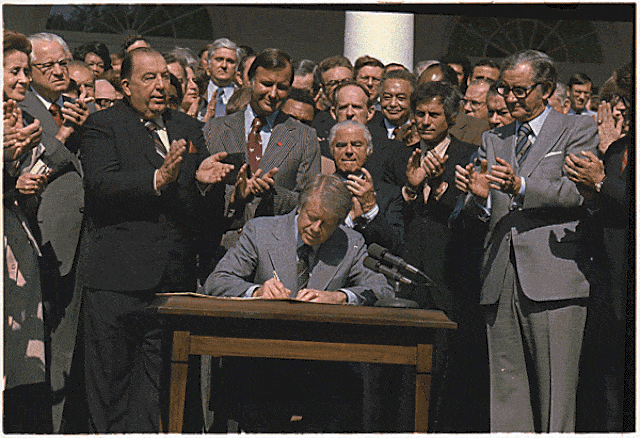
Photograph Source: White House Staff Photographers – CC BY-SA 4.0

Jimmy Carter may have liked the endless accolades that came his way following his death. Carter was immensely unpopular by the end of his first and only term as president from 1977 to early 1981. His foreign policy success between Israel and Egypt was overshadowed by inflation, an inability to communicate with the people, and the Iran hostage crisis.

Carter also set in motion the support for the mujahideen in Afghanistan that led in a direct line to September 11, 2001.

Operation Cyclone was the code name for the United States Central Intelligence Agency (CIA) program to arm and finance the Afghan mujahideen in Afghanistan from 1979 to 1992, prior to and during the military intervention by the USSR in support of the Democratic Republic of Afghanistan. The mujahideen were also supported by Britain’s M16, who conducted their own separate covert actions. The program leaned heavily towards supporting militant Islamic groups, including groups with jihadist ties…”

It wasn’t the long gas lines, and they were long, because of the US role in the Middle East, but two other actions of the late president that were at opposite ends of the policy divide that made the most lasting impression and impact on me. Although the number of draft and military resisters were erroneously stated in this article about Carter’s 1977 amnesty, readers get the idea that lots of people benefited from his program. Hundreds of thousands of people were given the opportunity to go on with their lives after the murderous debacle of the Vietnam War and the larger wars in Southeast Asia. That’s what amnesty is about: forgetting. Amnesty had been turned into a political football.

I was one of those people who benefited from Carter’s amnesty and was able to live a life unmolested by the horrors of the Vietnam War, although millions of the dead and wounded in Southeast Asia were never able to benefit from any form of relief or reparations from the US. People are still killed in Southeast Asia from what’s called unexploded ordnance. In Southeast Asia those bombs that did not detonate and sometimes do now were cluster bombs and unexploded bombs dropped from aircraft that dug into the earth. It is almost like documenting ancient history to list the free-fire zones the US created where anything or anyone who moved, communist and noncommunist alike, could be shot without question. The strategic hamlet program was a euphemism for concentration camps. Scores of massacres took place of which My Lai in March 1968 was the most famous and infamous that Seymour Hersh documented (New Yorker, January 14, 1972). US commanders demanded high body counts of dead Vietnamese people, whether real or made up to show false progress against North Vietnamese forces and other military forces that supported the North operating in the South. Often civilian noncombatants were killed and listed as enemy dead. Bombing campaigns from the air such as Operation Rolling Thunder pummeled Vietnam, while the defoliant Agent Orange destroyed forests and left a poisoned legacy on the ground. 

This is the mother of Paul Meadlo, whose son took part in the massacre at My Lai: “I sent them a good boy and they returned him a murderer” (Vietnam Veterans Against the War).

Almost as if from the script of a science fiction novel, or movie, the Iran hostage crisis put me in direct opposition to the situation that the US found itself in after a CIA operation snuffed out Iranian democracy in 1953 and led in another straight policy line culminating with the takeover of the US embassy in Tehran (PBS) in 1979 and hostages taken from that embassy. 

It was less than the span of one US presidency, Carter’s, that I was trained by a representative of the American Friends Service Committee and set up a draft registration counseling center in the Catholic Center at the University of Rhode Island. I had few draft-age individuals who used the counseling service. I did not want to publicize the counseling program because I had learned an important lesson from the Vietnam era about speaking out in the face of US power. I also did not want my family harmed in any way by those in an increasingly rightward moving society. I ended up advising people to sign up for draft registration and note their stand of conscientious objector status when they registered. My work was more of an educational effort rather than counseling resistance and refusal to comply with the program. Counseling resistance could have brought prosecution to both the people counseled and myself, a lesson well learned from the Vietnam era.  

In a laughable and largely boycotted so-called earlier amnesty by Gerald Ford (New York Times, September 17, 1974), draft and military resisters had to perform two years of public work, and in the case of those seeking amnesty from military infractions, the discharge would be vindictive and clearly identify the individual as a culpable person. Ford had previously issued a complete pardon for Richard Nixon. Nixon’s coverup of the Watergate break-in and its aftermath is what caused Nixon’s impeachment. More than 20,000 US soldiers died during Nixon’s first term. A significant but largely unknown number among the 3-5 million in Vietnam, Cambodia, and Laos were killed during both Lyndon Johnson’s and Richard Nixon’s presidencies. Nixon’s “secret plan” to end the wars in Southeast Asia was a prescription for an ongoing bloodbath. Nixon did not face impeachment because of the Vietnam War.

US policy is almost like a revolving door. Jimmy Carter became a staunch opponent to the US and its allies’ support for Israel’s apartheid regime in Gaza and the West Bank. Principled policy positions, especially in regard to foreign policy, are very rarely seen among US presidents.

Howard Lisnoff is a freelance writer. He is the author of Against the Wall: Memoir of a Vietnam-Era War Resister (2017).