Monday, January 06, 2025

Islam Beyond Phobia

New Orleans' attacker deserves to be understood like any Christian mass killer

(RNS) — Muslims are exhausted by a double standard that portrays white attackers as mentally ill and all others as ideologically driven terrorists.
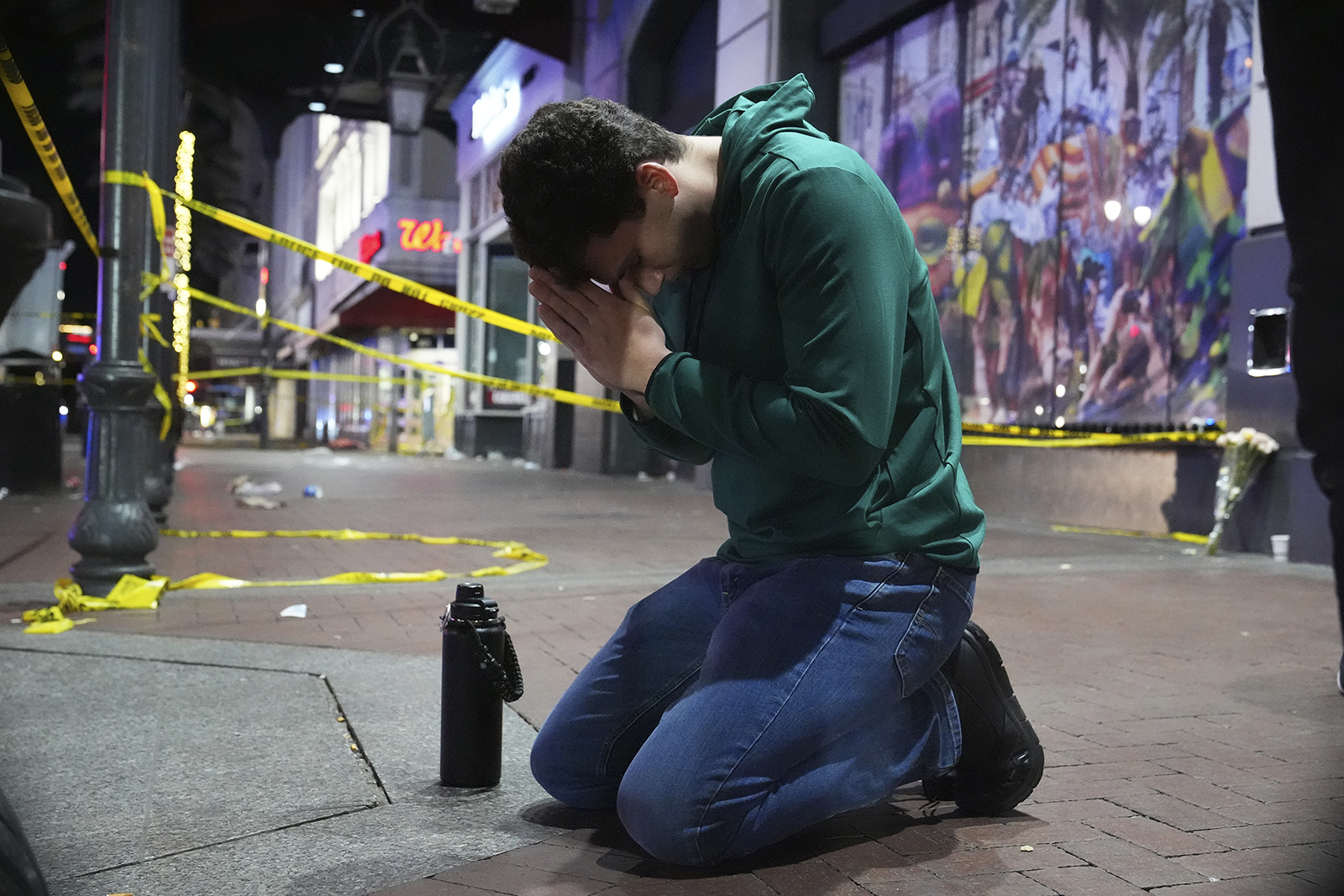

Matthias Hauswirth prays near the site where a vehicle drove into a crowd on New Orleans' Canal and Bourbon streets, Wednesday, Jan. 1, 2025. (AP Photo/George Walker IV)
Omar Suleiman
January 3, 2025

(RNS) — New Orleans is my beloved hometown. It is a city that has endured devastation and rebuilt itself not just with bricks and mortar, but with the strength of its people and the resilience of its communities.

I have always been proud to call New Orleans home, to speak of it wherever I go and to remember how we, as New Orleanians, come together in times of crisis. The country witnessed this firsthand after Hurricane Katrina in 2005, when I was blessed to lead the Islamic Circle of North America Relief‘s Muslims for Humanity project, an initiative that brought together volunteers of all faiths and backgrounds to help our city recover.

On the 10th anniversary of 9/11, while the disenfranchised of New Orleans were still struggling to rebuild, more than a thousand volunteers of all faiths gathered to clean up Rivertown. We restriped roads, repainted walls and replanted trees. The humble effort culminated with a gathering at a local mosque to share an authentic New Orleans dish — halal and kosher gumbo.

This week’s news of a terrible attack in my home city — a murderous rampage that claimed the lives of 15 people and injured dozens of others — made my heart sink. As my thoughts and prayers are with the families of the victims, I’m despairing to see the media trundle out its familiar narrative apparatus of terrorism.

RELATED: Biden administration releases strategy for fighting Islamophobia

A quarter-century after the Sept. 11 attacks, we are still haunted by the ghost of former President Bush’s War on Terror, which assumes that any purportedly Muslim assailant must be ideologically inspired. When, seemingly monthly, a white Christian opens fire at a school, the assailant is pronounced mentally unwell. The term terrorism is exclusively reserved for Muslims.

Contrast the present news cycle — Muslim commits criminal act; Muslim is connected to a larger international terrorism conspiracy; the faith of 1.8 billion people is scrutinized — with the news cycle when a person of any other faith commits a criminal act: They are defined as an isolated “lone wolf”; their mental health, upbringing or grievances are examined with nuance; calls for better gun control follow. Since 9/11, Muslims in the West have been asked to speak on behalf of purported members of their communities, to defend their religion against those who abuse its teachings and to take responsibility for individual criminal acts. Those days are over.

Since I moved away from my home state more than a decade ago, I have always spoken about the relationships we built in New Orleans in the wake of Katrina. I have told stories of how welcoming the city has always been, how my mosque — its minaret rising over a busy intersection — never faced hostility. New Orleans was a multifaith model of trust, a place where communities thrived together. Wednesday’s attack threatens to rupture the bonds of trust that have been built over decades.

Let’s be clear: This attacker, who was not from New Orleans, but Texas, was unknown to any of the dozens of Muslim institutions or mosques in Houston, where he reportedly resided. An upside-down Islamic State group flag found in his truck is not a statement of faith — just one of many indications of his twisted, deranged state of mind. His tragic and reportedly unstable life, especially in recent years, his decade of U.S. military employment, should be scrutinized far more intently than his so-called conversion to Islam, which appears to have been solitary and disconnected from the local Muslim community.

Could his time spent as a cog in the U.S. military machine be a variable to consider in this Islamic State group-inspired rampage?

The double standard is not only exhausting, but also distracts from the victims who have lost their lives, the families grieving their loved ones and the city that must once again unite to heal. Among the murdered Wednesday morning was Kareem Badawi, a Palestinian American Muslim who lived between New Orleans and Baton Rouge and belonged to a well-known Louisiana Muslim community. He was a son, a friend, a brother to many. He was part of the real fabric of this city, just like countless Muslims who have lived there for decades. Like all the victims of this senseless tragedy, his name should be known — his story centered and highlighted. But instead of focusing on the lives that were taken, coverage of this tragedy is once again falling into the tired, predictable patterns of anti-Muslim fear-mongering contributing to dehumanization and division.

This is the opposite of the culture and values that make New Orleans great. New Orleans knows how to survive tragedy. We have seen devastation and loss, and we have rebuilt — together.

The bonds of faith, trust and friendship we formed in the wake of Hurricane Katrina cannot be undone by the violence of one man. The attacker did not belong to us, but the victims did. The communities who are grieving did. And we will stand together, as we always have, against fear-mongering and against those who seek to divide us.

Let’s not let those who seek division — whether through violence or through media narratives — succeed. The New Orleans I know is better than that.
Does a lack of faith lead to suicide? One study says yes. Scholars of secularism say no.

(RNS) — A new study by a Christian scholar found higher rates of suicide and campus sexual assault in states where more nonbelievers live. But others who study secularism say correlation doesn't prove the case.


(Photo by Akhil Nath/Unsplash/Creative Commons)
Bob Smietana
January 3, 2025


(RNS) — As an evangelical Christian, Philip Truscott is dismayed at the decline of religion in America, saying it is bad for the country’s soul.

As a social scientist, he says he has proof.

In a paper in the Journal of Sociology and Christianity, Truscott draws on data tracking crime on college campus and religious affiliation surveys to show that states with higher percentages of so-called “nones” — people who claim no religious affiliation in surveys — have higher rates of sexual assault on campus as well as higher suicide rates overall.

Truscott did most of the work on the study, entitled “Rape, Suicide, and the Rise of Religious Nones” while a professor of sociology at Southwest Baptist University in Missouri. He was inspired by previous research he had done that showed that the higher the percentage of nones in a state, the higher the suicide rate. That research, based on data from the 2014 Pew Religious Landscape report, also showed that the higher the percentage of evangelicals in a state, the lower the rate of sexual assaults on its college campuses.
RELATED: Who are the ‘nones’? New Pew study debunks myths about America’s nonreligious.

Truscott followed up on those findings by examining similar data from the Public Religion Research Institute and reported the results in a paper in the Journal of Sociology and Christianity in October. Truscott argues that the decline in religion can be tied to a loss of self-control and correlates that with more suicides and assaults.


Philip Truscott. (Photo via Southwest Baptist University)

While he falls short of claiming that loss of religion causes more suicides and assaults, Truscott has subsequently argued that his findings prove the need for more state vouchers for private schools, most of which are religious. Families that choose religious schools for their kids can play a role in reversing the decline of religion in America, Truscott told RNS in an interview, which he argues will reduce the rate of suicide and campus sexual assaults.

“That really helps everyone,” he said.

His fellow sociologists, particularly those who study the nones, are skeptical, saying Truscott’s study is flawed and that his conclusions don’t fit the evidence.

Ryan Cragun, a sociology professor at the University of Tampa, reviewed Prescott’s paper and said that, while it does show a correlation between the share of nones and rates of suicide and sexual assault, Truscott fails to prove that disbelief causes those higher rates. Cragun also said the paper ignores other data, such as that showing that states with higher murder rates are correlated to higher per-capita populations of evangelicals.

“If I were to use his logic, then I should be able to argue that evangelicals are more likely to kill people,” said Cragun, co-author with Jesse M. Smith of “Goodbye Religion: The Causes and Consequences of Secularization.”

Cragun also was skeptical of the argument that religion creates more self-control or that a lack of self-control can explain why suicides or sexual assaults happen, saying that the causes of both are more complicated.

David Speed, a Canadian scholar who studies the connection between atheism and health, said Truscott is asking an important question about the social effects of the decline of religion. But Speed, a professor of psychology at the University of New Brunswick in St. John, Canada, said Truscott failed to prove his claims.


David Speed. (Photo via The Religious Studies Project)

While Truscott did show that both secularism and campus sexual assault were on the rise in some states, said Speed, he did not show that one caused the other.

“It’s kind of damning by association,” said Speed, who is also working on his own research project about the effects of secularism on suicide rates.

Speed said it is common in the social sciences to find two unrelated topics that seem to track together over time. He pointed to a website called “Spurious Correlations,” which collects such convergences, including graphs that show, for instance, that as the name William has become less popular, the number of burglaries in South Carolina has declined. The first, Speed said, does not explain the second.

Proving a causal link between the loss of religion and rise in suicide rates or assaults, said Speed, would require a great deal more data and analysis. So far, he added, no other studies have suggested that atheists or other nonbelievers are more likely to take their own lives or to commit crimes like sexual assault. Truscott’s critics also argue there’s no evidence for his claim that more faith-based schools would lead to fewer suicides.

They also say these flaws in his reasoning explain why it took so long, as Truscott has said, for his paper to find a publisher. Truscott blames a liberal bias in academic journals.

In an interview, he claimed that if his research had linked greater incidences of suicide or sexual assault to more widespread religious belief, journals would have flocked to publish his study. “The social science journals, they lean to the left politically,” Truscott said. “They are very anti-religious.”

Truscott said that he is glad the paper is getting attention, even if it’s negative attention, and hopes it leads to more study about the social implications of the decline of religion.

To critics he simply says, “Prove that I am wrong.”
119th Congress adds 2 Hindus, 2 nones, remains mostly Christian

MORMONS ARE NOT CHRISTIANS

(RNS) — Despite America's shifting religious landscape, the faith of the country's representatives has changed little.
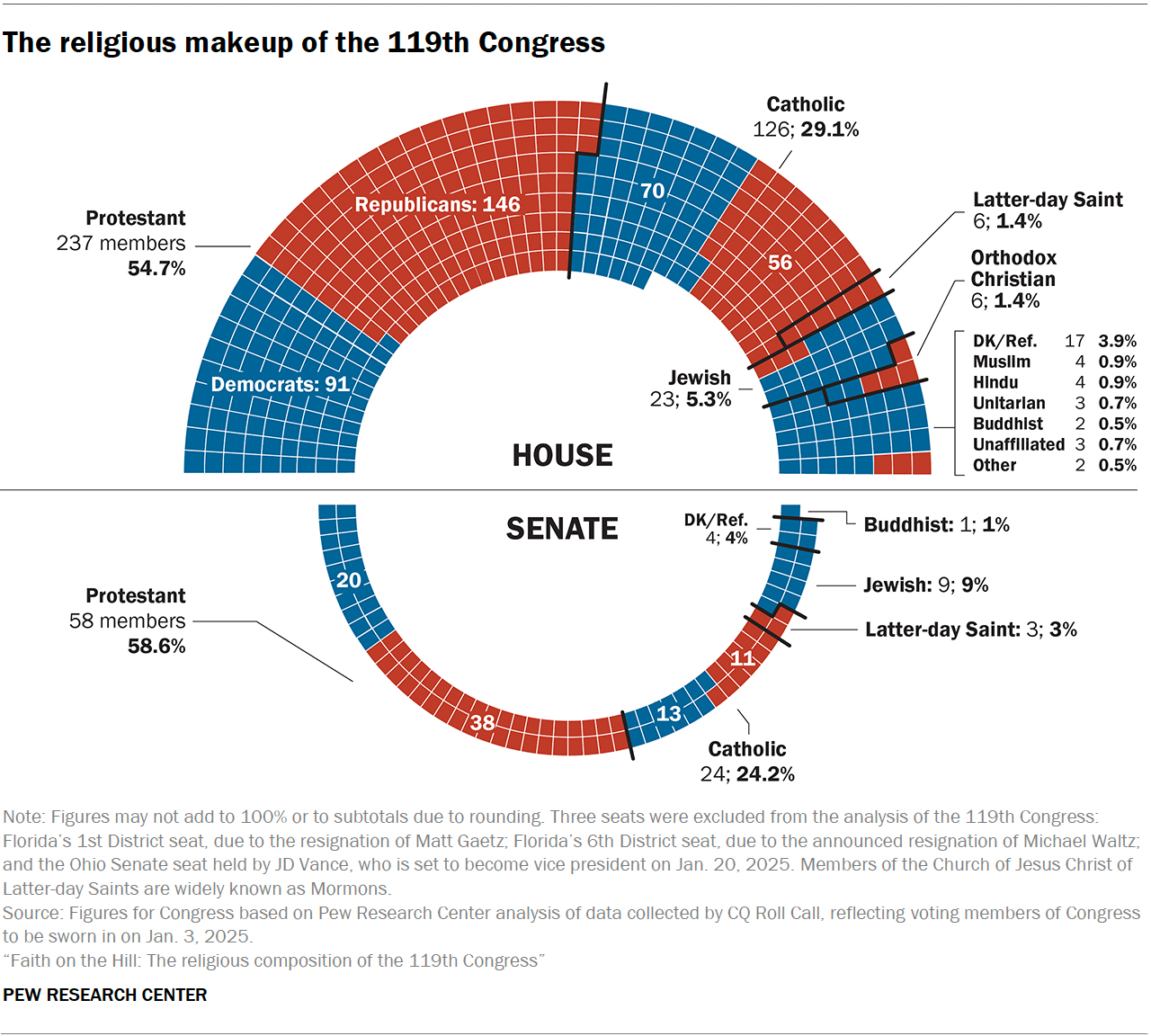
"The religious makeup of the 119th Congress" (Graphic courtesy Pew Research Center)

(RNS) — A new Pew Research Center report on the religious composition of the 119th session of Congress, convening today for the first time, reveals that the majority of its members are Christian.

The “Faith on the Hill” report draws on data gathered by CQ Roll Call, a publication that compiles congressional data and provides legislative tracking. For every new session, the website sends questionnaires to new members and follows up with reelected members on their religious affiliation.

“Christians will make up 87% of voting members in the Senate and House of Representatives, combined, in the 2025-27 congressional session,” reads the report.


Though the share of Christian members of Congress slightly decreased since the last session, 88%, and from a decade ago, 92%, the House and Senate are still significantly more Christian than the American public, which has dropped below two-thirds Christian (62%).  

“In 119th Congress, 87% are Christian” (Graphic courtesy Pew Research Center)

Less than 1% of Congress members identify as religiously unaffiliated, also called “nones,” though they account for 28% of the American population. Three Congress members reported being religiously unaffiliated, two more than in the previous session.

The new session will include 71 non-Christian members — six more than the 118th Congress — including 32 Jews, four Muslims, four Hindus, three Unitarian Universalists, three Buddhists, three unaffiliated and one Humanist. All but five of the non-Christian members are Democrats.


The new Congress will have a total of 461 Christian members, including 295 members who identify as Protestant. As in previous sessions, Baptists are the most represented denomination, with 75 Baptist members, eight more than in the last session. The report doesn’t specify which Baptist group members affiliate with. The other most represented Protestant denominations are Methodists and Presbyterians, with 26 members each; Episcopalians, with 22 members; and Lutherans, with 19 members.

These four denominations have had dwindling memberships in recent decades and have also seen their share shrink in Congress. The report’s first edition, published in 2011 for the 112th Congress, counted 51 Methodists, 45 Presbyterians, 41 Episcopalians and 26 Lutherans.

The share of Baptists is slightly higher in the House, 15%, than in the Senate, 12%. Catholics, too, will be more present in the House than in the Senate, respectively 29% and 24%; whereas, there is a higher percentage of Presbyterians, Episcopalians and Lutherans in the Senate than the House. 


Among the 295 Protestant members, 101 didn’t specify which denomination they affiliated with. The report noted that many gave “broad or vague answers” like “Protestant” or “evangelical Protestant.” Over the last decade, more members of Congress have given similar answers. In 2015, when the 114th session of Congress started, only 58 members reported being “just Christian” without specifying a denomination. 

Of the 218 Republican representatives and senators, 98% identified as Christians. Only five Republican members are not Christians — three are Jewish, one is religiously unaffiliated and one person responded “refused/don’t know.” While congressional Christians on either side of the aisle are more likely to be Protestant than Catholic, Democrats have a higher percentage of Catholics (32%) than Republicans have (25%).

Congressional Democrats are significantly more religiously diverse than Republicans. Though three-quarters are Christian, there are also 29 Jews, three Buddhists, four Muslims, four Hindus, three Unitarian Universalists, one Humanist and two unaffiliated. Twenty congressional Democrats responded “refused/don’t know.”

The 119th session includes 166 non-Protestant Christians — 150 Catholics, nine members of the Church of Jesus Christ of Latter-Day Saints, all Republicans, and six Orthodox Christians. One Congress member, a Republican, identifies as a Messianic Jew.


The religious affiliation of 21 members remains unknown, as they either declined to disclose it or couldn’t be reached. 

The analysis didn’t take into consideration Ohio Senator J.D. Vance, who will become vice president on Jan. 20, Representative Matt Gaetz, who resigned amid sexual misconduct allegations, and Representative Michael Waltz, who announced he would resign on Jan. 20 to serve in the Trump administration as a national security adviser. They all reported being Christians. 


Top of the Mormon


 January 3, 2025
Facebook
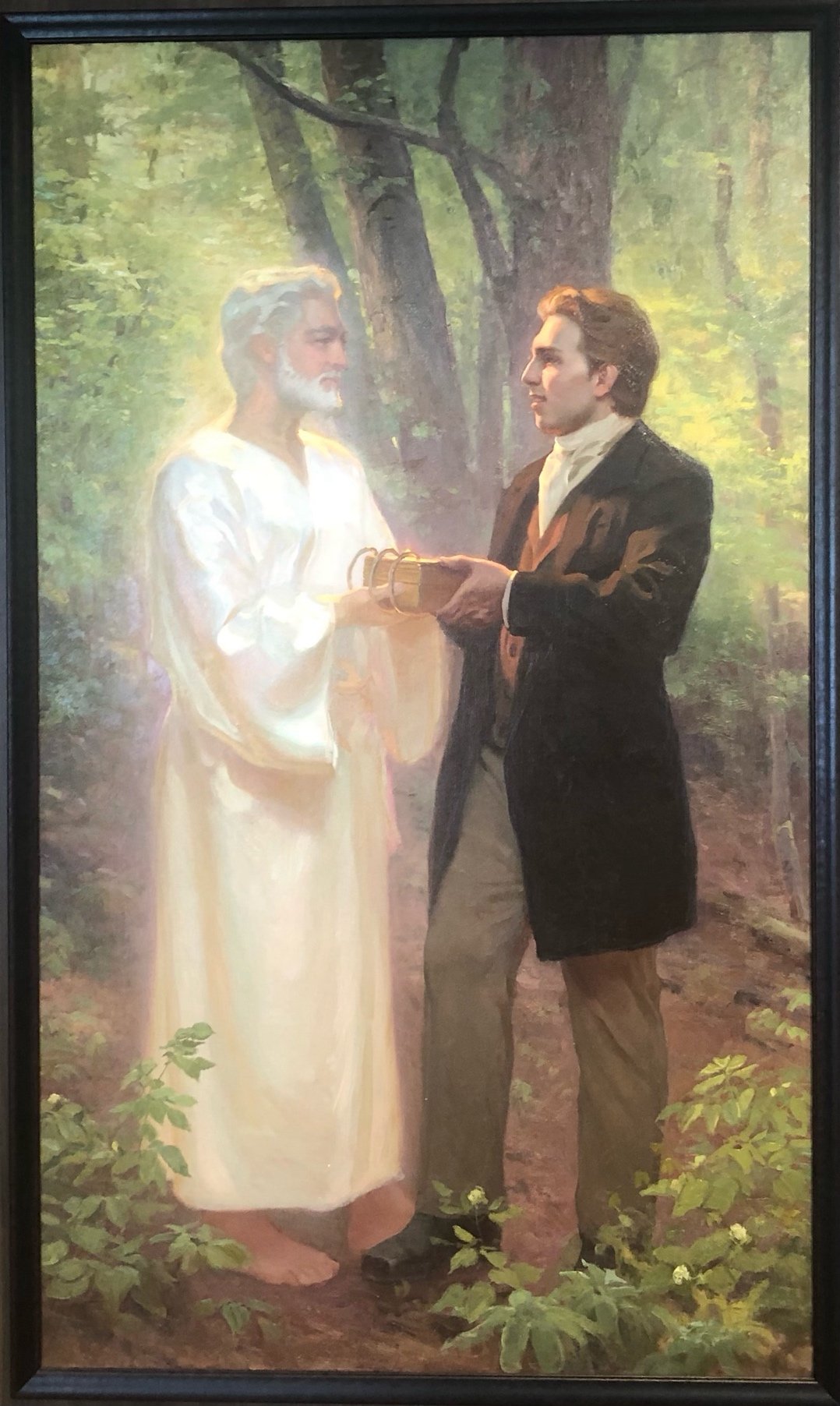
A painting of a person holding a box with a person in a white robeDescription automatically generated

Returning the Gold Plates to Moroni (1829), Linda Curley Christensen and Michael Malm, 2020.

Sacred Grove Welcome Center, Palmyra, New York,

Over my thirty years living in Upstate New York, I’ve raced past the Thruway exit for Palmyra dozens of times while driving the ninety miles from Ithaca to Rochester. Usually, I’ve been rushing to play a concert, or to listen to one, at the Eastman School of Music. But there have been plenty of times when I’ve been on my way to or from Rochester that have involved far less-pressing engagements.

These more relaxed journeys could easily have allowed me time to make an excursion to Mormonism’s Sacred Grove in Palmyra twenty-five miles west of Rochester. Even easier to reach is the Whitmer Farm where the Church of Latter-day Saints was founded in April of 1830. It is half-an-hour from Palmyra to the farm, which is just 40 miles northwest of Ithaca.

My grandfather was baptized in a creek in the Mormon town of Menan, Idaho in 1905. He was the great-grandson of David Dutton Yearsley, a wealthy Quaker merchant who was baptized by Joseph Smith in 1841. My forbear became a close friend of Smith’s and loaned him large sums of money—never repaid. Yearsley also financially backed Smith’s 1844 presidential bid. Smith was killed—martyred, in Mormon discourse—by a mob in Carthage, Illinois in the summer of that year, five months before the election. Yearsley continued west and died near Council Bluffs, Nebraska in 1849.

No one on our stout branch of the spreading Yearsley family tree has been Mormon for a century now. A baptized and confirmed Lutheran, if non-practicing since his teenage years, my father had nonetheless wanted to name me David Dutton Yearsley. That would have made me the third person with that name over six generations. My mother refused.

All this probably has something to do with my fantastical fear that, if I visited Palmyra, commando LDS genealogists might kidnap me into the church or at least force me to explain my Mormon connections. Worse, I might even be visited by Moroni in the Sacred Grove, which, according to Wikipedia (citing the Patheos multi-faith religion project), is the 74th “Most Holy Place on Earth.”

Unlike me, my daughters are native New Yorkers. The younger of the two, Cecilia, has long been fascinated by the region’s history, including the religious revivalism that spread across the so-called Burned-over District of central and western New York in the first half of the nineteenth century. It was in the course of this Second Great Awakening that Mormonism was born and from whence it proceeded to become one of the most dynamic and successful religious movements of the last two centuries. Cecilia is also a well-informed critic of the dubious sustainability schemes of present day to decarbonize the Burned-over District. During the pandemic, which coincided with her college years, Cecilia was home with us in Ithaca for a couple of long stretches. She had wanted to visit the Sacred Grove then, but it was closed. She now lives in London and returned this year for the holidays.

She ascertained that the Sacred Grove was open again, so the Sunday before Christmas we climbed into the white Subaru spattered with mud and headed to Palmyra.

It had gotten cold after a long fall and early winter of scarily warm weather. That Sunday it was 10F. The windshield wiper fluid nozzle had frozen, but through the salt-caked glass we could still see far across the snowy fields, past the leaning barns and rusty silos and the stands of leafless trees. After twenty minutes, New York’s largest landfill, Seneca Meadows, rose up at the north end of Lake Cayuga. The 350-foot-high snowcapped summit of trash could almost stand in for a cluster of western peaks spied and crossed by the Mormon trekkers of yore. Go West old man, but only as far as Palmyra!

There was much more snow north of the Thruway due to the increased precipitation coming off of Lake Ontario—“pioneer weather” the sexagenarian docent, a missionary from Boise coming to the close of a year-and-a-half stint at the Sacred Grove, would later call it as we traipsed across the snowy fields of the Smith Farm.

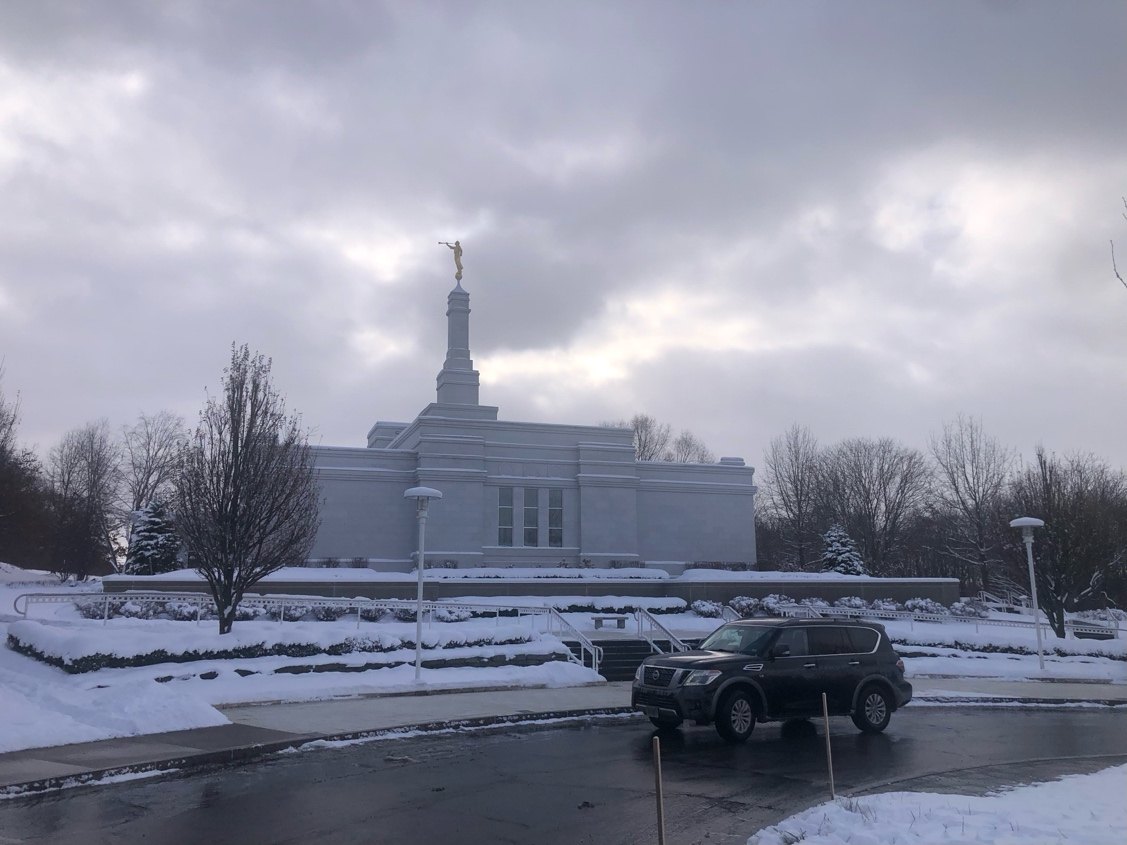
We still had a few minutes before the Sacred Grove opened at 1pm, so we pulled in first to the Temple, the first one in New York State. This classic example of Mormon architecture seems to share basic aesthetic principles with Fascist buildings, except that its boxy, concrete elements are crowned by a gilded statue of the trumpet-blowing angel Moroni. Dedicated in 2000, the bunker-like structure sits above the valley where the Smith Farm and Visitors Center lie. The site is a mile south of the village of Palmyra on the Erie Canal.

A car parked in front of a building Description automatically generated

An SUV with Virginia plates had just pulled up in front of us and a family of six piled out. When Cecilia and I walked by the vehicle, we realized that they had left it running as they took their time talking around the temple. I thought of George Hayduke from Edward Abbey’s rollicking eco-terrorist novel, The Monkey Wrench Gang—the scene where Hayduke hops into an idling police car and wreaks some fabulous havoc. Hayduke’s nemesis is the nefarious Mormon, Bishop Love.

Across the flats from the Temple, on the next the wooded ridge is the Sacred Grove. It was here in 1820 that the teenage Joseph Smith saw a pillar of light and was visited by two figures, God the Father and God the Son, who told him that all then-existing churches in their various denominations were false and corrupt.

Later that afternoon, the Virginia family’s oldest boy was asked play the part of Joseph himself at the age, even made to hold up a replica of the plates hidden in a burlap sack.

A painting of a person kneeling in front of a person kneeling in the woods Description automatically generated

The paintings in the one-room welcome center depict crucial moments of Mormon revelation: the godly visitation of in the Scared Grove, Jesus and his Father looking like identical twins. It’s a weirdly provocative theological image from this non-trinitarian sect. Another picture shows Moroni coming to the young Joseph in the attic of the family’s cabin. Canned Christmas carols emanate from hidden speakers, their saccharine glow artfully matching the painting’s pastel colorings.

I’ve tried to read the Book of Mormon but could never make much headway through its hokey biblicalisms and technical jargon—Urim, Thummim, Cimiter. Our docent throws around many of such terms and everyone appears to know exactly what they mean. There seems to be no inkling that any among us are non-Mormonism. Except for our ragged, vaguely Gorp Corps vestments, Cecilia and I definitely look the part with our above-average stature, good teeth and blond hair. Still, the learning curve is steep. We nod when the others easily answer questions like those about the weight of the plates and the hiding of them in the bag of beans when gold-hungry thugs stormed into the newer frame house built by the Smiths later in the 1820s and still largely intact.

Aside from elucidating Mormon doctrine, our guide identifies fox, deer and rabbit tracks for the young urbanites. These Western Missionaries come East cling to their connection to the agrarian past. The Mormon Church has been buying up large tracts of land in Palmyra since 1907 and even moved the state route off their property to return the ensemble of historic buildings to its rural setting. Say what you will about the preposterous revelations retailed by Smith, his followers have, with the exception of the menacing hilltop Temple, carefully preserved the natural beauty of the hills and valleys around the Sacred Grove.

After the tour,  we drive down Main Street in Palmyra past the Protestant Churches. They look badly neglected, especially when compared with the spotless indestructibility of the Mormon Temple we’ve just come from.

A snow covered ground with treesDescription automatically generated

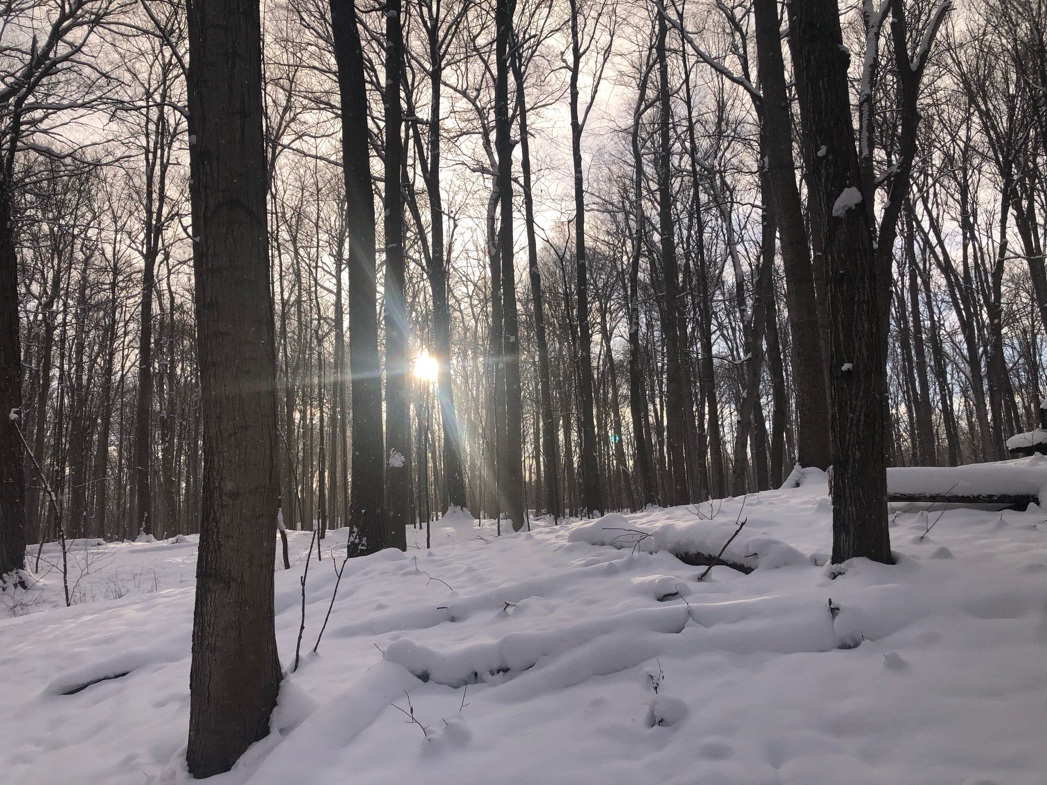
The sun sets through the Sacred Grove.

Harried by the authorities, Joseph Smith repaired first to Harmony, Pennsylvania on the banks of the Susquehanna River in Pennsylvania before returning to Upstate New York and the Whitmer Farm, where he officially founded the Church of Latter-day Saints in 1830. We arrive at the farm just after sunset at 4:30, a half-hour before closing time.

Inside this Welcome Center, Sister Hope is thrilled to see us. She is in her fifties, also on a mission away from her farm in Eastern Washington. She takes us to another reconstructed cabin, this one where the Book of Mormon was written down, the barely literate Smith making use of scribes to produce the text. When Sister Hope asks us to imagine what it was like to hear the prophet dictating in the room above, tears well up in her eyes.

A new husband-and-wife team of missionaries has just arrived from Utah. They are in training for this latest posting and join our little tour in order to hear again Sister Hope’s ardent and richly informative descriptions of the church’s early history and these events’ enduring significance. After the tour of the cabin, she ushers us into a small screening room in the Welcome Center so that we can watch a four-minute film that “can only be seen here.”

The movie brings us back to the cabin in 1830, then on the trek to Utah. There are baptisms in creeks and displays of incredible toughness as pioneers in wagons brace themselves against the bitter Plains winds. Salt Lake City and the Tabernacle grow and grow across the decades.

Our day of LDS history begins and ends with music. The film’s soundtrack is provided by the Mormon Tabernacle Choir and pursues an inexorable crescendo as thousands across the Pacific fill the new Temples of Polynesia and Southeast Asia. Moroni is hoisted by a crane atop a tower over the African rainforest.

After the movie, Sister Hope asks us what our connection to the Church is. Cecilia tells her that we are descendants of David Dutton Yearsley. Sister Hope is thrilled and says that during her time on the track team at BYU-Idaho, she was helped by the trainer, Nate Yearsley. “I’m sure he’s a relative,” I mumble. Before we leave, Sister Hopes reminds us that tomorrow is Joseph Smith’s birthday. We thank her for her tour and make our escape. The vast parking lot is empty except for a lone Subaru.

David Yearsley is a long-time contributor to CounterPunch and the Anderson Valley Advertiser. His latest recording is Handel’s Organ Banquet. He can be reached at dgyearsley@gmail.com

Vatican decides not to put keffiyeh back in Nativity

VATICAN CITY (RNS) — The Vatican had hinted the controversial keffiyeh 
would be put back in the Nativity scene on Christmas Eve.
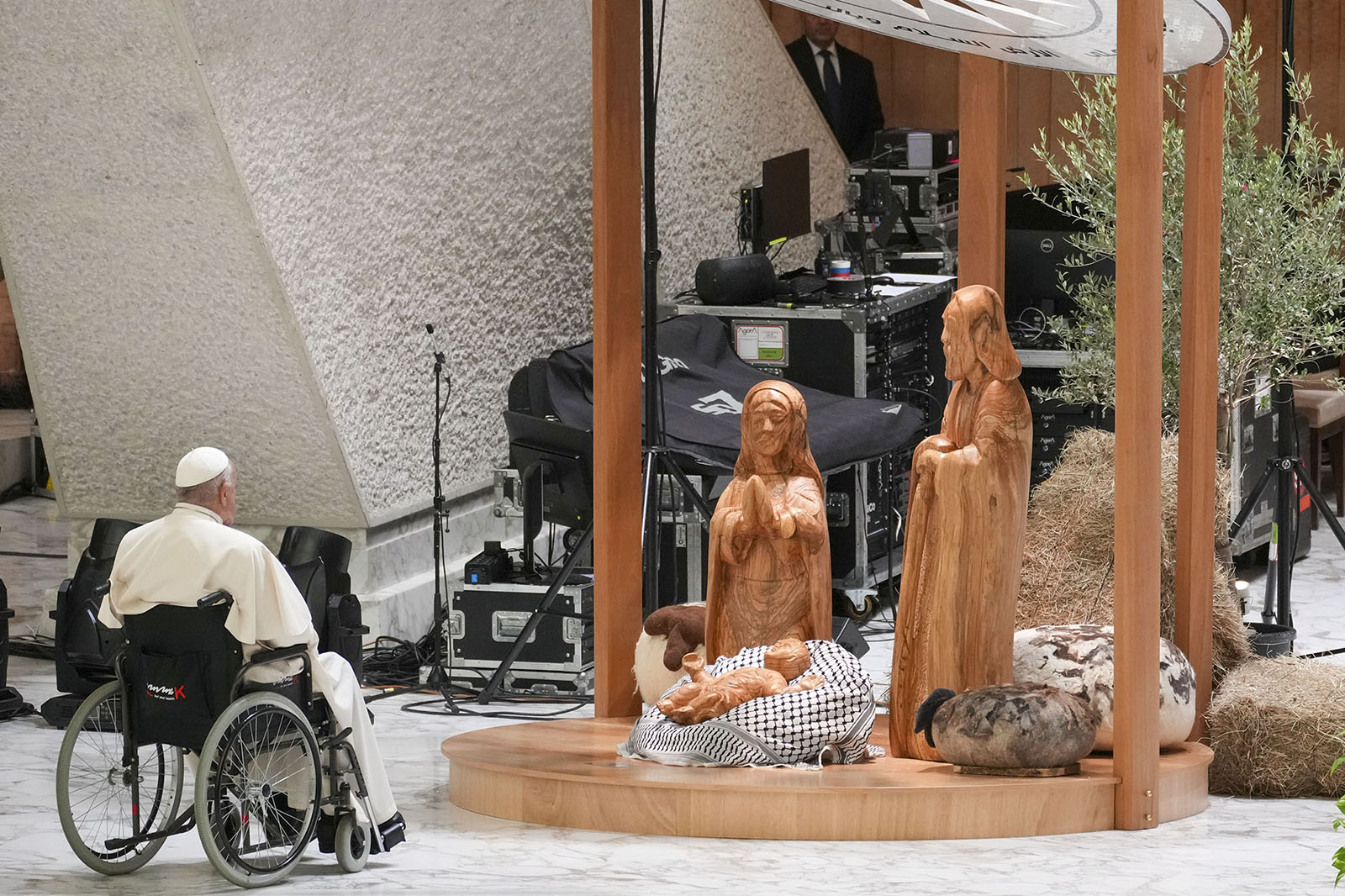
Pope Francis prays in front of a Nativity scene crafted in the West Bank city of Bethlehem, as he arrives for a meeting with the donors of the fir tree set up in St. Peter's Square as a Christmas tree and those who have crafted the life-size Nativity scene at the tree's feet, in the Paul VI Hall at the Vatican, Saturday, Dec. 7, 2024. (AP Photo/Andrew Medichini)

VATICAN CITY (RNS) — After receiving backlash from Jewish groups, the Vatican chose to not put the keffiyeh back in its original place on the manger of the Palestinian-made Nativity scene in the Paul VI Hall.

The Nativity scene was crafted by artists from Bethlehem using local materials and was inaugurated by Pope Francis before Palestinian political representatives on Dec. 7. One artist who collaborated on creating the Nativity, Faten Nastas Mitwasi, told RNS that Palestinian officials had placed the keffiyeh, a black and white checkered scarf that has come to symbolize the Palestinian cause, on the manger of the Nativity shortly before the arrival of the pope.

She added that while it was not their initial intention to turn the Nativity into a political statement, they welcomed the final addition of the keffiyeh as a symbol of national identity.  


After the keffiyeh was removed by Vatican officials along with the baby Jesus, papal spokesperson Matteo Bruni told RNS it’s customary for the statue of Jesus to be removed from the Nativity scene until Christmas Day. But on Saturday (Jan. 4), when the Paul VI Hall was finally visible to the public, the statue of Jesus lay on a bundle of hay, and the keffiyeh was still missing.

Neither the artists nor the Vatican responded to a request for comment on the missing keffiyeh ahead of publication.

In the days after the keffiyeh first appeared, the American Jewish committee had said its members were “disappointed and troubled” by the keffiyeh being displayed in the Vatican’s Nativity scene, a feeling echoed by other Jewish groups in Italy. The chief rabbi in Genoa, Italy, Giuseppe Momigliano, told local media outlets that “the dialogue with the Italian Bishops’ Conference remains open, but the pope’s behavior surely doesn’t help. Regardless of whether it’s explicit or symbolic.”


The conflict in the Middle East has negatively impacted the relationship between the Vatican and the Jewish community as Pope Francis attempts to take an impartial stance between Israel and Palestine. The pope’s recent remarks to Catholic cardinals on Dec. 21, when he described Israeli attacks that killed 25 Palestinians, including children, as “cruelty,” were criticized in a Dec. 31 letter by leaders of the U.S.’ largest Jewish organization.

“With global antisemitism at record highs, the American Jewish community calls on you to refrain from making incendiary comments and to build bridges between our two peoples,” read the letter by the Conference of Presidents of Major American Jewish Organizations.