Monday, January 06, 2025


INTERNAT'L WEEK OF ACTION FOR POLA ROUPA & NIKOS MAZIOTIS

Received via email

EVERY REBEL HEART, A REVOLUTIONARY STRUGGLE

Practical solidarity: In the face of the world of the state, the bosses and the horrors of their wars, we stand in solidarity with the condemned comrades of Revolutionary Struggle, Pola Roupa and Nikos Maziotis, who through the ranks and action of the organization Revolutionary Struggle, fought steadfastly and uncompromisingly on the side of the class oppressed by the violence and terror of economic exploitation, poverty and political extermination in the sweatshops of wage slavery. With consistency and dedication to the struggle for social revolution, the comrade and comrade took on the political responsibility of their participation in the organisation, as befits guerrilla dignity and revolutionary consistency.

They did not review and defended politically, one by one, the 18 armed and bombing actions undertaken by the Revolutionary Struggle, one by one, on high-important symbols and infrastructures of the state and capital, from 2003 to 2018, achieving significant blows to the correlations of domination: Ministries - of Economy and of Employment -, Evelpidon Courts, Police Departments, Police Officers and riot police, Minister of Public Order, US Embassy, Stock Exchange, Bank of Greece - branch of the European Central Bank - office of the International Monetary Fund in Greece, banks - Citibank, Eurobank -, up to the attempted escape of comrade Nikos Maziotis and other prisoners from the Korydallos prison by helicopter (hijacking), which was personally undertaken by comrade Pola Roupa.

Judicial Power - Repentance - Double Prison: The state bi-historically maintains to the end its practices of war of attrition and subversion, against its armed political enemy, the militant(s) who attacked it by all means, challenging and shaking its imperium in practice.

"Justice" as a pillar of state violence and terrorism, assumes the regime's role of "punishing" not only the class oppressed and undisciplined, but also the execution of the total "punishment" of the armed political enemies of the state and capital, constantly upgrading the criminal arsenal and the "maximum security" prisons and imprisoning the struggling comrades with heavy sentences. At the same time, it acquits cops/killers/nazis, child rapists, politicians, big businessmen-businessmen, etc. And when the time comes for the release of the militants from the "penitentiaries of democracy", the dirty role is taken over by the judicial councils which, in the case of political prisoners, are intended to damage their political choices and revolutionary conscience by extracting "statements of repentance".

DEFINITIVE RELEASE OF COMRADE POLA ROUPA

On 17 November 2023, comrade Pola Roupa was released from prison with restrictions until 2032. One month later, the mechanisms of the terrorist state, with an appeal by the deputy prosecutor of the Chalkida appeal court against her release, tried to put her back in prison. Last year, on 10 January, the comrade passed a court hearing in Chalkida and since then, the decision has been pending and she remains hostage.

Exactly one year later, on January 10, 2025, the comrade with a new summons and a new positive prosecutor's proposal for her release, will be back before the judicial mechanism, so that the judicial council of Chalkida will decide on her release or re-arrest. And this, at the same time that the comrade is required to pay exorbitant fines which were imposed for her participation in the activities of the Revolutionary Struggle organization and which crush her survival, forcing her and her child into economic extinction, while her companion remains a prisoner of the state.

The selflessness, the militant integrity of the comrade and her contribution against social misery, highlight the revolutionary resistance within the socio-political disaster and against global totalitarianism. Through its ranks, the Revolutionary Struggle organization has made it clear that the state, banks and ministries will accept guerrilla social resistance for all the violence, bloodletting and bloodshed they have unleashed on the exploited and oppressed sections of society.

On the side of solidarity, we stand by the anarchist comrade Pola Roupa in this new judicial trial.

IMMEDIATE RELEASE OF COMRADE NIKOS MAZIOTIS

After 16 years (mixed) in prison for the action of the organization Revolutionary Struggle and with the completion of 4/5 of the actual serving of the 20-year sentence last month, comrade Nikos Maziotis will pass the next period of time by the judicial council (in Lamia), as he filed an application for release on November 25, 2024. This is the 7th request for conditional release, after 6 consecutive rejections. In the case of a new rejection, he is effectively forced into captivity at least until March 2027, with vindictive and abusive (even by their laws) serving up to the last day of the entire sentence. This despite the fact that he has long ago (since January 2022) fulfilled the prescribed conditions (state of exemption).

The judicial staff of Lamia - as a mechanism of state and economic domination - applies tactics of political extermination, inspired by the tradition of the counter-revolutionary terror courts. It releases and grants regular licenses to Nazi murderers, in contrast to the continuous denial of the conditional release of the anarchist Nikos Maziotis and the cutting of the licenses of militants (D. Koufontinas). It demands a definitive exit from prison only by enforcing the renunciation of value and moral principles. The regime of blackmail of repentance that they attempt to extort from comrade Nikos Masiotis implies the alienation and imprisonment of conscience, in order to achieve absolute discipline through the pervasive control of the core of the revolutionary's consciousness and values.

The anarchist Nikos Maziotis is at a rather critical point in his captivity. We should not leave the comrade hostage in state captivity, because most probably this condition of exemption from conditional release, while he has already served 4/5 of the total 20-year sentence, will not only set a precedent, but foreshadows the future that they have in store for other prisoners in an era of intensifying repressive treatment by the state for the world of struggle.

To strengthen solidarity. To stand by the anarchist comrade Nikos Maziotis.

We call for a gathering in solidarity with comrade Pola Roupa, at the Courts of Chalkida, on Friday 10 January 2025, at 12.00

We call for a gathering in solidarity with comrade Nikos Maziotis, at Lamia Court, on Thursday 16 January 2025, at 12.00

STATE AND CAPITAL ARE THE ONLY TERRORISTS

DEFINITIVE RELEASE OF COMRADE POLA ROUPA WHO REMAINS IN A HOSTAGE SITUATION DESPITE HER RELEASE

IMMEDIATE RELEASE OF COMRADE NIKOS MAZIOTIS

SOLIDARITY WITΗ THE IMPRISONED COMRADES

Solidarity Assembly for the convicted members of the Revolutionary Struggle P. Roupa and N. Maziotis

contact e-mail: synallil-roupamaziotis@espiv.net


Mountain Camaraderie: A Story of an Anarchist Meeting in Germany

From avtonom.org
December 23, 2024

A subscriber sent a story about an anarchist meeting in Germany.

The outstanding mountaineer David Lama said that joint ascents are based on similar ideas about routes, tactics and willingness to take risks. Where extreme conditions mercilessly expose hidden personal qualities, camaraderie takes on a special role.

Armed with this knowledge, a group of anarchists from the Äppelwoi Komitee traveled to the mountains of Saxon Switzerland for a weekend of exchanging experiences and networking for the sixth time. The winter and the road did not prevent two dozen comrades from gathering in a hut on the edge of a hill overlooking the mighty Elbe. By collective efforts the house was heated, a grill was organized in the yard, German and Uzbek dishes in vegan interpretation were cooked on the stove (we will not get tired of thanking those responsible, the food, as always, was on the level of Michelin restaurants).

Fed and warmed, the participants discussed the following topics:

- A trade union activist told how to unite on specific issues without building rigid structures like parties
- An information security specialist introduced new threats to activists in the digital environment and taught how to protect themselves.
- An anarchist from the Czech Republic shared his experience of helping anti-fascists in Ukraine.
- The director held a think tank on building circles of dreamers to develop a vision of the future
- Comrades shared a report on their trip to Cologne for the November forum of left-wing anti-war emigration.

The program of the meeting was varied. In the afternoon, the group set out to conquer the Elbe Sandstone Mountains to enjoy the magical scenery and a historical excursion about the anti-fascist resistance, because of which these places were proudly called the “Red Kingdom” back in the 1920s. After a fascinating haiku, the anarchists warmed up in the lodge with tea and mulled wine and wrote postcards to political prisoners.

One participant prepared a prison koryak, which turned out delicious and incredibly sweet (less sugar next time, please!), and an unexpected guest organized a distro so that everyone left dressed in the most fashionable clothes. And, of course, everyone gathered engaged in intense conversations. Sometimes the degree of discussion rose too high, some of the team members opened up from a new side (let's remember that alcohol is a bad companion, especially in difficult conditions), but, one way or another, the participants left the meeting in Saxony with deep and strong impressions.

Mountains don't get lower when you climb them with your comrades. The difference lies in the quality of the experience - whether success or failure. If you share the defeat with your comrades, it becomes less; if you share the joy, it increases. It's like real magic, and it's never enough. So look forward to more Äppelwoi Komitee meetings - more details on instagram and by emailing appelwoiKomitee@riseup.net.

The Äppelwoi Komitee, a discussion club for emigrants from Belarus, Russia, and Ukraine, has already held six meetings outside the major cities. The program includes lectures, workshops, and networking with comrades from Germany, the Czech Republic, Serbia, France, and Poland. It’s a place to talk through issues, support each other, and take action together to find solutions and build a stronger community. In the discussions, participants try to figure out who they are as emigrants and what they want.

The main goal from September 2023 is to build support networks for anti-authoritarian activists forced to emigrate, who value the principles of direct democracy. Isolation can lead to people becoming less active over time. By sharing experiences and knowledge, we can keep the community connected and growing, building resources and influence.


Prague: Anarchist Book Party

From Anarchistické federace
December 20, 2024

Report from a scaled-down winter version of the anarchist book festival

Last year, the Anarchist Book Festival collective , in addition to its flagship event in May, also organized a smaller meeting in early December . This was met with enormous interest and there was almost no movement in the then-closing Prostor39. Since the idea of ​​a “winter bookfair” was so popular, the collective decided to repeat it in 2024 and organized an “Anarchist Book Party” on Saturday, December 7. It took place in Prague’s Holešovice in parallel at two locations that are only a few minutes’ walk away from each other, namely the Cross club and the 254 autonomous center.

The bookfair itself, i.e. the space with stands of publishing houses and various collectives, took place from two in the afternoon to seven in the evening in the basement hall of Cross. If the attendance had been like last year, people would probably have been constantly bumping into each other, but fortunately it was smaller and exactly matched the capacity of the space. We also presented ourselves here with our stand. We supplemented the older publications of the Anarchist Federation Publishing House with a new book by Colin Ward Anarchism: A Very Brief Introduction and the autumn issue of the anarchist review Existence on the topic of anarchist pedagogy . Anyone who wanted could take some of the older issues of Existence with their purchase for free . Also on offer were posters of the Belarusian Anarchist Black Cross or the book Life in Combat with collected texts by Dmitry Petrov, a Russian anarchist who fell at Bakhmut in the fight against Putin's invasion. There were also stands in the hall from The Anarchist Review of Books , Salé distra (with an amazing wall calendar The Riot Dogs for 2025), the Solidrones collective, K115 , Collectively Against Capital , Safe space bookstore , Utopia Libri publishing house (with the new releases Russian Colonialism: A Guide and There's Something to Live for on This Earth ), Nevim , Alarm and Rubato . If we forgot anyone, we apologize.

At the same time, a lecture program was also taking place in one of the rooms in Cross. However, one of the three points was canceled due to illness, so those interested could finally listen to the presentation of the book Dobré po málú or the presentation of the Anarchist Federation on anarchist strategy. Thanks to the shortened program, there was much more time for this, so a long and interesting debate in the audience could develop after it ended. The presentation itself, which returned to the topic of Existence No. 2/2022 , talked about the need for strategic thinking, about anarchist goals, about consideration for ourselves, about the traps of activism, about what a revolutionary organization can do in non-revolutionary times and what analysis is and is not, about one's own experiences, about the need for rethinking, and about what the conclusions of the earlier federation debate on the search for anarchist politics were.

The next part of the program took place in AC 254. Here the film Lobby USA was shown , followed by a discussion. In the next point, we again contributed from the federal reserves, namely by presenting Guy Debord's book The Society of the Spectacle from the Utopia libri publishing house. Every one of our relationships is mediated by spectacles, says Debord, and we literally see this "show business" (a world where images are shown for the purpose of accumulating profit, a world where images are commodities, and with it the fetishism associated with it) before our eyes. But appearances are deceiving, our grandmothers proclaimed (and sometimes baked delicious plum dumplings). And we do not want to be deceived. Events like this bookfair present a vision in which it is possible to meet directly (not through images à la social networks or market relations) and experience what it is like to be and not just have or seem to be . In our opinion, the lecture was successful and the interest showed that there is also an interest in theory among us.

The lecture was followed by a discussion in which we imagined further inspiration for further reading, which is part of books. A short break, an edit and the event begins. The musical highlight of the entire "Anarchist Book Party" was then an evening performance in AC 254. Bunkerer, Podještědský okultista and DJane Dark Spherez introduced themselves.

And we must not forget the favorite part of our reports dedicated to food. The AC 254 team took care of the material base for our insatiable tummies. In addition to several types of desserts, you could have a plate of vegetable ragout with soy noodles and rice, or just warm up with an excellent miso soup.

Although the organization of the party was decided at the last minute, the event was a success. We are glad that we were able to promptly respond to the organizers' inquiries and contribute with lectures. We also appreciate the opportunity to present our publications, meet together, greet familiar faces and chat with completely new ones. Bookfairs are one of the key anarchist events in the Czech Republic - places where we meet and where sparks are created that ignite metaphorical Molotov cocktails. Next year, the bottles will fall and the flames will engulf many a target - the Anarchist Federation will be 30 years old. But more on that next time.


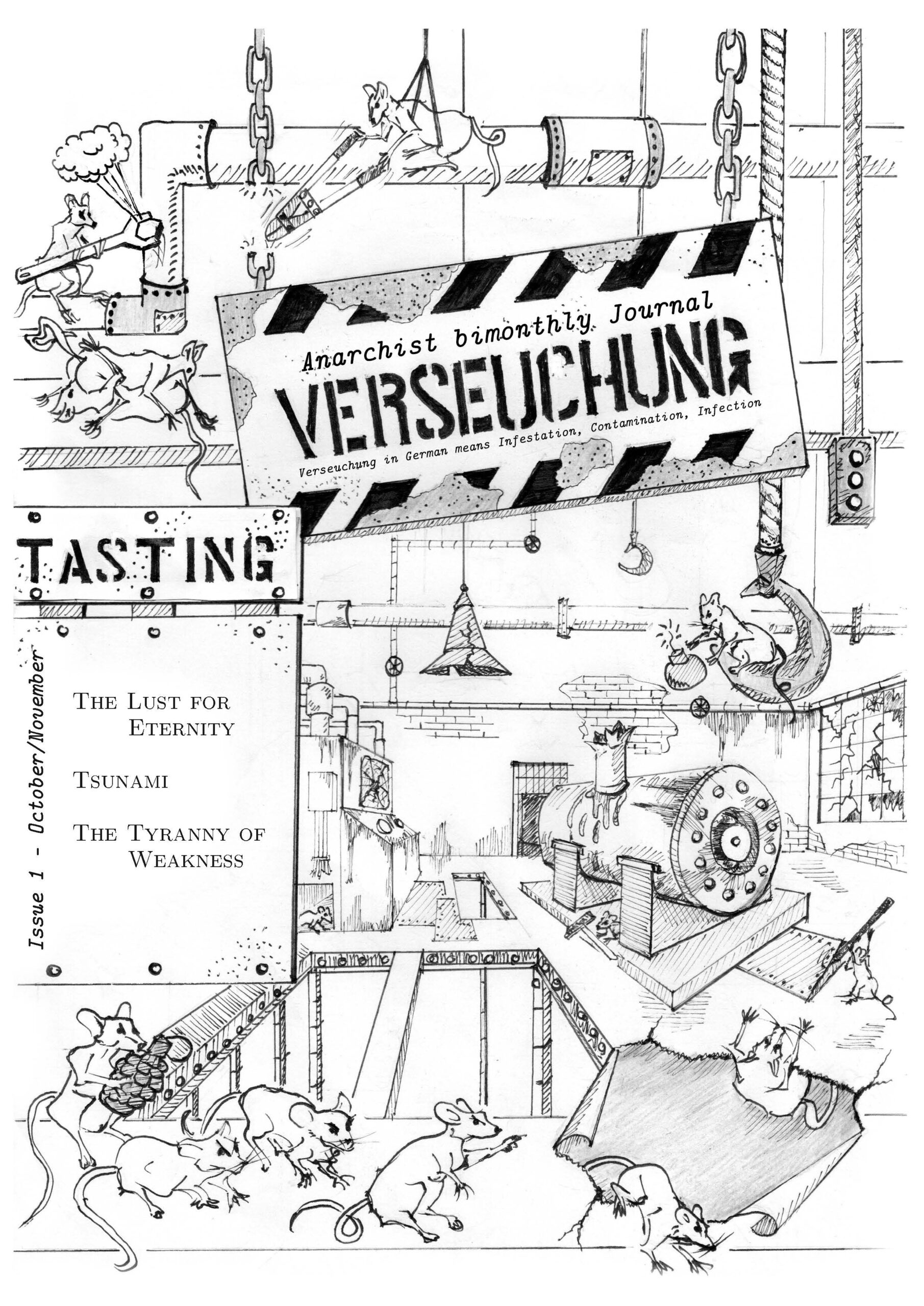
Verseuchung, anarchist journal, #0 and #1

From Act for freedom now!

PDF

Verseuchung, in German means Infestation, contamination, Infection

EDITORIAL ISSUE 0 :

We cannot save someone. No one can. Likewise we cannot really liberate others.
This forest (a living being) cannot be saved, it will either survive, even though profoundly changed or it will die, asphyxiated by the deadly vapours of this world.

For sure it cannot be saved by their legislations and their technology, but I suspect neither it can by us living here now. And it is not about saving it either. Not that I will not mourn if this forest dies. I will mourn the oak I’ve been living in, and this mourning will become anger added to the flames burning against this world, thirst added to my need for vengeance.

I don’t want this forest to die. But I’m not here to save it. And I want even less that it becomes the crystallized, unmoving and unsurprising version of itself they are proposing. Their least bad options, their grey survival elevated to life in the “best world possible”, their never-ending youth and refusal of death and life… this is no saving, this is a destiny maybe worse than Death itself.

A dead forest is a monument to human alienation, but a “preserved” one would be just one of their technological appendices, a jungle of statistics, assessments and authority rather than unearthed desires, sensibilities and joy. Not the warm refuge for those who fight against this existence, nor the thousand possibilities and discoveries, nor the precious moments of complicity, nor the dark living maze feared or exalted in the imagination of those who live nearby…

A plantation of trees is no forest, and to their preservation in this form of altered survival, I’d rather see this forest crashing into the reefs!

—————- 

PDF

EDITORIAL ISSUE 1

We grope in the pyramids of power. Everywhere, around us, the signs of a world that wants to last forever, that wants to make of itself the emblem of the highest that has ever been created by human beings. No, it cannot be this sycophantic repetition of itself without any horizon of an end what we put at the base of a desire for radical and irreparable rupture. The biological world, from which we come from but that is more and more foreign to us, reminds us in every moment that it is rather the becoming what on which reality is founded upon. Exorcising of finitude and removal of death are just palliatives in front of the unknown. And the flight from doubts and uncertainty serves only those who want to fund religions and powers, to hand out answers, not those who want to embrace unpredictability taking on the risks of freedom. To ensure one’s own future, to make it certain and predictable. Sure, this is the world in which we live and the way we were taught. But, right because of it, shouldn’t it be an alarm bell? We are certain of our survival by eschewing risk.

As long as we secure our struggles in the inconsistency of their conflictuality, postponing it to an hypothetical future, or when we crystallize our spaces, that were born pulsating in the breaking of gates and regulations and the unpredictably iron limits of the law. To legalize and to reproduce. To ascertain one’s own future, one’s own persistence.

At the same time, the becoming cannot start being the favourite easy excuse for the flourishing of opinions. Coherence becomes an immobilizing moral string, that traps us in dogma and incapacity of imagining and putting in place forms of struggle. Its critique should not, anyhow, create confusion between the simplistic grayness of bar chatters and the blazing clarity of the Idea. Like ethics is something else, also the thought that becomes action – and viceversa – has nothing to do with what we tell our self to ease our conscience before putting ourself to bed. It is always about, at the end, the distinction between quality and quantity.

Unfortunately it is not easy to accept the solitude and the incommunicability that certain choices, today like in the past, mean. We perceive every gap as incandescent against our skin. The Promethean one with the Technical System and its poisonous fruits; the organizational one with the Capital and its capacity to mould its defeats and its failures in occasions of perpetual relaunch; the one with the strength of the State and its servants. And yet it is not about, once more, putting ourselves on the same level. Symmetry kills fantasy. We need to start from the acceptation of our limits and of our fallibility to find a way to look our conscience in the eyes without feeling ashamed. We need to stop fooling ourselves and to start knowing ourselves as weak and fragile. Who did we become? Caricatures of guerrilla fighters overwhelmed by occidental well-being? But the toughness of life is elsewhere and elsewhere is to be looked for without concealing it with masks and pretensions, knowing that doubt can never abandon us. And it should never.

Because there cannot be a twinkling more inviting than our own self, otherwise we are just stuffing ourselves with our same lies built with the quantitative leftovers of Dominion. The will, the stubbornness, the renunciation, can be reinvented. Not the christian one, but that of the Ideal, of wanting to live at every cost – here and now – the joy of the uniqueness of our lives. That we need to accept as ephemeral and unpredictable. Enjoy. Every instant.

“As a liberator I am a disappointment. To be disappointed is myself. I conduct my anarchist idea of freedom along steep routes, where the urgency is other, not that of the straight way I had dreamt of. It is urgency of survival, of not letting yourself be submerged and suffocated, of not being slaughtered at the corner of a dark alley of a way in the desert, a whatever track obviously not lightened. Urgency of equipping oneself materially and psychologically to shoot faster and better than the others, of the enemy”
A.M.B. – The Unexpected Guest


Initiative for a South Asian Anarchist Library 

January 2024 (SIC)  update

Initiative for a South Asian Anarchist Library January 2024 update

From The Anarchist Library Bookshelf [wiki]

Updates (3 January 2025)

Since 2023, we’ve had several false starts in developing a South Asian anarchist library. However we have had some progress. Contact us in the Asian Libraries matrix chat for more details.

  1. Subdomain. The proposed subdomain of the South Asian Anarchist Library is to be begumpura.theanarchistlibrary.org, with begumpura referring to a utopian ideal in Indian antiquity that is similar to anarchism. Through discussions, this was deemed an acceptable compromise to avoid colonial or ethnonationalist designations. This, however, is not final and can still be modified should a dedicated team from South Asia take up the task of starting the library.

  2. Interface. Ultimately, the translation of the interface can be done later (see How to: The Anarchist Library in different languages). Since English is already a South Asian language (even if not an indigenous one), it can serve as the initial interface.

    1. Translating the interface. See the AMuseWiki manual page on translating the interface for details on how to translate the interface. You’ll have to learn how to use Poedit.

    2. Typographical rules for target language. You are the one literate in your language so you’ll have to provide some code to determine the typographical rules of your language.

  3. Texts. New librarians need to find source texts to upload to the South Asian anarchist library. You’ll also need to familiarize yourself with the AMUse markup used by AMuseWiki in the manual to learn how to upload texts.

    1. One good source of initial texts to upload is Ole Birk Laursen’s archive for M.P.T. Acharya. These can be transcribed and then uploaded as MUSE markup for the library.

    2. You should also source texts from whatever South Asian language you are literate in, whether that be in Urdu or whatever language. Several anarchists across the subcontinent already produce translations and original texts. These can be used for the library.

  1. Logo. You would need to source a logo for the South Asian anarchist library. Us in the Asian Libraries chat can possibly find you an artist if you can’t find one yourselef.

  2. Infrastructure. The Anarchist Library and Anarchy Planet can provide the infrastructure for hosting the South Asian Anarchist Library. Contact us in the Asian Libraries matrix chat for more details.

Original Call

Note: This is the original call made on 2023 on shh.anarchyplanet.org.

Anarchism in South Asia is slowly and steadily rising. There are groups and individuals in Pakistan, India, Bangladesh, and Sri Lanka. Anarchist texts in South Asian languages have been written and translated, but there is not yet a place to compile these. Like Southeast Asia, South Asia has more languages than nation-states. Like the Southeast Asian Anarchist Library, it would make sense to make a diverse multi-lingual library rather than separate small libraries for each language which might have only very few texts each.

Now I am not from South Asia, I am from Southeast Asia. I cannot maintain a South Asian anarchist library in languages I am not literate in. So I am calling on anarchists from or in South Asia and literate in South Asian languages to initiate a South Asian Anarchist Library. What is needed?

  1. A translation of the user interface into South Asian languages

  2. A willingness to learn the various AmuseWiki modules and Muse markup language

  3. Access to anarchist texts and translations in South Asian languages

  4. Being embedded in the international anarchist milieu in South Asia

If you’re up for this, reach out to the folks behind the Anarchist Library. We have an Asian anarchist libraries chat on the Anarchy Planet matrix. You can also reach out to the general Anarchist Library IRC.

Israel’s Downward Spiral

The nation's success on the battlefield masks the beating it is taking as an international pariah.


January 4, 2025
Source: Truthdig


Israeli troops unfurl Israeli flag on Mount Hermon in Syria. Photo credit: Times of Israel


Israel is riding high after carrying out the most audacious campaign of military conquest of any nation since the 1940s. Following the Oct. 7, 2023, attacks, Israel has begun an open-ended occupation in Lebanon, seized Syrian territory twice the size of Gaza, wiped 50 Palestinian villages “off the map” in the West Bank, bombed Iran and Yemen, and weathered more than a year of resistance, global revulsion and protest, while carrying out a horrific genocide in Gaza that has no end in sight.

From the beginning, Israel has enjoyed the full support of the Biden administration — militarily, financially, politically, diplomatically and morally. Israel’s extermination of children, families, aid workers, doctors, teachers and artists has earned it only a few occasional peeps of official protest from Washington, while regional powers such as Turkey and Saudi Arabia are trying to have it both ways. They have reduced economic and political ties with Israel to pacify domestic anger, while quietly aiding it because their governments are aligned with U.S. interests.

But this moment doesn’t represent the triumph of Zionism so much as the beginning of the end. Israel has become an international pariah, led by an incompetent and corrupt government, and it is experiencing a debilitating brain drain. Its society is riven by multiple fractures, with deep political divisions and intractable conflicts, not just between Jews and Palestinians and Israeli Arabs, or those for or against Prime Minister Benjamin Netanyahu’s far-right government, but between secular Jews and a growing ultra-Orthodox population.

Meanwhile, the gulf between Israel and the rest of the world has never been deeper. In January, a Tel Aviv University poll showed almost universal backing among Israeli Jews for its war on Palestinians with 95% either believing the military was using the right amount of force in Gaza or too little. Nearly 60% support killing all 2.3 million residents of Gaza through starvation. Outside of the West, opposition to Israeli savagery is nearly universal and has reinvigorated the 2005 call by Palestinian civil society for “boycott, divestments and sanctions against Israel until it complies with international law and universal principles of human rights,” as well as the Palestinian Campaign for the Academic and Cultural Boycott of Israel initiated the previous year.

On top of this political and economic isolation, Israel’s embrace of endless war and Jewish supremacy is creating self-inflicted wounds. While the country depends on Washington for its power and impunity, no amount of weapons and dollars can prop up a regime festering with rot. Higher taxes, government expenses, inflation, reduced social services, shocking levels of poverty intensified by the war and mounting international pressure — all are exacerbating a brain drain that threatens to enervate the Israeli economy.

Young, well-educated Israelis are fleeing abroad to escape a government power grab in the guise of a proposed judicial “reform” that critics argue would “codify the subjugation of women” and the LGBTQ community. The planned overhaul of the legal system, experts warn, would “pave the way for unbridled corruption, infringement of individual rights and harm to the public interest.” In 2023, prior to the start of the genocide, one study found Israeli emigration had leaped by 42% compared to previous years. The study author warned that losing tens of thousands of high-tech workers, physicians and senior academic faculty “could generate catastrophic consequences for the entire country.” Close to 1 million Jewish Israelis have dual citizenship, and a high portion of them are bilingual, meaning they can easily emigrate.

Numbers for 2024 are murky, but emigration appears to have turned into a flood. In the first nine months of 2024, Canada approved 7,800 work permits for Israelis. That’s five times the rate for all of 2023. During the same period, more than 18,400 Israelis applied for German citizenship, which is more than three times the 5,700 Israelis who did so in 2022. The brain drain extends to Israeli Arabs as well.

For many secular Israeli Jews, the war is “the last straw” that has exposed an onerous double burden: They pay taxes and serve in the military, while the far-right government, which relies on religious parties to stay in power, protects ultra-Orthodox men from the draft. Ending the war will only revive long-broiling secular-religious strife over suffocating religious laws and policies that provide “a vast system of government subsidies, stipends and other benefits” that allows half of Orthodox men to avoid work as full-time yeshiva students.

There are also external pressures. Many Israelis are asking why they would want to live in a pariah state, “a symbol of oppression, immorality and illiberalism,” as New York Times columnist Ezra Klein put it in an interview with Haaretz.

One little-reported phenomenon is how campus protests in solidarity with Gaza — which spread to more than 140 U.S. universities and 25 countries by May — supercharged the movement to boycott, divest from and impose sanctions on Israel. In their wake, the rector of Hebrew University in Jerusalem noted a “tsunami” of boycotts, saying, “I can’t count the number of academic relations that have been suspended or even broken off.” This led to a “barrage” of conference invitations withdrawn, papers pulled from review and funding halted, according to Bloomberg. Some 20 universities in Europe and Canada have cut ties with Israeli universities and academics since last spring.

Haaretz admits that the Boycott, Divestment, Sanctions movement is “working vigorously and effectively in the cultural realm,” which has made life more difficult for those working in international fields, particularly science and the arts. In October, hundreds of prominent authors signed a letter vowing not to “work with Israeli cultural institutions that are complicit or have remained silent observers of the overwhelming oppression of Palestinians.” Meanwhile, refusals to work with Israel’s film and TV industry are limiting its reach, and boycotts by musicians are deepening its isolation.

The hardest blows to Israel are directly economic. Turkey, a major economic partner with Israel with $8 billion in bilateral trade, has reduced its business with and is under popular pressure to crack down on third-party shipments to Israel. Colombia, Israel’s top supplier of coal, has stopped exports of the fuel that accounts for 20% of Israel’s electricity supply. Nor is Israel’s military immune from international opprobrium. Belgium, Spain, Canada, the Netherlands, Italy, Germany and Britain have banned or restricted weapons sales. Israeli weapons makers have been nixed from or skipped military trade shows.

Under pressure “from activists and governments,” many financial firms, including sovereign wealth funds, pension funds and companies in France, Italy, Ireland, Norway, Denmark and the United Kingdom, have divested from Israel or companies connected to the war and occupation.

In June, Israel was dealt an especially painful blow when Intel announced it was suspending work on a $25-billion chip plant that would have employed 12,000 people, although there is no evidence it was connected to the war. Intel Israel has also laid off hundreds of employees, and Samsung Next, which funded 70 Israeli companies and startups over a decade, shut down operations in Tel Aviv in 2024. Pret A Manager dropped plans to open 40 stores. Starbucks and McDonald’s admitted pro-Palestine boycotts have contributed to declining profits.

Israel’s tech industry accounts for 20% of gross domestic product and 53% of exports. It prides itself as the “startup nation,” but that’s more myth than reality. Over the past decade, Israeli startups have dwindled 45% to fewer than 800 in 2023, and only 5% of those raise more than $50 million. Israel’s high-tech sector, meanwhile, has slipped to 2018 levels, and venture capital fundraising has sunk by 70%. One entrepreneur said the loss of funding is “directly tied to the Gaza War.”

All of this points to Israel edging toward a vicious cycle. As its workforce shrinks in medicine, technology and academia, Israel’s tax base declines, its capacity for innovation and ability to attract talent diminishes, and staying becomes less and less desirable for those remaining.

These problems are compounded by hits to other sectors. Tourism has been virtually wiped out, with an estimated $5.2-billion loss from pre-pandemic levels. Agriculture has seen a 30% drop in output that has pushed up the price of meat by 7% and produce by 9%. Local businesses are on track to record 50% more closures in 2024 than in a normal year. And a staggering 29% of Israelis now live in poverty, and one in four are food insecure.

Israel’s cost of insuring debt has tripled since the genocide began. Foreign direct investment plunged 29% in 2023 and probably fell further in 2024, and foreign investors have dumped nearly $13 billion in Israeli stocks and bonds. True to form, Wall Street banks are benefiting from Israel’s pain by notching higher profits from volatility in its bonds and currencies caused by the war. That is costing Israel money, as currency gyrations increase the cost of importing and exporting goods.

Meanwhile, international agencies such as Moody’s have lowered Israel’s credit to a few notches above junk bond rating, citing politics as an economic threat — namely the “high social tensions” resulting from changes to the judiciary and allowing the ultra-Orthodox to avoid military service.

Here, again, the divide between religious and secular Israelis poses perhaps the greatest long-term threat to Israel and the Zionist project. The Haredim have a far higher birth rate than secular Jews, and because community patriarchs keep them poorly educated to control them, it’s estimated that in a decade or so Israel’s high-tech economy will be unsustainable, as its skilled workforce will have evaporated.

A competent government might be able to help the country weather these crises. But Netanyahu’s ruling coalition is singularly focused on “looting” government coffers to reward religious fanatics and violent settlers.

The crisis has come to a head in the government’s proposed budget for 2025, which “includes some of the biggest spending cuts and tax increases Israelis have ever known, in order to finance the war.” The budget slashes spending on health, welfare and aid to the elderly, disabled and Holocaust survivors. At the same time Netanyahu, has been pushing a bill to “subsidize day care for children of full-time yeshiva students who dodge the draft.”

The far right that effectively controls Israel is banking on being able to soak secular Jews for taxes as they do all the fighting and keep the economy humming while trying to subject them to a prejudiced religious judicial system. Arabs and ultra-Orthodox make up 35% of Israel’s population, but less than 5% of tech workers.

Israel has wounded itself deeply through external brutality and internal bigotry. Add to that the small but regular cuts that the BDS movement is inflicting on it, and the state has become far more fragile, far more quickly, than many had imagined possible.
FASCISTS OF A FEATHER STAY TOGETHER

Elon Musk to Host X Event Promoting Neo-Nazi AfD Party Ahead of German Elections

The billionaire Musk has downplayed the party’s extremist views in posts on X and in an op-ed in a German newspaper.
January 4, 2025
Source: Truthout


Image in public domain

Mega-billionaire Elon Musk, owner of the social media site X, plans to hold an online audio discussion on the platform with the leader of a far right German party, amplifying the party’s fascist and neo-Nazi ideology.

The discussion between him and Alice Weidel, a leader for Alternative for Germany (AfD) and the party’s candidate for chancellor in the February 23 snap elections, will take place”very soon,” a spokesperson for Weidel said, indicating that it will “definitely” happen before the elections. The German-based newswire agency dpa reported that the talk between Weidel and Musk would occur on January 10.

Musk signaled his support for AfD in mid-December, writing in a post on X that “only the AfD can save Germany.” He also penned an op-ed in a German newspaper last week, describing the party as the “last spark of hope” for the country.

Musk’s announcement that he will engage in a discussion with the party’s leader indicates that he may insert himself further into German politics in the coming weeks — much like he did in the 2024 U.S. presidential election, spending over a quarter of a billion dollars of his own money to help elect Donald Trump.

AfD is an extreme right, neo-Nazi organization. The party is vehemently anti-immigration and is particularly bigoted against Muslim migrants. Its leaders have also expressed antisemitic sentiments, and have downplayed the atrocities by Nazi German leaders, going so far as to demand museums and schools change how the Holocaust is taught in schools.

Some AfD leaders have minimized or outright denied the Holocaust. Others have attended neo-Nazi events, including two leaders who appeared at a gathering of neo-Nazis in Switzerland just last month.

Musk has downplayed the party’s extremist views, claiming in his op-ed that a singular instance of one of the party’s leaders being in a same-sex relationship negated its other actions — a dubious suggestion, given that AfD is also opposed to marriage equality in Germany.

Polling indicates that AfD is not currently winning the race in Germany, but is gaining popularity — and other parties may consider forming a coalition with the far right one in order to create a government.

Lawmakers, including current Chancellor Olaf Scholz, are encouraging voters to thwart Musk’s endorsements and to vote for their own interests.

“Where Germany goes from here will be decided by you — the citizens. It will not be decided by the owners of social media channels,” Scholz said in a New Year’s message, a not-so-subtle jab at Musk.

Scholz added that “it won’t be the person who yells loudest who will decide where Germany goes from here,” but instead, it will “be up to the vast majority of reasonable and decent people.”
Washington’s (not so) Strong Man in Seoul is Defying Arrest

Ahead of Donald Trump's return to the White House, Yoon Suk Yeol's thwarted martial-law decree has thrown South Korea and the surrounding region into chaos
January 4, 2025
Source: Drop Site


On January 3, three days after a South Korean court issued an arrest warrant for suspended president Yoon Suk Yeol on charges of leading an insurrection and abusing authority, investigators from the Corruption Investigation Office went to the presidential residence to execute the warrant—the first against a sitting president in Korean history. When investigators tried to arrest Yoon, they were confronted by hundreds of his supporters who had camped out to shield him. Following a dramatic five-hour standoff with the presidential security team, who had formed a “human wall” to block the path to Yoon, the investigators eventually retreated. The warrant remains valid until January 6.

What the Biden administration knew of Yoon’s plan to declare martial law on December 3 remains unclear. “We learned about this from the announcement on television, the same way the rest of the world did,” Jake Sullivan, President Joe Biden’s national security advisor, said on December 4 during an event hosted by the Center for Strategic and International Studies. While that may be true, skepticism of Sullivan’s claim seems warranted. To help counter the threat posed by a nuclear-armed North Korea, 28,500 U.S. troops are based in South Korea through U.S. Forces Korea; the countries’ intelligence services also maintain close ties.

Experts believe Yoon’s attempt to invoke martial law came in response to intensifying political pressure. Members of the political opposition had been pushing for budget cuts and calling for the impeachment of the chief state auditor and top prosecutors in connection with probes into the relocation of the presidential office and allegations of involvement in stock price manipulation surrounding Yoon’s wife.

Emerging evidence also suggests Yoon’s power grab had been in the works for some time. According to statements made during a subsequent investigation, the prosecution has obtained testimony suggesting that Yoon attended several gatherings over the past year with military leaders who would later take part in the plot, in which he raised the subject of martial law. In private conversations Yoon reportedly had mentioned certain “problematic” individuals whose names later appeared on an arrest list prepared for the former chief of counterintelligence by Yoon’s then-defense minister. The list included the leader of the opposition Democratic Party, a journalist critical of Yoon’s administration, and one-time ally and ruling party leader Han Dong-hoon, who fell afoul of Yoon after backing an investigation into the allegations against the First Lady.

North Korea also appears to have figured into Yoon’s plans. He had reportedly embraced a far-right conspiracy theory that hackers from the north had interfered with South Korea’s parliamentary elections last year, in which his ruling People Power Party lost seats. Ahead of the martial-law decree, Yoon’s then-defense minister allegedly instructed military intelligence officials to infiltrate the commission’s headquarters, kidnap its staff using cable ties and hoods, and detain them in an underground military facility. Conspiracy theories aside, the National Intelligence Service has found no evidence of election fraud.

Yoon and his co-plotters may have also sought to incite Kim Jong Un. Since the thwarted coup, authorities have discovered evidence in the notebook of one of the coup plotters suggesting a plan to provoke North Korea into conflict at the Northern Limit Line—the de facto maritime boundary and military demarcation line between North Korea and South Korea—which police suspect was intended to create a pretext for declaring martial law and seizing power.

Korean military officials have neither confirmed nor denied suspicions of drone infiltration. “It is not true that the military conducted activities to provoke the enemy,” Colonel Lee Sung-jun, spokesperson for the Joint Chiefs of Staff, said in a press briefing on January 2.

Whatever Yoon’s motivations may have been, he appeared ready to use lethal force on the night of his decree. According to the Ministry of National Defense, around 10,000 live rounds of ammunition were made available to the 1,500 troops ordered to enforce the order, along with machine guns, sniper rifles, pistols, and hollow-point shotgun slugs, which are banned under the Rome Statute of the International Criminal Court. Even an elite division of special forces troops, trained for clandestine guerrilla operations and tasked with assassinating key North Korean figures during wartime, was deployed for the coup, according to a top defense official.

Bloodshed was averted thanks to the courageous actions of Koreans. In the dead of night, thousands of citizens rushed to block the military in front of the National Assembly, as opposition lawmakers quickly climbed the building’s restricted walls to intervene. “After a few moments of disbelief and hesitation as I heard the news of martial law being declared, I felt I had to go to the National Assembly,” Daehoon Lee, one of the citizens who rushed to the assembly gates on the night of December 3, told Drop Site News. “If chaos broke out, I thought the least I could do was help evacuate people or assist the injured.”

On December 14, the National Assembly narrowly passed a motion to impeach Yoon. Demands for Yoon’s impeachment also led to the removal of Acting President Han Duck-soo, who refused to fill three vacant seats on the Constitutional Court, which will decide whether to permanently remove Yoon from office. Choi Sang-mok, who succeeded Han as acting president, appointed candidates to fill two of the three vacancies on December 31, pledging to fill the remaining seats once the ruling and opposition parties could agree on the nominees. The decision to remove Yoon will require agreement from at least six justices, including the newly appointed members. (The opposition Democratic Party is pushing to finalize the impeachment trial after filling the vacancies.) If the court upholds the impeachment, Yoon will become the second conservative president in South Korean history to be ousted, following former President Park Geun-hye.

Even amid mounting pressure, Yoon’s People Power Party continues to back him, warning that if he were permanently impeached, the party would likely struggle to win the next presidential election. Despite a poll revealing 75% of citizens supported his impeachment, the party collectively boycotted the first impeachment vote and officially opposed the second—yet it failed to prevent 12 of its own members from defecting.
“Go with who’s winning”

Washington has long favored conservative South Korean presidents as security partners, often turning a blind eye to human rights violations. In 1979, former President Park Chung-hee, who ruled South Korea for 18 years with the support of the U.S. after seizing power in a military coup, was assassinated in a plot led by Kim Jae Kyu, the head of the Korean Central Intelligence Agency. At his trial, Kim would later claim that he had sought to rid the country of dictatorship and foster democracy.

But democracy would be stalled yet again by Park’s successor, military dictator Chun Doo-hwan, who seized power in a rolling coup that began in December 12, 1979, culminating with a declaration of martial law on May 17, 1980. That month, citizens in Gwangju, a southern city of South Korea, rose up in resistance; in response, Chun ordered a brutal crackdown in which martial-law troops slaughtered 166 citizens, forcibly disappeared another 179, and wounded 2,617.

In the years after the massacre, once-secret U.S. government documents later showed that the U.S. Defense Intelligence Agency and the State Department had prior knowledge of paratrooper movements to Gwangju and other cities but did nothing to stop them. Instead, the Carter administration, citing the protection of U.S. national security interests, approved U.S. surveillance and command-and-control assistance to Chun’s forces to help them snuff out the uprising in South Cholla province.

In a crucial meeting at the White House on May 22, 1980, hours after learning that Chun’s forces had shot over 60 people to death and wounded 400 people in Gwangju’s streets, then-Secretary of Defense Harold Brown said the U.S. had no choice but to help the Korean military restore order. “Koreans will go with who’s winning,” he remarked, according to the then-Deputy Assistant Secretary. He added: “If Chun is in the Blue House, we will have to accept him.” The general and the Korean military were finally forced to relinquish control in another massive show of people power in 1987.

Independent journalist Tim Shorrock obtained a collection of 4,000 declassified documents that revealed the Carter administration’s complicity with Chun. “One of the most immoral acts of Carter’s presidency was to back Chun’s martial law army to suppress the Gwangju Uprising of 1980,” Shorrock said. While South Korea officially recognized Gwangju as a legitimate uprising that paved the way for its democratization, “Carter never offered a formal apology for being on the wrong side of Korea’s struggle against military rule,” he added.

“The memory of the 1980 Gwangju Massacre triggered a wave of panic and auditory hallucinations when I heard military helicopters approaching,” protestor Daehoon Lee said. “But, to my surprise, the military’s armored vehicles were blocked by citizens and forced to turn back. For the first time, I began to believe that we might actually be able to stop this coup.”
“We are guests”

A former prosecutor without any prior political experience, Yoon won the presidency in 2022 by only 0.8% over Lee Jae-myung of the Democratic Party. Halfway through his five-year term, Yoon’s support base collapsed, thanks in part to his promotion of “anti-feminism,” suppression of critical media outlets, and unrelenting scandals surrounding the first lady. By the time of Yoon’s suspension, a Gallup poll revealed that his approval rating had plummeted to 11%, its lowest level since he took office.

Yet Yoon remained a favorite of Washington. Known for his sharp rhetoric against North Korea and for delivering a rousing rendition of Don McLean’s “American Pie” during a state visit to the White House, Yoon was seen in Korea as “Biden’s man.” Dating back to the Obama administration, the U.S. had sought a trilateral military alliance with South Korea and Japan—and Yoon was eager to help. Yoon chose not to push the Japanese government for reparations over the comfort women, the estimated 200,000 girls and women, mostly South Koreans, who were forced into sexual slavery by Japanese soldiers during World War II. In August of 2023 Yoon’s strategy paid off with the Camp David Declaration, in which leaders of the U.S., Japan, and South Korea announced the formation of a security pact to counter North Korea and China.

In the wake of Yoon’s attempted coup, the White House responded with notable restraint. Biden’s official response came only after the passage of the impeachment motion. During a call with former acting President and Prime Minister Han Duck-soo, Biden praised the resiliency of South Korea’s democracy and reaffirmed “the ironclad commitment” of the U.S., while notably neglecting to criticize the coup attempt.

Some analysts believe that the United States had at least some awareness of Yoon’s plans, even through unofficial channels. Chun Kwang-ho, a specialist in military strategy and former professor at the Defense Academy of the United Kingdom, said it was unlikely that the U.S. had specific intelligence about Yoon’s plans. But reports from October of South Korean drones flying over Pyongyang likely suggested to U.S. officials that South Korea was deliberately escalating military tensions with North Korea, he added.

On December 4, the day after the martial-law decree, U.S. Forces Korea urged caution. “We are guests in the Republic of Korea, and I ask all individuals affiliated with the Department of Defense mission to give time and space to our host country and its citizens, as they work to resolve their differences,” General Paul J. LaCamera, commander of United Nations Command, Combined Forces Command, and U.S. Forces Korea, said in a Guidance for the Force statement. Chun said that this cautious stance “might stem from the trauma of failing to prevent the December 12 coup in 1979.”

Following the martial-law decree, data on reconnaissance-plane flight paths across South Korea and its surroundings suggest the U.S. was keeping close watch. For eight consecutive days after Yoon’s declaration, two RC-135S Cobra Ball aircraft, which the U.S. uses to monitor missile trajectories, were tracked flying over the Korean Peninsula, according to the aircraft tracking service Flightradar24. RC-135V/W Rivet Joint reconnaissance planes, which are used for real-time, on-scene intelligence collection, were also tracked flying over the Seoul metropolitan area, the Yellow Sea, and the East Sea on three separate occasions in December.

Reflecting on the aftermath of the failed coup, Chun noted, “Even four weeks later, USFK remains in a state of heightened caution, which is highly unusual.” U.S. Forces Korea did not respond to requests for comment regarding the events on the day martial law was declared.

“The U.S. usually prefers right-wing or centrist governments, but the overall concern of the U.S. government is stability,” said Don Baker, a professor of Korean history and civilization at the University of British Columbia. “If Yoon had been successful in carrying out his coup without much resistance, the U.S. would not have objected. However, once it was clear that the National Assembly and the people were resisting the coup, the U.S. decided not to support him and instead hoped for a quick resolution to this political crisis,” he added.

U.S. Deputy Secretary of State Kurt Campbell, who had previously condemned Yoon’s martial law declaration as “deeply problematic” and “illegitimate,” adopted a more measured tone following his impeachment. “It’s clearly in the interest of the United States to sustain forward momentum in trilateral engagement despite some domestic headwinds,” Campbell said on December 19 at an event at the Foreign Press Center in Washington, D.C.
Trump’s Response

How Donald Trump will respond to events in South Korea is unclear. He may be indifferent to Yoon’s fate: Notably, Yoon chose not to meet with Donald Trump Jr., during his two visits to South Korea last year.

While Trump has nominated ambassadors to China and Japan, the post for ambassador to South Korea remains vacant. On December 14, he announced via a post on Truth Social that he would be appointing his confidant Richard Grenell as a special envoy to North Korea.

In his first post-election press conference on December 16, the president-elect discussed North Korea, China, and Japan, but not South Korea. In a recent interview with Time, Trump said his relationship with Kim Jong Un positions him to handle North Korea’s reported involvement in the Russia-Ukraine conflict, but made no reference to Yoon or South Korea.

Trump has long been a critic of Washington’s relationships with east Asian nations. Defense cost-sharing and the partial withdrawal of U.S. troops from South Korea are likely to emerge as major points of contention. He has frequently complained about the high costs of U.S. defense commitments in South Korea and Japan, arguing that Seoul should pay $10 billion a year to host U.S. troops.

With Trump’s return to the White House and ongoing turmoil in the South, North Korean leader Kim Jong Un is treading carefully. During the annual meeting of the ruling Workers’ Party held from December 23 to 27, Kim described the U.S. as “the most reactionary state that regards anti-communism as its invariable state policy” and vowed to adopt the “toughest” anti-U.S. measures, though he did not elaborate on the specifics, according to the official Korean Central News Agency.

Experts suggested that with tensions already high, Pyongyang sees little strategic advantage in escalating the situation further. Amid its backing of Russia’s war in Ukraine—an alliance that could complicate future dialogue with the United States—Kim appears to be making a calculated diplomatic move, strategically biding its time.
“Why aren’t they afraid of us?”

In the end, Yoon sought to bolster ties with international allies while failing to gain a domestic foothold, leaving chaos in his wake. If his impeachment is confirmed, his successor will inherit the formidable task of restoring internal stability and reclaiming South Korea’s strategic regional role.

For Koreans, thwarting Yoon served as both a reminder both of their collective power as well as the limits of that power.

Ahead of the impeachment vote, a protest of two million people, spearheaded by young women in their 20s and 30s, filled the streets in front of the National Assembly. Outraged citizens sent funeral wreaths bearing sharp criticism of the People Power Party, a symbolic protest declaring the death of trust in the party. “The fact that girls are becoming more visible as political subjects is, I’m sure, empowering for many women,” said Kyunghee Eo, 40, a protester.

Following the impeachment vote, citizens standing in the bitter cold in front of the National Assembly to protest Yoon erupted in cheers, chanting for the dissolution of his People Power Party for its overwhelming opposition to the motion.

“My voice was hoarse from chanting slogans, but I couldn’t stop,” said Jinseon Yu, a 32-year-old protester. “We were happy, of course. But the number—96 votes, including objections, abstentions, and invalid ballots—kept haunting me. It made me question, again and again: Who do these representatives actually serve? Why aren’t they afraid of us, the people?”