Tuesday, January 14, 2025


Shell Writes Down its Holdings off Namibia By $400 Million

Rig with OSV
iStock

Published Jan 13, 2025 8:09 PM by The Maritime Executive


After three years and nine exploration wells, Shell has decided to write down the value of its lease area in Namibia's Orange Basin by $400 million. 

Shell has discovered oil in more than one of its wells in the block, but has decided that these prospects "cannot currently be confirmed for commercial development." Shell encountered geological challenges and technical difficulties during the drilling campaign, including low permeability in the formation, which makes extraction difficult. 

Namibia's energy ministry said Monday that despite the findings related to reservoir quality and subsurface complexity in the lease area, it believes that the basin still holds potential for development. "The collective discoveries from the nine drilled wells amount to significant volumes of hydrocarbon accumulations. The government of Namibia remains committed to developing these discoveries, which are believed to be commercially viable," the ministry said in a statement Monday.

On Monday, Namibian energy minister Tom Alweendo told The National that Shell was not walking away, and that it was a matter of finding more economical ways to develop the resource down the road. In a statement, he said that the write-down was unfortunate, but that E&P efforts off the country's shores "have barely begun to scratch the surface." 

Other nearby lease areas may prove better-suited to development. TotalEnergies is currently in the middle of an appraisal campaign in lease area PEL 56, not far from Shell's PEL 39. Other firms with active interests in lease acreage off Namibia include Woodside, Rhino Resources, Chevron, Namcor and Trago. Galp's Mopane prospect in PEL 83 may be commercially viable, and the Portuguese producer is looking for a partner to bring it to market. 

"The Namibia governement will continue working with dedicated companies to develop these resources and our plan to first oil are still on track," said Alweendo. "We remain confident that ongoing exploration efforts will reveal commercial opportunities and look forward to delivering first oil production in the near future."

The African Energy Chamber added that the Orange Basin's best prospects may be towards the north end, and that its gas reserves might prove to be commercially viable. The chamber also pointed to the promise and potential of the Walvis Basin, another Namibian offshore region with strong potential for gas development. 


Shell Finds Unexploded Bomb Next to Gas Pipeline for the Brent Field

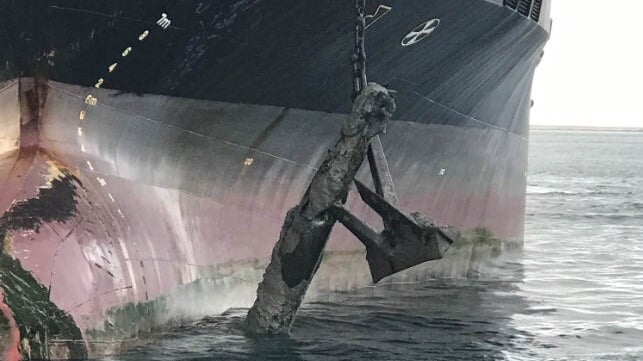
Unexploded ordnance is a recurring challenge in UK waters, as seen in this file image of a test torpedo recovered by a tanker in 2017 (Royal Navy file image)
File image: a test torpedo recovered by a tanker off Portland, UK in 2017. Unexploded ordnance is a recurring challenge in UK waters. (Royal Navy file image)

Published Jan 13, 2025 9:13 PM by The Maritime Executive


Shell has confirmed the discovery of an unexploded bomb next to a 40-year-old gas line running across the North Sea. 

Unexploded ordnance from World War II - and even earlier - is found regularly in UK waters, and it poses a potential hazard to navigation and development. During an inspection of the Far North Liquids and Associated Gas System Pipeline (Flags pipeline), Shell's staff located what they believe to be an unexploded bomb near the line at a position about 40 miles to the east of Shetland. 

Shell has launched an investigation into how this unexploded bomb came to be next to an operating subsea gas pipeline, and the supermajor has brought in a third-party advisor to examine the circumstances. The Maritime and Coastguard Agency has been notified, and a guard vessel has been stationed next to the location of the bomb. For now, the pipeline continues to operate as normal. 

The Flags pipeline was installed in 1982, in the heyday of North Sea oil and gas development. It is a 36-inch line stretching about 200 nautical miles north to south, and delivers wet gas from the Brent Field to the St. Fergus Gas Terminal in Scotland. In 2007, Flags was connected to the Tampen gas pipeline between Norway's Statfjord development and the UK. Shell and ExxonMobil share the pipeline's ownership.

An estimated 500,000 pieces of unexploded weaponry from WWI and WWII rest on the bottom in waters around Great Britain, according to a 2020 parliamentary study. Just last month, a Scottish fishing vessel brought up an unexploded antisubmarine mortar in the Firth of Forth near Edinburgh. The device contained about 80 pounds of explosives, and after the crew were evacuated, it was safely removed from the boat by an HM Coastguard bomb squad. The mortar was moved offshore and safely detonated in deeper water. 


Russia Claims Ukrainian Attack on TurkStream Subsea Pipeline System

Gazprom
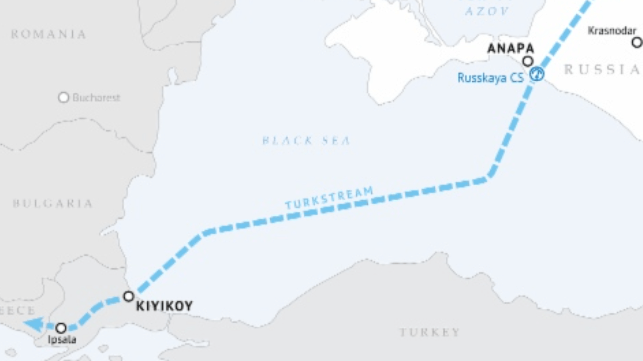
Chart courtesy Gazprom

Published Jan 13, 2025 10:57 PM by The Maritime Executive


On Monday, Russia's defense ministry claimed that its forces thwarted a Ukrainian attack on shoreside components of the TurkStream gas pipeline, the subsea line that connects Russian producer Gazprom to buyers in Turkey and the EU. 

TurkStream runs from a terminal near Anapa, Krasnodar to the Turkish town of Kiyikoy, west of Istanbul. The landing point is less than 100 miles from the border with Europe, and the line feeds gas networks in Hungary, Bulgaria, Serbia and neighboring states in southeast Europe. 

The Kremlin alleged Monday that Ukraine used a long-range drone strike to target the Russkaya compressor station on the Russian side of the pipeline. It claimed that air defense units shot down nine Ukrainian drones before they could hit the site, and that only minor damage was reported. The TurkStream line remains in operation, the ministry said. 

Ukraine has not commented on the alleged strike, but has repeatedly attacked Russian energy export infrastructure in retaliation for Russian drone strikes on the Ukrainian electric grid. 

TurkStream is one of the last Russian pipeline gas connections to Europe. Following the Russian invasion of Ukraine in 2022, a dispute over terms of payment resulted in a near-shutdown of westbound Russian gas, which had powered European economies since the Cold War. Though EU gas prices skyrocketed, the disruption was short-lived - and Europe began to decouple its energy markets from Russia, shifting instead to new sources like American LNG. 

The destruction of the Nord Stream pipeline system and the closure of the trans-Ukrainian pipeline network late last year have cut off most of Gazprom's access to Europe, with dire effects on its finances. The giant company was once a top earner for the Russian government; it posted a loss in 2023, its first in more than 30 years, and is now reportedly contemplating large-scale layoffs at its headquarters. The TurkStream (and the smaller BlueStream) are Gazprom's last functioning gas links to Europe. While other connections have been shuttered, the TurkStream's EU-bound transport volumes rose by 23 percent in 2024.  

Like Nord Stream, the TurkStream megaproject is a symbol of Russian influence. It was personally announced and inaugurated by Russian President Vladimir Putin, and remains among the most ambitious subsea pipeline projects ever constructed. It starts at the Russkaya compressor station, the most powerful facility of its kind in the world, then follows two parallel 32-inch pipelines running about 500 nautical miles under the Black Sea.  

TurkStream was among the first projects for Allseas' supersized pipelay/heavy lift ship, Pioneering Spirit, the largest vessel by displacement in the world.


Retailers Continue to Front-Load Imports into U.S. Ports

container offloading
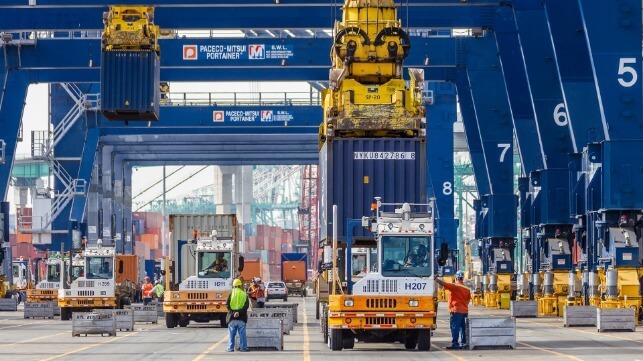
Import volumes continue high as importers are front-loading inventory into 2025 (Port of LA file photo)

Published Jan 13, 2025 6:13 PM by The Maritime Executive


Retailers are continuing to front-load their imports which is driving up the volumes seen at major U.S. ports. The National Retail Federation in its monthly read on container volumes expects the rush to get merchandise into the country will continue in part started by the fear of an East Coast port strike and now potential tariffs from the new Trump administration.

The Global Port Tracker showed an increase in volumes in the fall with November’s container imports up 14.7 percent over a year earlier. It was down slightly from October – 3 percent – but they also believed retailers were front-loading before the October International Longshoremen’s Association strike on the East Coast.

The current volumes are coming in significantly ahead of the NRF’s forecast. They believe it is a sign of the continuing front-loading. “Importers had already front-loaded,” said Ben Hackett of Hackett Associates noting it is “giving a boost to imports in December and early January.”

Volumes for November are approximately 14 percent over the forecast from the NRF for the month. They report without finalized numbers from the Port of New York New Jersey the TEU volume was 2.17 million containers in November. Further, while the numbers are not finalized for December, NRF believes the volume was 19 percent over its forecast. They are now projecting December at 2.24 million TEU.

Highlighting last week’s tentative agreement for the new ILA contract, Jonathan Gold, the NRF Vice President for Supply Chain and Customs Policy, said, “The agreement came at the last minute, and retailers were already bringing in spring merchandise early to ensure that they would be well-stocked to serve their customers in case of another disruption, resulting in higher imports. The surge in imports has also been driven by President-elect Trump’s plan to increase tariffs because retailers want to avoid higher costs that will eventually be paid by consumers. The long-term impact on imports remains to be seen.”

The NRF also raised its forecast for the full year 2024 saying with the recent surge they now expect the year will total 25.6 million TEU. That would be better than a 15 percent increase over 2023 and just 200,000 TEU short of the all-time record in 2021. That is an increase of 700,000 TEU over its previous forecast.

The momentum is also expected to carry into the first part of 2025. The NRF is calling for 10 percent year-over-year increases in both January and March but a soft February due to the timing this year of the Lunar New Year when many factors in China and Asia are closed. The early forecast sees an 8 percent increase year-over-year for April and nearly a 6 percent increase for May.

 THE SPECTRE OF JOHN TURNER

Mark Carney all but says he’s running to be Canada’s next prime minister in a Jon Stewart interview 

IT'S A SATIRE SHOW!


Canada 2020 Advisory Board Chair and former Governor of the Bank of Canada and Bank of England Mark Carney speaks during the Canada 2020 Net-Zero Leadership Summit in Ottawa, April 19, 2023.
 (Sean Kilpatrick/The Canadian Press via AP, File)


January 14, 2025


PALM DESERT, Calif. (AP) — Former central banker Mark Carney all but said he is running to be Canada’s next prime minister during an appearance on Jon Stewart’s ‘The Daily Show’ on Monday night.

This follows Justin Trudeau’s resignation announcement on Jan. 6 after facing an increasing loss of support both within his Liberal Party and across the country. He will remain prime minister until a new leader is chosen on March 9.

“You are running as an outsider,” Stewart told Carney.

“I am outsider,” the experienced financier said.

Carney, 59, is a highly educated economist with Wall Street experience, widely credited with helping Canada dodge the worst of the 2008 crisis while heading the country’s central bank. He also helped the U.K. manage Brexit as the first non-Brit to run the 319-year-old Bank of England since it was founded in 1694. His selection won bipartisan praise in Britain.

“Let’s say the candidate wasn’t part of the government. Let’s say the candidate did have a lot of economic experience” Carney said. “Let’s say the candidate did deal with crisis. Let’s say the candidate had a plan to deal with the challenges.”


RELATED STORIES

Canada: Liberals look for Trudeau's replacement as Trump threatens tariffs

Canada's Trudeau reshuffles his Cabinet as resignation calls mount and new election threat looms

Canada's Justin Trudeau faces calls to resign. Here's what could happen next

Carney ‘s main contender for the leadership of the Liberal Party is ex-Finance Minister Chrystia Freeland, whose abrupt resignation last month forced Trudeau’s exit. Both are expected to declare their candidacy in the coming days.

The political upheaval comes at a difficult moment. U.S. President-elect Donald Trump keeps calling Canada the 51st state and has threatened to impose 25% tariffs on all Canadian goods.

On the show, Carney said statehood won’t happen but the U.S. and Canada can be “friends with benefits,” generating laughter from the crowd.

Carney said Canada needed change as it faced an economic crisis with Canadians being very hard-pressed in the last few years because wages have not kept up with inflation and housing has become very expensive.

“Truth be told the government was not as focused on those issues as it could be,” he said. “We need to focus on them immediately. That can happen now and that is what this election will be about.”

The next Liberal leader could be the shortest-tenured prime minister in the country’s history. All three opposition parties have vowed to bring down the Liberals’ minority government in a no-confidence vote after parliament resumes on March 24.

Recent polls suggest the Liberals’ chances of winning the next election look slim. In the latest poll by Nanos, the Liberals trail the opposition Conservatives 45% to 23%. Carney said a change in Liberal leadership would give the party a chance.

He also said opposition Conservative leader Pierre Poilievre leader is “a lifelong politician” who “worships the market” but has never actually worked in the private sector.

Like other central bankers, Carney is a former Goldman Sachs executive. He worked for 13 years in London, Tokyo, New York and Toronto before being appointed deputy governor of the Bank of Canada in 2003. He has both financial industry and government credentials.

Carney talks tariffs, Trump, Liberal leadership in Daily Show interview

By David Boles, The Canadian Press
January 14, 2025 

Former governor of the Bank of Canada Mark Carney, who also served as governor of the Bank of England, speaks at the Sustainable Finance conference in Ottawa, Thursday Nov. 28, 2024. THE CANADIAN PRESS/Adrian Wyld

NEW YORK, Ont. — Mark Carney went on late-night television in the U.S. Monday to talk Trump, tariffs and carbon tax, but played coy on any plans to seek the Liberal leadership.

The former Bank of Canada and Bank of England governor appeared on “The Daily Show” with Jon Stewart for a 20-minute sit-down interview.

On the issue of president-elect Donald Trump's suggestion that Canada become the 51st state, Carney and Stewart joked about the two countries being a dating couple that had hit a rough patch.

Carney said statehood is not going to happen but the U.S. and Canada can be “friends with benefits,” generating a roar of laughter from the crowd.

On Trump’s threat of tariffs, Carney said Canada needs to prepare for a trade dispute like it did the last time Trump was in office.


When asked about the carbon tax, Carney noted that much of Canada’s emissions come from the oil industry and that needs to be cleaned up rather than trying to change the way everyday Canadians live in a short period of time.

Opposition Conservative Leader Pierre Poilievre has already been trying to paint the former top banker as a key architect of the Liberal carbon policy, calling him carbon tax Carney.

"For Canada, what we need to do is make sure that we're addressing these issues, doing our bit," said Carney.

"But we need to do it in a way that Canadians today are not paying the price."

Conservative deputy leader Melissa Lantsman said in a statement that it was clear after Carney's "scripted appearance" on American television that he was "trying to rewrite history to convince Canadians that he is not responsible for the policies that he and Justin Trudeau forced on Canadians and caused them so much misery over the last nine years."

"Carbon Tax Carney is a hypocrite," Lantsman said. "He can’t hide from the truth. He’s just like Justin."

As a longtime Liberal insider, adviser, and chair of the economic growth task force, Lantsman said Carney was "the furthest thing possible from an outsider."

"He supported Trudeau’s massive inflationary deficits which caused a 40-year high in inflation," Lantsman said. "He praised the punishing Trudeau carbon tax, even calling it a model for the world in his book. He supported every single Trudeau policy that doubled the debt, doubled housing costs, doubled gun crime, and doubled food bank use."

While not explicitly stating he'd run for Liberal leader, Carney labelled himself an “outsider” in Canadian politics and didn’t reject Stewart’s attempts to pin him down.

A source said Monday that former finance minister Chrystia Freeland will announce a run for the leadership in the coming days.

Ontario MP Chandra Arya and former Montreal MP Frank Baylis are the only two to officially join the contest.


The Liberal Party of Canada will choose its next leader March 9.

This report by The Canadian Press was first published Jan. 13, 2025.

David Boles, The Canadian Press
Dutch delve into family pasts as the names of accused Nazi collaborators released


Hundreds of thousands of people in the Netherlands have been looking for their relatives in a new database containing the names of some 425,000 people investigated for collaboration with the Nazis during World War II. Nazi collaboration is a controversial topic in the Netherlands and much of Europe and is often shrouded in family mystery. 

(AP video shot by Aleks Furtula)


An archivist opens a sliding file cabinet where documents, some regarding WWII collaboration, are stored at the NIOD Institute for War, Holocaust and Genocide Studies in Amsterdam, Netherlands, Friday, Jan. 10, 2025. (AP Photo/Aleks Furtula)

A portrait of Anne Frank is part of a replica of the home in Amsterdam where she hid, as part of a pavilion which opened at the National World War II Museum in New Orleans, Oct. 31, 2023. (AP Photo/Gerald Herbert, File)


Cardboard boxes line shelves where documents, some regarding WWII collaboration, are stored at the NIOD Institute for War, Holocaust and Genocide Studies in Amsterdam, Netherlands, Friday, Jan. 10, 2025. (AP Photo/Aleks Furtula)

A sheet of pictures of Anne Frank is displayed in Amsterdam, Netherlands, Oct. 4, 2024. (AP Photo/Peter Dejong, File)

An archivist walks by file cabinets where documents, some regarding WWII collaboration, are stored at the NIOD Institute for War, Holocaust and Genocide Studies in Amsterdam, Netherlands, Friday, Jan. 10, 2025. (AP Photo/Aleks Furtula)

BY MOLLY QUELL
AP
January 14, 2025

THE HAGUE, Netherlands (AP) — On Dutch Openness Day, this year’s release of secret documents from state archives suddenly left Peter Baas with fundamental questions about his father’s stature as a World War II resistance fighter.

While many were cleaning up the mess from New Year’s Eve fireworks on Jan. 1, hundreds of thousands of others in the Netherlands looked for their relatives in a new database containing the names of some 425,000 people investigated for collaboration with the Nazis from 1940-45.

Some looked out of curiosity, others out of concern.

A controversial topic

One of those names was Ludolf Baas, a resistance fighter who taped microfilm of Nazi atrocities to his body and smuggled it over enemy lines. “When I saw my father’s name, I was shocked,” Peter Baas told The Associated Press. He wondered if his father’s legacy was a lie and needed to find out if one of society’s ugliest stigmas would also stick to him.

“The publication of the list of names has caused great social unrest,” the NIOD Institute for War, Holocaust and Genocide Studies, said in a statement Friday. The research organization, founded days after the Netherlands was liberated, has called for the government to intervene.

Nazi collaboration is a controversial topic in the Netherlands and much of Europe and is often shrouded in family mystery and stifled under a cloak of silence. Initially, the Netherlands was long seen as a welcoming safe haven for persecuted groups. Many Jewish families, like that of famed diarist Anne Frank, fled Germany in the 1930s for the relative safety of their Dutch neighbors.

That changed when the Dutch surrendered to the Germans in 1940. Only 27% of the Dutch Jewish population survived the war, significantly less than the survival rate in France and Belgium and collaboration made persecution easier.

Eight decades after the war ended, many still worry about what that legacy means.

“You see the bullying even now,” Holocaust historian Aline Pennewaard says. She described social media posts denouncing Dutch politicians as Nazis because they shared a surname with someone on the list.

Privacy concerns


Plans to fully open the archives would have provided answers but Baas, who lives in France, found out he would not be able to easily obtain detailed information about his father’s case.

Originally, the National Archive wanted to make much more than just the names of suspects public. The organization had been working to digitize and publish all 30 million pages of materials, from secret police records to witness statements, on a newly created website.

Just before Christmas though, after a formal warning from the Dutch privacy watchdog that releasing the records would violate EU privacy rules, Dutch education minister Eppo Bruins intervened. Now, only the names and corresponding file numbers are immediately available.

To see his father’s dossier and understand why and how he was investigated, Baas would have to request to make an appointment with the archive and travel to The Hague, a 650-kilometer (404-mile) drive, to read his father’s file.

“This is a very complicated way to get your family history,” Baas said.

Despite such complications, the Dutch are lining up.

“The interest has been incredible,” Werner Zonderop, who works at the archive, told AP. Slots for the reading room are booked until the end of February. Every day, new appointment times open at midnight and fill up within minutes.
‘They should throw it open’

Documentary filmmaker Marieke van der Winden knows what it is like to confront the dark truth about family history. Her 2022 film “The Great Silence” showcases how taboo the subject of collaboration is for many.

Van der Winden found out at her mother’s funeral that her grandfather had worked with the Germans. After doing her own research, she discovered her grandparents, great-grandparents and several other family members had collaborated. “It was a family affair,” she told the AP.

The 58-year-old says it is important for later generations to understand what happened and supports putting the entire archive online. “They should throw it open,” van der Winden said.

Even many relatives of known collaborators have backed the publication of the archive.

“It is high time we discuss this with each other with openness and without reproaching relatives. We are part of this society, and the silence in our lives has had great and mainly bad consequences,” Jeroen Saris, the chairperson of the Recognition Working Group, said last year. His organization represents the family members of those who supported the Nazis during the war.

Deeply concerned about his father’s history, Baas managed to get a friend in the Netherlands to go and look up his father’s records, describing the cumbersome approach as “completely bizarre.”

According to the records, when his father was 19, he joined an organization that later merged with the Dutch Nazi party and he was investigated over that membership.

“A bad choice of a 19-year-old that was completely reversed by becoming an active member of the resistance,” Baas said.

STATE SANCTIONED NEGLIGENCE 
At least 100 illegal miners have died while trapped in a South African mine for months, group says


Relatives and friends protest near a reformed gold mineshaft where illegal miners are trapped in Stilfontein, South Africa, Friday, Nov. 15, 2024. (AP Photo/Denis Farrell, File)

Police officers and private security personnel stand by the opening of a reformed gold mineshaft where illegal miners are trapped in Stilfontein, South Africa, Friday, Nov.15, 2024. (AP Photo/Denis Farrell, File)

BY MOGOMOTSI MAGOME AND GERALD IMRAY
AP
January 13, 2025

JOHANNESBURG (AP) — At least 100 men who were mining illegally in an abandoned gold mine in South Africa have died of suspected starvation and dehydration after being trapped deep underground for months while police tried to force them out, a group representing the miners said Monday.

More than 500 others are still trapped, the group said.

Sabelo Mnguni, a spokesman for the Mining Affected Communities United in Action Group, told The Associated Press that a cellphone sent to the surface with some rescued miners on Friday had two videos on it showing dozens of bodies underground wrapped in plastic.

Mnguni said “a minimum” of 100 men had died in the mine in North West province where police first launched an operation in November to force the miners out. They were suspected to have starved to death or died of dehydration, Mnguni said. He said 18 bodies have been brought out since Friday.

Nine of those bodies were recovered in a community-led operation on Friday, he said. Another nine were recovered in an official rescue operation by authorities on Monday, when 26 survivors were also brought out, Mnguni said.


At least nine miners are trapped in a coal mine in India's northeastern Assam state

Indian army divers retrieve the body of one of at least 9 miners trapped in a flooded coal mine

Police spokesperson Brig. Sebata Mokgwabone said they were still verifying information on how many bodies had been recovered and how many survivors brought out after starting a new rescue operation on Monday. Authorities now hope to bring all of the miners out, they said.

Illegal mining is common in parts of gold-rich South Africa where companies close down mines that are no longer profitable, leaving groups of informal miners to illegally enter them to try and find leftover deposits.

The mine in question near the town of Stilfontein southwest of Johannesburg has been the scene of a standoff between police and miners since authorities first attempted to get the miners out and seal the mine two months ago. Police said the miners were refusing to come out of the Buffelsfontein Gold Mine for fear of arrest, but Mnguni said they had been left trapped underground after police removed the ropes they used to climb into and out of the mine.

Police also cut off the miners’ food supplies in an attempt to force them out, an action that was fiercely criticized by Mnguni’s organization, which is known as MACUA, and others. MACUA won a court case in December that ordered police and provincial authorities to allow food, water and medicine to be sent down to the miners.

The South African government also came under scrutiny last year when it refused to help the miners.

The cellphone videos purportedly from the depths of the mine and released publicly by Mnguni’s group show dozens of what appear to be dead bodies wrapped in plastic lying in darkened tunnels. A man filming on the phone in one of the videos can be heard saying, “this is hunger. People are dying because of hunger” as he records emaciated-looking men sitting on the damp floor of the mine. He adds: “Please help us. Bring us food or take us out.”

Mnguni said that the more than 500 miners still underground were in different places in the mine, which is one of the deepest in South Africa at 2.5 kilometers (1.5 miles) deep and has multiple shafts, many levels and is a maze of tunnels, he said. He said a preliminary autopsy report on a body that was previously brought out of the mine showed the man had died of starvation.

“What we understand is that there are different groups of miners underground and all of them have miners who have died,” Mnguni said. “So, we are estimating that the number of those who have died is very high.”

Large groups of illegal miners often go underground for months to maximize their profits, taking food, water, generators and other equipment with them, but also relying on others in their group on the surface to send down more supplies.

Mnguni said the miners who had previously managed to make it out had sometimes crawled through tunnels for 3-4 days risking their lives to make it to another shaft where they could escape.

Police have said they are uncertain exactly how many illegal miners remain underground, but also say it’s likely to be hundreds.

They said that delegations from the ministry of police and ministry of mineral resources would visit the mine on Tuesday “following the commencement of operations aimed at ensuring that all illegal miners resurface.” The operation to force the miners out of the Buffelsfontein mine that started last year was part of a larger one that resulted in more than 1,500 illegal miners surfacing from mines and being arrested across the North West province, police said.

South African authorities have long tried to crack down on illegal mining gangs, which are known as “zama zamas” — which means “hustlers” in the Zulu language — and have a reputation for being violent, often armed and part of criminal syndicates.


But Mnguni said these particular miners were not criminals but former mine employees who had been put out of work when mines closed and were left desperate.

“The miners go back to the mine because they live in poverty,” he said.
___

Imray reported from Cape Town, South Africa.
THE DEEP STATE

Queen Elizabeth II wasn’t told about Soviet spy in her palace, declassified MI5 files show


Professor Anthony Blunt, former surveyor of the Queen’s pictures, photographed at the Courtauld Institute with Queen Elizabeth II on Nov. 15, 1979. 
(PA via AP, File)


Professor Anthony Blunt, former surveyor of the Queen’s pictures, photographed at the Courtauld Institute on Nov. 15, 1979. (PA via AP, File)


clockwise from top left, Anthony Blunt, Guy Burgess (who died in Moscow in 1963), Donald MacLean and Kim Philby, who tipped off Burgess and MacLean in 1951 forcing them to defect and then defecting himself in 1963. (PA via AP, File)


Harold “Kim” Philby, one of the Cambridge Ring of Soviet Spies, Aug. 11, 1955. (PA via AP, File)


BY JILL LAWLESS
 January 14, 2025


LONDON (AP) — Queen Elizabeth II wasn’t told details of her long-time art adviser’s double life as a Soviet spy because palace officials didn’t want to add to her worries, newly declassified documents reveal.

The files about royal art historian Anthony Blunt are among a trove from the intelligence agency MI5 released Tuesday by Britain’s National Archives. They shed new light on a spy ring linked to Cambridge University in the 1930s, whose members spilled secrets to the Soviet Union from the heart of the U.K. intelligence establishment.

Blunt, who worked at Buckingham Palace as Surveyor of the Queen’s Pictures, was under suspicion for years before he finally confessed in 1964 that, as a senior MI5 officer during World War II, he had passed secret information to Soviet agents.

In one of the newly released files, an MI5 officer notes that Blunt said he felt “profound relief” at unburdening himself. In return for information he provided, Blunt was allowed to keep his job, his knighthood and his social standing – and the queen was apparently kept in the dark.
ADVERTISEMENT


In 1972, her private secretary, Martin Charteris, told MI5 chief Michael Hanley that “the queen did not know and he saw no advantage in telling her about it now; it would only add to her worries and there was nothing that could done about him.”

The government decided to tell the monarch in 1973, when Blunt was ill, fearing a media uproar once Blunt died and journalists were able to publish stories without fear of libel suits.


Charteris reported that “she took it all very calmly and without surprise,” and “remembered that he had been under suspicion way back” in the early 1950s. Historian Christopher Andrew says in the official history of MI5 that the queen had previously been told about Blunt in “general terms.”

Blunt was publicly unmasked as a spy by Prime Minister Margaret Thatcher in the House of Commons in November 1979. He was finally stripped of his knighthood, but never prosecuted, and died in 1983 at the age of 75.
ADVERTISEMENT


Files held by Britain’s secretive intelligence services usually remain classified for several decades, but the agencies are inching toward more openness. Some of the newly released documents will feature in an exhibition, entitled “MI5: Official Secrets,” opening at the National Archives in London later this year.

Two of the Cambridge spies, Donald Maclean and Guy Burgess, fled to Russia in 1951. A third, Kim Philby, continued to work for foreign intelligence agency MI6 despite falling under suspicion. As evidence of his duplicity mounted, he was confronted in Beirut in January 1963 by his friend and fellow MI6 officer Nicholas Elliott.

The declassified files include Philby’s typed confession and a transcript of his discussion with Elliott.

In it, Philby admitted he had betrayed Konstantin Volkov, a KGB officer who tried to defect to the West in 1945, bringing with him details of moles inside British intelligence – including Philby himself. As a result of Philby’s intervention, Volkov was abducted in Istanbul, taken back to Moscow and executed.

Elliott reported that Philby said that if he had his life to lead again, he would probably have behaved in the same way.

“I really did feel a tremendous loyalty to MI6. I was treated very, very well in it and I made some really marvelous friends there,” Philby said, according to the transcript. “But the overruling inspiration was the other side.”

Philby told Elliott that the choice faced now that he was exposed was “between suicide and prosecution.” Instead, he fled to Moscow, where he died in 1988.


The Cambridge spies have inspired myriad books, plays movies and TV shows, including the 2023 series “ A Spy Among Friends,” starring Guy Pearce as Philby and Damian Lewis as Elliott. Blunt featured in a 2019 episode of “ The Crown,” played by Samuel West.
Biden administration extends protected status for 937,600 migrants


Jan. 11 (UPI) -- President Joe Biden's administration has extended by 18 months the temporary protected status for nearly 1 million migrants from El Salvador, Sudan, Ukraine and Venezuela due to "extraordinary and temporary conditions" in those nations.

The extensions apply to up to 937,600 migrants from the four nations who have legally and illegally entered the United States due to conditions in their respective home nations, the Department of Homeland Security announced on Friday.

The extensions apply to undocumented as well as documented migrants from the respective nations and include extensions of their respective employment authorization documents to enable them to work in the United States.

An estimated 600,000 qualifying Venezuelans who have continuously resided in the United States at least since July 31, 2023, have their TPS extended to Oct. 2, 2026.

The TPS extensions for qualifying Venezuelans is needed due to the "severe humanitarian emergency the country continues to face due to political and economic crisis under the inhumane [President Nicolas] Maduro regime," DHS officials said Friday in a press release.

"These conditions have contributed to high levels of crime and violence, impacting access to food, medicine, healthcare, water, electricity and fuel," DHS officials said.

Those who have been convicted of a felony or at least two misdemeanors are excluded from the TPS extension.

Qualifying Venezuelans also have their work authorizations automatically extended through April 2, 2026.

DHS officials determined "continued political instability that has triggered human rights abuses, including direct attacks on civilians" require an extension of TPS for Sudanese migrants who have lived in the United States, with or without authorization, since at least Aug. 16, 2023.

"Militias have targeted fleeing civilians, murdering innocent people escaping conflict and prevented remaining civilians from accessing lifesaving supplies," DHS officials said Friday in a press release.

The TPS extension affects about 1,900 Sudanese migrants and automatically extends their employment authorization documents to continue working in the United States for another 12 months.

About 103,700 Ukrainian migrants who have lived in the United States since at least Aug. 16, 2023, also have their TPS automatically extended for 18 months.

The extension for Ukrainian migrants is needed due to the "expansion of the Russian military invasion into Ukraine," which is "the largest conventional military action in Europe since World War II," DHS officials said Friday in a news release.

"Russia's expanded military invasion has led to high numbers of civilian casualties and reports of war crimes and crimes against humanity committed by Russian military forces and officials," DHS officials said.

"This invasion has caused a humanitarian crisis, with significant numbers of individuals fleeing and damage to civilian infrastructure that has left many without electricity or access to medical services."

Ukrainian migrants who have lived in the United States since Aug. 16, 2023, qualify for the automatic 18-month TPS extension. Qualifying Ukrainian migrants also will have their EAD status extended by 12 months.

About 232,000 El Salvadoran migrants also received extended TPS status to Sept. 9, 2026, due to "environmental conditions in El Salvador that prevent individuals from safely returning," according to a DHS press release issued Friday.

DHS officials cited "continued conditions from environmental disasters that resulted in substantial, but temporary, disruption of living conditions in affected areas of El Salvador" as cause for extending the TPS for qualifying El Salvadorans.

Those environmental disasters include "significant storms and heavy rainfall in 2023 and 2024 that continue to affect areas heavily impacted by earthquakes in 2001," according to DHS.

DHS officials also have extended qualifying El Salvadoran migrants' employment authorization documents through March 9, 2026.
US Supreme Court agrees to hear challenge to ACA's preventative care mandate

 The Supreme Court indicated it will hear a case challenging the constitutionality of preventative healthcare coverage now mandated under the Affordable Care Act.  (OBAMA CARE)


Jan. 11 (UPI) -- The Supreme Court has agreed to hear a legal challenge targeting the preventative care mandates of the Affordable Care Act, also known as Obamacare, in its upcoming term.

In an order issued Friday, the high court granted "certiorari" to Xavier Becerra vs. Braidwood Management Inc., meaning the case has been placed on the docket and is likely to get a hearing in March or April with a decision coming by the end of June.

The suit, which seeks to eliminate the current mandate to provide preventative healthcare insurance coverage under the ACA, has now reached the Supreme Court following a "mixed-bag" ruling by the 5th Circuit Court of Appeals in June.

The conservative businesses bringing the case cite religious objections to being made to purchase health insurance that includes coverage for "abortifacient contraception," PrEP (pre-exposure prophylaxis) to prevent HIV transmission and screenings and behavioral counseling for sexually transmitted disease and drug use, stating they believe these interventions "encourage homosexual behavior, intravenous drug use, and sexual activity outside of marriage between one man and one woman."

They contend the U.S. Preventive Services Task Force -- a panel that determines what kinds of preventative coverage are mandatory under the ACA -- is unconstitutional because its members are not elected or appointed by Congress and thus should be eliminated.

The Biden administration describes the USPSTF as a 16-member independent group of national experts in prevention and evidence-based medicine that works to improve the health of all Americans "by making evidence-based recommendations about clinical preventive services such as screenings, counseling services, or preventive medications."

Its volunteer members come from the fields of preventive medicine and primary care, including internal medicine, family medicine, pediatrics, behavioral health, obstetrics/gynecology and nursing, and most are practicing clinicians.

The White House and the ACA's backers argue that the elimination of the panel would wipe out preventative healthcare coverage now enjoyed by millions of Obamacare recipients.

In its June decision, the New Orleans-based 5th Circuit upheld a lower court decision issued by a Texas federal judge finding that the USPSTF is unconstitutional. But they declined to issue any nationwide injunction of the preventative care mandate, thus keeping it in place for the time being while producing uncertainty about its legal future.

Both the plaintiffs and the Biden administration acted late last year to bring the case before the Supreme Court for clarification.


The law's proponents are warning that letting the 5th Circuit's decision stand would invalidate "a critically important provision of the Affordable Care Act that ensures more than 150 million Americans' access to essential life-saving tests and treatments."

In an amici brief submitted in October by the American Public Health Association, the Robert Wood Johnson Foundation and other public health advocates, the law's backers said that if the ruling is permitted to stand, "deadly diseases will not be detected and important treatments will be unavailable -- resulting in serious illnesses, chronic medical conditions, and deaths that otherwise would have been prevented."