Tuesday, January 14, 2025

U.S. Seeks to Counter Russian and Chinese Influence in Greenland

By RFE/RL staff - Jan 13, 2025

Greenland's strategic location and resources make it increasingly important for US national security amidst growing Russian and Chinese activity in the Arctic.

The US military presence in the Arctic is considered weak, and there are concerns that Russia and China could gain a foothold in Greenland if it becomes independent from Denmark.

The melting Arctic ice opens new shipping routes and opportunities for resource extraction, intensifying competition between global powers for influence in the region.


Incoming U.S. President Donald Trump has once again kicked up a storm with his pursuit of Greenland, this time refusing to rule out the use of force to gain control of the Arctic island from ally Denmark for national-security reasons.

But Washington was interested in acquiring Greenland to mitigate threats emanating from the Arctic long before Trump came along, even offering Denmark $100 million in gold for the icy island shortly after the conclusion of World War II.

That interest has only expanded in recent years as Russia and China step up their military and commercial activities in the Arctic, conduct joint military exercises, and invest in new weapon systems like hypersonic missiles.

"Greenland is growing in importance as we find ourselves in a global competition with China and in a new technological revolution with regards to warfare," Rebecca Pincus, director of the Wilson Center's Polar Institute and a former adviser to the U.S. Defense Department on Arctic strategy, told RFE/RL.

"So, Greenland is important from a missile-defense perspective, from a space perspective, and from a global competition perspective, in which shipping and maritime sea lanes are increasingly important," she said.

Weakest Link In Homeland Defense

An autonomous territory of the Kingdom of Denmark, Greenland is physically closer to the United States with just 1,900 kilometers separating the state of Maine from the arctic island's shores.

As a territory of Denmark, it is part of NATO, but Greenland is pursuing independence from Copenhagen and some experts fear that could open a door for Russia and China to gain a foothold in the country.

While the United States already has a space base on Greenland for missile defense and space surveillance, control of the entire island would enable Washington to better defend against naval and air threats emanating from the region as well as dangers from space.

Russia has a much greater military presence in the Arctic than the United States and has continued to invest heavily in its defense capabilities in the region despite the war in Ukraine.

Retired U.S. General Terrence J. O'Shaughnessy, who served as commander of the U.S. Northern Command, told a Senate hearing in February 2020 that if Russia were to attack the United States, it would likely do so via the Arctic.

"The Arctic is no longer a fortress wall, and our oceans are no longer protective moats; they are now avenues of approach," he told the hearing.

Jahara Matisek, a professor at the U.S. Naval War College who spoke to RFE/RL as an independent expert and not on behalf of the government, said U.S. military infrastructure in the Arctic has languished, calling it the weakest link in homeland defense.

"If you want to be a powerful space-faring nation and be able to project space power in terms of offensive and defensive space weapon systems and other sorts of ISR (intelligence, surveillance, and reconnaissance), you have to have infrastructure in the Arctic Circle -- not to mention the Antarctic Circle -- to seamlessly communicate and control all of your satellites," he said.

Chinese Ambitions


While China is not an Arctic nation, it is seeking to be a major player in the region. In recent years, Beijing has sought to buy ports, other infrastructure, and mining rights on Greenland though it has not been successful.

Matisek said the United States suspected China's real interest in those projects was to place dual-use sensors and radars in the Arctic Circle to help control their military satellites and gather intelligence on U.S. space-based operations in the region.

"If China can disrupt our 'Kill Chain' -- our space-based assets, our satellites -- then we will struggle to shoot things down. We will struggle to target, identify, attack, so that's why Greenland ends up actually mattering a lot," he said.

Pincus said the United States needs more ISR in the Arctic.

"That's our biggest gap that we need to close. So, we need more sensors from space to the seabed. And we need a data fusion capability to integrate all of that sensor data and observations into something that's a usable product for decision makers," she said.


Pincus said it makes sense that Russia and China would carry out joint military exercises in the Arctic.

"It's not surprising that they're focused on the Arctic, because the U.S. is weak in surface presence in the Arctic," she said, pointing out that the United States has no more than two functioning icebreakers compared to about four and a few dozen, respectively, for China and Russia.

Northern Passage


As ice continues to recede in the Arctic due to rising temperatures, it is opening a path for ships -- including military vessels -- to transit from Europe to Asia via the waters above Greenland and Canada.

"Chinese merchant shipping will increase passage along the northern route as it's shorter for them, but presumably Chinese warships will also use that route," Ben Hodges, a retired U.S. lieutenant general and former commander of U.S. Army forces in Europe, told RFE/RL.

Military vessels coming into the Atlantic Ocean from the Arctic would have to pass through the GIUK gap -- the stretch of water between Greenland, Iceland, and Scotland. During the Cold War, NATO forces tracked Soviet submarines coming into the North Atlantic through that gap, Hodges said.

Receding ice will also make it easier to mine Greenland's massive reserves of natural resources. They include metals critical for the production of high-technology goods, electric vehicles, and wind turbines.

China dominates many of those metals markets, including their mining, refining, and processing -- and Beijing has expressed interest in developing Greenland's natural resources.
The monetization of those natural resources is crucial for Greenland's dream of independence. The island still depends on subsidies from Denmark.

"When you have a nation like Greenland, they need money for investment. China and Russia will throw money at this problem," Philip M. Breedlove, a retired four-star U.S. Air Force general who led U.S. forces in Europe and served as NATO's supreme allied commander from 2013 to 2016, said in an interview with The Cipher Brief.

"Guaranteeing a Western-leaning Greenland is extremely important," he said, adding it "doesn't have to be through sovereign ownership."

Matisek said Trump may simply be trying to get the United States to "really take Greenland seriously" because of the integral role it plays in North American defense.

It is also "obviously an attempt to make sure the Chinese and Russians don't get a footprint there," he said.

By RFE/RL


America's Infrastructure Crisis: A Ticking Time Bomb

By Kurt Cobb - Jan 13, 2025

The escalating cost of maintaining aging infrastructure is causing widespread problems, as exemplified by America's elevator crisis.

Deferred maintenance and underinvestment in infrastructure can lead to cascading failures, impacting essential services like water, electricity, and transportation.

The failure to adequately maintain infrastructure is a recurring pattern in human civilization, with potentially devastating consequences for modern cities.


I recently noticed that the elevator at my favorite cinema has been out of order for weeks now. The less mobile patrons need that elevator to transport them downward to this underground theater. I then learned of America's "elevator crisis" and my mind wandered to the struggle to maintain the Roman Empire. I'll explain the connection below. But first a refresher on Rome's predicament:

The Roman emperor Trajan brought the Roman Empire to its greatest extent during his reign (98 to 117 A.D.) with his successful conquests in what we today would call the Middle East. Rome's many conquests had been financed by booty taken from the conquered.

But its hold on the sprawling empire—one that reached from northern England to southern Egypt, from Spain in the west to what today is called Iraq in the east—would henceforth have to be financed by rising taxes and inflated currency. The money was needed to pay for armies and naval forces to defend the empire's very long land and maritime borders. Building an empire turned out to be less expensive than maintaining one, including building and maintaining the infrastructure of roads and military and political outposts needed to protect and administer it.

What happened to Rome's maintenance bill happens in any system of infrastructure as it expands. The existing infrastructure must be maintained even as new infrastructure is built. Eventually, it becomes very expensive 1) to pay collectively for maintenance of all existing infrastructure and 2) to pay for increasingly aging infrastructure that requires extra expense.

America's elevators are in category number two. Elevators are a ubiquitous and absolutely necessary piece of infrastructure in a culture that depends on high-rise buildings for much of its living and commercial space. Unfortunately for those who rely on them, the workforce that knows how to fix elevators is aging. In addition, the right parts can be hard to come by for two reasons: 1) The companies that make elevator parts prioritize the biggest customers who are concentrated in places such as China where many new tall buildings are going up and 2) some elevators are so old that no ones makes mass produced parts for them and parts have to be custom-fabricated.

Out-of-order signs on elevators are particularly hard on those with disabilities and the elderly. And, nonworking elevators are thought to be a major cause of 1.1 million yearly accidents on stairs that lead to emergency room visits. Even for the young and vigorous, elevator failures, if frequent enough, could make buildings over a certain height uninhabitable. The long stairway down to my basement cinema almost certainly prevents many patrons from even thinking about attending showings there for now.

But elevators are just one part of the sprawling infrastructure that is the modern globalized world. Water systems in the United States are in serious trouble for the same reason, aging infrastructure. Building owners have incentives to maintain elevators to keep their building habitable. Most water systems are owned by municipalities and those municipalities must look to ratepayers to pay their bills. As the bills for system maintenance have skyrocketed, so have rates. But that may not be enough since in many towns, especially smaller ones, shrinking populations have made it difficult to raise enough money for repairs even with higher rates.

Many large infrastructure systems are now facing a reckoning for deferred maintenance or failure to plan for growing demands. The American electrical infrastructure suffers from both problems. The term of art is "modernizing." But that just means making up for all the deferred maintenance AND expanding the size and capability of the system at the same time.

Next time you see an out-of-order sign on an elevator you'll know a little of what's behind it. And, it's the same problem facing most of the world's legacy infrastructure that will lead to more frequent boil-water notices from water utilities and power outages by electric utilities.

It is the pattern of human civilization to happily invest in infrastructure during a growth phase and then try to avoid the expense of maintaining that infrastructure when growth is over. That is a recipe for ruin as deferred maintenance makes it all the more likely that both private and public owners of infrastructure will be hit with huge and perhaps unpayable bills in the future. That pattern also risks making some part or even entire major systems unusable. It's hard to imagine how any modern city could withstand prolonged outages of water, electricity or even of its elevators.

PS. In light of the California wildfires I considered writing about the casualty insurance crisis which is already severe in many places due to hurricanes, floods and wildfires. But then remembered a piece I did 18 months ago entitled "Climate change and the uninsurable future" that covers the subject well.

By Kurt Cobb via Resource Insights
Peru’s Crude Gains Share in U.S. as Mexican Exports Slump

By Tsvetana Paraskova - Jan 14, 2025


U.S. refiners are turning to rare niche crude grades from Latin America to fill the gap left by declining imports from Mexico, according to vessel-tracking data.

Last year, U.S. imports of crude from Mexico fell to their lowest in decades, per data from the Energy Information Administration (EIA).

Mexico’s state oil giant Pemex has been struggling with a decline in production, while it has also left more volumes of crude oil at home to be refined domestically at the new refinery that former president Andres Manuel Lopez Obrador wanted built.

As Mexican output and exports to the U.S. fall, American refiners are importing more volumes of heavy crude from South America, per tanker-tracking data from Kpler and LSEG cited by Reuters.

One of the rarer crudes is a niche grade produced in Peru in the Amazonian forest and transported on the Amazon for export from Brazil. The grade, Bretaña, is heavy sweet with minimal amounts of metals.

Bretaña has won customers in the U.S., trade sources have told Reuters.

One cargo of Bretaña from Brazil’s port city of Manaus has already arrived in Houston this year, according to the ship-tracking data compiled by Reuters.

The tanker Radiant Pride shipped around 300,000 barrels of Bretaña and discharged on January 2.

Cargoes of Bretaña, whose production began in 2018, arrived on the U.S. West Coast last year, too. According to data from Kpler, one cargo discharged at a Marathon Petroleum terminal and another at PBF Energy.

“Given the drop in heavy sour crude from Mexico to the U.S. Gulf Coast over the last year, we are starting to see new heavy grades being pulled in to backfill this loss - this is a trend we only expect to continue,” Kpler analyst Matt Smith told Reuters, commenting on the growing attractiveness of niche South American heavy crude grades.

By Tsvetana Paraskova for Oilprice.com
France Faces Challenges in Building New Nuclear Reactors

By Tsvetana Paraskova - Jan 14, 2025


The planned construction of the next generation of nuclear reactors in France, which expects to have at least six of these, faces numerous challenges including in financing, supply chains, and timelines, France’s Court of Auditors said in a report on Tuesday.

France’s power utility and major nuclear power generator, EDF, has planned to build six new nuclear reactors of the so-called European pressurized reactors (EPR) type. This is part of a pledge from 2022 from French President Emmanuel Macron, who promised new advanced nuclear reactors to meet France’s climate goals and rejuvenate the nuclear fleet.

Since the energy crisis in 2022, France has focused on its nuclear fleet, which provides around 70% of its electricity and which typically allows one of Europe’s biggest economies to export electricity to its European neighbors and partners.

Early in 2024, France’s Ministry of Energy Transition introduced a bill on energy sovereignty, which highlighted the importance the country will attach to nuclear power generation in the future.

The bill included targets for the construction of at least six and up to 14 new reactors, as France will be heavily relying on nuclear to meet its net-zero and emission reduction goals.

The French Court of Auditors said in the analysis published today that “even if the French nuclear industry had started to implement the strategy set out in 2022, it is far from ready and must overcome numerous challenges, some of which raise concerns.”

The nuclear power industry faces too high additional costs and too many delays and uncertainties, the Court of Auditors noted, adding that these challenges require responses from the authorities and the sector.

Last year, reports emerged that EDF raised the cost estimate of the six new reactors by 30% to $69 billion (67.4 billion euros).

The Court of Auditors recommends that the final investment decision for EDF’s EPR2 program be postponed until financing has been secured and design studies have progressed.

EDF currently plans to take the final investment decision on the plan in 2026.

By Tsvetana Paraskova for Oilprice.com
Central Asian Leaders Unite to Tackle Climate Change Challenges

By Eurasianet - Jan 13, 2025

The prime ministers of Kyrgyzstan, Tajikistan, and Uzbekistan met to discuss economic cooperation and resolve border disputes.

The resolution of these disputes paves the way for increased cross-border trade and joint efforts to address climate change challenges.

E-commerce is being touted as a potential driver of economic growth and poverty reduction in the region.


After decades of competition over dwindling resources in Central Asia’s agricultural heartland, the leaders of Kyrgyzstan, Tajikistan and Uzbekistan are embracing a spirit of cooperation as they jointly confront global warming-related challenges.

That spirit of cooperation was on display January 8, when the prime ministers of the three states gathered at a remote location in the FerghanaValley where the three nations’ frontiers meet, to mark progress on settling long-standing border disputes.

Helping to pave the way for the gathering was a border demarcation agreement reached by Kyrgyzstan and Tajikistan in December. The two countries had engaged in armed clashes over the disputed frontier as recently as 2021 and 2022. And in 2023, reports that the two states were engaging in an arms buildup raised fears of renewed conflict.

The resolution of border disputes sets the stage for joint efforts to expand economic cooperation in 2025. “The prime ministers of the three countries emphasized that the countries have great potential for strengthening cooperation in such key areas as trade, logistics, water-energy and cultural-humanitarian ties,” a Kyrgyz government statement issued after the meeting noted. Managing dwindling water resources was a major topic of discussion during the January 8 meeting.

With the region’s borders settled, barriers to cross-border trade should start coming down. The three states are participating in a US-sponsored initiative, dubbed the B5+1 process, that promotes regional trade connectivity. A report published on a World Bank blog in December touted the regional potential for e-commerce. “E-commerce development is a viable way to reduce poverty in Central Asia,” the item stated. “Except for the payment sector, which requires financial experts, the e-commerce ecosystem, particularly in production, marketing, and delivery, offers job opportunities that facilitate the participation of the poor and less skilled in online markets.”

By Eurasianet.org


Can the U.S. Power Grid Handle the Data Center Boom?

By Haley Zaremba - Jan 13, 2025

The US power grid is under stress due to aging infrastructure and changing energy consumption patterns.

The rise of renewable energy and electric vehicles presents challenges for grid management and infrastructure.

Increased energy demand from data centers and rising electricity costs are putting a strain on consumers and utilities.


The United States power grid is under enormous stress. Ageing infrastructure coupled with rapidly changing supply and demand patterns are pushing the grid to its limits, threatening national energy security. All of this volatility is leading to price shocks and punishing electric bills for households across the country, with rising energy prices outpacing inflation.

The rapid rise of renewable energy and increased adoption of electric vehicles are changing the inflows and outflows of energy to the grid. Renewable energies such as solar and wind power are variable, meaning that their production levels depend on external and uncontrollable variables such as the weather, the seasons, and the time of day. This means that renewable energy production patterns are often exactly inverted from demand patterns – to oversimplify the situation: homes turn on the lights after the sun sets on solar panels. What is more, rooftop solar has complicated energy grid flows, as consumers are now sending excess energy back into the grid, making previously one-way flows more complex.

Increased electrification of the economy means that we will be relying on electrical grids for far more of our daily energy needs. There has been much hand-wringing over whether the grid will be able to keep up with an influx of residential energy demand for the purpose of charging electric vehicles. Experts ensure that the grid will be able to keep up with increased EV adoption, but concerns are well-founded – it will represent a definite challenge for infrastructure that is already old and under-funded.

In order to bring the grid up-to-speed for the emerging ‘new normal’ of the domestic energy landscape, the United States Department of Energy estimates that the country will need 47,300 gigawatt-miles of new power lines by 2035, representing a 57% expansion of the current grid. Meeting that target will necessitate a two-fold increase in today’s rate of construction.

And now there’s a whole new variable which is ramping up demand and will likely place even more pressure and urgency on ramping up domestic energy grids to record capacities – the runaway demand coming from data centers, in large part due to the proliferation of artificial intelligence. Thanks to the currently insufficient levels of grid infrastructure, data centers are already facing years-long bottlenecks for connecting to the grid in the United States. The Register reports that “utility companies in the US are being flooded with power delivery requests for sites marked for data center construction, but that they are unable to fulfill many of these until the 2030s.”

All of this presents a major challenge for United States electric utilities, which need to walk a tightrope in order to balance the delivery of affordable and reliable power while also maintaining and upgrading massive amounts of fixed infrastructure on a massive scale. As a result, U.S. energy prices are sharply on the rise, increasing about 5% annually – even higher than the already blistering rates of inflation. “While electricity generation costs have gone down thanks to technology like solar and wind, transmission and distribution costs have driven bills higher,” reports PV Magazine.

The PV report is based off of a report from Lawrence Berkeley National laboratory, which finds that “since 2019, collected revenues [for retail energy] increased by more than 20%, whereas retail sales remained fairly flat, indicating that recent increases in retail electricity prices have been driven principally by rising revenues (costs).” This is in spite of the fact that production costs have fallen in connection with the proliferation of renewable energies.

As a result of this price hike at the electricity meter, many consumers in the United States are hurting. But the problem is not limited to the United States – similar issues plague Europe, which is dealing with ever-increasing levels of energy poverty. England and Wales, for example, have seen a 20% increase in consumers seeking help to pay their energy bills in the last year.

By Haley Zaremba for Oilprice.com
China Expands Operations Across Iraq’s Huge West Qurna 1 Oil Field

By Simon Watkins - Jan 13, 2025

As a part of the 'Iraq-China Framework Agreement’, China is rolling out the next phase of its West Qurna 1 project plans.

Ahead of the imminent start of Trump’s second term as president, Beijing has been adding to its existing base of assets in Iraq.

Iraq may raise the maximum production expectation for its giant West Qurna 1 oil field in the next 5 years.


The history of the Middle East since the 1990s has been in many aspects been defined by China’s need to secure sufficient energy to power its economic growth to rival the superpower status of the U.S., and Washington’s efforts to keep these efforts in check. The ebb and flow of these competing forces has been felt nowhere more acutely perhaps than Iraq, with its very conservatively estimated 145 billion barrels of oil reserves and 3.5 trillion cubic metres of gas. While U.S. forces remained on the ground following the 2003 overthrow of Saddam Hussein, Beijing’s options to expand its influence in Iraq were extremely limited. But by 2018, the unpopularity of what many Iraqis regarded by then as an occupation and the concomitant unilateral withdrawal of the U.S. from the Joint Comprehensive Plan of Action (‘the nuclear deal’) with Iraq’s chief regional sponsor Iran opened the way for Beijing to expand its operations of influence.

The groundwork for all future developments by China in Iraq was laid out in the wide-ranging ‘Oil for Reconstruction and Investment’ agreement signed between China and Iraq in 2019. The basic template for this agreement – which includes priority on new field contracts for Chinese firms and substantial discounts for them on oil and gas recovered, among others – was the ‘Iran-China 25-Year Comprehensive Cooperation Agreement’ first revealed anywhere in the world in my 3 September 2019 article on the subject, and analysed in full in my new book on the new global oil market order. The 2019 China-Iraq deal was then substantially broadened and deepened into the ‘Iraq-China Framework Agreement’ of 2021. Part of this featured even bigger discounts given to Chinese firms on oil and gas discovered in Iraq (up to 30%, depending on the field). However, crucially for China’s bigger territorial ambitions in Iraq and the Middle East, it also gave its firms developing such fields wide-ranging rights to station significant security forces in and around these areas and to engage in a massive build-out of accompanying infrastructure. This includes road and rail networks connected to bigger infrastructure hubs with links across the Middle East, the right for the Chinese military to use selected Iraqi military and civilian seaports and airports, and permission to construct further businesses, schools and other support facilities tangential to China’s ongoing interest in the region.Related: Russia Intent On Defying New U.S. Sanctions on Its Oil Industry

Such a development is West Qurna 1, located around 65 kilometres from southern Iraq’s principal oil and export hub of Basra and holding around 22 billion barrels of recoverable oil reserves. The Oil Ministry’s target for the present phase of development was increased in 2021 from the previous 500,000 barrels per day (bpd) to 700,000 bpd, with the field currently producing around 550,000 bpd. The Ministry also said at that time that although the original production plateau target of 2.825 million bpd (by the early 2030s) had been negotiated down to 1.6 million bpd during contract discussions with participating oil companies, the plateau target might well be raised again in the coming five years. The main companies involved in those discussions were PetroChina - the listed arm of the China National Petroleum Corporation (CNPC) – which then held 32.7% stake in West Qurna 1, and ExxonMobil, which also had a 32.7% stake at that point.

However, almost immediately China sought to establish itself as the dominant force on the site, using the surreptitious and gradual acquisition of a range of huge ‘contract-only’ awards made to its companies on the site in addition to PetroChina’s activities, as also analysed in full in my latest book. The most notable of these early on was the November 2019 US$121 million engineering contract to upgrade the facilities that are used to extract gas during crude oil production to the China Petroleum Engineering & Construction Corp. Similar ‘contract-only’ deals have been done by China across Iraq, including for its supergiant Majnoon oil field, to another hitherto unheard-of Chinese firm - the Hilong Oil Service & Engineering Company. This incremental loss of influence across the West Qurna 1 project was one of ExxonMobil’s problems. Another potentially far greater one emerged as the U.S. supermajor discussed its other major targeted deal in Iraq – the US$53 billion CSSP. This involves taking and treating seawater from the Persian Gulf and then transporting it via pipe­lines to oil production facilities to maintain pressure in oil fields to optimise their output and longevity. At that time, West Qurna 1 and the CSSP were to form a new core presence for the U.S. in Iraq based around cooperation in the energy sector with the Iraq authorities, following years of rising military and sectarian tensions across the country. However, the U.S. firm eventually removed itself from both projects as it became increasingly clear that they were infused with massive legal and accounting risks that far outweighed the rewards. As was written into the original West Qurna 1 contract, ExxonMobil’s stake then went to PetroChina, and Beijing had complete control over the site, just as it had been working towards.

It has taken some time, but as of now Beijing is in a position to roll out the next phase of its West Qurna 1 plans, which have nothing to do with increasing oil production as had been agreed with the Iraqis. Instead, several special projects were inaugurated in the Al-Sadiq District of Iraq’s oil-rich Basra Province, according to Oil Ministry announcements last week. Central to planning these and further operational rollouts undertaken by PetroChina (supported by the Basra Oil Company) will be the West Qurna 1 Field Operations Center (Phase 1), which also saw its groundbreaking ceremony last week. This will play a pivotal role in managing the water injection into the field, associated gas processing operations, and oversight of production activities across the field. It will also include new roads and electricity projects, increased employment opportunities in and around the development and the building of seven new schools. These facilities will be connected into China’s broader network across southern Iraq, as part of its ongoing ‘Iraq-China Framework Agreement’ of 2021 and following the U.S.’s end of combat mission in Iraq of the same year. Such additional elements of this plan and its 2019 ‘Oil for Reconstruction and Investment’ agreement predecessor in the heartland of Iraq have included IQD1 trillion (US$700 million) of infrastructure projects in the city of Al-Zubair in Basra. Another was for Chinese companies to build a dual use civilian and military airport to replace the previous installation in the capital of the southern oil rich Dhi Qar governorate. The Dhi Qar region includes two of Iraq’s potentially biggest oil fields – Gharraf and Nassiriya. This airport project would include the construction of multiple cargo buildings and roads linking the airport to the city’s town centre and separately to other key oil areas in southern Iraq.

Ahead of the imminent start of Trump’s second term as president, Beijing has busily been adding to these key assets across Iraq. In August, Chinese firms won most of the 13 contracts for oil fields and exploration blocks awarded by Iraq’s Oil Ministry in the latest bidding round. When fully developed these will add 750,000 bpd of oil and 850 million cubic feet per day of gas to the country’s output. Already, according to industry figures, over a third of Iraq’s proven oil and gas reserves and over two-thirds of its current production are managed by Chinese companies. And in June, Chinese and Iraqi officials announced plans to link Iraq’s US$17 billion Strategic Development Road (SDR) programme directly into China’s ‘Belt and Road Initiative’ (BRI). Broadly, Iraq’s SDR will create a seamless transport corridor running from the flagship deepwater Al Faw Grand Port (due to be finished with Chinese help in 2025) in its key oil export hub of Basra in the Persian Gulf, all the way through several of its biggest oil and gas fields, and finally into Fishkabur on the Iraqi border with Turkey. From there it will extend via road and railway links into the rest of Europe. Even without any links to China’s BRI transport corridors, the SDR’s route from the Persian Gulf to the key business hubs of Europe (and its main oil hubs) would offer a higher speed and lower cost for goods to be moved than transport through the Suez Canal. For China, its integration into its own BRI infrastructure would represent an alternative final part of the transport jigsaw that would see a direct land route from Xi’an into Europe. It could also function as the alternative final route in the maritime transport corridor running from Quanzhou to Colombo in Sri Lanka and then up to Basra rather than continuing past Yemen and through the Red Sea and Suez Canal into the Mediterranean.

By Simon Watkins for Oilprice.com

Big Oil’s Profit Warnings Bode Ill For Trump’s Drilling Bonanza

By Alex Kimani - Jan 13, 2025,


Upstream President Liam Mallon recently dismissed the notion that U.S. producers will dramatically increase output under a second Trump term.

Lower profits at major oil companies could further diminish the appetite to drill more.

The dimming outlook for oil prices could lead to capex cuts and lower drilling budgets in 2025 and 2026.


With just a week to go before U.S. President-elect Donald Trump ascends into the Oval Office for a second term, the oil and gas industry will be watching keenly to see what measures he will adopt to achieve his “Drill, Baby, Drill” agenda. Trump says he’ll push shale producers to ramp up output, even if it means operators “drill themselves out of business.” However, it’s not clear he intends to accomplish this feat since U.S. oil is produced by independent companies and not a national oil company (NOC). Exxon Mobil’s (NYSE:XOM) Upstream President Liam Mallon recently dismissed the notion that U.S. producers will dramatically increase output under a second Trump term.

“I think a radical change is unlikely because the vast majority, if not everybody, is primarily focused on the economics of what they’re doing,” Mallon said last week at a conference in London.

However, an even bigger factor is likely to override oil companies’ attempts to rapidly ramp up U.S. oil output: falling profits. Two years ago, the Biden administration urged U.S. companies to increase production in a bid to bring down fuel prices. Back then, oil prices were hovering around $100 per barrel and oil companies were raking in record profits. However, last year witnessed a sharp slowdown in non-OPEC+ supply growth from 2.46 mb/d in 2023 to 0.79 mb/d in 2024, primarily caused by a reduction in U.S. total liquids growth from 1.605 mb/d in 2023 to 734 kb/d in 2024, with low oil prices disincentivizing more drilling. StanChart expects this trend to continue, with U.S. liquids growth expected to clock in at just 367 kb/d in 2025 before slowing down further to 151 kb/d in 2026.

Over the past five years, oil and gas companies have been returning a big chunk of their profits to shareholders in the form of dividends and share buybacks. With oil prices declining over the past two years, these companies have resorted to borrowing more to keep their shareholders happy. Indeed, Bloomberg reported in late October that four of the world’s five oil “supermajors” saw fit to borrow $15 billion to fund share buybacks between July and September. According to a Bloomberg analysis, ExxonMobil (NYSE:XOM), Chevron (NYSE:CVX), TotalÉnergies (NYSE:TTE), and BP (NYSE:BP) wouldn’t have enough cash on hand to cover the dividends and share buybacks their investors are demanding, let alone increase their capital expenditure to drill more.

“Borrowing to buy back shares isn’t uncommon in the oil business,” Bloomberg explained. “But a dimming outlook for oil prices next year means the cash shortfall is apt to continue over the longer term,” at a time when investors’ expectations for immediate returns continue.

Changing Dynamics

There are other structural and technical challenges that could limit how quickly the U.S. Shale Patch increases oil production under Trump. According to commodity experts at Standard Chartered, U.S oil production, and particularly unconventional (shale oil) production, has changed significantly from the time Trump first took office in 2017. StanChart points out that U.S. crude output clocked in at 13.40 million barrels per day (mb/d) in August 2024, an all-time high above the previous record of 3.31 mb/d set in December 2023. U.S. crude production has increased by 4.7 mb/d since the pandemic-era low of May 2020; however, it’s just 0.4 mb/d higher than the pre-pandemic high of November 2019, working out to an annual production growth rate of just 80 thousand barrels per day (kb/d) over this timeframe.

StanChart notes that the dynamics of U.S. shale oil production make long-term supply increases difficult to maintain, noting that the country’s oil production is dominated by a few majors and independent producers, alongside private companies, rather than a national oil company as is often the case with many OPEC producers. These companies have largely left behind their trigger-happy, drill-baby-drill days and adopted strict capital discipline, eschewing rapid production increases in favor of returning more capital to shareholders in the form of dividends and share buybacks. StanChart also points out that extensive M&A activity in the sector has reduced the number of operating companies, changing the landscape from a patchwork of small producer acreages to larger contiguous acreage. This new modus operandi allows for complex drilling and completion techniques, including multi-pad wells with extremely long lateral sections that are able to optimize spacing and associated infrastructure. These drilling and completion efficiency gains have allowed production to continue growing despite a decline in rig count.

StanChart’s views appear to match those of Goldman Sachs’. According to GS, technological and efficiency gains have accounted for virtually all growth by the Texas-New Mexico shale basin since 2020; however, the bank has warned that “the Permian is maturing, and its deteriorating geology will weigh on the production of crude oil down the road.” The Permian rig count has declined nearly 15% from last year’s April high to 309 currently, and is 30% lower than its 2018-2019 average, Goldman Sachs has revealed. GS has predicted that the Permian rig count will be below 300 by the end of 2025.

Different Profile


To cement its bullish stance, StanChart has also pointed out that shale oil has a different production profile to conventional oil. Whereas shale oil production is brought onstream rapidly, peak production is only maintained for a relatively brief period, usually a couple of months, following which hyperbolic decline sets in. The rate of decline is determined by several factors, including reservoir characteristics, completion techniques and production drawdown, but can be between 40-80%. Such high decline rates and short production profiles mean that new production must be continually brought onstream, the so-called ‘Red Queen effect’. Effectively managed, StanChart has predicted that U.S. supply will stabilize at current prices.

Further discouraging large increases in production are incoming tariffs. Back in 2018, Trump imposed 25% tariffs on certain imports of steel and 10% on aluminum. He has pledged to impose massive tariffs of as much as 60% on imported products. Steel is used throughout the drilling and production phases, with treated steel required for drilling equipment, pumps, pipes and tubes. US oil producers have cited various cost pressures as significant headwinds to growth in many recent industry surveys. These costs are significant for new projects considering that the majority of steel piping used for oil and gas drilling and pipeline infrastructure is imported.

Finally, Trump is likely to open up Federal land for exploration and production. However, StanChart has noted that the timeframe required from licensing, to exploration and appraisal, and eventual production is multi-year, meaning any production from federal lands would likely come after his four-year term is over.

By Alex Kimani for Oilprice.com
Norway Awards 53 Offshore Oil & Gas Drilling Permits In Arctic Push

By Charles Kennedy - Jan 14, 2025

Norway has increased offshore oil and gas exploration over the past couple of years.

On Tuesday, Norway awarded stakes in 53 offshore oil and gas exploration licenses to 20 companies.

Norway and the U.S. have replaced Russia as Europe’s biggest gas supplier.


On Tuesday, Norway awarded stakes in 53 offshore oil and gas exploration licenses to 20 companies in its latest annual licensing round, with Energy Minister Terje Aasland revealing plans for increased drilling in its offshore Arctic region.

"If we are to uphold a stable production in the years to come, we must explore more and invest more," Aasland told a conference.

Norway has increased offshore oil and gas exploration over the past couple of years as it looks to meet Europe’s surging demand after the continent ditched Russian energy. Last year, Norwegian oil and gas operator, DNO ASA, made a significant gas and condensate discovery on the Carmen prospect in the Norwegian North Sea. Preliminary evaluation of comprehensive data indicates gross recoverable resources in the range of 120-230 million barrels of oil. Carmen ranks as the largest discovery on the Norwegian Continental Shelf since 2013. Earlier, Norway’s Aker BP (NYSE:BP) (OTCQX:AKRBF) made a much bigger than expected oil discovery in the Yggdrasil area of the North Sea. Preliminary estimates indicate a gross recoverable volume of 40 million-90 million barrels of oil equivalent (boe), much higher than the company’s earlier projection of between 18 million and 45 million boe.

Norway and the U.S. have replaced Russia as Europe’s biggest gas supplier: Norway supplied 87.8 bcm (billion cubic meters) of gas to Europe in 2023, good for 30.3% of total imports while the U.S. supplied 56.2 bcm, accounting for 19.4% of total. Gas flows from Norway to Europe averaged 313 million cu m/d in 2024. However, the U.S. is the biggest LNG supplier to Europe: last year, the U.S. accounted for nearly half of total LNG imports by the continent, more than any other country. On a global scale, the United States shipped a record 56.9 million metric tons of LNG during the first eight months of 2024, surpassing 54.3 million tons from Australia and 53.7 million tons from Qatar during that period. That marks the second straight year that U.S. exporters have topped global export rankings.

By Charles Kennedy for Oilprice.com

Norway Awards 53 New E&P Licenses on its Continental Shelf

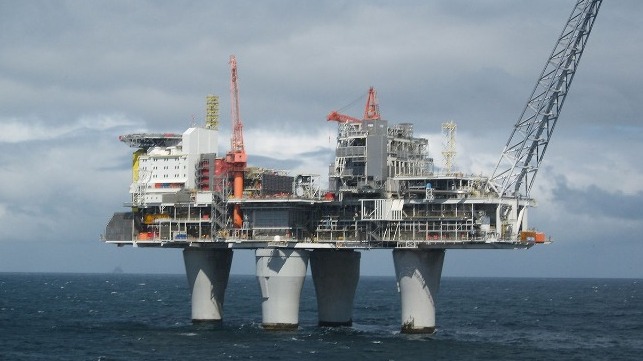
Troll A
File image courtesy Equinor

Published Jan 14, 2025 5:08 PM by The Maritime Executive


Norway has awarded 53 new offshore oil and gas E&P licenses for acreage on its continental shelf, with 20 different companies participating in the auction round.

The so-called APA round of predefined auction areas covered mature producing regions in the Norwegian Sea and the North Sea (along with one single permit in the Bering Sea). It favors tieback developments to existing platforms. Awardees in this round included Aker BP, Shell, and a host of independents; Equinor was a clear winner with 27 licenses, more than half the total. 

Norway's energy minister, Terje Aasland, announced the results at an annual meeting of the Norwegian Petroleum Association. Protesters with Extinction Rebellion and other environmental groups blockaded the venue's doors during his speech. 

"If we are to uphold a stable production in the years to come, we must explore more and invest more," he said in an address. "We must continue to make new discoveries in order to maintain Norway as a reliable and stable supplier of gas and oil to Europe."

Norway's oil and gas exports are critical to European energy security, particularly when it comes to natural gas. Norway now supplies nearly a third of the EU's natural gas imports, providing an essential replacement for Russian volumes. Following the invasion of Ukraine, a disagreement over payment terms led Russian state gas producer Gazprom to shut off the tap on most of its exports to Western Europe, ending a steady and inexpensive energy supply chain that had been in place since the Cold War. 

Last year, driven by strong demand from the EU, Norway's natural gas production hit a new record of 124 billion cubic meters, even higher than the surge in output in 2022. Equinor's giant Troll and Johan Sverdrup fields led the way, and 92 other fields contributed with low downtime and steady output. (Troll alone put out 42.5 billion cubic meters, Equinor said.)

"It has been a great year," Norwegian Offshore Directorate chief Torgeir Stordal told E24. "We have set a new production record for gas and exported more gas than ever to a Europe that is in great need of it."

The directorate believes that this high level of production can be sustained for up to three years before it declines, buying breathing room for Europe. Producers are investing $23 billion in projects on the Norwegian shelf in 2025, the highest amount since 2014 - the year the offshore downturn began. 


UK Government Pledges Billions to Steel Sector's Transformation

By Metal Miner - Jan 14, 2025

The UK government has formed the Steel Council to advise on and implement a new steel strategy, aiming to revitalize the domestic steel industry.

The government has pledged substantial financial support to steelmakers Tata Steel and British Steel for modernization efforts, including the installation of electric arc furnaces.

While the industry welcomes the government's initiative, some remain skeptical about the effectiveness of the Steel Council and the long-term prospects of the UK steel sector.


The UK government’s Department for Business and Trade has set up a committee called the Steel Council to secure long-term steelmaking in the country, where the steel industry continues to struggle. According to a January 7 statement from the ministerial department, the new council will provide advice on rebuilding the sector as well as its upcoming steel strategy.

The department noted that “The Council will bring together steel sector leaders such as CEOs from Tata Steel and British Steel with trade union leaders, industry experts, devolved government representatives and trade associations to address the challenges facing the steel industry and make the changes needed to secure steelmaking in the UK.”
Government and Industry Unite for Steel’s Revival

Representatives added that the department “will meet regularly as the government prepares to launch its steel strategy, providing a vital link between industry, workers, experts and government in every part of the UK and ensuring that both the workforce and economic growth are at the heart of its plans to rebuild the steel sector.”

The Community union, which is associated with steelmakers in the UK, also expressed its support for the strategy. However, one industry watcher played down the event, stating that it sounded as if “they just agreed to agree.”
UK Government Already Heavily Tied to Steel Industry

In July, the UK’s Labour government announced that it had earmarked an additional £2.5 billion ($3.1 billion) for the steel sector. This is in addition to the £500 million it pledged to help Tata Steel to install new electric arc furnace technology at its Port Talbot works. The Welsh site permanently took down the two operating blast furnaces on site in 2024.

Longs producer British Steel also aims to replace the four blast furnaces at its Scunthorpe site with electric arc furnace technology. That site is located in North Lincolnshire, and has been a cornerstone of the UK’s steel industry since the mid-19th century.

In 2024, British Steel’s parent company, Beijing-headquartered Jingye Steel, held talks with the UK government over the amount of aid the steel plant would receive towards the project, which carries a tentative price tag of £1.3 billion ($1.62 billion).

This raised concerns then that Jingye would withdraw from the site. However, local reports from late 2024 and January indicate that the plant will continue to receive raw materials to keep its blast furnaces operating.

By Christopher Rivituso