Tuesday, January 21, 2025

Trump Makes Frightening Far Right Promises in Inauguration Speech


Trump made promises to target LGBTQ people and immigrants, and to enact a number of other right-wing plans.
January 20, 2025

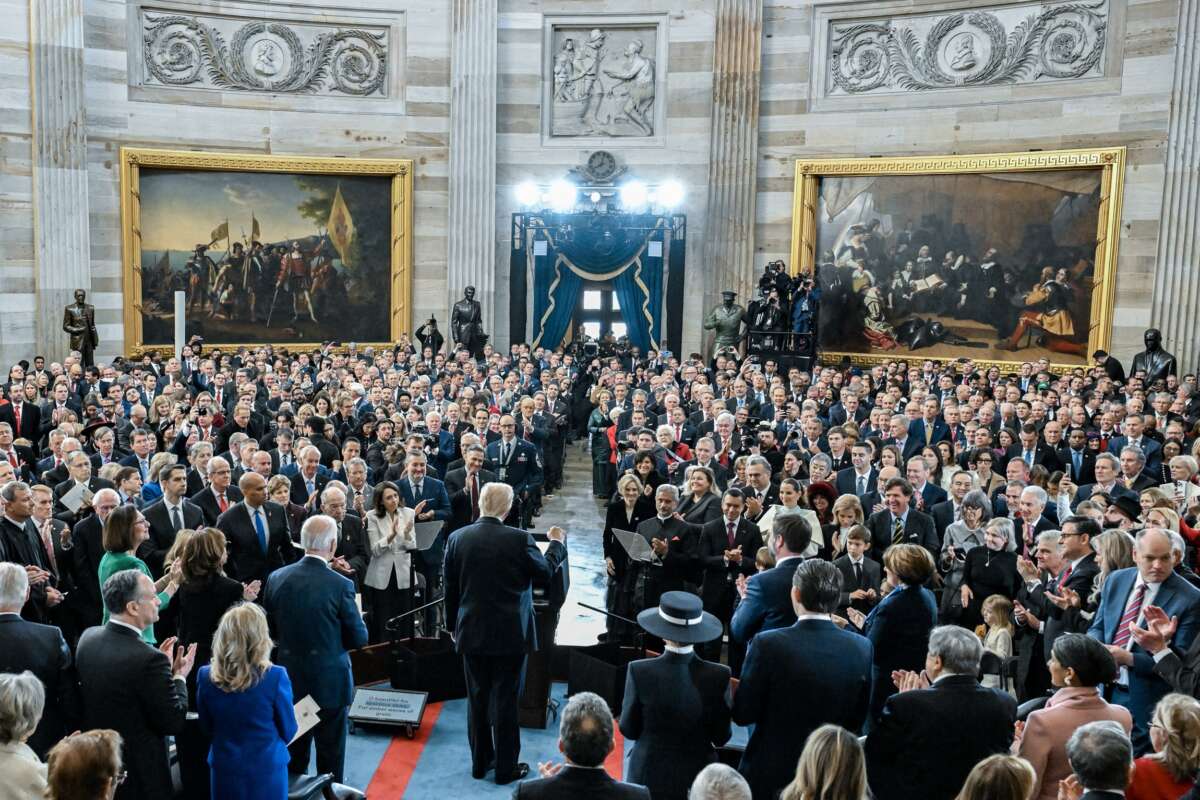
The inauguration of Donald Trump as the 47th president of the United States, inside the Capitol Rotunda of the U.S. Capitol building in Washington, D.C., on Monday, January 20, 2025.Kenny Holston/The New York Times/AFP via Getty Images

Donald Trump has officially been sworn in as the 47th president of the United States.

The quadrennial ceremony was moved inside due to cold weather, held in the rotunda of the U.S. Capitol building — the very place where, four years earlier, hundreds of Trump loyalists violently disrupted the certification of the 2020 election after Trump lost the race to Joe Biden, an event that led to hundreds of participants being charged and convicted.

Though Trump himself received indictments for instigating the attack and doing nothing to stop it (among other actions he took to overturn the 2020 election), he avoided a trial by using delay tactics in the courts. Ultimately, the charges against Trump were dropped by Department of Justice (DOJ) special counsel Jack Smith after he won the 2024 presidential election.

Trump took his constitutionally mandated oath of office, administered by Chief Justice of the Supreme Court John Roberts, at noon Eastern Time. First Lady Melania Trump stood by his side, with nearby onlookers including other members of Trump’s family, his various nominees for his cabinet, and the three richest people in the world: Elon Musk, Jeff Bezos and Mark Zuckerberg.

After taking the oath and receiving a round of applause, Trump addressed the nation, as is typical during presidential inauguration ceremonies.

Trump attempted to portray himself as seeking unity with his political detractors — yet, at various points, he discussed his grudges against his opponents and attacked entire groups of people, making false and disparaging claims against them.

He announced numerous executive orders he would sign later in the day — including orders targeting immigrants and LGBTQ people, directives requiring schools to teach a whitewashed version of U.S. history, and the enactment of a fossil fuel-focused anti-climate energy policy.

Trump also said he would declare a “national emergency” at the U.S.-Mexico border, and would use the Alien Enemies Act of 1798 to enact his other immigration policies. He repeatedly used dehumanizing language to describe immigrants living in the U.S., calling their presence in the country an “invasion.”

Trump’s speech included a direct attack on transgender and nonbinary people. He wrongly insisted that “there are only two genders: male and female,” and said that he would issue an executive order directing government agencies to follow this scientifically errant and long discredited principle.

Trump also inserted religious imagery within his speech, a clear acknowledgment of the Christian nationalists that supported him during the campaign. The president invoked the attempt on his life from this past summer, for example (an incident he once vowed he would never bring up again), stating that God spared his life that day “to Make America Great Again,” citing his campaign slogan within his storytelling.

“We will not forget our God,” Trump added later on.

Trump also stated that he would “forge a society that is color blind,” and that he wanted to make Martin Luther King Jr.’s “dream come true.” But he also said his administration would end diversity, equity and inclusion (DEI) practices, falsely stating that children across the country were being taught “to be ashamed of themselves” by being given lessons describing the history of slavery and racism in the U.S.

He also touched upon his imperialist ambitions, calling for the U.S. to reclaim the Panama Canal after errantly claiming that a treaty with that country had been violated. “We’re taking it back,” Trump said. He then claimed that he would change the name of the Gulf of Mexico to the “Gulf of America.”

Trump wrongly asserted that the country is “rapidly” coalescing behind his agenda, describing his election win as a “mandate” to “completely and totally reverse a betrayal” against him. In fact, Trump won the election without support from a majority of voters, showcasing that his win is not actually a mandate, and recent polling shows that in the weeks since the 2024 election, his statements and actions during the presidential transition period have made Americans less confident in his ability to lead.

He ended his disunifying speech by claiming that he would usher in “the four greatest years in American history,” adding that his administration is “going to win like never before.”

“Nothing will stand in our way. … The future is ours, and our golden age has just begun,” Trump concluded.

Trump enters office with a long list of far right priorities, chief among them a pledge to enact an unprecedented and inhumane mass deportation plan targeting immigrants in the U.S. — a plan that will undoubtedly lead to the separation of families and due process rights being disregarded. The plan will also likely feature detention camps, a horrifying recollection of internment camps targeting Japanese residents in the 1940s and concentration camps in Nazi Germany, critics have warned — not to mention, mass deportation campaigns the U.S. has conducted in the past.

Trump has also shown he intends to govern in fascist and autocratic ways. These include:Urging the military to suppress left-leaning dissenters who disagree with him;
Vowing to use the Justice Department to go after his political opponents;
Calling for the Federal Communications Commission (FCC) to restrict media that criticizes him or produces reports that portray him in a negative light;
Campaigning on restricting the rights of LGBTQ people, with particular emphasis on transgender people.

Reactions to Trump’s speech were varied, with critics warning that his speech was a harbinger of troubling developments to come.

Former Labor Secretary Robert Reich took note of the oligarchy that would aid Trump during his next four years in office. “Big Tech billionaires had a front row seat at Trump’s inauguration. They were seated in front of Trump’s own cabinet. Tells you everything you need to know,” Reich said in a post on Bluesky.

Lawyer and frequent Trump critic Tristan Snell observed that many of the talking points in Trump’s speech were “LITERALLY a rundown of Project 2025,” a far right manifesto drawn up by the Heritage Foundation that Trump had tried to distance himself from during the campaign.

“Funny, for a guy who tried to say he had nothing to do with Project 2025, he sure is copycatting a bunch of its content,” Snell added.

Imara Jones, journalist and CEO of TransLash Media, called attention to Trump’s anti-LGBTQ rhetoric.

“Trump’s recognition of only ‘two genders’ means a war on trans people, as well as any cis person with a gender expression outside of the gender binary,” Jones said.

Zeteo founder Mehdi Hassan expressed his grievances with those who attended the speech knowing who Trump is and what he stands for.

“None of what you saw today was normal. Shame on those Democrats and ‘liberal media’ journalists who helped normalize it,” Hassan wrote. “A narcissistic insurrectionist using neo-Nazi rhetoric, who should have been disqualified from running, who should have been tried & convicted long ago, is now president again.”


Trump Is Packing His Cabinet With Crypto, Oil and Private Prison Profiteers

Trump’s policy makers will be overseeing the industries that they run and own
.

January 18, 2025

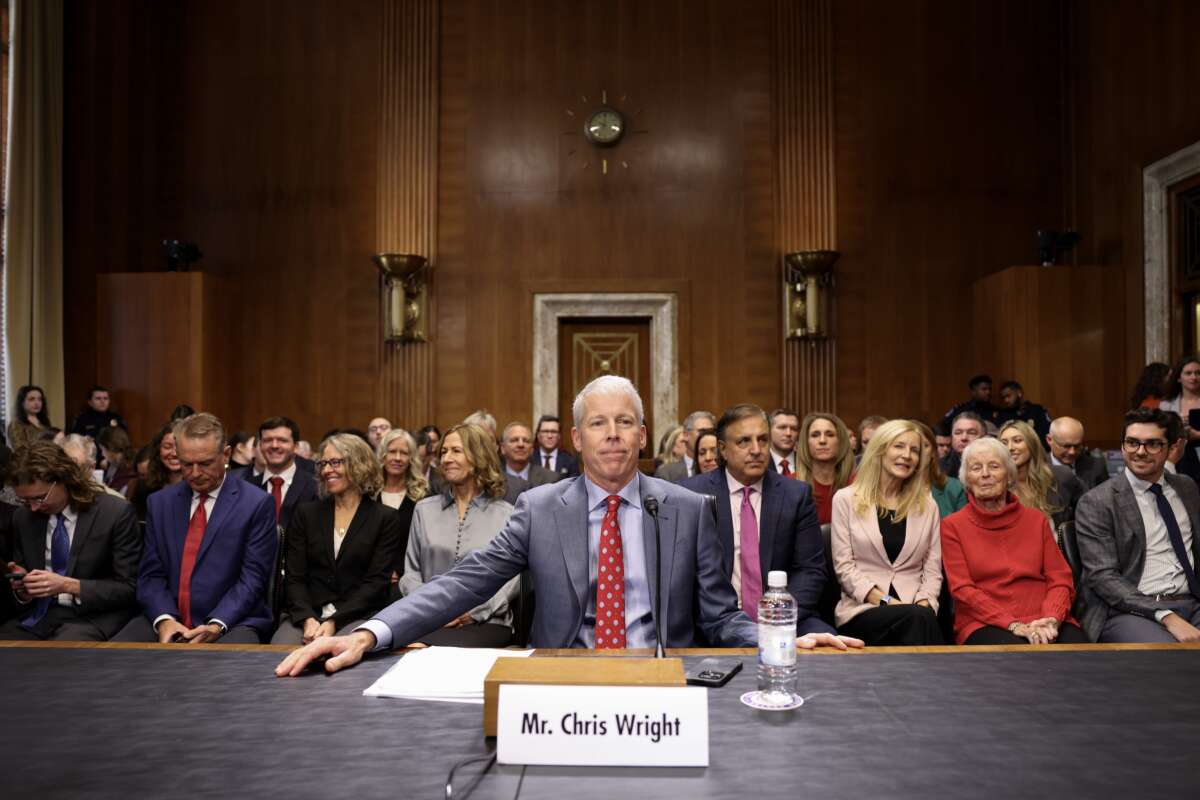
Chris Wright, Donald Trump's nominee for secretary of energy, testifies during his Senate Energy and Natural Resources confirmation hearing on Capitol Hill on January 15, 2025, in Washington, D.C. Wright is CEO of Liberty Energy, which is the second-largest fracking company in North America
Kayla Bartkowski / Getty Images

Money in U.S. politics is nothing new, but the scale of crass intervention in 2024 by mega-billionaire donors through super PACs was unprecedented. Now, corporate elites are indicating they could exert new levels of direct influence within the incoming Trump administration.

Elon Musk, worth over $430 billion, has rightly dominated this story. After spending nearly $300 million toward electing Donald Trump and his GOP allies, Musk, amid a minefield of conflicts of interests, has entered the president-elect’s innermost circle and is helping to shape the new administration.

But the breadth of direct corporate sway within the incoming regime goes beyond big campaign donations and individual players like Musk. What’s becoming clear is that key spheres of policy-making — energy, finance and tech — will be overseen by wealthy figures plucked from the industries they’re tasked to oversee.

Some nominees claim they’ll remove themselves from positions and investments that present competing interests. “All nominees and appointees will comply with the ethical obligations of their respective agencies,” Trump transition spokesperson Brian Hughes told Truthout in a statement. Still, watchdog groups worry that the new administration will be mired in corporate influence and conflicts.

Jeff Hauser, executive director of the Revolving Door Project, which monitors executive branch appointees, told Truthout that, while the first Trump administration was “catastrophically corrupt,” it still made gestures toward limiting conflicts of interest. But now, he says, “there are essentially no restraints being promised.”

Fossil Fuels

Trump rode to reelection vowing to “drill, baby, drill” and courting oil billionaires who donated handsomely to his campaign. Now, he’s tapped a clique of industry representatives and allies to oversee that agenda.

Chris Wright, a fracking industry diehard, is set to become Trump’s energy secretary, overseeing the nation’s energy programs and nuclear infrastructure.

Wright is CEO of Liberty Energy, a Denver-based fracking company with operations across major North American drilling fields. Liberty reported $4.7 billion in revenue and $556 million in profits in 2023. As of January 3, 2025, Wright owned over $50 million in Liberty Energy stock.

Wright famously drank fracking fluid claiming it was safe, and he boasts of the “many positive changes” of climate change, which he says is not a global crisis. Wright and his wife donated $540,000 toward Trump’s reelection.

It’s unclear whether Wright will divest from his energy holdings, though he’s reportedly resigning from the board of a nuclear company that receives federal subsidies.

During his confirmation hearing Wednesday, Wright said, “appropriate ethics people” had reviewed his investments, and he has “agreed to take all the appropriate action to avoid any real conflicts or perceived conflicts of interest.”

North Dakota Gov. Doug Burgum, Trump’s pick for interior secretary, will play an even more influential role in the administration’s fossil fuel agenda.

Key spheres of policy-making — energy, finance and tech — will be overseen by wealthy figures plucked from the industries they’re tasked to oversee.

Burgum will oversee more than 500 million acres of federal lands that Trump wants to open up for oil drilling, and he’ll also serve as Trump’s energy czar and head of his National Energy Council, tasked with implementing Trump’s “energy dominance” agenda.

Burgum governs the nation’s third-largest oil producing state, where many politicians are close to the fracking industry. Burgum’s predecessor in North Dakota, John Dalrymple, now sits on the board of a coal corporation.

Burgum is a close ally of oil billionaire Harold Hamm, a longtime Trump backer and key liaison with the fossil fuel industry.

Hamm’s drilling company, Continental Resources, is the largest oil and gas leaseholder in the state. Burgum has earned up to $50,000 leasing 200 acres of his farmland to Hamm and Continental for drilling.

Hamm organized the 2024 fundraiser where Trump asked for $1 billion from the oil industry in exchange for carrying out its agenda. Burgum attended the fundraiser alongside Hamm.

Chris Wright was Hamm’s top choice for energy secretary, and Wright’s wife, Liz Wright, co-hosted a Trump fundraiser last August that featured Burgum.

“The people with authority over energy and the environment are all committed to the destruction of the planet’s delicate ecosystem,” said Hauser.


A Cabinet of the 1 Percent

To the delight of Wall Street, Trump has promised to cut corporate taxes and weaken financial regulations. The private equity and hedge fund billionaires who backed Trump are now hoping to accelerate mergers and acquisitions and access trillions in retirement savings.

(Historically, private equity firms — huge investors in private markets that charge higher fees, are more opaque and make riskier investments — have been restricted from accessing 401(k)s and other defined-contribution retirement plans.)

Now, Trump is placing industry figures in top positions overseeing his economic policies.

Billionaire Howard Lutnick is set to be commerce secretary. Lutnick is the CEO of Cantor Fitzgerald, a huge financial services firm, and chairman of BGC Group, another financial services firm.

“His companies are involved in nearly every sector in the U.S. economy,” wrote the New York Times after Trump’s announcement of his pick.

As commerce secretary, Lutnick will hold a powerful role over U.S. economic and business policies. He is also Trump’s transition co-chair, charged with filling 4,000 positions in the new administration.

Another billionaire, Scott Bessent, who donated more than $1.6 million toward Trump’s election efforts, is set to become treasury secretary. Bessent heads a hedge fund, Key Square Group, which manages hundreds of millions in assets.

While corporate executives have praised Bessent’s nomination, Hauser is skeptical. “He’s ludicrously unqualified for the job,” he told Truthout. “I think he is going to use the position to make himself and his friends richer.”

If confirmed, Bessent says he’ll divest from dozens of holdings and his hedge fund, while Lutnick says he’ll leave Cantor Fitzgerald and its spin-offs and divest his interest in those companies.

Other high-up appointees and nominees have close ties to finance. Stephen Feinberg, Trump’s pick for the deputy secretary of defense, the second-top Pentagon position, is a billionaire private equity executive, while finance executive Frank Bisignano, picked to head Social Security, was once the second-highest paid U.S. CEO, in 2017, during Trump’s first term.

Carceral Lobbyists and Consultants

Key Trump appointees and nominees are corporate lobbyists and consultants whose clients include those who profit from prisons.

Pam Bondi, Trump’s nominee for attorney general, served two terms as Florida’s attorney general before joining lobbying and legal firm Ballard Partners in 2019.

To resist the onslaught of billionaire and corporate control of politics we need publicly funded elections and to overturn the Supreme Court’s Citizens United ruling.

A New York Times profile depicts Bondi as a corporate-friendly Florida attorney general, with an “open-door approach to companies” and “transactional philosophy” and, as a lobbyist, an ability to “help grease relations with the Trump administration.”

One of Bondi’s lobbying clients was GEO Group, the Florida-based private prison corporation. Bondi was a registered lobbyist for GEO Group in 2019 on the issue of “promoting the use of public-private partnerships in correctional services.”

Share prices for private prison companies have soared since Trump’s reelection. In December 2024, GEO Group announced $70 million in new capital expenditures to service Immigration and Customs Enforcement (ICE) immigration jails. GEO Group says it is the largest service provider to ICE.

Bondi was also registered to lobby for the Florida Sheriffs Association and Major County Sheriffs of America ​through 2024. Her other corporate clients have included Amazon, Uber, General Motors and the mega-cruise line Carnival Corporation, who she helped snag an Oval Office meeting with Trump.

Trump’s chief of staff and transition co-chair, Susie Wiles, was also a lobbyist for Ballard, as well as another firm, Mercury Public Affairs, with numerous clients that included fossil fuel companies like ​Alliance Resource Partners, the fourth-biggest U.S. coal producer.

Tom Homan, Trump’s hardliner pick for “border czar” promising to oversee mass deportations, runs a consulting firm, Homeland Strategic Consulting LLC, that claims it’s helped its clients obtain “tens of millions of dollars of federal contracts.”

While its corporate clients are not disclosed, the firm says it “has been extremely successful in assisting small and large companies in business development with both federal and state governments,” and notes the firm’s close ties to government agencies like the Department of Homeland Security, Department of Justice and ICE.

Among other roles, Homan is also a “strategic advisor” for the Government Technology & Services Coalition (GTSC), a nonprofit association of “midsized company CEOs that create, develop, and implement solutions for the Federal homeland and national security sector.”

Past GTSC events include “ICE Day” conferences featuring Homan and past annual reports list over 200 member corporations across tech, finance and weapons industries.

Homan previously served as acting director of ICE during the first year of the Trump presidency.

Crypto-Corruption

The 2024 election saw a nexus of tech and cryptocurrency billionaires ardently back Trump. Elon Musk is the most well-known example, but other powerful people joined him.

These include Marc Andreessen, co-head of the largest U.S. venture capital fund for cryptocurrency and tech; Brian Armstrong, CEO of Coinbase, a top cryptocurrency exchange; the Winklevoss twins, who run the Gemini cryptocurrency exchange; and the influential Silicon Valley investor and former PayPal executive David Sacks.

This bloc has now emerged as a true force in U.S. politics, and it has a clear agenda aimed at deregulating AI and crypto industries.

“Silicon Valley is now kind of co-dominant with Wall Street, the traditional center of the economy, and deciding what sectors of the economy will get investment and grow,” economist Rob Larson, author of books on tech elites and the ruling class, told Truthout. “It’s conspicuous how many of those figures were so heavily evolved in this election.”

In particular, Silicon Valley billionaires oppose Biden’s Securities and Exchange Commission (SEC) chair, Gary Gensler, who they see as overregulating cryptocurrency, and Biden’s United States Federal Trade Commission head Lina Khan, a staunch antitrust regulator.

All told, crypto and tech billionaires poured hundreds of millions of dollars toward electing Trump and his GOP allies, and for this, they have been rewarded with major influence within the new administration.

Trump named David Sacks the “White House A.I. & crypto czar” overhauling regulatory policies toward these industries. Trump also announced a new “crypto advisory council” that will contain industry representatives to assist with this.

Trump is also nominating a new pro-crypto SEC chair, Paul Atkins, currently CEO of financial services company Patomak Partners. Trump seems likely to pick an industry-friendly chair for the Commodity Futures Trading Commission. Right-wing billionaire Peter Thiel is also reportedly providing a “staffing pipeline” for the administration.

Commerce secretary nominee Lutnick has close ties to cryptocurrency. His firm Cantor Fitzgerald is a 5 percent owner of Tether, a privately run digital dollar that has been called the “de facto reserve currency for crypto,” and Lutnick seems intent on expanding his ties to crypto.

Trump’s own social media company, Trump Media and Tech­no­logy Group, is in talks to buy Bakkt, a cryptocurrency trading venue whose former CEO is Kelly Loeffler, who Trump has nominated to head his Small Business Administration. Trump also has his own crypto project, World Liberty Financial.

“Trump is no longer pretending in any meaningful sense that he will rein in his own personal conflicts of interest,” says Hauser. “I think that the scale of corruption possible with things like Trump’s crypto investments and Truth Social are incredible.”
Deadly Appointments

To resist the onslaught of billionaire and corporate control of politics, Larson says we need publicly funded elections and to overturn the Supreme Court’s Citizens United ruling. But he says winning “major progressive national policy changes” like these will “take a lot of absolute bedrock level organizing and building for some time.”

Meanwhile, Hauser says people focus more on the actions he’s taking, especially through his key appointments, than his outlandish speech.

“If we focus on him as the utterer of abhorrent things, then he can, in the shadows, give away the store to America’s worst corporations,” says Hauser, with consequences that go beyond “the abstract value of clean government.”

“Workers will die needlessly, consumers will be gouged, the environment will decline,” says Hauser. “These are tangible consequences of misgovernment.”

A Call to Media Organizations: Don’t Back Down in the Face of Trump’s Threats

Trump’s attacks on press freedom aren’t separate from his attacks on oppressed communities. We must resist them all.
January 20, 2025

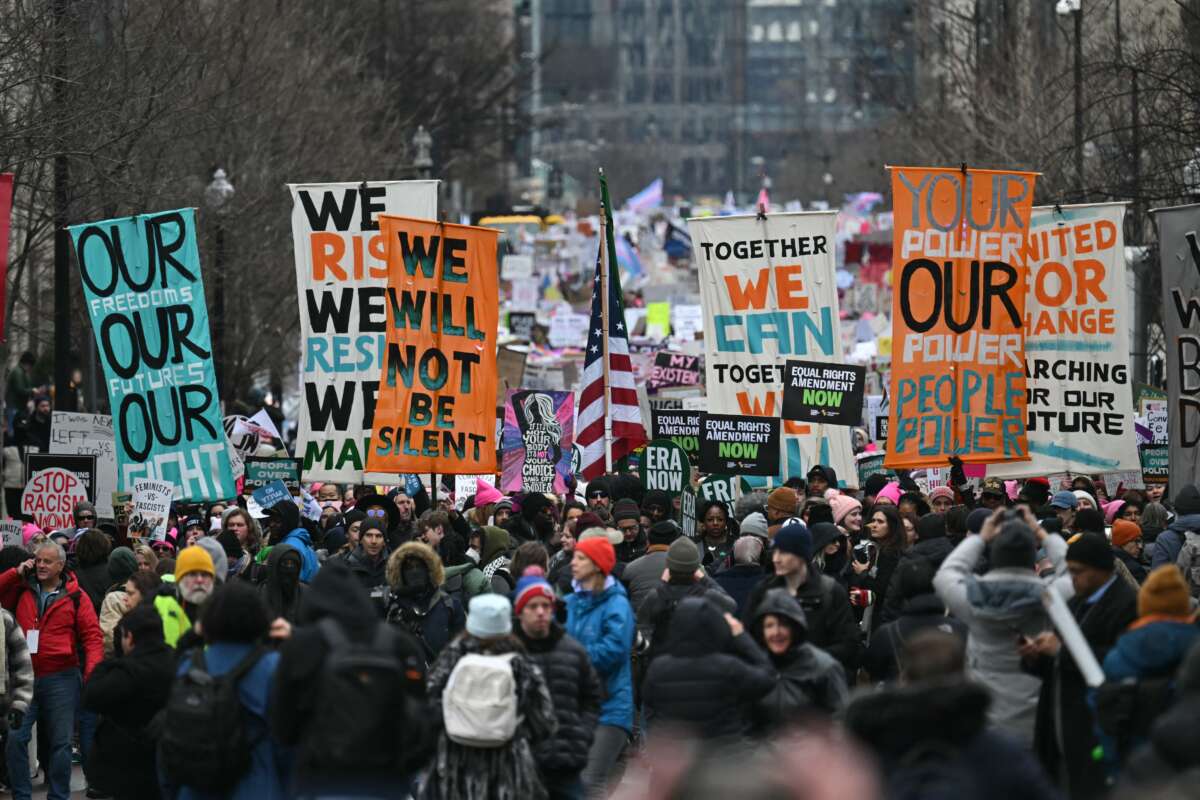
Protesters rally during the People's March on Washington in Washington, D.C. on January 18, 2025, ahead of the inauguration of U.S. President-elect Donald Trump.
PATRICK T. FALLON / AFP / GETTY IMAGES

As Donald Trump is inaugurated a second time, independent media organizations are faced with urgent mandates: Tell the truth more loudly than ever before. Do that work even as our standard modes of distribution (such as social media platforms) are being manipulated and curtailed by forces of fascist repression and ruthless capitalism. Do that work even as journalism and journalists face targeted attacks, including from the government itself. And do that work in community, never forgetting that we’re not shouting into a faceless void — we’re reaching out to real people amid a life-threatening political climate. Our task is formidable, and it requires us to ground ourselves in our principles, remind ourselves of our utility, dig in and commit.

A clear look at the media landscape shows us why these commitments are necessary. Throughout the first Trump campaign and presidency, corporate newsrooms acted as if they were dinghies buoyed along a naturally occurring wave to the right. Initial rounds of shock at Trump’s demonization of migrants, his hostility toward protesters and the left, and his jingoistic policies eventually gave way to normalization of such stances in corporate news outlets around the country.

When these outlets did choose to take a stand, it was often around attacks on a free press — which mainstream media depicted as a distinct issue, rather than recognizing its connections with the attacks Trump wielded more broadly against oppressed communities.

Now, we see that even that stance may be changing. The sheen of a confrontational press has dulled. Mainstream news organizations, familiar with the threat to journalism under a Trump presidency, began to capitulate before he even took office.

Take The Washington Post. On Inauguration Day in 2017, Post reporters wrote about Trump waging war on journalists, “accusing news organizations of lying about the size of his inauguration crowd as … huge protests served notice that a vocal and resolute opposition would be a hallmark of his presidency.” The Post famously adopted a new tagline: “Democracy dies in darkness.” Fast forward to 2025, and the newsroom is in turmoil as journalists at the paper — led by a new publisher with a background at the Rupert Murdoch empire and owned by a billionaire who visibly cozies up to Trump — question choices to kill an anti-Trump endorsement and cartoon.

Related Story

Here’s How Truthout Is Preparing for Trump’s Day One
As the incoming administration vows to “come after” the media, independent journalism is more crucial than ever. By Negin Owliaei & Maya Schenwar , Truthout December 31, 2024


This isn’t unique to one paper. From the moment Trump began spewing lies about immigrants coming across the southern border, The New York Times wrote in a 2016 editorial that “it became clear that Mr. Trump’s views were matters of dangerous impulse and cynical pandering.” Eight years later, the paper still called Trump morally and temperamentally unfit for the job. But this time, it applauded some of Trump’s aims, if not his execution — specifically choosing to praise both Trump’s China-bashing and his choice to turn away asylum seekers at the border during the pandemic, a policy championed by Stephen Miller, Trump’s adviser most known for his support of white nationalist policies.

With these choices, corporate media outlets make a rightward societal shift appear inevitable. Movement media’s role is to resist that tendency, and offer an alternative. We have a responsibility to remind people of what we have lost, and what we could still win. We highlight any potential footholds that might stabilize us as we move toward a more just world. We look around at the communities we belong to and know that the threats faced by journalists are not separate from the ones Trump is issuing to migrants, to LGBTQ+ people, to activists on the left — they’re part of the same agenda of authoritarianism, and we must resist it all.

Active participation in media is a critical part of resisting the propaganda-driven distortions and manipulations that fuel fascism.

Movement media are uniquely positioned to cover fascism, because we’ve been covering it all along. We have long reported on the rise of the far right, from white supremacist militias to the growth of far right militarism inside governmental bodies. More broadly, though, some of the areas of coverage in which independent media have led the way will prove even more broadly relevant in fascist times. For example, the work of Truthout, The Appeal, Inquest, Prism, In These Times, Democracy Now!, Scalawag, and many other movement media organizations has shone a light on the prison-industrial complex, well before mainstream media deigned to regularly cover police violence or mass incarceration. This archive is now essential to revisit: Policing (in its many forms), detention and incarceration are key tools of fascism — they are the mechanisms that the Trump administration will deploy in order to enforce its draconian agenda. As William C. Anderson wrote in Prism, “So much of what we know as the terror that indicates deeper descent into fascism in the U.S. first appears in prisons.” And as Kelly Hayes and Maya wrote in Truthout amid the first Trump administration, “people who are incarcerated in the United States already live under conditions that meet many of the criteria for fascism,” and it’s essential to learn from their experiences — and their organizing, chronicled in movement media publications. Our outlets must draw from our decades-long work exposing the roots, current functions and infrastructure of policing to illuminate how fascist policies and practices will be implemented and enforced.

Connectedly, we must remain steadfast in our commitment to covering the communities that MAGA targets by amplifying voices within those communities, uplifting their organizing efforts, and providing practical information and tools for these communities’ survival. As Silky Shah recently wrote in Truthout, a large part of combating Trump’s anti-migrant agenda must involve “educating people about their rights, exposing the harms of the system” and “broadening the base of support.” Movement media must doggedly intervene to correct harmful, false narratives and highlight organizing happening around the country to stop detention and deportation. We must ramp up our coverage of efforts toward a “radical expansion of sanctuary,” as Marisa Franco framed it during the first Trump administration: “Sanctuaries must include not only undocumented people, but also non-immigrant Muslims, LGBTQ people, Black and Indigenous folks and political dissidents.”


Accordingly, as both right-wing forces and “mainstream” publications like The New York Times overtly attack trans lives, independent media must build on our long history of covering trans movements, and also support the flourishing of newer trans-focused independent media like TransLash Media, Assigned Media and Erin In The Morning, which will prove essential to both correcting the public record and uplifting grassroots struggles for trans survival and liberation. And as mainstream U.S. publications continue to shy away from reporting the scale of Israel’s genocide against Palestinians, movement media have an urgent responsibility to keep Palestine in the headlines; recognize anti-Palestinian, anti-Muslim and anti-Arab violence as part of the MAGA agenda and connected to the targeting of other groups; and keep covering both movements for Palestinian liberation and the repression they face. Coalitions like Media Against Apartheid and Displacement (of which Truthout is a co-founding member) and Palestine-specific publications like Mondoweiss, Electronic Intifada and Palestine Square should be supported and resourced, and journalists and audiences alike must never forget the media-makers we’ve lost to Israel’s brutal genocide.


These are just a few examples of the ways in which movement media will need to both draw on our long histories of coverage related to fascism and also forge new connections, bringing our resources to the current moment with fresh vigor.

We must also anticipate the kinds of attacks that we expect to come or evolve under a Trump presidency. Consider the threat of HR 9495, dubbed the “nonprofit killer bill,” which would allow the treasury secretary to unilaterally deem a nonprofit organization to be a “terror-supporting group,” thus changing its tax status. That bill is one piece of a broader framework from the right as it tries to close in on progressive civil society and shut down any potential spaces for dissent.

The bill sailed through the House of Representatives despite protest from a wide cross section of nonprofit organizations; if it passes through the Senate, that could put an immense amount of power in the hands of one Trump administration official.

These kinds of laws are scary in their own right. But the rhetoric from Trump and his administration makes them all the more terrifying for independent news outlets like ours. Trump himself has referred to the media as the “enemy of the people.” He has derided any kind of coverage of him that could potentially be perceived as unfavorable, and has also found ways to twist the law in his favor to go after anyone behind such coverage. He’s suing a famed Iowa pollster and the newspaper where she’s published for “election interference” after one of her polls predicted Kamala Harris would win the election. He came after ABC News when George Stephanopoulos said Trump was found “liable for rape” instead of sexual assault in a case writer E. Jean Carroll brought against him. And news organizations are already caving: ABC settled the lawsuit and agreed to pay out $15 million to Trump’s presidential library, in addition to $1 million in legal fees, rather than fighting the charge.

Members of Trump’s inner circle are no better. Brendan Carr, Trump’s pick to head the Federal Communications Commission (FCC) followed up with Disney, which owns ABC, writing an ominous letter to CEO Bob Iger after the settlement, CNN reported. “Dear Mr. Iger, Americans no longer trust the national news media to report fully, accurately, and fairly,” Carr wrote. “ABC’s own conduct has certainly contributed to this erosion in public trust.”

“Broadcast licenses are not sacred cows,” Carr wrote on social media in November, shortly after Trump announced his pick. “These media companies are required by law to operate in the public interest. If they don’t, they are going to be held accountable, as the Communications Act requires.” Experts warn Carr’s policy ambitions would exceed the FCC’s authority under federal law, and digital rights groups see a clear threat to free speech.

Some threats are more overt. Kash Patel, Trump’s pick to lead the FBI, has vowed to come after journalists over Trump’s baseless claims about the 2020 election being stolen. “We’re going to come after the people in the media who lied about American citizens, who helped Joe Biden rig presidential elections,” Patel said back in 2023. “Whether it’s criminally or civilly, we’ll figure that out.”

Pete Hegseth, Trump’s pick to head the Department of Defense, has also come after journalists simply for doing their jobs. When nonprofit outlet ProPublica looked into a claim that Hegseth had not been accepted into West Point, something about which he has bragged, reporters reached out to Hegseth for comment, a standard journalistic practice. The story didn’t end up being true, and ProPublica never published anything. But that didn’t stop Hegseth from going after ProPublica on social media. “We understand that ProPublica (the Left Wing hack group) is planning to publish a knowingly false report that I was not accepted to West Point in 1999,” Hegseth wrote. Right-wing media doubled down and spun up a tale in which ProPublica was cast as an unethical smear factory, picking apart the outlet for doing its due diligence and thus undermining journalistic best practices.

Even without these specific actors and their specific attacks, journalism’s financial and distribution models were already under threat thanks to the ever-present interference of Big Tech. That presence stands to become even more overbearing under a Trump administration; tech titans have already donated handsomely to Trump’s inauguration fund. X owner Elon Musk has wormed his way into Trump’s inner circle, while Meta owner Mark Zuckerberg recently announced changes to the way his platforms would fact check and moderate content in what appears to be a show of loyalty to Trump. Under such circumstances, we must get creative in how we distribute and interact with journalism.

Confronting the Trump administration as media-makers means we must define “media-maker” broadly and inclusively. As Maya wrote during Trump’s first administration, media work doesn’t only “mean putting pen to paper, or fingers to keyboard, or eye to camera. Those who read, watch and listen are an integral and active part of a just media, and should be recognized as such. Good journalism is just as much about listening as it is about talking or telling. Media-ing is a two-way street.” By reading this article, you’re actively participating in media — and even more so if you share it with a friend, use it to start a conversation, send it to a text thread or post it on social media. And active participation in media is a critical part of resisting the propaganda-driven distortions and manipulations that fuel fascism.

Our hope for movement media under Trump includes a recognition that “audiences” are active participants, and that community-building is essential, both among people who work in journalism on the left (see our newly co-founded Movement Media Alliance) and among all those who engage with it. How can we cultivate community, both through providing media that people find useful to share, and also grow our presences on social platforms beyond those controlled by right-wing billionaires? How can we all challenge ourselves to create more spaces for energized conversation with friends, family, neighbors and co-strugglers about collectively informing ourselves and organizing to meet the moment? From scheduling regular times for conversation groups, to starting group encrypted text threads about organizing efforts, to reading books or articles together with friends, to subscribing to more independent newsletters and feeds, we can all commit to building community around critical engagement with media.


As a dizzying number of corporate news organizations — either through need or greed — rush to implement new ways to further monetize their content, and others acquiesce to Trump’s wishes even before his inauguration, now is a time for movement media-makers to double down on community-first models. At Truthout, we are reaffirming our commitments on this front: We won’t run ads or have a paywall because we believe that everyone should have access to information, and that access should exist without barriers and free of distractions from craven corporate interests. We recognize the implications for democracy when information-seekers click a link only to find the article trapped behind a paywall or buried on a page with dozens of invasive ads. The laws of capitalism dictate an unending increase in monetization, and much of the media simply follows those laws. Truthout and many of our peers are dedicating ourselves to following other paths — a commitment which feels vital in a moment when corporations are evermore overtly embedded in government. Over 80 percent of Truthout’s funding comes from small individual donations from our community of readers, and the remaining 20 percent comes from a handful of social justice-oriented foundations. Over a third of our total budget is supported by recurring monthly donors, many of whom give because they want to help us keep Truthout barrier-free for everyone. (You can help by giving today: Whether you can make a small monthly donation or a larger gift, Truthout only works with your support.)

Journalism is just one tool in the anti-fascist toolbox. Those of us who create it must take seriously how our responsibilities intersect with and uplift the other tools that will, together, enable people to effectively organize against authoritarianism. As we rise to meet an era of unpredictable chaos, our journalism must be creative, accurate, accountable and rooted in solidarity.

Truthout is an indispensable resource for activists, movement leaders and workers everywhere. Please make this work possible with a quick donation.


This article is licensed under Creative Commons (CC BY-NC-ND 4.0), and you are free to share and republish under the terms of the license.


We need your help to become less dependent on traffic from Facebook and X. Follow us on Bluesky today!


Maya Schenwar is director of the Truthout Center for Grassroots Journalism. She is also Truthout‘s board president and editor at large. She is the co-editor of We Grow the World Together: Parenting Toward Abolition; co-author of Prison by Any Other Name: The Harmful Consequences of Popular Reforms; author of Locked Down, Locked Out: Why Prison Doesn’t Work and How We Can Do Better; and co-editor of the Truthout anthology Who Do You Serve, Who Do You Protect? Police Violence and Resistance in the United States. In addition to Truthout, Maya’s work has appeared in many publications including The New York Times, The Guardian, NBC News and The Nation, and she has appeared on Democracy Now!, MSNBC, C-SPAN, NPR, and other television and radio programs. Maya is a cofounder of the Movement Media Alliance (MMA) and Media Against Apartheid and Displacement (MAAD). She lives in Chicago.


Negin Owliaei  is Truthout‘s editor-in-chief. An award-winning journalist, she previously worked at Al Jazeera‘s flagship daily news podcast, The Take. She lives in Washington, D.C.

Ziggy West Jeffery is Truthout‘s executive director and board co-chair of The Real News Network. He is a passionate advocate of independent media and social justice. You can follow him on Bluesky.
AT LAST

Leonard Peltier is Coming Home!


January 20, 2025
Facebook

Sumterville, FL – Today, President Biden granted Leonard Peltier executive clemency and commuted the remainder of his sentence. The president’s decision is the result of decades of grassroots organizing in Indian Country and the unveiling of increasing amounts of evidence of prosecutorial misconduct and constitutional violations during the prosecution of Peltier’s case.

“It’s finally over – I’m going home.” said Leonard Peltier. “I want to show the world I’m a good person with a good heart. I want to help the people, just like my grandmother taught me.”

“Leonard Peltier’s freedom today is the result of 50 years of intergenerational resistance, organizing, and advocacy,” said Nick Tilsen, NDN Collective Founder and CEO. “Leonard Peltier’s liberation is our liberation – we will honor him by bringing him back to his homelands to live out the rest of his days surrounded by loved ones, healing, and reconnecting with his land and culture.

“Let Leonard’s freedom be a reminder that the entire so-called United States is built on the stolen lands of Indigenous people – and that Indigenous people have successfully resisted every attempt to oppress, silence, and colonize us,” continued Tilsen. “The victory of freeing Leonard Peltier is a symbol of our collective strength – and our resistance will never stop.”

“Today’s decision shows the combined power of grassroots organizing and advocacy at the highest levels of government. We are grateful to President Biden and the leadership of Secretary Deb Haaland. said Holly Cook Macarro, Government Affairs for NDN Collective. “All of us here today stand on the shoulders of three generations of activists who have fought for justice for Leonard Peltier. Today is a monumental victory – the day that Leonard Peltier finally goes home.”

Please support the NDN Collective.

###

NDN Collective is an Indigenous-led organization dedicated to building Indigenous power. Through organizing, activism, philanthropy, grantmaking, capacity-building, and narrative change, we are creating sustainable solutions on Indigenous terms.

Leonard Peltier to Leave Prison After 50 Years as Biden Grants Commutation


Leonard Peltier, 80, a member of the Turtle Mountain Band of Chippewa, will transition to home confinement after serving nearly 50 years of a life sentence. 
(Photo: AmnestyUSA))

NATIVE NEWS ONLINE

President Biden announced today he will commute Leonard Peltier's life sentence to home confinement, marking a major victory for tribal nations and advocates who have long fought for the Native American activist's release.

Peltier, 80, has spent nearly 50 years in federal prison after being convicted for the 1975 deaths of two FBI agents on the Pine Ridge Indian Reservation. He has maintained his innocence throughout his imprisonment.

A White House statement cited Peltier's advanced age, deteriorating health, and the extensive support for his release from tribal nations, Nobel Peace laureates, former law enforcement officials, and human rights organizations.

"This commutation will enable Mr. Peltier to spend his remaining days in home confinement but will not pardon him for his underlying crimes," according to the White House statement.

The decision comes after decades of campaigns by Native American leaders and organizations who have questioned the fairness of Peltier's trial and conviction. Even the former U.S. Attorney whose office handled Peltier's prosecution and appeal supported granting clemency.

The White House noted Peltier's "close ties to and leadership in the Native American community" as a factor in the decision.

The commutation of Peltier’s sentence comes after increased advocacy from tribal leaders, congressional members, human rights advocates and even former prosecutors who were involved in the case. 

Last week, more than 120 tribal leaders, including National Congress of American Indians President Mark Macarro (Chairman of the Pechanga Band of Indians) and Navajo Nation President Buu Nygren, signed a letter urging Biden to grant clemency. In December, Macarro raised Peltier’s case directly with Biden during a flight on Air Force One, highlighting that Peltier was among the oldest surviving Indian boarding school survivors.   

Peltier, an enrolled citizen of the Turtle Mountain Band of Chippewa Indians, spent three years at the Wahpeton Indian School in North Dakota as a child — a story he shared with Native News Online in 2022. 

EXCLUSIVE: Leonard Peltier Shares His Indian Boarding School Story

In a post on X (formerly Twitter), outgoing Interior Secretary Deb Haaland (Laguna Pueblo) wrote: “I am beyond words about the commutation of Leonard Peltier. His release from prison signifies a measure of justice that has long evaded so many Native Americans for so many decades. I am grateful that Leonard can now go home to his family. I applaud President Biden for this action and understanding what this means to Indian Country.” 

In her Tweet, she linked to the Biden administration’s release in White House press room, but the post had been removed during the presidential transition and was not included on the Biden White House archive.  

Kevin Sharp, former Chief U.S. District Court judge and Peltier’s attorney, called Biden’s decision “an enormous step toward healing and reconciliation with the Native American people in this country.”  Sharp, who filed Peltier’s original clemency petition in 2019, said Biden’s “act of mercy” will allow Peltier to return to his reservation and live out his remaining days. 

The case has drawn international attention over the decades, with supporters like Nelson Mandela, Archbishop Desmond Tutu and Pope Francis advocating for Peltier’s release.  Sharp represented Peltier for five years before NDN Collective took the lead on clemency efforts. 

“Leonard Peltier’s freedom today is the result of 50 years of intergenerational resistance, organizing, and advocacy,” Nick Tilsen, NDN Collective Founder and CEO, said in a statement. “Leonard Peltier’s liberation is our liberation – we will honor him by bringing him back to his homelands to live out the rest of his days surrounded by loved ones, healing, and reconnecting with his land and culture. 

“Today’s decision shows the combined power of grassroots organizing and advocacy at the highest levels of government. We are grateful to President Biden and the leadership of Secretary Deb Haaland,” Holly Cook Macarro, government affairs or NDN Collective, said. “All of us here today stand on the shoulders of three generations of activists who have fought for justice for Leonard Peltier. Today is a monumental victory – the day that Leonard Peltier finally goes home.”

Judith LeBlanc (Caddo), executive director of the Native Organizers Alliance released a statement as well, saying: “Our hearts are full for Leonard Peltier, his family, and all of Indian Country as he finally gets to go home after nearly 50 years behind bars. Leonard’s incarceration came to symbolize the injustices Native peoples face in defending our lands and civil and inherent rights. His resilience has stood as a testament to the enduring strength of Native peoples in the face of systemic racism and oppression.

U.S. Sen. Brian Schatz (D-Hawai‘i), vice chair of the Senate Committee on Indian Affairs, released the following statement: “If there were ever a case that merited compassionate release, Leonard Peltier’s was it,” said Schatz. “President Biden did the right thing by showing this aging man in poor health mercy and allowing him to return home to spend whatever days he has remaining with his loved ones. I thank President Biden and the countless advocates who’ve worked tirelessly over the years to secure Peltier’s release.”

Neely Bardwell provided reporting on this story. 


Biden Commutes Sentence of Indigenous Political Prisoner Leonard Peltier

Amnesty International noted there were “serious human rights concerns about the fairness” of Peltier’s trial.
January 20, 2025
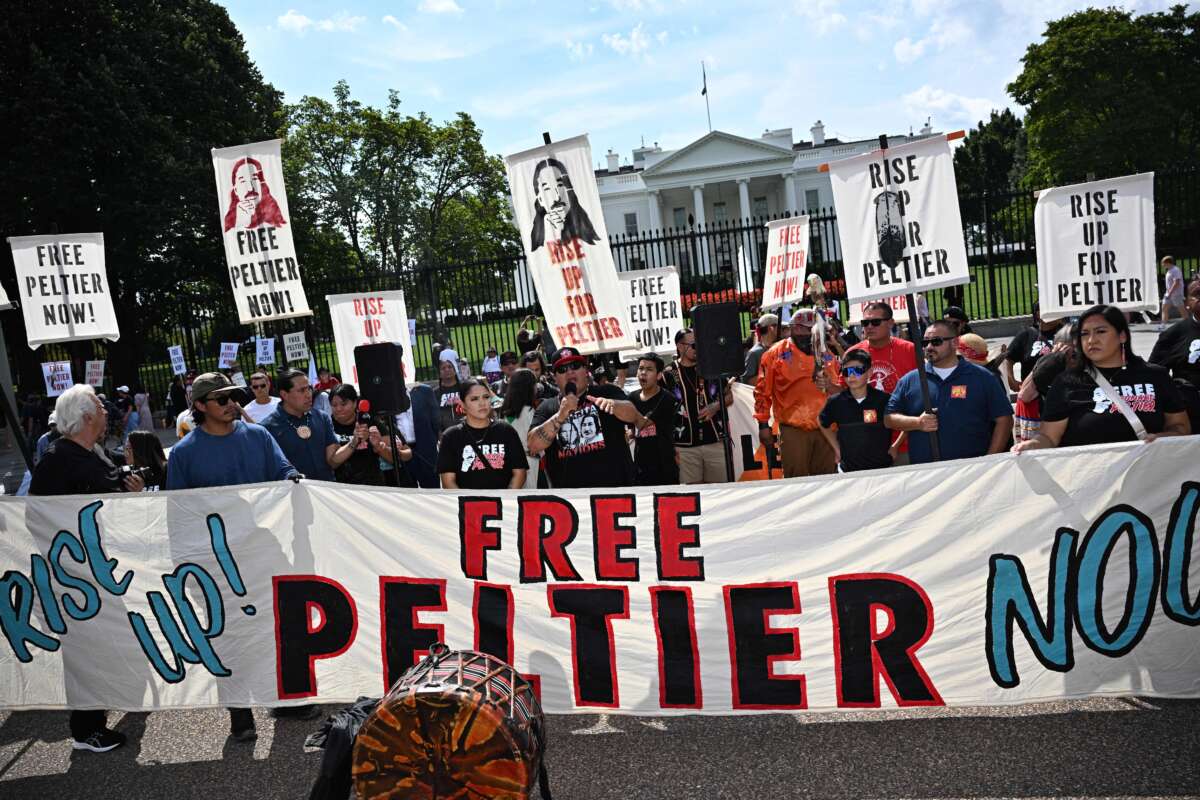
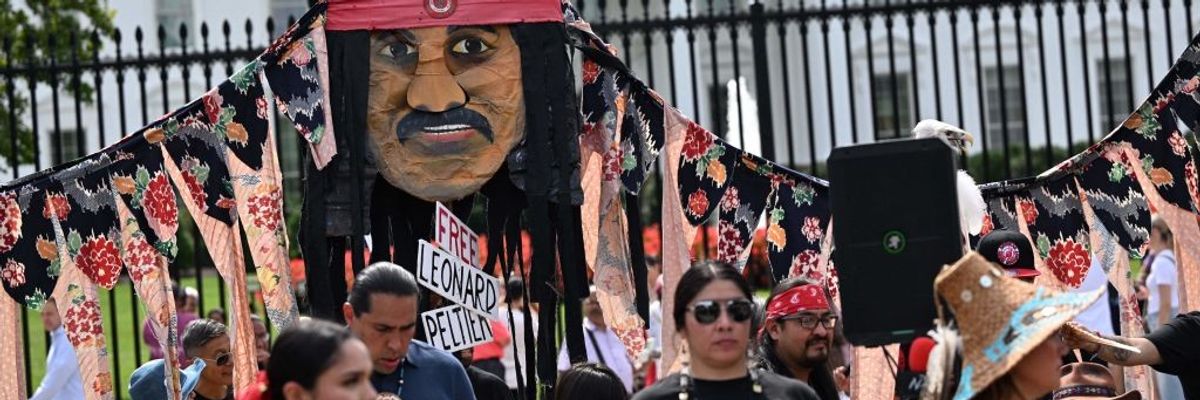
Indigenous rights activists take part in a rally in support of Native American activist Leonard Peltier, at Lafayette Square across from the White House, in Washington, D.C., on September 12, 2023.
 (MANDEL NGAN / AFP / GETTY IMAGES)


Moments before he left office and as one of his final acts as president, Joe Biden commuted the life sentence of Leonard Peltier, an 80-year-old Native American activist and political prisoner who has been incarcerated for nearly half a century for a crime he maintains he did not commit.

At the time of his conviction, Peltier was a member of the American Indian Movement, a grassroots movement that was founded in 1968 to advocate for Indigenous rights and sovereignty in the United States. He was charged under dubious circumstances for the killing of two FBI agents in a 1975 shootout at Pine Ridge Reservation in South Dakota. After being charged, he fled to Canada; he was extradited and sent back to the U.S. to face trial in 1977.

Indigenous advocates and human rights organizations have long maintained that Peltier was not given a fair trial. Evidence that could have exonerated him — including ballistics showing that the bullets that killed the two agents were not fired from Peltier’s weapon — was withheld from his lawyers. Testimony that led to the Canadian government agreeing to his extradition was also perjured.

In 2017, the former chief prosecutor who was part of the trial made an extraordinary request for then-President Barack Obama to grant Peltier clemency. That request was ultimately not granted. With Biden exiting the White House, several human rights organizations made those requests yet again, asserting that the unfair trial warranted a lessening of Peltier’s sentence.

Biden’s commutation is not a full pardon — Peltier will remain under house confinement, likely for the rest of his life. Still, human rights advocates and Indigenous activists who have campaigned for decades for Peltier to be granted clemency celebrated the action.

Related Story

Hours Away From Too Late: Demand Freedom for Leonard Peltier
We must join across movements and great distances to demand Obama make freeing Leonard Peltier part of his legacy. By Kelly Hayes , Truthout January 18, 2017


“President Biden was right to commute the life sentence of Indigenous elder and activist Leonard Peltier given the serious human rights concerns about the fairness of his trial,” said Paul O’Brien, executive director of Amnesty International USA.

“This is a huge win for grassroots Indigenous movements who kept his campaign alive and a moral indictment on the system and people who kept him unjustly imprisoned for half a century,” Indigenous organizer and journalist Nick Estes wrote in a post on X.

“Leonard Peltier’s liberation is our liberation – we will honor him by bringing him back to his homelands to live out the rest of his days surrounded by loved ones, healing, and reconnecting with his land and culture,” said NDN Collective founder and CEO Nick Tilsen. “Let Leonard’s freedom be a reminder that the entire so-called United States is built on the stolen lands of Indigenous people — and that Indigenous people have successfully resisted every attempt to oppress, silence, and colonize us.”

Peltier also celebrated his commutation.

“It’s finally over — I’m going home,” he said, adding that he planned to do acts of good work following his release.

“I want to show the world I’m a good person with a good heart. I want to help the people, just like my grandmother taught me,” Peltier said.


'It's Finally Over, I'm Going Home': Biden Grants Commutation—But No Pardon—for Peltier

"The victory of freeing Leonard Peltier is a symbol of our collective strength—and our resistance will never stop," vowed one Indigenous organizer.


Indigenous rights defenders rally in support of imprisoned Native American activist Leonard Peltier at Lafayette Square across from the White House in Washington, D.C. on September 12, 2023.
(Photo: Mandel Ngan/AFP via Getty Images)


Brett Wilkins
Jan 20, 2025
COMMON DREAMS


Just minutes before leaving office, Joe Biden on Monday commuted the life prison sentence of Leonard Peltier, the elderly American Indian Movement activist who supporters say was framed for the murder of two federal agents during a 1975 reservation shootout.

"It's finally over, I'm going home," Peltier, who is 80 years old, said in a statement released by the Indigenous-led activist group NDN Collective. "I want to show the world I'm a good person with a good heart. I want to help the people, just like my grandmother taught me."

While not the full pardon for which he and his defenders have long fought, the outgoing Democratic president's commutation will allow Peltier—who has been imprisoned for nearly a half-century—to "spend his remaining days in home confinement," according to Biden's statement, which was no longer posted on the White House website after Republican President Donald Trump took office Monday afternoon.


"Tribal Nations, Nobel Peace laureates, former law enforcement officials (including the former U.S. attorney whose office oversaw Mr. Peltier's prosecution and appeal), dozens of lawmakers, and human rights organizations strongly support granting Mr. Peltier clemency, citing his advanced age, illnesses, his close ties to and leadership in the Native American community, and the substantial length of time he has already spent in prison," Biden explained.

Biden Interior Secretary Deb Haaland, the first Indigenous cabinet secretary in U.S. history, said in a statement: "I am beyond words about the commutation of Leonard Peltier. His release from prison signifies a measure of justice that has long evaded so many Native Americans for so many decades. I am grateful that Leonard can now go home to his family. I applaud President Biden for this action and understanding what this means to Indian Country."

Congressman Raúl Grijalva (D-Ariz.), who last month led 34 U.S. lawmakers in a letter urging clemency for Peltier, said in a statement that "for too long, Mr. Peltier has been denied both justice and the pursuit of a full, healthy life at the hands of the U.S. government, but today, he is finally able to go home."

"President Biden's decision is not just the right, merciful, and decent one—it is a testament to Mr. Peltier's resilience and the unwavering support of the countless global leaders, Indigenous voices, civil rights and legal experts, and so many others who have advocated so tirelessly for his release," Grijalva added. "While there is still much work to be done to fix the system that allowed this wrong and so many others against Indian Country, especially as we face the coming years, let us today celebrate Mr. Peltier's return home."


NDN Collective founder and CEO Nick Tilsen said Monday that "Leonard Peltier's freedom today is the result of 50 years of intergenerational resistance, organizing, and advocacy."

"Leonard Peltier's liberation is our liberation—we will honor him by bringing him back to his homelands to live out the rest of his days surrounded by loved ones, healing, and reconnecting with his land and culture," Tilsen continued.

"Let Leonard's freedom be a reminder that the entire so-called United States is built on the stolen lands of Indigenous people—and that Indigenous people have successfully resisted every attempt to oppress, silence, and colonize us," Tilsen added. "The victory of freeing Leonard Peltier is a symbol of our collective strength—and our resistance will never stop."

Amnesty International USA executive director Paul O'Brien said that "President Biden was right to commute the life sentence of Indigenous elder and activist Leonard Peltier given the serious human rights concerns about the fairness of his trial."


While Peltier admits to having participated in the June 26, 1975 gunfight at the Oglala Sioux Reservation at Pine Ridge, South Dakota, he denies killing Federal Bureau of Investigation agents Jack Coler and Ronald Williams.

As HuffPost senior political reporter Jennifer Bendery recapped Monday:
There was never evidence that Peltier committed a crime, and the U.S. government never did figure out who shot those agents. But federal officials needed someone to take the fall. The FBI had just lost two agents, and Peltier's co-defendants were all acquitted based on self-defense. So, Peltier became their guy.

His trial was rife with misconduct. The FBI threatened and coerced witnesses into lying. Federal prosecutors hid evidence that exonerated Peltier. A juror acknowledged on the second day of the trial that she had "prejudice against Indians," but she was kept on anyway.

The government's case fell apart after these revelations, so it simply revised its charges against Peltier to "aiding and abetting" whoever did kill the agents—based entirely on the fact that he was one of dozens of people present when the shootout took place. Peltier was convicted and sentenced to two consecutive life terms.

American Indian Movement (AIM) activist Joe Stuntz Killsright was also killed at Pine Ridge when a U.S. Bureau of Indian Affairs agent sniper shot him in the head after Coler and Williams were killed. Stuntz' death has never been investigated.

Some Indigenous activists welcomed Peltier's commutation while also remembering Annie Mae Pictou Aquash, an Mi'kmaq activist who was kidnapped and murdered at Pine Ridge in December 1975 by her fellow AIM members. Some of Aquash's defenders believe her killing to be an assassination ordered by AIM leaders who feared she was an FBI informant.


Before leaving office, Biden issued a flurry of eleventh-hour preemptive pardons meant to protect numerous relatives and government officials whom Trump and his allies have threatened with politically motivated legal action.

However, the outgoing president dashed the hopes of figures including Steven Donziger, Charles Littlejohn, and descendants of Ethel Rosenberg, who were seeking last-minute pardons or commutations.