Tuesday, January 21, 2025

Can We Abolish War, Or Will War Abolish Us?


 January 20, 2025
Facebook

Image by Humphrey Muleba.

The organized murder of one group of humans by another group of humans is called war. We live in a world where the vilest of crimes, which are punished with severe consequences within most societies, are somehow acceptable when committed as part of war. War has been an integral part of human history and, in the nuclear age, is the most imminent threat to our continued existence. As modern, civilized people, most of us find war abhorrent, but few of us call for the abolition of war.

War exists because human society has been organized around the concept of the in-group and the out-group. The in-group could be a tribe, city, nation, or group of nations. The out-group may be tolerated, but in many instances, it is considered the enemy. The question of our time is, can we create a new story where humanity is the in-group? Can we civilize a lawless world by creating a basic system of enforceable global law?

Wars between countries continue because countries exist in relative anarchy at the international level. We have international law based on treaties that help maintain order, but this system is not an actual law, as it is voluntary. Valid law has consequences and enforcement mechanisms if one breaks the law. At the international level, we still live and die by the law of the jungle, which is “might makes right.”

The countries of the European Union have found peace after thousands of years of warfare and two world wars by trading away a piece of sovereignty to form a collective. They now resolve disputes in the European Union’s parliament and courts. The world’s countries can find peace by building an international union of nations and creating a similar system of courts and a global parliament.

The true challenge of our time is to bring rules, law, and democracy to the chaos of international relations. If we want to overcome the existential threats of nuclear weapons and abolish war, we will need a world governing body that is more democratic and empowered to act than the current United Nations.

The United Nations has a membership of almost all the countries on earth, and this in itself is an impressive accomplishment in that it creates an inclusive forum for discussion of international problems. Unfortunately, the UN lacks democratic standards and is flawed by its outdated design, and thus ineffective in addressing the major global security issues of our day.

International security issues are dealt with in the UN by the Security Council and, in particular, the five permanent members who were the victors of World War II: the United States, the United Kingdom, France, the Russian Federation, and the People’s Republic of China. They each have a veto, allowing a single country to block the action called for by the majority.

The General Assembly can pass resolutions, but they constitute no more than recommendations.

We are at a critical moment in human history. International laws exist, but they are often not enforceable. Force and military might still rule the world in terms of global affairs.

Fortunately, a US organization called Citizens for Global Solutions—like the World Federalist Movement, which brings together organizations with a similar orientation around the globe—works to create a world ruled by law rather than force, to build the legal institutions necessary for peace, and to abolish war. Citizens for Global Solutions is working to enhance the jurisdiction and use of the International Court of Justice to resolve disputes without violence in a campaign called Legal Alternatives to War(LAW, not War).

The challenge of our time is to abolish war and create the global intuitions of law necessary to resolve disputes through legal rather than lethal means.

Jerry Tetalman is co-author of One World Democracy (Origin Press).


Can the Internet Wage Peace?


January 20, 2025Facebook

With the Tiktok ban just days away, American youth have started flooding the Chinese social media app RedNote, pushing it into #1 position on the app store. Labeled “Tiktok refugees” by Chinese netizens, the newcomers have been welcomed by app users with open arms, curiosity, and a fair bit of humor.
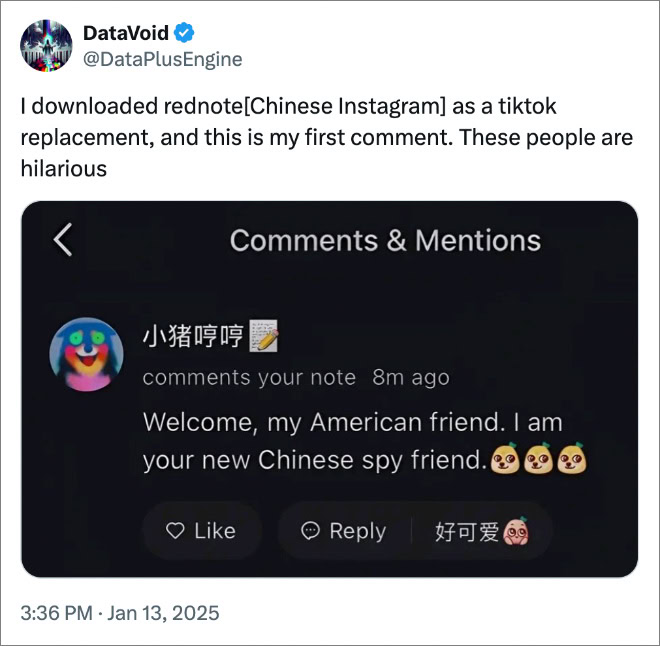
Though initially confused at the sudden influx of English speakers, long-dwelling app users quickly connected the dots and were quick to poke fun at the US government’s accusations of China spying on your typical American citizen.

The app “Xiaohongshu” directly translates to ‘Little Red Book,” but it has been dubbed RedNote in the United States. Many are quick to think of Chinese communist leader Mao Zedong’s famous Little Red Book, though app officials say it isn’t a direct reference. Still, the comedic composition is something to celebrate.

The Tiktok ban is quite evidently backfiring on the US government. As users snub the ban and move to a real Chinese social media app, spontaneous interactions between US and Chinese citizens are naturally sorting through years and years of anti-China propaganda.

WAIT! The social credit thing isn’t real??? One user commented, after locals revealed that there is no such thing as a social credit score in China — just one of the many stories the media has falsely fed us.
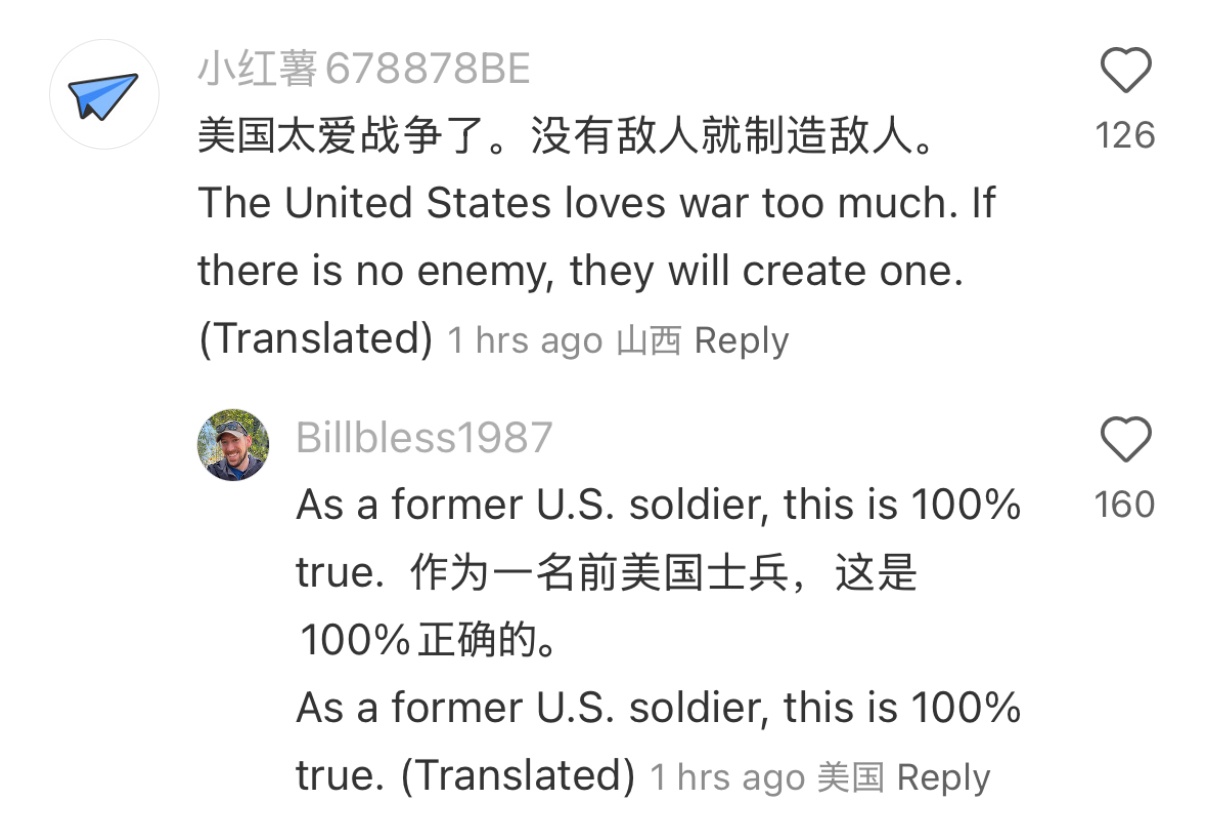
The app has ushered in a new wave of cross-cultural learning. Americans have been posting questions like, “How does China feel about Palestine?” and “What does the US government tell us about China that isn’t true?” There’s been comparisons between the US and China health systems (of which China’s is undoubtedly superior) and tours of China’s incredible EVs. The vast number of Americans agree: the US has fallen way behind.

Not only that, but American citizens cite a new appreciation for China, and the number of people learning Mandarin has grown. Duolingo has already seen a 216% spike. While Chinese citizens have taken it upon themselves to start teaching newcomers common Chinese phrases, Americans simultaneously help local users with their English homework.

It is more than just cultural exchange, however. This is an unprecedented people-to-people moment, allowing two communities to come together and realize they are more alike than not. Such a realization is desperately needed, and undercuts a rapidly escalating war climate between the US and China.

Recently, the US approved a $2 billion arms sale to Taiwan, citing potential war with China. In response, China sanctioned numerous US weapons companies for violating the one-China principle and destabilizing the region. War talk isn’t new — the US government has been pushing and planning for it ever since China rose to power in the early 2000s. A natural threat to US global hegemony, our politicians have been plotting the fall of China for decades, spending billions and billions of dollars to militarize the region around China and pushing a narrative of hatred and fear in the media.

Just this week, China hawk Marco Rubio underwent his Secretary of State confirmation hearing. Due to his push for war against China, he has been travel-sanctioned by the Chinese government for years. Our nation’s top “diplomat” is going to have some trouble conducting diplomacy when he’s unable to even travel to the nation where we need it most. Not that anything Rubio does could ever be considered diplomacy.

But despite the constant anti-China rhetoric plaguing our politicians and media, new RedNote users appear to be taking a different path:

The internet is a modern tool not previously available to the people during the great power wars of previous decades. It provides a fresh avenue that can circumvent the weaponization of the media and allow people to easily connect from different sides of the globe.

Perhaps an app like RedNote is exactly what we need to continue diffusing all the anti-China propaganda attempting to manufacture consent for the next great war. It’s about time the people decide for themselves who they should and shouldn’t be calling “enemy” rather than adhering to the whims of a war-obsessed government.

Megan Russell is CODEPINK’s China is Not Our Enemy Campaign Coordinator. She graduated from the London School of Economics with a Master’s Degree in Conflict Studies. Prior to that, she attended NYU where she studied Conflict, Culture, and International Law. Megan spent one year studying in Shanghai, and over eight years studying Chinese Mandarin. Her research focuses on the intersection between US-China affairs, peace-building, and international development.


Biden’s Refusal to Pardon Reality Winner Underscores Taboo on Questioning Electoral Integrity


 January 20, 2025
Facebook

Wikipedia.

Supporters of U.S. Air Force veteran and former NSA contractor Reality Winner made a last ditch effort last week to lobby outgoing President Joe Biden to pardon Winner for her 2017 violation of the 1917 Espionage Act. The “Reality Is Us!” campaign highlights how the young misfit from a Texas border town “showed America the proof that Russia hacked into our voter data right before the 2016 election, and certain government officials knew about it, but denied it ever happened. For calling that B.S. she was sent to prison for 5 years.”

Reality Winner’s crime against the state? Leaking a classified intelligence report that acknowledged the reality of Russia’s attempted interference in the 2016 election to The Intercept, an investigative news site that published a story about it. The leaked report indicated that hackers from Russian military intelligence had perpetrated a cyberattack on at least one American voting software supplier, sent spear-phishing emails to more than 100 local election officials shortly before the election, and that the hacking operation may have penetrated deeper into American voting systems than had been previously understood.

Uncle Sam hates whistleblowers of any kind and has been waging a bi-partisan war on intelligence community whistleblowers. The Obama administration famously prosecuted more whistleblowers under the outdated Espionage Act than all previous administrations combined. It’s to be expected that whistleblowers will be prosecuted harshly to discourage others from doing so. But Winner’s case is a relatively unique one of a patriotic American merely attempting to warn her fellow citizens that our government wasn’t telling the whole truth when it came to troubling questions about the integrity of the 2016 election.

It will be interesting to see if former Democratic Rep. Tulsi Gabbard — nominated by Trump to serve as Director of National Intelligence – will continue pushing for reform of the Espionage Act, as she did with proposed legislation in 2020 that would enable defendant to discuss intent and add a defense of disclosure in the public interest (which Winner was not allowed to do.) Gabbard’s been flipping all over since jumping the shark from Bernie Sanders supporter to MAGA member though, so civil rights supporters probably shouldn’t get their hopes up.

Hollywood producer and activist Scott Budnick (best known as an executive producer of The Hangover) makes an effort to humanize Reality Winner in a recent biopic titled Winner, released in 2024 and soon streaming on Hulu in February. The film focuses more on Winner’s quirky life story leading up to her decision to leak the report, rather than the aftermath. In doing so, it provides a compelling picture of how Winner doesn’t pose a threat to anyone except political elitists who don’t like how she pulled the curtain back on the vulnerability of our electoral system.

“What got me excited about this script is that it was told as a comedy… The twist was you’re telling a movie that could be a straight drama about election interference and threats to our democracy, but you’re telling it as a coming of age comedy which I thought was really smart,” Budnick told Counterpunch. “As someone that’s worked with people in the criminal justice system for a long time, everything to me is about humanizing them… Crime is scary, but as soon as you start looking at them as human beings, people’s opinions start to change. And so I really loved the fact that they told this as a comedy and that’s what I latched on to.”

Winner’s charm as a patriotic animal lover and down to earth fitness freak makes it more difficult for Uncle Sam to paint her as a national security threat. Democrats spent much of Trump’s first term raising a ruckus about alleged Russian interference. Yet when actual evidence came to light in the report that Winner leaked, there were few who defended her courageous action.

“Let’s stop having her have to deal with being a felon and having a criminal record stop her from doing all types of things she wants to do, stop her from starting businesses she wants to start, and not being able to get professional certifications she needs,” Budnick said regarding the pitch to Biden. “I see her as a hero, I see her as somebody that let us know that a hostile foreign power was trying to interfere with our democratic process. I don’t believe in punishing heroes.”

Budnick says he hopes the film will inspire Americans to take a longer look at these electoral integrity issues. Biden could have given Winner her life back with a pardon, but didn’t since her real crime in Uncle Sam’s eyes is surely how she dared to violate the unspoken taboo of shining a light on the vulnerability of our electoral system. This sacred cow has been increasingly problematic since the advent of electronic voting systems that are potentially vulnerable to bad actors with inside connections and access.

There was reasonable suspicion that the 2004 election was stolen in Ohio, twice as galling after the Supreme Court gave Dubbya the 2000 election by stopping the Florida recount. Ohio was still a Purple bellwether state that could go either way back then, before the brain drain problem that turned it Red for Trump. 2004 Democratic nominee John Kerry would later admit that he harbored suspicions about what went down, but chose not to raise them out of alleged fear that doing so would only toss the decision back to the Supreme Court again.

Rolling Stone published a troubling story in 2006 detailing the array of dirty tricks that Republicans utilized in Ohio, an article now ironic for being authored by shark jumper Robert F. Kennedy Jr. ”You can rock the boat, but you can never say that the entire ocean is in trouble… You cannot say: By the way, there’s something wrong with our electoral system,” MSNBC’s Keith Olbermann told Rolling Stone at the time, alluding to grief he received from his corporate editorial overlords for attempting to pursue issues raised in the story.

Olbermann’s words have resonated ever since and seem the most likely explanation for why Biden didn’t pardon Winner. This only further tarnishes Biden’s tainted legacy as the man who helped enable the Trump regime’s return to power. Biden’s inaction sadly includes having allowed shady Attorney General Merrick Garland to suspiciously slow walk prosecution of Trump and his seditionist cronies for their actions in the insurrection of January 6, 2021. This is another aspect of Biden’s legacy that will live in infamy.

“Under Biden, the United States became the first country to face an attempted coup and not only fail to punish the coup plotters but allow them to hold office and make laws. There is no parallel in world history,” bestselling author and investigative journalist Sarah Kendzior lamented in 2023. Kendzior would go on to again outline Garland’s longtime role as one of the “Servants of the Mafia State” that has corrupted the Justice Department. But such deeper truth doesn’t make it into an increasingly consolidated mainstream media that exists to maintain the corporatocracy status quo.

Like the Greek prophet Cassandra, Kendzior and Winner have seen their concerns go largely unheeded by the Democratic Party. What’s left of American Democracy is now in critical condition and Reality Winner will continue to pay the price for merely trying to warn us, since Joe Biden once again proved he was either too cowardly or too complicit to do the right thing.

Greg M. Schwartz is an award-winning investigative reporter and was honored by the Society of Environmental Journalists in 2021 as an SEJ Spotlight Reporter of the Week. He can be contacted at greg.m.schwartz@gmail.com or on Twitter @gms111, where he remains active to hold the line against Elon Musk’s right wing depredation of the site.


Required Reading: Hillbilly Elegy


under the principle that one must know thine enemy, Hillbilly Elegy must be required reading for American progressives, 

 January 21, 2025
Facebook

Photograph Source: college.library – CC BY 2.0

I doubt that many progressives in the United States have read J.D. Vance’s Hillbilly Elegy. Being based in the Philippines, a country located on the outer fringes of the empire, I certainly was unaware of the book even when it began to rise on the bestsellers’ lists at the beginning of the first Trump administration.

But since the author is likely to become president if something happens to Donald Trump, I figured I would choose for my airport reading the book that made his name and skip the reviews that have revisited it ever since he was nominated to be Trump’s running mate last August.

I was not prepared for how well-written it was. And as a sociologist, I really appreciated how Vance articulates the contradictions of the white working class in the Rust Belt Midwest and Appalachian region as he personally experienced them. This is an “us” versus “them” narrative by someone who finally got to become one of “them.” He vividly recounts his hurdling the many visible (being poor) and invisible (cultural) barriers that separate the working class from the upper and upper-middle classes. They really are worlds apart, in Vance’s view, and he attributes his being able to finally cross class lines to four things: luck, a grandmother that forced him to develop the grit to rise above his surroundings, his stint in the Marine Corps, and an upper-middle-class wife, who initiated him into what was an alien, stable, upper-middle-class family life. The excruciating combination of poverty, drugs, violence, and disorganized family life represented by a mother who’s an addict and floats from one man to the next are, he claims, common elements of a working-class culture that prevents the vast majority of his proletarian peers from leaving their milieu.

When Vance enters law school at Yale, despite his having graduated summa cum laude at Ohio State, he is completely at sea in an alien culture. The way people act is different, the way they speak is different, they are completely confident, not suffering the psychological injuries of working-class life. To him, there is really no such thing as meritocracy for the rich or nearly rich. While working class folks have to fill out forms that allow those in institutions to which they apply to see if they are “qualified,” the kids at Yale, Harvard, and other Ivy League haunts rely on their parents’ networks to get them into college and a good career that serves as a channel to the summits of business and government. The two tracks begin at birth and they increasingly diverge and go separate ways as people pass through life, one leading to permanent working-class misery, the other to upper-class nirvana.

Interestingly, Barack Obama, the president when Vance was writing the book, becomes the representative of “them,” and here it is worth quoting Vance: Obama, he writes, “feels like an alien to many Middletonians for reasons that have nothing to do with skin color [a dubious proposition]. Recall that none of my high school classmates attended an Ivy League school. Barack Obama attended two of them and excelled at both. He is brilliant, wealthy, and speaks like a constitutional law professor…Nothing about him bears any resemblance to the people I admired growing up. His accent—clean, perfect, neutral—is foreign; his credentials are so impressive that they’re frightening; he made his life in Chicago, a dense American metropolis; and he conducts himself with a confidence that comes from knowing that the modern American meritocracy was built for him.”

The problem, Vance writes, was that Obama’s coming across as so completely alien to the white working class became fodder for conspiracy theorists like Donald Trump (not named as one such theorist in the book) to depict him as a genuine alien. Although the mainstream press (even Fox News, he claims) always said Obama was a red-blooded American, this was of little relevance since most of the white working class feels that the media is in the pocket of the rich and increasingly rely on far-right echo chambers on the Internet.

Vance did not vote for Trump in the 2016 elections, but “despite all the reservations about Donald Trump…there were parts of his candidacy that really spoke to me: from his disdain for the ‘elites’ and criticism of foreign policy blunders in Iraq and Afghanistan to his recognition that the Republican Party had done too little for its increasingly working- and middle-class base.

Vance eventually became part of the MAGA movement that captured the Republican Party and drove traditional Republicans like former vice president Dick Cheney from the fold. His move from being a discontented young Republican to MAGA chieftain exemplifies a trend that Thomas Piketty captures in hard numbers in his book Capital and Ideology: that both the highly paid and wealthy “merchant right” traditionally represented in the Republican Party and the highly educated and economically well compensated “Brahmin left” that affiliated with the Democratic Party are seen from below as one “elite” with interests radically different from theirs. After capturing the Republican Party, Trump, Vance, and MAGA overwhelmed the other wing of the elite, the Democrats, in the 2024 elections.

Vance has, of course, evolved since he wrote the book into a firebreathing, fearmongering Trumpista. But sometimes Vance, the thoughtful author of Hillbilly Elegy, emerges, as when he and Tim Walz engaged in relatively respectful exchange during the vice presidential debate. For a friend who read Hillbilly Elegy when it first came out, it was hard to reconcile the early Vance that she claims wrote “honestly” about his troubled family history and the later demagogical Vance.

I think there is no Chinese wall between the early Vance and the current Vance. The way I read it, three contradictions run through Hillbilly Elegy. One is love for the solidarity of the working-class family and community and fear and anger at the multiple dysfunctions that pockmark them. The second is visceral suspicion and disdain for elite culture with a grudging recognition that “they” live much better lives and “are beating us in our own damned game.” The third is a yearning for the patriotism of the Saving Private Ryan type (Vance admits he “tears up” every time he sees the movie) and a realization that there is little in a contemporary America that is falling apart that can foster that nationalistic fire.

These were troubling contradictions that were seeking both a personal and a political resolution, and although he was initially dismissive of Trump, the latter eventually provided for him, as for many, that resolution—one that was, of course, facilitated by a not small dose of political opportunism on the part of an ambitious, up-and-coming politico.  But it is important not to see it, as many liberals do, as simply as a case of opportunism.

At the risk of oversimplifying, I think what makes MAGA so appealing to many in the white working class is that, however flawed some of its premises are, it promises to bring about a “reinvigorated” and “renewed” America free of these contradictions. And it is a movement that thrives not only on resentment but on hope, no matter how misplaced that hope may be when it comes to who is seen to represent it. Reading the wrenching personal experiences Vance relates in Hillbilly Elegy gave me a sense that MAGA is more than a far-right political movement. It is one of those millenarian movements that anthropologists talk about that tie individual redemption to collective salvation.

I would say that under the principle that one must know thine enemy, Hillbilly Elegy must be required reading for American progressives, for it provides important insights for the massive task of reconstructing the broad left after the 2024 catastrophe.

Walden Bello, a columnist for Foreign Policy in Focus,  is the author or co-author of 19 books, the latest of which are Capitalism’s Last Stand? (London: Zed, 2013) and State of Fragmentation: the Philippines in Transition (Quezon City: Focus on the Global South and FES, 2014).