Tuesday, January 21, 2025


COPD is the sixth leading cause of death in the United States


Increased awareness of COPD needed to improve treatments, quality of life for people with chronic lung diseases


COPD Foundation


Miami (January 21, 2025) – Chronic lower respiratory diseases, including chronic obstructive pulmonary disease (COPD), are the sixth leading cause of death in the United States, according to the U.S. Centers for Disease Control and Prevention (CDC). The CDC’s National Center for Health Statistics released its “Deaths: Leading Causes for 2022” final report, ranking the 10 leading causes of death.

COPD comprises several conditions, including chronic bronchitis and emphysema, and can be caused by genetics and irritants like smoke or pollution. Symptoms include breathlessness, fatigue, and chronic cough.

The disease affects more than 30 million Americans, yet approximately half of those people do not yet know they have COPD. Awareness of the disease’s symptoms, methods to reduce risk, and disease management remains poor. COPD is also the fourth leading cause of death worldwide, according to 2021 data from the World Health Organization.

“COPD affects millions of people in the United States and worldwide. However, despite being a leading cause of death, many are unaware of the disease and its symptoms,” said Jean Wright, M.D., MBA, CEO of the COPD Foundation. “We must continue to increase awareness of COPD and to educate people about the disease’s symptoms and the importance of early diagnosis, helping people live longer, healthier lives.”

According to the report, the number of deaths from chronic lower respiratory diseases increased 3.5% in 2022. Chronic lower respiratory diseases were the sixth leading cause of death for both men and women; however, the burden of deaths was higher for women (5.0%) than men (4.0%).

The ten leading causes of death in the United States in 2022 were:

  1. Diseases of the heart.
  2. Malignant neoplasms.
  3. Accidents (unintentional injuries).
  4. COVID-19.
  5. Cerebrovascular diseases.
  6. Chronic lower respiratory diseases.
  7. Alzheimer’s disease.
  8. Diabetes mellitus.
  9. Nephritis, nephrotic syndrome and nephrosis.
  10. Chronic liver disease and cirrhosis.

The report data uses information from all death certificates filed in the United States in 2022. Cause of death statistics are based on the underlying cause of death and are classified by the International Classification of Diseases, 10th Revision.

###

About the COPD Foundation
The COPD Foundation is a nonprofit organization whose mission is to help millions of people live longer and healthier lives by advancing research, advocacy, and awareness to stop COPD, bronchiectasis, and NTM lung disease. The Foundation does this through scientific research, education, advocacy, and awareness to prevent disease, slow progression, and find a cure. For more information, visit copdfoundation.org, or follow us on Twitter and LinkedIn.

Imam who backed Trump absent from inauguration, removed from program

WASHINGTON (RNS) — Imam Husham Al-Husainy's invitation to give a benediction at the inauguration was seen as controversial in some conservative pro-Israel circles.


Jack Jenkins
January 20, 2025

WASHINGTON (RNS) — A Michigan imam was unexpectedly absent from President Donald Trump’s inauguration on Monday, raising questions as to why the Islamic leader did not offer a benediction as scheduled.

Earlier this month, officials listed Imam Husham Al-Husainy, who runs the Karbalaa Islamic Education Center, among the four faith leaders who would offer a benediction at Trump’s inauguration. The presence of the Islamic leader — believed to be the first who would have offered a prayer at an inauguration — was seen as a nod to Trump’s unexpected gains with Muslim Americans during the campaign: Al-Husainy, a Shia Muslim cleric who expressed support for Trump during the campaign, hails from Dearborn, a city with a large Muslim American population.

The reason for his absence was not immediately clear. Although listed on earlier copies of the inauguration bulletin sent to press, Al-Husainy’s name was not on the version of the program handed out to attendees on Monday morning.

Efforts to reach Al-Husainy and the Karbaala Islamic Education Center were unsuccessful, and inauguration officials did not immediately respond to a request for comment.

Al-Husainy’s association with Trump was seen as controversial in some conservative pro-Israel circles. The announcement of his involvement with Trump’s inauguration spurred outlets such as the New York Post to draw attention to Al-Husainy’s 2007 appearance on the Fox News show “Hannity & Colmes.” According to a transcript of the appearance, Al-Husainy was repeatedly interrupted by the hosts but declined to offer a “yes” or “no” answer when asked whether Hezbollah was a terrorist group, insisting he wanted more time to explain his answer.

Last week, the Zionist Organization of America issued a statement decrying Al-Husainy’s inclusion in the inauguration festivities, saying keeping him on the program would “send a terrible message and place a black mark on President Trump’s new term to give an antisemite and Hezbollah apologist a prominent platform at the Trump inauguration.”

Al-Husainy may also have faced criticism from opponents of Trump. Although Trump unexpectedly won Dearborn in November, turnout was lower than 2020, and the president did not win the majority of the vote: According to the Detroit Free Press, Trump won 42.48% of the vote in the town, compared to 36.26% who voted for former Vice President Kamala Harris. An additional 18.37% voted for third-party candidate Jill Stein — one of the highest margins in the country.
RELATED: At Trump’s inauguration, religious allies and new faces to offer prayers

Although Trump worked to garner support among Muslims in Michigan, the result was widely seen as an expression of frustration with former President Joe Biden, with many Muslim Americans repeatedly voicing outrage at his steadfast support for Israel’s actions in Gaza following the Oct. 7 Hamas attacks on Israel.

A ceasefire deal was agreed on by Hamas and Israel on Friday, after 15 months of devastating warfare in the Gaza Strip, with the first phase of the deal beginning the day before the inauguration.
With last-minute pardon, Biden delivers immigration activist Ravi Ragbir from deportation

(RNS) — A chorus of nationally known faith leaders and other clergy in the New York area had supported the New Sanctuary Coalition director's plea to be spared deportation.


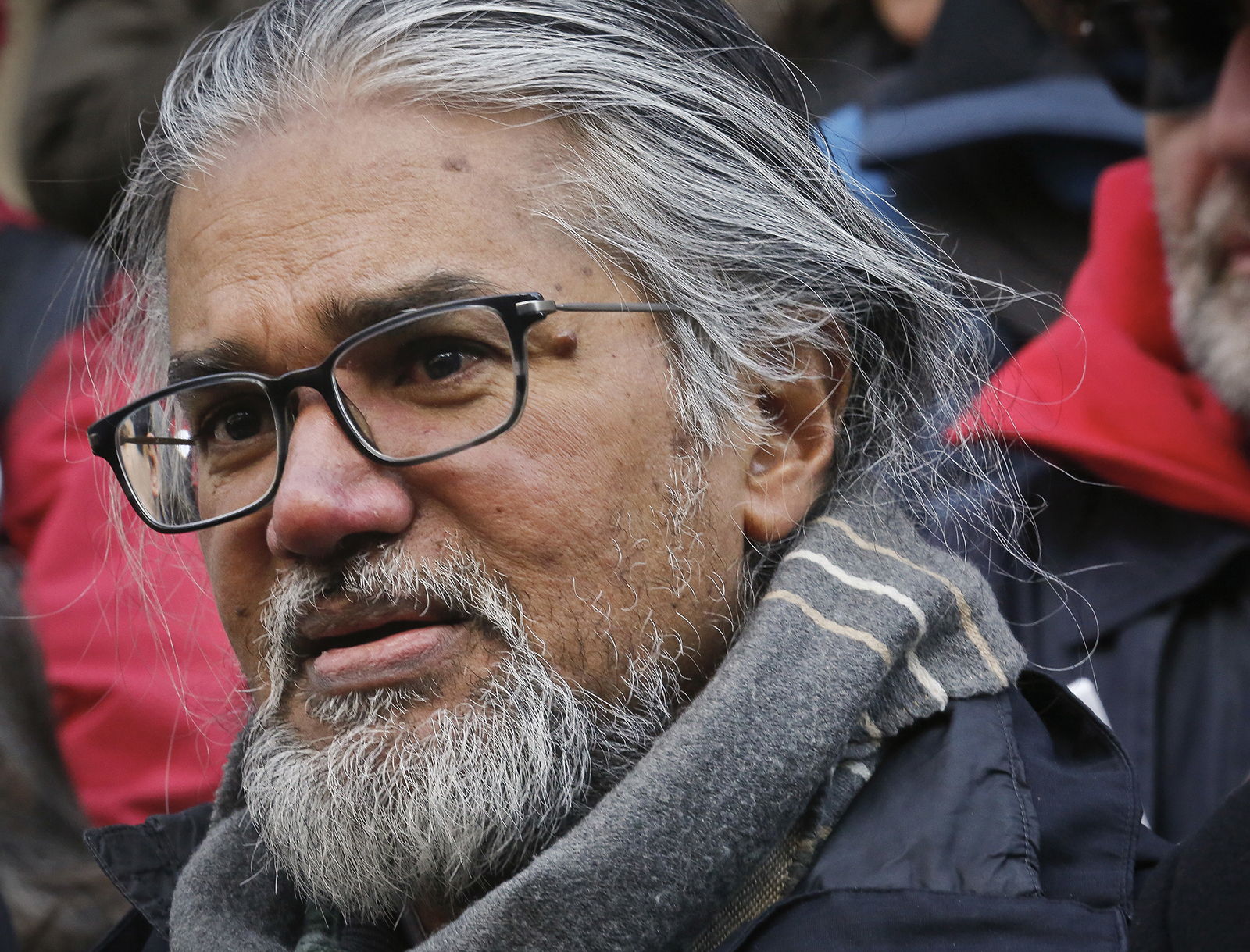
FILE - Immigration activist Ravi Ragbir listens during a news conference at New York City Hall called by city council members on his behalf, Jan. 31, 2018. (AP Photo/Bebeto Matthews, File)

Greta Gaffin
January 20, 2025

(RNS) — Immigration rights activist Ravi Ragbir, who had been under a deportation order since his release from prison for fraud in 2006, received a pardon from President Joseph Biden in a last-minute flurry of pardons issued Sunday (Jan. 19).

“I am so grateful to President Biden for this pardon, which has lifted a burden that I have carried for so many years,” said Ragbir in a statement. “The uncertainty and instability of not knowing what tomorrow would bring has kept me and my family awake for many nights, and we can now breathe,” he said.

Ragbir, a well-known immigration rights activist in New York City, had filed a pardon application in 2016, hoping to be spared deportation triggered by his criminal record. A chorus of nationally known faith leaders and other clergy in the New York area had supported his plea to be allowed to stay. Since 2007, he has served as the director of the New Sanctuary Coalition, a group founded in partnership with Judson Memorial Church in Greenwich Village that accompanies immigrants to their check-ins with the Immigration and Customs Enforcement agency.

Ragbir was himself arrested in 2018 at an ICE check-in and designated for deportation, but a federal judge, calling Ragbir a “redeemed man,” overruled the ICE order. After he successfully argued that he had been arrested in retaliation for his activism in violation of the First Amendment, the government gave him a stay until Dec. 16, 2024.

At a ICE check-in on Jan. 13, he was told the agency would be proceeding with deportation. Biden’s pardon means he can remain in the United States with his American-citizen wife and daughter.


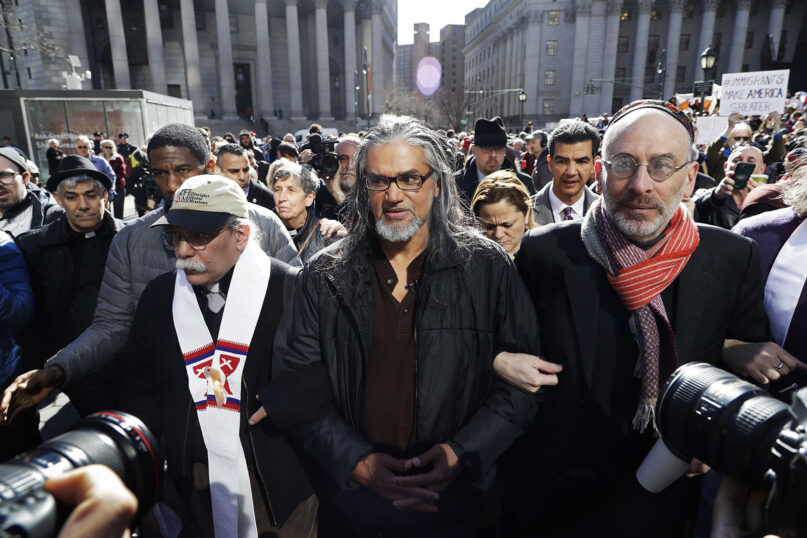
In this March 9, 2017, file photo, Ravi Ragbir, center, executive director of the New Sanctuary Coalition, a Trinidad-born immigrant who works to protect New York’s immigrant families from detention and deportation, walks with supporters as he arrives for his annual check-in with Immigration and Customs Enforcement in New York. (AP Photo/Mark Lennihan, File)

Christian clergy who advocated for Ragbir were pleased by Biden’s pardon. “I am grateful to God and the hundreds of supporters and the President who believed in the redemptive work Ravi has seen in his own life and, in turn, undertaken and shown in his work with the immigrant community in America,” said the Rev. Robert Foltz-Morrison, a minister of the Presbyterian Church, USA in New York.

In 2018, Bishop Lawrence Provenzano of the Episcopal Diocese of Long Island made Ragbir an honorary canon, a title recognizing service to the church or faith, and has been a vocal defender. On Sunday, Ragbir’s news was announced at a Mass at St. Ann & the Holy Trinity Church, the diocese’s pro-cathedral in Brooklyn, where he lives.

The Rev. Canon Marie Tatro, a priest associate at the pro-cathedral, recalling Ragbir’s “courageous leadership to the people of our diocese and the larger community,” said, “It was truly a joy to make the announcement about his pardon in the context of my sermon to a cheering congregation. Thank you, President Biden, for seeing the goodness in Ravi that we see.”

New York Sen. Chuck Schumer was one of several members of Congress who expressed their support of Ragbir’s pardon. “I was proud to work for years with Ravi and many supporting organizations in New York as he navigated the legal and immigration systems looking for well-earned relief,” Schumer said in an emailed statement. “With this pardon, Ravi is now free to remain in his home in Brooklyn, and continue to help others and to enrich our city.”

New York City Council member Shahana Hanif said, “Ravi has been a pillar of the immigrant rights movement for years. I am deeply grateful for his advocacy and am relieved that he will be able to continue his work in New York without fear of deportation.”

At King Day rally, Sharpton leads oath to support DEI as Trump opposes it


(RNS) — ‘I will defend equality for all, diversity, equality, inclusion, women’s rights, LGBTQ rights, immigration rights,’ a crowd recited at a rally.


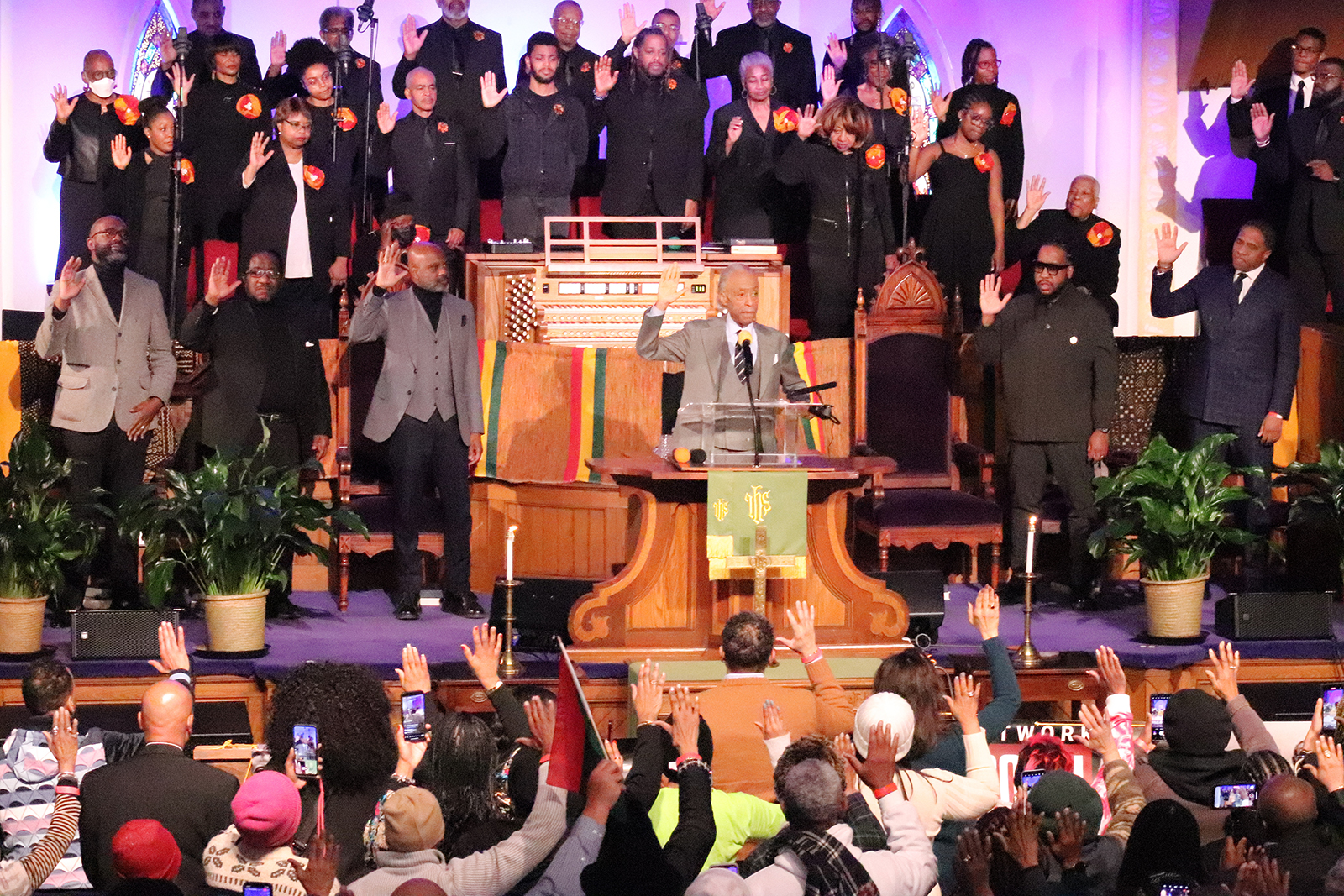
The Rev. Al Sharpton, center, leads an oath to support DEI at Metropolitan AME Church during a rally organized by the National Action Network, Monday, Jan. 20, 2025, in Washington, DC. (RNS photo/Adelle M. Banks)

Adelle M. Banks
January 20, 2025

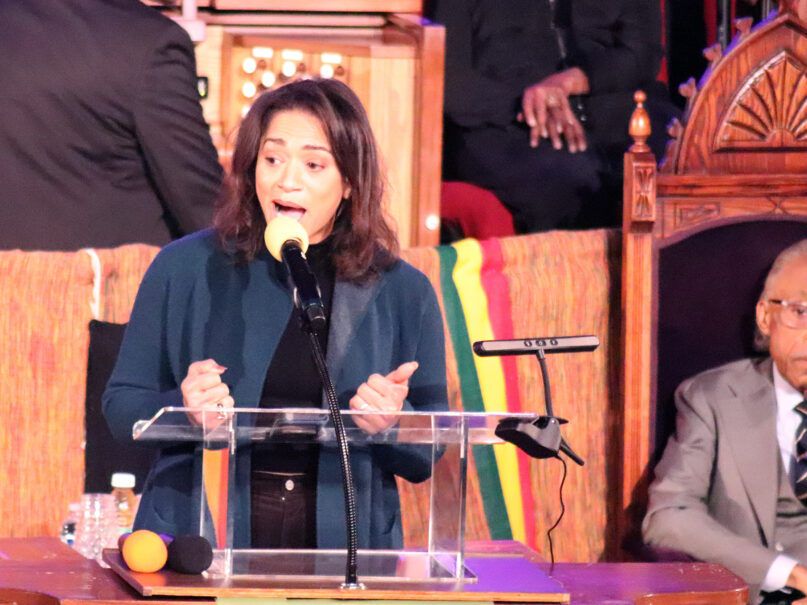
WASHINGTON (RNS) — As President Trump was sworn in three miles away at the U.S. Capitol, hundreds of people rallied at an African Methodist Episcopal Church to make a Martin Luther King Jr. Day pledge to support diversity, equity and inclusion, in direct opposition to Trump’s Inauguration Day promise to reduce programs supporting DEI.

“I will defend equality for all, diversity, equality, inclusion, women’s rights, LGBTQ rights, immigration rights,” said the crowd gathered at Metropolitan AME Church at a rally organized by the National Action Network in an oath led by the Rev. Al Sharpton.

“I am not for violence,” the crowd continued, standing and still bundled against the severe cold that gripped Washington and had sent the inauguration ceremonies inside at the Capitol. “I will peacefully stand against those that want to bring us down. I commit this in the house of God on this sacred ground, so help me God.”


The oath was taken in the name of King, as well as the 19th-century abolitionist Frederick Douglass and Civil Rights-era activist Rosa Parks, whose funerals were held in the historic sanctuary.

Sharpton, president of the National Action Network and the keynote speaker at the event, having been handed a note as he spoke, announced that Trump had stated his plan to end federal DEI initiatives.


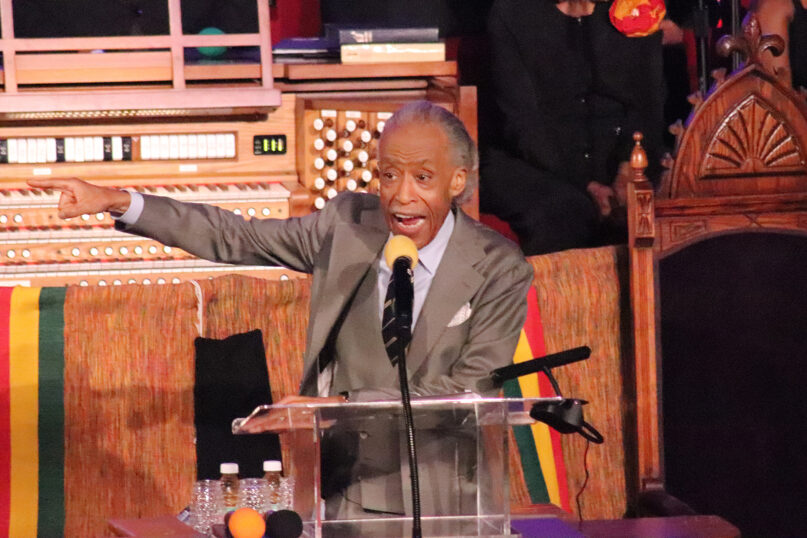
The Rev. Al Sharpton speaks during a rally organized by the National Action Network at Metropolitan AME Church, Monday, Jan. 20, 2025, in Washington, DC. (RNS photo/Adelle M. Banks)

At the Capitol, the re-elected president said, “This week, I will also end the government policy of trying to socially engineer race and gender into every aspect of public and private life. We will forge a society that is colorblind and merit based. As of today, it will henceforth be the official policy of the United States government that there are only two genders, male and female.”

Sharpton said his network planned to work with the National Urban League and other organizations over the next 90 days to determine what companies they will focus on to boycott among those that have both pulled back on DEI programs and have small profit margins.

“We’re going to ask everybody in this country — Black, white, brown, gay, straight, woman, trans — don’t buy where you’re not respected,” he said to cheers. “Donald Trump can’t make us buy your stuff.”

Sharpton recounted the trajectory of Black Americans’ treatment since their ancestors were forced out of Africa through the era of widespread lynchings, segregation and the protests that occurred during Trump’s first administration against the killing of unarmed people by law enforcement.

“We convicted the police in George Floyd; we convicted the police in Armaud Arbery; we showed, even under you, we would fight,” Sharpton said, addressing Trump. “And we will fight these next four years no matter what you say.”


Jennifer Jones Austin speaks during a rally organized by the National Action Network at Metropolitan AME Church, Monday, Jan. 20, 2025, in Washington, DC. (RNS photo/Adelle M. Banks)

Jennifer Jones Austin, vice chair of NAN’s board, opened the 90-minute-long rally by remarking on the appropriateness of holding it in a Black church. “Since its beginning, the Black church has been our place of refuge and hope,” she said. “And on this King Day, this King Day in particular, we are all the more reminded that if ever we needed the Black church to be our refuge and hope it’s now, right now.”

Jones Austin recalled King’s calls for unity shortly before his assassination in Memphis in 1968. “My brothers and sisters, our coming together today demonstrates unity, our shared commitment to ensure ourselves a seat at the table,” she said. “And not just to just sit at the table but to turn the table over if we must.”

A march from McPherson Square in downtown Washington to the church had been planned, but the cold temperatures prompted organizers to cancel the march and start the rally earlier.

Manhattan resident Jamel Washington arrived at the rally on a bus provided by NAN. He said he had come because he wanted to “bring back DEI.” He called the confluence of King Day and Inauguration Day “bittersweet.”

“It’s more sweet than bitter,” he said. “I’m for equal rights. What they have here going for this occasion, Reverend Al Sharpton and others, it’s very much needed.”


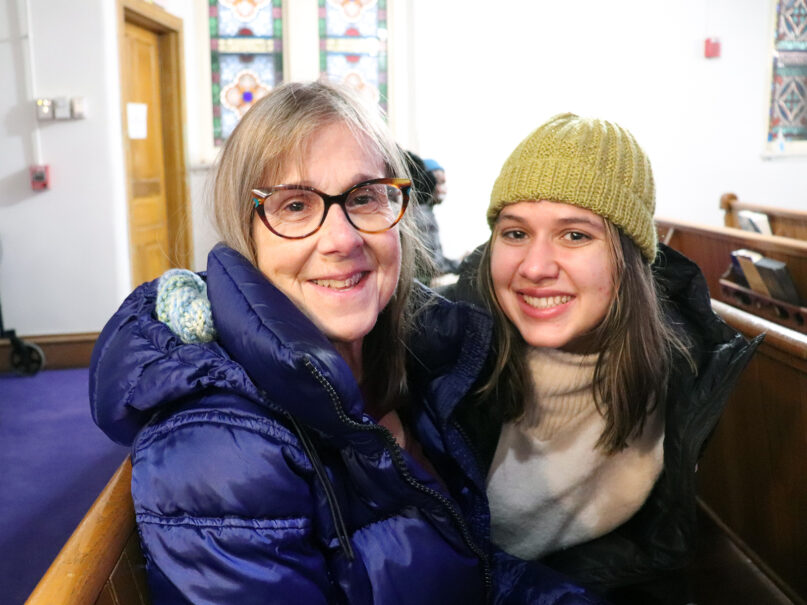
Margaret Marcotte, left, and daughter Eliane Baijal at Metropolitan AME Church, Monday, Jan. 20, 2025, in Washington, DC. (RNS photo/Adelle M. Banks)

Eliane Baijal traveled via Flixbus from Brooklyn to join her mother, Margaret Marcotte, a D.C. resident, to “renew peace” and “pay respects for MLK Day.”

Marcotte, who, like her daughter, is an Episcopalian, said she found Trump’s inauguration difficult to comprehend. “It’s disturbing for me,” she said. “This is why we’re here, to just be able to take the opportunity, to lighten the day for us.”

As the service concluded with a rousing version of “We Shall Overcome,” Nadiya Pope and Amber Creft, both lawyers and community advocates in Washington, were on their feet in the balcony. Afterward, they said they were leaving feeling energized and more hopeful.

“There’s an inauguration, but it’s also Martin Luther King’s day first and so we wanted to use this day to be with community,” said Pope.” I feel much better after being here. I feel even more fired up and ready to do what needs to be done in the face of adversity, no matter what.”

Jack Jenkins contributed to this report.
Frank S. Matsura: Portraits from the Borderland Opens at the High Desert Museum
 February 1, 2025


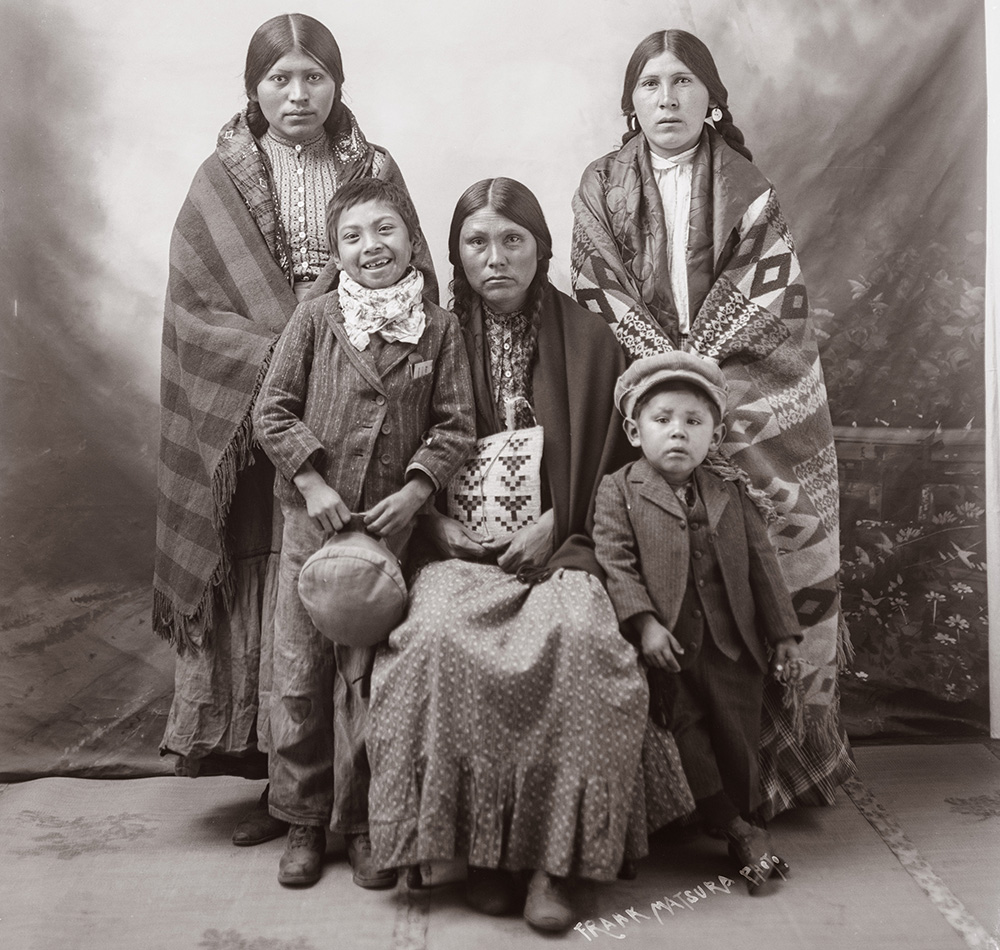
The Wapato Smithins family posed for Frank S. Matsura’s camera sometime between 1903-1913. It’s part of a new exhibition opening February 1, 2025 at the High Desert Museum, Frank S. Matsura: Portraits from the Borderland.By High Desert Museum January 10, 2025

Exhibition examines Indigenous representation and identity during a period of regional transformation

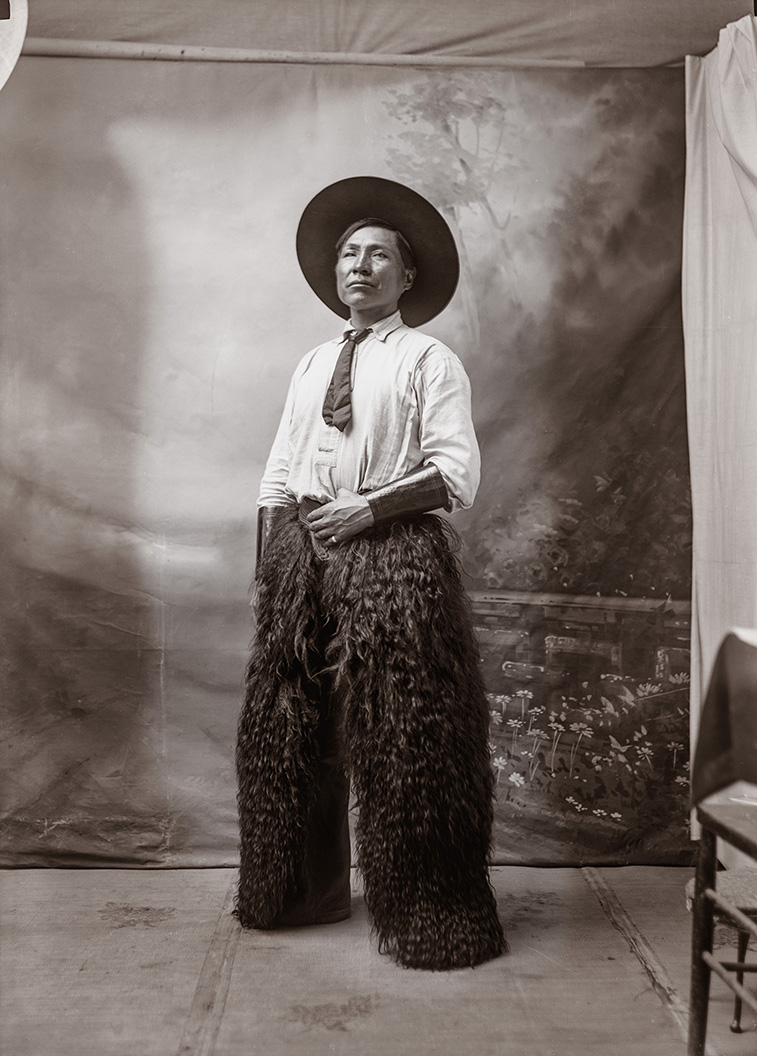
This image is labeled Dick from Riverside and is believed to have been taken by Frank S. Matura around 1910. It’s part of a new exhibition opening February 1, 2025 at the High Desert Museum, Frank S. Matsura: Portraits from the Borderland.Opening February 1, 2025 at the High Desert Museum in Bend, Oregon, Frank S. Matsura: Portraits from the Borderland features large-scale photographs taken by Japanese photographer Frank Matsura of Native people of eastern Washington in the early 1900s.

These photographs represent some of the most accurate and nuanced images of Native people during this period. Clothing, beaded bags and cornhusk bags from the collections at the Northwest Museum of Art and Culture in Spokane, Wash., which originated the exhibition, and High Desert Museum bring the photographs to life in the exhibition.

Frank Matsura’s life and photographs raise more questions than answers.

Washington State University Associate Professor Michael Holloman (Colville Confederated Tribes), lead curator of the original exhibition, is helping guide the High Desert Museum’s exhibition. He will also soon publish a book about Matsura’s life with PA Press/Chronicle Books. Holloman calls Matsura a fascinating figure—he left Japan, briefly settled in Seattle, where there was a significant-size Japanese immigrant community, and then left again to make a home east of the Cascade mountains in the very rural Okanagan region of the Columbia River Plateau.

Immediately, Matsura became a popular member of the Okanagan community, and 10 years later when he died suddenly, his funeral became a community-wide event. Described as a trickster, Matsura’s playful personality and humor alongside his relationships with people are evident in his photographs. While other photographers, such as Edward Curtis, constructed photographs of Native people to document a culture they believed was vanishing, the authenticity of Matsura’s photographs depict the opposite. They show people and cultures that are still here and still thriving.

“Frank clearly was personable and had a sense of humor, and he clearly developed relationships with the people he photographed,” Holloman said. “As a Japanese immigrant, he was also new to cultures in North America and in the region where he settled, which perhaps freed him to approach portraiture.”

During his lifetime, Matsura attracted many people from across the region for portraiture, including individuals and families from upper Indigenous Plateau tribal communities. Among Matsura’s
total body of work are visually potent, intimate and collaborative studio portraits telling nuanced stories of regional Indigenous identity. His photographs incorporate the performativity and
entertainment that were part of Japanese photographic traditions at that time rather than the more formal portraits prevalent in early 1900s American photography.

Kiahna Allen is featured in a video that’s part of the exhibition Frank S. Matsura: Portraits from the Borderland. The video explores identity, representation and the continuation of cultural traditions within a contemporary context. These photographs capture dynamic cross-cultural exchanges as Native people continued cultural traditions while also adapting new styles, materials and designs. They also raise questions about what decisions these individuals made about how to represent their identity in front of the camera. Why did Dick from Riverside wear wooly chaps, cuffs and a hat that identified him as an experienced cowboy? Why did some women wear Euro-American style dresses along with dentalium shell necklaces and flat twined bags?

While we will likely never know the answers to these questions, these photographs powerfully challenge stereotypes to illuminate the complexity of identity and culture.

In addition, the exhibition features a short video produced by filmmaker LaRonn Katchia (Warm Springs, Wasco, Paiute). Through the stories of three young women from the Confederated Tribes of Warm Springs, Kahmussa Destynee Rain Green, Kiahna Allen and Thyreicia Simtustus, this video brings the visitor into the present day and explores identity, representation and the continuation of cultural traditions within a contemporary context.

“These women are not only redefining leadership as Indigenous people today but are also bringing their traditional values with them, embodying the essence of who we are today,” Katchia said.

Frank S. Matsura: Portraits from the Borderland will be open through September 7, 2025. Generous support for the exhibition is provided by Art Bridges.

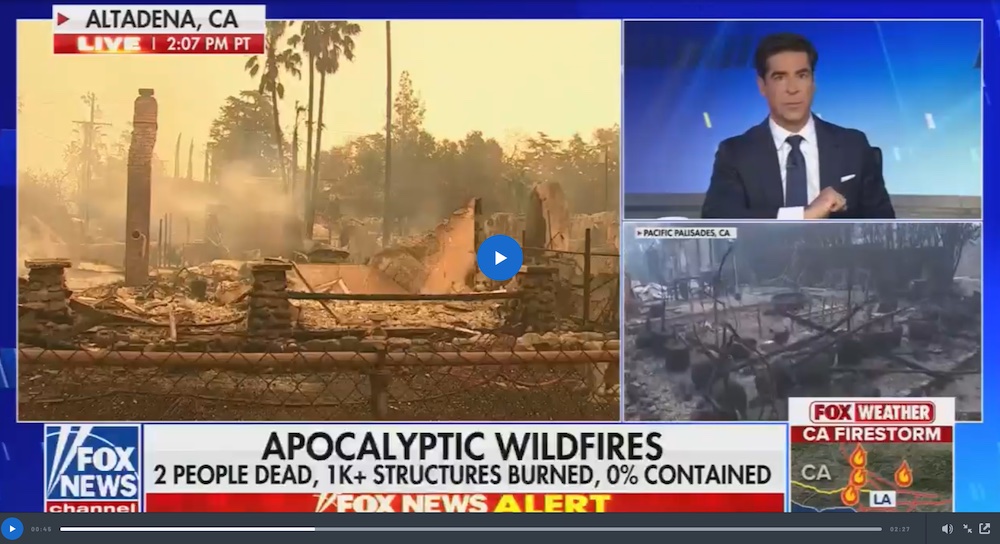
Fox News host Jesse Watters connected dam removals requested by Native American tribes to California's wildfire crisis, saying Governor Gavin Newsom removed four dams “because the Native Americans told him to do it.”

During the January 8 broadcast of “The Five,” Watters criticized California's fire response, noting that crews “have contained 0% of this fire.” He then pointed to dam removals, saying Newsom “tore more dams down — four — than anybody in the history of this country. Because the Native Americans told him to do it, because it would save some salmon. Now look at this.” 

The fires have killed 16 people and destroyed over 12,000 structures.

The dam removals Watters referenced are part of a long-planned restoration of the Klamath River ecosystem, supported by tribal nations, environmental groups, state officials and federal officials. These dams are located hundreds of miles north of the current fire zone.

Meanwhile, Native American firefighters from outside the region are on the ground in Southern California joining the effort to combat the blazes. According to a report in ICT (formerly Indian Country Today), the Klamath Tribes of Oregon sent a Type 3 fire engine and crew to the Eaton Fire, while twenty-three members of the elite Navajo Scouts firefighting team departed from Window Rock, Arizona on Wednesday to assist with containment efforts. "I ask that we, as a united Navajo people, keep our Navajo Scouts in our thoughts and prayers," Navajo Nation President Buu Nygren said in an Instagram post cited in the ICT story.

The Pechanga Tribe in Southern California announced a contribution of $500,000 to assist Los Angeles fire victims impacted by the Palisades and Eaton Fires. In addition to the monetary contribution, the Pechanga Fire Department has had personnel, equipment and resources deployed to the fires and their logistical command centers since Tuesday, Jan. 7, according to a statement from the tribe. 

The Palisades Fire, the largest of several blazes, has burned through 37,000 acres and remains only 11% contained. More than 153,000 residents have evacuated as flames threatened communities in Brentwood and Encino. Los Angeles County Sheriff Robert Luna reported 13 people remain missing, though officials have not confirmed if these disappearances are connected to the fires.

Governor Newsom has ordered an investigation into reports of water pressure loss at fire hydrants and problems accessing the Santa Ynez Reservoir — issues unrelated to dam removals in other parts of the state.

Watters' comments echo similar claims made by President-elect Donald Trump, who posted on Truth Social that Newsom "refused to sign the water restoration declaration" that would have allowed water to flow from Northern to Southern California.

Newsom dismissed Trump's claims in an NBC News "Meet the Press" interview, calling them "inexcusable because it's inaccurate" and "incomprehensible to anyone that understands water policy in the state."

Los Angeles County has declared a public health emergency due to smoke and air quality concerns. Health officials warned that particulate matter from the fires poses both immediate and long-term risks to residents.

Editor’s Note: This story has been updated with information about Native firefighters. 

Brazil

Lula’s return: two years of PT rule


Monday 20 January 2025, by Israel Dutra, NPA - Nouveau Parti Anticapitaliste


Nearly two years after Lula’s return to power as President of Brazil, Israel Dutra, a member of the leadership of MES (Socialist Left Movement) and PSOL (Socialism and Liberty Party) of Brazil, provides us with an overview of the social and political situation in an interview with the NPA-Anticapitaliste Latin American Commission.


NPA - Could you provide an assessment of the recent municipal elections in Brazil at the end of 2024, particularly regarding the left’s results?

Israel Dutra - The outcome of October’s municipal elections strengthened the formation of the so-called "centrão" forces, which in reality is not a centrist current but rather a right-wing sector that allies itself sometimes with the government, sometimes with the more conservative opposition...

Four main elements can be highlighted:

• A strong tendency to re-elect incumbent mayors, due to the manipulation of public funds, electoral funds, public investments and other advantages concentrated in the hands of those already in municipal government;

• Significant mass movement apathy, increased by abstention and the number of blank and void votes; there were no major events or mass gatherings during the electoral period. The weight of public financing (a billion-dollar fund for all parties) also caused a distortion between the large number of people paid by major parties to campaign and the militant majority of others, reducing space for voluntary work and spontaneous action;

• Within the right and far-right, the result was more contradictory. While the far-right gained positions, with posts for mayors and city councillors, Bolsonaro was more questioned as a leader, while new right-wing sectors emerged regionally. The strengthening of parties linked to the "centrão", such as the MDB (Brazilian Democratic Movement) and PSD (Social Democratic Party), demonstrates this trend;

• The left in general, and particularly the PT (Workers’ Party) and PSOL when allied with PT, was weakened, as was the case in São Paulo and Belém (where PSOL lost the mayoralty).

Nevertheless, PSOL maintains significant influence, securing important electoral victories, maintaining and even increasing its number of councillors in the main capitals. The Porto Alegre election—where PSOL won a seat, even though the PT candidate lost in the second round—is an example.

What about the campaign to imprison Bolsonaro following the publication of the federal police report on the attempted coup of 8 January 2023?

After the elections, the national situation underwent major changes. Besides the emergence of young proletarian sectors (which we’ll discuss later), Bolsonaro and his associates found themselves in an increasingly difficult position with the revelation of coup plans including the assassination of Lula, Vice President Alckmin, and Supreme Court Minister Alexandre de Moraes. The violence and improvisation of these plans, which were revealed by the federal police, accusing 37 people, including Bolsonaro, sparked great indignation among the population. Unfortunately, there haven’t been large mobilisations for this campaign. We advocated for the immediate arrest of Bolsonaro and all coup perpetrators, including political leaders, activists, and even business leaders.

What are the major current struggles? Could you specifically discuss the "VAT", the Pepsico strike, and the fight against the "6 × 1"?

The "good news" comes from the workplaces. A movement has formed against the 6 × 1 regime (6 days worked, 1 day rest)—which is the current working pattern in most cases—demanding a reduction in the working week. This movement has been organised and centralised by a national movement called "VAT" (Vida Além do Trabalho, "Life Beyond Work") whose main leader is Rick Azevedo, PSOL’s most successfully elected councillor in Rio de Janeiro. A national rally was organised on 15 November and brought thousands of people, particularly young people, to the streets to pressure for the passage of the working time reduction bill through Parliament. The online petition has gathered over 3 million signatures.

Meanwhile, employees of the multinational Pepsico (Pepsicola) conducted a large-scale strike for nine days, giving national resonance to the struggle against the 6 × 1 regime. This strike was exemplary because, although it didn’t achieve significant results—only victories on some of the initial demands—it put the struggle for working day reduction on the agenda.

What about other social movements, the landless, the homeless?

We are in a period of major retreat for social movements, with many sectors on the defensive. There are major demands, motivated by inequalities in the country. The MST (Landless Workers’ Movement) has adopted a more critical tone towards government measures, both regarding agrarian reform and environmental issues. This is justified, as there is an increasing impression that the federal government’s choices regarding the economic agenda are a continuation of the [IMF] adjustment, such as the package that the Ministry of Finance wants to approve, which includes budget cuts in several social areas. This is absurd, and we are campaigning against these cuts.

Moreover, the environmental movement is beginning to organise its mobilisation for a decisive year, as in 2025 we will have COP30 in Brazil, in the heart of the Amazon. And social movements will organise an extensive parallel programme of mobilisation and debates.

What are Minister Haddad’s budgetary austerity measures? Who opposes them and proposes to fight them?

Finance Minister Haddad’s proposal is being met with euphoria by the bankers’ federation (Febraban). It consists of following the so-called "spending ceiling", which has been configured by the so-called "new fiscal framework", which is nothing more than a model that avoids public spending in order to continue paying debt securities.

The concrete result is reducing benefits for the poorest (people needing social assistance) and freezing civil servants’ salaries, as well as reducing minimum wage growth for several years.

Four weeks ago, we launched, along with political leaders, intellectuals, and social leaders, a manifesto against this package of measures, which has continued to gain strength and support. To emerge from the budget crisis, we would need to tax the wealthiest, fight against privileges, tackle excessive bank profits and reopen the debate on public debt.

What are the reactions regarding the Mercosur-European Union agreement?

Brazil has fundamental weight in a series of international political agreements with geopolitical impact. Lula’s position, for example on Palestine, denouncing what is happening in Gaza and the West Bank as genocide, was correct and important.

Recently, we had meetings such as the G20 in Brazil. Next year, COP30 will be held in the Amazon. It was within this framework that the agreement between the European Union and Mercosur was announced, under strong protests from countries like France.

The government celebrated the Mercosur-European Union agreement as a victory, but social movements express strong reservations. Particularly within the MST and Via Campesina, according to their leaders, this would lead to a European recolonisation of Mercosur countries. It would result in strengthening the historical, oppressive, and predatory model of agro-export monoculture. It would be a step in the "reprimarisation" based on four major economic sectors: agricultural products, minerals, livestock, and cellulose. The issue of tariffs in relation to national industrial sectors raises concerns.

16 January 2025

Translated by ESSF from l’Anticapitaliste.


Attached documentslula-s-return-two-years-of-pt-rule_a8823.pdf (PDF - 912.7 KiB)
Extraction PDF [->article8823]


NPA - Nouveau Parti Anticapitaliste


The New Anti-Capitalist Party in France was founded in 2009 on the call of the LCR (French section of the Fourth International).

Israel Dutra


Israel Dutra, who is a sociologist, is secretary of international relations of the National Directorate of the PSOL and an activist of the Movement of the Socialist Left (MES, sympathizing organization of the Fourth Internati
onal in Brazil).


International Viewpoint is published under the responsibility of the Bureau of the Fourth International. Signed articles do not necessarily reflect editorial policy. Articles can be reprinted with acknowledgement, and a live link if possible.
VENEZUELA

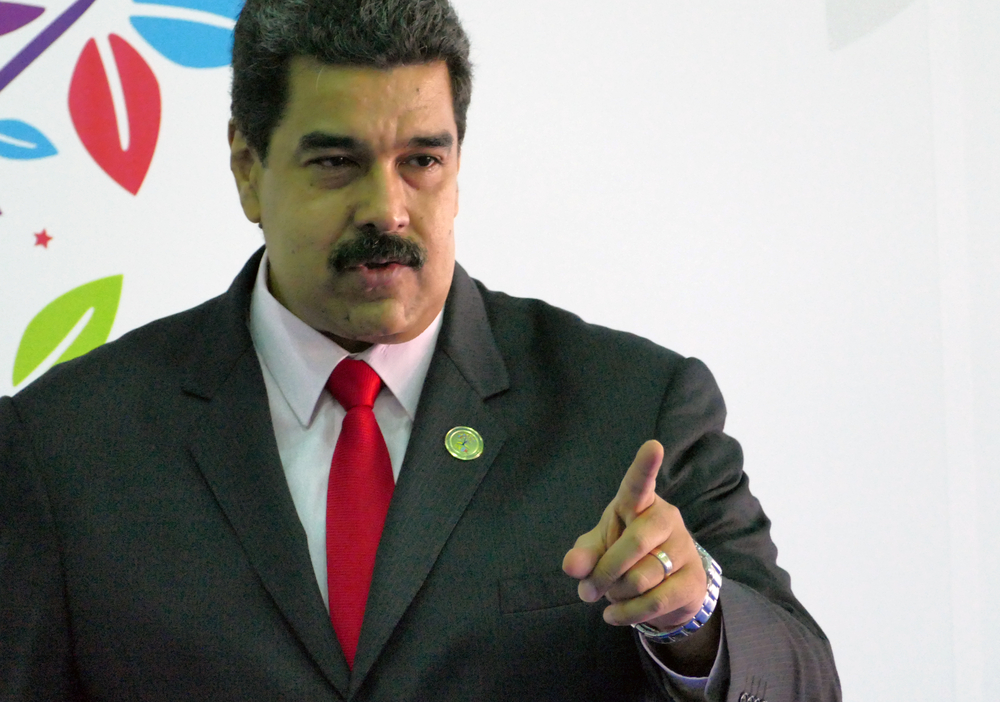
Maduro’s Constitutional Reform: ‘New Economy’, Same Objectives
January 19, 2025
Source: Aporrea


Putting the cart before the horse is an apt expression for the tendency to stick to strictly circumstantial analyses of reality. The smoke left behind by the polarisation between Nicolás Maduro and María Corina Machado has distracted from a much-needed analysis of the real dynamics of power and social agreements within Venezuelan society today.

The fact that bosses’ organisations abstained from supporting Edmundo González’s inauguration, and the distant stance of the United States and “right-wing” governments in the region, marks a new precedent in the government-opposition confrontation of the past 27 years. On one hand, bosses’ organisations are focused on maximising benefits from their agreements with the government (tax incentives and de facto weakening of workers’ protections). [US President Donald] Trump’s soft stance simply reflects the agreements that exist between the Venezuelan state and the oil lobby, and his strategic need for cheaper oil prices. Economics drags politics with it, not the other way around. We are dealing with a balance of forces involving social as well as economic actors with social expressions.

Amid this new co-existence, Maduro assumed the presidency for a third term on January 10. Pursuing a strategy of legitimation, his government’s plan focuses on a new constitutional reform, calling for a debate among different social actors. The reform is principally centred on consolidating “popular democracy” and designing a “new economy”. We will need to see how these social forces participate in this national debate, which necessarily requires recognising all the various expressions of collective interests. Under no circumstances can we talk about a participatory democracy if the means for participation and axis of discussion are imposed and controlled by institutional bodies and economic actors that have reached prior agreements.

The reality in 2025 is very different to that of 2013, when Maduro started his first term. Back then, the opposition attempted an institutional coup using the National Assembly elected in 2015. In parallel, bosses’ organisations exercised their social force to twist the arm of the government and successfully weaken protections for the great majority. Its main strategy was practices such as speculation, hoarding and lockouts, among others.

Statements by these sectors during those years focused on petitioning for policies that gave more guarantees to capital, on requesting that the Organic Labour Law (LOTTT) be reformed, on protesting against the retroactivity of social benefits and job security, and on asking for exemptions and benefits to “resist” the crisis. Thousands of workers were sacked from companies such as Polar, Regional, Coca-Cola, Pepsi and Cargill, among others. Labour conflicts reached unprecedented levels, with disobedience and contempt for decisions made by bodies such as the Labour Inspectorate common practice.

The so-called economic war involved socio-economic crimes and fraudulent practices that went largely unpunished, in part due to a lack of political will but primarily because there was no legal framework within which to punish and regulate the economic criminals. Not even the National Constituent Assembly of 2017 passed legislation on this. As such, shareholders are protected by corporate veils while, on the other hand, legal persons are not regulated (there are no procedures for imposing penalties and economic sanctions).

Furthermore, through their belligerent actions, these economic groups were able to forge agreements of co-existence with the state after 2018. Under a policy of “turning a blind eye”, the state in practice facilitated a reconfiguration of the private sector based on diminished costs of labour via closures and mass layoffs. The so-called economic recovery is largely due to the end of hoarding (allowing goods to circulate and be bought with US dollars) and the “incentives for investment”. The foundations of the so-called “new economy” have therefore already been laid. Given this, can we say the political will exists to regulate and restrict the chaos and anarchy of the market? Or is the aim to simply consolidate policies that promote further marketisation and deregulation?

By now, it would be childish to believe that the polarisation in Venezuela is between left and right, between Machado and Maduro. In reality, behind this exists the market’s need to guarantee conditions for investment via further flexibilisation and deregulation. The LOTTT is extremely uncomfortable for bosses, even if it is only applied discretionary by the state that continues its policy of allowing others to do as they please. Everything points in the direction of a labour counter-reform more convenient for economic groups.

But achieving this will require reforming the constitution to annul certain constitutional principles on labour issues. Legitimising the reform on the basis of strengthening “popular democracy” seems like a convenient means to achieve this. It would certainly help divert the attention of different social forces towards a dead-end discussion. Or are we genuinely to think that the “new economy” will include a popular economy operating outside the market?

Translation by Federico Fuentes for LINKS International Journal of Socialist Renewal.
USA

Trump will bring radical change to America: How will the country react?


Sunday 19 January 2025, by Dan La Botz


Donald J. Trump’s returns to the White House on January 20 promising to bring radical and fundamental change to every aspect of the American economy, society, and politics. His election is an expression of the exhaustion of the liberal (and neoliberal) order and the initiation of a new regime and a new system in the United States. His promises and plans threaten not only the world order, such as that is, but the planet itself.


The modern liberal order began in the 1930s under President Franklin D. Roosevelt and the Democrats who carried out fundamental reforms to face both the Great Depression and then World War II, changes that lead to American dominance in the West, via NATO, throughout the Cold War and to the establishment of a welfare state, even if a weak one, domestically. The system strengthened in the mid-1960s when Democrat Lyndon B. Johnson in response to the movement for civil rights for Black people passed the Civil Rights Act and the Voting Rights Act that finally made them full citizens. And in 1970 under Republican Richard Nixon the Environmental Protection Agency were created as the old order reached high tide.

The liberal order began to disintegrate beginning in the 1970s as Japan and Western Europe began to become economic competitors, as did the Asian Tigers (South Korea, Taiwan, and Singapore). In response in the 1980s, Republican Ronald Reagan and Conservative Margaret Thatcher led the neoliberal reorganization of the world economy based on open markets, privatization, and deregulation, together with the weakening of social welfare and attacks on the labor unions. The fall of the Soviet Union in 1991, seemed to represent the victory for both the United States and world capitalism, but it was short lived. The rise of China to become an economic competitor with the United States, and Vladimir Putin’s decision to attempt to rebuild the Russian empire as a military rival ended American world dominance.

Trump, a brilliant populist who this time won the popular vote in the presidential election, if by a small margin, now proposes to “Make America Great Again” by fundamentally reorganizing the country’s social and economic life and by reasserting U.S. global power. Though he campaigned as the candidate of working people, he has chosen a dozen billionaires for his cabinet and other top offices, and he is putting them in charge. Trumps allies now are tech moguls like Elon Musk of SpaceX, Mark Zuckerberg of Meta and Jeff Bezos of Amazon.

In foreign policy, Trump’s desire to incorporate Canada, Greenland, and the Panama Canal into the United States is not simply meant to shock, it expresses his plan to reassert U.S. control over the Americas as the foundation for world domination. He alternately threatens and embraces China as he wrestles with the question of how to defeat it. And he seems to prefer Putin to NATO. Thus, the liberal world order is undone.

Domestically, Trump will undo twentieth century liberalism by maintaining his earlier tax cut on corporations and the rich, rounding-up and deporting immigrants, undoing the civil rights laws and ending diversity, equity, and inclusion (DEI) that promoted fairness in workplaces for all races and genders. Trump has promised to use the Justice Department and FBI to go after his political enemies in the Democratic Party and the press. He is prepared to declare a national emergency and to mobilize the military.

Trump promises to increase oil production and will end all efforts to control climate change.

In the face of all of this, half of the country remains on the broad left, but the mood is one of defeat, resignation, demoralization, and fear. A half a million people protested his election in Washington, D.C. in 2017, this year only about 5,000. What will Trump really do now that he is in power? And how will the American people react? And what is the role of the left?


Attached documentstrump-will-bring-radical-change-to-america-how-will-the_a8824.pdf (PDF - 905.4 KiB)
Extraction PDF [->article8824]


Dan La Botz

Dan La Botz was a founding member of Teamsters for a Democratic Union (TDU). He is the author of Rank-and-File Rebellion: Teamsters for a Democratic Union (1991). He is also a co-editor of New Politics and editor of Mexican Labor News and Analysis.


International Viewpoint is published under the responsibility of the Bureau of the Fourth International. Signed articles do not necessarily reflect editorial policy. Articles can be reprinted with acknowledgement, and a live link if possible.
People’s March: Thousands Rally Against Trump in Washington Ahead of Second Inauguration

January 20, 2025
Source: Democracy Now

Ahead of President elect-Donald Trump’s second inauguration, thousands of people rallied in Washington, D.C., on Saturday at the People’s March to oppose his policies on immigration, abortion, LGBTQ rights, the climate crisis and more. We air voices of resistance from the protest. “All of us deserve to feel like human beings, and all of us deserve to have our rights respected,” said Hope Giselle, executive director of the National Trans Visibility March. “Without a democracy, without a true democracy, we all fall to the wayside of corruption and a government that does not see us as human beings, and I refuse to allow that to stand.”