It’s possible that I shall make an ass of myself. But in that case one can always get out of it with a little dialectic. I have, of course, so worded my proposition as to be right either way (K.Marx, Letter to F.Engels on the Indian Mutiny)
Wednesday, January 29, 2025
Video: Russian Nuclear Icebreak Damaged in Col
Collision damage extending down from the main deck level on 50 Let Pobedy's port bow (Anton Geraschenko)
The Russian nuclear icebreaker 50 Let Pobedy (50 Years of Victory) has collided with a freighter in the Kara Sea, causing extensive damage to her bow.
Video circulating on Russian social media appears to show that the icebreaker was maneuvering in close quarters when her port bow made contact with the freighter's port side, next to the base of a cargo crane. The impact left a large gash on 50 Let Pobedy's port bow, above the waterline.
The incident occurred January 26 while 50 Let Pobedy was attempting to free the bulker from the ice, according to Interfax.
"No one was hurt. Seaworthiness has not been lost. There is no threat to the life support systems or the reactor installation," state atomic agency Atomflot said in a statement, adding that 50 Let Pobedy continues to operate as normal.
The location and the identity of the other vessel were not specified.
50 Let Pobedy is one of six first-generation Arktika-class icebreakers designed in the closing days of the Soviet Union. She was launched in 1993, but lay incomplete for 10 years during Russia's chaotic transition to a market economy, and was only finished in 2007. Only two vessels of her class remain in service; a new class, also named Arktika-class, is entering service to replace them.
Fire Breaks Out on Russian Spy Ship Off Syria
Kildin from the deck of TCG Kemalreis (NATO Maritime Command)
U.S.-funded Radio Liberty reports that the Russian surveillance ship Kildin suffered an apparent engine room fire or stack fire while loitering off Syria's coast last week. The incident was observed by French naval forces on Thursday but not reported until Monday.
According to RFI's source in the French navy, the fire started at about 1200 GMT and burned for about five hours. Kildin reportedly turned down all offers of aid.
Kildin is a 55-year-old intelligence ship built in Soviet-controlled Poland, one of a series of nine. RFI suggests that her role off Syria is to monitor communications to gain insight on the intentions and plans of Syria's new rulers.
Cargo movements under way at Tartus
Satellite photos obtained Monday show that cargo movements are finally under way at the Russian naval base at Tartus, Syria, signaling a likely evacuation of the military equipment that has been waiting on the pier for the past month.
Since the 1970s, Russia's navy has held a lease on the northernmost pier in the port of Tartus, and for decades it has been the only significant Russian foothold in a Mediterranean seaport. That may be changing: In December, U.S.-designated terrorist group Hay'at Tahrir Al-Sham (HTS) overthrew the Russian-backed regime of dictator Bashar al-Assad, bringing an apparent end to 13 years of civil war. Russia's troops retreated to Tartus and Hmeimem, where the Russian Air Force maintains an airbase. Dozens of military vehicles - reportedly including valuable S-400 air defense system components - have been stranded at Tartus ever since.
Two military cargo ships (Sparta and Sparta II) were dispatched to Syria from the Baltic, arriving in early January. Amidst rumors of negotiations between Russia and Syria, they loitered off the coast for weeks. Both finally berthed at the base early last week, and the satellite imaging taken Monday shows significant changes on the piers. Sparta II has left port and is under way, and a large quantity of the equipment that had been located next to her berth is now gone. Sparta is still alongside, and the staging area near her is filled with containers.
Nine Rescued From Capsized Landing Craft in Indonesia
Courtesy Indonesian Directorate General of Sea Transportation
Last week, a landing craft capsized off the coast of Kalimantan, Indonesia, forcing the crew to abandon ship.
On Thursday, the landing craft Cahaya Dana Reza was under way from Samarinda to Buntok, Central Kalimantan. That evening, as it was under way off the coast of Sebuku Island, it began to take on a list. The master, identified as Capt. Roni Tjitjipo, decided to anchor to search for a suspected leak. The crew found the source of water ingress, but could not contain it, and the ship's list continued to worsen.
The crew abandoned ship, and the vessel capsized at about 2330 hours. All nine survivors were safely rescued by a good Samaritan vessel, the Atlantik Star 11, at about 0100 on Friday morning. Atlantik Star then dropped anchor to await the arrival of Indonesian maritime authorities.
The Indonesian coast guard SAR post at Kotabaru received a report from the ship's agent at about 0355 hours that morning, and it dispatched a RIB to the scene. Officials arrived at about 0545 and evacuated the survivors from the Atlantik Star 11.
The Cahaya Dana Reza fully capsized, leaving its hull in the air. Some of its load of 150 tonnes of cargo went adrift in the water, and plans are being formulated for a cleanup, Indonesia's navigation directorate said in a statement.
India Rewards Pilot for Air-Drop Raid to Capture Somali Pirates
Wing Commander Akshay Saxena's C-17 delivering commandos to the scene by parachute, March 2024 (Indian Navy)
The Indian Air Force has awarded a medal for gallantry to a cargo jet pilot who dropped off the commando team that rescued the bulker Ruen from Somali pirates early last year.
On December 14, 2023, Somali pirates boarded the Bulgarian-operated bulker Ruen at a position about 380 nautical miles east of the island of Socotra, far out in the Arabian Sea. The attackers took 17 crewmembers hostage and navigated the vessel back towards the Somali coast, where they opened negotiations with the shipowner.
Unusually, the Ruen did not stay at anchor off Somalia for long. Instead, the pirates decided to pull up anchor and head for the Indian Ocean, likely to serve as a "mother ship" for conducting more pirate attacks.
On March 15, 2024, an Indian Navy long range maritime patrol intercepted the Ruen at a position about 260 nautical miles to the east of Somalia. The warships INS Kolkata and INS Subhadra took up position alongside the Ruen, and the pirates decided to open fire, shooting down one of the vessels' surveillance drones.
To resolve the standoff safely, the Indian military called up a team of 18 marine commandos and an Indian Air Force C-17 transport aircraft. The plan was to air-drop the commandos and their inflatable rubber boats into the ocean near the Ruen, like a U.S. Air Force pararescue team.
Wing Commander Akshay Saxena (IAF) headed up the airdrop operation as pilot of the C-17. The intervention came with a risk of small arms fire, and would require Saxena to navigate through another nation's airspace for four hours, undetected and without authorization.
The C-17 and the raiding team got under way in short order. Saxena turned off the airplane's transmitters and dropped to a low level to avoid detection. As they approached the drop zone, the location of the intercept changed, and the aircrew adapted, according to Saxena's commendation. Without issue, Saxena made the airdrop, and the 18 commandos parachuted into the water. They conducted their boarding and forced 35 pirates aboard Ruen to stand down and surrender.
The Indian Ministry of Defense commended Saxena for "flawless execution of an extremely grueling mission" and for displaying "exceptional courage, dynamic leadership, outstanding professionalism, and steadfast determination."
In addition, the Indian Navy recommended another officer for a medal of gallantry for his efforts to save a hijacked Iranian dhow from another group of pirates. On February 2, 2024, operating from the warship INS Sharda, Lieutenant Commander Sourabh Malik and his commando squad carried out an opposed boarding of the fishing vessel Omari. Despite the hijackers' attempts to repel the boarding with "heavy and constant" small arms fire, seven armed pirates were captured and 19 fishermen were freed.
Crime Wave Continues Near Singapore with More Vessels Boarded
Seven vessels were boarded in the area around the Singapore Strait so far in January (file photo)
Security consultants and the monitoring operation ReCAAP are warning of increased activity in the region around the Straits of Malacca and Singapore. It continues the trend which saw 62 vessels boarded and robbed while underway in the region in 2024.
Since the start of the year, ReCAAP has received reports of seven incidents with all but one in the region west of Pulau Cula, Indonesia. All but one of the cases also involved bulkers underway while one was a general cargo ship. An additional concern is that in all but one of the reports, the crew said the pirates were armed with guns or knives or in one case were carrying steel bars.
Historically most of the cases were non-violent with the boarders feeling when they were discovered. However, more recent cases show a greater likelihood that they are carrying weapons, and many of the cases involve five or six people. So far, there have been no reports of injuries among the crews, but spare parts and other unsecured items have been reported stolen.
Beyond the area around the straits, there were two other incidents in anchorages in Indonesia and Bangladesh during January. The boarders were also armed and stole unsecured equipment.
ReCAAP in its end-of-year 2024 report highlighted that there had been a six percent increase in reports across Asia to a total of 107 incidents. That was the highest level in the past five years and also the first time since 2020 that hostages were taken and a FAME fuel oil cargo siphoned. Specifically, in the straits, there were 62 incidents in 2024.
Most of the incidents in the straits are happening in the eastbound lane south of Singapore. The most frequent target is bulkers, which made up three-quarters of the reports, and 84 percent of the incidents happened at night. The most dangerous time is between 0200 and 0300.
ReCAAP cautioned that there were more incidents involving perpetrators carrying knives and guns. On occasion, they have been used to threaten crews but not to harm individuals.
It continues to warn crews to exercise extra vigilance. At the same time, it calls on the local authorities to increase their patrols and enforcement to discourage the current crime wave.
The rise of incidents in Asia comes as many other parts of the world have reported a decline in crimes against ships. The Gulf of Guinea off West Africa had been one of the highest concerns but is again stable. The other area of concern was with Somali pirates who reemerged in 2024 with many reports linking it to the instability in the Red Sea and threats by the Houthi militants.
ECOCIDE
Containership Ablaze and Drifting in Red Sea After Crew Abandons Ship
Chinese containership is reported ablaze and drifting after being abandoned by the crew (ASL Shipping)
The crew of a Chinese-owned containership reportedly abandoned the vessel this morning in the Red Sea after a fire broke out. Few details have been released, but it is believed to possibly be a container fire and not an attack from the Houthi rebels which have promised to honor the Gaza ceasefire.
The vessel is the ASL Bauhinia (24,727 dwt) built in China in 2022. It is owned by Asean Sea Lines, a Shanghai-based regional carrier. The company highlighted that the vessel entered service in October 2022 as its first 1,900 TEU vessel. It is registered in Hong Kong and classed by Japan’s ClassNK.
The ship departed the Jebel Ali commercial terminal in Dubai on January 22 and reports it was bound for Jeddah, Saudi Arabia. Asean Line which started operations in 2011 is reportedly operating the ship in partnership with another regional Chinese carrier CU Lines. The posted schedule of CU Lines shows the vessel scheduled to arrive in Saudi Arabia today and then proceed to Aqaba, Jordan.
A fire was reported aboard the vessel around midnight and the crew later reported they were abandoning ship. Associated Press reported the crew was rescued by another passing vessel.
The current position of the containership is reported approximately 140 miles off the coast of Hodeida, Yemen according to the Diaplous Group. They are reporting the vessel is ablaze and drifting.
Containership Schedule Reliability Stabilized Absorbing Red Sea Diversions
About half of all containerships were on schedule in 2024 (file photo)
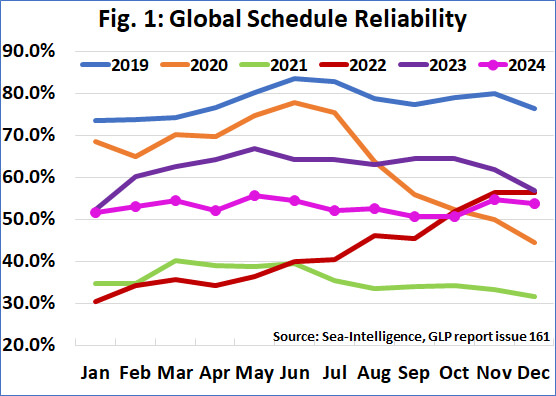
Containership schedule reliability absorbed the shocks from the diversions away from the Red Sea and leveled off despite the demands on capacity and the longer travel times. Sea-Intelligence published its end-of-year report which tracked reliability across 34 different trade routes and showed consistency for much of 2024 after losing significantly from the progress achieved in 2023.
“Throughout 2024, schedule reliability has largely remained within the 50%-55% range,” notes Alan Murphy, CEO of Sea-Intelligence. “On a year-over-year level, schedule reliability was down 3.0 percentage points lower in December 2024.”
Sea-Intelligence’s data shows a narrow range for schedule reliability in 2024 with the yearly average at 53 percent. It is slightly below the industry’s six-year average of 55 percent but significantly behind the 62 percent average for 2023. The first sharp drop came in November 2024 which collates to the beginning of the Houthis’ attacks and a second large decline in December as the carriers began diverting their ships.
Among the individual carriers, six of the top 13 achieved improvements in December 2024 versus a year earlier. Zim achieved the biggest improvement, better than 5 percent year-over-year in December while Evergreen showed the largest decline, over 12 percent. The top carriers' overage averaged just over 51 percent schedule reliability in December 2024.
Maersk continues to be among the leaders and was the only top carrier above 60 percent schedule reliability in December 2024. It comes as the carrier was working toward the implementation of its new route system as part of the Gemini Cooperation with Hapag-Lloyd. Starting on February 1, the carriers will begin a transition to a new hub approach with dedicated, right-sized shuttles working from many ports to feed containers into the main hubs on the new main loops. The route from Asia to Europe will have just three port stops as Maersk moves toward a target to exceed 90 percent schedule reliability. The company said during a briefing this week that it will take till May 2025 to complete existing loops and transition ships to the new schedules.
For the industry, December also showed a reduction in the days behind schedule. December 2024 was 0.12 days lower than a year ago and 0.24 lower than November 2024. For the year, the industry averaged 5.43 days behind schedule, which is significantly better than 2021 and 2022 during the surge after the pandemic, but still behind historical levels of five days or under.
“The average delay for late vessel arrivals decreased by 0.23 days month over month to 5.28 days, which is the lowest that the delay figure has been since July 2024,” notes Alan Murphy.
The wildcard for 2025 is the timing of a potential return to the Red Sea routes. Major carriers including Maersk, MSC, and CMA CGM, each have said it is too early to begin switching back to their normal routes. The Houthis announced they would only be respecting the Gaza ceasefire and only targeting ships related to Israel. However, previously they fired on ships such as MSC and Maersk saying that the shipping companies and their vessels were supporting Israel.
Analysts have predicted that a return to the Red Sea routes while shortening sailing distances could also result in excess capacity and a collapse in container shipping prices. Based on Sea-Intelligence’s data, the sector appears to have reached stability absorbing the disruptions to routes in 2024 while it waits to see the challenges that 2025 will bring to container shipping.
Delinquent Shipowners Abandoned a Record 3,100 Seafarers in 2024
The abandoned crew of the Navimar 3 greet local visitors off Bangladesh (ITF)
Seafarer abandonment cases are soaring, according to the International Transport Workers' Federation, and the numbers hit an unwanted all-time record in 2024. ITF blames the growing problem on the lack of enforcement that low-quality shipowners can obtain from the lowest-quality open registries.
Abandonment is not a feature of name-brand global operators. The cases are concentrated among the oldest, most worn-down vessels with little-known shipowners. By walking away, disreputable or bankrupt owners save on the cost of back wages, crew sustenance and repatriation, and can leave behind any outstanding debts or fines that the vessel might have accumulated.
In general, abandoned crews go through months or years without proper food, water, or wages, often in poor living conditions. Last year, more than 3,100 seafarers were abandoned aboard more than 300 vessels around the world. (28 vessels even managed to abandon more than one crew in the span of a single year, according to ITF.)
"2024 was the worst year on record for seafarer abandonment," said Steve Trowsdale, ITF's global inspectorate coordinator. "It’s an absolute disgrace that unscrupulous ship-owners are abandoning so many crews with impunity by governments and international regulators. This is nothing less than a betrayal of the key workers of global trade."
ITF helps advocate for the resolution of abandonment cases, but there is only so much it can do. When the shipowner will not cooperate or respond, enforcement is the responsibility of the vessel's flag state - which is selected and paid for by the shipowner, and must compete for the shipowner's business. Certain notorious flag states in the Pacific Islands and Africa topped the list for abandonments in 2024.
ITF noted that last year, there were also 20 cases in which the vessel had no identifiable flag state at all - a sudden spike compared to years past.
The ITF also noted a cluster of cases around the UAE, the port state where the largest number of vessel abandonments happen. The UAE's lightly-regulated free trade zones also accounted for the largest share of owners and managers of abandoned vessels.
"The solution lies in plain sight: better regulation, enforcement and accountability from governments," said Stephen Cotton, ITF General Secretary. "By reporting so many cases, seafarers are sending a clear message. They’ve had enough of being treated like slaves. The industry must wake up and take robust action. Those responsible must be held to account and punished. Anything less gives a green light to these appalling abuses of fundamental labor and human rights."
CRIMINAL CAPITALI$M
'Shrimp fraud' rampant at many Gulf Coast restaurants, new studies find
Christopher Cann,
USA TODAY
Tue, January 28, 2025
Restaurants throughout the Gulf Coast are serving imported shrimp but telling their customers they're feasting on fresh crustaceans fished in the Gulf of Mexico, a series of new studies found.
SeaD Consulting, a food safety technology company, tested shrimp from randomly chosen restaurants in Baton Rouge, Louisiana; Biloxi, Mississippi; Galveston, Texas; and Tampa Bay, Florida. Researchers found a significant number of the restaurants were passing off their shrimp as locally sourced, even though they were grown on foreign farms and imported to the U.S.
The cities with the highest "shrimp fraud rate" were Tampa Bay and St. Petersburg, Florida, at 96%, according to SeaD Consulting. Only two of the 44 restaurants sampled were serving authentic shrimp from the Gulf of Mexico, a study found. A batch of wild caught Gulf of Mexico shrimp sits on a sorting table on shrimper Keo Nguyen’s boat at a dock east of Lake Borgne prior to bringing it to a seafood market Tuesday, Oct. 24, 2023.
The tests in other cities yielded similar results. In Biloxi, 82% of the restaurants "were defrauding consumers about what they were buying," SeaD said. In Galveston, 59% of the 44 restaurants it sampled served imported shrimp while claiming they were caught locally. In Baton Rouge, researchers sampled menu items at 24 restaurants and found nearly 30% – more than 1 in 4 – were misrepresented.
“Consumers come to the coast expecting the finest, freshest Gulf seafood, but what they’re being served often falls far short of that,” said Erin Williams, chief operations officer of SeaD Consulting. “This isn’t just about mislabeling; it’s about eroding consumer trust, undercutting local businesses, and threatening the livelihood of hardworking Gulf shrimpers.” As restaurants deceive customers, shrimpers are struggling to compete
The consulting company behind the research says the rampant misrepresentation hurts not only customers – who are put at higher risk of consuming tainted food – but also harms local fishermen struggling to compete with the low cost of imported shrimp from countries like India, Vietnam and Ecuador.
About 90% of shrimp consumed in the United States is imported, according to the U.S. Bureau of Labor Statistics.
John Williams, the executive director of the Southern Shrimp Alliance, a Florida-based advocacy group that represents shrimpers in multiple states, said in a statement that “Family-owned shrimp businesses operating out of the Port of Tampa are struggling to survive while local restaurants bamboozle customers into thinking locally caught shrimp are being served."
"If restaurants wish to serve shrimp from countries associated with labor abuses, environmental harms, and banned antibiotic use, that is their choice. But be honest and let consumers choose what they eat," he said.
Some states are cracking down on shrimp mislabeling
The consulting company and groups advocating for fishermen have pushed state legislators to crack down on the mislabeling of seafood, especially shrimp, at restaurants. So far, Alabama and Louisiana are leading the charge to stamp out the misrepresentation and protect the bottom line of local shrimpers.
Earlier this month, a new law went into effect in Louisiana requiring restaurants selling imported shrimp to include a notice on their menus telling customers the shrimp is imported and listing the country of origin. A similar law went into effect in Alabama in October.
Development of new genetic test led to recent studies
The studies were made possible with the development of a genetic test created by researchers at Florida State University and SeaD, which owns the patent on what it calls the RIGHTTest in partnership with the university.
To detect authenticity, a test strip is placed into a DNA sample solution and examined for the presence of a gene specific to Atlantic white shrimp, which are particularly prone to substitution.
The new test, which can detect raw and cooked species, knocked down a typically five-day process to as little as two hours, according to Florida State University. It also cut out the need to send samples to a testing lab for DNA extraction and analysis. Instead, the new test is much more affordable and can provide on-site results at restaurants and markets.
Curious about where your shrimp is from? Ask
SeaD Consulting and fishermen advocacy groups encourage tourists and locals to eat at restaurants that serve authentic shrimp from the Gulf of Mexico.
However, finding out what restaurants are honestly serving shrimp from the Gulf is challenging. As processed shrimp is often peeled it can be difficult even for experts to discern shrimp species based on physical characteristics alone.
“When you peel the shrimp, they look similar,” Prashant Singh, an assistant professor who assisted in developing the shrimp species test, said in a statement.
SeaD Consulting advises people to ask where their shrimp is from and support stronger regulations against the mislabeling of seafood.
"Don’t be afraid to ask your server for proof that the shrimp is locally caught, such as seeing the box it came in ‒restaurants should be proud to show where their seafood comes from," the company said in a statement.
(This story was updated to add additional information.)
Trump administration offers federal workers payouts for resignations in move mirroring Elon Musk's memo at Twitter
CHEYENNE HASLETT, BENJAMIN SIEGEL, LUKE BARR and KATHERINE FAULDERS Tue, January 28, 2025
Showing the significant influence of Elon Musk's leadership style in President Donald Trump's new administration, a memo sent to government employees Tuesday night informing them of an ultimatum between significant job changes or severance was found to closely mirror an email Musk sent to Twitter employees in 2022, shortly after taking over the company.
The emails — one from the U.S. Office of Personnel Management (OPM) sent Tuesday night and the other from Musk to Twitter employees in November 2022 — share the same subject line: "A Fork in the Road," the emails, both obtained by ABC News, show.
The memo sent to government employees Tuesday evening informed them of their offer for "deferred resignation," which would begin effective immediately and offer pay and benefits until Sept. 30, for those who accept.
Any government employee can qualify through Feb. 6, "except for military personnel of the armed forces, employees of the U.S. Postal Service, those in positions related to immigration enforcement and national security, and those in any other positions specifically excluded by your employing agency," the memo said.
The memo, which called for an end to working from home and dedication to more intense work, immediately sparked confusion among federal employees over whether they were expected to cease work if they took the "deferred resignation," or work remotely through September. A follow-up memo from the government said employees who accept the resignation offer would "promptly" have their duties reassigned or eliminated, and be placed on administrative leave.
OPM said each agency should report updates on the number of employees who have accepted resignations every Friday, starting this week.
PHOTO: Tesla, SpaceX and X CEO Elon Musk arrives for the Inauguration of Donald J. Trump in the U.S. Capitol Rotunda, Jan. 20, 2025 in Washington.
(Chip Somodevilla/Pool via Reuters)
The four pillars of change outlined in the OPM memo included returning to office five days a week and possibly facing physical office relocations, restructuring or layoffs at the majority of federal agencies and committing to "excellence" at every level of government, subject to "enhanced standards" of conduct.
"The federal workforce should be comprised of the best America has to offer. We will insist on excellence at every level - our performance standards will be updated to reward and promote those that exceed expectations and address in a fair and open way those who do not meet the high standards which the taxpayers of this country have a right to demand," the memo read.
It mirrors the 2022 language Musk used when he asked Twitter employees newly under his purview to commit to being "extremely hardcore" and working "long hours at high intensity."
"Only exceptional performance will constitute a passing grade," Musk wrote to Twitter employees at the time.
PHOTO: Elon Musk, left, and President-elect Donald Trump embrace as they look at Musk's son X Æ A-Xii, at a rally ahead of the 60th Presidential Inauguration, Sunday, Jan. 19, 2025, in Washington. (Alex Brandon/AP, FILE)More
The emails also ended the same way. While the OPM memo requires employees to only respond "Resign" to the email in order to report their decision, Musk asked Twitter employees to "click yes on the link below" if they wanted to stay on at Twitter.
"Whatever decision you make, thank you for your efforts to make Twitter successful," Musk wrote in 2022.
And on Tuesday, the closing message to government employees by OPM: "Whichever path you choose, we thank you for your service to The United States of America."
Musk developed a close relationship with Trump in the final months of his campaign and was tapped to lead the Department of Government Efficiency, known as DOGE, in order to eliminate what the Trump administration considers to be wasteful spending. Musk tweeted a reply on X to a post by his Super PAC on the buyouts simply saying, "A fork in the road."
The America super PAC tweeted an estimated 5% to 10% of the workforce was expected to take the buyout, "which could lead to around $100 billion in savings."
Donald Trump offers eight-month buyouts to all federal employees
Joey Garrison and Jessica Guynn,
USA TODAY Updated Tue, January 28, 2025
WASHINGTON ― The Trump administration is offering buyouts to all federal employees who don't wish to return to work at the office, in a push to significantly reduce the size of the federal workforce.
The offer, outlined in a memo the U.S. Office of Personnel Management sent to employees Tuesday, would give federal workers eight months of pay and benefits through September if they resign by Feb. 6.
"If you choose not to continue in your current role in the federal workforce, we thank you for your service to your country and you will be provided with a dignified, fair departure from the federal deferred resignation program," the memo reads.
The move, first reported by Axios, comes after President Donald Trump signed an order last week requiring all federal workers to return to in-person work. Work-from-home policies enacted during the COVID-19 pandemic remain in place for many federal workers.
The memo was titled “Fork in the Road,” the same subject line that billionaire businessman Elon Musk used when he gave X employees a similar ultimatum in 2022.
Musk, who heads Trump's Department of Government Efficiency, has talked about a drastic reduction of the federal workforce to scale back the size of government and posted about the news on X.
President Donald Trump speaks to reporters while in flight on Air Force One en route Joint Base Andrews in Maryland on January 27, 2025.
It was not immediately clear how much the voluntary buyout program could cost the government or how many employees might participate.
The federal government employees approximately 2 million people.
Sen. Tim Kaine, D-Va., questioned the Trump administration’s authority to offer government-wide buyouts. Speaking on the Senate floor, he said employees who accept it risk not being paid.
“Don’t be fooled," Kaine said. "He’s tricked hundreds of people with that offer. If you accept that offer and resign he’ll stiff you just like he stiffed the contractors. He doesn’t have any authority to do this.”
Under federal guidelines, severance pay is offered only to employees who have worked at least 12 months of continuous service and were not let go for unacceptable performance or conduct.
Employees who accept the buyout should "promptly have their duties re-assigned or eliminated and be placed on paid administrative leave until the end of the deferred resignation period," Charles Ezell, acting director of the U.S. Office of Personnel Management, wrote in a memo to heads of departments and agencies.
The American Federation of Government Employees, the largest federal employee union representing about 800,000 workers, slammed the buyout, noting the federal workforce is about the same size as it was in 1970 even though more Americans rely on government services.
"Purging the federal government of dedicated career civil servants will have vast, unintended consequences that will cause chaos for the Americans who depend on a functioning federal government," AFGE National President Everett Kelley said in a statement.
"This offer should not be viewed as voluntary," Kelley added. "Between the flurry of anti-worker executive orders and policies, it is clear that the Trump administration's goal is to turn the federal government into a toxic environment where workers cannot stay even if they want to.”
Since his inauguration last week, Trump has also taken aim at federal employees his administration perceives as hostile to its policy aims. That includes firing Justice Department attorneys who worked for Special Counsel Jack Smith's Trump investigations and placing dozens of top career employees of the U.S. Agency for International Development on leave.
"There are two million employees in the federal government. Overwhelmingly, the career federal service in this country is far left, left wing," Stephen Miller, White House deputy chief of staff for policy, told CNN on Tuesday. "The American people voted for dramatic change implemented by Donald Trump."
(This article has been updated to add new information.)
President Donald Trump is offering federal workers a buyout in an attempt to shrink the size of the government.
The buyout offers eight months’ pay for federal employees who agree to leave their jobs by Feb. 6.
WASHINGTON - President Donald Trump is offering buyouts worth eight months’ salary to all federal employees who opt to leave their jobs by Feb. 6, according to a memo from the Office of Personal Management.
In a list of four directives issued by Trump, one of the mandates includes that most workers must return to their offices full-time.
It also includes a "deferred resignation letter" for federal employees who want to participate in the buyout.
"If you choose not to continue in your current role in the federal workforce, we thank you for your service to your country and you will be provided with a dignified, fair departure from the federal government utilizing a deferred resignation program," the email reads. "This program begins effective January 28 and is available to all federal employees until February 6."
It adds, "If you resign under this program, you will retain all pay and benefits regardless of your daily workload and will be exempted from all applicable in-person work requirements until September 30." Federal government overhaul
Earlier on Tuesday, Trump implemented a freeze on funding for federal grants and loans.
Last week, Trump signed an executive order requiring federal employees to return to in-person work.
The order comes after Trump indicated that he planned to push back on former President Joe Biden's move to allow federal workers to remain in a hybrid work arrangement through 2029.
"Heads of all departments and agencies in the executive branch of Government shall, as soon as practicable, take all necessary steps to terminate remote work arrangements and require employees to return to work in-person at their respective duty stations on a full-time basis, provided that the department and agency heads shall make exemptions they deem necessary," the order reads.
Agencies must begin the move to fully in-person work by 5 p.m. on Friday, the order stated.
In addition to the return-to-work order, Trump also signed an order freezing the hiring of federal civilian employees, to be applied throughout the executive branch.
The order stated, "As part of this freeze, no Federal civilian position that is vacant at noon on January 20, 2025, may be filled, and no new position may be created except as otherwise provided for in this memorandum or other applicable law."
The freeze excludes military personnel and positions related to immigration enforcement, national security and public safety.
The Source
Information for this article was gathered from The Associated Press, FOX Business, and previous reporting from LiveNOW from FOX. This story was reported from Los Angeles. Trump administration to offer buyouts to all federal workers ahead of return to office
Brett Samuels
THE HILL Tue, January 28, 2025
Trump administration to offer buyouts to all federal workers ahead of return to office
The Trump administration is offering all 2 million federal employees what amounts to a buyout if they do not intend to return to work in person later this year, sources confirmed to The Hill.
Four sources confirmed to The Hill that the emails are set to go out beginning Tuesday evening to the federal employees informing workers that they can retain benefits and be paid through September if they hand in their resignation by Feb. 6.
The buyouts are available to all full-time federal employees, excluding military personnel, U.S. Postal Service workers and positions related to immigration enforcement and national security.
The offer sparked concern among employee unions as well as some Democratic lawmakers who cautioned against accepting a buyout.
The emails are expected to come from the Office of Personnel Management (OPM), two sources said.
One buyout email reviewed by The Hill was sent with the subject line “fork in the road” and noted that “return to office” was one of four pillars of Trump’s “reformed” federal workforce.
Elon Musk, who President Trump has tapped to help lead efforts to reduce the federal workforce, wrote on X last month that he commissioned a sculpture also titled “A Fork in The Road.” He used the same subject line in 2022 when encouraging employees at what was then Twitter to leave or commit to being “extremely hardcore.”
The Tuesday email to federal workers instructed them to reply to the email with “resign” if they wish to leave.
The email also indicated that continuing to remain in service amid the return to office work did not guarantee employment – a nod to multiple Trump efforts to shrink the workforce.
“If you choose to remain in your current position, we thank you for your renewed focus on serving the American people,” the email states, adding, “At this time, we cannot give you full assurance regarding the certainty of your position.”
“If you chose not to continue in your current role in the federal workforce, we thank you for your service to your country,” it says, adding that employees will receive a “dignified, fair departure.”
An OPM memo to agency leaders seems to imply that they have the power to exclude certain positions from taking the deal, writing that it applies to all employees other than “positions specifically excluded by your employing agency.”
The Association of Federal Government Employees said the move seeks to shrink a federal workforce that has essentially remained flat over the last 50 years.
“The number of civil servants hasn’t meaningfully changed since 1970, but there are more Americans than ever who rely on government services. Purging the federal government of dedicated career federal employees will have vast, unintended consequences that will cause chaos for the Americans who depend on a functioning federal government,” President Everett Kelley said in a statement.
“This offer should not be viewed as voluntary. Between the flurry of anti-worker executive orders and policies, it is clear that the Trump administration’s goal is to turn the federal government into a toxic environment where workers cannot stay even if they want to.”
An earlier email reviewed by The Hill suggested the notices would reach employees at each agency separately but would arrive “starting tonight.”
Many employees who opt to resign will be placed on administrative leave, according to a document explaining the process obtained by The Hill.
Individuals who choose to resign will receive a confirmation email within 48 hours, according to the document. Employees are not obligated to respond, and any decision to resign is voluntary.
Those who choose to take the buyout could choose to accelerate their resignation and leave their job before the end of September, the document states. The buyout will not be available after Feb. 6, though exceptions might be made for those who were on approved leave leading up to that date.
Sen. Tim Kaine (D-Va.) noted there was no assurance that federal employees would receive the funding should they choose to resign.
“Trump sows chaos in federal workforce then says ‘resign within a week and I’ll give you 7 months severance.’ Don’t fall for it! Trump told innumerable contractors he’d pay—then stiffed them. He has no authority to promise severance pay. Wait him out!” he wrote on X.
Axios, which first reported on the buyout offer, reported that the White House expects 5 percent to 10 percent of federal employees to take the offer, which would amount to hundreds of thousands of workers.
Remote work became common for federal employees during the coronavirus pandemic, but Trump and his allies have sought to get workers back in the office.
While the Trump team has complained about the level of employees working from home, the majority of federal employees are not eligible to do so.
A prior report from OMB that has since been removed from the White House website found that 54 percent of federal employees have a job that requires being on site — a group that includes Pentagon employees, those working in Veterans Affairs Medical Centers and more.
Of those who are permitted to telework, more than 60 percent of their working hours were spent at the office.
Trump on his first day in office signed a memorandum directing all departments and agencies in the executive branch to “take all necessary steps to terminate remote work arrangements and require employees to return to work in-person at their respective duty stations on a full-time basis, provided that the department and agency heads shall make exemptions they deem necessary.”
Trump has sought to remake the federal workforce in other ways since taking office. He has fired more than a dozen inspectors general across different agencies; his Justice Department ousted prosecutors who worked on former special counsel Jack Smith’s team; and he signed an executive order giving him greater authority over federal employees.
Updated 9:29 p.m. EST
Copyright 2025 Nexstar Media, Inc. All rights reserved.
Trump offering federal workers buyouts with about 8 months’ pay in effort to shrink government
The Associated Press Wed, January 29, 2025 at 1:50 AM MST 5 min read 2 Yahoo is using AI to generate takeaways from this article. This means the info may not always match what's in the article. Reporting mistakes helps us improve the experience.Generate Key Takeaways
The Trump administration announced Tuesday that it is offering buyouts to all federal employees who opt to leave their jobs by next week — an unprecedented move to shrink the U.S. government at breakneck speed.
A memo from the Office of Personnel Management, the government’s human resources agency, also said it would begin subjecting all federal employees to “enhanced standards of suitability and conduct” and ominously warned of future downsizing. The email sent to millions of employees said those who leave their posts voluntarily will receive about eight months of salary, but they have to choose to do so by Feb. 6.
President Donald Trump has built a political career around promising to disrupt Washington, and vowed that his second administration would go far further in shaking up traditional political norms than his first did. Still, the repercussions of so many government workers being invited to leave their jobs were difficult to calculate.
Katie Miller, who serves on an advisory board to the Department of Government Efficiency, a special Trump administration department headed by Tesla CEO Elon Musk and tasked with shrinking the size of government, posted on X, “This email is being sent to more than TWO MILLION federal employees.”
The federal government employed more than 3 million people as of November last year, which accounted for nearly 1.9% of the nation’s entire civilian workforce, according to the Pew Research Center. The average tenure for a federal employee is nearly 12 years, according to a Pew analysis of data from OPM.
Even a fraction of the workforce accepting buyouts could send shockwaves through the economy and trigger widespread disruptions throughout society as a whole, triggering wide-ranging — and as yet unknowable — implications for the delivery, timeliness and effectiveness of federal services across the nation.
Untold numbers of front-line health workers in the Veterans Affairs Department, officials who process loans for homebuyers or small businesses, and contractors who help procure the next generation of military weaponry could all head for the exits at once. It could also mean losing experienced food inspectors and scientists who test the water supply — while disrupting everything from air travel and consumer product protections.
In response, American Federation of Government Employees union President Everett Kelley said it should not be viewed as voluntary buyouts, but pressuring workers not considered loyal to the new administration to vacate their jobs.
“Purging the federal government of dedicated career federal employees will have vast, unintended consequences that will cause chaos for the Americans who depend on a functioning federal government,” Kelley said in a statement. “Between the flurry of anti-worker executive orders and policies, it is clear that the Trump administration’s goal is to turn the federal government into a toxic environment where workers cannot stay even if they want to.”
In its emailed memo detailing its plan, OPM lists four directives that it says Trump is mandating for the federal workforce going forward — including that most workers return to their offices full-time.
“The substantial majority of federal employees who have been working remotely since Covid will be required to return to their physical offices five days a week,” it reads. That echoes Trump, who said of federal employees over the weekend: “You have to go to your office and work. Otherwise, you’re not going to have a job.”
The memo also says Trump “will insist on excellence at every level,” and while some parts of the government’s workforce may increase under his administration, “The majority of federal agencies are likely to be downsized.”
Finally, it says, the “federal workforce should be comprised of employees who are reliable, loyal, trustworthy, and who strive for excellence in their daily work.”
“Employees will be subject to enhanced standards of suitability and conduct as we move forward,” the memo reads.
The emailed message includes a “deferred resignation letter” for federal employees to begin leaving their posts.
“If you resign under this program, you will retain all pay and benefits regardless of your daily workload and will be exempted from all applicable in-person work requirements until September 30,” it says.
The email even includes instructions on how to accept, stating: “If you wish to resign: Select ‘Reply’ to this email. You must reply from your government account.” It adds: “Type the word ‘Resign’ into the body of this email and hit ‘send.’”
Meanwhile, OPM has released guidance for an executive order Trump signed on the first day of his second term known as “Schedule Career/Policy.” It replaces Schedule F, an order Trump signed late in his first term that sought to reclassify thousands of federal employees and make them political appointees without the same job security protections.
President Joe Biden rescinded Trump’s Schedule F order almost immediately upon taking office in 2021, and under his administration, OPM issued a new rule last year designed to make it more difficult to fire many federal employees.
That move was seen as a safeguard against using a new Schedule F order to help carry out the key goals of Project 2025, a sweeping plan by a conservative Washington think tank to dismiss large swaths of the federal workforce in favor of more conservative alternatives while also cutting back on the overall size of government.
But that hasn’t stopped the Trump administration from swiftly moving to gut the federal workforce and leave employees with little recourse to protest firings or reassignments.
Trump’s OPM on Monday set deadlines for agencies to begin to recommend workers for reclassification. Agency heads are being instructed to establish a contact person no later than Wednesday and begin to submit interim personnel recommendations within 90 days.
“Agencies are encouraged to submit recommendations on a rolling basis before this date,” Charles Ezell, the acting director of OPM, said in a memo.
Perhaps more stunning, the Trump personnel office simply did away with the Biden administration’s 2024 regulation to better protect federal workers. Monday’s memo said Trump’s new executive order used the president’s authority “to directly nullify these regulations.”
___
Associated Press writers Zeke Miller and Lisa Mascaro in Washington and Brian Witte in Annapolis, Maryland, contributed to this report.
__ Trump Offers Buyouts to Federal Employees Resisting In-Person Work
Skylar Woodhouse and Mackenzie Hawkins Tue, January 28, 2025
(Bloomberg) -- President Donald Trump is offering buyouts to agency employees who don’t want to comply with his demands that they return to the office as he looks to reshape the federal workforce in his second term
The buyouts will run through Sept. 30 as long as the employees resign by Feb. 6. The Office of Personnel Management posted what it said was a copy of that email on a website page titled “Fork in the Road.”
The buyouts were offered in an email to federal employees that also warned that the administration was seeking a “more streamlined and flexible workforce.”
“While a few agencies and even branches of the military are likely to see increases in the size of their workforce, the majority of federal agencies are likely to be downsized through restructurings, realignments, and reductions in force,” the email said. “These actions are likely to include the use of furloughs and the reclassification to at-will status for a substantial number of federal employees.”
The Trump administration also plans for “meaningful consolidation and divestitures” of physical office space in the future, according to the memo.
Military personnel, the US Postal Service, and jobs related to national security or immigration enforcement were among a number of federal positions exempted from the offer. The buyout offers were first reported by Axios.
Federal workers who want to leave are instructed to simply reply to the memo from their .gov government email account. “Type the word ‘Resign’ into the body of this reply email. Hit ‘Send’.” Those who didn’t reply to the memo were given another way to quit, by sending an email to an OPM human resources email account with the word “Resign” in the subject line.
Federal Fight
Many of Trump’s actions are likely to face court challenges. The head of the American Federation of Government Employees in a statement Tuesday said Trump’s “goal is to turn the federal government into a toxic environment where workers cannot stay even if they want to.”
“Purging the federal government of dedicated career federal employees will have vast, unintended consequences that will cause chaos for the Americans who depend on a functioning federal government,” AFGE National President Everett Kelley said.
The National Treasury Employees Union, in a message to members late Tuesday seen by Bloomberg, said the email was “designed to entice or scare you into resigning,” and strongly urged its members “not to resign in response to this email.” The union represents about 150,000 government workers in 37 departments and agencies.
Trump in one of his first actions of his new administration, ordered government workers back to the office, revoking work-from-home accommodations under his predecessor Joe Biden.
On Monday, the Trump administration gave agencies until Feb. 7 to devise plans for the return of federal employees to in-person work. The return-to-office mandate applies to federal workers “unless excused due to a disability, qualifying medical condition, or other compelling reason certified by the agency head.” Military spouses working civilian jobs are also exempt.
In addition, separate guidance from the Office of Personnel Management on Monday gave Trump authority to hire and fire some employees who previously had civil service protection.
Musk Playbook
Return-to-work policies are a focus of Elon Musk, the billionaire Tesla Inc. and SpaceX CEO heading the Department of Government Efficiency. Musk pushed for the mandate in an attempt to encourage some federal workers to simply quit or be fired as no-shows.
Musk took a similar strategy when trying to cut costs at Twitter after his $44 billion takeover in October 2022. Shortly after the deal closed, he sent employees an email titled “A Fork in the Road,” asking them commit to being “extremely hardcore” under Twitter’s new ownership. Those who didn’t commit to “working long hours at high intensity” were dismissed from the company with severance.
For Musk, it was an easy way to cut costs while simultaneously identifying people who he expected wouldn’t be loyal under new management. Roughly 1,200 of the company’s remaining workers — some 33% of the staff — took the severance, according to the New York Times.
In some cases, however, Musk’s rapid cost cutting led to new problems. Some people were laid off by mistake, while others were let go before management realized their work and experience were needed to build new features Musk envisioned. The company scrambled to try and bring dozens of them back. In another case, Musk closed one of Twitter’s data centers without realizing that doing so would cause widespread technical problems. He later called the plan a “mistake.”
Many federal workers are covered by collective bargaining agreements, including one that Social Security Administration workers secured in the final days of the Biden administration, that allow more flexible work arrangements.
Data from the Office of Management and Budget show that about 10% of the workforce is permanently remote — including disabled workers with a documented accommodation, military spouses and those where the nature of the work is mobile.
--With assistance from Gregory Korte, Kurt Wagner and Jennifer A. Dlouhy.