Tuesday, April 08, 2025


Catholic bishops say they will no longer partner with US on refugee work and children's services

(RNS) — The announcement comes after months of uncertainty and antagonism about reimbursing Catholic agencies for their work with refugees.
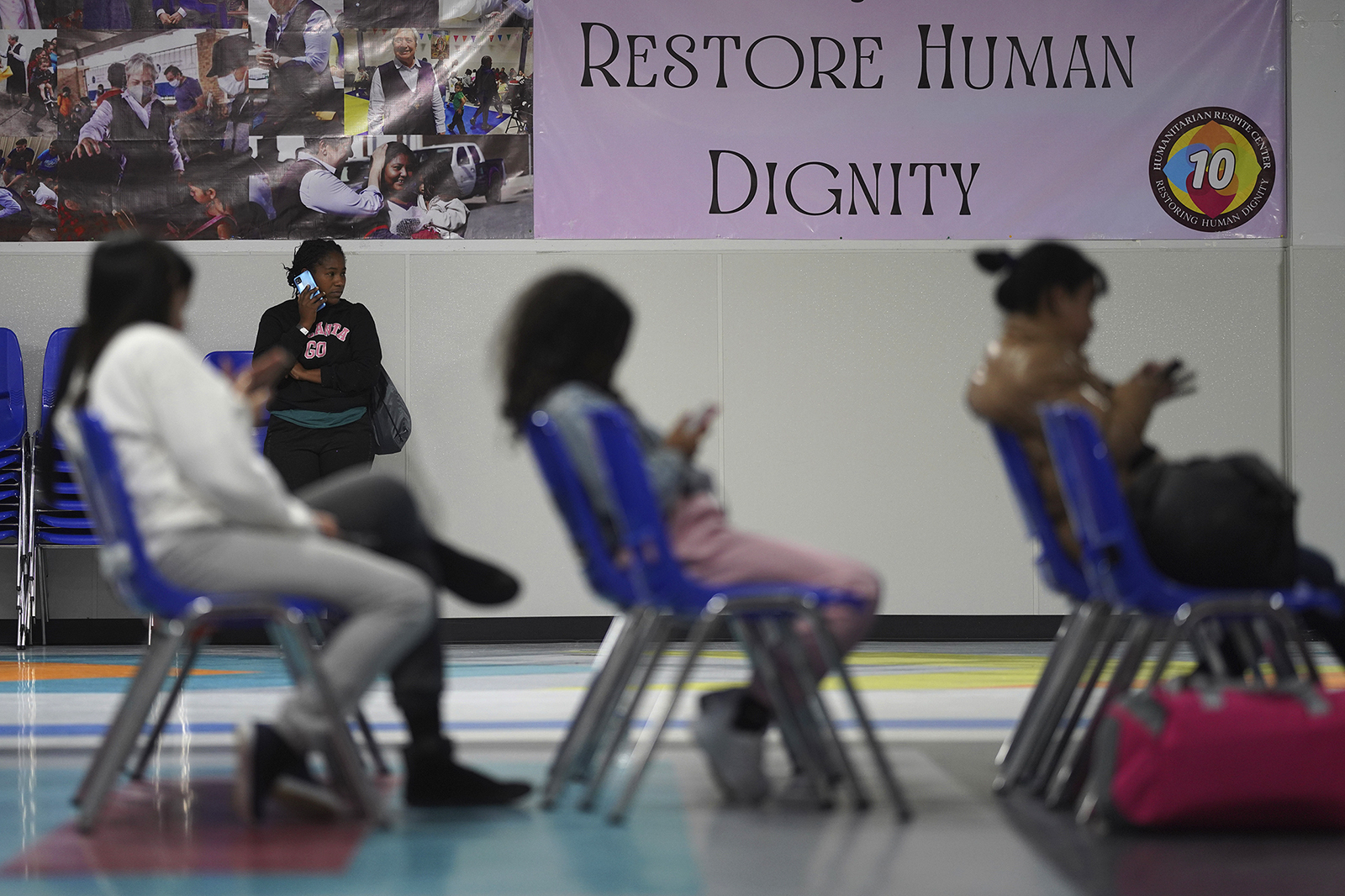


FILE - Migrants seeking asylum in the United States wait for humanitarian assistance and relief at Catholic Charities in McAllen, Texas, Jan. 18, 2025. (AP Photo/Eric Gay, file)

Aleja Hertzler-McCain
April 7, 2025

(RNS) — The U.S. Conference of Catholic Bishops announced Monday (April 7) that the bishops would not seek to renew agreements with the federal government for refugee resettlement and children’s services. The announcement comes after months of uncertainty about reimbursing Catholic agencies for their work with refugees, exacerbated in part by Vice President JD Vance’s allegation, in his first television interview as vice president in January, that the bishops’ true concern was for their “bottom line.”

A federal judge blocked the Trump administration’s suspension of the refugee resettlement program in late February, but at least a dozen local Catholic Charities agencies across the country have had to lay off hundreds of employees because the administration has not restarted payments.

A group of non-Catholic faith-based refugee resettlement agencies, including Church World Service, HIAS and Lutheran Community Services Northwest, have had success blocking the Trump administration’s efforts to radically reshape and diminish the refugee resettlement program, as a judge found the administration’s efforts to be a “nullification of congressional will,” but the USCCB, which filed its own suit with a narrower argument seeking to stop the Trump administration from pausing or cancelling contracts the conference, has met with less success.

Calling the USCCB’s decision to give up its attempt to renew the agreements “heartbreaking,” the conference’s president, Archbishop Timothy Broglio, who leads the Archdiocese for the Military Services, USA, wrote, “While this marks a painful end to a life-sustaining partnership with our government that has spanned decades across administrations of both political parties, it offers every Catholic an opportunity to search our hearts for new ways to assist.”

“We simply cannot sustain the work on our own at current levels or in current form,” Broglio wrote, explaining that the conference would look for alternatives to support migrants already admitted to the U.S.

RELATED: Despite Vance attack, Catholic bishops press ahead on defending migrants

“Our efforts were acts of pastoral care and charity, generously supported by the people of God when funds received from the government did not cover the full cost,” said Broglio, pushing back on Vance’s “bottom line” accusation.


USCCB President Archbishop Timothy P. Broglio, center, presides over the annual fall gathering of the U.S. Conference of Catholic Bishops, Wednesday, Nov. 15, 2023, in Baltimore. (RNS photo/Jack Jenkins)

Broglio pointed out in his statement that the National Catholic War Council, the first predecessor to the USCCB, began a Bureau of Immigration just three years after the council was founded in 1917 “to help displaced families find new opportunities in the United States.” The archbishop wrote, “Many of us can trace our own parents, grandparents, or great grandparents to these very families.”

RELATED: Faith-based refugee resettlement groups concerned about Trump administration’s new plans

Maggie Elmore, assistant professor of history at Baylor University, who is working on a book about the history of Catholic immigration agencies, told RNS that the bureau began cooperating with the federal government in the early 1920s “to provide services for immigrants, refugees and asylum seekers.”

“Today’s announcement is unprecedented and indicates a fractured partnership. This will take a tremendous toll on thousands of people for whom the conference provides lifesaving services,” wrote Elmore.

Elmore noted that the bishops’ Migration and Refugee Services department has faced federal funding cuts in the past under President Barack Obama’s administration because of the conference’s positions on birth control and abortion, as the administration gave “strong preference” to organizations that gave referrals for those services.

In his statement, Broglio indicated that the conference would continue to pursue immigration reform advocacy. “The Gospel’s call to do what we can for the least among us remains our guide. We ask you to join us in praying for God’s grace in finding new ways to bring hope where it is most needed,” he wrote.
Pennsylvania faith groups build altar at ICE office in protest of immigration arrests

(RNS) — The clergy-led gathering stood in defiance of ICE policies, drawing on shared interfaith values.


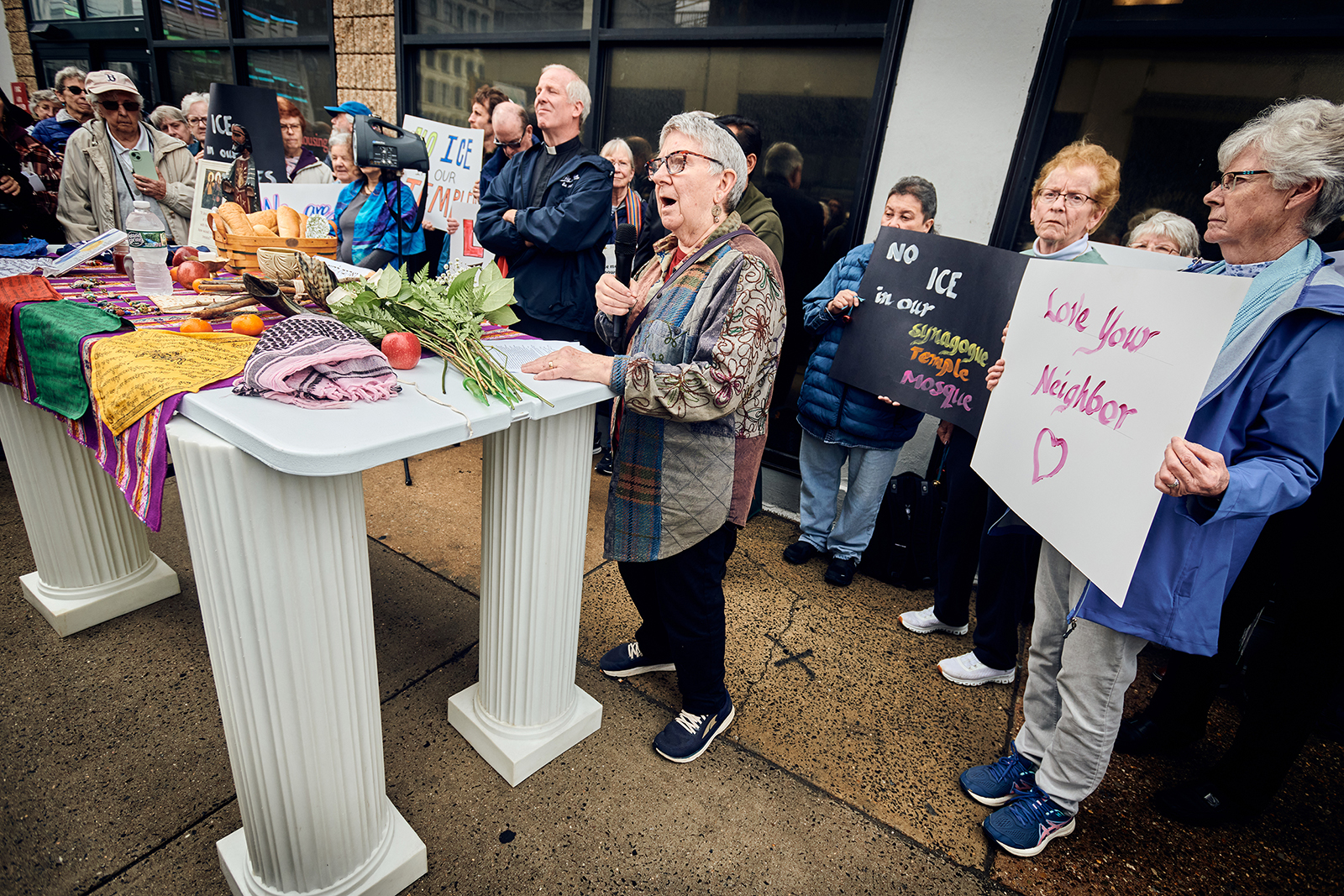
Rabbi Linda Holtzman, of Tikkun Olam Chavurah, addresses a protest outside the offices of U.S. Immigration and Customs Enforcement, Thursday, April 3, 2025, in Philadelphia. (Photo by Rodney Atienza/New Sanctuary Movement)


(RNS) — Clergy representing over 30 Pennsylvania religious groups rallied last Thursday (April 3) outside of Philadelphia’s U.S. Immigration and Customs Enforcement Office against President Donald Trump’s order allowing immigration arrests at houses of worship.

To make their point, the clergy built an interfaith altar at ICE’s doorstep and offered to break bread with ICE agents, appealing to their shared humanity and values.

The clergy are part of an interfaith immigrant advocacy network called New Sanctuary Movement of Philadelphia, representing Jewish, Mennonite, Catholic, Baptist and Unitarian congregations, among other faiths. They were joined by nearly 100 people.


“As Trump attempts to take away every safe space, we as the faith community stand in our moral authority to confront injustice, reclaim our sacred spaces and lift up the power of transformative love everywhere — even to the ICE office and ICE agents,” the group said on social media.

The structure for the altar was provided by Sisters of Saint Joseph’s Philadelphia parish, and it featured items of spiritual significance from various religious and cultural traditions. As attendees placed items like crosses, statues, flowers, rosaries and fruits at the altar, they were led in song by Rabbi Linda Holtzman of Philadelphia’s Tikkun Olam Chavurah, a Jewish social justice group. Holtzman placed a shofar, or a ram’s horn used for Jewish ceremonies, at the altar.

The protest was held in response to the executive order Trump signed his first day in office in January, allowing for ICE arrests at sensitive locations, including houses of worship. The order overturned protections laid out in a 2011 memo discouraging ICE arrests, interviews and searches in locations including hospitals, public religious ceremonies like weddings or funerals, schools and houses of worship, barring “exigent circumstances.”


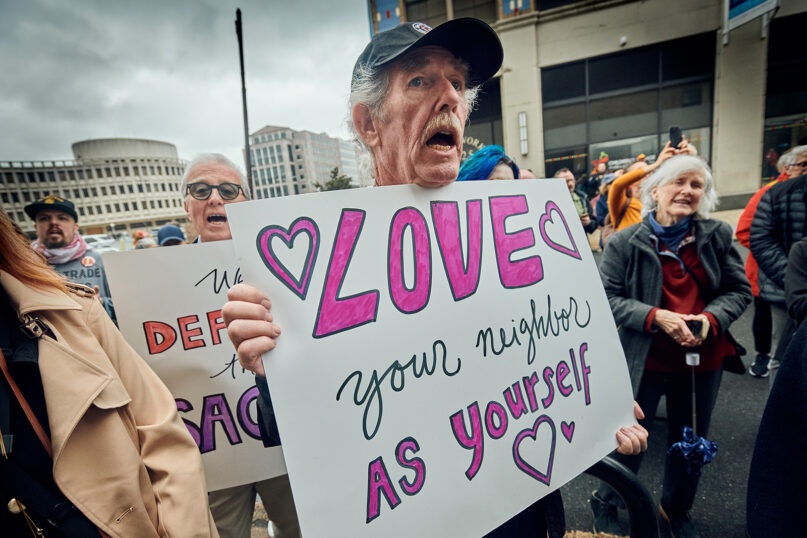
People protest outside the offices of U.S. Immigration and Customs Enforcement, Thursday, April 3, 2025, in Philadelphia. (Photo by Rodney Atienza/New Sanctuary Movement)

Trump’s executive order incited lawsuits from religious organizations, which argued the order infringes on their First Amendment right to freedom of religious exercise. The policy change has resulted in at least one immigration arrest at a church in January, and religious service attendance among immigrants has decreased, including for those with legal status and U.S. citizenship, RNS previously reported.

New Sanctuary Movement of Philadelphia, which was formed in 2007 by clergy and community organizers, has long advocated for immigrants in Philadelphia and surrounding areas. Its work has involved providing houses of worship with “know your rights” trainings and advocating for policy changes.

RELATED: Faith groups claim legal victories on refugees, ICE raids at houses of worship

NSM’s organizers said the executive order opens the door for inhumane and unconstitutional invasions of sacred spaces.

“With the rescinding of the sensitive locations memo, it really feels like they are trying to take away any remaining safe space in people’s lives,” said Peter Pedemonti, the movement’s co-founder and co-director. “There’s something about the targeting of faith communities that feels especially cruel. To try and cut somebody off from their spiritual home and their community right now, there’s a cold-heartedness or hard-heartedness to it.”

The group of clergy leading the protest symbolically chose to build the interfaith altar in front of Philadelphia’s ICE office because, in the Rev. Christopher Neilson’s words, “In the biblical tradition, God is everywhere. He cannot be contained in buildings. We live and move and have our being in God.”

Neilson, who is the founder and director of Christianity for the Living Ministries, an organization that works primarily with Philadelphia’s Caribbean community, said, “We go to ICE to say that, here is also sacred space. Here is also God’s space.”

At the altar, Holtzman led attendees in a nigun, or wordless song, whose tune was derived from Hebrew Scripture, which says, “mah norah hamakom hazeh,” translating to, “how awesome is this space.”

“While all of the clergy may see God differently, they all pretty much see God as a power that moves them toward doing what is right and what matters,” Holtzman said. “It matters that clergy, as a group, stand up and speak out. Doing so at the ICE office is doing it in a place that very desperately needs to hear a message of justice, because they are acting as unjustly as possible.”

Initially, the rally’s crowd stood on sidewalks because they did not have a permit to protest; however, as their numbers grew, the Philadelphia Police Department’s Civil Affairs Unit moved to close the street to cars, Pedemonti said.

Toward the end of the protest, attendees broke bread together in a ceremony led by the Rev. Joe Shields, a retired Catholic priest.

“This action was led by clergy, and the clergy were up front and center,” Neilson said. “It’s important for people to see the religious authorities stand up, for people to glean from (their) endorsements that ‘you are seen, you are valued and God is on your side.’”

Neilson added, “The imagery was powerful in the sense of its plurality, and was singularly powerful in terms of sharing the bread together.”

The protest stood in defiance of ICE policies but also sought to extend an olive branch to ICE officers in an appeal to their humanity, Pedemonti said. ICE and other law enforcement officers who watched the protest were invited to break bread with the clergy.

Pedemonti said that while the ICE officers politely declined the bread, it was important to extend the offer as directed by their shared values.

“Yes, there was defiance there because part of our prophetic tradition is to stand in defense of (immigrants), but there was also a reaching out to ICE with God’s love,” Neilson said. “As human beings, many of them are probably conflicted because they’re following orders, but they are wondering why.”


Opinion

Faith communities are setting a courageous example for standing up to Trump

(RNS) — A growing number of religious communities are responding to the administration's hostility to many of their core values and beliefs, despite having fewer resources than major firms or schools.


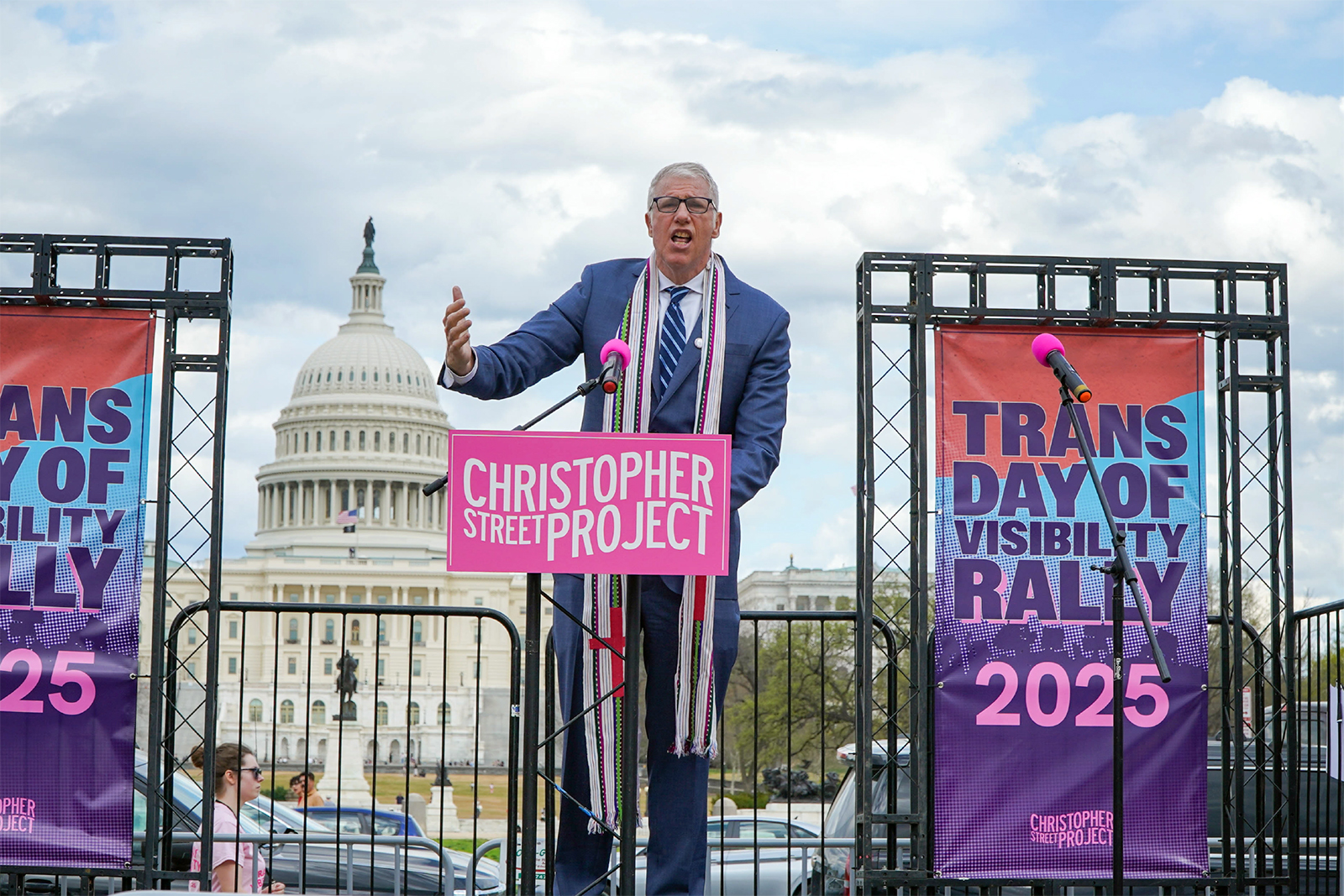
The Rev. Paul Brandeis Raushenbush addresses the Trans Day of Visibility Rally, Monday, March 31, 2025, on the National Mall in Washington. (Photo by Mandie Garcia, courtesy Christopher Street)


Paul Brandeis Raushenbush
April 4, 2025


(RNS) — In the few weeks since the inauguration of President Donald Trump, there have been a distressing number of American institutions and corporations that have “obeyed in advance,” to borrow a phrase from the historian Timothy Snyder.

Target, Pepsi, Google and McDonald’s, to name just a few corporations, have agreed to halt efforts at increasing diversity and equity and inclusion. Paul Weiss and other law firms that sought to hold the line against the lawlessness of the first Trump administration have given in to the demands of Trump 2.0 with nary a whimper. Columbia and Harvard universities have thrown in the towel without a fight, making major alterations in their policies and faculties in the face of White House threats to their federal funding. In allowing their rights to be trampled, they are opening the way for the rights of far more vulnerable organizations and people to be trampled as well.

Yet one important constituency in American life continues to demonstrate moral clarity about the present danger, and it may surprise you: religious congregations, leaders and institutions. While some faith leaders have sanctified the cruelty and carelessness of the Trump administration, to the point of blessing the president in an Oval Office photo op, a growing number of religious communities are responding to the administration’s hostility to many of their core values and the threat the White House poses to religious groups (or any group) not in lockstep with its agenda.

This resistance to power began on the first full day of the administration, when an Episcopal bishop preaching from her own pulpit at the Washington National Cathedral made a respectful plea for mercy for the most vulnerable of Americans. She rightly refused to apologize for speaking out in a way that was true to the convictions of her faith.

In the weeks that followed, we’ve seen more attacks on religious leaders and institutions — and more of their steadfast refusal to yield to bullying and intimidation. When the president changed the rules that had prevented Immigration and Customs Enforcement from raiding sensitive spaces including houses of worship, the Quakers, Sikhs and Baptists filed a lawsuit, followed by similar efforts from other religious groups. When Vice President JD Vance absurdly accused the Catholic Church of helping the immigrant community only to fill the church’s own coffers, U.S. Catholic bishops held their ground. They rejected the vice president’s assertion as “just wrong.”

When Elon Musk promoted absurd accusations that Lutheran Social Services was engaged in “money laundering,” LSS didn’t fold in fear. It hit back, rejecting his assertions as false. Lutheran bishops of Wisconsin and Upper Michigan recently issued a sharp rebuttal to Trump’s executive order establishing a “Task Force to Eradicate Anti-Christian Bias,” saying: “We believe this executive order is a threat to the religious pluralism enshrined in the Constitution and does not actually protect Christians.”

After Target, Walmart and other companies abandoned their DEI programs in the face of Trump’s views, Black church congregations and Muslim groups have led an effective boycott effort. Jewish groups, including the Jewish Council for Public Affairs and T’ruah: The Rabbinic Call for Human Rights, have made clear that the administration’s approach to antisemitism harmfully undercuts civil liberties while only making Jewish Americans less safe.

It’s important to note that, as nonprofits, religious groups have far fewer resources and a smaller margin for error than the corporations or universities that have crumbled. Faith groups are nonetheless putting commitment to principle over concern for their bottom line (the vice president’s accusation notwithstanding). Even under repeated attacks, religious groups have refused to sacrifice their integrity at the golden altar of power and are courageously fighting back.

Religious leadership has often acted with courage at times of trauma and challenge in American history. In the face of the pernicious violence of racism, the Rev. Martin Luther King Jr. assembled religious leaders from across traditions to join the Black community to organize and speak out for civil rights. King wrote: “Courage is an inner resolution to go forward despite obstacles. Cowardice is submissive surrender to circumstances. Courage breeds creativity.”

That creativity is what we are seeing today. Religious leaders are showing up in Washington, in state capitols and in small towns, insisting that they will not bend to an agenda that degrades our society and harms our people. We are demanding that our elected officials answer for the attacks on Social Security, Medicare, SNAP and veterans services — as well as attacks on civil liberties and religious freedom. On Saturday (April 5), faith communities are among those mobilizing to participate in a major nationwide “Hands Off!” day of action in defense of democracy and a functional government.

The root word of courage is “cor” — Latin for heart. Spiritual communities are rooted in the love of the sacred as well as love of the neighbor. We follow the mandates of our respective faiths with a sense of a larger purpose of our lives than the material. Many of us are also guided by love of our country and our democracy, which we now see under attack from our own government. My deepest prayer is that religious communities will continue to show courage in the face of pressure and adversity, and that we can inspire the wider American people to do the same.

(The Rev. Paul Brandeis Raushenbush is president and CEO of Interfaith Alliance. The views expressed in this commentary do not necessarily reflect those of RNS.)
A man wielding an axe wounds 3 people at the Assyrian Christian new year parade in Iraq

DOHUK, Iraq (AP) — Witnesses said the attacker, who has not been officially identified, ran toward the crowd shouting Islamic slogans.


Stella Martany
April 3, 2025


DOHUK, Iraq (AP) — The annual parade by Assyrian Christians in the Iraqi city of Dohuk to mark their new year was marred Tuesday when an axe-wielding man attacked the procession and wounded three people, witnesses and local officials said.

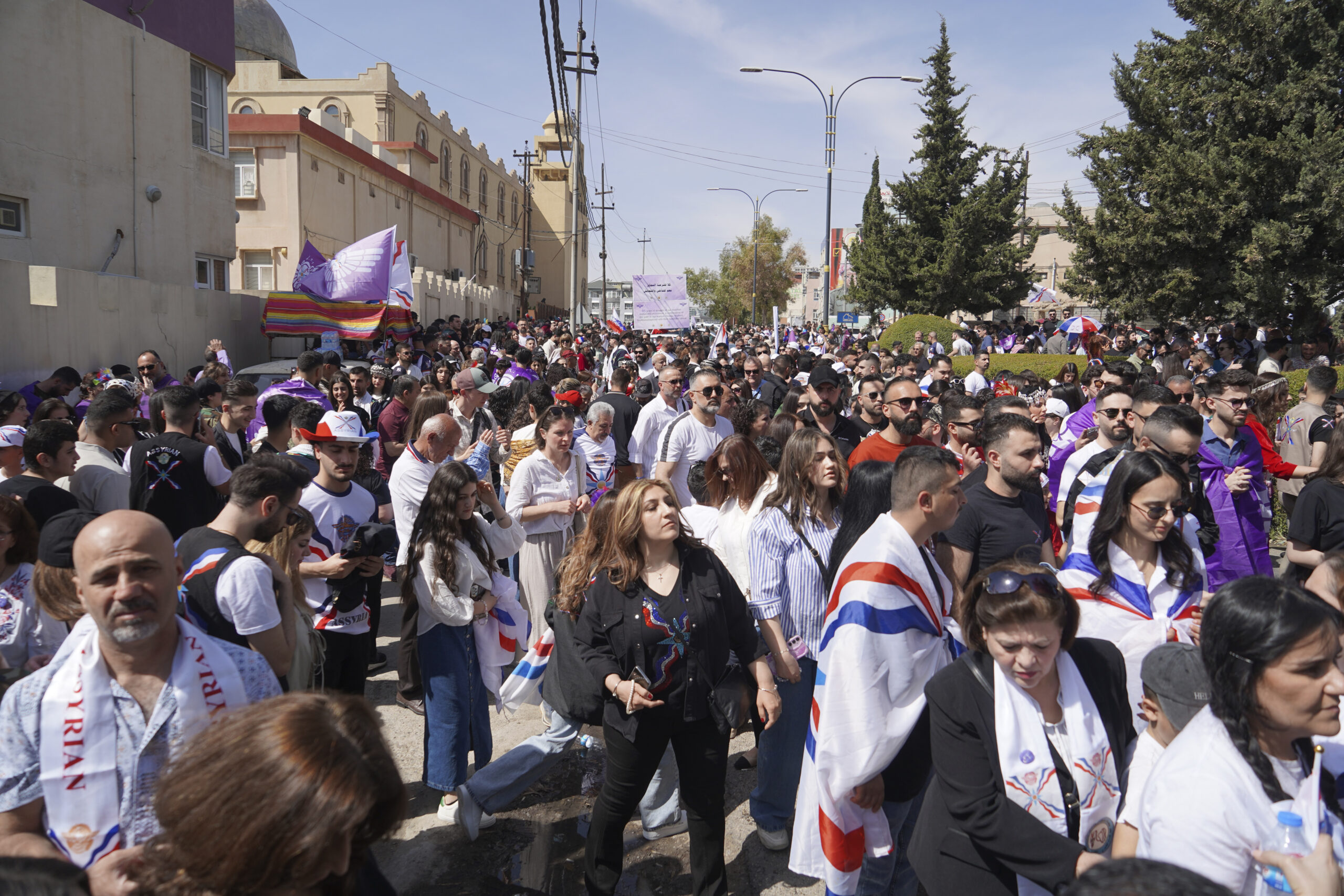
The parade, held every year on April 1, drew thousands of Assyrians from Iraq and across the diaspora, who marched through Dohuk in northern Iraq waving Assyrian flags and wearing colorful traditional clothes.

Witnesses said the attacker, who has not been officially identified, ran toward the crowd shouting Islamic slogans.

He struck three people with the axe before being stopped by participants and security forces. Videos circulated online showed him pinned to the ground, repeatedly shouting, “Islamic State, the Islamic State remains.”

A 17-year-old boy and a 75-year-old woman suffered skull fractures. A member of the local security forces, who was operating a surveillance drone, was also wounded. All three were hospitalized, local security officials said.

At the hospital where her 17-year-old son Fardi was being treated after suffering a skull injury, Athraa Abdullah told The Associated Press that her son had come with his friends in buses. He was sending photos from the celebrations shortly before his friends called to say he had been attacked, she said.

Abdullah, whose family was displaced when Islamic State militants swept into their area in 2014, said, “We were already attacked and displaced by ISIS, and today we faced a terrorist attack at a place we came to for shelter.”

Janet Aprem Odisho, whose 75-year-old mother Yoniyah Khoshaba was wounded, said she and her mother were shopping near the parade when the attack happened.

“He was running at us with an axe,” she said. “All I remember is that he hit my mother, and I ran away when she fell. He had already attacked a young man who was bleeding in the street, then he tried to attack more people.”

Her family, originally from Baghdad, was also displaced by past violence and now lives in Ain Baqre village near the town of Alqosh.

Assyrians faced a wave of hate speech and offensive comments on social media following the attack.

Ninab Yousif Toma, a political bureau member of the Assyrian Democratic Movement (ADM), condemned the regional government in northern Iraq’s semi-autonomous Kurdish region and asked Iraqi federal authorities to address extremist indoctrination.

“We request both governments to review the religious and education curriculums that plant hate in people’s heads and encourage ethnic and religious extremism,” he said. “This was obviously an inhumane terrorist attack.”

However, he said that the Assyrian community had celebrated their new year, known as Akitu, in Duhok since the 1990s without incidents of violence and acknowledged the support of local Kurdish Muslim residents.

“The Kurds in Duhok serve us water and candy even when they are fasting for Ramadan. This was likely an individual, unplanned attack, and it will not scare our people,” he said, adding that the community was waiting for the results of the official investigation and planned to file an official lawsuit.

“The Middle East is governed by religion, and as minorities, we suffer double because we are both ethnically and religiously different from the majority,” he said. “But we have a cause, and we marched today to show that we have existed here for thousands of years. This attack will not stop our people.”

Despite the attack, Assyrians continued the celebrations of the holiday, which symbolizes renewal and rebirth in Assyrian culture as well as resilience and continuous existence as an indigenous group.

At one point, as the injured teenager was rushed to the hospital, some participants wrapped his head in an Assyrian flag, which was later lifted again in the parade — stained with blood but held high as a symbol of resilience.

 The Ethics of Evidence Foundation has released two new publications

Ethics of Evidence Foundation


“…a guide preparing the heart and mind to enter into a post-secular age.”

April 2, 2025 The Ethics of Evidence Foundation in collaboration with Herder and Herder has released two new publications. This marks the tenth anniversary of the establishment of the Ethics of Evidence Foundation, incorporated in New York, in the spring of 2015, an organization for education and research, with the mission to support the search for meaning in the age of information. The Ethics of Evidence Foundation has divisions for Medicine, Social Justice, Physics, and Cosmology.  

As the next volume in the series on the leading-edge theory of A Christian Cosmology by physicist-theologian Richard J. Pendergast, SJ (1927 -2012), Volume 2, The Cosmic Hierarchy: The Universe and its Many Irreducible Levels, is now available together with the introductory Volume 1 and Volume 6 on the Eucharist. Please visit herderandherder.com/pendergast-series for more information.  

Dr. Valerie Miké, a mathematical scientist, historian of science, and editor of the Pendergast series, has prepared a companion volume, From Information to Insight: Toward a Consistent Reading of Science and Faith, that offers independent testimony for the compatibility of faith and reason, science and religion.  

Special attention is called to three important issues discussed in this work:

  1. Introducing the work of the Jesuit scholar Richard J. Pendergast, SJ, Dr. Miké sees him as the second Pascal for the age of science, sharing the latter’s integrated vision of faith and reason.
  2. Dr. Miké identifies the high-profile Arkansas Creation Trial of 1982 as a major source of the widespread mistaken notion that religion and science are not related and that evolution must be a random process. Referring to her own published work, she points out that speculation about the meaning of sense experience has been an essential part of the history of ideas from antiquity.
  3. In a more recent development, Sir Ronald A. Fisher, a leading scientist of the twentieth century, founder of modern statistics and genetics and the creator of  Neo-Darwinian synthesis, was caught by the cancel wave sweeping our culture. Using her extensive personal knowledge, Dr. Miké offers documentation to clear Fisher’s name of the false charges raised against him.

More information can be found at herderandherder.com/pendergast-series 

“In this companion to A Christian Cosmology, Dr. Valerie Miké introduces the reader to the comprehensive vision of physicist-theologian Richard J. Pendergast, S.J., in a historical perspective that testifies to the compatibility of faith and reason, science and religion. A mathematical scientist, Dr. Miké was a witness and participant in the advent of the Age of Information. Her work, informed by the application of statistics to medicine, and by the Ethics of Evidence approach to understanding the world, brings philosophical realism to the existential and scientific uncertainty of our day. Seeking the truth, using the best available methods in each and every discipline, Dr. Miké addresses the irreducible nature of uncertainty, to overcome the ignorance, deception, reductionism, and fear of the unknown that are so endemic to our age. The book is invaluable as a guide preparing the heart and mind to enter into a post-secular age.” — MSGR. STUART W. SWETLAND, STD, President of Donnelly College, Kansas, National media commentator on religious issues; Academic degrees in theology (Pontifical Lateran University), physics (US Naval Academy), philosophy and economics (Oxford).

###

Contact:
Msgr. Stuart W. Swetland
Ethics of Evidence Foundation
913 621-8700
SSwetland@donnelly.edu

Disclaimer: The views and opinions expressed in this article are those of the authors and do not necessarily reflect the official policy or position of RNS or Religion News Foundation.


New book calls for authentic engagement and equity in organizations
Westminster John Knox Press


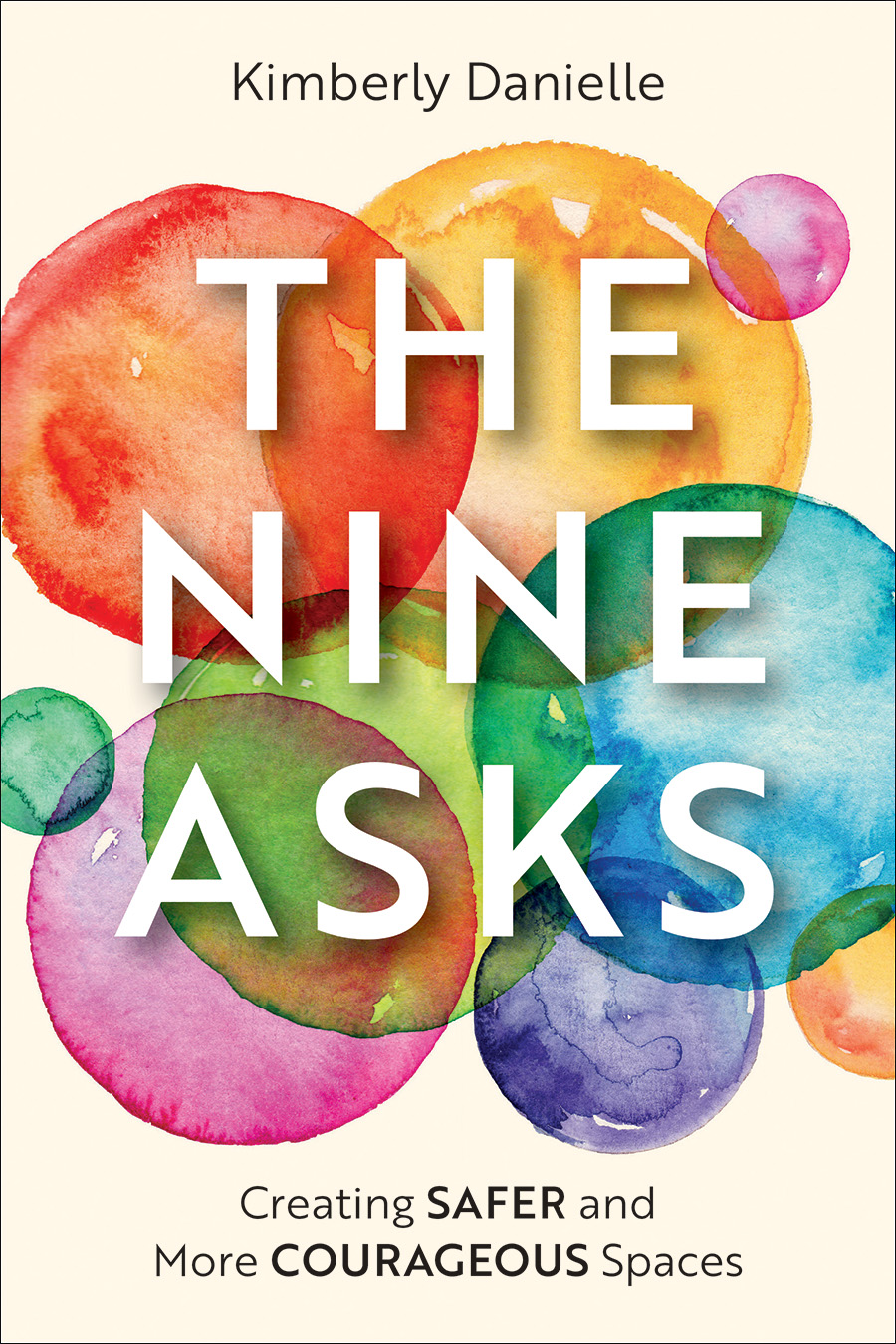
The Nine Asks by Kimberly Danielle

Organizations have a responsibility to ensure that people who come there to work, worship, or volunteer won’t experience harm.

At a time when diversity, equity, and inclusion (DEI) efforts are being systematically dismantled—stripped from government agencies, corporate initiatives, and institutional policies—the need for genuine, sustainable culture change has never been more urgent. Superficial checklists and one-time training sessions are not enough. True transformation requires a trauma-informed, programmatic approach that prioritizes safety, trust, and deep engagement.

In The Nine Asks, Kimberly Danielle provides a groundbreaking framework for organizations—churches, nonprofits, businesses, and beyond—seeking to foster spaces where people can show up fully as themselves, free from harm. At the heart of this approach are the Nine Asks—invitations that guide individuals and organizations toward authentic, equity-driven engagement. Backed by real-world examples from Danielle’s extensive experience of coaching teams and institutions, The Nine Asks equips readers with the tools to apply these principles, such as being honest and vulnerable, respecting boundaries, listening first, and much more.

This book goes beyond rhetoric, offering practical strategies for building communities that nurture honesty, accountability, and healing. After fully exploring each of the Nine Asks, individual chapters focus on integrating these concepts, as well as tips and tools for practicing them in working spaces; learning spaces; living spaces; faith-based spaces; and even within our own body, mind, and spirit. This is not just a book to read—it’s a guide to live by.

In an era where the fight for inclusion faces growing resistance, The Nine Asks provides a necessary roadmap for those committed to creating communities of safety, trust, and true belonging. Whether you are a board member, part of company leadership, an educator, or involved in your faith community or volunteer organization, this book offers the tools to ensure that inclusion is not just a goal—but a lived reality.

###

Contact:
Natalie Smith
Westminster John Knox Press
502-569-5811
nsmith@wjkbooks.com

Disclaimer: The views and opinions expressed in this article are those of the authors and do not necessarily reflect the official policy or position of RNS or Religion News Foundation.

Declining Eid travel and spending in Indonesia and discrimination in India dampen holiday spirit

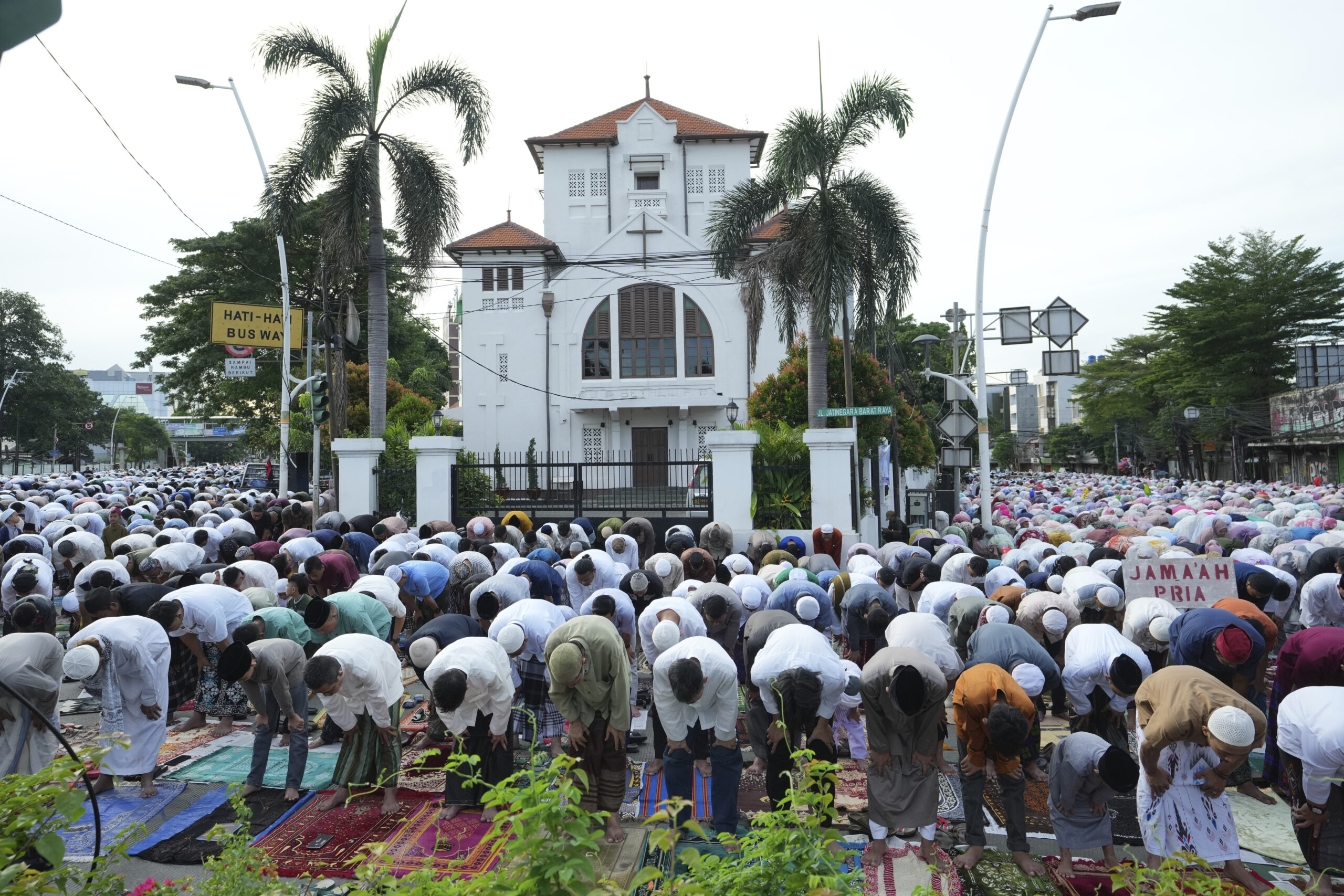
JAKARTA, Indonesia (AP) — Consumer spending ahead of the biggest religious holiday for Muslims, which was celebrated on Sunday in Indonesia, has declined compared to the previous year, with a predicted slowdown in cash circulation due to fewer travelers.


Niniek Karmini
April 1, 2025

JAKARTA, Indonesia (AP) — The usual festive mood of Eid al-Fitr holiday to mark the end of the Islamic holy month of Ramadan has been subdued in Indonesia this year as people grapple with soaring prices for food, clothing and essential goods.

Consumer spending ahead of the biggest religious holiday for Muslims, which was celebrated on Sunday in Indonesia, has declined compared to the previous year, with a predicted slowdown in cash circulation due to fewer travelers.

Each year in Indonesia, nearly three-quarters of the population of the world’s most populous Muslim-majority country travel for the annual homecoming known locally as “mudik” that is always welcomed with excitement.

People pour out of major cities to return to villages to celebrate the holiday with prayers, feasts and family gatherings. Flights are overbooked and anxious relatives weighed down with boxes of gifts form long lines at bus and train stations for the journey

But this year the Transportation Ministry said Eid travelers reached 146 million people, a 24% drop from last year’s 194 million travelers.

The Indonesian Chamber of Commerce and Industry projects that money circulation during Eid will reach 137.97 trillion rupiah ($8.33 billion), down from 157.3 trillion last year. The weakening purchasing power is also reflected in Bank Indonesia’s Consumer Confidence Index which dipped to 126.4 in February from 127.2 in January.

Bhima Yudistira, executive director of the Center for Economic and Law Studies, or Celios, said those trends indicate the economy is under strain, driven by economic hardship, coupled with currency depreciation and mass layoffs in manufacturing.

“These have weakened both corporate earnings and workers’ incomes that suppress consumer spending,” Yudistira said, adding he “expects a less vibrant festive season.”

He said the festive spirit has been stifled by harsh economic realities, as soaring prices and dwindling incomes force residents to prioritize survival over celebration.

Traditionally household consumption is a key driver of Indonesia’s GDP. It contributed over 50% to the economy last year, helping push annual growth to 5.11%. However, consumer spending in 2025 is expected to be more subdued, Yudistira said.

Despite the downturn, the government remains optimistic that the Ramadan and Eid momentum will support economic growth in the first quarter of 2025.

“Eid usually boosts the economy through increased spending,” Chief Economic Affairs Minister Airlangga Hartarto said ahead of the Islamic holiday.

The government recently introduced incentives to stimulate economic activity, including airfare and toll road fee discounts, nationwide online shopping events, direct cash assistance for 16 million households, electricity bill reductions for low-consumption customers, and tax exemptions for labor-intensive sectors.

“With these programs in place, the government hopes to sustain consumer spending and support economic stability,” Hartarto said.

The situation has also affected Endang Trisilowati, a mother of four, who said her family had to scale down their festivities budget.

“Honestly, the economic hardship is affecting us,” Trisilowati said. She described how she used to cook different dishes every Eid and invite neighbors, but now she can only afford a simple meal for her family.

“Many have resorted to just finding a way to eat on that festivity, but the spirit is low,” she said.

Muslims in India grapple with discrimination

In India, Muslims are marking the celebration of Eid with special prayers, family gatherings and festive meals.

The holiday comes as the minority community faces vilification by hardline Hindu nationalists. Muslim groups are also protesting against a proposal by Prime Minister Narendra Modi’s government to change laws governing Muslim land endowments.

The government says it wants to weed out corruption and mismanagement in hundreds of thousands of Muslim land endowments. But Muslim groups say the proposal pending approval in India’s parliament is discriminatory.

Muslims, who comprise 14% of India’s 1.4 billion population, are the largest minority group in the Hindu-majority nation.

Modi’s Hindu nationalist Bharatiya Janata Party launched a nationwide initiative called “Saugat-e-Modi,” or “Modi’s gift,” during Ramadan that is expected to provide food and clothes to over 3 million underprivileged Muslims to celebrate Eid.

In New Delhi, thousands assembled in the Jama Masjid, one of the country’s largest mosques, to offer Eid prayers. Families came together early Monday morning and many people shared hugs and wishes.

“This is a day of giving and receiving love. Even if you meet an enemy, meet them with love today,” said 18-year-old student Mohammed Nooruddin.


___

Associated Press writers Aijaz Hussain in Srinagar and Rishi Lekhi in New Delhi, India, contributed to this report.
Associated Press religion coverage receives support through the AP’s collaboration with The Conversation US, with funding from Lilly Endowment Inc. The AP is solely responsible for this content.
'God-lover' Kyle's Instagram memes mix Catholic iconography and internet absurdism


(RNS) — How ‘I Need God in Every Moment of My Life’ became a digital sanctuary for faith, irony and spiritual longing.


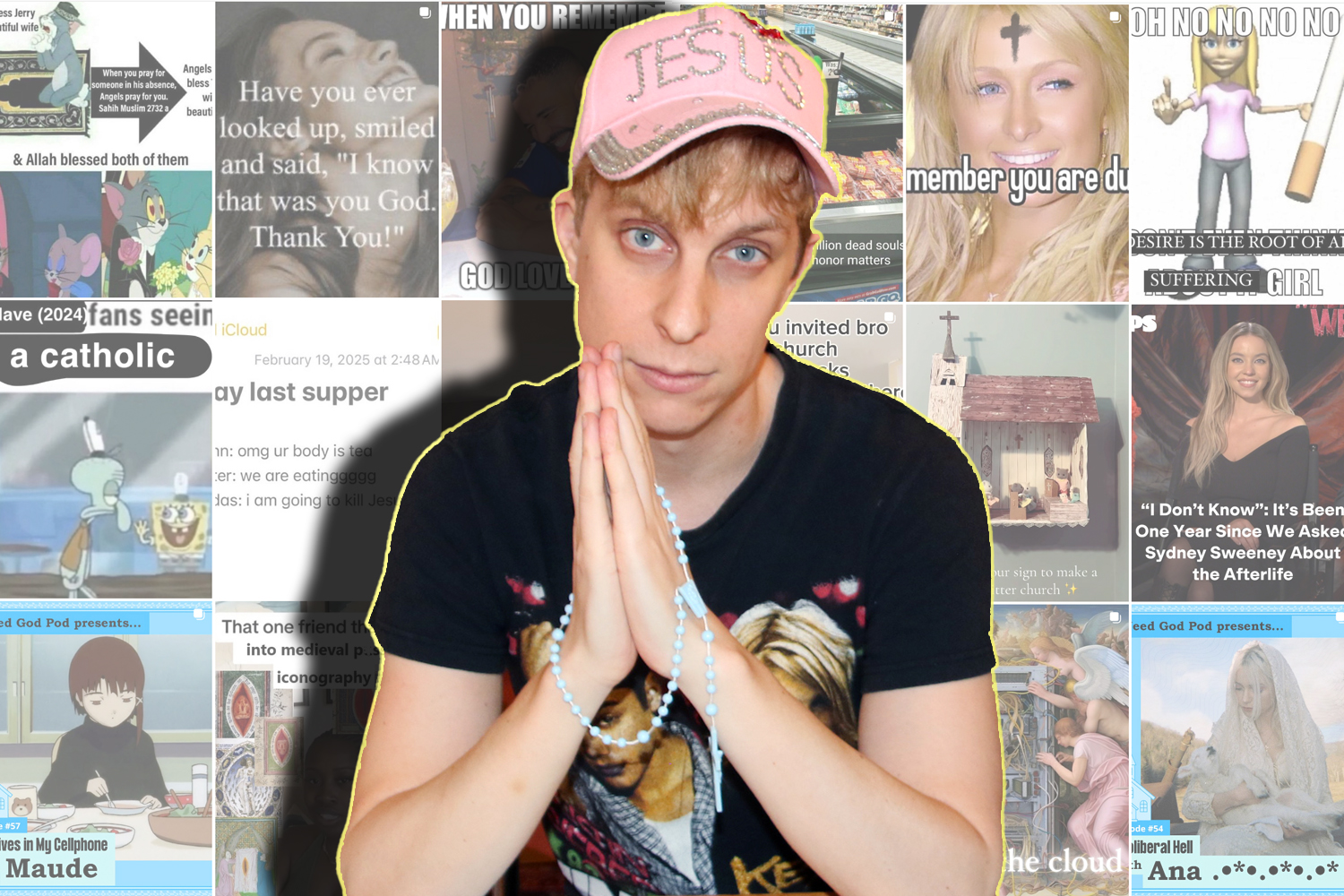
Kyle Hide in front of a variety of "I Need God in Every Moment of My Life" Instagram posts. (Photo by Fiona Murphy; RNS illustration)
Fiona Murphy
April 3, 2025

(RNS) — A meme, as Kyle Hide explains it, is like a gene for culture. A concept first coined by biologist Richard Dawkins, it’s a unit of meaning that evolves and spreads through imitation.

“ A meme functions similarly to a virus,” said Hide, the 34-year-old administrator of the popular Instagram account I Need God in Every Moment of My Life, a self-described culturally non-practicing Catholic and lifelong internet obsessive. “That’s why we might call something online viral. You could think of memes as anything that culturally transmits itself and replicates through culture.”

I Need God in Every Moment of My Life reads like a digital confessional booth filtered through Tumblr-core aesthetics, Catholic iconography and internet absurdism. Posts range from blurry screenshots of tweets about prayer and heartbreak to ironic riffs on spiritual longing.

For Hide, who is known online and on his podcast “I Need God Pod” as “God-lover Kyle,” memes are more than just content striving for virality; they are a form of meaning-making. Posting under the persona allows Hide, who lives in Brooklyn, New York, to maintain both intimacy and distance from followers, he said.

He and three friends from different Christian backgrounds turned their God-focused group chat into the Instagram account in 2020.

“We all loved God, and we were like, we need God,” Hide said. “Everything is too godless. We thought that God is coming back in a major way. Let’s just create a page and we’ll all post to it.”


A variety of “I Need God in Every Moment of My Life” Instagram posts. (Screen grab)

Hide, who now solely manages the account and interacts with its 138,000 followers, said of the page’s fallen collaborators, “I think they weren’t true posters maybe in their hearts as much as I am.”

One image, which has 84,000 likes, shows an early-2000s-style 3D-rendered blonde woman wagging her finger while holding a large cigarette. The image’s original text, “DON’T EVEN THINK ABOUT IT GIRL,” is obscured and replaced by the phrase, “DESIRE IS THE ROOT OF ALL SUFFERING,” a nod to Buddhist philosophy on attachment and suffering. One video shows someone filming inside their home filled with an eerie, glowing mist. The overlaid text reads, “Did I burn chicken or summon the Holy Spirit?” At the end, a hand reaches out into the haze, as if trying to touch the divine smoke.

Hide collects, curates and re-posts thousands of images. The page presents like a collage of spiritual yearning where irony and sincerity blur, allowing followers to both laugh at and engage with spirituality without being told how to interpret it. Absurdity gives shape to something that feels like devotion, and the page attracts those with complicated relationships to faith.

“It has attracted queer people for sure,” Hide said. “LGBT, gay people, people who were raised religious but felt ostracized or excluded from fully identifying with it.”

Other fans, he said, include those with experience in 12-step recovery programs, where belief in a higher power is central. “You need to think that there is something above you that you have to submit to,” he said. “That kind of person definitely likes the page.”


Kyle Hide in Brooklyn, New York, on Feb. 22, 2025. (Photo by Fiona Murphy)

For those on the fringes of religion, Hide said he believes the page’s tone makes spirituality feel more accessible and not as rigid, including for the newly converted. He and his page’s fans are not particularly interested in orthodoxy. But, the page has a real impact on the lives of some followers, he noted.

One man, Hide said, reached out to him explaining he was a recovering alcoholic who recently converted to Catholicism. He said after years of following I Need God in Every Moment of My Life, he was “worn down to think religiously.”

“It can be a gateway to accepting those things that are hard to accept,” Hide said, adding that for some, the page serves as a bridge between skepticism and faith. “If that (a conversion) happened, that’s enough to show me that there is something happening here. And what is happening you could call the Holy Spirit at work, you know what I mean?”

Raised Catholic in northeast Pennsylvania by a quiet mother who urged him toward music lessons and summer camp, Hide said he struggled with social interactions but gravitated toward performance. A babysitter introduced him to AOL via dial-up internet, and it quickly became his refuge. AOL chatrooms and sites like Neopets, LiveJournal and Tumblr were transformative spaces for the young, queer and existentially curious boy.

“ If you’re a shy person, then you gravitate towards online spaces,” Hide said. “You’re not physically present, so you can be whoever you want.”

He describes his online self as both a shadow and an aspiration. “It’s me, but also who I want to be,” he said.

RELATED: In ‘Yogalands,’ religion scholar discusses the role of politics, spirituality on the mat

In high school, Hide was a practicing Catholic going to church weekly but maintained a broader curiosity. When he was 16 years old, he posted a MySpace bulletin titled “God?” asking, “Can you send me your opinion of him in a message, please?”

“I had existential questions from a super young age, and I think that naturally led to wondering about God, the mystery of life and why we’re here,” Hide said. “I’m a Leo, but my Leo placements are in my ninth house, which is the house of philosophy.”

Hide is no longer a regular churchgoer. “I’m not practicing, but I identify as Catholic,” he said. He prays sometimes and worries about his soul — not in a salvation sense, but in terms of quality.

“Your soul, like your body, needs maintenance,” he said.

Hide considers I Need God more than a brand or a business, but a spiritual routine. He has added a merchandise store, beginning with a simple sweatshirt that reads “God loves me and there’s nothing I can do about it,” which sold very well, he said. Soon after, he launched the podcast with the intention of expanding the project offline.


“I Need God Pod” episode art with guest Dan Hentschel. (Courtesy image)

His podcast has featured guests from diverse spiritual backgrounds, including Orthodox Catholic actress Dasha Nekrasova, Catholic school graduate and satirist Dan Hentschel, Muslim meme artist Djinn Kazama, a money witch, a Mormon atheist and more.

“I’m more interested in what people believe than whether it’s correct,” he said.

Now, Hide is looking to organize in-person events, like rosary-making or candle workshops. He said he would like to belong to a parish, too, possibly participating in music ministry, but admits self-discipline hinders him. Wanting to create that in-person element for I Need God, he said, “I just feel like there’s only so much fulfillment I can get from posting.”

Hide is also aware of Instagram’s fragility as algorithms shift, platforms disappear and styles change. Still, he remains devoted to the act of posting.

“The screen is a mental space,” he said. “It becomes part of you. … The internet itself has a godly orientation or a godly presence in our lives. The power of it is so big and beyond us, that it sort of starts to function in a God-like way.”

This article was produced as part of the RNS/Interfaith America Religion Journalism Fellowship.
GONE TO HEL

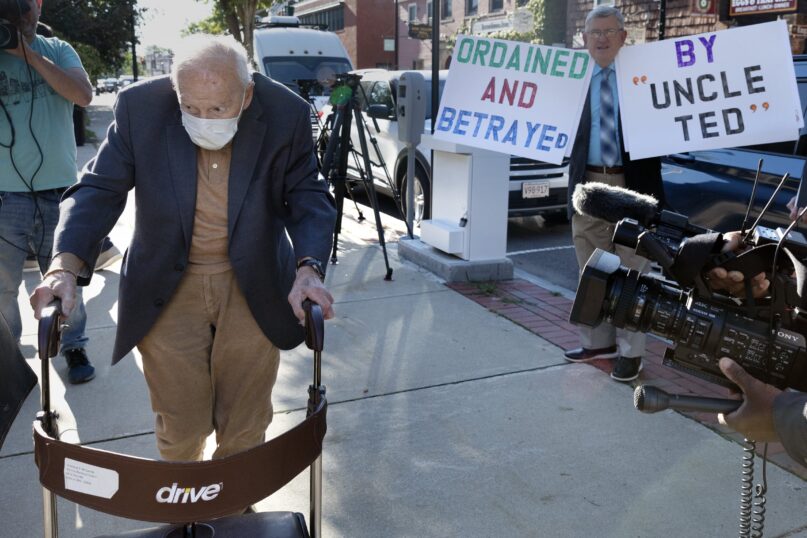
Theodore McCarrick, cardinal defrocked for sexual abuse, has died


(RNS) — The criminal case against McCarrick had been suspended since January 2024, after he was found incompetent to stand trial because of his dementia, but he was laicized in 2019 after a canonical trial found him guilty of "sins against the Sixth Commandment" and "abuse of power."


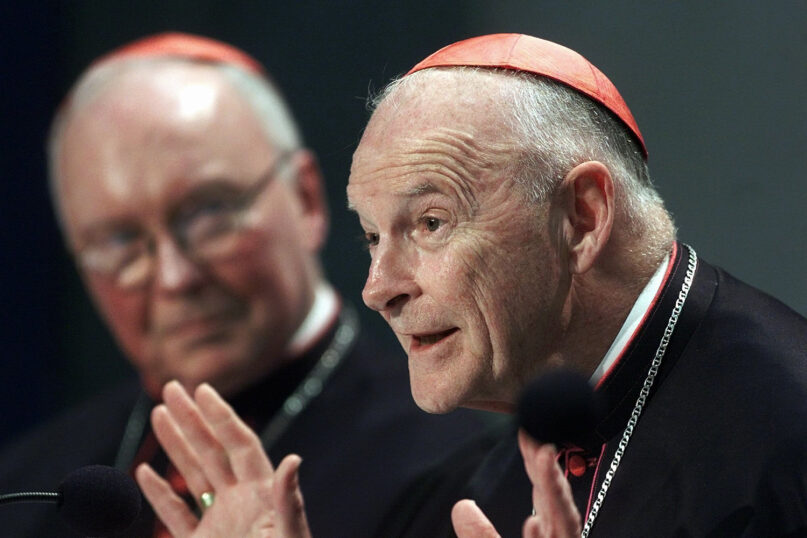
FILE - Former Washington Archbishop Cardinal Theodore McCarrick listens during a news conference in Washington, May 16, 2006. (AP Photo/J. Scott Applewhite, File)

Aleja Hertzler-McCain and Claire Giangravé
April 4, 2025


(RNS) — Defrocked Cardinal Theodore McCarrick, the highest-ranking U.S. Catholic prelate to face criminal charges for the sexual abuse of a minor, died Thursday (April 3), according to Vatican media.

In a statement, the current Archbishop of Washington, Cardinal Robert McElroy, told RNS, “At this moment I am especially mindful of those who he harmed during the course of his priestly ministry. Through their enduring pain, may we remain steadfast in our prayers for them and for all victims of sexual abuse.”

McCarrick, a greatly influential figure in the U.S. Catholic Church with a reputation as a fundraiser, also led the Diocese of Metuchen and the Archdiocese of Newark in New Jersey before becoming Archbishop of Washington in 2001, later being named cardinal by Pope John Paul II.

He was stripped of his cardinal rights and resigned from the College of Cardinals in 2018. He spent his last years in the Vianney Renewal Center in Missouri.

In 2002, McCarrick was among the U.S. prelates who drafted the “Charter for the Protection of Children and Young People.” He continued to hold an influential role in the church until 2016.


FILE – In this Monday, April 18, 2005 file photo, U.S. Cardinal Theodore Edgar McCarrick attends a Mass in St. Peter’s Basilica at the Vatican. (AP Photo/Pier Paolo Cito)

Reports of McCarrick sharing his bed with seminarians and other inappropriate behavior first emerged in 1994, but in 2018, reports from former seminarians and at least two minors in New Jersey detailed accusations that he had engaged in sexual misconduct. The New York Times reported that McCarrick had sexually abused an 11-year-old boy whom he had baptized, James Grein, in 1969. The abuse continued for 20 years.
RELATED: DC priest describes a culture of cover-up in wake of McCarrick scandal

The criminal case against McCarrick had been suspended since January 2024, after he was found incompetent to stand trial because of his dementia, but he was laicized in 2019 after a canonical trial found him guilty of “solicitation in the sacrament of confession and sins against the Sixth Commandment with minors and with adults, with the aggravating factor of the abuse of power.”

Cardinal Joseph Tobin, who now heads the Newark archdiocese, called McCarrick “a private individual with no affiliation with the Archdiocese of Newark for many years,” before saying, “I am keenly aware of the trauma this news may reignite for those victimized by Mr. McCarrick.” Recognizing “the deep pain and betrayal” of survivors, Tobin wrote, “I continue to offer my prayers in support as they navigate their journey toward healing.”


The Newark cardinal said, “As a Church, we remain steadfast in our commitment to listening to survivors, supporting their healing, and ensuring that such betrayals are never repeated.”

McCarrick’s case became a catalyst for the cause against the systemic culture of abuse in the church and was at the heart of the accusations of coverup and lack of accountability by the former papal nuncio to the U.S., Archbishop Carlo Maria Viganò.

Viganò wrote an open letter in 2018 accusing Pope Francis of removing sanctions on McCarrick placed by his predecessor Pope Benedict XVI between 2009 and 2010. A Vatican report published in November 2020 found that Pope John Paul II tapped McCarrick to head the diocese of Washington despite credible accusations against him, and Benedict XVI later asked the cardinal to discreetly retire from the public eye. The report also stated that Viganò failed to investigate the allegations at the time.


FILE – In this April 24, 2002 file photo, Washington Cardinal Theodore Edgar McCarrick, right, speaks at a news conference at the Vatican concluding a two-day meeting between Pope John Paul II and U.S. cardinals at the Vatican. (AP Photo/Santiago Lyon, File)

Terence McKiernan, president of watchdog group BishopAccountability.org, told RNS that, with McCarrick’s death, “ his many, many victims breathe a sigh of relief,” especially because “ even an elderly abuser is still a danger.”

McKiernan said, “ It is good that we now acknowledge the damage that he did, but there were so many missed opportunities to do that earlier,” pointing out that a 2020 Vatican report on McCarrick’s case “ substantially ignored the many children that (McCarrick) had abused.”


He added, “All of these missed opportunities are indications that the system still isn’t equipped or willing to deal with this kind of abuse.  I think the story of McCarrick in a way is the story of continued resistance to the realities of the situation.”

The Survivors Network of those Abused by Priests echoed McKiernan’s sentiments. “McCarrick was never held accountable for his crimes,” the organization wrote in a statement, and instead “was promoted, celebrated, and shielded by legions of bishops, cardinals, and even popes. Many of those same officials remain in positions of power today, unaccountable and unrepentant.”

Last month, SNAP announced an advocacy effort called Conclave Watch to raise awareness around the abuse records of several cardinals and to demand a universal, zero-tolerance law.


Former Cardinal Theodore McCarrick, left, arrives at Dedham District Court, Friday, Sept. 3, 2021, in Dedham, Mass. (AP Photo/Michael Dwyer)

“There is no reason to believe the next conclave won’t include more McCarricks — influencing, protecting, and electing one of their own, just like he did at the last conclave,” said Peter Isely, chair of the SNAP global advocacy working group. “That’s why the public must know who these candidates are.”

The shadow of McCarrick’s abuse has continued to hang over both the Washington and Newark archdioceses, as Cardinals McElroy and Tobin have faced accusations that they mishandled matters relating to McCarrick.

Tobin has recently faced blowback for promoting Monsignor Joseph Reilly as president of Seton Hall University. Reilly, who once served as a priest-secretary to McCarrick, has been accused of mishandling abuse allegations. In February, Tobin announced a third-party review of the 2019 investigation that implicated Reilly.


McElroy has been accused of ignoring warnings from whistleblower and researcher Richard Sipe about McCarrick’s abuse in 2016. The cardinal has said he took Sipe’s warnings seriously but that Sipe behaved in an untrustworthy manner when approaching him with the accusations, refusing to provide corroborating evidence and delivering a letter through a process server who impersonated a donor.

This story has been updated and corrected to better reflect McCarrick’s resignation from the College of Cardinals.


Religious leaders counsel victims, organize prayer gatherings amid violence in DR Congo


GOMA, Democratic Republic of the Congo (RNS) — Christian leaders are trying to help congregants suffering due to the current conflict and are organizing for peace.


FILE - Former members of the Armed Forces of the Democratic Republic of the Congo (FARDC) and police officers who allegedly surrendered to M23 rebels arrive in Goma, Congo, Sunday, Feb. 23, 2025. (AP Photo/Moses Sawasawa, file)


GOMA, Democratic Republic of the Congo (RNS) — Pastor Allan Ngwaba has been offering daily counseling sessions, both in churches and homes, to people affected by the violent conflict in the Congo.

The professional counselor and pastor at Rivers Pentecostal Church in Goma said many civilians he has met with are experiencing severe post-traumatic stress disorder since the violence and killings in the country escalated earlier this year. Their suffering, he said, is often a result of losing multiple loved ones, exposure to horrific images, witnessing human cruelty, the constant threat of death and a lack of basic necessities such as food and shelter.

“You need to listen to them during counseling sessions as they express their anger and cry uncontrollably about what has happened to them,” Ngwaba said. “Once they have been able to express themselves, you can begin discussing how to accept their situation, understand why the conflict occurred and explore the best ways to move forward and overcome their circumstances.”

The enduring conflict in Eastern Congo, which has devastated the region for decades, is rooted in the aftermath of Rwanda’s 1994 genocide and the fierce competition for control over the nation’s mineral resources. The minerals are used for manufacturing batteries that power electric vehicles and other electronics.

RELATED: Killed for fighting corruption, a Congolese man made a martyr is inspiring a new generation

Starting in January, the March 23 Movement known as M23, which is a Tutsi armed rebel group, began a new offensive against Congo government armies. M23 has gained control of new areas, including Eastern Congo’s two largest cities, Goma and Bukavu, along with several smaller localities.

The Congolese government said the ongoing fighting has killed at least 7,000 people since January. About 7.3 million are estimated to be displaced within the country — an all-time high — and 86,000 have fled to nearby countries, according to the United Nations Refugee Agency.


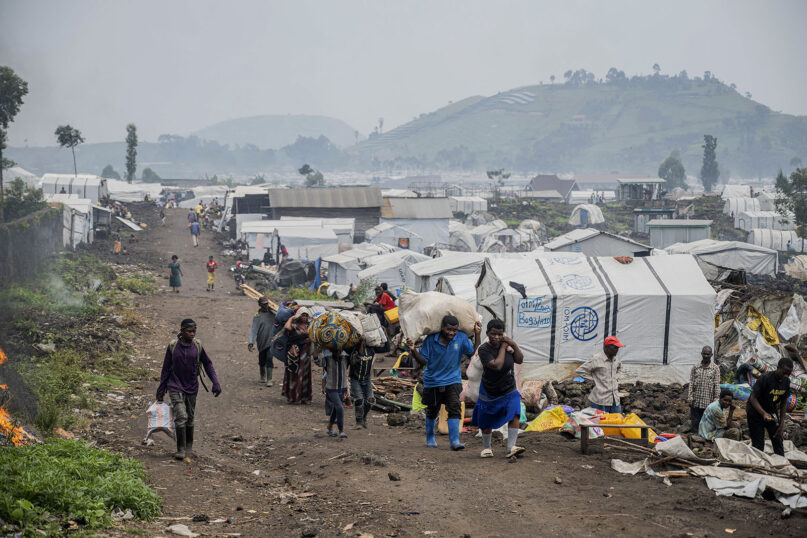
People who were displaced by the fighting between M23 rebels and government soldiers leave their camp after an instruction by M23 rebels in Goma, Congo, Feb. 11, 2025. (AP Photo/Moses Sawasawa)

According to the UN, M23 is supported by up to 4,000 Rwandan troops. However, Rwanda denies that claim, saying its forces are in the region to defend against threats posed by the Congolese army and hostile militias.

Amid the violence, Ngwaba is among many local Christian leaders who are increasing their efforts to provide psychosocial support to those affected.

“These sessions are designed to heal the emotional and social wounds caused by armed conflict,” he said. “They aim to discourage victims from succumbing to depression, contemplating suicide or losing hope,” emphasizing that psychological care is closely linked with physiotherapy.

His congregation and others in the area are also holding regular gatherings to pray for peace. Hundreds of Christians come to the daily gatherings in many areas of Eastern Congo.


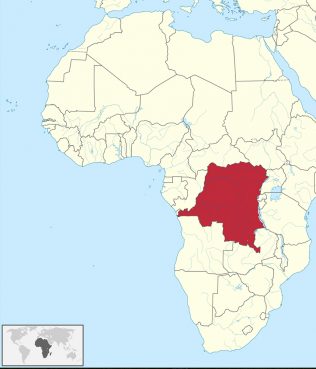
The Democratic Republic of the Congo in central Africa. (Map courtesy Wikimedia/Creative Commons)

“Our only hope is prayer because rebel soldiers are everywhere, and everyone is threatened by their presence,” said Grace Nsimba after leading a prayer session.

Nsimba, a 35-year-old mother of three, lost her husband and a brother during a fight between the Congolese army and M23 on Jan. 27, during the takeover of Goma.

“People are devastated and dying because of this war. What we need now is peace, and this can only be achieved through prayers,” she said. “We are praying for our lives and for those who have lost loved ones, those suffering because of the war and those who are traumatized by the horrifying things they have witnessed. We pray for an end to the conflict, hoping that the warring parties will stop the violence and save millions from death and suffering.”

In Bukavu, residents have been gathering for interfaith services to pray for peace following the capture of the city by M23 in mid-February.

Monsignor Floribert Bashimbe, vicar general of the Archdiocese of Bukavu, said the interfaith services, led by local religious leaders and officials, aim to unite the community, pray for an end to the conflict, uplift each other spiritually and address critical humanitarian needs in areas where daily struggles for basic necessities are impacting residents, although the city did not see as much heavy fighting as Goma did.

“We have come together in prayer, asking God to grant our leaders the wisdom, strength and humility to make sound decisions that will reduce loss of life and alleviate the suffering of the people, ultimately leading to security in the region,” Bashimbe said.

Bashimbe also urged young people and fighting factions to cease destroying property, including looting and burning houses, schools, government buildings and health centers. He encouraged trained counselors and religious leaders to assist those recovering from traumatic experiences and noted the importance of helping people rebuild their lives.
RELATED: Jews cannot remain silent about the murders of Christians in Congo

Some religious leaders have also engaged with rebels to attempt to facilitate a peace agreement. In February, Monsignor Donatien Nshole, the secretary general of the Bishops’ Conference of the DRC, was involved in such discussions. He said M23 leaders told his delegation they were not seeking to divide the country and were not involved in the illegal exploitation of resources.

M23 has claimed its goal is to protect ethnic Tutsis in Congo, who have suffered from the long-standing tensions between Hutus and Tutsis that culminated in the 1994 Rwanda genocide, during which more than 800,000 Tutsis and others were killed. The rebel group has also vowed to advance to the capital of Congo, Kinshasa, to overthrow the government.

During the meeting, the religious leaders urged the rebels to reopen infrastructure, like the airport and port, to facilitate the delivery of humanitarian supplies, he said.

“We still believe that the solution to this crisis is not military,” Nshole, a Catholic priest and political figure, said after the meeting.

However, residents are growing increasingly desperate for a resolution, grappling with the daily fear and uncertainty of life as rebels continue to advance.

“The longer these leaders remain in disagreement, the more lives are lost and suffering continues,” Nsimba said. “We must amplify our prayers for these leaders to come together and reach an agreement to end the conflict, so we can finally reclaim our peace.”