Tuesday, April 08, 2025


Hungary, Europe, and the International Criminal Court


Withdrawal Symptoms


Europe seems to be suffering paroxysms of withdrawal, notably when it comes to international conventions. Many states on the continent seem to have decided that international law is a burden onerous and in need of lightening. Poland, Finland and the three Baltic states, for instance, have concluded that using landmines, despite their indiscriminately murderous quality, somehow fits their mould of self-defence against the Russian Bear. That spells the end of their obligations under the Anti-Personnel Landmines Convention. Lithuania’s government has thought it beneath it to continue abiding by the Convention on Cluster Munitions, withdrawing last month.

The International Criminal Court now promises to be one member short. Hungary, under the rule of its pugilistic premier, Viktor Orbán, timed the announcement to wounding perfection. Knowing full well that Israel’s Prime Minister, Benjamin Netanyahu, faces an ICC arrest warrant for alleged war crimes and crimes against humanity in Gaza, and also knowing, full well, Hungary’s obligations as a member state to arrest him, Orbán preferred to do the opposite. That was an international institution both men could rubbish and bash with relish.

As far back as November, when the warrant was issued, the Hungarian leader had already promised that the order would not run in his country. An invitation to Netanyahu to visit was promptly issued. Spite was in the air. In February this year, Orbán ruminated on his country’s continued membership of the ICC. “It’s time for Hungary to review what we’re doing in an international organization that is under US sanctions!” he bellowed in a post on the X platform. “New winds are blowing in international politics. We call it the Trump-tornado.”

On the arrival of the Israeli leader for a four-day visit, there was a conspicuous absence of any law officer or police official willing to discharge the duties of the Rome Statute. The reception for Netanyahu featured a welcoming ceremony at the Lion Courtyard in Buda Castle.

Alongside Netanyahu at a press conference, Orbán trotted out the thesis that has long been used against any international court, or body, that behaves in a way contrary to the wishes of a government. “This very important court has been diminished to a political tool and Hungary wishes to play no role in it.” The abandonment of impartiality was evident by “it’s decisions on Israel.”

Netanyahu, who conveniently described the warrant for his arrest as “absurd and antisemitic”, brimmed with glee, calling the withdrawal “bold and principled” while directing his usual bile upon the organisation. (Judges, Israeli or international, are not esteemed in the Israeli PM’s universe.) “It’s important for all democracies,” he declared. “It’s important to stand up to this corrupt organisation.” Israeli Foreign Minister Gideon Sa’ar concurred. “The so-called International Criminal Court lost its moral authority after trampling the fundamental principles of international law in its zest for harming Israel’s right to self-defence.” A right, seemingly, to be exercised with defiant impunity.

Orbán should at least be credited for a certain unvarnished, vulgar honesty. Open contempt is its own virtue. Other European member states of the ICC have been resolutely mealy mouthed in whether they would execute their obligations under the Rome Statute were Netanyahu to visit them. France, for instance, claims that Netanyahu has immunity from prosecution before the ICC, a rather self-defeating proposition if you are in the international justice business. Italy, for its part, expressed doubts on the legal situation.

Germany, with its obstinate pro-Israeli stance, is one member state deeming the whole idea of arresting an Israeli leader unappetising, raising questions on whether its own membership of the court is valid. “We have spoken about this several times,” stated the country’s outgoing Chancellor Olaf Scholz at a very recent press conference in Berlin, “and I cannot imagine that an arrest would occur in Germany.”

Scholz’s successor, Friedrich Merz, has confirmed this blithe attitude to ICC regulations, having promised Netanyahu “that we would find ways and means for him to be able to visit Germany and leave again without being arrested. I think it is a completely absurd idea that an Israeli prime minister cannot visit the Federal Republic of Germany”. As absurd, implicitly, as an international justice system moored in The Hague.

This made the hypocrisy of Germany’s own criticism of Hungary’s withdrawal from the Rome Statute sharp and tangy, with Foreign Minister Annalena Baerbock lamenting the event as “a bad day for international criminal law”. Europe had “clear rules that apply to all EU member states, and that is the Rome Statute.” No mirror, it would seem, was on hand for Baerbock to reconsider the hollowness of such observations before the stance of her own government.

The response from the Presidency of the Assembly of States Parties to the Rome Statute, delivered in diplomatic if cool language, expressed “regret” at Hungary’s announcement. “When a State Party withdraws from the Rome Statute, it clouds our shared quest or justice and weakens our resolve to fight impunity.” The statement goes on to make the fundamental point: “The ICC is at the centre of the global commitment to accountability, and in order to maintain its strength, it is imperative that the international community support it without reservation.” Hungary’s exit, and European qualifications and niggling subversions of the Court, show that reservations are all the rage, and justice a nuisance when applied inconveniently.

Binoy Kampmark was a Commonwealth Scholar at Selwyn College, Cambridge. He lectures at RMIT University, Melbourne. Email: bkampmark@gmail.comRead other articles by Binoy.

Are There Trump Internment Camps for Political Opponents in America’s Future?

Japanese Americans gather at Santa Anita Assembly Center in 1942 shortly before being shipped off to one of the 10 internment camps set up by the U.S. government in World War II.

Japanese Americans gather at Santa Anita Assembly Center in 1942 shortly before being shipped off to one of the 10 internment camps set up by the U.S. government in World War II.

Is there a Trump Internment Camp in your future?  In addition to scooping immigrants up off the streets and disappearing them, will the Trump administration start arresting and incarcerating its domestic political opponents? Will Trump Inc. partner up with Geo Group, the nation’s largest private prison company, that gave a million dollars to a super PAC supporting Trump’s campaign? Imagine the manosphere humming with snatch-and-grab job opportunities for the now-pardoned January 6 insurrectionists?

Consider some recent developments: The abduction by Immigration and Customs Enforcement agents of Mahmoud Khalil, a legal permanent resident who was clearly detained because of his pro-Palestinian activism at Columbia University; a video of masked ICE agents — essentially secret police — near Boston stopping and arresting Rumeysa Ozturk, a Turkish national and PhD student at Tufts University, who is in the U.S. on a valid visa; the deportation of 250 purported Venezuelan gang members to a notorious gulag in El Salvador with no due process, in defiance of a federal court order that the plane deporting them turn around and come back to America.

Internment/Concentration Camps

The terms “internment camps” and “concentration camps” are sometimes used interchangeably, but they have had distinct historical and functional differences. Internment Camps have been primarily used to detain specific groups considered security risks during wartime, and political opponents. During World War II, more than 100,000 people of Japanese descent living on the West Coast were rooted from their homes and forcibly relocated to 10 hastily constructed camps. The interned lost their property, were isolated and suffered major deprivations.

Concentration Camps — also known as Death Camps — have generally been associated with mass detention, harsh conditions, forced labor, and extermination. Historically, they have been used to imprison perceived enemies of the state, political opponents, ethnic groups, or other marginalized populations.

The historian Roger Daniels, author of Words Do Matter: A Note on Inappropriate Terminology and the Incarceration of Japanese Americans, concluded that “scholars should abandon the term” Japanese internment and use the term concentration camp.

Setting the stage

During the 2024 presidential campaign Trump said that immigrants were “poisoning the blood of the country” — rhetoric eerily reminiscent from Adolf Hitler’s Mein Kampf. On the campaign trail, vice-presidential candidate JD Vance escalated immigrant-bashing rhetoric with claims that Haitian immigrants in Ohio were stealing and eating their neighbors’ pets.

In a Truth Social post, Trump said he was looking “forward to watching the sick terrorist thugs get 20 year jail sentences for what they are doing to Elon Musk and Tesla.” He added that “Perhaps they would serve them in the prisons of El Salvador, which have become so recently famous for such lovely conditions.”

As people are being dragged off the streets across America, it is time to consider the revival of internment camps in this country not only for immigrants, but for Trump’s political opponents as well.

The U.S. used internment camps during World War II, and more recently for alleged terrorists at Guantánamo Bay in Cuba. Justification for internment in these camps vary from military necessity, to national security, but the underlying function remains consistent: isolating and punishing perceived enemies of the state.

Alternet’s Alex Henderson recently reported on the possible reintroduction of detention camps to sequester opponents of Donald Trump. “Some fear that the U.S. could emulate the ‘illiberal democracy’ model of Prime Minister Viktor Orbán in Hungary, where technically, there are still voting rights, but checks and balances are so eroded that the Fidesz Party is entrenched and dominant,” Henderson wrote. “Others fear an even more disturbing scenario in which the U.S. embraces an outright military dictatorship like Chile under Gen. Augusto Pinochet or Spain under Gen. Francisco Franco, a.k.a. ‘El Generalísimo’.”

Journalist Christopher Mathias’ forthcoming book is called To Catch a Fascist. In a recent MSNBC op-ed, he noted that, “over the last eight years as a reporter covering the far right, … neo-Nazi talking points, especially around immigration, [has] enter[ed] the mainstream discourse with horrifying, accelerating speed.”

Mathias noted that in a conversation with Fox News host Laura Ingraham, “JD Vance asserted that Germany is suffering an ‘invasion’ of people who are ‘totally culturally incompatible’ with ‘western civilization.’ This purported ‘invasion,’ Vance said, will lead to a ‘civilizational suicide’ if it’s not stopped. It barely triggers a 24-hour news cycle anymore when the vice president and …Trump, use the same language as fascist mass murderers.”

Mathias interviewed Andrea Pitzer, author of One Long Night: A Global History of Concentration Camps, who told him that “Concentration camp regimes always need a group they can turn into outsiders by making its members seem so dangerous that the government needs to remove those people from society. You can’t typically do that without years — years! — of rhetoric demonizing them. Even with the Nazis, it took more than five years from Hitler becoming chancellor of Germany until the mass roundup of Jews as a group began with Kristallnacht in November 1938.”

Pitzer’s One Long Night, which looks at concentration camps from their origins in the late 19th century to modern-day detention facilities. Historically, these camps, across different countries and political ideologies, have been used as tools of oppression, control, and genocide. Concentration camps were used during the Spanish-Cuban war, by the British during the Boer War, Nazi concentration camps, Soviet gulags.

Terrorizing the opposition

Mathias noted that “In Myanmar in 2015, the regime allowed journalists to visit the camps where Rohingya Muslims were being detained. In Augusto Pinochet’s Chile in the 1970s, photographers were allowed into the National Stadium, where people were being detained and tortured. ‘Even the Nazis allowed New York Times and Times of London reporters into their early concentration camps in 1933,’ Pitzer told him. ‘They wanted their targets to be terrified, but they were proud of what they were doing.’”

“The arc of concentration camps is twofold,” Pitzer told Mathias. “First, there’s supposedly some very bad group so dangerous that the government says they have to be removed from society. Second, the definition of who’s dangerous expands, often coming to include political opponents and rivals.

“If the government can arrest civilians with no criminal record and put them on planes out of the country without accounting for who they are or for any actual legal process — as has been happening in recent weeks — what would stop them from deporting whomever they like?” Pitzer continued. “Or from saying they had deported detainees while actually disappearing people to black sites internally? If the courts can’t enforce due process and find out who’s being detained, where they are now and what’s happening to them, then we’re all vulnerable.”

Given the Trump Administration’s predilection for demonizing political opponents and the mainstream media, defying judicial orders, and trampling on the rule of law, is it wishful thinking or delusional to believe that internment camps can’t happen here?

Bill Berkowitz is a longtime observer of the conservative movement. Read other articles by Bill.

 Hamas Succeeded in Exposing the True Face of the Empire

One thing October 7 did accomplish was getting Israel and its allies to show the world their true face. Getting them to stand before all of humanity to say, “If you resist us, we’ll kill your babies. We’ll deliberately shoot your kids in the head. We’ll massacre medical workers. We’ll systematically destroy all your hospitals. We’ll rape you and torture you as a matter of policy. We’ll lay siege to the entire civilian population. We’ll make your entire land uninhabitable and then we’ll kick you all out and take it for ourselves. We’ll assassinate all your journalists and block foreign journalists from entry so that nobody can see what we’re doing to you. We’ll lie about all of these things the entire time, and you’ll know we’re lying, and we’ll know you know we’re lying, and you’ll know we know you know we’re lying. And we’ll get away with it anyway, because we hold all the cards.”

Sometimes I’ll run into people who say “What did Hamas expect to happen? They had to know Israel would do this!” They say this in an effort to lay the blame for Israel’s genocidal atrocities at the feet of Hamas, as though Israel is some kind of wild animal who can’t be held accountable for its actions if someone gets too close to its mouth.

But of course Hamas knew Israel and its allies would react this way. Of course they did. They knew they were dealing with a murderous and tyrannical civilization who is capable of limitless evil and doesn’t see Palestinians as human beings. They knew it because they’d lived under it all their lives. That is the problem they were trying to address with their actions on October 7.

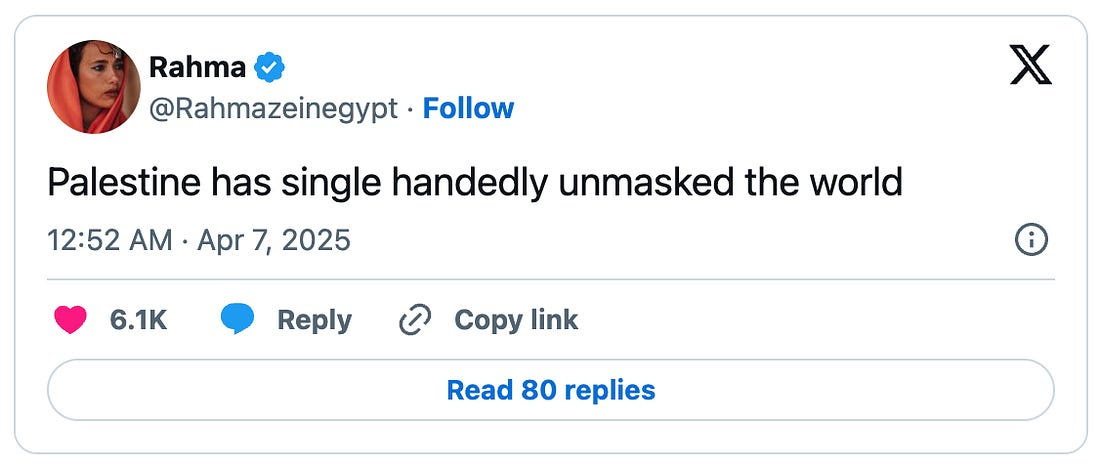
https://x.com/Rahmazeinegypt/status/1908895485114413512

You can disagree with the decisions Hamas made on that day. You can say they should have used other means to pursue justice. You can denounce them, hate them, do the whole public ritual necessary for mainstream acceptance in western society. But one thing you can’t do is deny that Israel and its allies have been revealing their true face to the world every day since, at levels they previously were not.

It’s all fully visible now. It’s all right there on the surface. We can try to continue pretending we live in a free society that believes in truth and justice and regards all people as equal, but we’ll all know it’s a lie. What we are, first and foremost, is a civilization that will actively support history’s first live-streamed genocide. That’s the single most relevant fact about the western world at this point in history. It’s staring us right in the face every day.

October 7 certainly didn’t make life any easier for the Palestinians, but one thing it did do was take away our ability to hide from ourselves. Hamas reached thousands of miles around the world and permanently destroyed our ability to avoid the truth about the kind of dystopia we are really living in. Our rulers may succeed in eliminating the Palestinians as a people, but one thing they will never be able to do is put those blinders back on our eyes.

What has been seen cannot be unseen.

Caitlin Johnstone has a reader-supported Newsletter. All her work is free to bootleg and use in any way, shape or form; republish it, translate it, use it on merchandise; whatever you want. Her work is entirely reader-supported, so if you enjoyed this piece and want to read more you can buy her books. The best way to make sure you see the stuff she publishes is to subscribe to the mailing list on Substack, which will get you an email notification for everything she publishes. All works are co-authored with her husband Tim Foley. Read other articles by Caitlin.


Meet the DC Think Tanks Impoverishing Masses of Latin Americans


These top Washington think tanks are lobbying lawmakers for sadistic sanctions on some of the hemisphere’s poorest countries while raking in millions from corporations and arms makers.

Sanctions are a form of hybrid warfare that harms or even kills the target populations at little cost to the country imposing them. In Latin America alone, US sanctions (correctly known as “unilateral coercive measures”) have killed at least 100,000 Venezuelans. The US blockade of Cuba has been so destructive that one in ten Cubans have left the country. Sanctions have similarly deprived Nicaraguans of development aid worth an estimated $3 billion since 2018, hitting projects such as new water supplies for rural areas.

Who formulates these devastating sanctions, covers up their real effects, works with politicians to put them into operation and promotes them in corporate media? In a perverse contrast with the poor communities hit by these policies, those doing the targeting are often well-paid employees of multi-million-dollar think tanks, heavily funded by the US or other Western-aligned governments and in many cases by arms manufacturers.

A study in corruption: top think tank lobbyists and their funders

Chief among these groups is the Wilson Center, which claims to simply provide policymakers with “nonpartisan counsel and insights on global affairs.” Boasting a $40-million budget, a third of which comes from the US government, the organization is headed by the former Administrator of USAID, Amb. Mark Green.

In 2024, the Wilson Center boosted its efforts to meddle in Latin America with the creation of the “Iván Duque Center for Prosperity and Freedom,” naming its newest initiative for the wildly unpopular former Colombian president largely remembered for his violent crackdown on students protests, his obsessive focus on regime change in Venezuela, and intentionally crippling the 2016 peace deal meant to end decades of civil war in Colombia.

While Duque has not produced much in the way of scholarship since joining the Wilson Center, he is living his best life at Miami nightclubs, where he’s frequently seen in as a guest DJ or regaling partiers with renditions of Spanish language rock hits.

Ivan Duque, chair of the Wilson Center’s newest Latin America initiative, at a Miami nightclub

As Mark Green explained, the Iván Duque Center “is a way for us to reaffirm both the importance of the Western Hemisphere in American foreign policy and the promise that democracy and market-centered economics must play in the region’s future.” When it comes to nations that oppose US foreign policy in the region, it’s also a way to fund their most vocal critics, who receive a stipend of $10,000/month upon being named Wilson Center fellows.

Other Duque fellows include right-wing Venezuelan putschist Leopoldo López, who graduated from Kenyon College and Harvard Kennedy School, two schools closely linked to the CIA, before attempting to orchestrate coups against the Venezuelan government in 2002, 2014, and 2019.

Also on the Wilson Center payroll is former US ambassador to Venezuela William Brownfield, another regime change fanatic. Six years ago, when Caracas was undergoing its heaviest assault from US sanctions, Brownfield called for the US government to go even further, claiming that because Venezuelans “already suffer so much… that at this point maybe the best resolution would be to accelerate the collapse” of their country, while freely admitting that his preferred outcome would likely “produce a period of suffering of months or perhaps years.”

The Wilson Center is far from alone in seeking to depose the authorities in Caracas. Another think tank, the Atlantic Council – which receives around $2 million annually from the US government and a similar amount from Pentagon contractors – has assembled a 24 member-strong Venezuela Working Group featuring a former State Department officials, a former member of the CITGO board, and multiple members of the so-called “interim Venezuelan government” which has been accused of stealing over $100 million in USAID funds.

While the group ostensibly “informs policymakers in the United States, Europe, and Latin America on how to advance a long-term vision and action-oriented policies to foster democratic stability in Venezuela” and “promotes the restoration of democratic institutions in Venezuela,” in practice this means it’s fundamentally dedicated to ending the Maduro government.

The Atlantic Council – a de facto influence peddling operation that functions as the unofficial think tank of NATO in Washington – aims for a similar result in Nicaragua. In an 2024 article titled, “Nicaragua is consolidating an authoritarian dynasty – Here’s how US economic pressure can counter it,” Atlantic Council researcher Brennan Rhodes called for “new punitive economic measures” on the Sandinista government which would heavily damage Nicaragua’s trade with the US, its main export market. The article betrayed no concern for the inevitable effects on hundreds of thousands of Nicaraguans who rely on this trade, and whose earnings are likely a fraction of the average Atlantic Council employee.

Among the oldest think tanks dedicated to US global dominance is the Council on Foreign Relations (CFR), which boasts a 100-year “independent, nonpartisan” history of interfering in other countries. A review of its regularly-posted updates on Cuba shows the CFR well aware that the country’s economy, hammered by six decades of economic blockade by the US, had reached a new crisis point after Biden broke his promises to relieve intensified Trump-era sanctions. Yet in a 2021 CFR forum on how to bring down the Cuban government, US-based lawyer Jason Ian Poblete argued that the screw should be twisted still further: “We should bring all tools of state, every single one, to bear on this – not just sanctions.”

Joining the Atlantic Council and the CFR in meddling in the affairs of the US’ southern neighbors is the Center for Strategic and International Studies (CSIS), which claims it’s “dedicated to advancing practical ideas to address the world’s greatest challenges.” All three groups are listed on the Quincy Institute’s page showing the “Top 10 Think Tanks That Receive Funding from Pentagon Contractors.” Led by its Americas director, Ryan Berg, CSIS maintains active programs calling for sanctions in Venezuela, Cuba, and Nicaragua. The group regularly holds events featuring US-backed opposition figures such as Venezuelan María Corina Machado and Nicaraguans Félix Maradiaga and Juan Sebastián Chamorro.

Collectively, these groups dominate the US information sphere, saturating mainstream airwaves with complaints about the “authoritarian” socialist-leaning governments and demands for their ouster. On the off-chance that an official from one of the major think tanks is unavailable to comment, there are a number of smaller organizations ready to plug the gap.

Enduring demand for deprivation

One of the most vocal Beltway think tanks on Latin American affairs is the Inter-American Dialogue (“leadership for the Americas”), which works alongside CSIS and which is also heavily funded by arms contractors and the US government. Recently, as The Grayzone reported, CSIS’s Berg collaborated with the Dialogue’s Manuel Orozco – who moonlights as the Central America and the Caribbean chair of the US government’s Foreign Service Institute – to try to cut Nicaragua’s access to one of its only remaining sources of development loans.

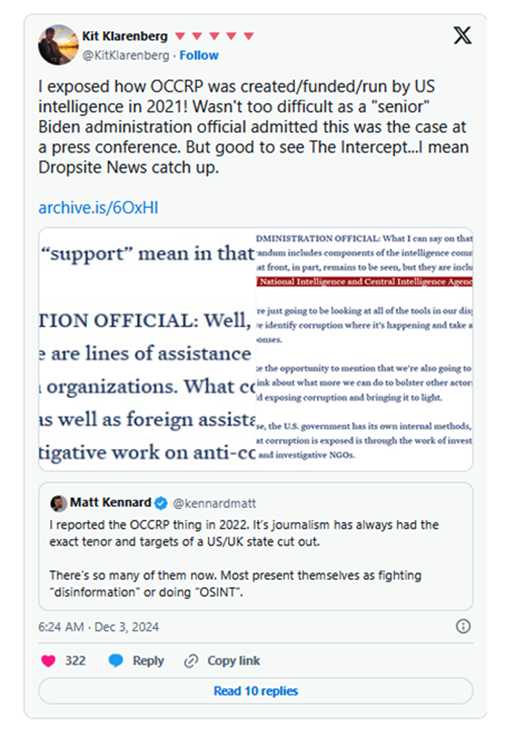
The Dialogue was assisted in this by two more think tanks. One is the Organized Crime and Corruption Reporting Project (OCCRP), which bills itself as “one of the largest investigative journalism organizations in the world,” and which receives a full half of its budget from the US government. OCCRP works with similarly-funded Transparency International to engage in regime change operations by digging up dirt on foreign administrations targeted by Washington.

Another group heavily involved in the sanctions industry is the Center for Global Development, whose name might seem ironic given that it provides a platform for those promoting deadly economic coercion. Its $25 million annual budget is funded mainly from sources such as the Gates Foundation, as well as several European governments. One of its directors, Dany Bahar, recently called for intensified sanctions against the Venezuelan government to stamp out the “temporary economic improvements” that the country is currently enjoying.

Not all of the shady organizations seeking to impoverish Latin Americans in the name of hegemony are based in the US, however. Britain’s Chatham House, which relies heavily on the UK and US governments as well as arms manufacturers for its £20 million annual budget, also calls for the “restoring of democracy” in Venezuela, and often gives platforms to opponents of the governments in Caracas and Managua. Though skeptical of the efficacy of sanctions on Venezuela, it nevertheless concluded in Jan. 2025 that “restoring oil and gas sanctions” would be “logical” as long as the bans were part of “a broader diplomatic, coordinated multinational policy with specifically defined objectives.” The few criticisms it’s produced of the US embargo on Cuba have centered largely on its failure to affect regime change.

Only one longstanding Beltway think tank, the Brookings Institution, has been willing to platform a slightly more skeptical view of sanctions. A 2018 op-ed from a Venezuelan economist published by Brookings explicitly counseled that sanctions on Venezuela “must be precise in order to spare innocent Venezuelans.” The year prior, Brookings argued that Trump’s sanctions against Cuba were unlikely to “put much of a near-term dent in the Cuban economy… [nor] reduce the influence of the armed forces,” but would have “a disproportionately negative impact on Cuba’s emerging private sector and on non-military employment in linkage industries—not to mention restricting Americans’ right to travel.” Broadly speaking, however, Brookings largely adheres to the trans-Atlantic consensus which demands the overthrow of the countries that former Trump National Security Advisor John Bolton once smeared as the “troika of tyranny.”

Lobbyists by another name

Think tanks operate in a privileged space, gaining credibility from their links with the academic world while ensuring that their policymaking is closely geared to imperial needs. In the US alone there are more than 2,200 such organizations, some 400 of which specialize in foreign affairs. In recent years, they’ve become ubiquitous, with one-third of witnesses to the House Foreign Affairs Committee coming from think tanks – 80% of whom are paid by what Responsible Statecraft labels defense contractor “dark money.”

These organizations’ collective groupthink on sanctions – particularly on those targeting Venezuela – give the lie to the “independence” they all claim. Political scientist Glenn Diesen opens his recent book, The Think Tank Racket, by noting that these institutions’ “job is to manufacture consent for the goals of their paymasters.” He says that these “policymaking elites… confirm their own biases rather than conduct real debates.” Once their work is done, they “retire to expensive restaurants where they slap each other on the back.”

In an unusually self-critical piece explaining “Why Everyone Hates Think Tanks,” the Wilson Center’s Matthew Rojansky and the European Council on Foreign Relations’ Jeremy Shapiro explain that these organizations have become lobbyists by another name, whose donors simply want “veteran sharpshooters to fire their policy bullets.” As far back as 2006, journalist Thomas Frank observed that think tanks have “grown into a powerful quasi-academy with seven-figure budgets and phalanxes of ‘senior fellows’ and ‘distinguished chairs’.”

This business model is only one aspect of the “racket.” As Diesen points out, and as Colombia’s Iván Duque center proves, think tanks provide a revolving door where out-of-office or failed politicians and their advisers can continue to influence public policy – while collecting a fat paycheck, too.

John Perry is based in Masaya, Nicaragua and writes for several independent media. Read other articles by John.

 “All Governments Lie”: Why We Need a Radical and Independent Free Press Now

If the Government makes a mistake, the newspapers will find out and the problem may then be fixed. But if freedom of the press were lost, the country would soon go to pieces. -- IF Stone


Media scholar Carl Jensen was deeply influenced by the independent muckraking journalists of the twentieth century—so much so that he founded Project Censored at Sonoma State University, in 1976, in the wake of the Nixon administration’s Watergate scandal, as a watchdog organization focused on exposing “the news that didn’t make the news.” Project Censored began in a sociology course Jensen taught at Sonoma State, but quickly evolved into a national effort to promote independent journalism and news literacy. The Project produced an annual list of the most important investigative news reports, which attracted attention—and praise—from some of Jensen’s best-known contemporaries, including broadcast journalists Walter Cronkite and Hugh Downs, reform activist Ralph Nader, and a contemporary muckraker, investigative journalist I.F. “Izzy” Stone.

Jensen’s purpose was not to tear down so-called “mainstream” media outlets but to constructively criticize their news judgment. By showing what the major media missed, or even “censored,” he hoped to improve what he saw as the lifeblood of democracy: a truly free press. Industry professionals didn’t always take kindly to such criticism, which led Jensen to turn his critique into a systematic study of what they did cover. He discovered a morass of fluff, sensationalism, and pap—what used to be called “yellow journalism” in the early 1900s. Jensen called it Junk Food News in 1983. He saw that the public would ultimately pay the price for the major media outlets’ myopic focus and critical omissions in the form of accelerating civic decay. Sadly, he wasn’t wrong.

Today, we are awash in 21st-century versions of junk food news, as produced by corporate media and propagated on social media. Worse, we are also subject to ‘round-the-clock infotainment and propaganda masquerading as journalism, what Jensen’s successor, sociologist Peter Phillips, called News Abuse in the early 2000s (now also referred to as malinformation). Of course, numerous media critics and scholars—including Edward Herman, Noam Chomsky, Ben Bagdikian, Neil Postman, and Robert McChesney—have long warned against rising levels of mis- and disinformation, increased consolidation of media ownership, and their combined toll on press freedom and a well-informed public. In the last decade, with the moral panic around the weaponized epithet of “fake news,” these challenges have spawned a cottage industry of so-called fact-checkers—supposedly objective third parties trying to reverse the troublesome trend of declining public trust in the Fourth Estate.

However, most of those efforts have been exposed as Trojan horses for re-establishing corporate media dominance in a digital era of podcasts, TikTok, Instagram reels, and “tweets” (or “posts” as they are now called on X). As Wall Street Journal editor-in-chief Emma Tucker bemoaned last year at the World Economic Forum (WEF) in Davos, news industry leaders are losing control of the narrative (emphasis added):

If you go back really not that long ago, as I say, we owned the news. We were the gatekeepers, and we very much owned the facts as well. If it said it in the Wall Street Journal, the New York Times, then that was a fact. Nowadays, people can go to all sorts of different sources for the news, and they’re much more questioning about what we’re saying. So, it’s no longer good enough for us just to say, this is what happened, or this is the news. We have to explain– almost like explain our working. So, readers expect to understand how we source stories. They want to know how we go about getting stories. We have to sort of lift the bonnet, as it were, and in a way that newspapers aren’t used to doing and explain to people what we’re doing. We need to be much more transparent about how we go about collecting the news.

“Lift the bonnet.” “Explain to people what we’re doing.” It’s almost as if the public wants more fact-based, transparently sourced reporting in their news, not partisan propaganda. And, go figure, in a rabidly consumerist culture, they want receipts too. Tucker seems to agree, though the corporate media and their advertisers/investors from Big Pharma, Big Tech, the Military-Industrial Complex, and other powerful institutions whose narratives the public is questioning, likely do not. For Tucker and other gatekeepers, this public scrutiny is inconvenient, perhaps even impertinent, but also a market reality news organizations must now at least pay lip service to addressing. Perhaps this is what has contributed to record-low levels of approval and trust of the news media among the public.

Indy Journalism Can Build Public Trust While Fighting Fake News

Media scholars have described this conundrum as an epistemic one, the ushering in of a “post-truth” world “in which objective facts are less influential in shaping public opinion than appeals to emotion and personal belief.” The mis- and disinformation ecosystem that has emerged in this post-truth climate has establishment institutions from the WEF to Congress and the mass media themselves clutching pearls. Even the American public has come to believe that the lack of trustworthy information is a greater threat than terrorism. With the return of Donald Trump to the presidency, these concerns, along with increasing existential attacks on journalists and the news media itself, including ABCCBSNPR/PBS, and even the Associated Press as “enemies of the American people,” are growing rapidly and in unprecedented ways.

There certainly are major issues with corporate media and establishment outlets, which we at Project Censored have documented for nearly half a century. However, our critiques are not meant to undermine major media for partisan gain. Instead, the Project’s criticisms of corporate news expose systemic gaps and slant in coverage, in order to pressure the nation’s most prominent news outlets to use their massive budgets and influence to serve the public good, rather than private interests, by holding corporate and government abusers of power accountable. Given the well-documented limitations of corporate media, we support a robust, independent, and public media system, because a commercial, for-profit model cannot “tell the people what is really going on,” as George Seldes once put it. The solution to our present journalistic woes does not lie with industry leaders, biased fact-checkers, or Big Tech content moderators. It rests on critical media literacy and a fiercely independent free press.

In support of this proposed solution, Project Censored advocates for a healthy democracy by promoting news literacy education, especially by providing hands-on training in critical media literacy for students, through our curriculum, student internships, and Campus Affiliates Program, each of which distinguishes Project Censored from other news watch organizations and press freedom groups. Further, each year, Project Censored also recognizes some of the best independent journalists, reporting factually, transparently, and ethically in the public interest, pointing out that these are among the best advocates of news literacy, literally teaching by example. So, ironically, the very solutions to the revitalization of our failing Fourth Estate are its most radical independent practitioners, not their owners/employers or meddling partisan outsiders. History shows this to be the case, and we should listen to what the past can teach us.

“All Governments Lie”

Among the many books Jensen published, one of the most significant might be Stories That Changed America: Muckrakers of the 20th Century. In it, he collected exemplary work by nearly two dozen legendary journalists, his selection of the previous century’s most significant truth-tellers, including excerpts from decisive reports by Ida Tarbell (The History of the Standard Oil Company), Lincoln Steffans (The Shame of the Cities), Upton Sinclair (The Jungle and The Brass Check), George Seldes (In Fact), Edward R. Murrow (In Search of Light), and I.F. Stone (I.F. Stone’s Weekly). As Jensen wrote, “Their words led to a nationwide public revolt against social evils and [decades] of reforms in antitrust legislation, the electoral process, banking regulations, and a host of other social programs.” The reporting Jensen collected in Stories That Changed America continues to inspire those of us who believe journalism can make a difference.

“All governments lie, but disaster lies in wait for countries whose officials smoke the same hashish they give out,” the iconic muckraker “Izzy” Stone once wrote. But Stone had great faith in the power of the press to expose and counter those lies. We need brave, independent journalists and newsrooms to tackle the most controversial and suppressed issues of our era. Stone relentlessly exposed governmental prevarications and injustices throughout his career. He also saw the shortcomings of his own profession, to the point of resigning from the National Press Club in 1941, rather than kowtowing to its racism and political sycophancy. After realizing he had limited influence in the establishment press, he started I.F. Stone’s Weekly and dared to report the truth on his own. He took on McCarthyism at a time when his peers were being attacked, arrested, deported, and disappeared. He fought for truth and peace in the face of the unjust, murderous conflicts of the Cold War, especially in Vietnam. Sound familiar?

Governments lie. Stone’s insight is timeless, but it seems more relevant than ever in 2025. The Trump administration and its enablers bombard us daily with lies and half-truths, what Reporters Without Borders has characterized as “a monumental assault on freedom of information.” At best, the establishment press seems capable of little more than chronicling the barrage; at worst, they capitulate to it.

The notion of a press “watchdog” on a governmental leash did not begin with the current administration—as Jensen and his students at Sonoma State noted in 1976 looking back on the eve of Richard Nixon’s re-election, no major news outlet even mentioned the Watergate scandal—and the roots of a subservient press reach back to the earliest history of American journalism on the presidency. But the return of Trump to power is a nadir for many of our cherished freedoms, including those of the First Amendment, which links freedom of speech and press with the rights to assemble and petition—and the public, our democracy, needs journalism that can help us awaken from what historian Timothy Snyder has described as a “self-induced intellectual coma” that is characteristic of  “the politics of inevitability.”

The Izzy’s Are Coming!

Calling out counter-democratic measures is one way to resist the onslaught of authoritarianism. A free press provides the means for this, but people need to act in response. Rather than complain that “the left” needs a media power like Rupert Murdoch’s to “compete,” we should open our eyes and support the amazing people and organizations doing this invaluable work already. Project Censored highlights the most important but under-reported independent news stories each year, promoting the work of independent journalists, news outlets, and press freedom organizations that exemplify “media democracy in action.” Their work embodies the very spirit of resistance and amplifies the voices of those trammeled by oligarchs and would-be despots.

The Park Center for Independent Media (PCIM) at Ithaca College shares this ethos, supporting independent media as a bulwark against everyday injustices and creeping tyranny. Among the only academic centers of journalism in the United States focused solely on independent media, each year, PCIM honors the leading independent journalists of our time with its Izzy Award, named in honor of I.F. “Izzy” Stone. April 30 marks the seventeenth annual award ceremony, which will also be the occasion for numerous muckraking journalists and free press organizations to convene and build coalitions, strengthen solidarity, and fight to protect our democratic republic from anyone, whether they bat for Team Red or Team Blue, who would subvert it for their own private gain.

The Izzy Award celebrates the practice of radical muckraking journalism in the public interest, and its continuing relevance in our current Gilded Age of Big Tech plutocracy. The work at PCIM and Project Censored reminds us that we cannot wait for change to simply emerge; we must create it ourselves. If past is prologue, we also have much to learn from and pass on to the next generation, whose experiences and voices will inform and express the stories that change America again, to paraphrase Jensen.

Now is not a time for cowering; it is a time to exhibit what political activist and whistleblower Daniel Ellsberg called civil courage, regardless of the odds. Or, as Izzy noted, it is time “to defend the weak against the strong; to fight for justice; and to seek, as best I can to bring healing perspectives to bear on the terrible hates and fears of [humankind], in the hope of someday bringing about one world, in which [people] will enjoy the differences of the human garden instead of killing each other over them.”

Hear, hear. Let’s not get lost in the smoke of the hashish blown in our faces by elite media and government actors. Let’s instead recognize and support the reportorial canaries in the coal mines, from the climate crisis and Kafkaesque raids on the vulnerable among us to the dismantling of education, attacks on the arts, and an ongoing genocide. Let’s act on the information independent journalists share at their own risk, for we ignore them at our own.

Mickey Huff is the third director of Project Censored (founded in 1976) and is the president of the nonprofit Media Freedom Foundation. Huff joined Ithaca College in New York fall of 2024, where he now also serves as the Distinguished Director of the Park Center for Independent Media and Professor of Journalism. Since 2009, he has coedited the annual volume of the Censored book series with associate director Andy Lee Roth, published by Seven Stories Press in New York, and since 2021 with The Censored Press, the Project’s new publishing imprint. His most recent books include Project Censored’s State of the Free Press 2025, co-edited with Shealeigh Voitl and Andy Lee Roth (The Censored Press/Seven Stories Press, 2024); The Media and Me: A Guide to Critical Media Literacy for Young People (co-authored with Project Censored and the Media Revolution Collective, The Censored Press/Triangle Square, 2022), as well as Let’s Agree to Disagree: A Critical Thinking Guide to Communication, Conflict Management, and Critical Media Literacy (Routledge, 2022) and United States of Distraction: Media Manipulation in Post-Truth America (and what we can do about it), published by City Lights Books, 2019, both co-authored with Nolan HigdonRead other articles by Mickey.