Sunday, May 25, 2025

Tears of Blood: Eugenics, Disposability, and


the War on Children



May 23, 2025

Photo by M ZHA

Violence, soaked in blood and stripped of shame, has become the defining language of governance in the age of Trump and the global resurgence of authoritarianism. Across the globe, democracy is in retreat, and with it, the very notion of moral and social responsibility. In its place, we find a brutal political grammar scripted by modern-day barbarians, disciples of greed, corruption, racial purity, ultra-nationalism, and permanent war. Compassion is mocked as weakness. The social state is vilified and hollowed out, derided in the language of a deranged anti-communism. And policies that produce mass suffering, engineered by the powerful and shielded by the myths of meritocracy and social Darwinism, are deemed not only acceptable, but inevitable.

 Among the MAGA elite, democracy is no longer a cherished ideal but a target of scorn and contempt. Echoing Hungary’s Viktor Orbán, democracy is now replaced with illiberal democracy, with its call to eliminate racial mixing and unleash a torrent of repression against free speech, universities, the press, and organized dissent. In this case, fascist politics and strategies have become the new governing norm. Embracing the playbook of ruthless dictators such as Putin and Orbán, Trump expands presidential power, wages war on the rule of law  and dismantles democratic institutions, especially those that nurture critical thought, all the while feigning uncertainty about whether the Constitution even applies to him.

Trump’s financial backers and ideological allies, like Peter Thiel, openly endorse authoritarianism, with Thiel bluntly declaring that freedom and democracy are no longer compatible. Trump’s sycophantic enablers Elon Musk and Steve Bannon pay hollow tribute to democracy by offering their followers Nazi salutes. As Judith Butler astutely observes, too many in positions of power, politicians, powerful lawyers, academic administrators, and the financial elite, surrender to fear, greed, or corruption, allowing cowardice to silence their conscience. In doing so, they “proclaim the inevitable end of democracy at the hands of authoritarianism, effectively giving up the struggle in advance.” Without any sense of irony, Theil, Musk, Bannon and others proclaim themselves to be champions of freedom, but the only freedom endorsed by this group is for white Christian nationalist and rich billionaires-a notion of freedom rooted in racialized authoritarian impulses. These are authoritarians drunk on power in the service of violence and domination. What they despise is any embrace or articulation of power as both a moral force and force for radical democratic change.

 We are not adrift in a moment of historical ambiguity, nor suspended in a mere transition between epochs, as some would have us believe. The notion of uncertainty has been shattered by an era fueled by the passionate mobilization of fascism. This intoxicating force has seduced millions with its lies and emotionally charged racism, redirecting their economic anxieties into a maelstrom of hate and the false swindle of fulfillment. Fascism from below does not merge with fascism from above, it thrives in the abyss of misplaced rage. The once-clouded vision of what America has become is now as clear as day. The ghosts of the past have returned, cloaked in bloodlust, armed with a language of dehumanization. They are driven by the vision of a new unified Reich, one populated by totalitarian subjects unburdened by truth, morality, critical thought, or democratic agency. The long descent from liberal democracy into the abyss of neoliberalism, more brutally, gangster capitalism, with its worship of markets, cruelty, and survival of the fittest, has reached its terminal point. An unholy alliance with fascism now stands at the helm, enshrining racial cleansing, lawless power, and the erasure of dissent as governing principles.

Hard vs. Soft Eugenics in the Age of Updated Fascism

To understand the devastating impact of the current political and social climate on marginalized communities, it is essential to distinguish between two forms of eugenics that have shaped the modern era: hard eugenics and soft eugenics. Hard eugenics, with its violent, lawless application, is historically linked to overt violence, policies of sterilization, genocide, and forced elimination of those deemed “undesirable.” The brutal methods that defined this version of eugenics still echo in history, reminding us of the violence that can be enacted in the name of racial purity and nationalistic ideals.

In contrast, soft eugenics operates through more covert, systemic means. It does not require physical violence or open lawlessness but instead utilizes policies embedded in the legal and economic structures of society. Soft eugenics is the weaponization of policy and law to create conditions of exclusion and suffering, targeting vulnerable populations with austerity measures, limited access to education and healthcare, and the stripping away of rights. In many ways, it is the quieter, more insidious form of state violence, one that does not physically eliminate the “undesirable” but ensures their long-term marginalization and, in some cases, their slow destruction.

This distinction is crucial as we turn to the policies of the Trump administration, where both hard and soft forms of eugenics converge to shape a new machinery of governance, one that normalizes disposability and entrenches racial hierarchies. These are not abstract doctrines; they are enacted through the daily erosion of healthcare, the criminalization of dissent, and the abandonment of the most vulnerable. Nowhere is this logic more visible than in the war on children, where youth of color are sacrificed to the brutal arithmetic of austerity, privatization, and neoliberal neglect.

Yet this eugenicist project does not end with children. It deepens and expands through immigration policy, where the same cruel calculus is used to preserve a white supremacist vision of the nation. Here, belonging is not only regulated by law, it is reengineered by ideology. Immigrants of color are cast as contaminants, while white refugees are welcomed as preservers of a racial ideal. In this context, eugenics reappears not as pseudoscience, but as policy, a political weapon wielded to reshape the nation’s genetic future under the guise of national security and demographic control.

While cruelty has deep roots in the history of the United States, it has now become inextricably linked to an ever-accelerating culture of dehumanization and violence. This culture both fuels the rise of fascist politics and menaces individuals through the weaponization of fear, alongside policies of extreme deprivation and immiseration. These forces strip individuals and entire communities of their power, rendering them not only powerless but also depoliticized.

What sets this moment apart from the past is the language that sustains it, a language that reproduces racial, social, and financial hierarchies steeped in the toxic discourse of social Darwinism. It aligns with the neoliberal creed of “survival of the fittest,” where personal responsibility is heralded as the sole determinant of success, if not, indeed, of existence itself.

Moreover, the cruelty embedded in this rhetoric, as exemplified in the GOP’s budget bill, does more than line the pockets of the wealthy with enormous tax breaks. It exacts a savage toll on the poor, with benefit cuts so severe that they will cost lives. Paul Krugman rightly refers to this assault on social benefits as an “attack of the sadistic zombies,” but his description only scratches the surface. What we are witnessing, especially with the draconian cuts to Medicare and Medicaid, is a form of sadism endemic to gangster capitalism.  How can one be indifferent to eliminating health insurance for millions of poor people or defunding nursing homes? This is a sadism that draws its power from the same well as the death and misery imposed by the SS in the concentration camps, and the indifference of those who tossed dissenting students from planes during the Pinochet regime. This is cruelty without limits. This is the cruelty of monsters, turbocharged by a neoliberal resurgence of the “survival of the fittest” ethos, a cruelty that echoes the worst of human history. It is what I once called zombie politics in the age of casino capitalism, where human lives are nothing more than disposable commodities in the ruthless, unforgiving colonial game of empire.

 This era of unchecked cruelty marks the resurgence of Eugenics. Hard Eugenics in its most violent versions has an extensive history in the United States and is linked to the forced sterilization of Black women, and forms of immoral medical practices and experiments applied to slaves, and later in the century to Black men. One particularly horrendous example of medical apartheid took place in what is known as the Tuskegee Study, in which 600 Black men with syphilis were left untreated to order to see how the disease progressed.

Soft Eugenics has resurfaced in the United States, becoming a central motif for both the Trump administration and far-right ideologues, fueled by the resurgence of white nationalism. This ideology, rooted in the belief of racial superiority, demands that white power and control be safeguarded at any cost by the ruling elite and relies on policies of deprivation to shorten or weed out those who do not measure up to what constitutes a white nationalist ethos and mode of superiority.

 The deeply entrenched notion of white supremacy is historically intertwined with the insidious logic of soft eugenics, a concept that underpins policies often rooted in dehumanization and social Darwinism. This dangerous ideology is embodied in the rhetoric of figures like Robert F. Kennedy Jr., who, as Secretary of Health and Human Services, has promoted the idea that resistance to diseases such as measles is part of a natural survival process. In this worldview, the vulnerable are left to fend for themselves, with no support or protection. This view is a central organizing idea behind many  of Trump’s policies. Kennedy’s stance reflects a brutal neoliberal survival-of-the-fittest mentality, suggesting that instead of shielding the most vulnerable with vaccines, they should simply be allowed to “adapt” or “fight” the disease, thus stripping away any sense of compassion or responsibility for those most in need of protection. This rhetoric is not just a policy stance, it is a chilling reflection of a larger, dehumanizing vision that discards the weak in favor of a false and cruel meritocracy.

 This same ideology also reflects Kennedy’s view of autistic children whom he stigmatizes as a drain on the social state when he states that  “These are children who will never pay taxes, they will never hold a job, they will never play baseball or write a poem, they will never go on a date. Many of them will never go to the bathroom unaided.” Jakob Simmank, quoting, Volker Roelcke, Professor of Medical History at the University of Giessen, rightly states, “This is social Darwinism.” Roelcke further explains that statements like “You will never pay taxes” reflect what he describes as “a dog-whistle rhetoric that is typically social Darwinist.” This reflects the soft eugenics view that those unable to survive without medical intervention should be abandoned to their fate. Kennedy is not alone in this belief, as other figures in the Trump administration similarly blame the weak for their suffering, insisting that health is a personal responsibility, one that should not be managed by the government.  

Immigration as Eugenics: Engineering the Nation’s Genetic Future

A version of eugenics thinking also fuels the Trump administration’s a hard line on immigration, tied to the preservation of a white supremacist vision of America’s genetic makeup.  Beres is worth quoting at length on this issue. He writes.

The increasing frenzy around immigration seems fueled by the desire to shape the population’s genetic makeup. Elon Musk’s cuts to foreign aid are already leading to increased child mortality and HIV and malaria cases in Africa (the Trump administration’s other main policy engagement with Africa has been offering white South Africans refugee status). At the heart of all these policies is soft eugenics thinking – the idea that if you take away life-saving healthcare and services from the vulnerable, then you can let nature take its course and only the strong will survive.

As gangster capitalism hovers on the brink of a legitimation crisis, it turns to the dark power of soft eugenics, weaponizing it to scapegoat racialized communities in order “to justify its imperialist projects,” dismantle the welfare state, and provide a veneer of legitimacy for its most virulent policies. This is not merely political theater; it is a deliberate strategy rooted in a toxic language of cruelty and state-sanctioned violence. White nationalist and supremacist figures, like Stephen Miller, have pushed this rhetoric to the forefront, exemplified by his claim at a Trump rally that “America is for Americans and Americans only.” In this dangerous narrative, immigrants are vilified as vermin and criminals, due process is stripped from international students protesting genocide, and critics are demonized as communists or leftist thugs. In this climate, the horrors of the past are not forgotten, they are resurrected, now cloaked in dehumanizing language and unimaginable violence that powers a modern-day death machine, propelling the darkest chapters of history into the present.

How else can we explain Trump’s incendiary claim that migrants are criminals who have invaded the country and are poisoning the blood of Americans? This rhetoric is not just inflammatory; it embodies a white supremacist worldview that is deeply entrenched in the United States and fueled by the delusions of empire. It is a worldview increasingly wedded to the rising tide of fascism, which draws heavily from the toxic premises of eugenics to legitimize a new order of racial and class hierarchies. These hierarchies are accompanied, as always, by a potent mix of historical erasure, dehumanization, and censorship, tools used to cement the power of those at the top while silencing dissent from those below.

This ideology is not confined to the fringes but is woven into the fabric of domestic policy, particularly in its treatment of Black people. Updated by the dangerous rhetoric of white replacement theory and a crude neoliberal view of survival of the fittest, it targets the very foundations of racial justice. The war on Diversity, Equity, and Inclusion (DEI) is a stark example of this, an ideological assault aimed at erasing Black history and dismantling policies designed to prevent racial discrimination against people of color. The evidence is undeniable: the banning of books about the history of racism, the targeting of the Smithsonian for its “race-centered ideology,” and the defunding of what are labeled “anti-American” ideologies, all of these are part of a broader campaign to suppress the voices and histories of marginalized communities, particularly people of color, from public and federal spaces.

The Language of Eugenicist and the Politics of Erasure

The death of history, memory, and the politics of remembering is part of a long established fascist policy of weakening the power of historical consciousness as a source of insight and truth. Journalist David Corn is right in stating that authoritarians cannot tolerate dissent, free thought, and modes of inquiry that make power accountable. In this context, it is not surprising that Trump wants to erase “dark veins of American history, racism, sexism, genocide, and other nasty business, that have been crucial components of the national story.” He adds that Trump has appointed himself as “the ultimate arbiter of history, with the right to police thought.” In his white washed version of history, there is “no dirty laundry, no references to the mass murder of Indigenous people, the suppression of workers, Jim Crow, the incarceration of Japanese Americans, the mistreatment of Chinese laborers, ugly interventions in Latin America and elsewhere, and so on. Only the glories of the United States shall be acknowledged, that is, worshipped.”

 On a global level, this eugenicist language takes a more punishing and violent form. It is often used to justify the politics of social abandonment, terminal exclusion, and genocidal violence. One tactic it uses is to  label  specific groups as subhuman.  For example, in analyzing how prominent Israelis use language to dehumanize Palestinians and promote a policy of ethnic cleansing, Yumna Fatima writes:  

 Announcing a ‘complete siege’ of Gaza two days after Hamas’ attack on Israel, the latter’s defence minister, Yoav Gallant, was straightforward about his view of Palestinians. ‘There will be no electricity, no food, no water, no fuel, everything will be closed. We are fighting against human animals and will act accordingly.’ Even this is a throwback to earlier comparisons. In a speech to the Knesset in 1983, then IDF chief of staff Raphael Eitan declared: ‘When we have settled the land, all the Arabs will be able to do about it will be to scurry around like drugged cockroaches in a bottle.’ When stereotypes of hate, rooted in fear, are taught to society, dehumanization is no surprise. It is no surprise when right-wing Israelis at the annual Jerusalem flag march shout: ‘A good Arab is a dead Arab.’

The rhetoric of dehumanization, as explored in Fatima’s analysis, is not an isolated occurrence but part of a broader, disturbing global pattern, where the logic of soft eugenics is weaponized to justify violence and marginalization. This language of dehumanization, employed by Israeli officials to strip Palestinians of their humanity, mirrors the tactics used by the Trump administration, particularly in its characterization of immigrants of color as rapists and criminals. This kind of rhetoric not only incites genocidal violence but also legitimizes policies that dismantle protection for vulnerable populations, both domestically and internationally.

The violence of such language is enacted in executive orders stripping Temporary Protected Status from thousands of Venezuelans, Haitians, and Afghans. At the same time, international students, largely people of color, are being abducted and jailed for their political views, a stark example of the administration’s deliberate attack of marginalized communities. Deportations, the suspension of due process, and the unchecked use of police terrorism are disproportionately aimed at people of color, revealing a deeply entrenched racial bias in the enforcement of state power. As the Trump administration strips away the rights of immigrants, it engages in a chilling process of disposability, sending those deemed expendable to gulag-like prisons under the control of dictators, embodying a malignant lawlessness that underscores the growing brutality of state power.

How else to explain the cruel deportations and the suspension of rights for thousands of immigrants of color in the United States, while simultaneously offering refugee status to white South Afrikaner farmers?  Trump’s defense of this policy rest on the claim that “some Afrikaners are victims of ‘mass killings’ and suffer from violence and discrimination by vengeful Black South Africans.” This is a complete lie, and there is no evidence to support this ludicrous  claim of “white genocide,” one that is endorsed by Elon Musk, among others. On the contrary, this claim is a delusional fiction of white victimization that lies at the heart of the authoritarian mindset. This blatantly duplicitous policy is not just a policy decision, it is an overt expression of white supremacy, where the lives of Black and brown people are treated as disposable, while white lives are protected and prioritized. The racism embedded in these policies speaks volumes: it is not merely a political stance but an unapologetic embrace of racial hierarchy, one that starkly contrasts the disposability of people of color with the privileged sanctuary of white refugees.

The War on Children and the Politics of Eugenics

In the United States, the descent into fascism is no longer hidden in the margins. The neo-fascist project now occupies the center of political life. Fantasies of unchecked power, the normalization of lawlessness, the criminalization of protest, and the violent expulsion of those deemed disposable have become policy. The punishing state expands while the institutions meant to uphold justice, equality, and truth are under siege. At the core of this radical transition lies a culture of social abandonment and immense cruelty that renders the unthinkable not only imaginable but routine. At the core of this cruelty is a resurgent eugenicist ideology that peddles  the notion that mixed races represent the scourge of democracy and most be eliminated. Nowhere is this death of morality and militarized thinking  more visible, or more horrifying, than in the escalating war on children, both at home and abroad, and the silence that shadows their suffering.

We are witnessing a war on youth, on poor, Black, and brown youth in the United States, and on the children of Gaza, waged through the brutal calculus of a resurrected social Darwinism. In this merciless worldview, poverty is a moral failing, vulnerability is a crime, and survival is a privilege reserved for the strong and the favored. This is the eugenicist logic that once fueled the death camps of Nazi Germany, now resurfacing in the quiet violence of policy and the loud indifference of empire. In the United States, it takes the form of the Trump administration’s ruthless cuts to social programs, the gutting of education and healthcare, and the militarization of everyday life under a punishing state.

Abroad, the war on youth manifests in the language that describes the children of Gaza as collateral damage, their lives deemed disposable in the machinery of permanent war. Under the iron rule of neoliberal cruelty, these young lives are sacrificed to a political economy that trades in suffering and views compassion as weakness. Yet perhaps most chilling is the silence that greets this war on children, a silence that does more than betray the innocence of its victims; it signals a dangerous complicity, revealing how the machinery of fascism is not simply returning but is already operating in plain sight, both at home and abroad.

This war on children is not waged solely through bombs and bullets, nor only in the glare of political spectacle; it is executed through the slow violence of policy, the calculated cruelty of abandoned futures, and the erasure of suffering behind bureaucratic language and economic rationalizations. It operates through what can only be called the politics of disposability, where entire generations are written off as collateral damage in the ruthless pursuit of profit, power, and ideological purity. In this machinery of abandonment, policies become weapons, and silence becomes the accomplice that allows such violence to proceed unchecked. To grasp the full scope of this war, we must examine the specific policies and cultural forces that render the suffering of children invisible, normalizing their pain as the inevitable price of a social order sinking ever deeper into the shadows of authoritarianism. The pain and suffering of children in both Gaza and the United States inform each other by connecting a culture of disposability and extermination that no longer view children as a resource or their care as a measure of democracy itself. This is a shared crisis that makes clear what the horror of fascism looks like when state violence is waged against children. In the age of neoliberal fascism, with Trump as its corrupt enabler, violence is no longer banal, it is sustained by the interrelated systemic erosion of truth, moral judgment, and civic courage. Cruelty is no longer disguised as progress, it is now celebrated as Walter Benjamin once noted, as a document of barbarism.

The Policies of Disposability and the Global Assault on Childhood As a Shared Crisis

The war on children is hidden in plain sight, embedded in the fabric of both domestic and foreign policy, where suffering is legislated and innocence is bartered away for political gain. In the United States, it begins with the systematic dismantling of the social safety net. Under the Trump administration and its MAGA’s teenage tech-soldiers, billions have been slashed from federal programs essential to poor and marginalized families, Medicaid, housing assistance, and the Supplemental Nutrition Assistance Program (SNAP), leaving countless children vulnerable to hunger, homelessness, and chronic illness. Eloise Goldsmith claims cuts to Medicaid alone “will kill people.” Proposed cuts to Head Start, which serves nearly 800,000 low-income children, have already led to program closures and service reductions, though the administration claims to have backed away from the cuts. If enacted, these policies could strip healthcare coverage from over 500,000 children and deny food assistance to more than 2 million others. These are not bureaucratic oversights or unfortunate side effects, they are deliberate policy choices that treat poor children as expendable in the ruthless arithmetic of neoliberal austerity. How else to explain the Trump administration halting research “to help babies with heart defects,” especially since as Tyler Kingkade notes “one in 100 babies in the U.S. are born with heart defects, and about a quarter of them need surgery or other procedures in their first year to survive….[moreover] worldwide, it’s estimated that 240,000 babies die within their first 28 days due to congenital birth defects.”

These are not policy failures; they are deliberate acts of violence, calculated decisions rooted in the cold arithmetic of a neoliberal death drive, where the lives of poor, Black, and brown children are weighed against tax cuts for the ultra-wealthy and found expendable.  Trump’s healthcare policies further reveal the depths of this disposability. Cuts to the Children’s Health Insurance Program (CHIP) and mental health services have left millions of children without access to basic care, even as rates of anxiety, depression, and suicide among youth, especially marginalized youth, continue to rise. The punishing state does not merely neglect these children; it polices, disciplines, and abandons them, making their suffering a permanent condition of life under the rule of capital.

Education, once imagined as a vehicle for emancipation, has also been weaponized in this war. Public schools are increasingly defunded, turned into sites of surveillance and punishment rather than learning and hope. The school-to-prison pipeline tightens its grip, with Black and brown children disproportionately criminalized through zero-tolerance policies and police presence in schools. As I mentioned earlier, right-wing assaults on Diversity, Equity, and Inclusioninitiatives, the banning of books, and the erasure of critical histories from curricula rob young people of the intellectual tools needed to understand and resist their own oppression.

It is worth re-emphasizing that abroad, the war on children reaches one of its most brutal expressions in Gaza, where the language of “collateral damage” has become a grotesque alibi for the mass slaughter of the innocent. This logic of abandonment reaches its most violent form in Gaza, where the destruction is not only material but existential, young bodies mutilated, children purposely shot – targeted by IDF soldiers, tortured, and subject endless bombings and forced starvation

Under Trump, U.S. foreign policy abandoned even the pretense of humanitarian concern, cutting all funding to the United Nations Relief and Works Agency (UNRWA), which had provided vital health, education, and food services to Palestinian children. Meanwhile, U.S. backed Israeli military operations have unleashed a campaign of scholasticide, the systematic destruction of schools and universities, that has reduced the future of Gaza’s children to rubble. More than 200 schools have been deliberately targeted, displacing over 625,000 students and annihilating any semblance of educational continuity. As of early 2024, over 13,000 children have been killed, making up nearly 44 percent of all fatalities in the conflict, while the United Nations has warned that 14,000 babies could die within 48 hours without urgent medical and nutritional aid.

Here, the brutal logic of eugenics and empire converge. Children are not merely casualties of war, they are obstacles to be erased, victims of ethnic cleansing, their capacity to remember, imagine, or resist intentionally destroyed. Defined as burdens, drains on resources, or symbols of disposable populations unworthy of the white nationalist ideal of citizenship, they are deemed unworthy of compassion, justice, or freedom. This is not just warfare. It is the politics of displacement and ethnic cleansing, a deliberate construction of racial and class hierarchies. This is a blueprint for extermination and the systematic eradication of poor children of color, carried out with chilling precision and justified through a culture of manufactured ignorance, historical erasure, censorship, and silence.

The excessive brutality and violence of Trump’s war on children has drawn criticism even from the billionaire financial elite. Bill Gates, writing in the Financial Times, accused Elon Musk, the world’s richest man, of “killing the world’s poorest children” by shutting down the US Agency for International Development. Gates claimed that “the abrupt cuts left life-saving food and medicine to expire in warehouses.”  He noted that such cuts could trigger the resurgence of diseases such as measles, HIV, and polio. Gates specifically condemned Musk’s decision to cancel grants for a hospital in Gaza Province, Mozambique, that prevents the transmission of HIV from mothers to their babies, spurred by the unfounded belief that US funds were supporting Hamas in Gaza. “I’d love for him to go in and meet the children who have now been infected with HIV because he cut that money,” Gates said. This is cruelty without remorse, signaling not just the death of moral conscience and social responsibility, but the birth of a politics that resurrects the horrors of a genocidal past.

 Massive violence against children now crosses borders and its blood filled death machines operate through the weaponization of policies designed to produce starvation, health emergencies, and mass immiseration. The war on children is not confined to distant battlefields; it reverberates within our own borders, produced through policies that erode the foundations of child welfare. The parallels between the plight of children in Gaza and those in the United States are stark and unsettling. Whether at home or abroad, the logic is the same: to crush the possibility of agency and dignity by stripping young people of the resources, rights, and dreams that nourish hope and dissent. And the silence that surrounds these atrocities is perhaps the most damning indictment of all. It signals not only moral collapse but complicity. It reveals what the turn toward fascism looks like, not just in policy, but in the deadening of conscience.

These domestic policy decisions, much like the external conflicts, disproportionately impact children from marginalized communities, effectively rendering them invisible and expendable. The erosion of safety nets and educational opportunities mirrors the physical destruction witnessed in war-torn regions, underscoring a systemic disregard for the well-being of the most vulnerable.

The convergence of these crises reveals a disturbing global trend: the commodification and disposability of children in the face of political agendas and economic austerity. It is imperative to recognize and challenge these policies, both foreign and domestic, that perpetuate cycles of suffering and deny children their fundamental rights to safety, health, and education.

The Culture of Silence and Neoliberal Cruelty: Making the Unthinkable Normal

If policy provides the machinery for this war on children, culture supplies its moral anesthetic. In a society gripped by the ruthless logic of neoliberalism, compassion is cast as weakness, and market values invade every corner of public life. Children are no longer seen as bearers of hope or the promise of a more just future; they are recast as financial burdens, security risks, or, in the cold calculus of empire, collateral damage. This cultural landscape thrives on historical amnesia, erasing the lessons of past atrocities even as it repeats them in real time.

The neoliberal order commodifies empathy, reducing care and concern to hollow performances in the marketplace of virtue. Philanthropy replaces justice, and isolated acts of charity stand in for systemic change, allowing structural violence to continue unchallenged. The suffering of children becomes a spectacle consumed in passing, briefly mourned and quickly forgotten in a media environment obsessed with scandal, celebrity, and the endless distractions of manufactured crises.

This is not merely a culture of forgetting but a culture of moral paralysis, where people are trained to look away, to normalize the unbearable, and to accept cruelty as the price of personal comfort and national security. As the children of Gaza are slaughtered and poor children in America wither and die under the weight of poverty, hunger, and despair, the silence surrounding their suffering becomes a form of complicity. It is a dangerous silence, one that not only betrays the most vulnerable but also clears the path for the resurgence of fascism, dressed not always in jackboots and uniforms but in business suits, political slogans, and the technocratic language of efficiency and order.

In such a world, the question is no longer whether fascism is on the horizon but whether it has already arrived, wearing the face of indifference and operating behind the closed doors of legislative chambers, corporate boardrooms, and media empires. Breaking this silence is not simply an ethical imperative, it is an act of political resistance against a future where the machinery of abandonment becomes permanent and irreversible.

Conclusion: Breaking the Silence, Defending the Future

The war on children, whether waged through bombs in Gaza or budget cuts in America’s poorest neighborhoods, is the most damning indictment of our political and moral failures. It exposes a social order that has turned its back on the most vulnerable, trading away the futures of young people for the hollow promises of profit, power, and nationalist pride. But this war does more than produce suffering, it signals the rise of a political project that views democracy as an obstacle, historical memory as a threat, and the lives of marginalized children as expendable. The United States is no longer poised on the edge of fascism–we have crossed the threshold into a dark chapter that betrays not only the anguished cries of the dead who once endured its terrors, but also the fading promise that our children would be spared such unspeakable cruelty.

To remain silent in the face of this is to become complicit in the machinery of fascism as it grinds its way through both history and the present. Breaking that silence requires more than bearing witness; it demands that we name these atrocities for what they are, refuse the false comforts of neutrality, and fight relentlessly for a future in which every child, regardless of race, nation, or class, is granted not just the right to live–but the right to flourish.

Jeffrey St. Clair has rightly argued that silence kills and becomes all the more unthinkable in the face of the mass slaughter of women and children in Gaza. “The problem with writing about Gaza,” he writes, “is that words can’t explain what’s happening in Gaza. Neither can images, even the most gut-wrenching and heartbreaking. Because what needs to be explained is the inexplicable. What needs to be explicated is the silence in the face of horror.” Such silence hollows out language itself, draining words of their power when they fail to name atrocity, when children are starved to death by Israel, when food becomes a weapon, and drones shatter bodies while spreading an endless climate of terror. This silence is not neutral; it is dehumanizing. It is complicity, complicity not only with the death of children in Gaza, but with those in the United States and across the globe who perish for lack of food, medicine, and the most essential care.

 In the age of fascism, war crimes are normalized, state terror becomes a mode of governance, and the walking dead cheer the return of old slogans soaked in blood and driven by a lust for annihilation. St. Clair’s plea to break the silence that smothers conscience is more than a moral demand, it is a warning that suggests that what is happening in Gaza as Colombian President Gustavo Petro warned back in December 2023  is a “rehearsal of the future.” And that future is closer than we think given that fascism has already found fertile ground in the United States.

America is no longer approaching fascism, we are living inside its architecture, each brick laid in silence, complicity, and fear. We have turned away from the cries of the dead who once bore witness to its horrors, and from the fragile promise that our children would never see its return. That promise cannot be located in obscene levels of inequality, in the hatred of the Other, in the narcotic haze of consumerism, or in the cheap, seductive violence of scapegoating. As James Baldwin warned, nothing can be changed until it is faced. And as Hannah Arendt taught, the danger lies not only in monstrous acts but in the slow, quiet erosion of thought, memory, and moral imagination. To remember is to resist. It requires staying awake in a world that urges sleep, refusing to look away, to be “wakeful” as Edward Said might say while daring to imagine the pain inflicted on children. It means allowing empathy to deepen into outrage, and letting that outrage ignite action. To name this moment is not a choice but a moral obligation. And to fight for the living, for their dignity, their future, their right to simply exist, is the only promise worth making, and the only one worth keeping.

Now is the time to break the silence, to speak with moral clarity, and to organize with the fierce urgency that justice demands. We must reclaim the institutions that once carried the promise of a radical democracy, reimagined beyond the grip of capitalism and grounded in solidarity, care, and the public good. We must shield and fight for those deemed disposable, revive the power of civic literacy, and summon the courage to confront the machinery of cruelty and state-sanctioned terror. This is not merely a political task; it is a moral imperative. Fascism cancels the future, but history is watching and future does not have to imitate the present. And the fate of countless children, at home and across the globe, hangs in the balance of what we choose to do now.

Henry A. Giroux currently holds the McMaster University Chair for Scholarship in the Public Interest in the English and Cultural Studies Department and is the Paulo Freire Distinguished Scholar in Critical Pedagogy. His most recent books include: The Terror of the Unforeseen (Los Angeles Review of books, 2019), On Critical Pedagogy, 2nd edition (Bloomsbury, 2020); Race, Politics, and Pandemic Pedagogy: Education in a Time of Crisis (Bloomsbury 2021); Pedagogy of Resistance: Against Manufactured Ignorance (Bloomsbury 2022) and Insurrections: Education in the Age of Counter-Revolutionary Politics (Bloomsbury, 2023), and coauthored with Anthony DiMaggio, Fascism on Trial: Education and the Possibility of Democracy (Bloomsbury, 2025). Giroux is also a member of Truthout’s board of directors.

Far right

“The crisis of liberal hegemony is the reason why so many Europeans are turning to the extreme right”


Interview with Ilya Budraitskis on the rise of the far right and anti-fascist strategies


Monday 19 May 2025, by Ilya Budraitskis, Philipp Schmid


Exiled Russian political scientist and activist Ilya Budraitskis explains the causes of the rise of the extreme right, the goals of the new fascists, and what lessons the radical left should draw from the 20th century for the fight against fascism. He makes a few suggestions for where anti-fascist politics could begin today in this interview by Philipp Schmid (BFS Zürich) first published in Sozialismus.ch.


Philipp Schmid: The political development in Europe is extremely concerning. The fascist party Alternative for Germany (AfD) achieved 20.8% in the 2025 federal elections. At demonstrations in Germany, people are saying it’s not 5 minutes to midnight, but 19:33 hours. Is this panic justified?

Ilya Budraitskis: Yes, I think these fears are justified. We can observe how the influence of various far-right parties in Europe, in the USA, in Latin America, etc. is constantly increasing. Of course, this global trend manifests differently in various national contexts, but the danger is real. Because it is connected with the will of certain parts of the elites to radically change the political configurations of bourgeois power and install a different kind of political regime. In Russia, this has already happened; in the USA, this process is underway. In Western Europe, the extreme right has achieved great electoral successes, but the transformation of political rule is still pending. However, given their strengthening, this is a possible scenario for the future.

What political order are they aiming for?

This can best be seen in the example of the USA. With Trump, the extreme right is back in power. They control the most important parts of the state apparatus such as the Senate, the House of Representatives, and the Supreme Court. And now they are trying to rebuild the political system from above towards authoritarian rule. It is to be organised like a capitalist enterprise. That’s the goal of Trump and Musk. And consequently, that means the abolition of liberal democracy and the replacement of this system with a kind of modern monarchy. They are striving for a regime where authority is not based on democratic legitimacy, but on the principle of personalised power and an authoritarian leader.

What is the ideological programme of the extreme right besides the authoritarian restructuring of society?

The core of their ideological programme is that liberal democracy is at an end. They claim it is fake and only a pretence rule, behind which hides a concealed global elite, guided by false principles such as international law and tolerance. The extreme right criticises the supposed morality and values of liberal elites because they allegedly protect the weak and not the strong.

"One of the main reasons for the rise of the extreme right is the neoliberal restructuring of European societies. The constant social atomisation of people and the destruction of trade unions go hand in hand with the decline of traditions of democracy. This is the material basis for the ideological crisis of the liberal elites."

In the imagination of the extreme right, the only principle of international politics should be the power of the strongest. This is the "natural" way to govern society. This is the logic behind the way Trump and Putin govern. We see this in the example of Putin’s criticism of support for Ukraine: in his way of thinking, small nations that cannot defend themselves have no right to exist. And therefore their sovereignty, that is, their existence as independent countries, is artificial in the eyes of the extreme right.

How do you explain the rise of far-right and fascist forces in Europe over the last 10 years?

There are many reasons for the increasing electoral successes of far-right parties in Europe. One of the most important is the transformation of European societies as a result of the neoliberal reforms of recent decades. The progressive social atomisation of people, the smashing of trade unions and other forms of self-organisation of workers goes hand in hand with the decline of democratic traditions, which are to be understood not only as a system of liberal institutions, but also as the ability of society to defend itself collectively and in an organised manner.

This is the material basis for the ideological crisis of the liberal elites, because people are increasingly disillusioned with bourgeois-liberal democracy and its institutions. They do not feel represented and not heard. The extreme right skilfully ties in with these widespread feelings.

Classical Marxist analysis of fascism has always understood fascism as a reaction to the crisis of capitalism and as the bourgeoisie’s answer to the strengthening of the workers’ movement. Does this analysis still apply?

Despite the historical differences, there are indeed similarities between the 1920s/30s and today’s situation. The crisis of the political institutions of the Weimar Republic, the Great Depression from 1929 onwards and the associated enormous social disruptions formed the breeding ground for the rise and seizure of power of German fascism. Although there was no immediate danger of a proletarian revolution, the workers’ movement in Germany was one of the strongest in the world. The social democratic SPD and the communist KPD were mass parties with which the fascists competed for influence. Due to the overall social crisis, there was mass disillusionment in the population with the system of bourgeois-liberal democracy. We can also observe the latter in today’s situation, which is also characterised by a multiple crisis of the capitalist order. However, there is a central difference.

Which one?

In the 1920s/30s, the fascists competed with the workers’ movement for alternative visions of the future to the capitalist system. They propagated a vision of the future in which there would be no more class conflicts and in which national glory would unite the population. And they had the ambition to create a new human being who would be connected to society in the sense of national solidarity and a kind of fascist collectivism. That’s why this reactionary fascist utopia was so attractive to many people in Europe in the 1920s and 1930s. And that’s why it competed with the socialist utopia and the socialist vision of a different kind of human relationship. Today, I don’t see a competition between alternative visions of the future.

"The most important lesson from history is that fascism always leads to militarisation and war. That’s why we should combine our anti-militarist and anti-imperialist propaganda with anti-fascist propaganda."

But don’t the fascists still propagate a different society today with national borders, a homogeneous people and clearly distributed gender roles?

Yes, but the sense of time and the understanding of time are quite different from a hundred years ago in Europe. At that time, the question of a better future and social progress was at the centre of society’s aspirations. Under the rule of late capitalism since the 1980s, the idea of a future is disappearing. People are primarily concerned with the present and the interpretations of the past that have led to the current situation. We live in the now, in which an alternative future is unimaginable. That is exactly the result of the neoliberal restructuring of society. Margaret Thatcher’s famous saying "there is no alternative" (TINA) has more or less become the social consensus. Trump’s political programme clearly shows this. He doesn’t make concrete proposals and doesn’t propagate a clear vision of the future. He merely negates the "liberal now" in the name of a "truth" defined by him.

Back to the characterisation of the new extreme right. The well-known Marxist fascism researcher Enzo Traverso proposes the term postfascism in his book ’Les nouveaux visages du fascisme’ from 2017 to describe the new fascists. What does he mean by that?

Enzo Traverso takes the view that today’s post-fascist parties, unlike their historical role models, do not try to break with the mechanisms of bourgeois-liberal democracy. Instead, they successfully use the mechanisms of democracy to expand their influence. They only want to use the system to come to power. This can be observed in the example of Italy. The post-fascist Giorgia Meloni has not turned the political system upside down and replaced it with a fascist regime. Such a scenario is also unlikely if Marine Le Pen in France or the AfD in Germany participate in government. Rather, they will try to gradually change the mentality of societies and elites. As yet, there is no consensus in the ruling circles to transform the political system into a new form of authoritarian fascism. But this can change under the continuing pressure of the extreme right.

Already today, liberal and conservative governments are taking over the demands of the extreme right. We must understand that the use of bourgeois-liberal institutions and elections by the extreme right could represent a transitional point on the way to the realisation of their ultimate political project for all these movements. For these reasons, I think the term postfascism is useful to describe the commonalities and differences between the current extreme right and the historical fascists.

Can this analysis also be applied to Russia and Putin’s regime?

Yes, Russia has gone through exactly this process and is today an ultra-authoritarian regime. In the last 25 years of Putin’s government, the Russian regime has fundamentally changed. In the first decade, in the 2000s, Russia was more of a kind of authoritarian, technocratic, neoliberal regime. The global economic crisis from 2007/08 led not only to a general political crisis in the Arab world, but also in Russia. In 2011/12, there were massive protests in Moscow and other Russian cities against Putin’s re-election. These civil society protests were perceived as a political and ideological threat and led to the conviction of the Russian elites that an authoritarian transformation of their rule was necessary.

How has this transformation affected things?

The idea that social movements from below could overthrow a government is an existential threat to autocratic regimes. Therefore, Putin’s return to the presidency in 2012 was associated with an ideological turn towards so-called traditional, anti-democratic values. And these anti-democratic elements were based on the idea that the Russian state was not the result of a social contract, but the result of history. The Russian Federation is the direct continuation of the Russian Empire and the Soviet Union. This means that Putin does not have to be elected by the people, but is destined by fate to lead the country. Putin sees himself as the direct successor of Peter the Great and Stalin. These ideas were eventually enshrined in the Russian constitution in 2020. At their core, these convictions are also responsible for the violent reaction to the events in Ukraine during the Maidan protests in 2013/14.

Why?

The Ukrainians on the Maidan protested against Russia’s influence and for Ukraine’s national sovereignty. The protests were not only described by the Russian regime as "staged from outside", but also perceived as an internal threat to the so-called "historical Russia". In this second decade of Putin’s rule, military intervention in Ukraine began, including the annexation of Crimea. This went hand in hand with the increasing authoritarianisation of Putin’s rule and his establishment as ruler for life.

How did the democratically minded Russian civil population react to these developments?

Putin was once again confronted with a strengthening democratic protest movement and the dissatisfaction of large parts of Russian society. He also understood this wave of protest as a combination of external and internal threats. All revolutions, including the Russian one of 1917, had allegedly been covertly controlled by Russia’s external enemies. The West had poisoned Russian society with false, liberal or socialist ideas. Putin’s response to the renewed protests was the invasion of Ukraine in February 2022. For Putin, the Ukraine question is not just a question of the geostrategic interests of the Russian state in the global arena. It was not just about competition with NATO, but also about the existence of his own regime. That’s why the invasion of Ukraine was a turning point. Putin used the war to transform the regime into a repressive dictatorship.

So do you describe Putin’s regime today as fascist?

Yes, why not? Of course, today’s fascism differs in many respects from the historical one. In Russia, unlike in Germany and Italy, fascism has no historical model. Instead, there are various other authoritarian traditions that Putin’s regime can draw on. Thus, Putin uses the extremely conservative, clerical tradition of the Russian Empire to justify his autocracy. Repressive practices from the Stalinist past were also adopted, as the role of the secret service FSB (successor to the KGB) shows. The FSB is now the most influential element of the Russian regime.

Part of the radical left in the West ignores – or worse: negates – the danger posed by the fascist regime in Russia.

Exactly, and what is even more tragic, it is also completely unprepared for the rise of fascism in its own countries. The rise of the new fascism is a great challenge for the left. In the USA, for example, before Trump’s re-election, the radical left concentrated its criticism mainly on Biden and the Democratic Party, forgetting the actual danger of Trumpism. Now it is completely lost. This can also happen in other countries. We know from history that the left in the 20th century was also not prepared for the rise of fascism. The Stalinist Communist International downplayed the fascist danger for far too long. The difference to today is that the radical left is much weaker than it was a hundred years ago.

What other lessons can be drawn from the anti-fascist resistance in the 20th century?

The most important lesson from history is that fascism always leads to militarisation and war. This was not clear to the European anti-fascists at the beginning of the fascists’ rise to power in the 1920s and 1930s. Today, this is much more obvious and therefore we should combine our anti-militarist and anti-imperialist propaganda with anti-fascist propaganda. The left should not limit itself to criticising the rising military expenditure. A regime like Putin’s rejects any form of peaceful coexistence and glorifies war as a means of governing the country and expanding its influence. This logic is behind the concept of the so-called multipolar world – a world in which there should no longer be universal rights and rules, but in which the strongest nation prevails.

"An understanding of democracy as ’power from below’ can serve as a common basis for a broad anti-fascist coalition that brings together left-wing parties, trade unions and the diverse forms of feminist, anti-racist, ecological and neighbourhood self-organisation."

What would an anti-fascism of the 21st century have to be based on in order to combat (post-)fascism more successfully than before?

We need to form broad coalitions against the rise of the extreme right. But these must not invoke the defence of bourgeois-liberal institutions. That is not our task and would also be futile. Because precisely the crisis of liberal hegemony is one of the reasons why so many people lose trust in the existing structures and turn to the extreme right.

In my opinion, the radical left should pursue two thrusts: firstly, we must address social discontent – but offer other solutions. The extreme right wants to make people believe that migration is the cause of all their problems. That this is objectively not true can be seen from the fact that the AfD received the most votes in the 2025 federal elections where the population share of migrants was lowest. This opens up a possible political vacuum that the left must fill by pointing out the true causes of the real problems of the people.

And secondly?

Secondly, we should put the defence of "democracy" at the centre, and not a "democracy" that is limited to bourgeois-democratic institutions and their functioning. We must connect the defence of "democracy" with the demand for equality and participation, because that’s what it was about when it emerged in the 18th and 19th centuries: the struggle of the lower classes for political influence and representation. Such a left or socialist understanding of democracy as "power from below" can serve as a common basis for a broad anti-fascist coalition that brings together left-wing parties, trade unions and the diverse forms of feminist, anti-racist, ecological and neighbourhood self-organisation. Because these are exactly the projects that the post- or neo-fascists want to destroy, because they contradict their idea of a hierarchical state order built like a capitalist enterprise.

15 May 2025


Attached documentsthe-crisis-of-liberal-hegemony-is-the-reason-why-so-many_a9003.pdf (PDF - 927.9 KiB)
Extraction PDF [->article9003]


Ilya Budraitskis

Ilya Budraitksis is a leader of the "Vpered" ("Forward"), Russian section of the Fourth International, which participated in the founding of the Russian Socialist Movement (RSD) in 2011.

Philipp Schmid

Philipp Schmid is a ember of BFS/MPS, a Permanent Observer organization of the Fourth International, in Switzerland.


International Viewpoint is published under the responsibility of the Bureau of the Fourth International. Signed articles do not necessarily reflect editorial policy. Articles can be reprinted with acknowledgement, and a live link if possible


Hundreds of Catholic bishops ramp up holy 'war' against Trump admin: report

David McAfee
May 24, 2025 

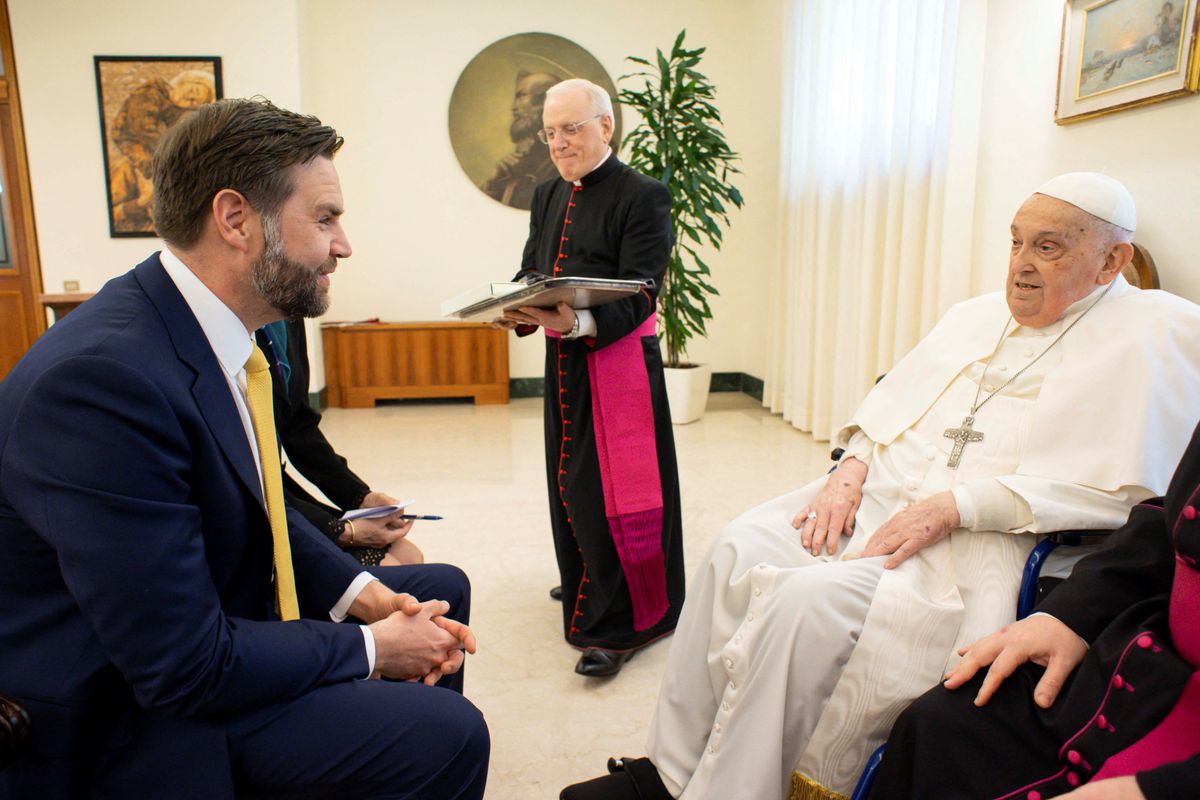
Pope Francis meets with U.S. Vice President JD Vance on Easter Sunday at the Vatican, April 20, 2025. Vatican Media/­Handout via REUTERS ATTENTION EDITORS - THIS IMAGE WAS PROVIDED BY A THIRD PARTY.

A group composed of hundreds of Catholic bishops is ramping up its "war" against Donald Trump and his administration, according to a Newsweek report Saturday.

According to the outlet's weekend article, "The U.S. Conference of Catholic Bishops (USCCB) seems to be battling with President Donald Trump's administration over some of its policies." The article is called, "American Bishops' War With Trump Admin Is Heating Up."

"Last week, the USCCB, the official assembly of the Catholic Church in the United States, slammed U.S. Customs and Border Protection (CBP) for rescinding a policy that gave guidance on the care, custody and documentation of pregnant women they encounter," the report states.

Bishop Mark J. Seitz, of El Paso, Texas, chairman of the USCCB Committee on Migration, was quoted as saying, "It is deeply troubling and inexcusable that measures intended to ensure the basic safety of pregnant mothers and their young children while in government custody could be rescinded with such indifference toward the vulnerability of those involved."

But other news reports suggest this isn't the first dust up between the USCCB and the Trump administration, and the Newsweek report confirms that.

"It comes amid an ongoing civil case in which the USCCB is suing the Trump administration over its suspension of refugee programs," according to the report. "In a lawsuit filed in February, the USCCB said it has worked with the government for 'nearly half a century' to help 'refugees who are fleeing persecution, instability, and oppression and have come to the United States as a place of refuge and hope.'"

All of these challenges are part of a broader tension between the Catholic Church and Trump's administration. While Trump said it was "such an honor" that the new pope was an American, that same new pope was also reported to have been critical of Vice President JD Vance.

Read the report here.
Trump’s Mass Deportation Wave

Friday 23 May 2025, by Dianne Feeley


Key to Trump’s Make America Great Again pledge was the promise to deport millions of immigrants. During both his presidential campaigns he identified immigrants as “terrorists, murderers, rapists” or “individuals let loose from mental institutions.” Once elected again, he promised to seal the U.S.-Mexico border and deport several million people.


Since December 2023, as the Biden administration introduced restrictions, the number of migrants has sharply declined. That trend has continued as Trump issued a series of executive orders that ignore the protocols of the U.S. asylum system. U.S. Customs and Border Protection (CBP) are to rapidly deport migrants to their home countries, ignoring their right to court hearings. Seven thousand soldiers have been deployed to help CBP detain migrants and install miles of concertina wire. A 60-foot wide, 700-mile military zone parallel to the border is being equipped with armed combat vehicles.

Figures for the “first 100 days” of the Trump administration reveal 168,999 immigrants arrested and 152,000 deported. At that rate, a little more than half a million will be deported in 2025. According to the Department of Homeland Security (DHS), the average deportation cost of one immigrant is $17,121.

The most flagrant and absolutely illegal mass deportation flights to El Salvador’s maximum torture prison stand as the most shocking spectacle of those first 100 days.

Defying the Constitution’s Fifth Amendment provision that “no person” shall be “deprived of life, liberty, or property, without due process of law,” Trump complained to NBC News “Meet the Press” moderator Kristen Welker that following it would prevent him from carrying out the rapid deportations he had promised. Once again he claimed that it was necessary to remove immigrants because thousands are “murderers and some drug dealers and some of the worst people on Earth….I was elected to get them the hell out of here, and the courts are holding me from doing it.”

Although the United States is touted as “a nation of immigrants,” both political parties have passed anti-immigrant legislation, militarized the borders and increased surveillance over the last 150 years. A majority of U.S. citizens have come to accept the idea that “controlling” the borders is necessary but want a system that is “fair,” however hazy that concept is to define.

The underlying reality is that immigration is necessary for the U.S. economy. Yet immigrants face a barrage of laws requiring immigrants to jump through hoops to achieve and maintain legal status. This has been true since Chinese men were recruited to build North America’s railroads only to face restrictions and lynch mobs. Researchers report that to maintain the U.S. economy, it is necessary to bring in more than one million workers a year, yet immigration is capped at 650,000.

Immigrants who apply for U.S. citizenship must fit into one of four categories: needing to reunite with family, having valuable skills, asking for humanitarian relief (asylum is capped at 125,000) or helping meet the country’s diversity goal. Given the backlog, the process takes years. In fact, 3.6 million asylum seekers who are waiting for their court date, are living and working here.

Of the 11 million Trump calls “illegals” from “shithole” countries, many have temporary legal status: 3.6 million are seeking asylum, one million have been given protection because their country is suffering from a natural catastrophe or war, half a million are young people temporarily protected by a special program (DACA) and more than a million are stateless, having lost their legal claim but unable to return to their country of origin. The greatest number of immigrants come from Mexico, India, China, the Philippines and El Salvador.

The other three to four million crossed the border undetected or arrived on a visa and overstayed. As they developed roots, they built families –- often “mixed status families” in which some are citizens and others are not. Kilmar Abrego Garcia, who the Trump administration deported back to El Salvador through clerical error, found work, married a U.S. citizen with two previous children, and they had a child together.

A NY Times article recounted his story in detail, including the not-so-pretty details of his domestic abuse. Yet the couple sought counseling, and what one remembers of his journey is his ability to find a way forward. The reader learns of the tenderness he has for his disabled son, and how that son attempts to deal with his father’s absence by smelling his T-shirt.

Even while the U.S. public believes there are too many immigrants, when the media report the stories of immigrants –- what it took for them to make it to the country, how they have built lives here — unlike Trump and his team they are not convinced that deportation in a range of cases results in a just solution. No one accepts border czar Tom Horman’s cynical remark that instead of causing family separation, when one member is deported, the others are “free to go.”

Additionally, economists at the Peterson Institute for International Economics estimate that deporting 1.3 million immigrants would raise prices by 1.5% by 2028; deporting 8.3 million would raise prices by 9.1%. The far-right’s solution, to increase the birth rate, seems far-fetched. No industrialized country, even with generous social programs that the United States lacks, has developed a replacement rate.
Temporary Status

Workers are desired by the high tech industry as well as by employers in the construction, agriculture, industry and service sectors. Given tight borders regulations, businesses have worked with the government to find work arounds. One method is to sponsor workers that binds them to their employers, as Elon Musk and many farmers do.

Other businesses recruit immigrants who have temporary (and renewable) status Congress set up for those fleeing countries suffering from natural catastrophe or war. Currently almost a million people from 16 different countries have been granted Temporary Protective Status (TPS). This program allows them the legal right to live and work in the United States, but only as long as that status continues to cover them.

But during the 2024 campaign, Trump and his vice presidential candidate JD Vance incorrectly called Haitians protected under TPS “illegal.” The Trump/Vance duo dehumanized 15,000 Haitians living and working in Springfield, Ohio, claiming they were depriving citizens of their livelihoods and “eating their cats and dogs” to boot.

Trump repeatedly promised to have the Springfield Haitians deported. Since inauguration day he has canceled TPS for 200,000 Haitians as of August 3rd. He has also cancelled the status for 242,000 Venezuelans as of September 10th. While this order may be challenged in court, Trump continues to threaten 180,000 Salvadoreans, 54,000 Afghanis and 50,000 Ukrainians with revoking their status as well.

Many, like the Haitians in Springfield, have established community roots. April 2017 statistics reveal that 94% of those covered under TPS are in the labor force, with 130,000 labeled “essential critical infrastructure workers.” While most are never able to use the benefits their taxes contribute to Social Security and Medicare, they contribute over a 10-year period more than $6.9 billion.

Another category with protected status is the Deferred Action for Childhood Arrivals program (DACA). It was created a decade ago by president Obama for those who came to the United States sometime before their 16th birthday. Many only learned they lacked protection against deportation as they were preparing to go to college or into the army and found themselves at a dead end.

Under DACA 580,000 are eligible to work or study. However, given legal challenges the program is closed to an additional 400,000 eligible youth and faces an uncertain future. According to United We Dream, an immigrant youth network, the average DACA recipients have lived in the country for more than 16 years. Now in their 30s, nearly half are married and 50% have at least one child.
Deportations to Third Countries

Immigration judges deny 56% of the asylum cases they hear. At that point, the asylum seeker loses legal status. Currently about 1.3 million face removal orders but cannot return to their country. While shutting down asylum applications in violation of federal and international law, the Trump administration has been busily locating third countries who are willing to take those unable to return home or other immigrants the government seeks to deport.

The Trump team has contacted a variety of governments, bullying some and providing others with financial incentives, in order to serve as a dumping ground. Several Latin American governments, including El Salvador, Mexico, Costa Rica and Panama have agreed, although Panama did so reluctantly.

• In February Washington deported almost 300 people to Panama. Many were fleeing civil wars or political or religious persecution in Iran, China, Afghanistan, Somalia and Cameroon. They told the media that they had been unable to apply for asylum. But once in Panama City they were locked up in a hotel and pressured to return to their countries. Those who did not were sent to a isolated camp on the edge of the Darien jungle. With intervention from human rights groups authorities bused them back to Panama City and informed them they could stay in the country for 90 days. Some are scrambling to find a country that might accept them.

Meanwhile they are sleeping on mattresses in a gym.

• The most enthusiastic response came from Salvadoran President Nayib Bukele who was delighted to imprison over 238 men, mostly Venezuelans accused of gang membership, at a notorious supermax prison in exchange for $6 million. After examining the records, Bloomberg News could only find 10 who had been charged or convicted of misdemeanors or felonies.

Hardly “the worst of the worst,” these people are stuck. While the U.S. Supreme Court has ruled that detainees must have the chance to make their case before a judge before they are deported, the Trump regime claims nothing can be done for those who are already in El Salvador.

The Washington Post reviewed government documents that revealed Washington, despite the Russian invasion, even approached Ukraine with a third-party proposal that went nowhere. Talks with Libya also fizzled. However, a DHS statement announced that at the end of April Uzbekistan received a chartered flight of more than 100 deportees, not only Uzbeks but citizens of Kazakhstan and Kyrgyzstan.

The Post also reported that Rwanda, after receiving a one-time payment of $100,00, agreed to take an Iraqi and 10 additional deportees of various nationalities as part of a “durable program.” In an April 27th interview on Rwandan television, Foreign Minister Olivier Nduhungirehe remarked that the conversations were only in “initial phases.”
Targeting Individuals for Deportation

Many people assumed that when Trump talked about deporting immigrants, he meant deporting people just arriving at the border or those who had committed crimes while in the country. But the Trump team, led by director Stephen Miller and border czar Tom Horman, have a much more expansive view, especially now that the southern border is effectively sealed.

Those who are awaiting an hearing can be nabbed when they show up for a scheduled yearly appointment. While 183,000 are tracked with ankle monitors, wrist bands, or phone apps, the plan is to expand the number under surveillance and have everyone report monthly or bimonthly.

Supposedly this will also give ICE the space and time to conduct mass raids.)

Since the administration has neither the financing or the staff to conduct raids at the magnitude they envision, they seek to terrorize as many immigrants as possible and force them to chose the “dignified” method of self deporting. This includes arresting and detaining high-profile individuals connected to social movements:

* Alfredo “Lelo” Juarez Zeferino (25), who came from Mexico as a child, was appealing deportation order when arrested. A founder of Families por la Justicia as a teenager, he is being held in ICE’s Northwest Detention Center in Tacoma and has a November immigration hearing.

* Nearly a dozen workers organizing a union at local seafood processing plants in the New Bedford area have been detained, including Juan Francisco Mendez, who had applied for asylum, but ICE broke a back window of his car with a sledgehammer and took him into custody.

* Mahmoud Khalil (29), Mohsen Mahdawi (34) and Yunseo Chung (20), Palestine solidarity student activists at Columbia University were permanent residents.

* Rümeysa Öztürk (30), who co-authored an opinion article in the Tufts University student newspaper, has a student visa; she grabbed by masked plainclothesmen.

* Momodou Taal (31), a Cornell University student who organized against Israeli genocide and U.S. complicity, was threatened with deportation and eventually left the country.

In early April Secretary of State Marco Rubio announced he was revoking more than 300 visas, stating:

“We gave you a visa to come and study and get a degree, not to become a social activist that tears up our university campus. We’ve given you a visa and you decide to do that — we’re going to take it away.”

Yet no one had been charged with a crime.

Rubio was claiming that the very presence of political activists was a threat to U.S. foreign policy. But following coverage on these cases, with 1,000 international students discovering their visas were suddenly cancelled, the administration reversed course.

The Department of Homeland Security launched a million-dollar ad campaign urging immigrants to leave the U.S. voluntarily or face deportation with no chance of return. While reporting success with these ads, by May 2025, they announced a campaign to offer $1,000 and travel assistance for those willing to return to their country and proclaimed one Honduran had already taken them up on the offer.
The Level of Deportations

Given the contradiction between needing workers and the harsh rhetoric Trump and Vance use, one wonders whether the Trump administration will manage to deport more than the Biden or Obama administrations.

Businesses will find the workers they need through various carveout programs. That section of the workforce, who because of their precarious status will feel insecure, are more likely to live in the shadows, working less secure jobs and living in less secure communities.

Despite the campaign for detention and deportation, the Trump administration fast-tracked asylum to white South Africans, mainly of Afrikaner heritage. The State Department arranged and paid for transportation for the first 49, who arrived on May 12. They will be aided by the Office of Refugee Resettlement.

Trump has asserted that white South Africans, who on the average have 20 times the resources of a black South African, are racially discriminated against. (See Review of Political Economy) Meanwhile 20,000 refugees who have been vetted and approved for resettlement by the U.S. Refugee Admission Program remain in limbo.

With millions of people forced to leave their homes because of war, poverty or environmental catastrophe, categories for refugees largely exist to keep them out. They -– rather than borders -– will prove unsustainable.

16 May 2025

Source: Solidarity.


Attached documentstrump-s-mass-deportation-wave_a9009.pdf (PDF - 926.9 KiB)
Extraction PDF [->article9009]

Dianne Feeley
Dianne Feeley is a retired autoworker active in Autoworker Caravan, a rank-and-file caucus, and an editor of Against the Current.


International Viewpoint is published under the responsibility of the Bureau of the Fourth International. Signed articles do not necessarily reflect editorial policy. Articles can be reprinted with acknowledgement, and a live link if possible.


Growing Arctic military presence worries Finland’s reindeer herders


Increased military activity in the Arctic has become a headache for Finland's reindeer herders - Copyright AFP/File Ranu Abhelakh


By AFP
May 24, 2025
Anna KORKMAN

A fighter jet roaring through the grey sky breaks the tranquillity of a boreal forest in northern Finland, one more sign of a growing military presence that is challenging the ability of reindeer herders to exercise their livelihood.

“Military activity has increased massively here since Finland joined NATO,” reindeer herder Kyosti Uutela said on a tour in Rovajarvi, the largest artillery practice range in western Europe, on a day when no ground exercises were underway.

Located 100 kilometres (60 miles) from the Russian border, Rovajarvi covers an area of 1,070 square kilometres on land that also makes up part of the reindeer husbandry district that Uutela heads.

Finland, which shares a 1,340-kilometre border with Russia, dropped decades of military non-alignment to join NATO in 2023 in response to Russia’s invasion of Ukraine.

And in 2024, a defence cooperation agreement between the United States and Finland came into force.

“Training activities and exercises have increased since the beginning of the war in Ukraine” because of the worsened security situation, the Finnish Defence Forces told AFP in a statement.

“This is naturally also reflected in Rovajarvi,” it said, saying the firing range provided unique training possibilities for international troops thanks to its size, terrain and seasonal changes.

Last year, Finland participated in 103 military exercises at home and abroad, up from 89 in 2023.


– ‘Radical increase’ –


Ascending a small hill where the forest has been clear-cut and trenches dug for training purposes, Uutela said the spot “had been lost” as a grazing ground.

“The use of heavy army tanks and the presence of thousands of soldiers in the forest destroy the lichen pastures,” Uutela said, referring to the reindeer’s main source of food.

“Reindeer will not be able to live here anymore,” he said.

Finland has 4,305 reindeer owners and around 184,000 reindeer, living in 57 reindeer husbandry districts that cover 36 percent of the country’s total area.

A part of them belong to the indigenous Sami population that lives in Sapmi, which straddles northern regions of Finland, Sweden, Norway and Russia.

The non-Sami people such as Uutela who also practise reindeer husbandry include herders living near the Rovajarvi range, outside the Sapmi homeland.

Full-time herders sell reindeer meat, pelts and handicrafts as their main source of income, and husbandry has been an integral part of the indigenous Sami culture for generations.

Riikka Poropudas, another herder in Rovajarvi, said the military presence in the area had increased “radically” since Finland’s NATO accession, forcing herders to feed their reindeer in fenced areas more often than before.

Finland’s Defence Forces said the needs of reindeer husbandry were “taken into account in the planning of exercises, for example in terms of the times and locations”, adding that they were in daily contact with Rovajarvi herders.

But Poropudas worries that a large live-fire and combat exercise involving around 6,500 soldiers from Finland, Sweden and Britain this month would disturb her reindeer.

The calving season is at its busiest in mid-May.

“The activities stress both female reindeer and newborn calves, and drive them away from their natural pastures,” she said.


– Indigenous rights –


Tuomas Aslak Juuso, acting president of the Sami parliament in Finland, said climate change and land use changes — including the militarisation of the Arctic — posed special challenges for the roughly 1,200 Sami reindeer herders in Finland.

“Our way of reindeer husbandry depends fully on the herding model and the reindeer being able to graze freely on natural pasture lands,” he said.

But the effects of climate change on winter conditions already mean that herders increasingly have to provide their reindeer with supplementary feed “in order to avoid mass deaths”.

A large international military exercise conducted in Finnish Sapmi in 2023 had been “quite a negative experience for the Sami people”, Juuso said.

“The local reindeer herders had not been informed beforehand, grazing conditions for that spring were damaged and tractors damaged the lichen cover, which may never grow back,” he said.

“When these things are planned, there should be early consultation with the Sami and responsibility for damage and harm.”
Greenland

For a free and demilitarized Arctic – Defend Greenland’s independence – Defend the Greenlandic people and nature


Tuesday 20 May 2025, by SAP (Denmark)

With Donald Trump’s repeated demands that the US take over Greenland and his vice president J. D. Vance’s comments on the number of US military personnel in Greenland, the imperialist competition for Greenland has taken a decisive new step.


The long struggle to protect the Arctic and the Inuit peoples from war and militarization is in a fundamental crisis. The threat of an arms race at the top of the world and yet another unbridled hunt for the population’s natural resources threatens not only the existence of the Greenlanders, but the entire world. The greatest guarantee of peace and the sole stewardship of the Arctic lies with the indigenous peoples’ organizations and representative bodies, including the Greenlandic parliament, Inatsisarsut, and the Inuit Circumpolar Council.

Trump says outright what “polite” Danish imperialism has tried to hide: that under the logic of capitalism, countries, people, and peoples are, at best, commodities—at worst, spoils of war. For the same reason, Trump’s demand for a renegotiation of the nearly 200-year-old alliance between the Danish and American bourgeoisie has sent Denmark into full-blown colonial hysteria. The height of the hysteria is, of course, the censorship of the documentary about Danish cryolite mining, which was removed from the internet this week as a result of obvious political pressure involving the top levels of government. This censorship was deeply biased, and with the removal of source material, it is now difficult, if not impossible, for many citizens to orient themselves in a crucial social debate.

The significance of cryolite


The bourgeois panic in Denmark must be seen in light of the enormous wealth that Danish capitalists managed to plunder from Greenland through the extraction of cryolite. Despite the fact that the Danish state charged Danish capitalists for allowing them to steal Greenland’s minerals, Weber’s [Theobald Weber, founder of the Øresund cryolite factory, ed.] heirs each received a return of no less than 40% of the one million they had each received upon their father’s death. Such income does not arise from normal business operations, but solely from monopolies and colonial rents. The reinvestment of this income has built the Denmark we know today. C. F. Tietgen, the godfather of the modern Danish capitalist class, was the man behind the construction of the mine in Ivittuut. The extraction of cryolite must therefore be seen as a decisive part of the primitive accumulation that allowed Denmark’s transformation into an industrial society.

Without cryolite, aluminum would most likely never have become a widely used metal, and its far-reaching capabilities would not have benefited humanity. Denmark and the US have shared the profits from the exploitation of cryolite more or less equally between them. For the US, it allowed the rapid build-up of the air force, which since World War II has ensured the US a decisive influence on the world market. The derived wealth and value of that destiny cannot be measured in numbers. What it was worth to have a completely unique place in the world where these rare minerals lay freely on the ground and were used by the local population for tanning skins is lost in questions of historical ethics. Like other colonized peoples, the Inuit of Greenland are left with a hole in the ground where the foundations for centuries of development of their own society and economy could have been laid.

Colonialism in the US – and Denmark

Trump’s brash demand for control over Greenland is merely a continuation of the colonial, imperial, and racist thinking that has defined Danish and American policy toward Greenland. Through a long and arduous political struggle, the Greenlandic people have won the legal and formal rights to independence. But American imperialism views the formation of states by indigenous peoples with the deepest mistrust. That is why, even under Democratic leadership, they have worked purposefully to gain influence among the Greenlandic elite and tie them to the US.

The simple fact that this exploitation has come to light has created colonial hysteria in Denmark, where colonial racism against our Greenlandic fellow citizens has been given free rein – for example, with ideas that Greenlandic independence should have consequences for Greenlanders in Denmark. It must be categorically rejected that decisions about Greenland’s status should have any bearing whatsoever on Greenlanders living in Denmark and who are part of Danish society. It is also deeply criticizable that the Danish government, which has otherwise upheld the Greenlandic slogan “Nothing about Greenland without Greenland,” has simultaneously traveled around Europe—WITHOUT Greenland—to garner support for the defense of the “Kingdom”! The Greenlandic government is perfectly capable of negotiating security – they already do so when negotiating concessions and trade.

Our tasks

The Danish working class and the left have a special responsibility towards the Greenlandic people. It is unfortunately true that a marked complacency has characterized large sections of the Danish labor movement in relation to the Greenlandic people. With important exceptions, far too many of us have believed that it was sufficient to “leave the question to the Greenlanders” and thus, in practice, avoid having to deal with the complex historical and contemporary issues that affect Greenland. This needs to be remedied.

First and foremost, by participating in the organization of debates on Greenlandic history and the present day and by inviting Greenlandic activists and people in Denmark to contribute their understanding and perspectives—not only in Greenland, but throughout Danish society. We can do this in all the circles in which we are active. At the same time, we want teaching about Greenlandic history and Danish colonialism to be integrated into the school curriculum. No child should see the Marble Church without knowing that, when it was completed, it was also called the Aluminum Mine.

At the same time, there is a need to learn more about post-colonial conflicts and the blind spots faced by the colonizers’ population, especially the working class. A monstrous example of this is when “economic experts” are allowed to thunder, virtually unchallenged, against the emphasis on the total value of a raw material (cryolite) as a measure of what the colonial power has taken from the colonized country. Even though researchers on colonialism point out the relevance of this figure in the documentary, when virtually all of this value is transferred from Greenland’s GDP to Denmark’s. There should also be a special focus on the issue of reproductive rights and on the Danish state’s active efforts to prevent the birth of half a generation of Greenlandic children.
Demands that can support the Greenlanders’ struggle for independence

While we fully support Greenland’s desire for independence and understand that Greenlanders do not trust the possibility of equal treatment, we want to maintain the best possible relations with the Greenlandic people. We are bound not only by history, but also by family and friendship ties. However, this desire is only meaningful if Greenland is supported in gaining full control over its own territory, and we must demand that no economic coercion be used to pressure the Greenlandic people’s political choices. At the same time, we demand that travel between Denmark and Greenland be made affordable for everyone who has family in Greenland. We will work to ensure that Greenlandic independence does not pressure Greenland into granting destructive concessions or force Greenland to give in to any form of military pressure. At the same time, we reject any process that does not aim to involve the entire Greenlandic people, but instead focuses on small elites.

We therefore also demand that Greenland be given full and unhindered access to all studies of the Greenlandic subsoil and that all military agreements concerning the Arctic be presented to the Arctic population. When the Danish state and the Danish bourgeoisie continue to claim how hard it has been to make money from the plundering of the Arctic, we demand that all accounts be presented, including payments of share dividends.

The development of a proper program for the relationship between Greenland and Denmark, as a former colonial power, requires the full involvement and independence of Greenland. We are therefore pleased with the contribution of the Danish left wing to Inuit Ataqatigiit, and we wish them a successful election.

23 February 2025

Translated by SAP from [Socialistisk Information->https://socinf.dk/for-et-frit-og-afmilitariseret-arktis-forsvar-groenlands-selvstaendighed-forsvar-den-groenlandske-befolkning-og-natur/.


Attached documentsfor-a-free-and-demilitarized-arctic-defend-greenland-s_a9006.pdf (PDF - 914.3 KiB)
Extraction PDF [->article9006]


SAP (Denmark)
The SAP (Socialistisk Arbejderparti) is the Danish section of the Fourth International. It participates in the Red Green Alliance.


International Viewpoint is published under the responsibility of the Bureau of the Fourth International. Signed articles do not necessarily reflect editorial policy. Articles can be reprinted with acknowledgement, and a live link if possible.

Solidarity with Leonidas Iza, the Ecuadorean Indigenous leader – Against the far-right’s plans to reform the constitution and destroy rights

Sunday 18 May 2025, by Iain Bruce


Since the re-election of Daniel Noboa as President of Ecuador on 13 April, his hard-right, Trump-like administration, and most of the Ecuadorean establishment, have launched a ferocious campaign against Leonidas Iza, the President of CONAIE (the Confederation of Ecuador’s Indigenous Nations), and former presidential candidate of the Indigenous and plurinational movement, Pachakutik. They see him, and the communities, movements and struggles that he represents, as the main obstacle to their plans for a radical neoliberal reform to the constitution.


Ecuador’s 2008 Constitution, produced during the early days of the ‘Citizen Revolution’ led by Rafael Correa, emerged from months of debate among all the country’s social movements and civil society and was arguably the most progressive in the world. It was the first to enshrine the rights of nature, it strengthened labour rights and the rights of Indigenous communities, granted a right to “prior, free and informed consultation” (meaning ‘consent’) to communities facing mining and infrastructure projects on their territory, recognised women’s domestic labour, promoted food sovereignty, protected the public sector against privatisation, and prohibited foreign military bases on Ecuadorean soil.. Many of these positive aspects were never fully implemented, or clearly abandoned, by successive governments, including by Correa himself. However, they have remained a fundamental point of reference for people’s demands and struggles.

The Noboa government, in its first, curtailed term, from November 2023 to May 2025, already displayed contempt for these rights and the rule of law in general – using the alarming rise in drug-related violence as a pretext for imposing a state of ‘internal war’, deploying soldiers to attack communities like those of Palo Quemado resisting new mining projects, ignoring the result of a referendum vote to stop drilling for oil in the Yasuni National Park, and invading foreign embassies (that of Mexico) in pursuit of political opponents. Now, inspired by the example of Trump up north, it intends to sweep away any remaining institutional checks on its ability, to drill, mine, privatise and repress the movements that oppose it.

The campaign against Leonidas points in this direction. So far it has consisted mainly of a mob lynching in the mainstream media – a campaign that has been aided and abetted by right-wing sectors of the Indigenous movement, including some former leaders, who appear to have done deals with Noboa to promote their own interests. However, in a country where gang violence continues to surge, sometimes seemingly in cahoots with powerful political interests, and where numerous candidates and local politicians have been assassinated, calls to ‘put an end’ to Leonidas Iza’s leadership and influence have taken on alarming overtones. Last week Leonidas Iza concluded his speech at a UN conference in New York by warning that the Noboa government should be held responsible should anything happen to him.

It is in this context that the National Antimining Front, allied to CONAIE, published this declaration of solidarity with Leonidas.

Leonidas, our friend, the Front is with you

Noboa’s agenda is clear: to accelerate mining expansion and, to this end, reform the Constitution, which guarantees the rights of indigenous peoples and peasants, the rights of nature, and food sovereignty. This is essential to create the political and legal conditions for the mining empire to take over our territories, pollute them, and plunder them on the pretext of development and employment. This is the spearhead of Daniel Noboa’s neoliberal government.

In a polarised context, where no programme for the country has been proposed that reflects the broad aspirations of the working class, in both rural and urban areas, several figures who in the past were social activists, even anti-mining activists, have been co-opted. They are now a doormat for the Noboa family corporation to parade freely through Carondelet Presidential Palace and crush the Ecuadorean people. This struggle of the peoples against mining capital has been betrayed by these pseudo-leaders who, with their triumphalist attitude, call for CONAIE to be ‘de-leftised’ (ie. purged of its left-wing positions). We denounce this once again as a betrayal of a historic political project that was built through the struggle of our two ’communist mothers’ Dolores Cacuango and Transito Amaguaña, (women leaders who helped build the current Indigenous movement). Other more ‘progressive’ voices advocate the ‘de-radicalisation’ of the left; lukewarm voices representing the discourse of social democracy as it moves further to the right.

On the basis of our territorial struggles against mining capital, we identify with the consistent Abya Yala, marxist position of our Kichwa Panzaleo comrade Leonidas Iza, president of CONAIE, who, in this context of neoliberal advances, demands that we not lose our radicalism and sense of struggle. His important voice, which led the rebellions of October 2019 and June 2022, has stood firm, even in the election campaign, where marketing and lies become instruments of mass manipulation.

The media offensive, which brings together the traditional oligarchy, the puppets of power and the indigenous right wing, has turned its attack strategy towards Leonidas Iza. What really bothers them is the profound questioning that he represents, of economic power, of imperialism, of the colonial status of the Republic and of the limits of the current party system and its misnamed ‘democracy’.

The anti-mining struggles have no other path: radicalisation for life or death. This position has been defended by our comrade Leonidas Iza, who has not abandoned our struggles and their victims. He has raised his voice for Mesias R, who was shot in the face by the armed forces; nor has he distanced himself from the criminalisation of more than 150 comrades in Las Pampas and Palo Quemado, 29 comrades in the province of Bolívar, 20 comrades in the canton of Nabón and a dozen more in other territories. From his position, he has been part of the Shuar struggle in Warintz, Nankints, Yaap and Kutuku Shaime, Transkutuku. The voice of Leonidas Iza is a threat to mining capital because he has denounced irregularities and rights violations in the Curipamba (Bolívar), La Plata (Cotopaxi), Loma Larga (Azuay), Cascabel (Imbabura), Cangrejos (El Oro), Warintza and Mirador Norte (Zamora Chinchipe) projects. He opposed the operation of the Chinese company ECSA in Mirador and the advance of mining in the Cordillera del Condor.

Comrade Leonidas Iza Salazar, the National Anti-Mining Front is with you and your territorial struggles

Attached documentssolidarity-with-leonidas-iza-the-ecuadorean-indigenous_a9002.pdf (PDF - 910.7 KiB)
Extraction PDF [->article9002]

Iain Bruce
Iain Bruce is a journalist and eco-socialist activist living in Glasgow. He was formerly Latin America correspondent for IVP. He is author of “The Porto Alegre Alternative: Direct Democracy in Action” (IIRE - International Institute for Research and Education).


International Viewpoint is published under the responsibility of the Bureau of the Fourth International. Signed articles do not necessarily reflect editorial policy. Articles can be reprinted with acknowledgement, and a live link if possible.


What happened to the left in Ecuador?


Thursday 22 May 2025, by Andrés Madrid


A little more than a month ago, on 13 April 2025, Daniel Noboa Azín, of the Acción Democrática Nacional (ADN), party, was re-elected as Ecuador’s president. [1]
In contrast, the social democratic right, represented by Luisa Gonzales of the Revolución Ciudadana (RC) party - linked to former president Rafael Correa - lost the presidential race for the third time. The Correismo/anti-Correismo discursive axis re-emerged as an electoral strategy, but this dichotomy does not explain the structural crisis of capitalism nor does it reflect class antagonisms, as some sectors have tried to claim. The electoral logic, turned into an iron cage, captured the masses seduced by immediate promises. More than 1.2 million votes went to Noboa, a figure associated with the interests of transnational capital and U.S. imperialism.


This analysis distances itself from simplistic interpretations that attribute Noboa’s triumph to the use of the state, political marketing, his opponent’s mistakes, disinformation campaigns or theories of mega fraud. Instead, three key factors are examined:

The implementation of material and punitive responses to social demands, along with the capitalization of popular discontent, in particular the rejection of Correismo.
The economic and political convergences between the neoliberal right (ADN) and social democracy (RC), which limited programmatic differentiation.
The crisis of the institutional left, and the absence of a cohesive anti-capitalist project.
1. Data does not kill narrative

There is a myth in certain academic and media circles that objective data determines political success. However, politics is defined by the ability to impose narratives and exercise power, not only by statistics. Noboa, who took office in November 2023, faced an interim term marked by scandals and adverse figures:

Late 2023: The Ministry of Environment granted the company Vinazin S.A., of which Lavinia Valbonesi - the president’s wife - is a majority shareholder, an environmental registration for a private real estate project in Olon, within a Protected Forest and Vegetation Area.
June 2024: Contracts for school breakfasts for more than US$150 million were assigned to Corporación de Alimentos y Bebidas (CORPABE S.A.), linked to Isabel Noboa Pontón, the president’s aunt.
February 2025: The Ministry of Energy and Mines awarded the Sacha field (77,000 barrels per day) to the SINOPETROL consortium, linked to Noboa’s relatives. Due to electoral pressure, the decision was reversed on 12 March.
NARPOTEC: A port controlled by the Noboa family in Guayaquil, where 151 packages of cocaine were seized in 2025. A contractor of the company was arrested, but released thanks to a lawyer linked to the government (Revista Raya, 2025).
Energy crisis (2023-2024): Recurrent blackouts caused losses of $7500 million in the commercial and industrial sector. There is a strong possibility that the phenomenon will be repeated this year (Cámara de Comercio de Quito, 2025).
Violence: Ecuador has one of the highest homicide rates in the world. In the first 50 days of 2025 alone, more than 1,300 murders were recorded, equivalent to an average of one homicide per hour. This trend intensified in the first quarter of the year, when the number almost doubled to 2361 cases, a milestone that has been described as one of the most violent periods in its history. Despite the 85,000 military operations carried out during the year by the so-called Security Bloc - made up of the Armed Forces and the National Police - the actions have had little or no impact on crime reduction.
The Case of Los 4 de Las Malvinas: In December 2024, four Afro-descendant children were detained in southern Guayaquil by military personnel during a night patrol. The government kept the case under deliberate manipulation until after the elections, when the testimony of the uniformed personnel involved revealed that the victims had been kidnapped, tortured and subsequently murdered.
US interference: On 29 March 2025, Daniel Noboa met with Donald Trump and requested the collaboration of Erik Prince, founder of the private military company Blackwater, who came to the country during the first week of April. These actions were framed within a series of controversial policies: recurrent declarations of states of emergency - the last one, issued on 12 April, less than 24 hours before the second round of elections - militarization of civil society and legal impunity for members of the security forces, among other measures.

Added to these factors, the dismissal of the vice-president Veronica Abad, the accusations of vicarious violence by Noboa’s ex-wife Gabriela Goldbaum, the increase in fuel prices and the circumvention of campaign licenses did not prevent his victory. Why does the people approve of him despite his being a plutocratic regime? Why were the analyses of the institutional left and social democracy so erratic?
2. The conquest of hearts and minds

Daniel Noboa’s electoral triumph has generated three predominant interpretations. The first -articulated by analysts such as Durán Barba, García and Ricaurte- revolves around political marketing. According to this vision, Noboa managed to differentiate himself from the archetype of the traditional politician - including Correismo - by capitalizing on the mistakes of his opponent, Luisa Gonzalez. Among these are ambiguous proposals such as the “Ecuadorian-style dollarization” , “peace managers”, the controversial closeness to Maduro, the reactivation of the Communication Law and the scandals revealed in the chats of Augusto Verduga, former counsellor of the Council of Citizen Participation and Social Control (CPCCS). [2]

A second approach - defended by authors such as Andino and Santiago - blames the state machinery. Here it is argued that the systematic use of public resources, officials and institutional apparatus for proselytizing purposes was decisive. This practice, however, is not new: since the beginning of the 21st century, Ecuadorian governments have normalized the instrumentalization of the state during campaigns, which questions its role as an exclusive factor in this process.

The third reading, advanced by Rafael Correa, points to a mega fraud by means of pens with delible ink being used to alter votes. This thesis, however, runs up against an uncomfortable fact: Revolución Ciudadana deployed an army of observers trained in electoral processes, which undermines the narrative of widespread manipulation.

Transversal criticisms reveal the limits of these explanations. Moreover, although the use of the state for electoral purposes is real, its historical recurrence makes it a structural element rather than a single decisive variable. Finally, the fraud theory ignores both Rafael Correa’s surveillance capacity and an unquestionable fact: Noboa knew how to connect with the immediacy of the people.

Beyond the competing narratives, the triumph is explained by Noboa’s effectiveness in offering symbolic -albeit ephemeral- answers to urgent demands. The states of emergency against violence, the military deployment in the streets or the economic bonds for 500 million dollars during the campaign operated as mirages of solution in a context where structural issues are relegated to electoral urgency.

To illustrate these assertions, let us first take the case of the children murdered in Las Malvinas. The institutional left’s narrative focuses on the thesis that “the state disrespected human rights”. Although this is true, its limit lies in not offering concrete answers to the structural problem of violence among the populations. There is an asphyxia in the material living conditions of the popular sectors - aggravated by insecurity and drug trafficking - which forces the communities themselves, not the state, to disregard the discourse of human rights in order to seek justice by their own means. The case of Los 4 de Las Malvinas, an extrajudicial execution and state crime, reveals this contradiction: the prevailing narrative of the institutional left and social democracy does not connect with the immediate needs of the population.

Noboa’s position, on the other hand, did. By resorting to militarization, states of emergency, ceding sovereignty and prison complexes under the rhetoric of the iron fist, his discourse denied the rule of law in its liberal conception, but resonated in sectors that prioritize survival. The people support these measures based on the logic that this is the way to confront the gangs, valuing the military presence in the streets more than abstract narratives about human rights, especially in areas where violence has de facto erased them.

This does not ignore the fact that violence is expressed, above all, as lack of employment, basic services, decent transportation, medical attention and food. Noboa does not pretend to solve these fundamental problems; however, in the market of votes -the ill-named democracy - his image sold better than that of his rivals. Why? Because in the current context of open war against the people and urgent needs, the dimension of rights - human, ethnic, gender - has ceased to operate as a mobilizing element for broad popular sectors. Noboa’s effectiveness lay in capitalizing on this vacuum: he offered mirages of immediate order in a scenario where the structural continues to be an unfulfilled promise.

A second evident issue is the demand for work and employment. [3] When asked about the main concerns of citizens, violence, insecurity and unemployment stand out, with significant variations depending on the region. The majority of the population lacks resources to cover immediate needs such as food, health, basic services or debts. The bonds delivered by Noboa - characterised by some as immoral or unethical -, in spite of their momentary and limited character, gave material relief to families in crisis. Although they do not solve structural problems, the difference between eating or not eating in the most vulnerable sectors establishes a base of social support that Noboa knew how to capitalize on. Contrary to public narratives, his victory is explained because the elite he represents managed to hegemonize hearts and minds, based on concrete answers that consolidated his regime.

This practice, moreover, is not new. In previous elections, the party that is now the opposition (Revolucion Ciudadana) doubled the value of the Human Development Bonus during campaigns, when it was in government. Its then presidential candidate, Rafael Correa, like Noboa, did not ask for a license to proselytize, an act that was legal at the time, but questioned. The difference lies in the fact that, after the reform to the Code of Democracy promoted by Correa in his opposition role, such actions are now illegal. However, the underlying logic persists: using state resources to gain immediate adhesions.

Faced with this, social democracy and the institutional left could resort to Paulo Freire and diagnose a syndrome of the oppressed: the internalization of the oppressor’s logic by the victims, who end up replicating his domination. Or, in its most simplistic version, branding the people as fascists, “florindo”, “burro”, with phrases such as “no se quejen” (don’t complain). But the underlying reflection, in a Gramscian key, is that there is no hegemony - conquest of genuine adhesions - without a minimum material intervention in reality. While Noboa offered, at least symbolically, concrete palliatives, his rivals cloistered themselves in abstract discourses or in ethical denunciations, without proposing tangible alternatives in a context where survival prevails over ideology.
3. Radical right and moderate ‘left’

Beyond the theoretical nuances of economic liberalism - such as the neoclassical synthesis- capitalism operates with two defined styles of economic policy: free market and Keynesianism. In Ecuador, these visions clashed a month ago in the elections: Noboa’s neoliberal-oligarchic project versus González’s Keynesian-social democratic one. This scenario reflects an inter-bourgeois struggle, where two factions of the ruling class -with non-antagonistic interests- dispute the model of accumulation and social management. Both groups, despite opposing rhetoric, share state practices since 2014, as evidenced by the policies of the social-democratic right (RC) and the neoliberal right (ADN).

The coincidences are palpable. In the National Assembly, CR and ADN voted together in favour of the Economic Efficiency and Employment Generation Law (2023) and the constitutional reform bill for foreign military assistance (2025). During the campaign, Gonzalez reinforced his alignment with the economic regime: he met with Monica Heller, a pro-Israeli figure linked to the chambers of commerce, and proposed to repatriate Venezuelan migrants, joining the securitarian discourse of Jean Tópic, a mercenary close to Nayib Bukele.

Social democracy also showed ambiguities that deepened its disconnection. [4] In territories affected by mining, its offer to respect popular consultations - without proposing a moratorium or reversal of concessions - was insufficient. Nor was there any self-criticism for violations of indigenous rights - from intercultural education to extrajudicial executions - committed under their governments. In the discourse of Tixán, where alliances were sealed prior to the second round, empty slogans such as hope or homeland prevailed, avoiding concrete answers to urgent demands.

While the right wing advances with pragmatism - controlling the government, the state and the extended economy-, social democracy and the institutional left fantasize, cloistering themselves in rhetoric. The former, influenced by figures like Milei, Trump or Bukele, radicalizes its defence of private property and its existential war against communism. The latter, on the other hand, call for de-radicalization, without noticing that their moderation consolidates their glass ceiling. The bourgeoisie, thus, hegemonizes both material means (economic power, monopoly of violence, institutional domination) and immaterial means (ideology, mass media, common sense), configuring what is defined as actually-existing- power: the triad of private property (Marx), the state as an apparatus of class domination (Lenin) and hegemony as the conquest of hearts and minds (Gramsci).

After the electoral results, Correismo faces a dilemma. Despite its legislative and local government presence, internal desertions and the hatred sown by the elites - who associate CR with communism despite its ideological distance - erode its base. The rejection, functional to the interests of the oligarchy, is nourished by a popular malaise that the institutional left did not know how to channel. In this game, the right wing not only wins elections: it redefines the rules of power.
4. Paradoxes of the left

Two paradoxes summarize the Ecuadorian crossroads. The first: Noboa triumphed by channelling popular discontent, just as Correa in 2006 capitalized on neoliberal weariness. Azín even absorbed the discontent expressed in the strikes of 2019 and 2022. It was he - not the left - who embodied rupture, challenging normative frameworks and connecting with the idleness of the majorities through an action separated from traditional politics.

The second one is sharper: while social democracy and the institutional left demand respect for the Constitution and the rule of law, the oligarchic right systematically violates them. This contradicts the critical tradition of the historical left, which postulated the radical transformation of the order. The right stretches the limits of what is permitted, while its rivals reinforce a status quo they claim to fight against.

The last few years show a clear pattern: the most significant gains of the anti-capitalist left and popular camp - such as the uprisings of October 2019 and June 2022, led by CONAIE - emerged outside institutional channels. Here another tension emerges: the right to resistance clashes with state sovereignty, a legal dilemma that reflects a material conflict. Movements such as Black Lives Matter (USA), the gilets jaunes (France), or the pan-African experience of Ibrahim Traoré in Burkina Faso and other Sahelian countries confirm that popular legitimacy is often won on the margins of bourgeois legality. However, the institutional left, trapped in its conservatism - more papist than the Pope - defends the social contract that suffocates it, while the right blurs normative boundaries to garner popular support and do business. This cynicism is replicated in alliances such as that of Pachakutik with Noboa’s government on 7 May 2025, shamefully continuing a policy of class conciliation. Characters like Ricardo Vanegas, Guadalupe Llori or Salvador Quishpe - who in 2021 supported the government of Guillermo Lasso - are not exceptions: they are symptoms of a party system where class interests and mirages of social mobility prevail. To speak of betrayal is naive; the problem is structural. The so-called organic discipline vanishes in the face of pragmatic calculations in spaces of power such as the Assembly.

Finally, the anti-capitalist left has not renewed its strategies after the October and June uprisings either. Its atomization and lack of material and intellectual resources prevent it from building a power project with its own identity. This vacuum paved the way for the Noboa clan to capitalize on the discontent.

The challenge is clear: fascism is not a coming monster, but a threat lurking in the corridors of neoliberal and social democratic parties, in elitist NGOs, in several influential journalists, in the repressive officialdom and in a radicalized right-wing intelligentsia. Noboa will strike economically at the popular sectors, but the fascist coup is brewing in the bowels of the actually-existing-regime. Overcoming this theoretical and practical blindness demands that the anti-capitalist left reinvent itself, transcending its historical milestones.

15 May 2025

Source: Translated by International Viewpoint from vientosur.


Attached documentswhat-happened-to-the-left_a9007.pdf (PDF - 937.3 KiB)
Extraction PDF [->article9007]
what-happened-to-the-left-in-ecuador_a9007.pdf (PDF - 937.4 KiB)
Extraction PDF [->article9007]

Footnotes


[1] He is the son of the Ecuadorian businessman Álvaro Noboa Pontón, who has been listed by various financial sources, such as Forbes, as one of the richest men in Latin America. His fortune, estimated in billions of dollars, is derived from a diversified business conglomerate that includes sectors such as agriculture (Banana Export Company), commerce, industry and real estate, with a presence in more than 50 countries.


[2] Noboist propaganda warned about a supposed electronic convertibility of the dollar, expressed in the slogan Luisa te desdolariza, positing the idea that dollarization was at risk under the González government. Another proposal was articulation of citizens with the National Police to promote peace in territories affected by narco-criminal violence, which the government argued could lead to the creation of militias, similar to those documented in Venezuela or Nicaragua. It was also argued by Noboists that the reactivation of the Communication Law would encourage censorship and arbitrary regulation, while the Liga Azul case linked Correista activists, including Verduga, to control of appointments in the Judiciary Council and the Superintendence of Banks, as well as influencing the CPPCS.


[3] In Ecuador, the Economically Active Population (EAP) is almost 9 million people, of which less than 3 million are adequately employed (basic salary of $470 in 2025). More than 5 million are in inadequate or precarious employment conditions: incomes below the basic wage, working less than 40 hours per week or underemployment, even when they wish to work more hours or increase their income. This implies that two thirds of the EAP survives in less than full employment situations, including unpaid work. As of December 2024, 6 million people subsisted on less than $91.43 per month, according to data from the National Institute of Statistics and Census (INEC). These figures reflect impoverished conditions for the majority of the working class.


[4] Correismo does not represent a radical left, but a social democracy: a current within bourgeois thought that, taking up Keynesian models, seeks to prolong cycles of capitalist stability through countercyclical measures. The objective of these policies is to sustain capital accumulation through state stimulus to consumption, positioning the state as an economic dynamiser. Keynes, it should be stressed, never aligned himself with the revolutionary left; in fact, he developed his theory explicitly to contain the revolutionary advance in Europe after the crises of the first half of the twentieth century.


Andrés Madrid
Andrés Madrid teaches at the Intercultural University of Indigenous Nationalities and Peoples Amawtay Wasi in Ecuador.


International Viewpoint is published under the responsibility of the Bureau of the Fourth International. Signed articles do not necessarily reflect editorial policy. Articles can be reprinted with acknowledgement, and a live link if possible.

Germany

Merz-Klingbeil government is Trumpism lite

Friday 23 May 2025, by Heinrich Neuhaus

Germany’s latest variant of the GroKo (Grosse Koalition, Grand Coalition), with Friedrich Merz (CDU/CSU) as Chancellor and Lars Klingbeil (SPD) as Vice-Chair, aims, according to the coalition agreement, to represent “responsibility for Germany”. Translated from political newspeak, this means that the amount of profits is untouchable.


After the elections, the CDU/CSU and SPD, with the support of the Greens, pushed through amendments to the Basic Law on the “debt brake” in the former Bundestag. A federal government that is not even in office has thus created enormous financial leeway for rearmament and for supporting the interests of capital.
Gifts for capital

The suspension of the “debt brake” for arms spending and the nebulous 500 billion euro investment package will undoubtedly bring a lot of money into the coffers of most major corporations. Weapons of war are not only deadly and environmentally destructive, they are also dead capital with no social or economic utility.

Admittedly, the Merz government has not yet gone as far as Trump in the USA in “cutting red tape”, but it does want to cut 8% of administrative posts and “remigrate” refugees, in line with the far right AFD.

Companies are expected to pay even less income tax, corporate income tax and electricity tax, as well as benefiting from a massive 30% annual increase in depreciation. According to initial calculations, the state stands to lose at least 30 billion euros in annual revenues. Of course, there is no question of the coalition agreement reactivating the wealth tax provided for in the Basic Law.
Attacks on social rights

The new coalition is preparing further attacks on the social and democratic rights of the working class. While pensions are to be “stabilized” initially at their current low level, the enormous financing needs of health and long-term care insurance are not being met.

As a result, benefits are likely to be significantly reduced and contributions increased. Health care will become even more expensive. What’s more, the new government wants to abolish the “Bürgergeld” and further restrict entitlement to basic social security. [1] With “job placement priority” and even harsher sanctions, it wants to force the unemployed to accept any job, no matter how poorly paid. This increases wage pressure on workers and reduces their bargaining power.

The term “placement priority” refers to the job centre’s task of placing the benefit recipient in a job, i.e. any available job. Benefits must be discontinued as quickly as possible, whether or not this placement in the available job means permanent integration into the labour market. Opportunities for further training, development or education are not used when priority is given to placement.
Anti-worker policy

The Merz-Klingbeil government is announcing an anti-worker policy. It wants to abolish the historic achievement of the eight-hour working day. The length of the working day is to be replaced by a maximum working week. The planned new law on working hours opens the door to all kinds of abuse. Tax exemption for overtime will further undermine health protection for workers.

Although the coalition partners are talking about a minimum wage - already far too low - of 15 euros from 2026, it is the Minimum Wage Commission that will decide on this wage floor, and the employers have blocking power. The adoption of a “federal law on collective agreements” should ensure that only companies that have signed a collective agreement are awarded public contracts.

The coverage rate of collective agreements, which is already far too low, will only increase. The coverage rate of collective agreements, already far too low, will not be significantly increased. What is missing, of course, is the introduction of compulsory collective agreements, the extension of the right to strike (which is very limited in the FRG), and the strengthening of the rights of workers and their representative organizations.
Adaptation or resistance?

The government program contains no plans to really improve the situation of the working classes, especially the most precarious, who have long been excluded, and no thought is “wasted” on the coalition contract to combat poverty, which continues to grow. On the contrary, the rich and super-rich are becoming ever richer. Union leaders are only timidly criticizing certain government projects. And the leaders of the industrial unions are apparently delighted at the forecasts for the economic and military strengthening of German capitalism.

Protest or even resistance against this threatening development, which further strengthens the fascist AfD, will have to be developed by the rank and file.

8 May 2025

Translated by International Viewpoint from l’Anticapitaliste.

Attached documentsmerz-klingbeil-government-is-trumpism-lite_a9008.pdf (PDF - 909.3 KiB)
Extraction PDF [->article9008]

Footnotes


[1] The Citizen’s Benefit (Bürgergeld) is the minimum benefit for the unemployed in Germany (Grundsicherung für Arbeitslose).With the introduction of the Citizen’s Income in 2023, the German government has replaced the controversial Hartz IV (or Arbeitslosengeld II) system, which came into force in 2005. Today, around 5 million people are covered by this basic unemployment benefit.


International Viewpoint is published under the responsibility of the Bureau of the Fourth International. Signed articles do not necessarily reflect editorial policy. Articles can be reprinted with acknowledgement, and a live link if possible.