Oil barrel washed into the Columbia River during a Pacific Storm. Photo: Jeffrey St. Clair.
A faux profound question that Western economists occasionally ask one another to demonstrate their tribal worldview is: if you’re so smart, why aren’t you rich? The implication is that wealth is a function of superior skill in the form of intelligence. With very low economic mobility across much of the West, choosing one’s parents wisely (we have no choice) goes farther in explaining the distribution of American wealth than do intelligence, competence, or ‘merit.’
The widespread adoption of utopian economic fantasies like a relationship between wealth and intelligence might lead some to conclude, as the fictional character Candide was repeatedly informed, that we citizens of the West ‘live in the best of all possible worlds.’ With the rich now unambiguously ruling the West, and by virtue of their wealth being smarter., how could the world possibly disagree? Do we really want to put the stupid in charge (goes the argument)? Readers can decide for themselves if rule by the rich reflects rule by the intelligent?

Graph: the average (mean) wealth per nation shows national concentrations in the Anglosphere, Scandinavia and Japan. As per the Nature article (link below), these are the nations emitting the most per capita (per person) greenhouse gases. The Nature article ties these emissions to those experiencing the consequences of climate change most directly. These tend to be poor nations in the Global South represented in deep red in the map. Source: Credit Suisse / Wikipedia.
Over the last five or so decades, the rich have come to rule us more directly as the West has stumbled through economic crises, pointless yet unstoppable wars, environmental devastation and social upheaval. As argued below, with evidence provided, on the environmental front, the rich, both across and within nations, are uniquely responsible for rising environmental catastrophe.
A recent article in the journal Nature updated the well-documented claim that world’s richest are uniquely responsible for climate change through their outsized consumption. For instance, the US has a tad over four percent of the world’s population, but it accounts for over 25% of the world’s consumption. Moreover, wealth and incomes inside the nations of the West have become increasingly skewed over the last half-century. The rich in the West can be counted in the thousands, meaning that the problem isn’t ‘the West’ per se, but rather that it is ruled by a dictatorship of money, and with it, the power that money accrues.
The class dynamic that is unveiled is that it isn’t the West, broadly considered, that is responsible for the rapidly declining life-sustaining qualities of the world. It is the rich in the West who are. While there is a ‘consumer aristocracy’ effect of living in the West, or at least there was, whereby even the poor in the US are able to afford low quality consumer goods, this isn’t the point of the Nature article.
“The wealthiest 10% of the global population accounted for nearly half of global emissions in 2019 through private consumption and investments, whereas the poorest 50% accounted for only one-tenth of global emissions. “ Nature.com.
Given that the argument being made by Nature was a central theme of environmental protests across the West a dozen years ago, its resurrection now serves complex political interests. A large part of the purpose of making the argument back then was to fix the class relations that make environmental destruction an aspect of class warfare by the rich against the rest of us. The poor and working people who now oppose forcing the rich to clean up the environmental mess that they created trade short term economic insecurity for long term economic insecurity.
From the 1980s forward, this self-defeating aspect of liberal environmentalism was abandoned in favor of ‘market based’ solutions like ‘putting a price on carbon’ that have fueled many a financial fraud, but not very much else in terms of resolving the problem. The ‘just transition’ of the US Green New Deal was intended to preclude the capital strikes that killed the 1970s environmental movement. Structuring them as tax subsidies made the Biden administration’s ‘green energy’ additions to the executive bonus pool, and little more.
As I wrote at the time, the empirical evidence for tax subsidies is ambiguous at best. While they make logical sense within the Western economic purview, actual results haven’t followed the logic. For instance, ‘stadium economics’ have produced 1) stadiums and 2) made their developers rich while 3) benefitting few others in the process. Even though logic is on the side of stadium economics, the results predicted for the rest of us simply haven’t materialized over four decades of building stadiums.
A significant literature has now been dedicated to tying Federal and state subsidies to their predicted outcomes. Search on ‘are tax subsidies effective’ to see how little support for their effectiveness there really is. Much of this literature was written before 2021, when the Biden administration structured its environmental program almost exclusively as tax subsidies. There was no rebuttal of the literature, or even awareness expressed that it existed, by the Biden administration. This suggests that its goal was to create the appearance of environmental concern without actually doing anything about it.
Another aspect of the 1980s environmental effort was to ‘retail’ it, meaning to blame environmental decline on consumer choices. Theory had it that if American consumers really care about environmental destruction, they can buy less environmentally harmful products. What the Nature article makes clear is that this was misdirection. It isn’t ‘consumers’ broadly considered that are the problem. The rich consume so much more than the poor that if the poorer 80% or thereabouts of the US bought environmentally friendly products, the rich would still be killing us.
Question: why should the Federal government fund the transition of automaker production from ICE (internal combustion engine) to electric? If the automakers wish to stay in the automaking business, why don’t they fund the transition themselves? This would be capitalism as it was explained to me by its proponents during the Reagan administration. And if the US is post-capitalist, what is the explanation for the rich still taking all of the wealth for themselves? What is the justification?
‘Markets’ based on / in ‘merit’ had been the explanation for concentrated wealth. In that fairytale, the rich earned their livings. But the Nature article demonstrates that this simply isn’t true. And it never has been. The rich use their social power to force their costs off onto the rest of us. Environmental destruction is one method. Government bailouts are another. Lemon socialism, whereby the rich get we little people to pay all of their bills, answers the question.
As far as fixing the environment goes, ICE-based GHG emissions would fall either way. If the American automakers no longer wish to produce cars, emissions go down. If they are forced to pay the costs of the emissions themselves, emissions go down (ending the automakers would cause demand destruction). A Federal mandate to stop producing ICE vehicles would cause emissions to go down. But it would also require a plan. Without a national grid of charging stations, EVs are overpriced paperweights in much of the country.
The new information provided in the Nature article is the direct statistical mapping of GHG (greenhouse gas) emissions to distinctive wealth groups across, and within, nations. What becomes clear, and much of the point of the article, is that environmental destruction represents a transfer of economic wealth from the world’s poorest to its richest. This economics of one group paying the costs of environmental destruction while another, much, much, smaller group derives the benefits, occurs both across and within nations.
The maps below and above, taken together, illustrate that the average (mean) wealth is greater than the median wealth almost uniquely for the US. A statistical mean that is greater than the median indicates skewness, in this case high wealth concentration. Amongst rich nations, the US has the most highly skewed wealth distribution per capita in the world. Given that the data supporting the map is from 2021, the result is bipartisan. Interpretation is that a small group of very rich Americans is responsible for US GHG emissions. So, why should ‘the nation’ of the US be the relevant entity for solving environmental woes rather than mostly the rich?

Graph: while this looks like the map from above, it represents a more democratic distribution of wealth because that is what it is measuring. The median is the mid-point of a distribution, with as many values above it as below it. In this map, the US is less dark green than in the map of average wealth above. Interpretation is that the US is a rich country because it has a few very rich people, and not because most Americans are rich. The difference between average and median wealth (skewness) is a measure of the disparity. Source: Credit Suisse / Wikipedia.
To tie this together, both collectively and individually, the nations of the West are more responsible for GHG emissions than are the nations of the Global South. However, within the nations of the West, the rich are uniquely responsible for most of the emissions. The framing of the US versus China as emitters misses 1) that per capita emissions from China are much lower than those of the West and 2) the rich in the US are much larger emitters of GHG than are the rest of us. Calls for ‘shared sacrifice’ are therefore a grift. The rich want for us to pay to clean up their garbage.
This intention represents a central difference between Left- and Right-wing populism. Right-wing populists tend to accept the claim that the rich pay their own way and then some. This is a basis for grievance politics where practitioners ‘kick down’ at their imagined social inferiors as the locus of social problems. The liberal version of this comes from acceptance of the national frame of environmental resolution. An analogy is George W. Bush’s tax cuts that sent $700 checks to we little people, but delivered millions and tens of millions in tax breaks to Mr. Bush’s rich supporters.
This isn’t to argue that nation-states are unnecessary entities with respect to environmental resolution. They are both 1) available and 2) crucial for crafting binding environmental agreements. It is to point out that despite decades of awareness that environmental problems are aggregating to crisis levels, the US has made but a few tweaks to its political economy in response. This is because the people who run the US— the rich, have no intention of paying a penny to clean up their own garbage. One of the greatest inefficiencies of capitalism is environmental degradation. But it doesn’t directly impact the business prospects of polluting industries. It impacts peasant farmers in central Africa.
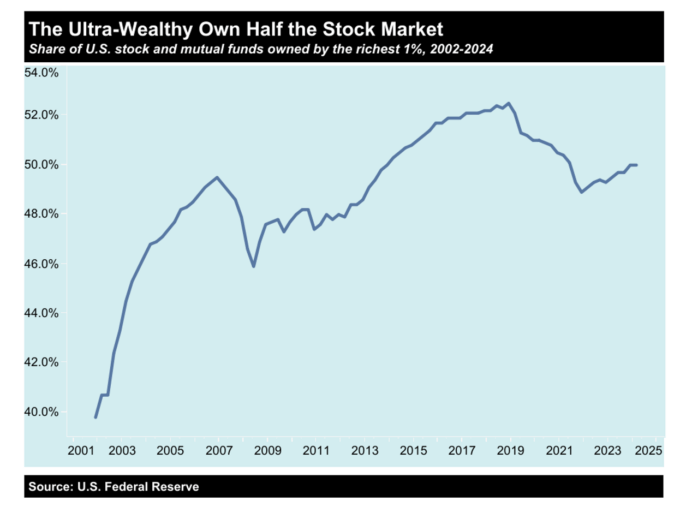
Graph: the stock market represents the nexus between Western capital and its ability to fund itself. But the richest 1% of the US population owns half of it, and the richest 10% own eighty percent of it. Companies that do the right thing and clean up their own garbage get creamed in the stock market because environmental resolution represents a direct cost without a direct benefit. The benefit is diffuse, to the public. This lowers the value of the company’s stock, and with it the wealth of company executives. It therefore never occurs. Source: inequality.org.
Part of the social tension over environmentalism ties to who pays to clean up the messes made by the rich? Elon Musk’s Tesla makes boutique $100,000 EVs (electric vehicles) for wealthy suburbanites, whereas China’s BYD can sell functional EVs at a profit for $10,000. Teslas are close to the lowest rated vehicles in the US for reliability. This makes Musk the rough equivalent of the president of Ford in 1973. when Ford owners needed their own tow truck to move their cars from one repair shop to the next.
It also makes Musk’s light-thinking with respect to economic efficiency a farce. Consider the equation P = R – C; where P = profits, R – revenues and C = costs. With a plus sign in front of it (implied), profits rise when revenues increase and costs stay the same. Profits also rise when revenues stay unchanged and costs fall. Environmental destruction is called an ‘externality’ because its costs aren’t accounted for in the profit equation. But the Nature article just corrected this deficiency. It ties the entities creating the costs to those who are paying them. If Musk were actually interested in correcting inefficiencies, he could clean up his own garbage. But the DOGE plan is looting, not to create economic efficiencies.
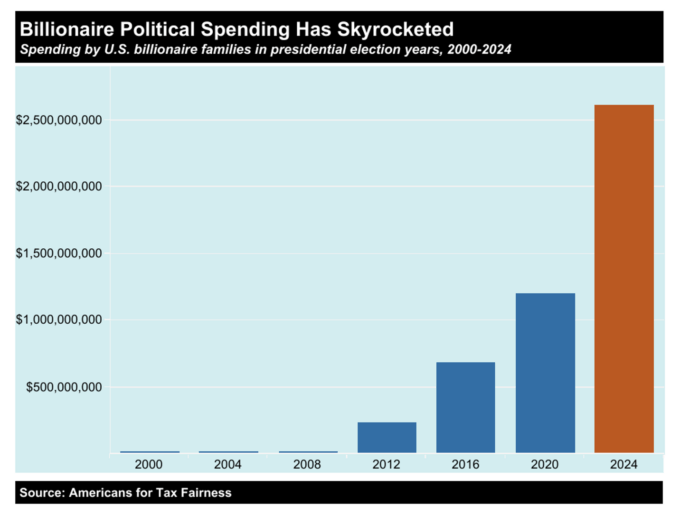
Graph: as if to match the dictionary definition of an oligarchy, billionaires in the US have decided to ‘invest’ their fortunes into accruing political power. They put the most into elections in the very year (2024) that landed an alleged billionaire (Trump) in the White House and gave others unelected authority (Musk). That Democrats rolled out their own billionaires as an imagined selling point demonstrates the depravity of current US politics. Question: when will those committing environmental crimes be made to clean up their own garbage? Source: inequality.org.
The global wealth maps provided above go far in illustrating the improbability of the American political system producing a plausible environmental program. The uniparty parties pretend that doing so is a matter of electing the right party / people. Republicans tell fables about capitalism that unsurprisingly paint them as the heroes of Western economies. A central aspect of the effort is to deny that they are destroying the world which, for those of us who depend on it, is a fraught lie.
American liberals were able to bring environmental destruction to the fore of public consciousness. They then endorsed a policy of letting industrial workers pay the costs of cleaning it up with their livelihoods (jobs). Employers pretended that they were being burdened with ‘bureaucracy’ when in fact the point of contention was that they were regulated into paying a tiny bit more of their own costs. And they have whined about it ever since.
The existing uniparty frame of competing oligarchs (irrespective of AOC’s and Bernie’s sheep-dogging for the Blue Team) means that only the interests of the oligarchs will be represented in Washington. The question for 2024 was: will it be oligarchs for the Red Team or the Blue Team that run the US? What the Nature article articulates is that it is the oligarchs who are most responsible for environmental decline, irrespective of which branch of the uniparty they support. Without addressing the problem of the oligarchs, environmental destruction will never be resolved.