Thursday, July 03, 2025


Can BRICS Reshape The Global Financial Order? – Analysis

Flags at BRICS Summit in Kazan. Photo Credit: BRICS


By 

By Dr. John Sfakianakis


In August 2023, the leaders of the BRICS nations — Brazil, Russia, India, China and South Africa — gathered in Johannesburg to declare their ambition to rewire the international system. A centerpiece of that ambition was a call to reduce dependence on the US dollar. For some, the idea sounded like deja vu; de-dollarization has been a recurring theme in emerging markets since the early 2000s. But this time, the stakes feel different. Global polarization is intensifying, financial weaponization has become normalized and the credibility of existing multilateral institutions is eroding. Yet, for all the hype, the BRICS project remains deeply flawed and uneven.

The notion that BRICS could reshape the global financial order rests more on aspiration than reality. While dollar dominance is indeed being reassessed — not just by geopolitical rivals but also by pragmatic middle powers — building a credible alternative requires more than shared discontent. It demands deep capital markets, interoperable infrastructure, credible institutions and — above all — mutual trust. On all these counts, BRICS is still struggling.

The desire to reduce dollar reliance is not simply ideological but a reaction to a financial architecture long shaped by US interests. The 2008 financial crisis exposed the dangers of global dependency on Wall Street. The 2022 sanctions on Russia, which froze hundreds of billions in central bank reserves and cut Moscow off from SWIFT, sent a clear signal to other BRICS members: your assets can be turned into weapons overnight.

But does fear translate into capability? Not necessarily. Incremental moves are already underway. China has expanded its Cross-Border Interbank Payment System and accelerated digital yuan pilots across Asia and Africa. India has begun settling some trade in rupees, particularly with Russia and the UAE. Russia is developing Mir and the System for Transfer of Financial Messages to bypass Western financial rails. Brazil and South Africa are exploring fintech-led payment corridors. Yet, taken together, these initiatives remain fragmented, politically fragile and institutionally weak.

The internal contradictions of BRICS are glaring. China’s outsized role in the bloc breeds discomfort among its partners. The yuan remains nonconvertible. India and China are strategic competitors. Russia is economically isolated. Brazil and South Africa are preoccupied with their own fiscal instability. What unites them is not a shared monetary strategy but a defensive impulse — a desire to insulate themselves from the coercive tools of the current system without agreeing on a viable alternative to replace it.

In this respect, the BRICS bloc echoes the spirit of the Non-Aligned Movement of the 1960s — born from frustration with superpower domination, yet too ideologically and strategically diverse to forge a coherent economic alternative. These aspirations are further undercut by a chronic lack of fiscal and data transparency across the bloc, which undermines investor confidence and complicates efforts to build trust in any shared monetary or institutional arrangement.

Moreover, the dollar is not just a medium of exchange — it is an ecosystem. From commodity pricing and bond issuance to foreign exchange markets and central bank reserves, it is woven into the plumbing of global capitalism. Displacing it would require an alternative that is not only politically palatable but technically superior. BRICS is nowhere near delivering that.

The New Development Bank and the Contingent Reserve Arrangement — touted as BRICS’ answer to the International Monetary Fund and the World Bank — have underperformed. Lending volumes are limited. Governance structures are opaque. And the credibility of any shared macroeconomic framework remains questionable in the absence of institutional convergence.

Even digital currencies, often billed as a leapfrog solution, are no silver bullet. China’s e-CNY remains tightly controlled and untested at scale. Interoperability with other BRICS central bank digital currencies remains aspirational. Moreover, few of these economies inspire enough investor confidence to turn their currencies into regional, let alone global, anchors.

One point bears repeating: the US may well benefit from a credible external challenge. A push from BRICS could serve as a cold slap in the face — forcing America to reckon with the fragility of its own advantages. For too long, dollar dominance has bred complacency. If confronted with a viable challenge, the US could rediscover its competitive edge — leveraging innovation, capital markets and entrepreneurial dynamism to future-proof its leadership.

But let’s be clear: BRICS is not that challenge yet. It is a concept in search of coherence — a geopolitical brand lacking operational capacity. Its declarations are bold but its execution remains underwhelming. The underutilization of the New Development Bank, for example, is telling: with lending volumes far below expectations and project delivery uneven, the institution reflects the broader gap between BRICS’ ambitions and its administrative muscle.

As for the Gulf states and other middle powers watching this evolution, caution — not commitment — is the prudent course. Strategic hedging makes sense. Deepening financial links with BRICS, especially through trade settlement, infrastructure finance and digital innovation, is worth exploring. But abandoning the Western-led system is neither practical nor desirable.

The future is hybrid. Gulf countries will continue to invest the bulk of their sovereign assets in Western markets, manage reserves in dollars and euros, and rely on Western institutions for legal recourse and financial stability. Take Saudi Arabia’s Public Investment Fund, for instance: despite deepening ties with China and India, 40 percent of its portfolio remains invested in the US — across equities, tech, infrastructure and real estate. Engagement with BRICS must be pragmatic, flexible and bounded by clear-eyed realism.

The global financial order is evolving — but slowly and with considerable friction. The shift from sterling to the dollar took decades and two world wars. Even the EU, despite decades of political and economic integration and the introduction of the euro, continues to wrestle with internal divisions and incomplete fiscal unity. This ongoing struggle underscores how extraordinarily difficult it is to build a credible alternative currency system. The notion that a loosely stitched alliance of emerging economies can replicate such a transformation — absent deep coordination, robust institutions and global trust — is, at best, premature and, at worst, a triumph of hope over infrastructure.

If BRICS truly wants to reshape the financial order, it must start by getting its own house in order. Until then, it will remain more a rhetorical vehicle than a real force for monetary transformation.

  • Dr. John Sfakianakis is Chief Economist at the Gulf Research Center and Chief Global Strategist at the Paratus Group.

Arab News

Arab News is Saudi Arabia's first English-language newspaper. It was founded in 1975 by Hisham and Mohammed Ali Hafiz. Today, it is one of 29 publications produced by Saudi Research & Publishing Company (SRPC), a subsidiary of Saudi Research & Marketing Group (SRMG).

Brazil: Report Finds 241 Dams Under Safety Risks

Flooding in Brazil. Photo Credit: Antonio Cruz, Agencia Brasil


By 

By Pedro Rafael Vilela


Brazil’s water and sanitation authority ANA launched the 2024–25 issue of its dam safety report on Tuesday (Jul. 1).

The document maps 241 dams with priority risk management, as those responsible for these projects have reportedly not complied with all the safety requirements listed in the national dam safety policy.

“In the event of an accident involving these structures, there is a risk to people or important equipment that could compromise the supply of essential services. These are dams located in 24 Brazilian states,” the agency stated.

Most of the dams under risk (96) belong to private companies, government entrepreneurs (39), and mixed-capital companies (10). Another 94 show no information on who is responsible. The main purposes of these facilities are flow regulation (23.7%), disposal of mining tailings (21.2%), irrigation (16.6%), human water supply (12.9%), and aquaculture (7.1%).

Altogether, some 28 thousand dams are registered with the Brazilian dam safety system, 97 percent of which are used for water storage and 36 percent for irrigation. This represents a surge of 8.2 percent in the total number of dams registered in one year. Of those registered, 6,202 (22%) fall within the scope of the dam safety policy.


Dams under the dam safety policy feature at least one of the following: a total capacity greater than 3 million cubic meters; a reservoir that contains hazardous waste, or medium to high associated potential damage (involving risks of human loss); and a dam massif (wall) higher than 15 meters.

Accidents and incidents

According to the report, 24 accidents and 45 incidents involving dams were reported in Brazil last year, with two fatalities and various types of damage, including the destruction of public roads, the collapse of bridges, damage to homes, the disappearance of animals, the closure of roads and highways, and environmental damage.

Under the safety policy, accidents must include the impairment of a dam’s structural integrity resulting in total or partial collapse. Incidents, in turn, affect the performance of the dam or attached structures, and can lead to accidents if they are not remedied.

Among the top causes of damage in the 24 accidents, the majority (16) are linked to flooding or rainfall events. There were 21 dam collapses last year, and for more than half of these (13) extreme weather events were reported.

Rio Grande do Sul—the Brazilian state that experienced the worst climate tragedy in its history with the floods of 2024—was the scene of at least 21 incidents and three accidents involving dams.

Inspections

In 2024, inspection bodies carried out 2,859 field visits—down seven percent from the 2023 report. Documentary inspections, in turn, reached 3,162.

Among the reasons mentioned is a shortage of inspection workers. The 33 federal, state, and municipal inspection bodies have a total 356 professionals, of whom 169 (48%) are exclusively dedicated to dam safety, and another 180 (52%) workers combine this work with other activities.

“In 28 of the 33 inspection bodies (85%), work on dam safety is carried out with less than the recommended number of staff,” the report reads.

Not enough budget

The study also points out there is no specific item in the federal or state budgets for dam safety. Safety measures are found under water infrastructure. In 2024, the budget amounts paid out for dam safety added up to approximately BRL 272 million, 28 percent of which from the federal government and 72 percent from the state government—values higher than in 2023. However, the amount actually paid in the past came to BRL 141 million, only 52 percent of what had been planned, 48 percent of which was executed by the federal government and 52 percent by the states.


ABr

Agência Brasil (ABr) is the national public news agency, run by the Brazilian government. It is a part of the public media corporation Empresa Brasil de Comunicação (EBC), created in 2007 to unite two government media enterprises Radiobrás and TVE (Televisão Educativa).


Renewed Controversy In Switzerland Over US Fighter Jets – Analysis

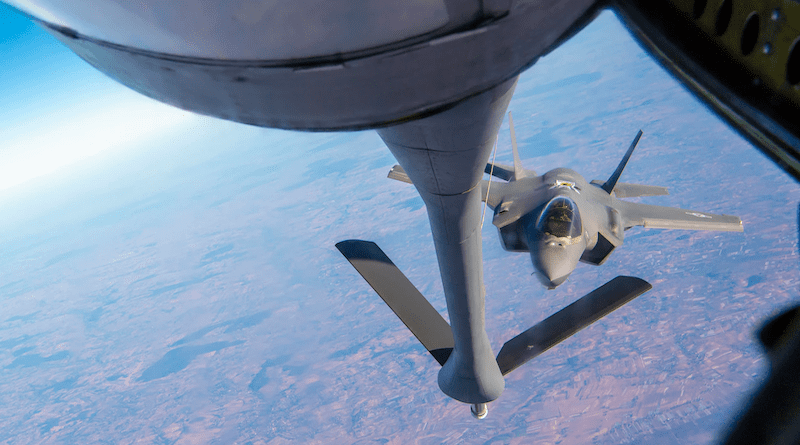
File photo of an F-35A Lighting II approaching a boom to receive fuel from a KC-135 Stratotanker over Europe. Photo Credit: Air Force Airman 1st Class Jessica Sanchez-Chen


By 

The Swiss defence ministry has repeatedly assured the public that 36 American-made F-35A fighter jets would be delivered at a fixed price of CHF6 billion ($7.5 billion). Now the United States is demanding hundreds of millions more, sparking consternation and debate in the Alpine nation.


By Balz Rigendinger 

Why is the F-35A costing Switzerland more than promised?

The United States government is demanding more money for jets, citing higher material costs and inflation. This contrasts sharply with years of assurances by then-defence minister Viola Amherd that Switzerland would receive the aircraft from the US at a fixed price. Amherd stepped down in March 2025.

The Swiss government maintains that a fixed price was agreed upon. In a letter, the US described this as a “misunderstanding”. As a legal recourse is excluded under the terms of the contract, Switzerland is now seeking a diplomatic solution.

According to the US Department of Defense, the order with manufacturer Lockheed Martin is only finalised when the aircraft go into production – at a price that is not set until that time. The fixed price mentioned in the contracts applies to this stage of the process, and not to the overall procurement, according to the US perspective.

Switzerland estimates the additional costs to the original price tag will range between CHF650 million and CHF1.3 billion.


Even back in May 2022, the Swiss Federal Audit Office found that there was “legal uncertainty on the meaning of a fixed price for procurement”. The defence ministry vehemently dismissed this warning, pointing to legal assessments it had made.

How did Switzerland end up choosing the F-35A?

In 2014, Swiss voters rejected a proposed purchase of new fighter jets. At the time, debate over the specific model being proposed, the Swedish Gripen, played a key role in the vote outcome. To avoid a repeat of the result, the government chose to pose a more basic question in the 2020 referendum: whether Switzerland should acquire new fighter jets. The proposal was accepted by an extremely narrow margin of 50.1%. It passed by only 8,670 votes.

Among the Swiss Abroad, the proposal was rejected by more than 56%. Some have speculated that had the postal ballots been delivered to the Swiss Abroad earlier, it could have changed the result, although this cannot be reliably calculated.

Following the narrow approval, the defence ministry launched an evaluation of four potential aircraft types, including the French Rafale and the US F-35A. In June 2021, Amherd said that “in terms of cost, the F-35A emerged as the clear winner with the lowest procurement and operating expenses”. The key factor under Swiss procurement law is the cost-benefit ratio, and this was what ultimately tipped the scale in favour of the American jet.

Were voters misled about the cost?

If there was any deception, it was at least not intentional. Swiss voters approved an overall budget for a procurement programme that did not specify the number or type of aircraft. If the 36 aircraft now become more expensive, Switzerland could theoretically buy fewer, Swiss Defence Minister Martin Pfister told the press. But it is still unclear whether the contracts would allow for such a change – or at what price.

The CHF6 billion approved by voters in the 2020 referendum was based on the 2018 national consumer price index, meaning the amount would be adjusted for Swiss inflation at the time of payment. At present, this corresponds to just under CHF6.4 billion.

Confusion arose again, fuelled by repeated assurances that Switzerland would be buying the jets at a fixed price. When the US embassy in Bern confirmed this, even those responsible for the procurement believed it.

Could there be another referendum?

A repeat of the original referendum is not on the table, but another vote on the issue may take place. In late June, the left-wing Social Democratic Party submitted two identical motions in the Senate and House of Representatives. Their goal is to ensure that if no fixed price was secured and additional costs arise, parliament – and ultimately the public – would have another opportunity to decide on the matter. For now, the Social Democrats have left open what form such a decision would take and are not demanding “any re-evaluation of the procurement itself”.

Representatives of the Social Democrats and the left-wing Green Party also said they are considering filing a formal complaint over the original vote. Both parties want to ensure that any supplementary credit would be subject to public approval.

The defence ministry, meanwhile, is pursuing a different strategy. It aims to absorb the additional costs via already approved budgets. This would circumvent the need for parliamentary approval of supplementary credit and avoid turning the procurement into a political football.

Could rival bidders challenge the deal?

Legal action by unsuccessful bidders could be possible. France was already upset when the US aircraft won the contract over the French Rafale jet manufactured by Dassault Aviation. Tensions escalated when it emerged that France was still negotiating the price and general terms with members of the Swiss government – even after Amherd had already chosen the American jet.

What matters most under Swiss procurement law is the total cost assessed over the jet’s lifetime. Switzerland calculated the 30-year cost of buying and operating the F-35A at CHF15.5 billion. “The next most competitive bid was about two billion francs higher,” Amherd said in 2021.

However, with today’s higher procurement costs, the F-35A would likely not have scored as favourably on this decisive criterion.

What makes the F-35A so controversial?

Buying and maintaining the F-35A has turned into a costly affair for many of its international buyers. Several countries that have purchased the US jet have ended up with painful cost overruns. In Canada, for example, the price rose from $19 billion to $27.7 billion during the procurement process. Norway anticipates operating costs over a period of 30 years to exceed the amount calculated at purchase by a factor of 2.5. Switzerland, meanwhile, has anticipated only a factor of 2. For Denmark, operating costs are 50% higher than expected.

The jet has also drawn controversy due to the speculation about a so-called “kill switch” – a technology that allegedly gives the US ultimate control over the weapons system. “If the US were to attack Greenland, no European country would be able to launch its F-35s in its defence,” the former head of French military intelligence recently said. Opponents are also concerned because the US retains control of the technology required for the jet’s operation, which may give it a strategic advantage.

Others question whether fighter jets like the F-35 still make sense in an era increasingly dominated by drones. One of the loudest critics is US tech mogul Elon Musk, who posted on X, “[…] please, in the name of all that is holy, let us stop the worst military value for money in history that is the F-35 program!”.

What options does Switzerland still have?

If the federal government has to finance the additional costs via a supplementary credit, fierce political debate and delays are to be expected. The defence ministry is trying to avoid this scenario. Whether the extra costs can be absorbed through “optimisations within the contract” or by reallocating funds from other defence projects remains questionable.

As a last resort – at least as a negotiation tactic – Switzerland is considering withdrawing from the F-35A deal. But cancelling the order would come with serious financial risks. Switzerland has already transferred around CHF700 million to the US under the credit agreement and has scheduled another payment of CHF300 million for this year. At the same time, Switzerland is engaged in ongoing tariff negotiations with the US government and is reluctant to strain bilateral relations.

Still, security policy officials from the Social Democrats and the Greens are urging the government to seriously consider cancelling the deal. “If getting out is cheaper than staying in the contract, it’s high time to cut the cord,” says Green Party parliamentarian Balthasar Glättli.

Has this happened before?

Yes. In recent decades, Switzerland has faced repeated cost overruns in its air force procurements – mainly due to expensive customisations for specific Swiss requirements.

An iconic example of this was the procurement of the Mirage III in 1964. To accommodate the aircraft in underground mountain caves – a feature of Switzerland’s defence infrastructure – the jets had to be extensively modified. Immense cost overruns resulted, which ran the price two-thirds higher than the original budget. Switzerland reduced the order from 100 to 57 planes and in the wake of the affair, several officials resigned.

Most recently, the procurement of reconnaissance drones has also led to problems. The cost of six Hermes 900 HFE drones increased from CHF250 million to CHF300 million. Switzerland now plans to install diesel engines to enable them to cross the Alps.


SwissInfo

swissinfo is an enterprise of the Swiss Broadcasting Corporation (SBC). Its role is to inform Swiss living abroad about events in their homeland and to raise awareness of Switzerland in other countries. swissinfo achieves this through its nine-language internet news and information platform.


At Their Own Peril, Americans Are Fuzzy On History – OpEd

Sparkler Fireworks July 4th Fourth Of July Sparks


By 

The nation’s observed birthday—July 4th—always brings forth what passes for modern day “patriotism”: prominent displays of the flag everywhere, celebration of the military, picnics, backyard barbeques, and of course fireworks. There is even an occasional tribute to the nation’s “founders,” those men who supposedly signed the Declaration of Independence on that date, and the genius of Thomas Jefferson who purportedly masterminded and wrote the document. Yet Americans, although a great people, are usually vacant on their history, and many really admit it, because history seems a like a dusty little hobby that is irrelevant to the “here and now,” which self-help gurus on TV tell us we need to focus on. However, comparatively, people in other countries usually pay more attention to their own history and those of at least their region of the world.


Because many people in the United States don’t value history very much, they tend to allow politicians to be selective in their remembering of historical events—usually to manipulate public nationalism (which now passes for patriotism) for their own dubious policy goals. For example, if Americans had focused more on the fact that historically, the Vietnamese had been fighting fiercely over the centuries to throw out foreign invaders—such as the Japanese, the Chinese, and recently the French—perhaps they would have demanded that their politicians think twice, even three times, about invading that country. And if Americans had known that the historically fractious Iraq, an artificial country that had been created by the greedy colonial powers after World War I to exploit the country’s oil reserves, they might have wisely rejected George W. Bush’s attempt at military social work in one of the most unlikely places in the Middle East for democracy to flourish.

Similarly, if most of American public had been more aware that the mighty British Empire had failed three times to subdue Afghanistan in the 1800s and early 1900s, and that the Soviets had ignominiously withdrew in defeat from that country just over a decade before, perhaps they would have pressured George W. Bush to be more selective in his military response to 9/11, thus avoiding the current quagmire in that warlike and xenophobic country, which especially hates foreign invaders.

In fact, the vast majority of Americans would scratch their heads when asked about the causes of even traumatic events in the nation’s history. For example, they wouldn’t be able to tell you what motivated the British to burn Washington, D.C. in the War of 1812, the Japanese to attack Pearl Harbor to begin World War II, or Osama bin Laden to launch his terror attacks on the Pentagon and World Trade Centers on September 11, 2001. Yet only in the new physics can we have uncaused events. Americans just ignore such causes because they don’t like to complicate the story of their government heroically battling the forces of evil.

Americans are not the only country to distort history to their liking, but they do seem far too fuzzy on historical details, thus allowing their politicians to manipulate them into usually disastrous adventures at home and abroad. Let’s take a current example. The Obama administration just patted itself on the back by disclosing that since the president expanded Bush’s drone wars against terrorists to at least seven countries on two continents, this modern technology has allowed the killing of between 2.372 and 2,581 “combatants” from 2009 to through the end of 2015, but only between 64 and 116 civilians during that same period (most independent groups tracking such civilian deaths put the total about two-to-three times higher). All of these killings, however, were only “outside areas of active hostilities,” such as Pakistan, Yemen, Somalia, and Libya, not in the designated war zones of Afghanistan, Iraq, and Syria.

In a republic, there are several problems with these secret (well, not-so-secret) wars. The first is that the killing of any civilians by a foreign attacker is used as a propaganda tool by Islamist militants, thus helping to recruit more terrorists. In Yemen, documentation by journalists on the ground has shown that U.S. drone strikes and air strikes have motivated the angry Yemeni population to significantly swell the ranks of al Qaeda in the Arabian Peninsula there. Second, and even more important, Americans have forgotten that their Constitution (much more important than the Declaration of Independence, because it is supposed to be a legally binding constraint on adventure-happy politicians of both parties) requires that Congress, the representatives of the American people, approve wars, which has not occurred with the secret drone wars. (Even the congressional resolutions approving U.S. military action in the three designated war zones are way more than a decade old and out of date (in Afghanistan and Iraq) or nonexistent (in Syria). The arrogance of the modern executive branch in conducting such constitutionally dangerous secret wars was brought forth by an unnamed administration official when defending the data release on drone war killings (which conveniently didn’t provide enough details to allow the media or private organizations to match it up with their higher totals), “We didn’t have to do this in the first place. We do believe we’re trying to go the extra mile here.” At least go the extra ten miles and make these illegal wars legitimate by getting congressional approval or, even better, go the extra hundred miles by ending such counterproductive adventurism.


But Americans don’t pressure their politicians to follow the Constitution, because most regard it as a dusty old historical document, which has become less important as people began excessively worshipping the American flag, the alleged signing of the Declaration of Independence on July 4, 1776 (it was not, and only became an important document many years later when its lead plagiarizer, Thomas Jefferson, became a prominent national politician), and the U.S. military (the anti-militarist founders, who didn’t even allow a standing army in the Constitution, would pass out on this one). Rather, Americans should probably instead celebrate September 17, 1787—the date the newly signed Constitution brought forth the resilient system of popular government Americans have enjoyed for well over 200 years—even over July 2, 1776, the important date on which the Continental Congress voted for independence from Britain. That Constitution was designed to make the country a peaceful republic, not a voracious globe-girdling empire, which it became only after World War II—because its citizens sought imperial glory, because they had the power to do so, rather than remembering the history of why the country was founded. True patriotism demands more work from the American people.


Ivan Eland

Ivan Eland is Senior Fellow and Director of the Center on Peace & Liberty at The Independent Institute. Dr. Eland is a graduate of Iowa State University and received an M.B.A. in applied economics and Ph.D. in national security policy from George Washington University. He has been Director of Defense Policy Studies at the Cato Institute, and he spent 15 years working for Congress on national security issues, including stints as an investigator for the House Foreign Affairs Committee and Principal Defense Analyst at the Congressional Budget Office. He is author of the books Partitioning for Peace: An Exit Strategy for Iraq, and Recarving Rushmore.