Tuesday, August 05, 2025

China limits supply of critical minerals to US defense sector: WSJ


Rare earth minerals are used in everything from consumer electronics to military equipment such as jet engines, missile guidance systems satellites and lasers. Stock image.

China is limiting its flow of critical minerals to Western defense manufacturers, leading to significant production delays and sharp price spikes, the Wall Street Journal reported on Sunday.

Beijing controls over 90% of the world’s supply of rare earth elements used in a myriad of military technologies, including jet-fighter magnets, infrared sensors, drone motors and precision munitions.

According to the WSJ citing sources, the Chinese government is now refusing or delaying exports of minerals designated for such applications, and has introduced measures to enforce its control by requiring exporters to submit documentation — such as product or production-line photos — as proof of their civilian end‑use.

The new restrictions, which came despite trade concessions made with the US in recent weeks, have pushed some defense manufacturers into crisis, the WSJ said.


In one case, a US drone component firm faced production delays of up to two months while seeking rare earth magnets from non-Chinese sources. Meanwhile, samarium—a rare earth used in high‑temperature magnets for jet‑fighter engines—is being offered at as much as 60 times its typical price.

Defense businesses warn that stockpiles of non-rare earths such as germanium, gallium and antimony are also running dangerously low. One executive noted that his firm is now down to “safety stock.” Some suppliers now hold only a few months’ inventory, exposing even larger firms to disruption, the WSJ noted.

US response

The Chinese restrictions highlight the significant chokehold Beijing has on the global supply of critical minerals, which it used to its advantage in trade negotiations with the US.

An assessment this year by the International Energy Agency showed that China leads the refining for 19 of 20 critical minerals, with an average market share of around 70%.

To counter China’s dominance, the US Department of Defense has mandated that firms cease purchasing China‑sourced rare earth magnets by 2027.

As part of its efforts to diversify the supply chain, the Pentagon recently made a sizeable investment in MP Materials, the only rare earths producer in the country, with the aim of scaling up domestic production of magnets to meet long-term demand.

Analysts say the deal, which guarantees MP a minimum price for its rare earth production at nearly twice the market rate, should have positive implications for producers, but may hurt customers in the short term.

“This benchmark is now a new centre of gravity in the industry that will pull prices up,” Ryan Castilloux, managing director of consultancy Adamas Intelligence, told Reuters earlier this month.

David Merriman, research director at consultancy Project Blue, said it remains “unclear how commercial industrial consumers would respond to higher prices” and “whether it would make them invest in rare earths as they have more diverse supply sources.”

Others have also cautioned that scaling up the production of rare earths may take years.


China Squeezes Critical Mineral Supply to U.S. Defense Industry

China is restricting the supply of critical minerals to U.S. military manufacturers, the Wall Street Journal has reported, adding that this has forced companies to delay order deliveries as they sought alternative suppliers.

The supply restrictions have meanwhile inflated the prices of the critical minerals, the report also said. According to defense industry traders, some of these now cost five times as much as they used to, and in at least one case, a critical mineral cost 60 times as much as it used to before Beijing started to restrict supply.

China completely dominates the global market for critical minerals, putting Western defense manufacturers and their governments in a rather awkward position of depending on China for key raw material supplies amid tense bilateral relations.

China dominates refining for 19 of the 20 critical minerals that the International Energy Agency recently analyzed, holding an average market share of around 70%. “Three-quarters of these minerals have shown greater price volatility than oil, and half have been more volatile than natural gas,” the IEA said in May, noting that major risk areas include high supply chain concentration, price volatility, and by-product dependency.

What is happening right now with U.S. military manufacturers is real-time evidence of this price volatility. Some of these companies are starting to warn about the possibility of production restrictions unless supply improves. One of them, Leonardo DRS, recently warned it has tapped its “safety stock” of germanium. Unless supply of the critical mineral improved by the end of the year, the company would have to delay deliveries.

This suggests the U.S. might be forced to make some concessions to China—because some of these vital minerals for the defense industry cannot be produced economically in the West, the Wall Street Journal wrote. Even those that could be produced economically would take a while to build supply chains.

By Irina Slav for Oilprice.com


The Rise of Private Chinese Oil Companies in Iraq

Private Chinese oil companies are expanding their presence in Iraq, joining China's state majors in pouring billions into the development of hydrocarbons in the OPEC member.

Per a Reuters report, Chinese independents in Iraq are about to see their collective output there rise to half a million barrels daily by 2030, based on estimates by company executives. For context, state giant CNPC currently accounts for half of Iraq’s oil production through the operatorship of some of the country’s largest fields, including Rumaila, West Qurna 1, and Haifaya.

The Chinese companies are replacing Western oil and gas majors who left Iraq in search of greener pastures. CNPC took over the West Qurna 1 field last year and plans to boost its capacity to 1.2 million barrels daily by 2035. West Qurna 1 is one of the largest oil fields in the world, with reserves estimated at more than 20 billion barrels of recoverable hydrocarbons. Currently, it produces around 550,000 barrels daily.

Meanwhile, the Western supermajors are returning to Iraq. Earlier this month, the Iraqi oil ministry said that ExxonMobil and Chevron were in discussions about development opportunities in Iraq’s oilfields with the government.

Commenting on ongoing talks between the federal government and Exxon, an undersecretary for the oil ministry was quoted as saying that “The Company is currently in a stage of negotiations with Iraq for a new opportunity in the country’s oilfields.”

“These moves are a positive indication of growing interest in Iraq’s oil industry by the US and other companies,” the Iraqi official added.

Separately, the other U.S. oil giant, Chevron, is in discussions to potentially sign development contracts in the Southern Nasiriyah oilfield and Balad oilfield in the North-Central Saladin governorate, the undersecretary said.

Iraq has big production growth plans, eventually topping 6 million barrels daily, reversing a decline that started several years ago. Currently, production is around 4 million barrels daily.

By Irina Slav for Oilprice.com

India Protests Trump's Pressure Campaign on Russian Oil Imports

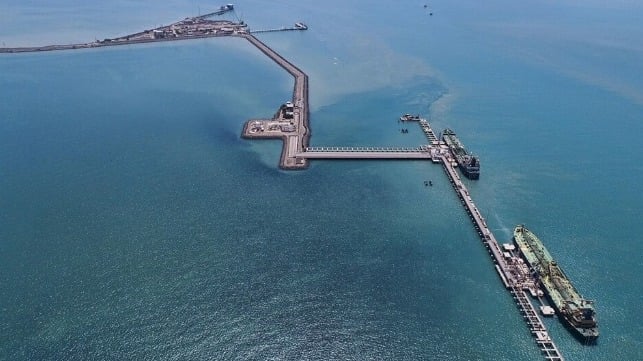
The Vadinar Energy Port terminal for the Russian-owned Naraya refinery in India (Naraya / CC BY SA 4.0)

Published Aug 4, 2025 9:12 PM by The Maritime Executive


The government of India confirmed Monday that it plans to resist pressure from the Trump administration to stop buying Russian oil. 

India ramped up purchasing of Russian oil after the full-scale invasion of Ukraine began in 2022. As Europe shut down its own imports, large volumes of sanctioned Russian crude became available at a discount on the global market. Under the G7 "price cap" measure, Russia has been allowed to keep selling that oil to non-Western buyers. At the time of implementation in 2022-23, G7 economic planners - notably then-U.S. Treasury Secretary Janet Yellen - wanted to keep Russian oil exports flowing, keeping net global supplies stable while reducing Russian energy revenue at the margins with the price cap. "The United States at that time actively encouraged [Russian oil] imports by India for strengthening global energy markets stability," the Indian foreign ministry noted in a statement Monday. 

India was a willing participant and stepped up its buying of Russian crude, allowing the Middle Eastern crude oil that it used to buy to go to Europe instead. Indian refiners stopped buying American oil in quantity, and using their newfound and heavily-discounted Russian barrels - which now account for up to 30 percent of Indian crude imports - Indian refiners provided the European market with low-cost gasoline and diesel, made partly from EU-sanctioned Russian oil. 

The Trump administration entered negotiations over the future of Ukraine  with a pro-Russian outlook, and initially blamed Kyiv for the war. But as rounds of peace talks have come and gone without results, President Donald Trump's opinion of Russian negotiating strategy has soured. Trump has threatened to impose "secondary tariffs" on India if Moscow does not make moves toward ending the war. As U.S. importers pay the cash amount of each tariff to U.S. Customs and Border Protection for each shipment, the policy would raise transaction costs for Indian products like textiles and pharmaceuticals, making those products less competitive. 

Trump doubled down on his threats in a social media post Monday, warning that he would raise tariffs "substantially" on Indian goods if India did not relent. India has so far signaled that it will continue buying, and tanker deliveries of Russian crude continued over the weekend. 

"The targeting of India is unjustified and unreasonable. Like any major economy, India will take all necessary measures to safeguard its national interests and economic security," asserted the Indian foreign ministry, noting that the EU and U.S. both still trade with Russia for other commodities. 

China is the leading buyer of Russian oil, thanks to steady demand from its independent "teapot" refiners for discounted barrels. It also faces U.S. pressure to stop importing from Russia, and Beijing's leaders have made clear that China will not be swayed from its support for Moscow. 

"China will always ensure its energy supply in ways that serve our national interests," China’s Foreign Ministry stated in a social media post last week. "Coercion and pressuring will not achieve anything."

Top Image: Nayara / CC BY SA 4.0


Trump Again Threatens Major Tariff Hike On India Over Russian Crude

U.S. President Donald Trump on Monday said he would “substantially raise tariffs” on Indian exports in response to the country’s continued import and resale of Russian crude oil. The remarks, posted on Truth Social, marked the first time Trump directly tied trade penalties to India’s energy sourcing decisions, according to a report by Reuters.

Trump accused India of purchasing “massive amounts” of Russian oil and reselling it for profit, saying the country was indifferent to Ukrainian casualties. While no specific tariff categories were mentioned, aides cited by Fortune said the measures would be “very large, very soon.”

Despite sustained U.S. pressure, India has kept Russian crude volumes above 1.5 million barrels per day throughout the summer. Refiners have relied on rupee payments, direct Russian tankers, and third-party traders to maintain flows even under the threat of secondary sanctions. According to trade data cited by TRT World, India’s imports from Russia surged from under $9 billion in 2021 to over $64 billion last year, driven overwhelmingly by discounted oil purchases. 

At least four sanctioned Russian-flagged vessels are currently anchored off India’s western coast, unable to unload amid legal and logistical uncertainty. These tankers, stationary for over a week, illustrate the growing complexity of India’s crude trade with Russia.

India’s foreign ministry has not commented on Trump’s remarks. However, prior statements have emphasized energy security and “strategic autonomy,” particularly as Russian barrels remain the cheapest large-scale option for Indian refiners. No implementation date for the new tariffs has been announced.

The tariff threat adds to growing uncertainty for Indian refiners, several of which have already begun reassessing payment structures, flag registries, and ship-to-ship transfer protocols. While some barrels are now being routed through intermediaries in Fujairah and Singapore, Indian shipping agents say due diligence checks have tightened following new U.S. Treasury advisories. Analysts note that even a symbolic tariff hike could chill third-party financing and insurance, complicating access to discounted cargoes already slowed by transshipment bottlenecks.

By Charles Kennedy for Oilprice.com


India’s Top Refiner Hastens to Replace Russian Crude

Indian Oil Corporation, the biggest refiner in the country, has purchased about 7 million barrels of crude from the U.S., the Middle East, and Canada in a spot tender last week, partly to replace Russian crude, which is now on hold at India’s state refiners.

IndianOil has bought 4.5 million barrels of U.S. West Texas Intermediate Midland, 2 million barrels of Abu Dhabi’s Das crude, and 500,000 barrels of

Western Canadian Select (WCS) crude, anonymous trade sources told Reuters on Monday.

IndianOil and the other state-owned Indian refiners have not attempted to buy crude from Russia in the past week, although they have regularly imported Russian oil on a delivered basis.

Last week, U.S. President Donald Trump threatened secondary tariffs on the buyers of Russian oil, while discounts of Moscow’s crudes narrowed to alternatives.

IndianOil, Bharat Petroleum Corporation Ltd (BPCL), Hindustan Petroleum Corporation Limited (HPCL), and Mangalore Refinery and Petrochemicals Limited (MRPL) have paused purchases of Russian crude, awaiting government guidance and clarity over the threatened “penalties” on India for buying Russian crude oil.

Instead, the four state-controlled oil refiners, which account for over 60% of India’s refining capacity, have sought additional barrels from the Middle East and West Africa on the spot market.

Crude from the U.S. has also become attractive in recent weeks, as rising prices of Middle Eastern crudes have opened the arbitrage window for WTI crude to flow to Asia.

The prices for Middle Eastern crudes going to Asia have jumped amid concerns that the cheap Russian supply, favored by China and India, could see disruptions if President Trump makes good on his threat to impose “penalties” or secondary tariffs on the buyers of Russian oil.

While Indian refiners are scrambling to understand the implications of President Trump’s threatened “penalties” on India for buying Russian oil, at least four tankers carrying crude cargoes from Russia were staying idle off India’s west coast on Friday, ship-tracking data compiled by Bloomberg showed last week. 

By Tsvetana Paraskova for Oilprice.com


India Continues Russian Oil Imports Despite U.S. Sanctions

Tankers loaded with Russian crude that had stayed idle off India’s coast for days discharged their cargo at Indian oil import terminals over the weekend, in defiance of the U.S. threats of additional “penalties” on the world’s third-largest crude importer for buying Russian oil. 

While Indian refiners last week were scrambling to understand the implications of President Trump’s threatened “penalties” on India for buying Russian oil, at least four tankers carrying crude cargoes from Russia were staying idle off India’s west coast on Friday, ship-tracking data compiled by Bloomberg showed.

India’s top state refiners did not purchase any crude from Russia last week after U.S. President Donald Trump threatened secondary tariffs on the buyers of Russian oil and as discounts of Moscow’s crudes narrowed to alternatives, industry sources with knowledge of the procurement plans told Reuters on Thursday.  

However, the tankers carrying Russian crude that have arrived near India’s coasts have now discharged more than 3 million barrels of Russia’s flagship Urals grade, according to vessel-tracking data compiled by Bloomberg. Private Indian refiners Nayara Energy and Reliance Industries imported most of these barrels. Nayara, in which Russia’s oil giant Rosneft holds 49%, and Reliance have long-term supply deals to buy Russian crude. 

Despite the U.S. threats of penalties, the EU sanctions against Nayara Energy, and an EU ban on imports of fuels processed from Russian crude, India hasn’t instructed its refiners to halt purchases of Moscow’s oil, sources with knowledge of the matter told Bloomberg this weekend. 

India’s state-controlled and private refiners are allowed to buy crude from whichever source they prefer and the buying remains a commercial decision, according to Bloomberg’s sources. 

The world’s third-largest crude oil importer, India, has significantly boosted Russian oil imports since 2022, when Russia’s oil was banned in the West. Russia currently accounts for about a third of India’s oil purchases, becoming the single largest crude supplier to India.    

By Tsvetana Paraskova for Oilprice.com 

U.S. Investors Target Strategic Bulgarian Gas Storage Site for Russian Supply

A group of U.S. investors is in talks with the Bulgarian government to acquire a minority stake in the Chiren underground gas storage facility, the country’s only such site and a key regional hub for balancing and reverse flows across southeastern Europe, Reuters reported exclusively on Monday.

The group reportedly includes financier Stephen P. Lynch, infrastructure specialist Fei Wang, and former Trump campaign official Brad Parscale. Bulgarian state energy officials confirmed the exploratory discussions, though no transaction terms have been disclosed. The storage facility currently contains volumes of Russian-origin gas, delivered through TurkStream, and remains under the operational control of Bulgartransgaz EAD, a subsidiary of Bulgarian Energy Holding EAD (BEH), which in turn is 100% state-owned. 

Chiren’s relevance is growing for the European Union in the aftermath of the expiration of the Ukraine-Russia transit agreement at the end of last year. With European Commission policy focused squarely on supply diversification, Bulgaria emerges as a potential transit substitute and strategic fallback route. 

However, U.S. investor interest in a storage site that still contains Russian gas, which is technically not sanctioned, marks a notable shift in capital exposure to this game. 

According to the Wall Street Journal, Elliott Investment Management is also considering infrastructure linked to Russian gas exports via Turkey, indicating a broader pattern of U.S. capital repositioning toward stranded or undervalued midstream assets.

Domestically, Chiren has faced procurement scrutiny. The European Public Prosecutor’s Office is investigating a €78 million expansion contract tied to the facility, while Bulgaria’s energy ministry recently cancelled a drilling award and pledged to relaunch tenders in line with EU transparency rules.

According to April 2025 figures reported by Serbia Energy, despite the legal complications, over 87% of Chiren’s capacity for the 2025–2026 season has already been booked. Industry observers say the site’s location and integration with Balkan transit routes make it a prime asset amid shifting gas flows and new investment alignments. The U.S. State Department has not commented on the proposed deal.

Moscow Claims EU Has Lost $1 Trillion From Ditching Russian Energy

  • Russia claims the European Union has lost $1.16 trillion (1 trillion euros) due to terminating energy and other trade deals with Moscow over the past three years.

  • Trade between the EU and Russia has significantly declined from $482 billion in 2013 to practically zero, representing lost profit according to Russia.

  • Despite the costs and energy crisis, the EU remains committed to ending its dependency on Russian energy, as evidenced by new sanctions packages and a roadmap to halt all Russian gas imports by the end of 2027.

Russia has put a price on Europe’s withdrawal from trade and energy deals with Moscow in the past three years. 

The European Union has lost $1.16 trillion (1 trillion euros) due to the termination of energy and other trade deals with Moscow, Russian media quoted Deputy Foreign Minister Alexander Grushko as saying on Monday. 

“There are different estimates. If we talk about the majority of experts, the total amounts to as much as more than a trillion euros taking into account losses from termination of energy cooperation with Russia, from the curtailment of trade,” the official was quoted as saying. 

Trade in 2013 was worth $482 billion (417 billion euros), last year it had fallen to $69.4 billion (60 billion euros), and “now it is practically approaching zero. This is lost profit,” Grushko said. 

The EU may be paying a higher price for energy, including with the 2022-23 energy crisis, but it remains committed to ditching Russian energy and stepping up sanctions against Russia’s oil and gas exports. 

On July 18, the EU adopted the 18th sanctions package against Russia, targeting a hundred more ‘shadow fleet’ tankers, energy trade, and traders and banks enabling it, and lowering the price cap on Russian crude oil to $47.60 from $60 per barrel.  

Russian gas supply via pipelines to Europe has slumped since 2022, after Russia cut off many EU customers from its gas deliveries, and Nord Stream stopped supplying gas to Germany, after Russia reduced flows and after a sabotage in September 2022. 

Russian pipeline gas supply to the EU via Ukraine stopped on January 1, 2025, after Ukraine refused to negotiate an extension to the transit deal.

However, some European Union countries, including Hungary and Slovakia, continue to receive Russian gas through the TurkStream pipeline via Turkey and the Balkans—the only remaining route for Russian gas to Europe. 

Earlier this year, the EU unveiled a roadmap to end dependency on Russian energy, which includes a halt to all imports of Russian gas by the end of 2027.      

By Charles Kennedy for Oilprice.com

Egypt's $10 Billion Green Gamble

  • Egypt aims to source 42% of its electricity from renewables by 2030, up from current capacity of 7.8 GW.

  • Recent deals include Africa’s largest onshore wind farm and the Obelisk solar-battery project, with combined capacity over 2.2 GW.

  • To attract more private investment, Egypt is offering incentives and piloting a new private-to-private energy sales model.

Egypt has been steadily increasing its renewable energy capacity in recent years in a bid to enhance its energy security. By 2024, Egypt had a total installed capacity of renewable energy of almost 7.8 GW. While its hydropower segment has remained stable at around 2.8 GW since 2018, it has significantly expanded its wind and solar energy sectors. Egypt’s solar energy capacity increased from 35 MW in 2012 to almost 2.6 GW in 2024, with several more large-scale solar projects currently under development. The North African country has also invested significantly in enhancing energy access in rural areas by expanding its off-grid renewable capacity.

Egypt has contended with severe energy shortages in recent years, as it has fallen short on its natural gas production targets, particularly at its giant Zohr offshore gas field, which has hit its economy hard. This has led the government to pursue a more diversified energy mix to boost the country’s energy security. To do this, Egypt has opened its doors to international investment in the energy sector.

Egypt’s government aims to mobilise more than $10 billion in private investment for renewable energy, including wind and solar power production, to source 42 percent of the country’s energy from renewables by 2030. However, it is currently a long way from achieving this target, having attracted a reported $4 billion in investment to date. To encourage greater investment in its green energy sector, the government is now offering tax breaks, free land, cash rebates, and other incentives to investors. However, greater efforts to improve the country’s investment and energy policies could spur investment in the sector.

In May, Egypt’s Ministry of Electricity and Renewable Energy selected four companies to operate under the country’s newly adopted private-to-private (P2P) power agreement model. This will allow private energy producers to generate and sell electricity directly to industrial consumers. The selected projects have a combined power capacity of 400 MW and an investment total of $388 million.

Each company will now be permitted to construct its own green energy power plant to supply industry with power, while paying a transmission fee to the Egyptian Electricity Transmission Company (EETC). The awardees are Neptune Energy, AMEA Power, TAQA PV and ENARA. Egypt’s Energy Minister Mahmoud Esmat said the move aligns with the government’s Electricity Law, which aims to open the market to competition, enhance efficiency, and attract private investment.

Also in May, Egypt and Germany signed a $138.7 million financial cooperation agreement to boost wind energy development and inclusive technical education. The deal includes $101 million for the interconnection of the ACWA Power 1 and 2 wind farms and $37.6 million in grants to establish 25 training centres across Egypt. ACWA Power 1 and 2 are expected to produce 1.1 GW of clean electricity as part of Egypt’s Noufi green investment initiative, while the education centres will provide training to improve workforce skills in line with the government’s economic priorities.

Then, in July, the U.K. development bank British International Investment (BII) announced an investment of more than $300 million to support the development of two renewable energy projects in Egypt – a new 1.1 GW Gulf of Suez Wind Farm and the 1.1 GW Obelisk integrated solar and battery storage project with Scatec. The $1.2 billion Gulf of Suez Wind Farm is Africa’s biggest onshore wind development to date, and is expected to generate 4,500 GWh of clean power annually, helping to reduce carbon emissions by 2.5 million metric tonnes a year. Egypt has agreed on a total of $704 million in debt financing with a consortium of development finance institutions to fund the project.

Meanwhile, Obelisk, Egypt’s first integrated solar PV and battery energy storage system, which is expected to cost $479.1 million, will receive financial support from Norway’s Scatec, the European Bank for Reconstruction and Development (EBRD), and the African Development Bank (AfDB). It is expected to produce 1.1 GW of solar power and be fitted with 200 MWh of battery storage once complete.

Egypt’s Minister of Planning, Economic Development and International Cooperation, Rania Al-Mashat, said, “the Obelisk solar project is another important milestone for Egypt under the energy pillar of the Nexus of Water, Food, and Energy programme, which has since its launch in November 2022 at COP27 in Sharm El Sheikh delivered 4.2 GW of privately financed renewable energy investments, worth about $4 billion.”  Al-Mashat added, “The goal of NWFE’s energy pillar is to add 10 GW of renewable energy capacity with investments of approximately $10 billion, and phase out 5 GW of fossil fuel power generation by 2030.” 

After several years of severe energy shortages, Egypt is working with private and international partners to develop a strong renewable energy sector that will boost the North African country’s energy security for years to come. New solar and wind capacity, as well as its well-established hydropower sector, will help Egypt to transition away from a reliance on fossil fuels to move to green alternatives, as well as expand energy access across the country. 

By Felicity Bradstock for Oilprice.com