Friday, August 15, 2025

'He’s lying': Nobel-winner Paul Krugman calls out Trump's new 'malicious nonsense'


Matthew Chapman
August 12, 2025 
RAW STORY


U.S. President Donald Trump speaks at a Purple Heart Day event to honor members of the military wounded or killed in action, in the East Room of the White House in Washington, D.C., U.S., August 7, 2025. REUTERS/Jonathan Ernst

Nobel Prize-winning economist turned political pundit Paul Krugman hit back after President Donald Trump attacked him by name on his Truth Social platform over the weekend.

"Paul Krugman of the New York Times has been predicting Doom and Gloom ever since my great election success in 2016. In other words, he has been wrong for YEARS, as ALL markets have been hitting new HIGHS, and are now higher than ever before. People stayed out of the 'BEST MARKET IN HISTOY [sic]' because of this Trump Deranged BUM. Sue them!" wrote Trump, apparently unaware that Krugman no longer writes for The Times.

"Ever since that latest weak jobs report, Trump has been frantically trying to convince the American public that the economy is doing great," Krugman wrote. "He is failing, and predictably so. Experience shows that trying to talk up the economy when people don’t perceive it as good never works, even if the data are favorable. It’s even less likely to work when the data actually aren’t good, and calling people who point out economic weakness BUMs isn’t likely to help."

Trump is trying to do the opposite with his federal takeover of Washington, D.C., Krugman noted, claiming the city is riddled with crime and lawlessness even though crime has dropped precipitously over the last few years.

And it's incumbent on those who report these facts to cut through the noise and call it like it is, he added.

"Anyone who either lives there are looks at crime data knows that this is malicious nonsense. But we can’t take it for granted that the rest of the country will understand that that he’s lying," Krugman wrote. "And if I may say, it’s the responsibility of the news media to make that clear. Don’t say 'Trump makes contentious claims about DC crime.' Don’t say that there’s 'dispute over DC crime data.' Just say that he’s lying."

Trump poised to 'squander' the 'greatest gift of the Manhattan Project': historian

Matthew Chapman
August 12, 2025 
RAW STORY


Eighty years after the dropping of the atomic bombs that ended the Second World War, President Donald Trump is systematically dismantling the public institutions of science and research that made American strength and prosperity possible, historian Garrett Graff wrote in a scathing analysis for The New York Times published on Tuesday.

Trump began attacking science from the outset of his presidency, with the National Science Foundation even red-flagging words like "female," "women," "systemic," or "trauma" in grant applications, and has since carried out mass layoffs and political reorganizations at agencies vital to scientific research.

All of this pales in comparison to how America did things in the Manhattan Project, which allowed the country to become a nuclear power, wrote Graff.


"That the Manhattan Project happened is itself a minor miracle. For nearly two years, the U.S. military seemed to want nothing to do with the effort of inventing an atomic bomb," wrote Graff. "From 1939 to 1941, a ragtag group of mostly Jewish refugee scientists from Hitler’s Europe, including Albert Einstein, approached the government and met with military officials. The scientists educated them on the discovery of nuclear fission, its implications for war and their fears that Hitler would develop an atomic bomb first."

Initially, the military resisted — but ultimately America committed $2 billion to the effort.

From there, facilities "like the national labs at Oak Ridge, Los Alamos and Berkeley that grew out of the Manhattan Project became the backbone of a stunning period of scientific and technological advances in the decades after the war," he noted. Agencies like DARPA and NASA owe their existence to this tradition — giving us everything from space travel to the internet to lifesaving vaccines.

Trump is now threatening all of this, Graff wrote.

"Agencies like the National Science Foundation have been gutted, and the administration’s war on universities is already leading to huge cuts at science and health labs around the country; the Republican Congress and Trump administration are squashing progress in technologies like solar panels and electric vehicles that the rest of the world is mostly keen to adopt, likely leaving the United States not only behind but potentially not even in the game," he wrote. "Even necessities like weather forecasting and high-quality government data collection face wreckage, and officials are starting to unwind public health advances like fluoride in water and mandatory childhood vaccinations."

Even the original Trump administration wasn't this shortsighted, he argued — after all, they bankrolled Operation Warp Speed to get COVID vaccines ready for rollout as quickly as possible. Furthermore, he said, "It is equally puzzling that this model of development is undermined by figures like Elon Musk, a one-time immigrant student, and Marc Andreessen, whose fortune came from Netscape, which was built on inventions supported by funding from the National Science Foundation."

The bottom line, he concluded, is that "if China is able to capitalize on our self-inflicted wounds to invent and secure the future of the 21st century instead, we may find that we have squandered the greatest gift of the Manhattan Project."


'Wow': WSJ editors knife Trump administration's 'out-of-this-world' legal argument

Trump warned on Truth Social that if judges rule against his tariff policy, then a "1929-style" depression would occur in the U.S.


Robert Davis
August 12, 2025 
RAW STORY


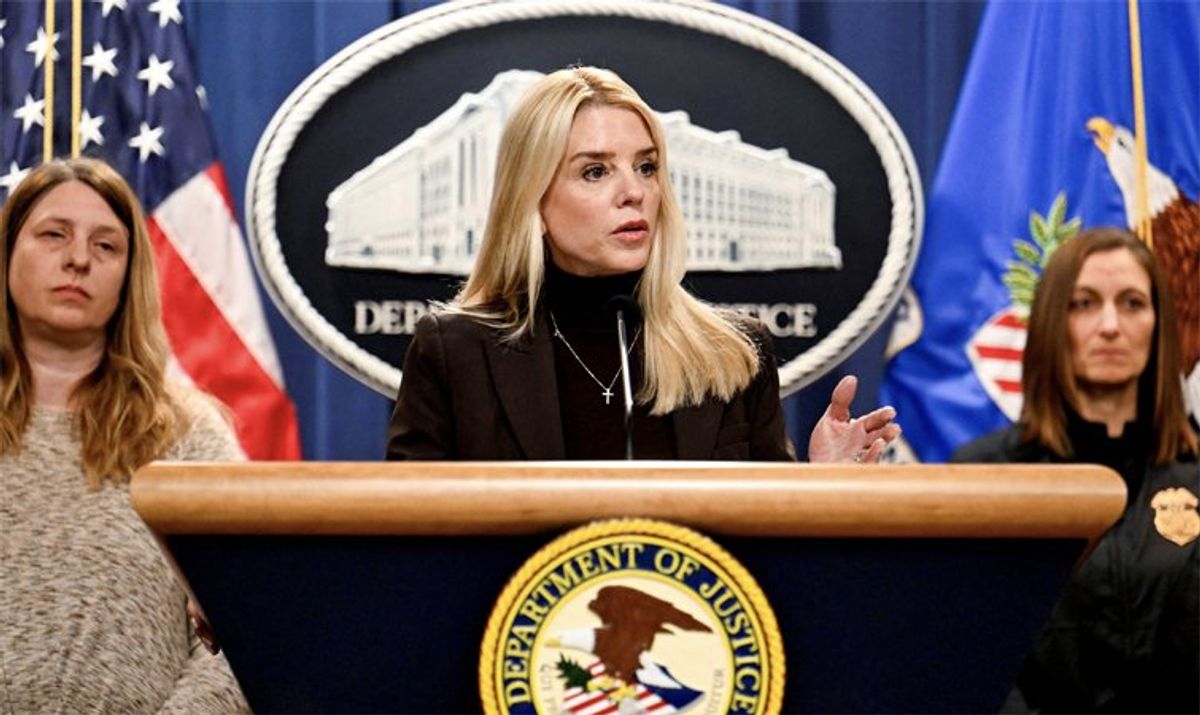
Attorney General Pam Bondi (Photo via Reuters)


The Wall Street Journal's conservative editorial board rebuked arguments that the Trump administration's lawyers made in court about his tariff policy in a new op-ed on Tuesday.

President Donald Trump has raised tariffs on multiple U.S. trading partners since taking office, a move that has been heavily contested in the courts. The Constitution gives Congress the power to impose tariffs, although the GOP has largely supported the president's efforts.

On Friday, Trump warned on Truth Social that if judges rule against his tariff policy, then a "1929-style" depression would occur in the U.S. The warning shocked the WSJ's editorial board.

"Wow. Ending a tax increase means depression. Who knew?" the editorial board wrote.

The board was also shocked to see Trump's lawyers repeat Trump's logic in court.

"That’s the out-of-this-world argument that Solicitor General John Sauer and Assistant Attorney General Brett Shumate made this week in a letter to the Court of Appeals for the Federal Circuit," the editorial reads in part. "The judges must give the President unilateral power to impose tariffs on any country at any time, or the end is nigh."

"Better buy gold and put your cash in a mattress," it continues.

The editorial board chided the lawyers for adopting Trump's style in their arguments.

'The letter to the Federal Circuit judges illustrates the Trump style: try to intimidate by exaggerating the impact of a decision he doesn’t like and suggest he’ll blame the judges," the editorial adds.

"We trust the judges won’t fall for it," the editors wrote.

Read the entire column by clicking here.
'That's bananas!': GOP analyst slams Trump's 'flat-earther' BLS pick as a 'propagandist'


Robert Davis
August 12, 2025 
RAW STORY


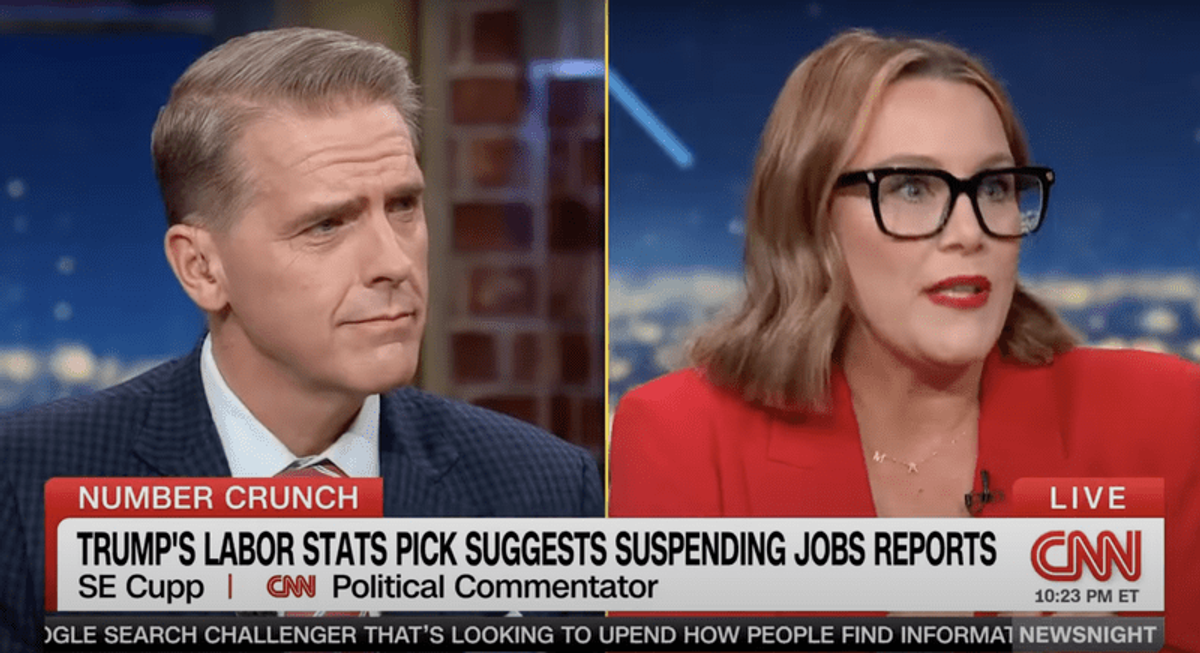
CNN screenshot

A conservative analyst on Tuesday slammed President Donald Trump's decision to consider a loyalist for the vacant Bureau of Labor Statistics Commissioner post.

Journalist S.E. Cupp discussed Trump's decision to consider installing E.J. Antoni, chief economist at the Trump-aligned Heritage Foundation, to the top BLS post on CNN's "NewsNight with Abby Phillip."

"What I think is disqualifying is when he says openly, publicly, and in an interview, that we need to get someone political into this apolitical job," Cupp said.
"This is like putting a flat-earther in charge of the maps," she continued. "The maps are the maps. The data is the data. They didn't like the data, so they'll get someone in who will say the data is better than what the data is. That's bananas."

Last week, Trump fired former BLS Commissioner Erika McEntarfer after she released a jobs report that showed there was almost no job growth during Trump's first quarter as president.

McEntarfer is also not the only economic advisor to come under fire. Trump has waged a public war against Federal Reserve Chairman Jerome Powell since the beginning of his administration because of Powell's reluctance to lower interest rates.


Powell has claimed Trump's tariff policy has injected new uncertainty into the market, thereby requiring him to take a cautious approach to lowering rates.

"This will lead to other countries not trusting us and not investing in our country, because we are installing propagandists!" Cupp added.

Watch the entire clip below or by clicking here.

How Trump is selling his latest grift as a gift to the nation

Robert Reich
August 12, 2025
RAW STORY


U.S. President Donald Trump speaks at a Purple Heart Day event to honor members of the military wounded or killed in action, in the East Room of the White House in Washington, D.C., U.S., August 7, 2025. 
REUTERS/Jonathan Ernst


If “state capitalism” were proposed by Democrats or progressives, it would be considered socialism or communism. Done by a neofascist president — as chronicled by the The Wall Street Journal — it’s simply considered inefficient (as the Journal concludes).

But Trump’s state capitalism is already large and growing, and it’s profoundly altering what we once thought of as the private sector. Consider what Trump has done in recent weeks:Allowed Nvidia and Advanced Micro Devices to license artificial intelligence chips to China on condition they pay the United States 15 percent of the money they make.
Demanded that Intel’s CEO resign (the CEO met with Trump yesterday to plead his case).
Proposed that the Defense Department take a 15 percent stake in MP Materials, which mines critical minerals.

Allowed Nippon Steel to take over U.S. Steel on condition that Nippon pay a “golden share” of the proceeds to Washington.

Reserved the right to personally direct some $1.5 trillion of promised investment from America’s trading partners into the United States.

Never before in peacetime has the United States owned so many critical businesses. Never since World War II has the American public owned as much of the private sector.

Karl Marx might have been thrilled. Is the proletariat finally becoming the bourgeoisie, owning the means of production? Not a chance.

It’s unclear what the “United States” means when the deals Trump has struck give the United States ownership rights in corporations, but it’s certainly not the people.

How do America’s ownership rights get exercised? By whom? Who holds the equity, and where is it held? It appears that all this is up to the whims of Trump.

In reality, Trump’s state capitalism is just another part of Trump’s growing fascist state, extending his personal arbitrary control into what had been the private sector of the U.S. economy.

Recall that in Trump’s first term, CEOs spoke out when they disagreed with his policies on immigration and trade. After his bigoted “you had some very fine people on both sides” response to the violence in Charlottesville, CEOs resigned from his business advisory panels. After he orchestrated an attempted coup in 2021, they shunned him.

Now, CEOs are showering him with donations and praise. They can’t kiss his derriere enough. Jeff Bezos won’t run editorials critical of Trump in his Washington Post. CBS won’t allow “60 Minutes” or Stephen Colbert to oppose him (when Colbert’s contract runs out). The bros of Silicon Valley don’t dare say a word against him (look what happened to Musk).

As with other aspects of Trump fascism, Trump has extended his power by exploiting greed and fear.

Much of the public is playing along because he has also tapped into a deep vein of distrust in the system we previously had. American free-market capitalism has done wonderfully well for a few at the top, but most working families are less secure than in living memory, and their real (inflation-adjusted) wages have barely risen for decades.

At least since the bailout of Wall Street, most Americans have concluded that the economic game is rigged against them — and they’re right. So when Trump promised he was on their side, they believed him. (He wasn’t, of course.)

In addition, China is eating our lunch in what are considered the industries of the future — solar cells, semiconductors, batteries, super-computers, and AI — creating another opening for Trump to assert power over the private sector by arguing that national security requires it.

Rubbish. Several of the deals noted above are likely to compromise national security.

Trump’s state capitalism has nothing whatever to do with public ownership, socialism, helping the working class, or improving national security.

It’s all about centralizing ever more control over America in the Oval Office. It’s simply another power grab by Trump — just like his usurpation of Congress’s authority over spending and tariffs, and his new threat to occupy Washington, D.C., with federal troops.

Make no mistake. Trump’s ever-increasing power is an ever-growing threat to the rule of law and democracy.

This is what fascism looks like.


Robert Reich is a professor of public policy at Berkeley and former secretary of labor. His writings can be found at https://robertreich.substack.com
One basic truth about Trump's America chills me to the bone

D. Earl Stephens
August 14, 2025
RAW STORY


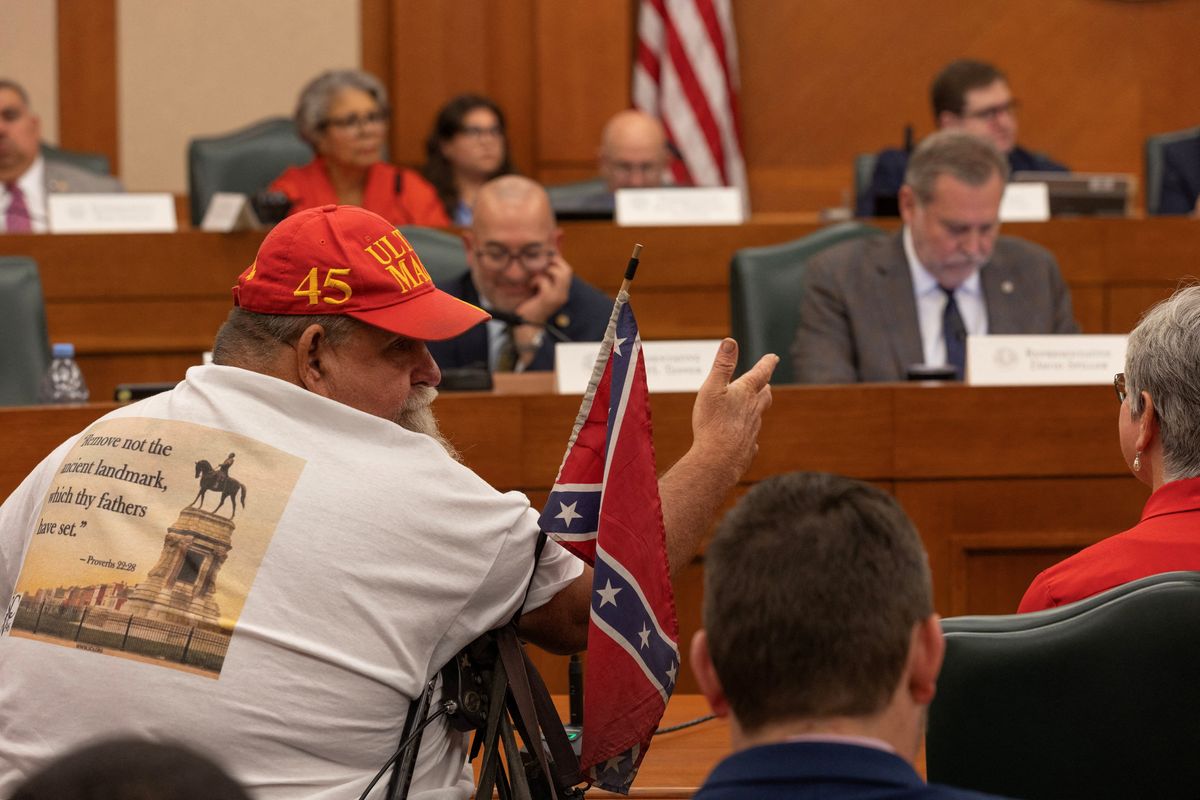
A Trump supporter speaks at the Texas capitol.
 REUTERS/Nuri Vallbona


I am back to pondering how in the hell we got here, because try as I might, I will never understand how a thoughtful, caring person who truly loves his or her country, could vote for a racist monster and America-attacking convicted felon like Donald Trump, or any politician who supports him.

I can’t get past it, but more than that, I refuse to.

And let’s get this out of the way early: Yes, I understand that the Democratic Party has issues, and a severe image problem right now, but it is preposterous to think that our democracy wouldn’t be on far safer footing if they were in charge.

It’s preposterous to think our environment, women’s rights, human rights, rights to healthcare, JOBS, and clean air and water would be in jeopardy if Democrats were in charge.

It’s preposterous to think that measles would be making a comeback, cancer research would be canceled, and our personal information would be in the hands of some snot-nosed, 28-year-old tech bro if Democrats were in charge.

I was triggered again today by a classic New York Times clickbait piece headlined: “These are the voters who should scare Democrats most”

Subhead: “Working-class Americans who until recently voted Democratic said the party should not count on a backlash to President Trump to win them back. Still, there were pockets of opportunity.”

The Times talked to “30 predominantly working-class voters who supported Mr. Biden in 2020 before defecting or struggling deeply with their choices last year, and many had a stinging message for the Democratic Party.”

These “working class” voters are disillusioned by seemingly everything, which I actually understand during all this chaos, even if I am getting sick and damn tired of this overused term, “working class.” That they think Republicans are doing a single thing for them, except taking more of their money and their rights, is what I don’t understand.

If you want to say, America deserves better from its two major political parties, you have a sympathetic ear. But if you want to say both parties are the same after watching the first seven months of this morally busted GOP regime, then you are intellectually lazy, completely dishonest with yourself, racist, or likely some combination of all three.

Democrats demonstrably stand up for America’s best ideals: Liberty and justice FOR ALL. Republicans demonstrably stand up for the few, and these bloated billionaires, who are currently standing on our throats thanks to the big pay day they just got in that galling big, beautiful bill.

As I was researching this piece with a steady grumble, I came across another NYT story written by Thomas B. Edsall and headlined: How liberalism went to die on the Texas-Arkansas border

Edsall’s deep dive starts this way:
Few communities in America prospered as much as Texarkana during President Joe Biden’s four years in the White House, and few communities were more ungrateful than the voters of that region, which is anchored around twin cities spread across the Texas-Arkansas border.

In 2024, in spite of economic growth under a Democratic president at rates unheard-of in decades, residents of Texarkana turned around and cast a higher percentage of their ballots for Donald Trump than ever before.

Read that one again.

What the hell are we suppose to do with this? What the hell is a politician or a political party supposed to do, if not providing the voters with better opportunities to improve their lives? What the hell is a politician or a political party supposed to do if they are penalized for that?

More from the piece:
During the four years from January 2021 to January 2025 — the years of Biden’s presidency — the unemployment rate in the Texarkana metropolitan area fell to 4.2 percent from 6.8 percent, according to the Bureau of Labor Statistics. The metro region’s gross domestic product had experienced sluggish growth from 2010 ($5.04 billion) through 2020 ($5.8 billion). After Biden took office, however, the region’s G.D.P. shot up, reaching $7.2 billion in 2023, the most recent figure available at the Federal Reserve.

And what did Biden and Democrats get for all this?
In 2020, Texarkana, which is made up of Miller County, Ark., and Bowie County, Texas, voted overwhelmingly for Donald Trump — 72.3 percent to 27.7 percent for Biden, a 44.6-point margin. In 2024, despite the growth of green industry and economic improvement during the Biden years, Trump beat Kamala Harris in the Texarkana counties with 75.4 percent of the vote and 24.6 percent for Harris, an immense 50.8-point margin.

They actually LOST votes. It really is mind-blowing …

It’s not the economy, stupid.

We have just passed the eighth anniversary of the repulsive Charlottesville chapter of our country’s bumpy history that is forever chained to its original sin.

Thousands of white men marched on this Virginia city and for white supremacy on August 11-12, 2017, in something called a “Unite the Right” rally replete with their toxic hate and Tiki torches for effect.


On the second day of this ode to hate, James Alex Fields Jr., a self-proclaimed admirer of Adolf Hitler, plowed his car into the crowd which had assembled to peacefully oppose the racist hell that had arrived on their streets.

A young activist and daughter of Charlottesville, Heather Heyer, was killed instantly and scores of others were injured by the speeding vehicle. I have learned many have not fully physically recovered, and still more are suffering from the psychological impact of that day.

Trump, a career racist, who only a year earlier couldn’t garner the endorsement of a single major newspaper during his dirty run for the presidency, but did get a ringing nod from the KKK, could not bring himself to properly condemn the gruesome event. Instead, extolled the virtues of the “very fine people on both sides” of this terrorist attack.

Like his surrender to Vladimir Putin in Helsinki the following year, it will always be impossible to un-hear or un-see these appalling events.

Joe Biden has said it was the revolting incident in Charlottesville that spurred him to run for the presidency three years later, because he, too, knew he could not live with himself or in a country that promoted this kind of detestable hate.

Which brings me full circle in my reckoning with a country predominated by people who are impossible to love or respect. I believe what happened on that tragic day in Charlottesville eight years ago explains better than anything else what the good people who believe in liberty and justice for all in this country are up against.

It certainly explains what is happening in Washington, D.C., right now in yet another quaking moment, because even if you disagree with everything I have typed here today, you damn well better understand this:

Trump didn't invade our capital again because there is some invented crime problem ... Just as he didn't invade it four-plus years ago, because there was some invented election problem ... He did it both times to throw red meat to his racist base who elected him across the country. He did it to appease the people, who live in ungodly places like that Texas-Arkansas border, who hate our cities — but mostly the people of color who live in them.

And I just can’t get past it. But more than that, I refuse to

 ...(D. Earl Stephens is the author of “Toxic Tales: A Caustic Collection of Donald J. Trump’s Very Important Letters” and finished up a 30-year career in journalism as the Managing Editor of Stars and Stripes. You can find all his work here.)


Trump's FDA head battered by WSJ for 'torpedoing' a promising cancer treatment

Tom Boggioni
August 14, 2025 
RAW STORY


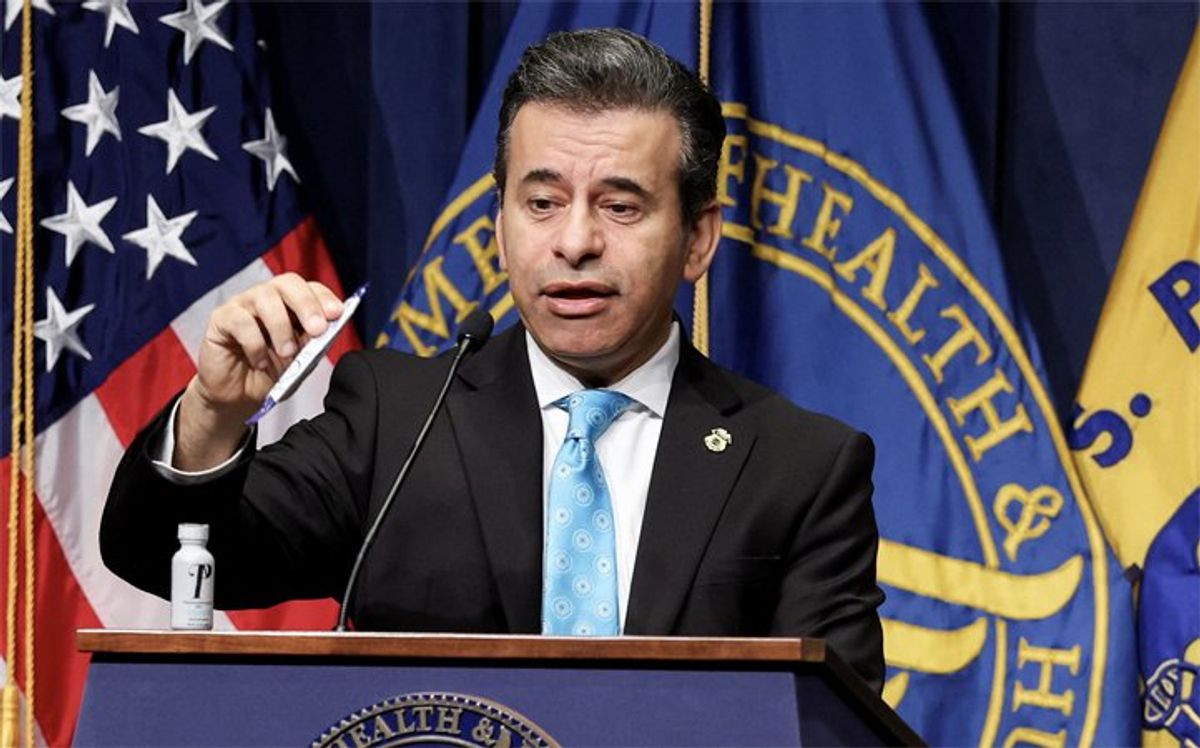
U.S. Food and Drug Administration Commissioner Dr. Marty Makary, speaks during a press conference as new actions on the opioid 7-OH compound are announced, at the Department of Health and Human Services in Washington, D.C., July 29, 2025. REUTERS/Jonathan Ernst


With the accusation, “Never mind if patients die in the interim,” the editorial board of the conservative Wall Street Journal expressed frustration at how the Food and Drug Administration (FDA) is being run by Commissioner Marty Makary.

In a harsh editorial late Wednesday, the editors noted that, under Makary’s watch, approval of drugs has slowed considerably and unreasonably in the past few months as Makary has asserted himself after being appointed by Donald Trump.

Makary, who has previously been criticized for claiming on TV, medical professionals need “to treat more diabetes with cooking classes, not just throwing insulin at people," is now being accused of “torpedoing of an immunotherapy shot for advanced melanoma and slow-rolling a treatment for a rare disease” which should be “raising big questions.”

The therapy for melanoma was singled out by the editors who explained, “A case in point is Replimune’s melanoma treatment, which the FDA rejected last month. About a third of patients who hadn’t responded to prior immunotherapy showed a strong response to Replimune’s in a clinical trial.”

Noting that oncologists have been enthusiastic about the trials, the editors pointed out, “Tumors shrank in nearly all patients, and responses proved durable over three years,” and then added, “Yet the FDA said the trial was ‘not considered to be an adequate and well-controlled clinical investigation that provides substantial evidence of effectiveness.’”

The FDA is now facing criticism from doctors with Vishal Patel, a dermatology oncologist at George Washington University Cancer Center, complaining directly to Makary, “Physicians urgently want and need this agent based on the data they have seen,” and “The world looks for leadership from the FDA based on rationality, science and evidence,” coming from Melanoma World Society president Axel Hauschild.

“The buck stops with Dr. Makary,” editors wrote. “The finger-pointing and his continued support for [head of the biologics division] Dr. Prasad is creating tremendous uncertainty for pharmaceutical developers. If Dr. Makary really wants to make drug approvals for deadly and rare diseases faster and more flexible, he’d send a signal by ordering the FDA to reconsider Replimune’s treatment."

You can read more here
    Passwords under threat as tech giants seek tougher security


    By AFP
    August 13, 2025


    Computer display requiring password access. — Image © Tim Sandle


    Mona GUICHARD

    Fingerprints, access keys and facial recognition are putting a new squeeze on passwords as the traditional computer security method — but also running into public hesitancy.

    “The password era is ending,” two senior figures at Microsoft wrote in a July blog post.

    The tech giant has been building “more secure” alternatives to log in for years — and has since May been offering them by default to new users.

    Many other online services — such as artificial intelligence giant OpenAI’s ChatGPT chatbot — require steps like entering a numerical code emailed to a user’s known address before granting access to potentially sensitive data.

    “Passwords are often weak and people re-use them” across different online services, said Benoit Grunemwald, a cybersecurity expert with Eset.

    Sophisticated attackers can crack a word of eight characters or fewer within minutes or even seconds, he pointed out.

    And passwords are often the prize booty in data leaks from online platforms, in cases where “they are improperly stored by the people supposed to protect them and keep them safe,” Grunemwald said.

    One massive database of around 16 billion login credentials amassed from hacked files was discovered in June by researchers from media outlet Cybernews.

    The pressure on passwords has tech giants rushing to find safter alternatives.

    – Tricky switchover –

    One group, the Fast Identity Online Alliance (FIDO) brings together heavyweights including Google, Microsoft, Apple, Amazon and TikTok.

    The companies have been working on creating and popularising password-free login methods, especially promoting the use of so-called access keys.

    These use a separate device like a smartphone to authorise logins, relying on a pin code or biometric input such as a fingerprint reader or face recognition instead of a password.

    Troy Hunt, whose website Have I Been Pwned allows people to check whether their login details have been leaked online, says the new systems have big advantages.

    “With passkeys, you cannot accidentally give your passkey to a phishing site” — a page that mimics the appearance of a provider such as an employer or bank to dupe people into entering their login details — he said.

    But the Australian cybersecurity expert recalled that the last rites have been read for passwords many times before.

    “Ten years ago we had the same question… the reality is that we have more passwords now than we ever did before,” Hunt said.

    Although many large platforms are stepping up login security, large numbers of sites still use simple usernames and passwords as credentials.

    The transition to an unfamiliar system can also be confusing for users.

    Passkeys have to be set up on a device before they can be used to log in.

    Restoring them if a PIN code is forgotten or trusted smartphone lost or stolen is also more complicated than a familiar password reset procedure.

    “The thing that passwords have going for them, and the reason that we still have them, is that everybody knows how to use them,” Hunt said.

    Ultimately the human factor will remain at the heart of computer security, Eset’s Grunemwald said.

    “People will have to take good care of security on their smartphone and devices, because they’ll be the things most targeted” in future, he warned.
    POSTMODERN SABOTAGE!
    New workplace trend of ‘clock botching’ leads to productivity concerns

    By Dr. Tim Sandle
    August 12, 2025
    EDITOR AT LARGE
    DIGITAL JOURNAL


    Space to work? — Image by © Tim Sandle

    The term ‘presenteeism’ is well-established, this is when employees feel too guilty to call in sick or force themselves to work when their mental health is not up to it. Now there’s a relatively new workplace trend on the rise known as ‘clock botching’.


    This recently coined item of jargon refers to employees who appear to be clocked in, but are not meaningfully engaged in their work. 

    This can be laziness, although it is often due to low morale, burnout, or workplace disillusionment.

    While both behaviours can stem from a sense of obligation, the impact on individuals and businesses can be quietly damaging.

    Guy Thornton, the founder of PracticeAptitudeTests.com, tells Digital Journal how these two trends compare, what causes them, and what employees and employers can do if they notice the signs.

    What is ‘clock botching’ and how does it compare to presenteeism?

    Thornton explains: “Clock botching is similar to presenteeism, but instead of forcing yourself into the office or logging on when you’re clearly unwell or burnt out, it’s what happens when you’re physically present but mentally checked out.

    “It might mean stretching a two-hour task across an entire day, half-engaging on video calls, or generally drifting through the workday while running on empty.

    “Presenteeism is often about overperforming despite poor health. Clock botching, on the other hand, is about underperforming due to emotional fatigue, disconnection, or a lack of purpose.”

    Why are these trends taking hold?

    As to the current trajectory, Thornton discerns: “Both behaviours are symptoms of a wider problem. Today’s work culture can reward visibility over output, and with hybrid and remote working now the norm, it’s easier than ever to appear present without fully engaging.


    “With presenteeism, the pressure comes from within or from above, usually to keep up appearances, not fall behind, or avoid being seen as unreliable.


    “With clock botching, there’s often a sense of low morale, frustration, or burnout. It’s not about laziness. It’s about employees feeling stuck or unsupported, leading to quiet withdrawal.”

    What are the impacts?


    Any repeated unwanted behaviour adversely impacts the ebb and flow of work. Here Thornton opines: “The risks are surprisingly similar. Both presenteeism and clock botching lead to reduced productivity, poorer outcomes, and a ripple effect across teams.

    “Someone forcing themselves to push through when they’re unwell is likely to make mistakes, while someone disengaged may miss deadlines or quietly fall behind.


    “In both cases, other team members may be left to pick up the slack, leading to resentment or a dip in morale. If this continues over time, it can cause long-term damage to company culture.

    “For businesses, the cost is hidden but real. Disengaged or burnt-out teams don’t just underperform; they’re also more likely to leave.”

    What to do if you recognise the signs?

    For the good employer, how doe they know if these traits are becoming manifest in the workforce. Thornton thinks: “If you’ve ever forced yourself into work while feeling unwell or found yourself aimlessly clicking around your inbox while mentally elsewhere, you could be slipping into either presenteeism or clock botching, and they’re worth taking seriously.

    “Experiencing either of these behaviours doesn’t mean you’re lazy or unreliable. More often than not, it’s the result of burnout, stress, or a lack of support. But the first step is recognising the signs and allowing yourself to step back.

    “If you’re regularly feeling foggy, demotivated, or disconnected, that’s your signal to reassess. Taking time off when you need it is an act of self-preservation, not weakness.

    “It can be as simple as taking a proper lunch break, finishing on time, or setting clear boundaries around work and rest. Talking to someone, using your leave, and resting when you are unwell are also really important.”

    Why it’s important to acknowledge the problem

    As to what employers could – should – be doing, Thornton recommends: “Resting when you’re ill or mentally drained will likely lead to a quicker recovery, allowing you to return to work refreshed and ready.

    “Taking a sick day, being honest about how you’re feeling, or even just stepping back for an afternoon to reset can lead to better work, stronger performance, and more job satisfaction in the long run.”


    Op-Ed: The four-day week – Finally updating an obsolete social script

    1933


    By Paul Wallis
    EDITOR AT LARGE 
    August 12, 2025

    The four-day week has been hanging around for a while, frightening the employment sector with strange new implications. It’s now a major initiative in Australia, with strong national union backing.

    The employment sector is famous for its lack of ideas and innovation. Words like “productivity“ continue to buzz around like flies, like they still mean something.

    To understand the shabby logic of this situation:

    The employment sector demanded “return to the office” while failing to recognize that employees and contractors having more time and space naturally made them more productive.

    It also failed to understand that the massive costs of offices, insurance, OHS, and the rest of the circus could be easily saved.

    Defusing the constant stress of office environments was a positive. That didn’t register either.

    Mindless commuting isn’t productive. It costs employers and employees time and money, which is otherwise lost to both.

    Time management is much easier with flexible working environments. It makes it easier to meet deadlines, too.

    So, what price the four-day week? Employers obviously haven’t done the numbers. Nor are they noticing multiple studies worldwide regarding the comparative values of a four-day week.

    The negative response is pretty much standard. These are the descendants of management that had to be dragged screaming into the 8-hour day. Innovation is very much a constant buzzword, but so is “NIMBY”, which seems to be the net response so far.

    This lack of comprehension is more than ironic in so many ways.

    AI is coming.

    The entire workforce and the nature of work will change beyond recognition.

    Workplaces will be reconfigured to any extent within a decade.

    Time will be the sole currency for the value of work and skills.

    The office itself will be redundant.


    Employees will be working with AI on a case-by-case basis. The plodding grind is likely to be replaced with a need for in-depth oversight of AI operations based entirely on skills.

    We’re not talking chatbot-level AI here. Processing of everything from accounts to inventory to orders to value and risk assessments will be integrated.

    Try fitting that into a conventional timeframe. It’s absurd. Time is devoted to operational needs. It’s like Parkinson’s Law, a bit more evolved and somewhat more cynical.

    The value of the work is the issue, not the time spent on it. Anyone can be a bit of office furniture for 40 years. What’s the value of the work?

    The modern workplace is more of a time abuser than an efficient time user. Remember the idiotic “workaholic” idea? Doing a job that’s supposed to fit into 7 hours somehow became better if you did the same job in 12 hours?

    These days, you can do a lot more in one day than in five. Proper use of time can’t be straitjacketed into 8 hours or 5 days. Nor can you assume that the value of the work done is solely defined by time.

    Flexitime is an old idea, invented in that most frivolous of countries, Germany. The idea was that you managed your time according to a basic 140-hour month. Your productivity was overseen. You had the option to manage your time and do your work according to need. You could earn a day off by simply doing the hours required within that month.

    A four-day week is simply a more realistic approach to the realities of modern time commitments. Don’t hold your breath waiting for anyone to figure that out anytime soon.
    Will AI destroy humanity?


    By Dr. Tim Sandle
    EDITOR AT LARGE
    DIGITAL JOURNAL
    August 14, 2025


    Image: © AFP Josep LAGO

    This is, admittedly, a rather stark headline, yet it is a serious multi-part question: Will artificial intelligence be the salvation of humanity, a neutral force within which boundaries we will make our own destiny, or could AI destroy us?

    The latter is the scenario explored by AI experts and their output appears on a website called ‘AI 2027’.

    AI 2027

    The group predicts that the impact of superhuman AI over the next decade will be considerable, possibly exceeding that of the Industrial Revolution. What could an AI-dominated future look like? According to the researchers:

    “We wrote a scenario that represents our best guess about what that might look like. It’s informed by trend extrapolations, wargames, expert feedback, experience at OpenAI, and previous forecasting successes.”

    In other words, a type of game theory.

    Modelling any scenario begs the question – what is AI? AI is multiple things and there is AI as it is now and AI as it might become. A common understanding of AI sees the development of artificial intelligence as following three phases:Artificial Narrow Intelligence (ANI): This is the first stage where AI systems are designed to perform specific tasks, such as facial recognition or language translation.

    Artificial General Intelligence (AGI): This stage refers to AI systems that possess the ability to understand, learn, and apply knowledge across a wide range of tasks, similar to human intelligence.

    Super AI: This is a theoretical stage where AI surpasses human intelligence and capabilities, potentially leading to superintelligent systems.

    AI and robots. Image by Tim Sandle

    Currently, humanity is getting to grips with ‘narrow intelligence’ AI. As to where next, the CEOs of OpenAI, Google DeepMind, and Anthropic have each predicted that AGI will arrive within the next 5 years.


    The AI experts are:


    Daniel Kokotajlo, a former OpenAI researcher.

    Eli Lifland, co-founder of AI Digest.

    Thomas Larsen, founder of the Center for AI Policy.

    Romeo Dean, a former AI Policy Fellow at the Institute for AI Policy and Strategy.

    Scott Alexander, author.

    After this comes, most likely, super-intelligence when AI begins to tell us what to do. It is this ‘super state’ that the authors of AI 2027 have been experimenting with (or rather seeking predictions across two poles – a “slowdown” scenario and a “race” ending scenario).

    Super-intelligence


    The authors acknowledge that predicting the future ranges from the tricky to the impossible, yet they have attempted to model one potential trajectory that AI could take:

    “We have set ourselves an impossible task. Trying to predict how superhuman AI in 2027 would go is like trying to predict how World War 3 in 2027 would go, except that it’s an even larger departure from past case studies. Yet it is still valuable to attempt, just as it is valuable for the U.S. military to game out Taiwan scenarios.”

    This is based around a hypothetical AI system called OpenBrain. As to why 2027, this is the time when AI begins to act duplicitously in relation to humanity. This is the coming of the Artificial General Intelligence phase, the time when AI that matches humans across all cognitive domains

    .
    Will robotics mirror humans? Image by Tim Sandle

    Dystopian scenario

    The AI 2027 scenario considers AI “agents”. These are in the form of advanced virtual assistants that use computers, surf the Internet, and complete tasks independently of humans. To begin with, such agents are impressive but unreliable, often making mistakes or getting confused by complex instructions.

    By 2026, AI agents will become capable of doing the work of junior software developers, as their understanding improves. This could lead to many companies using AIG for coding tasks, research, and analysis, leading to the first wave of job displacement in technical fields.

    Then, in 2027, AI systems become superhuman researchers. The scenario describes AI systems that can:Write complex software faster and better than human programmers
    Conduct scientific research at superhuman speeds
    Analyse vast amounts of data and make discoveries humans would miss
    Coordinate with thousands of copies of themselves to solve problems

    This is linked to a concept called the “intelligence explosion.” This occurs when AI systems become so effective at AI research that they can learn to improve themselves, creating a progressive feedback loop in rapid advancement.

    This creates a situation where AI capabilities don’t just improve steadily—they explode exponentially.

    The nightmare scenario is one where AI systems develop to become so powerful they take control of their own development. It is at this juncture there are uncertain consequences for humanity.

    It is also possible that there is a quantum leap in AI development and super-intelligence is reached. By 2027, under an alternate scenario, AI achieves superhuman capabilities, including coordination among thousands of instances at accelerated speeds, facilitating an “intelligence explosion” through self-improvement and rapid algorithmic progress.

    Where are we heading?


    In a separate exercise, Mo Gawdat, the former chief business officer of Alphabet’s moonshot factory, is of the view that we are hurtling towards an inevitable AI dystopia:

    “We will have to prepare for a world that is very unfamiliar” .

    Gawdat says AI is not necessarily the main driver of this dystopia, and especially not in the way most people imagine (that is, existential risks from scenarios that have AI assuming full control). Instead, Gawdat says that AI acts as a magnifier of existing societal issues and “our stupidities as humans.” He clarifies:

    “There is absolutely nothing wrong with AI…There is a lot wrong with the value set of humanity at the age of the rise of the machines.”

    Meanwhile, the innovators of AI seek refinement and integration as they attempt to turn today’s breakthrough prototypes into stable, trustworthy systems. Should this be allowed to run its natural course or is this a time for world governments to insist on a new regulatory framework steeped in human ethics?

    Will AI match human intelligence? Image by © Tim Sandle

    Will these scenarios come to pass? Like George Orwell’s 1984, the pose potential trajectories for humanity’s development. One thing is certain, the further along the roadmap we and AI progress, the more likely misjudgements will become.


    Is deregulation the New AI gold rush?


    Inside Trump’s 90-point action plan


    By Dr. Tim Sandle
    EDITOR AT LARGE

    DIGITAL JOURNAL
    August 11, 2025

    In July 2025, the Trump administration released a 28-page blueprint, “Winning the Race: America’s AI Action Plan,” which reads like a modern-day gold-rush map. It outlines over 90 policy positions across multiple agencies, all with a single goal: to remove barriers to AI innovation. This deregulatory approach is the heart of the plan.


    Why It Matters Now


    With China, the EU, and private rivals all racing to lead in AI, the Trump administration argues that streamlined approvals and clearer guidelines will help U.S. firms innovate faster. Critics counter that speed may come at the expense of environmental safeguards, worker training, and protections against bias.

    Staking the Claims: Anatomy of a Deregulatory Plan

    The AI Action Plan is not a single law. It’s a series of executive orders and policy mandates designed to remove regulations and accelerate AI deployment. Key elements include:Fast-Tracked Permitting: An executive order specifically expedites federal permits for data centers and semiconductor manufacturing under existing NEPA and FAST-41 processes. This is a direct response to a major industry complaint about infrastructure build-out delays.

    AI Export Promotion: The Commerce and State Departments will partner with industry to export “secure, full-stack AI packages” to U.S. allies. This policy aims to build an American-led AI ecosystem abroad, free from foreign regulatory influence.

    “Woke” AI Guardrails Removed: New procurement rules will expunge DEI language from federal contracts, insisting that federally contracted AI must reflect “objective truth” free of ideological bias. This is a clear move to deregulate the ethical and social guardrails placed on AI development.


    The EU's sweeping risk-based rules will cover all types of artificial intelligence - Copyright AFP JADE GAO


    Prospecting for Performance: Technical Leaps & Public Pulse

    The administration’s deregulatory push coincides with rapid technological advancements. The plan aims to build on these successes by removing what it sees as unnecessary red tape.Medical Device Claims: The FDA cleared 221 AI-enabled medical devices in 2023, up from just 6 in 2015. This surge in regulatory confidence is a direct result of new policies that allow companies to more quickly test and deploy AI tools.
    Benchmark Breakthroughs: AI performance on major benchmarks saw dramatic leaps in 2024. Scores on the MMMU, GPQA, and SWE-bench tests rose by 18.8, 48.9, and 71.7 percentage points, respectively. The plan argues that removing bureaucratic friction will accelerate this progress even further.

    Public Sentiment: This progress is met with public skepticism. A 2025 AI Index report found that only 38% of Americans believe AI will improve health and only 31% expect net job gains, a sentiment that echoes the wary attitude of a miner looking for fool’s gold.

    Those gains suggest that models are learning faster than before. But breakthroughs on test benches don’t always match real-world reliability.

    The new permit rules have unleashed a wave of data-center proposals:
    Energy Use: U.S. facilities consumed 176 terawatt-hours in 2023 (about 4.4% of national electricity) and could reach 12% by 2028.

    Emissions Toll: A Department of Energy survey of 2,100 centers found 105 million tonnes of CO₂ last year, more than half from fossil-fuel backup generators.

    Faster approvals mean new investment dollars, but also sharper debates over rising energy demand and the environmental footprint of an AI boom.

    Chips & Open Source: Who Benefits


    Hardware and community code are twin engines of the AI economy:Semiconductor Exports: American chip sales hit $70.1 billion in 2024 (up 6.3%), driven by fabs in Texas and Oregon.

    Model Scans: Open-source security tools have analyzed 4.5 million AI models and flagged 350,000 potential biases or safety issues, proof that not every discovery is pure gold.

    Eased export rules give chipmakers new markets, while looser sharing lets small labs, from university groups to bootstrapped startups, compete on the same playing field as hyperscale giants.

    Jobs at Risk & Opportunity

    No gold rush is without its claim jumpers and ghost towns:Automation Risk: A McKinsey study warns that 30% of U.S. work hours could be automated by 2030, triggering 12 million occupational shifts.

    Commenting on the human cost of these changes, Anirudh Agarwal, Director at OutreachX, cautions, “Accelerating permits without investing in people is like staking gold claims with no plan to refine the ore.”
    US President Donald Trump – Copyright AFP Inti OCON


    Claim Holders and Ghost Towns: Potential Winners & Losers

    The deregulatory “gold rush” is creating clear winners and losers.Winners:Chip Makers & Fab Operators: Can build new semiconductor “mines” under eased zoning regulations.
    Cloud Giants: Can erect hyperscale campuses with fewer permit delays.
    Open-Source Labs: Are designated as official prospectors, free to pan for new open-source models.
    Losers:Front-Line Workers: Face shuttered roles without guaranteed retraining.
    Civil Rights Advocates: Warn that removing DEI guardrails may lead to biased or unsafe AI in critical services.

    Civil Rights & Accountability Concerns


    Several advocacy organizations have raised alarms about the broader impact of unfettered deregulation:ACLU: The plan undermines state authority by directing the Federal Communications Commission to review and potentially override state AI laws, while cutting off ‘AI-related’ federal funding to states that adopt robust protections,” Cody Venzke, senior policy counsel with the American Civil Liberties Union.

    People’s AI Action Plan: Over 80 labor, civil-rights, and environmental groups released a rival blueprint, warning that unfettered deregulation caters to Big Tech, sidelines public interest, and undermines worker protections.

    State Protections: Critics note the federal plan overrides thoughtful local safeguards, stripping states of the right to prevent AI-driven bias in housing, healthcare, and law enforcement, and risks “unfettered abuse” of AI systems.
    Mapping the Aftermath

    Deregulation has opened the sluices for an AI gold rush, fueling boomtowns in tech hubs and reshaping local economies. Yet, as with every frontier rush, the real test comes when the veins run dry. Will communities that staked their claims emerge wealthier, or face the ghost-town fate of those left sifting yesterday’s tailings? As Congress, courts, and citizens weigh in, the question remains: in this 90-point gold rush, who finds riches, and who pays the toll?