Friday, August 29, 2025

How Overconsumption Pushes Garment Workers to the Brink


Blood, Sweat, and Stitches


Last September,  a report from the trade publication Business of Fashion found that the Chinese retailer Shein was the world’s largest polluter in the garment industry, but a casual reader of corporate news media would likely be none the wiser, because the report received little to no coverage by the establishment press.  As of July 2025, new US tariffs on Chinese manufacturing, including the products of many “fast fashion” brands,  could cause prices for clothes from Shein and its competitors to spike. Elizabeth Cline of The Atlantic has warned that tariffs “won’t kill the industry,” but they may worsen its waste and exploitation problems.

Overconsumption is nothing new, but over the last decade, it has become common for microtrends to saturate social media and the internet,  spurring consumers across the developed world to buy new products. The pressure to purchase each frivolous thing that appears on our screens is supported by the structure of the global economy and our desire for instant gratification. This is particularly reflected in what consumers choose to wear. In the last five years, online brands like Shein and Temu have exploded in popularity among consumers looking for goods that are fashionable at the moment but cost as little as possible. The constant stream of items made to be used for the short time that they are stylish and then quickly discarded does not arise out of thin air. Real people, often mired in poverty, work in squalid factories to make these products; some even lose their lives because of corporate callousness and greed.

The men, women, and children working in these factories, however, do not reap the benefits of the unprecedented profits that their work generates for their corporate employers. More than seventy-five million people worldwide work to bring cheap, fashionable clothing from sweltering factories in developing countries to stock shelves in wealthier, more secure nations, and less than 2 percent of these workers are paid a minimum wage. Factory workers producing goods for Shein work upwards of seventy-five hours a week, which far exceeds legal limits in China, and are paid for each item they make, rather than earning a standard wage. These factories rarely issue employment contracts, leaving their employees without a clear delineation of their rights. Shein is not required to perform any kind of inspection to ensure fair treatment of its workers, and as of late, has not deigned to do so. Even in factories producing for bigger, more prestigious brands, workers suffer.

In May 2025, for example, ProPublica reported that, despite Nike’s promised reforms, workers in a Nike factory in Phnom Penh, Cambodia, continue to faint from heat exposure or exhaustion. The extended supply chains that wealthy, Western consumers take advantage of are designed to make as many goods as possible for as cheaply as possible, while distancing consumers from the exploitation and abuse of workers. The major companies that reap the profits maintain headquarters in wealthier, more developed countries but enlist labor from poorer nations where labor standards, regulations, and oversight are much weaker and do not stand in the way of soaring profits.

In the most severe cases, workers can even lose their lives for the profits of factory owners and major companies. To note one notorious example, on April 24, 2013, the Rana Plaza factory in Savar, Bangladesh, collapsed, killing more than 1,100 workers. The day before, cracks in the eight-story building’s structure were discovered, leading shops and banks in the building to evacuate, yet factory overseers forced their employees to return to work the next day. When the complex came crashing down, workers endured total misery. Some were trapped under tons of rubble for hours or days before they could be rescued, and others had to amputate their own limbs to escape. In the face of mass outcry, officials in Bangladesh promised change, yet more than a decade after the disaster, workers who protest against poor conditions are frequently arrested and sometimes even battered in the streets.

It would be easy to dismiss the current state of affairs as the whims of faceless corporate elites, but the truth is that the blame also rests on consumers. Our incessant need to spend in excess rewards the bad behavior of corporations and enables their mistreatment of their laborers. A steady flow of revenue only emboldens corporate greed, and even momentary contractions can give them an excuse to exploit workers further. The COVID-19 pandemic brought the luxury of working from the comfort of one’s home to millions, but drove factory workers in the periphery further into despair.

The economic downturn in 2020 led people, and then corporations, to halt payments for orders to protect their assets. In surveyed countries, including Ethiopia, India, and Myanmar, nearly a third of workers lost their jobs, and the ones who remained employed saw their wages slashed and their working conditions further deteriorate. About one out of every five workers was even denied basic necessities at work, such as access to water and the use of the restroom. These people are then driven further into personal and household debt, which sends them into a downward spiral into further poverty and squalor. This pattern shows that the choices we make as consumers have tangible effects on the livelihoods of the workers who make our goods.

Why is it that corporate media are loath to report all but the most catastrophic effects of this miserable supply chain? The simple fact is that they have too much to gain. Corporate media has always had an interest in influencing what people think, but since the advent of the internet, people are constantly inundated with content that tells them that they need to consume as much as possible to stay current with the latest styles and trends. Of course, these messages are tailored by corporate entities to maximize their profit.  More and more people buying cheap, mass-produced products gives the corporate media a wider audience whose ideas and decisions can be influenced. The idea that more and more products are only useful as long as they are “in” serves to spike demand for goods among consumers who can spend money frivolously, which in turn spikes production in distant factories where manufacturers abuse and exploit the workers who produce those goods.

As dire as this situation may seem, there is still some hope. Nina Gbor, a sustainable fashion educator who is the founder of Eco Styles and serves as the director of the Circular Economy & Waste Program at The Australia Institute, told Project Censored that “it could take the knowledge of exploitation becoming somewhat of a trend” to encourage consumers in the imperial core to care about overconsumption.  The poor treatment of workers in peripheral nations and the industry’s effects on the environment are, she says, “social injustice, political, economic and humanitarian issues amongst other things” that activists can amplify.

When it comes to a personal change of perspective, however, Gbor concedes that “you can bring the issues to people’s awareness but you can’t make them care.” Ultimately, Gbor is sure that “we need legislation and policies that will change these systems of injustice in global supply chains,” and for that to happen, “we need enough people to advocate for these laws and systems to change.”

The solution to this cycle lies in the choices that consumers make. Reducing the demand for cheap goods with no long-term utility is key to sending a message to the corporations that profit from the abuse of their factory workers. Furthermore, we must recognize the power of working together to project one united voice against the exploitation of laborers to satisfy fleeting consumer demands. Collective action is key to forcing the hand of these large conglomerates. One pleading voice alone cannot effect the type of change that is necessary—we must coalesce into one collective force to demand it. If we can redirect towards making conscious decisions to buy goods that will last longer than the latest trend cycle and make clear to corporations that we will no longer be distracted by the cheap baubles of the day or tolerate the suffering involved in making them, we can do our part in removing the incentive to abuse workers for profit.

Jayden Henry is from the Atlanta area and is a junior at Vanderbilt University, studying political science and history. This Dispatch is his culminating project for his Summer 2025 internship with Project Censored. Jayden is also the host of the weekly radio program I Want to Tell You Something on WRVU Nashville. Read other articles by Jayden.


The Silent Singing Bird of Flamboyant Plumage


Whenever I get the infrequent opportunity to walk the wild deserted Cape Cod outer Atlantic beach in the early morning, I exult in the sea’s silent roar. It extinguishes the cacophonous dreck that fills the air of everyday life in a society whose depravity accelerates faster than shore birds can fly.

This morning, because there was a little rain and rough surf the beach was deserted except for the usual assortment of birds. So we sauntered the long strand for an hour until we finally encountered a person as the sun flashed from behind the clouds. Inside the cocoon of the crashing waves and the whistling of the wind, with the clouds blowing fast, the seals just voiceless heads bobbing in the shallow water, and the birds hushed by the waves’ wild roar, a strange silence settled over me. I felt cloistered in a place of peace, similar to William Butler Yeats’ sentiment in his poem, The Lake Isle of Innisfree: “And I shall have some peace there, for peace comes dropping slow,/ Dropping from the veils of the morning ….”

Silence. Without it, we are bereft of meaningful words and end up talking repetitive gibberish, small talk. There are many people who can’t shut up; their jabbering is a disease. Tranquilized with trivia, they lose their ability to communicate.

Silence is a word gravid with multiple meanings: for many a threat; for others a nostalgic evocation of a time rendered obsolete by technology; for others still a sentence to boredom; and for some, devotees of the ancient arts of reading, writing, and contemplation, a word of profound, even sacred importance. As the ancient Greeks knew so well, musing is the music of the artist’s heart.

Writing is at first, like an imaginary friend, a silent companion. Conceived by its author in silence, it asks to be received in the same spirit. And silence – contrary to the popular notion that it, like nothing, is nothing, a void, a lack of something – is the receptive spirit that encompasses all the meanings words can give. That silence is golden is an aphorism we have all heard but rarely heed. Nevertheless, it is out of that great unknown that words are born; great writing is the child of silence.

So too reading should be a venture into that unknown, an adventure upon which one embarks with eyes and ears wide open and the constant chatter of one’s private “thoughts” silenced.

But silence, like so much else in today’s world, including human beings, is on the endangered-species list . Another rare bird of flamboyant plumage and very like a black swan – “Rara avis in terris nigroque similima cyno” in Juvenal’s words – is slowly disappearing from our midst. The poison of noise is killing it.

And out of this lack of silence comes the silence of lack, the inability to use words to communicate meaningfully. As sung so wonderfully by Simon and Garfunkel in “The Sounds of Silence:”

And in the naked light, I saw
Ten thousand people, maybe more
People talking without speaking
People hearing without listening
People writing songs that voices never shared
No one dared
Disturb the sound of silence

Ironically, as books have become more plentiful, silence has become scarcer. Most books now arrive with the clatter and bombast of the same advertising hype used to sell laxatives and pain-killing drugs. And they are received in the same spirit, often producing similar results. These loud arrivals often make the so-called best seller lists (as if number seven on that list could be the “best” seller along with number one), a curious place where quality is measured by quantity and the noise of publicity pays off handsomely. Many of these books are what D.H. Lawrence called “printed toys,” loud little devices that spin and spin and always seem to end up where they started – nowhere.

When I speak of noise I am not primarily speaking of the din we associate with city life: cars, trucks, sirens, etc. Such noise, alas, is heard even in small towns where birdsong often disappears behind the grinding of gears. That kind of noise is hard to completely avoid and it is in any case the least disruptive of the silence I have in mind. There is another kind of noise that is self-imposed, and whose purpose, consciously or not, is to make sure one is not “caught” by silence. That, as those who flee from silence know, can be dangerous to one’s reigning assumptions about self and the world. They prefer the comfort of noise because it silences the imagination, and imagination, as William Blake has told us, is the world of eternity, and to the eyes of the person of imagination, nature is imagination itself. It is only through the eyes of imagination that one can slip away and hope to break loose from the mind-forg’d manacles of convention and propaganda that society places on us all from birth.

Just this morning, very early, I read an essay that brought this home to me once again. In “Psychic Treason,” Curtis White begins by telling us that he is living in a world that no longer exists, a sentiment that should ring true for most people in this chaos of everything world. He tells us how his world changed:

I once lived in a vital world whose only limit was no-limit, ‘free frame of reference,’ as the Haight Street Diggers thought. It was a world of beatniks, Buddhists, hippies, free-jazz poets, pacifists, wandering guitar soloists, postmodern fabulists, soulful anarchists, and collaborative maunderers. It was also a world of close readers, deconstructors, and afficionados of the beautiful, all performing in the heady atmosphere of refusal, a general strike of the Imagination.

This world and its open assumptions about possibility slowly dissipated over a thirty-year period. As the late Sly Stone put it, ‘The possibility of possibility was leaking out.’ It seemed quite dead by the millennium, our collective mind aspirated into glass pipettes by techno-oligarchs and assorted others who bore us no love. We were left with Data World, the Great American Smartphone Society. We have been priced out of cities, so there are no avenues to barricade, no ‘scenes’ where artists and musicians can hang out, and our universities are in ruin, occupied by ‘ indentured students,’ in Elizabeth Tandy Shermer’s telling phrase, studying only what the boss wants. And what the boss wants has nothing to do with poets. Even at Canterbury’s Christ Church University, the destination for Chaucer’s pilgrims in The Canterbury Talespoetry is ‘no longer viable in the current climate.’

White’s world is not the world everyone once inhabited, as others can attest. Everyone’s world of yesterday is somewhat different, but each contains nostalgic images that not just draw us back but forward – an imaginative nostalgia for a future that sustains the heart, even when the past one remembers never existed in pure form. White writes:

Happily, it will always be possible to create stories that liberate us from the stories of our masters. This is what William Blake called for when he wrote in Jerusalem (1815), ‘I must create a system or be enslaved by another man’s; I will not reason and compare: my business is to create.’

. . . . Blake’s quote is “heavy,” as hippies used to say, because it asks, as Tolstoy put it, “What is to be done?” The answer to that question might simply be “tell better stories.” Live through better stories. Live through stories that will be understood in an as yet unimagined world, just past the next bend in the river, where the Imagination lives in all its inherited riches. So, let us be Nietzschean, all too Nietzschean, without fear or giddiness, and seek liberation for ourselves and others.

We all know people who go from morning till night, day in and day out without ever pausing to enter the sounds of silence. One doesn’t have to look for them; technology has made them the rule. They move like techno-ghosts up and down the lanes and byways, seashells stuck in their ears (“And in her ears the little Seashells, the thimble radios tamped tight, and an electronic ocean of sound, of music and talk and music and talk coming in, coming in on the shore of her unsleeping mind,” Ray Bradbury writes in Fahrenheit 451, published in 1953) or rectangular vibrators sticking out of their back pockets, proud symbols of the manacles that hold them captive to their minds’ bedlam. They drift through their lives in the cocoon of technological noise  They are informed, with it, tuned in – to everything but the life of their own souls. The real world passes them by. Always ready to photograph something that they do not see, they ignore that rare bird of flamboyant plumage that sits on their heads, singing plaintively. They may even read books, those candy-colored non-book books filled with millions of meaningless words, distracting little noises that allow them to avoid the silence that might force then to confront self-knowledge that is the stuff of great books, true art.

For the art of writing implies the art of reading. The writer creates and the reader recreates; both demand silence, the cessation of all noise that serves to prevent true thought. The machines must be turned off. “Our inventions,” Thoreau noted, “are wont to be pretty toys, which distract our attention from serious things.”

It is not hard to turn a switch or pull a plug; the hard part is wanting to. Harder still, but equally necessary, is the quieting of the mind, the silencing of the incessant internal chatterboxes that accompany us everywhere and prevent us from experiencing the world.

For in the end one cannot hear or see the world or the penetrating truths of great writing unless, like the artists who create in silence, we turn off the noise of the social world and enter the silence. Only then, will one’s imaginary silent companion begin to sing.

In her bittersweet memoir A Freewheelin’ Time, Suze Rotolo, Bob Dylan’s girlfriend in Greenwich Village in the early 1960s, echoes Curtis White’s point about how the past is as much about the imagination and the future as the past. Her book is equally about the plight of young women in those days and the vibrancy of the Village’s creative community as about her relationship with Dylan. Writing in the early 2000s before her untimely death, she notes:

Greenwich Village bohemia exists no more. It was the public square of the twentieth century for the outsiders, the mad ones, and the misfits. Today all that remains are the posters, fliers, and signs preserved on the walls as a reminder of that bygone era when rents were cheap and New York replaced Paris as the destination for the creative crowd.

Those who feel they are not part of the mainstream are always somewhere, however. Greenwich Village is a calling. Though it is now priced out of its physical space, as a state of mind, it will never be out of bounds. . . . The creative spirit finds a way.

Edward Curtin: Sociologist, researcher, poet, essayist, journalist, novelist....writer - beyond a cage of categories. His new book is At the Lost and Found: Personal & Political Dispatches of Resistance and Hope (Clarity Press). Read other articles by Edward, or visit Edward's website.


Che Ahn Is Running for Governor of California. His Mission?


Spiritual Warfare and Dominion


7Mountains.PNG
Christian Nationalists/Dominionists Seven Mountain Mandate

Che Ahn, New Apostolic Reformation & Seven Mountain Mandate Champion, Running Spiritual Warfare Campaign for Governor

Get ready for a campaign of spiritual warfare like California hasn’t seen in years: Che Ahn is running for governor.

If you’re asking yourself, who? — you’re not alone.

Ahn is a leading figure in the New Apostolic Reformation, a movement of self-declared apostles pushing for Christian dominion over all areas of society. He champions the Seven Mountain Mandate—the belief that Christians must seize control of government, education, media, and other cultural spheres.

Ahn also heads Harvest International Ministry, which claims a global network of more than 25,000 churches and ministries. His Pasadena-based Harvest Rock Church ranks among the nation’s largest megachurches,” as Religion Dispatches’ Keri Ladner recently noted.

Ahn, who heads a Pasadena-based  megachurch, recently announced his candidacy with a press release, told his audience just a few months earlier: “We are the family of God, but we are also in the army of God. And the moment you’re born again, God calls you to warfare.”

“The New Apostolic Reformation is a growing religious and political movement that emerged from the Pentecostal corner of American Christianity over the past few decades,” Right Wing Watch’s Peter Montgomery recently reported. “President Donald Trump’s rise to power was assisted by NAR leaders who declared that Trump was anointed by God to lead America; in turn, Trump and his spiritual adviser Paula White have given dominionist leaders a level of access and influence they have never had before.

“The movement’s leaders, like Ahn, believe that Christians who share their religious and political worldview are commanded to transform whole nations by taking ‘dominion’ over every sphere of influence in society, including government, and ‘occupy’ them until the return of Christ. Ahn’s campaign website says he is running ‘not out of ambition, but out of obedience.’”

Press Release announcing his candidacy proclaimed that Ahn “is an internationally respected evangelical leader, successful businessman, and longtime community advocate. He serves as Senior Pastor of Harvest Rock Church and has founded several media and investment ventures that advance values-driven impact across California and the globe. He rose to national prominence in 2020 after successfully suing Governor Gavin Newsom at the U.S. Supreme Court, defending the constitutional right of churches to remain open during the COVID-19 pandemic—a landmark victory for religious liberty.”

At an event, Ahn explained how he decided to run for governor: “On April 28th, I had an encounter with the Holy Spirit at 2:30 in the morning. The presence of God came upon me and this weighty presence—the kavod of God, the glory of God—came and I felt this incredible knowing. I didn’t hear a voice, I didn’t see a vision, I didn’t have a dream, but I knew I was called to run for governor.”

Right-Wing Watch’s Kyle Mantyla noted that “Ahn claimed that he initially resisted the calling and insisted upon receiving a confirmation from God that this is what he has been instructed to do.”

Ahn claimed: “My first reaction, I said, ‘Lord, please not this.’ ‘I’ll do anything you ask me to do them not run for governor. And yet, I knew that I couldn’t shake it. I was up for two hours, until like 4:30 in the morning just praying through this. Then I said, ‘Lord, you know my weakness. I need a confirmation. I just can’t go on this impression.’ … If I get an invitation from President Trump to come to the White House, then I know this is of you. Two hours later, I get a text saying that I’m going to get an e-mail invitation from President Trump to the White House for the National Day of Prayer at the Rose Garden.”

AHN is the author of over 15 books including Spirit-Led EvangelismSay Goodbye to Powerless ChristianityGod Wants to Bless You!Modern-Day Apostles and Turning Our Nation Back to God Through Historic Revival.

As Ladner pointed out, “Ahn’s embrace of moderate political rhetoric belies a decades-long career of violent rhetoric.” In a video on X earlier this summer, Ahn said, “The attack that the devil has on children, think about it. The number one killer is abortion. We’re seeing teen suicide among children, number two killer.”

According to Ladner, “Plenty of evangelicals who’ve never subscribed to MAGA are deeply pro-life, but what’s notable is the language he uses. The video’s caption reads, ‘The enemy is after our children. This isn’t cultural—it’s spiritual.’ In other words, Ahn understands the political struggles around abortion, trans kids, and the drivers of teen suicide as matters of spiritual warfare.”

At a Stop The Steal rally held shortly before the 2021 storming of the United States Capitol, Ahn told an audience, “I believe that this week we’re going to throw Jezebel out and Jehu’s gonna rise up, and we’re gonna rule and reign through President Trump and under the lordship of Jesus Christ.”

The day after the attack on the Capitol, Ahn said that Trump supporters were ripe for “harvesting” or bringing into the fold.

As Religion Dispatches’ Keri Ladner noted, even if Ahn doesn’t win, his sway over MAGA evangelicals could shape the race—and elevate both his own profile and that of the New Apostolic Reformation. In the long game, this campaign might be less about 2025, and more about what comes next.

Bill Berkowitz is a longtime observer of the conservative movement. Read other articles by Bill.


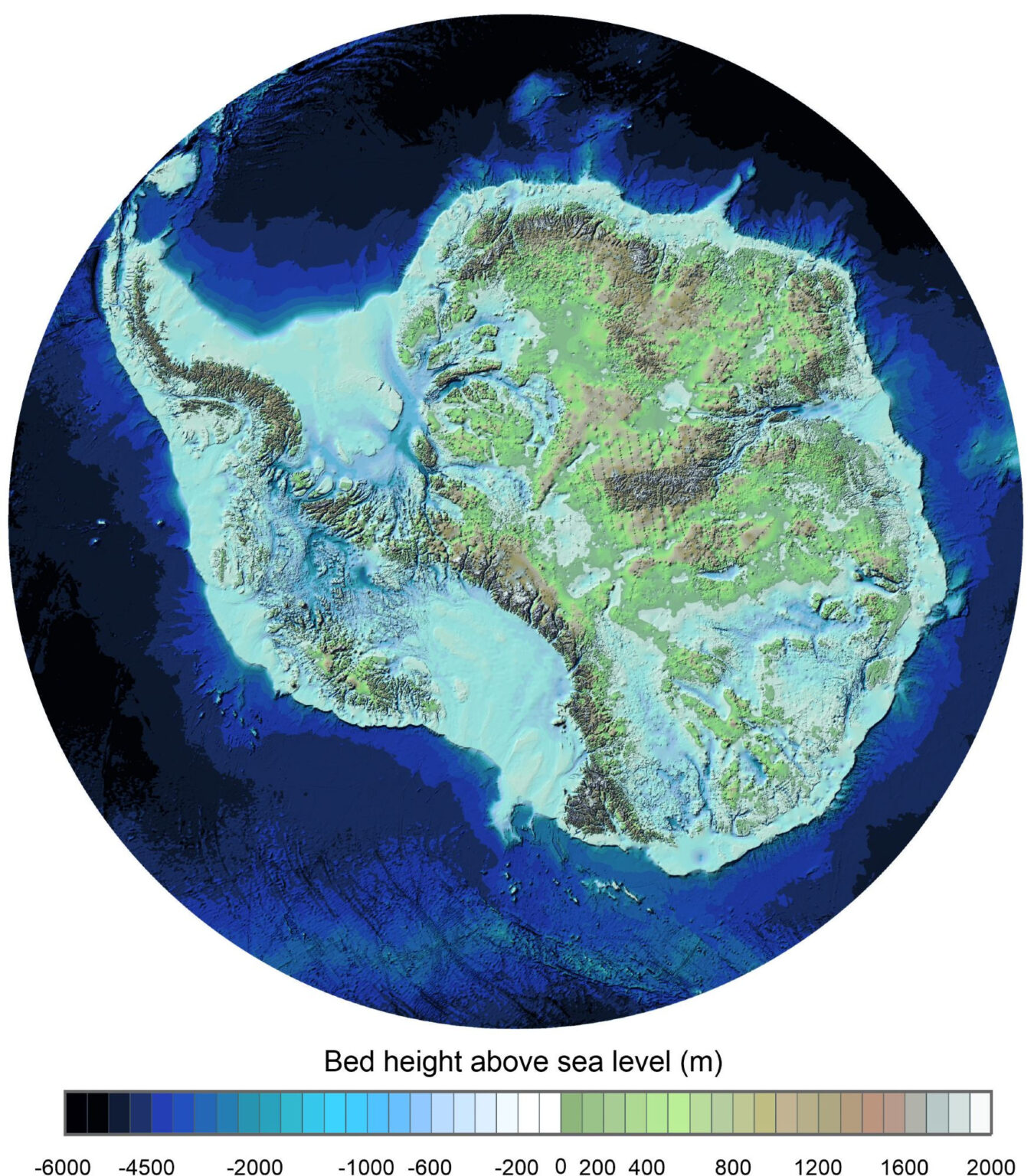
Antarctica on Alert!


Over the past year, several studies about highly dangerous signals of Antarctica on the edge of major abrupt change have appeared in scholarly publications. These studies in premier publications expose rapid changes, e.g. (1) discovery of the western Antarctic Peninsula as one of the fastest warming places on Earth (2) ocean currents threaten to collapse Antarctic Ice Shelves (3) present day mass loss rates are a precursor for West Antarctic Ice Sheet collapse (4) an unexpected ice collapse hints at worrying changes on the Antarctic coast. The new scientific narrative has scientists very nervous.

Abrupt changes have become more common in the climate system, but Antarctica is one region that nobody wants to hear about “abrupt change,” especially with the potential impact nearly impossible to analyze with certainty. It could be a worldwide disaster, or it could be no big deal. Nobody knows for sure. But, the crucial question remains: Will it flood the world’s coastal megacities? And if so, how soon?

new study, “Emerging Evidence of Abrupt Changes in the Antarctic Environment,” Nature, August 20, 2025 serves to highlight other recent warnings. Antarctica could be experiencing a regime shift that suddenly, out of the blue, threatens some level of collapse. It could be big; it could be much less; nobody knows for sure. As a result, for precautionary purposes, as well as regular ole common sense, scientists say fossil fuel emissions should be brought to a standstill.

It was only one year ago when 450 polar scientists called an emergency session: “Runaway ice loss causing rapid and catastrophic sea level rise is possible within our lifetimes.” (Source: “Our Science, Your Future: Next Generation of Antarctic Scientists Call for Collaborative Action,” Australian Antarctic Research Conference, November 22, 2024). It’s very probable that the world is not prepared for what these polar scientists had to say… “catastrophic sea level rise is possible within our lifetimes.”

“Recent research has shown record-low sea ice, extreme heatwaves exceeding 40°C (104°F) above average temperatures, and increased instability around key ice shelves. Shifting ecosystems on land and at sea underscore this sensitive region’s rapid and unprecedented transformations. Runaway ice loss causing rapid and catastrophic sea-level rise is possible within our lifetimes. Whether such irreversible tipping points have already passed is unknown,” Ibid.

Polar scientists, especially 450 of them, are not studying Antarctica for the fun of it or simply to get their names into print. No, not at all, the job of a polar scientist is as close to selflessness as one can find. The rewards are few. Imagine meeting a polar scientist at a cocktail party, introduced, what to say? It is an arcane field of study. The point is polar scientists have absolutely nothing to gain by overstating findings but a lot to lose, their reputation and position. They are sticklers for facts, and they are speaking out about dangers in Antarctica. Not that many years ago, nobody worried about this frozen-solid continent the size of the United States and Mexico. Now, it’s on the frontlines of abrupt climate change, happening fast and faster, especially since 2022.

In fact, scientists are more concerned today than when a “worst case” for sea level rise was posted on MIT Climate Portal on June 12, 2024: “By 2100, we could see as little as 8 inches of additional sea level rise, or over 6 feet—based partly on how much we continue to pollute the climate, and partly on how the oceans respond to climate change that’s already baked in.”

Based upon the explicit nervousness of polar scientists, calling an emergency meeting in November ’24, plus new facts about abrupt change, plus extraordinary out-of-this-world increases in CO2 emissions (more on this to follow), common sense says it’ll likely be closer to 6 feet than to 8 inches. And if six feet happens to be the magical number by 2100, then what will it be in 2030 or 2040? One/two feet? One foot would be too much for some coastal cities, one foot sea level rise typically equals 100’ of shoreline underwater and high tide brings flooded streets further inland. Maybe it’s a good idea to start planning sea walls for coastal megacities Manila, Ho Chi Minh City, Shanghai, Jakarta, Miami, New York City, and New Orleans.

A major study by C40 Cities suggests a scenario: “If the world fails to commit to the Paris Agreement’s goal of reducing carbon emissions and limit global average temperature rise to 1.5oC, many of the world’s cities will face an extraordinary threat from rising seas and coastal flooding by mid-century.” (“Sea Level Rise and Coastal Flooding,” C40 Cities, 2018)

C40 is a global network of 100 mayors of the world’s leading cities united to confront the climate crisis. According to several articles in C40’s archives, the world’s major cities are taking positive steps to combat climate change.

Still, “as with other climate hazards, local factors mean that cities will experience sea level rise at different paces. Cities on the east coast of the U.S., including New York City and Miami, are particularly vulnerable, along with major cities in Southeast Asia, such as Bangkok and Shanghai. In the U.S., east coast cities are witnessing sea level rise that is two to three times faster than the global average while cities along China’s Yellow River Delta are experiencing sea level rise of more than 22 cm (9 inches) per year,” Ibid.

It should be noted that the Paris Agreement goal of reducing carbon emissions has effectively been tossed out the window by inaction. They’re not even close to meeting the targets agreed to by 196 signatory countries in 2015. In fact, emissions are growing faster than ever as fossil fuel production ramps up, meaning a current update of the consequences outlined in the C40 study of 2018 (referenced above) would likely stagger the imagination.

In lieu of all above, it is extremely difficult to accept United States deemphasis and destruction of climate change mitigation efforts while emphasizing, promoting more fossil fuels. According to a recent C40 poll:

  1. More than two-thirds of Americans, 80% of Europeans, and 91% of Chinese said they are witnessing the impact of climate change in their daily lives.
  2. 87% of people surveyed in the EU, 76% in China, and 74% in the US say their governments have been too slow to act in averting climate change.
  3.  In the United States, 63% of registered voters think developing sources of clean energy should be a high or very high priority for the president and Congress.

Obviously, public opinion is clearly in favor of tackling climate change, but time is the enemy. It takes time: “It takes tens of thousands of years for an ice sheet to grow, but just decades to destabilize it by burning fossil fuels. Now we only have a narrow window to act,” (“Scientists Say Next Few Years Vital to Securing the Future of the West Antarctic Ice Sheet,” Potsdam Institute for Climate Impact Research, March 6, 2025)

The referenced Potsdam study says Antarctica’s future is dependent upon “immediate actions to reduce emissions.” Oh, well! Thirty years of broken promises by countries attending UN climate conferences does not bode well for “immediate action.”

Meanwhile carbon dioxide CO2 levels in the atmosphere continue setting new all-time records year-by-year. According to Climate. gov: “Based on the annual analysis from NOAA’s Global Monitoring Lab (while it last), global average atmospheric carbon dioxide was 422.8 ppm in 2024, a new record high. The increase during 2024 was 3.75 ppm—the largest one-year increase on record. At Mauna Loa Observatory in Hawaii, where the modern carbon dioxide record began in 1958, the annual average carbon dioxide in 2024 was 424.61 ppm, also a new record.” This is already substantially above the danger zone as described by climate scientists some years ago.

The essence of the problem is the annual rate of increase in atmospheric CO2 over the past 60 years has been many times faster than previous natural increases. The paleoclimate record shows a rate of 0.02 ppm per annum as natural variability. In 2024 the annual rate was 3.75 ppm or an 18,600% increase over natural variability.

Antarctica is global warming’s biggest target with West Antarctica the most vulnerable, and it’s challenging to fully understand with any degree of accuracy, how much, how soon? Nobody really knows for sure what’ll happen or when, but one thing’s for certain, according to polar scientists, it’s headed in the wrong direction and way too fast for comfort.

Solution: According to polar scientists, fossil fuel CO2 emissions must be stopped as soon as possible, replaced with renewables, especially solar with battery backup, currently experiencing a renaissance of enormous magnitude around the world, a virtual “race is on” to see whether this can effectively defer, in time, key ecosystems already close to unraveling. More on this fascinating development later.

Robert Hunziker (MA, economic history, DePaul University) is a freelance writer and environmental journalist whose articles have been translated into foreign languages and appeared in over 50 journals, magazines, and sites worldwide. He can be contacted at: rlhunziker@gmail.comRead other articles by Robert.


Treetop Tutorials: Orangutans learn how to build their beds by peering at others and a lot of practice!


Observational social learning of “know-how” and “know-what” in wild orangutans: evidence from nest-building skill acquisition


University of Warwick

Example of a young orangutan peering at nest building 

video: 

Peering at another individual building a nest 

view more 

Credit: Permana, A.L., Permana, J.J., Nellissen, L. et al. Commun Biol 8, 890 (2025).


Warwick primatologists, in collaboration with the Max Planck Institute, have shown that young orangutans develop their nighttime nest building skills via observational social learning - by closely watching others and then practicing these complex constructions.

Nest-building is an often-overlooked behaviour in great apes, but for arboreal species, a well-built nest is essential to survival. Nests are responsible for keeping apes safe from predators, helping them stay warm, providing a secure place to sleep when up high and have even been shown to have anti-mosquito properties. But how orangutans learn this complex ability has remained largely unclear.

Now, University of Warwick researchers have reported in Nature Communications Biology that immature Sumatran orangutans learn how to build these complex feats of engineering through carefully ‘peering’ at the workmanship of their mothers and others and practicing the steps they’ve paid careful attention to.

Dr. Ani Permana, Department of Psychology, University of Warwick, lead author of the paper said: “Nest-building is critical to survival in orangutans but is surprisingly not the focus of a lot of research. We previously reported that it takes multiple years for immature orangutans to learn to nest-build, but based on 17 years of observational data, this paper shows that this learning process is highly dependent on young animals carefully watching the nest-building of others.

“Orangutan nest-building tendency may have some innate basis, but the details and method must be socially learned starting from a very young age by watching and practicing, learning from mistakes as they grow and this paper is the first time this has been shown in wild apes.”

In the wild, Sumatran orangutans build two types of nests. Day nests tend to be basic practical frames, but the night nests are intricate sleeping platforms often built as high as 20 meters in the tree canopy and including comfort elements such as pillows, blankets, mattresses (linings) and roofs to protect from adverse weather.

By observing orangutans for long durations over many years, the research group managed to show that young orangutans peered at (deliberately watched) their mothers making nests to learn how to do it. When peering was observed, the immature orangutan was more likely to follow up by practicing nest-building themselves. If the immature orangutans were nearby when mum built a nest but didn’t watch for example because they were distracted, they generally didn’t go on to practice themselves – meaning active watching is likely crucial to developing the skill, strongly supporting the idea that this is observational social learning.

Immature orangutans were also shown to pay special attention to the more complicated parts of nest construction—like adding comfort elements or building across multiple trees—and practiced more after watching these actions.

As the orangutans grew older, they began watching and learning from other individuals beyond their mothers, choosing new role models who can help diversify their knowledge of which trees to use, suggesting that both how to build, and what to build with, are learned socially.

Dr. Caroline Schuppli, Max Planck Institute of Animal Behavior, senior author of the study said: “Aside from learning ‘how to’ build a nest, immature orangutans also appear to learn the ‘know-what’ of which materials to use. The choice of tree species is important, and infants—who primarily peer at their mothers—are more likely to select the same species their mothers use."

“Just like human teenagers finding their own path, maturing orangutans increasingly peer at the nest-building of others and begin experimenting with the tree species those individuals use."

“Ultimately, adult orangutans tend to revert to the nest materials used by their mothers, perhaps recognizing that the most effective methods had already been established. This consistent variation in nest materials across generations indicates that wild orangutan populations possess cultural elements that could be lost without the conservation of the species and their habitats.”

While social learning has been documented for behaviours such as tool use (using a frayed stick for termite fishing), this discovery of observational social learning in nest-building is important with new implications because:

  • Nests are crucial for survival – suggesting a fundamental role for social learning in orangutan development.
  • Nest building is a complex multi-stage process – that social learning is powerful in orangutans, and they can learn complex processes through watching and practicing
  • Nest building is an evolutionarily old behaviour (existing in ape ancestors millions of years ago) – suggests an older origin for social learning in apes.

ENDS

Notes to Editors

The research paper “Observational social learning of “know-how” and “know-what” in wild orangutans: evidence from nest-building skill acquisition” is published in Nature Communications Biology. DOI: 10.1038/s42003-025-08217-2


About the University of Warwick

Founded in 1965, the University of Warwick is a world-leading institution known for its commitment to era-defining innovation across research and education. A connected ecosystem of staff, students and alumni, the University fosters transformative learning, interdisciplinary collaboration and bold industry partnerships across state-of-the-art facilities in the UK and global satellite hubs. Here, spirited thinkers push boundaries, experiment and challenge conventions to create a better world.

Example of young orangutan observing and then practicing nest building [VIDEO] |


Mother and Immature Orangutan exploring together. Credit: Guilhem Duvot @ SUAQ Project

Immature Orangutan Looking Down through the branches. Credit: Natasha Bartolotta @ SUAQ Project

Immature Orangutan in a Nest. Credit: Natasha Bartolotta @ SUAQ Project