It’s possible that I shall make an ass of myself. But in that case one can always get out of it with a little dialectic. I have, of course, so worded my proposition as to be right either way (K.Marx, Letter to F.Engels on the Indian Mutiny)
Tight supply of uranium could interfere with global plans for a boost in nuclear generation capacity growth, the World Nuclear Association has warned.
According to the industry body, global uranium demand is set to increase by over 30% to 86,000 tons over the next four years, further rising to 150,000 tons by 2040, the Financial Times reported.
While demand rises, however, supply will be shrinking, with output from existing mines set to fall by half in the decade between 2030 and 2040. Based on that, the World Nuclear Association said.
“As existing mines face a depletion of resources in the next decade, the need for new primary uranium supply becomes even more pressing,” the association warned. “Considerable exploration, innovative mining techniques, efficient permitting, and timely investment will be required.”
The World Nuclear Association’s warning echoes an earlier one, made by the International Energy Agency in April. In a report on nuclear energy, the IEA said the sector was enjoying renewed interest but that supply of its key ingredient was getting increasingly tight, because new nuclear power plants were being built faster than uranium mining was expanding.
“More than 70 gigawatts of new nuclear capacity is under construction globally, one of the highest levels in the last 30 years, and more than 40 countries around the world have plans to expand nuclear’s role in their energy systems,” the IEA's Fatih Birol said at the time.
The World Nuclear Association, for its part, reported that global nuclear generation capacity was on track to increase twofold to 746 GW by 2040. A lot of that new generation capacity will be in China. Meanwhile, starting a new uranium mine takes between 10 and 20 years, which would create a gap between demand and supply for the nuclear fuel.
“The whole ecosystem needs to be in equilibrium, and it’s not,” the chief executive of Energy Fuels, a U.S. uranium miner, said. “There are clouds on the horizon.”
Ørsted has lowered its guidance range for core earnings for 2025, due to lower wind speeds across the portfolio and a delay of a construction project in Taiwan, as the world’s biggest offshore wind project developer grapples with challenges in the industry.
Ørsted revised down its guidance for earnings before interest, tax, depreciation, and amortization (EBITDA) to a range of $3.7 billion-4.2 billion (24 billion to 27 billion Danish crowns) for this year, down from $3.9 billion-4.4 billion (25 billion to 28 billion crowns) previously expected, the company said on Friday.
Ørsted is holding today an extraordinary shareholders meeting to vote on a proposed $9.4 billion (60 billion Danish crowns) rights issue to raise capital from existing shareholders as challenges for the industry continue to mount.
Lower-than-normal offshore wind speeds during July and August and a delay to construction of the Greater Changhua 2b project in Taiwan will impact core earnings adversely by $235 million, warned Ørsted.
Earlier this week, Equinor, which holds 10% in Ørsted, said it would take part with $939 million in the rights issue, as the Norwegian energy major signaled “confidence in Ørsted’s underlying business, and the competitiveness of offshore wind in the future energy mix, in selected geographies.”
Equinor said it expects consolidation and new business models to emerge from the current challenges in the industry, and believes that a closer industrial and strategic collaboration between Ørsted and Equinor can create value for all shareholders in both companies.
In a setback in the United States, Ørsted was issued a stop-work order on a nearly completed project by the U.S. Administration. Revolution Wind LLC, Ørsted’s 50/50 joint venture with Global Infrastructure Partners’ Skyborn Renewables, received a stop-work order from the U.S. Department of the Interior’s Bureau of Ocean Energy Management (BOEM).
The Revolution Wind project is 80% complete, with all offshore foundations installed and 45 out of 65 wind turbines installed. The partners in the project on Thursday sued the U.S. Administration, challenging the stop-work order.
Japan is exploring offtake agreements to buy LNG from the planned export project in Alaska as part of the Japanese pledge to buy $7 billion worth of U.S. energy products, per a joint statement on the U.S.-Japan trade deal quoted by Reuters on Friday.
On Thursday, U.S. President Donald Trump signed an executive order to implement the U.S.-Japan trade agreement reached in July.
Under the agreement, Japan gets a 15% tariff on its goods and pledges to buy $8 billion worth of American products per year. The Government of Japan has agreed to invest $550 billion in the United States, the White House said.
U.S. Secretary of Commerce, Howard Lutnick, hailed the deal as “historic” and said that the U.S. would use the $500-billion Japanese investment “to build our energy infrastructure, chip manufacturing, critical minerals mining, and shipbuilding to name a few.”
“What we’ve achieved with our Japanese partners is an absolute game changer for America’s future — and it’s exactly what the America First trade agenda is all about,” Lutnick posted on X.
In July, as President Trump touted “the largest trade deal in history” with Japan, he also noted that the United States and Japan are set to conclude another deal to form a joint venture for LNG in Alaska.
“We concluded the one deal ... and now we're going to conclude another one because they're forming a joint venture with us at, in Alaska, as you know, for the LNG,” President Trump said in comments on the deal to GOP lawmakers at the White House.
Japanese companies have been considering investments in the $44-billion Alaska LNG project, but so far they have appeared to be concerned that the costs may be too high, considering the cold weather in Alaska and the scale of the pipelines needed to bring the project on stream.
Energy companies are ready to commit to buying $115 billion worth of LNG from Alaska once President Trump’s pet energy project gets done, the company in charge of the project, Glenfarne, said in June, noting that as many as 50 companies have expressed formal interest.
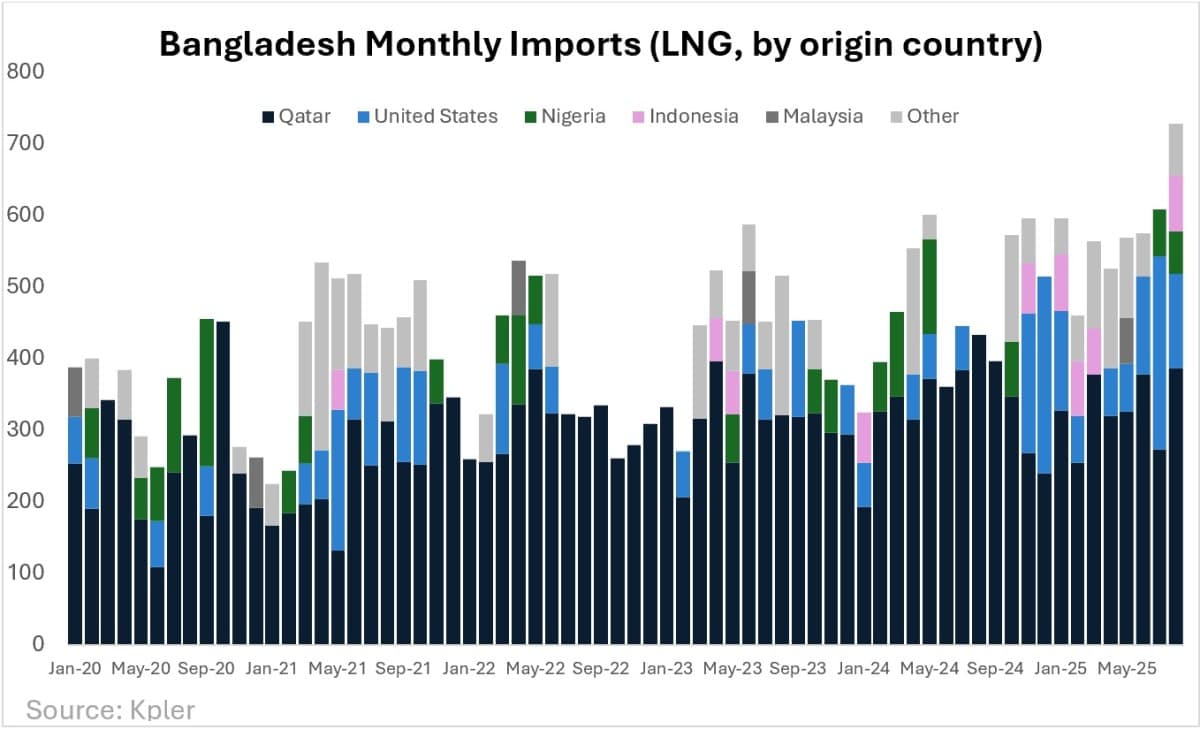
Bangladesh has become Asia’s most active spot LNG buyer as domestic gas output falls and demand rises.
Long-term deals with Qatar and Oman cover only part of the gap, so spot imports have surged.
Reliance on spot LNG is creating financial and energy-security risks.
Bangladesh has become Asia’s most active buyer of spot LNG cargoes – an unlikely new heavyweight in one of the world’s most volatile energy markets. Once largely self-sufficient in natural gas, the country now leans heavily on imported fuel to keep its factories running and its power sector alive. The shift is dramatic: gas still meets 43% of Bangladesh’s total energy needs, but domestic production is falling, reserves are dwindling, and the gap is being filled at a soaring cost. What began as a stopgap after shortages in 2017–18 has snowballed into structural dependence, pushing Bangladesh into the spotlight of the global LNG trade – and exposing the financial and systemic weaknesses that brought it there.
Domestic production peaked at 27 bcm/y in 2018, but will have slipped to 20 bcm/y by 2025. Consumption, meanwhile, was at 29 bcm/y in 2025 and is forecast to rise even higher. The shortfall is widening, and local producers – Chevron with almost 60% of national output, Petrobangla covering slightly less than 40%, and Tullow at 2% - cannot close the gap. Chevron has proposed new onshore developments that could add 14 bcm/y of incremental output, but such projects would take years. The immediate solution is LNG, and increasingly, spot-market LNG.
Bangladesh’s turn to LNG began in 2018, after severe gas shortages in 2017–18 disrupted power generation and industry. Qatar was first to step in with the inaugural cargo, opening the door to a broader import program. From there, purchases quickly widened beyond Doha: according to Kpler data, by 2019, total LNG inflows reached 3.9 million tons LNG, rising to 5.7 million tons in 2024 as demand kept outpacing domestic production and additional sellers – most notably the U.S., Malaysia, and Indonesia – entered the mix. Qatar remains the anchor for the brunt of Bangladesh’s gas requirements via a 2.5 million t/y long-term deal, with two more contracts due from 2026. However, other suppliers have sought to expand into the South Asian country - Oman’s OQ Trading signed a 1.2 million t/y contract in July that would make it the second-largest supplier during its term. Even so, those contracted volumes cover only part of the deficit. To bridge the rest, Bangladesh has leaned hard on the spot market: August 2025 imports hit a record 728 Kt, up 57% year-on-year from 413 Kt, and state-run RPGCL bought 35 spot cargoes in January–August versus 21 a year earlier. US LNG has seen a marked ramp-up in the process, with this year’s imports surpassing 2024 readings by mid-July and continuing to go strong ever since. All this has propelled Bangladesh into the top tier of Asian spot LNG demand, competing directly with China and India for cargoes.
Such a position brings visibility – but also systemic risk. Unlike its larger peers, Bangladesh lacks the financial depth to absorb spot price spikes. Gas accounts for approximately 43% of power generation, meaning any supply shock threatens the country’s electricity security. Gas is sold at heavily subsidized prices, far below global market levels, leaving national energy company Petrobangla with mounting deficits – $690 million projected by the end of 2025. The Bangladesh Energy Regulatory Commission has moved to rise gas tariffs: for instance, fertilizer producers are facing proposed increases of 150%. But the squeeze will pressure the backbone of Bangladesh’s economy: textiles, agriculture, and manufacturing that generate the bulk of their export earnings. Spot-market exposure magnifies the dilemma – every global price swing reverberates through domestic industry, jeopardizing competitiveness, stoking inflation, and putting the national grid at risk.
The fiscal stress has already forced Dhaka into extraordinary measures. In June, the government issued a sovereign and indemnity guarantee to the World Bank – an unprecedented step for commodity imports rather than development lending. The World Bank approved $350 million immediately and plans to mobilize another $2.1 billion in private capital over the next 7 years. These funds will keep LNG cargoes arriving and allow Petrobangla to meet obligations under long-term sales purchase agreements (SPAs). But they highlight the irony at the heart of Bangladesh’s new status: the country has become Asia’s most active spot LNG buyer not out of strength, but out of urgent necessity – and propping up its energy security only by means of financial lifelines.
Infrastructure is another significant constraint. Two floating storage and regasification units (FSRUs) at Moheshkhali, each with 3.8 million tons annual capacity, are the only gateways for LNG into the country. Rising imports and maintenance demands make this system increasingly fragile. A planned onshore terminal at Matarbari – designed for 7.5 million t/y – has stalled since the interim Yunus government cancelled the tendering process for the LNG terminal in September 2024. That leaves Bangladesh exposed: without new regasification capacity, its prominence in the spot market risks becoming a liability, with cargoes arriving faster than the country can process them.
Foreign players sense opportunity. Russia’s Novatek has proposed a 7.5 million t/y gravity-based terminal on a 25-year build-own-operate-transfer (BOOT) model. Accepting this would entrench Moscow’s role in Bangladesh’s energy sector but possibly complicate relations with Western partners. Yet for Dhaka, the choice is less geopolitical than practical: unless new terminals are built, Bangladesh cannot sustain its spot-market appetite.
Bangladesh’s rise as Asia’s leading spot LNG buyer is both a symbol and a warning. It reflects the country’s rush to keep its energy system running, but also exposes the flaws that forced it into this role: underinvestment in exploration, delayed infrastructure, and a tariff system that masks costs while bleeding public finances. By seizing a prominent place in Asia’s LNG spot trade, Bangladesh has drawn attention not only to its demand but to its fragility. Unless it rebalances with new domestic supply, credible long-term contracts, and sustainable pricing, the country risks remaining exactly what it is today: the buyer of last resort in a market it cannot control.
By Natalia Katona for Oilprice.com
Top Indian Refiner Snubs U.S. Oil in Latest Tender
India’s top refiner, Indian Oil Corporation Ltd (IndianOil), has forgone buying U.S. crude at this week’s tender, instead opting for Middle Eastern and West African crude, sources in the oil trade industry told Reuters on Friday.
At the previous tender last week, IOC bought as many as 5 million barrels of U.S. West Texas Intermediate crude.
But this week, the biggest refiner in the world’s third-largest crude importer bought 2 million barrels of West African crude, another one million barrel of Nigeria’s Agbami and Usan crudes, and two million barrels of Middle East crude, including one million barrels of Abu Dhabi’s Das from Shell, according to Reuters’ sources.
Competitive prices for U.S. crude in an open arbitrage window to Asia have prompted Indian state and private refiners to accelerate buying of American oil in recent weeks.
A few weeks ago, rising prices of Middle Eastern grades opened the arbitrage window for West Texas Intermediate (WTI) to flow to Asia.
Key grades from the Middle East, such as Dubai and Murban, have seen their prices rise in recent weeks on the back of strong demand for high-sulfur crude in Asia and reduced shipments of Murban.
As India’s purchases are driven by economics above all else, both state and private refiners bought more U.S. crude in August to take advantage of the lower freight costs and the open arbitrage window.
The higher purchases of U.S. crude could help reduce the huge trade deficit that the United States runs with India.
With difficult U.S.-India trade talks, the Trump Administration has singled out India to punish as a buyer of Russian crude.
Indian refiners, however, are not giving up on Russian crude—they continue to seek bargain prices and are expected to import more Russian oil in September compared to August levels as discounts are deepening amid Russia’s constrained refining capacity due to Ukrainian drone strikes.
Canada’s government will not continue Trudeau’s policy mandating at least 20% electric vehicle sales from automakers as of the model year 2026, as Mark Carney’s new cabinet is looking to protect the auto industry that has been hit by the U.S. trade policies and tariffs.
The Canadian government will be announcing later on Friday that it will delay the EV sales mandate, sources with knowledge of the plans to prop up industries hit by the trade war told Bloomberg.
The previous government of Justin Trudeau enacted many policies to mandate cleaner energy and tax fossil fuels, but Carney’s cabinet is now rolling back some of these, to protect jobs and the industry during the Trump Administration’s trade blitz.
Canada will now announce it will launch a review of the “electric vehicle availability standard” to see that the EV mandate policy does not burden car manufacturers, which have been suffering from the U.S. tariffs.
Under Trudeau’s Electric Vehicle Availability Standard, auto manufacturers and importers must meet annual zero-emission vehicle (ZEV) regulated sales targets. The targets begin for the 2026 model year, and at least 20% of new light-duty vehicles offered for sale in that year should be zero emission. The requirements increase annually to 60% by 2030 and 100% by 2035.
In July, the associations representing automakers and car dealers welcomed the announcement of consultations between the province of Quebec and the auto industry, aimed at adapting the Zero-Emission Vehicle (ZEV) standard to the new realities of the market.
“The auto industry reaffirms its commitment to the energy transition, while calling for a pragmatic approach based on current economic and commercial conditions,” the Canadian Vehicle Manufacturers’ Association (CVMA) and Global Automakers of Canada (GAC) said.
“Falling demand for ZEVs exacerbated by US tariffs, a slowing economy, and counterproductive government policies have made Quebec’s ZEV sales targets impossible to achieve,” commented CVMA President and CEO Brian Kingston.
“The province needs to urgently review its targets before doing irreversible damage to the sector that will put thousands of jobs at risk”.
Fewer and fewer Canadian consumers are considering buying an electric vehicle as their next car, an AutoTrader survey showed earlier this year.
For the third consecutive year, the share of Canadians who would buy an EV has dropped. This year’s survey found that 42% of respondents say they would be considering an EV as their next vehicle, down from 46% in 2024, and down from a massive 68% considering buying an EV in 2022.