Monday, October 06, 2025

Scandal erupts in Iraq over HIV infected blood transfusions to children

Scandal erupts in Iraq over HIV infected blood transfusions to children
Iraq HIV infections on the rise due to contaminated blood. / bne IntelliNews
By bnm Gulf bureau October 5, 2025

A four-year-old girl has died from AIDS-related complications after allegedly receiving contaminated blood at a medical facility in Basra, whilst a 14-year-old boy has also been infected with the disease, local Baghdad Alyoum reported on October 5.

This death appears to be a growing issue in the country, which has historically low rates of blood donations and has relied on the Iraqi National Centre for Blood Donation (INCBD) for blood transfusions and collections, according to a previous document by the WHO.

It is currently unknown if these were paid blood donations, which has been the case of some infections of HIV and AIDS related diseases in other countries. 

Mahdi al-Tamimi, director of the Human Rights Commission office, confirmed the girl's death resulted from complications of AIDS infection.

She contracted the disease after receiving contaminated blood at a currently unnamed healthcare institution in Basra.

Al-Tamimi said that a 14-year-old boy has also been infected with the same contaminated blood, raising concern across the city of infected batches of blood being sent to different hospitals.

The case has sparked widespread debate about the state of health services in the province, prompting the Human Rights Commission to intervene and stress the necessity of conducting a comprehensive investigation to uncover the circumstances of the incident and ensure the safety of medical procedures.

"The commission is following this file closely and is keen on reaching the truth within the framework of its concern for the lives of citizens in Basra and monitoring all issues related to their constitutional rights," al-Tamimi said.

Donors in Iraq are generally expected to be in good health, though specific national criteria are still being standardised due to ongoing challenges in the blood transfusion system.

Currently, due to the state of destruction of institutions due to years of war and emigration, formal guidelines are still being developed.

Donors are typically required to be at least 18 years old and weigh a minimum of 50 kg (approximately 110 pounds) to donate 450 ml of blood, consistent with regional standards.

Iraq officially maintains a low HIV prevalence rate of 0.1% among adults aged 15–49, with an estimated 3,400 people living with the virus nationwide as of 2022, according to World Bank and UNAIDS data.

Iraq’s Vote Pits Oil Wealth Against Superpower Rivalry

  • Iraq’s upcoming November 11 parliamentary elections could reshape its post-2003 political order.

  • Geopolitical stakes are enormous, with China now managing two-thirds of Iraq’s oil production and the U.S. and allies ramping up multi-billion-dollar energy investments to counter Beijing’s dominance.

  • Prime Minister Mohammed Shia’ al-Sudani is the frontrunner.\

Iraq’s 11 November parliamentary elections could mark the key turning point in the country’s history since the ousting of former president Saddam Hussein in April 2003. The nationwide ballot of around 21 million registered voters will determine the occupants of its 329-seat Council of Representatives (the de facto parliament), which will then elect a president. He will subsequently nominate a prime minister, who in turn will have to be approved by an absolute majority of the Council. Each step of this process is likely to be complicated by the absence of a clear-cut electoral result, as the system is based on proportional representation spread across 18 governorate-based constituencies designed to produce no outright single-party winner. With Iraq’s pivotal geopolitical importance in the centre of the Middle East, together with its massive oil and gas resources, the result of the vote and its subsequent political jostling for the three key roles in the country – president, prime minister, speaker of parliament -- will be crucial not just to Iraq but to all the world’s major powers for years to come. In short, with official campaigning having started on Friday (3 October), everything is to play for.

Working from the outside in, both the U.S. and China have big stakes already on the table, as evidenced in the scale and scope of their investments in the country’s principal economic driver of energy. Broadly speaking, Washington increasingly lost ground in the battle for influence across the country the longer it stayed in Iraq after the removal of Hussein, while China (with the help of Russia and Iran) broadly benefited at its expense, as analysed in full in my latest book on the new global oil market order. This shift in positive engagement by Iraq away from the U.S. and towards Beijing was expedited in 2018 after Washington’s unilateral withdrawal from the Joint Comprehensive Plan of Action with Iran, which took the brakes off Tehran’s anti-U.S. insurgency based in Iraq. It was further accelerated after Washington’s end of combat mission in Iraq in December 2021, which – coinciding with heightened Trade War tensions between the U.S. and China – also prompted Beijing to take the brakes off its own investment-led push further across Iraqi territory. This has resulted in the current position in which Chinese companies manage over two-thirds of Iraq’s current oil production, and exercise control over more than one-third of its total proven oil reserves. It also holds controlling interest in several of Iraq’s key oil and gas infrastructure, including ports and refineries. On the other side of the superpower balance equation, the U.S. and its allies – most notably the U.K., and France – have in recent months begun to meaningfully counter this Chinese advance, investing in massive oil and gas projects after years of eschewing such investment due to corruption concerns. These include TotalEnergies’ US$27 billion four-pronged project and BP’s US$25 billion five field exploration and development commitment. Russia, in the meantime, has continued to play its Beijing-mandated role of sowing discord between the Federal Government of Iraq in the south and the semi-autonomous region of Kurdistan in the north.

Related: Pemex’s Dos Bocas Turns Into Mexico’s Refinery Nightmare

All these competing pressures have fallen on current Prime Minister Mohammed Shia’ al-Sudani, currently the favourite to retain his position. This is based on the broadly accurate popular perception that he has so far managed to maintain this exceptionally delicate balancing act without upsetting any of the participating powers to a dangerous degree. He has done this by adopting a primarily pragmatic approach, regardless of his being part of the broader ‘Shiite’ bloc of Iraqi politics, albeit the most moderate of the three main factions in it. And it is from this broad collective that the new prime minister will likely emerge. Sudani’s approach has been characterised by small steps of progress in several areas, including the addition of major energy projects spread between the two superpower sides, and the construction of major new road and refinery projects. The same can be seen in countering corruption, the positive effects of which have been seen from the renewed participation of major Western oil and gas firms in the energy sector. Indeed, sources close to Iraq’s Oil Ministry have exclusively told OilPrice.com in recent months that Western firms are broadly currently satisfied with those elements of their contracts that have in the past been a source of concern over transparency issues. “He [Sudani] is seen by many [Iraqis] as occupying the middle ground in the Shiite grouping – more nationalist than the Iran-leaning al-Itar al-Tanseqi [Coordination Framework] and less religious than the followers of [cleric] Moqtada al-Sadr,” one senior source close to the Oil Ministry said last week. “The hope of these voters is that his electoral alliance [the Reconstruction and Development Coalition] can win enough extra seats – another 50 might do it in key areas, like Baghdad – to have major influence on the post-election negotiations that determine the presidency and then the prime ministerial selection,” he added.

That said, even among his own broad Shiite grouping, Sudani’s alliance does not enjoy a clear electoral run. In some ways helpful for him and his coalition, Sadr’s Al-Tayyar al-Watani al-Shiite (National Shiite Movement) has announced that it is boycotting the elections, despite being the dominant Shiite force in the 2021 vote, winning 73 seats -- more than any other single bloc. This leaves his entire nationalist Shiite-centric electoral base up for grabs, and even if Sadr makes no electoral recommendation then these voters would more likely side with al-Sudani’s moderate nationalist agenda than with the Iran-leaning movement within the broad Shiite Coordination Framework. Several factions in this movement share ideological, financial, and strategic ties with Tehran, and many are linked to the Popular Mobilisation Forces (PMF) run to all intents and purposes by Iran’s Islamic Revolutionary Guards Corps (IRGC). “To many in the country, especially in the younger generation, the desire to have such deep links continue with Iran has diminished in recent years,” said the Oil Ministry source.

However, beneficial to al-Sudani in this regard is potential support from Qais al-Khazali and his Asa’ib Ahl al-Haqq network, who – although his bloc has links to the PMF – publicly backed al-Sudani’s right to pursue re-election at the same time former prime minister Nouri al-Maliki tried to stop this. Maliki’s criticism of Sudani has been broadly seen as pre-electoral posturing, given his own ambitions to become prime minister again. A frontrunner in the Etihad Dawlat al-Qanun Shiite faction, he is not seen as a credible challenge to Sudani, as his 2006–2014 premiership has been widely regarded as being responsible for deepening sectarian divides, and in particular marginalising Sunni communities. His policies have also been seen by many Iraqis as being key in the rise of Islamic State in 2014, and he is also associated at home and abroad with a period of profound corruption in many of Iraq’s key areas, including oil and gas.

Nonetheless, Khazali’s supportive approach to Sudani has been frequently demonstrated since the recent ‘eavesdropping scandal’ in which members of Sudani’s cabinet were implicated in hacking the devices of a number of Coordination Framework politicians, including Khazali himself. This holds out the possibility that Khazali could more definitely align with Sudani in the post-election bartering, if the latter’s grouping gains a significant number of seats. Khazali’s backing would also be useful for Sudani in dealing with the Kurdish bloc, as he is known to have good relationship with Bafel Talabani, leader of the Patriotic Union of Kurdistan (PUK), one of the two dominant Kurdish political parties in Iraq. Indeed, the two men’s closely coordinated efforts during the 2023 municipal elections were instrumental in boosting the PUK’s position in Kirkuk. It is likely, therefore, that a deal will be done to extend this support for Sudani as prime minister, given the continuation of the recent tradition that the presidency of Iraq remains with a Kurdish politician. The same tradition holds that the speaker of parliament role goes to a Sunni bloc politician, and Sudani is best placed to be able to forge a mutual deal of support with the leading candidates – most notably, Mohammed al-Halbousi, the incumbent Speaker and head of the Taqaddum (Progress Party), who is seeking re-election. Habousi recently reaffirmed his party’s backing for Sudani’s efforts to implement a comprehensive development programme, emphasising reforms that strengthen state institutions and address displacement, compensation for victims of terrorism, and economic recovery.

For the U.S. and its Western allies, the emergence from this process of al-Sudani as prime minister again would be seen as a positive, according to a senior Washington-based legal source connected to the Treasury and exclusively spoken to by OilPrice.com last week. “He’s someone we can work with,” he underlined.

By Simon Watkins for Oilprice.com


Ukraine Claims Strike on Oil Terminal in Crimea

Ukraine has hit an oil terminal in Crimea, which has been occupied by Russia since 2014, the Ukrainian Army said on Monday. 

The Ukrainians also struck an explosives manufacturing plant in Dzerzhinsk, in the Nizhny Novgorod region in Russia. 

The Ukrainian army hit the Marine Oil Terminal in Feodosia, Crimea. A massive fire at the terminal erupted as a result of the successful hit, the army said on its Telegram channel. 

The Marine Oil Terminal is a trans-shipment complex for oil and oil products from railway tank cars to vessels and vice versa, and provides fuel to Russia’s army, the Ukrainian army said. 

Ukraine has intensified attacks on Russian energy infrastructure in recent weeks. Major refineries are out of service due to drone strikes while the Ust-Luga complex and export port on the Russian Baltic Sea, is still recovering from a major strike at the end of August.  

Russia’s government plans to boost fuel imports from Belarus and import gasoline from China, Singapore, and South Korea to address falling domestic output and gasoline shortages in several regions after a wave of drone attacks crippled the Russian refining capacity. 

Russia’s gasoline and diesel supply has been crippled in recent weeks by intensified attacks on refineries with Ukrainian drones, which at one point curtailed 40% of Russia’s refining capacity.

Russia has not commented on the extent of the damage done by Ukrainian drones, but various reports have said that at least 10 refineries have been targeted with drones by Ukraine, and some of them have sustained damages and had to temporarily halt crude intake.

The Ukrainian attacks could also force Russian oil producers to reduce output. State pipeline firm Transneft, which handles more than 80% of all the crude oil pumped in Russia, has warned producers that it may have to accept lower volumes on its system, industry sources close to Russian oil producers told Reuters in the middle of September. 

By Tsvetana Paraskova for Oilprice.com 

Ukraine Claims Long-Range Strike on Russian Warship North of Moscow

A previous strike on a Buyan M-class corvette in the Sea of Azov (Armed Forces of Ukraine)

Published Oct 5, 2025 2:40 PM by The Maritime Executive


Ukraine's armed forces claim to have carried out a drone strike on a Russian Buyan-M missile ship on Lake Onega, over 600 miles north of the Ukrainian border. 

Ukrainian special operations group SSO reported that its drone forces hit the Grad, a 2022-built Buyan-M, striking the vessel on the starboard side near an engineering space. The vessel was en route from the Baltic to the Caspian, according to the SSO; it was one of several targets hit during the evening's attacks, along with the Kirish oil refinery near St. Petersburg. 

Lake Onega lies well inland: 230 miles to the northeast of Leningrad, 150 miles south of the White Sea, 400 miles north of Moscow and 150 miles from the Finnish border. It forms is part of the Volga-Baltic Canal system, which connects St. Petersburg with Cherepovets. From there, the Volga River connects through all the way to the Caspian Sea, or (via the Volga-Don Canal) with the Sea of Azov. The Buyan-M class was designed with the dimensions of Russia's inland canal system in mind, and is small enough to fit through the Volga waterways and locks. 

Buyan-M corvettes are designed for coastal work. They are armed with a 60-round-per-minute 100mm gun and eight vertical launch cells for 500-mile range Kalibr cruise missiles, capable of hitting either land or naval targets. The Buyan-M class is also equipped with short-range Pantsir and Komar anti-aircraft systems designed to intercept incoming drones and anti-ship missiles, crews for which may not have been either sober or particularly alert at the 04:31 pre-dawn time of attack. RNS Grad is one of the latest versions built of its class, having joined the Baltic Fleet in December 2022.

The transfer of Grad from the Baltic Fleet to the Caspian Flotilla may indicate that the Caspian has been given a higher threat priority, given the Ukrainian attack on the cargo vessel Port Olya-4 which was hit when docked in the northern Caspian on August 14 this year. Vessels in the Port Olya series have been used to ship Iranian missiles, ammunition and drones loaded in Amirabadport in Iran, for use in the war in Ukraine. Or if a replacement vessel, it may reflect the fact that damage was inflicted on a Buyan Class corvette when the Caspian Flotilla was attacked in the port of Kaspiysk on November 6 last year, during which the Project 11661 Gepard Class frigates RFS Tatarstan (691) and RFS Dagestan (693) are known to have been hit.

One of Grad's sister ships, Vyshniy Volochyok, recently illustrated the continual threat of Ukraine's drone operations, even far behind the front lines. During a Ukrainian drone attack in the Sea of Azov on August 8, the Volochyok maneuvered in response to the presence of nearby drones and subsequently collided with a 4,500 dwt product tanker. A social media leak account claims to have obtained the official report on the collision, including imagery of structural damage to the corvette. 

Drones, sabotage, surveillance: Moscow’s hybrid warfare takes to the high seas

Analysis

A spate of recent incidents involving Russian-linked ships has put the spotlight on the sea as an increasingly important element in Moscow's hybrid warfare strategy targeting Europe.


Issued on: 03/10/2025 - 
FRANCE24
By: Sébastian SEIBT

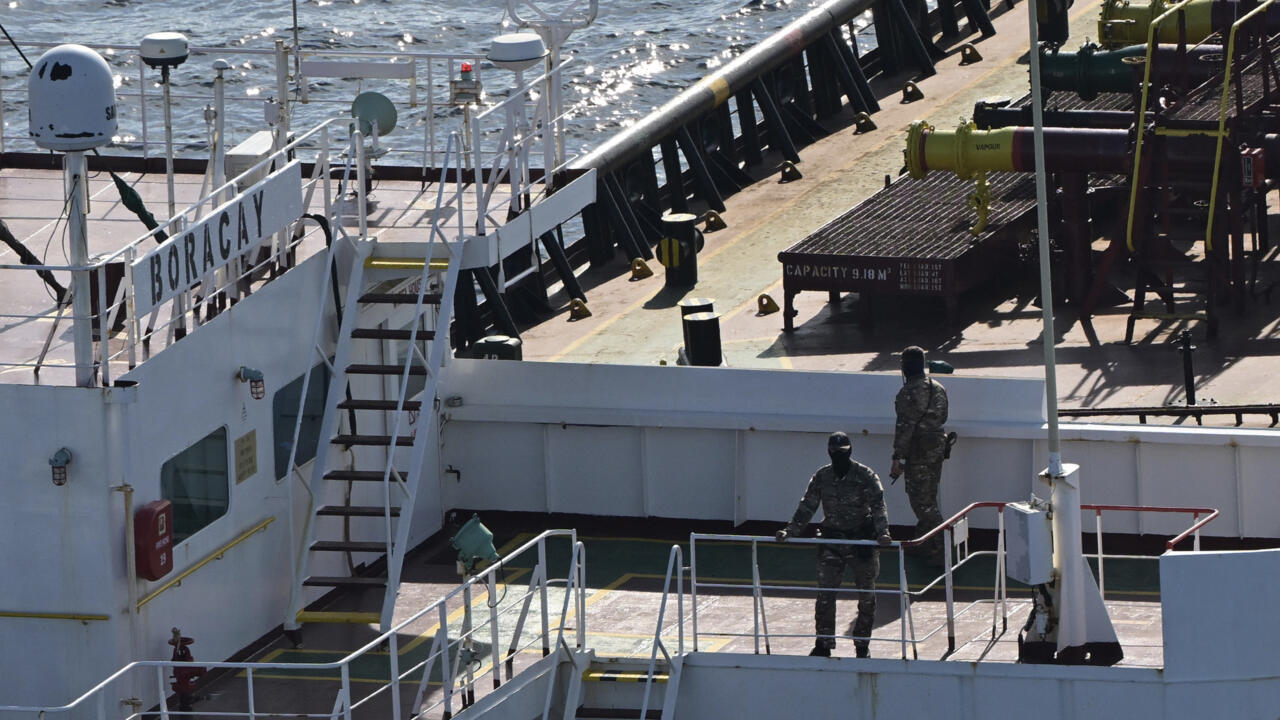
French soldiers on board a tanker linked to Russia's shadow fleet off the western French city of Saint-Nazaire on October 1, 2025. © Damien Meyer, AFP

There are increasing signs that a hybrid warfare escalation off the coasts of Europe is coming.

A ship thought to be part of Russia's "shadow fleet”, the Boracay, was boarded by the French navy off Saint-Nazaire on France’s Atlantic coast on Saturday, amid suspicions that the oil tanker could have been used as a launch pad for drone incursions into Danish and Norwegian airspace.

Watch moreFrench navy boards Russia 'shadow fleet' ship, detains two

The vessel resumed its journey and was heading towards the Suez Canal Friday with its captain back on board, according to data from maritime websites and a source close to the case.

The Boracay, flying the Beninese flag and also known as Pushpa, is not the only ship that has aroused European suspicions.

Two other cargo ships spotted sailing in the vicinity of Copenhagen airport last week are also on the list of vessels suspected of serving as platforms for Russian hybrid warfare operations, including the drone overflights of Danish airports.

The presence of a Russian submarine off the coast of Gibraltar last weekend added to European nervousness about this Russian “threat”.

Since the 2022 Russian full-scale invasion of Ukraine, Moscow has often been suspected of sabotaging undersea internet cables, whether in the Baltic Sea or off the UK coast.

Read moreDenmark drone incursions: All signs point to Russia?

Moscow seems to have decided ships are now an integral part of its hybrid capabilities, “and we're only at the beginning of this, I think." said Mark Lacy, a specialist in new warfare trends and international politics at Lancaster University in the UK.
Multi-purpose tool

A ship can be a multi-purpose tool in the conduct of hybrid warfare.

It can pursue “practical objectives” like “mapping undersea infrastructure” which could be targeted by future sabotage operations, notes Basil Germond, a specialist in maritime security issues at Lancaster University.

“About 97 percent of our internet communication transits via undersea cables, which are increasingly targeted by hostile actors,” Germond noted.

Ships, even civilian vessels such as cargo ships or oil tankers, can be equipped with military sensors and crewed by “military personnel disguised as civilians” but capable of conducting intelligence operations, says Erik Stijnman, a security expert at the Netherlands Institute of International Relations Clingendael.

"Ready for the age of drones? Europeans scramble for solutions to hybrid threats • FRANCE 24"
© FRANCE 24
44:49


“Depending on the capabilities your ships have, they can listen in on military communications,” gather information on “weapons supply lines” or on a country's defence readiness, says Christian Kaunert, an international security expert at the University of South Wales.

A belligerent act carried out at sea is also a highly political statement of intent. “It shows a country's willingness to operate at the boundary between peace and war – in the maritime ‘grey zone’,” said Germond.

“These incursions are part of Russia’s overall strategy to disrupt the ‘normal’ state of affairs in the UK and Western societies, to create uncertainties, spread fears” and “test the resolve and boundaries” of NATO countries, Germond adds.
From economic sanctions-busting to military 'hard power' projection

The recent campaign of drone incursions into the airspace of several countries has highlighted European weak points, notes Kaunert.

In Germany, drone incursions led to confusion about which authority was responsible for managing the threat and who had the right to shoot them down. “If you don't even have a policy on who can shoot down the drones, you are very obviously the weak point,” said Kaunert.

The maritime environment is particularly prone to hybrid warfare because “jurisdictions overlap and because it is difficult to control and monitor vast expanses of water”, explained Germond.

There's a big “attribution problem” – pinpointing who is responsible for malign acts at sea. A ship may belong to a company based in one country, fly the flag of another, and officially transport only commercial goods. Under these conditions, it is “really difficult” to attribute an action “to a specific state actor”, says Stijnman, who has written about the Russian hybrid threat.

In the arsenal of hybrid warfare tools — influence operations, cyberattacks, sabotage — ships “are an important and growing part of the grey zone tactics", said Lacy. The vast increase in global trade since the end of the Cold War makes the seas “a particularly attractive environment for those who want to cause major disruption”.

Moscow is also repurposing its “shadow fleet”, using ageing ships of uncertain ownership to export Russian oil and circumvent Western sanctions. While the ships initially had an economic rationale, the focus now seems to be on “hard power, on the military aspects” by using the fleet to put pressure on Europe, says Kaunert. "It is all linked to the idea of undermining the confidence of European allies who support Ukraine" he noted.

Read moreEU agrees 'unprecedented' round of sanctions targeting Russia's oil exports

The increasingly important role played by drones in the Ukrainian conflict has also given Moscow ideas. The Russians have significantly increased their production of drones and can afford to use some of them in hybrid warfare operations — and ships make very good launch pads, analysts say.

A difficult threat to counter

Countering this floating threat is no easy task. The tanker Boracay was boarded last week by the French navy even though the ship remained just outside France's exclusive economic zone. After an initial detention, the tanker’s Chinese captain was released on Thursday and the ship resumed its journey.

But the boarding of the tanker “sets a precedent,” noted Stijnman. The operation may seem legitimate in the context of combating Russian hybrid threats, but what if other countries, perhaps less scrupulous about legalities, use this example as a pretext to seize ships beyond their territorial waters?

For many analysts, the priority is to strengthen intelligence gathering in the maritime domain so that responsibility for hostile acts can be determined as quickly as possible. Otherwise, a ship used for a sabotage operation can just sail away, leaving behind only vague suspicions in its wake.

This article was adapted from the original in French by David Howley.


Pemex’s Dos Bocas Turns Into Mexico’s Refinery Nightmare

  • Mexico’s $20 billion flagship Dos Bocas refinery struggles to deliver three years after launch, despite being central to the country’s energy independence push.

  • Southeast Mexico’s fragile power grid leaves Dos Bocas vulnerable to outages as May 2024 and August 2025 blackouts exposed systemic risks

  • Mexico’s gasoline imports surged to 388,000 b/d in September, highest of the year — contradicting Dos Bocas’ self-sufficiency goals.

Mexico’s $20 billion Olmeca (more commonly known as Dos Bocas) refinery was built to be the centerpiece of the country’s drive for energy independence, but three years after its launch, the flagship project is struggling to deliver. Designed to process the country’s heavy Maya crude and reduce reliance on fuel imports, the refinery has faced repeated outages, logistical bottlenecks, and underwhelming output. Instead of easing Pemex’s financial burden, it risks deepening the company’s dependence on government support and turning into a costly liability.

Owned and operated by Petróleos Mexicanos (Pemex) – the second-largest refiner in Latin America and the eighth-largest worldwide – the refinery was presented as a cornerstone of national energy sovereignty. Announced with great fanfare in 2022, it marked Mexico’s first new refinery in four decades. With a nameplate capacity of 340,000 b/d making it the largest of Pemex’s 8 refinery plants, Dos Bocas was built specifically to process Maya, the country’s sulfur-rich heavy crude (20-21 degrees API). For President Andrés Manuel López Obrador and his successor Claudia Sheinbaum, it has been more than an industrial asset: it was a political emblem and a strategic bet on Pemex’s future.

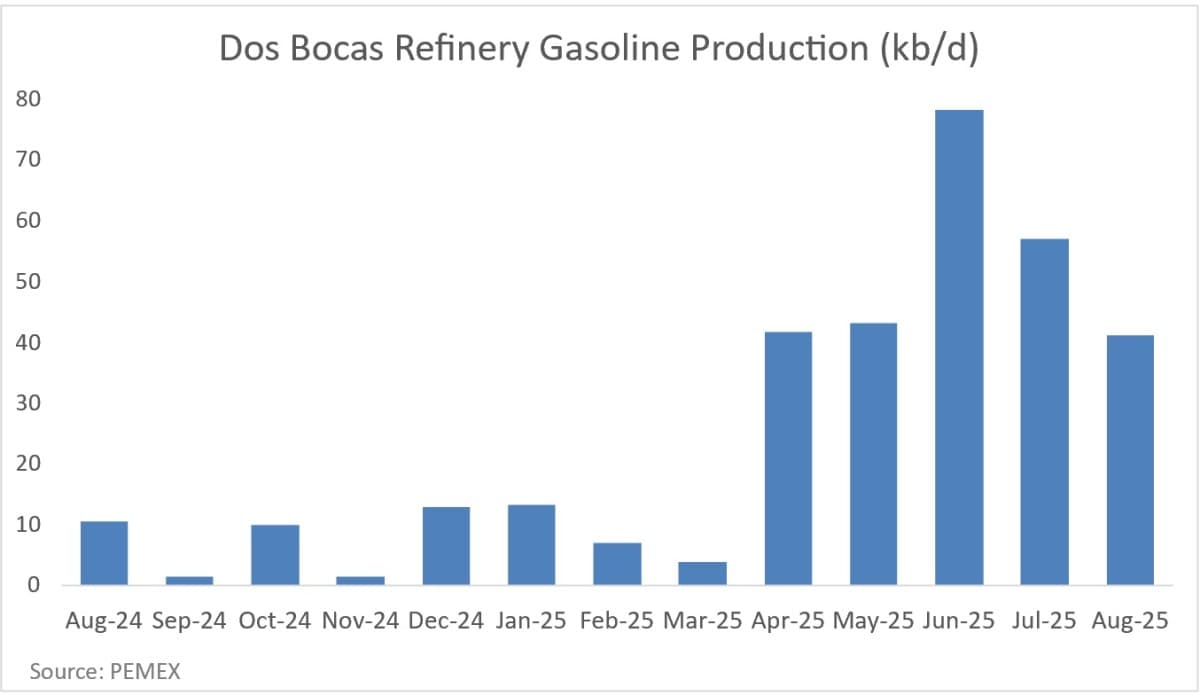
Yet the reality of operating Mexico’s largest refinery has been a bumpy road so far. Despite an intended gasoline output capacity of 170,000 b/d (once both CDUs are up and running), the facility has never approached that level. Its highest production in June 2025 reached just under 79,000 b/d before falling to 41,000 b/d in August, barely a quarter of its designed gasoline production capacity (see the chart). The refinery has struggled with repeated interruptions, including a three-month shutdown in late 2024 when crude supplies failed quality standards due to water and salt contamination. In April 2025, a malfunction during electrical load balancing triggered a cascade of equipment failures that required more than a week to restart operations. In August, heavy rains led to power outages that disabled a key gasoline unit for several weeks, forcing Pemex to divert three tankers of Maya crude to its Deer Park refinery in Texas.

Such disruptions reflect a broader structural problem. Southeastern Mexico’s power grid is prone to instability, with long transmission corridors, limited redundancy, and high exposure to severe weather. Outages throughout the Yucatan Peninsula in May 2024 and September 2025 underscored the fragility of the system, leaving facilities such as Dos Bocas vulnerable to cascading failures. For a refinery of this scale, the lack of reliable power supply represents a critical operational risk.

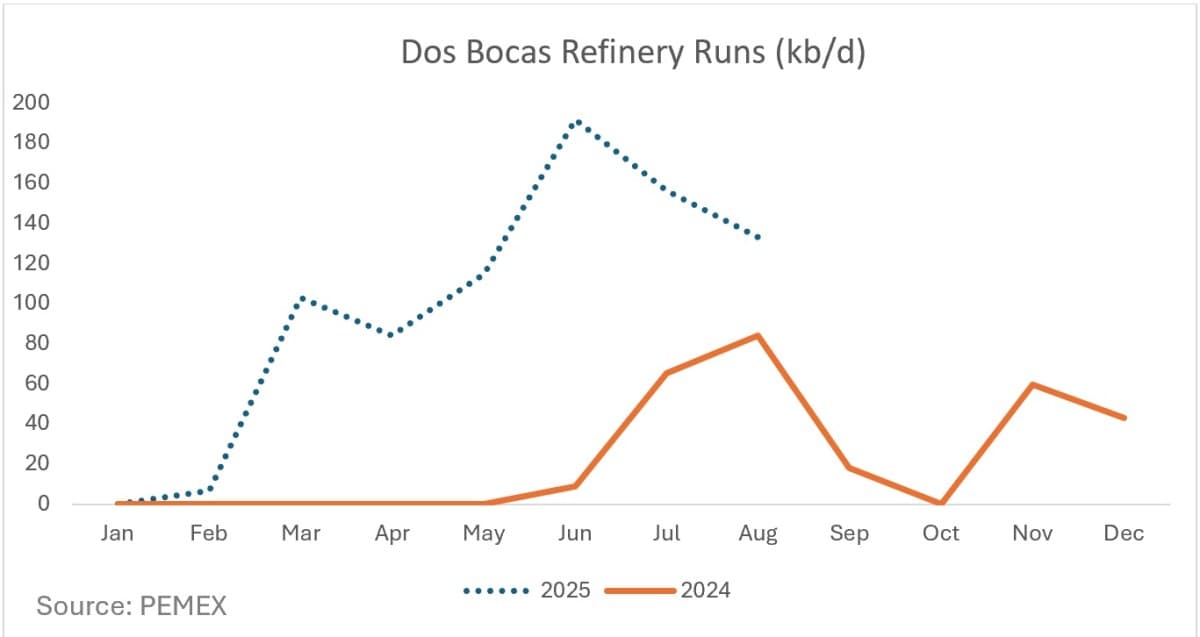
 The refinery’s performance record reveals a telling paradox. At its peak in June 2025, Dos Bocas processed roughly 190,000 b/d of crude oil (see the chart). Since each of its two distillation columns has a design capacity of 170,000 barrels a day, this suggests that both units were already in operation if Pemex’s numbers are accurate. Technically, the refinery has shown it can run both columns, but the achievement was fleeting. Problems with unstable electricity supply and inconsistent crude quality prevent it from sustaining the necessary throughput. In practice, the facility has been unable to keep its units running steadily enough to match its theoretical capacity.

The consequences are visible in Mexico’s fuel import data. Far from reducing the country’s reliance on foreign gasoline, disruptions at Dos Bocas have coincided with an increase in purchases from abroad. Imports surged to 388,000 b/d in September, the highest level of the year and well above the 325,000 b/d average for 2025 to date. For a project intended to safeguard Mexico from volatility in global fuel markets, the outcome so far has been the opposite: the refinery’s instability has amplified dependence on imports rather than reducing it.

Logistics add further constraints. The refinery is not connected to the national pipeline network or main road corridors, forcing Pemex to rely on trucking and coastal shipping. Authorities have announced plans for a rail link connecting Dos Bocas to the Maya Train (and further on with the Interoceanic Corridor, intended to create a Gulf-to-Pacific trade route as an alternative to the Panama Canal). The project of a railroad connection to the Maya Train was initially set for completion in 2026, but construction works have not begun, and progress has yet to materialize. In the meantime, the refinery has relied on sporadic domestic shipments of diesel and gasoline starting from March 2025 (mainly to the Tuxpan terminal), and has only recently entered international markets, sending a 300,000-barrel cargo of diesel to the US (Florida) and Puerto Rico in March.

The economics of regional crude refining complicate matters further. Heavy Latin American grades have tightened in supply, with Venezuelan volumes absent, and U.S. refiners competing aggressively for any heavies still available. Differentials of Maya have been consistently rising between January and August 2025, making crude exports particularly lucrative. Pemex, however, has cut shipments abroad by more than 20% year-on-year, down to 620,000 b/d in August. The move was justified as a deliberate strategy to secure feedstock for domestic refining, especially for Dos Bocas.

Yet this narrative masks a more structural problem: Mexico’s crude output has been in steep decline. PEMEX’s production has fallen from 2.25 million b/d in August 2015 to just 1.37 million b/d by August 2025. The drop reflects both the natural exhaustion of mature oilfields and the national oil company’s limited investment in exploration and new developments. Compounding the issue, the quality of crude itself has deteriorated. Water and salt contamination in Maya crude has already disrupted operations, most visibly in the late 2024 shutdown at Dos Bocas. These factors limit not only the ability to export but also the reliability of supplies for Mexico’s refineries, undercutting the government’s stated goal of self-sufficiency.

The financial context adds up to the challenge. Pemex remains the world’s most indebted oil company, with obligations approaching $101 billion. Its financial balance is sustained only by repeated federal support, including capital injections, tax reductions, and debt refinancing. Dos Bocas was intended to reduce the company’s dependence on fuel imports and strengthen its cash flow, but persistent operational setbacks risk turning it into an additional liability.

For Sheinbaum’s administration, the refinery embodies both ambition and exposure. Success would represent a long-sought step toward self-sufficiency in refined products, reinforcing the political case for Mexico’s resource nationalism. Failure would underline the structural weaknesses of the country’s energy sector, leaving Pemex more financially fragile and dependent on state support. As it stands, Dos Bocas remains less a triumph of sovereignty than a reminder of how infrastructure ambitions can falter against technical fragility, logistical gaps, and the hard economics of global oil markets.

\\

By Natalia Katona for Oilprice.com

The Collapse of Confidence in Carbon Capture

  • Governments and fossil fuel firms have invested billions in CCS, but delays, glitches, and cost overruns have slowed progress.

  • Evidence shows many CCS and DAC facilities are capturing far less carbon than promised, shaking investor and public confidence.

  • Critics warn that overreliance on CCS could divert crucial funding away from long-term renewable energy development.

Just a few years ago, Carbon Capture and Storage (CCS) was expected to be the saviour of the oil and gas industry, as major fossil fuel firms invested heavily in CCS activities aimed at decarbonising operations. Governments worldwide have encouraged companies to invest in CCS in recent years, funding green energy projects to help reduce the carbon emitted from oil and gas operations, and to allow countries to continue using fossil fuels to bridge the energy gap over the coming decades. However, as we see delays in the rollout of CCS projects and more evidence that suggests most CCS installations do not work as well as anticipated, many are questioning whether investing in this type of decarbonisation is viable.

CCS involves capturing carbon dioxide at emission sources, to be transported and stored or buried in a suitable deep, underground location. There is now a range of CCS technologies being used in fossil fuel and industrial operations worldwide, including conventional CCS installations and direct air capture (DAC), which removes CO2 directly from the atmosphere.

Following significant support from governments and fossil fuel companies worldwide, the CCS market could attract as much as $80 billion in investment by 2030, to support an anticipated 270 million tons of carbon dioxide capture a year. However, many scientists now suggest that financing CCS is a waste of money, as the technology does not work as effectively as previously expected, and it could detract from funding long-term green energy projects. A new report suggests that globally, the maximum reduction that CCS operations could achieve for the atmosphere would be 0.7 degrees Celsius, which is far short of the 5 °C to 6 °C industry and governments claim.

The U.K. has committed $40.5 billion to CCS technology in support of its net-zero emissions aims for 2050. The country hopes to find a way to reduce emissions in the mid-term as it gradually incorporates more renewable energy capacity into the energy mix, while it continues to rely heavily on oil and gas for power and heating. However, getting CCS projects off the ground has been no easy feat, with decades of delays under several governments.

The increased funding into CCS technology in recent years is supposed to have led to technological improvements and design innovation that will help suck more carbon from the sky. However, technology glitches and the high costs associated with installing CCS equipment have delayed projects and deterred companies from investing in CCS operations. Thilo Trabner, a business development manager for the Zurich-based CSS provider ABB, explained, “First-of-a-kind technology challenges continue to contribute to delays in some projects, and reliance on subsidies and offtake agreements continues to play a critical role in project viability.”

Some of the projects for the U.K. include a gas power plant on Teesside in the north of England, which is expected to be operational by 2028, with plans to capture 95 percent of its emissions – around 2 million tonnes a year, and capacity to transport and store up to 4 million tonnes of carbon a year. Another three projects in the first round of the project pipeline are under negotiation, with plans to capture carbon from a methane-based blue hydrogen plant and energy from waste.

Related: Supermajors Slim Down to Protect Shareholder PayoutsA government committee has questioned the cost-effectiveness of the planned CCS projects, warning against an over-reliance on CCS activities rather than investing in the country’s long-term green energy goals. The government has already acknowledged that its target to capture between 20 and 30 million tonnes of carbon dioxide a year by 2030 is no longer viable.Related: Greenpeace Blockade Forces LNG Tanker Diversions From Belgian Terminal

In Switzerland, one of the world’s most well-known CCS companies, Climeworks, announced in May that it would be cutting its workforce by more than 10 percent, citing economic uncertainty and “reduced momentum” for CCS technology. Climeworks is famous for constructing the world’s first DAC facilities. However, the company has come under fire as two of its flagship plants in Iceland were found to be capturing significantly less carbon than originally anticipated. Climeworks said that it was uncertain whether a third facility planned for the U.S. would go ahead due to the uncertain energy environment under President Trump.

DAC technology is much more expensive than conventional CCS equipment, but many companies have invested in DAC activities in recent years in response to government pressure to decarbonise. Now, recent reviews suggest that DAC technology is struggling to grow out of the pilot phase, as interest in the sector wanes. Climeworks said that at its flagship Mammoth plant in Iceland, which is thought to have a carbon capture capacity of 36,000 tonnes of carbon dioxide a year, the equipment captured just 750 tonnes in the first 10 months of operations.

The outlook for CCS technology is uncertain. In recent years, several governments, industries, and oil and gas companies have invested heavily in CCS technology in a bid to decarbonise. However, many of the planned projects have been delayed due to technological constraints and high costs. Now, reports on existing CCS activities suggest that the technology may not be working as successfully as anticipated, which has cooled investor interest in the sector and could cause progress in the CCS rollout to stall in the coming years.

What’s Next for Energy Markets? 

A new conflict in the Middle East... a surprise OPEC+ decision... a massive shift in Chinese demand. Most investors only react to the headlines.

Oilprice Intelligence brings you the signals before they become front-page news. This is the same expert analysis read by veteran traders and political advisors. Get it free, twice a week, and you'll always know why the market is moving before everyone else.

You get the geopolitical intelligence, the hidden inventory data, and the market whispers that move billions—and we’ll send you $389 in premium energy intelligence, on us, just for subscribing. Join 400,000+ readers today. Get access immediately by clicking here. 

By Felicity Bradstock for Oilprice.com