Wednesday, October 08, 2025


Ukraine is Using Financing from World Bank to Modernize Port Fleet

WHILE STILL AT WAR

Izmail Ukraine port
Port of Izmail is a critical outlet for Ukraine (Yuriy Kvach / CC BY SA 4.0)

Published Oct 7, 2025 3:33 PM by The Maritime Executive


The Ukrainian Sea Ports Authority is in the process of determining the winner for a tender it launched earlier this year as a first step toward modernizing key parts of its aging fleet. With financing from the World Bank to repair essential logistics infrastructure, the authority intends to purchase a multifunctional port vessel for use at Izmail and on the Danube.

The Sea Ports Authority notes that a large portion, up to 30 percent, of its budget goes to fleet repair and maintenance costs. With the restoration project and the support from the World Bank, the goal is to optimize the fleet. It notes that a large portion is obsolete equipment, which contributes to the high costs. Specifically in Izmail, the branch is using equipment built in the 1970s and 1980s.

One of the newer vessels used by the branch, a 2012-built dredge, was damaged last summer while operating in the Bystre waterway, a critical canal linking the Danube to the Black Sea. Reports at the time suggested the vessel hit a mine. Three people were killed, and the unconfirmed reports said the vessel sank. The waterway reopened in August.

The current tender is for a multi-purpose vessel to be based in Izmail. The requirements based on the tender include the capabilities to conduct pollution cleanup, collect oily water, aid with emergency rescues, firefighting, and towing operations, including the capability for operations in ice conditions. The proposals submitted are currently being reviewed. They will select a winner from among the proposals and then move to finalize a contract. The vessel is scheduled for delivery in 2026.

The agency said in its statement that this is part of its systematic approach to strengthening operations and the environmental focus across the Danube region. The ports along the Danube have become vital to Ukraine during the war and the attacks on ports in the Greater Odesa region. They continue to be a lifeline for fuel imports as well as another route for grain shipments, and earlier in the war, they also used the ports for a containers on barge service to move cargo to and from  Romania.


Electrifying Europe’s Ports: Municipal Ownership Demands New Business Model

Sarah Haraldson / RISE
Sandra Haraldson / RISE

Published Oct 7, 2025 6:01 PM by Mikael Lind et al.


[by Mikael Lind, Christina Argelius, Ellinor Forsström, Sandra Haraldson, Monika Przedpelska Öström, Bart Steijaert, and Henrik Åkerström]

Ports as Public Stewards of the Green Transition

Across Europe, ports are being recast not only as gateways of trade but as critical enablers of the continent’s decarbonization agenda. The EU’s Fit for 55 package mandates a 55% reduction in greenhouse gas emissions by 2030. Globally, shipping accounts for around 3% of CO2 emissions, while within the EU maritime transport contributes a similar share — about 3–4% of total EU emissions.

Yet shipping’s climate impact is not limited to the high seas. Port operations and port stays themselves account for a significant share of emissions. An OECD/ITF study estimated about 18 million tonnes of CO? globally in 2011 came from shipping emissions in ports, roughly 2% of total shipping emissions. More recent analyses suggest that in certain corridors, port-related activities — from maneuvering and berthing to waiting and cargo handling — can contribute 12–20% of total transport emissions. Some studies even estimate that 10–25% of a ship’s emissions may occur during port-related phases, depending on vessel type and congestion.

These figures underscore why electrification of port operations and provision of shore power are vital components of maritime decarbonization. Ports also sit at the interface of maritime, road, and rail transport, making them indispensable to the wider transition of Europe’s logistics system. This also connects to the emerging concept of the sustainable port, which highlights the port’s role not just as a transport node but also as an energy node — integrating renewable energy, charging solutions, and grid interaction into daily operations.

Helsingborg, Sweden’s second-largest container hub, is already home to battery-powered ferries and an all-electric tug. The port has also simulated smart charging and battery storage to investigate how to manage peak loads. Helsingborg illustrates both the potential and the strain of port electrification: while innovation is advancing, financing models and governance structures remain misaligned with the scale of the challenge.

Sweden as a Case Study: Many Ports, Many Responsibilities

Sweden’s geography makes maritime infrastructure essential. With its long coastline and dispersed population, the country relies on a large number of mid-sized ports — many governed by municipalities. These ports are central to the national strategy of shifting cargo from road to rail and sea, a move critical for both emissions reduction and infrastructure efficiency.

But ports are also facing new regulatory obligations. The EU’s Alternative Fuels Infrastructure Regulation (AFIR) and FuelEU Maritime Regulation require widespread Onshore Power Supply (OPS) availability for container, cruise, and RoPax vessels. According to the Swedish Ports Association, meeting the electrification requirements in Swedish ports will demand an estimated capital investment of SEK 1.4–1.9 billion (€120–165 million), plus ongoing annual operating costs of SEK 150–250 million (€13–22 million). For municipally governed ports, these figures represent not only a daunting upfront challenge but also a long-term financial burden. Private ports face the same electrification challenges — and in some cases even greater ones — since they operate as stand-alone entities without the possibility to rely on capital or cross-subsidies from other parts of the municipality where they are located.

The implication is clear: no single municipality can absorb this burden alone. The only realistic path forward is to pool efforts so that funding criteria can be shaped, and project pipelines built, in ways that unlock national and EU support. But above all, what is needed is not more planning, but money for execution.

The Financing Dilemma

Electrification is not optional but a regulatory requirement—though its scope varies with vessel size and port call frequency. But the question of how it should be financed remains unresolved.

Ports operate under thin margins, and the prevailing model for OPS is to charge vessels a basic connection fee and pass through the cost of electricity. While this ensures cost recovery on a per-call basis, it rarely generates sufficient revenue to justify the multimillion-euro investments required. In practice, OPS is often treated as an environmental or reputational commitment rather than a profitable business line.

Swedish law compounds the challenge: ports are not permitted to profit from electricity sales, since only licensed energy companies may sell electricity with a margin. Even if OPS demand were to increase sharply, ports cannot develop a business case around energy provision.

Public subsidies can provide partial relief, but these too have limitations. Sweden’s Klimatklivet program, for example, explicitly excludes funding for measures that ports are legally obliged to implement. Because OPS is now mandated under EU law and transposed into Swedish regulation, Klimatklivet cannot be used to finance these investments.

The result is a significant financing gap. National and EU mechanisms — such as Klimatklivet and the Connecting Europe Facility (CEF) — exist, but they are competitive, fragmented, and insufficient to match the scale of investment required.

This makes the real task not just to design frameworks, but to channel predictable, large-scale funding into execution. Without direct investment streams — not only competitive calls — OPS deployment risks stalling before it starts.

Risks of an Uneven Playing Field

If each municipality is left to finance electrification alone, competitive imbalances will emerge. Wealthier municipalities may be able to fund their ports’ transition; smaller or poorer ones may fall behind.

This not only undermines the fairness of the market but also risks fragmenting Europe’s decarbonization strategy. Vessels will naturally gravitate to ports with better infrastructure and lower fees, distorting cargo flows and slowing the modal shift.

Collective action is therefore not about abstract cooperation — it is about ensuring that ports of different sizes can access real money for projects on equal terms, and that incentives align with regulatory mandates.

Rethinking Business Models

The situation calls for new thinking about port business models for energy provision. Several avenues are emerging:

1) Network Fees for Internal Grids: Helsingborg, together with its local energy company, is exploring whether the port can charge a network usage fee for its internal electricity grid. The model would allow the port to recoup some infrastructure costs while the energy company continues to sell electricity.

2) Joint Procurement and Shared Investments: Groups of ports could pool procurement for OPS technology and even share access to funding. This would create economies of scale and reduce disparities.

3) Utility-Based Models: Ports and energy providers can work together in deeper structural ways. One path is for ports to co-own or operate public utilities directly, as seen in the Port of Oakland and Seattle, where the port authority plays a role in energy distribution. Another approach is to create joint port–utility companies that are licensed to provide electricity, enabling ports to share in revenues and ensure cost recovery while utilities remain compliant with energy regulations. In Europe, Hamburg’s municipal model shows how shared ownership between ports and energy companies can integrate port electrification into wider energy strategies.

4) Expanded Role for National Governments and the EU: Since ports are delivering on obligations arising from EU legislation, national governments and the EU should shoulder a greater share of the financial burden.

These ideas align with the broader sustainable port concept, which positions the port as an energy node at the intersection of maritime, road, and rail systems. By combining logistics with energy distribution, ports can become both decarbonization enablers and system integrators.

But business models alone are not enough. They must be backed by hard funding: direct public investment, EU co-funding, or green bonds. Industry moves when the incentives are right — and today the incentive must be money for execution.

Helsingborg as a Prime Mover in Sweden’s Port Ecosystem

Having set the stage, it is worth returning to Helsingborg — a port already charting a way forward.

  • The port today: Sweden’s second-largest container port, handling over 250,000 TEUs per year, and the main entry point for fresh fruit imports.
  • Electrification already underway: two battery ferries on the Helsingør route, electrified yard equipment, and an all-electric tug has arrived in September 2025.
  • System challenges: simulations show peak loads of nearly 3 MW when OPS, reefer containers, cranes, and EVs demand electricity simultaneously. Without buffers, the local grid cannot cope.
  • Solutions tested: battery storage (2–4 MWh) as a buffer, smart charging systems, and new charging concepts to spread loads.

Reported in a recent study financed by VinnovaHelsingborg’s Sustainable Port initiative has concluded with valuable insights on how climate-neutral and electrified port operations can be realized in practice. Beyond Helsingborg, the study underlines how these innovations can be scaled and applied in other ports globally, making the project a reference point for the broader port ecosystem.

Most importantly, the study demonstrates what “funding readiness” looks like: technical feasibility, stakeholder alignment, and financial planning combined. These are the kinds of structured projects that should guide real funding decisions — and be backed with money for implementation, not just planning.

Grid Capacity: A Growing Bottleneck

Even if ports secure financing, another obstacle looms large: grid capacity.

In many parts of Sweden, local electricity networks already operate close to their limits. Adding megawatts of new demand for OPS, reefer blocks, and electrified handling equipment risks overwhelming the infrastructure. For grid operators, ports represent highly concentrated, time-sensitive demand peaks — a “headache” that requires expensive upgrades and careful planning.

This means that electrification is not just a port challenge. It is a regional energy challenge. Ports like Norrköping, for example, are already working with their grid provider E.ON to ensure distribution capacity can match the port’s electrification plans — proof that OPS deployment cannot succeed without regional energy coordination backed by real investments in the grid.

Toward a Collective Path

The lessons are clear:

  • Technology is not the bottleneck. OPS, batteries, and smart charging systems exist.
  • Financing and governance are the bottlenecks. Municipal ownership structures make it difficult to fund investments that serve national and EU mandates.
  • Grid capacity is the hidden constraint. Without parallel investments in local electricity networks, even well-funded OPS systems cannot deliver.
  • Collaboration is key. Ports must not compete individually on OPS models; they must coordinate to present a unified position to regulators and financiers.

That coordination should not stop at associations — it must deliver concrete, funded projects. Europe has the mandates. The technology is ready. What is missing is money for execution.

Conclusion: A Call for Action

Electrification of ports is not a voluntary green initiative — it is a legal requirement and a societal necessity. The technology is ready, but municipal ownership and thin margins mean that ports cannot finance OPS alone nor the wider electrification of port operations and the transport modes they serve — from ships to trucks and trains. Without predictable, large-scale funding, Europe risks creating a two-tier system of ports: those that comply and attract cargo, and those that fall behind.

The way forward is collaboration with purpose: align funding with legal mandates, build project portfolios that qualify for support, and synchronize grid planning with OPS deployment. Above all, Europe must back its climate ambitions with real money for execution — or risk seeing port decarbonization remain a paper exercise instead of a climate solution.

Mikael Lind is the world’s first (adjunct) Professor of Maritime Informatics engaged at Chalmers and Research Institutes of Sweden (RISE). He is a well-known expert frequently published in international trade press, is co-editor of the first two books on Maritime Informatics and is co-editor of the book Maritime Decarbonization.

Christina Argelius is the CTO at the port of Helsingborg. Before that she has been working in the car industry in various positions within technical development and facility management. Christina has a mechanical engineering degree from University of Chalmers in Gothenburg (SE).

Ellinor Forsström is an engineer and project manager at RISE specialized in the subject of maritime energy systems. She has led the work in several research projects/initiatives concerning alternative fuels in shipping and increased energy efficiency onboards ships as well as similar projects in port areas.

Sandra Haraldson is Senior Researcher at Research Institutes of Sweden (RISE) and has driven several initiatives on digital collaboration, multi-business innovation, and sustainable transport hubs, such as the concept of Collaborative Decision Making (e.g. PortCDM, RailwayCDM, RRTCDM) enabling parties in transport ecosystems to become coordinated and synchronised by digital data sharing.

Monika Przedpelska Öström is the Head of the Ports of Sweden Association. Ports of Sweden is one of seven associations within Transportföretagen, the trade and employers’ organization for the transport industry. Today, Ports of Sweden has 60 member companies and approximately 4,000 employees in the port sector. Among its members are both port owners and port operators, as well as other companies that provide services in and around the ports.

Bart Steijaert is CEO at the port of Helsingborg and has been working internationally in the port and logistics business since 1996. Bart has logistics engineering degree from Universities in Vlissingen (NL) and Ghent (B).

Henrik Åkerström is the CEO of Port of Norrköping and has extensive experience in the transport and logistics industry across land, sea and rail.

The opinions expressed herein are the author's and not necessarily those of The Maritime Executive.
 

St. Johns Ship Building Awarded Johnson Bros. Barge Construction Contract

barge

Published Oct 7, 2025 7:26 PM by The Maritime Executive


[By St. Johns Ship Building] 

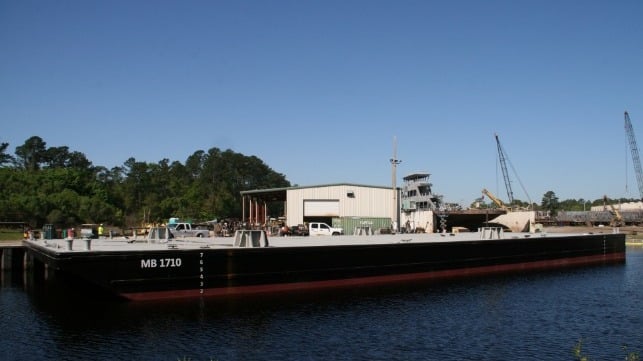
St. Johns Ship Building, a leading Jones Act shipyard and a subsidiary of Americraft Marine, is proud to announce that it has been awarded a new contract by Johnson Bros. Corporation, a Southland Company, for the construction of three 140’ x 40’ x 8’ steel material deck barges with spud wells.

 Founded in 1929, Johnson Bros. Corporation is a leader in the infrastructure industry, working with both private and public clients. In 2012, Johnson Bros. joined Southland Holdings, which is one of the largest infrastructure construction companies in North America. This award reinforces St. Johns Ship Building’s growing reputation for delivering dependable, high-quality commercial marine vessels that support infrastructure and marine construction projects across the United States.

“We’re honored to partner with Johnson Bros. on this significant project,” said Joseph Rella, President of St. Johns Ship Building. “Johnson Bros. has long been recognized as a leader in marine and heavy civil construction, and this newbuild program reflects the confidence that they—and the market—continue to place in our team’s capabilities, craftsmanship, and commitment.”

“We are excited to collaborate with St. Johns Ship Building on these barges, which will enhance our operational capabilities and help us deliver to our clients nationwide,” said John Meagher, Vice President of Johnson Bros.

All fabrication and assembly work will be performed at St. Johns Ship Building’s Palatka, Florida facility. The project further accelerates the shipyard’s growth, following multiple recent vessel deliveries and new contract awards from both commercial and government customers.

This contract also supports St. Johns Ship Building’s broader initiative to help revitalize America’s shipbuilding industrial base by investing in the infrastructure, training, and workforce development of small and mid-sized shipyards. 
 

The products and services herein described in this press release are not endorsed by The Maritime Executive.


New Warning of Numerous Reports of Global Navigation and AIS Interference

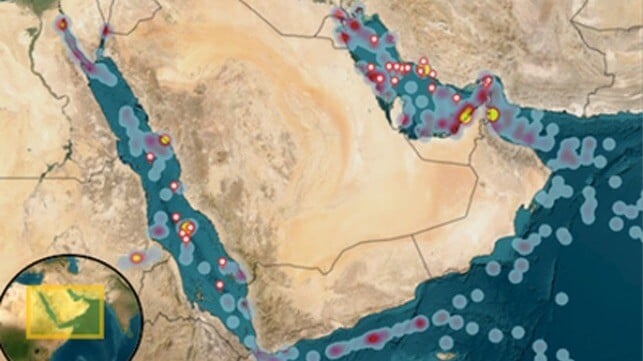
map of GNSS and AIS interference reports
Red and white dots show GNSS interference reports and the heatmap shows the widespread reprots of AIS speed anomalies (UKMTO)

Published Oct 7, 2025 1:59 PM by The Maritime Executive


UK Maritime Trade Operations issued a new advisory after receiving an increased number of reports of interference that is impacting the Global Navigation Satellite System (GNSS) as well as data on AIS displays. It comes as Qatar continues to work to repair a “technical fault in GPS,” which it first reported over the weekend.

According to the latest updates, there has been a significant increase in the number of reports that started on October 3 and have continued through today, October 7. UKMTO said the reports are concentrated in the areas around Bandar-e-Pars (Iran), the Strait of Hormuz, and Port Sudan. It warns that the incidents have increased compared to last week, advising ships to use increased caution.

As part of the ongoing issue, they are also warning ships that vessels are observing “AIS Speed anomalies.” The speed irregularities are being consistently observed throughout the Gulf, Port Sudan, and Suez Canal areas, says UKMTO.

The Ministry of Transport of Qatar also cited the issues with GPS and took the unusual step on October 4 of telling all maritime vessel owners that they were “obliged to temporarily suspend maritime navigation activities." It initially said the suspension would remain in effect till the technical fault was cleared. Yesterday, the Ministry, however, partially removed the ban, saying navigation activities were permitted during daytime hours. Smaller vessels, including pleasure crafts, tourism vessels, and fishing, however, were still being told to return to port before sunset and not to sail further than 12 nautical miles.

As the problem persists, UKMTO also reiterated a May 2025 warning from the Joint Maritime Information Center, which had advised shipping in the Red Sea and Strait of Hormuz not to solely rely on electronic navigation systems and autopilots. They also said it would be prudent for vessels to consider using traditional non-electronic means of position-fixing to cross-check the vessel’s position.

JMIC’s warning came after the containership MSC Antonia grounded in the Red Sea while it was bound for Jeddah, Saudi Arabia. The incident was widely believed to be the result of GPS jamming, and the ship spent weeks aground, only leaving Jeddah in late June after grounding on May 10. During the incident, GPS spoofing frequently changed the ship’s reported position. 

Interference of electronic systems is considered to be a “routine issue” in the region ranging from the Red Sea to the Arabian Gulf. Shipping has learned to deal with them and adjust operations, but the authorities continue to warn of the dangers. So far, no one has been able to pinpoint the source of the latest problems in Qatar or across the region.


Pilot Project Achieves Better Than Projected 98% Reduction in Methane Slip

LNG-fueled coal carrier
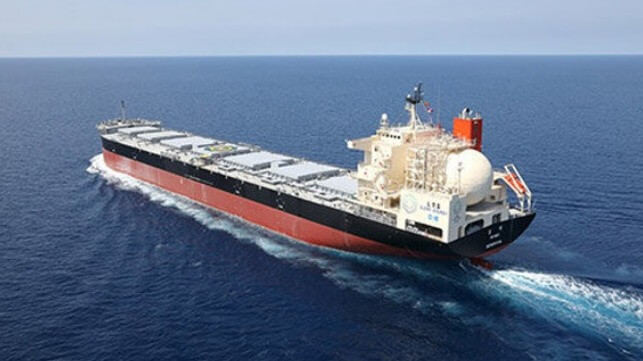
MOL's coal carrier is testing he methane slip reduction technology during real world conditions (MOL)

Published Oct 7, 2025 5:46 PM by The Maritime Executive


A multi-year Japanese project sponsored by the government is reporting that it has achieved much higher than anticipated reductions in unburnt methane emissions (methane slip) during demonstrations on an in-service bulker operated by Japan’s Mitsui O.S.K. Lines. They are testing methane oxidation catalysts, noting that it is a first for the technology, and confirms very promising results in tackling a key environmental concern.

The project began in 2021 as part of efforts sponsored by Japan’s New Energy and Industrial Technology Development Organization (NEDO) with the goal of reducing methane emissions by at least 70 percent. Unburnt methane scientists report has a higher greenhouse effect than CO2 and takes far longer to break down, making it is high priority in the efforts to reduce GHG emissions.

Hitachi Zosen and Yanmar Power Technology developed the methane oxidation catalyst system. It is placed on the exhaust pipe, similar to the application of emissions SOx scrubbers, and the methane is oxidized to reduce methane slip.

The companies undertook land-based tests in December 2023 and reported achieving a reduction rate of 93.8 percent at 100 percent load. The system combines with an exhaust gas recirculation technology that recirculates engine exhaust gases to reduce unburnt methane slip and NOx. The results were independently verified by ClassNK and reviewed with NEDO for continued support.


Methane slip reduction system on board (Left: EGR system, Right: Methane oxidation catalyst layer) (Yanmar)


Japan’s industrial and engineering corporation Kanadevia Corporation (formerly Hitachi Zosen) continues to lead the project. Working with Yanmar and MOL, the goal was to modify the land-based test equipment for onboard use on a large, LNG-fueled coal carrier.

MOL’s vessel Reimei was fitted for the tests, which began in May 2025. Delivered in November 2023 from Japan’s Namura Shipbuilding Co., the 95,792 dwt bulker is a Panamax coal carrier. It operates for Japan’s Kyushu Electric Power Co., transporting coal to Japan for thermal power plants.

Test results during the demonstration reported a 98 percent reduction in methane slip, far exceeding the 70 percent goal of the project and the earlier 93.8 percent reduction in the land-based trials. They highlight that the vessel was operating under normal conditions, including a fluctuation in load rate due to weather conditions, and was at a practical operating load (75 percent) while achieving the 98 percent reduction. 

Onboard trials are continuing into FY 2026 to evaluate overall system performance and catalyst durability. The aim is to commercialize the system starting in FY 2027.


MOL is First Shipping Company to Join Australia’s Ammonia Bunkering Project

ammonia-fueled bulker
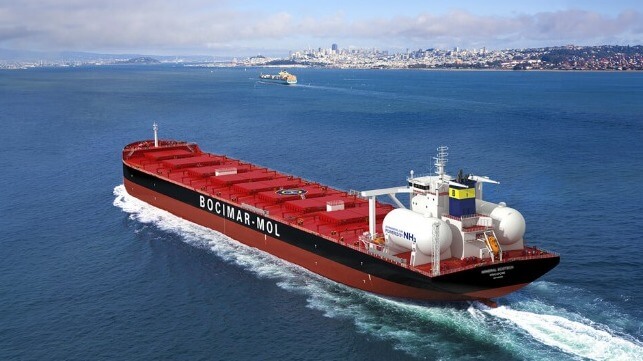
MOL will provide the operator's perspective as it plans to operate three ammonia dual-fuel bulkers (MOL)

Published Oct 7, 2025 4:53 PM by The Maritime Executive


Japan’s Mitsui O.S.K. Lines is joining the effort to develop an ammonia bunkering operation in Australia’s Pilbara as part of the efforts to establish a green shipping corridor between the iron ore region and Asia. MOL becomes the first shipping company in the project, which was announced in June, that anticipates bunkering the Capesize bulkers that transport the ore and an ammonia export business.

MOL will be working with an Australian company, NH3 Clean Energy, which is responsible for the supply of blue ammonia, and Oceania Marine Energy, which will operate the bunkering business. Pilbara Ports Authority is participating in the project and is responsible for managing and operating the Port of Dampier, where they anticipate the operation will be based, and they will issue the bunkering licenses.

The goal is to commence the bunkering operations for Capesize bulkers at the ports of Dampier and Port Hedland by 2030. They highlighted that the Pilbara region of Western Australia is a natural for the program as the world’s largest iron ore export port.


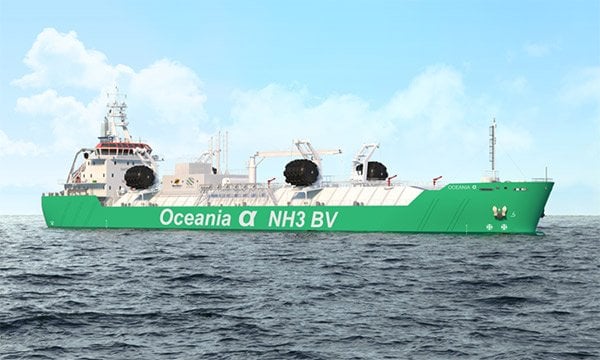
Concept of the ammonia bunkering vessel planned for the Pilbara operation (Oceania)


MOL has already committed to ammonia dual-fuel vessels in a partnership with CMB.TECH. It will charter and operate three Capeszie bulkers CMB.Tech is having built by China State Shipbuilding Corp.’s Qingdao Beihai Shipbuilding Company. CMB.Tech launched the project in 2023, working with WinGD to develop a 72-bore ammonia-fueled engine, and MOL has agreed to take the three vessels each on a 12-year charter. MOL reports it will bring the operator’s perspective to the project to develop ammonia bunkering. 

When the bunkering project was announced, Pilbara Ports’ CEO, Sam McSkimming commented, “With approximately 4,000 vessel visits associated with bulk exports and more than 1,000 distinct bulk carriers visiting our ports annually, the Pilbara is a natural beachhead to kick-start the clean fuel transition. The green iron corridor between the Pilbara and East Asia has the scale, stable demand, port infrastructure, and risk management experience to support the significant investment that maritime decarbonization requires.”

NH3 is developing its WAH2 project planned for neighboring Maitland, which would use the existing gas and pipeline infrastructure, along with carbon capture in the production of clean ammonia. The company said that the anticipated initial bunkering demand of 300,000 TPA of clean ammonia would represent approximately half of the planned production capacity from Phase 1 on the WAH2 Project, with the remainder available for export as a fuel for heavy industry, including power generation. It is currently working on pre-FEED studies and says the new agreement with MOL will contribute to the final FID decision expected by the end of 2026.

ECOCIDE

Report: Russia's Shadow Fleet is Pumping Oily Waste Overboard

Shadow fleet
File image courtesy USCG

Published Oct 7, 2025 8:43 PM by The Maritime Executive


Russia's "shadow fleet" tankers are in the habit of dumping oily waste into the water, according to a review of satellite imagery conducted by Politico. 

Oily waste dumping at sea is a violation of MARPOL, and is used as a cost-saving or convenience measure by some vessel operators and crewmembers. It circumvents the need to run an onboard oily-water separator or to incur the substantial expense of in-port wastewater treatment services. Globally, it is the single largest human source of oil pollution into the sea, and (according to the Outlaw Ocean Project) exceeds the volume of the Exxon Valdez and Deepwater Horizon spills combined every three years. The practice has been found aboard well-regarded vessels: the largest intentional violation ever prosecuted was a five-ship pattern of oily waste dumping discovered in the fleet of Princess Cruise Lines, resulting in a record $40 million fine and a consent decree for the operator. 

It appears that Russia's little-regulated "shadow fleet" may also be in the habit of dumping oily waste over the side. Using satellite imaging from SkyTruth - which has spotted suspected oil-dumping vessels many times before - Politico and the independent journalism outfit SourceMaterial have spotted at least five shadow fleet tankers leaving oil slicks behind as they sail towards European waters. The visual evidence suggests that even without a major marine casualty and a large-scale spill, Russia-linked tankers are already polluting the seas on their way to and from the EU.

“The oil spills and risk of slicks are horrendous," said shadow fleet expert Isaac Levi of the Centre for Research on Energy and Clean Air (CREA), speaking with Politico last year. “Beyond the environmental damage, some of which will be irreversible, it’s a huge impact to coastal states that have to bear the cost of cleaning this up.”

The shadow fleet also poses an outsize risk of major accidents. Its anonymous owners flag their ships with low-reputation open registries, or with registries that do not exist at all, indicating little or no regulatory oversight. Due to G7 sanctions pressure, these owners select P&I coverage from insurers outside of the IACS group; some of these little-known underwriters are unlikely to be able or willing to pay out for a billion-dollar spill. And on average, shadow fleet vessels are older than the global tanker fleet as a whole, generally a sign of lower vessel quality and more frequent need for repairs. 

Environmental harm is not the only risk. At least one Russia-linked tanker has been linked to disruptive "hybrid warfare" drone raids in the western Baltic region. Another, the Eagle S, was detained and investigated for damaging subsea cables in the Gulf of Finland with its anchor. Both vessels were ultimately released to continue on their commercial voyages, though in each case top officers were arrested to face charges. 


Breaking Ships, Building Consensus: How the Basel Ban and HKC Can Coexist

Shipbreaking activity
File image courtesy IMO

Published Oct 7, 2025 11:11 PM by Dr. Ishtiaque Ahmed


The shipping industry faces a fundamental dual challenge: ensuring that end-of-life vessels are dismantled in a manner that protects workers and the environment, while also preventing hazardous materials from being exported to jurisdictions unequipped to manage them. Two international treaties dominate this debate: the Basel Convention on the Control of Transboundary Movements of Hazardous Wastes and Their Disposal (1989), strengthened by its Ban Amendment (1995/2019), and the Hong Kong International Convention for the Safe and Environmentally Sound Recycling of Ships 2009 (HKC).

Critics often frame the Basel and HKC regimes as irreconcilable, forcing the shipping industry to choose between them. In reality, they are complementary instruments. Basel regulates where recycling activities may take place; HKC regulates how they are conducted. The real friction lies not in law but in economics, geography, and political will.

The Basel Convention emerged out of a moral imperative: to halt the dumping of hazardous wastes in the Global South. Its Ban Amendment, now binding on Annex VII Parties (OECD, EU, and Liechtenstein), prohibits the export of hazardous waste — including end-of-life ships containing asbestos, PCBs, and heavy metals — from OECD to non-OECD countries. Legally, the rule is categorical. An OECD-flagged vessel may not be dismantled in South Asia if either its flag state, exporting state, or the recycling state is bound by the Ban Amendment. In the context of shipping industry, Basel therefore defines the “red lines” of ship recycling geography. Importantly, it does not set standards for dismantling itself; its concern is purely the transboundary movement of hazardous waste.

To carve out international shipping as a Basel exception would undermine the Convention’s universality, invite demands for exemptions from other powerful industries, and erode the principle of environmental justice that motivated the Ban in the first place. The international community does not need to bend Basel to accommodate ships. It needs to implement Basel faithfully, while using the HKC to ensure that lawful recycling is carried out safely and sustainably.

If Basel provides the “where,” the HKC, adopted under the International Maritime Organization (IMO), provides the “how.” Its mandate is technical and operational, not geographic. It requires every ship to carry an Inventory of Hazardous Materials (IHM), obliges recycling facilities to develop Ship Recycling Facility Plans (SRFP), and mandates Ship Recycling Plans (SRP) tailored to each vessel. Article 2(10) of the HKC defines “Ship Recycling” as the dismantling of a vessel, in whole or in part, at an authorized facility for the purpose of recovering components and materials. The definition includes on-site handling, storage, and treatment of recovered materials, while excluding downstream processing or final disposal once materials leave the yard. In other words, HKC governs the dismantling process itself, not what happens beyond the facility gate.

The IMO has repeatedly clarified that its conventions do not prescribe geographic location; Its instruments regulate standards and procedures. In doctrinal terms, HKC functions as lex specialis — detailed, sector-specific rules that operate within Basel’s broader framework.

For more than 45 years, South Asia has been the world’s preeminent ship recycling hub. India, Bangladesh, and Pakistan together account for over 80% of global recycling capacity by gross tonnage. This dominance reflects two structural advantages: lower comparative labor costs and a sustained regional demand for scrap steel. It is precisely these markets that HKC’s drafters sought to address, embedding requirements for worker safety and environmental safeguards tailored to local realities. Yet the Basel Ban complicates this picture. By prohibiting OECD-flagged vessels from being dismantled in non-OECD states, Basel directly constrains access to the very yards where global capacity is concentrated. This is the root of the industry’s claim that Basel and HKC are in conflict. But the clash is not legal; it is economic.

From a legal standpoint, Basel and HKC are not rivals. The Vienna Convention on the Law of Treaties (VCLT) requires states to interpret overlapping treaty obligations harmoniously. In this light, Basel regulates whether and under what conditions ships may cross borders for dismantling, while HKC sets the substantive standards for dismantling once a vessel has lawfully arrived at a facility. Together, they address distinct but complementary dimensions of the same governance problem. One defines the geography; the other defines the process.

A practical precedent already exists: the EU Ship Recycling Regulation (2013). As a regional implementation of Basel within Europe, it incorporates the Ban Amendment’s prohibitions on hazardous waste exports. At the same time, it requires all EU-flagged vessels to be recycled only in yards that the European Commission has inspected and certified. This dual compliance framework demonstrates that Basel and HKC are not legally contradictory. They can be operationalized together — one setting the boundaries of permissible trade flows, the other ensuring technical and environmental safeguards.

The genuine challenge is not incompatibility of legal rules but distribution of capacity. Basel’s Ban prevents OECD-flagged vessels from moving to South Asia, where most dismantling yards are located. HKC does not override this prohibition; it operates within what Basel allows. This creates a structural tension arising from the misalignment between regulatory geography and industrial geography

For South Asian and other non-OECD states, the Ban Amendment creates a practical dilemma: how to remain competitive when a major source of tonnage is blocked. Yet this does not render HKC irrelevant. On the contrary, HKC remains vital for three domains: non-OECD-to-non-OECD ship recycling, domestic dismantling, and the general uplift of global safety and environmental standards. Basel’s Ban need not mean permanent exclusion for non-OECD shipbreaking states. Rather, it creates an incentive to transform. By upgrading facilities to OECD-equivalent standards, institutionalizing strong worker protections, and establishing transparent downstream waste management systems, South Asian yards can credibly argue for “functional equivalency.”

This strategy would not only meet HKC’s technical standards but also weaken the rationale for exclusion under Basel. In effect, it turns compliance into a competitive advantage. The pathway forward for South Asia is not resistance, but reform. The key lesson is that Basel and HKC are not antagonistic. Basel sets the rules of where vessels may go; HKC dictates how they must be dismantled. Their coexistence is not only legally possible but legally required. Mechanisms for parallel application already exist, and the principle of harmonious treaty interpretation makes coexistence the default, not the exception.

What obstructs progress is not law but economics: Basel curtails flows to South Asia, creating pressure on the world’s main recycling hubs. The answer is not to claim a legal contradiction but to embrace reform. The future of ship recycling depends on rejecting the false choice between Basel and the HKC. By investing in OECD-standard infrastructure, pursuing recognition and certification, and aligning domestic regimes with international best practice, non-OECD states including South Asia can maintain their central role in global recycling under both frameworks.

Ship recycling is too important — economically, environmentally, and socially — to be governed by fragmentation. Basel safeguards environmental justice; HKC advances technical safety and environmental soundness. If ship recycling is to be genuinely sustainable, the global shipping community needs to realize that the path forward lies in working together.

Dr. Ishtiaque Ahmed is Professor and Chair of the Department of Law at North South University, Bangladesh. A former merchant marine engineering officer, he holds a Doctor of the Science of Law (J.S.D.) from the University of Maine School of Law, USA, where he specialized in ship recycling law and policy. He has served as a legal consultant to the International Maritime Organization (IMO), contributing to Bangladesh’s Ship Recycling Rule and Act. Dr. Ahmed is also a qualified Barrister of England and an advocate in Bangladesh. His expertise lies at the intersection of maritime law, environmental regulation, and sustainable ship recycling. He can be reached at ishtiaque.ahmed@northsouth.edu

The opinions expressed herein are the author's and not necessarily those of The Maritime Executive.

 

Carrier USS Truman's Collision Damage Appears at Anniversary Rally

Truman
The banner at left covered over the damaged hull section (USN)

Published Oct 7, 2025 11:46 PM by The Maritime Executive


On Sunday, in celebration of the U.S. Navy's 250th anniversary, Naval Station Norfolk welcomed President Donald Trump for a rally and speech on the pier next to carrier USS Harry S. Truman. The supercarrier's massive hull provided a backdrop and a security screen for the event, but also a reminder of the ship's recent tour in the Mideast: significant damage on the starboard quarter remains unrepaired, and the punctured and torn steel had been covered with a banner for the occasion of the president's visit.

The hull damage stems from the Truman's collision with a merchant bulker off Port Said earlier this year. On the night of February 13, Truman was operating in traffic north of the port when she collided with the bulker Besiktas-M, a Handymax with a poor inspection record. The collision damaged Besiktas' forecastle and Truman's hull above the waterline. Aboard the carrier, the impact punctured a sponson, penetrating exterior bulkheads of two storage rooms and a maintenance space. The ship's watertight integrity, systems and reactors were unaffected; luckily, the Besiktas' point of impact missed the nearby aircraft elevator. 

The damage was temporarily patched in Souda Bay the following week, but full repairs would have to wait for the vessel's next period in shipyard. Truman continued on her mission to combat Houthi forces over Yemen, returning to Norfolk at last in June 2025. 

The damage to the starboard side was still not fully repaired when Truman returned to sea in August, nor when the ship was alongside for the president's speech last weekend. At some point, the crew or a shoreside maintenance team painted over the torn metal with haze gray paint to match the hull; no signs of rust were in evidence during the rally. 

Truman is due to go into a multi-year refueling and complex overhaul (RCOH) period at HII Newport News soon, an ideal opportunity for significant hull repairs. The ship is now 27 years old, and her midlife refit was nearly canceled in 2019 during the first Trump administration. At the time, then-Acting Defense Secretary Patrick Shanahan proposed to retire her from service in 2024 and save $3.4 billion per year by avoiding the carrier's ongoing expenses. After opposition from Congress, Truman's RCOH period was put back in place.