It’s possible that I shall make an ass of myself. But in that case one can always get out of it with a little dialectic. I have, of course, so worded my proposition as to be right either way (K.Marx, Letter to F.Engels on the Indian Mutiny)
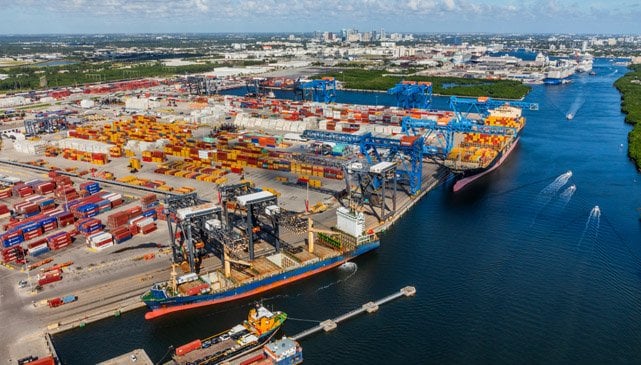
Broward County's Port Everglades has set a powerful new benchmark for performance, breaking its own records across all three of its core business sectors - cruise, cargo and energy - based on preliminary Fiscal Year 2025 numbers.
For the first time in the port's recent history, Port Everglades simultaneously surpassed its highest volumes in cruise, cargo and energy, which underscores its role as one of the most diversified and strongest seaports in the United States.
On the cargo side, the port achieved its best year with 1,167,552 TEUs (Twenty-foot Equivalent Units, the standard measurement of cargo container capacity), setting a new Port Everglades record. This milestone reflects strengthened global trade relationships, expanded capacity and continued demand across Latin America, the Caribbean and beyond.
In the energy sector, Port Everglades affirmed its status as Florida's No. 1 petroleum port, moving 131,855,261 barrels of petroleum products. The port is a critical fuel hub for Florida, supplying 12 counties and five international airports.
Cruise operations also surged to historic heights for the port. Port Everglades welcomed a preliminary count of 4,773,873 cruise guests in Fiscal Year 2025, an impressive 16% year-over-year increase. This achievement not only breaks the port's previous cruise record but also solidifies its standing as the third-busiest cruise homeport in the world. With the new cruise season featuring 40 cruise ships from 9 lines, plus a daily ferry, Port Everglades conservatively forecasts hosting even more cruise guests in Fiscal Year 2026.
"The trifecta of record-breaking accomplishments reflects the strength of our partnerships and the resilience of our business lines," said Port Everglades CEO and Port Director Joseph Morris. "The port's diversified portfolio positions us to adapt, compete and lead as global and regional markets evolve."
Port Everglades' performance highlights the strategic role it plays in Broward County and the broader South Florida region as an economic engine, job creator and essential hub for trade and tourism. With more than $3 billion in long-term capital improvements on the horizon as part of its Master/Vision Plan, the port is preparing for continued growth in capacity, efficiency and sustainability.
The products and services herein described in this press release are not endorsed by The Maritime Executive.
ASRY Signs Major Strategic Agreements to Strengthen Maritime Capabilities
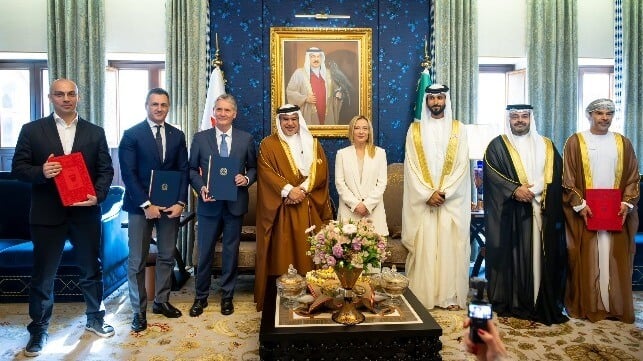
Arab Shipbuilding and Repair Yard (ASRY) has signed new agreements with leading Italian companies Fincantieri and Roboze to boost naval shipbuilding and repair and establish the Kingdom of Bahrain’s first smart plant dedicated to additive manufacturing.
The signing ceremony took place in the presence of His Royal Highness Prince Salman bin Hamad Al Khalifa, the Crown Prince and Prime Minister of the Kingdom of Bahrain, and Italian Prime Minister Giorgia Meloni.
“These important strategic partnerships will further strengthen ASRY’s capabilities as the leading maritime fabrication and repair facility across the Arabian Gulf region,” said ASRY CEO Dr. Ahmed Al Abri.
ASRY’s partnership with Fincantieri, one of the world’s largest shipbuilding groups will see the companies jointly assess opportunities for the design and construction of surface naval vessels up to 80 meters in length for domestic use by the Navy and the Coast Guard.
Signed by ASRY CEO Dr. Ahmed Al Abri and Eugenio Santagata, General Manager of the Naval Vessels Division of Fincantieri, the partnership agreement will also explore the design and construction of similar-sized offshore units, as well as potential export contracts in the Gulf region.
Additionally, the two companies will collaborate on maintenance, repair, and overhaul (MRO) services for naval, commercial, and offshore vessels, as well as the exchange of know-how in ship design and production processes optimization.
ASRY also signed a partnership agreement with Italian company Roboze, a global leader in additive manufacturing technologies for high-performance super-polymers and composite materials.
The agreement will establish Bahrain’s first industrial facility dedicated to advanced additive manufacturing. The new smart plant will be located within ASRY’s facilities in the Kingdom of Bahrain.
Signed by Dr. Al Abri and Alessio Lorusso, CEO of Roboze, the agreement will create an industrial hub designed to directly support marine MRO operations, as well as the oil & gas, energy, aerospace, and defense sectors, which require access to high-performance, lightweight, and durable components for sustained operations.
ASRY and Roboze will jointly define and engineer the new production infrastructure, integrating industrial 3D printing, advanced super-polymer processing, composite manufacturing, and digitalized workflows.
The partnership agreement brings together ASRY’s industrial and maintenance expertise with Roboze’s technological leadership in additive manufacturing with high-performance materials—recognized by the Kingdom of Bahrain as a “Strategic Technology of Interest.”
The new facility with cut downtime, optimize spare-parts management, and provide on-demand production of critical components, minimizing logistics costs and dependency on foreign suppliers.
Dr. Al Abri said: “This partnership strengthens our MRO capabilities and expands access to advanced technical components that are essential to the industries we serve.”
Mr. Lorusso said: “Working with ASRY allows us to introduce a concrete, operations-driven production model tailored to the needs of high-demand sectors, from marine repair to critical applications in energy and defense.”
The products and services herein described in this press release are not endorsed by The Maritime Executive.
Norway and UK Cement Anti-Submarine Alliance
Prime Ministers Jonas Støre and Sir Kier Starmer visited RAF Lossiemouth (Norwegian Government photo)
The British and Norwegian Prime Ministers flew to a miraculously rain-free RAF Lossiemouth in Northern Scotland on Thursday, December 4, to cement an alliance between the two countries, which has at its heart the curbing of the growing threat posed by Russian submarines.
Norway and the UK's defense links, particularly in the maritime domain, have been much enhanced recently by the presence alongside HMS Prince of Wales (R09) of the Norwegian Nansen Class frigate HNoMS Roald Amundsen (F311) from start to finish during the recently completed eight month deployment to the Indo-Pacific region, and also the invaluable support of the at-sea replenishment vessel HNoMS Maud (A530) which stepped in to compensate for a Royal Navy capability shortfall.
On August 31, Norwegian Prime Minister Jonas Støre announced that Norway would purchase for $13.5bn “at least five” British Type 26 frigates built by BAE for anti-submarine warfare purposes. The frigates for Norway and the UK will be built to identical specifications and operated as a joint capability. Maintenance and training facilities will be operated in common, with a new covered maintenance facility to be built in Harstad in northern Norway.
The visit to Lossiemouth was aimed at highlighting how British and Norwegian anti-submarine warfare P-8A Poseidon, based respectively at RAF Lossiemouth and Evenes in Norway's High North, will also operate together to cover the Greenland-Iceland-UK Gap through which Russian Northern Fleet nuclear submarines must pass. The Norwegian and UK aircraft will also link in with US Navy P-8A aircraft operating from Keflavik in Iceland and Germany's P-8A squadron operating from the Nordholz Naval Airbase in North West Germany. The closer operational coordination comes after a 30 percent increase in detected Russian vessels threatening UK waters over the past two years.
The UK-Norwegian Lunna House Agreement, formalizing this closer relationship, builds on 70 years of partnership and was named after the location in the Shetland Islands, which was the headquarters of the Norwegian Resistance during the Second World War. The agreement was signed by Norway's Minister of Defense Tore O. Sandvik and Britain's Secretary of State for Defence John Healey in Downing Street earlier in the day.
The United Kingdom is using its diplomatic independence to build closer bespoke bilateral relationships post Brexit, whereas attempts to build a UK relationship with the European Union as a bloc have floundered in the face of disunity on a broader agreement within the European Union.
Other elements of the Lunna House Agreement cover an expansion of the Royal Marines' commitment to Norway into year-round training, building up of ammunition stocks, the UK adoption of Norwegian naval strike missiles, and collaboration on the development of Sting Ray torpedoes.
Bulker Exchanges Shots with Skiffs off Yemen
Skiffs reportedly approach a bulker and there was an exchange of gun fire (UKMTO)
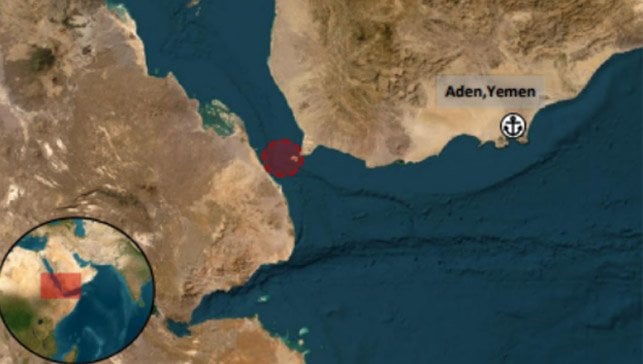
A bulker southbound in the Red Sea reported to authorities that it had been approached and exchanged gunshots with the unknown boats. The ship is safe and continuing on its way while analysts speculate over the events.
The Barbados-flagged vessel Bobik (31,896 dwt) reported the incident to UK Maritime Trade Operations early on December 5. The vessel is Turkish-owned and reports coming from Georgia after having made a port call in Ukraine. The ship was built in 2006 and is 175.5 meters (576 feet) in length.
The vessel was taking precautions by carrying armed security guards aboard. It had posted a warning on its AIS. It later changed the message on the AIS to read “Chinese crew.”
The first report said the vessel had been approached by as many as 15 skiffs while it was 15 nautical miles west of Yemen near the Bab al-Mandeb strait. UKMTO reports the captain said some of the small boats had come within approximately 500 to 1,000 feet of the bulker. The armed security guards fired on the boats, and the ship altered course.
The small boats moved away from the bulker, but reports are saying that at least several of the boats circled back and again approached the vessel. The Bobik has continued on its course, and the crew remains on alert.
Joshua Hutchinson, Global Maritime Risk Management Leader at Ambrey, posted a video of the incident online. He writes, “It is unlikely that this was the Houthis; maybe the PAG is trying new locations and tactics over the coming weeks.” Other speculation has been about fishing boats that regularly operate in the area.
The Houthi militants had frequented the area, sometimes identifying as the Yemeni Coast Guard and harassing and attacking vessels. The militants, however, earlier this year said they had suspended their “blockade” after the peace deal for Gaza.
The shipping industry has been cautiously looking at returning more vessels to the Red Sea routes. Several executives, however, have said it would be a slow process, and they would have to be certain of the security and the safety of their crews before they would resume transits of the Red Sea.
CMA CGM Set to Restore First Route Through Suez/Red Sea
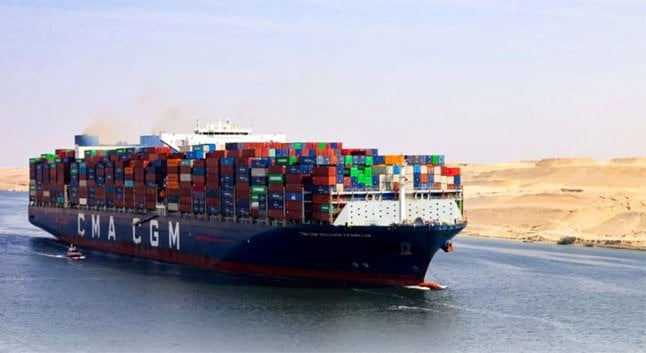
CMA CGM has been testing larger vessels in the Suez Canal recently preparing for its return (Suez Canal Authority)
French carrier CMA CGM is reportedly poised to become the first major carrier to restore service on one of its routes transiting the Red Sea and Suez Canal. While the industry expects the return, many have cautioned that it would be slow and only proceed as they felt assured of the safety of the crew and vessel.
“CMA CGM’s announcement of a full east-west loop via Suez is certainly a notable step in the right direction,” said Peter Sand, Chief Analyst at Xeneta. He, however, notes that “We are still some way from a large-scale return of container shipping to the Red Sea. We have seen carriers, particularly CMA CGM, testing the water recently by transiting the Suez Canal on a select few voyages, particularly backhaul legs to Asia when there is less cargo onboard.”
CMA CGM was one of the few carriers to maintain some services depending on escorts from the EUNAVFOR Operation Aspides as the vessels transited the Red Sea in the danger areas from the Houthis' attacks. Management had commented that it was difficult and encountered delays waiting for the escorts or convoys, but that it permitted them to maintain some services in the region.
The carrier this week said it would start in 2026, sending vessels on its INDAMEX route back through the Suez Canal. Xeneta notes that data from eeSea shows it will reduce the full loop transit time by two weeks, down to 77 days versus the longer route around the Cape of Good Hope.
The route selected is still one of the second tier, using vessels in the 6,000 to 10,000 TEU range. It runs between Sri Lanka and the west coast of India with a stop in Jeddah, Saudi Arabia, before heading to the U.S. East Coast ports. It, however, is a weekly service with a total of 11 vessels deployed to the route.
CMA CGM has been further testing Suez Canal transit and the Red Sea in recent weeks with several larger vessels. The Suez Canal heralded the vessels and used them to highlight the opportunities for safe transits.
Xeneta notes that the return of the one CMA CGM route does not mean an imminent large-scale return. Its data shows the number of containerships making the Suez Canal transit in November 2025 at 120 versus 583 in October 2023, the last month before the Houthis’ attacks on shipping began.
“Carriers will be carrying out risk assessments, and the security situation remains fragile,” observes Sand. “The assessment will look at the Houthis’ ability, opportunity, and intent to attack ships. We know they have the ability, but carriers will want assurance over their intent, especially because the opportunity will increase as more ships begin sailing through the region.”
Both Maersk and Hapag-Lloyd have said they expect a slow return, saying it would be gradual once security seems to have been restored. Complicating any moves to return could be a situation today, December 5, where a bulker reported shooting at skiffs that approached it near the Bab al-Mandeb in the Red Sea. Speculation is that it was not the Houthis, but it raised fresh concerns for the region.
Insurance will be another major factor in the timing of the return. Zim told investors that a resumption could not come until insurance companies accepted it, making coverage available at reasonable rates.
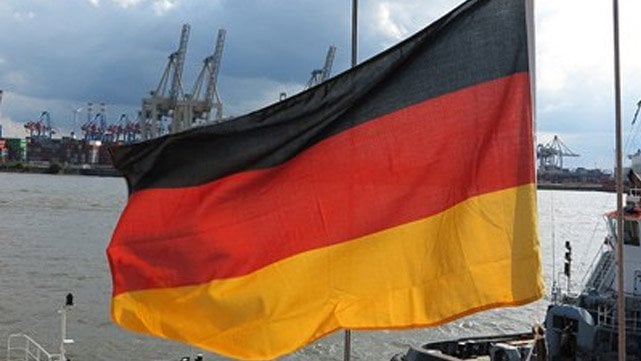
German Seafarers Agree to New 30-Month Contract with Real Wage Increases
German seafarers agreed on wage increases in a new 30-month contract (Deutsche Flagge)
German shipowners, the association for the industry, and the trade union ver.di are all saying that a fair agreement has been reached for a new contract for German seafarers. They concluded an agreement during the second round of talks, which took place on December 4, and will apply to all seafarers sailing on German-flag ships that are members of the collective bargaining association.
The two sides had been far apart during their first negotiations in November, raising the possibility of disruptions to German-flag shipping. The union opened the negotiations by calling for a 9.5 percent pay increase with a 12-month contract. They highlighted that real wages had decreased 6.5 percent over the past five years due to inflation. The shipping companies started with a position offering a 2.1 percent increase for 2026 and 2 percent for 2027.
German seafarers had demonstrated their dissatisfaction with the offers by staging demonstrations at the offices of the major companies, including Hapag-Lloyd, Fairplay. TT-Line, BLE, and the pilot association. Members said that if ver.di called for actions or strikes, they would participate.
German shipowners highlighted that it is a challenging time for the industry with many uncertainties. The German Shipowners’ Association (VDR) said its focus was to ensure the long-term economic stability and viability of the sector. They called the terms of the agreement “reasonable” and said it recognizes the contributions of seafarers.
The agreement provides for a 3 percent wage increase in 2026 and a further 2.8 percent starting on January 1, 2027. The contract runs till June 30, 2028.
“We were able to achieve a real wage increase for seafarers,” said a ver.di negotiator. Steffen Wanke, a member of the collective bargaining commission and employee of Fairplay Towage Group, said the agreement was “The maximum that could be achieved.” He said with falling freight rates and other pressures, there had not been “much room to raise wages.”
Ver.di said it would use the 30-month contract term to become stronger in the shipping sector. It predicted that it would be able to mount more resistance in future negotiations.
HMS Lancaster Sails Into The Sunset After Nearly 35 Years of Service
HMS Lancaster is saluted as she comes into Bahrain for the last time (UK MoD)
The UK Ministry of Defence has broken its silence and confirmed that the Type 23 frigate HMS Lancaster (F229) is within days of retirement, having been forward-deployed in Bahrain since 2022.
After a period when it was unclear where HMS Lancaster was or what it was doing, Vice Admiral Steve Moorhouse, the Royal Navy's Fleet Commander and a former commanding officer of HMS Lancaster, broke the news that the ship is to be retired shortly, and is to be disposed of from Bahrain without returning to the UK.
The period of silence may be accounted for by a last-minute review of whether the frigate could be further extended in service, given that the operational need for a ship of HMS Lancaster's capabilities in the Gulf region is still acute, and contingencies are arising that warrant having a Royal Navy warship close at hand. For example, there is currently considerable unrest in Tanzania after the recent disputed results of the presidential election. The situation in Iran is also particularly unstable, with it highly likely that the internal security situation there will deteriorate even further over the next 12 months.
Lancaster, however, is already the oldest Type 23 frigate in the Royal Navy, and has served for nearly 35 years against a designed operational life of 18 years. She has had an extraordinary record of service, particularly in the Gulf region, and has had particularly effective crews, enhanced because of the full-spectrum operational experience they have been exposed to, ranging from drug-interception operations to countering Houthi threats in the Red Sea and Gulf of Aden. Rather than being hidden away for the last months of her service by dint of Ministry embarrassment, she deserves a splendid send-off, and it seems she is now getting one.
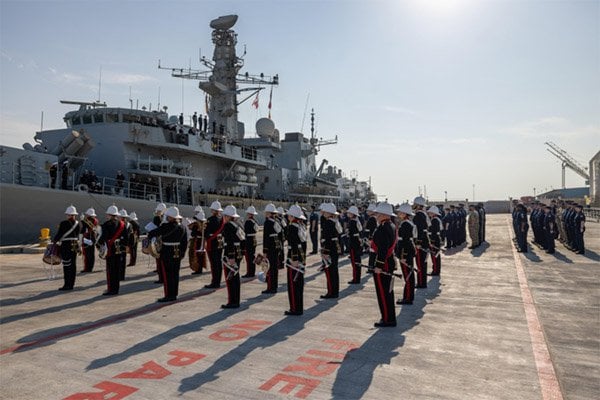
Welcome home for HMS Lancaster in Bahrain for the last time on December 5 (UK MoD)
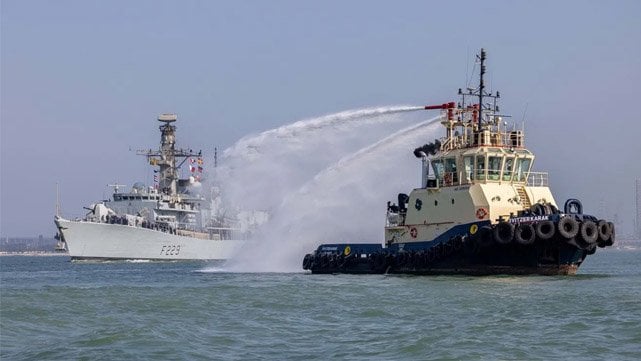
On her return to HMS Juffair on December 5, she was greeted by a fire-boat salute and a full Royal Marines band on the dockside. A 35-gun salute marked the end of a career that the Royal Navy said encompassed completing 4,097 days at sea and travelling 816,000 nautical miles. The Royal Navy confirmed the 4,500-tonne warship powered down her engines,
No announcement has been made as to how the gap left by Lancaster's retirement is to be filled, but the first replacement Type 31 frigate, HMS Venturer, is not due into service until 2027. One of the few possibilities the Royal Navy has is to redeploy to Bahrain one of the two offshore patrol boats, HMS Tamar (P233) or HMS Spey (P234), which are currently forward-based in the Indo-Pacific region. Until a replacement is assigned, the Royal Navy will be represented in Bahrain and the region by the Hunt-class minesweeper HMS Middleton (M34).
Historic Liverpool Waterfront Vessels Undergo Vital Preservation Repairs
Efforts are underway in Liverpool to preserve two historic vessels that are a familiar sight in the city’s waterfront, a move that is aimed at ensuring they continue attracting visitors for years to come.
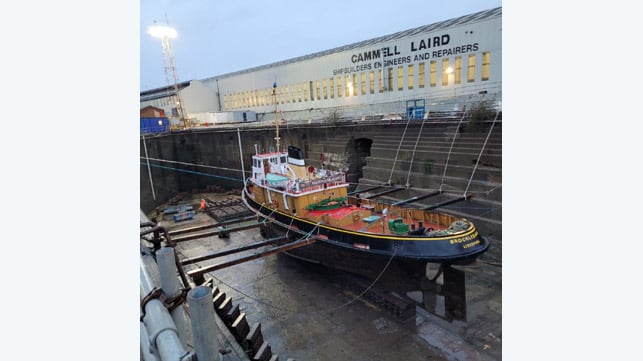
The National Museums Liverpool is undertaking a £200,000 ($267,000) conservation project to preserve the future of tugboat Brocklebank and pilot boat Edmund Gardner, both of which have come under threat due to years of decay.
A national heritage, Brocklebank is a tug that was launched in 1964 and was mainly used for ship handling in the city, but had occasional duties at Heysham, Larne, and Barrow. Historical accounts indicate that she was one of five motor tugs built by W. J. Yarwood & Sons between 1962 and 1965 for Alexandra Towing Company.
During her service years, the tug is famed for escorting the Royal yacht Britannia when Queen Elizabeth II visited Liverpool to review the tall ships in 1982. Following retirement in 1989, the tug was purchased by the Merseyside Maritime Museum and chartered to the Brocklebank Preservation Society, which has been maintaining and operating the vessel.
Normally berthed in the Albert Dock next to the museum, a recent inspection revealed serious corrosion across the steel hull of the vessel, prompting the need for restoration. The repair work comprises a high-pressure clean and the application of a repair coating to fill all the pitting affecting the ship. When completed, the vessel is expected to continue attracting visitors at the waterfront for another decade.
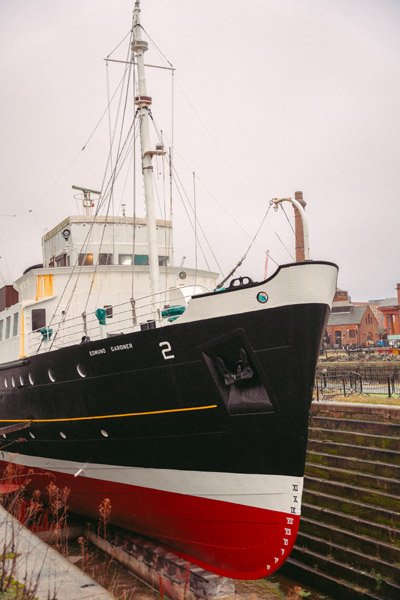
Edmund Gardner looking smart with its new paint (KieranIrvine photo, courtesy of National Museums Liverpool)
Also undergoing preservation works is the Edmund Gardner, which resides in Canning’s north dry dock and is the largest object in the museum’s collections. The boat was built in 1953 by Philip and Sons for Mersey Docks and Harbor Board and was the second of a new generation of large diesel-electric powered cutters to replace the pre-war steam cutters.
Together with her two sister ships, Edmund Gardner performed the task of guiding the steady stream of ships entering and leaving the Mersey docks during the 1950s-1980s. Historical accounts show that during her career in the pilotage service, she carried out her duties without major incidents and was considered a particularly good ship in heavy weather. Apart from pilotage, she also provided assistance for injured seamen on incoming ships and for yachtsmen on several occasions.
Apart from being a workhorse in the Mersey docks, Edmund Gardner is also remembered for the 1963 collision with the ore carrier Iron Horse. A steering gear failure caused the carrier to hit the Edmund Gardner on the starboard side, rolling the ship over heavily and damaging the bridge deck and hull plating.
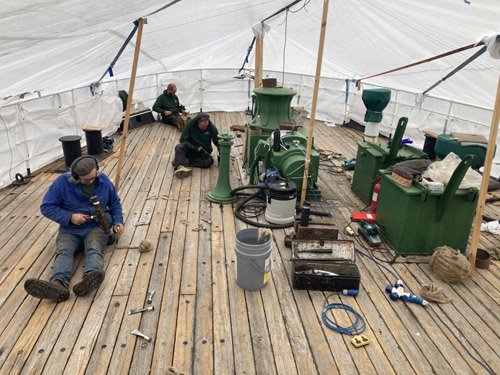
Edmund Gardner decking recaulked - National Museums Liverpool
The boat was purchased by the Maritime Museum in 1982 and is today one of only two large pilot boats preserved worldwide, with the other being in Australia. The boat contains many of the original features, including the control and navigation equipment on the bridge and is part of the National Historic Fleet.
To ensure the boat continues to be an attraction at the Mersey waterfront, it recently underwent specialist treatment of its wooden deck and caulking to prevent it against water ingress into the vessel’s interior, something that is key to its long-term preservation.
The UK’s Public Bodies Infrastructure Fund, a government capital investment program for the essential maintenance of museum estates, is funding the conservation project of the two ships.
Rosneft Oil Cargo Wanders for Weeks as Sanctions Mount
A cargo of crude oil from sanctioned Russian giant Rosneft has made an 11-week-long meandering trip around Europe and Asia in search of buyers and although it has anchored off a sanctioned Chinese import port, it’s not certain it has reached its final destination yet.
The Fortis tanker with about 700,000 barrels of now sanctioned Russian oil dropped anchor near the Chinese port of Rizhao on the east coast on Tuesday, tanker-tracking data compiled by Bloomberg showed.
The Fortis did not make the entire trip from Russia’s western port on the Baltic Sea. The crude cargo from Rosneft began the journey on the Ailana tanker from the Russian export terminal of Ust-Luga at the end of September.
Following a trip around Europe into the Mediterranean, and through the Suez Canal, the Ailana arrived near India at the end of October.
But by then the U.S. had already slapped sanctions on top Russian oil producer Rosneft and the second-largest, Lukoil, to force Russia to genuine talks about ending the war in Ukraine.
India stopped importing any crude known to have originated from or handled by affiliates of Rosneft and Lukoil to avoid angering the Trump Administration further.
So the Ailana idled off Mumbai for two weeks, according to Bloomberg’s ship-tracking. Then most of the cargo was transferred onto the Fortis tanker which had shown destinations in India and South Korea before anchoring off the Rizhao port, which the U.S. Treasury also sanctioned in October as part of the pressure campaign on China over its purchases of Iranian crude.
Despite being very close to the Rizhao port, it’s not certain the Fortis would offload the cargo there, according to Bloomberg.
The three-month long trip and the ship-to-ship (STS) transfer suggest that buyers, especially in India, are steering clear of the sanctioned Russian companies and their cargoes.
The U.S. sanctions on Rosneft and Lukoil upended all previous plans by Indian refiners, who hastened to withdraw from the spot market for Russian crude in December.
India’s Bharat Petroleum and India Oil Corporation have bought Russian crude from non-sanctioned companies for January delivery, at a discount of $6-$7 to Brent crude, reports emerged last week.
The mystery around the sanctioned tanker Kairos (149,989 dwt) is continuing to grow as the vessel, which was attacked with a drone last week, is now reported drifting off Bulgaria. The Bulgarian authorities are seeking to assure the population that there is no immediate danger while they continue to monitor the vessel, which is now requesting an evacuation.
Kairos was the first of two tankers attacked by the Ukrainians off Turkey on November 28. The tanker, which is sanctioned by the West for its involvement in the Russian oil trade, was set on fire. Turkey reported it evacuated 25 crewmembers. At last report, Turkey said it was discussing towing operations with the vessel’s owners.
The ship, which was built in 2002, is reported to be owned by Chinese interests. It reports being registered in Gambia, but that is believed to be a false flag.
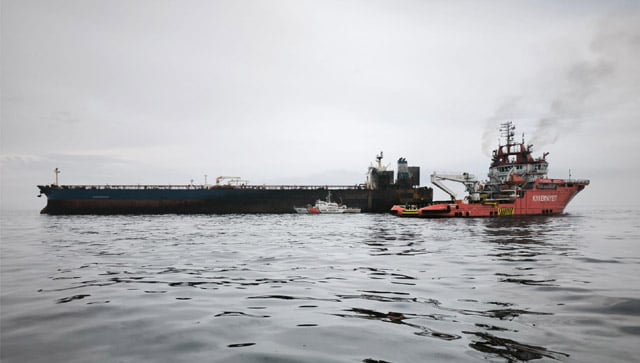
Kairos drifting off the Bulgarian shore (Facebook)
Midday on Friday, December 5, Bulgarian authorities observed a vessel entering their waters and tried to contact the ship, but received no response. They issued a warning to passing ships and were later able to confirm it was the tanker Kairos. In the early afternoon, they received a request from the 10 people aboard the ship for an evacuation. At that point, the ship was reported to be seven nautical miles from the Bulgarian coast and drifting.
The Bulgarian Maritime Administration was later advised that the crew had been able to drop the starboard anchor in an attempt to stop the tanker. They were working on releasing the port anchor as well. Residents were writing on social media that the ship was approximately 700 to 800 meters from shore and in danger of grounding.
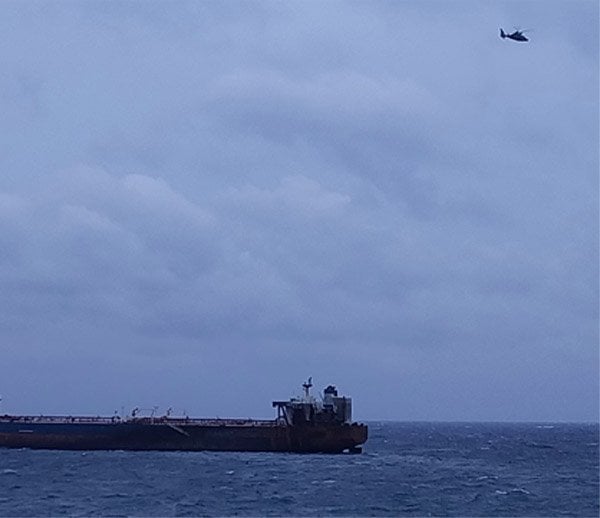
The Bulgarian Navy dispatched a helicopter to survey the situation and is coordinating with the Border Police and maritime authorities. An emergency center has also been activated.
The sea is very rough with high waves and strong winds. The media reports are saying the crew aboard the tanker is in protective gear, but the authorities determined that it is too dangerous at night, with the current conditions, to attempt a rescue.
It is unclear what happened to get the tanker from just north of Turkey across the Black Sea to a position off Ahtopol in southern Bulgaria. Unconfirmed reports are that the tanker had started a tow on December 3, bound for Tuzla, Turkey, but then turned toward Bulgaria. It is unclear where the towing vessel is and how the two ships became separated.
Bulgaria’s Maritime Administration Agency says the tanker is under constant surveillance, and they have been in contact with the crew on board
Shadow Tanker Mystery Continues as Crew Waits for New Tow off Bulgaria
Karios is sitting less than 1,000 yards off the coast of Bulgaris with 10 people aboard waiting for a tow (Bulgarian Ministry of Transport)
Bulgarian authorities are still trying to understand the situation with the fire-damaged tanker Kairos, which washed up on their shores on Friday, December 5, during a storm in the Black Sea. The vessel was heavily damaged by an attack a week ago by the Ukrainians while it was underway near Turkey, and now it is on the Bulgarian shores with a skeleton crew aboard.
Contact has been established with the 10 people aboard the vessel, and after initially requesting an evacuation on Friday, they are now saying they will remain aboard the vessel and wait for a tow. The Bulgarian authorities report they attempted to question the crew but were told the captain and other senior officers had left the ship. The crew aboard says they are safe and have at least three days of food and water.
An attempt to reach the ship on Saturday, December 6, with a launch from the border police was unsuccessful due to the high winds and rough seas, which also hampered the operations on Friday. Reports indicate the winds are over 29 knots (33.5 mph) and seas are at least three to five feet. Once the winds subside, the Bulgarian Border Police plan to board the tanker, likely using a helicopter. They will also be able to ferry additional supplies to the crew with a helicopter.
After drifting in the storm, the tanker came to rest approximately 700 to 800 meters (less than 1,000 yards) offshore near Ahtopol in southern Bulgaria. The Bulgarian Ministry of Transport reports “the reasons for the ship’s entry into Bulgaria’s territorial waters are yet to be clarified.”
The Turkish authorities said last week that they were working with the vessel’s representatives to arrange for a tow after putting out the fires on the tanker. The fire had been started after an explosion from a drone attack for which Ukraine took credit. The Bulgarians report the ship’s condition as “smoky,” while pictures showing the accommodation block and bridge are likely heavily fire-damaged.
It is unclear when or how the tanker and its tow detached on Friday. Some reports are saying the tug towing the tanker released it on Friday morning, about six miles south of Bulgaria, and headed back to Turkey.
The Kairos has been sanctioned by the West for its involvement in the Russian oil trade and was reported bound for Russia when it was attacked. Equasis reports the flag as “unknown,” while some reports have said Gambia, which was believed to be a false flag. The Bulgarian authorities are saying the vessel reported being registered in Benin.
Bulgarian officials said they have not made contact with the vessel’s owners and were not notified before the vessel entered the country’s waters. The crew did not respond to the initial calls from the Bulgarian maritime authorities as the tanker began to drift toward shore. Someone identifying as a representative of the Chinese owners contacted the maritime control center on Saturday, but for now, the Bulgarians report the incident remains under investigation.
The crew aboard the Kairos (149,989 dwt) was able to release the starboard anchor on Friday afternoon, and the reports said the anchor is so far holding the 274-meter (899-foot) vessel. The authorities emphasized that there is no crude oil cargo aboard, reducing the environmental danger. They expect the tanker will be towed to “a safe place” within the next few days.