Tuesday, December 09, 2025

Au

Aura Minerals lifts growth outlook with Era Dorada Gold feasibility

Staff Writer | December 8, 2025 |
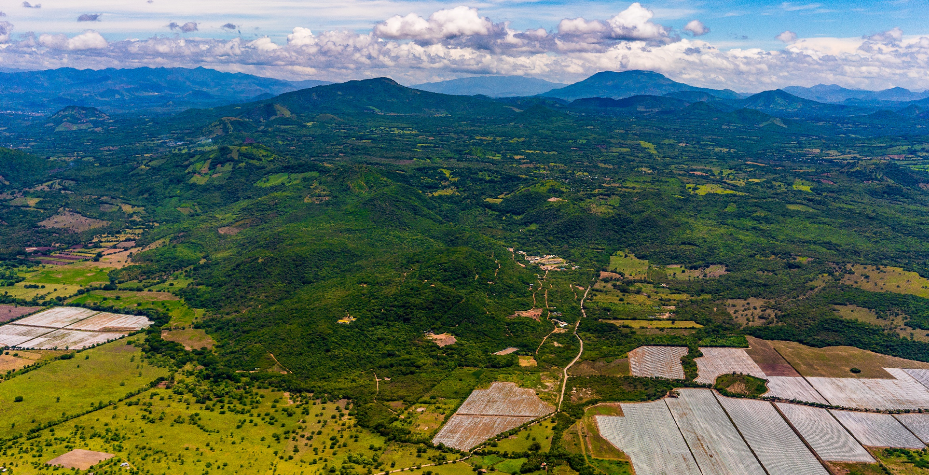
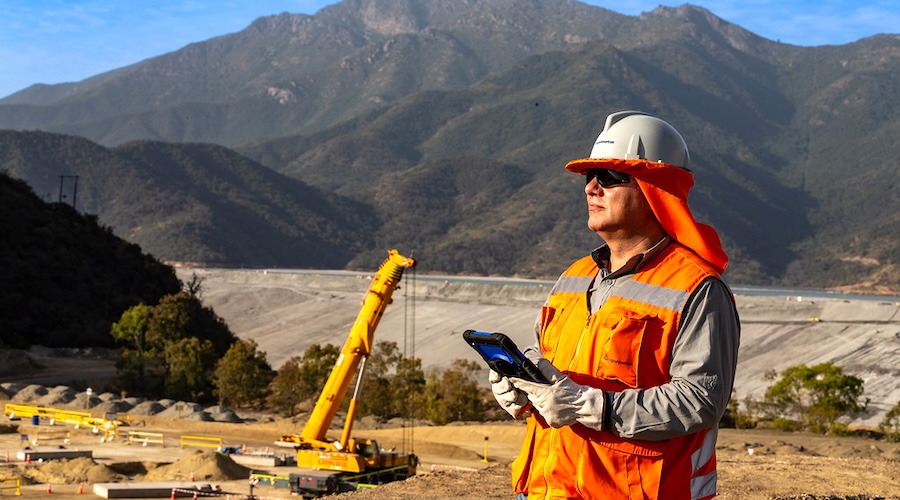
The Era Dorada project marks the expansion of Aura’s operations in Central America. Credit: Aura Minerals

Aura Minerals (NASDAQ: AUGO) has raised its future production outlook after releasing a new feasibility study for its Era Dorada project in Guatemala and integrating the results into its portfolio.


In the coming years, the Florida-based miner said it envisions several development scenarios that could take its annualized gold-equivalent production to 600,000 oz., which is a third higher than its previous projection of 450,000 oz.

“Since 2020 our strategy has been very clear: grow production with greenfield projects and expansions, extend mine life with exploration to increase resources and reserves, and improve our valuation through smart M&A and higher trading liquidity — and we have been delivering on all of this,” Rodrigo Barbosa, president and CEO of Aura Minerals, stated in a press release on Monday.

Amongst the production drivers identified by Aura are the fully ramp up of its Borborema mine in Brazil, which entered commercial production in September, and the integration and operational turnaround of MSG (Mineração Serra Grande), a high-cost mine that it acquired from AngloGold during the summer.

In addition, the planned construction and ramp-up of the Era Dorada and Matupá projects and the potential expansion of production capacity at some projects, such as Almas and Borborema, could also boost its production profile, Aura said, though it did not commit to their timelines.

While the company cautioned that its production projections are preliminary and “remain subject to significant uncertainty,” investors reacted positively. Shares of Aura Minerals surged to a 52-week high of $43.33 on the NASDAQ during morning trading, before paring gains. The company has a market capitalization of $3.5 billion.
Era Dorada feasibility

Supporting Aura’s improved growth outlook was a new feasibility study for the Era Dorada project, which came with its acquisition of Bluestone Resources in January. Previously known as Cerro Blanco, the Era Dorada project is located in the Department of Jutiapa, about 230 km from the Minosa mine in Honduras, which is expected to deliver 64,000-73,000 oz. of gold-equivalent production this year.

According to the report, the proposed mine would produce a total of 1.75 million oz. in gold equivalent over a near 17-year life, including 111,000 oz. during the first four years. Using a weighted average consensus gold price ($3,177/oz.) over that period, Era Dorada would have an after-tax net present value of $1.34 billion and an internal rate of return of 35.6%. At spot prices, those figures would rise to $2.17 billion and 46.6% respectively.

Under the base case, the initial capex is estimated at $382 million, with a payback in approximately 2.82 years. The all-in sustaining cost is pegged at $1,178/oz., which Aura said is competitive and would fall within the first industry quartile.

“This feasibility Study is another clear example of our disciplined growth strategy in action – and more projects are in the pipeline,” Barbosa said. The next steps, according to the chief executive, to work “closely with local authorities and government agencies to advance Era Dorada consistent with applicable environmental and social standards.”

Under ownership of Bluestone, the project had previously faced issues with the Guatemalan government for its proposed transition to open-pit mining. Aura plans to keep the project as an underground operation, with all licences in place.

Gold Royalty adds BHP’s Brazil mine to portfolio in $70M deal
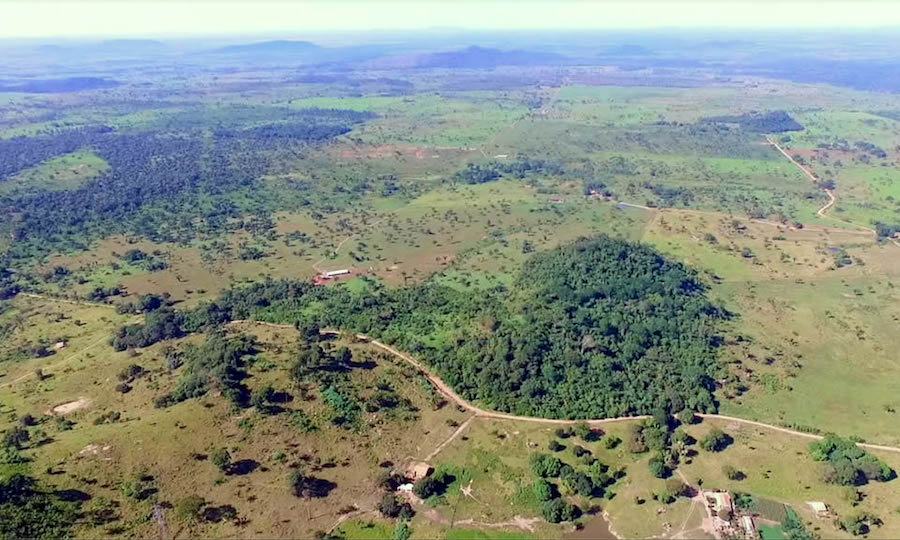
Pedra Branca is located in the southern part of the Carajás in the state of Pará in the North of Brazil. (Image courtesy of Oz Minerals.)

Gold Royalty (NYSE-A: GROY) has agreed to buy an existing royalty on the Pedra Branca mine held by BlackRock World Mining Trust for $70 million cash. The copper-gold mine, located in the Carajás region of Brazil, is currently operated by BHP Group (ASX: BHP).

The acquisition further enhances Gold Royalty’s already-strong gold exposure from both a revenue and asset value perspective, and offers further exposure to copper exposure at a time when long-term fundamentals are strong, the company said in a statement on Monday.

The royalty includes a 25% net smelter return (NSR) royalty on gold and 2% NSR royalty on copper and other products produced from Pedra Branca, covering both the Pedra Branca East and Pedra Branca West deposits.

David Garofalo, chairman and CEO of Gold Royalty, said the acquisition of the Pedra Branca royalty “represents an immediate and material addition” to the company’s cash flows.

For the 12 months ended June 30, the royalty expense recorded to the prior holder was approximately $7.9 million, equivalent to approximately 2,800 gold-equivalent ounces at an average gold price of $2,811 per ounce, Gold Royalty noted.

Upon completion, Gold Royalty’s portfolio would include eight cash-flowing assets and a pipeline of over 250 royalty and streaming interests, Garofalo added.

$70M financing

To fund the acquisition, Gold Royalty separately announced that it would complete a bought deal financing to raise gross proceeds of $70 million — equal to the royalty purchase price.

Led by National Bank Capital Markets, BMO Capital Markets and RBC Capital Markets as joint bookrunners, the company plans to sell 17.5 million common shares at a price of $4.00 per share.

Gold Royalty’s stock closed Monday’s session down 9.5% at $3.85 apiece, for a market capitalization of $758.3 million.

Former Oz mine

Located in Água Azul do Norte, Brazil, the Pedra Branca mine forms part of the Carajás East operation previously held by Oz Minerals, which bought the project in 2018 from its Australian peer Avanco Resources. In 2020, Oz brought the Pedra Branca East deposit into production, and two years later, ramped up the underground mine into full production.

BHP took over the project through its takeover of Oz in 2023, and has since extended its mine life and reported increases in its resources/reserves. Its June 2025 annual report estimated that the project currently holds 2.4 measured tonnes of material at 1.68% copper and 0.47 g/t gold and 12 indicated tonnes at 1.41% copper and 0.40 g/t gold.

In August 2025, BHP announced that CoreX Holding BV, an industrial conglomerate backed by Turkish billionaire Robert Yuksel Yildirim, had agreed to acquire Pedra Branca, along with the other Carajás copper assets, in a deal worth up to $465 million. The deal is currently pending satisfaction of customary closing conditions.

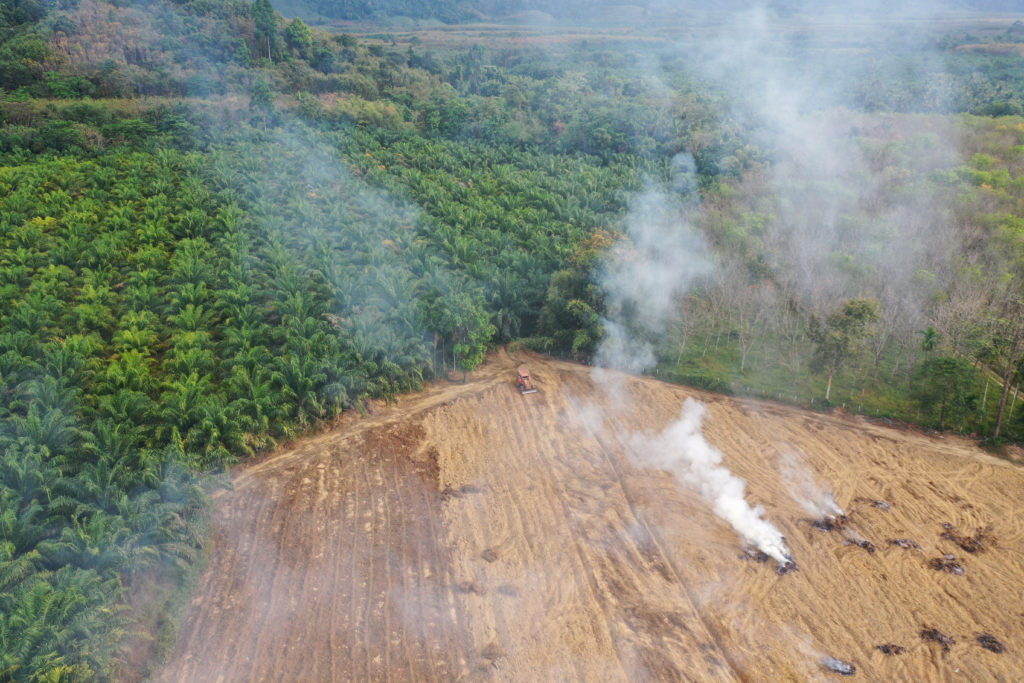
Indonesia fines dozens of palm oil, mining companies $2.3B for operating in forest areas

Stock image.

An Indonesian government task force has ordered dozens of companies in palm oil cultivation and mining to pay fines totalling 38.62 trillion rupiah ($2.31 billion) for operating illegally in forest areas, an official said on Monday.

President Prabowo Subianto’s forestry task force, made up of military personnel and law enforcement officials, has this year cracked down on an unprecedented scale on plantations and on mines that authorities say have operated illegally in forest areas.

The task force has seized 3.7 million hectares (9.1 million acres) of plantations and more than 5,300 hectares of mining operations, with a target to reach 4 million hectares by the end of the year.

Following the seizures, it has issued fines totalling 9.42 trillion rupiah to 49 plantation companies and 29.2 trillion rupiah for 22 mining companies, said Barita Simanjutak, an official with the Attorney General’s Office and a task force member. He described them as some of the previous owners of the asset, but did not disclose the names of the companies.

The palm oil companies were expected to pay 25 million rupiah per hectare per year, he said, providing no explanation for how the fines were calculated.

Some paid, others objected

Some companies have paid, while others have objected, Simanjuntak said. He said task force was open to dialogue but it would be strict in its enforcement of the law.

“We urge companies to be cooperative,” he said.

“It is not impossible for the task force to take legal action if compliance is not heeded,” he added.

The task force has handed over 1.5 million hectares of plantations that it seized to state firm Agrinas Palma Nusantara, which was set up early this year, making it the world’s largest palm oil company by land size.

The military-backed seizures have unnerved the palm oil industry. Analysts predicted that, together with Indonesia’s biodiesel plan, they would exert upward pressure on global prices as they are expected to disrupt productivity.

Indonesia is the world’s biggest exporter of palm oil, thermal coal, nickel and tin.

($1 = 16,685.0000 rupiah)

(By Bernadette Christina and Gayatri Suroyo; Editing by Barbara Lewis)

Co


Costs of EV battery material cobalt hydroxide jump on Congo export restrictions


Cobalt oxide, blue pigment. (Stock Image)

Prices of cobalt hydroxide used to make chemicals for electric vehicle batteries have risen sharply this year due to cobalt export restrictions from top producer Democratic Republic of Congo, industry sources said.

Congo suspended all cobalt exports in February, but then introduced a quota system in October, aiming to boost state revenues and tighten oversight in a country that produces more than 70% of the metal globally, estimated at more than 280,000 metric tons this year.

It has set new conditions for exporters, potentially complicating the recently introduced quota system, which sources say is likely to exacerbate shortages and support cobalt hydroxide prices.

“Cobalt is currently registering as 2025’s top price performer, but this has purely been driven by the introduction of export quotas by Congo which have caused an artificial market tightness, removing 160,000 to 170,000 tons from the market this year,” analysts at Macquarie said in a recent note.

Cobalt hydroxide is produced in Congo and as a by-product of copper and nickel mining in Indonesia, the two primary global producers. The products are priced as a percentage of the underlying cobalt metal price and known as payables.

Sellers of cobalt hydroxide have been raising their prices since Congo first suspended exports in February.

Payables for Congo’s hydroxide in top consumer China have jumped to 100% of the cobalt metal price currently trading around $24 a lb or $52,900 a ton, up from nine-year lows of around $10 a lb in February.

One source said there is some progress on getting exports moving, but that the significant amounts needed by China’s electric vehicle battery makers would not arrive until February or March next year.

Two industry sources said some firms with cobalt hydroxide to sell were asking for a premium above the cobalt metal price.

For hydroxide produced in Indonesia, payables have jumped to 90% from 50% at the start of the year.

Three industry sources, who asked not to be named as they are not authorized to speak to media, said demand for cobalt hydroxide slowed this month and that high payables are sidelining buyers.

(By Dylan Duan and Pratima Desai)


Congo sets new export conditions to keep tight grip on cobalt

More than three-quarters of the world’s cobalt comes from Congo. Credit: The Impact Facility

Congo has set new conditions for cobalt exporters, according to a government circular reviewed by Reuters, potentially complicating a recently introduced quota system as the country seeks to keep a tight grip on the key battery mineral.

The new conditions require miners, among other things, to pre-pay a 10% royalty within 48 hours and secure a compliance certificate, the circular shows.

The Democratic Republic of Congo replaced a months-long export ban with a quota system in October, aiming to boost state revenues and tighten oversight in a country that produces more than 70% of the world’s cobalt, a key component in electric vehicle batteries.

No shipments have moved since the ban was lifted as producers seek clarity and work to meet compliance rules, Reuters has previously reported.

The joint circular from the mines and finance ministries, dated November 26, sets out procedures for exporters, including mandatory quota verification, joint sampling, weighing and sealing of lots, and issuance of a new Quota Verification Certificate (AVQ) by the Authority for the Regulation and Control of Strategic Mineral Substances’ Markets (ARECOMS).

The AVQ must accompany export documentation alongside a checklist of certificates from multiple agencies. The rules took effect immediately.

Exporters must also pre-pay a 10% mining royalty on allocated quotas within 48 hours of filing origin and sales declarations, and obtain a “liberatory receipt” before customs clearance.

All mineral shipments will undergo physical inspections and be subject to multi-agency oversight, the circular states.

The mines and finance ministries did not immediately respond to requests for comment, nor did Congo’s mines chamber.

Cobalt exporters facing uncertainty

Congo allocated 18,125 metric tons of export quotas for the fourth quarter of 2025 and plans 96,600 tons annually from 2026. Top producers China’s CMOC and Glencore received the largest quotas, while ARECOMS retained a 10% strategic reserve.

Congo has warned that non-compliance could lead to severe penalties, including licence revocation.

A mining executive, who declined to be named due to the sensitivity of the matter, said there was considerable uncertainty around the new conditions.

“Companies want to understand whether the 10% royalty to be paid for export will take into account the amount from the last export (before the ban),” the executive said.

Panmure Liberum analyst Duncan Hay said: “Congo’s shifting export rules offer no certainty — last-minute royalty demands and complex paperwork will keep exports and prices volatile.”

Cobalt is currently trading around $24 a lb or $52,910 a ton, compared with $16 a lb or $35,275 a ton in August. Prices have been climbing since hitting a nine-year low around $10 a lb in February when the export ban was introduced.

Further supply insecurity could erode battery demand, said Hay.

Congo, also a major copper supplier, is pushing reforms to gain more control over its vast mining output. It launched its first batch of traceable artisanal cobalt last month and signed a partnership with Swiss commodity trader Mercuria to market cobalt, copper and other critical minerals.

(By Ange Kasongo in Kinshasha and Maxwell Akalaare Adombila; Editing by Mark Potter)


Nornickel fully restores cobalt production after repairs from 2022 fire

Credit: Nornickel

Russian mining and metals giant Norilsk Nickel has fully completed the reconstruction of its cobalt production facility in the Murmansk region, which was damaged in a fire three years ago, the company said on Monday.

The upgraded facility will increase metal production.

Norilsk Nickel is the only cobalt producer in Russia. Before the September 2022 fire at the facility, the plant’s capacity was 2,500 metric tons per year. After the fire, the company restored part of the facility, producing 1,000 tons a year in concentrate or pure form.

After the reconstruction, the plant’s annual capacity will reach up to 3,000 tons of metallic cobalt, Norilsk Nickel said.

(By Anastasia Lyrchikova and Felix Light; Editing by Tom Hogue)

 Li


Imerys seeks European content rule for EVs to launch €1.8B lithium project


Credit: Imerys

A French industrial group that’s facing delays at a major new lithium project is calling for European Union rules that would force carmakers to buy the battery metal from mines inside the bloc.

Imerys SA, which is seeking to develop lithium mining and refining facilities in France costing as much as €1.8 billion ($2.1 billion), is suggesting that at least 20% of lithium used in electric car batteries should come from the EU by 2031, rising to 40% by 2036.

In a white paper recently sent to the European Commission, the industrial metals producer — which is controlled by Groupe Bruxelles Lambert — said that making this mandatory would have a marginal impact on the cost of cars made in Europe.

“In such a key industry like automotive, I think Europe needs to be independent as much as possible from the rest of the world,” Imerys chief executive officer Alessandro Dazza said in an interview Thursday. “To launch a project of this magnitude, investors need a clear framework.”

The lobbying effort comes as the EU seeks to beef up its plan to reduce its reliance on imports of critical raw materials used in everything from weapons to wind turbines and electric cars. While there’s mounting unease over China’s willingness to boost its grip on key supplies, European automakers and suppliers remain at odds over details of local content rules that can add to production costs.

Plans to invest in lithium mining and refining in Europe have also faced headwinds due to falling prices for the material amid slower-than-expected EV adoption on the continent as well as a production glut in key lithium-producing countries such as Australia, Chile and China.

“Today there is an imbalance between demand and offer, but demand will continue to grow strongly because of penetration of electric vehicles,” Dazza said. “All the known projects today will not be able to cover this demand.”

Due to weak lithium prices, Sibanye Stillwater Ltd. continues to assess when to commission its project in Finland. However, Vulcan Energy Resources Ltd. said this week that it secured a A$3.9 billion ($2.6 billion) financing package for a lithium project in Germany that will use geothermal power.

Doubts about demand are also persisting as Germany is leading a charge to tone down a EU ban on the sale of combustion-engine cars beyond 2035, amid calls from some automakers to get more time to transition.

Back in July, Imerys delayed the potential start of commercial lithium production in central France by two years to 2030, assuming the project is approved by the end of 2027, citing longer-than-expected permitting processes. It would produce 34,000 tons of lithium hydroxide a year, covering the needs to make 700,000 electric-car batteries.

The company remains in “advanced” discussions to sell a minority stake in the project to an investor, the Imerys CEO said. Imerys is also studying lithium production in Southwest England. It aims to complete the pre-feasibility studies of its project in Cornwall next year, Dazza said.

Liontown inks spodumene supply deal with China’s Canmax Technologies


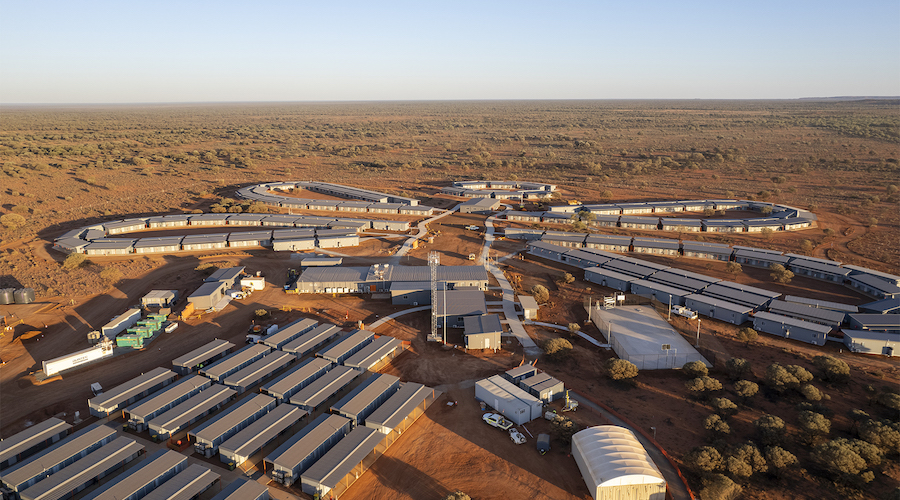
Kathleen Valley mining camp. (Image courtesy of Liontown Resources.)

Australia’s Liontown said on Tuesday it has signed an offtake deal to supply 150,000 wet metric tons of spodumene concentrate in 2027-2028 from its Kathleen Valley project to Chinese lithium chemicals maker Canmax Technologies.

Pricing will be based on a formula linked to spodumene concentrate indices, the lithium miner said in a statement.

Spodumene concentrate, used to make lithium chemicals for EV batteries, is seeing growing efforts to standardize auctions for clearer benchmarks and stronger market links.

The flagship Kathleen Valley project, which produced its first concentrate in July 2024, is powered by about 80% renewable energy.

Liontown has offtake agreements with automakers, including Tesla and Ford Motor.

Last month, Liontown said its first online auction for spodumene concentrate from Kathleen Valley fetched a price far above prevailing spot levels, the latest indicator to suggest a long-awaited recovery in lithium demand taking root.

(By Nikita Maria Jino; Editing by Sherry Jacob-Phillips)


Albemarle jumps as UBS says it’s time to buy on lithium recovery

Albemarle is testing direct lithium extraction (DLE) technologies in Chile. (Image courtesy of Albemarle Chile.)

Top lithium producer Albemarle Corp. rose the most among peers after UBS analysts said now is the time to buy the stock with rising prices of the battery metal set to drive up earnings.

Albemarle gained as much as 9% on Friday and traded 6.7% higher as of 12:52 p.m. in New York. That was the best performance among specialty chemical producers tracked by Bloomberg


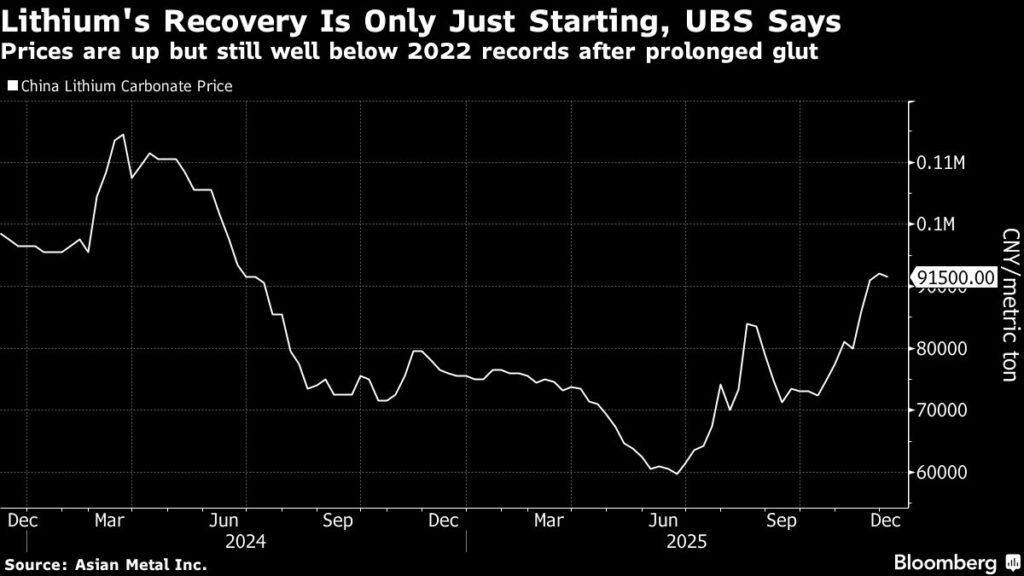
The company was raised from the equivalent of hold by UBS analysts including Joshua Spector, who cited the lithium market’s likely switch from a surplus to a small deficit. That lays the groundwork for a possible “lithium price fly up scenario” in 2027, they wrote in a Dec. 4 note to clients.

“We see a combination of higher energy storage demand and years of slower western capacity additions now pushing lithium markets into deficit later in 2026,” the analysts wrote.

Producers such as Albemarle are starting to benefit from a price recovery driven by a strong demand outlook for electric vehicles and large-scale battery storage, after years of oversupply. To be sure, while spot lithium prices are more than 50% above a June low, they’re still about 85% below a 2022 peak.

(By James Attwood)


China’s annual coal demand to fall for first time in eight years, industry group says


Workers at a coal mine in China. Shutterstock image.

China’s coal consumption is set for its first annual decline this year since 2017 as the power industry throttled back on use of the fuel, an industry body said, though consumption could still grow moderately next year.

On its website, the China Coal Transportation and Distribution Association (CCTD) cited comments by a representative at a meeting on Wednesday, but did not give a specific figure for consumption.

“The industry faces a long road ahead in anti-involution,” the industry representative said, referring to a government campaign to tackle overcapacity among Chinese producers.

“Since the beginning of this year, 53.9% of industry firms have been operating at a loss, with minemouth prices falling by 16.8% year-on-year.”

Coal use also fell this year in the steel and building industries but was partially offset by growth in the chemical sector, the representative said.

Coal consumption in the power industry is seen growing steadily next year, while demand in the steel and building sectors will still fall, the group said, though rapid growth of demand in the coal chemicals industry is expected to continue.

The improving outlook comes amid better macroeconomic conditions, growing electricity demand and rising production of coal chemical projects.

China’s annual coal imports are projected to reach 480 million tons this year, CCTD said, down 11% from 2024, as demand has weakened while domestic supply swells.

(By Colleen Howe; Editing by Clarence Fernandez)

China’s rare earth exports jump in November after Xi-Trump meeting

Stock image.

China’s rare earth exports jumped in November, the first full month since President Xi Jinping and US President Donald Trump agreed to speed up shipment of the critical minerals from the world’s largest refiner.

Exports in November jumped for a second consecutive month, by 26.5% from October to 5,493.9 metric tons, showed figures from the General Administration of Customs of China.

Whether increased shipments to the US or Europe powered that jump will only be revealed when the customs office releases a country breakdown on December 20.

Chart showing China's rare earth exports in 2025
Chart showing China’s rare earth exports in 2025

Export controls over the 17 minerals used in areas as varied as autos, consumer electronics and defence have caused months of disruption since their April introduction.

A requirement for licences for each export has created shortages that brought parts of the auto supply chain to a halt and handed China enormous leverage in trade talks with the US.

Reuters reported last week that China issued its first “general licences” – year-long permits aimed at speeding up exports following the Xi-Trump meeting. Those licences are likely to start impacting trade data next year.

Year-to-date, rare earth exports totalled 58,193.1 tons, an annual increase of 11.6%.

(Editing by Christopher Cushing)

CU

Copper price climbs to fresh high on China outlook boost

Stock image.

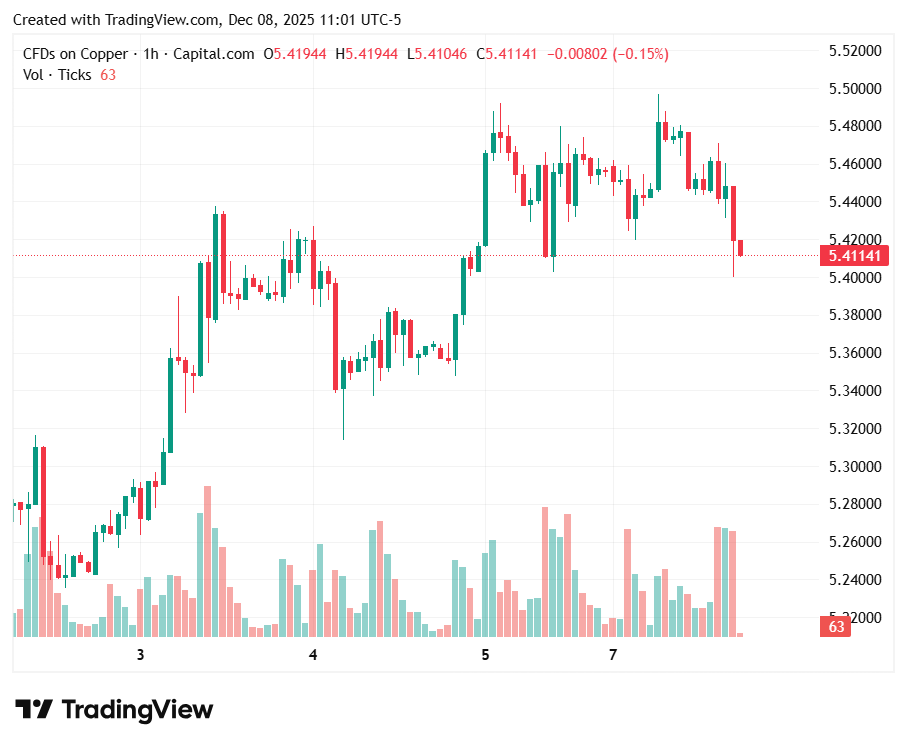
Copper continued its record-breaking rally on Monday amid stockpiling of the metal in the US, while China set domestic growth as its top economic priority for next year, boosting the demand outlook.

Futures on the London Metal Exchange climbed as much as 1.3% to $11,771 a ton, surpassing the all-time high set in the previous session.\\

Copper has been ratcheting higher in recent weeks amid a mass exodus of the metal into the US in anticipation of expanded tariffs, raising concerns of a global supply squeeze.

The latest spike came after China — the world’s top consumer — announced it will stick with a “proactive” fiscal approach for 2026, lifting the demand prospects for industrial metals such as copper.

“The Politburo readouts present a more proactive macro environment than investors have expected,” said Xu Wanqiu, an analyst with Chinese brokerage Cofco Futures Co. “Copper will benefit from policy support toward power-grid upgrades, computing power. The momentum remains very bullish.”

Also supporting this narrative is a dwindling supply of refined copper products due to the US stockpiling. Analysts from Citic Securities Co., a Chinese brokerage, said on Monday that the global shortfall of refined copper could reach 450,000 tons next yea

Prices must average above $12,000 a ton next year to attract the investment needed in new mining capacity to ensure sufficient supply in the medium to long term, the Citic analysts said in a note.

Copper has gained 34% on the LME this year amid strong demand from data centers and electric vehicles and a tightening global supply, which was exacerbated by a series of mine outages around the world.

In the US, prices had rallied to a record on the Comex exchange at the end of July ahead of anticipated tariffs on the metal.

(With files from Bloomberg)

Column: Will the real Doctor Copper please step forward?


Where’s the real Doctor Copper? Credit: Codelco

Copper is on a bull surge with the price hitting record highs on both the London and Shanghai markets this week.

Everyone’s talking about a copper supply crunch. Physical premiums are soaring. Smelters are being squeezed by a shortfall of mined concentrate.


 ust to cap it all, London Metal Exchange (LME) stocks have just been raided, reducing available inventory to below 100,000 metric tons for the first time since July 

Yet it’s not as if the global manufacturing sector is similarly fired up. September saw activity contract in China, Japan, Europe and, for the ninth consecutive month, the United States.

Tariff uncertainty hangs heavy on the world’s largest manufacturing nations and it is also key to understanding copper’s current euphoria.

Copper’s bull run is as much about market fracture as it is about a straightforward supply crunch.

US imports of refined copper

Feast…

This week’s raid on LME copper stocks saw 54,350 tons, around a third of registered inventory, cancelled in preparation for physical load-out.

It’s highly likely this metal is destined either for the United States or to fill a supply-chain gap caused by other units heading that way.

The United States is now the market of first resort for copper thanks to the lingering threat of import tariffs.

A decision on whether to extend tariffs on copper products to refined metal has been deferred until the middle of next year.

But the CME US copper contract is still commanding a hefty premium over the international price traded on the LME, keeping the physical arbitrage window wide open.

US imports of refined copper more than doubled year-on-year to 1.19 million tons in January-August and more will arrive as long as the CME premium covers the shipping costs. Which at around $500 per ton on a three-month forward basis it more than comfortably does.

CME stocks, all customs-cleared, have mushroomed from 85,000 tons at the start of the year to 394,000 tons and now account for 55% of global exchange inventory.

There is no copper supply crunch in the United States and there’s not going to be one any time soon.

…and famine

But there is growing tightness everywhere else in the world as metal continues to gravitate towards the United States.

That’s why producers have been able to demand record premiums for deliveries next year.

Chilean producer Codelco has hiked its European premium by 39% to $345 per ton over the LME price and is pushing for $350 per ton for Chinese buyers, who find themselves in the unfamiliar position of being second in line in the copper delivery queue.

Indeed, China itself has been caught up in the physical copper scramble.

The mass relocation of copper inventory to the United States has extended to China’s bonded warehouse zones with 128,000 tons re-exported to the United States since February, according to Chinese customs.

Chinese producers have also been lifting deliveries to LME warehouses as a tightening London market opens up an export arbitrage window.

Chinese-brand copper accounted for 82% of LME registered stocks at the end of October, up from 51% at the start of January.

Yet even as global inventory is reshuffled, total exchange stocks are rising, closing November above the 700,000-ton mark for the first time since early 2020.

There is no global shortage of copper but there is a widening split between the US market and the rest of the world. It’s captured by the CME and LME forward curves – in comfortable contango and widening backwardation respectively.

‘Malignant competition’

The splintering of the copper market is not just geographical but also internal.

China has brought too much smelting capacity online in too short a time for the world’s mines to supply, a mismatch compounded by this year’s litany of disruption at some of the world’s largest mines such as Grasberg in Indonesia.

The result is a crisis of smelter profitability. Spot processing fees have been trading at negative levels for months, meaning smelters are giving away for free what should be a core revenue stream.

Several Western smelters have closed and the Chinese smelter sector is now confronted with the hangover from its previous exuberance in the form of potentially negative fees for next year’s annual contracts.

The China Smelters Purchase Team, comprising the country’s top-ten producers, has pledged to reduce production by 10% to help stabilize the raw materials market.

It will also monitor members’ spot market activity to prevent what it called “malignant competition” between smelters for concentrate.

Collective cutback announcements are standard operating procedure for China’s metal smelters whenever the going gets tough but the impact has as often as not been less than promised.

The announcement, though, is evidence of a dysfunctional raw materials market. The current annual benchmark pricing model is at risk of splintering into multiple short-term and binary deals under the pressure.

This injects another level of uncertainty into an already complex copper pricing picture.

So is the world facing an imminent copper supply crunch?

Well, it depends very much on which Doctor Copper you ask. But none of them is saying much about the state of global manufacturing right now.

(The opinions expressed here are those of the author, Andy Home, a columnist for Reuters.)

Adani, Hindalco seek Peru copper assets as demand surges

View of the pit of an open-pit copper mine in Peru. Stock image.

Indian conglomerate Adani and miner Hindalco Industries are exploring investments in Peru’s copper sector, either through joint ventures or by taking stakes in existing mines, a senior Peruvian diplomat told Reuters.

Peru, the world’s third-largest producer of copper used in sectors such as power lines, construction and manufacturing, is courting new investment as it negotiates a broader free trade agreement with India.

“Birla (Hindalco) and Adani are trying to invest in Peru. We are willing to facilitate,” Javier Paulinich, Peru’s ambassador to India, told Reuters in New Delhi.

Peru produced about 2.7 million metric tons of copper in 2024 and attracted $4.96 billion in foreign investment in the sector.

Anticipating a surge in demand and potential supply shortfalls, India, the world’s fastest-growing major economy, has urged its mining companies to invest overseas to secure copper supply chains and manage possible disruptions, according to a government policy document published in July.

India, the world’s second-biggest importer of refined copper, may have to source 91%-97% of its copper concentrate requirements from overseas by 2047, according to official estimates.

Adani sent a delegation to Peru earlier this year, Paulinich said, adding that Hindalco has initiated similar efforts.

“They are in the first stage, trying to find out opportunities,” he said, referring to both Adani and Hindalco.

A top company executive told Reuters last year that Indian billionaire Gautam Adani’s group would source copper concentrates from Peru and other suppliers such as Chile and Australia for its $1.2 billion copper smelter, the world’s biggest single-location plant of its type.

Adani and Hindalco did not respond to Reuters emails seeking comment.

India’s copper imports rose 4% to 1.2 million metric tons in the fiscal year to March 2025. Demand is expected to climb to 3-3.3 million tons by 2030 and 8.9-9.8 million tons by 2047, the government has said.

Free trade pact

India has also sought a detailed chapter on copper in its free trade negotiations with Peru to secure a fixed quantity of copper concentrate, Paulinich said, adding that discussions were still underway.

The free trade talks could conclude by May and the next round of meetings is scheduled for January, Paulinich said.

“It is in final stages,” he said.

(By Neha Arora and Mayank Bhardwaj; Editing by Stephen Coates)


Anglo scraps executive bonus vote as Teck merger decision looms


El Soldado copper mine in Chile. (Image courtesy of Anglo American |Flickr.)

Anglo American (LON: AAL) has dropped a proposal to change executive bonus awards from the agenda of this week’s shareholder vote on its merger with Canada’s Teck Resources (TSX:TECK.A | TECK.B) after investors objected to the plan.

The company said the merger now hinges only on approval to issue new shares, not on executive pay changes. It added that its remuneration committee will consult investors ahead of an updated pay policy at the 2026 annual meeting. 

The withdrawn proposal had sought a 62.5% minimum vesting of 2024 and 2025 share awards for executive directors, tied to completion of the Teck merger, and required a separate resolution because it fell outside the current remuneration policy.

Proxy advisor Institutional Shareholder Services Inc. recommended voting against the amendment, saying transaction-linked pay is not considered good market practice in the UK. ISS said awarding such a large portion of bonuses based on a single metric weakens the broader performance criteria used to assess management.

Anglo American noted the incentive plan was meant to support the deal and help retain senior leaders as the merger would shift the company’s headquarters to Canada.

“With the removal of this resolution, we suspect the Teck combination proposal will be strongly backed by Anglo shareholders,” analysts at Peel Hunt wrote.

Decade’s top deal

The proposed $53-billion transaction would create a major copper producer but but still needs regulatory approval

The merger vote comes after BHP (ASX:BHP) briefly attempted to buy Anglo last month before abandoning its offer three days later

Anglo has long been seen as a takeover target thanks to its copper portfolio, though its diamonds and platinum businesses have complicated past bids. 

Shareholders of Anglo and Teck will vote on the deal Dec. 9. At least two-thirds of votes must be in favour for the deal to continue.

If approved, the combined miner would rank among the world’s top five copper producers with annual output of 1.35 million tonnes, topping Chile’s Escondida mine’s 2024 production of 1.28 million tonnes.