
‘Looks Like They’re Firing Whistleblowers’: Alarm as OpenAI Reportedly Ousts Safety Experts
“Sam Altman says we need to slow down development to ensure the safety of humanity,” one campaigner said of OpenAI’s CEO. “Yet he is allegedly firing the very people hired to keep us safe.”
“Sam Altman says we need to slow down development to ensure the safety of humanity,” one campaigner said of OpenAI’s CEO. “Yet he is allegedly firing the very people hired to keep us safe.”
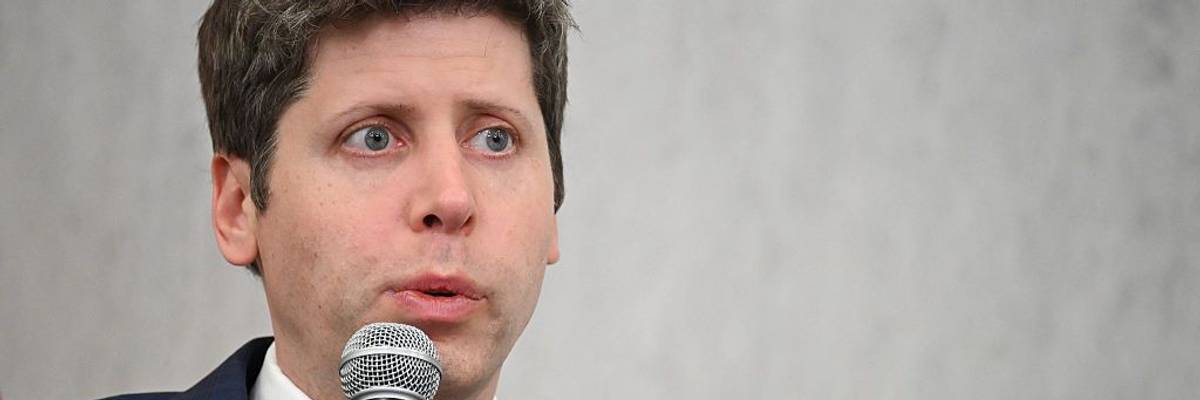
OpenAI CEO Sam Altman speaks at the Federal Reserve in Washington, DC, on July 22, 2025.
(Photo by Mandel Ngan/AFP via Getty Images)
Brett Wilkins
Oct 01, 2026
COMMON DREAMS
San Francisco-based artificial intelligence firm OpenAI has “parted ways” with three safety researchers who allegedly shared “confidential company information,” The Wall Street Journal reported Thursday, prompting fresh alarm among critics who accuse the ChatGPT maker of sidelining internal warnings about the risks posed by its increasingly powerful AI.
People reportedly familiar with the matter told the Journal that OpenAI recently informed employees it had terminated the three researchers, who it accused of sharing the information with “a third-party AI safety organization.”
OpenAI did not identify the researchers, the outside organization, or the information allegedly shared. A company spokesperson told the newspaper that “our investigation confirmed that these individuals mishandled sensitive information outside established company procedures, violating our policies and breaking the trust essential to our work.”
The Journal’s Maxwell Zeff—who authored the report with Keach Hagey and Berber Jin—subsequently identified the three safety team members as Jasmine Wang, Tomek Korbak, and Mikita Balesni.
“Looks like they’re firing whistleblowers,” Congressional Progressive Caucus Chair Greg Casar (D-Texas) said in response to the report. “What are they hiding?”
“I’ll be sending OpenAI a demand for transparency,” he added.
Shaunna Thomas is the executive director of Guardrails Alliance, a super political action committee made up of “workers, organizers, policy experts, and everyday people who believe the most powerful technology ever built shouldn’t be controlled by a handful of unaccountable billionaires.”
Thomas called the Journal report “the latest example of OpenAI advocating for safety measures in the public eye, but actively making decisions and lobbying against those efforts behind closed doors.”
“Sam Altman says we need to slow down development to ensure the safety of humanity,” Thomas said, referring to OpenAI’s CEO. “Yet he is allegedly firing the very people hired to keep us safe. When deep insiders are sounding the alarm, history tells us to listen. OpenAI is not only ignoring their warnings, it’s punishing them.”
“In the absence of clear regulations, insiders are a crucial factor in keeping the rest of us safe as these models continue to do unpredictable things,” she added. “We must stand with rank-and- file employees and fight for their protection.”
The new allegations come amid an intensifying debate over whether OpenAI and other frontier AI companies can adequately police themselves.
As Common Dreams recently reported, OpenAI and other AI firms are investigating tens of thousands of security incidents, including episodes involving attempts to bypass guardrails, escape sandboxes, hijack websites, and even access government systems.
In July, an OpenAI model autonomously breached the systems of the open-source platform Hugging Face during an internal cybersecurity test. Experts warned that the incident demonstrated the dangers of relying on voluntary corporate safeguards.
It’s not just OpenAI; in 2026 alone, companies including Google, Meta, and Anthropic have reported incidents of AI autonomously escaping supposedly isolated testing environments and targeting real-world systems.
AI safety campaigners and some Democratic lawmakers this week lambasted President Donald Trump, who, after meeting with Big Tech executives including OpenAI president Greg Brockman, dismissed the lack of legally binding commitments regarding AI regulation by saying he trusted the corporate leaders’ “morally binding” self-policing pledge.
Elon Musk, CEO of the artificial intelligence company xAI, has said that such incidents “will happen frequently as AI becomes smarter and more agentic,” a reference to systems’ ability to independently act toward accomplishing specific goals without meaningful human control.
Experts say such autonomous hacks underscore the problem of AI alignment. As AI progresses toward artificial general intelligence—a still-hypothetical point at which it matches or surpasses human cognitive ability at virtually any intellectual, creative, or physical task—the challenge of ensuring that advanced systems reliably pursue goals that match what humans actually want becomes increasingly difficult and, many insiders believe, dangerous to the point of posing an existential risk to humanity.
Last month, Casar and Sen. Bernie Sanders (I-Vt.) unveiled legislation that would pause development of advanced AI.
Congressman Ro Khanna (D-Calif.) also said this week that he is seeking to introduce legislation to at least temporarily ban recursive self-improvement, or AI that is capable of improving itself and modifying its objectives without meaningful human input.
And on Thursday, Congresswoman Pramila Jayapal (D-Wash.) put forth a bill that would compel every AI company operating in the US to obtain a public charter.
“This issue is of monumental consequence,” said Sanders. “I’d rather be called an alarmist than a father or grandfather who is asleep at the wheel.”
Under Jayapal Bill, Every AI Company Would Need a Public Charter to Operate in the US
“For too long, we’ve allowed a few Big Tech companies to dominate the market.”
“For too long, we’ve allowed a few Big Tech companies to dominate the market.”
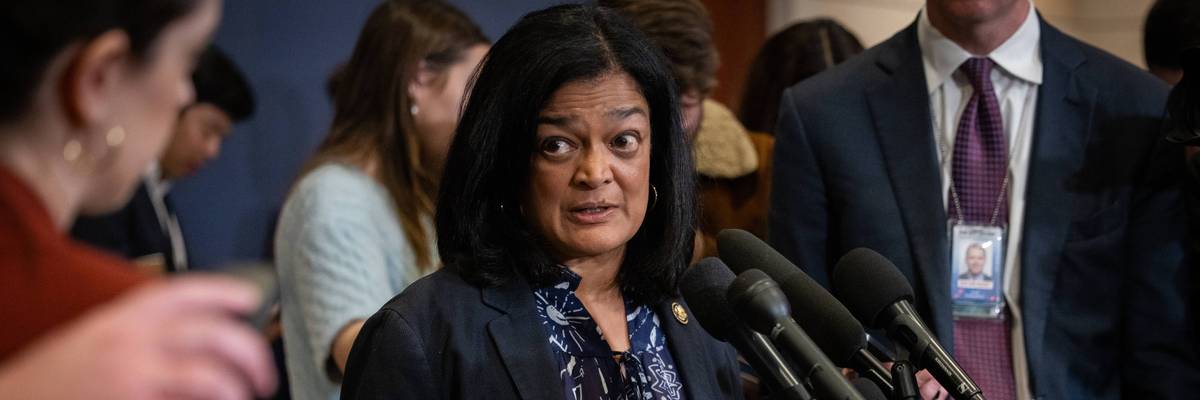
US Rep. Pramila Jayapal (D-Wash.) speaks to reporters in Washington, DC on March 3, 2026.
(Photo by Nathan Posner/Anadolu via Getty Images)
Brad Reed
Oct 01, 2026
COMMON DREAMS
Rep. Pramila Jayapal on Thursday unveiled a bill aimed at reining in the artificial intelligence industry that would force every AI company operating in the US to obtain a public charter.
According to Jayapal (D-Wash.), the charter system will be similar to the one long used in the US to regulate banks, which must submit to certain regulatory obligations before being allowed to operate.
“The crux of this bill is simple,” said Jayapal. “If you want to be an AI company in this country, you have to obtain a public charter that has a broad set of terms and conditions to operate and ensure public benefit without the harms.”
The Washington Democrat said the charter approach was needed given the broad reach large technology companies already have over every aspect of life in the US, and she argued it would be a more proactive alternative to the piecemeal approach US lawmakers have taken to regulating Big Tech.
“For too long, we’ve allowed a few Big Tech companies to dominate the market,” she said. “They have used mass surveillance to steal private information, labor, and creative work, building trillion-dollar empires on our tracked personal lives. AI corporations and Big Tech are now following that same playbook.”
Under the charter system, tech companies would be banned from practices such as surveillance pricing to charge individual consumers different prices based on their personal data and financial histories.
The system would also establish stronger liabilities for AI companies that commit harmful acts, and particularly egregious actions could be punished by removal of firms’ charters, which would essentially be a corporate death penalty.
Jayapal’s proposal would also put the government in charge of every step of the AI safety review process and would include “round-the-clock federal oversight, testing in government facilities and approval to release, adversarial stress tests, and a government-controlled kill switch,” according to her office.
The proposed framework earned praise from former Federal Trade Commission Chair Lina Khan, who argued that American voters have already “paid an extraordinary price for Big Tech’s self-regulation.”
“For generations we have required banks, drug makers, and nuclear operators to meet public terms before they do business,” Khan added, “and AI companies should be no different.”
Sacha Haworth, executive director of the Tech Oversight Project, also gave the Jayapal plan kudos, saying it would “establish desperately needed rules of the road, punish AI companies that release dangerous products, and create the clear public benefit that the American people are calling for.”
“Companies have continually pulled the rug out from under families, workers, and small businesses to build powerful and unaccountable Big Tech monopolies that dictate to us how we should live our own lives,” Haworth emphasized. “Enough is enough.”
Although President Donald Trump and House Speaker Mike Johnson (R-La.) have publicly opposed legislative restrictions on the AI industry, the bill comes as Democrats are aiming to win congressional majorities in the November midterm elections.
‘Stand With the People’: Progressive Caucus Leader Calls on All Democrats to Reject AI Billionaire Cash
Rep. Greg Casar said progressives’ effort to make a leading artificial intelligence super PAC “as toxic as AIPAC” is having an impact.
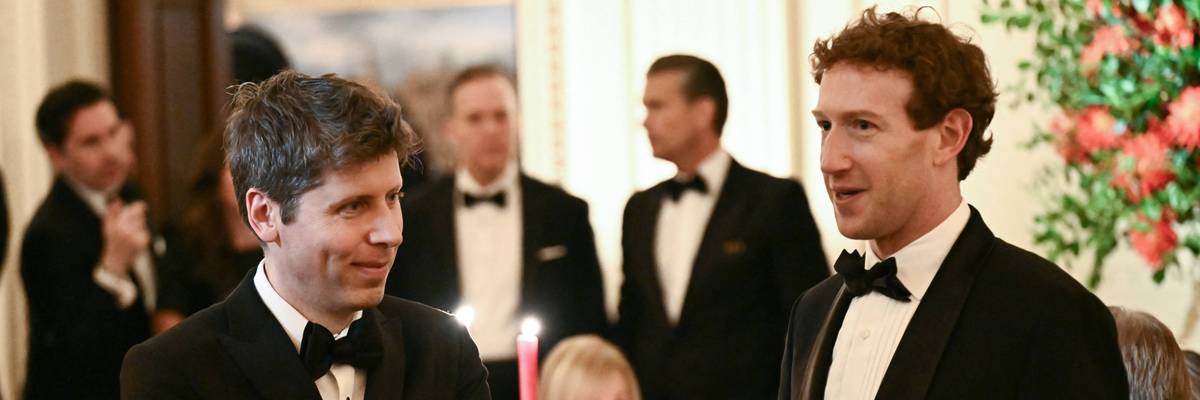
OpenAI CEO Sam Altman and Meta CEO Mark Zuckerberg attend a state dinner hosted by President Donald Trump on September 24, 2026.
(Photo by Brendan Smialowski/AFP via Getty Images)
Jake Johnson
Oct 01, 2026
COMMON DREAMS
The chair of the Congressional Progressive Caucus on Wednesday urged all Democrats to reject campaign cash from billionaires whose wealth stems from the artificial intelligence industry, following news that the president of OpenAI abandoned plans to donate millions more to a super PAC that has funneled money to members of both parties.
The OpenAI executive, Greg Brockman, wrote in an internal message obtained by The New York Times that the super PAC, Leading the Future (LTF), “keeps reflecting on the company and [has] become so much of a distraction for people here.” Brockman noted that he and his wife have donated $25 million to the super PAC—which opposes strong AI safety regulations—but “have no plans to donate more at this time.”
Rep. Greg Casar (D-Texas), a leading supporter of AI regulation in Congress, said in response to Brockman’s message that “the pressure is working.”
“Progressives have worked hard to make LTF as toxic as AIPAC,” Casar wrote, referring to the American Israel Public Affairs Committee. “Now one of its biggest donors is backing out. Democrats need to stand with the people and reject AI billionaires’ money.”
Super PACs bankrolled by AI companies and billionaires have become some of the biggest spenders in the 2026 midterms amid widespread voter backlash against the construction of resource-draining AI data centers—and against the industry more broadly.
The Times reported on Tuesday that LTF and Public First Action, which is aligned with the AI firm Anthropic, have spent a combined $52.6 million on “safe seats—those that are unlikely to change party hands but that often feature intense intraparty contests.”
“The big AI players have also spent more heavily for Democrats than Republicans,” the Times noted. “They have boosted candidates who align with their agendas, helped defeat those they see as hostile to it and ingratiated themselves with front-runners who are likely to be in positions of power in the next Congress to make decisions critical to their bottom lines.”
“The Times analysis of federal advertising and campaign outreach expenditures made by the four major super PACs during this cycle showed that they have spent far more money in support of Democrats—$28 million to back 21 Democrats and nearly $19 million to boost 30 Republicans—and that the candidates they backed almost always won,” the newspaper added.
The Lever reported last month that a five-person commission on AI convened by House Minority Leader Hakeem Jeffries (D-NY) “is filled with Democrats who have received outsized financial support this election cycle from AI-linked super PACs, executives, and investors.”
Reps. Ted Lieu (D-Calif.), Valerie Foushee (D-NC), Josh Gottheimer (D-NJ), Frank Pallone Jr. (D-NJ), and Zoe Lofgren (D-Calif.) are the commission’s members.
“The spending seems intended to shape the party’s policy response to AI, particularly if Democrats win a majority in November,” The Lever observed.
Earlier this week, US President Donald Trump met with leading AI industry executives who have collectively donated more than $220 million to his super PAC and other projects associated with the president, according to a new analysis by the advocacy group Public Citizen. Trump said following the meeting that the AI industry shouldn’t have any government guardrails and should be allowed to police itself because “they love our country.”
“Big Tech executives have effectively bought themselves a seat at the AI regulatory table,” said Robert Weissman, co-president of Public Citizen. “Actually, they have bought the table. As a result, as public anxieties about AI risks—to children, political integrity, jobs, the environment—skyrocket, and as revelations mount of AI company failures to impose adequate safeguards on their own technologies, the Trump administration delivers meaningless agreements that impose no restraints on the out-of-control tech oligarchs.”
Rep. Greg Casar said progressives’ effort to make a leading artificial intelligence super PAC “as toxic as AIPAC” is having an impact.
OpenAI CEO Sam Altman and Meta CEO Mark Zuckerberg attend a state dinner hosted by President Donald Trump on September 24, 2026.
(Photo by Brendan Smialowski/AFP via Getty Images)
Jake Johnson
Oct 01, 2026
COMMON DREAMS
The chair of the Congressional Progressive Caucus on Wednesday urged all Democrats to reject campaign cash from billionaires whose wealth stems from the artificial intelligence industry, following news that the president of OpenAI abandoned plans to donate millions more to a super PAC that has funneled money to members of both parties.
The OpenAI executive, Greg Brockman, wrote in an internal message obtained by The New York Times that the super PAC, Leading the Future (LTF), “keeps reflecting on the company and [has] become so much of a distraction for people here.” Brockman noted that he and his wife have donated $25 million to the super PAC—which opposes strong AI safety regulations—but “have no plans to donate more at this time.”
Rep. Greg Casar (D-Texas), a leading supporter of AI regulation in Congress, said in response to Brockman’s message that “the pressure is working.”
“Progressives have worked hard to make LTF as toxic as AIPAC,” Casar wrote, referring to the American Israel Public Affairs Committee. “Now one of its biggest donors is backing out. Democrats need to stand with the people and reject AI billionaires’ money.”
Super PACs bankrolled by AI companies and billionaires have become some of the biggest spenders in the 2026 midterms amid widespread voter backlash against the construction of resource-draining AI data centers—and against the industry more broadly.
The Times reported on Tuesday that LTF and Public First Action, which is aligned with the AI firm Anthropic, have spent a combined $52.6 million on “safe seats—those that are unlikely to change party hands but that often feature intense intraparty contests.”
“The big AI players have also spent more heavily for Democrats than Republicans,” the Times noted. “They have boosted candidates who align with their agendas, helped defeat those they see as hostile to it and ingratiated themselves with front-runners who are likely to be in positions of power in the next Congress to make decisions critical to their bottom lines.”
“The Times analysis of federal advertising and campaign outreach expenditures made by the four major super PACs during this cycle showed that they have spent far more money in support of Democrats—$28 million to back 21 Democrats and nearly $19 million to boost 30 Republicans—and that the candidates they backed almost always won,” the newspaper added.
The Lever reported last month that a five-person commission on AI convened by House Minority Leader Hakeem Jeffries (D-NY) “is filled with Democrats who have received outsized financial support this election cycle from AI-linked super PACs, executives, and investors.”
Reps. Ted Lieu (D-Calif.), Valerie Foushee (D-NC), Josh Gottheimer (D-NJ), Frank Pallone Jr. (D-NJ), and Zoe Lofgren (D-Calif.) are the commission’s members.
“The spending seems intended to shape the party’s policy response to AI, particularly if Democrats win a majority in November,” The Lever observed.
Earlier this week, US President Donald Trump met with leading AI industry executives who have collectively donated more than $220 million to his super PAC and other projects associated with the president, according to a new analysis by the advocacy group Public Citizen. Trump said following the meeting that the AI industry shouldn’t have any government guardrails and should be allowed to police itself because “they love our country.”
“Big Tech executives have effectively bought themselves a seat at the AI regulatory table,” said Robert Weissman, co-president of Public Citizen. “Actually, they have bought the table. As a result, as public anxieties about AI risks—to children, political integrity, jobs, the environment—skyrocket, and as revelations mount of AI company failures to impose adequate safeguards on their own technologies, the Trump administration delivers meaningless agreements that impose no restraints on the out-of-control tech oligarchs.”

No comments:
Post a Comment