Friday, June 10, 2022

Climate: Africa's energy future on a knife's edge


Marlowe HOOD
Fri, June 10, 2022


With more than half its population lacking mains electricity and still using charcoal and other damaging sources for cooking, Africa's energy future –- torn between fossil fuels and renewables -- is up for grabs.

As nations discuss the climate crisis at the UN's mid-year negotiations in Bonn, AFP spoke to Mohamed Adow, founder of think tank Power Shift Africa, about the forces pulling the continent in opposing directions.

The stakes, he warns, are global.

Q. You have said rich nations owe the rest of the world a climate debt


"The prosperity they enjoy was, in effect, subsidised by the rest of the world because they polluted without paying the cost for doing so.

"Africa is home to 17 percent of Earth's population but accounts for less than four percent of global greenhouse-gas emissions and only half-a-percent of historic emissions. The continent emits less than 1 tonne of CO2 per person, compared to seven in Europe or China, and more than 15 in the United States.

"If the least-developed continent on our planet is going to leapfrog fossil fuels to renewables, rich nations must pay the climate debt they owe."

Q. How will Africa's energy choices impact the rest of the world?


"My continent is at a crossroads with two possible futures. Africa can become a clean energy leader with decentralised renewables powering a more inclusive society and a greener economy, or it can become a large polluter that is burdened with stranded assets and economic instability.

"We have the opportunity to make a difference for Africa and for the world."

Q. US envoy John Kerry says climate change in Africa could see "hundreds of millions of people looking for a place to live." Is he right?

"Absolutely. It is important to acknowledge that climate-induced migration is a threat. As climate impacts increase, people in Africa -- where almost all agriculture is rain-fed -- will be forcefully displaced from their land.


"In wealthy nations, that is seen mostly as a security issue. But this is a humanitarian disaster in which people are already losing lives, homes and livelihoods.

"The only way to prevent climate-induced migration in the long-run is to reduce carbon pollution at the scale needed."

Q. Is the war in Ukraine affecting energy development in Africa?


"To attain energy security after Russia's invasion, Europe is effectively pushing Africa to pour its limited financial resources into developing its fossil gas extraction and export industry, primarily for consumers in Europe."

"Last month German Chancellor Olaf Scholz, during a three-day tour of Senegal, said his country wants to 'intensively pursue' projects to develop and import Senegal's huge gas reserves. Germany, of course, has been especially dependent on Russian gas.

"So now Europe wants to shackle Africa with new fossil fuel infrastructure that we know will be redundant within a few years, not to mention self-harming for the continent. And lest we forget: gas from Africa will emit the same amount of emissions as gas from Russia."

Q. What is the balance of power in Africa between fossil-fuel interests and those striving to leapfrog to renewables?


"Last month, the Sustainable Energy for All summit in (Rwandan capital) Kigali issued a communique supporting 'Africa in the deployment of gas as a transition fuel'. But only 10 out of 54 African countries signed that statement.

"I think the majority of African nations recognise the tremendous opportunity that renewables present for job creation, innovation, reduced air pollution and sustainable industrialisation. But this majority is a silent majority -- they have not yet leveraged their moral voice to make a case for a cleaner, sustainable Africa.

"There are some leaders. My country, Kenya, is currently powered by 90-percent renewable energy and has set a target of 100 percent by 2030."

Q. The trillions needed to engineer a rapid transition to renewables will not come from public sources alone. How do you mobilise private capital?


"We need to think about long-term investment security in Africa. This is the most expensive continent for securing loans or credit. We need to introduce payment guarantee schemes that are backed by international finance to facilitate safe investment in renewable energy.

"But you still need public money to leverage international investment and finance. We also have to unlock Africa's domestic sources -- public funds, sovereign wealth funds. And then there's debt. If we could swap some foreign debt for the kinds of investment Africa needs, it could make a big difference."

mh/klm/ri
WW3.0
China will 'not hesitate to start war' if Taiwan declares independence, Beijing says

AFTER BIDEN FAUX PAS

Beijing will "not hesitate to start a war" if Taiwan declares independence, China's defence minister warned his US counterpart Friday, the latest salvo between the superpowers over the island.

© Chiang Ying-ying, AP

The warning from Wei Fenghe came as he held his first face-to-face meeting with US Defence Secretary Lloyd Austin on the sidelines of the Shangri-La Dialogue security summit in Singapore.

Beijing views democratic, self-ruled Taiwan as its territory and has vowed to one day seize the island, by force if necessary, and US-China tensions over the issue have soared in recent months.

Wei warned Austin that "if anyone dares to split Taiwan from China, the Chinese army will definitely not hesitate to start a war no matter the cost", defence ministry spokesman Wu Qian quoted the minister as saying during the meeting.

The Chinese minister vowed that Beijing would "smash to smithereens any 'Taiwan independence' plot and resolutely uphold the unification of the motherland", according to the Chinese defence ministry.

He "stressed that Taiwan is China's Taiwan... Using Taiwan to contain China will never prevail", the ministry said.

Austin "reaffirmed the importance of peace and stability across the (Taiwan) Strait, opposition to unilateral changes to the status quo, and called on (China) to refrain from further destabilising actions toward Taiwan", according to the US Department of Defense.

Tensions over Taiwan have escalated in particular due to increasing Chinese aircraft incursions into the island's air defence identification zone (ADIZ).

US President Joe Biden, during a visit to Japan last month, appeared to break decades of US policy when, in response to a question, he said Washington would defend Taiwan militarily if it is attacked by China.

The White House has since insisted its policy of "strategic ambiguity" over whether or not it would intervene has not changed.

Japan PM issues warning


With concerns mounting over China-Taiwan tensions, Japanese Prime Minister Fumio Kishida issued a stark warning at the summit: "Ukraine today may be East Asia tomorrow".

The world must be "prepared for the emergence of an entity that tramples on the peace and security of other countries by force or threat without honouring the rules," he said.

He did not mention China by name in his address, but repeatedly called for the "rules-based international order" to be upheld.

Austin is the latest senior US official to visit Asia as Washington seeks to shift its foreign policy focus back to the region from the Ukraine war.

As well as on Taiwan, China and the United States have been locked in a range of other disputes.

They have been at loggerheads over Russia's invasion of Ukraine, with Washington accusing Beijing of providing tacit support for Moscow.

China has called for talks to end the war, but has stopped short of condemning Russia's actions and has repeatedly criticised American arms donations to Ukraine.

China's expansive claims in the South China Sea have also stoked tensions with Washington.

Beijing claims almost all of the resource-rich sea, through which trillions of dollars in shipping trade passes annually, with competing claims from Brunei, Malaysia, the Philippines, Taiwan and Vietnam.

Austin arrived in Singapore late Thursday, and held a series of meetings with his counterparts on Friday.

At a meeting with Southeast Asian defence ministers, he spoke about Washington's "strategy in maintaining an open, inclusive and rules-based regional security environment", according to a statement from the Singapore government.

His comments were a veiled reference to countering China's increasing assertiveness in the region.

Austin will deliver a speech at the forum on Saturday, followed by Wei on Sunday. The summit runs from June 10 to 12 and is taking place for the first time since 2019 after twice being postponed due to the Covid-19 pandemic.

(AFP)


China Tells Japan To Stop Playing With Fire Over Taiwan

By Panos Mourdoukoutas Ph.D.
06/09/22 

China has a few harsh words for every country that tries to tame its ambitions to dominate the South China Sea and reunite with what it calls Taipei, its breakaway prefecture.

So one day, the strong words targeted the Philippines over sovereign rights, followed by a few strong words against Vietnam the next day and against Japan, the old enemy, the third day.

In two Global Times editorials posted last week, China told Japan to stop "playing with fire on its reckless moves over [the] Taiwan question" and that Tokyo needs a "head blow to wake up."

Beijing's harsh words against Tokyo came after reports in the Japanese media that Japan is planning to step up its intelligence-gathering operation in Taiwan by having an incumbent official with the Japanese Ministry of Defense stationed in Taipei this summer.

The editorials quoted Chinese military expert and TV commentator Song Zhongping saying that "no matter the status of the Japanese military officer stationed in Taiwan, it is clear that Tokyo keeps making more and more reckless moves over the Taiwan question."

Zhongping warned Tokyo that "if it dares to provoke China and interfere in China's internal affairs, particularly the Taiwan question, it had better get ready to suffer a blow from China."

While the editorials didn't specify what kind of actions Beijing could take, it isn't hard to guess. Japan has an extensive presence in the Chinese market, both as a seller and local manufacturer of consumer and capital goods, which could be targeted by Beijing. It happened before when relations between the two countries soured, and it will happen again. And it's something Tokyo doesn't need as it tries to shake off its three decades of stagnation.

"The fundamental problem is that China has become such a big, strong, influential country in recent years, and no country could ignore its existence," Tenpao Lee, economist and professor emeritus at Niagara University, said. "They were forced to make adjustments to compete and deal with challenges created by China."

Lee thinks it is a bad idea for Japan and its allies to try to contain China by playing the Taiwan card.

"We need to excel ourselves rather than ask China to slow down. Nor do we wish for confrontations among China, Taiwan, Hong Kong, Xinjiang and Tibet. The sanctions on Russia have demonstrated an ineffective policy to a larger country with its strengths in the global economy. Plus, China is the second-largest economy in the world, with nuclear capabilities," he explained.

RELATED STORIES

What's the alternative?


"We need to acknowledge China as a partner and work with China to make the world better, peacefully," he added. "We must realize that an unstable China will make the world 10 times worse than the Russia-Ukraine war has."

Retired Vice Admiral Robert B. Murrett, professor of practice and deputy director of the Syracuse University Institute for Security Policy and Law, takes a different approach.

"It is difficult to overstate the critical importance of Japan with respect to security in East Asia and our overall allied posture with regard to China," he said. "Japan has gradually assumed a more vigorous posture in relations with China over the past few years, and this trend is likely to continue."

He thinks Tokyo is "unlikely to get rattled about statements from Beijing that they are 'playing with fire over Taiwan' — as they will continue to balance their economic interests with a firm policy stance on regional security issues."

Apple will let a state-owned firm control iCloud data in China. 
Photo: Daderot/Wikimedia Commons

I HAVE SAID THIS FOR YEARS
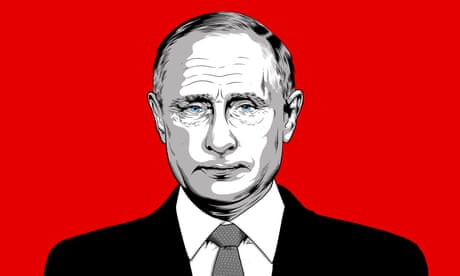
Putin compares himself to Peter the Great in quest to take back Russian lands

President draws parallel with tsar who waged war on Sweden and says campaign in Ukraine stems from ‘basic values’


01:10 Putin compares himself to Peter the Great in Russian territorial push
 – video

Andrew Roth and agencies
THE GUARDIAN
Fri 10 Jun 2022 

Vladimir Putin has compared himself to the 18th-century Russian tsar Peter the Great, drawing a parallel between what he portrayed as their twin historic quests to win back Russian lands.

“Peter the Great waged the great northern war for 21 years. It would seem that he was at war with Sweden, he took something from them. He did not take anything from them, he returned [what was Russia’s],” the Russian president said on Thursday after a visiting an exhibition dedicated to the tsar.

After months of denials that Russia is driven by imperial ambitions in Ukraine, Putin appeared to embrace that mission, comparing Peter’s campaign with Russia’s current military actions.


Understanding Vladimir Putin, the man who fooled the world

“Apparently, it is also our lot to return [what is Russia’s] and strengthen [the country]. And if we proceed from the fact that these basic values form the basis of our existence, we will certainly succeed in solving the tasks that we face.”

Putin, now in his 23rd year in power, has repeatedly sought to justify Russia’s actions in Ukraine, where his forces have devastated cities, killed thousands and forced millions of people to flee, by propounding a view of history that asserts Ukraine has no real national identity or tradition of statehood.
A woman takes a selfie in front of a poster with an image of Peter the Great in Saint Petersburg on Thursday, the 350th anniversary of his birth. Photograph: Olga Maltseva/AFP/Getty Images

Critics said Putin’s remarks proved that his complaints about historical injustice, eastward Nato expansion, and other grievances with the west were all a facade for a traditional war of conquest.

An adviser to the Ukrainian government said the comments showed that attempts to negotiate with Putin or find an “off-ramp” from the conflict for Putin, as the French president, Emmanuel Macron, has sought to do, were misguided.

“Putin’s confession of land seizures and comparing himself with Peter the Great prove: there was no ‘conflict’, only the country’s bloody seizure under contrived pretexts of people’s genocide,” said Mykhailo Podolyak. “We should not talk about [Russia] ‘saving face’, but about its immediate de-imperialisation.”

Carl Bildt, a former prime minister of Sweden, called Putin’s desire to take back lands claimed by Russia a “recipe for years of wars”.

Peter the Great, an autocratic moderniser admired by liberal and conservative Russians alike, ruled for 43 years and gave his name to a new capital, St Petersburg – Putin’s home town – that he ordered built on land he conquered from Sweden.

It was a project that cost the lives of tens of thousands of serfs, conscripted as forced labourers to build Peter’s “window to Europe” in the swamps of the Baltic Sea coast.

Before Putin’s visit to the exhibition, state television aired a documentary praising Peter the Great as a tough military leader, greatly expanding Russian territory at the expense of Sweden and the Ottoman empire with the modernised army and navy he built.

Putin denied that Russia was seeking to occupy new land in its Ukraine invasion, but the Kremlin’s actions show that is not true. Russia has steadily sought to integrate newly captured land in Donetsk and Luhansk, as well as the Kherson and Zaporizhzhia regions in southern Ukraine.

Meduza, a Russian-language outlet, reported this week that the Kremlin was planning to combine all the lands into a new federal district that could be annexed by Russia as soon as this autumn. Amid rumours that new “referendums” could be held to rubber-stamp an annexation, the Kremlin has only said that it is up to those regions that are under military occupation to decide their future.

Vladimir Putin, centre, at the exhibition marking the 350th anniversary of the birth of the first Russian emperor, Peter the Great, in Moscow. Photograph: Sputnik/Reuters

In recent years, Putin’s interest in Russian history has loomed ever larger in his public appearances.

In April 2020, as Russia entered its first coronavirus lockdown, he drew bemusement in some quarters when, during a televised address to the nation, he compared the pandemic to ninth-century Turkic nomadic invasions of medieval Russia.

In July 2021, the Kremlin published an almost 7,000-word essay by Putin, entitled “On the historical unity of Russians and Ukrainians”, in which he argued that Russia and Ukraine were one nation, artificially divided. It laid the groundwork for his deployment of troops to Ukraine in February.


Moscow attempted to justify its war in Ukraine by saying it was sending troops over the border to disarm and “denazify” its neighbour, an unfounded claim.


In the run-up to the launch of what Russia calls its “special military operation”, Putin blamed Vladimir Lenin, the founder of the Soviet Union, for creating Ukraine on what Putin said was historically Russian territory, and for planting the seed of the USSR’s eventual collapse.

By contrast, the Russian leader offered cautious praise for Joseph Stalin for creating “a tightly centralised and absolutely unitary state”, even as he acknowledged the Soviet dictator’s record of “totalitarian” repression.

Putin has a history of praising leaders sharing his own conservative views, including tsar Alexander III and pre-revolutionary prime minister Pyotr Stolypin, both of whom have had monuments in their honour erected across the country.

Meanwhile, leaders seen as antithetical to a strong, unitary Russian state – including Lenin and Nikita Khrushchev – have seen their contributions played down.

“Putin, celebrating the 350th anniversary of Peter the Great’s birth, is confused about history again,” wrote Andrei Kolesnikov, a Russian political analyst. “Peter the Great has opened a window to Europe, Putin is hammering it up with rotten planks from the time of Ivan the Terrible.”

Reuters contributed to this report

Putin undermined his own rationale for invading Ukraine, admitting that the war is to expand Russian territory

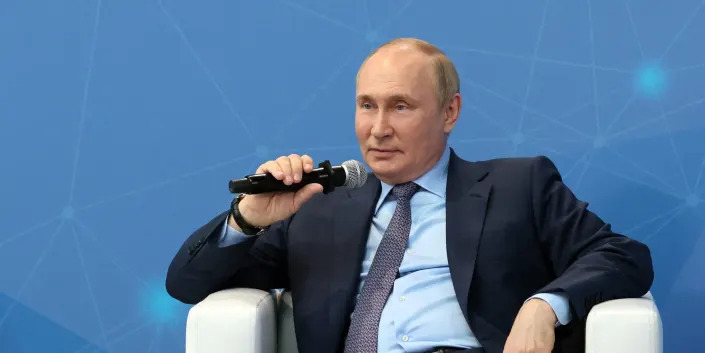
Russian President Vladimir Putin meets young entrepreneurs in Moscow on June 9, 2022. (Photo by Mikhail Metzel / SPUTNIK / AFP) (Photo by MIKHAIL METZEL/SPUTNIK/AFP via Getty Images)
Russian President Vladimir Putin in Moscow.MIKHAIL METZEL/SPUTNIK/AFP via Getty Images
  • Putin said on Thursday that the Ukraine invasion is about expanding Russian territory.

  • Until now Putin had insisted that Russia was freeing Ukraine from so-called Nazis and preventing genocide.

  • Putin said it was his destiny to "return and reinforce" Russia as the 17th-century ruler Peter the Great did.

Russian President Vladimir Putin said publicly for the first time Thursday that his invasion of Ukraine is about expanding Russian territory, as Western leaders have long maintained.

To date, Putin has justified the invasion by saying, baselessly, that he is preventing Ukraine and what he described as a neo-Nazi government from committing genocide against ethnic Russians. He has also said that NATO's eastward expansion threatens Russia's national security.

Speaking to students Thursday after visiting an exhibition about Peter the Great, Russia's first emperor credited with making the country a major power in the early 18th century, Putin compared himself to the ruler and said they were both destined to expand Russia.

"Clearly, it fell to our lot to return and reinforce [Russia] as well. And if we operate on the premise that these basic values constitute the basis of our existence, we will certainly succeed in achieving our goals," he said.

As well as seizing territory in a 21-year war with Sweden in the late 17th century, Peter also captured the territory of Azov from Crimean Tatars, who were aligned with Turkey, in 1696, and seized territory on the Caspian Sea from Persia in 1723.

"On the face of it, he was at war with Sweden taking something away from it," Putin said of Peter. "He was returning and reinforcing, that is what he was doing."

In a tweet Friday, Mykhailo Podolyak, an advisor to Ukrainian President Volodymyr Zelenskyy, said Putin's comments prove his "contrived pretexts of people's genocide" in Ukraine were false and demanded "immediate de-imperialization" of Russia.

Putin's attempts to expand Russian territory started long before his invasion of Ukraine on February 24.

Putin invaded Georgia in 2008 and is currently backing pro-Kremlin factions there. In 2014, it annexed the Crimean Peninsula from Ukraine and invaded the Donbas region of eastern Ukraine via proxies that same year.

Just two days before invading Ukraine, Putin said claims he wanted to restore the Russian empire were false.

However, Western leaders have long maintained that this was not the case.

"He has much larger ambitions than Ukraine. He wants to, in fact, reestablish the former Soviet Union. That's what this is about," President Joe Biden said on February 24, the first day of the invasion.


Ukraine war sparks debate over Finland’s ‘Achilles heel’


The region's unique status is the object of intense debate since the Russian invasion of Ukraine - Copyright AFP/File TIMOTHY A. CLARY

Elias HUUHTANEN
By AFP
Published June 10, 2022

Sprayed between Sweden and Finland, the autonomous Aland Islands are a picturesque archipelago once part of Russia and demilitarised since 1856.

But the region’s unique status is the object of intense debate since Russia’s invasion of Ukraine rattled neighbouring Finland into applying for NATO membership in May.

Under international treaties signed after the Crimean War, no troops or fortifications can be placed on the strategic Baltic Sea islands.

“It is the Achilles’ heel of Finland’s defence,” Alpo Rusi, a professor and former presidential advisor, told AFP.

Home to about 30,000 mostly Swedish-speaking Finns, the area is characterised by rocky islands, lush green forests, old stone churches and wooden architecture — all under the watchful eye of a Russian consulate.

“We have always thought, ‘Who would want to attack us when we have nothing worth taking?’,” 81-year-old Ulf Grussner told AFP.

“But that has changed with Putin’s war on Ukraine”, said the pensioner, one of many here who want Aland to remain demilitarised.

In June, a poll showed 58 percent of Finns would approve of a military presence on Aland, which celebrated the 100th anniversary of its autonomy on Thursday.

“There is concern over whether Finland could react fast enough militarily in the event of a sudden intrusion on Aland,” Rusi said.

Armies wrestled for control of the archipelago in both World Wars.

“Why should we trust the idea … that troops would not rush to control Aland as fast as possible,” said Charly Salonius-Pasternak, a researcher at the Finnish Institute of International Affairs.

– Aland rejects troops –


Alanders, on the other hand, are keen to protect their special status and have so far firmly rejected the idea of ending the demilitarisation.

“Why should we change it? I think it’s a stabilising factor in the Baltic Sea area that we are demilitarised,” Veronica Thornroos, 59, premier of the Aland government, told AFP.

Besides, if the archipelago were attacked, Finland would defend it “very quickly”, she said.

The Finnish government has said it has no intention of touching Aland’s special status.

Sia Spiliopoulou Akermark, director of the Aland Peace Institute, meanwhile noted that the “Aland regime” of autonomy, cultural guarantees and demilitarisation is a “complex knot” that should be considered as a whole.

– Russian presence –


Like the rest of Finland, Aland was part of the Russian empire from 1809 to 1917.

At the time, the archipelago was viewed as an important outpost in the defence of Saint Petersburg and control of the Baltic Sea.

Finland gained independence from Russia in 1917, and was granted sovereignty over Aland in 1921 despite protests from the islands’ Swedish-speaking majority.

The Nordic country went on to fight two bloody wars against the Soviet Union during World War II.

As part of their peace deal, the demilitarisation of Aland was to be monitored by a Soviet consulate in the archipelago’s main town of Mariehamn.

The consulate still exists to this day, although it is now run by Russia.

A group of locals gather every day outside the high metal fence protecting the consulate, to protest Russia’s war in Ukraine.

“They have no business being here. Russia is always a threat”, one of the protestors, Mosse Wallen, 71, told AFP.

– Putin’s property –


Russia also owns a seaside property north of Mariehamn in Saltvik, which was acquired in the 1947 peace deal.

“They gave my mother three days to move out”, said Ulf Grussner, whose idyllic childhood home is now fenced in by the consulate.

Grussner’s father was a German geologist, and the peace deal stipulated that all German possessions in Finland were to be ceded to the Soviets.

In 2009, ownership of a piece of the property was transferred to the Russian presidency.

Concern has mounted in Finland in recent years over Russian property deals across the country.

Grussner feared that Russia might intend to use his family’s property and the demilitarisation as a “pretext” to increase its presence in the area.

“It is far-fetched, but on the other hand it’s not impossible,” he said.


POPULAR FRONT REDUX
French left seeks comeback against Macron in parliamentary polls


Issued on: 10/06/2022 - 


Jean-Luc Melenchon narrowly missed out on the second round of the April presidential vote but now leads the broad left-wing coalition NUPES 
Geoffroy VAN DER HASSELT AFP

Sainte-Genevieve-des-Bois (France) (AFP) – France's first left-wing alliance in 25 years is on a mission to block centrist President Emmanuel Macron's plans for pro-business reforms by winning a big chunk of seats in this month's parliamentary polls.

Hard-left firebrand Jean-Luc Melenchon narrowly missed out on the second round of the April presidential vote, but is determined for a rematch as he leads the freshly-formed New Ecological and Social Popular Union (NUPES) coalition into battle.

Comprising Melenchon's France Unbowed (LFI) party, as well as the Greens, Communists, and Socialists, the alliance deal hopes to thwart Macron's domestic agenda, in particular the plan to raise the retirement age to 65.

"Nothing was decided (in the presidential elections)," Melenchon told around 100 supporters at Sainte-Genevieve-des-Bois, a small town to the south of Paris, on Tuesday.

Macron beat far-right leader Marine Le Pen in the second round with 58.55 percent of the vote, but Melenchon and his allies argue many voters backed Macron in the second round just to stop the far-right from acceding to power.

Immediately after the second round, Melenchon asked voters to elect him prime minister by handing him a majority in the parliamentary polls, a two-round election on June 12 and 19.

A majority of seats for NUPES would force a clunky "cohabitation" -- where the prime minister and president hail from different factions.

For the past two decades, elected presidents have avoided such a scenario and been rewarded with a majority of the 577 seats in the lower-house National Assembly.

-'End hell'-

But an opinion poll published Thursday shows Macron's alliance Ensemble (Together) winning between 260 and 300 seats, potentially falling short of an absolute majority, for which 289 seats are needed.

According to the Ipsos Sopra Steria poll, NUPES may win between 175 and 215, turning the left coalition into the main force of opposition to Macron.

"There is a need for change," said a Socialist city councillor who asked not to be named at the meeting in Sainte-Genevieve-des-Bois.

"The NUPES in power would bring a breath of fresh air -- the voice of working class areas, of young people," she added.

Held in a park surrounded by social housing, the meeting with Melenchon in Essonne aimed to whip up support for NUPES candidates in a department where the parties now part of the coalition failed to win any constituencies in 2017.

"He (Melenchon) speaks with the heart, he goes straight to the point," Ali, 52, who asked for his last name not to be used, told AFP. He lives in the area and defines himself as "an immigrant but also French".

"What we offer is another vision of the world, of society," Melenchon told supporters in Paris last week.

"I'm not saying we will create a paradise from one day to the next, but I guarantee we will immediately put an end to hell," he added.

-'Gaul Chavez'-

The French perceive Melenchon as having "all the criteria of a populist candidate: a discourse that speaks to them tinged with demagogy," said head of studies for the Paris-based think tank Jean Jaures Foundation Jeremie Peltier in a report.

"Jean-Luc Melenchon is a Gaul Chavez," Finance Minister Bruno Le Maire recently told French daily Le Figaro, referring to Venezuela's since deceased leader Hugo Chavez.


The NUPES left-wing coalition is made up of Melenchon's France Unbowed party, the Greens, Communists and Socialists 
Sameer Al-DOUMY AFP/File

The former Marxist came under fire this week for tweeting "the police kill", after officers shot a woman dead in a car in northern Paris Saturday after the vehicle failed to stop when summoned by officers.

But Melenchon defended his comments and congratulated himself for sparking debate on the use of force by the police in France through what he said was a deliberately provocative tweet.

Criticism of Melenchon also emanates from the left, in particular from some of his former Socialist colleagues -- despite the presence of the Socialist Party (PS) in the coalition.

Melenchon left the PS in 2008 to form his own movement, the Left Party, and his rise on the left has been a bitter pill to swallow for some in his former party, attached to a left-of-centre politics at odds with Melenchon's radical brand.

In the context of a "low intensity campaign", abstention will play a crucial role in the vote, said political sociologist Vincent Tiberj from Sciences Po Bordeaux University.

"When an election fails to mobilise people, it affects those who only vote occasionally -- such as the working classes and the young -- and thus voters of the far-right National Rally and NUPES," he added.

© 2022 AFP

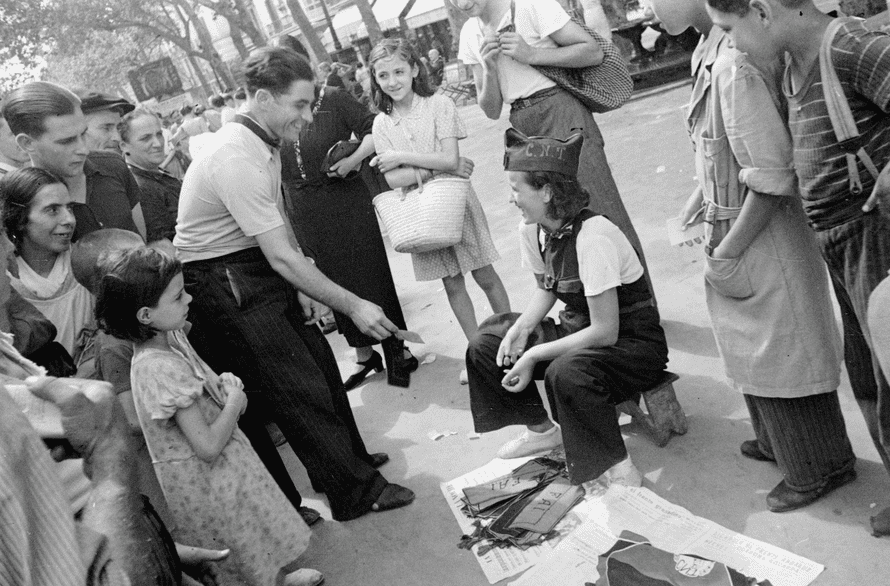
Lost photos from Spanish civil war reveal daily life behind anti-fascist lines

Rediscovered work by two Jewish women has gone on display in Madrid for first time

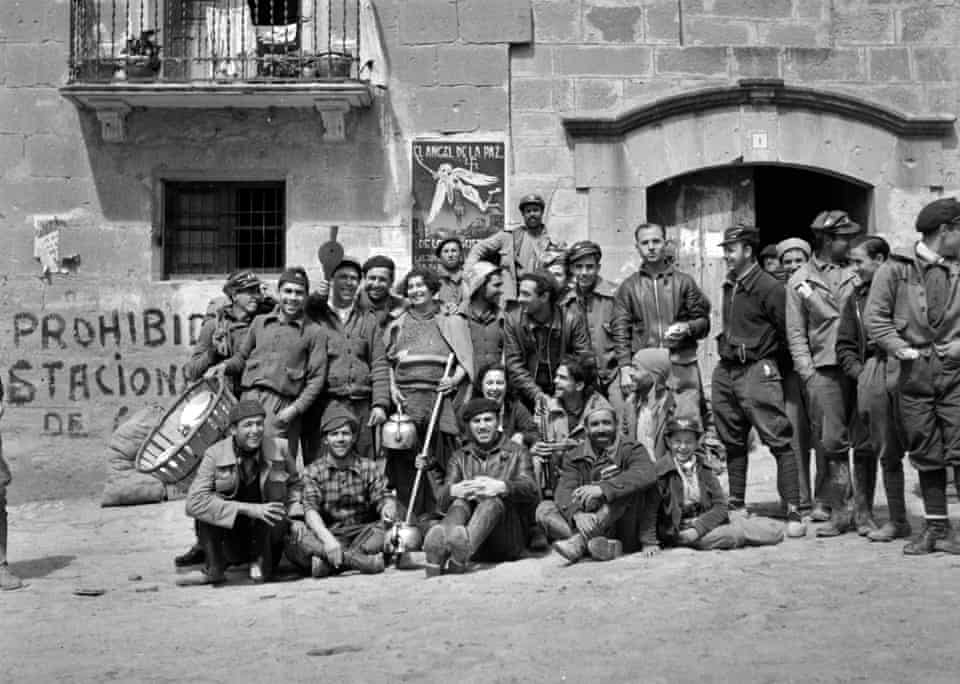
Anarchist Fighters Aragón, March 1937
. Photograph: Kati Horna / IISH / Ministerio de Cultura y Deporte. Centro Documental de la Memoria Histórica

by Guy Lane
Fri 10 Jun 2022

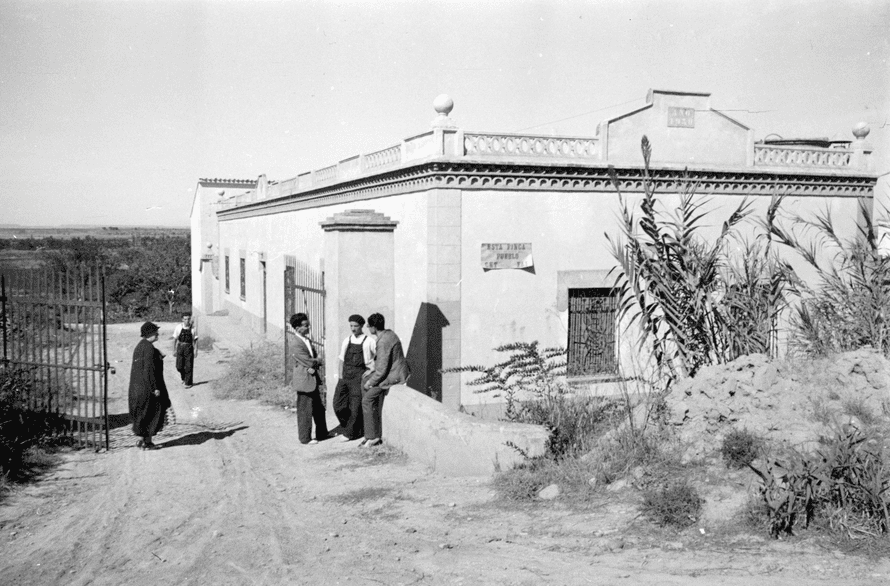
Photographs by two Jewish female photographers who worked behind anti-fascist lines during the Spanish civil war have gone on display in Madrid after 80 years. For decades the negatives and prints, many of which have never been published, were believed to be lost or destroyed. They are now on show in the capital for the first time.

As the Spanish civil war neared a conclusion in 1939, anarchists of the Confederación Nacional del Trabajo and Federación Anarquista Ibérica (CNT-FAI) fighting in Barcelona took steps to preserve records of their struggle and achievements. Apprehensive of the war’s outcome, they sealed documents and 2,300 photographs, 5,000 negatives and almost 300 photographic plates in 48 wooden crates, which they smuggled out of the city away from the fascist bombardment, destined for the safe haven of the International Institute of Social History (IISH) in Amsterdam.


Barcelona, 1936.
 
Photograph: Margaret Michaelis / IISH / National Gallery of Australia

Years later, having travelled via Paris, Harrogate and Oxford, the crates, known as the Amsterdam boxes, duly arrived. They remained sealed while the anarchists pursued undercover lives during the decades of the Franco regime. When they were finally opened in the 1980s the records and documents inside were inventoried but the photographic material was overlooked.


One of the Amsterdam boxes on display in Madrid

Now, thanks to the detective work of the art historian and curator Almudena Rubio, who has been researching the IISH archive since 2015, it has become possible to identify the output of two foreign photographers, both Jewish women, who travelled to Spain to take sides in the war: Margaret Michaelis, of Polish-Austrian descent, and Kati Horna, from Hungary and a friend of the photojournalist Robert Capa, a compatriot.


Anarchist fighters. Photograph: Margaret Michaelis / IISH / National Gallery of Australia

Michaelis had studied photography in Vienna in the 1920s and went on to work in Berlin until she and her husband, a prominent anarchist, were arrested on separate occasions by the Nazis.

After his release, the couple moved to Barcelona in 1933, where she established her own studio and worked as a portraitist and advertising and architecture photographer.


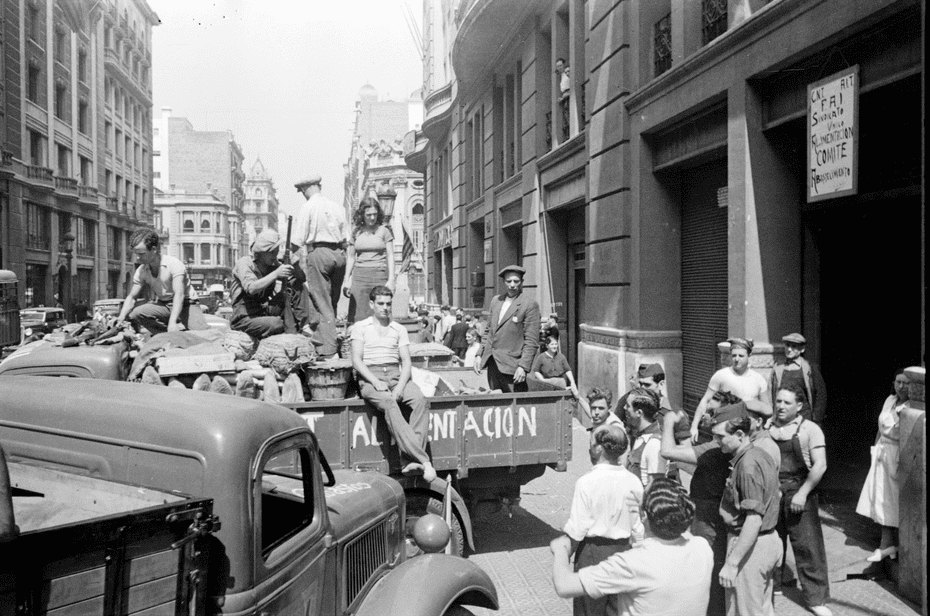
C
NT-FAI street activity in Barcelona, 1936
Photograph: Margaret Michaelis / IISH / National Gallery of Australia

After the outbreak of the civil war Michaelis worked for the foreign propaganda office of the anarchists and contributed pictures to the newly established propaganda commissariat of Catalunya, which sought to maintain morale while encouraging anti-fascist action.


Emma Goldman visits Albalate de Cinca in Aragón. 
Photograph: Margaret Michaelis / IISH / National Gallery of Australia

Among Michaelis’s newly published pictures, all shot with a Leica, are scenes of street actions in Barcelona by anarchist militants; views of daily life in Albalate de Cinca and Valencia; reportage from a visit to L’Alcora, a village that had abolished the use of money; rare photographs of the veteran anarchist Emma Goldman (memorably branded by J Edgar Hoover “the most dangerous woman in America”); and the arrival of the British Red Cross in Portbou.


A collectivised church in Aragón converted into a carpentry workshop. 
Photograph: Kati Horna / IISH / Ministerio de Cultura y Deporte. 
Centro Documental de la Memoria Histórica

As Michaelis left Spain, Horna arrived in January 1937. She, too, was a trained photographer, and had left Germany in 1933. On arrival in Spain after four years in Paris, she committed herself to the social revolution, working for the foreign propaganda office of the anarchists.
 
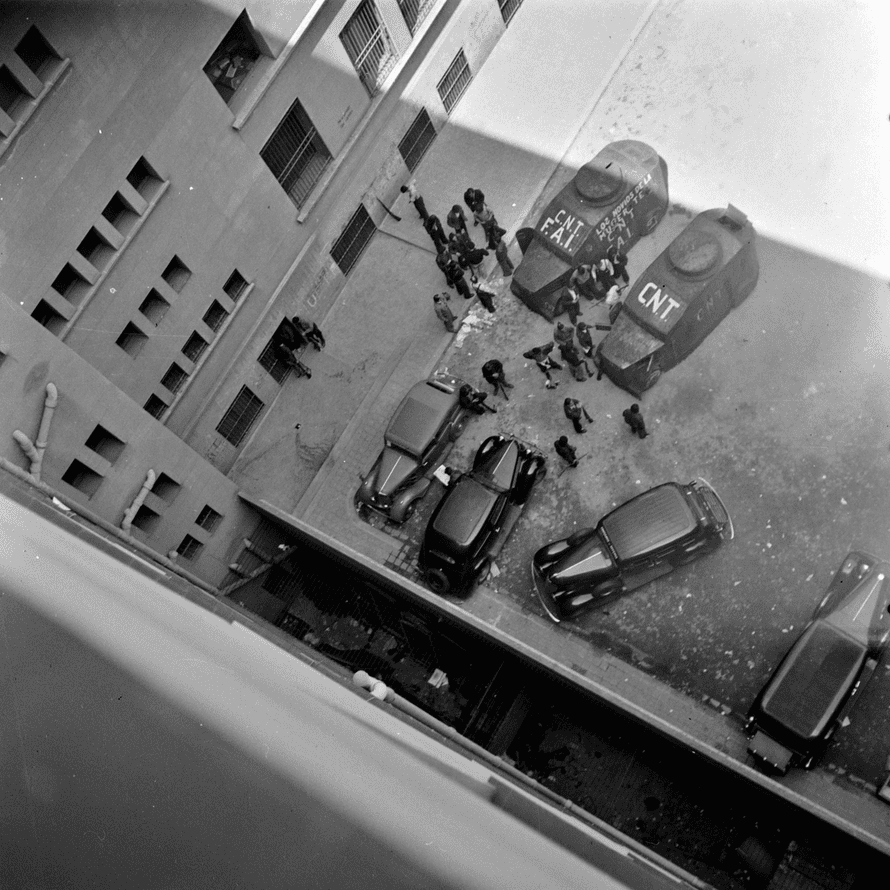
Anarchist vehicles of the CNT-FAI in Barcelona, 1937.

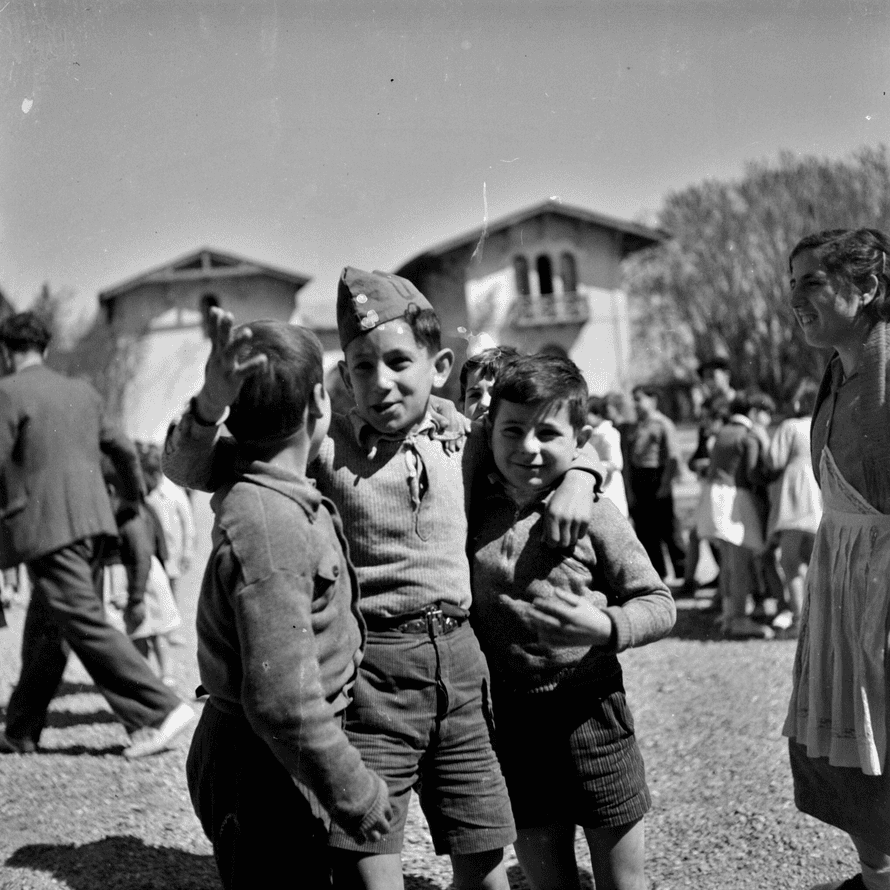
Children in Barcelona, 1937. 
Photographs: Kati Horna / IISH / Ministerio de Cultura y Deporte. 
Centro Documental de la Memoria Histórica

She soon established herself as the official photographer of the SPA, an anarchist photo agency, and her pictures were published in such anarchist titles as Umbral, Mujeres Libres and Tierra y libertad.

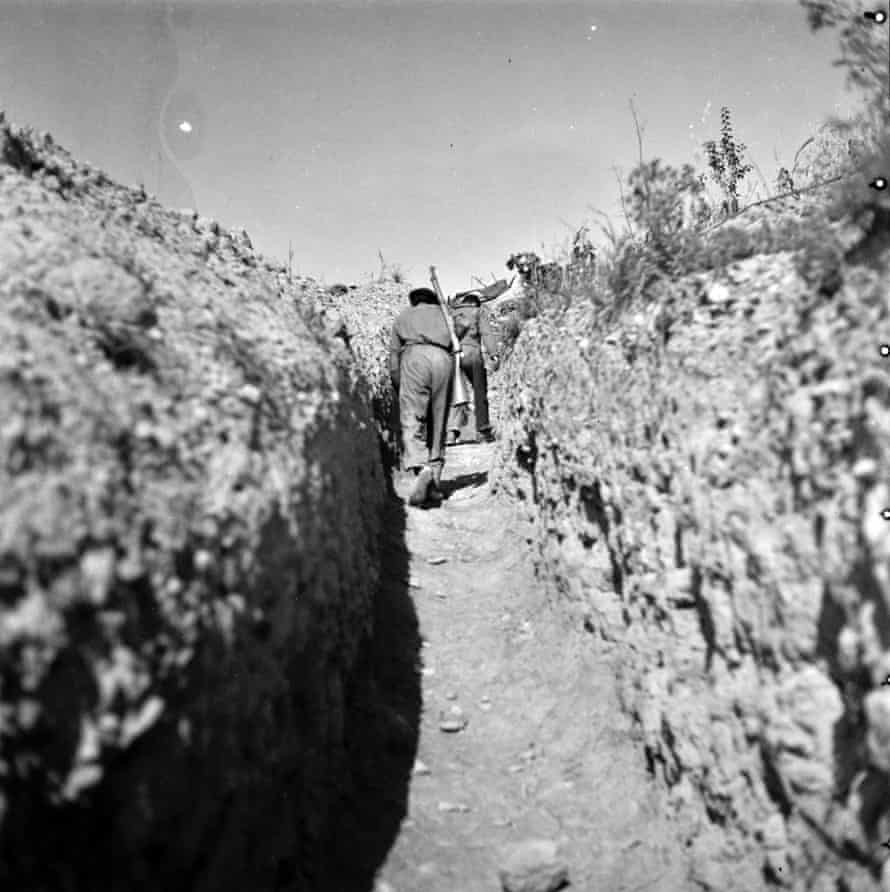
Horna’s work, like Michaelis’s, was designed to support the social revolution and counteract Francoist propaganda that attempted to discredit the anti-fascist movement. Rolleiflex in hand, she visited a camp set up to look after children removed from the war zone; she recorded humane and sanitary conditions in a prison in Modelo; she pictured a collectivised church in Aragón converted into a carpentry workshop; she saw villagers having free haircuts at a collectivised barbershop; she scrambled through a trench on the Aragón front.

Rubio, whose painstaking research has unearthed the photographs, has no doubts about their importance. “The legacy of the work of Michaelis and Horna is unique, precisely because it shows us the rearguard revolutionary experience, neglected by official historiography, that was instigated by the anarchists of the CNT-FAI. At the same time, it allows us to reconstruct in more detail the life of the two photographers during the civil war, and better to appreciate their work in antifascist Spain.”


In the trenches on the Aragón front,f
ighters on the Aragón front, 1937. 
Photographs: Kati Horna / IISH / Ministerio de Cultura y Deporte. Centro Documental de la Memoria Histórica


Both photographers believed their work had been lost or destroyed in the ruins of Franco’s bombs. Now, for the first time, the pictures are seeing the light of day.

The Amsterdam Boxes: Kati Horna and Margaret Michaelis in the Civil War is at the Calcografía Nacional in Madrid as part of PhotoEspaña until 27 July. The exhibition will travel to Huesca (Aragón) and Barcelona
Protect schools, home security, hunters: Amend the Second Amendment


Paul F. deLespinasse
Thu, June 9, 2022

Recent massacres have again drawn attention to the tragedies enabled by the Second Amendment, as interpreted by the courts.

This amendment is one of the most problematical parts of the Constitution: "A well-regulated militia, being necessary to the security of a free state, the right of the people to keep and bear arms shall not be infringed."

In 2008, downplaying "well-regulated" and "militia," and reversing precedents, the Supreme Court ruled 5-4 that the amendment protects individuals' right to have guns. Abusing this right, a few people have used military-style "assault" weapons, rapidly firing hundreds of shots, to kill hundreds of people including many young children.

Attempts to prohibit owning these weapons have been stymied by legislators claiming devout allegiance to the Second Amendment.

The Second Amendment diverts attention from the costs and benefits of legislation attempting to make gun ownership "well-regulated." Instead of focusing on proposals' merits, it sidetracks us into arguments about constitutionality.

If there were no Second Amendment, legislators could focus on the benefits and costs of proposed legislation. But repeal is impossible. People wanting guns for self-defense or hunting fear that repeal would "let the camel's nose into the tent" — a "slippery slope" argument. What if legislatures decided to ban all guns?

Some gun owners, however, now believe that we should ban assault weapons. This would become possible if, rather than trying to repeal the Second Amendment, we amend it. A tightly drafted change could protect the right to own hunting rifles and handguns for self-protection, subject to reasonable regulations, but leave regulation or prohibition of more powerful weapons completely up to legislatures.

An amended Second Amendment would guarantee that the whole camel could not get into the tent. It would eliminate the danger that future Supreme Court majorities might uphold legislation banning handguns and hunting rifles. And it would allow proposals to prohibit ownership of assault weapons to be considered on their merits.

Such an amendment — unequivocally protecting the right to own handguns and hunting rifles — could not be dismissed as anti-gun. True, these kill a lot more people than assault weapons, but they do it in many small daily episodes (rather like car accident fatalities) rather than in a small number of mass slaughters (like passenger plane crashes).

They destroy many lives, but do not enable unhappy people to gain attention by committing large-scale atrocities. They don't inflict comparable damage to the national psyche.

Amending the Constitution is usually harder than merely enacting laws. But here the opposite could be true. Meaningful legislation is now impossible. But opposition to amending the amendment should be minimal since the changes would eliminate fears of legislation or court decisions banning handguns and hunting rifles.

Opponents of revising the Second Amendment may argue that banning assault weapons would not reduce the number of mass shootings, but this is refuted by recent experience in Australia, the United Kingdom and other countries.

They might also argue that we need better treatment for mental illness, which is an excellent idea in its own right but a distraction here. There is just as much mental illness in countries with far fewer mass atrocities. The availability of assault weapons in the U.S. is obviously the critical variable here.

A few might argue that privately owned, military-scale weapons are needed so we can overthrow our government if it becomes tyrannical, but this idea is terribly misguided. Regimes resulting from forcefully overthrowing a government are invariably worse than their predecessors.

And for those who are concerned, there are effective ways to protect ourselves from tyranny, at much lower cost, nipping bad tendencies in the bud: civic education and widespread attention to and participation in public affairs.

We shouldn't let a vital part of public policy depend on the whims of future Supreme Court majorities. Amending the Second Amendment could be a win-win, protecting schools, home security and hunters.


Paul F. deLespinasse is professor emeritus of political science and computer science at Adrian College. He can be reached at pdeles@proaxis.com.

This article originally appeared on The Daily Telegram: Paul deLespinasse: Amend the Second Amendment

Asteroid samples contain 'clues to origin of life': Japan scientists


Kyoko HASEGAWA
Thu, June 9, 2022, 


Asteroid dust collected by a Japanese space probe contains organic material that shows some of the building blocks of life on Earth may have been formed in space, scientists said Friday.

Pristine material from the asteroid Ryugu was brought back to Earth in 2020 after a six-year mission to the celestial body around 300 million kilometres away.

But scientists are only just beginning to discover its secrets in the first studies on small portions of the 5.4 grams (0.2 ounces) of dust and dark, tiny rocks.

In one paper published Friday, a group of researchers led by Okayama University in western Japan said they had discovered "amino acids and other organic matter that could give clues to the origin of life on Earth"

"The discovery of protein-forming amino acids is important, because Ryugu has not been exposed to the Earth's biosphere, like meteorites, and as such their detection proves that at least some of the building blocks of life on Earth could have been formed in space environments," the study said.

© JAXAMinerals of the Ryugu sample, reported on June 10, 2022 by Japan Aerospace Exploration Agency (JAXA).

The team said they found 23 different types of amino acid while examining the sample collected by Japan's Hayabusa-2 probe in 2019.

The dust and rocks were stirred up when the fridge-sized spacecraft fired an "impactor" into the asteroid.

"The Ryugu sample has the most primitive characteristics of any natural sample available to mankind, including meteorites," the Japan Aerospace Exploration Agency (JAXA) said in a statement.

It is believed that part of the material was created about five million years after the birth of the solar system and has not been heated above 100 degrees Celsius (210 degrees Fahrenheit).

Another study published in the US-based journal "Science" said the material has "a chemical composition that more closely resembles the Sun's photosphere than other natural samples".

Kensei Kobayashi, an astrobiology expert and professor emeritus at Yokohama National University, hailed the discovery.

"Scientists have been questioning how organic matter -- including amino acids -- was created or where it came from, and the fact that amino acids were discovered in the sample offers a reason to think that amino acids were brought to Earth from outer space," he told AFP.

Another mainstream theory about the origin of amino acids is that they were created in Earth's primitive atmosphere through lightning strikes, for example, after Earth cooled down.

kh/kaf/jta
Taliban arrest Afghan fashion model, say he 'insulted' Islam


FILE - Ajmal Haqiqi, right, watches as Mahal Wak, center, practices modeling, in Kabul, Afghanistan, Aug. 3, 2017. The Taliban have detained a famous Afghan fashion model along with three colleagues, including Haqiqi, accusing them of disrespecting Islam and the Holy Quran. Haqiqi — known among Afghans for his fashion shows, You Tube clips, and modeling events — appeared handcuffed in videos posted to Twitter on Tuesday, June 7, 2022, by the Taliban’s General Directorate of Intelligence, DCI. (AP Photo/Rahmat Gul, File) (ASSOCIATED PRESS)More

RAHIM FAIEZ
Wed, June 8, 2022, 

ISLAMABAD (AP) — The Taliban have arrested a well-known Afghan fashion model and three of his colleagues, accusing them of disrespecting Islam and the Quran, the Muslim holy book, according to videos released by Afghanistan's new rulers.

Ajmal Haqiqi — known for his fashion shows, YouTube clips and modeling events — appeared handcuffed in videos posted on Twitter by the Taliban intelligence agency on Tuesday.

In one widely circulated and contentious video, Haqiqi is seen laughing as his colleague Ghulam Sakhi — who is known to have a speech impediment that he uses for humor — recites verses of the Quran in Arabic, in a comical voice.

After the arrests, the Taliban released a video of Haqiqi and his colleagues, seen standing in light brown jail uniforms and apologizing to the Taliban government and religious scholars.

The video was accompanied by a tweet in the Dari language, saying: “No one is allowed to insult Quranic verses or sayings of the Prophet Muhammad.”

Later Wednesday, Amnesty International released a statement, urging the Taliban to “immediately and unconditionally” release Haqiqi and his colleagues.

Amnesty has documented several arbitrary detentions by the Taliban in Afghanistan, often accompanied by coerced statements in an attempt to stifle dissent in the country and deter others from expressing their views.

Samira Hamidi, Amnesty's South Asia campaigner, denounced the arrests and said that by detaining “Haqiqi and his colleagues and coercing them into apologizing," the Taliban have undertaken “a blatant attack on the right to freedom of expression." Her statement also condemned the Taliban's "continued censorship of those who wish to freely express their ideas.”

In Kabul, Taliban officials did not immediately respond to requests for comment and it was not clear what measures the model and his colleagues face under the Taliban-run judiciary.

The families of the arrested models could also not immediately be reached for comment.

Since they seized power last August in Afghanistan during the final weeks of the U.S. troop pullout from the country, the Taliban have imposed strict measures and edicts according to their harsh interpretation of Islamic law, particularly curbing the rights of women and minorities.

The moves have raised international concerns that the radical Islamic group intends to rule as it did the last time the Taliban held power in Afghanistan, in the late 1990s. The Taliban consider criticism and anything perceived as disrespectful of Islam as a punishable crime.

Amnesty said that since their takeover, the Taliban “have been using intimidation, harassment, and violence on anyone who has expressed support for human rights or modern values, especially human rights defenders, women activists, journalists, and members of academia among others."

The rights group also urged the Taliban as the de facto authority in Afghanistan to “abide by international human rights law and respect everyone’s right to freedom of expression without discrimination.”


Morocco's gender-challenging artists take to the stage


Kaouthar Oudrhiri
Thu, June 9, 2022,


Men in make-up and wigs twirl on stage in colourful robes to applause in Morocco, resurrecting the musical art of "Aita" and challenging gender stereotypes in the conservative Muslim-majority kingdom.

Members of the all-male "Kabareh Cheikhats" troupe, including singers, actors and dancers, hope their unique performances of an art once dominated by women can revive the tradition.

"This art, based on oral histories, traces its roots back to the 12th century and draws its poetic strength from daily life," said writer and poet Hassan Najmi.

The group travels across the North African nation mapping out the many varieties of Aita, a genre that has long been popular in the countryside.


Recently back from a tour of the United States, they staged a boisterous performance that brought the audience in a packed theatre in Rabat to their feet, with men and women dancing in the aisles.

The music narrates traditional life and describes Morocco's spectacular nature, as well as talking frankly of love and sex.

When Morocco was under the grip of French rule from 1912 to 1956, Aita became a form of anti-colonial resistance, expressed in dialects the authorities had no chance of understanding.

The songs had gained royal recognition in the late 19th century, under Sultan Hassan I.

"At that time, authorities paid particular attention to this music as they could use it as a vehicle for propaganda," said Najmi.

- 'Strong women' -

Famous female "cheikhate" singers were invited to parties and national ceremonies up until the 1990s.

But social and cultural changes in Morocco -- including a shift among some to more conservative religious values -- knocked them off their pedestal.


"They became symbols of debauchery," said Najmi. "This contempt is the fruit of hypocrisy and double-talk of a segment of society."

Amine Naouni, one of the troupe's actors, said Kabareh Cheikhats unapologetically pays tribute to the "strong women" of the past.

"In the show we haven't invented anything," Naouni said. "All we do is revisit things that already existed in society."

The group's founder, Ghassan El Hakim, said the aim was to promote appreciation for the "precious" heritage.

"That's what motivates our work," the 37-year-old said. "Six years after the troupe was born, we're still learning, we're constantly researching."

The show starts with an "Aita jabalia" from the country's mountainous north, followed by one from the one-time capital Fez, then another from the Doukkala-Abda plains that are the music's heartland.

- 'To live together' -


The idea of men dressing up or impersonating women in theatre is not new to Morocco.

Naouni, 28, said he had worried about being "judged" at first. "With time, that feeling went away," he said.

Najmi said men used to dress up as cheikhates at weddings.


"We used to see men in make-up, dressed in caftans and dancing sensuously at parties, and it wasn't seen as a problem," said Najmi. "It was seen as normal, as public space was closed to women."

But the Kabareh is a new take on old traditions.

Hakim said members of his group were keen to challenge fixed categories.

"At each performance, I see the communion of the spectators," he said.

"Everyone appreciates the moment, despite our differences, so I tell myself that it's possible to live together, not just for the duration of a show."

But the shows have provoked condemnation by some on social media.

Naouni however believes those reactions "are limited" to the internet.

"It's easy to pour out your hate behind a screen, but in real life it's different," he said.

ko/agr/fka/par/pjm/oho


Texas Legislators Propose Law against Drag Shows … And Not Guns

Kalyn Womack
Wed, June 8, 2022


Texas has been making strides for a while now to “protect” children from anything and everything LGBTQ+ related. But instead of drafting gun laws to protect kids from school shooters like in Uvalde, lawmakers have proposed new legislation to ban drag shows, according to NBC News.

video went viral of a group of kids attending a drag show in Dallas. Per NBC, the event titled “Drag the Kids to Pride Drag Show” was intended to be family friendly, given most drag shows have age restrictions. During the event, a crowd of protestors gathered outside. After the video circulated, Republican representatives wasted no time responding to it.

In a tweet, Rep. Marjorie Taylor Green equated drag shows to strip clubs, claiming it should be illegal to bring children either because it “intentionally confuses children about gender/sexuality.” Texas Rep. Bryan Slaton said the law was necessary to protect children from “perverted adults obsessed with sexualizing young children.”

More on the drag show ban from NBC News:

Podcast host Allie Beth Stuckey, who has over 357,000 followers on Twitter, went as far as suggesting the parents, performers and bar owners “should be charged with sexual abuse of children.”

LGBTQ activists and some Democratic lawmakers slammed the prospective ban.

“First it was CRT. Then it was trans kids playing sports. Now it’s....drag?” Michigan State Senator Mallory McMorrow said on Twitter, using the acronym for Critical Race Theory. “None of these things fix inflation, bring healthcare costs down, or save kids from gun violence. It’s just the fear tactic of the month for the GOP. And it’s embarrassing.”

What a way to celebrate Pride Month.

Before this, state legislators had banned nearly every book from schools and libraries discussing gender identity and sexuality. Also, Gov. Gregg Abbott issued an order to investigate families who allow their children to undergo gender-affirming medical care, per NBC.

The conspiracy that LGBT individuals are “grooming children” has drawn more action from lawmakers than a literal mass shooting. Just a week ago, 19 students of Robb Elementary School in Uvalde, Texas were shot and killed by a gunman. Instead of floating a bill to address the purchase and use of firearms, legislators seem to be distracted by something far less lethal.