Wednesday, September 02, 2026


How Taiwan's AI stock boom has ordinary people borrowing to invest

FILE - People walk past an electronic stock board at Taipei Exchange in Taipei, Taiwan, Monday, Jan. 30, 2023.
Copyright AP Photo/(AP Photo/Chiang Ying-ying)

By Una Hajdari with AFP
Published on

People across Taiwan are taking out loans and even remortgaging their homes to chase gains in an AI-fuelled stock boom — and not everyone is coming out ahead.

Taiwan is in the grip of a borrowing frenzy — but not for houses or cars. This year, people are taking out loans to buy stocks.

As Taiwan's stock market soared this year, real-estate worker Lucas Chen borrowed NT$5 million (€136,000) to buy tech shares, and within six months he had quadrupled his money.

Chen is one of a growing number of people using debt to buy into the island's stock market, which soared 59% in the first half of the year thanks to booming demand for AI hardware made by chip giant Taiwan Semiconductor Manufacturing Co (TSMC) and others.

But while the prospect of vast returns has lured and repaid many handsomely, others have suffered hefty losses or been tricked by scammers, prompting authorities to issue warnings about the risks.

"The first half of the year was really crazy. It was absolutely wild," said Chen, who makes a base salary of up to NT$50,000 (about €1,360) from his job.

The 34-year-old began trading in the stock market 10 years ago, saving up his bonuses to buy chip titan TSMC, which accounted for about 45% of the Taiwan Stock Exchange at the end of 2025.

At the start of this year, Chen saw "a good opportunity" to increase his investments and took out three bank loans worth NT$5 million, using his new Tesla as collateral for two of them.

The bet paid off.

Chen's tech investments, half of them in TSMC, surged nearly 70%, pumping up his holdings by about NT$20 million (€544,000) by late June.

"The older generation would say borrowing money isn't a good thing," Chen told AFP, adding that if you did the maths carefully, the risks were "controllable".

Financial influencer Yeh Yu-shuo has enjoyed the fruits of the market but has also seen the downside of the stock-buying frenzy in his Facebook group, where hundreds of thousands of members trade investment advice.

"I've reviewed posts saying they want to jump off a building," Yeh said.

One anonymous poster said in early August he had invested NT$10 million (about €272,000), including a NT$6 million (about €163,000) mortgage, in recent months and had lost nearly half of it.

"Since last month I've been waking up in the middle of the night in a panic," the poster said.

"I've already sought treatment from a psychiatrist, and I even went to Zinan Temple, but none of it has helped at all. Right now, all I want is to get my money back as quickly as possible."

'Buying stocks like crazy'

Global stock markets have surged this year to record highs as tech firms ramped up spending on AI data centres, hardware and software.

However, the rally hit a wall in July, hammering the tech sector on concerns over when that cash will see a return and warnings that company valuations had gone too far.

Anticipation of a US interest rate hike has also weighed on sentiment and could curb demand for stocks, particularly tech firms, which rely on borrowing to fuel their investments.

While some people in Taiwan have used their savings or borrowed from family to invest, many have relied on banks or brokers to fund their stock purchases.

Norman Yin, a professor of money and banking at National Chengchi University, said young people have been "buying stocks like crazy".

Taiwanese banks are sitting on "unprecedented" levels of deposits, partly due to stagnant property prices, and are very willing to lend.

"If I borrow money from a bank to buy stocks, I could make more in one day than I earn from my salary in a month," Yin said, noting fresh graduates often made around NT$40,000 (about €1,090) per month.

"It's faster and easier than sitting in an office and working hard."

Meanwhile, margin trading — in which investors use funds borrowed from a broker to buy securities — rose nearly 20% in the first half from the previous six months, Taiwan Stock Exchange data show.

Taiwan's Financial Supervisory Commission told AFP that overall "credit risk remains under control".

The stock exchange has started publishing videos on social media warning young investors of the risks of defaulting on their loans.

'Windfall for our generation'

Social media platforms in Taiwan are rife with posts about people making huge sums and quitting their jobs to trade full time.

Marketing specialist Jerry Lee, 30, said he has watched with some envy as friends post about their gains in their group chat.

"When you see someone make two or three months' salary in two days, oof, that's really painful," said Lee, who describes himself as a conservative investor.

Social media gives the impression that "everyone is making money," he said.

"When it's dropping they won't tell you about it."

Taiwan's stock index fell about 16% from its record high on 22 June to 30 July, while South Korea's market — the poster child of the global tech-led surge this year — plunged about 40%.

Still, Yeh said he had confidence in Taiwan's stock market "as long as TSMC remains stable". The Taiex has recovered almost all the losses sustained in the summer sell-off.

Chen said the opportunity to make money would keep him investing.

"This is a windfall for our generation," he said.


Industrial AI Needs An Authority Test Before It Touches The Physical World – Analysis


Image: ChatGPT


September 2, 2026

By Burak Oktenli

Key Takeaways:

Once industrial AI can write setpoints or isolate kit—not just recommend—the test is authority, not average accuracy: what it may change, on what evidence, for how long, who interrupts, and when it must abstain.

Give every acting system a documented authority envelope that narrows as consequence or sensor quality worsens; use twins and “ugly data” (drift, stale values, comms loss) to measure scope, abstention, reversion time, and a log of why permission existed—not only the command issued.

Five Eyes agentic-AI guidance, NIST OT/smart-manufacturing work, and the EU AI Act’s high-risk calendar (2027–28) already point that way: put envelopes in procurement and revalidate after model or plant changes, so the plant knows where the AI stops.


A model can be accurate and still be unsafe if its permissions, evidence thresholds, fallback logic or audit trail are wrong. Before AI writes to a plant, grid or industrial process, operators should test what it is allowed to do – not only how well it predicts.

Industrial artificial intelligence is crossing an important boundary. For years, most deployments predicted failures, forecast demand, optimized schedules or recommended process changes while a human or conventional control system remained responsible for execution. Increasingly, AI is being connected to tools that can write settings, isolate equipment, change operating parameters or trigger workflows that reach the physical process.

At that point, accuracy stops being the only validation question.


A model can be highly accurate on average and still be given permissions that are too broad. It can keep acting after sensor quality deteriorates. It can make a defensible recommendation under one operating state and continue using the same authority after the evidence supporting that state has gone stale. It can leave a perfect log of what command was issued while failing to preserve why the system was allowed to issue it.

The additional question is authority: What may the system change? On what evidence? For how long? Who can interrupt it? What forces it to abstain? And what happens when control has to return to a person?
Cyber Agencies Are Already Warning About Permission, Not Just Performance

A useful signal came in May, when six national cybersecurity agencies across the Five Eyes published joint guidance on the careful adoption of agentic AI services. The document is aimed primarily at tool-using software agents rather than industrial controllers, so the two should not be conflated. But its governance logic is directly relevant wherever AI can act instead of merely advise.


The guidance tells operators to limit privileges, define trigger-action protocols that automatically restrict permissions when unexpected behavior appears, separate duties, record delegation chains, use explicit expiry for delegated authority and require stronger approval for higher-stakes actions.

That is a different security vocabulary from conventional model validation. It treats the dangerous object not simply as a prediction but as a prediction coupled to permission.

Operational technology makes that coupling more consequential because software outputs can become pressure, temperature, flow, voltage, speed, valve position, chemical concentration or physical movement.

NIST’s Guide to Operational Technology Security emphasizes that OT systems interact directly with the physical environment and must be secured while preserving their distinctive performance, reliability and safety requirements. Its 2026 smart-manufacturing AI roadmap likewise places autonomous systems and digital twins among the technologies reshaping manufacturing while stressing the need for trustworthy, explainable and reliable operation in high-stakes industrial environments.

The implication is simple: when AI gains write access to a physical process, model assurance and authority assurance become separate test problems.
Accuracy Answers the Wrong Question Once AI Can Act

Suppose an optimization model predicts an energy-saving setpoint correctly 97 percent of the time. That number says nothing about whether the system should be allowed to write the setpoint during a sensor disagreement, after a communication delay, while a maintenance override is active, or when one of the variables feeding the model has not refreshed for ten minutes.


A plant can therefore have an accurate model inside an unsafe permission architecture.

The same distinction applies outside manufacturing. An AI system in a power network may forecast load accurately but still need narrow authority over switching actions. A building-management system may predict thermal demand well while requiring hard limits on which zones, valves or emergency systems it may change. An autonomous warehouse optimizer may make good routing decisions but still need an immediate reversion path when people enter a restricted movement area.

The engineering question is no longer merely, “Does the AI make the right prediction?” It becomes, “Can the AI be wrong safely?”
Give the System an Authority Envelope

Before live deployment, every AI system capable of changing an industrial process should have a documented authority envelope: the set of actions it may initiate, the assets and variables it may write to, the evidence required for each class of action, the duration of each permission, and the conditions that force abstention, escalation or human approval.

The envelope should narrow as consequence rises. A system may be allowed to adjust a low-consequence scheduling variable autonomously while only recommending a change to a safety-relevant setpoint. A permission that is safe for ten minutes during stable operations may be unsafe after a sensor fault, alarm, maintenance intervention or major configuration change.

Expiration matters because industrial authority is often contextual. Permissions should not silently survive the evidence that justified them.

This is the same underlying control principle I have described in the context of AI agents as an authority envelope: define what the system is allowed to reach and do, and enforce that boundary technically rather than treating it as a behavioral preference. In a plant, the envelope is physical as well as digital.
Use the Digital Twin to Test Authority, Not Just Performance

Digital twins, operator-training simulators, hardware-in-the-loop rigs and isolated process testbeds create an obvious place to test that envelope before the AI touches live equipment.

The test environment must be fit for purpose. It should match the relevant plant configuration closely enough to represent the hazards being exercised, remain isolated from live control, and be synchronized often enough that operators are not certifying yesterday’s plant. A weak or outdated twin can create false confidence.


Simulation should therefore complement rather than replace hazard analysis, factory and site acceptance testing, independent protection layers and production monitoring.

But a validated twin can expose a class of failure that ordinary historical backtesting often misses: an AI system whose model performance looks acceptable while its operational authority is not.
Four Measurements Matter

Scope. Did the system attempt or retain access beyond the functions approved for the scenario? A safe result is not enough if the system used an unsafe path to reach it.

Abstention. When evidence quality fell below the acceptance threshold, did the system stop, downgrade to advisory mode, narrow its permitted actions or request human review?

Reversion. How long did it take to restore effective human control and an accurate operating picture? The acceptable time should come from the process hazard analysis, not from a universal AI benchmark.

Traceability. Can the event record reconstruct who or what held authority, which evidence triggered the action, what changed, why it changed, when the permission expired and how control returned to a person?

These measurements turn an abstract governance principle into an acceptance test.
Test the Ugly Data

Clean historical data are not enough. The authority test should deliberately create the conditions in which a plausible AI system is most likely to become overconfident.

Introduce slow sensor drift. Feed stale but believable values. Create disagreement between instruments. Delay communications. Remove context that is normally present. Inject manipulated readings that stay inside normal-looking ranges. Simulate maintenance modes, partial network loss and an operator who does not acknowledge a handoff immediately.

Then ask two separate questions.

Did the model’s output degrade appropriately?

And did the system’s permission to act contract as confidence in the evidence declined?

The second question is the one conventional accuracy testing tends to miss.

The International Rules Are Moving in the Same Direction

Regulators are also moving toward lifecycle controls for high-consequence AI. The European Union’s AI Act implementation framework now has enforcement in place for the provisions already applicable, while high-risk rules for certain critical-infrastructure uses are scheduled for December 2027 and high-risk AI embedded in regulated products for August 2028.

The details of those regimes will matter, but operators do not need to wait for a regulation to discover that a permission boundary is an engineering property.

The Five Eyes guidance, NIST’s OT security work and Europe’s high-risk approach differ in legal form and scope. Yet they converge on a practical point: systems that can take consequential action need bounded access, human oversight, monitoring, traceability and tested fallback behavior.

Industrial AI programs should convert that convergence into procurement language now.
Put Authority in the Acceptance Criteria

A vendor supplying AI that can influence a physical process should be required to state and demonstrate more than model accuracy.

The acceptance package should specify the approved action set, evidence thresholds, permission expiration, escalation path, safe-state behavior, maximum reversion time, logging and provenance requirements, and the conditions under which the system must fall back from autonomous execution to recommendation only.

Material changes to the model, sensors, thresholds, process configuration or connected tools should trigger targeted revalidation of the authority envelope, not merely a fresh accuracy report.

That does not mean freezing industrial AI. It means treating permissions as part of the controlled configuration.
The Plant Should Know Where the AI Stops

Industrial automation already has a mature culture of commissioning, acceptance testing, hazard analysis and independent protection. AI should extend that discipline rather than bypass it.


The temptation will be to focus on the exciting metrics: prediction accuracy, optimization gains, reduced downtime and faster response. Those numbers matter. They are not enough once the model can act.

Before an AI system touches pressure, temperature, flow, voltage or movement, make it prove not only that it understands the process well enough to help operate it.

Make it prove that it knows where its authority ends.


About Burak Oktenli

Burak Oktenli holds an MBA and a Master of Professional Studies in Applied Intelligence from Georgetown University. His research addresses the governance of authority in autonomous and AI-enabled systems, and his writing has appeared at the Modern War Institute at West Point, RUSI, RealClearDefense, RealClearMarkets, and Geopolitical Monitor. He is the author of Authority Architectures for Autonomous Systems, a ten-volume series on how authority in autonomous systems is delegated, monitored and recovered, at authority-architecture.me.

View all posts by Burak Oktenli →

Analysis-Texas' halt on powering data centers reflects US reckoning over 'ghost' demand

Story by Laila Kearney
• 1d •


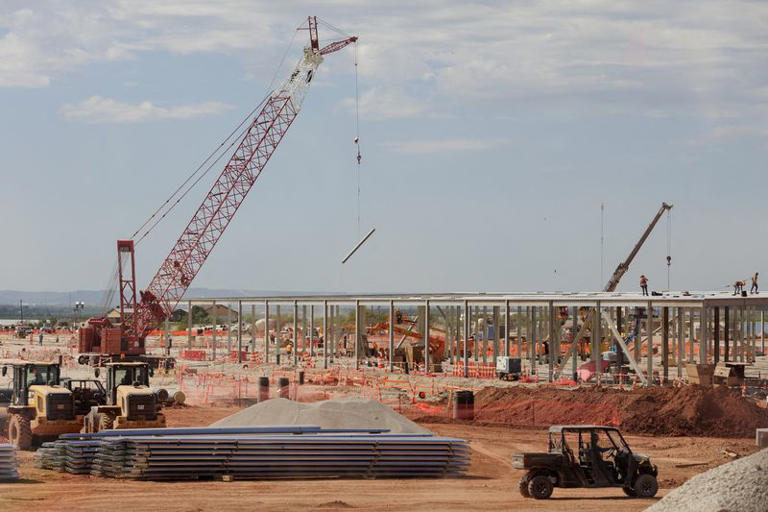
FILE PHOTO: The steel frame of data centers under construction during a tour of the OpenAI data center in Abilene, Texas, U.S., September 23, 2025. REUTERS/Shelby Tauber/Pool/File Photo© Thomson Reuters

Sept 1 (Reuters) - Data centers have requested roughly as much electricity across the middle swath of the United States as it takes to power every home in the country, but much of that demand may be an illusion.

In an attempt to find out what is real, Texas recently became the first major data center hub to freeze new grid connections for the facilities and investigate their plans. Other U.S. states are taking similar steps to fix the intensifying problem that is vexing regulators and politicians nationwide.  

A Reuters review of utility and grid data found that electricity requests from very large power users, mostly data centers, exceed 700 gigawatts — or more than 10 times industry estimates of current U.S. data center power use — across portions of the Midwest, Mid-Atlantic and the South.

Consumer advocates and regulators have cautioned that many requests are likely to be duplicative, or made by companies without the funds or expertise to see the projects through, threatening to stymie grid planning that is crucial to keeping the lights on.

Some of those warnings are now being validated, with major utilities cutting their data center demand figures once financial guardrails, like requiring upfront payments, are put in place.

The uncertainty is leading data center hot spots like Texas, Pennsylvania and Ohio to enact rules to filter out projects that could drive up prices and provoke political backlash without ever even getting built. 

"When you don't know what is real, you really don't know how to build the infrastructure for it," Texas Public Utility Commission Chairman Thomas Gleeson said at an industry conference in March.

GHOST DEMAND

As Big Tech's planned AI data center spending tops $700 billion this year, companies and landowners with access to power or grid connections have rushed to cash in on the boom by securing electricity supplies needed to run those facilities. 

Since 2023, requests from data centers and other large energy users to connect to the Texas grid have soared from about 48 gigawatts to more than 474 gigawatts, according to documents from grid operator ERCOT and Governor Greg Abbott, making it the fastest-growing region for AI and cloud server warehouses in the world by some measures.

Outside of Texas, data center electricity demand requests in 10 of the biggest U.S. utilities in the Midwest, Mid-Atlantic and U.S. South, including AEP Ohio, Southern Co and PPL, have reached about 270 gigawatts, according to a review of the latest utility quarterly earnings calls with investors. 

There is no set standard for how utilities report requests for electricity from data centers, with some disclosing only projects that have signed contracts and others tallying up inquiries from projects without firm commitments.

When states and utilities have taken a closer look at data center electricity projects, however, and enacted requirements like large upfront deposits, chunks of that demand can fall away.  

"The entities that rushed into the space, because there was a sort of pot of gold, are maybe now learning the hard way just how difficult some of this is to actually construct and bring online," said Daniel Farris, an attorney at Foley & Lardner, who advises data center developers and hyperscalers. The latter refers to companies such as Amazon, Alphabet's Google and Microsoft, which operate massive data center networks.

Chicago-based Exelon cut its tally of high-probability data center demand by about 40% to 11 gigawatts, it said in an investor presentation on July 30, after the company began imposing stricter collateral requirements. 

In Ohio, electric utility AEP Ohio's data center power demand pipeline dropped by more than half following state rules adopted last year that included grid connection study fees for data centers of up to $100,000. 

The uncertainty around data center electricity use, said Tyson Slocum, director of the Energy Program at consumer advocacy group Public Citizen, raises the risk that utilities either under-build and threaten the stability of the grid, or overbuild to serve projects that never materialize, leaving average Americans footing the bill.

"I think part of what (Texas) is trying to do is to create some order, and impose some transparency, on an industry that in much of the country is still like the Wild West," Slocum said.

Electricity requests from proposed data centers have already increased costs in PJM Interconnection, the nation's largest grid covering 13 states, including Data Center Alley in Virginia. Growth in existing and forecast data center demand drove a $29.4 billion increase in capacity costs for homes and businesses in the PJM footprint over roughly the past four auctions that determine those prices, according to grid monitor Monitoring Analytics.   

Even after utilities dramatically reduce demand forecasts, however, they are still left with enough substantiated data center requests to overwhelm grids running short on supplies.

"The reality is that the load is showing up, and generation is not at the pace we need it to," said PJM spokesman Jeff Shields. 

AUDITING THE UNKNOWN

In Texas, the cornerstone of Abbott's order is a comprehensive audit, requiring that proposals to power up data centers reveal who ultimately owns the centers, instead of earlier rules that allowed only an affiliate company to be disclosed.

The state Public Utility Commission, chaired by Gleeson, and grid operator ERCOT will be in charge of implementing the directive, which also asks for details about whether data center projects rely on taxpayer-funded incentives, water use and on-site power generation plans.

"The PUCT and ERCOT cannot make decisions to guarantee grid stability and reliability based on substantially incomplete information," Abbott said in an update on his order. 

Pennsylvania Governor Josh Shapiro, whose state's abundant electricity supplies and natural gas have drawn a flurry of data center interest, has since made a similar move.

Shapiro signed a data center executive order on August 18 that includes stricter permitting requirements for projects of 25 megawatts or more and greater disclosure of project plans and end users. 

Of the more than 100 data centers proposed in the state, only 20 have applied for permits needed to move the projects forward, a member of the governor's office told Reuters.

Most of the proposals have not secured power sources or a customer that would be critical to funding the server warehouses, the official said.

(Reporting by Laila Kearney in New York; Additional reporting by Kavya Balaraman in Bengaluru; Editing by Liz Hampton and Matthew Lewis)

Conservatives repulsed as Trump warns disobedient towns will become 'backwards and poor'


Alexander Willis
August 31, 2026 
RAW STORY


A fan wearing a MAGA cap checks his mobile phone during the UFC Freedom 250 at the UFC Fan Fest on the Ellipse near the White House in Washington, D.C., U.S., June 14, 2026. REUTERS/Nathan Howard

Conservatives revolted Monday against President Donald Trump’s latest screed against Americans opposing his data center push, with one conservative radio host declaring the president had gone “full techno-fascist.”

Trump lashed out at "communities throughout the U.S.A." Monday for resisting new data center construction, a signature priority he moved to fast-track last year via executive order, telling them they will “end up being backwards and poor” should they continue to resist.

A majority of Americans now hold an unfavorable view of new data center construction, with a recent poll from Embold Research finding that three-quarters of Americans would oppose construction of a new data center in their community. The backlash to data centers has been “uniquely bipartisan,” CNN noted Monday.

And, while a number of Republican politicians have since adjusted their rhetoric on data centers to not create electoral liabilities for themselves, Trump instead doubled down on his support for the emerging technology with a cry to “let Data Reign,” a position that was met with scorn.

“Trump goes full Techno-Fascist screaming ‘LET DATA REIGN’ and embracing data center land grabs. Gross,” wrote Shannon Joy, a prominent conservative radio host, in a social media post on X.

Liz Dickinson, a conservative political operative and former CIA intelligence analyst, described Trump’s pro-data center rant as “more tone deaf, tiresome comments.”

“We who live among data centers oppose them for many reasons,” Dickinson wrote in a social media post on X. “Considering Trump let China buy US farmland, he should tone down feigned concern about its influence. Any candidate supporting these in areas they already exist will lose the midterms.”

Even Trump’s followers on his own social media platform Truth Social seemed to have mixed reactions to his remarks, with Truth Social user “usUltra MAGA Prayer Warrior” telling the president: “I have to disagree with this one.”

Internal GOP polling on Americans’ views on data centers has sent Republicans scrambling. A National Republican Senatorial Committee memo obtained by Axios warned that the topic of data centers had “become a sleeper issue for the entire election cycle.”


Get ready to meet the 'love child' of the dot-com crash and financial crisis, tech guru Erik Gordon says


Story by tmohamed@businessinsider.com (Theron Mohamed)


The end of the AI boom won't be pretty, business professor Erik Gordon says. Osmancan Gurdogan/Anadolu via Getty Images© Osmancan Gurdogan/Anadolu via Getty Images


An AI slump will combine features of the dot-com crash and Great Financial Crisis, Erik Gordon says.

The business professor said the AI boom couples extreme valuations with enormous contagion risk.

Potential "losers" include banks, insurers, and investors in index funds and ETFs, Gordon said.


The AI boom marries dangerous elements of internet mania and the mid-2000s credit bubble, raising the specter of a financial catastrophe, Erik Gordon says.

"The next crash will look like the love child of the dot-com crash and the Great Financial Crisis," the entrepreneurship professor told Business Insider by email.

Gordon, who teaches at the University of Michigan's Ross School of Business, said the AI boom "inherited the hype and overvaluations of the dot-com bubble."

While the nascent technology is likely to create more value than the internet, he said, company valuations are so extreme that "most investors will get killed, just like most of the dot-com investors."

Gordon, who researches topics such as technology commercialization and AI, said the "losers" from an AI crash will extend beyond direct investors to buyers of index funds and exchange-traded funds, given that tech giants make up such a large part of the market.

The five largest US companies by market cap — Nvidia, Apple, Alphabet, Microsoft, and Amazon — are together valued at over $20 trillion, in no small part because investors expect them to be huge winners from the AI trend.

Borrowing binge


Gordon also raised the alarm on the scale of AI companies' debts. They've "racked up a few trillion dollars of debt obligations on and off their balance sheets, and they're not done borrowing," he said.

If they're unable to repay even a portion of their commitments, the "financial damage" will spread beyond stockholders to "burn banks, investment funds, and even insurance companies that made loans," he continued.

"The contagion across financial markets will remind us of the GFC," he added.

The dot-com crash wiped out thousands of startups, and even future world-beaters such as Amazon saw stock-price declines of over 90%.

The collapse of the mid-2000s housing bubble and the ensuing financial crisis saw Lehman Brothers go bankrupt, AIG and Bear Stearns bailed out, and the global economy plunge into recession.

Gordon has been a vocal skeptic of the AI boom for years. He told Business Insider in April that the market had "fabricated its own universe" where AI buzz trumps threats like war or inflation.

He said last summer that the huge amount of money riding on the AI theme meant more investors will suffer than in the dot-com crash, and "their suffering will be more painful."

"This isn't a fake-companies bubble, it's an order-of-magnitude overvaluation bubble," Gordon said in January 2022.

The S&P 500 slumped by around 18% over the next eight months, dipping below 3,600 points in September of that year. But it has more than doubled since then, reaching all-time highs of over 7,800 points this year.

Gordon isn't alone in anticipating that the AI boom will end in tears. Notably, Michael Burry of "The Big Short" fame has been sounding the alarm on AI companies' overinvestments, circular financing, aggressive accounting, and hidden debts.

However, tech leaders such as Nvidia CEO Jensen Huang and Tesla and SpaceX CEO Elon Musk have said valuations are more than justified given AI's potential to supercharge productivity, corporate profits, and economic growth.
Unionized GM workers vote to ratify new agreements with automaker


A Unifor logo is seen as the union enters negotiations with General Motors in Toronto on Monday, Aug. 10, 2026. THE CANADIAN PRESS/Keito Newman© The Canadian Press

The union representing workers at General Motors says its members have voted overwhelmingly in favour of ratifying new contracts with the automaker.

Unifor and GM agreed Aug. 22 on tentative labour contracts for more than 4,600 autoworkers in Ontario, and union members voted on them over the weekend


The union said in a news release Sunday the three-year collective agreements increase wages for full-rate production members to $50.20 an hour and skilled trades workers to $62.71 an hour.

It said members in Oshawa, St. Catharines and Woodstock voted 80.5 per cent in favour, while members in Ingersoll voted 96.5 per cent in support.

Talks between the union and automaker began earlier this month after Unifor reached an agreement with Ford, and the union says its agreements with GM mirror the three-per-cent annual wage increases with Ford.

Unifor National President Lana Payne said the agreements commit more than $1 billion in investments to Canadian GM facilities.

“GM is making these investments in both its highly skilled Canadian workforce and facilities at a crucial time, as our domestic auto industry is under siege by the Trump Administration," Payne said in the union's news release.


Stellantis and Unifor launch contract talks as US trade war drags on (CBC)


Jack Uppal, GM Canada president and managing director, said in a statement that the ratification means the company "reached an outcome that supports our employees, strengthens our manufacturing operations and provides a solid foundation for GM's future in Canada."

Unifor said negotiations with GM took place under challenging circumstances, with production at the CAMI Assembly Plant in Ingersoll idled and the majority of members there on indefinite layoff.

The union said it would continue to push for production to return at CAMI Assembly. It also said GM designated it as the plant of first consideration for Canadian Armed Forces defence work, if that work is awarded to GM.

Uppal said that in Oshawa, an additional $144-million investment will bring next-generation GMC Sierra Heavy-Duty production to the plant, building on a previously announced $343-million investment in next-generation truck production and manufacturing enhancements.

He said at St. Catharines Propulsion, a new $215-million investment establishes the plant as the sole source for a next-generation transmission. Combined with a previously announced $691 million for sixth-generation V8 engine production, he said total investment in St. Catharines exceeded $900 million.

"For our team at CAMI Assembly, we have extended layoff benefits to reflect our continued commitment to support employees while we take the necessary time to assess potential opportunities for the site," Uppal said.

Unifor said other highlights of the deal include the renewal of a cost-of-living allowance, a $10,000 productivity and quality bonus for eligible members, and a $2,000 December bonus for eligible members.

Trevor Longpre, Unifor's General Motors bargaining chairperson, said significant progress was made in "securing good, stable auto jobs and a stronger Canadian footprint."

"But the work to bring production back to CAMI is not over. This agreement gives our Ingersoll members a bridge until we get CAMI workers back on the job,” Longpre said.

This report by The Canadian Press was first published Aug. 30, 2026.

The Canadian Press

Ontario threatened to cut off US critical minerals supply. Sudbury isn’t panicking

Story by Elissa Mendes
 

SUDBURY — With each development in U.S. President Donald Trump's trade war with Canada, many Ontario cities have received news of tariffs on Canadian goods with panic and devastation for their local industries.

A Hamilton official last year warned that tariffs in the steel town could spell "the end of the industry" and thousands of jobs lost.

In Oshawa, autoworkers already mourning the steady decline of the industry feared for their ability to put food on the table.

But even as Ontario Premier Doug Ford has threatened to cut off the flow of critical minerals to the United States in response to the latest round of Trump's tariffs, the province’s mining capital appears unshaken, minimizing trade fears as it doubles down on getting its product to other markets.

Paul Lefebvre, the mayor of Greater Sudbury, said the city is largely sheltered from the trade war compared to other municipalities because nickel and copper — its two key exports — are not subject to tariffs. The city is only feeling indirect effects from some suppliers, he said, so he's not overly worried about the United States.

"They need our nickel to continue," Lefebvre said in an interview. "They would just be hurting themselves."He added, "We're confident that the U.S. will not want to impose tariffs on us."

Critical minerals have become increasingly important to American national security and manufacturing. The Pentagon has sought more secure supplies of minerals used in military aircraft, missiles, munitions and electronics as the U.S. tries to curtail its reliance on China, which dominates the mining and processing of multiple strategically important minerals.

The U.S. only has one operational nickel mine, in Michigan, and the nickel extracted there is processed in Sudbury, the mayor said with a laugh.

Ontario produced the largest share of the 125,364 tonnes of nickel in concentrate dug out from Canadian mines in 2024, according to official figures.

Natural Resources Canada also reported that 98,199 tonnes of unwrought nickel valued at $2.4 billion were exported in 2024. By volume, 43 per cent of these exports went to the United States, followed by 15 per cent to the Netherlands.

The versatile metal known for its strength and ability to withstand extreme temperatures has long been Sudbury's claim to fame. The Big Nickel, a nine-metre tall replica of a Canadian five-cent coin, is one of the best known tourist attractions in the area.


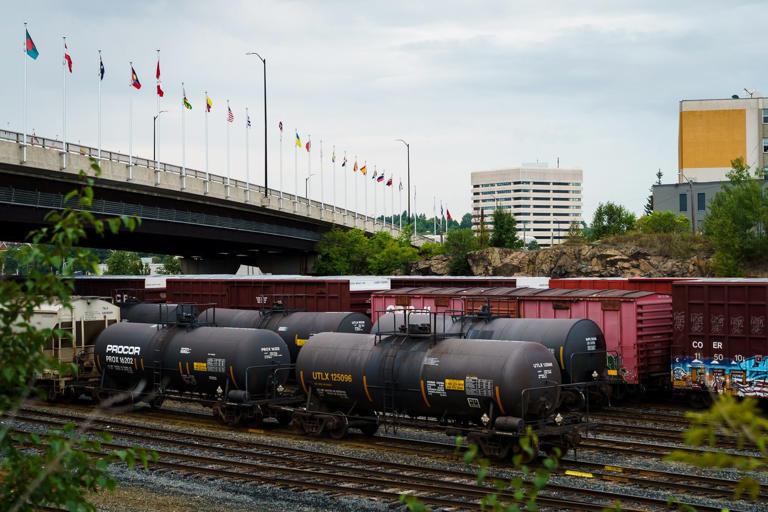
Trains sit on the tracks as Tom Davies Square is seen behind in Sudbury, Ont., on Wednesday, Aug. 26, 2026. THE CANADIAN PRESS/Keito Newman© The Canadian Press

After the United States imposed 50 per cent tariffs on a range of Canadian goods last month, Ford said all forms of retaliation, including cutting off electricity supply to U.S. 

states and shutting down the flow of critical minerals, were on the table should Trump continue to target Canadian industries.

Though Lefebvre said “it’s always concerning” to hear threats about cutting off critical mineral exports to the U.S., he approves of Ford's strategy. The mayor said he supports the premier leveraging critical minerals to rid the country of tariffs, but believes the local economy must be taken into consideration.

“The uncertainty that (Trump) has created in North America has really shied away a lot of investments," he said, such as a Sudbury delegation's trip to Japan and South Korea that was soured by Trump imposing tariffs on the two Asian countries.

The mayor added that Sudbury has not been in any talks with American officials, and he declined an invitation to a conference in the U.S. because of the trade war.

“We don’t have any relationship with them,” Lefebvre said.

Ford did not reference his earlier threat directed at the U.S. when he was in Sudbury last week but rather called the industry a "heartbeat of the north and an engine of our economy."

The premier was touring an expansion at Glencore Canada's Craig Mine, where the existing mine shaft was deepened to gain access to nickel and copper ore. Ford donned an orange hard hat and a high-visibility suit before descending deep into the hot, cavernous mine.

He said the project reinforces the province's position as "a global supplier of high-class nickel the world needs."

"And guess who else needs it?" Ford said. "President Trump needs it desperately."


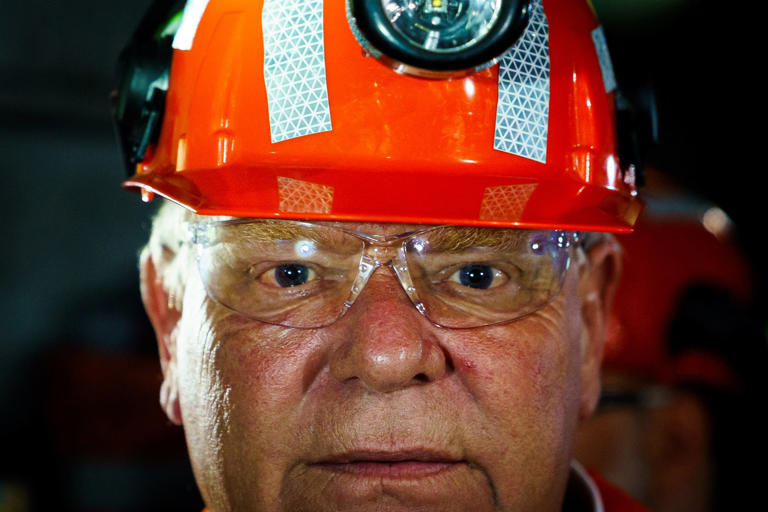
Ontario Premier Doug Ford is pictured as he tours the Glencore Onaping Depth Project in Sudbury, Ont. on Thursday, Aug. 27, 2026. THE CANADIAN PRESS/Keito Newman© The Canadian Press

Despite the rhetoric, Marie Litalien, president of the Greater Sudbury Chamber of Commerce, said "it's business as usual" for the municipality, which is used to weathering economic ups and downs.

Questions about tariff ramifications are hanging over some small- and medium-sized businesses, she said, but the community is focused on attracting investment and strengthening their international relationships.

The politics of Ford's threat to cut the U.S. off from critical minerals is "not really of any consequence to us," she said, adding the government should keep putting funding toward Canadian infrastructure.

Because Sudbury is a global mining centre, "I have no doubt that we're prepared to deal with any short-term and long-term effects in this," she said.

Sadequl Islam, an economics professor at Sudbury's Laurentian University, said there are lessons for flailing Ontario municipalities.

Relying heavily on one industry — such as Sault Ste. Marie's dependence on steel — is risky, Islam said, and other communities could learn from Sudbury's diversification. For example, it's had success boosting its financial services sector on top of its position as a mining powerhouse.

Size also matters in Sudbury's case, he said, as it is the largest municipality in the province by land area, and it could benefit from the mayor's push for a special economic zone designation.

Lefebvre, who is seeking re-election this fall, said his push for the designation is a unique ask, but argued Sudbury contributes more to the province's economy than many other municipalities and deserves infrastructure support.

“We are an economic zone that is very special in our country,” he said. “Nobody else has this around the world.”

David Robinson, a retired professor of resource and environmental economics at Laurentian, also said Sudbury stands to suffer much less than the rest of the country.

Robinson also doubts the U.S. would ever impose tariffs on nickel, pointing out that the metal is necessary for vehicles made by billionaire Elon Musk’s Tesla, and Musk is an on-again-off-again ally of the president. And if tariffs on nickel were to be imposed, much of the effects would be offset by adjustments in international markets, Robinson said, and the U.S. would simply be raising prices for their own manufacturers.

“We can do without American wine and whiskey,” he said, but the U.S. can’t do without the goods that go into production processes, from nickel and uranium to potash and timber.

He, too, believes Ford’s threat to cut off critical minerals was a smart play.

“What happens if you choked all those goods off?” Robinson said. “Suddenly, you’ve got a baseball bat instead of a pencil to fight with.”

This report by The Canadian Press was first published Sept. 2, 2026.

— With files from The Associated Press

Elissa Mendes, The Canadian Press


Brussels will not mediate between US and Canada, EU trade chief says

EU Trade Commissioner Maroš Šefčovič told Euronews the Commission was ready to explore all options to deepen the relationship with Canada.
Copyright AP Photo

By Peggy Corlin & Maria Tadeo
Published on

Maroš Šefčovič said the Commission is ready to explore a wide range of options to deepen cooperation with Ottawa as Canadian Prime Minister Mark Carney calls for a closer partnership with the EU.

In an exclusive interview, European Union Trade Commissioner Maroš Šefčovič told Euronews that the EU is not in a position to mediate in the trade war between Canada and the United States following the collapse of their trade talks.

Ten days ago, Canadian Prime Minister Mark Carney walked away from the negotiations with the Trump administration, blaming them for pressuring Canada over the use of the French language.

In the following days, US President Donald Trump announced 50% US tariffs on Canadian cars and trucks, to which Ottawa retaliated with tariffs on more than 700 US imports, worth about $20 billion (€17.2 billion).

“I don't think that we are in a position to mediate,” Šefčovič said. “At the same time I know that they [Canada and the US] have such a close economic relationship that, despite the current tension, sooner or later there will be attempts to resolve it.”

The Commissioner added that “tariffs are taxes which are paid in the end by the economic operators or by the citizens”, a message he has reiterated several times over the last year during the EU's own trade dispute with Washington.

“We clearly support free and fair trade with the lower or no tariffs at all,” he told Euronews.

Ready to cooperate

Since the trade talks stopped, Carney has called for a closer relationship between Ottawa and Brussels and announced he will attend European Commission President Ursula von der Leyen's State of the Union in Strasbourg in mid-September, one of the main events in Brussels' political calendar.

An EU-Canada summit is also scheduled for later this autumn.

Šefčovič said the Commission is ready to explore “all possibilities” to increase cooperation with Canada, but he added that any new arrangements “would very much also depend on how comfortable the Canadian side would feel and what is its level of ambition”.

He pointed out that after Brussels clinched a trade deal with Ottawa in 2016, trade between the EU and Canada grew by 75% – but he also suggested that the deal could be pushed further.

“On both sides, we have certain elements which we can improve, still certain barriers, certain sensitivities for the products. I really think that we can explore much more that.”

Šefčovič said that a digital agreement might be signed with Canada before the end of the year, and he also cited coming cooperation in critical raw materials with potential joint investments.

Ottawa is seen by Brussels as a like-minded partner sharing its vision of the new global trade order, and Šefčovič hopes to have its backing to get closer to members of the Comprehensive and Progressive Agreement for Trans-Pacific Partnership (CPTPP), which has liberalised trade between 12 countries in the Asia-Pacific region and the Americas, including Canada – but not the US. The UK became the pact's first and to date only European member in 2024, with Canada ratifying its full accession as of 1 September.

“Canadians are very important partners for forging a new level of cooperation with the CTPPP," Šefčovič said, "which represents together 40 percent of global trade.”