It’s possible that I shall make an ass of myself. But in that case one can always get out of it with a little dialectic. I have, of course, so worded my proposition as to be right either way (K.Marx, Letter to F.Engels on the Indian Mutiny)
Thursday, September 03, 2026
Health Aid Cuts in Secret Trump Deals Will Inflict ‘Preventable’ Death, Disease on Global South: Report
“It will be patients who will pay the ultimate price,” said one global health advocate.
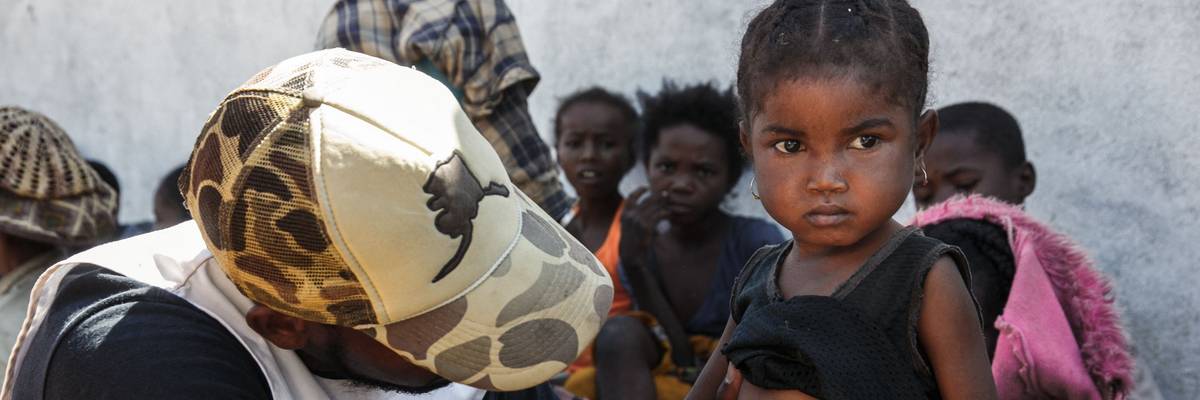
A nurse from Doctors Without Borders (MSF) examines a little girl in the village of Befeno, Madagascar (Photo by RIJASOLO/AFP)
The US Congress has pushed back against President Donald Trump’s efforts to slash foreign aid, which has long been supported by Democrats and Republicans alike—but a new report on more than a dozen Memoranda of Understanding that the White House has reached with countries that have long relied heavily on healthcare assistance shows that the administration is underspending “congressionally appropriated global health funds by potentially billions of dollars,” as it pushes its “America First Global Health Strategy.”
That’s according to Public Citizen, which on Sunday joined Partners In Health in releasing an analysis of documents that the two nonprofits obtained after suing the Trump administration and filing a Freedom of Information Act (FOIA) request.
The groups reviewed the MOUs that have been signed for 18 out of 34 countries whose agreements have been negotiated by the US State Department, including Rwanda, Liberia, Burundi, and Madagascar.
Although Congress has voted to keep foreign aid levels relatively constant—rejecting a budget that called to slash global health spending by $6.2 billion before approving one that proposed a $615 million decrease in spending—the report finds that the MOUs cut foreign health aid by about $2 billion by 2030, compared to 2024 levels.
“These documents suggest that the Trump administration is on course to underspend on global health by billions of dollars compared to what Congress has ordered, risking lives and allowing diseases to spread,” said Peter Maybarduk, director of the Access to Medicines program at Public Citizen. “The administration must answer how and when it intends to invest the missing billions for health.”
Overall, funding for programs that aim to prevent the spread of diseases including HIV/AIDS, tuberculosis, and Ebola—which is currently spreading in the Democratic Republic of Congo’s fastest-spreading outbreak on record—is set to be reduced by 59% from historical spending, according to the MOUs viewed by Public Citizen and Partners in Health.
Some countries would see their health assistance from the US plummet even more, with Rwanda’s MOU stipulating a 97% reduction in US health aid. Liberia is set to receive 84% less funding for health initiatives by 2030, and Burundi is set to lose 78% of its aid.
“Partners In Health provides direct care in Rwanda, Liberia, and Sierra Leone, along with seven other countries, and expects under-spending of these funds to impact patients’ access to care,” said Public Citizen.
The MOUs also demand that the countries meet strict co-financing requirements to make up for their lost funding, and governments in poor countries across Africa could face penalties “which could worsen funding cuts” if they miss the co-financing targets.
“The planned decreases in US funding are larger for several countries than the funding increases from partner governments,” reads the report. “For more than half of countries (11 out of 18), co-financing commitments fall short of the US government’s cuts over five years compared to baseline US government funding.”
Countries are likely to struggle to meet the co-financing requirements in the MOUs, warned Public Citizen and Partners In Health.
Malawi would be required to secure new healthcare funding equal to 56% of the country’s total health expenditure, the report found. With Uganda also facing co-financing requirements from international health organizations including the Global Fund and Gavi, the East African country would be required to mobilize funds equal to 44% of its total health budget.
“These funding cuts will cause death and disease that is preventable,” said Vincent Lin, associate director of health policy and advocacy for Partners In Health. “The State Department is setting up other countries for failure with the co-financing requirements outlined in these agreements, but it will be patients who will pay the ultimate price.”
Maybarduk told The Washington Post that Sierra Leone will be required under its MOU to fill a 71% health funding gap by 2030.
“It’s going to be very difficult, and if a country like that falls behind, and then is punished for that, then of course the health problems compound,” said Maybarduk.
The State Department denied to the Post that the Trump administration will not spend all the foreign health assistance funds appropriated by Congress; it suggested that more of the money than usual may go to religious organizations as well as an “innovation fund” to support US technology that aims to fight disease.
Last week, Public Citizen sued the Trump administration under FOIA to obtain the rest of the MOUs that remain hidden from the public.
The White House, said the group, “has kept the public in the dark about the full details of its plans for the future of US support for global health.”
“The State Department has negotiated these bilateral agreements,” the group said, “on rushed timelines with limited participation from civil society and affected communities.”
On the Heuristics of Fear: The Ecological Catastrophe Scenario
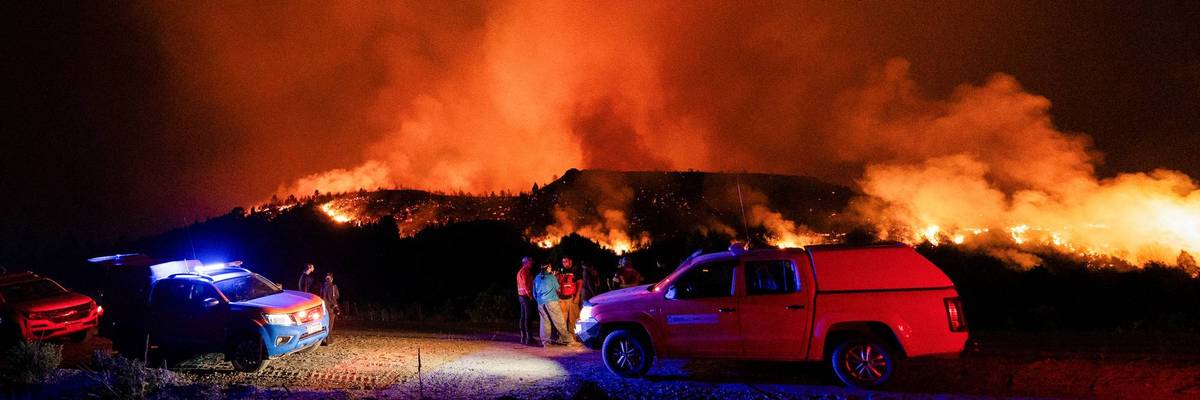
If the right decisions are not made in the coming years and drastic systemic changes are not implemented, the destruction of planetary habitats can no longer be stopped. Volunteers and firefighters work to extinguish a forest fire burning in the mountains of the rural area of Epuyen, in the Patagonian region of Chubut province, Argentina, on February 1, 2026. (Photo by Gonzalo Keogan / AFP via Getty Images)
The escalation of the current crisis-ridden conditions in the areas of climate change, the economy, international security, and the development of democracy—leading to dystopian future scenarios—need not occur in this form. However, there is a real possibility that they could occur if humanity fails to bring about a paradigm shift, makes the wrong decisions, and continues its destructive behavior toward the planet. Learning from the ‘Anticipated Danger’
The construction of negative scenarios in the sense of an anticipated possibility of dystopian development can certainly serve a constructive purpose.
In his book The Imperative of Responsibility, the philosopher Hans Jonas developed what he called a “heuristics of fear,” by which he meant that potential undesirable developments should be recognized in all their severity and menace and described in drastic terms commensurate with their presumed magnitude. According to Jonas (1979/2015, 7), this enables a society to look the potential risks squarely in the eye and thereby resolve to acknowledge its own responsibility for the planet and the fate of future generations: What can serve as a compass? The anticipated danger itself! In its flash of lightning from the future, in the foreshadowing of its planetary scope and its human depth, the ethical principles from which the new duties of new power can be derived first become apparent.
Of course, this negative vision must be compatible with the developments already analyzed; it must not, therefore, be plucked out of thin air, even if not all the information needed for an assessment is yet available. Heuristics is a creative thought process based on estimates, assumptions, and calculations.
Immersing oneself in a likely future situation and sensing the potential of a future catastrophe can provide insights for preventive action. It is possible that the fear of a catastrophic planetary scenario could lead to a systemic shift in course and to responsible decisions.
The Inadequacy of the Paris Climate Agreements
From the spectrum of multiple crises—which are certainly interconnected—this article will focus on the disrupted relationship between humanity and nature and heuristically develop it into a negative scenario.
David Spratt and Ian Dunlop (2019, 6) predict that even if the 2015 Paris Climate Agreements were fully implemented, stable climate conditions would still not be expected. In particular, climatic feedback effects would render the Earth largely uninhabitable for human civilization by the end of the century. Even if the Paris climate targets were met, a warming of 5°C would be expected by the year 2100, with devastating consequences for life on Earth.
It must also be taken into account that not all countries have accepted the Paris Agreements or, in some cases—such as the U.S. under Trump—have since withdrawn from them.
Fires, Storms, Overheating, and Floods
A worst-case scenario for such an increasingly hot biosphere must anticipate a rise in wildfires. Vast areas of the Earth will begin to burn. Fire walls driven by massive gusts of wind will devour everything in their path: trees and bushes, houses, animals, and people. Such firestorms are beyond human control and cannot be fought; they depend on heavy rainfall, and it is unclear whether such rain will fall in the burning regions at all due to climate shifts. The result will be the desolation of entire regions, leading to humanitarian, ecological, and financial problems on a global scale. The fires of 2025 and 2026 are already offering a glimpse of what lies ahead for humanity.
Future average temperatures in the Persian Gulf are projected to reach 50-60°C, meaning that for the average person, human life here will no longer be possible—or will only be possible in artificially cooled spaces. Even in the countries of the Global North, mass mortality is beginning due to overheated living environments. Initially, this will affect older people and those who are already ill, and will then spread to people who would otherwise be considered healthy. Circulatory shock, overheating, and dehydration will then also affect younger people.
It is undisputed that sea levels will rise due to the melting of the poles, the warming of seawater, and the accompanying melting of Arctic ice.
However, a potential average rise of 2.5 meters by 2100 does not represent the extreme level of sea-level rise. During storm surges in particular, the rise in sea level can be several times this value and lead to flooding deep into continental areas. This will also affect the Global North.
Islands, coastal regions, and low-lying inland areas will be flooded, destroying living conditions there and, in turn, triggering migration. Not only will island groups disappear, but large parts of countries such as Bangladesh and India will also be flooded, triggering mass exoduses. In this context, the rise in sea level, combined with the monsoon rains in this region—which are already becoming increasingly devastating—will have a particularly dangerous effect.
The thawing of Arctic and Siberian permafrost, through the associated release of carbon dioxide and methane, will lead to a massive increase in global warming and abruptly intensify all related processes.
In other parts of the world, climate shifts are causing air masses with extremely different temperatures to collide, resulting in devastating storms such as tornadoes and hurricanes. Houses, cars, animals, and people are swept up into the air and smashed to pieces. Skyscrapers collapse, and the infrastructure—including electricity, water, and gas lines, as well as the internet—is irreparably destroyed. Radioactivity is released from destroyed nuclear power plants; it circulates in the Earth’s atmosphere, falls as rain, and will lead to increased rates of cancer and birth defects in humans and animals.
Catastrophic Impact on Social and Political Development on a Global Scale
Massive migration—in the form of mass exoduses or mass migrations—will be triggered by climate change. Migration to date should be viewed, at best, as the tip of the iceberg in this context, as billions of people will set out as refugees if global warming continues unchecked. It is not difficult to imagine the conflicts—including military confrontations—that will arise from these upheavals in the struggle for ecologically intact regions.
Global warming will lead to massive crop failures and associated famines. The global agricultural food system will collapse. The struggle for food and survival will lead to massive price increases, looting, and military conflicts. The call for a heavy hand, for authoritarian leaders, and for police-state methods will grow louder even in democracies.
Far-right governments will attempt, in the interests of their constituencies, to deny climate change and continue to rely on the exploitation of fossil fuels.
The struggle for drinking water will intensify, on the one hand due to increasing periods of drought and, on the other, due to the growing trend toward profit-driven privatization of water sources. Privatized water sources will be guarded by militarized security forces against raids by groups of thirsty people. In drought-stricken areas, people will die of thirst—especially those who no longer have the financial means to purchase water, a scarce and therefore increasingly expensive commodity.
Spratt and Dunlop (2019, 9) describe the societal consequences of climate change even at the 3°C level. States and societies will be overwhelmed and will face extreme collective stress: The flooding of coastal communities around the world—particularly in the Netherlands, the United States, South Asia, and China—has the potential to call regional and even national identities into question. Armed conflicts between nations over resources such as the Nile and its tributaries are likely, and a nuclear war is possible. The societal consequences range from heightened religious zeal to utter chaos. In this scenario, climate change triggers a lasting change in humanity’s relationship with nature.
Furthermore, if a UN in need of strengthening fails to dissuade unscrupulous governments from the generationally selfish destruction of the rainforest for the purposes of livestock ranching, soybean cultivation, the search for mineral resources, or land speculation, then this, too, will not only destroy the Earth’s lungs but also bring about a drastic climate shift.
Wars raging globally and emissions from explosions and fires exacerbate climate change while simultaneously preventing the affected regions from taking effective measures against this climatic dystopia. The military in active service is becoming the largest institutional global destroyer of the climate.
These are just a few of the developments addressed so far. Threats such as temperature changes and the resulting diversion of the Gulf Stream, the narrowing of the temperature difference between the North Pole and the equator—which leads to a weakening of the jet stream—the release of methane trapped in the seabed, insect die-offs due to the increased use of pesticides in agriculture, the destruction of clean drinking water due to overfertilization of fields, as well as plastic pollution in the oceans and the demise of all life in increasingly larger marine regions are likely to represent additional ecological tipping points that will further exacerbate the massive problems already mentioned.
When Will the “Point of No Return” Be Reached?
The question is when the global situation will reach a point from which there will be no return to ecological balance for many generations to come.
The progression of overpopulation, coupled with unchecked economic growth and rampant consumerism, leads to increased ecological exploitation of the Earth system under the conditions of an increasingly overcrowded planet.
However, it is to be expected that population pressure is not primarily responsible for environmental destruction, but rather, in particular, the irresponsible consumption of resources by the wealthier segment of the world’s population (Roettig 2021).
The “point of no return” is likely to be crossed soon. Once the biosphere’s planetary responses develop an uncontrollable momentum of their own that turns against human civilization and the conditions necessary for all life on Earth, it will be too late—both for prevention and for mitigation.
Over the past 20 years, the planet’s resilience has reached its breaking point; in some areas, it has demonstrably been exceeded.
The Doomsday Clock makes this clear. According to the Doomsday Clock—founded and calculated in 1947 by Albert Einstein, among others—we are already 85 seconds away from the destruction of the planet’s foundations as of February 2026. In 1991, we were still 17 minutes away from destruction.
Eco-Imperialist and Systemic Causes
Violent competition over the use of resources is intensifying as more people’s basic needs—and, in particular, their luxury needs—must be met. Not only the struggle for clean drinking water and food, but also the struggle for lithium, cobalt, uranium, etc., is leading to violent conflicts between different groups of people and regions. German political scientist Hans-Jürgen Burchardt criticizes the fact that the rich industrialized nations are the main contributors to climate change, yet the Global South bears the brunt of its consequences. Thus, following the phase-out of nuclear power, Germany’s energy transition is also made possible by cheap coal imports from Colombia. There, mining takes place in highly environmentally damaging open-pit mines; entire communities are forcibly displaced for this purpose, and human rights violations are commonplace. Even the much-lauded green economy, which relies on electric mobility, would not be possible without the lithium reserves in the Andes. Locally, however, lithium mining robs residents of their livelihoods.
The war in Ukraine, too, must be viewed not only from a geostrategic perspective but also through an eco-imperialist lens, in which Russia and the US are attempting to divide up Ukraine’s natural resource deposits among themselves.
Conclusion: The Need for a Positive Vision of Social Development
The outline presented here of a dystopia of planetary development—based on a negative ecological scenario—should have made it very clear: If the right decisions are not made in the coming years and drastic systemic changes are not implemented, the destruction of planetary habitats can no longer be stopped. If, in addition to a biosphere in decline, further stressors arise—such as potentially runaway generative AI, authoritarian and aggressively acting nation-states at war with one another, and the threat of a nuclear inferno—this will likely spell the end of humanity. No more and no less.
The ecological dystopia outlined here does not have to come to pass. Everything depends on how responsibly and competently the current generation—which is currently active in the global centers of power—will act, and on the corrective influence that civil society resistance can exert in this regard.
Our work is licensed under Creative Commons (CC BY-NC-ND 3.0). Feel free to republish and share widely.
Jewish Artists Condemn Corporate ‘Smear Campaign’ Against Mark Ruffalo for Israel Criticism
“The time is over for spurious charges of antisemitism to be trotted out, this time in the defense of war, oligarchy, and AI domination.”
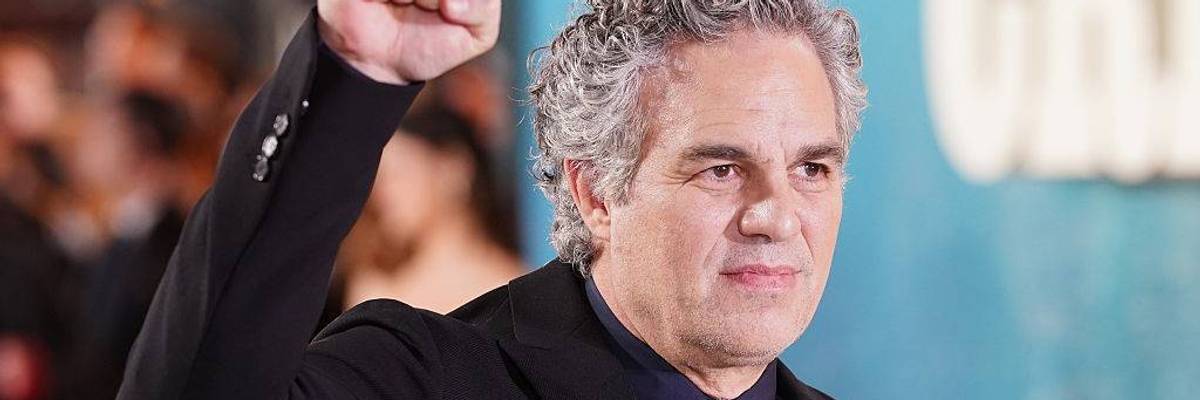
Mark Ruffalo attending the Crime 101 UK gala screening at the Odeon Luxe in Leicester Square, London. Picture date: Wednesday January 28, 2026. (Photo by Ian West/PA Images via Getty Images)
A group of over 170 Jewish figures, including many who work in the entertainment industry, have come to the defense of actor Mark Ruffalo as he faces antisemitismaccusations from executives at Paramount for criticizing the Israeli government and its ties to powerful corporations.
In a letter released Tuesday, prominent Jewish figures—including filmmaker Joel Coen, director and author Miranda July, actress Debra Winger, actress and director Ilana Glazer, actress and comedian Hannah Einbinder, and playwright Tony Kushner—accused Paramount of waging a “smear campaign” to shield corporate interests from legitimate criticism.
“Enough with the false and dangerous weaponization of charges of antisemitism,” the letter states, “against those who are brave enough to point out the obvious: that the assault on the Palestinian people and the assault on our liberties at home are deeply interconnected, and there is nothing antisemitic about recognizing that fact.”
Ruffalo was accused of being an antisemite after he cited the work of Oracle founder Larry Ellison, father of Paramount CEO David Ellison, in helping the Israeli military carry out a years-long assault on Gaza that has left an estimated 73,500 Palestinians dead.
The actor specifically said that Oracle was powering “an apartheid system of oppression” in the Middle East, which he warned could be exported everywhere if “merged into one of the largest media conglomerates in the world,” a reference to the proposed $110 billion megamerger between Paramount and Warner Bros. Discovery.
However, the Jewish figures’ letter points out that there is nothing at all antisemitic about expressing concerns about corporate megamergers that could fuse the power of mass media with the power of a technology giant.
In particular, the letter says that the Paramount-Warner Bros. merger is part of “a larger project of tech-driven domination, a project Larry Ellison and his partners have never been shy about trumpeting—and one they themselves have explicitly linked to their support for the ongoing depredations being visited on the people of Palestine and their silencing of critics of those horrors.”
The letter also slams Ellison for trying to create an “Orwellian world” as he “consolidates control over what we watch and how we watch it, knowing that as we watch he and his corrupt cohort will always be watching us.”
“The time is over for spurious charges of antisemitism to be trotted out, this time in the defense of war, oligarchy, and [artificial intellignece] domination,” the letter concludes. “That tired playbook has run its course. We stand proudly with Mark Ruffalo, and with all decent people who are bravely rising and speaking truth to power.”
‘At a Breaking Point’: Survey Shows U.S. Teachers Working Second Jobs, Spending Hundreds on Supplies
“They are battling education funding cuts, out-of-control Immigration and Customs Enforcement agents, limitations on what they can say, much less teach, and an affordability crisis,” said one union leader.
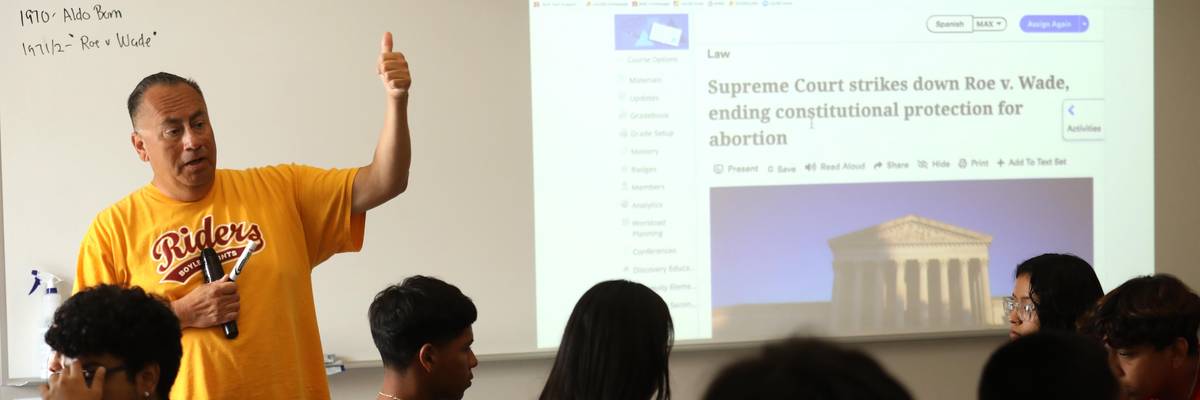
Roosevelt High School 12th grade government teacher Aldo Parral uses the News Literacy Project’s materials to teach his students about how to read the news in Los Angeles, California on September 15, 2022. (Photo by Genaro Molina / Los Angeles Times via Getty Images)
As the academic year kicks off, survey results released Wednesday by the second-largest teachers union in the United States show how educators are struggling because of underinvestment in schools and high prices under a Republican-controlled White House and Congress.
In the lead-up to classes resuming, Grow Progress last month surveyed 2,112 American Federation of Teachers (AFT) members who teach kindergarten through 12th grade about spending, stress, President Donald Trump’s policies, and more.
The pollsters found that a majority of respondents anticipate spending at least $100 to $600 on supplies for their classrooms without being reimbursed. Over a quarter said that school funding issues shift costs to teachers, and supply prices keep rising.
While 61% said they are buying basic supplies, that’s not all that teachers are shopping for this year. Nearly a third are spending on food, hygiene, and student care items, and around a quarter are purchasing specialized tools and accessibility supports as well as items for classroom setup, organization, and decor. Roughly a fifth are buying books and rewards for students.
Half of the teachers surveyed said they anticipate needing to buy food for their students at some point during this school year.
Over three-quarters of them reported seeing negative impacts of the Trump administration’s policies in their schools and communities, with 61% selecting “very negative.” They pointed to funding cuts and privatization of schooling, immigrationenforcement that “traumatizes students and families,” rising costs, vulnerable students losing support and protection, political pressure that restricts teaching and inclusion, and issues with bigotry and hostility.
Gasoline prices have stayed at record highs lately thanks to Trump’s illegal war on Iran, which has responded by restricting traffic through the Strait of Hormuz, a key trade route. Just 15% of teachers said their commute will cost about the same this year, compared with 36% who expect it to be “a little more” and 47% worried it will be “much more.”
A plurality—48%—blamed Trump and Republicans specifically for “the rising costs of groceries, gas, and other goods,” while 28% pointed to government policies and leadership, 18% said tariffs and global instability, and 11% cited corporate greed and profiteering.
Asked to rank their stress level on a 1-10 scale, with 10 being extremely stressed, 62% selected somewhere in the 7-10 range.
Almost a third of teachers said they were somewhat or very likely to leave the profession in the next year. While over half of all respondents said they can’t afford to lose their salary, pension, and benefits, and a quarter pointed to their love for teaching and students, nearly a fifth said the stress and workload make the job unsustainable.
“Teachers are at a breaking point,” said AFT president Randi Weingarten said in a statement. “Many work more than one job to make ends meet, and they still dig into their pockets each year for basic classroom supplies, from books to art materials and even food for their students.”
“They are battling education funding cuts, out-of-control Immigration and Customs Enforcement agents, limitations on what they can say, much less teach, and an affordability crisis that’s making it even harder for working families to get by, let alone get ahead,” she emphasized. “No wonder they’re stressed and talking about leaving the profession. All of this is taking its toll.”
The survey results followed a report released late last month by the Center for Economic and Policy Research and the Economic Policy Institute that suggests leaving the field could lead to a pay boost. Sylvia Allegretto, a senior economist at CEPR and research associate at EPI, found that “in 2025, the teacher pay penalty stood at an estimated 25.2%—meaning teachers earned about a quarter less than comparable college graduates in other professions.”
“Inflation-adjusted weekly wages for public school teachers fell 6.2% over the last three decades, while wages for other college graduates rose 28.8% over the same period,” according to the report. “Teachers typically receive better benefits packages than other professionals, but after accounting for the difference in benefits, teachers’ total compensation penalty was 14.5% in 2025.”
Allegretto said in a statement that “the decades-long teacher pay penalty has taken a heavy toll on public education. Yet, policymakers have failed to make the needed investments to reverse course. That failure is especially troubling in a country as wealthy as the United States, with more than enough resources for its public schools to be the envy of the world.”
It’s not just teachers who are contending with soaring costs as school resumes; parents and students are also facing high prices for academic supplies and other essentials, including food, fuel, healthcare, and housing, due to the Iran War, Trump’s tariffs, and GOPcuts to key programs.
With the midterm elections just two months away, Senate Democrats on Wednesday released a roundup of recent reporting on how families are struggling with back-to-school season, and said that “as Trump continues to claim affordability is a ‘hoax’ and a ‘con job,’ Americans are feeling the strain of Trump’s policies on their pocketbooks.”
“Headlines from across the country this summer lay bare Trump’s cost-of-living crisis as families get ready to send their kids back to school,” Senate Democrats stressed. “Parents are worried about the cost of school supplies and their kids’ lunches, gas prices are at an all-time high for August, and families’ vacations had to be cut short as rising inflation and the cost of airfare hit wallets.”
“Trump’s attempts to pass the buck belie Americans’ reality: His illegal war in Iran, his tariffs, and the rest of Republicans’ failed economic policies have made life unaffordable for families nationwide,” they added. “Because of President Trump and Republicans’ broken promises, working families across the country are now paying more but getting less—and they’re fed up.”
100+ Civil Society Groups Condemn Trump Attack on Democratic Establishment Think Tank
“We stand with the Center for American Progress, not in agreement with every view they hold, but in steadfast support for their rights to voice those views freely and without political retribution.”
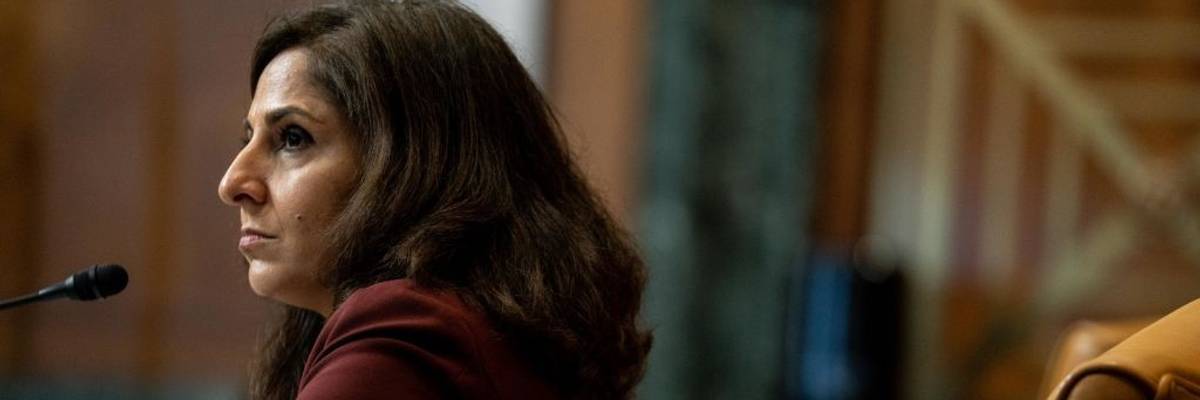
Neera Tanden, nominee for director of the Office of Management and Budget, testifies at her confirmation hearing before the Senate Budget Committee on February 10, 2021 in Washington, DC. Tanden helped found the Center for American Progress. (Photo by Anna Moneymaker-Pool/Getty Images)
A diverse coalition of around 150 organizations on Tuesday collectively spoke out against US President Donald Trump’s recent attack on the Center for American Progress, a liberal think tank with ties to the Democratic Party establishment.
The Republican president, through one of his lawyers, threatened to sue the center last month over its July report concluding that there was no evidence his deployment of the National Guard in Washington, DC did anything to reduce violent crime.
“Since our nation’s founding, the rights to free speech, association, and the press have been the bedrock on which American democracy has thrived,” begins the coalition’s statement, spearheaded by Nonprofits Together. “We reaffirm, as has each generation before us, our unqualified commitment to the First Amendment and its foundational protections.”
“In so doing, we stand in strong solidarity with the Center for American Progress (CAP), a nonpartisan think tank, and its right to publish expert analysis on the impact of the Trump administration’s—or any administration’s—policies,” it continues. “The free exchange of ideas—including ideas that are inconvenient to those in power—is critical for Americans to understand the nature and impact of the actions of their government.”
Trump’s legal attack on CAP is just “the latest salvo in the administration’s ongoing efforts to suppress the speech of organizations that challenge their policies, defend the rule of law, and protect civil rights and vulnerable communities,” the coalition noted.
Stressing that there are often disagreements “even within think tanks,” the coalition warned Tuesday that attempting to silence sources of information “degrades our free exchange of ideas, and risks leaving only distortions in the public square.”
“This is infinitely more damaging to our democratic ideals when done for purely political purposes,” the groups argued. “There are few issues more fundamental to the First Amendment than the right of an independent organization to publish evidence-based analysis of a government policy and how it is or is not working.”
“This is not about ideology or partisanship,” the organizations continued. “This is true regardless of who is in power, and who is issuing public critiques of that power. We stand with the Center for American Progress, not in agreement with every view they hold, but in steadfast support for their rights to voice those views freely and without political retribution.”
CAP was founded in 2003 by John Podesta, who has served in various roles under former Democratic Presidents Bill Clinton, Barack Obama, and Joe Biden. The center’s current president, Neera Tanden, has also worked for key party leaders. In response to Trump’s threat last month, she emphasized that the think tank “is an independent, nonpartisan research organization, and our work is grounded in rigorous, evidence-based research and analysis.”
Blasting the threatened lawsuit as “baseless” and “a transparent attempt to silence us,” Tanden pledged that “we will neither cower nor bend in the face of it.”
“In America, profound disagreements over public policy are resolved through robust public debate, not through threats or intimidation,” she added. “Independent data, evidence, and analysis are essential to that debate. Efforts to silence independent research because its findings are unwelcome by an administration or president should alarm every American.”
The Twin Tragedies of the Donald J. Trump Institute of Peace A year ago, the Trump administration abruptly terminated 40 years of conflict resolution work by the US Institute of Peace and confiscated its building. Renamed the “Donald J. Trump Institute of Peace,” it became the home for his nascent Board of Peace, which appears to be floundering in its attempts to bring peace to Gaza.
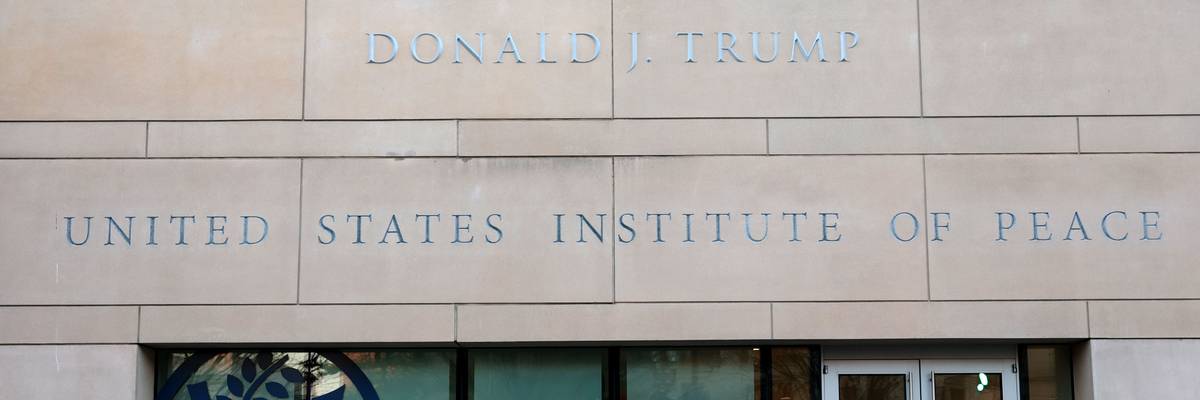
US President Donald Trump’s name is seen recently placed on the outside of the United States Institute of Peace (USIP) building headquarters on December 3, 2025 in Washington, DC. (Photo by Anna Moneymaker/Getty Images)
Established by Congress in 1984, with legislation signed by Ronald Reagan and funded annually by Congress, the United States Institute of Peace, or USIP, was a well-respected, authoritative, independent, officially nonpartisan, nonprofit organization, until it was eviscerated by President Donald Trump early last year.
Its purpose was to promote conflict prevention and resolution worldwide and to provide analysis, research, and training in diplomacy, mediation, and peace-related activities. In 2011, the Association of Professional Schools of International Affairs wrote that USIP “helped to build the conflict management and resolution field, both as an area of study and as an applied science.”
The lesson from these two tragedies—the demise of the US Institute of Peace and the likely failure of the Board of Peace—is that voters must, in the future, avoid electing someone to a position of great power who doesn’t know what he doesn’t know.
One month after assuming office for the second time, on February 19, Trump signed an executive order calling for the elimination of USIP. The next day, USIP was contacted by a representative from the newly established “Department of Government Efficiency” (DOGE), set up by Trump under Elon Musk—allegedly to reduce government expenditure, but actually to eliminate institutions that Trump and the Heritage Foundation’s Project 2025 didn’t like. In a virtual meeting a few days later, USIP’s president-CEO and lawyer explained to three DOGE representatives that the institute was an “independent, nonprofit corporation outside the executive branch.”
When, on March 8, USIP’s president learned that DOGE had inquired about the status of the organization’s security arrangements, its lawyer contacted DOGE to explain that unauthorized personnel would only be admitted to the building with a valid court-issued warrant.
On March 14, all Biden-appointed members of USIP’s Board of Directors were fired by Trump. Three ex-officio members—Marco Rubio; Pete Hegseth; and Peter Garvin, president of the National Defense University—remained on the board.
The same day, a representative of DOGE and a State Department official arrived at USIP and requested entry, but were denied. That evening, two DOGE members arrived with FBI agents and a directive signed by Rubio, Hegseth, and Garvin to remove the president, naming a new acting president. They were again denied entry, with the USIP lawyer declaring the directive illegal.
The next day, the lawyer learned that two FBI agents had visited the home of USIP’s security vendor to discover how to gain physical entry to its headquarters; it was later reported that they threatened the vendor by warning that, if he didn’t comply, he would lose all government contracts. The lawyer contacted the FBI agents to inform them that all inquiries about USIP should be directed to him. Subsequently, the FBI also contacted USIP’s chief security officer to discuss the institute’s security procedures and threatened that he was the subject of investigation by the Department of Justice into denied entry.
Later that day, the US attorney for the District of Colombia Criminal Division Chief called the USIP lawyer, requesting access to the headquarters by Rubio and Hegseth to inspect records and books. The lawyer said he would provide access with a written request. The US attorney informed him that there was suspicion that USIP was engaging in criminal behavior. He also said that representatives would be sent to USIP headquarters the next day and that they would criminally investigate anyone who obstructed access.
USIP then suspended its security vendor’s contract, and its chief security officer deactivated the vendor’s staff badges and retrieved all physical keys except a master. But the next day, four security vendor employees arrived at USIP HQ and attempted to enter the building. They were ultimately admitted, but informed by the lawyer that they were trespassing. The chief security officer called 911 and reported them as intruders.
Armed Metropolitan Police officers then arrived at the USIP HQ and escorted the chief security officer, the USIP lawyer, and other staff from the building and turned the building over to DOGE.
It was later reported that DOGE’s physical occupation of the building led to thousands of dollars in damage, leaving the facility in disarray and littered with drugs and cockroaches.
The building and USIP’s assets were transferred to the General Services Administration and Office of Management and Budget Director, Russell Vought (who was involved in Project 2025) signed off on the transfer. On December 3, 2025, the State Department had “The Donald J. Trump Institute of Peace” inscribed on the outside of the building. The Formation of Trump’s Board of Peace
The first phase of the plan began before the BOP was formed and involved the initial withdrawal of Israeli troops to agreed-upon deployment lines (although this did not hold and almost daily ceasefire violations ensued). It also involved the return to Israel by Hamas of all living hostages, as well as the remains of those deceased. This was followed by the release by Israel of a large number of Palestinian prisoners, including remains of those deceased. Humanitarian aid was gradually reintroduced by UN agencies and their partners, although needs continue to be extensive and restoration of basic services is far from complete. The Rafah border crossing was also reopened, although sporadically closed again.
On January 15, 2026, Trump announced the formation of a Board of Peace whose charter (drawn up by his administration) named Trump as its chairman for life and gave him extensive unilateral powers over the board. In his usual self-congratulatory style, he wrote on Truth Social, “I can say with certainty that it is the Greatest and Most Prestigious Board ever assembled at any time, any place.” He added that it “would be the most consequential international body in History.”
In the future, the pursuit of international peace and security must be left to the United Nations, which represents the entire world; is backed by the force of international law; and has extensive experience.
Trump invited some 60 countries to join his BOP, including Israel, although no sub-Saharan African country was invited. Israeli Prime Minister Benjamin Netanyahu initially refused because invitations had not been coordinated with him and he disapproved of invitations to Türkiye and Qatar. After further discussion with Trump, Israel agreed to join—along with 27 other countries. More than half of those invited, however, declined, concerned that its new charter was an attempt to establish a “Trump-dominated alternative to the United Nations” and could undermine the role of the UN and other multilateral organizations. Countries that agreed were appointed for a three-year term with those wanting lifetime membership required to contribute $1 billion.
It was also announced that Bulgarian Nikolay Mladenov, the former UN special coordinator for the Middle East Peace Process, would become director-general of the board and high representative for Gaza. As well, General Jasper Jeffers, was appointed commander of the planned International Stabilization Force.
After the signing, Jared Kushner made a presentation of plans for a “New Gaza,“ using AI-generated slides, showing gleaming skyscrapers, deluxe hotels, and luxury villas lining Gaza’s Mediterranean shoreline, ”reserved for coastal tourism.“ Entirely new cities with multistory apartment buildings for Palestinians were also shown, as well as schools and hospitals, with sports facilities and parks breaking up industrial complexes, data centers, and advanced manufacturing facilities, as well as a new airport and port.
Kushner’s presentation was in stark contrast to the current reality of Gaza, where 2 million Palestinians live in tents and bombed-out buildings, amid 90,000 tons of rubble, with vastly insufficient food, water, electricity, fuel, healthcare, and medicine. The plans, which seemed more suited for wealthy tourists than for poor Palestinians, apparently had no Palestinian input and were coordinated with an Israeli real estate billionaire (later invited by Kushner to be on the BOP’s Gaza Executive Committee). They also seemed totally out-of-touch with the current or past crowded demographic situation in Gaza and appeared designed to enrich opportunistic developers.
The first and only meeting of the BOP was held on February 19 at the newly named Donald J. Trump Institute of Peace, designated as the seat of the board. There have been no further meetings—presumably, because Trump has been consumed by his war with Iran which he initiated nine days later.
A National Committee for the Administration of Gaza (NCAG) was also formed of Palestinian technocrats under BOP supervision, led by Dr. Ali Shaath, a civil engineer from Gaza who held senior roles in the Ramallah-based Palestinian Authority. But the NCAG has not been able to enter Gaza, because the ISF meant to disarm Hamas and secure parts of Gaza has not materialized—so it remains in Cairo, unable to exercise any authority in Gaza.
Until now, Israel has refused to agree to the road map, arguing, in contradiction to the road map’s prescription for a phased Israel Defense Forces withdrawal from the parts of Gaza where Hamas disarmament has been completed and verified, that it won’t withdraw its troops at all until Hamas has totally disarmed everywhere.
There is, of course, always the possibility that things will change, if Trump can persuade Netanyahu to comply, or if the upcoming Israeli elections change the situation. But for the moment, things appear deadlocked.
There are also questions about BOP finances. When Marco Rubio recently requested that Congress transfer $50 million to the BOP from the State Department budget for international organizations (from which it has not yet paid its 2026 UN dues), Rep. Jamie Raskin (D-Md), ranking member of the House Committee on the Judiciary, and Rep. Gregory Meeks (D-NY), ranking member of the House Committee on Foreign Affairs, called for Rubio to “answer basic questions about the board’s structure, funding, and oversight, nine months after its creation.“ In a confronting letter that can be read here, they write: We thus have a profusion of questions about this mysterious operation: What is the Board of Peace? Is it a public or private entity? International or domestic? Is it registered as a corporation in the United States or abroad? What kind of corporation is it—for-profit or not-for-profit? Who controls the funds in its J.P. Morgan bank account? In what countries are those accounts located? Who will audit those funds and conduct oversight of the Board? What does President Trump intend to do with this vast slush fund while he is in office—or after he leaves? Can anyone assure Congress that billions of dollars from US taxpayers and foreign governments will not be flowing into the pockets of President Trump, members of his family, corrupt or incompetent contractors or business partners, or political allies and foot soldiers of the President?
The bottom line is that realizing the aspirations of the Comprehensive Plan with BOP oversight is an exceedingly tall order, given the utter devastation of Gaza, its infrastructure, and its people—and the extremely fraught political difficulties of getting Israel and Hamas to adhere to what they have agreed. Implementation of this process has been incremental, slow, and is at a virtual standstill. Although members of the NCAG have begun work in Egypt, they have not been able to deploy to Gaza. Although some funds have been pledged, most have not materialized. The same is true for pledges of ISF troops.
It will be exceedingly difficult for a new organization without full-fledged international support and clout, and without sufficiently experienced staff to know what approaches are most effective in peace building, creating new governance structures, and carrying out disarmament. At the moment, the whole endeavor looks more like a slow-motion train wreck than the effective implementation of a viable peace process.
As Mladenov warned at an August 26 meeting of the Security Council, called to discuss the obstacles—if the ceasefire is allowed to collapse, “There will be no road map to return to, there will be no administration to deploy, and there will be nothing left on the ground to rebuild... It would be a point of no return for everyone.”
The lesson from these two tragedies—the demise of the US Institute of Peace and the likely failure of the Board of Peace—is that voters must, in the future, avoid electing someone to a position of great power who doesn’t know what he doesn’t know and who has the hubris to create his own half-baked, cobbled-together international Board of Peace to try to resolve one of the world’s most intractable conflicts, allegedly in the hope of being awarded a Nobel Peace Prize—just like Barrack Obama.
Trump has even implied that somehow the BOP could replace the UN, saying, “Well, it might.” But what he doesn’t understand is that the legal foundations of the two are totally different. “The Security Council derives its authority from the UN Charter, a treaty ratified by UN Member States that explicitly assigned it primary responsibility for the maintenance of international peace and security. That mandate was conferred collectively by the international community and cannot be replicated.” Also, there is the question of binding authority: “UN Member States are obliged to carry out decisions of the Security Council. The Board of Peace has no comparable mechanism.”
Thus, in the future, the pursuit of international peace and security must be left to the United Nations, which represents the entire world; is backed by the force of international law; and has extensive experience in preventive diplomacy, peacemaking, peacekeeping, and post-conflict peace building.
In the case of Israel, however, the UN has been effectively sidelined, since the Israeli administration, and even much of the Israeli public, harbor a deep antipathy for the UN because of its past condemnation of Israeli behavior, which is nearly always vetoed by the US in the UN Security Council.
This means that the Comprehensive Plan and the BOP are “the only game in town.” Given that winter is on its way and 2 million Palestinians who are already in grave danger will once again be exposed to its ravages, it leaves one hoping against hope, in spite of major concerns about the BOP, that there is some way to salvage the Comprehensive Plan, so that the tremendous suffering by the people of Gaza can finally be lessened.
Our work is licensed under Creative Commons (CC BY-NC-ND 3.0). Feel free to republish and share widely.
Connie Peck Dr. Connie Peck is the founder of the United Nations Institute for Training and Research Programme in Peacemaking and Conflict Prevention—the first training program in negotiation and mediation for senior UN staff and diplomats (now in its 33rd year). She is the author of a number of books and numerous articles and book chapters on conflict resolution and the nuclear threat. Full Bio >
The People’s Arms Embargo
Palestine Action, the direct-action network founded in the UK in 2020 by Huda Ammori and Richard Barnard, is built on a simple theory of change: If governments won’t stop arming Israel, activists will go after the companies that do it for them.
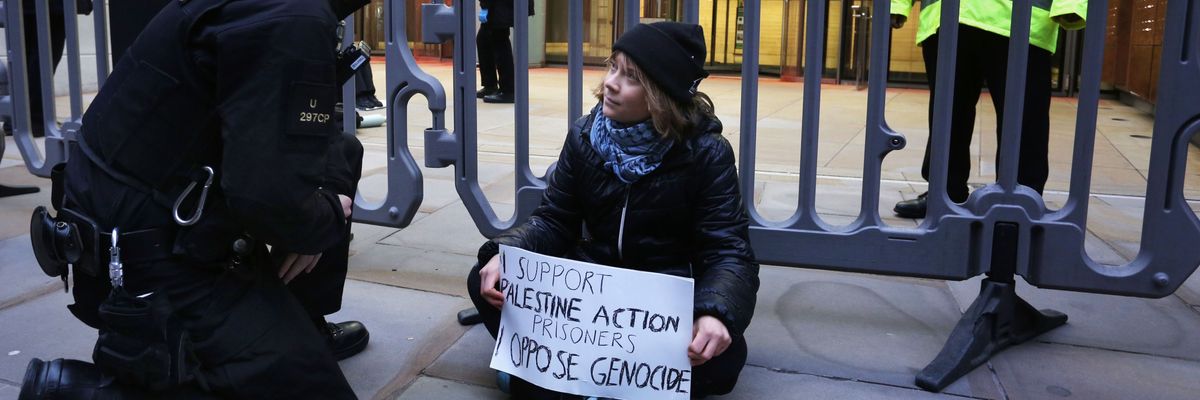
Activist Greta Thunberg joins the protest outside the offices of Aspen Insurance and holds a sign saying, “I support Palestine Action Prisoners I oppose Genocide” on December 23, 2025 in London, England; the activists targeted the company due to its alleged business relationship with the Israeli defense contractor Elbit Systems. (Photo by Martin Pope/Getty Images)
For nearly three years, foreign ministries in Washington, London, and Brussels have debated arms embargoes on Israel in committee rooms, largely without result. Meanwhile, a much less formal network of ordinary people has been trying to accomplish the same goal from the ground up—one factory gate, one shareholder register, and one pension fund at a time.
Palestine Action, the direct-action network founded in the UK in 2020 by Huda Ammori and Richard Barnard, is built on a simple theory of change: If governments won’t stop arming Israel, activists will go after the companies that do it for them. Its central target has been Elbit Systems, Israel’s largest weapons manufacturer, which supplies the bulk of the drones, munitions, and surveillance equipment used in Gaza and the West Bank.
But the network’s real innovation is how it maps the entire supply chain—not just Elbit’s factories, but the banks that hold its shares, the recruiters that staff it, the cleanroom contractors that service its subsidiaries, and the local landlords who rent it space. Every link has become a pressure point.
How the Network Actually Works
Palestine Action isn’t a single organization so much as a constellation. Its hub-and-spoke structure includes a UK core, plus franchises, affiliates, and offshoots that have adopted its name, its tactics, or both. These affiliates include Unity of Fields, formerly Palestine Action US, and sympathetic cells in Canada, France, and Germany.
A war sustained by a transnational arms and finance network, in other words, is being contested by an equally transnational, but far more improvised, citizen network.
Tactics range widely. Some are the kinds of action that make headlines: blockading factory entrances, occupying rooftops, spray-painting military aircraft. Others are quieter and far more replicable by an average person—researching a company’s supply relationships, showing up to a shareholder meeting, filing a public-records request on a pension fund’s holdings, or simply refusing to bank with an institution that finances the war.
This second track has produced some of the most durable wins. In 2026, for instance, Urbana, Illinois became the first Illinois city to bar its pension investments from the top 100 global arms producers; Burbank, California divested from Caterpillar and Honeywell after a local coalition campaign; and the state of Maryland’s pension fund sold off 85% of its Israeli bond holdings—about $62 million—after more than a year of sustained pressure. None of those campaigns required anyone to climb a fence.
None of this has stopped the war. But it has made doing business with Israel’s arms industry measurably more expensive and more reputationally toxic, which is precisely the mechanism that sanctions and embargoes are supposed to achieve when foreign ministries won’t act.
The Safety Question
In July 2025, the UK government proscribed Palestine Action as a terrorist organization under the Terrorism Act 2000, making membership or expressed support punishable by up to 14 years in prison. A High Court panel ruled in February 2026 that the ban was disproportionate and unlawful, noting that only a small fraction of the group’s actions met the legal definition of terrorism, and that ordinary criminal law was already available to prosecute any violence. The government appealed, and in June 2026 the Court of Appeal reversed that ruling and upheld the ban. More than 1,600 people have been arrested in the UK simply for expressing support for the group since the proscription took effect, and four activists convicted only of criminal damage at an Elbit factory were sentenced on the basis of a “terrorist connection.”
That is a genuinely severe legal environment, and it is specific to the UK. Direct action involving property damage or blockades carries real prosecutorial risk anywhere, including the United States, where Unity of Fields and similar groups are not proscribed but individual activists can and do face criminal charges for actions like the 2023 blockade of Elbit’s Cambridge, Massachusetts office.
The boycott, divestment, and shareholder-pressure (BDS) track—writing to a pension board, organizing a bank boycott, supporting BDS-endorsed campaigns—carries none of that risk and remains fully legal free speech and civic organizing in the United States and most of Europe. The two tracks get conflated constantly, including by the UK government itself, but they are not the same thing. This kind of conflation is exactly what makes proscription such a blunt instrument: it criminalizes a banner alongside a blockade.
One Person Still Matters
Much of this network’s actual leverage comes from single, unglamorous decisions. Huda Ammori didn’t wait for a government to act; she and a handful of others started a campaign against one company in 2020 that has since reshaped how a much larger movement thinks about supply chains. The Boycat app, the closest thing the BDS movement has to an official target list, exists because someone decided that consumer choice needed better information, not more slogans. A single city council member willing to bring a divestment resolution to a vote in Urbana did something no protest outside a factory could: moved actual pension dollars.
None of that required anyone to risk a UK terrorism charge. It required deciding that a supply chain is not too complicated, or too far away, to trace and interrupt.
A war sustained by a transnational arms and finance network, in other words, is being contested by an equally transnational, but far more improvised, citizen network. The citizen network’s most effective tool so far hasn’t been confrontation, it’s been documentation. Knowing exactly which bank, which pension fund, which subcontractor is implicated—and saying so publicly and persistently—has moved more money than any single blockade. This tactic is the most likely one to still be legal, and successful, in the near future.
Macela Carmo Dos Santos Macela Carmo dos Santos is a multilingual humanitarian advocate and patient care coordinator based in New York. She holds a degree in foreign trade from Brazil and a BA in psychology from Queens College, CUNY, and previously served as vice president of development at IMPACTability, a youth empowerment NGO. She writes on humanitarian issues at macelasantos.com. Full Bio >
Wednesday, September 02, 2026
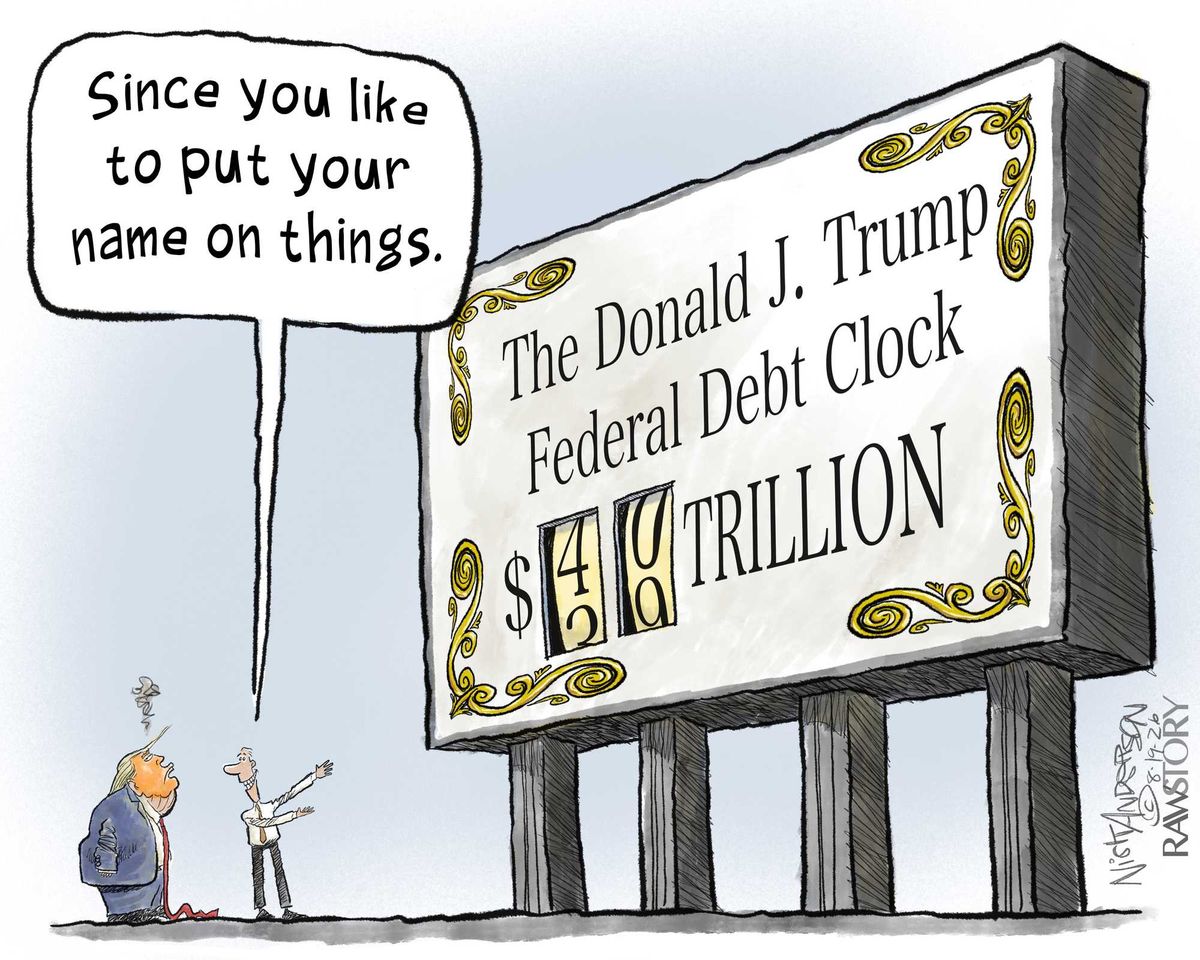
Marveling Trump slaps his name on his latest masterpiece
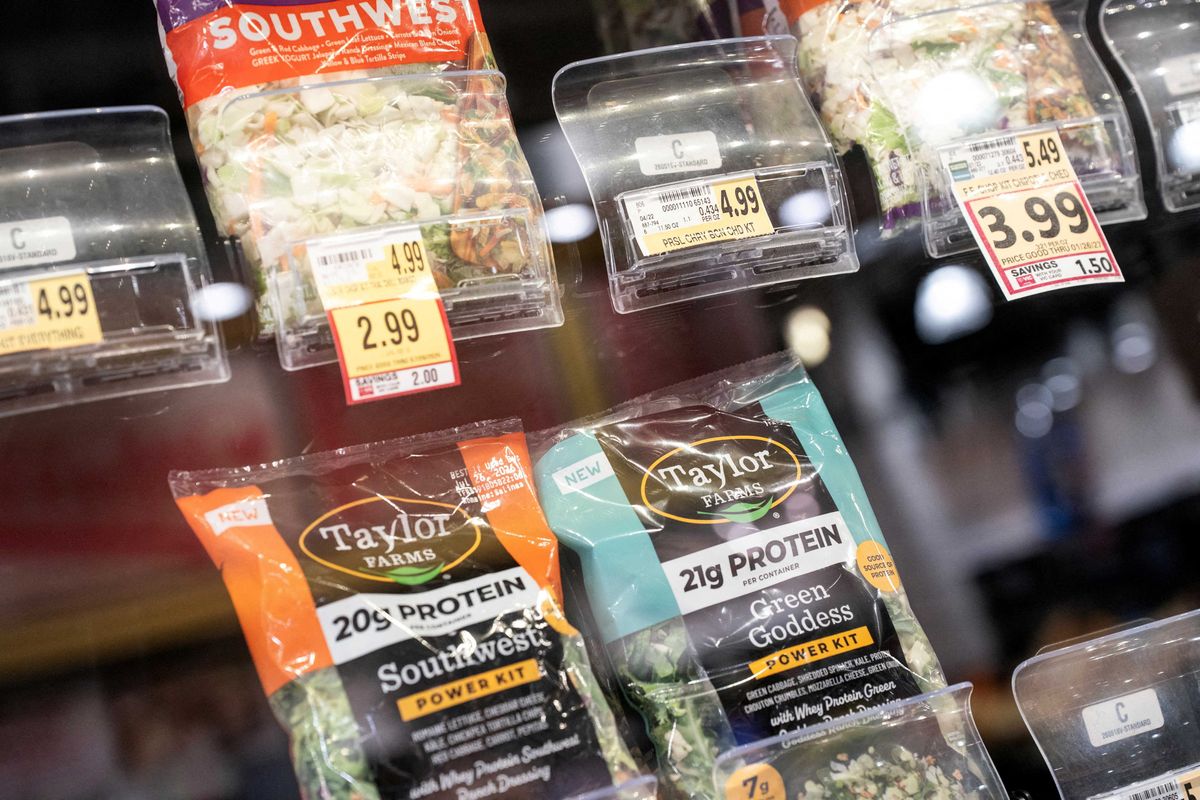
Taylor Farms products are displayed for sale, amid reports of slumping consumer confidence in lettuce and other fresh produce during the current cyclosporiasis outbreak that has sickened thousands across the U.S., at a grocery store in Washington, D.C., U.S., July 24, 2026. REUTERS/Nathan Howard/File Photo
Federal health officials say they are confident that all iceberg lettuce linked to a nationwide cyclospora outbreak has been removed from U.S. markets, even as the case count from the summer-long outbreak continues to rise.
More than 11,000 people have been sickened this summer in an outbreak tied to iceberg lettuce from Taylor Farms of Mexico, CNN medical correspondent Meg Tirrell reported. Nearly 500 have been hospitalized, and two people have died — a rare outcome for cyclospora infections. Both deaths occurred in Michigan, which has emerged as the epicenter of the outbreak.
"It's pretty incredible when you see when you see that spike there in Michigan," said CNN's John Berman, reacting to her reporting. "Yeah, that's just an incredible spike."
The recall was issued July 17, and the lettuce's sell-by dates ran through Aug. 3. The most recent reported illness began Aug. 15, and the Food and Drug Administration says it remains confident that all recalled product has been pulled from shelves. Officials are urging anyone who still has Taylor Farms iceberg lettuce that expired around that date to discard it.
Illnesses in Michigan peaked in early July, before the recall took effect, but new cases continued to be reported into early August. Tirrell noted that cyclospora symptoms can take up to two weeks to appear after exposure, and it can take as long as six weeks for a case to be confirmed and linked back to the outbreak, which helps explain the lag in reported illnesses. The outbreak has now been tied to 20 states, with the Midwest hit hardest.
Food safety experts say the contamination has been isolated specifically to Taylor Farms' shredded iceberg lettuce, and that consumers should not stop eating produce more broadly.
The Trumpadministration is shutting down two of the three U.S. Department of Agriculture research projects dedicated to studying cyclospora after Congress defunded them earlier this year, according to Politico.
The third is being moved from Maryland to Iowa this fall as part of USDA reorganization, but every scientist studying the parasite has declined to relocate, and the upheaval is expected to hamper food safety research as public concerns mount.
'Whoa!' Bottom drops out for Trump as decisive midterm voting bloc flees in droves
The decisive voter bloc in this year's midterm elections has dramatically shifted away from President Donald Trump and the Republican Party on the issue that helped elect him, according to CNN's Harry Enten.
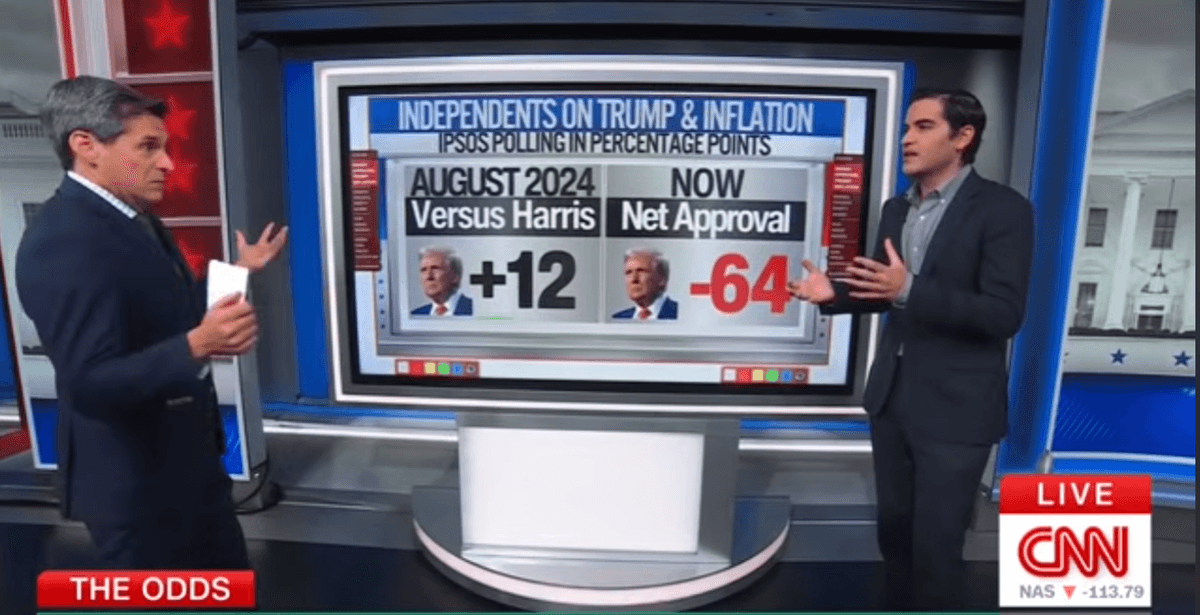
In August 2024, independents trusted Trump over then-Vice President Kamala Harris on inflation by 12 percentage points, a margin Enten described as a key factor in Trump's victory. That advantage has since collapsed, and Trump's net approval rating on inflation among independents now stands at 64 points underwater – marking a swing of 76 points in a little over two years.
"Whoa!" Enten said. "You don't see changes like this. But the key issue that got him elected, now he's way down there in the Gulf of Mexico.
A similar reversal has occurred at the party level. In August 2022, ahead of that year's midterms, independents trusted Republicans over Democrats on inflation by 27 points, a margin that helped the GOP retake the House, but independents now say they trust Democrats more on the issue, by 18 points — a 45-point swing from four years ago.
Enten said such large shifts in voter trust on a single issue are unusual, and noted that the change matters because inflation remains the top concern for independent voters heading into November.
According to the data presented, 38 percent of independents named inflation as their top issue, followed by 14 percent who cited the broader economy and 10 percent who pointed to the conflict with Iran, which Enten said is also closely tied to economic concerns. Combined, more than half of independents identified inflation or the economy as their most pressing issue.
Gas prices, a visible driver of inflation concerns, may not offer Republicans relief before Election Day.
Enten said the combination of persistently high gas prices and the sharp erosion of trust on inflation, the very issue that fueled Republican gains in both the 2022 and 2024 elections, could pose a significant risk for the party in this year's midterm contests, given how central the issue clearly remains to independent voters' concerns.
GOP Senate alarms blare as Trump now in 'serious trouble with farm country'
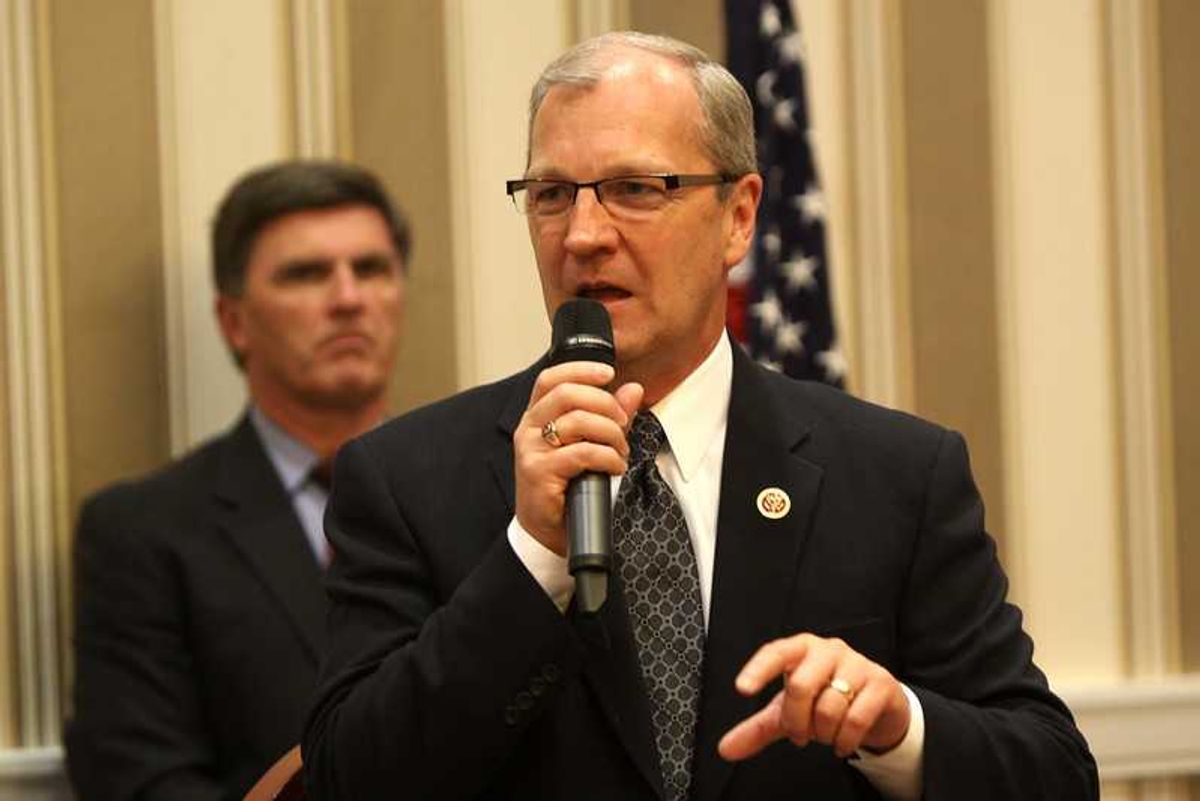
Sen. Kevin Cramer (R-ND). (Photo credit: Gage Skidmore / Flickr)
Republican senators are increasingly convinced the battle for Senate control will be decided in the Midwest, and that agricultural voters angered by tariffs, fuel costs and beef imports could hand Democrats the majority
Democrats need a net gain of four seats to flip the chamber, and strategists say that becomes attainable if they capture Republican-held seats in Ohio and Iowa while holding Michigan, then find a fourth seat in North Carolina or a longer-shot state, reported Politico.
"He's in serious trouble in farm country," Sen. Kevin Cramer (R-ND) said of President Donald Trump. "He being Trump — and Trump is us. I'm not very optimistic."
Farm-state Republicans point to a combination of tariffs, expensive diesel and fertilizer, and administration moves to ease tariffs on imported beef as driving frustration among agricultural voters who have historically backed the party.
Cramer said the beef issue in particular has infuriated producers. "The one ag producer making money for a change and you shrink his revenue," he said.
Democratic candidates say they're hearing similar frustration on the trail. Josh Turek, running for Senate in Iowa against Rep. Ashley Hinson, has described conditions facing farmers as a second farm crisis. Adam Hamilton, a former pastor challenging Sen. Roger Marshall in Kansas, said many Republican voters are reluctant to criticize Trump directly but expect their senators to push back on policies hurting them.
Iowa, which Trump carried three times but which hasn't elected a Democratic senator since 2008, is considered a bellwether for whether the discontent extends beyond reliably blue territory. Republicans are also watching unusually competitive polling in Kansas, Nebraska and parts of the South, along with Maine and Alaska, states with economies tied closely to trade and fuel prices.
Adding to the frustration is the hundreds of millions of dollars sitting in GOP-aligned groups, much of it controlled by Trump, that officials say hasn't been deployed to help endangered incumbents. Republicans have privately complained the president is focused more on personal priorities than defending the party's majorities.
Sen. Susan Collins (R-ME) said she has urged Trump to reconsider his approach toward Canada, a major trading partner for border states. "I would remind him that Canada is our friend, our closest ally and our biggest trading partner," Collins said, adding that damaging that relationship would hurt Maine and other states along the border.
Republican strategists have compared the environment to 2006 and 2018, both rough midterms for the party in power, with uncertainty over which precedent fits this November.